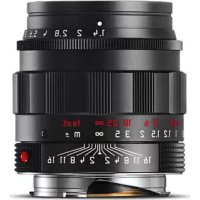
SummiluxM 50 f1.4 ASPH. - Lens LEICA - Free user manual and instructions
Find the device manual for free SummiluxM 50 f1.4 ASPH. LEICA in PDF.



| Product Type | Fast prime lens |
| Brand | Leica |
| Model | Summilux-M 50 mm f/1.4 ASPH. |
| Focal length | 50 mm |
| Maximum aperture | f/1.4 |
| Minimum aperture | f/16 |
| Optical construction | 10 lenses in 7 groups, 1 aspherical surface |
| Minimum focusing distance | 0.7 m |
| Filter diameter | E49 |
| Bayonet | Leica M with 6-bit identification code |
| Dimensions (without lens hood) | approx. 67 mm long, 61 mm diameter |
| Dimensions (with lens hood) | approx. 81 mm long |
| Weight | approx. 447 g |
| Finish | Black anodized |
| Lens hood | Screw-in, supplied |
| Compatibility | All Leica M cameras |
| Lens maintenance | Microfiber cloth, avoid solvents |
| Included accessories | Lens hood, front and rear caps |
| Spare parts | Lens hood ref. 12 468, lens hood cap ref. 14 480, rear cover ref. 14 269 |
| Special feature | Floating element for close focusing |
Frequently Asked Questions - SummiluxM 50 f1.4 ASPH. LEICA
User questions about SummiluxM 50 f1.4 ASPH. LEICA
0 question about this device. Answer the ones you know or ask your own.
Ask a new question about this device
Download the instructions for your Lens in PDF format for free! Find your manual SummiluxM 50 f1.4 ASPH. - LEICA and take your electronic device back in hand. On this page are published all the documents necessary for the use of your device. SummiluxM 50 f1.4 ASPH. by LEICA.
USER MANUAL SummiluxM 50 f1.4 ASPH. LEICA
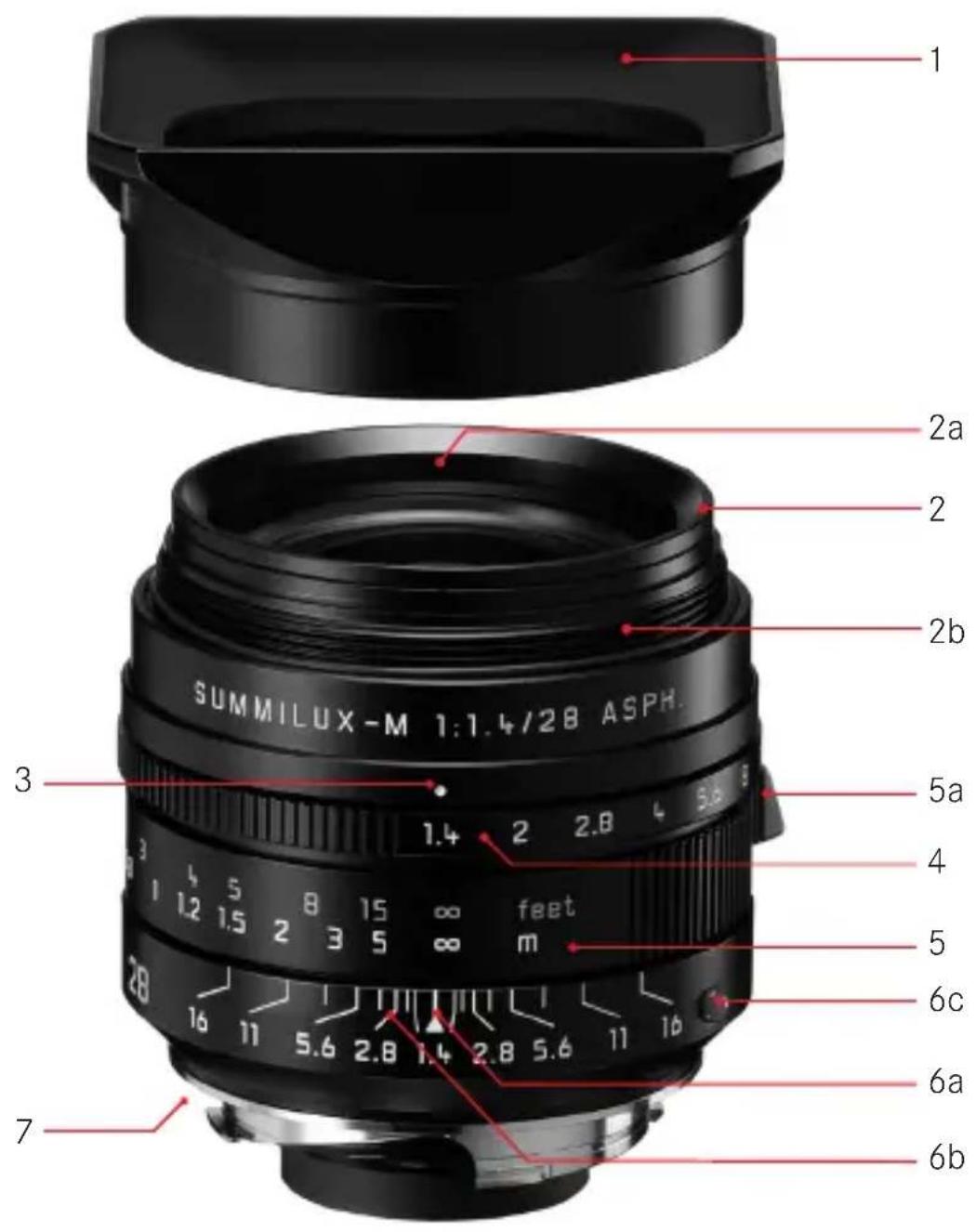
- Lens hood
- Front mount with
a. Female filter thread
b. Male filter thread for lens hood
- Index for mounting the lens hood
- Diaphragm setting ring
- Focusing ring with
a. Finger grip
- Fixed ring with
a. Index for focusing
b. Depth of field scale
c. Red alignment button for lens change
- 6 bit lens identification code
Product Support / Software Support
Am Leitz-Park 5
D-35578 Wetzlar
Tel.: +49(0)6441-2080-111 /-108
Fax: +49(0)6441-2080-490
info@leica-camera.com /
software-support@leica-camera.com
LEICA KUNDENDIENST
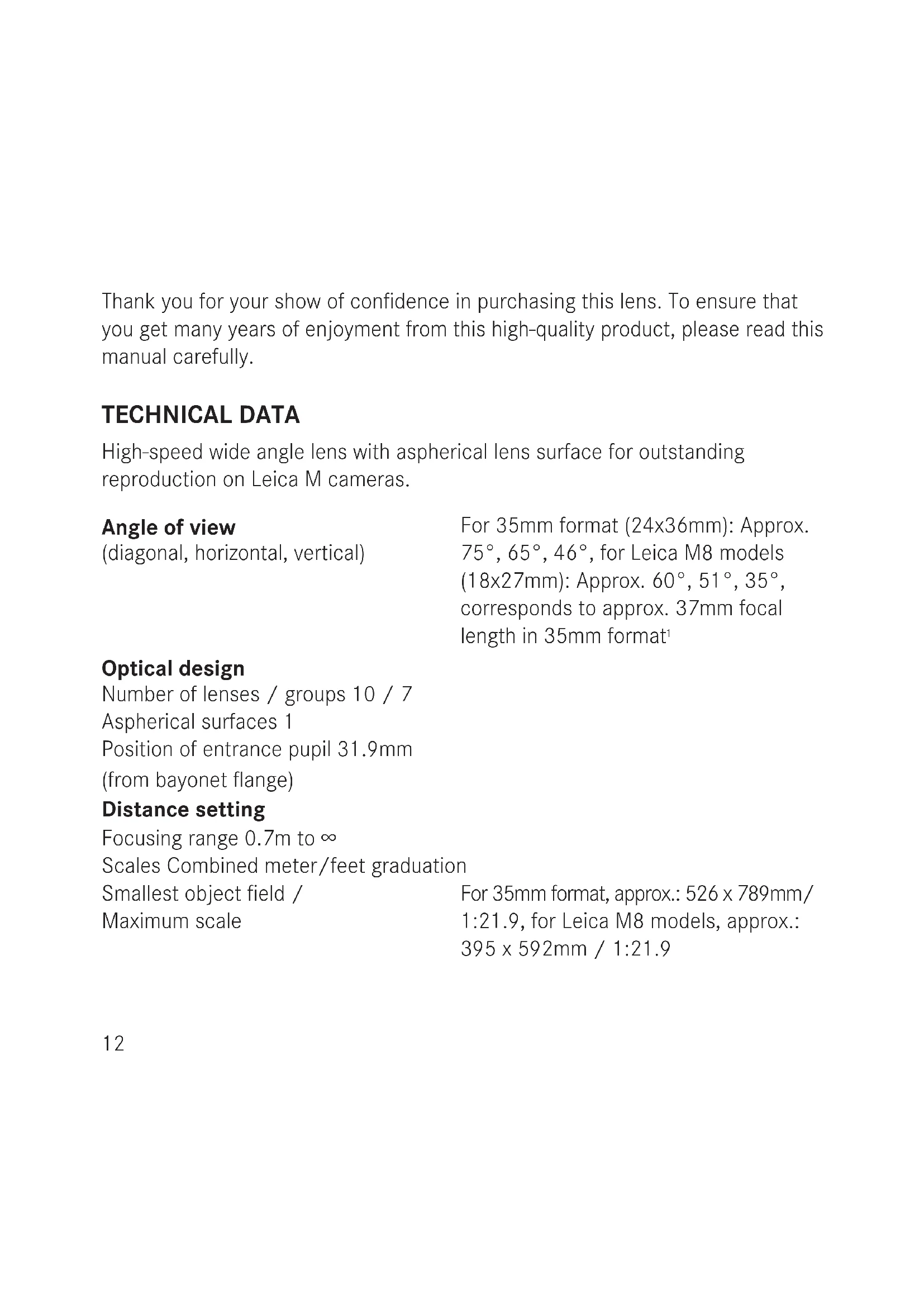
Thank you for your show of confidence in purchasing this lens. To ensure that you get many years of enjoyment from this high-quality product, please read this manual carefully.
TECHNICAL DATA
High-speed wide angle lens with aspherical lens surface for outstanding reproduction on Leica M cameras.
Angle of view
(diagonal, horizontal, vertical)
For 35mm format (24x36mm): Approx. 75°, 65°, 46°, for Leica M8 models (18x27mm): Approx. 60°, 51°, 35°, corresponds to approx. 37mm focal length in 35mm format ^1
Optical design
Number of lenses / groups 10 / 7
Aspherical surfaces 1
Position of entrance pupil 31.9mm
(from bayonet flange)
Distance setting
Focusing range 0.7m to ∞
Scales Combined meter/feet graduation
Smallest object field /
Maximum scale
For 35mm format, approx.: 526 x 789mm/
1:21.9, for Leica M8 models, approx.:
395×592mm/1:21.9
Aperture
Setting / Function Indexed settings, half values available
Lowest value 16
Bayonet fitting
Leica M quick change bayonet with 6 bit barcode lens identification for digital Leica M models ^2
Filter mount / Lens hood Non-rotating, internal thread for E49
screw-in filters, external thread with stop for screw-on lens hood (included)
Viewfinder Camera viewfinder
^3 on Leica M, Leica M-E,
Leica Monochrom, Leica M9, Leica
M8/M 8.2, Leica M7 0.58 / 0.72,
Leica MP 0.58 / 0.72, Leica M6 TTL
0.58 / 0.72, Leica M6 / 0.72 and
Leica M4-P (from no. 2 411 001),
otherwise external viewfinder (available as accessory) ^4
Finish
Black anodized
Dimensions and weight
Length to bayonet mount
approx. 81/67mm
(without/with lens hood)
Largest diameter approx. 61mm
Weight approx. 447g
Compatible cameras
All Leica M cameras ^3,5
The nominal focal lengths of the Leica M lenses are based on the 35mm film format, i.e. an initial format of 24x36mm. However, the sensor on the Leica M8 is slightly smaller at 18x27mm, by a factor of 0.75. Therefore the field angle of these lenses on Leica M8 models always corresponds to that for lenses with focal lengths longer by a factor of 1.33 (1.33 = reciprocal of 0.75). This has no impact on the depth of field, which can be read directly on the lens on the Leica M8 as on all other models.
^2 The 6-bit lens code in the bayonet (7) allows digital Leica M models to identify the attached lens type. The cameras use this information to optimize the exposure and image data.
^3 All Leica M cameras without the 28mm bright line frame, except for those with a 0.85x viewfinder, the M3 and the former Leica MP (professional version of M3) can be fitted with this by Leica Camera AG Customer Care department (see p. 21 or your Warranty Card for addresses) – it then appears in conjunction with the 90mm bright line frame.
^4 See „Accessories“, p. 18
^5 This does not depend on the initial format of the relevant camera – whether this is 18x27mm (sensor size) on Leica M8 models or 24x36 on all other Leica M models.
SPECIAL FEATURES
The Leica Summilux-M 28mm f/1.4 ASPH rounds off the range of high-speed M wide angle focal lengths. It offers excellent image performance over the entire image field even at full aperture and in the close-up range thanks to a „floating element“. With its exceptional contrast, the lens delivers the same recognized
high performance level as the Leica Summilux-M 35mm f/1.4 ASPH, and in some respects actually outperforms it. The vignetting that is typical of every optical system is naturally more defined on a wide angle lens, particularly a high speed one like this, than on standard lenses or those with a long focal length. At full aperture in 35mm format it is a maximum, i.e. in the corners of the image, of around 3.4 stops, around 2 stops on Leica M8 models with their slightly smaller format. Stopping down to 5.6 visibly reduces this light falloff – to 1.8 and 0.8 stops respectively. Stopping down further does not bring about any notable reduction as essentially only the natural vignetting remains.
Distortion is extremely low for a wide angle lens at a maximum of 1.1% (pulvinate), which is rarely noticeable in practice. A total of ten lens elements are used to achieve this exceptional performance. To correct color defects, seven of these are made of glass types with anomalous color dispersion (partial dispersion), while one has an aspherical surface. To maintain performance in the close-up range, one element towards the rear of the optical system is a “floating element” that moves independently of the rest of the mechanism.
Summary: The Leica Summilux-M 28mm f/1.4 ASPH offers maximum image performance with a focal length / speed combination previously unavailable in the M system. This extends the composition options of M photography, particularly for available light shots, but also thanks to a previously unattainable reduction in the depth of field combined with large field angles.
STRUCTURE OF LEICA M LENSES
In principle, all Leica M lenses have the same external structure: they have an aperture setting ring (4), a setting ring for the distance (5) with a finger grip (5a) and a fixed ring (6) with an index for focusing (6a), a depth of field scale (6b) and a red index button for changing the lens (6c).
There is also an external thread (2a) on the front mount of the Leica Summilux-M 28mm f/1.4 ASPH for attaching the lens hood.
The bayonet flange contains a 6-bit barcode lens identification (7), which transmits lens data to the camera body. This is used to adjust the exposure metering system on digital Leica M models and to optimize the image data for the lens type.
FOCUSING
The focus is adjusted by turning the focusing ring (5). The finger grip (5a) enables you to work quickly and comfortably.
DEPTH OF FIELD SCALE
The scale (6b) on the fixed ring (6) shows the depth of field range available for the set distance. This is read off using the corresponding lines labeled with the aperture values.
LENS HOOD
The Leica Summilux-M 28mm f/1.4 ASPH comes complete with a screw-on lens hood (1).
To attach it, screw on the square lens hood as far as it will go (clockwise). The special design of the threads on the lens hood and the lens front mount (2b) – with stop – ensures that the lens hood is correctly aligned. This guarantees that the lens hood does not impair the optical path of the lens or the distance meter, i.e. it prevents vignetting in the image and shadowing in the distance meter measuring field. At the same time, the gap in the top left corner of the lens hood minimizes coverage of the viewfinder image on the Leica M.
When the camera is being carried or used and is ready to shoot, this hood should always remain fitted. It provides effective protection against contrast-reducing stray light and also against damage and soiling of the front lens, e.g. from accidental fingerprints.
Notes:
- The lens hood must always be screwed on as far as it will go.
- The front cover supplied is designed for use with the lens hood attached.
FILTERS
E49 screw-in filters can be used on the Leica Summilux-M 28mm f/1.4 ASPH. A corresponding UVa filter is available from Leica, along with a UV/IR filter specially designed for Leica M8 models.
The universal polarizing filter can also be used. The option of pivoting the filter in front of the viewfinder allows you to control the effect through the camera's viewfinder without making any additional settings.
Accessories Order no.
Leica UVa filter E49 (black) 13 328
Leica UV/IR filter E49 (black)....13 412
Leica universal polarizing filter....13 356
E49 adapter for universal polarizing filter 14 211
Leica M universal wide angle viewfinder (black) 12 011
Spare parts Order no.
Lens hood....12 468
Cover for lens hood....14 480
Rear lens cover 14 269
Soft nappa leather case 439-606.113-000
CARE TIPS FOR YOUR LENS
Dust on the outer lenses should be removed with a soft hair brush or carefully using a clean, dry, soft cloth. Micro fiber cloths (available from specialist retailers) are ideal and can be washed at up to 40^ C. To remove marks or fingerprints, wipe the lens with this cloth starting in the middle and working towards the edge in a circular motion. Special cleaning cloths for glasses should not be used as they are impregnated with chemicals that can damage the types of glass and coatings used.
The bayonet is given an ultra-thin film of grease in the factory to ensure that the lens can be changed easily, gently and smoothly. In normal use, this is retained for many years even if the bayonet is occasionally wiped with a clean cloth. If a substance that dissolves grease is used for cleaning, the grease film must subsequently be replaced. To do this, coat the bayonet with a tiny amount of Vaseline with a finger and spread using a clean cloth.
Important: Make sure that the area around the lens identification (7) in the bayonet fitting is left clear, as otherwise grease residue can accumulate in the recess and collect more dirt. This could impair the legibility of the code and thus restrict camera functions on digital M models.
In addition to the type designation, every lens has its “personal” serial number. Note this number in your documentation for security.
LEICA INFORMATION SERVICE
Should you have any technical questions regarding the use of Leica products, the Leica information service will be happy to answer in writing or by phone, fax, or e-mail:
Leica Camera AG
Product Support / Software Support
Am Leitz-Park 5
D-35578 Wetzlar
Tel.: +49(0)6441-2080-111 /-108
Fax: +49(0)6441-2080-490
info@leica-camera.com /
software-support@leica-camera.com
LEICA CUSTOMER CARE
For service of your Leica equipment and in case of necessary repairs please contact the Customer Care department of Leica Camera AG or of any na-tional Leica agency (see Warranty Card for address list). Ask your authorized dealer and Leica specialist for advice.
Leica Camera AG
Customer Care
Am Leitz-Park 5
D-35578 Wetzlar
Tel.: +49(0)6441-2080-189
Fax: +49(0)6441-2080-339
customer.care@leica-camera.com
(diagonal, horizontal, vertical)
Product Support / Software Support
Am Leitz-Park 5
D-35578 Wetzlar
Tél.: +49(0)6441-2080-111 /-108
Fax: +49(0)6441-2080-490
info@leica-camera.com /software-support@leica-camera.com
SERVICE APRÈS-VENTE LEICA
SCHERPTEDIEPTESCHAAL
Product Support / Software Support
Am Leitz-Park 5
D-35578 Wetzlar
Tel.: +49(0)6441-2080-111 /-108
Fax: +49(0)6441-2080-490
info@leica-camera.com /
software-support@leica-camera.com
LEICA KLANTENSERVICE
Product Support / Software Support
Am Leitz-Park 5
D-35578 Wetzlar
Tel.: +49(0)6441-2080-111 /-108
Fax: +49(0)6441-2080-490
info@leica-camera.com /
software-support@leica-camera.com
SERVIZIO ASSISTENZA CLIENTI LEICA
(diagonal, horizontal, vertical)
Product Support / Software Support
Am Leitz-Park 5
D-35578 Wetzlar
Tel.: +49(0)6441-2080-111 /-108
Fax: +49(0)6441-2080-490
info@leica-camera.com /
software-support@leica-camera.com
SERVICIO POSTVENTA LEICA
Product Support / Software Support
Am Leitz-Park 5
D-35578 Wetzlar
Tel.: +49(0)6441-2080-111 /-108
Fax: +49(0)6441-2080-490
info@leica-camera.com /
software-support@leica-camera.com
ライカカスタマーケア

- LEICA KUNDENDIENST
- TECHNICAL DATA
- Angle of view
- Optical design
- Distance setting
- Aperture
- Bayonet fitting
- Finish
- Dimensions and weight
- SPECIAL FEATURES
- STRUCTURE OF LEICA M LENSES
- FOCUSING
- DEPTH OF FIELD SCALE
- LENS HOOD
- Notes:
- FILTERS
- Accessories Order no.
- Spare parts Order no.
- CARE TIPS FOR YOUR LENS
- LEICA INFORMATION SERVICE
- LEICA CUSTOMER CARE
- SERVICE APRÈS-VENTE LEICA
- SCHERPTEDIEPTESCHAAL
- LEICA KLANTENSERVICE
- SERVIZIO ASSISTENZA CLIENTI LEICA
- SERVICIO POSTVENTA LEICA
- ライカカスタマーケア
Brand : LEICA
Model : SummiluxM 50 f1.4 ASPH.
Category : Lens