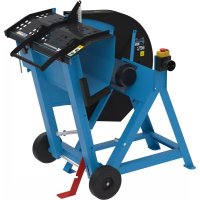
GWS 500 HM2 - Saw Güde - Free user manual and instructions
Find the device manual for free GWS 500 HM2 Güde in PDF.

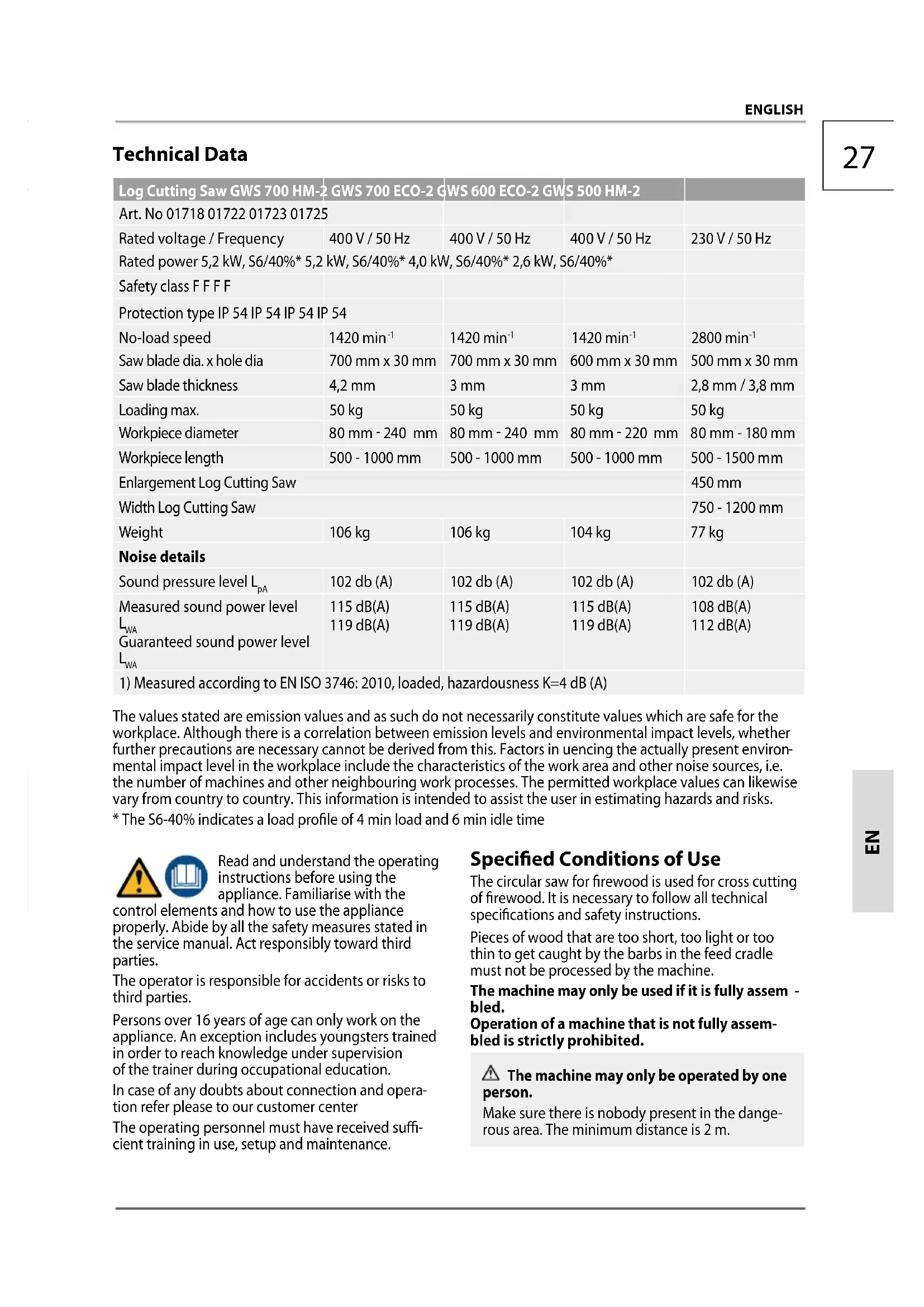


| Product type | Firewood log saw |
| Brand | Güde |
| Model | GWS 500 HM2 |
| Nominal voltage | 400 V / 50 Hz (or 230 V / 50 Hz depending on version) |
| Nominal power | 2.6 kW (S6/40%) |
| No-load speed | 2800 rpm |
| Blade diameter | 500 mm |
| Blade bore | 30 mm |
| Blade thickness | 2.8 / 3.8 mm |
| Weight | 77 kg |
| Saw extension | 450 mm |
| Saw width | 750 – 1200 mm |
| Piece diameter | 80 – 180 mm |
| Piece length | 500 – 1500 mm |
| Maximum load | 50 kg |
| Sound pressure level LpA | 102 dB(A) |
| Guaranteed sound power level LwA | 112 dB(A) |
| Protection class | F |
| Protection type | IP 54 |
| Required electrical protection | Residual current device 30 mA |
| Usage | Outdoor use only |
| Maintenance | Regular cleaning, oiling of moving parts, blade replacement |
| Safety | Blade brake, mandatory hearing protection, goggles, gloves |
| Spare parts | Available at www.guede.com |
Frequently Asked Questions - GWS 500 HM2 Güde
User questions about GWS 500 HM2 Güde
0 question about this device. Answer the ones you know or ask your own.
Ask a new question about this device
Download the instructions for your Saw in PDF format for free! Find your manual GWS 500 HM2 - Güde and take your electronic device back in hand. On this page are published all the documents necessary for the use of your device. GWS 500 HM2 by Güde.
USER MANUAL GWS 500 HM2 Güde
ENGLISH Please read the instructions carefully before starting the machine.
The saw blade runs down for app. 10 seconds. The saw blade must not be braked by side back pressure. The engine makes a grumbling noise when braking and shortly after breaking. The switch must not be pressed (on or off) in any case in this phase. The engine may be started again only after there is no more grumble.
The self-lock nut must be replaced with a new nut not later than after loosening it two times.
The self-lock nut must be replaced with a new nut not later than after loosening it two times.
Open the machine as specified in Changing the saw blade.
Close the machine as specified in Changing the saw blade.
GWS 600 ECO-2 | GWS 700 ECO-2 | GWS 700 HM-2
The values stated are emission values and as such do not necessarily constitute values which are safe for the workplace. Although there is a correlation between emission levels and environmental impact levels, whether further precautions are necessary cannot be derived from this. Factors in uencing the actually present environmental impact level in the workplace include the characteristics of the work area and other noise sources, i.e. the number of machines and other neighbouring work processes. The permitted workplace values can likewise vary from country to country. This information is intended to assist the user in estimating hazards and risks.
- The S6-40% indicates a load profile of 4 min load and 6 min idle time


Read and understand the operating instructions before using the appliance. Familiarise with the
control elements and how to use the appliance properly. Abide by all the safety measures stated in the service manual. Act responsibly toward third parties.
The operator is responsible for accidents or risks to third parties.
Persons over 16 years of age can only work on the appliance. An exception includes youngsters trained in order to reach knowledge under supervision of the trainer during occupational education.
In case of any doubts about connection and operation refer please to our customer center
The operating personnel must have received sufficient training in use, setup and maintenance.
Specified Conditions of Use
The circular saw for firewood is used for cross cutting of firewood. It is necessary to follow all technical specifications and safety instructions.
Pieces of wood that are too short, too light or too thin to get caught by the barbs in the feed cradle must not be processed by the machine.
The machine may only be used if it is fully assembled.
Operation of a machine that is not fully assembled is strictly prohibited.

The machine may only be operated by one son.
Make sure there is nobody present in the dangerous area. The minimum distance is 2m
Residual Risk
Risk of injury!
In spite of compliance with all relevant design regulations, dangers may still present themselves when the machine is operated, e.g.:
- Risk of injury to fingers and hands. Never put your hands in the saw blade area.
- Parts of workpieces and tools fly off from damaged tools. Wear eye protectors.
- Noise emission: It is necessary to wear ear protectors.
- Wood dust emission: Wear a respirator.
Despite the observance of the operating instructions there still may be some hidden residual risks.
Residual risks may be minimised by following the safety instructions and use as designated provisions and the Operating Instructions.
The exposure to dust is influenced by the type of the material processed. It is important to use local exhaust (catching near the source) and adjust well the exhaust covers, guide elements and the grab channels.
Dust produced during work is often harmful and must not get in your body. Use the exhauster and wear an appropriate respirator, too. Remove thoroughly any deposited dust, e.g. by vacuuming.
Use saw blades designed to reduce emitted noise. Keep the machine and saw blade running.
To minimise noise production, the tool must be sharpened and all elements for noise minimisation (covers, etc.) must be properly adjusted.
Emergency procedure
Conduct a first-aid procedure adequate to the injury and summon qualified medical attendance as quickly as possible. Protect the injured person from further harm and calm them down. If you seek help, state the following pieces of information: 1.
Accident site, 2. Accident type, 3. Number of injured persons, 4. Injury type(s)
Mains Connection
Operation is only allowed with a safety switch against stray current (RCD max. stray current of 30mA ).
Before putting into operation, a qualified electrician must check whether electric safety measures required are in place. Any national regulations in this regard must be complied with.
Electric connection to a socket.
It is necessary to make sure the connecting socket was not near water and humidity and the plug was protected against humidity.
Check the voltage. Technical data given on the type label must correspond with electric network voltage. Only use splash proof extension cables approved for
outdoor purposes.
Check the cable and/or socket for damages before the appliance putting into operation. In case damage is let repaired in authorized workshop
To avoid danger, a damaged mains supply pipe must be replaced by the manufacturer. Do not under any circumstances attempt any repair yourself.
Cable connections to be separated by pulling the plug only. Pulling the cable could damage both the cable and plug. As a result, electric safety would no longer be guaranteed.
GWS 500 HM-2
Special connection criteria according to EN 61000-3-11. The machine meets the requirements of EN 61000-3-11 and is subject to special connection criteria. This means that the machine may not be used at any arbitrary connection points.
The machine can cause temporary voltage fluctuations in poor mains supply conditions.
As the user, you must ensure (if necessary, in consultation with your power supply company) that the connection point at which you wish to operate the machine meets the above requirements.
Symbols

CAUTION! WARNING

Caution!
Read the operating instructions to reduce the risk of injury.

Caution!
Unplug the machine before any servicing or repair!

Always wear goggles when using the machine.

Wear ear protectors!

Wear safety shoes with steel reinforcement.

Wear protective gloves

Wear dust mask.

Wear protective clothing

To be used outdoors only.

Keep dry at all times. Never expose tool to rain.

Always keep hands away from the path of the saw blade.

Keep the machine out of reach of children.
Keep distance of persons Observe to keep out of dangerous zone
Warning against thrown-off items

Warning against rotating parts. Never put your hands and feet near the rotating parts.
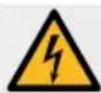
Warning against dangerous voltage
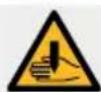
Warning against cutting injuries

Only use tools that meet standard EN 847-1.
Rotation direction
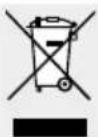
Any damaged or disposed electric or electronic devices must be delivered to appropriate collection centres.

Remove all undesirable items, e.g. nails and wire, before working.

Do not press too much

Strong

Slow

CE marking

Sound power level L_WA

Saw blade

Workpiece diameter


TUV/GS conformity mark

Two persons are required for implementation.
General Power Tool SafetyWarnings

WARNING Read all safety warnings and all
Instructions. Failure to follow the warnings and instructions may result in electric shock, fire and/or serious injury.
Save all warnings and instructions for future reference.
The term "power tool" in the warnings refers to your mains-operated (corded) power tool and battery-operated (cordless) power tool.
1) Work area safety
a) Keep work area clean and well lit. Cluttered or dark areas invite accidents.
b) Do not operate power tools in explosive atmospheres, such as in the presence of flammable liquids, gases or dust. Power tools create sparks which may ignite the dust or fumes.
c) Keep children and bystanders away while operating a power tool. Distractions can cause you to lose control.
2) Electrical safety
a) Power tool plugs must match the outlet. Never modify the plug in any way. Do not use any adapter plugs with earthed (grounded) power tools. Unmodified plugs and matching outlets will reduce risk of electric shock.
b) Avoid body contact with earthed or grounded surfaces, such as pipes, radiators, ranges and refrigerators. There is an increased risk of electric shock if your body is earthed or grounded.
c) Do not expose power tools to rain or wet conditions. Water entering a power tool will increase the risk of electric shock.
d) Do not abuse the cord. Never use the cord for carrying, pulling or unplugging the power tool. Keep cord away from heat, oil, sharp edges or moving parts. Damaged or entangled cords increase the risk of electric shock.
e) When operating a power tool outdoors, use an extension cord suitable for outdoor use. Use of a cord suitable for outdoor use reduces the risk of electric shock.
f) If operating a power tool in a damp location is unavoidable, use a residual current device (RCD) protected supply. Use of an RCD reduces the risk of electric shock.
3) Personal safety
a) Stay alert, watch what you are doing and use common sense when operating a power tool. Do not use a power tool while you are tired or under the influence of drugs, alcohol or medication. A moment of inattention while operating power tools may result in serious personal injury.
b) Use personal protective equipment. Always wear eye protection. Protective equipment such as dust mask, non-skid safety shoes, hard hat, or hearing protection used for appropriate conditions will reduce personal injuries.
c) Prevent unintentional starting. Ensure the switch is in the off-position before connecting to power source and/or battery pack, picking up or carrying the tool. Carrying power tools with your finger on the switch or energising power tools that have the switch on invites accidents.
d) Remove any adjusting key or wrench before turning the power tool on. A wrench or a key left attached to a rotating part of the power tool may result in personal injury.
e) Do not overreach. Keep proper footing and balance at all times. This enables better control of the power tool in unexpected situations.
f) Dress properly. Do not wear loose clothing or jewellery. Keep your hair, clothing and gloves away from moving parts. Loose clothes, jewellery or long hair can be caught in moving parts.
g) If devices are provided for the connection of dust extraction and collection facilities, ensure these are connected and properly used. Use of dust collection can reduce dust-related hazards.
4) Power tool use and care
a) Do not force the power tool. Use the correct power tool for your application. The correct power tool will do the job better and safer at the rate for which it was designed.
b) Do not use the power tool if the switch does not turn it on and off. Any power tool that cannot be controlled with the switch is dangerous and must be repaired.
c) Disconnect the plug from the power source and/or the battery pack from the power tool before making any adjustments, changing accessories, or storing power tools. Such preventive safety measures reduce the risk of starting the power tool accidentally.
d) Store idle power tools out of the reach of children and do not allow persons unfamiliar with the power tool or these instructions to operate the power tool. Power tools are dangerous in the hands of untrained users.
e) Maintain power tools. Check for misalignment or binding of moving parts, breakage of parts
and any other condition that may affect the power tool's operation. If damaged, have the power tool repaired before use. Many accidents are caused by poorly maintained power tools.
f) Keep cutting tools sharp and clean. Properly maintained cutting tools with sharp cutting edges are less likely to bind and are easier to control.
g) Use the power tool, accessories and tool bits etc. in accordance with these instructions, taking into account the working conditions and the work to be performed. Use of the power tool for operations different from those intended could result in a hazardous situation.
5) Service
a) Have your power tool serviced by a qualified repair person using only identical replacement parts. This will ensure that the safety of the power tool is maintained.
Safety instructions for circular saws for firewood
Operation is only allowed with a safety switch against stray current (RCD max. stray current of 30mA).
GWS 600 ECO-2 | GWS 700 ECO-2 | GWS 700 HM-2
The machine must be plugged to 400V with 16 A fuse.
GWS 500 HM-2
The machine must be plugged to 230V with 16 A fuse.
Wear ear protectors. Exposure to noise can cause hearing loss.
Wear gloves when handling saw blades and rough materials.
When being operated, the machine must stand on a horizontal and flat surface and the floor around the machine must be flat, well-maintained and with no waste, such as sawdust and cuttings.
The processed bundle of workpieces and finished workpieces should be placed near the standard place of work of the operator.
Switch the machine off and unplug it when unattended.
Check all screw and plug-in connections and protective equipment if firm and tightened properly and whether all moving parts are running smooth whenever the appliance is to be put into operation.
The protective equipment on the appliance is strictly prohibited to be disassembled, changed, used in conflict with the designation and it is prohibited to attach any protective equipment of other manufacturers.
For cleaning and maintenance, the following safety guards must be removed: Additional safety device for saw blade protection
After carrying out the work, all safety guards must be reinstalled again correctly! See image description.
The machine must not be used under any circumstances if the machine or the safety devices are damaged. Replace any worn and damaged parts.
Before use check appliance, cable, extension cord and plug for any damages or material fatigue.
Errors in the machine, including the guard or the blade shafts, must be reported to the person responsible for safety as soon as they are discovered.
Before pressing On/Off, make sure the saw blade has been fitted properly.
The saw must not be used any longer if the cradle fails to automatically return to the rest position.
The saw must not be used any longer if the saw blade fails to stop in 10 seconds after switching the machine off.
For security, use devices such as safety- and pressure device, guide slide, rip fence, etc.
Removing sawdust and chippings from the machine when running is strictly prohibited.
It is necessary to refrain from removing any cuttings and parts of workpieces from the cutting area.
Do not use saw blades which are damaged or deformed
Properly sharpened saw blades to be used only.
Follow instructions for use, adjustment and repair of saw blades of manufacturers.
Do not use saw blades not corresponding to the key data given in these instructions for use.
The rated speed of the accessory must be at least equal to the maximum speed marked on the power tool.
Only use tools that meet standard EN 847-1.
Transport and store the tools in a suitable receptacle;
To minimise noise production, the tool must be sharpened and all elements for noise minimisation (covers, etc.) must be properly adjusted.
Replace the table insert when worn
Familiarise with the safety procedures for cleaning, maintenance and regular removal of sawdust and dust to reduce the risk of fire.
Make sure the flange used is suitable for the given purpose of use, as specified by the manufacturer.
Use only original accessories and original spare parts.
Switch the machine immediately off when blocked. Unplug the machine and remove the stuck piece of wood.
Ensure the working space has sufficient general or targeted lighting.
Observe the maximum speed indicated on the saw blades.
Ensure that the separating safety equipment and other safety equipment which is necessary for operating the machine is fitted, is in a good operating condition and is properly serviced.
The operating personnel must have received sufficient training in use, setup and maintenance.
Installation and larger-scale repair work may only be carried out by personnel who have received special training.
Notices relating to restrictions on use in places where the fire risk may be high.
Transportation and Storage
The machine may only be lifted and transported by qualified staff with adequate equipment.
Safe position and balance to be provided for transport. Make sure the device cannot roll away, fall over or tip over with suitable fastening devices.
Machine to be stored in locked spaces, out of reach of children.
Disposal

Any damaged or disposed electric or electronic devices must be delivered to appropriate collection centres.
Transport packaging disposal
The packaging protects the machine against damage during transport. Packaging materials are usually chosen based on environment aspects and waste treatment principles and are therefore recyclable. Returning the packaging into material circulation saves raw materials and reduces waste production. Parts of packagings (e.g. foils, styropor) can be dangerous for children.
Risk of suffocation!
Keep parts of the packagings out of reach of children and dispose them as soon as possible.
Maintenance

Unplug the machine before any work on it.
There is a risk of injury in the event of unintentional activation of the on/off switch.
Carry out a visual inspection before switching the appliance on. Check especially the safety equipment, electrical control elements, power lines and screw couplings for any damage and if they are tightened appropriately.
The machine must not be used under any circumstances if the machine or the safety devices are damaged. Repairs and works specified in these Instructions may only be performed by qualified authorised staff.
If the device is defective, the repair has to be made exclusively by the customer service.
Use only original accessories and original spare parts. Components for which there are no instructions for exchanging should be replaced by the manufacturer only.
At all times, keep the machine, ventilation slots, in particular, clean. The sawdust ejection and/or dust exhauster should be cleaned at regular intervals. Never spray water on the machine!
Only a regularly maintained and treated appliance can serve as a satisfactory aid. Insufficient maintenance and care can lead to unforeseen accidents and injuries.
Never clean the machine and its components with solvents, flammable or toxic liquids. Us only a damp cloth making.
All moving parts should be treated with environmental-friendly oil. Never use any grease!
The ball bearings of the saw shaft are protected against dust and are therefore service-free, i.e. the bearings need not be lubricated.
If necessary, a list of spare parts can be found at www.guide.com.
Guarantee
Warranty period of 12 months applies to commercial use and 24 months applies to private use and commences on the day of purchase of the device.
The guarantee solely covers inadequacies caused by material defect or manufacturing defect. Original payment voucher with the sales date needs to be submitted for any claim in the guarantee period.
The guarantee does not cover any unauthorised use such as appliance overloading, use of violence, damage as a result of any unauthorised interference or caused by foreign items. Failing to follow the operating and assembly instructions and common wear are also not included in the guarantee.
Important information for the customer
Please note that returns within or outside the warranty period should always be in the original packaging. This measure effectively avoids unnecessary transport damage and any associated disputed ruling. Your equipment is optimally protected only in the original box, and keeping it in that box will ensure smooth processing.
Service
Do you have any technical questions? Any claim? Do you need any spare parts or operating instructions? We will quickly help you and without needles bureaucracy at our web pages at www.guide.com in the Servicing part. Please help us be able to help you. In order to identify your device in case of claim we need the serial No., product No. and year of production. All this data can be found on the type label.
Serial No.:
Art.No:
Year of production:
Failure removal
| FAILURES POSSIBLE CAUSES RECOMMEND | DED SOLUTION | |
| Not working when pressing the on-off switch. | No electricity Check the electricity supply | |
| On/off switch is defective Have on-off switch replaced by an approved after-sales service team. | ||
| Device is not running at full speed or unusual sounds from motor. | Motor is overheating Gear fixing screws | |
| Motor defective Have on-off switch replaced by an approved after-sales service team. | ||
| The saw blade brake does not bring the saw blade to a standstill within 10 seconds. | There may be a defective fuse in the switch. | Consult a qualified electrician or inform the Güde service team. |
Inspection and maintenance plan
| REGULAR SERVICING PERIOD | BEFORE ANY START-UP | DAILY WEEKLY | ONCE A MONTH | ||
| Chips | to be removed | ✓ | ✓ | ||
| Machine Clean | ✓ | ||||
| Gear fixing screws Inspection | ✓ | ||||
| Saw blade Inspection | ✓ | ||||
| Saw blade brake Inspection | ✓ |
\section*{Caracteristiques techniques}
GWS 600 ECO-2 | GWS 700 ECO-2 | GWS 700 HM-2
GWS 600 ECO-2 | GWS 700 ECO-2 | GWS 700 HM-2
GWS 600 ECO-2 | GWS 700 ECO-2 | GWS 700 HM-2
OPGELET! WAARSCHUWING

GWS 600 ECO-2 | GWS 700 ECO-2 | GWS 700 HM-2
GWS 600 ECO-2 | GWS 700 ECO-2 | GWS 700 HM-2
Pristroj musi byt zapojen do zasuvky 400 V s pojistkou 16 A.
GWS 500 HM-2
Pristoj musi byt zapojen do zasuvky 230 V s pojistkou 16 A.
GWS 600 ECO-2 | GWS 700 ECO-2 | GWS 700 HM-2
Pristroj musi byt zapojeny do zasuvky 400 V s poistkou 16 A.
GWS 500 HM-2
Pristroj musi byt' zapojen'y do zasuvky 230 V s poistkou 16 A.
GWS 600 ECO-2 | GWS 700 ECO-2 | GWS 700 HM-2
GWS 600 ECO-2 | GWS 700 ECO-2 | GWS 700 HM-2
Translation of the EC-Declaration of Conformity
We, hereby declare the conception and construction of the below mentioned appliances correspond - at the type of construction being launched - to appropriate basic safety and hygienic requirements of EC Directives.
In case of any change to the appliance not discussed with us the Declaration expires.
97/68/EC &2016/1628/EU
Emission No.:
2000/14/EC_2005/88/EC
GWS 700 HM-2 #01718 | GWS 700 ECO-2 #01722
GWS 600 ECO-2 #01723 |