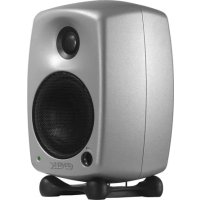
8020B - Loudspeaker COWON - Free user manual and instructions
Find the device manual for free 8020B COWON in PDF.



| Product type | Active speaker (active monitor) |
| Brand | Cowon |
| Model | 8020B |
| Category | Speaker |
| Dimensions (H x W x D) | 242 x 151 x 142 mm (with stand) / 230 x 151 x 142 mm (without stand) |
| Weight | 3.7 kg |
| Power supply | 100, 120, 220 or 230 V depending on region (±10%) |
| Power consumption | Standby: 5 VA / Max output: 50 VA |
| Speaker type | Active 2-way with built-in amplifiers |
| Transducers | Woofer: 105 mm (4") cone / Tweeter: 19 mm (3/4") metal dome, magnetically shielded |
| Frequency response | 66 Hz - 20 kHz (±2.5 dB) |
| Maximum sound level (peak, per pair) | ≥ 105 dB SPL at 1 m |
| Audio input | Balanced XLR female, 10 kOhm |
| Tone controls | Treble Tilt (0 to -2 dB @ 15 kHz), Bass Tilt (0 to -6 dB in -2 dB steps @ 100 Hz), Bass Roll-Off (-6 dB @ 85 Hz) |
| Volume control | Range from -80 dB to max |
| Amplification | Woofer: 20 W / Tweeter: 20 W (at 8 ohms) |
| Harmonic distortion (THD) | < 0.08% |
| Signal-to-noise ratio | > 95 dB (woofer and tweeter) |
| Protection | Integrated transducer protection circuits |
| Mounting options | Tiltable Iso-Pod™, microphone stand (3/8" UNC thread), Omnimount® 20.5 wall mount |
| Maintenance | No user-serviceable parts. Refer to qualified service personnel. |
| Safety | Do not open. Use grounded outlet. Protect from moisture. High sound level (>85 dB SPL). |
| Warranty | 2 years against material and workmanship defects |
| Compliance | CE (EN 60065, EN 55020, etc.) |
Frequently Asked Questions - 8020B COWON
User questions about 8020B COWON
0 question about this device. Answer the ones you know or ask your own.
Ask a new question about this device
Download the instructions for your Loudspeaker in PDF format for free! Find your manual 8020B - COWON and take your electronic device back in hand. On this page are published all the documents necessary for the use of your device. 8020B by COWON.
USER MANUAL 8020B COWON
natural_image
Black studio GENELEC audio speaker with visible sound waves and a small green button (no text or symbols on the device body)Operating Manual 2-7
natural_image
Top-down view of a black GENELEC audio player with speaker grille and buttons (no visible text beyond brand name)General description
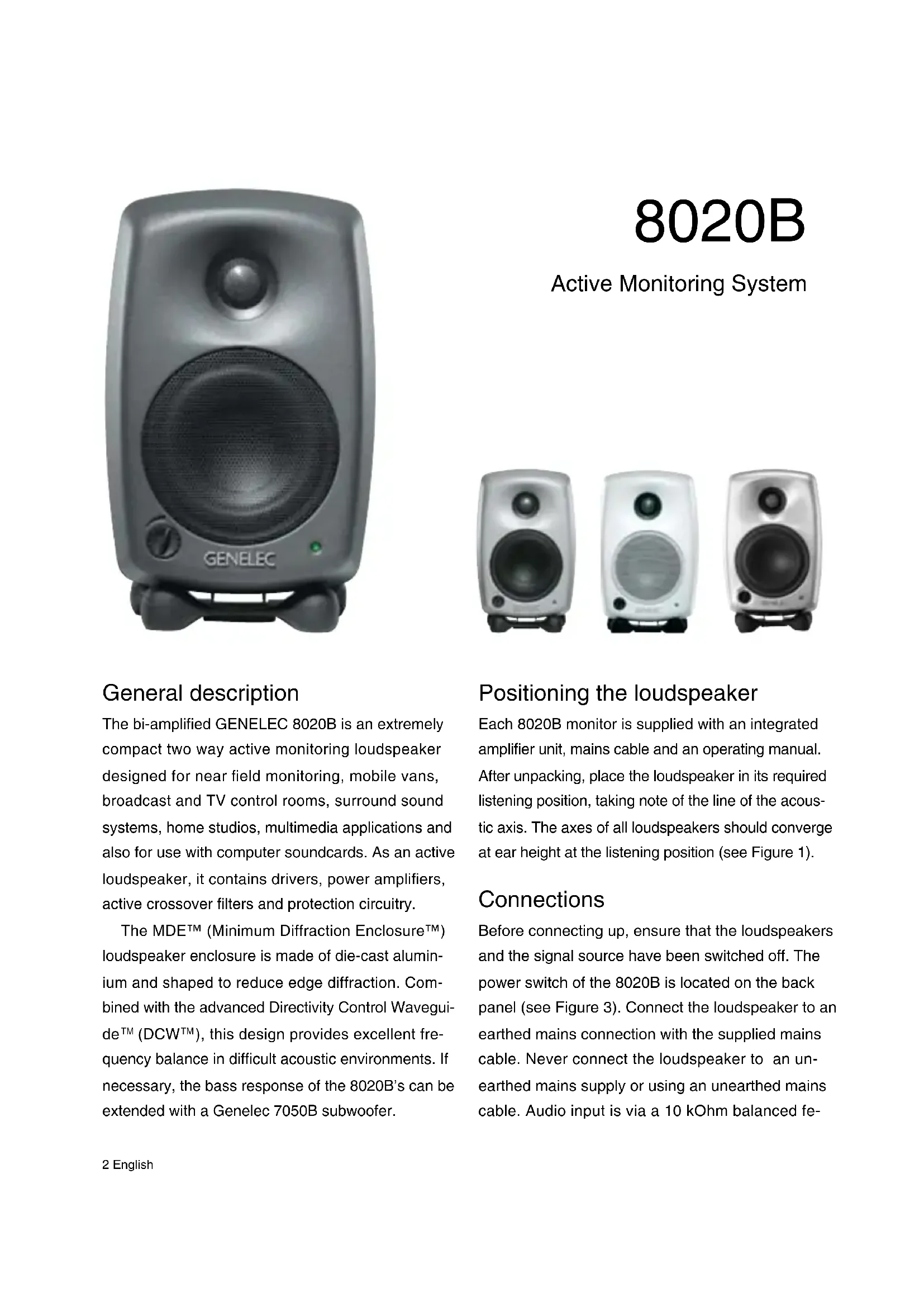
The bi-amplified GENELEC 8020B is an extremely compact two way active monitoring loudspeaker designed for near field monitoring, mobile vans, broadcast and TV control rooms, surround sound systems, home studios, multimedia applications and also for use with computer soundcards. As an active loudspeaker, it contains drivers, power amplifiers, active crossover filters and protection circuitry.
The MDE ^TM (Minimum Diffraction Enclosure ^TM ) loudspeaker enclosure is made of die-cast aluminium and shaped to reduce edge diffraction. Combined with the advanced Directivity Control Waveguide ^TM (DCW ^TM ), this design provides excellent frequency balance in difficult acoustic environments. If necessary, the bass response of the 8020B's can be extended with a Genelec 7050B subwoofer.
8020B
Active Monitoring System
natural_image
Three white studio audio speakers with black speaker stands, no visible text or symbols on the devices themselves.Positioning the loudspeaker
Each 8020B monitor is supplied with an integrated amplifier unit, mains cable and an operating manual. After unpacking, place the loudspeaker in its required listening position, taking note of the line of the acoustic axis. The axes of all loudspeakers should converge at ear height at the listening position (see Figure 1).
Connections
Before connecting up, ensure that the loudspeakers and the signal source have been switched off. The power switch of the 8020B is located on the back panel (see Figure 3). Connect the loudspeaker to an earthed mains connection with the supplied mains cable. Never connect the loudspeaker to an unearthed mains supply or using an unearthed mains cable. Audio input is via a 10 kOhm balanced fe-
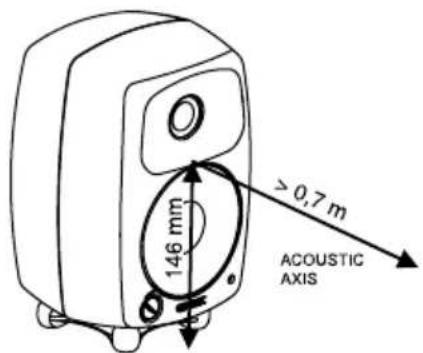
Figure 1: Location of the acoustic axis
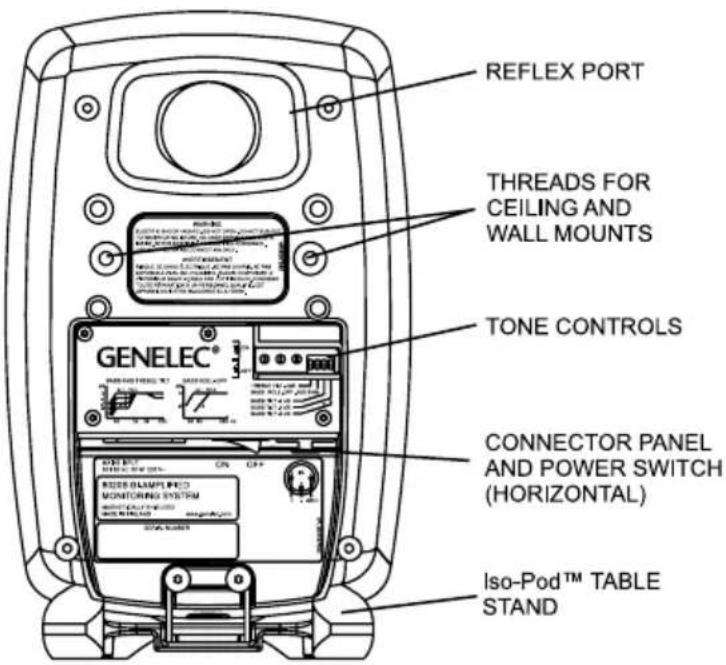
Figure 3: Control and connector layout on the rear panel of an 8020B.
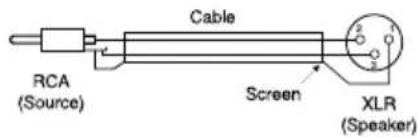
Figure 2: Type of cable needed if unbalanced source is used (example shown is RCA output to the XLR input)
male XLR connector. An unbalanced source may be used as long as pin 3 is grounded to pin 1 at the unbalanced source connector (see Figure 2). Never connect the 8020B to the loudspeaker outputs of a power amplifier or an integrated amplifier or receiver.
Once the connections have been made, the loudspeakers are ready to be switched on.
Volume control
The input sensitivity of the loudspeakers can be matched to the output of the mixing console or other signal source by adjusting the volume control on the front panel.
Setting the tone controls
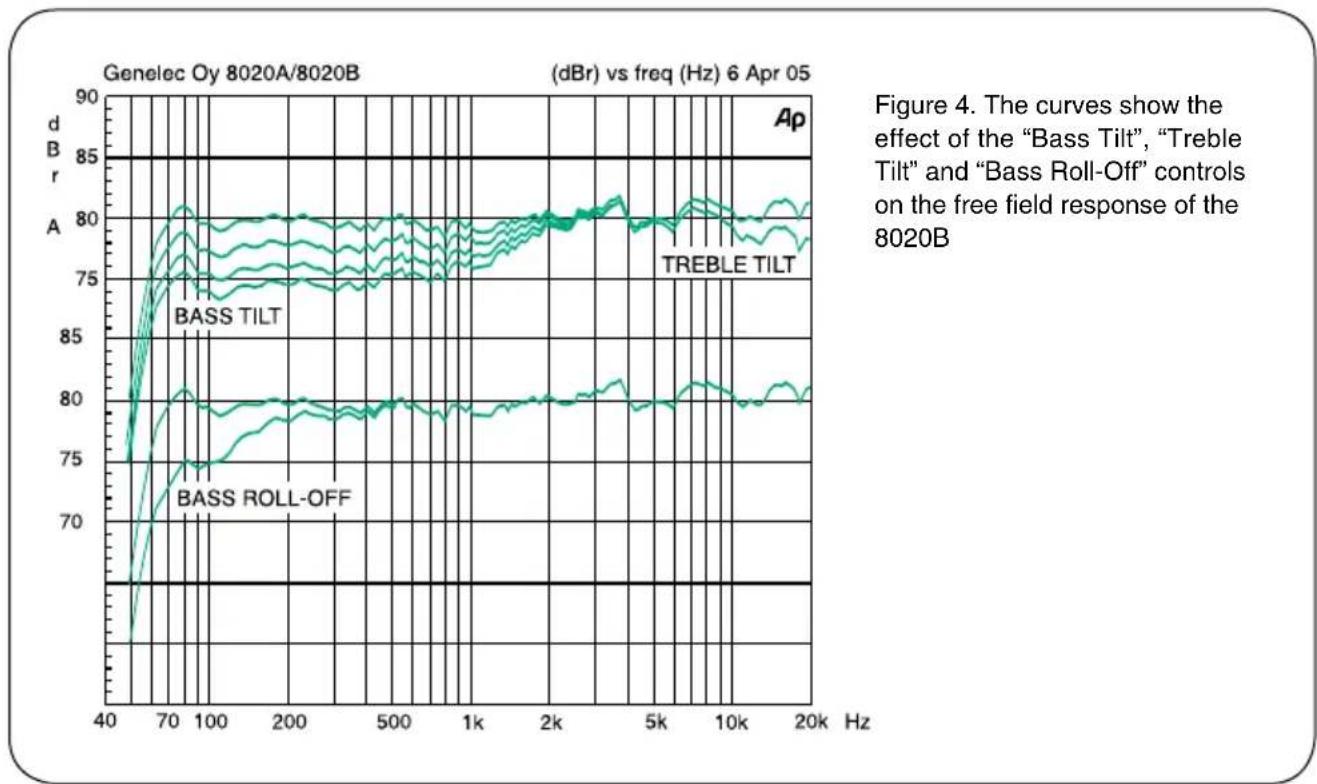
The frequency response of the Genelec 8020B can be adjusted to match the acoustic environment by setting the tone control switches on the rear panel. The controls are "Treble Tilt", "Bass Tilt" and "Bass Roll-Off". An acoustic measuring system such as WinMLS or comparable is recommended for analyzing the effects of the adjustments, however, careful listening with suitable test recordings can also lead to good results if a test system is not available. Table 1 overleaf shows some examples of typical settings in various situations. Figure 4 shows the effect of the controls on the anechoic response.
| Loudspeaker Mounting Position Treble Tilt Bass Tilt Bass Roll-Off | |||
| Flat anechoic response OFF OFF OFF | |||
| Free standing in a damped room OFF OFF OFF | |||
| Free standing in a reverberant room OFF | -2 dB | OFF | |
| Near field or console bridge | OFF | -4 dB | OFF |
| Near to a wall | OFF | -6 dB | OFF |
| With a 7050B subwoofer | See above | See above | ON |
Table 1: Suggested tone control settings for differing acoustical environments
Treble Tilt
Treble Tilt control (switch 1) attenuates the treble response of the loudspeaker at frequencies above 5 kHz by 2 dB, which can be used for smoothening down an excessively bright sounding system.
Bass Tilt
Bass Tilt control offers three attenuation levels for the bass response of the loudspeaker below 2 kHz, usually necessary when the loudspeakers are placed near a wall or other room boundaries. The attenuation levels are -2 dB (switch 3 "ON"), -4 dB (switch 4 "ON") and -6 dB (both switches "ON").
Bass Roll-Off
Bass Roll-Off (switch 2) activates high-pass filtering at 85 Hz to complement the low-pass filters of a Genelec 7050B or 7050A subwoofer. This switch should always be set to "ON" when using the 8020B with these subwoofers.
The factory setting for all tone controls is “OFF” to give a flat anechoic response. Always start adjustment by setting all switches to “OFF” position. Measure or listen systematically through the different combinations of settings to find the best frequency balance.
Mounting considerations
Align the loudspeakers correctly
Always place the loudspeakers so that their acoustic axes (see figure 1) are aimed towards the listening position. Only vertical placement is preferred, as it minimises acoustical cancellation problems around the crossover frequency.
Maintain symmetry
Check that the loudspeakers are placed symmetrically and at an equal distance from the listening position. If possible, place the system so that the listening position is on the centerline of the room and the loudspeakers are placed at an equal distance from the centerline.
Minimise reflections
Acoustic reflections from objects close to the loudspeakers like desks, cabinets, computer monitors etc. can cause unwanted colouration blurring of the sound image. These can be minimised by placing the loudspeaker clear of reflective surfaces. For instance, putting the loudspeakers on stands behind and above the mixing console and tilting them down to point the acoustic axes to ear
level at the listening position usually gives a better result than placing the loudspeakers on the meter bridge.
Minimum clearances
Sufficient clearance for cooling of the amplifier and functioning of the reflex port must be ensured if the loudspeaker is installed in a restricted space such as a cabinet or integrated into a wall structure. The surroundings of the loudspeaker must always be open to the listening room with a minimum clearance of 3 centimeters ( 1^3/_16 ) behind, above and on both sides of the loudspeaker. The space adjacent to the amplifier must either be ventilated or sufficiently large to dissipate heat so that the ambient temperature does not rise above 35 degrees Celsius (95°F)
Mounting options
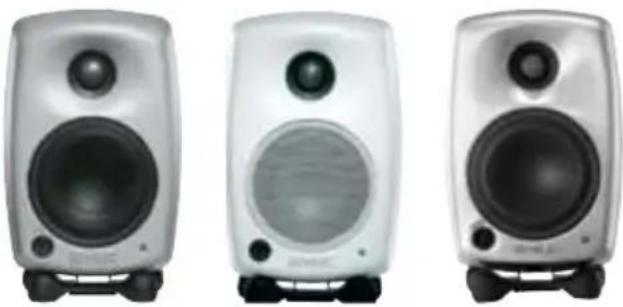
The Genelec 8020B offers several mounting options: The Iso-Pod™ (Isolation Positioner/Decoupler™) vibration insulating table stand allows tilting the loudspeaker for correct alignment of the acoustic axis. On the base of the loudspeaker is a 3/8" UNC threaded hole compatible with a standard microphone stand. On the rear there are two M6x10 mm threaded holes for Omnimount® size 20.5 brackets or the keyhole wall mount adapter provided with the loudspeaker.
Maintenance
No user serviceable parts are to be found within the amplifier unit. Any maintenance or repair of the 8020B unit should only be undertaken by qualified service personnel.
Safety considerations
Although the 8020B has been designed in accordance with international safety standards, the following warnings and cautions should be observed to ensure safe operation and to maintain the loudspeaker under safe operating conditions:
- Servicing and adjustment must only be performed by qualified service personnel. The loudspeaker must not be opened.
- Do not use this product with an unearthed mains cable or an unearthed mains connection as this may compromise electrical safety.
- Do not expose the loudspeaker to water or moisture. Do not place any objects filled with liquid, such as vases on the loudspeaker or near it.
- This loudspeaker is capable of producing sound pressure levels in excess of 85 dB, which may cause permanent hearing damage.
- Free flow of air behind the loudspeaker is necessary to maintain sufficient cooling. Do not obstruct airflow around the loudspeaker.
- Note that the amplifier is not completely disconnected from the AC mains service unless the mains power cord is removed from the amplifier or the mains outlet.
Guarantee
This product is guaranteed for a period of two years against faults in materials or workmanship. Refer to supplier for full sales and guarantee terms.
line
| Frequency (Hz) | BASS TILT | BASS ROLL-OFF | TREBLE TILT | | -------------- | --------- | ------------- | ----------- | | 40 | ~65 | ~65 | ~65 | | 70 | ~80 | ~75 | ~80 | | 100 | ~80 | ~75 | ~80 | | 200 | ~80 | ~75 | ~80 | | 500 | ~80 | ~75 | ~80 | | 1k | ~80 | ~75 | ~80 | | 2k | ~80 | ~75 | ~80 | | 5k | ~80 | ~75 | ~80 | | 10k | ~80 | ~75 | ~80 | | 20k | ~80 | ~75 | ~80 |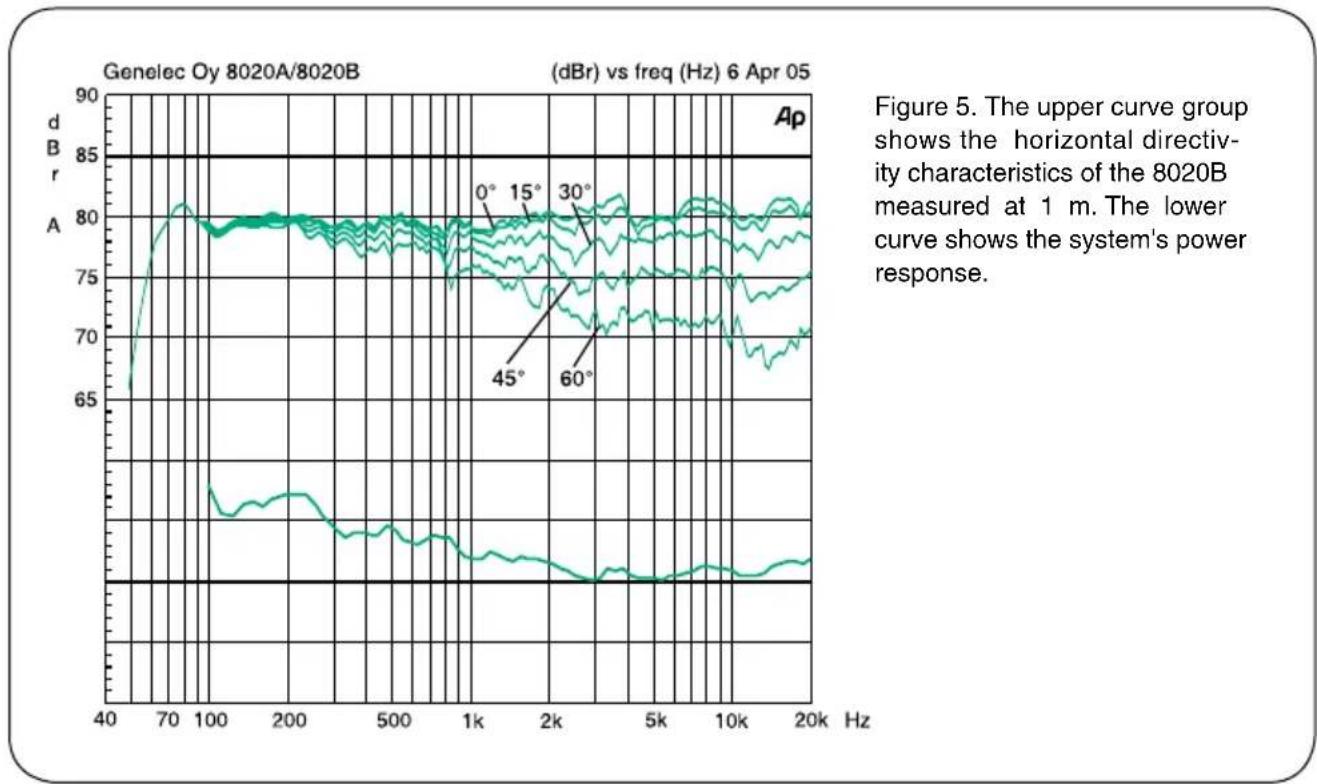
line
| Frequency (Hz) | dBr (dB) | | -------------- | -------- | | 40 | ~65 | | 70 | ~80 | | 100 | ~80 | | 200 | ~78 | | 500 | ~78 | | 1k | ~78 | | 2k | ~78 | | 5k | ~78 | | 10k | ~78 | | 20k | ~78 |SySTeM SpecificATiOnS
| Lower cut-off frequency, -3 dB: | ≤ 65 Hz |
| Upper cut-off frequency, -3 dB: | ≥ 21 kHz |
Free field frequency response of system:
66 Hz - 20 kHz (± 2.5 dB)
Maximum short term sine wave acoustic output on axis in half space, averaged from 100 Hz to 3 kHz:
@ 1 m ≥ 96 dB SPL
@ 0.5 m ≥ 102 dB SPL
Maximum long term RMS acoustic output in same conditions with IEC weighted noise (limited by driver unit protection circuit): @ 1 m ≥ 95 dB SPL
Maximum peak acoustic output per pair on top of console, @ 1 m distance with music material: ≥ 105 dB
Self generated noise level in free field @ 1m on axis: ≤ 10 dB (A-weighted)
Harmonic distortion at 85 dB SPL @ 1m on axis: Freq: 50...100 Hz < 3 %
100 Hz < 0.5 %
Drivers: Bass 105 mm (4") cone Treble 19 mm (3/4") metal dome
Both drivers are magnetically shielded
| Weight: | 3.7 kg (8.1 lb) |
| Dimensions: Height | 242 mm ( 9^1/_2 ") |
(including Iso-Pod™ table stand)
| Height | 230 mm ( 9^1/_16 ") |
(without Iso-Pod™ table stand)
| Width | 151 mm (6") |
| Depth | 142 mm ( 5^5/_8 ") |
ec DeclarATiOn Of cOnfORMiTy
This is to certify that the Genelec Monitoring System
8020B conforms to the following standards:
Safety: EN 60065: 2002 + A1:2006 / IEC 60065:2001
7th Edition + A1: 2005
EMC: EN 55020 A2: 2008
EN 55013: (2001)+ A1 : 2003 + A2: 2009
EN 61000-3-2: 2006
EN 61000-3-3 A2: 2005
The product herewith complies with the requirements of The Low Voltage Directive 2006/95/EC and EMC Directive 2004/108/EC

Ilpo Martikainen
Position: Chairman of the Board
Date: 12-January-2009
cROSSOveR SecTiOn
| Input connector: Input: XLR female, balanced 10 kOhm, pin 1 gnd, pin 2 +, pin 3 - |
Input level for 100 dB SPL output at 1 m: -6 dBu at volume control max
Volume control range: -80 dB relative to max output
Crossover frequency, Bass/Treble: 3.0 kHz
Treble tilt control operating range: 0 to -2 dB @ 15 kHz
Bass roll-off control operating in a -6 dB step @ 85 Hz (to be used in conjunction with a 7050B subwoofer)
Bass tilt control operating range in -2 dB steps: 0 to -6 dB @ 100 Hz
The 'CAL' position is with all tone controls set to 'off' and the input sensitivity control to maximum (fully clockwise).
AMplifieR SecTiOn
Bass amplifier output power with an 8 Ohm load: 20 W Treble amplifier output power with an 8 Ohm load: 20 W Long term output power is limited by driver unit protection circuitry.
Amplifier system distortion at nominal output:
THD < 0.08 %
SMPTE-IM < 0.08 %
CCIF-IM < 0.08 %
DIM 100 < 0.08 %
Signal to Noise ratio, referred to full output:
Bass > 95 dB Treble > 95 dB
Mains voltage:
100, 120, 220 or 230 V
according to region
Voltage operating range: ±10 %
Power consumption: Idle 5 VA
Full output 50 VA
Betriebsanleitung
8020B
Aktives Monitorsystem
| Lower cut-off frequency, -3 dB: | ≤ 65 Hz |
| Upper cut-off frequency, -3 dB: | ≥ 21 kHz |
Free field frequency response of system:
66 Hz - 20 kHz (± 2.5 dB)
Maximum short term sine wave acoustic output on axis in half space, averaged from 100 Hz to 3 kHz:
@ 1 m ≥ 96 dB SPL
@ 0.5 m ≥ 102 dB SPL
Maximum long term RMS acoustic output in same conditions with IEC weighted noise (limited by driver unit protection circuit): @ 1 m ≥ 95 dB SPL
Maximum peak acoustic output per pair on top of console, @ 1 m distance with music material: ≥ 105 dB
Self generated noise level in free field @ 1m on axis: ≤ 10 dB (A-weighted)
Harmonic distortion at 85 dB SPL @ 1m on axis:
Freq: 50...100 Hz < 3 %
100 Hz < 0.5 %
Drivers: Bass 105 mm (4") cone Treble 19 mm (3/4") metal dome
Both drivers are magnetically shielded
| Weight: | 3.7 kg (8.1 lb) |
| Dimensions: Height | 242 mm ( 9^1/_2 ") |
(including Iso-Pod™ table stand)
Height 230 mm (9 ^1/16 ) (without Iso-Pod™ table stand)
Width 151 mm (6")
Depth 142 mm ( 5^5/_8 )
eG KOnfORMiTÄTSeRKIÄRUnG
This is to certify that the Genelec Monitoring System
8020B conforms to the following standards:
Safety: EN 60065: 2002 + A1:2006 / IEC 60065:2001
7th Edition + A1: 2005
EMC: EN 55020 A2: 2008
EN 55013: (2001)+ A1 : 2003 + A2: 2009
EN 61000-3-2: 2006
EN 61000-3-3 A2: 2005
The product herewith complies with the requirements of The Low Voltage Directive 2006/95/EC and EMC Directive 2004/108/EC
Signed:

Ilpo Martikainen
Position: Chairman of the Board
Date: 12-January-2009
fReQUenZWeicHe UnD fiITeR
| Input connector: Input: XLR female, balanced 10 kOhm, pin 1 gnd, pin 2 +, pin 3 - |
Input level for 100 dB SPL output at 1 m: -6 dBu at volume control max
Volume control range: -80 dB relative to max output
Crossover frequency, Bass/Treble: 3.0 kHz
Treble tilt control operating range: 0 to -2 dB @ 15 kHz
Bass roll-off control operating in a -6 dB step @ 85 Hz (to be used in conjunction with a 7050B subwoofer)
Bass tilt control operating range in -2 dB steps: 0 to -6 dB @ 100 Hz
The 'CAL' position is with all tone controls set to 'off' and the input sensitivity control to maximum (fully clockwise).
veRSTÄRKeR
Bass amplifier output power with an 8 Ohm load: 20 W Treble amplifier output power with an 8 Ohm load: 20 W Long term output power is limited by driver unit protection circuitry.
| Amplifier system distortion at nominal output: | |
| THD < 0.08 % | - |
| SMPTE-IM < 0.08 % | - |
| CCIF-IM < 0.08 % | - |
| DIM 100 < 0.08 % | - |
| Signal to Noise ratio, referred to full output: | |
| Bass >95 dB | - |
| Treble >95 dB | - |
| Mains voltage:100, 120, 220 or 230 Vaccording to regionVoltage operating range: ± 10 % Power consumption: Idle 5 VAFull output | 50 VA |
commande Bass Roll-Off
natural_image
Top-down view of a black GENELEC audio player with speaker grille and buttons (no visible text beyond brand name)Yleistä
natural_image
Three white studio speakers with black speaker stands, no visible text or symbols on the devices themselves.Liitännät
@ 0.5 m > 102 dB SPL
-
Bass Roll-Off (Basavskärning)
line
| Frequency (Hz) | d Br (dB) at 0° | d Br (dB) at 15° | d Br (dB) at 30° | d Br (dB) at 45° | d Br (dB) at 60° | | -------------- | --------------- | ---------------- | ---------------- | ---------------- | ---------------- | | 40 | ~65 | ~65 | ~65 | ~65 | ~65 | | 70 | ~80 | ~80 | ~80 | ~80 | ~80 | | 100 | ~80 | ~80 | ~80 | ~80 | ~80 | | 200 | ~80 | ~80 | ~80 | ~80 | ~80 | | 500 | ~80 | ~80 | ~80 | ~80 | ~80 | | 1k | ~80 | ~80 | ~80 | ~80 | ~80 | | 2k | ~80 | ~80 | ~80 | ~80 | ~80 | | 5k | ~80 | ~80 | ~80 | ~80 | ~80 | | 10k | ~80 | ~80 | ~80 | ~80 | ~80 | | 20k | ~80 | ~80 | ~80 | ~80 | ~80 |International enquiries
Genelec, Olvitie 5
FI 74100, Iisalmi, Finland
Phone +358 17 83881
Fax +358 17 812 267
Email genelec@genelec.com
In Sweden
Genelec Sverige
Ellipsvägen 10B
P.O. Box 5521,
S-141 05 Huddinge
Phone +46 8 449 5220
Fax +46 8 708 7071
Email info@genelec.com
In the USA
Genelec, Inc., 7 Tech Circle
Natick, MA 01760, USA
Beijing Genelec Audio Co.Ltd
Jianwai SOHO, Tower 12,
Room 2605
D-1504, Chaoyang District
Beijing 100022, China
Phone +86 10 8580 2180
Fax +86 10 8580 2181
Email genelec.china@genelec.com
www.genelec.com
Genelec Document D0088R001 Copyright Genelec Oy 3.2009. All data subject to change without prior notice

- General description
- 8020B
- Active Monitoring System
- Positioning the loudspeaker
- Connections
- Volume control
- Setting the tone controls
- Treble Tilt
- Bass Tilt
- Bass Roll-Off
- Mounting considerations
- Align the loudspeakers correctly
- Maintain symmetry
- Minimise reflections
- Minimum clearances
- Mounting options
- Maintenance
- Safety considerations
- Guarantee
- ec DeclarATiOn Of cOnfORMiTy
- AMplifieR SecTiOn
- Betriebsanleitung
- Aktives Monitorsystem
- eG KOnfORMiTÄTSeRKIÄRUnG
- veRSTÄRKeR
- commande Bass Roll-Off
- Yleistä
- Liitännät
- Bass Roll-Off (Basavskärning)
Brand : COWON
Model : 8020B
Category : Loudspeaker