B002DV2A4 - Switch Tripp Lite - Free user manual and instructions
Find the device manual for free B002DV2A4 Tripp Lite in PDF.



User questions about B002DV2A4 Tripp Lite
0 question about this device. Answer the ones you know or ask your own.
Ask a new question about this device
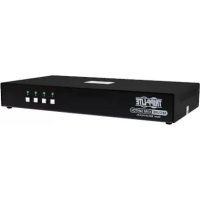
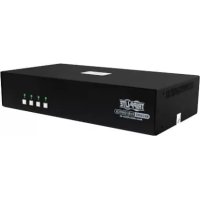
Download the instructions for your Switch in PDF format for free! Find your manual B002DV2A4 - Tripp Lite and take your electronic device back in hand. On this page are published all the documents necessary for the use of your device. B002DV2A4 by Tripp Lite.
USER MANUAL B002DV2A4 Tripp Lite
Secure KVM Switches, NIAP Protection Profile Version 3.0
DisplayPort Models:
B002-DP1A4, B002-DP2A4, B002-DP2AC4
DVI Models:
B002-DV1A2, B002-DV1A4, B002-DV1AC4,
B002-DV1AC8, B002-DV2A4, B002-DV2AC4
HDMI Models:
B002-HD1AC4 & B002-HD2AC4
Español 23 • Français 45
WARRANTY REGISTRATION
Register your product today and be automatically entered to win an ISOBAR ^® surge protector in our monthly drawing!
tripplite.com/warranty

text_image
TRIPP·LITE1111 W. 35th Street, Chicago, IL 60609 USA • tripplite.com/support
Copyright © 2022 Tripp Lite. All rights reserved.
Table of Contents
Package Includes 3
Optional Accessories....3
System Requirements 4
Features. 4
Important Safety Instructions 6
Installation....8
KM Switching 10
Single-Head Mode KM Switching....10
Multi-Head Mode KM Switching 11
KVM LEDs....14
Port Selection LEDs 14
Push-Button LEDs 14
Port Selection and Push-Button LEDs 14
Console Video Port LED....14
Console CAC Port LED 14
EDID Learn 15
Miscellaneous KVM Functionality.... 16
Disabling CAC Functionality.... 16
Enabling CAC Functionality ..... 16
CAC Port Configuration 16
AUDITING: Dumping the Event Log. 19
RESET: Restore Factory Defaults 20
Power Up Self-Test. 21
Warranty and Product Registration 22
Package Includes
• B002-Series Secure KVM Switch
• 12V 2A* External Power Supply
- Owner's Manual
*B002-DV1AC8 & B002-DP2A4 models include a 12V 3A external power supply
Optional Accessories
• P312-Series 3.5 mm Stereo Audio Cables
- P556-006 DVI-A Male to HD15 Male Adapter Cable – 6 ft.
• P560-Series DVI-D Dual-Link Cables
• P560-XXX-A Series DVI-D Dual Link + Audio Cables
• P561-Series DVI-D Single-Link Cables
• P759-Series DVI-D/USB/Audio Cable Kit
• P569-XXX-CERT Premium High-Speed HDMI Cables
• P782-XXX-DH HDMI/USB KVM Cable Kit
• P580-Series DisplayPort Cables
• U022-Series USB 2.0 A/B Device Cables
*XXX refers to length (e.g. 006 = 6 ft., 010 = 10 ft., and so on)
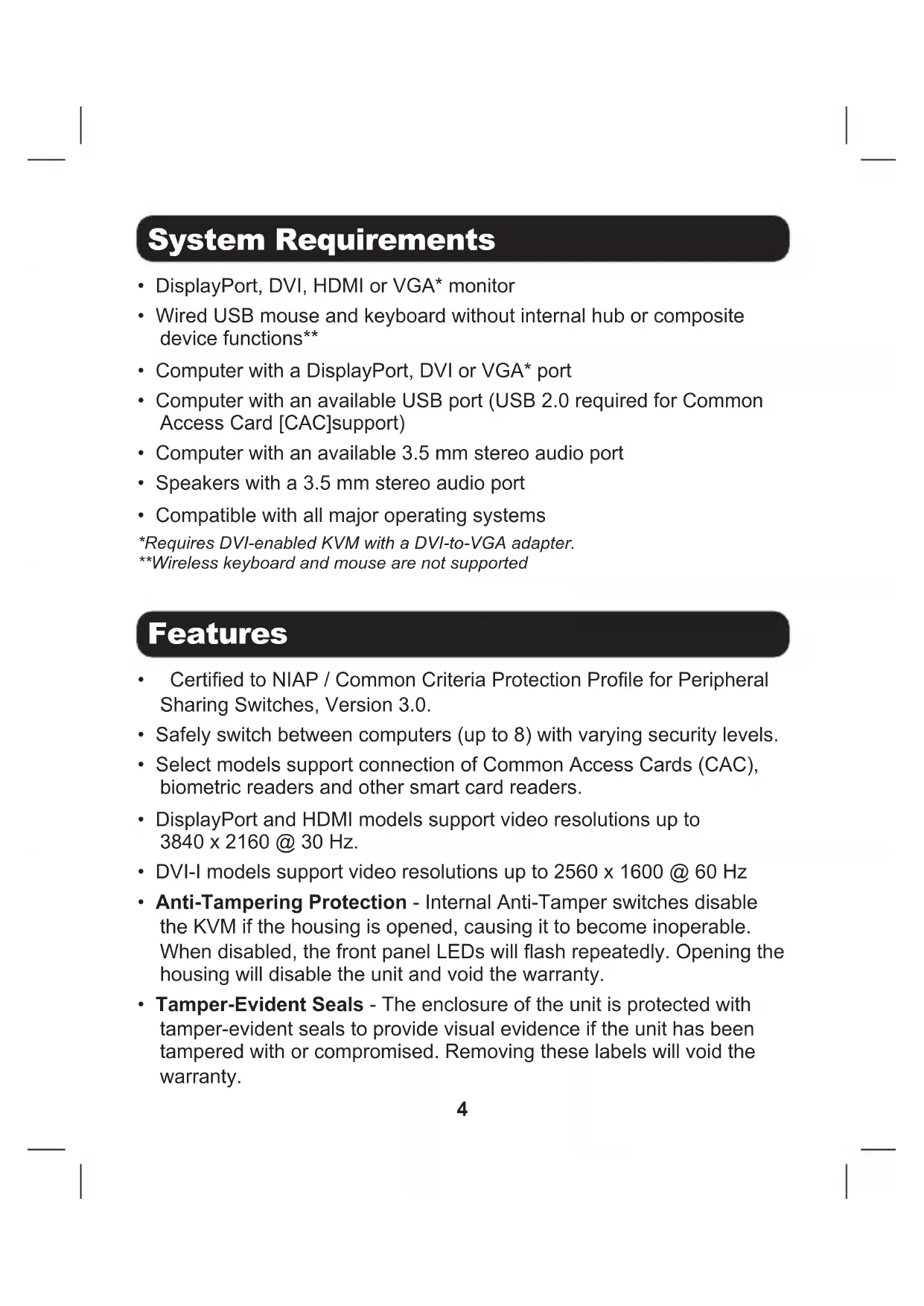
System Requirements
• DisplayPort, DVI, HDMI or VGA* monitor
- Wired USB mouse and keyboard without internal hub or composite device functions**
- Computer with a DisplayPort, DVI or VGA* port
- Computer with an available USB port (USB 2.0 required for Common Access Card [CAC]support)
- Computer with an available 3.5 mm stereo audio port
- Speakers with a 3.5 mm stereo audio port
- Compatible with all major operating systems
*Requires DVI-enabled KVM with a DVI-to-VGA adapter.
**Wireless keyboard and mouse are not supported
Features
• Certified to NIAP / Common Criteria Protection Profile for Peripheral Sharing Switches, Version 3.0.
- Safely switch between computers (up to 8) with varying security levels.
- Select models support connection of Common Access Cards (CAC), biometric readers and other smart card readers.
- DisplayPort and HDMI models support video resolutions up to 3840 x 2160 @ 30 Hz.
• DVI-I models support video resolutions up to 2560 x 1600 @ 60 Hz
- Anti-Tampering Protection - Internal Anti-Tamper switches disable the KVM if the housing is opened, causing it to become inoperable. When disabled, the front panel LEDs will flash repeatedly. Opening the housing will disable the unit and void the warranty.
- Tamper-Evident Seals - The enclosure of the unit is protected with tamper-evident seals to provide visual evidence if the unit has been tampered with or compromised. Removing these labels will void the warranty.
Features
- Protected Firmware - The unit features special protection that prevents reprogramming or reading firmware, protecting against attempts to alter the logic of the KVM.
- High Isolation on USB Channels - Opto-isolators are used to keep USB data paths electrically isolated from each other, preventing data leakage between ports.
- Secure EDID Emulation – Secure EDID learning and emulation prevents unwanted and unsecure data from being transmitted through the DDC line.
- Automatic Keyboard Buffer Clearing – The keyboard buffer is automatically cleared after data transmission, so no information is left stored in the switch.
- No Memory Buffer – The only way to access connected computers is via push button. Port switching methods such as On-Screen Display (OSD) and Hotkey Commands have been excluded to further ensure data integrity.
Important Safety Instructions
- Read all instructions and save them for future reference.
- Follow all warnings and instructions marked on the device.
- Do not place the device on any unstable surface (cart, stand, table, etc.). If the device falls, serious damage will result.
- Do not use the device near water.
- Do not place the device near, or over, radiators or heat registers. The device cabinet contains slots and openings to allow for adequate ventilation. To ensure reliable operation and to protect against overheating, these openings must never be blocked or covered.
- The device should never be placed on a soft surface (bed, sofa, rug, etc.) as this will block its ventilation openings. Likewise, the device should not be placed in a built-in enclosure unless adequate ventilation has been provided.
- Never spill liquid of any kind on the device.
- Unplug the device from the wall outlet before cleaning. Do not use liquid or aerosol cleaners. Use a damp cloth for cleaning.
- The device should be operated from the power source type as indicated on the marking label. If you are not sure of the type of power available, consult your dealer or local power utility.
- Do not allow anything to rest on the power cord or cables. Route the power cord and cables so that they cannot be stepped on or tripped over.
- If an extension cord is used with this device, make sure the total ampere rating of all products used on the cord does not exceed the extension cord ampere rating. Make sure the total rating of all products plugged into the wall outlet does not exceed 15 amperes.
- Position system cables and power cables carefully. Make sure nothing rests on any cables.
- To help protect your system from sudden transient increases and decreases in electrical power, it is recommended you plug your devices into a Tripp Lite Surge Protector, Line Conditioner, or Uninterruptible Power Supply (UPS).
Important Safety Instructions
- When connecting or disconnecting power to hot-pluggable power supplies, observe the following guidelines:
o Install the power supply before connecting the power cable to the power supply.
o Unplug the power cable before removing the power supply.
o If the system has multiple power sources, disconnect power from the system by unplugging all power cables from the power supplies.
- Never push objects of any kind into or through cabinet slots. They may touch dangerous voltage points or short out parts, resulting in a risk of electrical shock or fire.
- If the following conditions occur, unplug the device from the wall outlet and bring it to qualified service personnel for repair.
o The power cord or plug has become damaged or frayed.
o Liquid has been spilled into the device.
o The device has been exposed to rain or water.
o The device has been dropped or the cabinet has been damaged.
o The device exhibits a distinct change in performance, indicating a need for service.
o The device does not operate normally when the operating instructions are followed.
- Only adjust those controls that are covered in the operating instructions. Improper adjustment of other controls may result in damage that will require extensive work by a qualified technician to repair.
- This device is designed for IT power distribution systems with up to 230V phase-to-phase voltage.
- To prevent damage to your installation, it is important that all devices are properly grounded.
Important Safety Instructions
- This device is equipped with a three-wire grounding-type plug.
This is a safety feature. If you are unable to insert the plug into the outlet, contact an electrician to replace your outlet with one that will accept this type of plug. Do not attempt to defeat the purpose of the grounding-type plug. Always follow your local/national wiring codes. - Warning! There is a risk of explosion if the battery is replaced with an incorrect battery type. Do not attempt to service the device yourself. Refer all servicing to qualified service personnel.
Installation
Note: Before proceeding with installation, make sure all devices being connected to the KVM switch are turned off.
- Using audio/video cables appropriate for your switch model, connect the video output port of each computer you are adding to the video input ports of the KVM Switch.
Note: Models with Dual Monitor capability require two available video ports per computer. - Using USB A/B device cables, connect a USB port on each computer being added to the USB input ports of the KVM Switch.
Note: Models with CAC (Common Access Card) support require an additional USB 2.0 A/B cable connected to each computer. - Using 3.5 mm stereo audio cables, connect the audio output of each computer you are adding to the audio input ports of the KVM Switch.
- Using the appropriate audio/video cable, connect a monitor appropriate for your switch model to the console video output port of the KVM switch.
Installation
- Connect a wired USB keyboard and mouse to the console USB keyboard and mouse ports of the KVM switch.
Note: Keyboards and mice with internal USB hub or composite device functions are not supported. Wireless keyboards and mice are not supported.
- Connect a set of speakers to the console audio output port of the KVM Switch using a 3.5 mm stereo audio cable.
Note: Microphones or headsets with microphones are not supported.
- For models with CAC support, connect a CAC reader to the console CAC port of the KVM switch.
Note: CAC readers with external power sources are not supported.
-
Power on the KVM by connecting the included external power supply and plugging it into a Tripp Lite Surge Protector, Power Distribution Unit (PDU), or Uninterruptible Power Supply (UPS).
-
Power on all connected computers and monitor. The Front Panel LEDs will begin to flash.
Note: The computer connected to port 1 will always be selected by default after power up.
- To switch among the connected computers, simply push the desired input button on the front-panel of the KVM. If an input port is selected, the LED of that port will turn on.
KM Switching
Note: KM switching is not applicable to KVM models with only one video console port.
After connecting all devices to your B002-Series Secure KVM Switch, a display mode and display topology configuration must be selected. By default, the B002-Series Secure KVM Switches are configured to Single-Head Display Mode and a topology with four screens arranged horizontally, starting with Port 1.
Note: If one or more of the input computers have multiple displays, Multi-Head Display Mode must be selected. Otherwise, select Single-Head Display Mode.
The table below shows Display Mode keyboard hotkey commands:
| Commands Hotkeys | |
| Single-Head Sisplay Mode CTRL+CTRL+K+S | |
| Multi-Head Display Mode CTRL+CTRL+K+M | |
Single-Head Mode KM Switching
In addition to traditional channel switching by buttons located on the front panel, KM also supports cursor control of selected channels. This technology allows seamless switching between computers by moving the mouse cursor from one display to another. Users can effortlessly switch computers for faster productivity.
- KM functionality for KVM devices is only available once the device has been put into KM mode, refer to admin tool guide for detail.
- When the device is placed into KM mode, it will behave identically to the KM models of the product.
- The major difference when the device is placed into KM mode is that cursor control of selected channels is available as an additional method to switch the connected computer.
KM Switching
- The below illustration shows how this functionality works:
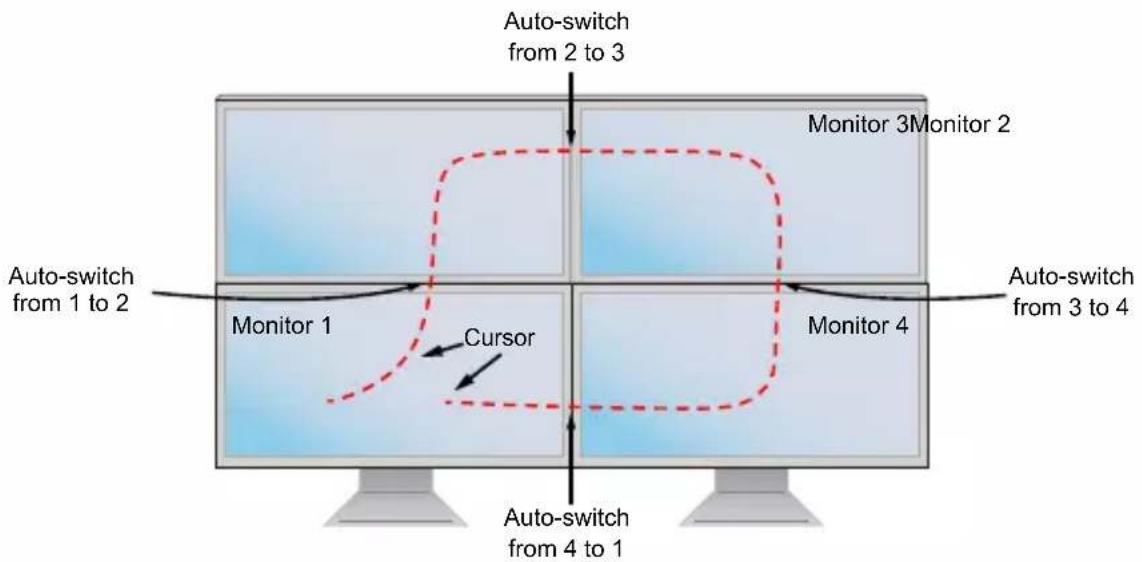
flowchart
graph TD
    A["Monitor 1"] --> B["Monitor 2"]
    B --> C["Monitor 3"]
    C --> D["Monitor 4"]
    D --> E["Cursor"]
    E --> F["Auto-switch from 1 to 2"]
    F --> G["Auto-switch from 2 to 3"]
    G --> H["Auto-switch from 3 to 4"]
    H --> I["Auto-switch from 4 to 1"]
Note: Cursor control of selected channels can only be used in Single-Head Display Mode.
Multi-Head Mode KM Switching
When using computers with multiple displays, cursor control of selected channels will no longer auto-switch from monitor to monitor. Cursor control of selected channels will now consist of pressing the scroll wheel twice and moving the mouse in the direction of the channel you desire to switch to.
Note: Multi-Head Display Mode switching must be used if any of the four computers have multiple displays.
The installation setup must match one of the B002-Series pre-defined display topology configurations. The B002-Series Secure KVM Switches have configurable display topologies that can be easily selected through keyboard hotkey commands.
KM Switching
The below illustration shows how this functionality works:
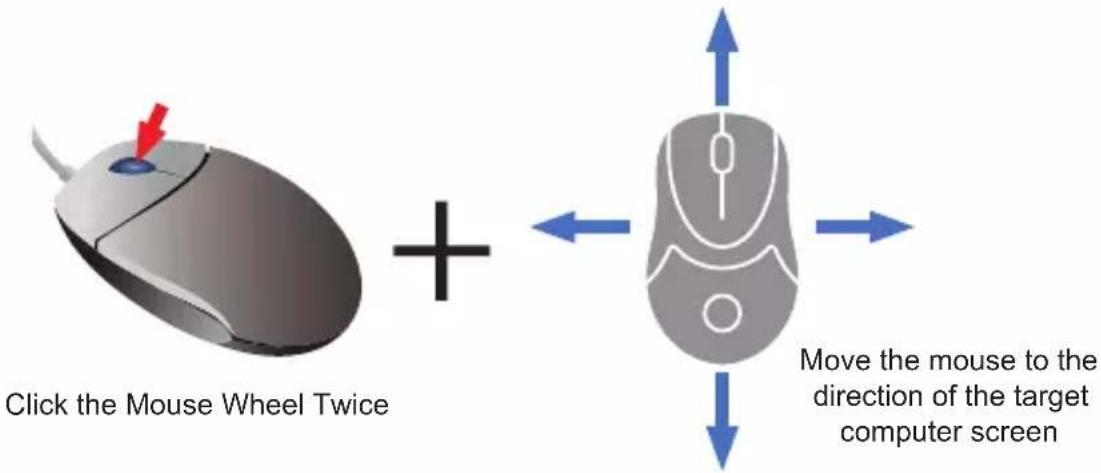
text_image
Click the Mouse Wheel Twice + ←→ Move the mouse to the direction of the target computer screenThe available display topologies and their hotkey commands are shown here:
The below hotkey commands are for multiple rows.
(1) Hotkey Command: "CTRL + CTRL + H + 4 + ENTER"
| 1 2 3 | 4 |
(2) Hotkey Command: "CTRL + CTRL + H + 2 + ENTER"
| 1 | 2 |
| 3 4 |
(3) Hotkey Command: "CTRL + CTRL + H + 3 + ENTER"
| 1 2 3 |
(4) Hotkey Command: "CTRL + CTRL + H + 1 + ENTER"
| 1 |
| 2 |
| 3 |
| 4 |
KM Switching
The below hotkey commands are for one row only.
(1) Hotkey Command: "CTRL + CTRL + W + 4 + ENTER"
| 1 2 3 | 4 |
(2) Hotkey Command: "CTRL + CTRL + w + 3 + ENTER"
| 1 2 3 |
Note: Port 4 N/A
(3) Hotkey Command: "CTRL + CTRL + W + 2 + ENTER"
| 1 | 2 |
(4) Hotkey Command: "CTRL + CTRL + W + 1 + ENTER"
| 1 |
Note: Ports 2-4 N/A
KVM LEDs
Port Selection LEDs
- When the LED is off, the corresponding port is not currently selected.
- When the LED is on, the corresponding port is currently selected.
- When the LED is flashing, the EDID Learn process is occurring.
Push-Button LEDs
- When the push-button LED of a non-selected port is off, the corresponding port is not currently selected.
- When the push-button LED of the selected port is off, CAC functionality has been disabled for the corresponding port.
- When the push-button LED is on, the corresponding port is currently selected and CAC functionality is enabled.
- When the push-button LED is flashing, the EDID Learn process is occurring.
Port Selection and Push-Button LEDs
- When all Port Selection and Push-Button LEDs are flashing simultaneously, the USB peripheral connected to the console keyboard or mouse port has been rejected.
Console Video Port LED
- When the LED is off, a monitor is not connected
- When the LED is illuminated, a monitor is connected
- When the LED is flashing, there is a problem with EDID. Perform the EDID Learn procedure (see the EDID Learn section for details) to resolve the issue.
Console CAC Port LED
- When the LED is off, a CAC device is not connected.
- When the LED is on, an authorized and functional CAC device is connected.
- When the LED is flashing, a non-CAC peripheral is connected.
EDID Learn
KVM models with DVI-I and HDMI video output are designed to learn the connected monitor's EDID upon power up. In the event of connecting a new monitor to the KVM switch, a power cycle is required. To indicate to the user that the EDID learn process is occurring, the front panel's green Port LEDs and blue Push-Button LEDs will flash for about 10 seconds. For Dual-Monitor KVM models, the unit will proceed to learn the EDID of the second connected monitor after the first monitor's EDID has been read, with the front panel LEDs flashing to indicate the process is taking place. When the front panel LEDs stop flashing, the EDID learning process is complete.
KVM models with DisplayPort video output use built-in EDID information that is set to HD resolution (1080p maximum), which will allow initial operation with most DisplayPort monitors. For security purposes, EDID learning of DisplayPort displays can be performed only by an Authenticated Administrator. Follow the steps below to perform EDID learning on your DisplayPort monitor:
- This process should be started with a powered-off KVM and computer that are not connected to each other.
- Connect a DisplayPort cable between the computer's DisplayPort output port and the KVM's Port 1 DisplayPort Input port.
- Using a USB A/B device cable, connect an available USB port on the computer to the KVM's Port 1 USB-B Input port.
- Connect a DisplayPort monitor to the console video output port of the KVM switch using a DisplayPort cable.
- Connect a wired USB keyboard and mouse to the console USB keyboard and mouse ports of the KVM switch.
Note: Keyboards and mice with internal USB hub or composite device functions are not supported. Wireless keyboards and mice are not supported. - Power on the computer and KVM switch.
- From the connected computer, download the Administration and Security Management Tool from tripplite.com/support.
EDID Learn
- Once downloaded, run the Administration and Security Management Tool executable file. The Administration and Security Management screen will appear.
- Initiate the session by pressing the following hotkey command, one key one after another.
[Alt][Alt][c][n][f][g]
- Upon completing the command, the mouse connected to the KVM will stop functioning. A prompt will appear to enter the Credential ID.
- Log in by entering the default username admin and pressing Enter.
- Enter the default password 12345 and press Enter.
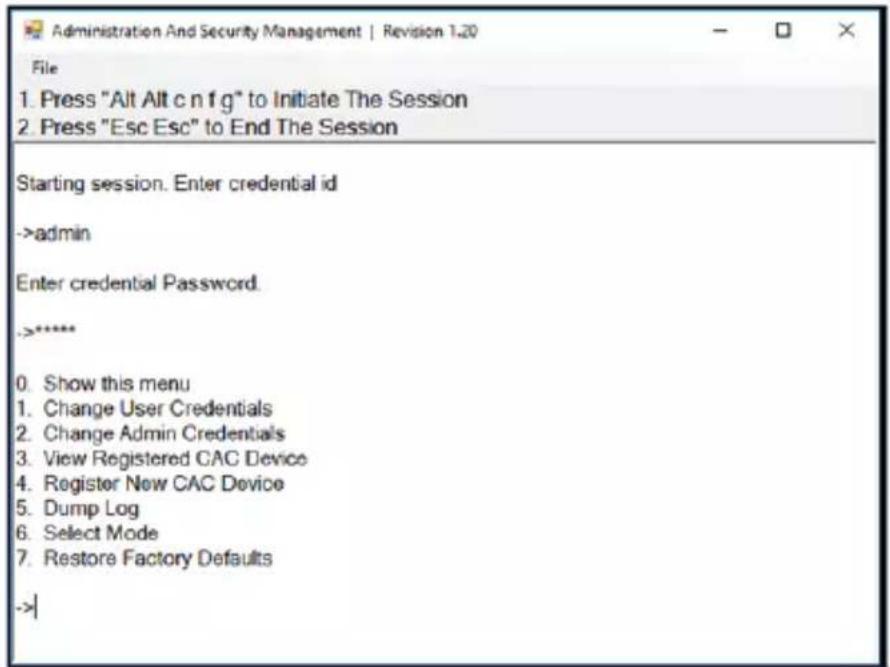
- Seven options will appear in a numerical menu. Select option 6 and press Enter.
- A menu will appear prompting you to Select Mode. Type local and press Enter. The Administration and Security Management Tool will automatically learn and store the display's EDID. The device will then reset and reboot. At the end of the boot-up, ensure all connected computers are properly displaying video on the connected monitor.
Miscellaneous KVM Functionality
Note: The following steps are intended for the system administrator only.
Disabling CAC Functionality
To disable CAC for any port on the KVM switch (all CAC ports are enabled as default), use the front panel push-buttons to switch the KVM to the port whose CAC mode you wish to change. Once selected, the push-button LED for the selected port will illuminate blue to indicate CAC functionality is enabled. Press and hold the button for 3 seconds until the blue push-button LED turns off. CAC functionality for the port is now disabled.
Enabling CAC Functionality
To enable CAC for any port on the KVM switch, use the front panel push-buttons to switch the KVM to the port whose CAC mode you wish to change. Once selected, the push-button LED for this specific channel should be off to indicate CAC functionality is disabled. Press and hold the button for 3 seconds until the blue push-button LED turns on. CAC functionality for the port is now enabled.
CAC Port Configuration
Note: The following steps are intended for the system administrator.
CAC port configuration is an optional feature, allowing registration of any USB peripheral to operate with the KVM. Only one peripheral can be registered at a time, and only the registered peripheral will be able to operate with the KVM. If a peripheral other than the registered peripheral is plugged in to the USB-A CAC port, it will not work. When no peripheral is registered, the KVM will default to operate with any CAC Reader. To configure the USB-A CAC port, follow the instructions below.
Note: Only one computer connected to port 1 is required for this operation.
- Open the Administration and Security Management Program (See the EDID Learn section for download instructions). The Administration and Security Management screen will appear.
Miscellaneous KVM Functionality
- Initiate the session by pressing the following hotkey command, one key after another.
[Alt][Alt][c][n][f][g]
- Upon completing the command, the mouse connected to the KVM will stop functioning. A prompt will appear to enter the Credential ID.
- Log in by entering the default username admin and pressing Enter.
- Enter the default password 12345 and press Enter.
- Select option 2 from the menu on your screen and press Enter.
- Connect the USB peripheral device to be registered to the console USB-A CAC port on the KVM. Wait until the KVM is reading the new peripheral information.
- When registration is completed, the KVM will list the information of the newly configured peripheral on the screen and vibrate 3 times.
![Tripp Lite B002DV2A4 - [Alt][Alt][c][n][f][g] - 1](/content/2026/03/534619/images/179d23edc2e16194720610bed5a0c5300494af8f2f8b96894256895ad269636e.jpg)
text_image
Administration And Security Management | Revision 1.20 File 1. Press "Alt Alt c n f g" to Initiate The Session 2. Press "Esc Esc" to End The Session Enter Password. ->***** 0. Show this menu 1. View Registered CAC Device 2. Register New CAC Device ->2 Insert CAC Device Vendor ID = 0BDA Product ID = 58BB Manufacturer : Generic Product : FULL HD 1080P Webcam Serial Number: 200901010001 This device is now registered. ->|Miscellaneous KVM Functionality
AUDITING: Dumping the Event Log
Note: The following steps are intended for the system administrator.
The Event Log is a detailed report of critical activities stored in the KVM or KVM memory. To view or dump the Event Log, follow the instructions below.
Note: Only one computer connected to port 1 is required for this operation.
- Open the Administration and Security Management Program (See the EDID Learn section for download instructions). The Administration and Security Management screen will appear.
- Initiate the session by pressing the following hotkey command. Hit each key one after another.
[Alt][Alt][c][n][f][g]
-
Upon completing the command, the mouse connected to the KVM will stop functioning. A prompt will appear to enter the Credential ID.
-
Log in by entering the default username admin and pressing Enter.
-
Enter the default password 12345 and press Enter.
-
Request a Log Dump by selecting option 5 in the menu.
Miscellaneous KVM Functionality
text_image
Administration And Security Management | Revision 1.20 File 1. Press "Alt Alt c n f g" to Initiate The Session 2. Press "Esc Esc" to End The Session Starting session. Enter credential id ->admin Enter credential Password. ->**** 0. Show this menu 1. Change User Credentials 2. Change Admin Credentials 3. View Registered CAC Device 4. Register New CAC Device 5. Dump Log 6. Select Mode 7. Restore Factory Defaults ->|RESET: Restore Factory Defaults
Note: The following steps are intended for the system administrator.
Restore Factory Defaults will reset all settings on the KVM to their original state:
- KVM mode
• CAC port registration will be removed
• KVM settings will be reset to factory defaults
To Restore Factory Defaults, follow the steps below.
Note: Only one computer connected to port 1 is required for this operation.
- Open the Administration and Security Management Program (See the EDID Learn section for download instructions). The Administration and Security Management screen will appear.
Miscellaneous KVM Functionality
- Initiate the session by pressing the following hotkey command, one key after another.
[Alt][Alt][c][n][f][g]
- Upon completing the command, the mouse connected to the KVM will stop functioning. A prompt will appear to enter the Credential ID.
- Log in by entering the default username admin and pressing Enter.
- Enter the default password 12345 and press Enter.
- Select option 7 from the menu on your screen and press enter to restore the KVM to its factory default settings.
Note: A comprehensive feature list and instructions for the Administration and Security Management Utility can be found in the Administrator's Guide available at tripplite.com/support.
Power Up Self-Test
If all front panel LEDs are on and not flashing, the Power Up Self-Test failed and all functions are disabled. Check if any of the front panel power selection buttons are jammed. In this case, release the jammed button and recycle power. If Power Up Self-Test continues to fail, contact Tripp Lite Technical Support at triplite.com/support.
Warranty and Product Registration
3-Year Limited Warranty
TRIPP LITE warrants its products to be free from defects in materials and workmanship for a period of three (3) years from the date of initial purchase.
TRIPP LITE's obligation under this warranty is limited to repairing or replacing (at its sole option) any such defective products. To obtain service under this warranty, you must obtain a Returned Material Authorization (RMA) number from TRIPP LITE or an authorized TRIPP LITE service center. Products must be returned to TRIPP LITE or an authorized TRIPP LITE service center with transportation charges prepaid and must be accompanied by a brief description of the problem encountered and proof of date and place of purchase. This warranty does not apply to equipment which has been damaged by accident, negligence or misapplication or has been altered or modified in any way.
EXCEPT AS PROVIDED HEREIN, TRIPP LITE MAKES NO WARRANTIES, EXPRESS OR IMPLIED, INCLUDING WARRANTIES OF MERCHANTABILITY AND FITNESS FOR A PARTICULAR PURPOSE. Some states do not permit limitation or exclusion of implied warranties; therefore, the aforesaid limitation(s) or exclusion(s) may not apply to the purchaser.
PRODUCT REGISTRATION
Visit tripplite.com/warranty today to register your new Tripp Lite product. You'll be automatically entered into a drawing for a chance to win a FREE Tripp Lite product!*
* No purchase necessary. Void where prohibited. Some restrictions apply. See website for details.
Tripp Lite has a policy of continuous improvement. Specifications are subject to change without notice.

text_image
TRIPP·LITE1111 W. 35th Street, Chicago, IL 60609 USA • tripplite.com/support
text_image
Administration And Security Management | Revision 1.20 File 1. Press "Alt Alt c n f g" to Initiate The Session 2. Press "Esc Esc" to End The Session Enter Password. ->***** 0. Show this menu 1. View Registered CAC Device 2. Register New CAC Device ->2 Insert CAC Device Vendor ID = 0BDA Product ID = 58BB Manufacturer : Generic Product : FULL HD 1080P Webcam Serial Number: 200901010001 This device is now registered. ->|Funcionalidades Misceláneas del KVM
text_image
Administration And Security Management | Revision 1.20 File 1. Press "Alt Alt c n f g" to Initiate The Session 2. Press "Esc Esc" to End The Session Starting session. Enter credential id ->admin Enter credential Password. ->**** 0. Show this menu 1. Change User Credentials 2. Change Admin Credentials 3. View Registered CAC Device 4. Register New CAC Device 5. Dump Log 6. Select Mode 7. Restore Factory Defaults ->|1111 W. 35th Street, Chicago, IL 60609 USA • tripplite.com/support
text_image
Administration And Security Management | Revision 1.20 File 1. Press "Alt Alt c n f g" to Initiate The Session 2. Press "Esc Esc" to End The Session Enter Password. ->***** 0. Show this menu 1. View Registered CAC Device 2. Register New CAC Device ->2 Insert CAC Device Vendor ID = 0BDA Product ID = 58BB Manufacturer : Generic Product : FULL HD 1080P Webcam Serial Number: 200901010001 This device is now registered. ->|text_image
Administration And Security Management | Revision 1.20 File 1. Press "Alt Alt c n f g" to Initiate The Session 2. Press "Esc Esc" to End The Session Starting session. Enter credential id ->admin Enter credential Password. ->**** 0. Show this menu 1. Change User Credentials 2. Change Admin Credentials 3. View Registered CAC Device 4. Register New CAC Device 5. Dump Log 6. Select Mode 7. Restore Factory Defaults ->|1111 W. 35th Street, Chicago, IL 60609 USA • tripplite.com/support