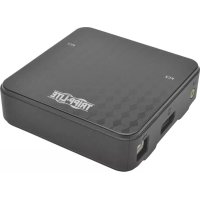
B004DP2UA2K - Switch Tripp Lite - Free user manual and instructions
Find the device manual for free B004DP2UA2K Tripp Lite in PDF.

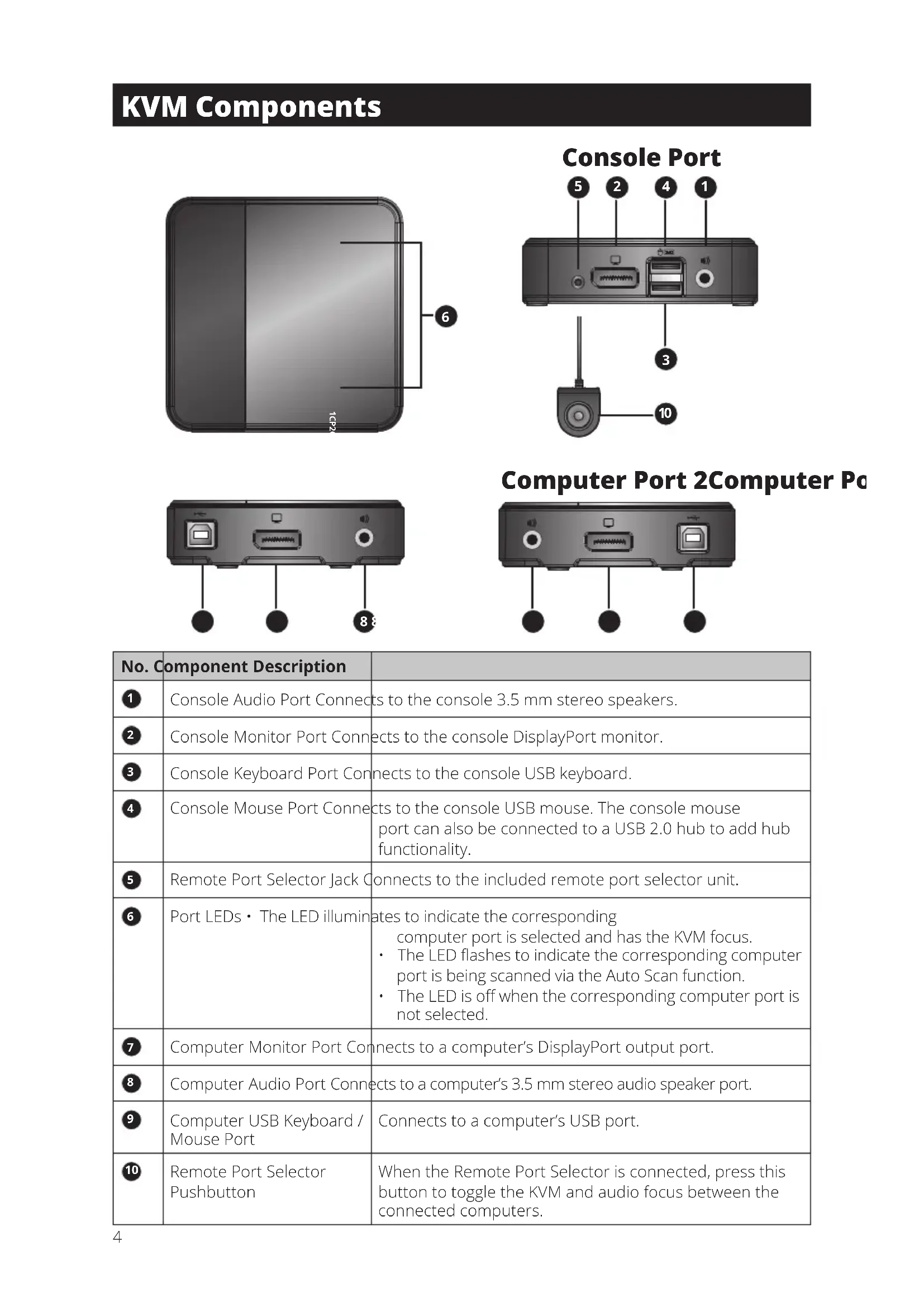


| Product Type | DisplayPort 2-Port KVM Switch |
| Brand | Tripp Lite |
| Model | B004-DP2UA2-K |
| Number of Computer Ports | 2 |
| Console Ports | 1x DisplayPort (Female), 1x USB Type B (Keyboard), 1x USB Type B (Mouse), 1x 3.5 mm Stereo Audio (Female) |
| Computer Ports | 2x DisplayPort (Female), 2x USB Type B (Female), 2x 3.5 mm Stereo Audio (Female) |
| Maximum Video Resolution | 3840 × 2160 at 60 Hz (UHD) |
| DisplayPort Standard | DisplayPort 1.2, MST (Multi-Stream Transport) Compatible |
| HDCP Compatibility | Yes |
| Audio Support | 2.1 Channel Stereo Audio, HD Audio via DisplayPort |
| Port Selection Methods | Remote Port Selector, Hotkey Commands, Mouse Scroll Double-Click |
| Keyboard/Mouse Emulation | Full USB, Mac and Sun Compatible |
| Special Features | Power-On Detection, Auto-Scan, MST Mode, USB 2.0 Hub via Mouse Port |
| Supported Operating Systems | Windows 2000+, Mac OS 9.0+, Linux RedHat 6.0+, SuSE 8.2+, Mandriva 9.0+, UNIX AIX 4.3+, FreeBSD 3.51+, Novell Netware 5.0+, DOS 6.2+ |
| Power Supply | USB Bus-Powered (No External Power Required) |
| Dimensions (H x W x D) | 1.1 × 3.7 × 3.7 in (268 × 930 × 937 mm) |
| Weight | 0.12 kg (0.26 lb) |
| Operating Temperature | 0 to 50 °C |
| Storage Temperature | -20 to 60 °C |
| Humidity | 0 to 80% RH, Non-Condensing |
| Warranty | 3-Year Limited |
Frequently Asked Questions - B004DP2UA2K Tripp Lite
User questions about B004DP2UA2K Tripp Lite
0 question about this device. Answer the ones you know or ask your own.
Ask a new question about this device
Download the instructions for your Switch in PDF format for free! Find your manual B004DP2UA2K - Tripp Lite and take your electronic device back in hand. On this page are published all the documents necessary for the use of your device. B004DP2UA2K by Tripp Lite.
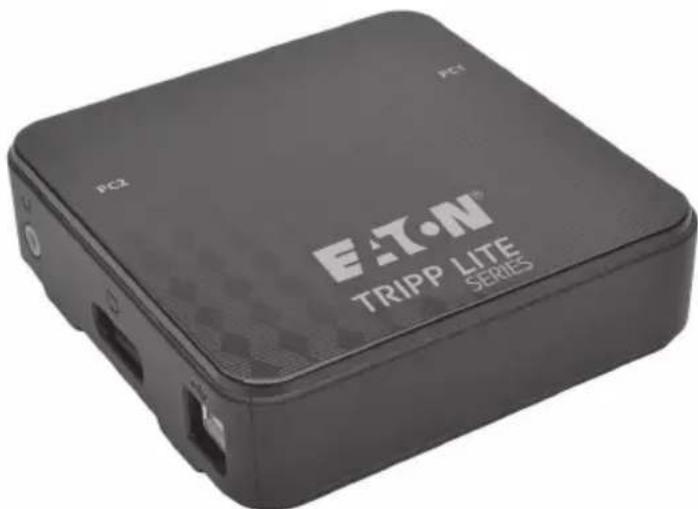
USER MANUAL B004DP2UA2K Tripp Lite
USB Peripheral Sharing
Model: B004-DP2UA2-K
Features 2
Package Contents 3
Optional Accessories 3
Console Requirements 3
Computer Requirements 3
Supported Operating Systems 3
KVM Components 4
Installation 5
KVM Operation 6
Appendix 9
Warranty 12
Espanol 13
Francais 25
Deutsch 37
Italiano 49
Features
- Control two DisplayPort™ computers from a single DisplayPort video console
- DisplayPort 1.2 compliant
Supports MST (Multi-Stream Transport) ^1 ,enabling multiple monitors to be used via a single DisplayPort connector
Supports Ultra High Definition (UHD) video resolutions up to 3840 × 2160 @ 60Hz - Computer selection via remote port selector, hotkeys, and USB mouse ^2
- Mouse port switching functionality allows users accessing the KVM switch with a scroll mouse to switch between ports by double-clicking the mouse's scroll wheel2
Supports DisplayPort Dual Mode (DP + + )^3 for directly outputting single-link DVI or HDMI signals via a DisplayPort to HDMI or DVI adapter
Transmits the monitor's EDID (Extended Display Identification Data) to the connected computers to optimize display resolution - HDCP-compliant
- Power on detection automatically switches to the next powered-on computer when the currently selected computer is powered off
Supports 2.1 channel surround sound systems
Supports HD Audio 4 through DisplayPort playback - Allows for the focus of the KVM and Audio to be switched independently of each other—for example, you can access one computer while at the same time listening to audio from another computer4
Supports multimedia keyboards, as well as wireless keyboards and mice
Supports most mouse drivers and multifunction mice
Mac and Sun keyboard support and emulation 5 - Add USB 2.0 hub port functionality by connecting a USB hub to the mouse port on the KVM switch6
- Bus powered; no external power supply required
- Firmware upgradable
- Auto Scan mode allows you to scan the connected computers without having to manually switch between them
- LEDs provide easy monitoring of the connected computers
- Complete keyboard emulation for error-free booting
- Quick installation without the need for software
- Compatible with Windows®, Mac® and Linux operating systems
1 MST (Multi-Stream Transport) requires the source computers have a DisplayPort 1.2 compatible graphics card. In addition, the connected monitors must feature DisplayPort output ports for daisychaining or a DisplayPort MST Hub must be used.
2 Mouse port switching is only supported when both the KVM's mouse port switching and mouse emulation mode features are enabled, and only 3-key wheel mice are supported.
3 The connected computers must have DisplayPort Dual Mode (DP++) compatible graphics card to use passive DisplayPort to HDMI or DVI adapters in order to connect a non-DisplayPort monitor. If the connected computer's graphics card is not DP++ compatible, an active DisplayPort to HDMI or DVI adapter is required.
4 HD audio through DisplayPort cannot be switched independently.
PC keyboard hotkey combinations emulate the special keys on Mac and Sun keyboards. Mac and Sun keyboards work only with Mac and Sun computers.
6 The use of an external power supply with the connected USB hub is recommended to ensure proper functionality. The KVM's Mouse Emulation Mode must be disabled when connecting a USB hub.
Package Contents
B004-DP2UA2-K KVM Switch
- (x2) DisplayPort Monitor Cables
- (x2) USB A/B Device Cables
- (x2) 3.5 mm Stereo Audio Cables
- Remote Port Selector
- Owner's Manual
Optional Accessories
- B156-002 DisplayPort v1.2 MST Hub - 2-Port
- B156-002-DVI DisplayPort v1.2 to DVI MST Hub - 2-Port
B156-002-HDMI DisplayPort 1.2 to HDMI MST Hub - 2-Port
B156-004-HD DisplayPort 1.2 to HDMI MST Hub - 4-Port -
P581-006-V2 DisplayPort 1.2 to DVI Active Adapter Cable - 6 ft.
-
P581-006-VGA-V2 DisplayPort 1.2 to VGA Active Adapter Cable - 6 ft.
- P582-006-V2 DisplayPort 1.2 to HD Adapter Cable - 6 ft.
- P582-006-V2-ACT DisplayPort 1.2 to HD Active Adapter Cable - 6 ft.
U222-004-R 4-Port USB 2.0 Ultra Compact Hub
U222-007-R 7-Port USB 2.0 Hub
U222-010-R 10-Port USB 2.0 Hub
Console Requirements
- A DisplayPort monitor capable of supporting the highest resolution out of any computer in the installation
- USB mouse and keyboard
- Speakers with a 3.5mm male connector (if using speaker functionality)
Computer Requirements
- DisplayPort audio/video port
-
USB port
-
3.5 mm audio jack (if using speaker functionality)
Supported Operating Systems
| OS Version | |
| Windows 2000 and higher | |
| Mac OS 9.0 and higher | |
| Linux RedHat 6.0 and higher | |
| Linux SuSE 8.2 and higher | |
| Linux Mandriva (Mandrake) 9.0 and higher | |
| UNIX AIX 4.3 and higher | |
| UNIX FreeBSD 3.51 and higher | |
| Novell Netware 5.0 and higher | |
| DOS 6.2 and higher |
KVM Components
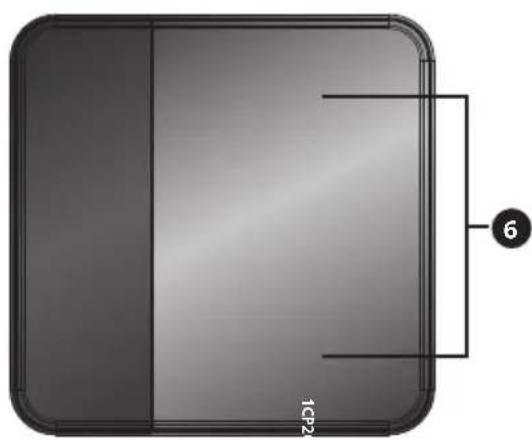
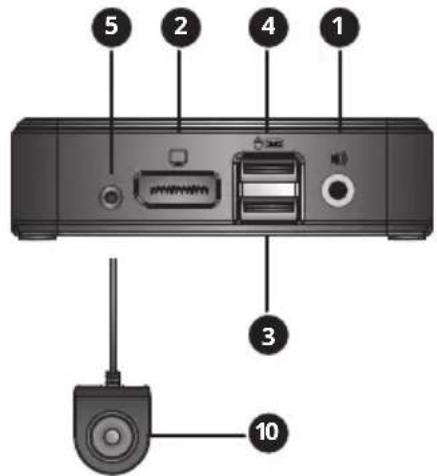
Console Port
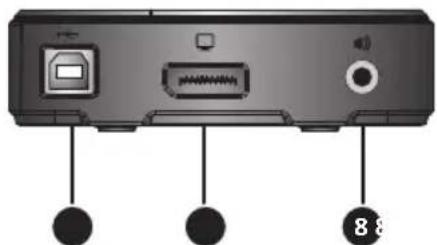
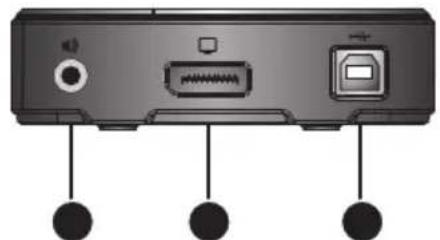
Computer Port 2Computer Pd
| No. | Component Description | |
| 1 | Console Audio Port Connects to the console 3.5 mm stereo speakers. | |
| 2 | Console Monitor Port Connects to the console DisplayPort monitor. | |
| 3 | Console Keyboard Port Connects to the console USB keyboard. | |
| 4 | Console Mouse Port Connects to the console USB mouse. The console mouse port can also be connected to a USB 2.0 hub to add hub functionality. | |
| 5 | Remote Port Selector Jack Connects to the included remote port selector unit. | |
| 6 | Port LEDs • The LED illuminates to indicate the corresponding computer port is selected and has the KVM focus. • The LED flashes to indicate the corresponding computer port is being scanned via the Auto Scan function. • The LED is off when the corresponding computer port is not selected. | |
| 7 | Computer Monitor Port Connects to a computer's DisplayPort output port. | |
| 8 | Computer Audio Port Connects to a computer's 3.5 mm stereo audio speaker port. | |
| 9 | Computer USB Keyboard / Mouse Port Connects to a computer's USB port. | |
| 10 | Remote Port Selector Pushbutton | When the Remote Port Selector is connected, press this button to toggle the KVM and audio focus between the connected computers. |
Installation
Refer to the following steps and diagram to set up your KVM switch installation.
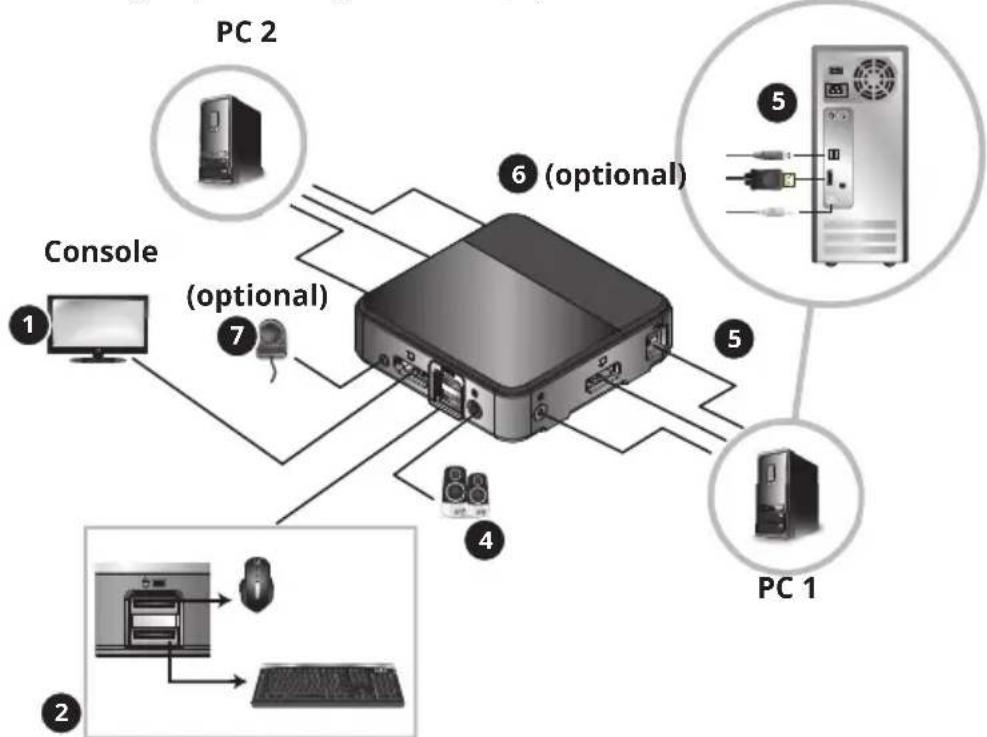
Notes:
- Before making any connections, make sure power to all devices being connected to the KVM switch is turned off. Unplug the power cords of any computers that have the Keyboard Power On function.
It is recommended that the total length between the console monitor and connected computers (including the KVM) not exceed 10 ft. (3 m).
Connect your monitor to the DisplayPort console port on the KVM switch.
Note: You can connect a DVI, HDMI or VGA monitor using a DisplayPort to DVI, HDMI or VGA adapter (see the Features and Optional Accessories sections of this manual for details).
OR
If the computers you are connecting have graphics cards that support Multi-Stream Transfer (MST), and you wish to connect multiple monitors, you can connect an MST Hub to the DisplayPort console port on the KVM switch. You can then connect multiple monitors to the monitor ports on the MST hub, and use the computer's graphics card display settings to customize how video is being displayed. This can also be achieved without an MST hub when using DisplayPort monitors that feature MST input and output ports for chaining multiple monitors together.
Connect your USB keyboard and mouse into the corresponding USB console ports of the KVM switch (the console mouse port is on top, and keyboard port on bottom).
Optional - A USB hub can be connected to the USB console mouse port, allowing you to add multiple USB peripherals to your installation.
Note: To ensure proper functionality, use a hub with an external power supply. Also, the KVM's Mouse Emulation Mode must be disabled (see the Hotkey section of this manual for details) when connecting a hub.
4 Connect your speakers to the console audio jack on the KVM switch.
5 Connect a set of computer monitor, keyboard/mouse and audio ports on the KVM switch to a computer using the included DisplayPort, USB and 3.5 mm stereo audio cables.
Optional - Repeat step 5 to connect a second computer.
Optional - Connect the Remote Port Selector to the corresponding 3.5mm jack on the KVM switch.
Turn on the power to all connected devices. The KVM switch focus will automatically switch to the first computer that is powered on.
KVM Operation
There are three ways of accessing computers and devices connected to the KVM switch.
- Remote Port Selector
- Mouse port switching functionality
- Keyboard Hotkeys
Notes:
- When switching ports, wait a few seconds for the selected computer's video to display on the console monitor prior to switching ports again.
- Do not switch port when a USB peripheral device is in operation.
Remote Port Selector
Press the button on the remote port selector to toggle both KVM and audio focus between ports.
Mouse Port Switching Functionality
Note: Mouse port switching is disabled by default and must be enabled via keyboard hotkey command. In addition, this function is only supported when the KVM's mouse emulation mode is enabled, which is also disabled by default (see the Hotkey section for details). Only 3-key wheel mice are supported.
When enabled, the Mouse Port Switching Functionality allows users with scroll mice to simultaneously switch the focus of the KVM and Audio between ports by double-clicking the scroll wheel on their mouse.
Keyboard Hotkeys
Hotkeys allow you to switch functionality focus between ports using only the keyboard, as well as perform other functions on the KVM switch. All hotkey commands start by pressing the [Scroll Lock] key twice and are followed by one or more keys pressed. For example, to toggle both KVM and Audio focus between ports, one would press [Scroll Lock] [Scroll Lock] [Enter].
Alternate Hotkey Preceding Sequence
By default, hotkey sequences start by hitting the [Scroll Lock] key twice; however, if using [Scroll Lock] conflicts with other programs on the connected computers, you can change this to use the [Ctrl] key instead. You can change the hotkey preceding sequence in two ways:
- Press [Scroll Lock] [Scroll Lock] [x] [Enter] to switch to the [Ctrl] key. Pressing [Ctrl] [Ctrl] [x] [Enter] will switch the hotkey preceding sequence back to [Scroll Lock].
OR - With the remote port selector connected to the KVM, press and hold the selector button for three seconds to toggle between the two hotkey preceding sequences.
KVM Operation
Hotkey Command Summary Table
The following table lists the keyboard hotkey commands available for use on the KVM switch.
| Hotkey Preceding Sequence | Hotkey Command | Function |
| [Scroll Lock] [Scroll Lock] OR [Ctrl] [Ctrl] | [Enter] Switches both KVM and Audio focus between ports. | |
| [k] [Enter] Switches only the KVM focus between ports. | ||
| [s] [Enter] Switches only the Audio focus between ports. | ||
| [a] [Enter] [n] | Initiates an Auto Scan at specified intervals, with [n] being either 1, 2, 3, or 4. (1 = 3 seconds, 2 = 5 seconds, 3 = 10 seconds, 4 = 20 seconds) Press the [Esc] or [Spacebar] key during an Auto Scan to stop scanning on the currently selected port. | |
| [x] [Enter] Toggle the hotkey preceding sequence between [Scroll Lock] and [Ctrl]. | ||
| [m] [Enter] Enables/Disables the Mouse Emulation function. This function is enabled by default. | ||
| [w] [Enter] Enables/Disables the Mouse Port Switching function. This function is disabled by default. | ||
| [F2] [Enter] Activates Mac keyboard mapping. | ||
| [F3] [Enter] Activates Sun keyboard mapping. | ||
| [F10] [Enter] | Auto detects the keyboard operating platform. | |
| [F4] [Enter] Lists the current switch settings. To perform this hotkey, you must first have a text editor or word processor (such as Microsoft Word) open, with the cursor in the page window. Upon performing this hotkey, the KVM's current settings will be displayed. | ||
| [F5] [Enter] Performs a USB keyboard and mouse reset. | ||
| [e] [Enter] Enables/Disables the Power On Detection feature. This function is enabled by default. | ||
| [r] [Enter] Resets hotkeys to the default setting. | ||
| [u][p][g][r] [a][d][e] | Causes the KVM to enter into Firmware Upgrade mode. | |
| [F6], [nn], [Enter] | Sets the keyboard language layout, with [nn] being a two digit number that represents the desired language code. (33 = U.S. English (Default), 15 = Japanese, 08 = French, 09 = German) | |
| [q], [n], [Enter] | Enables/Disables monitor redetection, with [n] being either Computer Port 1 or 2. This function is disabled by default. Enabling it can help if you are experiencing issues with your display. | |
KVM Operation
Firmware Upgrade
As firmware upgrades become available, they can be found at Triplite.Eaton.com/support. The Firmware Upgrade Utility comes with the firmware upgrade file built-in. To upgrade the firmware of your KVM switch, follow the steps below:
From a computer that is not part of your KVM installation, go to Triplite.Eaton.com/support and download the firmware upgrade file for your KVM switch.
The next step is to enter the KVM into firmware upgrade mode, of which there are two ways:
- Disconnect the KVM switch from the console, all computers, and any accessories (e.g. USB Hub). Press and hold the selector button on the remote port selector. While continuing to hold the button down, connect the computer you used to download the firmware upgrade file to one of the USB computer ports on the KVM.
OR - Connect the computer you used to download the firmware upgrade file to one of the USB computer ports on the KVM switch. Enter the KVM into firmware upgrade mode by pressing the [Scroll Lock] [Scroll Lock] [u] [p] [g] [r] [a] [d] [e] hotkey command.
The KVM now enters Firmware Upgrade Mode, with the Port LEDs flashing to indicate the unit is in Firmware Upgrade Mode.
Note: While the KVM is in Firmware Upgrade Mode, normal keyboard and mouse functions are suspended. You must complete the firmware upgrade or exit Firmware Upgrade Mode to regain normal control of the console.
4 Run the Firmware Upgrade Package file. The Firmware Upgrade Utility Welcome screen appears.
5 Read the License Agreement, clicking the /Agree button to proceed.
Click Next to continue. The Firmware Upgrade Utility main screen appears. All the devices capable of being upgraded are listed in the Devices List panel.
Select your device. Its description appears in the Device Description panel. Click Next to perform the upgrade.
As the upgrade proceeds, status messages appear in the Status Messages panel and the progress towards completion is shown in the Progress bar.
After the upgrade has completed, a screen appears to inform you that procedure was successful. Click Finish to close the Firmware Upgrade Utility.
Upgrade Failed
If the Upgrade Succeeded screen does not appear, it means the upgrade failed to complete successfully. If this occurs, do the following:
1 Disconnect the USB cable from the connected computer.
Press and hold the Remote Port Selector's pushbutton. While still holding the pushbutton, reconnect the KVM cable's USB connectors to the computer.
3 Follow steps 3 to 9 of the Firmware Upgrade section again.
Appendix
Mac Keyboard Emulation
The PC compatible (101/104 key) keyboard can emulate the functions of the Mac keyboard using the PC keystrokes in the table below.
Note: When more than one key is required on the PC Keyboard to emulate the Mac keyboard, press and release the first key, then press and release the second key.
| PC Keyboard Mac Keyboard | |
| [Shift] [Shift] | |
| [Ctrl] [Ctrl] | |
| H | |
| [Ctrl], [1] | |
| [Ctrl], [2] | |
| [Ctrl], [3] | |
| [Ctrl], [4] | |
| [Alt] [Alt] | |
| [Print Screen] [F13] | |
| [Scroll Lock] [F14] | |
| [=] | |
| [Enter] [Return] | |
| [Backspace] [Delete] | |
| [Insert] [Help] | |
| [Ctrl], | |
| [F15] | |
Appendix
Sun Keyboard Emulation
The PC compatible (101/104 key) keyboard can emulate the functions of the Sun keyboard using the PC keystrokes in the table below.
Note: When more than one key is required on the PC Keyboard to emulate the Sun keyboard, press and release the first key, then press and release the second key.
| PC Keyboard Sun Keyboard | |
| [Ctrl], [T] [Stop] | |
| [Ctrl], [F2] [Again] | |
| [Ctrl], [F3] [Props] | |
| [Ctrl], [F4] [Undo] | |
| [Ctrl], [F5] [Front] | |
| [Ctrl], [F6] [Copy] | |
| [Ctrl], [F7] [Open] | |
| [Ctrl], [F8] [Paste] | |
| [Ctrl], [F9] [Find] | |
| [Ctrl], [F10] [Cut] | |
| [Ctrl], [1] | □ □ |
| [Ctrl], [2] | ①-② |
| [Ctrl], [3] | ①+② |
| [Ctrl], [4] | C |
| [Ctrl], [H] [Help] | |
| ◆ | |
Appendix
Factory Default Settings
| Setting Default | |
| Hotkey Preceding Sequence [Scroll Lock], [Scroll Lock] | |
| Auto Scan Interval 5 seconds | |
| Keyboard Operating Platform PC Compatible | |
| Mouse Emulation Enabled | |
| Mouse Port Switching Disabled | |
| Power On Detection Enabled |
Specifications
| Feature Specification | |
| # of Computer Ports 2 | |
| Port Selection Hotkeys, Remote Port Selector, Mouse Switching Function* | |
| Console Keyboard/Mouse Ports | (x2) USB-B (Female) |
| Console Video Port DisplayPort (Female) | |
| Console Speaker Port 3.5 mm (Female) | |
| Computer Ports (x2) DisplayPort (Female), (x2) USB-B (Female), (x2) 3.5 mm (Female) | |
| USB 2.0 Hub Ports USB Mouse Port can be used to connect a USB Hub (see Installation section for details) | |
| Keyboard/Mouse Emulation USB | |
| Max Video Resolution 3840 x 2160 @ 60Hz | |
| Operating Temperature 32° to 122°F / 0° to 50°C | |
| Storage Temperature -4° to 140°F / -20° to 60°C | |
| Humidity | 0 to 80% RH, Non-Condensing |
| Unit Dimensions (H x W x D) 1.1 x 3.7 x 3.7 in. / 268 x 930 x 937 mm | |
| Unit Weight | 0.26 lb. / 0.12 kg |
- Mouse port switching is disabled by default and must be enabled via keyboard hotkey command. In addition, it is only supported when the KVM's mouse emulation mode is enabled, which is enabled by default (see the Hotkey section for details). Only 3-key wheel mice are supported.
Warranty
3-YEAR LIMITED WARRANTY
We warrant our products to be free from defects in materials and workmanship for a period of three (3) years from the date of initial purchase. Our obligation under this warranty is limited to repairing or replacing (at its sole option) any such defective products. Visit Triplite.Eaton.com/support/product-returns before sending any equipment back for repair. This warranty does not apply to equipment which has been damaged by accident, negligence or misapplication or has been altered or modified in any way.
EXCEPT AS PROVIDED HEREIN, WE MAKE NO WARRANTYES, EXPRESS OR IMPLIED, INCLUDING WARRANTYES OF MERCHANTABILITY AND FITNESS FOR A PARTICULAR PURPOSE. Some states do not permit limitation or exclusion of implied warranties; therefore, the aforesaid limitation(s) or exclusion(s) may not apply to the purchaser.
EXCEPT AS PROVIDED ABOVE, IN NO EVENT WILL WE BE LIABLE FOR DIRECT, INDIRECT, SPECIAL, INCIDENTAL OR CONSEQUENTIAL DAMAGES ARISING OUT OF THE USE OF THIS PRODUCT, EVEN IF ADVISED OF THE POSSIBILITY OF SUCH DAMAGE. Specifically, we are not liable for any costs, such as lost profits or revenue, loss of equipment, loss of use of equipment, loss of software, loss of data, costs of substitutes, claims by third parties, or otherwise.
WEEE Compliance Information for Customers and Recyclers (European Union)
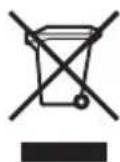
Under the Waste Electrical and Electronic Equipment (WEEE) Directive and implementing regulations, when customers buy new electrical and electronic equipment from Eaton, they are entitled to:
- Send old equipment for recycling on a one-for-one, like-for-like basis (this varies depending on the country)
- Send the new equipment back for recycling when this ultimately becomes waste
FCC Notice, Class B
This device complies with part 15 of the FCC Rules. Operation is subject to the following two conditions: (1) This device may not cause harmful interference, and (2) this device must accept any interference received, including interference that may cause undesired operation.
Note: This equipment has been tested and found to comply with the limits for a Class B digital device, pursuant to part 15 of the FCC Rules. These limits are designed to provide reasonable protection against harmful interference in a residential installation. This equipment generates, uses and can radiate radio frequency energy and, if not installed and used in accordance with the instructions, may cause harmful interference to radio communications. However, there is no guarantee that interference will not occur in a particular installation. If this equipment does cause harmful interference to radio or television reception, which can be determined by turning the equipment off and on, the user is encouraged to try to correct the interference by one or more of the following measures:
Reorient or relocate the receiving antenna.
- Increase the separation between the equipment and receiver.
- Connect the equipment into an outlet on a circuit different from that to which the receiver is connected.
- Consult the dealer or an experienced radio/TV technician for help.
Any changes or modifications to this equipment not expressly approved by Eaton could void the user's authority to operate this equipment.
Eaton has a policy of continuous improvement. Specifications are subject to change without notice.
Compartmento de Periféricos USB
Modelo: B004-DP2UA2-K
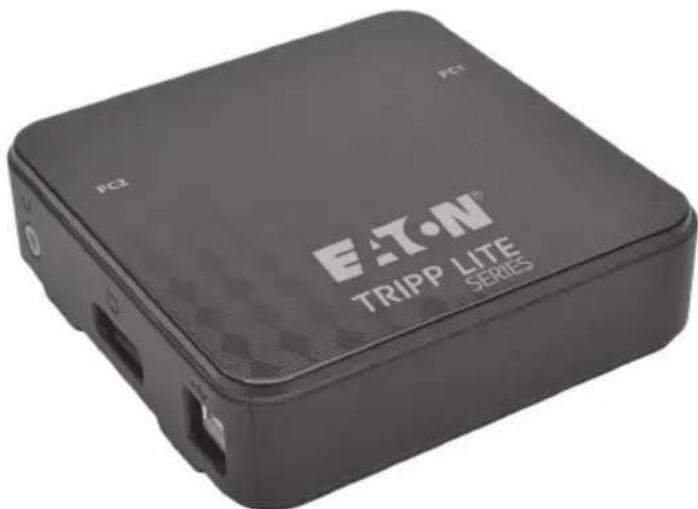
Characteristicas 14
| PC Tastatur Sun | Tastatur |
| [Strg], [T] [Stop] | |
| [Strg], [F2] [Wieder] | |
| [Strg], [F3] [Requisiten] | |
| [Strg], [F4] [Rückgangig] | |
| [Strg], [F5] Vorderseite: | |
| [Strg], [F6] [Kope] | |
| [Strg], [F7] [Öffnen] | |
| [Strg], [F8] [Einfügen] | |
| [Strg], [F9] [Finden] | |
| [Strg], [F10] [Schnitt] | |
| [Strg], [1] | |
| [Strg], [2] | |
| [Strg], [3] | |
| [Strg], [4] | |
| [Strg], [H] [Hilfe] | |
| ◆ |
Anhang
Werkseinstellungen
- USB Peripheral Sharing
- Features
- Package Contents
- Optional Accessories
- Console Requirements
- Computer Requirements
- Supported Operating Systems
- KVM Components
- Installation
- Notes:
- KVM Operation
- Remote Port Selector
- Mouse Port Switching Functionality
- Keyboard Hotkeys
- Alternate Hotkey Preceding Sequence
- Hotkey Command Summary Table
- Firmware Upgrade
- Upgrade Failed
- Appendix
- Mac Keyboard Emulation
- Sun Keyboard Emulation
- Warranty
- 3-YEAR LIMITED WARRANTY
- WEEE Compliance Information for Customers and Recyclers (European Union)
- FCC Notice, Class B
- Compartmento de Periféricos USB
- Anhang
Brand : Tripp Lite
Model : B004DP2UA2K
Category : Switch