ManualGo.com
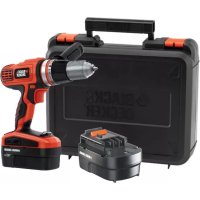
KC14XC - Drill BLACK & DECKER - Free user manual and instructions
Find the device manual for free KC14XC BLACK & DECKER in PDF.



Download the instructions for your Drill in PDF format for free! Find your manual KC14XC - BLACK & DECKER and take your electronic device back in hand. On this page are published all the documents necessary for the use of your device. KC14XC by BLACK & DECKER.
USER MANUAL KC14XC BLACK & DECKER
ENGLISH Intended use Your Black & Decker drill/screwdriver has been designed for screwdriving applications and for drilling in wood, metal and plastics. This tool is intended for consumer use only. Your Black & Decker charger has been designed for charging Black & Decker batteries of the type supplied with this tool. Safety instructions ◆ Warning! When using battery-powered tools, basic safety precautions, including the following, should always be followed to reduce the risk of fire, leaking batteries, personal injury and material damage. ◆ Read all of this manual carefully before operating the tool. ◆ Retain this manual for future reference. Keep work area clean Cluttered areas and benches can cause accidents. Consider work area environment Do not expose the tool to rain. Do not use the tool in damp or wet conditions. Keep the work area well lit. Do not use the tool where there is a risk of causing fire or explosion, e.g. in the presence of flammable liquids and gases. Keep children away Do not allow children, visitors or animals to come near the work area or to touch the tool. Dress properly Do not wear loose clothing or jewellery, as these can be caught in moving parts. Preferably wear rubber gloves and non-slip footwear when working outdoors. Wear protective hair covering to keep long hair out of the way. Personal protection Always use safety glasses. Use a face or dust mask whenever the operations may produce dust or flying particles. Hearing protection should be worn. Do not overreach Keep proper footing and balance at all times. Stay alert Watch what you are doing. Use common sense. Do not operate the tool when you are tired. Secure workpiece Use clamps or a vice to hold the workpiece. It is safer and it frees both hands to operate the tool. Connect dust extraction equipment If devices are provided for the connection of dust extraction and collection facilities, ensure that these are connected and properly used. Remove adjusting keys and wrenches Always check that adjusting keys and wrenches are removed from the tool before operating the tool. Use appropriate tool The intended use is described in this instruction manual. Do not force small tools or attachments to do the job of a heavy-duty tool. The tool will do the job better and safer at the rate for which it was intended. Do not force the tool. Warning! The use of any accessory or attachment or performance of any operation with this tool other than those recommended in this instruction manual may present a risk of personal injury. Check for damaged parts Before use, carefully check the tool for damage. Check for misalignment and seizure of moving parts, breakage of parts, damage to guards and switches and any other conditions that may affect its operation. Ensure that the tool will operate properly and perform its intended function. Do not use the tool if any part is damaged or defective. Do not use the tool if the switch does not turn it on and off. Have any damaged or defective parts repaired or replaced by an authorised repair agent. Never attempt any repairs yourself. Remove the battery Where the design permits, remove the battery when the tool is not in use, before changing any parts of the tool, accessories or attachments and before servicing. Avoid unintentional starting Do not carry the tool with a finger on the on/off switch. Be sure that the tool is switched off when inserting the battery into the tool. Do not abuse cord Never carry the charger by its cord or pull it to disconnect from the socket. Keep the cord away from heat, oil and sharp edges. Store idle tools When not in use, tools, batteries and chargers should be stored in a dry, locked up or high place, out of reach of children. Maintain tools with care Keep cutting tools sharp and clean for better and safer performance. Follow the instructions for maintenance and changing accessories. Keep handles and switches dry, clean and free from oil and grease. Repairs This tool complies with relevant safety requirements. Repairs should only be carried out by qualified persons using original spare parts; otherwise this may result in considerable danger to the user. Additional safety instructions for batteries and chargers Batteries ◆ Never attempt to open for any reason. ◆ Do not expose the battery to water. ◆ Do not store in locations where the temperature may exceed 40 °C. ◆ Charge only at ambient temperatures between 4 °C and 40 °C. ◆ Charge only using the charger provided with the tool.5 ENGLISH ◆ When disposing of batteries, follow the instructions given in the section “Protecting the environment”. ◆ Under extreme conditions, battery leakage may occur. When you notice liquid on the battery, proceed as follows: - Carefully wipe the liquid off using a cloth. Avoid skin contact. - In case of skin or eye contact, follow the instructions below. Warning! The battery fluid, a 25-30% solution of potassium hydroxide, can be harmful. In case of skin contact, immediately rinse with water. Neutralise with a mild acid such as lemon juice or vinegar. In case of eye contact, rinse abundantly with clean water for at least 10 minutes. Consult a physician. Fire hazard! Avoid short-circuiting the contacts of a detached battery (e.g. when storing the battery in a toolbox). Do not incinerate the battery. Do not attempt to charge damaged batteries. Chargers ◆ Use your Black & Decker charger only to charge batteries of the type supplied with your tool. Other batteries could burst, causing personal injury and damage. ◆ Never attempt to charge non-rechargeable batteries. ◆ Have defective cords replaced immediately. ◆ Do not expose to water. ◆ Do not open the charger. ◆ Do not probe the charger. The charger is intended for indoor use only. Electrical safety Your charger is double insulated; therefore no earth wire is required. Always check that the mains voltage corresponds to the voltage on the rating plate. Never attempt to replace the charger unit with a regular mains plug. Features (fig. A) This tool includes some or all of the following features.
1. Variable speed switch or two-speed on/off switch
2. Forward/reverse slider
3. Mode selector / torque adjustment collar
6. Battery release button
9. Charger connector
Assembly Fitting and removing the battery (fig. B) ◆ To fit the battery (5), line it up with the receptacle on the tool. Slide the battery into the receptacle and push until the battery snaps into place. ◆ To remove the battery, push the two release buttons (6) simultaneously while at the same time pulling the battery out of the receptacle. Fitting and removing a drill bit or screwdriver bit (fig. A & C) Warning! First remove the battery from the tool. This tool is fitted with a keyless chuck to allow for an easy exchange of bits. ◆ Lock the tool by setting the forward/reverse slider (2) to the centre position (fig. A). ◆ Open the chuck by turning the front part (11) with one hand while holding the rear part (12) with the other (fig. C). ◆ Insert the bit shank (13) into the chuck. ◆ Firmly tighten the chuck by turning the front part (11) with one hand while holding the rear part (12) with the other. Removing and refitting the chuck (fig. D) ◆ Open the chuck as far as possible. ◆ Remove the chuck retaining screw by turning it clockwise using a screwdriver. ◆ Tighten an Allen key (14) into the chuck and strike it with a hammer as shown. ◆ Remove the Allen key. ◆ Remove the chuck by turning it counterclockwise. ◆ To refit the chuck, screw it onto the spindle and secure it with the chuck retaining screw. Use Charging the battery The battery needs to be charged before first use and whenever it fails to produce sufficient power on jobs that were easily done before. A new battery, or a battery that has not been used for an extended period of time, achieves full performance only after approx. 5 charging and discharging cycles. The battery may become warm while charging; this is normal and does not indicate a problem.6 ENGLISH Warning! Do not charge the battery at ambient temperatures below 4 °C or above 40 °C. Recommended charging temperature: approx. 24 °C. Charger with charging base (fig. E) ◆ To charge the battery (5), remove it from the tool and insert it into the charging base (8). The battery will only fit into the charging base in one way. Do not force. Be sure that the battery is fully seated in the charging base. ◆ Plug in the charger. After normal use, a charging time of 3 hours will provide sufficient power for most applications. However, further charging for up to 6 hours could significantly increase the use time, depending on the battery and charging conditions. ◆ Remove the battery from the charger. Charger without charging base (fig. F) ◆ To charge the battery, make sure that it is fitted on the drill. ◆ Insert the charger plug (10) into the connector (9). ◆ Plug in the charger. Switch on at the mains. After normal use, a charging time of 3 hours will provide sufficient power for most applications. However, further charging for up to 6 hours could significantly increase the use time, depending on the battery and charging conditions. ◆ Disconnect the tool from the charger. Warning! Do not use the tool while it is connected to the charger. Selecting the direction of rotation (fig. A) For drilling and for tightening screws, use forward (clockwise) rotation. For loosening screws or removing a jammed drill bit, use reverse (counterclockwise) rotation. ◆ To select forward rotation, push the forward/reverse slider (2) to the left. ◆ To select reverse rotation, push the forward/reverse slider to the right. ◆ To lock the tool, set the forward/reverse slider into the centre position. Selecting the operating mode or torque (fig. G) This tool is fitted with a collar to select the operating mode and to set the torque for tightening screws. Large screws and hard workpiece materials require a higher torque setting than small screws and soft workpiece materials. The collar has a wide range of settings to suit your application. ◆ For drilling in wood, metal and plastics, set the collar (3) to the drilling position by aligning the symbol
with the marking (15). ◆ For screwdriving, set the collar to the desired setting. If you do not yet know the appropriate setting, proceed as follows: ◆ Set the collar (3) to the lowest torque setting. ◆ Tighten the first screw. ◆ If the clutch ratchets before the desired result is achieved, increase the collar setting and continue tightening the screw. Repeat until you reach the correct setting. Use this setting for the remaining screws. Switching on and off Variable speed switch ◆ To switch the tool on, press the variable speed switch (1). The tool speed depends on how far you press the switch. ◆ To switch the tool off, release the variable speed switch. Two-speed on/off switch ◆ To switch the tool on, press the on/off switch (1). When slightly pressing the switch, the tool will run at low speed. When pressing the switch further, the tool will run at high speed. ◆ To switch the tool off, release the variable speed switch. Hints for optimum use Drilling ◆ Always apply a light pressure in a straight line with the drill bit. ◆ Just before the drill tip breaks through the other side of the workpiece, decrease pressure on the tool. ◆ Use a block of wood to back up workpieces that may splinter. ◆ Use spade bits when drilling large diameter holes in wood. ◆ Use HSS drill bits when drilling in metal. ◆ Use a lubricant when drilling metals other than cast iron and brass. ◆ Make an indentation using a centre punch at the centre of the hole to be drilled in order to improve accuracy. Screwdriving ◆ Always use the correct type and size of screwdriver bit. ◆ If screws are difficult to tighten, try applying a small amount of washing liquid or soap as a lubricant. ◆ Always hold the tool and screwdriver bit in a straight line with the screw. Maintenance Your Black & Decker tool has been designed to operate over a long period of time with a minimum of maintenance. Continuous satisfactory operation depends upon proper tool care and regular cleaning. Your charger does not require any maintenance apart from regular cleaning. Warning! Before performing any maintenance on the tool, remove the battery from the tool. Unplug the charger before cleaning it.7 ENGLISH ◆ Regularly clean the ventilation slots in your tool using a soft brush or dry cloth. ◆ Regularly clean the motor housing using a damp cloth. Do not use any abrasive or solvent-based cleaner. ◆ Regularly open the chuck and tap it to remove any dust from the interior. Protecting the environment Tools Black & Decker provides a facility for recycling Black & Decker products and rechargeable batteries once they have reached the end of their working life. This service is provided free of charge. To take advantage of this service please return your product to any authorised repair agent who will collect them on our behalf. Batteries
Black & Decker batteries can be recharged many times. At the end of their useful life, discard batteries with due care for our environment: ◆ Run the battery down completely, then remove it from the tool. ◆ NiCd and NiMH batteries are recyclable. Take them to any authorised repair agent or a local recycling station. You can check the location of your nearest authorised repair agent by contacting your local Black & Decker office at the address indicated in this manual. Alternatively, a list of authorised Black & Decker repair agents and full details of our after-sales service and contacts are available on the Internet at: www.2helpU.com. Technical data KC96 AST2 KC12 Voltage V
Approx. charging time h 3 EC declaration of conformity Black & Decker declares that these products conform to: EN 50260, EN 55014, EN 60335, EN 61000
(sound pressure): 70 dB(A), L
(acoustic power) 83 dB(A), hand/arm weighted vibration < 2.5 m/s
Is this tool a gift?
Is this tool your first purchase?
Data protection act: Tick the box if you prefer not to receive further information.