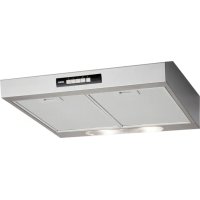
USER MANUAL WO60211BM Atag
Instructions for use
Cooker hood
ATAG
WO602..BM
WO61__BM
WO62.AC
NL Gebruiksaanwijzing NL 3 - NL 16
FR Mode d'emploi FR 3 - FR 16
DE Bedienungsanleitung DE 3 - DE 16
EN Instructions for use EN 3 - EN 16
Extraction systems 5
Use
Controls 6
Maintenance
Cleaning 7
Grease filters 8
Carbon filter 9
Lighting 10
Faults
What should I do if... 11
Faults table 11
Installation
General 12
Electrical connection 12
Built-in dimensions 13
Mounting 13
Technical data
General 15
Matching accessories 15
Appendice
Disposal of appliance and packaging 16
Introduction
Congratulations on your choice of this appliance. This product was designed with simple operation and optimum comfort in mind.
This manual describes the best way to use this appliance. In addition to information on operation, you will also find background information that may come in handy when using the appliance.

Please read the separate safety instructions carefully before using the appliance.
Read this manual before using the appliance and keep it in a safe place for future use.
Description
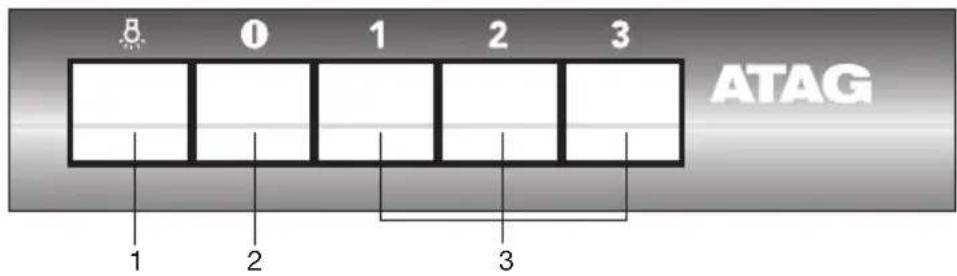
WO602..BM / WO61..BM
WO62.AC
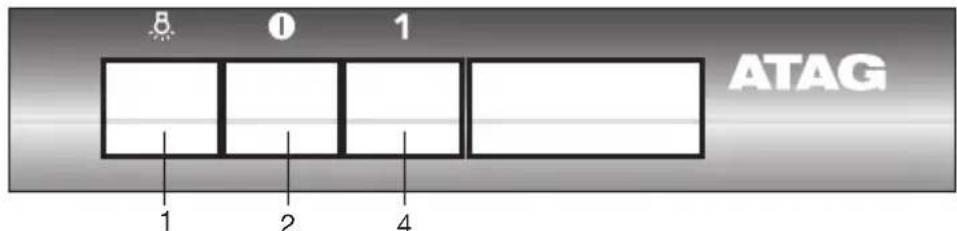
- Lighting button
- Off button
- Speed buttons fan
- Speed button electric valve

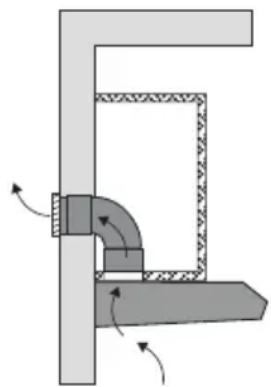
WO602..BM / WO61_.BM
This appliance can be connected in two ways.
- Exhaust to the outside.
The cooking air drawn in is discharged to the outside via a drain hose. Make sure to install a shut-off valve in the drain to prevent cold air from entering through the drain hose. This appliance can be freely hung on the wall in this way, or mounted under a cabinet.

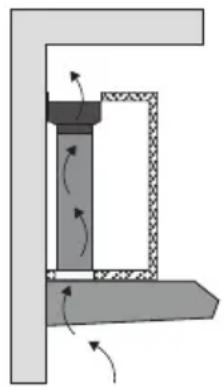
- Recirculation application.
In this application, cooking air is not exhausted to the outside. Contaminated cooking air is filtered and blown back into the kitchen. This requires an additional odour/fine dust filter, which should be replaced regularly for optimal operation.
Attention! The odour/fine dust filter must be ordered separately.
WO62__AC
This appliance is a motorless extractor hood and is only suitable for mounting on a central mechanical ventilation system. By opening the flap, the cooking air is discharged through the central system of the house.
Controls
WO602__BM / WO61__BM
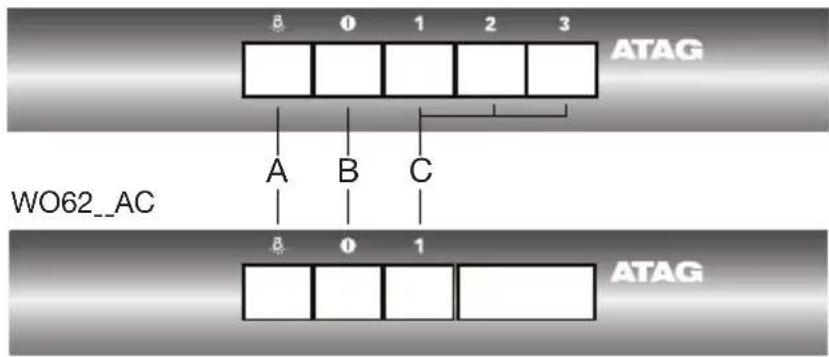
Switching on and off the fan
- Press speed button(s) 'C'.
The cooker hood switches on at setting 1, 2 or 3.
With models that are suitable for a central fan system, the electric valve opens.
- Press the off button 'B'.
The cooker hood switches off.
With models that are suitable for a central fan system, the electric valve closes.
Switching on and off the lighting
- Press the lighting button 'A'.
The lighting switches on.
- Press the lighting button 'A' again.
The lighting switches off.
Cleaning

Note! Before each servicing, first disconnect the cooker hood by removing the plug from the wall socket or by switching off the main switch of the residence.

The cooker hood should be cleaned regularly (at least with the same frequency with which you carry out maintenance of the fat filters) internally and externally. Do not use abrasive products. Do not use alcohol!

Attention! Failure to carry out the basic cleaning recommendations of the cooker hood and replacement of the filters may cause fire risks. Therefore, we recommend oserving these instructions. The manufacturer declines all responsibility for any damage to the motor or any fire damage linked to inappropriate maintenance or failure to observe the above safety recommendations.

Cooker hood
Clean the cooker hood with soapy water and a soft cloth. Then wipe with clean water to rinse. Do not use aggressive cleaning agents such as soda. The cooker hood paintwork will stay looking nice if you wax it occasionally.

Stainless steel canopy hoods
Do not use any sort of scourer. Treat with a stainless steel care product and polish with the structure of the stainless steel.

These must be cleaned once a month (or when the filter saturation indication system – if envisaged on the model in possession – indicates this necessity), using non aggressive detergents, preferably by hand or in the dishwasher, which must be set to a low temperature and a short cycle. The openings must be placed downwards to let the water run out of the filters. The cleaning agents will make the aluminium filter turn dull, this is normal.
Grease filters

Regular filter cleaning ensures optimal performance and prevents release of cooking odours when the appliance is not in use.
Clean the grease filters at least once a month. During cleaning, the aluminium parts of the filters may become dull as a result of the cleaning agents used, particularly when placed in the dishwasher. This is normal.
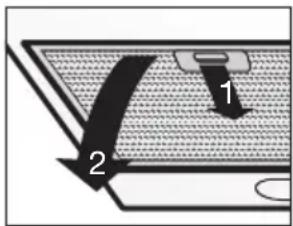
Removing the filter cassette
- Switch off the appliance and the lighting.
- Using the recess, press the filter backwards and tip it downwards at the front.
- Remove the filter from the hood.
Cleaning
- The filters can be easily cleaned by hand. Clean the filters in water and washing-up liquid and rinse them. Afterwards, let the filters drain and dry thoroughly before replacing them.
- You can also clean the filters in the dishwasher if necessary. Afterwards, let the filters drain and dry thoroughly before replacing them.
- The underside of the extractor hood can be cleaned with a mild cleaning agent and a moist cloth.
Reinstalling filter cassette
Make sure the filters are thoroughly dry before replacing them. The filter has to be installed with the locking mechanism at the front.
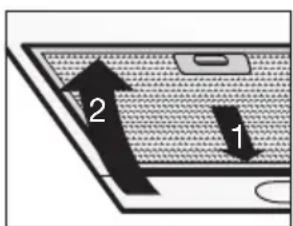
- Open the locking mechanism. This pulls the projections at the front of the filter inwards. When installing the filters hold the locking mechanism in this position.
- Push the projections at the back of the filter into the openings provided for this purpose at the rear of the extractor hood.
- Hinge the filter upwards.
- Release the locking mechanism. The projections at the front of the filter move outwards into the openings provided for this purpose at the front of the extractor hood.
Odour/fine dust filter
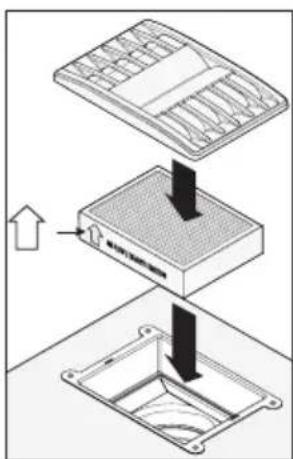
Inserting and replacing the filter in the filter box
Alternative: Inserting and replacing an internal odour/fine dust filter
- If the appliance is not mounted under an overhead cupboard but freely suspended on a wall and cannot drain to the outside, you will alternatively need to install an internal filter to neutralise cooking odours.
- Note that this application causes a sharp increase in noise and significantly reduces the performance of the appliance.
- The internal filter should be replaced every 3 months as it becomes saturated sooner.
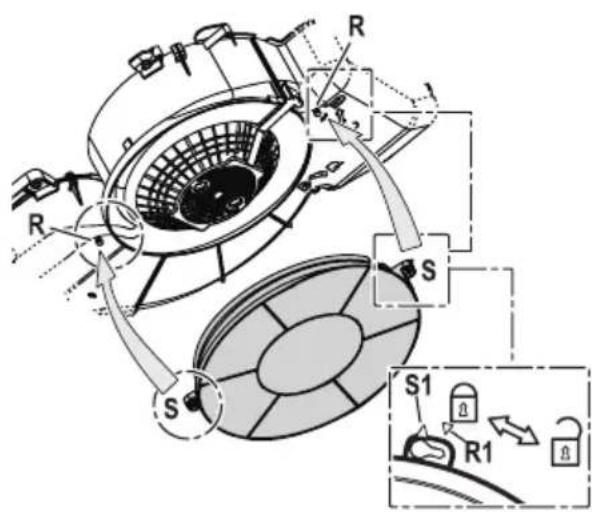

Important:
- Filter saturation depends on the intensity of use, cooking methods and the regularity with which the grease filters are cleaned.
- The applied odour filters are for single use and should be disposed of via the residual waste.
Lighting
Change the light bulbs
The lamp in this household appliance is only suitable for illumination of this appliance. The lamp is not suitable for household room illumination.

Please note!
Disconnect the appliance from the mains by removing the plug from the socket before the changing the light.
Unscrew the lamp from the fitting and replace it with a lamp of the same wattage.
| Lamp Power (W) | Socket Voltage | (V) | Dimension (mm) | ILCOS Code |
| 102° E14 035° | 3 E14 220-2 | 40 102 x 35 | DRBB/C-3-220- | 240-E14-35/102 |
What should I do if...
If the appliance does not work properly, this does not always mean that it is defective. Try to deal with the problem yourself first. Phone the service department if the advice given below does not work.

Attention!
Disconnect the appliance from the mains before starting the repair, preferably by removing the plug from the socket or setting the main switch to zero.
Faults table
| Symptom Possible cause Solution | |
| Lighting is not functioning. Light bulb defective. Change the light bulb (see chapter 'Lighting'). |
| Extractor hood makes a noise. | Discharge too long or too many bends in the duct. | Change the discharge ducting (see installation guide). |
| Flap defective. Phone the service department. |
| Internal odour/fine dust filters inserted. | For recirculation, preferably use the starter set HR0001. |
| No extraction. Flap or controlled defective. Phone the service | department. |
| Connection cable defective. Phone the service department. |
| Grease filters clogged. Clean the grease filters regularly. |
General
- If the cooker hood is to be fitted to an existing duct no other appliances, such as a geyser or heater, may be connected to that same duct.
- Bends produce resistance. Make sure that the duct has a smooth run and has as few bends as possible. Draw the flexible pipe out as far as possible. Before starting to drill, check that there are no installation pipes (for gas, water, etc.) present.
- The discharge stump has a diameter of 125mm . It is best if the discharge pipe also has this diameter.

Attention: Make sure that there is a sufficient supply of fresh air, if an extractor hood and a heat source (e.g. gas cooker) that both consume air from the same room, are switched on at the same time.
The maximum permitted underpressure is 4Pa
Electrical connection
The plug should be accessible after the extractor hood is fitted or it should be possible to disconnect the extractor hood from the mains by means of a bipolar switch with a contact gap of 3mm .

Attention!
When making the electrical connections, take care that the voltage and frequency correspond to the values given on the data plate.
If the connection cable becomes damaged, it should be replaced by the manufacturer's service department or by a person with equivalent qualifications, in order to prevent dangerous situations from arising.
Built-in dimensions
WO62_AC
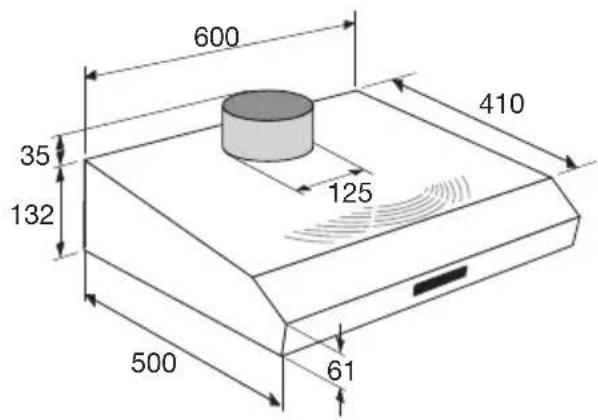
WO60BM / WO61..BM
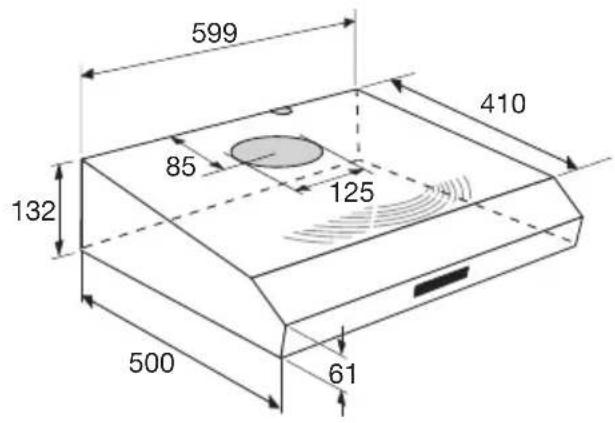
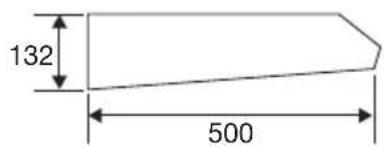
Clearance required
The distance between the underside of the extractor hood and the hob should be at least 550~mm . For gas hobs, this distance should be a minimum of 650~mm .
Mounting
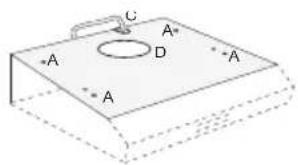
Below a kitchen cupboard
- Working through the hood, draw the 4 mounting holes (A), the hole for the power lead (C) and the hole for the flue (D) on the bottom of the kitchen cupboard.
- Drill the holes.
- Pull the power lead upwards through the hole provided and push the flue ring through the opening.
- Hang the hood, through the bottom of the kitchen cupboard, on the 4 mounting screws. Tighten the screws.
- Connect the flue pipe to the flue ring.

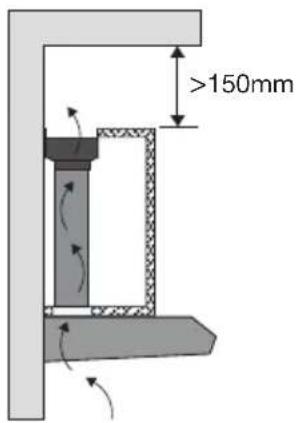
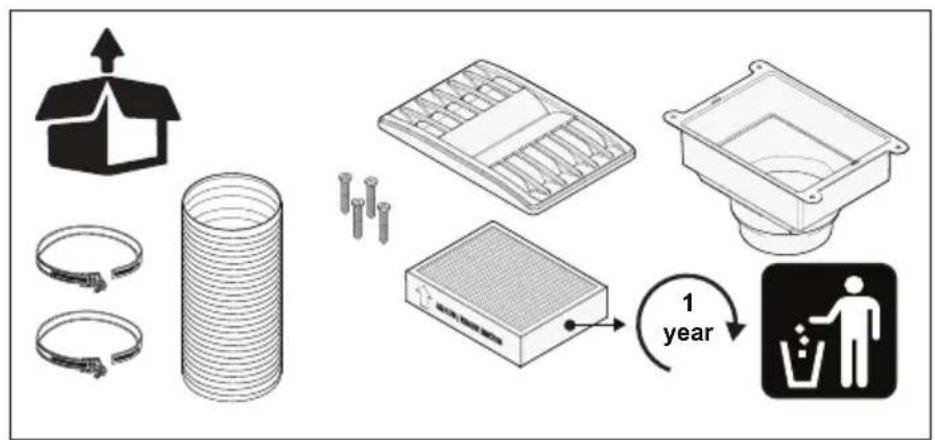
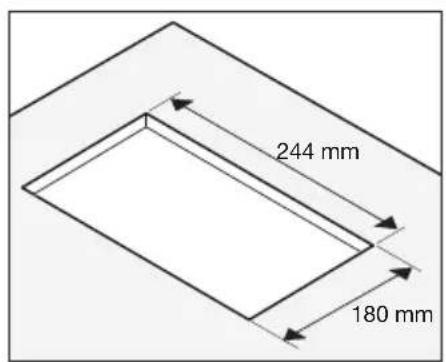
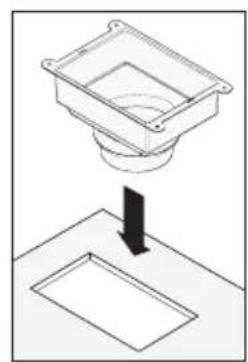
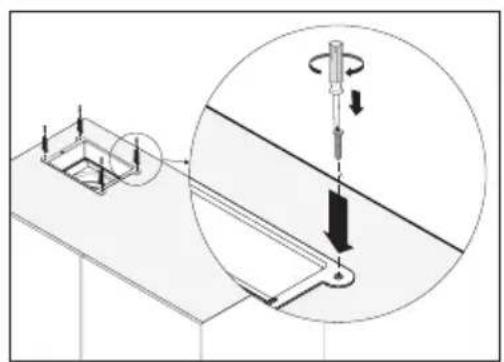
Mounting the HR0001 starter set for recirculation
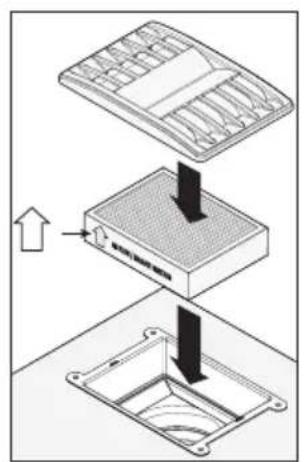
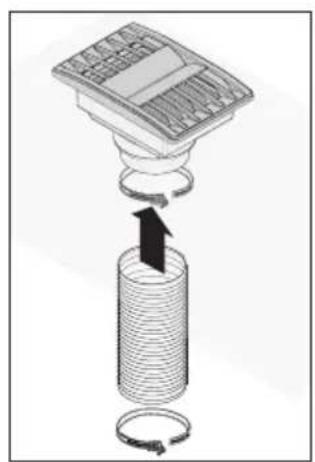

Attention!
DO NOT flip the switch for recirculation on the motor; the discharge remains upwards.
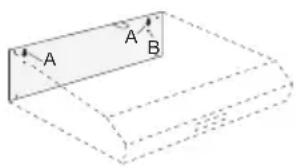
Against the wall
- Remove the filters from the extractor hood.
- Hold the hood against the wall.
- Working through the hood, draw the mounting holes (A) and the hole to secure the hood (B).
- Drill the holes and push the wall plugs supplied into the holes.
- Insert the screws into the 2 mounting holes (A). NB: screw the screws in until 1cm is left protruding from the wall.
- Hang the hood on the 2 mounting screws.
- Tighten the mounting screws.
- Tighten the locking screw.
- Connect the flue pipe to the flue ring.

For recirculation
To blow out the airflow through the front grille: place the cover plate at the top and flip the internal switch on the motor to recirculation mode.
General
This appliance conforms to current CE guidelines.
| Type W062 | \_AC | WO602\_BM
WO61\_BM |
| Power supply 230 V AC | - 50 Hz 230 V AC - 50 | Hz |
| Connected load See data plate See data plate | |
| Dimensions (wxhxd) 600 x 132 x 510 mm 600 x | 132 x 510 mm |
Matching accessories

- HR0001 starter set with connection material for recirculation including filter for odour/fine dust.
HF3001 Odour/fine dust filter for use in the starter set (annually replaced).
Alternative (only for wall-mounted installation)
- ACC926 Internal odour filter (replacement every 3 months).
Scan the QR code to order the above accessories for your appliance.
Disposal of the appliance and packaging
Sustainable materials have been used during the manufacture of this appliance. This appliance must be disposed of responsibly at the end of its service life. Ask your local authorities for more information about how to do this.
The appliance packaging is recyclable. The following may have been used:
cardboard;
polyethylene film (PE).
Dispose of these materials in a responsible manner and in accordance with government regulations.

Warning! Never allow children to play with packaging material due to the danger of injury or suffocation. Store the packaging material safely or dispose of it in an environmentally-friendly way.
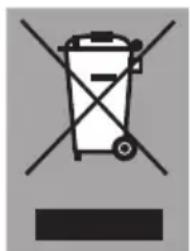
The product has been marked with a crossed-out dustbin symbol to remind you of the obligation to dispose of electrical household appliances separately. This means that the appliance may not be included with normal domestic refuse at the end of its service life. The appliance must be taken to a special municipal centre for separated waste collection or to a dealer providing this service.
A separate collection of household appliances helps to prevent any potential negative impact on the environment and on human health caused by improper disposal. It ensures that the materials of which the appliance is composed can be recovered to obtain significant savings in energy and raw materials.

We hereby declare that our products satisfy the applicable European directives, orders and regulations, as well as the requirements stated in the referenced standards.
Op once website=kunt u de meest recente versie van de gebruiksaanwijzing vinden.
Vous pouvez trouver la version la plus recente de le mode d'emploi sur notre site Web. Die neuste Version der Bedienungsanleitung finden Sie auf unserer Website. You can find the most recent version of the instructions for use on our website.
www.atag.nl
www.atag.be

ATAG
721222