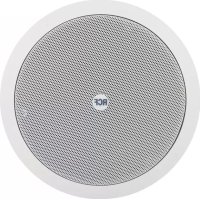
PL60 - Speaker RCF - Free user manual and instructions
Find the device manual for free PL60 RCF in PDF.



| Product Type | In-ceiling speaker (acoustic ceiling speaker) |
| Brand | RCF |
| Model | PL60 |
| Category | Speaker |
| Dimensions (diameter) | 204 mm |
| Dimensions (depth) | 75 mm |
| Net weight | 0.8 kg |
| Power supply | Constant voltage line 70 V or 100 V |
| Selectable power (70 V) | 1.5 W / 3 W / 6 W |
| Selectable power (100 V) | 3 W / 6 W |
| Frequency response (-10 dB) | 90 Hz - 20 kHz |
| Bandwidth (-3 dB) | 110 Hz - 20 kHz |
| Sensitivity (1 W/1 m) | 91 dB |
| Maximum SPL | 106.5 dB @ 1 m |
| Coverage angle (horizontal) | 90° |
| Coverage angle (vertical) | 90° |
| Transducer | Dual cone speaker 160 mm (6") |
| Body material | Plastic |
| Grille | Steel |
| Mounting system | Flush mount (surface mount accessory A1360 available) |
| Inputs | 5-conductor terminal block |
| Maintenance and cleaning | Clean with a soft, dry cloth; avoid solvents, alcohol, and petrol |
| Safety | Mandatory installation by a professional; comply with electrical standards |
| Usage | Indoor use only; avoid tropical climates and humidity |
Frequently Asked Questions - PL60 RCF
User questions about PL60 RCF
0 question about this device. Answer the ones you know or ask your own.
Ask a new question about this device
Download the instructions for your Speaker in PDF format for free! Find your manual PL60 - RCF and take your electronic device back in hand. On this page are published all the documents necessary for the use of your device. PL60 by RCF.
USER MANUAL PL60 RCF
Symbols used in the manual

nal injury.
WARNING: This symbol indicates very important instructions which must be followed carefully in order to prevent persona

VERY IMPORTANT - This symbol indicates instructions that must be followed to the letter in order to prevent possible
equipment damage or malfunctions. To ensure correct use of the product, it is indispensable to read and remember this information.

A CLOSER LOOK - This symbol calls attention to particular details, special instructions, suggestions, or other useful information.
1. Safety first!
Before installing and using this product, please read this instruction manual carefully and keep it on hand for future reference. Follow all the instructions to the letter.
WARNING: This product has been designed for installation only by qualified personnel having the technical know-how and experience or specific instructions to ensure correct execution of all the operations involved and to prevent any risk to personal safety. There are numerous factors that must be taken into consideration when installing a professional sound system, including mechanical and electrical evaluations as well as studies related to coverage and acoustic performance. We therefore strongly recommend that you have this product installed only by professional installers or specialized firms.
- Attention to the precautions - Always follow the precautions provided on this product and in the instruction manual.
- Water and humidity - Do not use this product near water; for example, in the vicinity of a bath tub or sink, in a damp cellar, near a swimming pool, etc..
- Foreign objects and liquids - Be careful not to allow any foreign objects or liquids to come into contact with this product.
- Installation - Do not install this product in any way that is not provided for in the instruction manual
- Technical service - The user should never attempt to make any repairs on this product unless otherwise indicated in the instruction manual. All repairs should be made by qualified service technicians.
- Respect the safety standards - The entire sound system must be created in compliance with the current standards and laws regarding electrical systems.
- Specifications - When installing and using this product, keep in mind the technical specifications indicated in the dedicated section of this instruction manual.
- Accessories - Install and use this product only with the accessories specified by the manufacturer or supplied with the product.

Hearing loss - Exposure to high sound levels can cause permanent hearing loss. The sound pressure level which leads to
hearing loss varies considerably from one person to another, and depends on the duration of exposure. The U.S. Government's Occupational Safety and Health Administration (OSHA) has established the maximum sound pressure levels that can be withstood without causing damage, which are shown in the table below.
According to the OSHA regulations, any exposure over the maximum limits indicated in the table can reduce the hearing capacity of a person. To prevent potentially dangerous exposure to high sound pressure levels, anyone subjected to such levels must use suitable protection. When an product capable of producing high sound levels is being used, it is therefore necessary to wear ear plugs or protective earphones when the limits shown in the table are exceeded.
| Duration per day (hours) | Sound level (dBA) Typical | example |
| 8 90 Duet in a | small club | |
| 6 | 92 | |
| 4 95 Undergrou | nd train | |
| 3 | 97 | |
| 2 100 Classical | music played at high vol | ume |
| 1.5 102 | ||
| 1 105 | ||
| 0.5 110 | ||
| 0.25 or less 115 Particulary "hard" music at a | rock concert | |

Consult the specifications provided in the instruction manual to know the maximum sound pressure (SPL) the speaker is capable of producing.
Contents
- SAFETY FIRST! 6
- OPERATING PRECAUTIONS 7
- INTRODUCTION 7
- INSTALLATION 8
- CONNECTIONS 8
- SERVICE 8
- APPENDIX A - Inputs cables 9
- SPECIFICATIONS 9
- FIGURES 22
2. Operating precautions
- Do not use solvent, alcohol, benzene, or other volatile substances for cleaning the external parts of the speaker.
- Do not use the speaker in tropical climates.
- If the speaker is used in particular, could places, drive it with a low signal for 5-10 minutes before using it at maximum power.
3. Introduction
The PL 60 is a ceiling speaker featuring elegant design that can be flush-mounted in false ceilings or panels. It can also be attached to walls or ceilings using a special accessory for surface mount installation. The PL 60 incorporates a 160mm (6") dual cone loudspeaker that improves high frequency extension, and it is equipped with a line transformer that enables direct connection to constant voltage systems at 70V or 100V . The multiple sockets on the transformer make it possible to select the output power from among several values. Installation is quick and easy thanks to a special three-terminal system that avoids the need for using screws or other attachment elements.
4. Installation

WARNING: Make sure that the speaker is installed in a stable and secure way in order to avoid any conditions that may be
dangerous for persons or structures.
Check to make sure that the support surface (e.g. wall, etc.) has the necessary mechanical characteristics to support the weight of the speaker without the danger of it falling.
Before suspending the speaker, carefully check all the components to be used to make sure that there is no damage, deformation, corrosion and/or missing or damaged parts that could reduce the safety of the installation.
In outdoor use, avoid installing the speaker in places exposed to harsh weather conditions.
The PL 60 is designed for flush-mount installation in false ceilings. Before installing the speaker, make sure that there is sufficient space behind the false ceiling panel to hold the speaker: with respect to the support surface of the front flange of the speaker, a free space of 65mm (2.56") depth is necessary.
- Drill a hole of diameter 182 mm (7.16") in the false ceiling at the point chosen for installing the speaker.
- Insert the speaker in the hole as shown in point 1 of Figure 1 on page 22.
- Screw in the three screws that tighten the three attachment terminals A of the speaker, as shown in point 2 of Figure 1 on page 22.
- Fit the metal protective mesh onto the front of the speaker as shown in point 3 of Figure 1 on page 22.
The A1360 adapter accessory can be requested for surface mount installation. To view the complete updated range of accessories available, contact your nearest sales point.
5. Connections

WARNING: To prevent the risk of electric shock, do not connect the speaker with the amplifier switched on.
Before using the speaker, carefully check that all the connections have been made correctly to make sure there are no accidental short circuits that could cause electrical sparks.
The PL 60 speaker can be connected to constant voltage audio lines at 70V or 100V . Connections are made using the 5-pin input terminal strip on the rear part of the speaker.
- Using the legend in Figure 2 on page 23, locate the input conductors to be used.
-
Connect the BLACK conductor of the speaker to the negative conductor (-) of the audio line that leads from the amplifier terminal marked -, 0, or COM (Fig. 2).
-
Connect the other speaker conductor located using the legend to the positive conductor (+) of the audio line (Fig. 2).

VERY IMPORTANT: To prevent speaker damage, never use the GREEN conductor when the speaker is supplied with 100V
lines.
- To prevent the risk of electric shock, situate the terminal strip in an inaccessible position (e.g. inside the speaker when it is used with the accessory for surface mount installation).
When making the connections, keep the following indications in mind (Fig. 3, page 23).
- The input voltage selected on the speaker must correspond with the voltage selected on the amplifier.
- The sum of the operating power values of all the speakers connected to the audio line must not exceed that of the amplifier.
- To ensure correct audio reproduction, the connections should be made "in phase", where the +/- polarities of the amplifier output correspond with the +/- polarities of the speaker input.

A CLOSER LOOK: When two speakers reproduce the same frequencies but with phase differences, these frequencies may
be annulled. In sound systems, speakers are often situated in adjacent positions and the sound waves produced interact with each other. If a speaker is connected incorrectly; i.e. the polarity of the audio line conductors is inverted, the audio signals are transmitted with differences in phase and correct reproduction is therefore jeopardized.
6. Service
If the product seems to be not operating correctly, before contacting the service centre, carry out all the tests the may confirm the malfunction. In many products taken to the service centre, it is not possible to reproduce the malfunction indicated because the problem is probably to be found elsewhere in the sound system. If the product does require service, place it in its original packaging and take it to your local dealer or to the nearest service centre.
7. Appendix A- Input cables
For connecting the speaker use cables with an adequate cross-section. The greater the distance between the amplifier and the speaker, the larger the connection cable cross-section should be.
To prevent inductive phenomena from giving rise to humming or disturbance that jeopardize the effective operation of the audio system, the speaker cables should not be run together with electrical energy con
ductors, microphone cables, or low level audio lines (e.g. LINE level).
To facilitate the "in phase" connection of the speaker, use bipolar cables that have markings to distinguish the polarity (e.g. insulation of different colours, conductors of different colours, ect.).
To minimize the inductive effects (hum) due to coupling with surrounding electrical fields, use cables with conductors braided together.
8. Specifications
Acoustic system
Frequency range (-10 dB): 90 Hz - 20kHz
Frequency response (-3 dB): 110 Hz - 20 kHz
HorizontaI angle of coverage: 90^ average from 800Hz to 16kHz
Vertical angle of coverage: 90^ , average from 800Hz to 16kHz
Directivity factor Q (DI): 8 (9), average from 800Hz to 16kHz
Sensitivity: 91 dB 1W @ 1 m
Calculated maximum sound pressure (SPL): 106.5 dB @ 1 m (3.3 ft.), maximum power
Impedance:
70 V: 3300Ω - 1.5W; 1660Ω - 3W;
817Ω - 6W
100 V: 3300Ω - 3W; 1660Ω - 6W
Input voltage: 70V, 100 V
Selectable power values: 70V:1.5W-3W-6W 100 V:3 W-6 W
Transducers
Extended range: 1 dual cone loudspeaker diam. 160mm (6")
Physical characteristics
Main body: Plastic material
Grille: Steel
Attachment system: Flush-mount
Inputs: 5-pin terminal strip
Dimensions (diam. x depth): 204 x 75 mm ( 8.03" x 2.95")
Weight: 0.8kg (1.8 lbs.)
Accessory
A1360 Base for surface mounting
1 Measured on the axis in free field, with input signal of 1 watt (2.83 V RMS @ 8ohm) and referring to one metre of distance using the inverse square root law. The sound pressure indicated represents an average from 300Hz to 3kHz.
Disclaimer
RCF S.p.A. applies a company policy based on constant research and development. With the aim of constantly improving our products, we reserve the right to make any aesthetic or functional modifications at any time and without prior notice. RCF is a registered trademark of RCF S.p.A.
Any other trademark mentioned herein is a trademark or registered trademark of the respective owners, who we gratefully acknowledge. ©2004 RCF S.p.A.. All rights reserved. Printed in Italy.
FRANÇAIS
6. Service Assistance
Connecting speakers with transformer in a constant voltage system.