
XR-C453RDS - Car radio SONY - Free user manual and instructions
Find the device manual for free XR-C453RDS SONY in PDF.



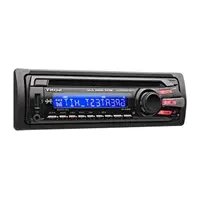
| Product Type | Cassette car stereo with FM/MW/LW tuner and CD/MD changer control |
| Brand | Sony |
| Model | XR-C453RDS |
| Dimensions (H x W x D) | 58 × 188 × 181 mm |
| Mounting dimensions | 53 × 182 × 164 mm |
| Weight | Approx. 1.2 kg |
| Power supply | 12 V DC battery (negative ground) |
| Maximum output power | 35 W × 4 (at 4 Ω) |
| Speaker impedance | 4 to 8 Ω |
| FM frequency ranges | FM1/FM2: 87.5 - 108.0 MHz; FM3: 65.0 - 74.0 MHz |
| MW/LW frequency ranges | MW: 531 - 1602 kHz; LW: 153 - 281 kHz |
| FM usable sensitivity | 8 dBf |
| FM selectivity | 75 dB at 400 kHz |
| FM signal-to-noise ratio | 63 dB (stereo), 65 dB (mono) |
| Cassette signal-to-noise ratio | 61 dB (TYPE II/IV), 58 dB (TYPE I) |
| Cassette wow and flutter | 0.08% (WRMS) |
| Cassette frequency response | 30 - 18000 Hz |
| RDS functions | AF, TA, PTY, CT, REG, EON |
| Cassette playback functions | AMS, Intro scan, Repeat, ATA, Blank skip, CrO₂/Metal |
| CD/MD playback functions | AMS, Intro scan, Repeat, Shuffle, changer control |
| Equalizer | Bass ±8 dB at 100 Hz, Treble ±8 dB at 10 kHz; D-Bass (levels 1-3) |
| Display | Backlit digital display (switchable amber/green color) |
| Supplied remote control | Rotary remote control RM-X2S |
| Security | Detachable front panel, warning alarm |
| Connector cleaning | Cotton swab moistened with alcohol |
| Supplied accessories | Installation parts, RM-X2S remote control, front panel case |
| Options | CD/MD changer, RCA bus cables RC-61/62/63/64/65, source selector XA-C30 |
Frequently Asked Questions - XR-C453RDS SONY
User questions about XR-C453RDS SONY
0 question about this device. Answer the ones you know or ask your own.
Ask a new question about this device
Download the instructions for your Car radio in PDF format for free! Find your manual XR-C453RDS - SONY and take your electronic device back in hand. On this page are published all the documents necessary for the use of your device. XR-C453RDS by SONY.
USER MANUAL XR-C453RDS SONY
FM/MW/LW Cassette Car Stereo
Operating Instructions EN
For installation and connections, see the supplied installation/connections manual.
Thank you for purchasing the Sony Cassette Car Stereo. This unit lets you enjoy a variety of features by using a rotary remote.
In addition to the tape playback and the radio operation you can expand your system by connecting optional CD/MD changer.
Table of contents
This Unit Only
Getting Started
Resetting the unit 4 Detaching the front panel 4 Preparing the rotary remote 4 Setting the clock 5
Cassette Player
Listening to a tape 5 Playing a tape in various modes 6
Radio
Memorizing stations automatically — Best Tuning Memory (BTM) 7 Memorizing only the desired stations 7 Receiving the memorized stations. 7
RDS
Overview of the RDS function 8 Displaying the station name 8 Re-tuning the same programme automatically - Alternative Frequencies (AF) 9 Listening to traffic announcements 9 Presetting the RDS stations with AF and TA data 10 Locating a station by programme type 11 Setting the clock automatically 11
Other Functions
Using the rotary remote 12 Adjusting the sound characteristics 13 Muting the sound. 13 Changing the sound and beep tone 13
With Optional Equipment
CD/MD Changer
Playing a CD/MD 14 Scanning the tracks - Intro scan. 15 Playing tracks repeatedly - Repeat play 15 Playing tracks in random order Shuffle play 15
Additional Information
Precautions 16 Maintenance. 17 Dismounting the unit 17 Location of controls 18 Specifications 19 Troubleshooting guide 20 Index 22
Getting Started
Resetting the unit
Before operating the unit for the first time or after replacing the car battery, you must reset the unit.
Press the reset button with a pointed object, such as a ball-point pen.
Reset button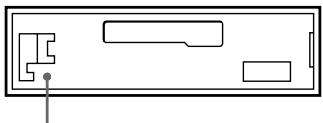
Note
Pressing the reset button will erase all the memorized programme and memory functions.
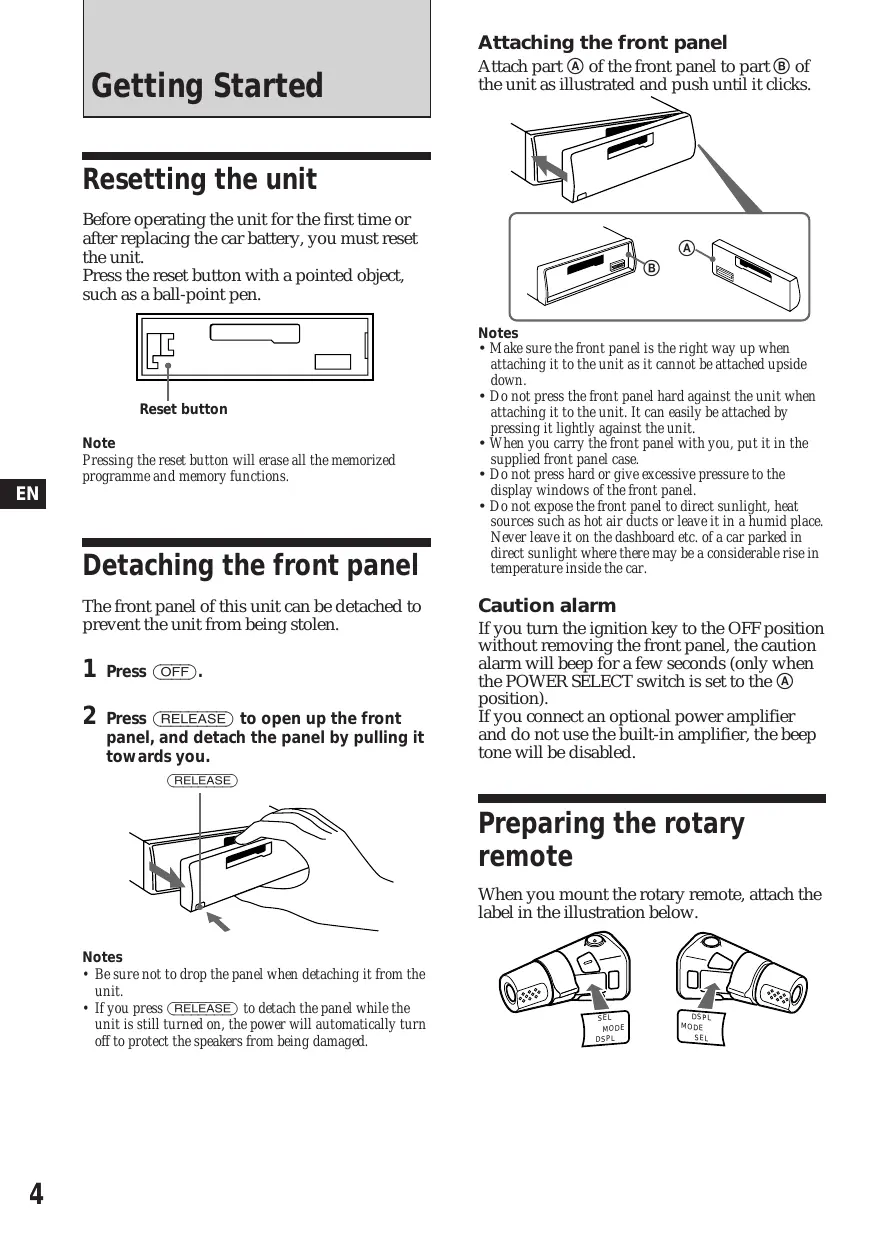
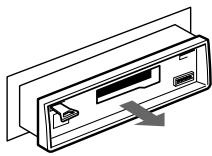
Detaching the front panel
The front panel of this unit can be detached to prevent the unit from being stolen.
1 Press OFF. 2 Press (RELEASE) to open up the front panel, and detach the panel by pulling it towards you.
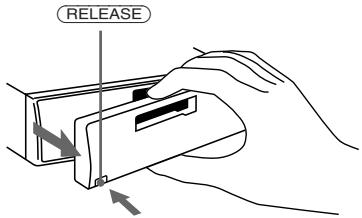
Notes
- Be sure not to drop the panel when detaching it from the unit.
- If you press (RELEASE) to detach the panel while the unit is still turned on, the power will automatically turn off to protect the speakers from being damaged.
Attaching the front panel
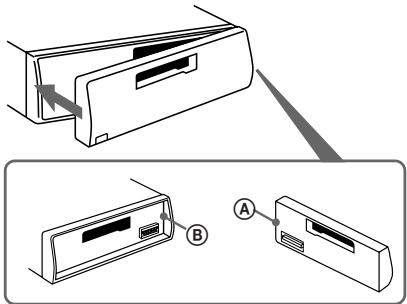
Attach part A of the front panel to part B of the unit as illustrated and push until it clicks.
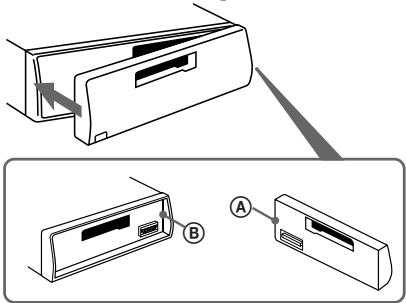
Notes
- Make sure the front panel is the right way up when attaching it to the unit as it cannot be attached upside down.
- Do not press the front panel hard against the unit when attaching it to the unit. It can easily be attached by pressing it lightly against the unit.
- When you carry the front panel with you, put it in the supplied front panel case.
- Do not press hard or give excessive pressure to the display windows of the front panel.
- Do not expose the front panel to direct sunlight, heat sources such as hot air ducts or leave it in a humid place. Never leave it on the dashboard etc. of a car parked in direct sunlight where there may be a considerable rise in temperature inside the car.
Caution alarm
If you turn the ignition key to the OFF position without removing the front panel, the caution alarm will beep for a few seconds (only when the POWER SELECT switch is set to the A position).
If you connect an optional power amplifier and do not use the built-in amplifier, the beep tone will be disabled.
Preparing the rotary remote
When you mount the rotary remote, attach the label in the illustration below.
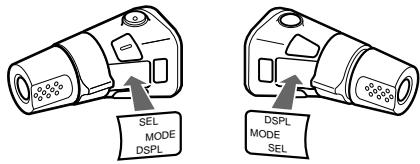
Setting the clock
The clock has a 24-hour digital indication.
For example, setting it to 10:08
1 Press OFF or DSPL during operation. 2 Press DSPL for two seconds.

The hour digit blinks.
1 Set the hour digits.

to go forward
to go backward

Press SEL momentarily.

The minute digit blinks.
Set the minute digits.

to go forward
to go backward

3 Press DSPL momentarily.

The clock activates.
Note
If the POWER SELECT switch on the top of the unit is set to the 3 position, the clock cannot be set unless the power is turned on. Set the clock after you have turned on the radio.
Cassette Player
Listening to a tape
Insert a cassette.
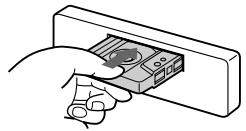
Playback will start automatically.
If a cassette is already inserted, press SOURCE repeatedly until "PLAY" is displayed.
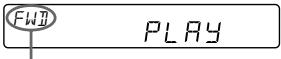
The side facing up is being played.
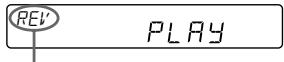
The side facing down is being played.
Tip
To change the tape transport direction, press MODE) (▶) during tape playback.
| To | Press |
| Stop playback | OFF |
| Eject the cassette | ▲ |
Fast-winding the tape
During playback, press either side of (SEEK/AMS) for more than two seconds.

Fast-forward
Rewind
To start playback during fast-forwarding or rewinding, press MODE (▶).
Locating the beginning of a track
Automatic Music Sensor (AMS)
You can skip up to nine tracks at one time.
During playback, press either side of (SEEK/AMS) momentarily.

To locate the succeeding tracks
To locate the preceding tracks
Note
The AMS function may not work when:
- the blanks between tracks are shorter than 4 seconds
- there is noise between tracks
- there are long sections of low volume or quiet sections.
Changing the displayed items
Each time you press DSPL during tape playback, the displayed item changes as follows:
* While the AF/TA function is activated.
Playing a tape in various modes
Searching for the desired track - Intro scan
Press ① during playback.
"INTRO" appears on the display.
The first 10 seconds of all the tracks are played.
When you find the desired track, press again. The unit returns to normal playback mode.
Playing tracks repeatedly - Repeat play
Press ② during playback.
"REP" appears on the display.
When the current track is over, it will be played again from the beginning.
To cancel this mode, press again.
Switching to the radio while fast-winding a tape
Automatic Tuner Activation (ATA)
Press ⑤ during playback.
"ATA" appears on the display.
When fast-forwarding or rewinding with (SEEK/AMS) for two seconds, the tuner will turn on automatically.
To cancel this function, press ⑤.
Skipping blanks during tape playback — Blank skip
Press ⑥ during playback.
"BL.SKIP" appears on the display.
Blanks longer than eight seconds will automatically be skipped during tape playback.
To cancel this function, press ⑥.
Playing a CrO₂ or metal tape
Press ④ when you want to listen to a CrO₂ (TYPE II) or metal (TYPE IV) tape.
"MTL" appears on the display.
To cancel this function, press ④.
Radio
The frequency ranges this unit can receive and memorize are 87.5-108.0MHz (FM1, FM2) and 65.0-74.0MHz (FM3).
Memorizing stations automatically
Best Tuning Memory (BTM)
This function selects from the currently received band the stations with the strongest signals and memorizes them in order of their frequency.
PREVENTING ACCIDENTS!
When tuning in while driving, use the automatic tuning or memory preset search function instead of manual tuning.
1 Press SOURCE repeatedly to select the tuner.
Each time you press (SOURCE), the source changes as follows:

2 Press MODE repeatedly to select the band.
Each time you press MODE, the band changes as follows:

3 Press (SENS/BTM) for two seconds.
Notes
- During FM1 and FM2 band reception, the BTM function searches only the 87.5-108.0MHz frequency range, and during FM3 band reception, it searches only the 65.0-74.0MHz frequency range.
- The unit will not store stations with weak signals on the preset number buttons. If there are only a few stations received, some preset number buttons will remain empty.
- When there is a preset number indicated on the display, the unit will store stations on all preset number buttons from the one currently displayed.
Memorizing only the desired stations
Up to 6 stations on each band (FM1, FM2, FM3, MW and LW) can be stored on the preset number buttons in the order of your choice. Therefore, 18 FM stations can be memorized. If you try to store another station on the same preset number button, the previously stored station will be erased.
1 Press (SOURCE) repeatedly to select the tuner. 2 Press MODE repeatedly to select the band. 3 Press (SEEK/AMS) to search for the station you wish to store on a preset number button. 4 Press the desired preset number button (1) to (6) for two seconds.
The number of the selected preset number button appears on the display.
Receiving the memorized stations
1 Press (SOURCE) repeatedly to select the tuner. 2 Press MODE repeatedly to select the band. 3 Press the preset number button (① to ⑥) momentarily on which the desired station is stored.
Tip
Press either side of PRESET/DISC to receive in order the stations stored in the memory (Preset Search Function). During FM1 or FM2 reception, the FM3 band cannot be received directly with PRESET/DISC because the frequency ranges are different. Select the band with MODE.
If FM stereo reception is poor
— Monaural mode
Press (SENS/BTM) momentarily until "MONO" lights up on the display.
The sound will improve, but it will become monaural. (The "ST" indication will disappear.)
Changing the displayed items
Each time you press DSPL, the display changes between the frequency and the clock.
If you cannot tune in a preset station
Press either side of (SEEK/AMS)
momentarily to search for the station (automatic tuning).
Scanning stops when a station is received. Press either side of the button repeatedly until the desired station is received.
Note
If the automatic tuning stops too frequently, press
(SENS/BTM) momentarily until "LCL" lights up on the display (local seek mode). Only the stations with relatively strong signals can be tuned in.
Tip
If you know the frequency, press and hold either side of
SEEK/AMS until the desired station is received (manual tuning).
RDS
Overview of the RDS function
Radio Data System (RDS) is a broadcasting service that allows FM stations to send additional digital information along with the regular radio programme signal. Your car stereo offers you a variety of services. Here are just a few: Re-tuning the same programme automatically, Listening to traffic announcements and Locating a station by programme type.
The RDS function is available only for FM1 and FM2 bands.
Notes
- Depending on the country or region, not all of the RDS functions are available.
- RDS may not work properly if the signal strength is weak or if the station you are tuned in is not transmitting RDS data.
Displaying the station name
The name of the station currently received lights up on the display.
Select an FM station.
When you tune in an FM station that transmits RDS data, the station name lights up on the display.
F1 F M
Note
The *indication means that an RDS station is being received.
Changing the displayed items
Each time you press DSPL, the displayed items change as follows:
Frequency → Time → Station name
Note
"NO NAME" lights up if the station received does not transmit RDS data.
Re-tuning the same programme automatically
Alternative Frequencies (AF)
The Alternative Frequencies (AF) function automatically selects and re-tunes the station with the strongest signal in a network. By using this function, you can continuously listen to the same programme during a long-distance drive without having to re-tune the station manually.
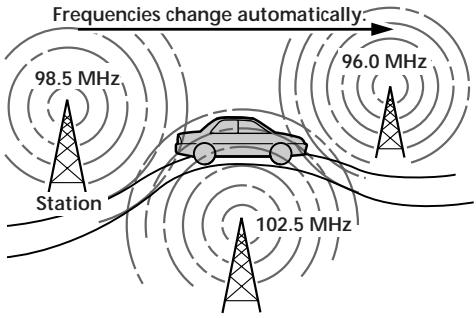
1. Select an FM station. 2. Press AF/TA until "AF" lights up on the display.
The unit starts searching for an alternative station with a stronger signal in the same network.
Notes
- When the AF/TA button is pressed during FM3 band reception, the band changes automatically to FM1.
- When there is no alternative station in the area, and you don't need to search for an alternative station, turn the AF function off by pressing AF/TA until "AF" disappears.
Changing the displayed items
Each time you press AF/TA, the displayed items change as follows:

- Select this to turn on both AF and TA functions.
Notes
- "NO AF" and the station name flash alternately, if the unit cannot find an alternative station in the network.
- If the station name starts flashing after selecting a station with the AF function on, this indicates that no alternative frequency is available. Press SEEK/AMS while the station name is flashing (within eight seconds). The unit starts searching for another frequency with the same PI (Programme Identification) data ("PI seek" appears and no sound is heard). If the unit cannot find another frequency, "NO PI" appears, and the unit returns to the originally selected frequency.
Listening to a regional programme
The "REG" (regional on) function of this unit lets you stay tuned to a regional programme without being switched to another regional station. (Note that you must turn the AF function on.) The unit is factory preset to "REG" but if you want to turn off the function, do the following.
Press AF/TA for more than two seconds until "REG" disappears.
Note that turning the "REG" function off might cause the unit to switch to another regional station within the same network.
Note
This function does not work in the United Kingdom and in some other areas.
Listening to traffic announcements
The Traffic Announcement (TA) and Traffic Programme (TP) data let you automatically tune in an FM station that is broadcasting traffic announcements even though you are listening to other programme sources.
Press AF/TA until "TA" or "AF TA" lights up on the display.
The unit starts searching for traffic information stations. "TP" lights up on the display when the unit finds a station broadcasting traffic announcements. When the traffic announcement starts, "TA" flashes, then flashing stops when the traffic announcement is over.
Tip
When the traffic announcement starts while you are listening to another programme source, the unit automatically switches to the announcement and goes back to the original source when the announcement is over.
Notes
- "NO TP" flashes for five seconds if the received station doesn't broadcast traffic announcements. Then, the unit starts searching for a station that does broadcast traffic announcements.
- When the "EON" indication appears with "TP" on the display, the current station makes use of broadcast traffic announcements of other stations in the same network.
To cancel the current traffic announcement
Press AF/TA momentarily.
To cancel all traffic announcements, turn off the function by pressing \(\overline{\mathrm{AF / TA}}\) until "AF" disappears.
Presetting the volume of traffic announcements
You can preset the volume level of the traffic announcements beforehand, so you will not miss the announcement. When a traffic announcement starts, the volume will be automatically adjusted to the preset level.
1 Select the desired volume level. 2 Press ③ while holding down SEL. "TA VOL" appears and the setting is stored.
Receiving emergency announcements
If an emergency announcement comes in while you are listening to the radio, the programme will be automatically switched to the announcement. If you are listening to a source other than the radio, the emergency announcements will only be heard if you set AF or TA to on. The unit will then automatically switch to these announcements no matter what you are listening to at the time.
Presetting the RDS stations with AF and TA data
When you preset the RDS stations, the unit stores each station's data as well as its frequency, so you don't have to turn on the AF or TA function every time you tune in the preset station. You can select different settings (AF, TA, or both) for individual preset stations, or the same setting for all preset stations.
Presetting the same setting for all preset stations
1 Select an FM band. 2 Press \(\overline{\mathrm{AF / TA}}\) repeatedly and select either "AF", "TA" or "AF TA" (for both AF and TA functions). Note that turning the "AF TA" function off stores RDS stations as well as non-RDS FM stations. 3 Press SENS/BTM for two seconds.
Presetting different settings for each preset station
1 Select an FM band, and tune in the desired station. 2 Press \(\overline{\mathrm{AF / TA}}\) repeatedly and select either "AF", "TA" or "AF TA" (for both AF and TA functions). 3 Press the desired preset number button for two seconds until "MEM" appears. Repeat from step 1 for presetting other stations.
Tip
If you want to change the preset AF and/or TA setting after you tuned in the preset station, you can do so by turning on/off the AF or TA function.
Locating a station by programme type
You can locate the station you want by selecting one of the programme types shown below.
Note
If the countries or regions where EON data is not transmitted, you can use this function only for the stations you have tuned in once.
| Programme types | Display |
| News | NEWS |
| Current Affairs | AFFAIRS |
| Information | INFO |
| Sports | SPORT |
| Education | EDUCATE |
| Drama | DRAMA |
| Culture | CULTURE |
| Science | SCIENCE |
| Varied | VARIED |
| Popular Music | POP M |
| Rock Music | ROCK M |
| Middle of the Road Music | M.O.R. M |
| Light Classical | LIGHT M |
| Classical | CLASSICS |
| Other Music Type | OTHER M |
| Weather | WEATHER |
| Finance | FINANCE |
| Children's programmes | CHILDREN |
| Social Affairs | SOCIAL A |
| Religion | RELIGION |
| Phone In | PHONE IN |
| Travel | TRAVEL |
| Leisure | LEISURE |
| Jazz Music | JAZZ |
| Country Music | COUNTRY |
| National Music | NATION M |
| Oldies Music | OLDIES |
| Folk Music | FOLK M |
| Documentary | DOCUMENT |
| Not specified | NONE |
Note
You cannot use this function in some countries where no PTY (Programme Type selection) data is available.
1 Press (PTY) during FM reception until "PTY" lights up on the display.
PTY INFO
The current programme type name appears if the station is transmitting the PTY data. "-----" appears if the received station is not an RDS station or if the RDS data has not been received.
Note
The PTY function is not available for the FM3 band.
2 Press PTY repeatedly until the desired programme type appears.
The programme types appear in the order as shown in the above table. Note that you cannot select "NONE" (Not specified) for searching.
PTY SPORT
3 Press either side of (SEEK/AMS).
The unit starts searching for a station broadcasting the selected programme type. When the unit finds the programme, the programme type appears again for five seconds.
"NO" and the programme type appear alternately for five seconds if the unit cannot find the programme type, and it returns to the previous station.
Setting the clock automatically
By receiving CT (Clock Time) data, the clock of this unit can be set automatically.
During FM reception, press ② while pressing SEL.
"CT" will be displayed, and the clock will be set.
To cancel the CT function
Repeat the above procedure.
Notes
- The CT function may not work even though an RDS station is being received. The time set by the CT function may not be exact.
Using the rotary remote
The rotary remote works by pressing buttons and/or rotating controls.
You can control the optional CD/MD changer by the rotary remote.
By pressing buttons (the SOURCE and the MODE buttons)
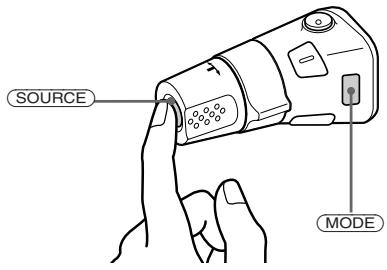
Every time you press SOURCE, the source changes as follows:
TAPE → TUNER → CD/MD
Pressing MODE changes the operation in the following ways:
- the tape transport.
- the band, FM1 → FM2 → FM3 → MW → LW.
- the CD/MD changer.
Tip
You can turn on this unit by pressing (SOURCE) on the rotary remote.
By rotating the control (the SEEK/AMS control)
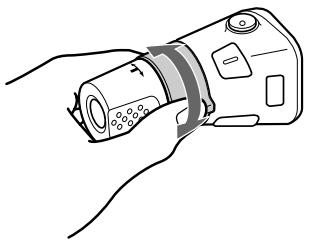
Rotate the control momentarily and release it to:
- Locate the beginnings of the tracks on the tape. Rotate and hold the control, and release it to fast-wind the tape. To playback, rotate and hold the control again, and release it.
- Locate a specific track on a disc. Rotate and hold the control until you locate the specific point in a track, then release it to start playback.
- Tune in the stations automatically. Rotate and hold the control to tune in the specific station.
By rotating the control while pushing in (the PRESET/DISC control)
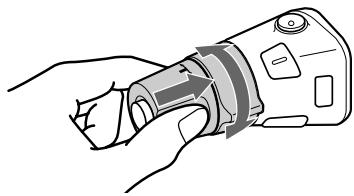
Push in and rotate the control to:
- Receive the stations memorized on the preset buttons.
- Change the disc.
Other operations
Rotate the VOL control to adjust the volume.
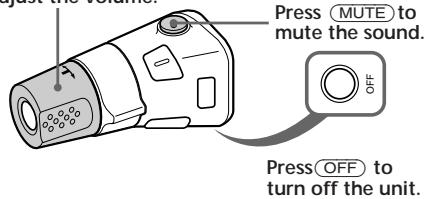
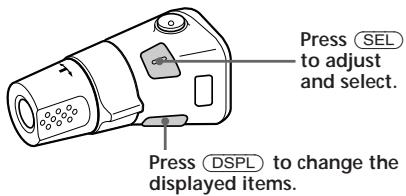
Changing the operative direction
The operative direction of controls is factory preset as in the illustration below.
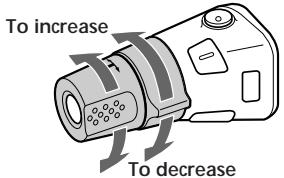
If you need to mount the rotary remote on the right side of the steering column, you can reverse the controls operative direction.

Press SEL for two seconds while pushing in the VOL control.
Adjusting the sound characteristics
1 Select the item you want to adjust by pressing SEL repeatedly. VOL (volume) → BAS (bass) → TRE (treble) → BAL (balance) → FAD (fader) 2 Adjust the selected item by pressing either (+) or (−)
Adjust within three seconds after selecting. (After three seconds the button will again serve as the volume control button.)
Muting the sound
Press MUTE. The "MUTE" indication flashes.
To restore the previous volume level, press again.
Tip The unit decreases the volume automatically when a telephone call comes in (Telephone-mute function).
Changing the sound and beep tone
Boosting the bass sound — D-bass
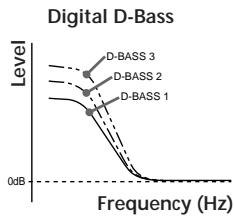
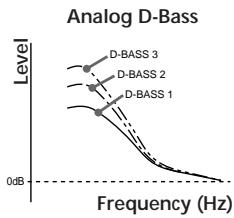
You can enjoy clear and powerful bass sound. The D-bass function boosts the low frequency signal with a sharper curve than conventional bass boost.
You can hear the bass line more clearly even if the vocal sound is the same volume. You can emphasize and adjust the bass sound easily with the D-BASS control. This effect is similar to the one you get when you use an optional subwoofer system. Moreover, the Digital D-bass* function creates even sharper and more powerful bass sound than Analog D-bass.
Adjusting the bass curve
Turn the D-BASS control to adjust the bass level (1, 2 or 3). "D-BASS" * appears in the display.
To cancel, turn the control to the OFF position.
- If the CD changer has the digital D-bass function, "DIGITAL D-BASS" appears on the display during CD playback.
Note: If the CD changer does not have a D-bass function, the bass sound may be distorted when the volume is increased. In this case, turn on the D-BASS control and adjust the volume.
Muting the beep tone
Press 6 while pressing SEL.
To obtain the beep tone again, press these buttons again.
Note
If you connect an optional power amplifier and do not use the built-in amplifier, the beep tone will be disabled.
Changing the illumination color
Press ① while pressing SEL.
You can choose the color between amber and green.
With Optional Equipment CD/MD Changer
You can control up to five CD/MD changers with this unit.
Playing a CD/MD
Press (SOURCE) until the desired changer indication appears on the display.
CD/MD playback starts.
When a CD/MD changer is connected, all the tracks play from the beginning.
Note
Even if you select an MD changer, "CD" appears in the display.
Selecting CD/MD changers (when several CD/MD changers are connected)
Press MODE repeatedly to select the desired CD/MD changer.
Changing the displayed items
Each time you press DSPL during CD/MD playback, the item changes as follows:
Elapsed playback time ↔ Clock
Locating a specific track
Automatic Music Sensor (AMS)
During playback, press either side of (SEEK/AMS) once for each track you wish to skip.

To locate the succeeding tracks
To locate the preceding tracks
Locating a specific point in a track
- Manual Search
During playback, press and hold either side of SEEK/AMS. Release the button when you have found the desired part.

To search forward
To search backward
Switching to other discs
During playback, press either side of PRESET/DISC.
To return to the previous disc
To advance to the next disc
Scanning the tracks
— Intro scan
The first 10 seconds of all the tracks on the current disc are played in order. After the first disc is over, the next disc is played.
Press ① during playback.
"INTRO" appears on the display.
When you find the desired track, press again. The unit returns to the normal CD/MD playback mode.
Playing tracks repeatedly
— Repeat play
To repeat a track
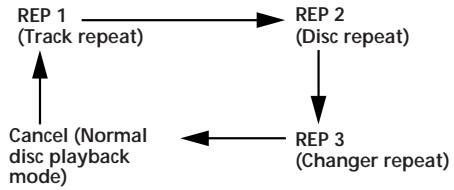
Press ② repeatedly during CD/MD playback until "REP 1" is displayed.
To repeat a disc
Press ② repeatedly during CD/MD playback until "REP 2" is displayed.
To repeat all the discs in the current changer
Press ② repeatedly during CD/MD playback until "REP 3" is displayed.
Each time you press ② the display changes as follows:
Playing tracks in random order — Shuffle play
To play the tracks on the current disc in random order
Press ③ repeatedly during CD/MD playback until "SHUF 1" is displayed.
To play all the discs in the changer in random order
Press ③ repeatedly during CD/MD playback until "SHUF 2" is displayed.
To play all the discs in the current connected changers in random order
Press ③ repeatedly during CD/MD playback until "SHUF 3" is displayed.
Each time you press ③ the display changes as follows:
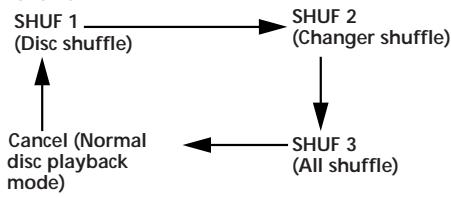
If you press ① during shuffle play, the first 10 seconds of all tracks will be played in random order.
Precautions
- If your car was parked in direct sunlight resulting in a considerable rise in temperature inside the car, allow the unit to cool off before operating it.
- If no power is being supplied to the unit, check the connections first. If everything is in order, check the fuse.
- If no sound comes from the speakers of a 2-speaker system, set the fader control to the center position.
- When the tape is played back for a long period, the cassette may become warm because of the built-in power amplifier. However, this is not a sign of malfunction.
If you have any questions or problems concerning your unit that are not covered in this manual, please consult your nearest Sony dealer.
To maintain high quality sound
If you have drink holders near your audio equipment, be careful not to splash juice or other soft drinks onto the car audio. Sugary residues on this unit or cassette tapes may contaminate the playback heads, reduce the sound quality, or prevent sound reproduction altogether.
Cassette cleaning kits cannot remove sugar from the tape heads.
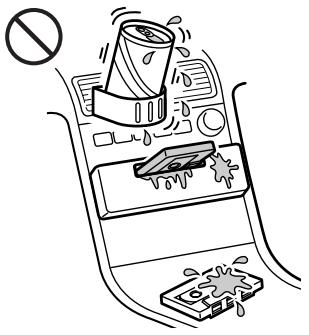
Notes on Cassettes
Cassette care
- Do not touch the tape surface of a cassette, as any dirt or dust will contaminate the heads.
- Keep cassettes away from equipment with built-in magnets such as speakers and amplifiers, as erasure or distortion on the recorded tape could occur.
- Do not expose cassettes to direct sunlight, extremely cold temperatures or moisture.
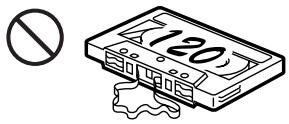
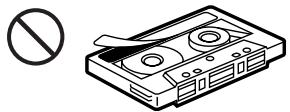
- Slack in the tape may cause the tape to be caught in the machine. Before you insert the tape, use a pencil or similar object to turn the reel and take up any slack.
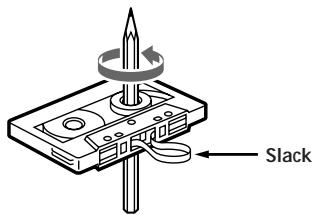
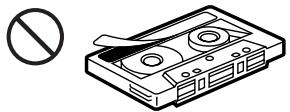
Distorted cassettes and loose labels can cause problems when inserting or ejecting tapes. Remove or replace loose labels.
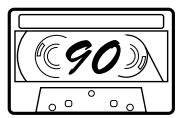
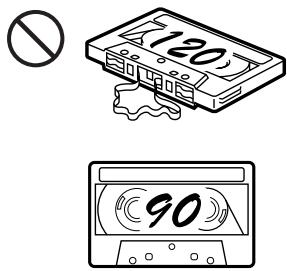
Cassettes longer than 90 minutes
The use of cassettes longer than 90 minutes is not recommended except for long continuous play. The tapes used for these cassettes are very thin and tend to be stretched easily. Frequent playing and stopping of these tapes may cause them to be pulled into the cassette deck mechanism.
Maintenance
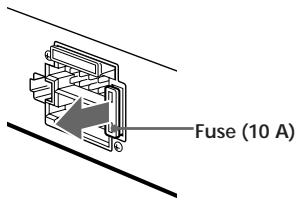
Fuse Replacement
When replacing the fuse, be sure to use one matching the amperage rating stated on the fuse. If the fuse blows, check the power connection and replace the fuse. If the fuse blows again after replacement, there may be an internal malfunction. In such a case, consult your nearest Sony dealer.
Warning
Never use a fuse with an amperage rating exceeding the one supplied with the unit as this could damage the unit.
Cleaning the Connectors
The unit may not function properly if the connectors between the unit and the front panel are not clean. To prevent this, open the front panel by pressing (RELEASE), then detach it and clean the connectors with a cotton swab dipped in alcohol. Do not apply too much force; otherwise, the connectors may be damaged.
Main unit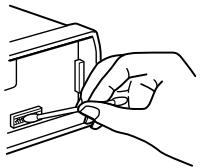
Back of the front panel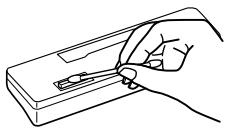
Dismounting the unit
1
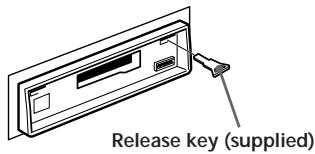
2
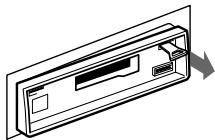
3
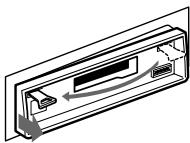
4
Location of controls
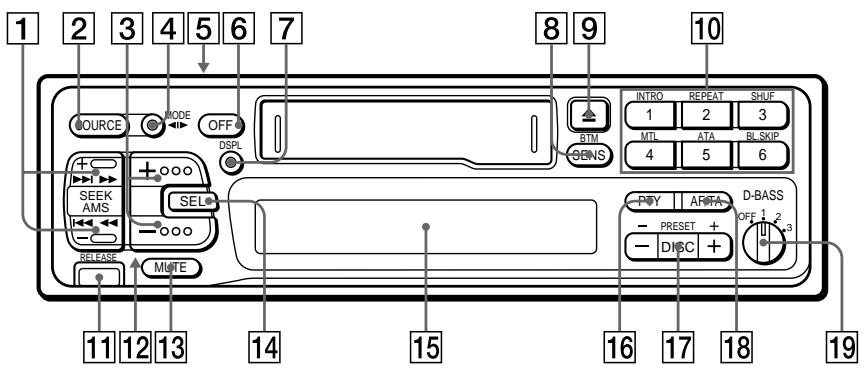
Refer to the pages for further details.
SEEK/AMS button 5,6,7,8,9,11,14,15 SOURCE button (TAPE/TUNER/CD/MD) 5, 7, 14 3 (+ - ) (volume/bass/treble/balance/fader control) button 13 4 MODE () button During Tuner reception: BAND select 7 During Tape playback: Transport direction change During CD/MD playback: Changer select 14 5 POWER SELECT switch (located on the top of the unit) See "POWER SELECT Switch" in the Installation/Connections manual. 6 OFF button 4,5 DSPL (display mode change/time set) button 5,6,8,14 8 SENS/BTM (sensitivity adjust/Best tuning memory function) button 7, 8, 10 9 (eject) button 5 During radio reception: Preset number buttons 7
During tape/CD/MD playback:
① INTRO button 6, 15 ② REPEAT button 6, 15 ③ SHUF (Shuffle) button 15 MTL button 6 ⑤ ATA (Automatic Tuner Activation) button 6 ⑥ BL.SKIP (Blank Skip) button 6
11 RELEASE (front panel release) button 4,17 Reset button (located on the front side of the unit hidden by the front panel) Press this button when you use this unit for the first time, when you have changed the car battery, or when the buttons of this unit do not function properly. 13 MUTE button 13 14 SEL (control mode select) button 5, 10, 11, 13, 14 15 Display window 16 PTY (programme type) button 11 17 PRESET/DISC button 7, 15 During Tuner reception: Preset stations select 7
During CD/MD playback: Disc change 15
18 AF/TA (alternative frequency/traffic announcement) button 9, 10 19 D-BASS control 13
Specifications
| Cassette player section | General | ||
| Tape track | 4-track 2-channel stereo | Outputs | Telephone mute control lead |
| Wow and flutter | 0.08 % (WRMS) | ||
| Frequency response | 30 - 18,000 Hz | Power amplifier control lead | |
| Signal-to-noise ratio | 61 dB (TYPE II, IV) | ||
| 58 dB (TYPE I) | Power antenna control lead | ||
| Tuner section | Line out (1) | ||
| FM | Tone controls | Bass ±8 dB at 100 Hz | |
| Tuning range | FM1, FM2: 87.5 - 108.0 MHz | Treble ±8 dB at 10 kHz | |
| FM3: 65.0 - 74.0 MHz | Power requirements | 12 V DC car battery (negative ground) | |
| Antenna terminal | External antenna connector | Approx. 188 × 58 × 181 mm (w/h/d) | |
| Intermediate frequency | 10.7 MHz | Dimensions | Approx. 182 × 53 × 164 mm (w/h/d) |
| Usable sensitivity | 8 dBf | Mounting dimensions | |
| Selectivity | 75 dB at 400 kHz | Mass | Approx. 1.2 kg |
| Signal-to-noise ratio | 63 dB (stereo), 65 dB (mono) | Supplied accessories | Parts for installation and connections (1 set) |
| Harmonic distortion at 1 kHz | Rotary commander RM-X2S (1) | ||
| 0.5 % (stereo), 0.3 % (mono) | Front panel case (1) | ||
| Separation | 35 dB at 1 kHz | Optional accessories | Bus cable (supplied with an RCA pin cord) |
| Frequency response | 30 - 15,000 Hz | RC-61 (1 m), RC-62 (2 m) | |
| Capture ratio | 2 dB | RCA pin cord | |
| MW/LW | RC-63 (1 m), RC-64 (2 m), | ||
| Tuning range | MW: 531 - 1,602 kHz | RC-65 (5 m) | |
| LW: 153 - 281 kHz | Optional equipment | CD changer CDX-705, CDX-605 (10 discs), CDX-T65, CDX-T62 (6 discs) MD changer MDX-61 Source selector XA-C30 | |
| Antenna terminal | External antenna connector | ||
| Intermediate frequency | 10.71 MHz/450 kHz | ||
| Sensitivity | MW: 30 μV | ||
| LW: 50 μV | |||
| Power amplifier section | |||
| Outputs | Speaker outputs (sure seal connectors) | ||
| Speaker impedance | 4 - 8 ohms | Design and specifications are subject to change without notice. | |
| Maximum power output | 35 W × 4 (at 4 ohms) | ||
Troubleshooting guide
The following checklist will assist in the correction of most problems you may encounter with your unit.
Before going through the checklist below, refer to the operating procedures.
General
| Problem | Cause/Solution |
| No sound | ·Adjust the volume with ⊙. ·Set the fader control to the centre position for 2-speaker systems. |
| Indications do not appear on the display window. | Remove the front panel and clean the connectors. See “Cleaning the Connectors” in “Maintenance” for details. |
| No beep tone. | ·An optional power amplifier is connected and you are not using the built-in amplifier. ·The beep tone is muted (page 14). |
Tape playback
| Problem | Cause/Solution |
| Playback sound is distorted. | Contamination of the tape head. → Clean the head. |
| The AMS does not operate correctly. | ·There is noise in the space between tracks. ·A blank space is too short (less than four seconds). ·▷ on (SEEK/AMS) is pressed immediately before the following track. ·▷ on (SEEK/AMS) is pressed immediately after the track starts. ·A long pause, or a passage of low frequencies or very low sound level is treated as a blank space. |
Radio reception
| Problem | Cause/Solution |
| Preset tuning is not possible. | • Store the correct frequency. • The broadcast is too weak. |
| Automatic tuning is not possible. | The broadcast is too weak.→Use manual tuning. |
| The "ST" indication flashes. | • Tune in precisely. • The broadcast is too weak. →Press (SENS/BTM) to enter the MONO mode. |
RDS functions
| Problem | Cause/Solution |
| The RDS function does not operate | The RDS function is available only for the FM1 and FM2 bands. |
| A SEEK starts after a few seconds of listening. | The station is non-TP or weaken signal. → Press (AF/TA) until “AF TA” disappears. |
| No traffic announcements | • Activate “TA”. • The station does not broadcast any traffic announcements despite being TP. → Tune in another station. |
| PTY displays “NONE”. | The station does not specify the programme type. |
Disc play
| Problem | Cause/Solution |
| Playback sound skips. | A dusty or defective disc. |
Error displays (when the optional CD/MD changer(s) is connected)
The following indications will flash for about five seconds and an alarm sound will be heard.
| Display | Cause | Solution |
| NO MAG | The disc magazine is not inserted in the CD/MD changer. | Insert the disc magazine with discs into the CD/MD changer. |
| NO DISC | No disc is inserted in the disc magazine. | Take out the magazine and insert a disc. |
| NG DISCS | A CD/MD cannot play because of some problem. | Insert another CD/MD. |
| ERROR | The disc is dirty. | Clean the disc. |
| The disc is inserted upside down. | Insert the disc correctly. | |
| RESET | The CD/MD changer cannot be operated because of some problem. | Press the reset button on the unit. |
| HI TEMP | The ambient temperature is more than 50°C. | Wait until the temperature goes below 50°C. |
If the above-mentioned solutions do not help to improve the situation, consult your nearest Sony dealer.
Index
A
Alternative Frequencies (AF) 9
Automatic Music Sensor (AMS) 6
Automatic tuning 7
Automatic Tuner Activation (ATA) 6
B
Bass 13
Balance 13
Beep tone 14
Best Tuning Memory (BTM) 7
Blank skip 6
C
Caution alarm 4
CD playback 14
Clock 5
D, E
D-Bass 13
Display 6,8,9,14
F, G, H
Fader 13
Fast-forward 5
Front panel 4
Fuse 17
I, J, K
Intro scan 6,15
L
Local seek mode (LCL) 8
M, N, O
Manual search 15
Manual tuning 7
MD playback 14
METAL 6
Monaural mode 8
Mute 13, 14
P, Q
Preset search 7
Programme Type (PTY) 11
R
Radio 7
Radio Data System (RDS) 8, 9, 10
Repeat play 6, 15
Reset 4
Rewind 5
Rotary remote 4, 12, 13
S
Shuffle play 15
T, U, V, W, X, Y, Z
Tape playback 5
Telephone-mute 13
Traffic Announcement (TA) 9,10
Traffic Programme (TP) 9
Treble 13
Welcome!
Analog system D-BASS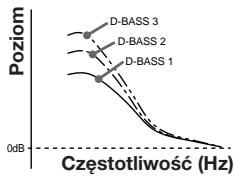
Automatic Tuner Activation (ATA) 7
Best Tuning Memory (BTM) 8
Fuse 20
CD/MD changer
CD/MD playback 16 Track selection — Intro scan function 16 Sequential playback of tracks — Repeat play function ....17 Playback of tracks in random order - Shuffle play function .........17
Additional information
Safety Instructions 18 Maintenance 19 Connecting the Device 20 Control Layout 21 Technical Specifications 22 Troubleshooting Guide 23 Index 25
Connecting the Power Supply
Connect the adapter to the device as shown in the figure and press it until it clicks into place.
Notes
- Make sure the power adapter is oriented correctly when connecting it to the device. It cannot be inserted if turned the wrong way. Do not force the adapter against the device when connecting it. The adapter can be connected with a slight push toward the device. Align the adapter with the connector slot when inserting it.
- Do not press hard on or drop the device. Do not expose the device to direct sunlight, heat sources such as radiators, or leave it in humid places. Never leave the device on the dashboard or in other open places in a car, parked in direct sunlight, where the temperature could rise significantly.
Warning Signal
If you set the power switch to OFF without disconnecting the adapter, a warning signal will sound for a few seconds (only if the POWER SELECT switch is set to position A).
If you have connected the supplied batteries and are not using the adapter, the warning signal is deactivated.
Press the button ④ when you want to play Type II or metal (Type IV) tapes.
The indicator "MTL" appears on the screen.
To cancel the function, press button ④ again.
Radio
The frequency ranges that this device can receive are 87.5-108.0 MHz (FM1, FM2) and 65.0-74.0 MHz (FM3).
-Best Tuning Memory (BTM) function
The tuner automatically selects only the stations with the strongest signal and tunes them to their exact frequency.
PRESETTING STATIONS! When tuning during reception, use the automatic tuning function or the tuning function for previously preset stations instead of manual tuning.
1 Press the SOURCE button repeatedly to select the radio as the source. Each time you press the SOURCE button, the source changes as follows: TAPE TUNER CD/MD
2 Press the MODE button repeatedly to select the desired band. Each time you press the MODE button, the band changes as follows: FM1 FM2 FM3 LW MW
3 Press the (SENS/BTM) button for two seconds.
Continued on next page →
Notes
-During reception in the FM1 and FM2 bands, the BTM function presets only stations in the 87.5-108.0 MHz range, while during radio reception in the FM3 band, it presets only stations in the 65.0-74.0 MHz range. The unit can preset radio stations with the numbered buttons for manual tuning. In case you can only receive a few stations with the numbered buttons, the buttons will remain unused. In case the display shows a button number, the unit will preset the radio station and all the numbered buttons for manual tuning from it.
Presetting manually radio stations
From each band, up to 6 radio stations (FM1, FM2, FM3, MW, and LW) can be preset with the numbered buttons for manual tuning in your preferred order.
Consequently, in the FM band, 18 radio stations can be preset. In case you want to preset a new radio station with an already used numbered button, the previously preset radio station will be erased.
1 Press the SOURCE button repeatedly to select the radio as the source. 2 Press the MODE button repeatedly to select the desired band. 3 Press the (SEEK/AMS) button to find the radio station you want to preset with the numbered button for manual tuning. 4 Press and hold for about two seconds the desired numbered button (from ① to ⑥).
The numbers of the selected buttons for manual tuning are displayed on the screen.
The indicator "0" indicates that you are currently receiving an RDS radio station.
Continued on next page →
Changing the screen indication
With each press of the button (DSPL), the screen indication changes as follows:
→ Frequency → Time → Station name
Note:
The indication "NO NAME" lights up if the station you are receiving does not broadcast RDS data.
AUTOMATIC TUNING OF THE RADIO STATION — FUNCTION ALTERNATIVE FREQUENCIES (AF)
The Alternative Frequencies (AF) function automatically tunes the station with the strongest signal on the same radio network. With this function, you can listen continuously to one radio station during your journey without needing to manually retune the radio station.

1 Select an FM station.
2 Press the (AF/TA) button until the indication "AF" lights up on the screen.
The device will start searching for an alternative radio station on the same radio network, but with a stronger signal.
Note:
When the (AF/TA) button is pressed during reception of an FM station, the station is automatically switched to FM1 or FM2. If the alternative radio stations for you are not necessary to search for other stations, deactivate the AF function by pressing the (AF/TA) button until the indication "AF" disappears from the screen.
Changing the screen information
With each press of the AF/TA button, the displayed information changes as follows.

- Select this to simultaneously activate the AF and TA functions.
The "NO AF" indicator and the name of the radio station are displayed with a slow flashing light if the device cannot find an alternative station from the radio network. In case the name of the radio station is supposed to flash with a slow light, after selecting the desired radio station, when activating the AF function, this means that there is no alternative frequency available. Press the SEEK/AMS button until the name of the station flashes with a slow light (within 8 seconds). The device will start searching for other frequencies with the given program identification data ("PI seek" appears without an audio signal on the screen). In case the device cannot find another frequency, "NO PI" appears and the device returns to the previously selected frequency.
- Listening to regional programs
The "REG" function (regional on) This device gives you the possibility to stay tuned to a given regional program, without switching to another regional program. (Note that you must deactivate the AF function.) The device is normally set to "REG", but if you want to deactivate the function, do the following.
Press the AF/TA button for more than two seconds, until the "REG" indicator disappears.
Note that deactivating the "REG" function may cause the device to switch to another regional station from the same radio network.
Note
This function does not work in poor reception conditions, as well as in some other areas.
Muting the sound
Press the MUTE button
Muting the audio signal
Press the ⑥ button, then press the SEL button.
Press the same buttons again to activate the warning signals.
Note
If you connect an external amplifier and do not use the built-in amplifier, the audio signal will be deactivated.
Note
The device is now ready for use.
Press the PLAY button 1 , then press the PLAY button SEL.
You can choose between blue and green light.
You can control up to 5 CD/MD changer units with this device.
Press the MODE button
repeatedly to select the desired CD/MD changer unit.
Changing the on-screen information
When you press the DSPL button during CD/MD playback, the on-screen information changes as follows:
Elapsed time ↔ Clock
Selecting a specific track
- Automatic Music Sensor (AMS) function
During playback, press the SEEK/AMS button briefly to skip to the beginning of each track you want to skip.

Selecting the next track
To select the previous track
Selecting a specific track
- Function Manual Search
During playback, press and hold the button (SEEK/AMS) until the desired track is found.
Release the button once you have found the desired track.

To search forward
To search backward
Skipping to the next or previous disc
During playback, press the button (PRESET/DISC) once.
To skip to the next disc
To skip to the previous disc
Skipping to the next or previous track
- Function Intro scan
Sequentially plays the first few seconds of each track on the current disc. At the end of the disc, the next disc is played.
Press button ① during playback.
The indicator "INTRO" appears on the screen.
When you find the desired track, press the button again. The unit returns to normal playback mode for CD/MD.
Press the buttons sequentially as shown by ② during playback of a CD/MD, until the indicator "REP2" appears.
For repeated playback of all discs in the current disc changer
Press the buttons sequentially as shown by ② during playback of a CD/MD, until the indicator "REP 3" appears.
Each time you press the button ②, the information on the screen changes as follows:

For playback in random order of all discs from all connected disc changers at the moment.
Press the button ③ sequentially during playback from CD/MD, until the indicator "SHUF 3" appears on the screen.
Each time you press the button ③, the display information changes as follows:
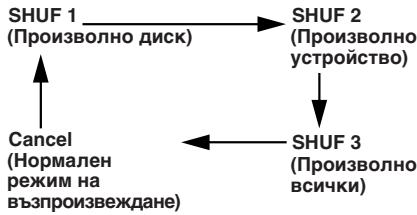
In case you press the button ① during playback in random order, the first 10 seconds of all tracks will be played in random order.
Playback from CD/MD: 13,16
5 POWER SELECT switch (located on the top side of the unit) 4, 5
See the sections "POWER/SELECT switch" in the installation/connection manual.
6 OFF button 5,6 7 DSPL button (display mode change/time display) 5,6, 10,16 8 SENS/BTM button (sensitivity adjust/Best tuning memory function) 8, 12, 23 9 (eject) button 6 10 For radio: Numbered buttons for preset tuning 8
Playback from CD/MD:
① INTRO button 6, 15, 16 ② REPEAT button 7,17
③ ByToH SHUF (Shuffle) 11, 17 ④ ByToH MTL 7 ⑤ ByToH ATA (Automatic Tuner Activation) 7 ⑥ ByToH BL.SKIP (Blank Skip) 7, 15
11 ByToH REaLSE (release) 4 12 ByToH Reset (located on the front panel of the device and hidden under the release button)
Press this button when first turning on the device, when changing the battery, or when the device buttons do not function properly.
13 ByToH MUTE 15 14 ByToH SEL (selection of control mode) 11, 13, 14, 15 15 Screen 16 ByToH PTY (program type) 12, 13 17 ByToH PRESET/DISC In radio reception: selection of preset station 8, 14
In CD/MD playback: 14, 16
18 ByToH AF/TA (alternative frequency/traffic announcement) 10, 11, 12, 13, 24 19 D-BASS control 15
Technical specifications
Cassette player section
Track system: 4-track, 2-channel stereo
Wow and flutter: 0.08% (WRMS)
Frequency response: 30-18,000 Hz Signal-to-noise ratio: 61 dB (TYPE II, IV) 58 dB (TYPE I)
Radio section FM
| Приеман обхьат | FM1, FM2: 87,5-108,0 MHz |
| FM3: 65,0-76,0 MHz | |
| Антынен Кунлунг | Быншen антынен Кунлунг |
| Мекдиноа честоа | 10,7 MHz |
| Използbaема чьвс捜телюст | 8 dBf |
| Чьвс捜телюст | 75 dB по 400 kHz |
| Ниво сигнал/шум | 63 dB (стео), 65 dB ( моно) |
| Харmonчни ИЗкр��ваимя р�п 1 кHz | 0,5% (стео), 0,3% ( моно) |
| Раздение | 35 dB по 1 KHz |
| Чебъ�тахаразкетероста | 30 - 15.000 Hz |
| Ниво на захьат | 2 dB |
MW/LW
| Оxbват 3а насточа | MW: 531 - 1.602 kHz LW: 153 - 281 kHz |
| Антынен купунг | Бышиен аntөнен купунг |
| Мөждинна честоа | 10,71 MHz/450 kHz |
| ЧУВСТВИТЕЛНOCТ | MW: 30 μV LW: 50 μV |
Amplifier section
Preset tuning: 6
Program (PTY) 12, 13
Alternative Frequencies (AF) function 10
Automatic Music Sensor (AMS) function 6, 16
Automatic Tuner Activation (ATA) function 7
Best Tuning Memory (BTM) function 7
DIGITAL D-BASS (D-BASS) function 15
Intro scan function 6, 16
Local seek mode (LCL) function 9
Traffic Announcement (TA) function 11
Traffic Programme (TP) function 11
Radio Data System (RDS) function 9, 10, 11
YacobHmK 5
Welcome!
DIGITALIS D-BASSZUS (D-Bass) 14
E
Balance 13
Mute 8
User Manual
Presetting the device. 4 Read the instructions before use 4 Preparation for use with the remote control 5 Setting the clock 5
Magnetophone
Playback of magnetic recordings .6 Different playback modes of magnetic recordings
Tuner
Automatic station search and storage
- Memorizing the optimal tuning (BTM). 7
Storing only those stations that interest you 8 Switching on stored radio stations 8
RDS
Overview 9 Station name display 9
Automatic retuning of the same program
-AltepHaTnBhIe YacToTbI (AF) 10
PpocnyuBaHne DopoxKbIX Coo6eHnI ....10 IpeynctaHOBKa cTaNcuiRDS cDaHHbIMN AF n TA. 11 ObnapyKeHne cTahun no Tnny nporpaMMbl 12 ABTomatuecka yctahOBka yacob 13
PpOuHneФyHKU
Пльзовные врашаюшмс
пегекlioчatelem Дистанционно
унравлия … 13 Perynipobka napameTpob 3ByuHaHna.15 OTKJIIOUeHHe 3Byka 15 IodctpoiKa 3ByuHnMaHHTOblI ToHaJIbHOCTn npEduPpeDnteJbHOrO CnHaHa .15
DonoHnTeIbHa aannapaTypa
Mhoro3apAHybI KOMnakr/MD- npOnrpBaTeJb
Bocnpoun3BeDeHne KOMNaKT/MD-dncka ....16 CkaHnpoBaHnne IdoPoxKe - CkaHnPbaHnne IO BCtynTeJIbHbIM fpaarmEtam 17
Повторное ВOCпpon3БeДЕНЕ Дорожек - Повтор ВOCпpon3БeДЕНЯ ..... 17 Bocnpoun3BedeHne dopoxek B cnyaHno nocneIOBaTeIbHocTn -IpepeTaOcbAHoe Bocnpoun3BedeHne..18
DOnOpHnTeJIbHaN HhΦopMaζη
Mepbl npedoctopoxhoctn 18 YxOJ 3a annapaTOM. 19 Демонтах пибopa 20 PacnoJoxHeOpraHOBynpaBHeHn 21 Texnueckne daHhble 22 PykoBoDCTBO no yctpaHEnHn HenoJaOK ..23 AilpaBHTbIy yka3aTeJIb 25
Переньстюка annapaşa
Ipejde, Yem HauaTb Nolb3OBaTbCmargHnToJIoN, a TaKxne Nocne 3aMeHbAkkymyJrTopa B abTomObUne annapatHeo6xoDIMO 3aHOBO HaCTpOnTb.
Дяг STOrO haxmTe KhoNkу nepeHaCTpoKn KaKIM-JIb6 3aOcTpeHbIM ppeMeTOM, HapnMep shapNKOBy pyKoN.
Knob is not adjustable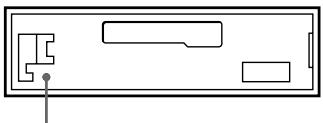
Application
To adjust the knob, all programs stored in memory will be deleted.
Removing the front panel
To protect the device from theft, its front panel can be removed.
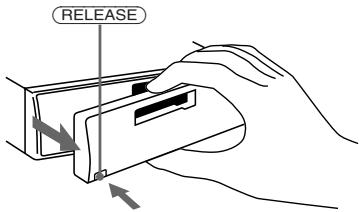
1 Press OFF. 2 Press (RELEASE) to open the front panel and remove it by pulling it towards you.
Note
- Do not drop the panel when removing it from the device.
- If you press (RELEASE) to remove the panel while the device is still on, the power will automatically turn off to protect the speaker from damage.
Installing the front panel
Connect part A of the front panel to part B on the device, as shown in the illustration, and press until it clicks.
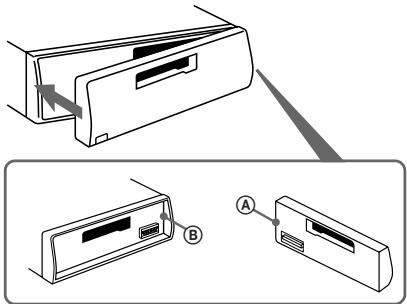
Note
- Make sure the front panel is on the correct side and facing up when installing it into the device, as it cannot be installed upside down. Do not apply strong pressure to the front panel towards the device when installing it. It can be installed with a light press towards the device.
- If you take the front panel with you, place it in the supplied carrying case. Do not apply strong pressure to the display of the front panel. Do not expose the front panel to direct sunlight, heat sources such as car heaters, and do not leave it in a humid place. Never leave it on the dashboard or in a car parked in direct sunlight, where the temperature inside the car may rise significantly.
Warning
When the power switch is set to OFF, without disconnecting the front panel, the standby signal will be emitted for a few seconds (only if the POWER SELECT switch is set to position A).
If you connect an external power amplifier and will not use the built-in amplifier, the standby signal will be audible.
Set the hour digits.

To move forward.
To move backward.

2 Press and quickly release SEL.

The minute digits flash.
3 Set the minute digits.

To move backward.
To move forward.

3 Press and quickly release DSPL.

The clock is activated.
Note
If the POWER SELECT switch on the top panel of the unit is set to position 8, the clock cannot be set until the unit is turned on. Set the clock after turning on the system.
Listening to magnetic tapes
Install the cassette.
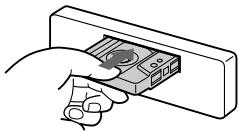
Playback starts automatically.
If there is already a cassette in the tape recorder, press the SOURCE button repeatedly until the word "PLAY" appears on the display.
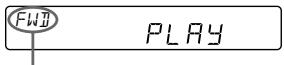
Side A plays.
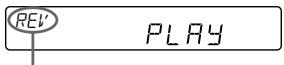
Side B plays.
Tip
To change the direction of tape movement during playback, press the MODE button.
The AUTO STOP function may not work if:
Pauses between tracks are shorter than four seconds, there is a gap in the pauses between tracks, or there are long quiet or silent sections in the recording.
Changing the parameters displayed on the screen
When you press [DSPL] during playback, the display indicators change as follows:

- When the AF/TA function is turned on.
Different playback modes for magnetic tape recordings
The tape recorder plays the first ten seconds of each track recorded on the tape.
To find the desired track, press the same button again.
The tape will return to normal playback speed.
Repeat playback - Repeat playback
During playback, press ②.
The display will show "REP".
When the current track finishes playing, it will be repeated from beginning to end.
To cancel repeat playback, press the same key again.
Now, during playback, the tape will automatically skip pauses longer than eight seconds.
To disable this function, press ⑥.
Playback of chrome (CrO2) or metal tapes
To play a CrO2 tape
(TYPE II) or metal (TYPE IV)
Press ④.
The display will show "MTL".
To cancel this mode, press ④.
Radio receiver
The availability of RDS stations and regions may not be available on all RDS receivers. RDS may not work correctly if the signal is weak or if the station you are tuned to does not transmit RDS data.
Station Name Display
The name of the received station is displayed.
Select an FM station.
If you tune to an FM station that transmits RDS data, the station name is displayed.
F1 BBC 1 F1
Usage
The indicator shows that an RDS station is being received.
Changing the Display
By pressing DSPL, the display changes as follows:
Frequency Time Station name
Usage
"NO NAME" is displayed if the received station does not transmit RDS data.
—Alternative Frequencies (AF)
The Alternative Frequencies (AF) function automatically selects and retunes to the station with the strongest signal in the radio network. With this function, you can listen to the same program continuously during long trips without having to retune the station manually.
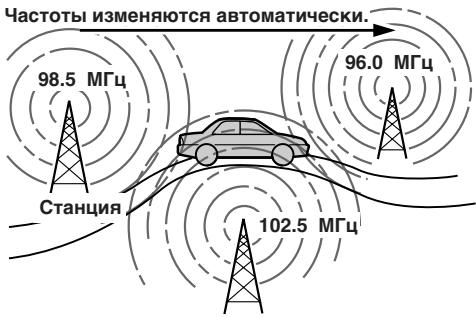
1 Select the FM station.
2 Press AF/TA until "AF" appears.
The unit starts searching for an alternative station with a stronger signal in the same radio network.
Notes
- If you press AF/TA in the FM3 band, the band automatically changes to FM1.
- If an alternative station is not available in your area, you can perform the search, turn off the AF function by pressing (AF/TA), so that "AF" disappears from the display.
Changing the display indication
The program types appear as described in the previous section. Note that you cannot select "NONE" for the search (without definition).
PTY SPORT
3 Press one of the sides (SEEK/AMS).
The unit starts searching for stations, tuning in the selected program types. When the program types are found, they appear again on the display.
"NO" appears alternately on the display for about 5 seconds if the unit cannot find the specified program type, and the unit returns to the previous station.
AUTOMATIC TIME SETTING
The clock time of this unit can be set automatically using RDS data.
While receiving an FM station, press and hold SEL.
The function is called "CT" and is set automatically.
FMI

DIGITAL FUNCTIONS
Repeat the procedure described above.
Note
The CT function may not work even if the RDS station is received. The time set using the CT function may not be accurate.
Other Functions
If a multi-disc player is not equipped with the D-bass function, the bass sound may be distorted when the volume is increased.
In this case, turn the D-BASS regulator and adjust the volume level.
Turning off the beep sound
While holding down the button marked , press 6.
To turn the beep sound back on, press these buttons again.
Note
When connecting an external device, the beep sound is turned off if the external device is used instead of the built-in tuner.
Changing the backlight
Press the POWER button (SEL), then press 1.
You can choose the backlight color to your taste in green or orange tones.
Multi-disc changer for CD/MD players
The magnet lets you control the operation of several (up to five) CD/MD players connected to it.
Playing a CD/MD disc
Press the SOURCE button until the indicator for your player appears on the display.
Playback of the CD/MD disc starts.
When a CD/MD player is connected, all tracks on the disc are played from the beginning.
Note
Even when you select an MD player, the "CD" indicator lights up on the display.
Selecting a CD/MD player (if multiple CD/MD players are connected to the magnet)
Select the desired CD/MD player by pressing the MODE button repeatedly.
Changing the parameters shown on the display
Each time you press the TIME button during CD/MD disc playback, the following is displayed sequentially:
Elapsed time ↔ Remaining time
Track selection — Automatic Music Sensor (AMS)
During playback, press one of the SEEK/AMS buttons repeatedly for the track you want to skip to.

Playback starts from the first 10 seconds of each track on the current disc in the order they are arranged on it. After the first disc finishes, playback of the next disc begins.
Press the ① button during playback.
The word "INTRO" appears on the display.
After finding the desired track, press the button once more. The unit then returns to normal playback of the CD/MD discs.
Playback of tracks in random order
—Shuffle playback
To play all tracks on the selected disc in random order,
press the ③ button during playback of a CD/MD disc until "SHUF1" appears on the display.
To play all discs in the player in random order,
press the ③ button during playback of a CD/MD disc until "SHUF2" appears on the display.
To play all discs in the connected players in random order,
press the ③ button during playback of a CD/MD disc until "SHUF 3" appears on the display.
With each press of the ③ button, the display shows in sequence:
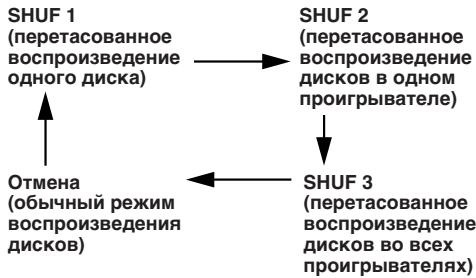
Before playing back a tape, rewind it completely to ensure that all tracks will be played in sequence, each lasting 10 seconds.
Precautions
- If your car has been parked in a sunny place, causing the air in the cabin to heat up significantly, let the device cool down before turning it on.
- If the tape player has no power, first check the connections. If they are in order, check the fuse.
- If you have connected only two speakers and the sound is not heard, set the balance control for front and rear speakers to the middle position.
- During prolonged playback of one tape, it may heat up due to the built-in amplifier. This is not a sign of malfunction.
If you encounter questions or problems not covered in this manual while using the tape player, please contact your nearest Sony dealer.
To avoid deterioration of sound quality
If the tape player in your car is located near cup holders, make sure that juices or other cold drinks do not spill onto the device. Sugary residue left on the tape player parts or on the tape head can cause the playback head to stick, degrading sound quality or even making playback impossible.
Tape heads contaminated with sugar cannot be cleaned with cleaning cassettes.
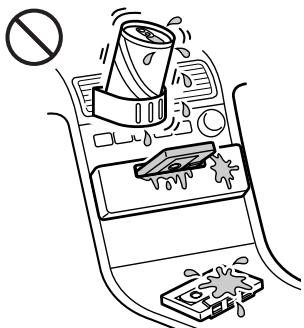
About cassettes
Cassette care
Do not touch the tape head, as any dirt or dust on its surface will contaminate the tape head. Keep cassettes away from equipment that contains magnets (such as speakers or amplifiers), as the recording may be erased or damaged in such cases. Protect cassettes from direct sunlight, severe cold, and humidity. A loose tape in the cassette may cause it to get caught in the tape transport mechanism. Before inserting a cassette, tighten the slack tape by turning one of the reels with a pencil or similar tool.
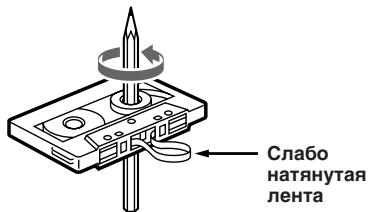
Deformation of the cassette case or labels that are peeling off may hinder the insertion and removal of cassettes from the tape player. If a label is peeling off, remove it or replace it.
Cassettes with a playback time of 60 minutes or 90 minutes
It is not recommended to use cassettes with a playing time of more than 90 minutes, except for continuous playback. The tape in such cassettes is very thin and stretches easily. With frequent switching on and stopping of playback, it can get pulled into the mechanism of the tape deck.
Care of the unit
Replacing the fuses
DIGITAL D-BASS (D-Bass) 15
Displays 6,8,10,16
Traffic program (TP) 10
Traffic announcement (TA) 10,11
E, X, 3, N, K
Storing the optimal tuning
(BTM) 7
M
Local seek (LCL) 9
METAL 7
H
Low frequencies 15
0
OTKJIIOUHHeN3ByKa 15
#
Pepednnaheb 4
IpeemOTkaJIeHTbI 6
IpeemotkaHa3aD 6
IpepehacTroika 4
Ipeetacobahhoe Bocpon3BedeHne 18
IobTop BocnpOn3BeDeHn6,16,17
PonckBpyHy10
Ponck no namrtn 7,8
PpeoXpaHnteIb 19,20
PpeynpeintenbHbCnHa1 16
Iponyck nay3 7
P
Page 7
PexmMOHO 8
Pунай Настponka 7
C
Cunhan TpeBorN 4
CnCTema paAnoJaHHbIX (RDS) 9,10,11
CkaHnpoBaHnE BCTyNITeIbHbIX
φparmteOB 6,17
T, Y,Φ,X,U,Y,I,I,I,Ib,I,O,A
TeIeponHa nay3a 15
Tn nporpammbi (PTY) 12
Yacbl 5
- FM/MW/LW CASSETTE CAR STEREO
- TABLE OF CONTENTS
- THIS UNIT ONLY
- GETTING STARTED
- CASSETTE PLAYER
- RADIO
- RDS
- OTHER FUNCTIONS
- WITH OPTIONAL EQUIPMENT
- CD/MD CHANGER
- ADDITIONAL INFORMATION
- RESETTING THE UNIT
- NOTE
- DETACHING THE FRONT PANEL
- NOTES
- ATTACHING THE FRONT PANEL
- CAUTION ALARM
- PREPARING THE ROTARY REMOTE
- SETTING THE CLOCK
- LISTENING TO A TAPE
- TIP
- FAST-WINDING THE TAPE
- LOCATING THE BEGINNING OF A TRACK
- AUTOMATIC MUSIC SENSOR (AMS)
- CHANGING THE DISPLAYED ITEMS
- PLAYING A TAPE IN VARIOUS MODES
- SEARCHING FOR THE DESIRED TRACK - INTRO SCAN
- PLAYING TRACKS REPEATEDLY - REPEAT PLAY
- SWITCHING TO THE RADIO WHILE FAST-WINDING A TAPE
- SKIPPING BLANKS DURING TAPE PLAYBACK — BLANK SKIP
- PLAYING A CRO₂ OR METAL TAPE
- MEMORIZING STATIONS AUTOMATICALLY
- PREVENTING ACCIDENTS
- MEMORIZING ONLY THE DESIRED STATIONS
- RECEIVING THE MEMORIZED STATIONS
- IF FM STEREO RECEPTION IS POOR
- MONAURAL MODE
- IF YOU CANNOT TUNE IN A PRESET STATION
- OVERVIEW OF THE RDS FUNCTION
- DISPLAYING THE STATION NAME
- RE-TUNING THE SAME PROGRAMME AUTOMATICALLY
- LISTENING TO A REGIONAL PROGRAMME
- LISTENING TO TRAFFIC ANNOUNCEMENTS
- TO CANCEL THE CURRENT TRAFFIC ANNOUNCEMENT
- PRESETTING THE VOLUME OF TRAFFIC ANNOUNCEMENTS
- RECEIVING EMERGENCY ANNOUNCEMENTS
- PRESETTING THE RDS STATIONS WITH AF AND TA DATA
- PRESETTING THE SAME SETTING FOR ALL PRESET STATIONS
- PRESETTING DIFFERENT SETTINGS FOR EACH PRESET STATION
- LOCATING A STATION BY PROGRAMME TYPE
- SETTING THE CLOCK AUTOMATICALLY
- TO CANCEL THE CT FUNCTION
- USING THE ROTARY REMOTE
- BY PRESSING BUTTONS (THE SOURCE AND THE MODE BUTTONS)
- BY ROTATING THE CONTROL (THE SEEK/AMS CONTROL)
- BY ROTATING THE CONTROL WHILE PUSHING IN (THE PRESET/DISC CONTROL)
- OTHER OPERATIONS
- CHANGING THE OPERATIVE DIRECTION
- ADJUSTING THE SOUND CHARACTERISTICS
- MUTING THE SOUND
- CHANGING THE SOUND AND BEEP TONE
- BOOSTING THE BASS SOUND — D-BASS
- ADJUSTING THE BASS CURVE
- MUTING THE BEEP TONE
- CHANGING THE ILLUMINATION COLOR
- WITH OPTIONAL EQUIPMENT CD/MD CHANGER
- PLAYING A CD/MD
- SELECTING CD/MD CHANGERS (WHEN SEVERAL CD/MD CHANGERS ARE CONNECTED)
- LOCATING A SPECIFIC TRACK
- LOCATING A SPECIFIC POINT IN A TRACK
- MANUAL SEARCH
- SWITCHING TO OTHER DISCS
- SCANNING THE TRACKS
- INTRO SCAN
- PLAYING TRACKS REPEATEDLY
- TO REPEAT A TRACK
- TO REPEAT A DISC
- TO REPEAT ALL THE DISCS IN THE CURRENT CHANGER
- PLAYING TRACKS IN RANDOM ORDER — SHUFFLE PLAY
- TO PLAY THE TRACKS ON THE CURRENT DISC IN RANDOM ORDER
- TO PLAY ALL THE DISCS IN THE CHANGER IN RANDOM ORDER
- TO PLAY ALL THE DISCS IN THE CURRENT CONNECTED CHANGERS IN RANDOM ORDER
- PRECAUTIONS
- TO MAINTAIN HIGH QUALITY SOUND
- NOTES ON CASSETTES
- CASSETTE CARE
- CASSETTES LONGER THAN 90 MINUTES
- MAINTENANCE
- FUSE REPLACEMENT
- WARNING
- CLEANING THE CONNECTORS
- DISMOUNTING THE UNIT
- LOCATION OF CONTROLS
- SPECIFICATIONS
- TROUBLESHOOTING GUIDE
- ERROR DISPLAYS (WHEN THE OPTIONAL CD/MD CHANGER(S) IS CONNECTED)
- INDEX
- A
- B
- C
- D, E
- F, G, H
- I, J, K
- L
- M, N, O
- P, Q
- R
- S
- T, U, V, W, X, Y, Z
- WELCOME
- CONNECTING THE POWER SUPPLY
- WARNING SIGNAL
- BEST TUNING MEMORY (BTM) FUNCTION
- PRESETTING STATIONS! WHEN TUNING DURING RECEPTION, USE THE AUTOMATIC TUNING FUNCTION OR THE TUNING FUNCTION FOR PREVIOUSLY PRESET STATIONS INSTEAD OF MANUAL TUNING
- PRESS THE (SENS/BTM) BUTTON FOR TWO SECONDS
- PRESETTING MANUALLY RADIO STATIONS
- CHANGING THE SCREEN INDICATION
- AUTOMATIC TUNING OF THE RADIO STATION — FUNCTION ALTERNATIVE FREQUENCIES (AF)
- SELECT AN FM STATION
- PRESS THE (AF/TA) BUTTON UNTIL THE INDICATION "AF" LIGHTS UP ON THE SCREEN
- CHANGING THE SCREEN INFORMATION
- THE "NO AF" INDICATOR AND THE NAME OF THE RADIO STATION ARE DISPLAYED WITH A SLOW FLASHING LIGHT IF THE DEVICE CANNOT FIND AN ALTERNATIVE STATION FROM THE RADIO NETWORK. IN CASE THE NAME OF THE RADIO STATION IS SUPPOSED TO FLASH WITH A SLOW LIGHT, AFTER SELECTING THE DESIRED RADIO STATION, WHEN ACTIVATING THE AF FUNCTION, THIS MEANS THAT THERE IS NO ALTERNATIVE FREQUENCY AVAILABLE. PRESS THE SEEK/AMS BUTTON UNTIL THE NAME OF THE STATION FLASHES WITH A SLOW LIGHT (WITHIN 8 SECONDS). THE DEVICE WILL START SEARCHING FOR OTHER FREQUENCIES WITH THE GIVEN PROGRAM IDENTIFICATION DATA ("PI SEEK" APPEARS WITHOUT AN AUDIO SIGNAL ON THE SCREEN). IN CASE THE DEVICE CANNOT FIND ANOTHER FREQUENCY, "NO PI" APPEARS AND THE DEVICE RETURNS TO THE PREVIOUSLY SELECTED FREQUENCY
- THE "REG" FUNCTION (REGIONAL ON) THIS DEVICE GIVES YOU THE POSSIBILITY TO STAY TUNED TO A GIVEN REGIONAL PROGRAM, WITHOUT SWITCHING TO ANOTHER REGIONAL PROGRAM. (NOTE THAT YOU MUST DEACTIVATE THE AF FUNCTION.) THE DEVICE IS NORMALLY SET TO "REG", BUT IF YOU WANT TO DEACTIVATE THE FUNCTION, DO THE FOLLOWING
- NOTE THAT DEACTIVATING THE "REG" FUNCTION MAY CAUSE THE DEVICE TO SWITCH TO ANOTHER REGIONAL STATION FROM THE SAME RADIO NETWORK
- THIS FUNCTION DOES NOT WORK IN POOR RECEPTION CONDITIONS, AS WELL AS IN SOME OTHER AREAS
- PRESS THE MUTE BUTTON
- PRESS THE ⑥ BUTTON, THEN PRESS THE SEL BUTTON
- IF YOU CONNECT AN EXTERNAL AMPLIFIER AND DO NOT USE THE BUILT-IN AMPLIFIER, THE AUDIO SIGNAL WILL BE DEACTIVATED
- THE DEVICE IS NOW READY FOR USE
- CHANGING THE ON-SCREEN INFORMATION
- SELECTING A SPECIFIC TRACK
- AUTOMATIC MUSIC SENSOR (AMS) FUNCTION
- FUNCTION MANUAL SEARCH
- SKIPPING TO THE NEXT OR PREVIOUS DISC
- SKIPPING TO THE NEXT OR PREVIOUS TRACK
- FUNCTION INTRO SCAN
- PRESS BUTTON ① DURING PLAYBACK
- TECHNICAL SPECIFICATIONS
- CASSETTE PLAYER SECTION
- RADIO SECTION FM
- MW/LW
- AMPLIFIER SECTION
- E
- USER MANUAL
- MAGNETOPHONE
- TUNER
- PPOUHNEФYHKU
- DONOHNTEIBHA AANNAPATYPA
- MHORO3APAHYBI KOMNAKR/MD- NPONRPBATEJB
- DONOPHNTEJIBHAN HHΦOPMAΖΗ
- ПЕРЕНЬСТЮКА ANNAPAŞA
- APPLICATION
- REMOVING THE FRONT PANEL
- INSTALLING THE FRONT PANEL
- LISTENING TO MAGNETIC TAPES
- CHANGING THE PARAMETERS DISPLAYED ON THE SCREEN
- DIFFERENT PLAYBACK MODES FOR MAGNETIC TAPE RECORDINGS
- REPEAT PLAYBACK - REPEAT PLAYBACK
- PLAYBACK OF CHROME (CRO2) OR METAL TAPES
- RADIO RECEIVER
- STATION NAME DISPLAY
- USAGE
- CHANGING THE DISPLAY
- SELECT THE FM STATION
- PRESS AF/TA UNTIL "AF" APPEARS
- CHANGING THE DISPLAY INDICATION
- PRESS ONE OF THE SIDES (SEEK/AMS)
- AUTOMATIC TIME SETTING
- DIGITAL FUNCTIONS
- TURNING OFF THE BEEP SOUND
- WHILE HOLDING DOWN THE BUTTON MARKED , PRESS
- CHANGING THE BACKLIGHT
- MULTI-DISC CHANGER FOR CD/MD PLAYERS
- PLAYING A CD/MD DISC
- SELECTING A CD/MD PLAYER (IF MULTIPLE CD/MD PLAYERS ARE CONNECTED TO THE MAGNET)
- CHANGING THE PARAMETERS SHOWN ON THE DISPLAY
- PRESS THE ① BUTTON DURING PLAYBACK
- PLAYBACK OF TRACKS IN RANDOM ORDER
- TO AVOID DETERIORATION OF SOUND QUALITY
- ABOUT CASSETTES
- CASSETTES WITH A PLAYBACK TIME OF 60 MINUTES OR 90 MINUTES
- CARE OF THE UNIT
- REPLACING THE FUSES
- E, X, 3, N, K
- M
- H
- P
- T, Y,Φ,X,U,Y,I,I,I,IB,I,O,A
Brand : SONY
Model : XR-C453RDS
Category : Car radio