HHG 994 X - Range hood HOOVER - Free user manual and instructions
Find the device manual for free HHG 994 X HOOVER in PDF.


| Product Type | Cooker Hood |
| Brand | Hoover |
| Model | HHG 994 X |
| Version of Use | Extractor (external evacuation) or recirculating (internal recycling) |
| Minimum Safety Distance (electric cooking) | 50 cm |
| Minimum Safety Distance (gas or mixed cooking) | 65 cm |
| Power Supply | 230 V / 50 Hz (to be confirmed on rating plate) |
| Motor Power | Not specified in the manual |
| Lighting | Halogen lamp 12 V, 20 W, 30°, Ø35, GU4 base (Philips Standard Line 425409 type) |
| Grease Filters | Washable metal filters (dishwasher safe) |
| Active Carbon Filter | Optional, regenerable or disposable (depending on model) |
| Cleaning | Damp cloth with neutral liquid detergent; do not use alcohol |
| Grease Filter Maintenance | Every month or according to saturation indicator |
| Carbon Filter Maintenance | Every 2 months (cleaning); replace pad every 3 years |
| Lamp Replacement | Unplug, wait for cooling, extract with flat screwdriver |
| Safety | Unplug before maintenance; never use without grid; avoid open flames; monitor frying |
| After-Sales Service | Contact authorized technical support service for any intervention |
Frequently Asked Questions - HHG 994 X HOOVER
User questions about HHG 994 X HOOVER
0 question about this device. Answer the ones you know or ask your own.
Ask a new question about this device
Download the instructions for your Range hood in PDF format for free! Find your manual HHG 994 X - HOOVER and take your electronic device back in hand. On this page are published all the documents necessary for the use of your device. HHG 994 X by HOOVER.
USER MANUAL HHG 994 X HOOVER
Consult the designs in the front pages referenced in the text by alphabet letters.
Closely follow the instructions set out in this manual. All responsibility, for any eventual inconveniences, damages or fires caused by not complying with the instructions in this manual, is declined.
Use
The hood is designed to be used either for exhausting or filter version.
Fig. 6
Ducting version
The hood is equipped with a top air outlet B for discharge of fumes to the outside (exhaust pipe and pipe fixing clamps not provided).
Filter version
Should it not be possible to discharge cooking fumes and vapour to the outside, the hood can be used in the filter version, fitting an activated carbon filter and the deflector F on the support (bracket) G, fumes and vapours are recycled through the top grille H by means of an exhaust pipe connected to the top air outlet B and the connection ring mounted on the deflector F (exhaust pipe and pipe fixing clamps not provided).
The models with no suction motor only operate in ducting mode, and must be connected to an external suction device (not supplied).
Installation
The minimum distance between the supporting surface for the cooking vessels on the hob and the lowest part of the range hood must be not less than 50cm from electric cookers and 65cm from gas or mixed cookers. If the instructions for installation for the gas hob specify a greater distance, this must be adhered to.
Electrical connection
The electrical tension must correspond to the tension noted on the label placed inside the cooker hood. Connect the electrical plug, where provided, to the an easily accessible outlet in conformity with local standards in force. Where an electrical plug is not provided (for direct connection to electrical network) or is not easily accessible, place a standards approved bipolar switch that provide full disconnection under overvoltage category III conditions, in accordance with the wiring rules.
Attention: substituting the supply cable must be carried out by the authorised technical assistance service.
Mounting
Expansion wall plugs are provided to secure the hood to most types of walls/ceilings. However, a qualified technician must verify suitability of the materials in accordance with the type of
wall/ceiling. The wall/ceiling must be strong enough to take the weight of the hood. Do not tile, grout or silicone this appliance to the wall. Surface mounting only.
Assembling the chimney flue support/bracket (3 parts):
The three parts should be fixed with 4 screws, the support extension is adjustable and should correspond to the internal width of the telescopic chimney flue.
Assembling the deflector (only when a deflector composed of 3 parts is supplied - the deflector should be only for the filter version):
The three parts should be fixed with 2 screws, the deflector extension is adjustable and should correspond to the width of the chimney flue support, to which it is then fixed.
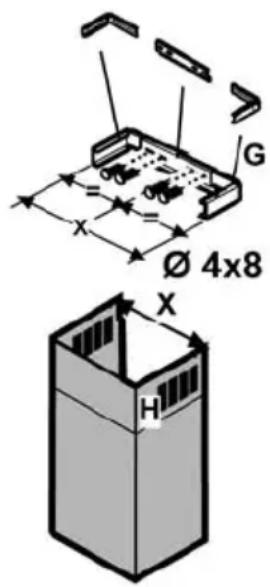
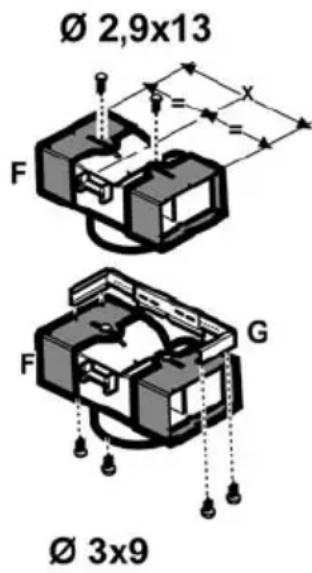
Fig. 5-6
Disconnect the hood during electrical connection, by turning the home mains switch off.
Remove the grease filter/s and the carbon filter frame.
- Rest the suction unit on a flat surface and thread the lower part of the hood onto it.
- Make all the electrical connections between the two parts.
- Permanently fix the cooker hood to the suction group with the 12 screws.
- Using a pencil, draw a line on the wall, extending up to the ceiling, to mark the centre. This will facilitate installation.
- Rest the drilling template against the wall: the vertical centre line printed on the drilling template must correspond to the centre line drawn on the wall, and the bottom edge of the drilling template must correspond to the bottom edge of the hood: bear in mind that, when installation is complete, the underside of the hood must be at least 50 cm above the cooker top in the case of electric cookers, and at least 65 cm above the cooker top in the case of gas or mixed cookers.
- Place the lower support bracket on the perforation diagram making it coincide with the traced triangle, mark
the two external holes and perforate. Remove the perforation diagram, insert two wall-dowels and fix the support bracket of the hood with two 5 × 45 mm screws.
-
If supplied dismantled, fix the hooks to the side of the aspiration group with two screws (7a). Hang the hood onto the lower bracket (7b).
-
Adjust the distance of the hood from the wall.
-
Adjust the horizontal position of the hood.
-
Using a pencil mark the cooker hood permanent drill hole inside the suction group (1 or 2 fixing points are necessary for permanent mounting).
-
Remove the hood from the lower bracket.
-
Drill at the point marked (Ø8mm).
-
Insert 1 or 2 wall screw anchors according to requirement.
-
Apply the flues support bracket "G" to the wall adherent to the ceiling, use the flues support bracket as a perforation diagram (if present, the small slot on the support must coincide with the line drawn previously on the wall) and mark two holes with a pencil. Make the holes (08mm) ,and insert 2 dowels.
-
Fix the chimney support bracket to the wall using two 5 × 45 mm screws.
-
Hook the hood onto the bottom bracket.
-
Fix the hood into its final position on the wall (ABSOLUTELY ESSENTIAL).
-
Connect a pipe (pipe and pipe clamps not provided, to be purchased separately) for discharge of fumes to the connection ring located over the suction motor unit.
If the hood is to be used in ducting version, the other end of the pipe must be connected to a device expelling the fumes to the outside. If the hood is to be used in filter version, then fix the deflector F to the chimney support bracket G and connect the other extremity of the pipe to the connection ring placed on the deflector F.
-
Connect the electricity.
-
Apply the chimney stacks and fasten them at the top to the chimney support, G (20b) using 2 screws (20a)
Only for the model with control panel on the flue: Only if the control panel is not mounted on the lower flue:
Insert the small plate of the commands coming from the motor group into the slot of the flue, from the interior to the exterior (20c).
Connect the control panel to the small plate.
Attention! The pin of the small plate terminal MUST correspond to the hole made in the connection plinth on the back of the control panel.
Only if the control panel is already mounted on the lower flue:
Connect the control panel to the electronic box of the hood.
Attention! The pin of the small plate MUST correspond to the hole made in the connection plinth on the electronic box (20d).
-
Slide the bottom section of the chimney down until it completely covers the suction unit and slots into the housing provided on top of the hood.
-
Fix the lower section of the chimney with two screws. Remount the carbon filter frame and the fat/s filter/s and check the perfect functioning of the hood.
Description of the hood
Fig. 1
- Control panel
- Grease filter
- Grease filter release handle
- Halogen lamp
- Vapour screen
- Telescopic chimney
- Air outlet (used for filter version only)
Operation
Use the high suction speed in cases of concentrated kitchen vapours. It is recommended that the cooker hood suction is switched on for 5 minutes prior to cooking and to leave in operation during cooking and for another 15 minutes approximately after terminating cooking.
Model with button panel
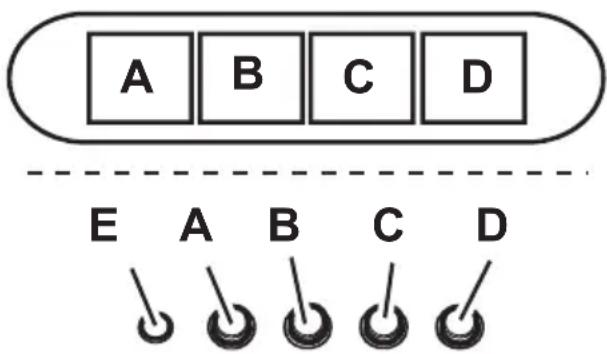
A. on/off light switch
B. on/off aspiration switch and minimum power selection
B+C. medium power selection aspiration switch
B+D. maximum power selection aspiration switch
E. operating gauge (foreseen in the model with round buttons)
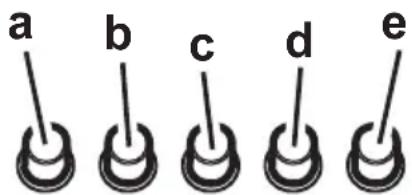
a. on/off light switch
b. off aspiration switch
c. minimum power selection aspiration switch
d. medium power selection aspiration switch
e. maximum power selection aspiration switch
Maintenance
Before performing any maintenance operation, isolate the hood from the electrical supply by switching off at the connector and removing the connector fuse.
Or if the appliance has been connected through a plug and socket, then the plug must be removed from the socket.
Cleaning
The cooker hood should be cleaned regularly (at least with the same frequency with which you carry out maintenance of the fat filters) internally and externally. Clean using the cloth dampened with neutral liquid detergent. Do not use abrasive products.
DO NOT USE ALCOHOL!
Grease filter
Fig. 2
This must be cleaned once a month (or when the filter saturation indication system - if envisaged on the model in possession - indicates this necessity) using non aggressive detergents, either by hand or in the dishwasher, which must be set to a low temperature and a short cycle.
When washed in a dishwasher, the grease filter may discolour slightly, but this does not affect its filtering capacity.
To remove the grease filter B, pull the spring release handle.
Charcoal filter (filter version only)
Fig. 3
It absorbs unpleasant odours caused by cooking.
The charcoal filter can be washed once every two months (or when the filter saturation indication system - if envisaged on the model in possession - indicates this necessity) using hot water and a suitable detergent, or in a dishwasher at 65°C (if the dishwasher is used, select the full cycle function and leave dishes out).
Eliminate excess water without damaging the filter, then remove the mattress located inside the plastic frame and put it in the oven for 10 minutes at 100° C to dry completely. Replace the mattress every 3 years and when the cloth is damaged.
Remove the filter holder frame by turning the knobs (g) 90° that affix the chimney to the cooker hood.
Insert the pad (i) of activated carbon into the frame (h) and fit the whole back into its housing (j).
It is possible to use a traditional carbon filter, neither washable nor regenerable, to be replaced every 3 - 4 months. The filter holder frame of the carbon filter is welded together; the eventual frame supplied with the hood is not, therefore, to be used.
Insert it into its housing and fix it turning the 2 plastic knobs.
Replacing lamps
Fig. 4
Disconnect the hood from the electricity.
Warning! Prior to touching the light bulbs ensure they are cooled down.
- Use a small screwdriver as a lever on the borders of the lamp in order to remove the lightbulb.
- Slide out the lightbulb to be replaced and replace with a new 12V 20W 30° Ø35 12V GU4 PHILIPS STANDARD LINE code 425409.
- Carry out the replacement and mount the new lightbulb by
following instructions in the reverse.
If the lights do not work, make sure that the lamps are fitted properly into their housings before you call for technical assistance.
Caution
Never use the hood without the grill mounted!
The hood must NEVER be used as a support unless expressly indicated.
The appliance is not intended for use by young children or infirm persons without supervision.
Young children should be supervised to ensure that they do not play with the appliance.
The premises must have sufficient ventilation when the kitchen hood is used at the same time as other apparatuses fuelled by gas or other fuels.
The sucked air must not be conveyed in a conduit used for discharging fumes produced by apparatuses fuelled by gas or other fuels.
Cooking food on the flame under the hood is severely prohibited.
The use of open flame damages the filters and can cause a fire; it must therefore be avoided in any case.
Frying must be carried out under control in order to prevent overheated oil catching fire.
Keep strictly to the regulations envisaged by the competent local authority as far as the technical and safety measures to adopt for discharging fumes are concerned.
The hood is to be cleaned frequently both internally and externally.
Failure to observe the regulations about cleaning the hood and substituting and cleaning the filters can lead to the risk of fire.
Any responsibility is declined for possible inconveniences, damage or fire caused to the apparatus deriving from failure to observe the instructions shown in this manual.
This appliance is marked according to the European directive 2002/96/EC on Waste Electrical and Electronic Equipment (WEEE). By ensuring this product is disposed of correctly, you will help prevent potential negative consequences for the environment and human health, which could otherwise be caused by inappropriate waste handling of this product.
The symbol on the product, or on the documents accompanying the product, indicates that this appliance may not be treated as household waste. Instead it shall be handed over to the applicable collection point for the recycling of electrical and electronic equipment. Disposal must be carried out in accordance with local environmental regulations for waste disposal.
For more detailed information about treatment, recovery and recycling of this product, please contact your local city office, your household waste disposal service or the shop where you purchased the product.
Assembler le support cheminée (3 parties):



- USE
- DUCTING VERSION
- FILTER VERSION
- INSTALLATION
- ELECTRICAL CONNECTION
- MOUNTING
- ASSEMBLING THE CHIMNEY FLUE SUPPORT/BRACKET (3 PARTS)
- DESCRIPTION OF THE HOOD
- FIG. 1
- OPERATION
- MODEL WITH BUTTON PANEL
- MAINTENANCE
- CLEANING
- DO NOT USE ALCOHOL
- GREASE FILTER
- FIG. 2
- CHARCOAL FILTER (FILTER VERSION ONLY)
- FIG. 3
- REPLACING LAMPS
- FIG. 4
- CAUTION
- ASSEMBLER LE SUPPORT CHEMINÉE (3 PARTIES)
Brand : HOOVER
Model : HHG 994 X
Category : Range hood