MV900SDS - Car stereo SONY - Free user manual and instructions
Find the device manual for free MV900SDS SONY in PDF.


User questions about MV900SDS SONY
0 question about this device. Answer the ones you know or ask your own.
Ask a new question about this device
Download the instructions for your Car stereo in PDF format for free! Find your manual MV900SDS - SONY and take your electronic device back in hand. On this page are published all the documents necessary for the use of your device. MV900SDS by SONY.
USER MANUAL MV900SDS SONY
Operating Instructions
US
Mode d'emploi
FR
Owner's Record
The model and serial numbers are located on the top of the unit.
Record these numbers in the space provided below.
Refer to these numbers whenever you call upon your Sony dealer regarding this product.
Model No. MV-900SDS Serial No.
For installation and connections, refer to "Connections" on page 35.
The use of optical instruments with this product will increase eye hazard.
CAUTION
Use of controls or adjustments or performance of procedures other than those specified herein may result in hazardous radiation exposure.
DANGER INVISIBLE LASER RADIATION WHEN OPEN. AVOID DIRECT EXPOSURE TO BEAM.
This is located on the drive unit's internal chassis.
To prevent fire or shock hazard, do not expose the unit to rain or moisture.
text_image
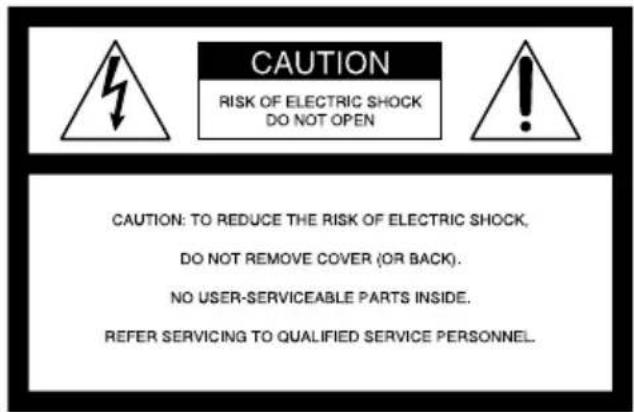
CAUTION RISK OF ELECTRIC SHOCK DO NOT OPEN CAUTION: TO REDUCE THE RISK OF ELECTRIC SHOCK, DO NOT REMOVE COVER (OR BACK). NO USER-SERVICEABLE PARTS INSIDE. REFER SERVICING TO QUALIFIED SERVICE PERSONNEL.
This symbol is intended to alert the user to the presence of uninsulated “dangerous voltage” within the product’s enclosure that may be of sufficient magnitude to constitute a risk of electric shock to persons.

This symbol is intended to alert the user to the presence of important operating and maintenance (servicing) instructions in the literature accompanying the appliance.
Warning
This equipment has been tested and found to comply with the limits for a Class B digital device, pursuant to Part 15 of the FCC Rules. These limits are designed to provide reasonable protection against harmful interference in a residential installation. This equipment generates, uses, and can radiate radio frequency energy and, if not installed and used in accordance with the instructions, may cause harmful interference to radio communications. However, there is no guarantee that interference will not occur in a particular installation. If this equipment does cause harmful interference to radio or television reception, which can be determined by turning the equipment off and on, the user is encouraged to try to correct the interference by one or more of the following measures:
— Reorient or relocate the receiving antenna.
— Increase the separation between the equipment and receiver.
— Connect the equipment into an outlet on a circuit different from that to which the receiver is connected.
— Consult the dealer or an experienced radio/TV technician for help.
You are cautioned that any changes or modifications not expressly approved in this manual could void your authority to operate this equipment.
For the customers in the United States
This product contains mercury. Disposal of this product may be regulated if sold in the United States. For disposal or recycling information, please contact your local authorities or the Electronics Industries Alliance (http://www.eiae.org).
Table of Contents
Welcome! 4
Precautions 4
About this manual 7
About discs this player can play 7
Resetting the player 9
Location of controls 10
Operation for Monitor
Opening the display monitor 13
Selecting the input source 14
Selecting the color system 14
Changing the player and monitor settings .... 15
Use of Headphones
Listening with the headphones 18
Various Playback
Playing a disc 19
Playing a "Memory Stick" 21
Displaying elapsed time 22
Changing the subtitle language 23
Using a DVD menu 24
Changing the audio language 25
Changing angles 25
Changing the audio output 26
Using the PBC (Playback Control) function ... 26
Changing Setup
Setting the aspect ratio for the TV screen — TV SCREEN .... 27
Displaying the multi-angle notice — ANGLE MARK .... 28
Setting the screen saver — SCR SAVER .... 28
Selecting the speaker mode — SPEAKER SETUP.... 29
Selecting the audio output mode — AUDIO OUT .... 29
Selecting the compression setting for the sound — DYNAMIC .... 30
Selecting the audio language for DVD — AUDIO .... 30
Displaying the subtitles for DVD — SUBTITLE .... 31
Selecting the DVD menu language — DISC MENU .... 31
Preparing for the initial parental setting ..... 32
Returning this player to the factory setting — DEFAULTS .... 34
Setting the menu display for MP3/JPEG/MPEG1 files — SMART NAVI .... 34
Connections
Installation diagram 35
Connection diagram 36
Additional Information
Maintenance.... 38
Notes on discs 40
About MP3 files 41
About "Memory Stick" 42
Specifications 44
Troubleshooting.... 45
Error display 47
Language Code List 48
Welcome!
Thank you for purchasing this Sony Mobile DVD System. You can enjoy its various features even more with:
•DVD/Video CD/Audio CD playback.
- MP3/JPEG file encoded disc playback.
- MP3/JPEG/MPEG1 file encoded "Memory Stick" playback.
- Support DTS/Dolby Digital through optical digital output terminal.
• Supplied controller accessory
Card remote commander RM-X137
Before operating the player, please read this operating instructions thoroughly and retain it for future reference.
Copyrights
This product incorporates copyright protection technology that is protected by method claims of certain U.S. patents, other intellectual property rights owned by Macrovision Corporation, and other rights owners. Use of this copyright protection technology must be authorized by Macrovision Corporation, and is intended for home and other limited viewing uses only unless otherwise authorized by Macrovision Corporation. Reverse engineering or disassembly is prohibited.
- "Memory Stick," and "MagicGate Memory Stick" are trademarks of Sony Corporation.
- "Memory Stick Duo" and "MEMORY STICK Duo are trademarks of Sony Corporation.
- "MagicGate" and "MAGICGATE" trademarks of Sony Corporation.
- "Memory Stick PRO" and "MEMORY STICK PRO are trademarks of Sony Corporation.
Manufactured under license from Dolby Laboratories. "Dolby", "Pro Logic", and the double-D symbol are trademarks of Dolby Laboratories.
"DTS," "DTS Digital Surround" and "DTS Digital Out" are trademarks of Digital Theater Systems, Inc.


Precautions
To avoid the risk of serious injury or accident, read the following precautions before installing and operating the player.
For driver's safety
Comply with your local traffic rules and regulations.
-
While driving
— The driver must not watch or operate the player. It may lead to distraction and cause an accident.
— The driver must not use the headphones. It may lead to distraction and cause an accident.
Park the car in a safe place when the driver watch and operate the player or use the headphones. -
After installing
— Do not hang onto the monitor.
— Do not insert your hands, fingers or foreign objects into the player. It may cause injury or damage to the player.
— Take care not to bump your head against the monitor when getting up from the back seat.
— Keep small articles out of the reach of children.
- If the player does not work, check the connections first. If everything is in order, check the fuse.
- If your car was parked in direct sunlight, allow the player to cool off before operating it.
- Avoid installing the player in places:
— subject to temperature below 0 ^ ( 32 ^ ) or above 45 ^ ( 113 ^ )
— subject to direct sunlight
— near heat sources (such as heaters)
— exposed to rain or moisture
— exposed to excessive dust or dirt
— subject to excessive vibration
— subject to heat:
Keep the player away from nearby hot vehicle components that heat up over time such as hoses, high current wires, and braking systems components. Make sure to leave enough room for ventilation on openings and slots to protect from over heating.
If you have any questions or problems concerning the player, please consult your nearest Sony dealer.
On heat build-up
Heat may build up in the player if it is used for an extended period of time. This, however, is not a malfunction.
Moisture condensation
On a rainy day or in a very damp area, moisture condensation may occur inside the lenses. Should this occur, the player will not operate properly. In such a case, remove the disc and wait for about an hour until the moisture has evaporated.
To maintain high sound quality
Be careful not to splash juice or other soft drinks onto the player or discs.
Notes on cordless stereo headphones
- For your safety, do not use the headphones while driving your car.
- When the headphones are not to be used for a long period of time, remove the battery to avoid damage caused by battery leakage and subsequent corrosion.
- Do not leave the headphones in a location subject to direct sunlight, heat or moisture (It is recommended to use the headphones at a temperature of between 5 °C and 35 °C (41 °F and 95 °F)).
- If the headphones are used while exposed to direct sunlight, sensitivity of the infrared receptor may deteriorate, and inferior quality sound may result.
- Do not drop, hit or otherwise subject headphones to strong shocks of any kind. This could damage the product.
- If you leave the headphones in direct sunlight, on a dash board etc., the battery may leak and burst, and cause an injury.
On installation
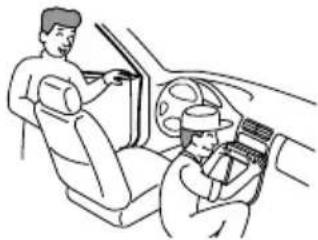
- Installing this unit requires technical expertise. This unit should be installed by a qualified technician or service personnel.
natural_image
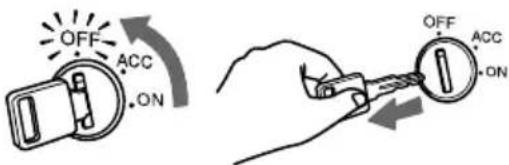
Line drawing of a car interior showing two people seated, one standing and one seated in a car seat, with no visible text or symbols.- If you try to install this unit by yourself, do it properly, referring to the installation and wiring diagrams in this operating manual. Improper installation may result in fire or electric shock. - Before installation, be sure to turn the ignition switch to the OFF position or take the key out. Installing this unit with the ignition on may cause battery drain or a short circuit.
text_image
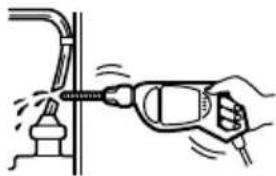
OFF ACC ON- Do not damage any pipes, tubes, the fuel tank or electric wiring when installing this unit. This can cause a fire. If you drill a hole in car panels, make sure that any hidden car parts will not be damaged.
natural_image
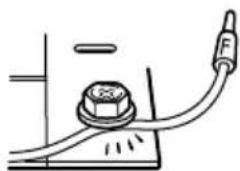
Illustration of a hand using a drill bit to adjust or install a pipe into a sink (no text or symbols present)- Do not use any nuts or bolts for safety devices such as steering linkage, fuel supply or braking systems. This can cause a fire or an accident. - Take care to prevent cords and wires from getting tangled or crimped in the moving portion of a seat rail.
natural_image
Simple line drawing of a mechanical component with a bolt and force gauge (no text or symbols)continue to next page →
Where to install
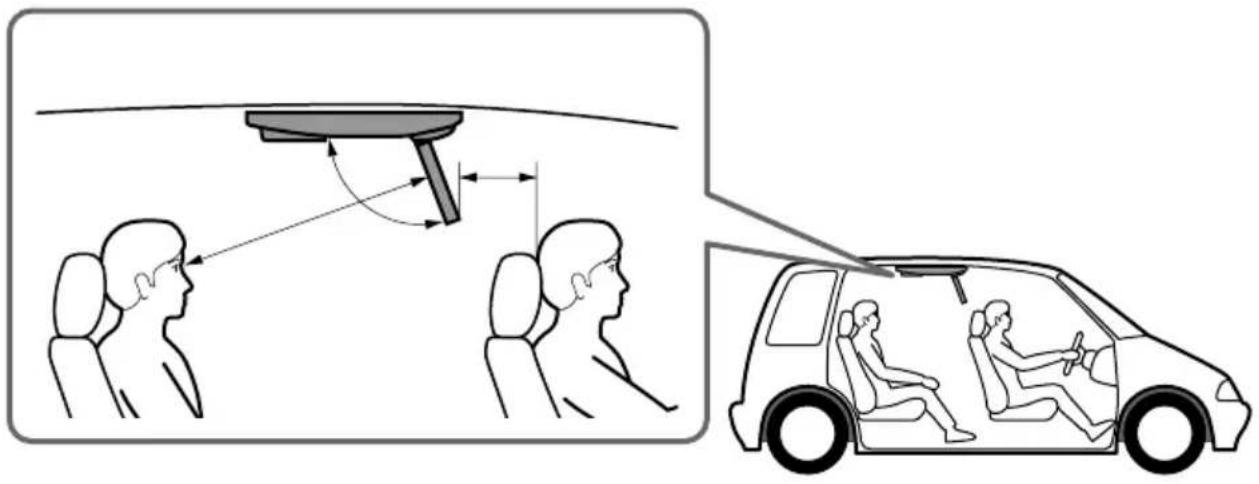
Before installing this unit, please check your local traffic rules and regulations. Follow the diagram below to install this unit in a suitable position in your car.
text_image
Diagram illustrating car safety perception with labeled components and directional arrows for driving and meeting scenarios.Do not install this unit where:
— It will obstruct the driver's view when the monitor is in either the open or closed position.
— It will obstruct the operation of the airbag system.
— It will obstruct the operation of the vehicle, especially the steering wheel, shift lever, or brake pedal.
— A driver or passengers may injure themselves when getting into or out of the car.
If you have any questions or problems concerning your unit that are not covered in this manual, please consult your nearest Sony dealer.
Before installing
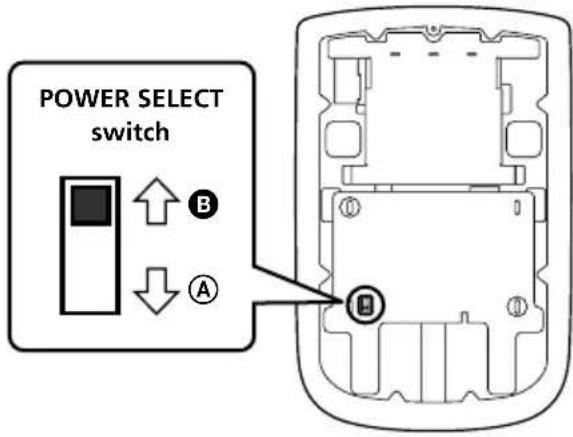
Make sure that the POWER SELECT switch is set to the correct position.
Ⓐ*: If your car has an accessory position on the ignition key.
B : If your car has no accessory position on the ignition key.
* Ⓐ is the factory preset position.
When the POWER SELECT switch is set to Ⓑ
Press POWER on the player to turn on. The player does not turn on by pressing POWER on the card remote commander.
text_image
POWER SELECT switch A BNote
Be sure to turn off the player after driving your car.
To turn off the player, follow the operations below:
- Press POWER on the player.
- Press POWER on the card remote commander. If the power is left on, it will cause battery drain.
About this manual
Conventions
- Instructions in this manual describe how to use the player and the cordless stereo headphones.
• The icons below are used in this manual:
| Icon Meaning | |
 | Functions available for DVD VIDEOs or DVD-Rs/DVD-RWs in video mode |
 | Functions available for Video CDs or CD-Rs/CD-RWs in video CD format |
 | Functions available for music CDs or CD-Rs/CD-RWs in music CD format |
 | Functions available for files in MP3 format stored on CD-ROMs/CD-Rs/CD-RWs and “Memory Stick” |
 | Functions available for files in JPEG format stored on CD-ROMs/ CD-Rs/CD-RWs and “Memory Stick” |
 | Functions available for files in MPEG1 format stored in “Memory Stick” |
About discs this player can play
This player can play the following discs:
• DVD
•DVD-R/DVD-RW
- Video CD
- Audio CD
- CD-R/CD-RW
| Disc type Label on the disc | ||
| DVD VIDEOS |  |  |
 |  | |
| Video CDs |  |  |
| Audio CDs |  | |
 |  | |
| MP3 files/ JPEG files |  |  |
 | COMPACTDISCReWritable | |
"DVD VIDEO," "DVD-R" and "DVD-RW" are trademarks.
continue to next page →
Notes on CD-Rs (recordable CDs)/CD-RWs (rewritable CDs)/DVD-Rs (recordable DVDs)/DVD-RWs (rewritable DVDs)
- Some CD-Rs/CD-RWs/DVD-Rs/DVD-RWs (depending on the equipment used for its recording or the condition of the disc) may not play on this player.
- You cannot play a CD-R/CD-RW/DVD-R/DVD-RW that is not finalized*.
- You cannot play a CD-R/CD-RW that is recorded in Multi Session.
- You can play MP3/JPEG files recorded on CD-ROMs, CD-Rs, and CD-RWs.
* A process necessary for a recorded CD-R/CD-RW disc to be played on the audio CD player.
Region code of DVDs this player can play
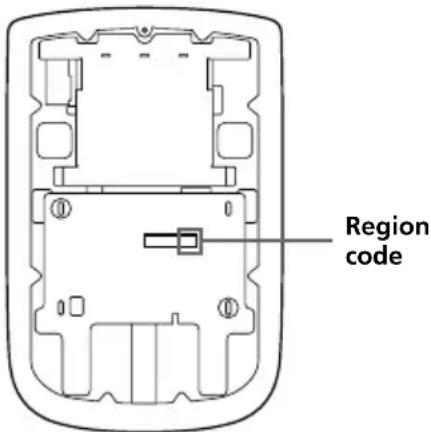
This player has a region code printed on the rear of the player and will only play DVDs that are labeled with identical region codes. DVDs labeled 📁 will also be played on this player. If you try to play any other DVD, the message "REGION ERROR" will appear on the screen. Depending on the DVD, the region code indication may not appear even if the DVD is prohibited by area restrictions.
text_image
Region codeCautions
• This player CANNOT play these discs.
— DVD-Audio — DVD-RAM
— DVD-ROM — CD-G
— SVCD — CD-I
— Photo-CD — VSD
— Active-Audio (Data)
— CD-Extra (Data)
— Mixed CD (Data)
— CD-ROM (the data other than the MP3/JPEG file)
— DVD-RW recorded in VR mode
- This product incorporates copyright protection technology that is protected by method claims of certain U.S. patents and other intellectual property rights owned by Macrovision Corporation and other rights owners. Use of this copyright protection technology must be authorized by Macrovision Corporation, and is intended for home and other limited viewing uses only unless otherwise authorized by Macrovision Corporation. Reverse engineering or disassembly is prohibited.
Note on PBC (Playback Control)

This player conforms to Ver. 1.1 and Ver. 2.0 of Video CD standards. You can enjoy two kinds of playback according to the disc type.
| Disc type | You can |
| Video CDs without PBC functions (Ver. 1.1 discs) | Video playback (moving pictures) as well as music. |
| Video CDs with PBC functions (Ver. 2.0 discs) | • Interactive software with menu screens displayed on the monitor (PBC Playback, page 26). • Video playback functions. • High-resolution still pictures if they are included on the disc. |
Note on DTS-encoded CDs
When playing DTS*-encoded CDs, excessive noise will be heard from the analog stereo outputs. To avoid possible damage to the audio system, the consumer should take proper precautions when the analog stereo outputs of this player are connected to an amplification system. To enjoy DTS Digital Surround™ playback, an external 5.1-channel DTS Digital Surround™ decoder system must be connected to the digital output of this player.
* "DTS," "DTS Digital Surround" and "DTS Digital Out" are trademarks of Digital Theater Systems, Inc.
Terms for discs
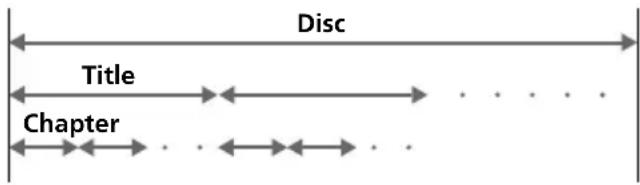
DVD structure
flowchart
graph LR
    A["Disc"] --> B["Title"]
    B --> C["Chapter"]
    C --> D["..."]
    style A fill:#f9f,stroke:#333
    style B fill:#ccf,stroke:#333
    style C fill:#cfc,stroke:#333
    style D fill:#fcc,stroke:#333
Video CD/Audio CD structure
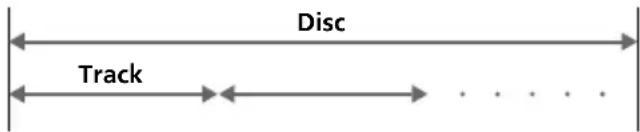
text_image
Disc Track•Title
The longest section of a picture or music feature on a DVD, e.g., a movie for video software, or an album for audio software, etc.
- Chapter
Sections of a picture or a music feature that are smaller than titles. A title is composed of several chapters. Each chapter is assigned a chapter number enabling you to locate the chapter you want. Depending on the disc, chapters may not be recorded.
- Track
Sections of a picture or a music feature on a Video CD/Audio CD. Each track is assigned a track number enabling you to locate the track you want.
- Scene
On a Video CD with PBC (Playback Control) functions, the menu screens, moving pictures and still pictures are divided into sections called "scenes." Each scene is assigned a scene number enabling you to locate the scene you want.
Resetting the player
Before operating the player for the first time, or after replacing the car battery, or after changing the connections, you must reset the player.
Press RESET with a pointed object, such as a ball-point pen. Pushing it with force by using a needle may damage the player.
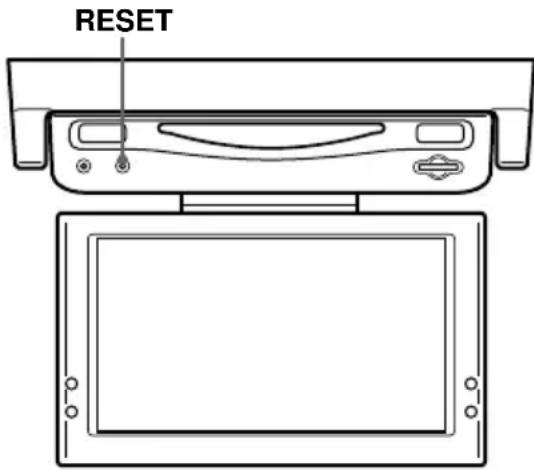
text_image
RESETNotes
- When you press RESET, some of the previous settings may be lost. If this occurs, make the settings again.
- It takes about 10 seconds for the player to reset itself after pressing RESET. Do not insert a disc during this time. If you do, the player may not be reset properly.
Location of controls
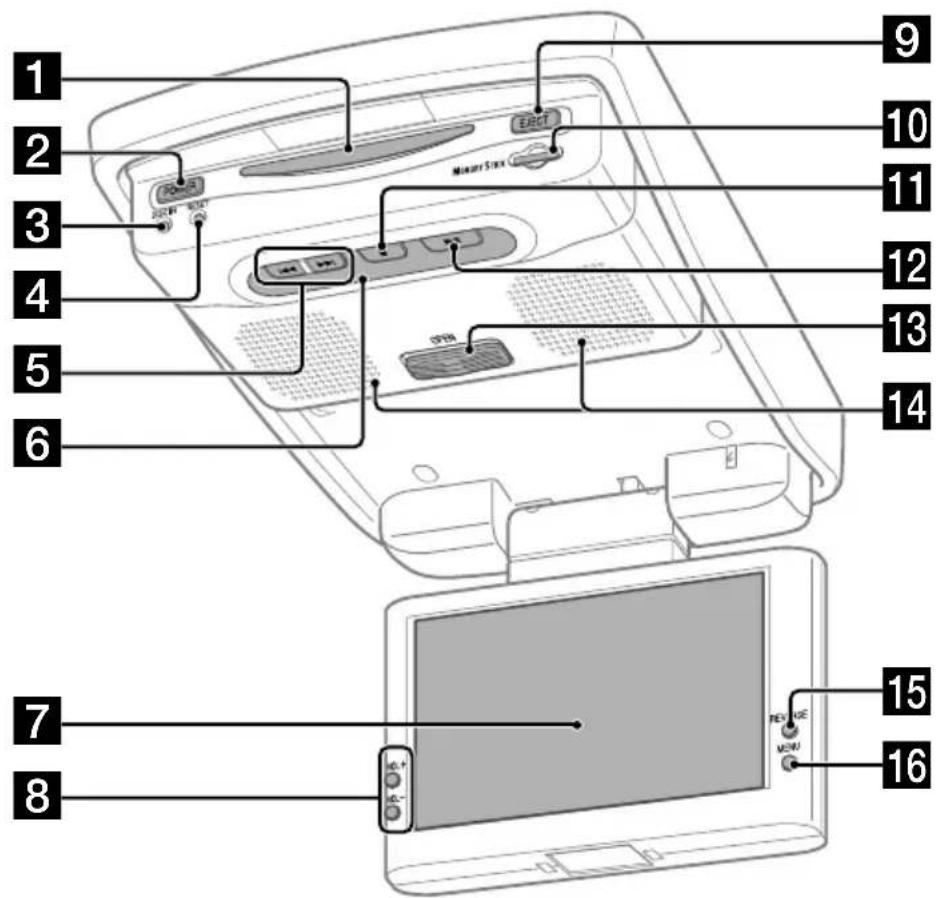
text_image
1 2 3 4 5 6 7 8 9 10 11 12 13 14 15 16 EBIT SmartBoxXVM-R90D
Refer to the pages listed for details.
1 Disc slot
2 POWER (on/off) button 13, 14, 19
To turn on/off the player.
3 DISC IN light
When a disc is in the player, the DISC IN light glows orange.
4 RESET button 9
5 I◀◀ (previous)/▶▶I (next) buttons 20, 22
6 Receptor for the card remote commander/Transmitter for the cordless headphones
7 Monitor
8 VOL +/- buttons 14, 15
To turn up or down the volume or to select the item during menu operation.
9 EJECT button 20
Available to eject a disc from the player even when the player is turned off.
10"Memory Stick" slot 21
11■ (stop) button 20, 22
12▶II (play/pause) button 20, 22
13 OPEN button 13
Slide to open the monitor.
14Speakers (left/right)
15REVERSE button 13, 15
To switch images upside down and reverse the output of the audio channels.
16MENU button 15
To make various display settings and FM transmitter setting.
Note
Even when the player is turned off by pressing POWER, you can eject a disc from the player, though you cannot insert a disc.
Card remote commander RM-X137
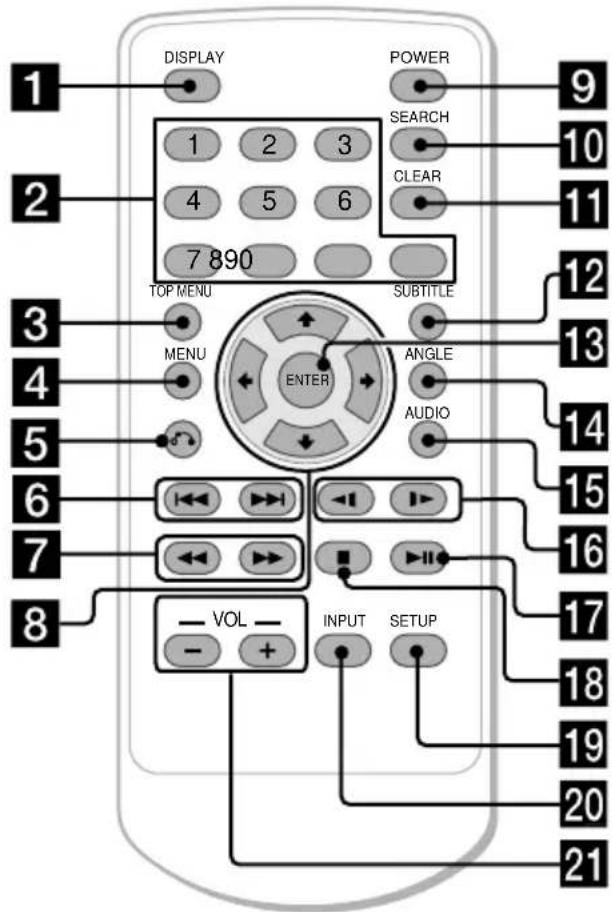
text_image
DISPLAY POWER 1 2 3 SEARCH 10 2 4 5 6 CLEAR 11 7 890 TOP MENU SUBTITLE 3 MENU ANGLE 13 4 ENTER AUDIO 14 5 6 15 7 VOL - INPUT SETUP 16 17 18 19 20 21Refer to the pages listed for details.
1 DISPLAY button 22
To display the time information of the disc.
2 Number buttons (0 to 9) 19, 21, 26, 27
3 TOP MENU button 24, 26
To display the top menu of a recorded DVD.
4 MENU button 24
To display the recorded DVD menu, or to turn on/off the PBC (Playback control) menu of a Video CD.
5 (return) button 26
6 I◄◄/►►I (previous/next) buttons 19, 21, 26
7◀◀ (fast reverse)/
▶▶ (fast forward) buttons 19, 21
8 ↑/→/↓/← buttons 19, 21, 24, 27
9 POWER (on/off) button 14, 19
To turn on/off the player.
10 SEARCH button 19
To specify a desired point on a disc by chapter, title, or track.
11 CLEAR button
The corresponding buttons of the card remote commander control the same functions as those on the player.
Instructions in this manual describe how to use the player by mainly using the card remote commander.
Tip
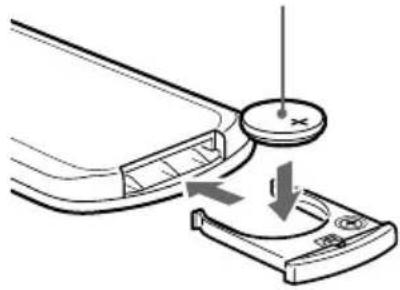
Refer to "Replacing the lithium battery" for details on how to replace the battery (page 38).
12 SUBTITLE button 23
To change the subtitle language while playing a DVD.
13 ENTER button 19, 24, 27
To enter a setting.
14 ANGLE button 25
To select the multiple angles of view while playing a DVD.
15 AUDIO button 25, 26
To change the audio output/audio language.
16 ◀ (slow reverse)/▶ (slow forward) buttons 19, 21
17▶II (play/pause) button 19, 21, 26
18 ■ (stop) button 19, 21
19 SETUP button 27
Used to perform menu operations.
20 INPUT button 14, 21
To select the input source.
21VOL (-/+) buttons 19
To turn up or down the volume.
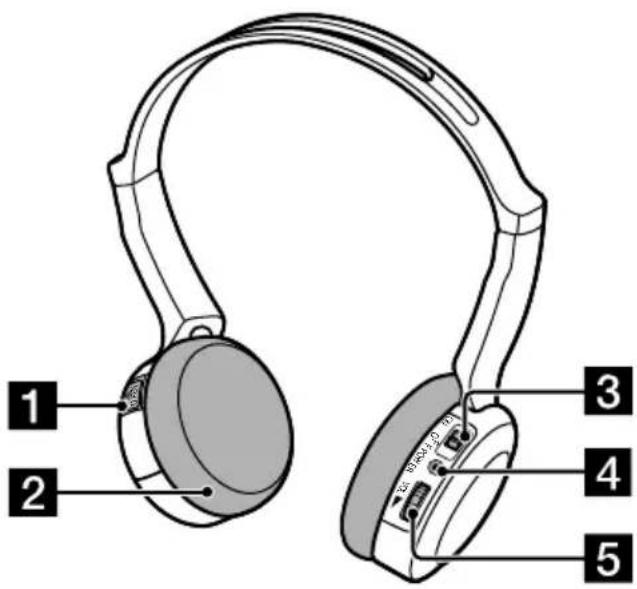
Cordless Stereo Headphones MDR-IF0140
text_image
1 2 3 4 51 Battery compartment lid 39
To set a battery, open the lid.
2 Ear pad 40
The ear pads are replaceable.
3 Power (ON/OFF) switch 18
4 POWER indicator 18
When the power switch of the headphones is set to ON, the POWER indicator lights up in red.
5 VOL control dial 18
To adjust the volume level from 0 to 10.
Battery life
Size AAA dry battery (1) is supplied with the headphones.
Battery Approx. hours* 1
| Sony alkaline battery 60 hours* | 2 |
| LR03/AM-4 (N) | |
| Sony manganese battery 28 hours* | 2 |
| R03/UM-4 (NU) |
*1 at 1 kHz, 1 mW+1 mW output
*2 Time stated above may vary, depending on the temperature or conditions of use.
Tip
Refer to "Replacing the battery" for details on how to replace the battery (page 39).
Operation for Monitor
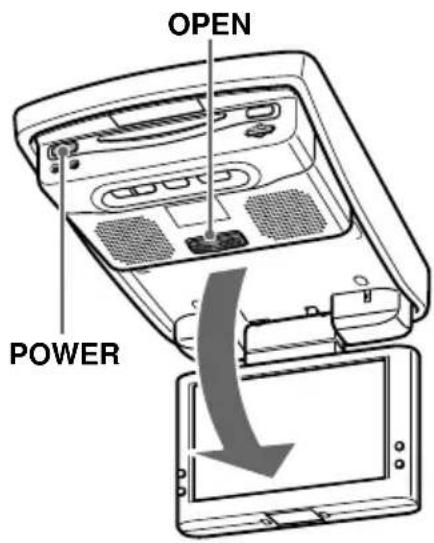
Opening the display monitor
text_image
OPEN POWER1 Slide OPEN to the front, and open the display monitor.
2 Press POWER to turn on the player.
Tip
If your car has no ACC (accessory) position on the ignition key switch and you set the POWER SELECT switch to the B position, the player does not turn on by pressing POWER on the card remote commander (page 6).
Returning the display monitor to its enclosure
Close the display monitor until it clicks.
Notes
- Be careful not to catch your finger in the display monitor when closing.
- Do not put any foreign objects between the LCD panel and the enclosure when closing.
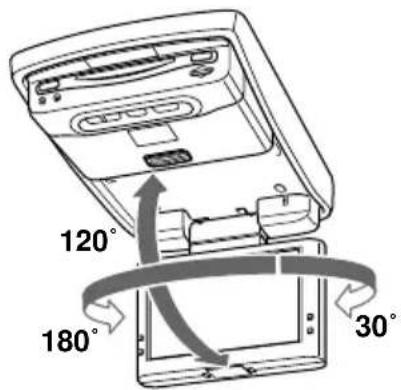
Adjusting the tilt and swivel
The display monitor can be adjusted within the angles shown.
text_image
120° 180° 30°Tips
- Before closing the display monitor, make sure that the monitor is turned and facing the enclosure (you will hear a click).
- The monitor stores the input mode you set, even if you turn off the monitor.
The reverse position of the display monitor
You can close with the LCD surface out after turning around 180 degrees, and images on the screen can be turned upside down by pressing REVERSE. Each time you press REVERSE, the reverse screen mode switches between on and off.

text_image
180° ↓ ↓ REVERSESelecting the input source
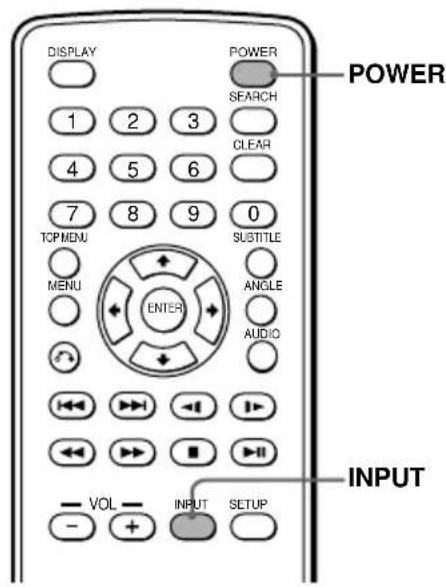
You can select the input source for the monitor.
text_image
DISPLAY POWER 1 2 3 1 2 3 4 5 6 7 8 9 0 TOP MENU MENU ENTER SUTTITLE ANGLE AUDIO VOL INPUT SETUP POWER INPUT1 Press POWER to turn on the player.
The current input source (DVD) appears on the screen for 5 seconds.
2 Press INPUT repeatedly to select the input source.
Each time you press Ⓗ INPUT, the indication changes as follows:
$$ \mathrm{DVD} \longleftrightarrow \mathrm{VIDEO} $$
Be sure to change the input source setting to "DVD" to play a disc or "Memory Stick" with this player.
Note
When you play a "Memory Stick," set the input source to "DVD."
Tip
If your car has no ACC (accessory) position on the ignition key switch and you set the POWER SELECT switch to the Ⓑ position, the player does not turn on by pressing POWER on the card remote commander (page 6).
Selecting the color system
The player detects the color system of the input video signal (NTSC or PAL) and changes the setting automatically (auto mode).
Do the steps below to change the color system setting for the input video signal manually.
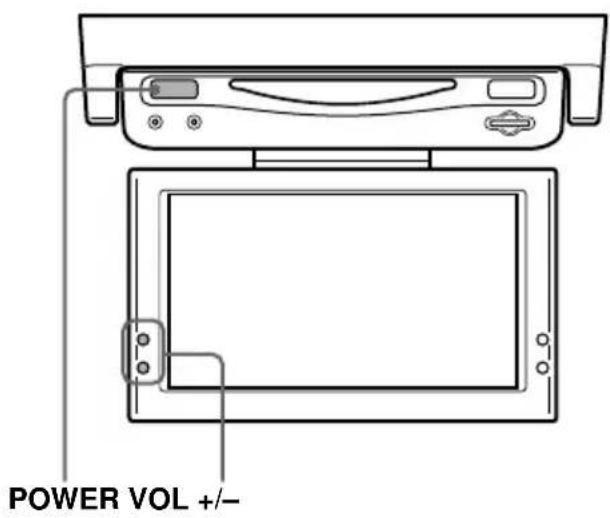
text_image
POWER VOL +/-1 Press POWER to turn on the player. The current input channel (DVD) appears on the screen for 5 seconds.
2 Within 5 seconds, press VOL (+) or VOL (-) repeatedly to select "NTSC" or "PAL."
Note
When changed manually, color system setting for the input video signal does not return to auto mode until the player is turned off or input channel setting is changed. Therefore, when it is set to "PAL," the DVD recorded in NTSC system cannot be viewed on the monitor of the player unless you turn off the player, then turn it on again.
Changing the player and monitor settings
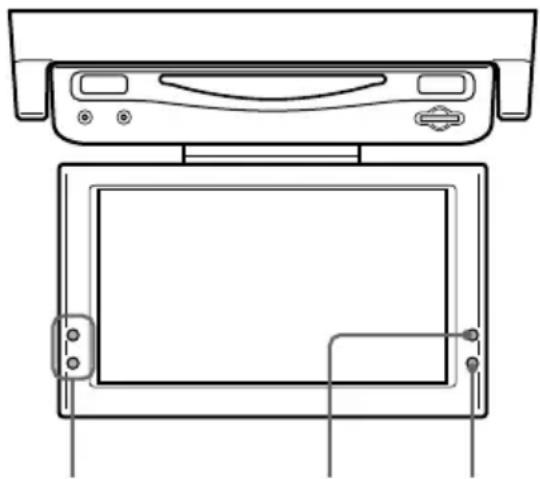
natural_image
Line drawing of a front view of a computer monitor with control panel and buttons (no text or symbols)To deactivate the cordless headphones
1 Press MENU repeatedly to select "IR HP."
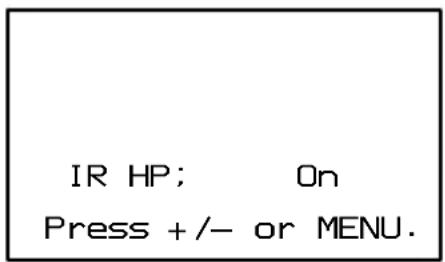
text_image
IR HP; On Press +/- or MENU.2 Press VOL (+) or VOL (-) to select "off."
MENUREVERSE Setting the FM modulator
Turning off the speaker sound from the player
1 Press MENU repeatedly to select "Speaker."
Each time you press Ⓜ, the setting screen changes as follows:
Speaker → IR HP → FM Modulator → Picture → Brightness → Color → Hue* → Dimmer → Video Adjust → Mode → Blue Back → Menu Off
* "Hue" appears only when the NTSC color system is selected (page 14).
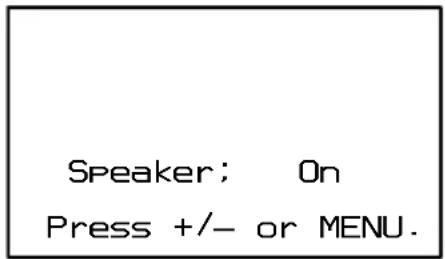
text_image
Speaker; On Press +/- or MENU.2 Press VOL (+) or VOL (-) to select "off."
You can transmit the audio signals to the FM radio and output the signals from the car stereo. Do the procedure below to turn on or off the FM modulator and select the frequency.
1 Press MENU repeatedly to select "FM Modulator."
2 Press VOL (+) or VOL (−) to select "Low," "Middle," "High," or "Off."
Select the FM modulator output level according to the input sensitivity of the car stereo's radio.
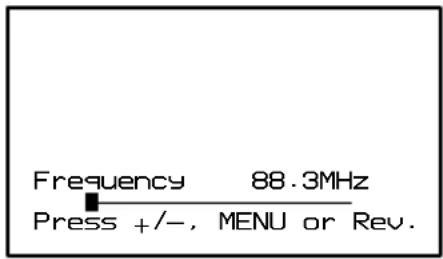
3 To select the frequency, press REVERSE.
The "Frequency" screen appears.
text_image
Frequency 88.3MHz Press +/-, MENU or Rev.4 Press VOL (+) or VOL (-) to select the frequency.
The settable range is 88.3 MHz to 89.9 MHz, in 0.2 MHz steps.
continue to next page →
Notes
- When the output level is set to "High" in step 2, noise may be heard.
- If noise is heard due to the interference with the local FM broadcast, change the FM transmission frequency.
- When the FM modulator is turned off, you cannot change the frequency setting.
Changing the display settings
You can adjust the display settings manually if the display is hard to see from the position where you are seated.
1 Press MENU repeatedly to select the desired item.
2 Press VOL (+) or VOL (-) to adjust to the desired setting.
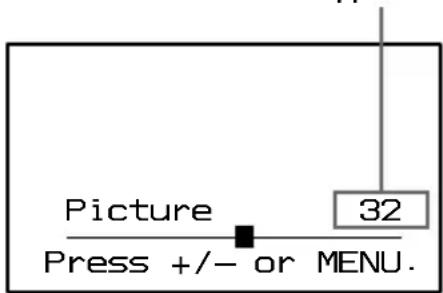
When "Picture" is selected;
The setting value of the item selected appears in this area.
text_image
Picture Press +/- or MENU. 32Press VOL (+): to increase the contrast. Press VOL (−): to decrease the contrast.
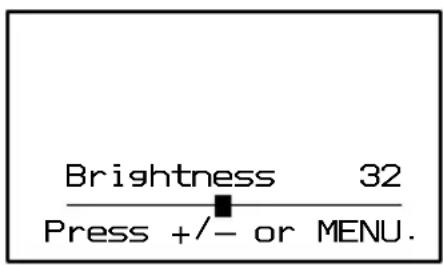
When "Brightness" is selected;
text_image
Brightness 32 Press +/- or MENU.Press VOL (+): to brighten the contrast. Press VOL (−): to darken the picture.
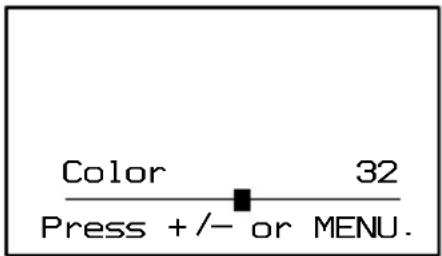
When "Color" is selected;
text_image
Color 32 Press +/- or MENU.Press (+): to increase color intensity. Press (−): to decrease color intensity.
When "Hue"*1 is selected;
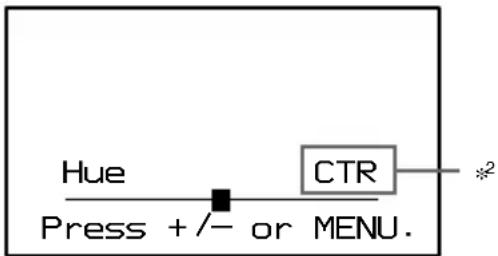
text_image
Hue Press +/- or MENU. CTR *²Press VOL (+) : to increase the saturation. Press VOL (-) : to decrease the saturation.
*1 "Hue" is adjustable only when the NTSC color system is selected.
^*2 “CTR” appears only when ■ in the center of the bar.
When "Dimmer" is selected;
Press VOL (+) or VOL (-) to select "On." The brightness of the screen will be adjusted automatically.
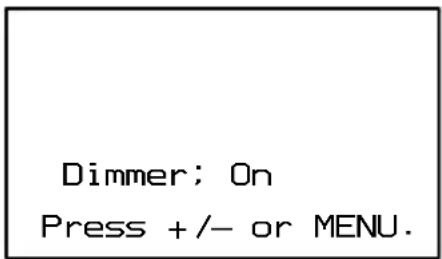
When "Video Adjust" is selected;
Press VOL (+) or VOL (-) to select "Reset."
"Picture," "Brightness," "Color," "Hue," and "Dimmer" settings will be reset to the factory preset level.
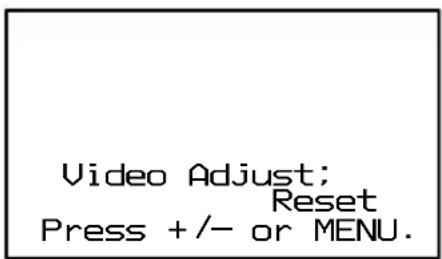
text_image
Video Adjust; Reset Press +/- or MENU.When "Mode" is selected;
"Normal," "Full," "Zoom," or "Wide" can be set as the screen mode.
Mode; Full
Press +/- or MENU.
- "Normal"
An image with an aspect ratio of 4 to 3 (regular image).
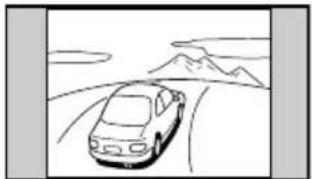
natural_image
Line drawing of a car driving on a curved road with mountains in the background (no text or symbols)• "Full"
An image with an aspect ratio of 4 to 3 enlarged to the left and right edges of the screen.
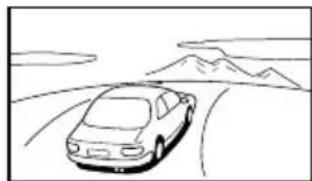
natural_image
Line drawing of a car driving on a curved road with mountains in the background (no text or symbols)- "Zoom"
An image with an aspect ratio of 4 to 3 enlarged to the left and right edges of the screen, with the overflowing parts (top and bottom) cut off to fill the screen.
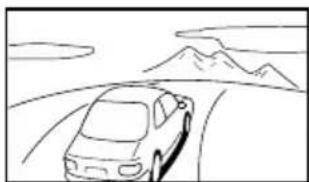
natural_image
Line drawing of a car driving on a curved road with mountains in the background (no text or symbols)- "Wide"
An image with an aspect ratio of 4 to 3, with only the left and right sides of the image being enlarged to fill the screen.
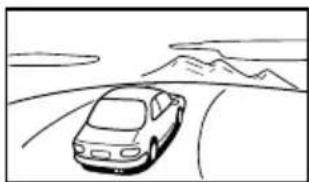
natural_image
Line drawing of a car driving on a curved road with mountains in the background (no text or symbols)When "Blue Back" is selected;
Press VOL (+) or VOL (-) to select "On." The blue background screen appears when no signal, or a weak signal is received. When a continuously weak video signal is received, the blue background may flicker. If this occurs, set to off.
Blue Back; On
Press +/- or MENU.
Use of Headphones
Listening with the headphones
Before listening
- The transmitter for the cordless headphones is on the player. See the location of controls for the player (page 10).
- To prevent your ears from being damaged, first lower the volume.
1 Turn on the player.
2 Set the power switch to ON on the right housing of the headphones.
The headphones turn on and the POWER indicator glows red.
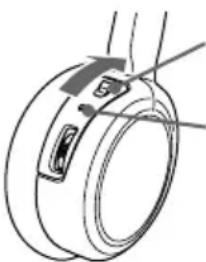
natural_image
Technical line drawing of a mechanical component with no visible text or symbolsPower (ON/OFF)
switch
POWER indicator
3 Put on the headphones.
Be sure to put the right housing (R) on your right ear and the left housing (L) on your left ear.
4 Start playback on the player.
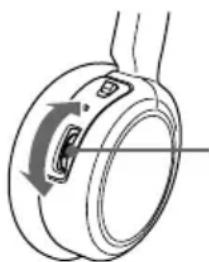
5 Turn the VOL control dial to adjust the volume.
If the infrared sensors of the headphones are covered by your hands when adjusting the volume, the attenuate function will be activated and volume cannot be adjusted. To adjust the volume, move nearer toward the transmitter of the monitor, or orient the infrared emitters on the left housing towards the transmitter of the monitor.
natural_image
Technical line drawing of a mechanical component with curved arrows indicating motion or force (no text or symbols)VOL control dial
Notes
- The volume of the headphones cannot be adjusted with the player or card remote commander. Use the volume control on the headphones.
- When the headphones are not to be used for a long period of time, remove the battery to avoid damage caused by battery leakage and subsequent corrosion.
- Do not leave the headphones in a location subject to direct sunlight, heat or moisture (It is recommended to use the headphones at a temperature of between 5^ and 35^ (41 °F and 95 °F)).
- If the headphones are used while exposed to direct sunlight, sensitivity of the infrared receptor may deteriorate, and inferior quality sound may result.
- Do not drop, hit or otherwise subject headphones to strong shocks of any kind. This could damage the product.
- If you leave the headphones in direct sunlight, on a dash board etc., the battery may leak and burst, and cause an injury.
Sound is automatically attenuated if noise increases — Attenuate function
If the infrared rays are obstructed, or the headphones are used outside their effective range, noise will increase and sound will become hard to hear. To avoid potential ear damage as a result of noise, this function attenuates any sound in the headphones. Sound is automatically restored when you move nearer to the transmitter or remove the obstruction.
After listening
Take off the headphones, and then turn off the power (Noise may occur if you turn off the monitor before taking off the headphones).
Various Playback
This chapter describes various functions for playback.
Playing a disc

text_image
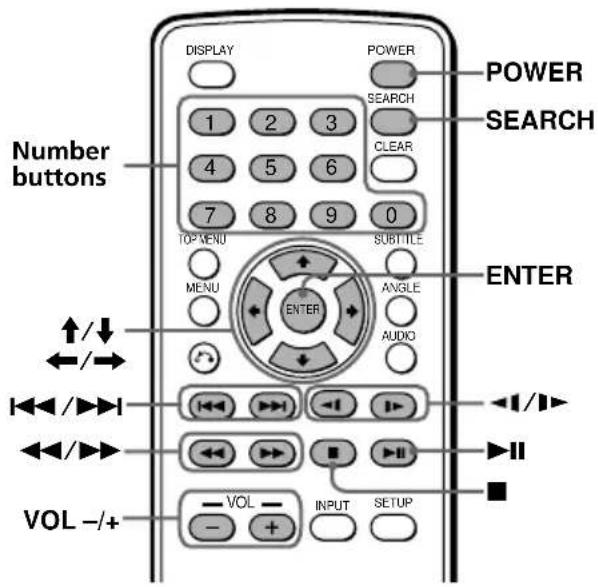
DISPLAY POWER POWER SEARCH SEARCH 1 2 3 4 5 6 7 8 9 0 TOP MENU SUBTITLE MENU ANGLE AUDIO ENTER ENTER VOL -/+ -VOL - INPUT SETUP +/- +/- VOL -/+1 Press POWER to turn on the player. The monitor turns on and the green light of the POWER button on the player lights up.
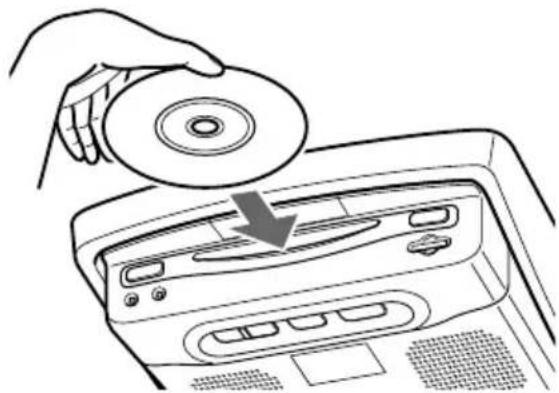
2 Insert the disc (labeled side up) into the player.
natural_image
Illustration of a hand holding a CD to open a computer case, with a downward arrow indicating the process (no text or symbols present)Playback starts automatically. If a disc is already inserted or playback does not start automatically, press ▶II to start playback.
The JPEG files are displayed as a slide show. If the "SMART NAVI" menu display appears, press the number buttons or ↑/→/↓/← buttons to select the desired folder/file (page 21) (MP3/JPEG only).
3 Press VOL (+) or VOL (-) to adjust the volume.
To turn off the power
Press POWER so that the green light of the POWER button on the player turns off.
Notes
- The volume of the headphones cannot be adjusted with the player or card remote commander. Use the volume control on the headphones.
• Even when the player is turned off, you can eject a disc from the player, though you cannot insert a disc. - Read the instruction manual supplied with the disc to play with this player.
- When you play an 8-cm disc (e.g., CD-single), be sure to insert it to the center area of the disc slot.
- Depending on the recording method used on the disc, it may take a minute or more before playing.
- Depending on the condition of the disc, it may not play back (page 40).
- A high-bit rate MP3 file such as 320 kbps may not play back properly.
- When "SMART NAVI" is set to "NO MENU" (page 34), if the last track/file of an Audio CD/MP3/JPEG disc has finished, playback restarts from the first track/file.
continue to next page →
Operation for playback
To Do this
| Stop playback Press ■* | 1 |
| Eject the disc Press ⬤EJECT on the player | |
| Pause Press ▶■* | 2Press again to resume playback |
| Go to the next chapter, Press ▶▶I track, or scene | |
| Go back to the Press ◀◀◀ preceding chapter, track, or scene | |
| Fast forward/ Press ▶▶/◀◀ while fast reverse playing* | 3 *4 |
| Slow forward Press ▶▶/ while ◀◀(DVD/Video CD only)/ playing* | 3 *4 |
| Slow reverse (DVD only) | |
*1 If the resume playback function is activated, you can resume playback later by pressing ▶II. For details, see "Resume playback" (page 20).
*2 "PAUSE" is displayed on the screen.
*3 No sound is output during fast forward/fast reverse or slow forward/slow reverse.
*4 A disc other than a DVD returns to normal playback when a track/MP3 file finishes.
Searching a chapter/title/track directly
1 During playback or pause, press SEARCH to display search scre
•DVD
When you press or , the search screen toggles between Title and Chapter.
• Video CD (only when PBC is off)/Audio CD
The track search screen appears.
2 Press the number buttons to enter the desired chapter/title/track number.
3 Press ENTER.
Note
You cannot set "0."
Resume playback
1 During playback, press ■ to stop.
The player memorizes the point where playback is stopped.
- DVD/Video CD/Audio CD "PRESS PLAY TO CONTINUE" flashes on the screen.
2 Press ▶II to start playback.
When resume playback is activated, playback starts from the point where playback is stopped. When resume playback is deactivated, playback starts from the beginning.
• MP3
When resume playback is activated, playback starts from the beginning of the MP3 file (track) during which you stopped playback.
Notes
- When you play back a "Memory Stick," the resume function is deactivated. Even if a disc is being played, the resume function is deactivated when a "Memory Stick" is inserted in the player.
- To deactivate the resume function, press ■ again while playback is stopped or eject the disc from the player.
- The player stores the point where you stopped playback for the disc currently in the player.
- The resume function will be deactivated: — when the disc is ejected.
- If the resume function is activated during fast/slow forward or fast/slow reverse playback, normal playback starts when you press ▶II.
MP3/JPEG/MPEG1\* file playback with the menu display
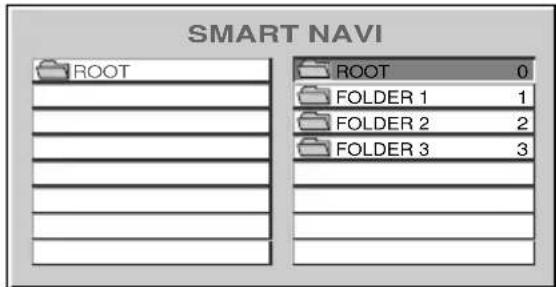
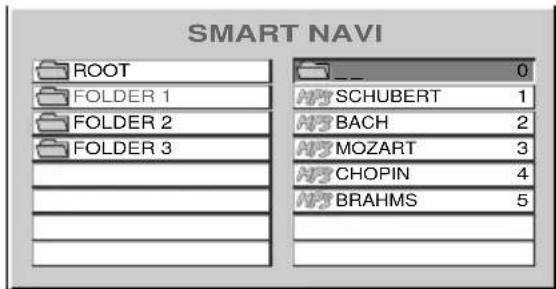
If you have set "SMART NAVI" to "WITH MENU" (page 34) and play media containing MP3/JPEG/MPEG1* files, the menu display for folder names and MP3/JPEG/MPEG1* file names will appear. You can easily search the desired MP3/JPEG/MPEG1* file with the "SMART NAVI" menu display.
1 Insert media containing MP3/JPEG/MPEG1\* files in this player.
The "SMART NAVI" menu display appears.
text_image
SMART NAVI ROOT ROOT 0 FOLDER 1 1 FOLDER 2 2 FOLDER 3 32 Press the number buttons to select the desired folder.
↑/→/↓/← buttons are also available to select the desired folder.
If you select the folder 1, the MP3/JPEG/MPEG1* file names in the folder 1 appear.
text_image
SMART NAVI ROOT FOLDER 1 FOLDER 2 FOLDER 3 0 SCHUBERT 1 BACH 2 MOZART 3 CHOPIN 4 BRAHMS 53 Press the number buttons to select the desired MP3/JPEG/MPEG1\* file.
↑/→/↓/← buttons are also available to select the desired MP3/JPEG/MPEG1* file. Playback starts.
To turn off the menu display for MP3/JPEG/MPEG1* files, set "SMART NAVI" to "NO MENU" (page 34).
* Only when a "Memory Stick" is played.
Notes
- To deactivate the resume function, press ■ again while playback is stopped or eject the disc from the player.
- Some MPEG1 files may not play back properly due to the way they were recorded.
Playing a "Memory Stick"

You can playback MP3/JPEG/MPEG1 files in a "Memory Stick."
Notes
- "Memory Stick Duo" and "Memory Stick PRO" cannot be used.
- Data playback that requires MagicGate functions cannot be performed.
- Some MPEG1 files may not play back properly due to the way they were recorded.
text_image
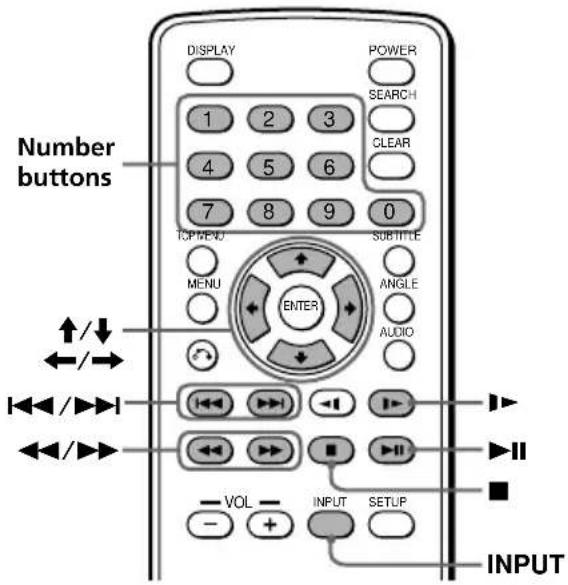
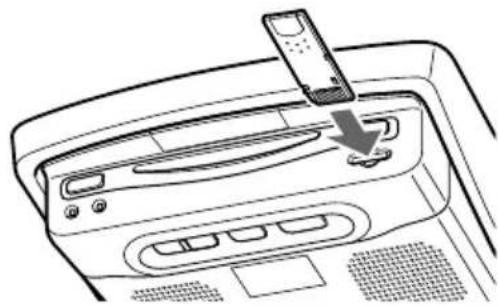
Number buttons DISPLAY POWER SEARCH 1 2 3 CLEAR 4 5 6 7 8 9 0 TOP/REV SUBTITLE MENU ANGLE AUDIO ENTER ↑/↓ ←/→ ◄◄◄/►►►►►►►►►►►►►►►►►►►►►►►►►►►►►►►►►►►►►►►►►►►►►►►►►►►►►►►►►►►►►►►►►►►►►►►►►►►►►►►►►►►►►►►►►►►►►►►►►►►► ► ◄◄◄/►►►►►►►►►►►►►►►►►►►►►►►►►►►►►►►►►►►►►►►►►►►►►►►►►►►►►►►►►►►►►►►►►►►►►►►►►►►►►►►►►►►►►►►►►►►►►►▶ VOL - INPUT SETUP - + + INPUT1 Insert a "Memory Stick" into the player until it clicks.
natural_image
Line drawing of a computer monitor with a scroll wheel and a hand inserting a scroll into the top panel (no text or symbols)2 Press INPUT repeatedly to select "DVD."
Playback starts automatically.
The JPEG files are displayed as a slide show.
If the "SMART NAVI" menu display appears, press the number buttons or ↑/→/↓/← buttons to select the desired folder/file (page 21).
continue to next page →
Note
Depending on the recording method and size of data, it may take some time before playback of the first track/file.
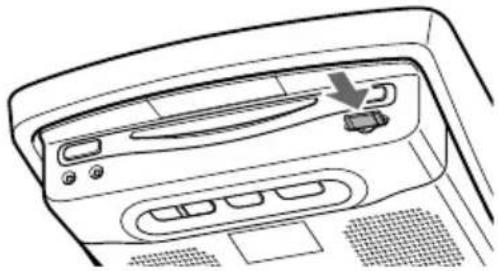
To eject the "Memory Stick"
Push in the "Memory Stick" momentarily, then remove it.
natural_image
Line drawing of a refrigerator interior showing the door, front panel, and side panels with a mouse pointer (no text or symbols)Notes
- Insert the "Memory Stick" in the correct direction.
- Do not forcefully remove the "Memory Stick."
Operation for playback
| To Do this | |
| Stop playback Press ■ | |
| Pause Press ▶■* | 1 |
| Go to the next file | Press ▶▶ |
| Go back to the preceding file | Press ◀◀◀ |
| Fast forward/ Press ▶▶/ ◀◀ while fast reverse (MP3/MPEG1 only) | playing*2 *3 |
| Slow forward (MPEG1 only) | Press ▶▶ while playing*2 *3 |
*1 "PAUSE" is displayed on the screen.
*2 No sound is output during fast forward/fast reverse or slow forward.
*3 The "Memory Stick" returns to normal playback when the MP3/MPEG1 file finishes.
Displaying elapsed time

You can display the elapsed time and the remaining time of DVDs, Video CDs and Audio CDs.
text_image
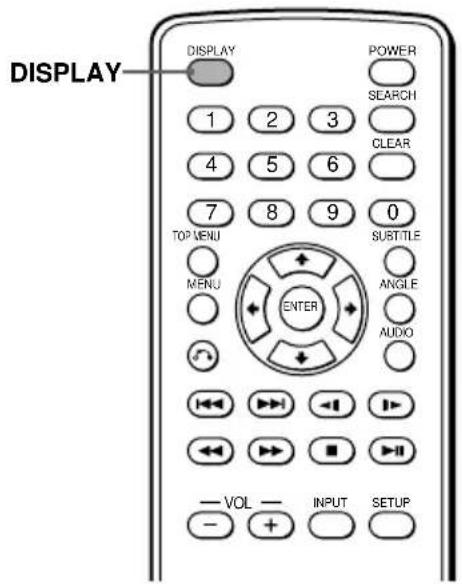
DISPLAY DISPLAY POWER SEARCH 1 2 3 CLEAR 4 5 6 7 8 9 0 TOP MENU MENU ENTER SUBTITLE ANGLE AUDIO VOL INPUT SETUPDuring playback, press DISPLAY.
The elapsed time or the remaining time is displayed at the upper left.
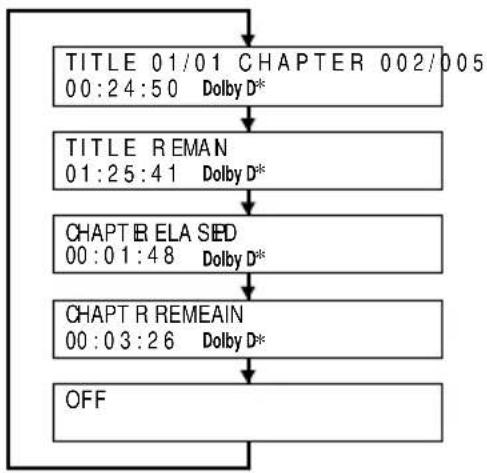
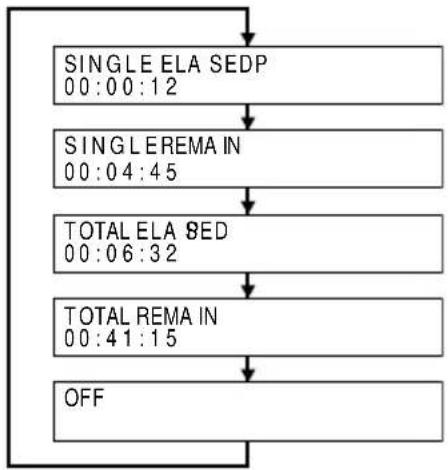
Each time you press DISPLAY, the display changes as follows:
• DVD
flowchart
graph TD
    A["TITLE 01/01 CHAPTER 002/005\n00:24:50 Dolby D*"] --> B["TITLE REMAN\n01:25:41 Dolby D*"]
    B --> C["CHAPT B ELA SIED\n00:01:48 Dolby D*"]
    C --> D["CHAPT R REMEAIN\n00:03:26 Dolby D*"]
    D --> E["OFF"]
* The format of the sound source (Dolby D, DTS, or LPCM) may appear.
• Video CD (when PBC is set to OFF)/CD
flowchart
graph TD
    A["SINGLE ELA SEDP\n00:00:12"] --> B["SINGLEREMA IN\n00:04:45"]
    B --> C["TOTAL ELA SED\n00:06:32"]
    C --> D["TOTAL REMA IN\n00:41:15"]
    D --> E["OFF"]
Changing the subtitle language DVD
Some DVDs have recorded subtitles in one or more languages. You can turn the subtitles on or off, or change the subtitle language on such DVDs.
text_image
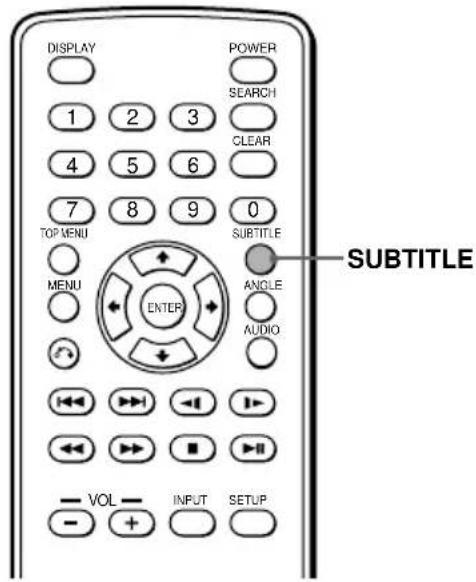
DISPLAY POWER SEARCH 1 2 3 CLEAR 4 5 6 7 8 9 0 TOP MENU MENU ENTER SUBTITLE ANGLE AUDIO VOL INPUT SETUP - +During playback, press SUBTITLE.
The subtitle language is displayed at the upper left.
Example: a subtitle language display
SUBTITLE 02/32 : ENGLISH
Each time you press (SUBTITLE), the language switches within the list of subtitle languages recorded on the disc.
When the display for the language code appears, input the language code corresponding to the desired language (page 48).
Notes
- You can also change the subtitle languages by changing Setup*. See "Displaying the subtitles for DVD — SUBTITLE" (page 31).
* You can change to a specific subtitle language using a setup menu, only if the language is included in both the disc and the setup screen. - If you want to hide the subtitles, press SUBTITLE repeatedly to select "OFF."
- This function varies or may not work, depending on the DVD.
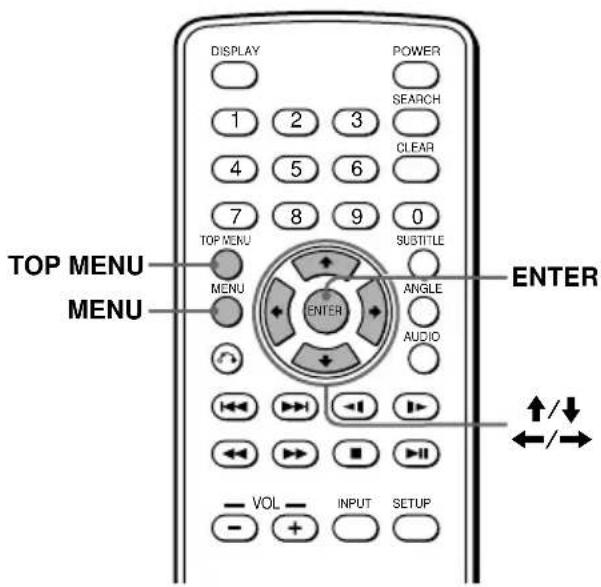
Using a DVD menu DVD
With some DVDs you can use the original menu such as title menu and DVD menu. You can play your favorite scene or song by selecting titles of songs and scenes during a DVD playback. You can select an item, subtitle language, audio language etc. by selecting a DVD menu. The contents of title menus and DVD menus differ, depending on the DVD. There may be some DVDs which have no recorded menus.
text_image
DISPLAY POWER 1 2 3 SEARCH 4 5 6 CLEAR 7 8 9 0 TOP MENU MENU SUBTITLE ANGLE AUDIO ENTER VOL INPUT SETUP TOP MENU MENU ENTER ↑/↓ ←/→Using the TOP MENU button
Some DVDs have a title menu. From the title menu you can select a title for playback. Titles are the longest sections of a picture or music feature on a DVD, e.g., a movie, or an album for audio software, etc. The TOP MENU button is available to display the initial menu screen.
1 During DVD playback, press TOP MENU.
The top menu (titles) is displayed. * The contents of the top menu differ, depending on the DVD.
2 Press /// to select the desired title.
3 Press ENTER.
The title you selected starts to play.
Using the MENU button
Some DVDs have more comprehensive Menu that includes such things as the audio languages, subtitle languages, titles, and chapters, etc.
1 During a DVD playback, press MENU. The DVD menu is displayed.
2 Press /// to select the desired item.
3 Press ENTER.
If additional selection screens appear, repeat step 2 and 3.
Notes
- Some DVDs do not have a DVD menu and on some DVDs, the contents of the DVD menu and title menu are the same.
- On some DVDs, "DVD Menu" may be expressed as "MENU."
- On some DVDs, "Press ENTER" may be expressed as "Press SELECT" in step 3.
- The contents of the DVD menu differ, depending on the DVD.
- Read the instruction manual supplied with a DVD.
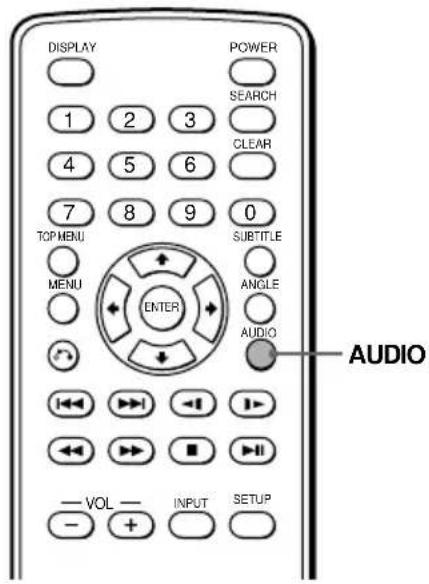
Changing the audio language DVD
Some DVDs have multiple audio languages you can choose from.
text_image
DISPLAY POWER SEARCH 1 2 3 CLEAR 4 5 6 7 8 9 0 TOP MENU SUBTITLE MENU ENTER ANGLE AUDIO VOL INPUT SETUP - +During playback, press AUDIO repeatedly to select the desired audio language.
The current audio language is displayed at the upper left.
Example: an audio language display
AUDIO 1/2: Dolby D 5.1 ENGLISH
The format of the sound source (Dolby D, DTS, or LPCM) may appear.
When the display for the language code appears, input the language code corresponding to the desired language (page 48). When the same language is displayed two or more times, the DVD is recorded in multiple audio format.
Notes
- You can switch the audio language only if multiple audio languages are recorded on the DVD.
- You can also change the audio languages by using the DVD menu (page 24) or the setup screen* (page 30).
* You can change to a specific audio language using a setup screen, only if the language is included in both the disc and the setup screen. - This function varies or may not work, depending on the DVD.
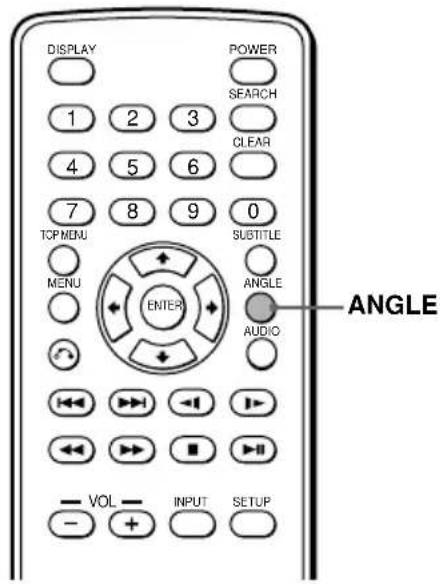
Changing angles

Some DVDs have multiple alternative angles recorded for certain scenes. If you have set "ANGLE MARK" to "ON" (page 28), a notice appears for 3 seconds at the scene. If "ANGLE MARK" is not set to "ON," the notice does not appear at the scene.
text_image
DISPLAY POWER SEARCH 1 2 3 CLEAR 4 5 6 7 8 9 0 TCP MENU SUTTITLE MENU ENTER ANGLE AUDIO -VOL INPUT SETUP - +1 During playback of a DVD having multiple alternative angles recorded, press ANGLE when a notice appears.
The number of the currently selected angle is displayed at the upper right.
2 Press ANGLE repeatedly to select your favorite angle number, while the angle number is displayed.
Each time you press ANGLE, the angle number switches.
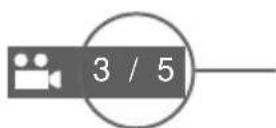
The angle number you have currently selected/the total number of multiple alternative angles
Notes
- You can switch the angle only if multiple angles are recorded on the DVD.
- The total number of recorded angles differs depending on the DVD and scene.
- You can only switch the angle during normal playback. You cannot switch the angle during fast forward/reverse playback.
- When the selected scene with multi angles appears, the angle is automatically switched to the angle number you selected in step 2.
- This function varies or may not work, depending on the DVD.
Changing the audio output

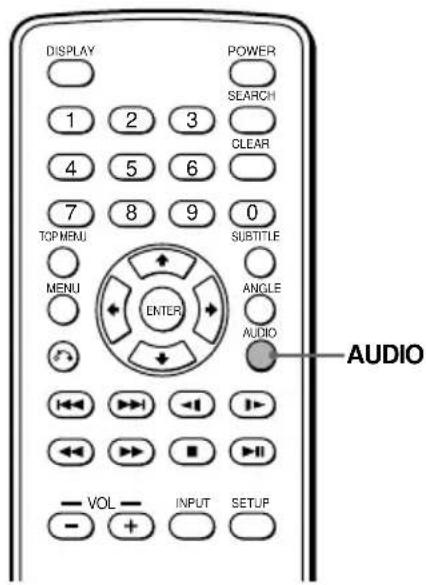
You can select the desired audio output from "STEREO," "L-MONO," "R-MONO," or "MIX-MONO" during Video CD or Audio CD playback.
text_image
DISPLAY POWER SEARCH 1 2 3 CLEAR 4 5 6 7 8 9 0 TOP MENU MENU ENTER SUBTITLE ANGLE AUDIO -VOL INPUT SETUP AUDIO1 During playback, press AUDIO.
The current output is displayed at the upper left.
Example: an audio output display
L-MONO
2 Press AUDIO to select the desired output from "STEREO," "L-MONO," "R-MONO," or "MIX-MONO" while the output is displayed.
Each time you press AUDIO, the output switches.
Using the PBC (Playback Control) function VCD
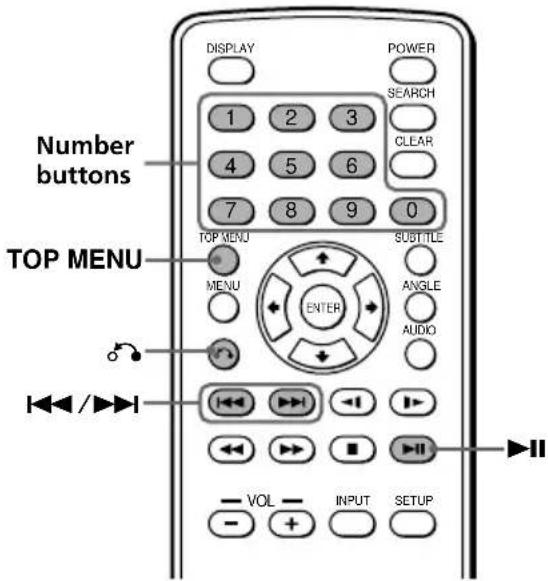
During playback of a PBC compatible Video CD, you can display the PBC menu and select the item from the menu.
text_image
Number buttons TOP MENU DISPLAY POWER 1 2 3 4 5 6 7 8 9 0 TOP MENU MENU ENTER SUBTITLE ANGLE AUDIO VOL INPUT SETUP1 Insert a Video CD, then press TOP MENU repeatedly to select "PBC ON."
Depending on the Video CD, the PBC menu may be displayed automatically after inserting a Video CD.
Each time you press TOP MENU, the PBC menu function turns on or off.
2 Press ▶II.
The PBC menu is displayed.
3 While the PBC menu screen is displayed; — press the number buttons to select the number of the desired item. — press I◄◄/►►I to go to the previous/ next page.
Button functions vary or may not work, depending on the Video CD.
Notes
- To display the PBC menu during playback of a Video CD, press TOP MENU repeatedly to select "PBC ON," then press ▶II.
- During playback of a Video CD with "PBC ON," press the number buttons or ◄◀/▶▶I to change the item. The PBC menu is not displayed but the item you selected starts to play.
- During playback of a Video CD with "PBC ON," press 📋 (return) to display the PBC menu.
- The PBC menus differ, depending on the Video CD. Read the instruction manual supplied with the Video CD.
Changing Setup
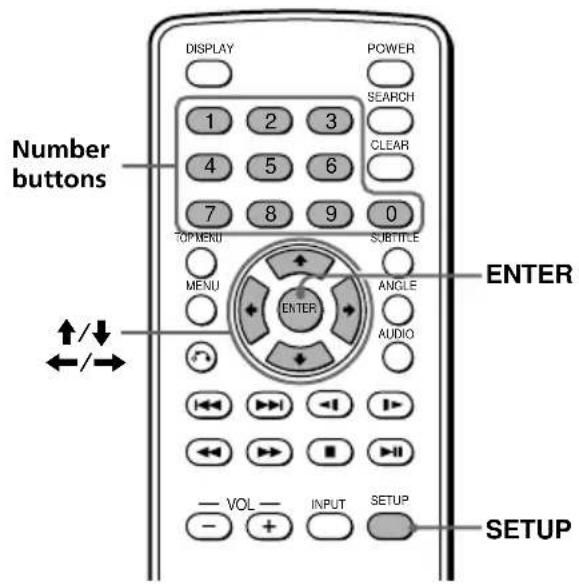
You can set up and adjust this player using the on-screen setup menu. Most settings need to be set when you first use this player.
text_image
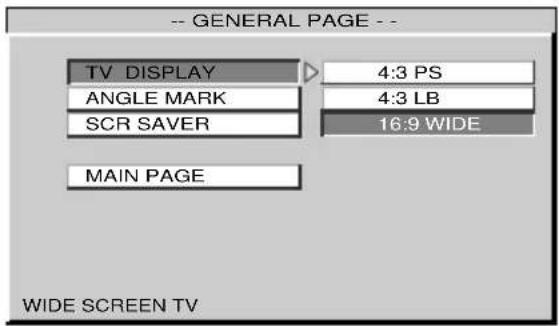
DISPLAY POWER SEARCH 1 2 3 CLEAR 4 5 6 7 8 9 0 TOP MENU SUBTITLE MENU ENTER ANGLE AUDIO ↑/↓ ←/→ — VOL — INPUT SETUP SETUP3 Press ↑ or ↓ repeatedly to select "TV DISPLAY," then press →.
text_image
-- GENERAL PAGE -- TV DISPLAY 4:3 PS ANGLE MARK 4:3 LB SCR SAVER 16:9 WIDE MAIN PAGE WIDE SCREEN TV4 Press ↑ or ↓ repeatedly to select "4:3 PS," "4:3 LB," or "16:9 WIDE."
5 Press ENTER.
To return to normal play screen, press SETUP anytime.
Note
To return to the main page for setup, press ↑/↓/← repeatedly to select "MAIN PAGE," then press ENTER.
Setting the aspect ratio for the TV screen
— TV SCREEN
When you connect the player to a TV to watch the DVD on TV screen, make this setting according to the type of the TV screen.
1 Press SETUP.
The main page for setup appears. "PREFERENCES" is only available when playback is stopped.

text_image
SETUP MENU -- MAIN PAGE GENERAL SETUP SPEAKER SETUP AUDIO SETUP PREFERENCES EXIT SETUP GENERAL SETUP2 Press ↑ or ↓ repeatedly to select "GENERAL SETUP," then press ENTER.
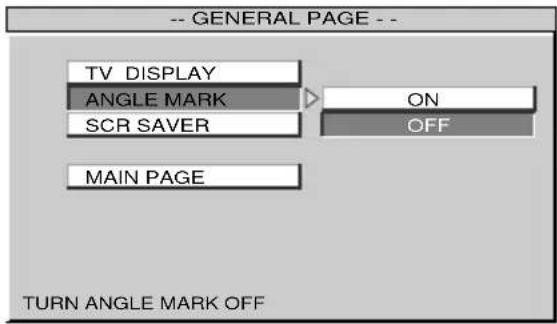
Displaying the multi-angle notice — ANGLE MARK DVD
If various angles (multi-angles) for a scene are recorded on the DVD and you have set the "ANGLE MARK" to "ON," a notice appears at the scene.
1 Press SETUP.
The main page for setup appears.
2 Press ↑ or ↓ repeatedly to select "GENERAL SETUP," then press ENTER.
3 Press ↑ or ↓ repeatedly to select "ANGLE MARK," then press →.
text_image
-- GENERAL PAGE -- TV DISPLAY ANGLE MARK SCR SAVER MAIN PAGE ON OFF TURN ANGLE MARK OFF4 Press ↑ or ↓ repeatedly to select "ON."
5 Press ENTER.
"ANGLE MARK ON" is displayed at the lower left on the monitor.
To turn off the multi-angle notice, select "OFF" in step 4.
To return to normal play screen, press SETUP anytime.
Note
To return to the main page for setup, press ↑/↓/← repeatedly to select "MAIN PAGE," then press ENTER.
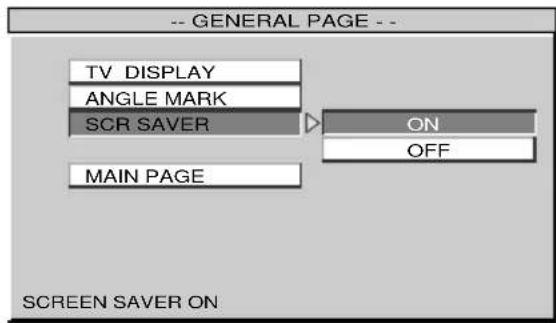
Setting the screen saver
— SCR SAVER
If you set the "SCR SAVER" setting to "ON," the screen saver image appears when you leave the player in pause or stop mode for more than 15 minutes. The screen saver will help prevent the monitor from becoming damaged.
1 Press SETUP.
The main page for setup appears.
2 Press ↑ or ↓ repeatedly to select "GENERAL SETUP," then press ENTER.
3 Press ↑ or ↓ repeatedly to select "SCR SAVER," then press →.
text_image
-- GENERAL PAGE -- TV DISPLAY ANGLE MARK SCR SAVER MAIN PAGE ON OFF SCREEN SAVER ON4 Press ↑ or ↓ repeatedly to select "ON."
5 Press ENTER.
To turn off the screen saver setting, select "OFF" in step 4.
To return to normal play screen, press SETUP anytime.
Note
To return to the main page for setup, press ↑/↓/← repeatedly to select "MAIN PAGE," then press ENTER.
Selecting the speaker mode — SPEAKER SETUP DVD
You can select the speaker mode setting from "LT-RT" or "STEREO." The downmix function is used to create stereo (2-channel) signals from more than 5 separated digital signals of a source.
LT-RT: theater downmix mode.
STEREO: stereo downmix mode.
1 Press SETUP.
The main page for setup appears.
2 Press or repeatedly to select
"SPEAKER SETUP," then press ENTER.
3 Press ↑ or ↓ repeatedly to select
4 Press ↑ or ↓ repeatedly to select the
desired item from "STEREO" or "LT/RT"
5 Press ENTER.
"LT/RT DOWNMIX" is displayed at the lower left on the monitor, for example if you select "LT/RT" in step 4.
To return to normal play screen, press
SETUP anytime.
Note
To return to the main page for setup, press ↑/↓/← repeatedly to select "MAIN PAGE," then press ENTER.
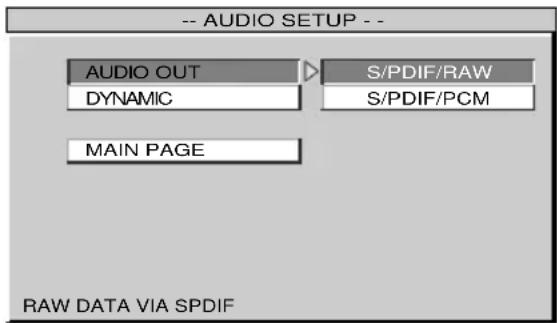
Selecting the audio output mode — AUDIO OUT
You can select the audio output setting from "S/PDIF/RAW" or "S/PDIF/PCM."
S/PDIF (Sony/Philips Digital Interface) is a standard of audio transfer file format. S/PDIF allows the transfer of audio, however, signal quality may be degraded.
S/PDIF/RAW: outputs the original audio data in S/PDIF format.
S/PDIF/PCM: outputs the sampling of the original audio data in S/PDIF format.
1 Press SETUP.
The main page for setup appears.
2 Press ↑ or ↓ repeatedly to select "AUDIO SETUP," then press ENTER.
3 Press ↑ or ↓ repeatedly to select "AUDIO OUT," then press →.
text_image
-- AUDIO SETUP -- AUDIO OUT S/PDIF/RAW DYNAMIC S/PDIF/PCM MAIN PAGE RAW DATA VIA SPDIF4 Press ↑ or ↓ repeatedly to select the desired item from "S/PDIF/RAW" or "S/PDIF/PCM."
5 Press ENTER.
"S/PDIF/RAW OUTPUT" is displayed at the lower left on the screen, for example if you select "S/PDIF/RAW" in step 4.
To return to normal play screen, press
SETUP anytime.
Note
To return to the main page for setup, press ↑/↓/← repeatedly to select "MAIN PAGE," then press ENTER.
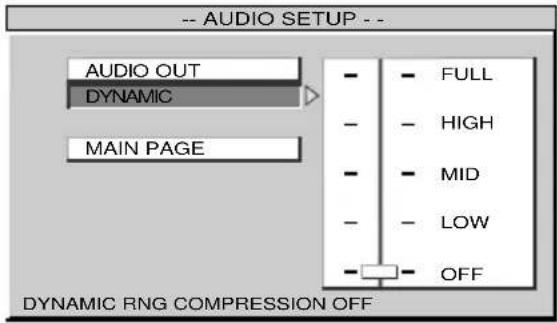
Selecting the compression setting for the sound
— DYNAMIC
You can select the compression setting for the sound. If you set the DYNAMIC setting to "OFF" and watch an exciting movie, you can enjoy dynamic sound to its best effect. However, for example, if the sound is too dynamic and loud to hear low level sound such as human voices, try adjusting the dynamic range.
1 Press SETUP.
The main page for setup appears.
2 Press ↑ or ↓ repeatedly to select "AUDIO SETUP," then press ENTER.
3 Press ↑ or ↓ repeatedly to select "DYNAMIC," then press →.
text_image
-- AUDIO SETUP -- AUDIO OUT DYNAMIC MAIN PAGE - - FULL - - HIGH - - MID - - LOW - - OFF DYNAMIC RNG COMPRESSION OFF4 Press ↑ or ↓ repeatedly to select the desired item from "FULL," "HIGH," "MID" or "LOW."
5 Press ENTER.
To turn off the dynamic range of sound volume, select "OFF" in step 4.
To return to normal play screen, press SETUP anytime.
Note
To return to the main page for setup, press ↑/↓/← repeatedly to select "MAIN PAGE," then press ENTER.
Selecting the audio language for DVD
— AUDIO DVD
Some DVDs have multiple audio languages you can select from.
1 Press SETUP while playback is stopped. The main page for setup appears.
2 Press ↑ or ↓ repeatedly to select "PREFERENCES," then press ENTER.
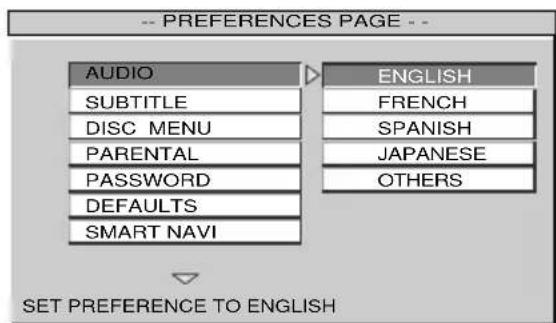
3 Press ↑ or ↓ repeatedly to select "AUDIO," then press →.
text_image
-- PREFERENCES PAGE -- AUDIO SUBTITLE DISC MENU PARENTAL PASSWORD DEFAULTS SMART NAVI ENGLISH FRENCH SPANISH JAPANESE OTHERS SET PREFERENCE TO ENGLISH4 Press ↑ or ↓ repeatedly to select the desired item from "ENGLISH," "FRENCH," "SPANISH," or "JAPANESE."
If you select "OTHERS," select and enter a language code from "Language Code List" (page 48).
5 Press ENTER.
"PREFERENCE SET TO ENGLISH" is displayed at the lower left on the screen, for example if you select "ENGLISH" in step 4.
To return to normal play screen, press SETUP anytime.
Notes
- To return to the main page for setup, press ↑/↓/ ↔ repeatedly to select "MAIN PAGE," then press ENTER.
- Regardless of setting to the desired language, other language may be automatically activated, depending on the DVD.
Displaying the subtitles for DVD — SUBTITLE DVD
If subtitles are recorded on the discs, you can change the subtitles or turn the subtitles on and off when playback is stopped or the disc is ejected.
1 Press SETUP.
The main page for setup appears.
2 Press ↑ or ↓ repeatedly to select "PREFERENCES," then press ENTER.
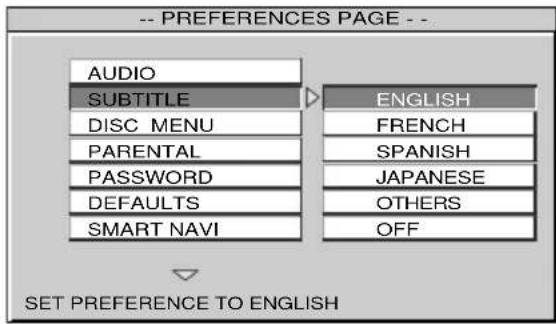
3 Press ↑ or ↓ repeatedly to select "SUBTITLE," then press →.
text_image
-- PREFERENCES PAGE -- AUDIO SUBTITLE DISC MENU PARENTAL PASSWORD DEFAULTS SMART NAVI ENGLISH FRENCH SPANISH JAPANESE OTHERS OFF SET PREFERENCE TO ENGLISH4 Press ↑ or ↓ repeatedly to select the desired item from "ENGLISH," "FRENCH," "SPANISH," or "JAPANESE."
If you select "OTHERS," select and enter a language code from "Language Code List" (page 48).
5 Press ENTER.
"PREFERENCE SET TO ENGLISH" is displayed at the lower left on the screen, for example if you select "ENGLISH" in step 4.
To turn off the subtitle, select "OFF" in step 4.
To return to normal play screen, press SETUP anytime.
Notes
- To return to the main page for setup, press ↑/↓/← repeatedly to select "MAIN PAGE," then press ENTER.
- Regardless of setting to the desired language, other language may be automatically activated, depending on the DVD.
Selecting the DVD menu language — DISC MENU DVD
You can select the display language for the DVD menu.
1 Press SETUP.
The main page for setup appears.
2 Press ↑ or ↓ repeatedly to select "PREFERENCES," then press ENTER.
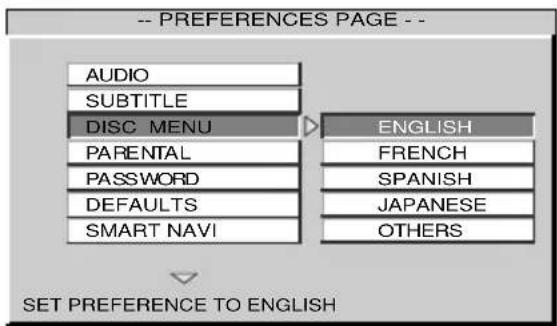
3 Press ↑ or ↓ repeatedly to select "DISC MENU," then press →.
text_image
-- PREFERENCES PAGE -- AUDIO SUBTITLE DISC MENU PARENTAL PASSWORD DEFAULTS SMART NAVI ENGLISH FRENCH SPANISH JAPANESE OTHERS SET PREFERENCE TO ENGLISH4 Press ↑ or ↓ repeatedly to select the desired item from "ENGLISH," "FRENCH," "SPANISH," or "JAPANESE."
If you select "OTHERS," select and enter a language code from "Language Code List" (page 48).
5 Press ENTER.
"PREFERENCE SET TO ENGLISH" is displayed at the lower left on the screen, for example if you select "ENGLISH" in step 4.
To return to normal play screen, press SETUP anytime.
Notes
- To return to the main page for setup, press ↑/↓/ ↔ repeatedly to select "MAIN PAGE," then press ENTER.
- Regardless of setting to the desired language, other language may be automatically activated, depending on the DVD.
Preparing for the initial parental setting DVD
Playback of some DVDs can be limited according to a predetermined level, such as the age of the viewer. The Parental control function allows you to set a playback limitation level. When you use the unit for the first time, set a password and parental level as described below.
Setting the password
1 Press SETUP. The main page for setup appears.
2 Press ↑ or ↓ repeatedly to select "PREFERENCES," then press ENTER.
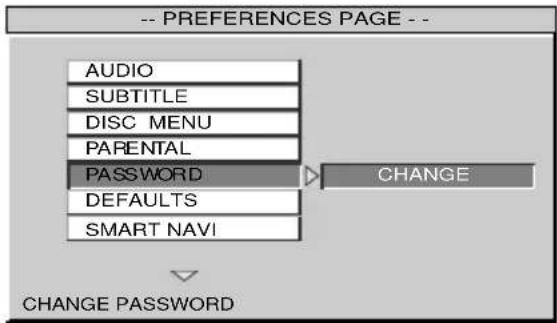
3 Press ↑ or ↓ repeatedly to select "PASSWORD," then press →.
text_image
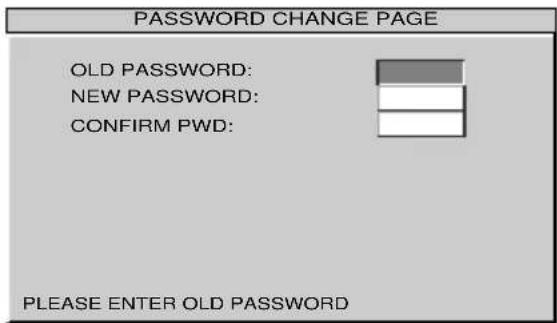
-- PREFERENCES PAGE -- AUDIO SUBTITLE DISC MENU PARENTAL PASSWORD DEFAULTS SMART NAVI CHANGE CHANGE PASSWORD4 Press ENTER. The setup screen for setting your password is displayed.
text_image
PASSWORD CHANGE PAGE OLD PASSWORD: NEW PASSWORD: CONFIRM PWD: PLEASE ENTER OLD PASSWORD5 Press the number buttons to enter 5370 at "OLD PASSWORD."
6 Press the number buttons to enter your desired 4-digit number at "NEW PASSWORD."
7 Press the number buttons to enter your password* (the same 4-digit number in step 6) again at "CONFIRM PWD." * If you enter a wrong number, press ENTER. All the numbers are cleared.
8 Press ENTER.
Selecting the desired parental setting — PARENTAL
1 Press SETUP. The main page for setup appears.
2 Press ↑ or ↓ repeatedly to select "PREFERENCES," then press ENTER.
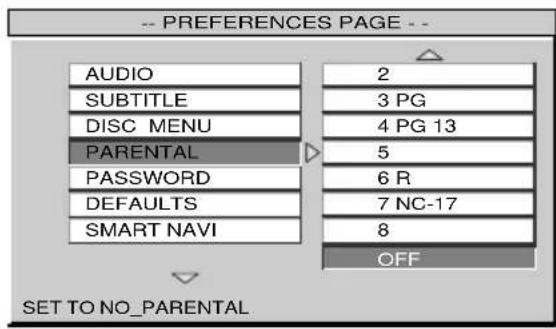
3 Press ↑ or ↓ repeatedly to select "PARENTAL," then press →.
text_image
-- PREFERENCES PAGE -- AUDIO 2 SUBTITLE 3 PG DISC MENU 4 PG 13 PARENTAL 5 PASSWORD 6 R DEFAULTS 7 NC-17 SMART NAVI 8 OFF SET TO NO_PARENTAL4 Press ↑ or ↓ repeatedly to select the desired item from "1 G," "2," "3 PG," "4 PG 13," "5," "6 R," "7 NC-17," "8," or "OFF."
5 Press ENTER. The screen for password appears.
6 Press the number buttons to enter your 4-digit password number. The parental setting is completed.
Note If you forget your registered 4-digit password number, press 5370.
Refer to the following table. Parental levels of the table are on the MPAA (Motion Picture Association of America) rating system. If you set this player to level "4" for example, DVDs with levels "5," "6," and "7" cannot be played.
This Player MPAA Rating System
| “OFF*” |
| “8” |
| “7” “NC-17”: No one 17 and under admitted |
| “6” “R”: Restricted |
| “5” “—”: |
| “4” “PG 13”: Parents strongly cautioned |
| “3” “PG”: Parental guidance suggested |
| “2” “—”: |
| “1” “G”: General audience |
* If you select level "OFF," you can play all discs.
Changing your password — PASSWORD
You can change your password for parental setting here. Follow the steps below.
1 Press SETUP.
The main page for setup appears.
2 Press ↑ or ↓ repeatedly to select "PREFERENCES," then press ENTER.
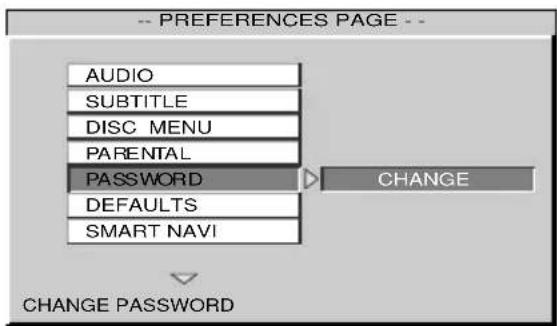
3 Press ↑ or ↓ repeatedly to select "PASSWORD," then press →.
text_image
-- PREFERENCES PAGE -- AUDIO SUBTITLE DISC MENU PARENTAL PASSWORD DEFAULTS SMART NAVI CHANGE CHANGE PASSWORD4 Press → to select "CHANGE," and press ENTER.
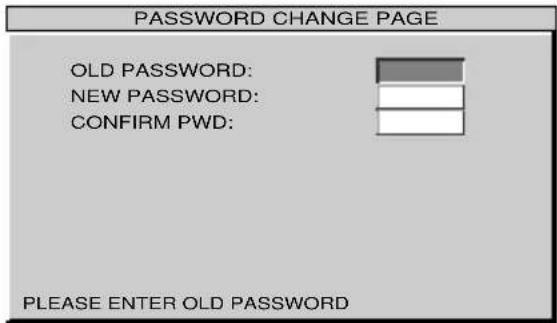
5 Press the number buttons to enter your old password, new password, then new password again to confirm it.
text_image
PASSWORD CHANGE PAGE OLD PASSWORD: NEW PASSWORD: CONFIRM PWD: PLEASE ENTER OLD PASSWORD6 Press ENTER.
To return to normal play screen, press SETUP anytime.
Note If you forget your registered 4-digit password number, press 5370.
Returning this player to the factory setting
— DEFAULTS
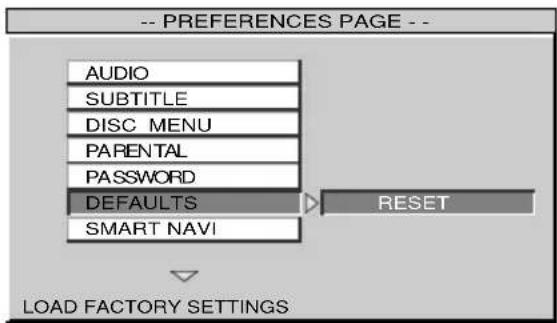
You can return this player to the factory setting except your password (page 32, 33) and parental setting (page 32). Follow the steps below.
1 Press SETUP. The main page for setup appears.
2 Press ↑ or ↓ repeatedly to select "PREFERENCES," then press ENTER.
3 Press ↑ or ↓ repeatedly to select "DEFAULTS," then press →.
text_image
-- PREFERENCES PAGE -- AUDIO SUBTITLE DISC MENU PARENTAL PASSWORD DEFAULTS SMART NAVI RESET LOAD FACTORY SETTINGS4 Press → to select "RESET."
5 Press ENTER. "FACTORY SETTINGS LOADED" is displayed at the lower left on the screen.
To return to normal play screen, press SETUP anytime.
Note To return to the main page for setup, press ↑/↓/← repeatedly to select "MAIN PAGE," then press ENTER.
Setting the menu display for MP3/JPEG/MPEG1\* files — SMART NAVI
MP3 JPEG MPEG1
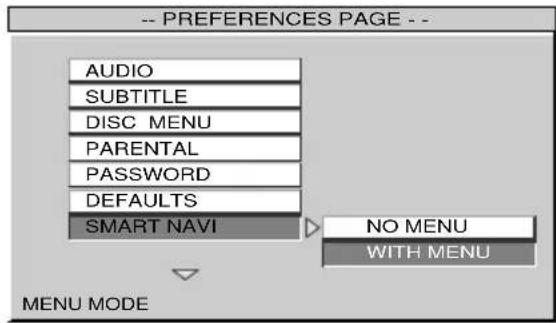
If you have set "SMART NAVI" to "WITH MENU" and play media containing MP3/JPEG/MPEG1* files, the menu display for folder names and MP3/JPEG/MPEG1* files names will appear. You can easily search the desired MP3/JPEG/MPEG1* files with the "SMART NAVI" menu display.
1 Press SETUP. The main page for setup appears.
2 Press ↑ or ↓ repeatedly to select "PREFERENCES," then press ENTER.
3 Press ↑ or ↓ repeatedly to select "SMART NAVI," then press →.
text_image
-- PREFERENCES PAGE -- AUDIO SUBTITLE DISC MENU PARENTAL PASSWORD DEFAULTS SMART NAVI NO MENU WITH MENU MENU MODE4 Press → to select "WITH MENU."
5 Press ENTER. "WITH MENU" is displayed at the lower left on the screen.
To turn off the menu display for MP3/JPEG/MPEG1* files, select "NO MENU" in step 4.
To return to normal play screen, press SETUP anytime.
* Only when a "Memory Stick" is played.
Notes
- To return to the main page for setup, press ↑/↓/← repeatedly to select "MAIN PAGE," then press ENTER.
- Some MPEG1 files may not play back properly due to the way they were recorded.
Installation diagram
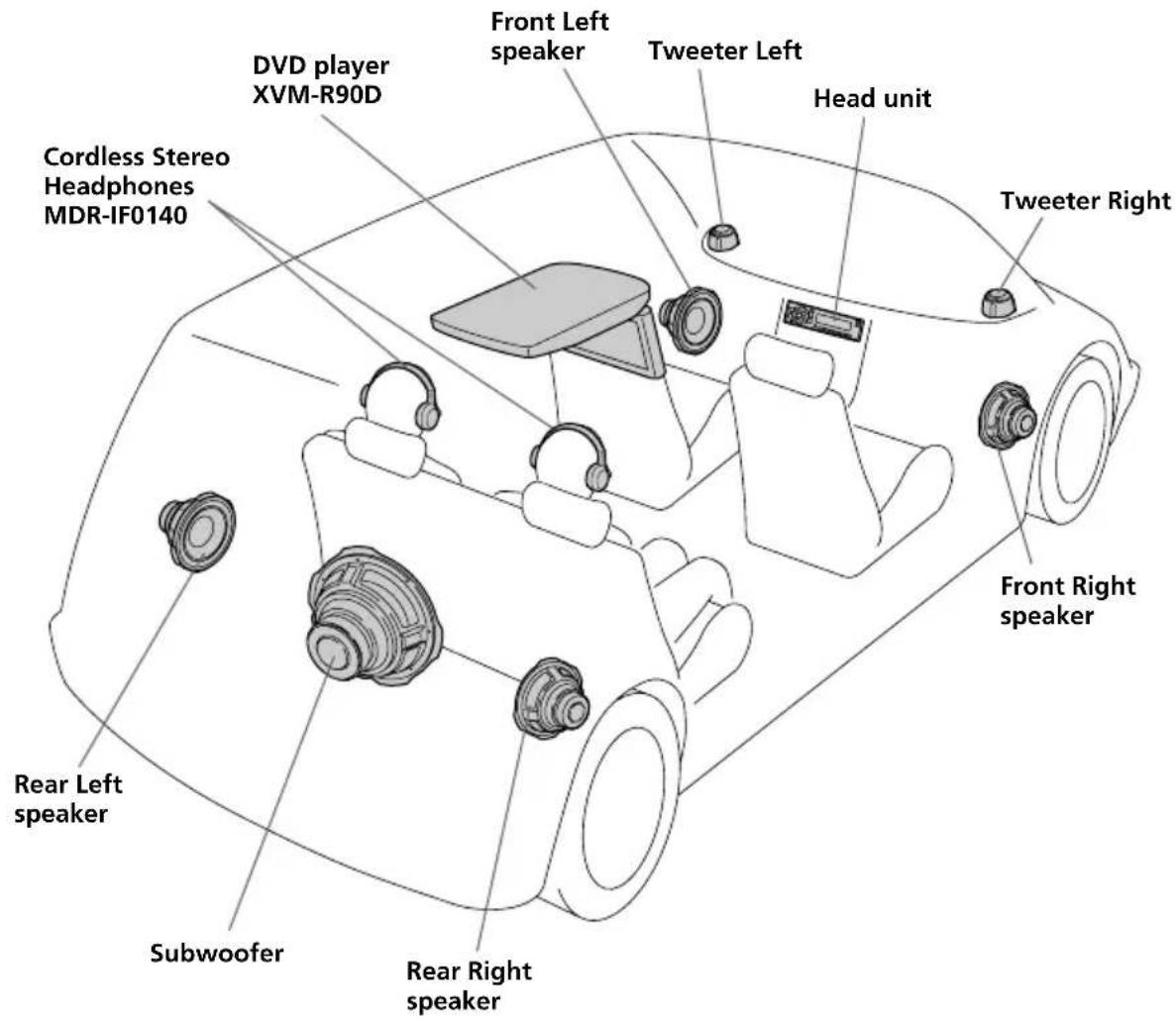
Refer to the installation diagram and ask a qualified technician for the installation of the unit.
text_image
DVD player XVM-R90D Front Left speaker Tweeter Left Head unit Cordless Stereo Headphones MDR-IF0140 Rear Left speaker Subwoofer Rear Right speaker Tweeter Right Front Right speakerBe sure to securely fasten all equipment to the car chassis, etc., to prevent them moving while your car is in motion.
Note
All equipment other than one DVD player and two cordless stereo headphones is optional.
Notes on the locations for PS one ^TM
Do not set PS one™:
— on a dashboard, or in a place subject to direct sunlight.
— in a place near magnetic source such as magnets, speakers and a TV/Monitor.
— on an unstable or uneven surface.
— in a place subject to excessive vibration.
— in a place subject to excessive dust or dirt.
— in poorly ventilated or humid place.
— in a place to subject to temperature extremes (below 5^ C ( 41^ F) or above 35^ C ( 95^ F)).
Refer to the operating instructions supplied to PS one ^TM .
"PS one" is a trademark of Sony Computer Entertainment Inc.
Connection diagram
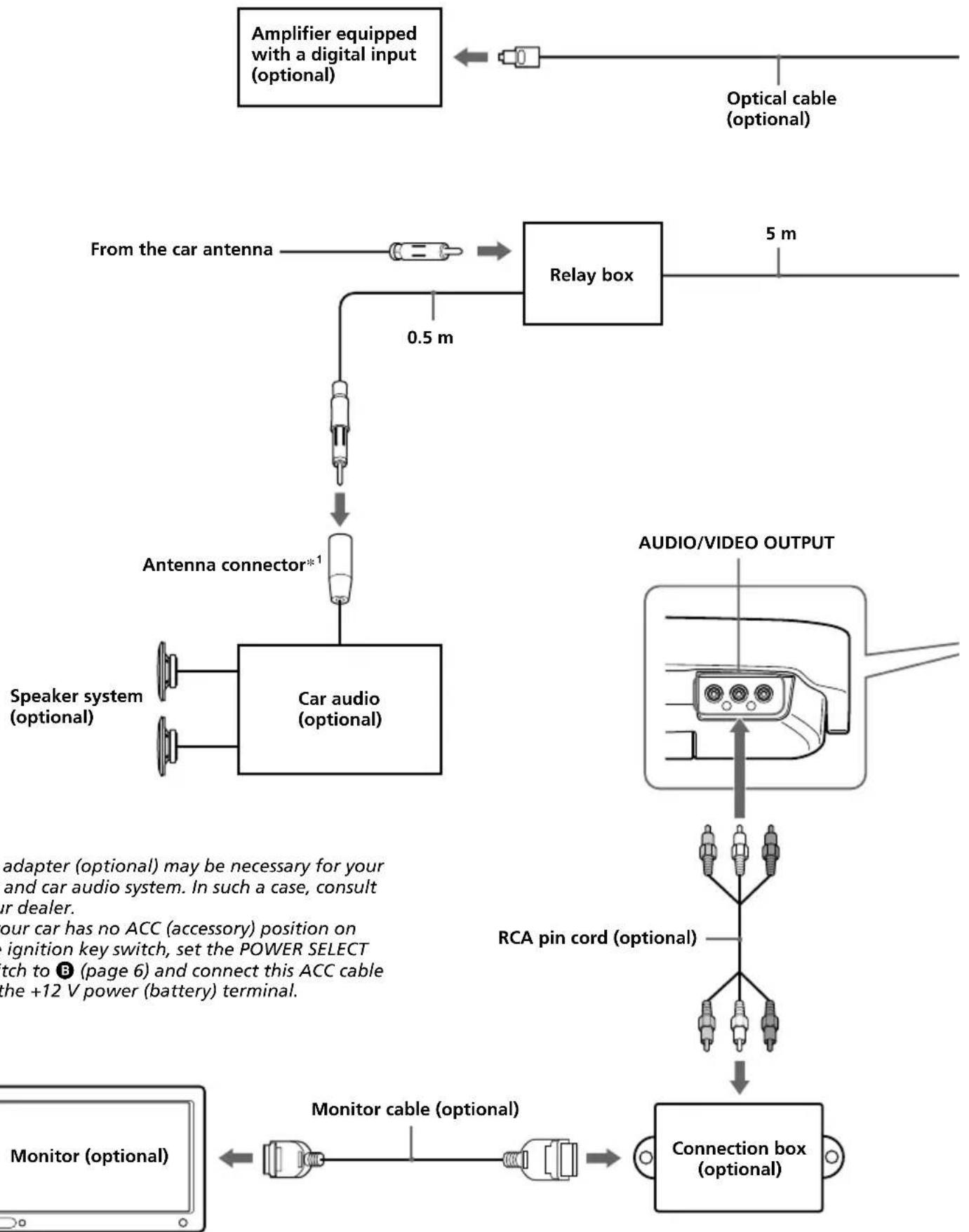
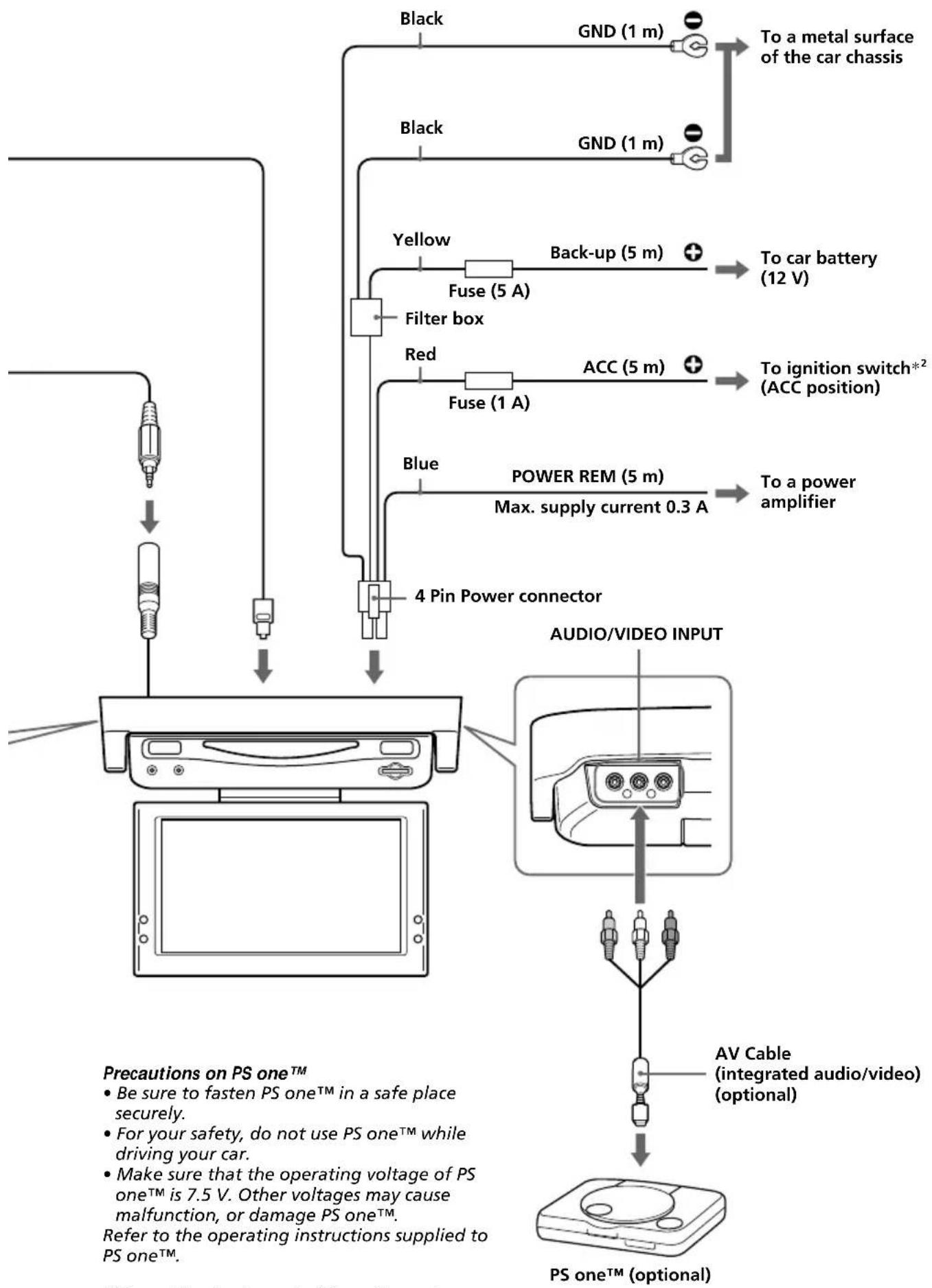
Refer to the connection diagram for the proper connections.
Note
Set the POWER SELECT switch before installing (page 6).
flowchart
graph TD
    A["Amplifier equipped with a digital input (optional)"] --> B["Relay box"]
    C["From the car antenna"] --> B
    B --> D["Audio/video OUTPUT"]
    D --> E["RCA pin cord (optional)"]
    E --> F["Connection box (optional)"]
    G["Speaker system (optional)"] --> H["Car audio (optional)"]
    I["Monitor (optional)"] --> J["Monitor cable (optional)"]
    J --> K["Connection box (optional)"]
    L["Antenna connector*1"] --> M["Reel box"]
    N["Optical cable (optional)"] --> O["Radio Cable"]
    P["5 m"] --> O
    Q["0.5 m"] --> O
flowchart
graph TD
    A["Precautions on PS one™"] --> B["4 Pin Power connector"]
    B --> C["Filter box"]
    C --> D["Yellow"]
    D --> E["Fuse (5 A)"]
    E --> F["Back-up (5 m)"]
    F --> G["To car battery (12 V)"]
    C --> H["Red"]
    H --> I["Fuse (1 A)"]
    I --> J["ACC (5 m)"]
    J --> K["To ignition switch*² (ACC position)"]
    C --> L["Blue"]
    L --> M["POWER REM (5 m)"]
    M --> N["Max. supply current 0.3 A"]
    C --> O["AUDIO/VIDEO INPUT"]
    O --> P["PS one™ (optional)"]
    P --> Q["AV Cable (integrated audio/video) (optional)"]
    Q --> R["Refer to the operating instructions supplied to PS one™."]
    style A fill:#f9f,stroke:#333
    style P fill:#ccf,stroke:#333
Precautions on PS one ^TM
- Be sure to fasten PS one™ in a safe place securely.
- For your safety, do not use PS one™ while driving your car.
- Make sure that the operating voltage of PS one™ is 7.5 V. Other voltages may cause malfunction, or damage PS one™. Refer to the operating instructions supplied to PS one™.
"PS one" is a trademark of Sony Computer Entertainment Inc.
Additional Information
Maintenance
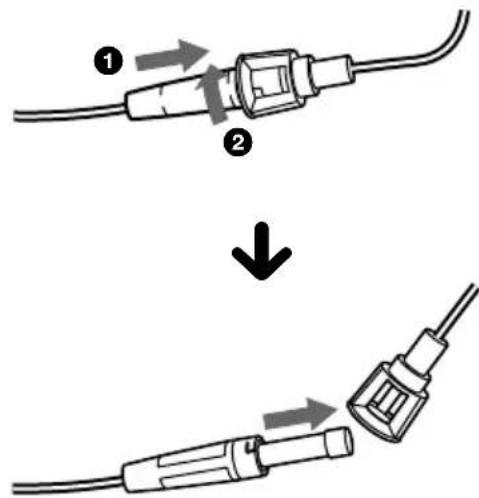
Fuse replacement
When replacing the fuse, be sure to use one matching the amperage rating stated on the original fuse. If the fuse blows, check the power connection and replace the fuse. If the fuse blows again after replacement, there may be an internal malfunction. In such a case, consult your nearest Sony dealer.
text_image
Diagram showing cable installation steps with numbered arrows indicating process flowWarning
Never use a fuse with an amperage rating exceeding the one supplied with the unit as this could damage the unit.
Card remote commander
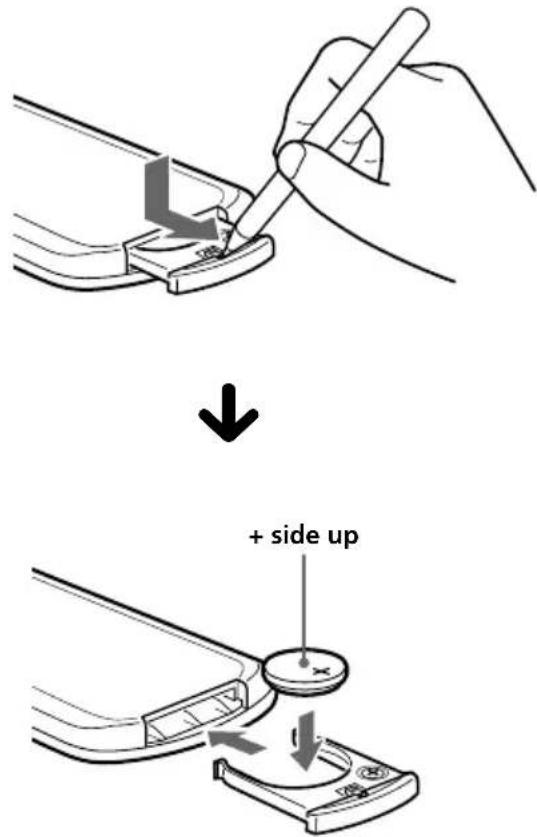
Replacing the lithium battery
When the battery becomes weak, the range of the card remote commander becomes shorter. Replace the battery with a new CR2025 lithium battery. Use of any other battery may present a risk of fire or explosion.
text_image
+ side upNotes on lithium battery
- Keep the lithium battery out of the reach of children. Should the battery be swallowed, immediately consult a doctor.
- Wipe the battery with a dry cloth to assure good contact.
- Be sure to observe the correct polarity when installing the battery.
- Do not hold the battery with metallic tweezers, otherwise a short-circuit may occur.
WARNING
Battery may explode if mistreated. Do not recharge, disassemble, or dispose of in fire.
Cordless stereo headphones
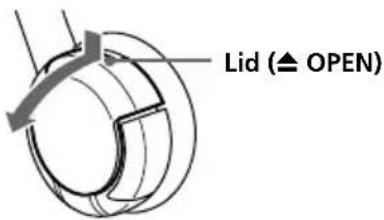
Replacing the battery
When the battery becomes weak, the POWER indicator light dims, or sound becomes distorted or noisy. Replace the battery with new one as soon as possible.
1 Open the lid (▲ OPEN) of the left housing.
text_image
Lid (▲ OPEN)2 Insert the size AAA dry battery into the battery compartment matching ⊕ terminal on the battery to ⊕ on the compartment.
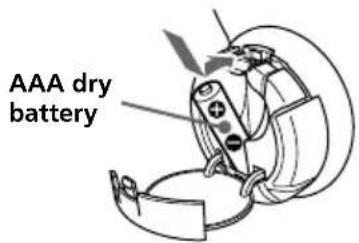
text_image
AAA dry battery3 Close the lid (△ OPEN).
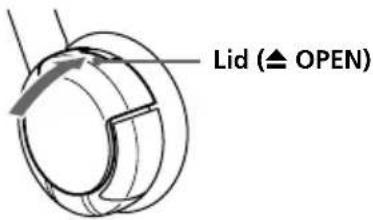
text_image
Lid (▲ OPEN)Notes on Battery
- Do not charge the dry battery.
- Do not carry the dry battery together with coins or other metallic objects. It can generate heat if the positive and negative terminals of the battery are accidentally come into contact with metallic objects.
- When you are not going to use the headphones for a long time, remove the battery to avoid damage from battery leakage or corrosion.
- Do not remove the attached label.
- Do not crack the casing.
- Do not drop, or subject to shock.
- Do not solder the terminals.
- Do not leave in an extremely hot or humid place.
- When storing or discarding, insulate the terminal portion with tape.
- Do not allow to get wet.
continue to next page →
Replacing the ear pads
The ear pads are replaceable. If the ear pads become dirty or worn out, replace them as illustrated below.
The ear pad is not commercially available. You can order replacements from the store where you purchased this system, or at your nearest Sony dealer.
1 Remove the old ear pad by pulling it off.
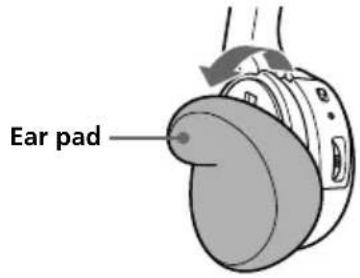
text_image
Ear pad2 Place the new ear pad around the housing.
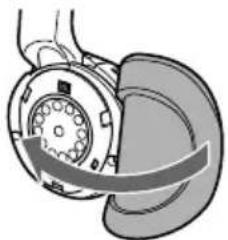
natural_image
Medical illustration of a mechanical device with a circular component and curved arm (no text or symbols)Notes on headphones preventing hearing damage
Avoid using headphones at high volume. Hearing experts advise against continuous, loud and extended play. If you experience a ringing in your ears, lower the volume or discontinue use.
Caring for others
Keep the volume at a moderate level. This will allow you to hear outside sounds and to be considerate to the people around you.
If you have any questions or problems concerning the headphones that are not covered in this manual, please consult nearest Sony dealer.
Notes on discs
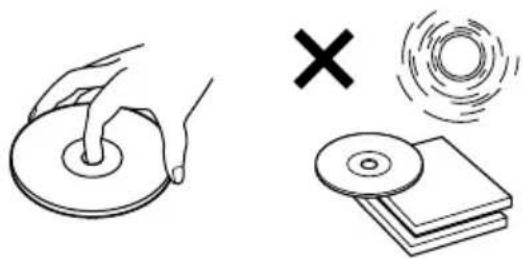
• To keep the disc clean, do not touch the surface. Handle the disc by its edge.
- Keep your discs in their cases or disc magazines when not in use. Do not subject the discs to heat/high temperature. Avoid leaving them in parked cars or on dashboards/rear trays.
natural_image
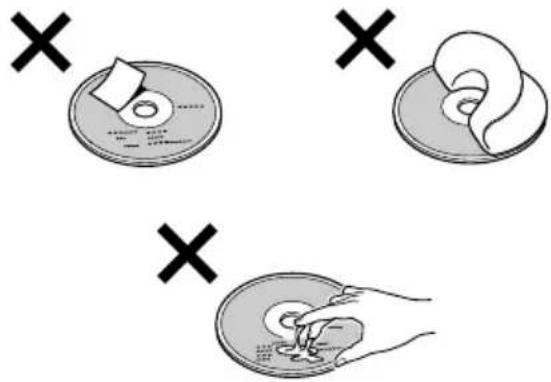
Illustration showing a hand holding a disc and a CD with a cross symbol (no text or labels)- Do not attach labels, or use discs with sticky ink/residue. Such discs may stop spinning when used, causing a malfunction, or may ruin the disc.
text_image
Diagram showing three stages of a medical procedure: disc removal, sutured section, and hand placement.- Do not use any discs with labels or stickers attached. The following malfunctions may result from using such discs:
— Inability to eject a disc (due to a label or sticker peeling off and jamming the eject mechanism).
— Inability to read audio data correctly (e.g., playback skipping, or no playback) due to heat shrinking of a sticker or label causing a disc to warp.
• Discs with non-standard shapes (e.g., heart, square, star) cannot be played on this player. Attempting to do so may damage the player. Do not use such discs.
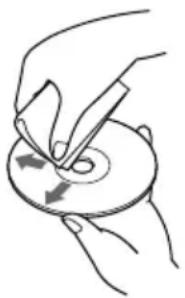
- Before playing, clean the discs with a commercially available cleaning cloth. Wipe each disc from the center out. Do not use solvents such as benzine, thinner, commercially available cleaners, or antistatic spray intended for analog discs.
natural_image
Illustration of hands using a tool to cut a circular object with directional arrows (no text or symbols)Music discs encoded with copyright protection
This product is designed to play back discs that conform to the Compact Disc (CD) standard. Recently, various music discs encoded with copyright protection are marketed by some record companies. Please be aware that among those discs, there are some that do not conform to the CD standard and may not be playable by this product.
About MP3 files
MP3 (MPEG 1 Audio Layer-3) is a standard technology and format for compressing a sound sequence. The file is compressed to about 1/10 of its original size. Sounds outside the range of human hearing are compressed while the sounds we can hear are not compressed.
Recommended MP3 file format
Sampling frequency 32k, 44.1k, 48k (Hz)
Bitrate (bps) 32k to 256k
Notes on discs/"Memory Stick"
You can play MP3 files recorded on CD-ROMs, CD-Rs, CD-RWs, and "Memory Stick." The disc must be in the ISO 9660* level 1 or level 2 format, or Joliet in the expansion format.
\* ISO 9660 Format
The most common international standard for the logical format of files and folders on a CD-ROM.
There are several specification levels. In Level 1, file names must be in the 8.3 format (no more than 8 characters in the name, no more than 3 characters in the extension ".MP3") and in capital letters. Folder names can be no longer than 8 characters. There can be no more than 8 nested folder levels. Level 2 specifications allow file names up to 31 characters long.
Each folder can have up to 8 trees.
For Joliet in the expansion format, make sure of the contents of the writing software, etc.
Notes
- With formats other than ISO 9660 level 1 and level 2, folder names or file names may not be displayed correctly.
- When naming, be sure to add the file extension ".MP3" to the file name.
- If you put the extension ".MP3" to a file other than MP3, the player cannot recognize the file properly and will generate random noise that could damage your speakers.
- The following discs/“Memory Stick” take a longer time to start playback.
— a discl"Memory Stick" recorded with complicated tree structure.
— a disc to which data can be added. - A high-bit rate MP3 file such as 320 kbps may not play back properly.
- This player does not support ID3 tag.
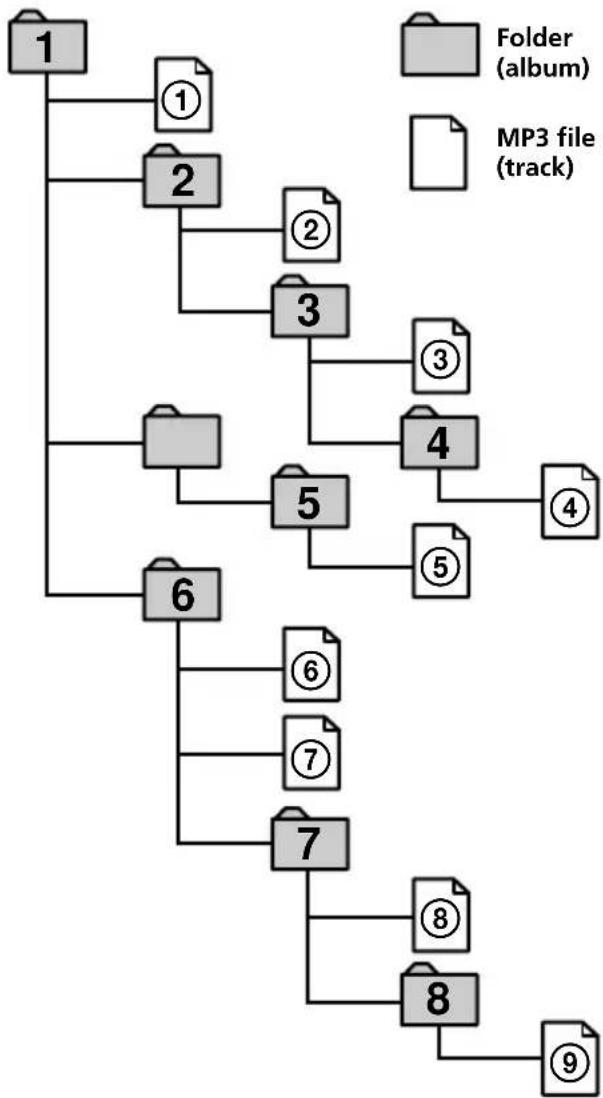
The playback order of the MP3 files
The playback order of the folders and files is as follows:
flowchart
graph TD
    1 --> 2
    1 --> 6
    2 --> 3
    2 --> 5
    3 --> 4
    3 --> 5
    4 --> 4
    4 --> 5
    5 --> 6
    5 --> 7
    6 --> 7
    6 --> 8
    7 --> 8
    7 --> 9
    8 --> 9
    style 1 fill:#ccc,stroke:#333
    style 2 fill:#ccc,stroke:#333
    style 3 fill:#ccc,stroke:#333
    style 4 fill:#ccc,stroke:#333
    style 5 fill:#ccc,stroke:#333
    style 6 fill:#ccc,stroke:#333
    style 7 fill:#ccc,stroke:#333
    style 8 fill:#ccc,stroke:#333
    style 9 fill:#ccc,stroke:#333
Tree 1 Tree 2 Tree 3 Tree 4 Tree 5 (root)
Tip
To specify a desired playback order, before the folder or file name, input the order by number (e.g., "01," "02"), then record contents onto a disc (The order differs depending on the writing software).
About "Memory Stick"
What is a "Memory Stick"?
"Memory Stick" is a compact, portable and versatile Integrated Circuit recording medium with a data capacity that exceeds a floppy disk. "Memory Stick" is specially designed for exchanging and sharing digital data among "Memory Stick" compliant products. Because it is removable, the "Memory Stick" can also be used for external data storage.
Types of "Memory Stick"
"Memory Stick" is available in the following types to meet various requirements in functions.
- "Memory Stick"
Stores any type of data except copyright-protected data that requires the MagicGate copyright protection technology.
You can use "Memory Stick" in this player.
• "Memory Stick Duo"
About half the size of a standard "Memory Stick."
"Memory Stick Duo" cannot be used in this player.
If you insert a "Memory Stick Duo" in this player, you may be unable to remove the "Memory Stick Duo."
- “MagicGate Memory Stick”
Equipped with the MagicGate copyright protection technology.
Data playback that requires MagicGate functions cannot be performed in this player.
• “Memory Stick PRO”
Equipped with the MagicGate copyright protection technology and can be used only with "Memory Stick PRO" compliant products.
"Memory Stick PRO" cannot be used in this player.
- "Memory Stick" (MagicGate/High-speed data transfer compatible)
Equipped with MagicGate, and supports high speed data transfer.
This player does not support parallel high-speed data transfer.
• “Memory Stick-ROM”
Stores pre-recorded, read-only data. You cannot record on "Memory Stick-ROM" or erase the pre-recorded data.
- "Memory Stick" (with memory select function)
This is a “Memory Stick” that has (128MB) plural memory in it.
You can select memory to use for whatever purposes through the memory select switch on the back of the “Memory Stick.”
Not all types of Memory Stick media are guaranteed to operate.
Notes
- "Memory Stick" is not ATRAC or ATRAC3 compatible.
- The maximum memory capacity of a "Memory Stick" supported by this player is 128MB.
Notes on use
To avoid damaging data, do not
- release the "Memory Stick" during reading or writing of data.
- use the "Memory Stick" in a location subject to static electricity or electric noise.
On formatting the "Memory Stick"
The “Memory Stick” is shipped with a FAT format as the standard format. When formatting the “Memory Stick,” do not use the format function on the Windows Explorer.
On handling the "Memory Stick"
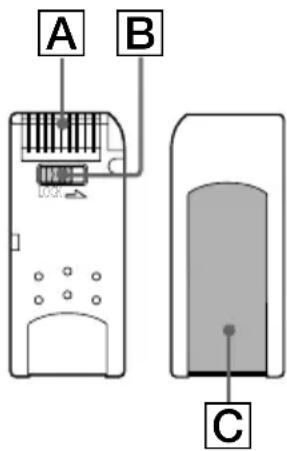
text_image
A B C- When the "Memory Stick" erasure prevention switch is set to "LOCK," data cannot be recorded, erased or edited. (B)
- Do not attach any other material than the supplied label on the label space. (C)
- Attach the label so that it does not stick out from the proper attachment location.
- Do not touch the "Memory Stick" connector with your finger or metallic objects. (A)
- Do not bend, drop or apply strong shock to the "Memory Stick."
- Do not disassemble or modify the "Memory Stick."
- Do not allow the "Memory Stick" to get wet.
- Do not use or store the "Memory Stick" in a location that is subject to:
– Extremely high temperature, such as in a car parked in the sun - Direct sunlight
– High humidity or places with corrosive substances - To prolong the life of the "Memory Stick," use the supplied storage case.
On cleaning
Clean the player casing with a soft cloth slightly moistened with water or a mild detergent solution. Do not use any type of abrasive pad, scouring powder or solvent such as alcohol or benzene as it may mar the finish of the casing.
Specifications
DVD player XVM-R90D
System
Laser Semiconductor laser
Signal format system NTSC/PAL
Audio characteristics
Frequency response 20 Hz to 20 kHz
Signal to noise ratio 90 dB (A)
Harmonic distortion 0.05 %
Dynamic range 90 dB
Wow and flutter below measurable limits
(±0.001% W PEAK)
General
Outputs FM output
Audio output
Video output
Optical output
Inputs Audio input
Video input
DC 12V input
Power requirements 12 V DC
Dimensions
Operating temperature 0 °C to 45 °C
(32 °F to 113 °F)
Supplied accessories Card remote commander
RM-X137
Power supply cord (1)
RF modulator cable (1)
Mounting plate (1)
Screws (5)
Tapping screws (8)
Operating Instructions (1)
Monitor
System Liquid crystal color display
Display Manual flipdown panel
Drive system
TFT-LCD active matrix
system
Picture size
9 inches wide screen (16:9)
Picture segment
336,960 (w 1,440 · h 234)
dots
Cordless Stereo Headphones MDR-IF0140
General
Modulation system Frequency modulation
Carrier frequency Right 2.8 MHz
Left 2.3 MHz
Frequency response 18 - 22,000 Hz
Power source DC 1.5 V (size AAA) dry battery
Mass Approx. 125 g (4.41 oz)
including battery
Operating temperature 5 °C to 35 °C
(41 °F to 95 °F)
Design and specifications are subject to change without notice.
Troubleshooting
The following checklist will help you remedy problems you may encounter with the player. Before going through the checklist below, check the connection and operating procedures.
General
This player does not turn on.
- Check the connections.
- If you find the connections in order, check the fuse.
→ If the fuse is blown, replace it with a correctly rated fuse.
→ If the fuse blows again, consult your nearest Sony dealer. - The player may be overheated. → Make sure that the player is turned off. Wait until the player cools off, then press POWER again.
The contents of the memory have been erased.
- The power cord or battery has been disconnected.
- The power connecting cord is not connected properly.
Stored settings are erased.
The fuse has blown.
Makes noise when the ignition key is in the ON, ACC, or OFF position.
The leads are not matched correctly with the car's accessory power connector.
No power is being supplied to the unit.
- Check the connection. If everything is in order, check the fuse.
- The car does not have an ACC position. → Press POWER.
The power is continuously supplied to the unit.
The car does not have an ACC position. Press and hold (POWER).
Disc/"Memory Stick" playback
A disc cannot be loaded.
- Another disc is already loaded.
- The disc is forcibly inserted upside down or in the wrong way.
- Be sure to insert an 8-cm disc in the center area of the disc slot. If you insert an 8-cm disc in the side of the disc slot, it may not be loaded.
MP3 files cannot be played back.
- Recording was not performed according to the ISO 9660 level 1 or level 2 format, or the Joliet convention in the expansion format.
- The file extension ".MP3" is not added to the file name.
- Files are not stored in MP3 format.
JPEG files cannot be displayed.
JPEG files are not displayed correctly.
- The file extension ".JPG" is not added to the file name.
- Files are not stored in JPEG format.
MP3/JPEG files take longer to play back than others.
The following discs/“Memory Stick” take a longer time to start playback.
— a disc/“Memory Stick” recorded with a complicated tree structure.
— a disc to which data can be added.
Playback functions such as pause are deactivated.
- The RESET button has been pressed.
- The disc/“Memory Stick” is ejected.
The sound skips.
- Dirty or defective disc.
- The player is installed in the place subject to severe vibrations.
A "Memory Stick" cannot be played.
A "Memory Stick" that cannot be played on this player is inserted.
Resume playback is not possible.
When the “Memory Stick” is removed and disc playback restarts, playback is started from the beginning of the disc. To enable resume playback again, remove and reinsert the disc.
continue to next page →
Picture
There is no picture.
•Color system setting has been changed manually while playing a DVD.
→ Change the setting according to the color system of the DVD, turn off the player and turn it on again, or switch the input channel to "VIDEO," then switch it to "DVD."
- Check that the device connected to the AUDIO/VIDEO INPUT connectors is connected correctly.
- If there is no picture on the screen, etc. connected to the player, check that the device connected to the AUDIO/VIDEO OUTPUT connectors is connected correctly.
Picture noise appears.
Dirty or defective disc.
Some stationary green, blue or red dots may appear on the monitor.
These are called bright spots, and can happen with any LCD. The LCD panel is highly sophisticated, and more than 99.99% of the segments used in the panel are flawless. However, there is a possibility that less than 0.01% of the segments are defective and may not light up properly.
Operation
The card remote commander does not function.
- Remove any obstacles between the card remote commander and this player.
- Use the card remote commander closer to the remote control sensor.
- Point the light emitter of the commander at the remote control sensor of the player.
- Replace the battery in the remote if it is weak.
The player does not play from the beginning when playing a disc.
- Resume Playback may be activated.
→ Press ■ again or eject the disc. - Depending on the DVD, a title menu or a DVD menu may automatically appear on the monitor during playback.
→ Select the desired menu (page 24). - Depending on the Video CD, the PBC menu display automatically appears on the monitor during playback.
→ Select the desired menu (page 26).
Playback stops automatically.
The disc may contain an auto pause signal. While playing such a disc, this player stops playback at the signal.
You cannot perform certain functions, such as Stop or Search Playback.
With some discs, you cannot activate these functions.
The language for the sound track cannot be changed when you play a DVD.
- Multilingual tracks are not recorded on the DVD.
- Changing the language for the track is prohibited on the DVD.
The subtitle language cannot be changed when you play a DVD.
- Multilingual subtitles are not recorded on the DVD.
- Changing the language for the subtitles is prohibited on the DVD.
The subtitles cannot be turned off when you play a DVD.
Depending on the DVD, you may not be able to turn the subtitles off.
The angles cannot be changed when you play a DVD.
- Multi-angles are not recorded on the DVD.
- Change the angles at a scene recorded with multiple angles (page 25).
- Changing the angles is prohibited on the DVD.
This player does not operate properly.
Static electricity, etc., may affect this player's operation.
→ Turn off the player, allow the player to cool, then press POWER again.
Error display
Error displays
The following indications will be displayed for about 8 seconds.
POWER OFF ABNORMALITY in TEMP
The surrounding temperature is too high or too low.
→ Operate the player at a temperature of 0 ^ ( 32 ^ ) to 45 ^ ( 113 ^ ).
REGION ERROR
The region code of the DVD currently in the player does not conform to the player.
→ Make sure the region code of the DVD and the player (page 8).
DISC ERROR
• The data recorded on the disc is damaged.
- The player does not support the format in which the data is recorded to the disc.

The operation cannot be done.
Language Code List
The language spellings conform to the ISO 639: 1988 (E/F) standard.
Code Language Code Language Code Language Code Language
| 6565 Afar 7089 Frisian 7771 Malagasy 8382 Serbian | |||
| 6566 Abkhazian 7165 Irish 7773 Maori 8385 Sundanese | |||
| 6570 Afrikaans 7168 Scots/Gaelic 7775 Macedonian 8386 Swedish | |||
| 6577 Amharic 7176 Gallician 7776 Malayalam 8387 Swahili | |||
| 6582 Arabic 7178 Guarani 7778 Mongolian 8465 Tamil | |||
| 6583 Assamese 7185 Gujarati 7779 Moldavian 8469 Tegule | |||
| 6588 Aymara 7265 Hausa | 7782 Marathi 8471 Tajik | ||
| 6590 Azerbaijani | 7273 Hindi | 7783 Malay | 8472 Thai |
| 6665 Bashkir | 7282 Croatian | 7784 Maltese | 8473 Tigrinya |
| 6669 Byelorussian 7285 Hungarian 7789 Burmese | 8475 Turkmen | ||
| 6671 Bulgarian | 7289 Armenian | 7865 Nauru | 8476 Tagalog |
| 6672 Bislama | 7365 Interlingua | 7869 Nepali 8479 Tonga | |
| 6678 Bengali | 7378 Indonesian 7876 Dutch 8482 Turkish | ||
| 6679 Tibetan | 7383 Icelandic | 7879 Norwegian | 8484 Tatar |
| 6682 Breton | 7384 Italian | 7982 Oriya | 8487 Twi |
| 6765 Catalan | 7387 Hebrew | 8065 Punjabi | 8575 Ukrainian |
| 6779 Corsican 7465 Japanese | 8076 Polish | 8582 Urdu | |
| 6783 Czech | 7473 Yiddish | 8083 Pushto/Pashto | 8590 Uzbek |
| 6789 Welsh | 7487 Javanese | 8084 Portuguese | 8673 Vietnamese |
| 6865 Danish | 7565 Georgian | 8185 Quechua | 8679 Volapük |
| 6869 German 7575 Kazakh | 8277 Raeto-Romance | 8779 Wolof | |
| 6890 Bhutani | 7576 Greenlandic | 8279 Romanian | 8872 Xhosa |
| 6976 Greek 7577 Cambodian | 8285 Russian | 8979 Yoruba | |
| 6978 English | 7578 Kannada | 8365 Kinyarwanda | 9072 Chinese |
| 6979 Esperanto | 7579 Korean | 8368 Sanskrit | 9085 Zulu |
| 6983 Spanish | 7583 Kashmiri | 8372 Serbo-Croatian | |
| 6984 Estonian | 7585 Kurdish | 8373 Sinhalese | |
| 6985 Basque | 7589 Kirghiz | 8375 Slovak | |
| 7065 Persian | 7665 Latin | 8376 Slovenian | |
| 7073 Finnish | 7678 Lingala | 8377 Samoan | |
| 7074 Fijian | 7679 Laotian | 8378 Shona | |
| 7079 Faroese | 7684 Lithuanian 8379 Somali | ||
| 7082 French | 7686 Latvian Lettish | 8381 Albanian | |
Avertissement
ATTENTION
natural_image
Line drawing of two people inside a car, one seated at the camera and the other standing beside a vehicle (no text or symbols)text_image
OFF ACC ONnatural_image
Illustration of a hand using a power tool to adjust or install a component (no text or symbols visible)natural_image
Simple line drawing of a mechanical component with a bolt and force gauge (no text or symbols)Lieu d'installation
text_image
Diagram illustrating car safety perception with labeled components and directional arrows for driving and meeting scenarios.12 Touche ▶II (lecture/pause) 20, 22
13 Touche OPEN 13
8 Touches ↑/→/↓/← 19, 21, 24, 27
13 Touche ENTER 19, 24, 27
17Touche ▶II (lecture/pause) 19, 21, 26
text_image
120° 180° 30°Conseils
natural_image
Line drawing of a front view of a computer monitor with control panel and buttons (no text or symbols)text_image
Frequency 88.3MHz Press +/-, MENU or Rev.natural_image
Line drawing of a car driving on a curved road with mountains in the background (no text or symbols)natural_image
Line drawing of a car driving on a curved road with mountains in the background (no text or symbols)natural_image
Line drawing of a car driving on a curved road with mountains in the background (no text or symbols)natural_image
Simple line drawing of a car driving on a curved road with mountainous background (no text or symbols)natural_image
Technical line drawing of a mechanical component with no visible text or symbolsnatural_image
Technical line drawing of a mechanical component with directional arrows indicating motion (no text or symbols)natural_image
Illustration of a hand holding a CD to open a computer case (no text or symbols visible)text_image
SMART NAVI ROOT ROOT 0 FOLDER 1 1 FOLDER 2 2 FOLDER 3 3La lecture commence.
natural_image
Line drawing of a device interior with a hand inserting a button into the top panel (no text or symbols)natural_image
Line drawing of a refrigerator interior showing the door, front panel, and side panels with a button (no text or symbols)Remarques
flowchart
graph TD
    A["SINGLE ELA SEDP\n00:00:12"] --> B["SINGLEREMA IN\n00:04:45"]
    B --> C["TOTAL ELA SED\n00:06:32"]
    C --> D["TOTAL REMA IN\n00:41:15"]
    D --> E["OFF"]
SUBTITLE 02/32 : ENGLISH
text_image
Diagram showing a cable connector with labeled parts and directional arrows indicating motion or movement.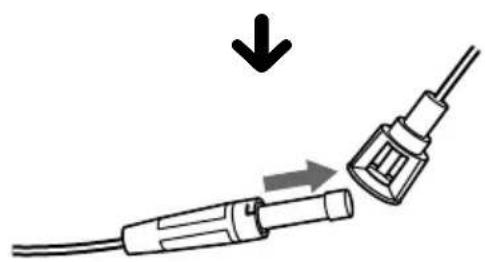
natural_image
Diagram showing a cable being inserted into a plug, with an arrow indicating direction of insertion (no text or symbols present)Avertissement
natural_image
Illustration of a hand using a tool to cut a mechanical component, with a downward arrow indicating action (no text or symbols present)Côté + vers le haut