EasyManual
Sonetto V - Speaker Sonus Faber - Free user manual and instructions
Find the device manual for free Sonetto V Sonus Faber in PDF.



User questions about Sonetto V Sonus Faber
0 question about this device. Answer the ones you know or ask your own.
Ask a new question about this device
Download the instructions for your Speaker in PDF format for free! Find your manual Sonetto V - Sonus Faber and take your electronic device back in hand. On this page are published all the documents necessary for the use of your device. Sonetto V by Sonus Faber.
USER MANUAL Sonetto V Sonus Faber
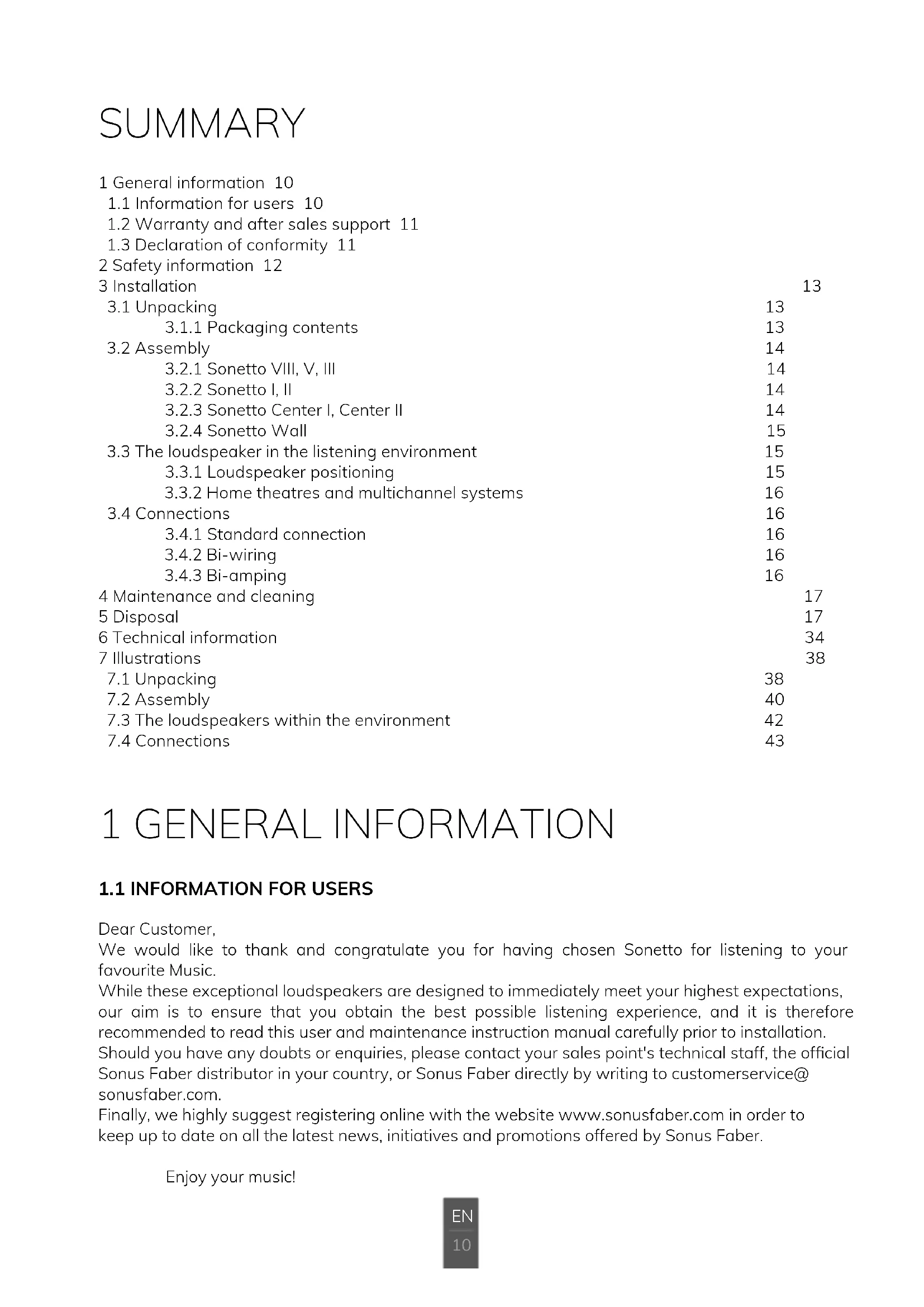
1 GENERAL INFORMATION SUMMARY Dear Customer, We would like to thank and congratulate you for having chosen Sonetto for listening to your favourite Music. While these exceptional loudspeakers are designed to immediately meet your highest expectations, our aim is to ensure that you obtain the best possible listening experience, and it is therefore recommended to read this user and maintenance instruction manual carefully prior to installation. Should you have any doubts or enquiries, please contact your sales point's technical staff, the ofcial Sonus Faber distributor in your country, or Sonus Faber directly by writing to customerservice@ sonusfaber.com. Finally, we highly suggest registering online with the website www.sonusfaber.com in order to keep up to date on all the latest news, initiatives and promotions offered by Sonus Faber. Enjoy your music! 1 General information 10
1.1 Information for users 10
1.2 Warranty and after sales support 11
1.3 Declaration of conformity 11
3.3 The loudspeaker in the listening environment 15
3.3.1 Loudspeaker positioning 15
3.3.2 Home theatres and multichannel systems 16
4 Maintenance and cleaning 17 5 Disposal 17 6 Technical information 34 7 Illustrations 38
7.3 The loudspeakers within the environment 42
Sonetto loudspeakers are designed and manufactured according to the highest quality standards. Should however a fault or a malfunction occur, the loudspeakers are covered by warranty, in compliance with the regulations in force in the country where the loudspeakers were purchased. In such cases, please contact the Sonus Faber dealer from whom you purchased your loudspeakers, or the ofcial Sonus Faber distributor for your country; the contact information for all the distributors can be found on our website:
- https://www.sonusfaber.com/distributori-store/
- https://www.sonusfaber.com/en/distributors-stores/ The following should also be kept in mind for your convenience:
- The warranty on the loudspeakers covers any manufacturing defects;
- Keep the receipt as proof of purchase to show to the retailer if necessary;
- Keep the loudspeakers' original packaging so that they can be transported without suffering damage if they need to be shipped to an authorised service centre;
- The loudspeakers must be accompanied by a description of the malfunction or defect encountered. The product's warranty will be void under the following conditions:
- If the product has been disassembled or modied by persons other than a Sonus Faber authorised service centre;
- If the product has been used in a manner that is not consistent with the indications contained within this manual.
1.2 WARRANTY AND AFTER SALES SUPPORT
Sonus faber SpA with headquarters at No. 10 Via Antonio Meucci - 36057 Arcugnano (VI) Italy, hereby declares under its sole responsibility that the passive loudspeaker system Sonetto models VIII, V, III, II, I, Center I, Center II, Wall you have purchased which this declaration relates is in conformity to: Directives: 2014/30/UE (EMC) Electromagnetic Compatibility. 2011/65/UE (RoHS) Restriction of the use of certain hazardous substances in electrical and electronic equipment. 2012/19/UE (RAEE) Waste electrical and electronic equipment (WEEE). 2006/1907/CE (REACH) Registration, evaluation, authorisation and restriction of chemical substances. Standards:
Audio/video, information and communication technology equipment - Part 1: Safety requirements. CEI EN 55013:2014 Sound and television broadcast receivers and associated equipment - Radio disturbance characteristics.
1.3 DECLARATION OF CONFORMITY12
- This instruction manual must be read carefully and kept in an accessible location for any needs that may arise.
- Adjust the support feet in such a way as to obtain the best possible stability.
- Avoid placing heavy objects upon the loudspeaker, as these can compromise its stability.
- If the loudspeakers are to be positioned upon a raised support surface (e.g. mezzanines, wooden boosters, etc.) or on wall, check beforehand to make sure that the surface is capable of bearing their weight. Also make sure that there is sufcient friction to prevent the loudspeakers from moving due to the vibrations generated under normal operating conditions.
- Do not place any objects containing ammable liquids, substances, or liqueable substances upon the loudspeaker.
- Use one of the connection diagrams contained in this instruction manual. The connection of two or more loudspeakers in parallel can damage your amplier. If in doubt, contact your dealer.
- Avoid staying in close proximity to the loudspeakers while the audio system is operating at high volume. This can cause permanent damage to your hearing! Children must be kept at a safety distance of least 50 cm from the loudspeaker.
- The speakers generate an electromagnetic eld that is harmless to humans and pets, but can compromise the proper functionality of electronic equipment, such as CRT monitors or TVs, when placed in close proximity. If this occurs, increase the equipment's distance from the loudspeakers. Do not place credit cards or other similar magnetic stripe cards on the loudspeaker.
- The technology underlying the speakers' functionality is based on the principles of electromagnetism, and the user should therefore avoid operating equipment that generates strong electromagnetic elds, as these could affect the loudspeaker's proper functionality. Avoid placing transmitting devices such as mobile phones, cordless phones, intercom systems, etc., upon the loudspeakers' cabinet.
- Do not connect the loudspeakers directly to a constant voltage sound distribution system (100 V, 70.7 V or similar). This could result in a serious system overload, with possible damage to the loudspeaker system and/or the amplier unit.
- Do not place audio cables and electrical power cables in close proximity to one another. An electromagnetic eld is present in the vicinity of the power cables, which can cause an unpleasant humming noise. In this case, increase the distance between the audio cables and the power cables. CEI EN 55020:2016 Sound and television broadcast receivers and associated equipment; Immunity characteristics - Limits and methods of measurement.
CEI EN 61000-6-1:2013
Electromagnetic compatibility (EMC) Part 4-3: Testing and measurement techniques; Radiated, radio-frequency, electromagnetic eld immunity test.
CEI EN 61000-6-3:2014
Generic standards; Immunity for residential, commercial and light-industrial environments. Arcugnano, 20/09/2017 Filippo Fanton - CEO13
3 INSTALLATION Hold the loudspeakers securely with both hands in order to avoid dropping them. The indicated operations can be performed more safely and conveniently by two people. The packaging materials can cause pollution. These materials must not be disposed of as domestic waste, and must be brought to a waste collection and recycling centre. Do not leave the packaging materials within the reach of children! They could pose a risk of poisoning or suffocation if ingested. Perform the unpacking operations as follows. Refer to the images contained in chapter 7. Follow the general instructions. Refer to Fig. 1a, 1b, 1c:
- Use a paper cutter to open the packaging. Do not insert the blade too deep to avoid damaging the contents.
- Keep all the packaging elements for any future transport operations.
- Do not wear any watches, bracelets, rings, etc., in order to avoid scratching the loudspeakers and their nishes. The same care must be taken in order to protect the loudspeakers from any metal elements present on the clothes you are wearing, such as zippers, buttons, belt clasps, rivets, etc...
Sonetto VIII Sonetto V Sonetto III 8 Spikes 8 Spikes 8 Spikes 8 Under Spikes 8 Under Spikes 8 Under Spikes 8 Spike locks 8 Spike locks 8 Spike locks 2 Masks 2 Masks 2 Masks 2 Fabric dust guards 2 Fabric dust guards 2 Fabric dust guards 2 Basis 8 Feet 8 Feet 16 Locking screws 16 Locking screws 16 Locking screws 2 Jumpers 2 Jumpers 2 Jumpers 1 Allen wrench 1 Allen wrench 1 Allen wrench 1 Manual 1 Manual 1 Manual Sonetto I Sonetto II 2 Masks 2 Masks 2 Fabric dust guards 2 Fabric dust guards 2 Jumpers 2 Jumpers 1 Manual 1 Manual
3.1.1 PACKAGING CONTENTS
In addition to the loudspeakers, the packaging also contains:14
The packaging dedicated to the Stand (2 sets) contains: If one or more of these items is missing, notify the retailer from whom the product was purchased Sonetto Stand 8 Spikes 8 Under Spikes 10 Washers 10 Countersunk hexagonal screws 14 Hex head screws 1 Allen wrench 1 Manuale Sonetto Center I Sonetto Center II Sonetto Wall 1 Masks 1 Masks 1 Masks 1 Fabric dust guards 1 Fabric dust guards 1 Fabric dust guards 1 Basis 1 Basis 2 Brackets 2 Jumpers 2 Jumpers 2 Phillips screws + washer 1 Manual 1 Manual 4 Wooden Phillips screws 6 Washers 2 Nuts 2 Locking screws 1 Allen wrench 1 Manual Follow the indications below, based on the model in your possession. Refer to the images contained in chapter 7.
These oor loudspeakers require a support base. Assemble the loudspeaker according to the instructions below. Refer to Fig. 2.
1. Turn the loudspeaker upside down, with its upper protection shell included.
2. Screw the base screws to the body of the loudspeaker.
3. Screw the spikes.
Rest the base of the loudspeaker on the support, according to Fig. 4. The base ensures stability for the speaker and allows for its proper positioning. These bookshelf speakers are suitable for assembly on support (advised). Assemble the supports and the speakers on supports as described below. Refer to Fig. 3.
1. Screw the screws of the upper base of the support
2. Screw the screws of the lower base of the support
3. Screw the conic points to the lower base of the support
4. Position the loudspeaker on the upper base of the support. The holes of the upper base must
match those of the loudspeaker
5. Manually tighten the screws of the loudspeaker to the base.
This speaker is intended to be assembled on a wall. Perform the xing operations as follows. Refer to Fig. 5.
1. Fix the two support screws to the wall. Use one of the brackets included as template for drilling
the wall. Leave about 4 mm of the screws protruding from the washer.
2. Assemble the rst bracket to the loudspeaker, using the four screws included
3. Assemble the second bracket to the rst using the two screws and the bolts. Do not tighten the
4. Insert the wall-mounted screws in their corresponding holes in the bracket.
5. Position the loudspeaker as necessary.
6. Completely tighten the screws of the second bracket to the bracket already mounted on the
loudspeaker. Sonetto loudspeakers were designed to be easy to be piloted in terms of sound amplication and easy to add to any room. Models I and II are suitable for small rooms. For larger spaces, use models VIII, V and III. To install a multi-channel or Home Theater system, it is possible to combine loudspeakers Center I, Center II and Wall. The choice of the listening environment and the loudspeakers' positioning can affect the entire audio system's performance. Rooms with irregular shapes are preferable, as these types of rooms can improve the frequency response within the listening environment, as they limit the formation of standing waves. Within reason, the presence of rugs and curtains can have a positive effect upon the acoustic response, as they help to absorb the reections and standing waves generated within the listening environment. There are no xed and universally-applicable rules for every environment. Nevertheless, one good approach to positioning the loudspeakers within the listening environment is to start by dividing the listening environment's oor plan into three equal areas, as indicated by the dotted lines in Fig. 6. Position the loudspeakers on the rst line (A), at a good distance from the lateral walls, and position the listening point on the second line (B). In this manner, a good amount of air will be present all around the subjects involved in the stereo reproduction, thus allowing the loudspeakers to work freely, while at the same time shielding the listener from the acoustic reections generated near the walls and in the corners of the room itself. Fig. 6 shows how the loudspeakers' axis should converge toward the listening position by crossing over top of it, thus creating the classic "equilateral triangle" conguration. This measure, which consists of orienting the loudspeakers in such a way as to literally point them towards the listener's ears, provides for a signicant improvement in the focus of the stereophonic image. Given that the illustrated procedure, which is aimed at creating quasi-ideal listening conditions, cannot be applied by all of our customers due to objective problems linked to the organization of the living environment, it is recommended to position the two loudspeakers away from the corners
In addition to use with traditional stereos, the loudspeakers of the Sonetto collection can also be used with "home theatres" and "multi-channel" systems. Taking into account the rules for the front loudspeakers, loudspeakers destined to the reproduction of posterior channels should be positioned as indicated in Fig. 6, and the central loudspeaker exactly in line with the vertical axis that passes through the centre of the video screen (above or below the screen), while a subwoofer can be positioned anywhere in the room, as long as it is not near the corners. Please refer to the documents regarding the amplifying system of the room, and at a distance of at least 100 cm from the end walls. The two loudspeakers should be at least 1.8 metres apart from each other. The listening point should be at a height of approximately 1.1 metres off the ground. The distance between the loudspeakers themselves, and between the loudspeakers and the listening point, can be subsequently adjusted as desired.
3.3.2 HOME THEATRES AND MULTICHANNEL SYSTEMS
Refer to the images contained in chapter 7. After the loudspeakers have been positioned, their connections must be completed. The terminals allow for connections using cables with spade terminals, stripped cable, or banana plugs. The loudspeakers' terminals (except for the Wall model) are equipped with jumpers, which allow the loudspeakers to be connected as follows. It may be necessary to remove the jumpers based on the selected connection type. The Wall model contains a single pair of terminals. Please refer to Fig. 10. The proper tightening and periodic inspection of the terminals can help to improve performance. Use a single stereo amplier or two mono ampliers and a pair of power cables. Complete the connections as indicated in Fig. 7. Use a single stereo amplier or two mono ampliers and two pairs of power cables. Remove the jumpers between the terminals and make the connections as indicated in Fig
Use two stereo ampliers or four mono ampliers (of the same brand and model, if possible) and two pairs of power cables. Remove the jumpers between the terminals and make the connections as indicated in Fig. 9.
The connections must be made with the equipment turned off!17
5 DISPOSAL Disposal of the electrical and electronic equipment. Directives WEEE 2012/19/EU - RoHS 2011/65/
The crossed-out waste bin symbol shown on the equipment indicates that the product must be disposed of separately from household waste at the end of its service life. The user is responsible for bringing the equipment to an appropriate waste collection facility at the end of its service life. The separate disposal of the decommissioned equipment for recycling, treatment and disposal in compliance with the current environmental protection regulations will help prevent potential negative consequences for the environment and human health, and will allow for the recycling of the materials and components of which the product is comprised. For more detailed information regarding the collection systems available in your area, please contact your local waste disposal service or the shop/dealer where you purchased the product. This device contains materials that can pollute the environment if disposed of improperly. The device must be disposed of at a designated sorted waste collection facility. Risk of damage to the loudspeaker's cabinet! Do not use cleaning products, furniture wax, liquid detergents, or alcohol. Do not use rough cloths.
4 MAINTENANCE AND CLEANING
Aside from periodic cleaning, the loudspeakers of the Sonetto collection do not require any particular maintenance operations. In order to preserve the loudspeakers' nish, cover them with the supplied fabric protector, especially if the loudspeakers are not expected to be used for an extended period of time. Do not use products like waxes or detergents to clean the wood parts, as these could stain or damage the wood or the loudspeakers themselves. Use a soft cloth (e.g. microbre), perhaps slightly damp. Wood is a natural living material that can be affected by the environmental conditions. We recommend keeping the loudspeakers away from heat sources or windows, above all during the summer months. Avoid exposing the loudspeakers to direct sunlight. Use a soft brush to eliminate any dust that may have accumulated on the cabinet, the front panels, and the loudspeakers themselves, taking care not to damage the loudspeakers' delicate membranes. These measures will help to keep the loudspeakers' working perfectly for years to come. Time will help improve the sound by breaking in the speakers' moving parts (membranes and suspensions), and the acoustic chamber will become accustomed to music being played the more it is used - much like what happens with acoustic string instruments!18
cording to the most natural sound. Ultra-dynamic per
formance and high linearity. Sonus faber design 150mm cone driver. Ul
tra-free compression basket, Sonus faber design. Special custom diaphragm made with a real time air dried non pressed blend of traditional cellulose pulp and other natural bers, developed ac
cording to the most natural sound. Ultra-dynamic per
formance and high linearity. Sonus faber design 150mm cone driver. Ul
tra-free compression basket, Sonus faber design. Special custom diaphragm made with a real time air dried non pressed blend of traditional cellulose pulp and other natural bers, developed ac
cording to the most natural sound. Ultra-dynamic per
formance and high linearity. Sonus faber design Woofer 3x180mm cone drivers. Ultra-free compression basket, Sonus faber design. Aluminum cone for maxi
mum speed. Ultra-dynamic performance and high linea
rity. Sonus faber design 2x180mm cone drivers. Ultra-free compression basket, Sonus faber design. Aluminum cone for maxi
mum speed. Ultra-dynamic performance and high linea
rity. Sonus faber design 2x150mm cone drivers. Ultra-free compression basket, Sonus faber design. Aluminum cone for maxi
mum speed. Ultra-dynamic performance and high linea
rity. Sonus faber design Crossover Anti-resonant design, optimized amplitude/pha
se response for optimal space/time performance. “Paracross topology”. Impe
dance compensation at low frequencies for a clear and friendly amplier performan
ce. Nano-technology coated, high-conductivity pcb tracks. Crossover frequencies: 270 and 3.000 Hz Anti-resonant design, optimized amplitude/phase response for optimal space/ time performance. “Para
cross topology”. Impedance compensation at low frequencies for a clear and friendly amplier performan
ce. Crossover frequencies: 235and 3.000 Hz Anti-resonant design, optimized amplitude/phase response for optimal space/ time performance. “Para
cross topology”. Impedance compensation at low frequencies for a clear and friendly amplier performan
35,235 Sonetto II Sonetto I Loudspeaker system 2-way shelf loudspeaker system. Vented box design 2-way shelf loudspeaker system. Vented box design Tweeter 29mm high denition DAD driver. DKM dome diaphragm. Visco-elastically bafe decoupling. Sonus faber design 29mm high denition DAD driver. DKM dome diaphragm. Visco-elastically bafe decoupling. Sonus faber design Midwoofer 165mm cone driver. Ultra-free compres- sion basket, Sonus faber design. Special custom diaphragm made with a real time air dried non pressed blend of traditional cellulose pulp and other natural bers, developed according to the most natural sound. Ultra-dynamic performance and high linearity. Sonus faber design 150mm cone driver. Ultra-free compres- sion basket, Sonus faber design. Special custom diaphragm made with a real time air dried non pressed blend of traditional cellulose pulp and other natural bers, developed according to the most natural sound. Ultra-dynamic performance and high linearity. Sonus faber design. Crossover Anti-resonant design, optimized amplitu- de/phase response for optimal space/time performance. “Paracross topology”. Impe- dance compensation at low frequencies for a clear and friendly amplier perfor- mance. Crossover frequency: 2.650 Hz Anti-resonant design, optimized ampli- tude/phase response for optimal space/ time performance. “Paracross topology”. Crossover frequency: 2.500 Hz Frequency Response 42 Hz -25.000 Hz 45 Hz -25.000 Hz Sensitivity 87 dB SPL (2.83V/1m) 87 dB SPL (2.83V/1m) Nominal Impedance 4 ohm 4 ohm Suggested amplier power output 40W - 200W without clipping 30 W -150 W without clipping Long-Term Max Input Voltage (IEC 268-5) 20V rms 20V rms Dimensions HxWxD (mm) Dimensions HxWxD (in) 370 (1101 stand included) x 250 x 334 15 (44 stand included) x 10 x 13 359 (1090 stand included) x 219 x 305 14 (43 stand included) x 9 x 12 Weight (Kg) each Weight (lb) each 6,8 14,9 5,5 12,136 Sonetto Center I Sonetto Center II Loudspeaker system 2-way shelf loudspeaker system. Vented box design 3-way shelf loudspeaker system. Vented box design Tweeter 29mm high denition DAD driver. DKM dome diaphragm. Neo Magnet system. Visco-elastically bafe decoupling. Sonus faber design 29mm high denition DAD driver. DKM dome diaphragm. Neo Magnet system. Visco-elastically bafe decoupling. Sonus faber design Midrange
2x150mm cone drivers. Ultra-free compression basket, Sonus faber design. Special custom diaphragm made with a real time air dried non pressed blend of traditional cellulose pulp and other natural bers, developed according to the most natural sound. Ultra-dynamic performance and high linearity. Sonus faber design Midwoofer 2x150mm cone drivers. Ultra-free compression basket, custom Sonus faber design. Special custom diaphragm made with a real time air dried, non pressed blend of traditional cellulose pulp and other natural bers, developed according to the most natural sound. Ultra-dy- namic performance and high linearity. Sonus faber design
2x150mm cone drivers. Ultra-free compression basket, Sonus faber design. Aluminum cone for maximum speed. Ultra-dynamic performance and high linearity. Sonus faber design Crossover Anti-resonant design, optimized amplitu- de/phase response for optimal space/ time performance. “Paracross topology”. Crossover frequency: 1.550 Hz Anti-resonant design, optimized amplitu- de/phase response for optimal space/ time performance. “Paracross topology”. Impedance compensation at low fre- quencies for a clear and friendly amplier performance. Crossover frequency: 220 and 1.650 Hz Frequency Response 60 Hz -25.000 Hz 42 Hz -25.000 Hz Sensitivity 90dB SPL (2.83V/1m) 91dB SPL (2.83V/1m) Nominal Impedance 4 ohm 4 ohm Suggested amplier power output 50W - 200W without clipping 50W - 300W without clipping Long-Term Max Input Voltage (IEC 268-5) 20V rms 22V rms Dimensions HxWxD (mm) Dimensions HxWxD (in) 242 x 495 x 303 10 x 20 x 12 289 x 743 x 409 12 x 30 x 16 Weight (Kg) each Weight (lb) each 6,5 14,3 16,2 35,737 Sonetto Wall Loudspeaker system 2-way on-wall speaker. Passive radiator design Tweeter 29mm high denition DAD driver. DKM dome diaphragm. Neo Magnet system. Visco-elastically bafe decoupling. Sonus faber design Midwoofer 150mm cone driver. Ultra-free compression basket, Sonus faber design. Special custom diaphragm is made with a real time air dried non pressed blend of traditional cellulose pulp and other natural bers, developed according to the most natural sound. Ultra-dynamic performance and high linearity. Sonus faber design Crossover Anti-resonant design, optimized amplitude/phase response for optimal space/time performance. “Paracross topology”. Crossover frequency: 3.800 Hz Frequency Response 60 Hz -25.000 Hz Sensitivity 89 dB SPL (2.83V/1m) Nominal Impedance 4 ohm Suggested amplier power output 30 W -150 W without clipping Long-Term Max Input Voltage (IEC 268-5) 20 V rms Dimensions HxWxD (mm) Dimensions HxWxD (in) 500 x 291 x 163 20 x 12 x 7 Weight (Kg) each Weight (lb) each 4,8 10,538