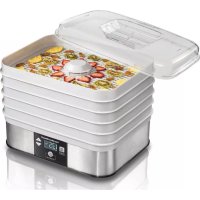
32100 - Food Dehydrator HAMILTON BEACH - Free user manual and instructions
Find the device manual for free 32100 HAMILTON BEACH in PDF.


| Product type | Food dehydrator |
| Brand | Hamilton Beach |
| Model | 32100 |
| Number of trays | 5 (all must be used, even if empty) |
| Temperature range | 100°F to 160°F (adjustable in 5°F increments; switchable to °C) |
| Timer | Up to 48 hours, in 1-hour increments |
| Display | Digital, alternates time and temperature |
| Controls | TIME/TEMP, START/PAUSE buttons, +/- arrows, hold 2 seconds to toggle °C/°F or reset |
| Included accessories | 1 mesh screen (for herbs/small foods), 1 fruit roll sheet |
| Safety | Polarized plug, do not use outdoors, do not immerse base, child supervision required |
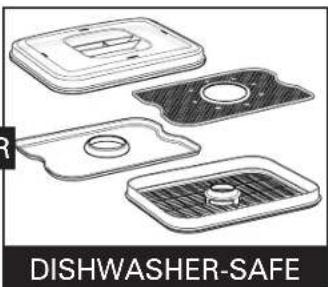
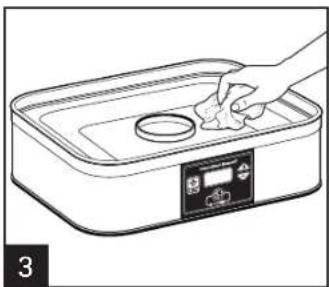
| Cleaning | Trays, screen and sheet are dishwasher-safe (except SANI cycle) or hand wash; wipe base with damp cloth |
| Warranty | 5 years (Canada), 1 year (USA) |
| Power supply | 120 V ~ 60 Hz |
| Use | Household only |
Frequently Asked Questions - 32100 HAMILTON BEACH
User questions about 32100 HAMILTON BEACH
0 question about this device. Answer the ones you know or ask your own.
Ask a new question about this device
Download the instructions for your Food Dehydrator in PDF format for free! Find your manual 32100 - HAMILTON BEACH and take your electronic device back in hand. On this page are published all the documents necessary for the use of your device. 32100 by HAMILTON BEACH.
USER MANUAL 32100 HAMILTON BEACH
Visit www.hamiltonbeach.com for our complete line of products and Use and Care Guides – as well as delicious recipes, tips, and to register your product online
Please call us – our friendly associates are ready to help. USA: 1.800.851.8900
Questions
natural_image
Stacked stainless steel steamer with clear lid and two separate plastic covers (no visible text or symbols)
IMPORTANT SAFEGUARDS
When using electrical appliances, basic safety precautions should always be followed to reduce the risk of fire, electric shock, and/or injury to persons, including the following:
- Read all instructions.
- This appliance is not intended for use by persons (including children) with reduced physical, sensory, or mental capabilities, or lack of experience and knowledge, unless they are closely supervised and instructed concerning use of the appliance by a person responsible for their safety.
- Close supervision is necessary when any appliance is used by or near children. Children should be supervised to ensure that they do not play with the appliance.
- Do not touch hot surfaces. Use handles or knobs.
- To protect against risk of electric shock, do not immerse cord, plugs, or heating element assembly in water or other liquid.
- Unplug from outlet when not in use and before cleaning. Allow to cool before putting on or taking off part.
-
Do not operate any appliance with a damaged supply cord or plug, or after the appliance malfunctions or has been dropped or damaged in any manner. Supply cord replacement and repairs must be conducted by the manufacturer, its service agent, or similarly qualified persons in order to avoid a hazard. Call the provided customer service number for information on examination, repair, or adjustment.
-
The use of accessory attachments not recommended by the appliance manufacturer may cause injuries.
- Do not use outdoors.
- Do not let cord hang over edge of table or counter, or touch hot surfaces, including stove.
- Do not place on or near a hot gas or electric burner, or in a heated oven.
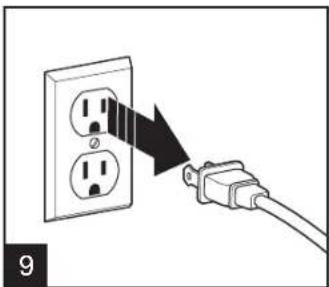
- To disconnect, Pause or Reset/Stop the appliance and then remove plug from wall outlet. To unplug, grasp the plug and pull from the outlet. Never pull from the power cord.
- Do not use appliance for other than intended use.
- Do not operate the appliance by means of an external timer or separate remote-control system.
SAVE THESE INSTRUCTIONS
Other Consumer Safety Information
This product is intended for household use only.
⚠ WARNING Electrical Shock Hazard: This product is provided with a polarized plug (one wide blade) to reduce the risk of electric shock. The plug fits only one way into a polarized outlet. Do not defeat the safety purpose of the plug by modifying the plug in any way or by using an adapter. If the plug does not fit fully into the outlet, reverse the plug. If it still does not fit, have an electrician replace the outlet.
2
The length of the cord used on this appliance was selected to reduce the hazards of becoming tangled in or tripping over a longer cord. If a longer cord is necessary, an approved extension cord may be used. The electrical rating of the extension cord must be equal to or greater than the rating of the appliance. Care must be taken to arrange the extension cord so that it will not drape over the countertop or tabletop where it can be pulled on by children or accidentally tripped over.
To avoid an electrical circuit overload, do not use another high-wattage appliance on the same circuit with this appliance.
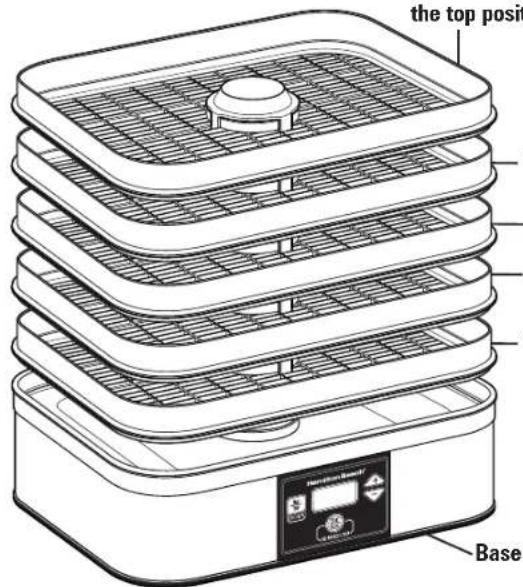
Parts and Features
BEFORE FIRST USE: Wash all removable parts in hot, soapy water. Rinse and dry.
To order parts:
US: 1.800.851.8900
www.hamiltonbeach.com
Canada: 1.800.267.2826
Mexico: 01 800 71 16 100
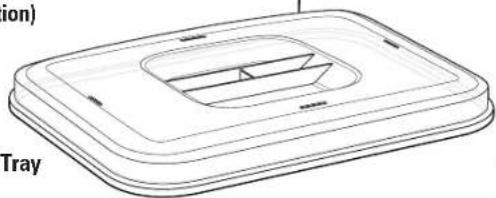
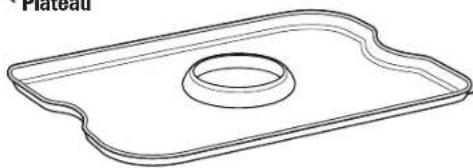
Top Tray (Note:
Top tray has "TOP" molded into the center cap. This tray must always be in the top position)
natural_image
Line drawing of a rectangular tray with a central circular hole and scalloped edges (no text or symbols)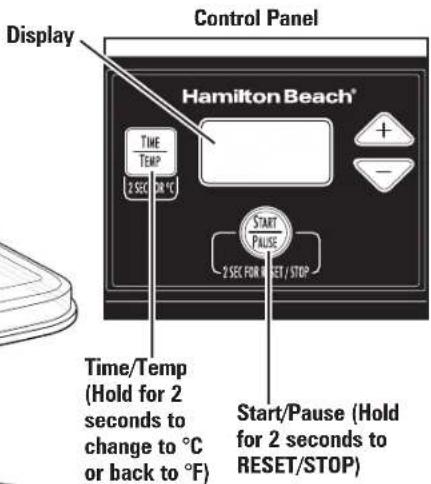
Mesh Screen (To be used on small fruits, vegetables, and herbs to prevent dropping through the trays as food is drying and shrinking)
Fruit Roll Sheet (To be used for making fruit leathers/fruit rolls only)
How to Load Trays and Screens
Dehydrator Preparation
- The top tray must always be in the top position for proper drying.
- All five trays should be used during each drying, even if some are empty.
- It is best to dry one type of similar food at a time; for example, all fruits or all vegetables.
• Always leave trays in place until drying is complete. You may remove food from trays when acceptably dried.
natural_image
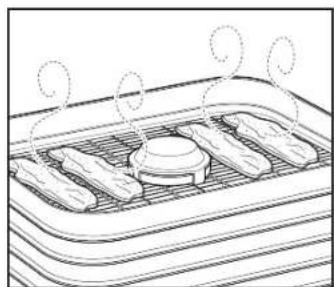
Line drawing of a steaming dish with five pieces arranged in a tray (no text or symbols)Always place food in a single layer on each tray for even drying. Do not overlap fruits, vegetables, or meats or crowd trays.
natural_image
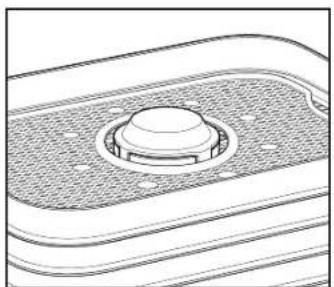
Technical line drawing of a mechanical component with a central circular feature and textured base (no text or symbols)Use the mesh screen for drying herbs and small pieces of fruits or vegetables.
natural_image
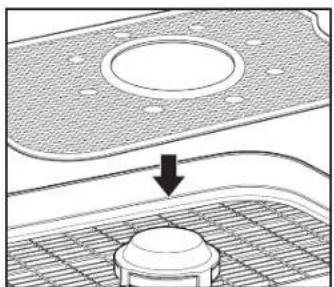
Diagram showing a curved surface with a circular opening and a central circular base, with an arrow pointing to it (no text or symbols present)If using a mesh screen, place screen in tray before adding food. For best results, only use mesh screens in the top two trays.
natural_image
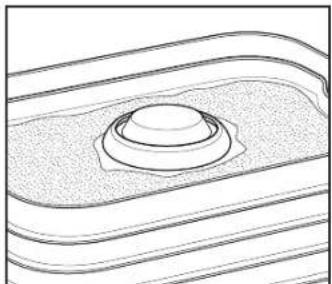
Technical line drawing of a mechanical component with concentric layers and a central circular feature (no text or symbols)Use the fruit roll sheet for drying purees from fruits.
natural_image
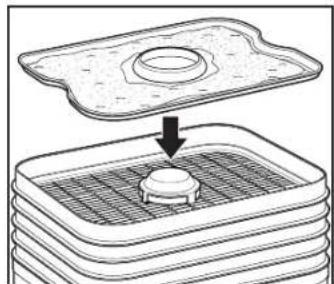
Diagram showing a mechanical component being inserted into a stack of stacked plates (no text or symbols)If using the fruit roll sheet, place sheet in the top tray. For best results, do not use more than two fruit roll sheets and place in the top two trays. Always stack the top tray last, before the lid, for proper drying.

natural_image
Stacked diagram of a mechanical component with a downward arrow indicating a process or assembly (no text or symbols present)How to Use the Dehydrator
NOTES:
- Food should be stored in an airtight container once properly cooled.
• To START, PAUSE, or RESET: Press the START/PAUSEbutton. - To Change Time or Temperature During Drying Without Pausing or Resetting: Press the TIME/TEMP button once for time or twice for temperature. The last setting will flash. Use arrows to adjust. Unit will continue drying automatically at the new setting.
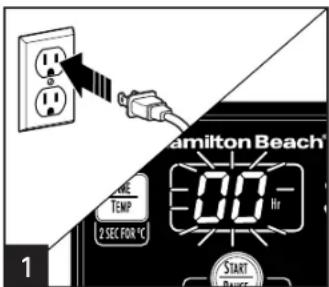
Plug in unit. Default time "00" will flash on the display.
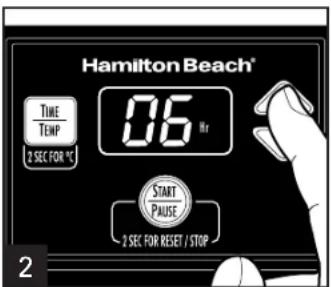
Press the + arrow to set the drying time. Maximum drying time is 48 hours, which can be set in 1-hour increments.
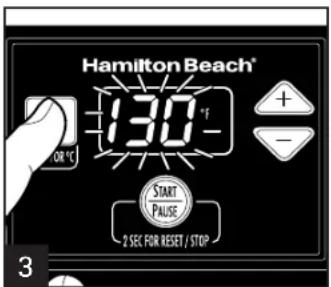
Press the TIME/TEMP button to set the temperature. Default temperature "130" will flash on the display.
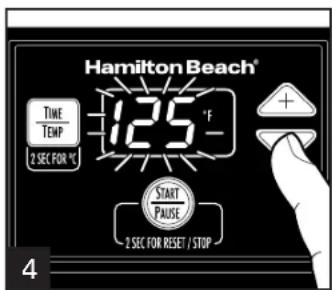
Press the + or - arrow to set the drying temperature. Press the TIME/TEMP button to adjust the temperature for Fahrenheit. Press and hold the TIME/TEMP button for 2 seconds while TEMP is displayed to change from °F to °C. Temperature can be set from 100°F to 160°F in 5° increments. NOTE: Default setting is Fahrenheit. If you reset this unit or unplug it while it is set for Celsius, it will go back to Fahrenheit.
How to Use the Dehydrator (cont.)

Press the START/PAUSEbutton to start drying. The display will alternate from showing TIME and TEMP over the drying period.
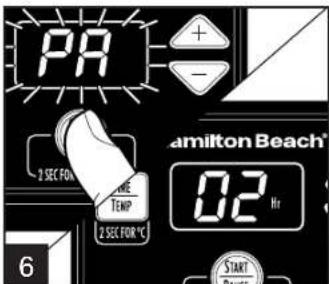
To PAUSE to Check Food: Press the START/PAUSEbutton and unit will pause. Display will flash "PA." Press the START/PAUSEbutton again to resume drying.
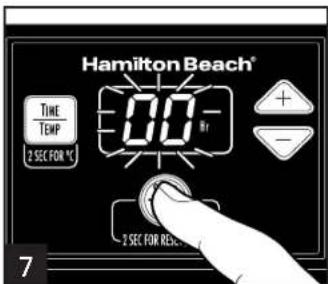
To RESET: Press and hold the START/PAUSE button for 2 seconds; "00" will flash in display. To continue drying, press TIME/TEMP button to set a new time and temperature.
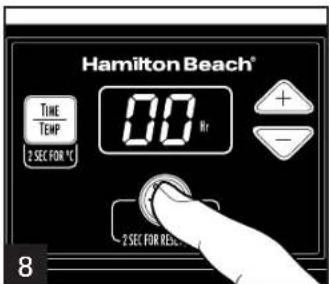
To STOP "00" flashing: Press and hold the START/PAUSE button again for an additional 2 seconds. "00" will still appear in display and not flash. If drying is complete, unplug the unit.
natural_image
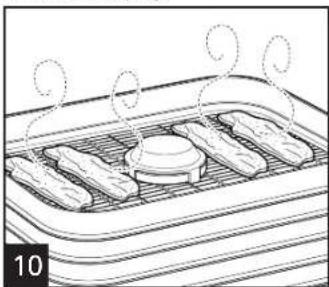
Diagram showing a cable being inserted into an electrical socket, with no text or symbols present.If drying is complete before programmed time has ended, PAUSE or STOP unit and then unplug. Let food cool completely on trays or wire rack before storing.
natural_image
Line drawing of a steamer with five pieces of food and steam rising (no text or symbols)Food Safety Tips
- For food safety, to help ensure any bacteria present are destroyed, choose pretreatment or post treatment from below:
- Pretreatment of Meat Prior to Dehydrating – Heat oven to 350^ F ( 177^ C). Drain and discard marinade from meat. Pat dry with paper towels and place meat in a single layer, leaving a space around each piece on baking sheet. Bake 5 to 10 minutes or until internal temperature reaches 160^ F ( 72^ C). Poultry must reach 165^ F ( 74^ C). NOTE: This method may reduce drying time and may result in a drier texture.
- Post Treatment of Meat After Dehydrating – Heat oven to 275°F (135°C). Line a large baking sheet with foil. Place jerky in a single layer, leaving a small space around each piece. Bake for 10 to 12 minutes. Cool completely on a wire rack. Pat jerky dry with paper towels to remove any surface fats before storing.
- Marinating meats helps with the flavor and texture of jerky. Do not marinate meat longer than recipe or package directions call for.
TIP: Post treatment of meat after dehydrating may result in a more desirable jerky texture. Try each treatment to determine which jerky you like best.
- Visit www.usda.gov for any questions on meat and food safety.
- Never dehydrate meats with fruits and vegetables, due to cross-contamination of foods. Meats dry at a different temperature from fruits or vegetables.
- All dehydrated foods must be cooled completely before storing.
- For food safety, complete the food drying process. Do not start and stop the process for longer than 5 minutes. You may pause the process to check on the food's dryness or to remove dehydrated pieces.
- Label and date all containers of dried foods.
Dehydrating Fruits and Vegetables
A. Food Preparation
• Always wash hands before starting food preparation.
- Wash all fruits and vegetables before preparation.
- Choose fruits and vegetables that are in season for the best flavor.
- Discard any fruits and vegetables that have bruises or mold.
- Cut foods the same thickness, size, or shape before drying to ensure even drying.
- Some foods, like garlic, onions, cauliflower, and broccoli, have a strong smell when drying.
B. Pretreatment
- Some fruits and vegetables require pretreatment before drying. Blanch or add color protectors to preserve natural color.
How to Blanch (see \*B on pages 10 and 11)
Blanching is recommended for some vegetables to help prevent color and flavor loss during drying and storage. Blanching is used to break the skins on some fruits to help shorten the drying process.
- Bring a large stockpot filled with cold water to a rolling boil.
- Place cleaned fruits or vegetables in a strainer with a handle.
- Dip strainer into the boiling water for the recommended time.
- Make sure that all the fruits or vegetables are covered with water for even blanching.
- After blanching is complete, plunge into a large bowl filled with ice water to stop the blanching process.
- Drain and completely pat dry the fruits or vegetables before dehydrating.
How to Protect Color (see #C on page 10)
Some fruits and potatoes may discolor during the drying process. To protect the color, follow these steps.
• Prepare a solution of equal parts lemon juice and water.
- Dip pieces into the solution; drain.
- If using a commercial fruit preservative, follow package directions.
C. Determining Dryness
- Many things influence drying time, including moisture content, type and amount of food, shape and evenness of food slices, air temperature, humidity, and your personal preference in texture of your food.
- Drying charts are a guideline. Drying times and temperatures vary for different types of foods; start checking food at the minimum recommended time referenced on the chart. If the food is not listed on the chart, pick a similar food.
- Combine any remaining food to upper trays for ease of checking doneness.
- Check all trays for doneness at the minimum recommended time on the chart.
- All fruits should be able to bend and be slightly soft but not be tacky, except for apples and bananas which should be crisp.
- All vegetables should be crisp and easily broken.
Dehydrating Fruits and Vegetables (cont.)
D. Drying Fruit Rolls
- Fruit rolls can be made with peeled and pitted pureed fresh fruits; canned fruit that has been well drained and pureed; defrosted frozen fruit, drained and pureed; or with store-bought applesauce.
- Fruits that are higher in pectin (apples, apricots, blueberries, grapes, peaches, pears, pineapples, and plums) will make a fruit roll with a nice leatherlike texture.
- When using a low-pectin fruit (grapefruits, lemons, limes, oranges, raspberries, and strawberries), combine with a higher-pectin fruit for an easy peelable fruit roll.
-
Lightly spray the fruit roll sheet with nonstick cooking spray or lightly grease with vegetable oil before adding your pureed fruit.
-
Evenly spread about 3/4 cup to 1 cup (177 ml to 237 ml) puree on the prepared fruit roll sheet about 1/4 inch (0.6 cm) thick.
- Add the fruit roll sheet to one of the top two trays for drying.
- Fruit rolls should be checked for doneness starting at 4 hours.
- Fruit rolls will be slightly tacky when dried.
- Always remove the fruit roll from the sheet after cooling for 15 minutes.
- The fruit roll should be slightly warm to easily remove from the fruit roll sheet.
- Once rolled up, cool completely before storing in an airtight container.
Storing Dehydrated Food
- Dehydrated foods have to be cooled completely before packaging.
- Properly dried foods need to be stored in a clean, dry, airtight container, such as resealable plastic bags, plastic containers, or glass canning jars with a tight-fitting lid, to keep foods from rehydrating.
- Store all packages in a cool, dry place.
- Dried fruits stored at 60°F (16°C) may keep up to 1 year, while vegetables stored at 60°F (16°C) may keep up to 6 months.
-
Fruit rolls stored at room temperature may keep up to 1 month, if stored properly.
-
If jerky has been properly dried, cooled, and packaged, it may be stored up to 2 months in an airtight container at room temperature.
- Storing at higher temperature locations will shorten the storing time. Place packaged foods in the freezer for a longer storing time.
- It is a good practice to check dehydrated foods daily. Dehydrate again if you see fruits and vegetables getting soft or if they have condensation on them. Check frequently during the additional drying, since this process will be much shorter.
- Always check the condition of your food prior to consumption. When in doubt, throw it out.
Dehydrating Chart for Fruits at 135°F (60°C)
*B = Blanching
C = Color Protector
(See "How to Blanch" and "How to Protect Color" on page 8)
Fruit How to Prepare Pretreatment/Time Dehydrating Time** High-Pectin Fruit
| Apples Peeled, sliced 1/4 inch (0.6 cm) thick #C 8 to 12 hours Yes | ||||
| Apricots | Pitted, peeled, sliced 1/4 inch (0.6 cm) thick | #C 15 to 19 hours Yes | ||
| Bananas Sliced 1/4 inch (0.6 cm) thick #C 6 to 10 hours No | ||||
| Blueberries | Whole | *B/1 minute | 14 to 18 hours | Yes |
| Cherries | Pitted, halved | - | 22 to 26 hours | No |
| Cranberries | Whole | *B/1 minute | 17 to 21 hours | Yes |
| Green or Red Seedless Grapes | Halved | - | 19 to 23 hours | Yes |
| Kiwi | Sliced 1/4 inch (0.6 cm) thick | - | 8 to 12 hours | Yes |
| Lemons, Limes, or Oranges | Sliced 1/4 inch (0.6 cm) thick | - | 17 to 21 hours | No |
| Mangoes | Peeled, pitted, sliced 1/4 inch (0.6 cm) thick | - | 13 to 17 hours | No |
| Nectarines | Peeled, pitted, sliced 1/4 inch (0.6 cm) thick | #C 11 to 15 hours Yes | ||
| Peaches | Peeled, sliced 1/4 inch (0.6 cm) thick | #C | 11 to 15 hours | Yes |
| Pears | Peeled, sliced 1/4 inch (0.6 cm) thick | #C | 10 to 14 hours | Yes |
| Pineapples | Peeled, cored, sliced 1/4 inch (0.6 cm) thick | - | 12 to 16 hours Yes | |
| Plums | Pitted, sliced in eighths | - | 23 to 27 hours | Yes |
| Strawberries | Sliced 1/4 inch (0.6 cm) thick | - | 6 to 10 hours | No |
**Times may vary depending on the ripeness of your fruits and amount per tray. See "Dehydrating Fruits and Vegetables" on pages 8 and 9.
Dehydrating Chart for Vegetables at 125°F (55°C)
*B = Blanching (See "How to Blanch" on page 8)
Vegetable How to Prepare Pretreatment/Time Dehydrating Time\*\*
Bell Peppers Sliced 1/4 inch (0.6 cm) thick - 9 to 13 hours
Broccoli Small florets *B/2 minutes 9 to 13 hours
Carrots Sliced diagonally 1/4 inch (0.6 cm) thick *B/2 minutes 11 to 15 hours
Cauliflower Small florets *B/2 minutes 8 to 12 hours
Celery Sliced diagonally 1/4 inch (0.6 cm) thick - 5 to 9 hours
| Grape Tomatoes | Halved | - | 13 to 17 hours |
| Green Beans | Sliced 1/4 inch (0.6 cm) thick | *B/2 minutes | 12 to 16 hours |
| Mushrooms | Sliced 1/4 inch (0.6 cm) thick – 8 to 12 hours | ||
| Onions | Sliced 1/4 inch (0.6 cm) thick – | 14 to 18 hours | |
| Squash, Yellow or Zucchini | Sliced 1/4 inch (0.6 cm) thick | - | 7 to 11 hours |
| Tomatoes | Sliced 1/4 inch (0.6 cm) thick | - | 10 to 13 hours |
**Times may vary depending on the water content of your vegetables.
Dehydrating Fresh Herbs
- Herb leaves that are larger such as basil, bay leaves, mint, sage, or sorrel should be picked from the stems before drying.
• Herbs such as cilantro, dill, parsley, or rosemary should be kept on the stem for drying. It is easier to remove the herbs after drying. - Always rinse herbs with cold water and carefully remove any remaining water with a salad spinner or paper towels. Herbs must be completely dried before dehydrating begins.
- Small herbs should be placed on the mesh screen for the best drying.
- Herbs are fast-drying when compared to fruits, vegetables, and marinated meats.
• Herbs crumble easily when dried. - Herbs must be cooled completely before storing in an airtight container.
Dehydrating Chart for Herbs at 100°F (40°C)
Fresh Herb Dehydrating Time**
Basil 4 to 6 hours
Chives 5 to 7 hours
Cilantro 4 to 6 hours
Mint 5 to 7 hours
Parsley 4 to 6 hours
Rosemary 5 to 7 hours
**Times may vary depending on the water content of your herbs.
Dehydrating Jerky
- Wash your hands with soap and warm water before preparation of jerky.
- Choose lean cuts of meat for jerky.
- Trim any fat from meat before marinating.
- Wrap meat in plastic wrap and freeze for a minimum of 1 hour for easy slicing before marinating.
- Marinate in a heavy-duty resealable plastic zipper bag or a glass dish. Do not use a metal pan for marinating, since it causes a flavor change and a possible reaction of the marinade to the metal of the pan.
- Always marinate meats for jerky in a refrigerator; drain and discard marinade before drying.
-
Dehydrate jerky according to the recipe or follow jerky preparation according to package directions.
-
Check jerky after 4 hours and every 30 minutes after.
- Jerky is dry when it cracks without breaking when bent.
- Pat jerky dry with a paper towel to remove any surface fats and cool completely before storing in an airtight container.
- If jerky has been properly dried, cooled, and packaged, it may be stored up to 2 months in an airtight container at room temperature.
• Always slice meats against the grain for a more tender jerky. - Meat slices should be no more than 1/4 inch (0.6 cm) thick, 4 inches (10.2 cm) long and 2 inches (5.1 cm) wide.
- Never marinate meat at room temperature. Always refrigerate meat when marinating.
• Always follow the recipe directions. - Label and date all containers of jerky.
NOTE: For food safety, to help ensure any bacteria present are destroyed, choose pretreatment or post treatment from below:
- Pretreatment of Meat Prior to Dehydrating – Heat oven to 350°F (177°C). Drain and discard marinade from meat. Pat dry with paper towels and place meat in a single layer, leaving a space around each piece on baking sheet. Bake 5 to 10 minutes or until internal temperature reaches 160°F (72°C). Poultry must reach 165°F (74°C). NOTE: This method may reduce drying time and may result in a drier texture.
- Post Treatment of Meat After Dehydrating – Heat oven to 275°F (135°C). Line a large baking sheet with foil. Place jerky in a single layer, leaving a small space around each piece. Bake for 10 to 12 minutes. Cool completely on a wire rack. Pat jerky dry with paper towels to remove any surface fats before storing.
Recipes
Whiskey Beef Jerky
Ingredients:
2 pounds (907 g) beef top round
2 cups (473 ml) root beer
1 cup (237 ml) whiskey
1/2 cup (118 ml) molasses
1/2 cup (118 ml) brown sugar
1/2 cup (118 ml) soy sauce
2 Tablespoons (30 ml) liquid smoke
1 Tablespoon (15 ml) garlic powder
1 Tablespoon (15 ml) chili powder
Directions:
- Place beef in a resealable plastic freezer bag and freeze for 1 hour or until firm enough to slice easily.
- In a medium bowl, mix remaining ingredients until brown sugar is dissolved.
- Remove beef from freezer and slice against the grain into 1/4-inch-thick (0.6-cm) slices.
- Add beef and marinade to bag, making sure meat is completely covered with marinade.
- Close bag and refrigerate 8 to 12 hours.
- Drain and discard marinade. Pat all slices of beef with paper towels.
-
Place beef slices in a single layer on the first tray, leaving space around each slice for proper drying. Fill trays with remaining beef slices.
-
Stack trays on base with the top tray last.
- Set the dehydrator to 160^ F ( 70^ C) for 4 to 8 hours. Start checking beef for doneness at 4 hours and then every 30 minutes. Jerky is dry when you can bend it and and the top cracks, but the slice does not break.
- Heat oven to 275°F (135°C).
- Line a large cookie sheet with aluminum foil. Place jerky in a single layer, leaving a small space around each slice.
- Bake for 10 to 12 minutes. Cool completely on a wire rack. Pat dry with paper towels before storing in an airtight container.
Makes: About 1 pound
Recipes (cont.)
Cajun Beef Jerky
Ingredients:
3 pounds (1.4 kg) beef top round
3/4 cup (177 ml) Worcestershire sauce
1/2 cup (118 ml) water
1/2 cup (118 ml) soy sauce
1/3 cup (79 ml) teriyaki sauce
1 Tablespoon (15 ml) onion powder
1 Tablespoon (15 ml) Old Bay ^® Seasoning
1 Tablespoon (15 ml) liquid smoke
2 teaspoons (10 ml) Cajun seasoning
1 teaspoon (5 ml) celery seed
Directions:
- Place beef in a resealable plastic freezer bag and freeze for 1 hour or until firm enough to slice easily.
- In a medium bowl, mix remaining ingredients.
- Remove beef from freezer and slice against the grain into 1/4-inch-thick (0.6-cm) slices.
- Divide beef and marinade between 2 bags, making sure meat is completely covered with marinade.
- Close bag and refrigerate 8 to 12 hours.
- Drain and discard marinade. Pat all slices of beef with paper towels.
-
Place beef slices in a single layer on the first tray, leaving space around each slice for proper drying. Fill trays with remaining beef slices.
-
Stack trays on base with the top tray last.
- Set the dehydrator to 160^ F ( 70^ C) for 4 to 8 hours. Start checking beef for doneness at 4 hours and then every 30 minutes. Jerky is dry when you can bend it and and the top cracks, but the slice does not break.
- Heat oven to 275°F (135°C).
- Line a large cookie sheet with aluminum foil. Place jerky in a single layer, leaving a small space around each slice.
- Bake for 10 to 12 minutes. Cool completely on a wire rack. Pat dry with paper towels before storing in an airtight container.
Makes: About 1 1/2 pounds
Recipes (cont.)
Teriyaki Beef Jerky
Ingredients:
2 pounds (907 g) flank steak
2 cups (473 ml) pineapple juice
1 bottle (15 ounces/444 ml) soy sauce
1 1/2 cups (355 ml) packed light brown sugar
1 cup (237 ml) rice vinegar
6 large garlic cloves, halved
2 small dried red chilis, halved
Directions:
- Place beef in a resealable plastic freezer bag and freeze for 1 hour or until firm enough to slice easily.
- In a medium bowl, mix remaining ingredients until brown sugar is dissolved.
- Remove beef from freezer and slice against the grain into 1/4-inch-thick (0.6-cm) slices.
- Add beef and marinade to bag, making sure meat is completely covered with marinade.
- Close bag and refrigerate 8 to 12 hours.
- Drain and discard marinade. Pat all slices of beef with paper towels.
-
Place beef slices in a single layer on the first tray, leaving space around each slice for proper drying. Fill trays with remaining beef slices.
-
Stack trays on base with the top tray last.
- Set the dehydrator to 160^ F ( 70^ C) for 4 to 8 hours. Start checking beef for doneness at 4 hours and then every 30 minutes. Jerky is dry when you can bend it and and the top cracks, but the slice does not break.
- Heat oven to 275°F (135°C).
- Line a large cookie sheet with aluminum foil. Place jerky in a single layer, leaving a small space around each slice.
- Bake for 10 to 12 minutes. Cool completely on a wire rack. Pat dry with paper towels before storing in an airtight container.
Makes: About 1 pound
Care and Cleaning
natural_image
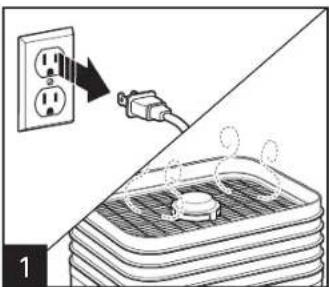
Diagram showing a plug inserted into an electrical outlet, with insulation layers and a close-up of the plug (no text or symbols present)Unplug unit when through drying. Let cool.
natural_image
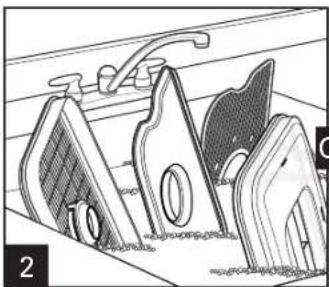
Technical line drawing of mechanical components or parts, no visible text or symbolsWash in warm, soapy water. Wipe
natural_image
Technical illustration of a dishwasher-safe kitchen sink with four compartments (no text or symbols on the diagram itself)HOO NOT Twiseal dan "SANI" setting when washing in the dishwasher. "SANI" cycle temperatures could damage your product.
natural_image
Line drawing of a hand cleaning a small circular object on a rectangular appliance (no text or symbols)soapy cloth.
Troubleshooting
PROBLEM
Food not drying.
Food drying unevenly.
Fruits or vegetables become soft during storage.
PROBABLE CAUSE/SOLUTION
- Food could be cut too thick or peel could have been left on. Follow recommendations in charts on pages 10, 11, or 12, or according to the recipe.
- Too much food on each tray. Remove some foods and dehydrate for a longer time.
- Foods need to be cut uniformly.
- Foods with uneven pieces can be rotated during the drying process.
- Too much moisture was left in the food. Dry further to remove excess moisture.
Limited Warranty
This warranty applies to products purchased and used in the U.S. and Canada. This is the only express warranty for this product and is in lieu of any other warranty or condition.
This product is warranted to be free from defects in material and workmanship for a period of five (5) years from the date of original purchase in Canada and one (1) year from the date of original purchase in the U.S. During this period, your exclusive remedy is repair or replacement of this product or any component found to be defective, at our option; however, you are responsible for all costs associated with returning the product to us and our returning a product or component under this warranty to you. If the product or component is no longer available, we will replace with a similar one of equal or greater value.
This warranty does not cover glass, filters, wear from normal use, use not in conformity with the printed directions, or damage to the product resulting from accident, alteration, abuse, or misuse. This warranty extends only to the original consumer purchaser or gift recipient. Keep the original sales receipt, as proof of purchase is required to make a warranty claim. This warranty is void if the product is used for other than single-family household use or subjected to any voltage and waveform other than as specified on the rating label (e.g., 120V \~ 60 Hz).
We exclude all claims for special, incidental, and consequential damages caused by breach of express or implied warranty. All liability is limited to the amount of the purchase price. Every implied warranty, including any statutory warranty or condition of merchantability or fitness for a particular purpose, is disclaimed except to the extent prohibited by law, in which case such warranty or condition is limited to the duration of this written warranty. This warranty gives you specific legal rights. You may have other legal rights that vary depending on where you live. Some states or provinces do not allow limitations on implied warranties or special, incidental, or consequential damages, so the foregoing limitations may not apply to you.
To make a warranty claim, do not return this appliance to the store. Please call 1.800.851.8900 in the U.S. or 1.800.267.2826 in Canada or visit hamiltonbeach.com in the U.S. or hamiltonbeach.ca in Canada. For faster service, locate the model, type, and series numbers on your appliance.
PRÉCAUTIONS IMPORTANTES
natural_image
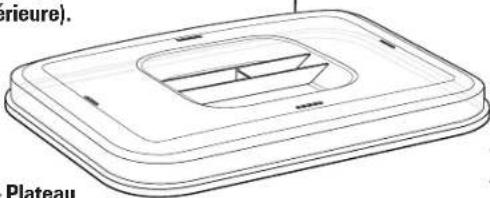
Line drawing of a rectangular plate with a central slot and a curved top layer, labeled 'Plateau' (no text or symbols on the diagram itself)Plateau
natural_image
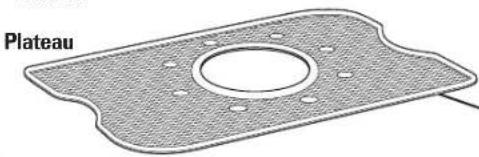
Technical diagram of a plate with a circular hole and bolt holes, no text or symbols presentPlateau
natural_image
Line drawing of a rectangular plate with a central circular hole and scalloped edges (no text or symbols)natural_image
Line drawing of a steamer with five panes and a lid, no text or symbols present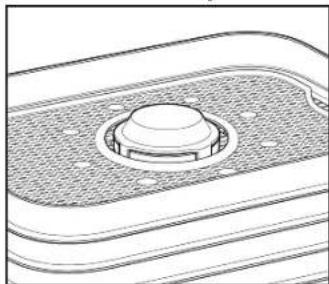
natural_image
Technical line drawing of a mechanical component with a circular top and textured base (no text or symbols)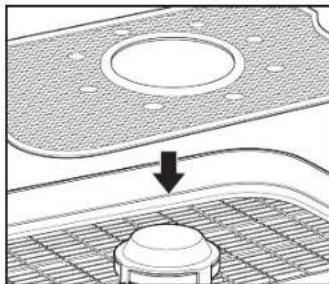
natural_image
Diagram showing a component being placed on a grid-patterned surface, with an arrow indicating direction (no text or symbols present)natural_image
Technical line drawing of a mechanical component with concentric layers and a central circular feature (no text or symbols)natural_image
Diagram showing a mechanical component being inserted into a stack of stacked trays (no text or symbols)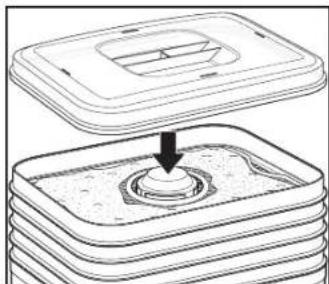
natural_image
Diagram of a mechanical assembly with layered components and a central component (no text or symbols)natural_image
Diagram showing a plug inserted into an electrical outlet with two socket outlets, connected by a cable (no text or symbols present)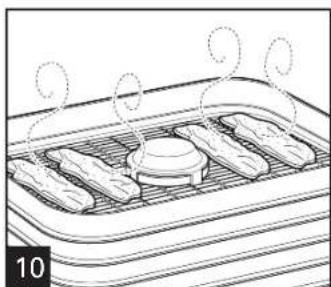
natural_image
Line drawing of a steamer with four panes and steam rising (no text or symbols)natural_image
Technical line drawing of mechanical components or parts, no visible text or symbolsnatural_image
Line drawing of a hand cleaning a small appliance on a rectangular stove (no text or symbols)CAUSE POSSIBLE/SOLUTION
natural_image
Line drawing of a rectangular tray with a central circular hole and scalloped edges (no text or symbols)natural_image
Line drawing of a steaming tray with five pieces of food, no text or symbols present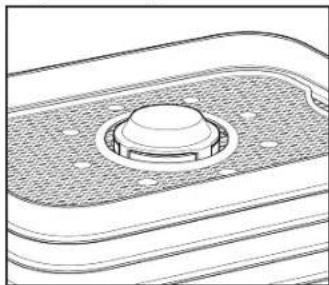
natural_image
Technical line drawing of a mechanical component with a central circular feature and textured surface (no text or symbols)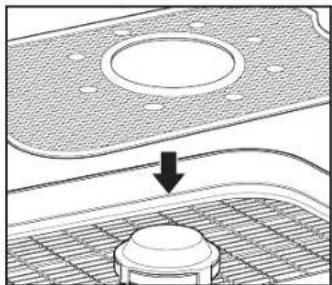
natural_image
Diagram showing a component being lowered into a grid-patterned surface, with no visible text or symbols.natural_image
Technical line drawing of a mechanical component with concentric layers and a central circular feature (no text or symbols)
natural_image
Diagram showing a lid being inserted into a rack with a central component (no text or symbols)
natural_image
Diagram showing a mechanical assembly with a central component and stacked layers (no text or symbols)natural_image
Diagram showing a cable being inserted into an electrical outlet, with no text or symbols present.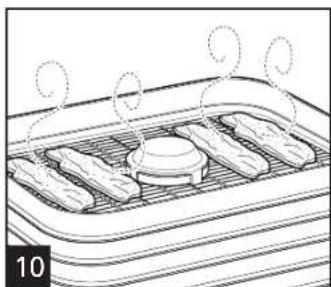
natural_image
Line drawing of a steamer with five panes and a lid, no text or symbols presentnatural_image
Diagram showing a power outlet connected to a stack of insulation layers, with an arrow indicating the outlet's direction (no text or symbols present)natural_image
Technical line drawing of mechanical components or parts, no visible text or symbolsnatural_image
Line drawing of a hand cleaning a small circular object on a rectangular appliance (no text or symbols)jabonoso húmedo.
- Questions
- IMPORTANT SAFEGUARDS
- SAVE THESE INSTRUCTIONS
- This product is intended for household use only.
- Parts and Features
- How to Load Trays and Screens
- Dehydrator Preparation
- How to Use the Dehydrator
- NOTES:
- How to Use the Dehydrator (cont.)
- Food Safety Tips
- Dehydrating Fruits and Vegetables
- Food Preparation
- Pretreatment
- How to Blanch (see \*B on pages 10 and 11)
- How to Protect Color (see #C on page 10)
- Determining Dryness
- Dehydrating Fruits and Vegetables (cont.)
- Drying Fruit Rolls
- Storing Dehydrated Food
- Dehydrating Chart for Fruits at 135°F (60°C)
- C = Color Protector
- Dehydrating Chart for Vegetables at 125°F (55°C)
- Vegetable How to Prepare Pretreatment/Time Dehydrating Time\*\*
- Dehydrating Fresh Herbs
- Dehydrating Chart for Herbs at 100°F (40°C)
- Dehydrating Jerky
- Recipes
- Whiskey Beef Jerky
- Ingredients:
- Directions:
- Recipes (cont.)
- Cajun Beef Jerky
- Teriyaki Beef Jerky
- Care and Cleaning
- Troubleshooting
- PROBLEM
- PROBABLE CAUSE/SOLUTION
- Limited Warranty
- PRÉCAUTIONS IMPORTANTES
- CAUSE POSSIBLE/SOLUTION
Brand : HAMILTON BEACH
Model : 32100
Category : Food Dehydrator