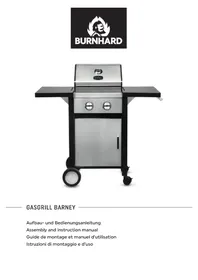
Barney - Barbecue Burnhard - Free user manual and instructions
Find the device manual for free Barney Burnhard in PDF.



| Product type | Gas barbecue |
| Brand | Burnhard |
| Model | Barney |
| Fuel type | Liquefied gas (butane G30 / propane G31) |
| Number of burners | 2 |
| Total power | 6.3 kW |
| Gas pressure | 50 mbar |
| Heat input | 450 g/h |
| Cooking grids | 2 cast iron grids |
| Warming rack | Yes, 1 rack |
| Heat diffusers | 2 pieces |
| Side worktables | 2 trays (left and right) |
| Grease collector | Yes |
| Ignition | Piezoelectric (button with spark) |
| Hood | Yes |
| Cart with wheels | Yes, 2 wheels 7" and 2 casters 3" |
| Compatible gas cylinder | 5 kg cylinder |
| Pressure regulator included | Yes, 50 mbar, flow rate 1.5 kg/h |
| Hose length | 0.8 m (recommended max 1.5 m) |
| Energy efficiency class | Not applicable |
| Usage | Exclusively outdoors |
| Regular maintenance | Empty burning, brushing, cleaning, galvanizing grids |
| Safety | Leak test mandatory, protective gloves, keep children away |
| Warranty | 2-year legal warranty |
Frequently Asked Questions - Barney Burnhard
User questions about Barney Burnhard
0 question about this device. Answer the ones you know or ask your own.
Ask a new question about this device
Download the instructions for your Barbecue in PDF format for free! Find your manual Barney - Burnhard and take your electronic device back in hand. On this page are published all the documents necessary for the use of your device. Barney by Burnhard.
USER MANUAL Barney Burnhard
Assembly and instruction manual
A NOTE ON THIS MANUAL
- Read these operating instructions before attempting to operate the appliance. Only use the gas barbecue as described in these instructions. Failure to do so could result in personal injury or material damage.
The owner of this appliance must retain these instructions. Keep these instructions in a safe place so that they are always to hand. If this product is passed on to a new owner, these instructions must also be provided.
EXPLANATION OF SYMBOLS

This warning symbol indicates risks that could lead to appliance damage or personal injury.
SAFETY INSTRUCTIONS
Intended use
The gas barbecue is intended for outdoor use only.
General risks

Risk for children and persons whose ability to operate such appliances is impaired. This appliance is not intended for use by children or persons whose ability to operate such appliances is impaired. The appliance may only be operated by persons who are capable of operating it safely.
WARNING: Accessible parts can become extremely hot. Keep children away from the appliance. Do not make any modifications to the appliance.
Unpacking the appliance
Risks for children. Risk of fatal injury from choking/swallowing. Keep the packaging material away from children. Dispose of it immediately. Keep small parts out of the reach of children.
Connecting the gas supply

Fire and explosion hazard
- This gas barbecue may only be operated using a pressure regulator. The supplied pressure regulator has been set correctly at the factory for liquid-gas operation.
- The gas hose may need to be replaced with another hose type, if this is stipulated by national statutory requirements.
-
Ensure that there are no ignition sources, i.e. open flames etc., in the vicinity when you are replacing the gas cylinder.
-
When buying or renting a gas cylinder, seek advice from a specialist retailer.
- The appliance must be connected as described in these instructions. Ensure that the gas hose does not buckle or become chafed.
- Before using the gas barbecue, first perform the gas leak test procedure described in these operating instructions. Always perform a leak-tightness test.
Operating the gas barbecue

Fire and explosion hazard
- While in operation, the appliance must be kept away from flammable materials.
- Do not smoke in the vicinity of the gas system. Do not place the gas cylinder in the vicinity of an open flame.
-
Do not move the appliance while the gas barbecue is in operation.
-
Only use the gas barbecue outdoors.
Ensure that the gas barbecue cannot be destabilised due to wind. - Keep the gas barbecue away from moisture, splashes of water etc.
- Place the gas barbecue on a stable, even and fire-retardant surface.
-
Protect the gas cylinder from strong sunlight.
-
Before use, always check the hose and pressure regulator for cracks or other signs of damage. Do not operate the gas barbecue if the pressure regulator, hose or gas cylinder are malfunctioning or leaking.
- Before use, always check the burners for traces of dirt and remove it before operating the gas barbecue.
- Do not ignite the gas flame by using an open flame. For ignition purposes, only use the appliance's electric igniter.
- To prevent the unintended escape of gas, the valve of the gas cylinder should only be open when the gas barbecue is in operation. Close the gas cylinder valve immediately when it is time to turn off the gas barbecue.
- Under no circumstances should the ventilation openings in the housing be covered.
- The surfaces of the gas barbecue become very hot during operation.
Gas barbecue maintenance

Fire and explosion hazard
- Repair and maintenance work may only be performed on the gas system by trained specialists who are authorised to do so. Do not make modifications to the gas barbecue or pressure regulator.
- Replace the pressure regulator and hose after a period of 10 years at the
Warn persons standing around the gas barbecue of this fact and keep children at a safe distance.
- Always wear protective gloves when the gas barbecue is in use and when touching hot components.
- Never leave the gas barbecue unattended when it is in use.
- In case of a malfunction or gas leak, close the valve of the gas cylinder immediately.
- Before moving the gas barbecue to another location, it must first be switched off, the valve on the gas cylinder must be closed and the gas cylinder must be detached from the underside of the gas barbecue to prevent damage to the pressure regulator and the hose.
After use, switch off the gas supply on the gas cylinder.
latest, even if there is no recognisable exterior damage. Ensure that the pressure regulator is approved for use with the relevant gas type and ensure that the correct output pressure level (see Technical information) is set. New hoses may not be longer than 1.5 metres.
Fire-fighting procedures
- Bring persons in the vicinity of the appliance to safety! If possible, close the valve on the gas cylinder. Cool the gas cylinder with water. While doing so, ensure your own safety. A spontaneous, explosive re-ignition is possible.
- In case of fire, filled pressurised
gas containers should be removed from the fire-hazard area. If this is not possible, you should prevent the pressurised gas containers from overheating by spraying them, from a safe distance, with water or another suitable substance.
First-aid procedures
Procedures after inhalation of gas
- High gas concentrations can cause asphyxiation. Possible symptoms include loss of mobility and loss of consciousness. The affected person does not realise he or she is asphyxiating. In low concentrations, gases can cause feelings of dizziness,
headaches, nausea and coordination problems. - Bring the affected person into the fresh air. Call a doctor or the emergency services. If the person stops breathing, provide artificial respiration.
Procedures in case of serious burns or scalding
- There is an acute risk of hypothermia for the affected person. Call the emergency services immediately!
- In cases where clothing catches fire, extinguish flames immediately with water or a heavy blanket.
- In case of burns: leave clothing on.
- In case of scalding: remove clothing immediately.
-
Apply cold water to the affected area of the body for at least 15 minutes, until the pain subsides.
-
Cover the affected area with a sterile Metalline® burn dressing. Place the side of the dressing with the Metalline® (aluminium) coating onto the injured skin, and fix it in place by lightly affixing a gauze or triangular bandage.
- Do not resort to using "home remedies" of any kind, i.e. ointments, powders, oils, disinfectants etc..!
Procedures in case of less serious burns or scalding
- In case of burns: only remove clothing if it is not stuck to the skin.
- In case of scalding: remove clothing immediately.
- Apply cold water to the affected area of the body for at least 15
minutes, until the pain subsides.
- In cases where there is no blistering of the skin, allow smaller burns or scalding injuries to heal in the open air. Do not cover them with a plaster or bandage.
Transport instructions

Fire and explosion hazard
- Wherever possible, avoid transporting the gas cannister in vehicles where the luggage compartment and driver's cab are not separated. The driver must understand the possible risks of the cargo and must know what to do in
case of an accident or emergency.
-
Transport the gas cannister in an upright position in order to prevent it from falling or sliding.
-
Ensure that the valve of the gas cylinder is closed and free of leaks.
Storage instructions

Fire and explosion hazard
- Store the gas cylinder in a place where it is inaccessible to children.
- Keep the gas cylinder away from oxidising gases and other oxidising substances.
- Escaping gas is heavier than air and sinks to the ground. Do not store the gas cylinder in your home, or below ground (e.g. in a cellar, underground car park etc.), or in any place where escaping gas can accumulate.
- Keep the gas cylinder away from
direct sunlight and other heat sources. Store the gas cylinder at temperatures below 50^ in a well-ventilated, shaded location and ensure that it is safe from adverse weather conditions.
- Store the gas cylinder in an upright position and ensure that it cannot fall.
- These storage instructions also apply to empty gas cylinders. Empty gas cylinders still contain residual traces of gas fluid.
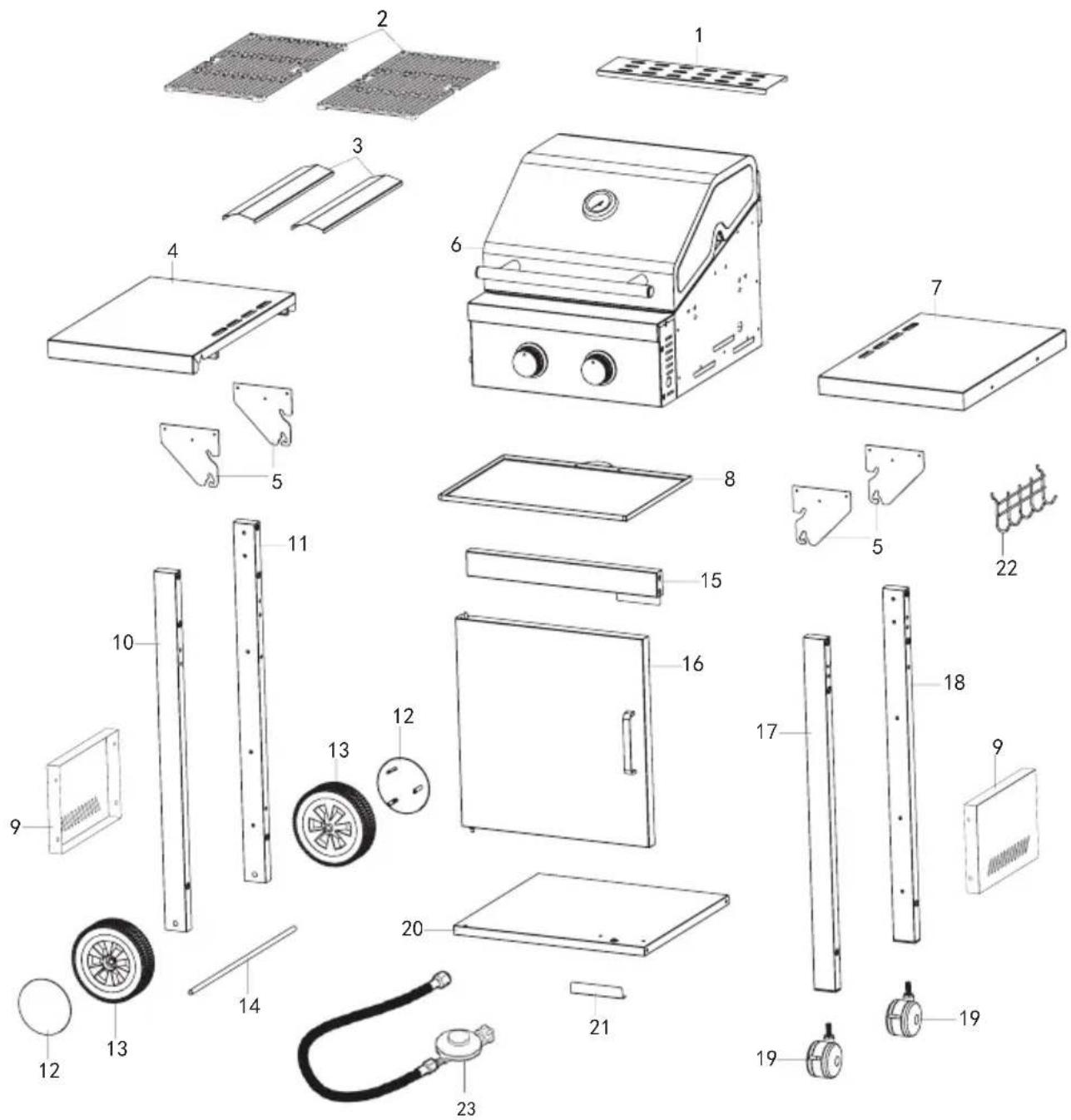
Ref Description Quantity
1 Warming rack 1
2 Cooking grate 2
3 Flame guard 2
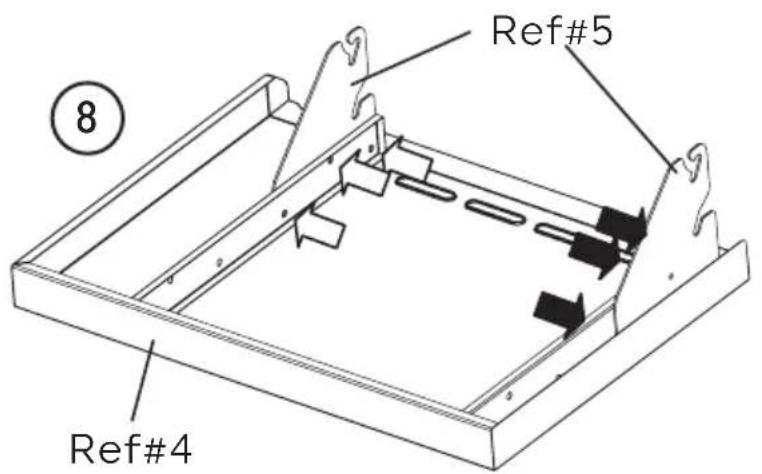
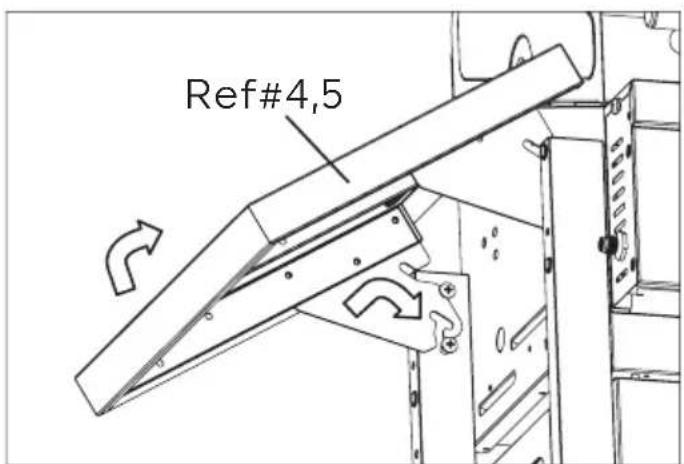
4 Left shelf 1
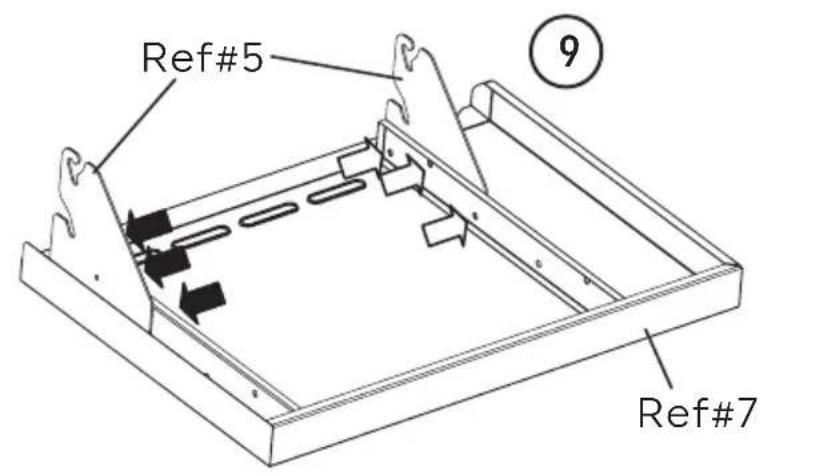
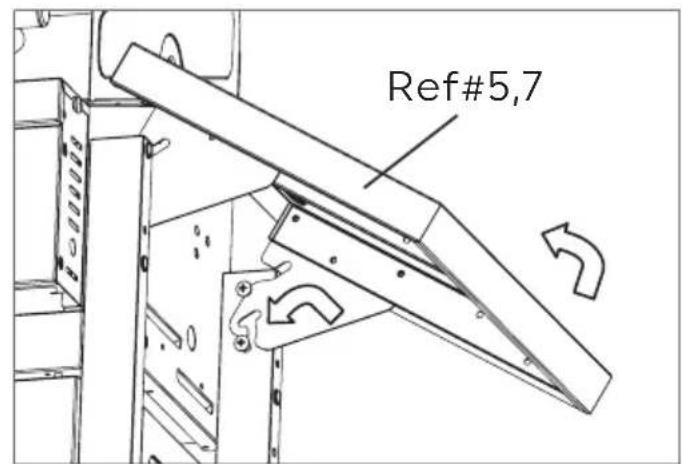
5 Bracket for left shelf 2
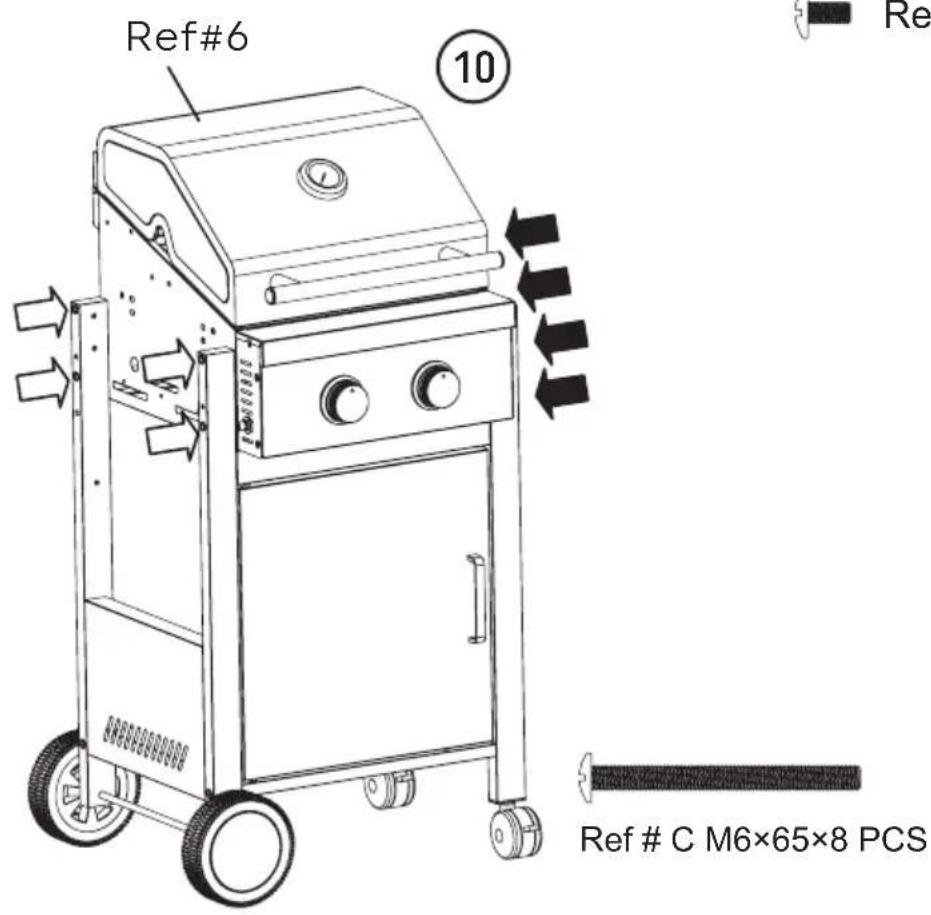
6 Housing assembly 1
7 Right shelf 1
8 Drip tray 1
9 Trolley side panel 2
10 Trolley leg, front left 1
11 Trolley leg, rear left 1
12 Wheel cap 2
13 Wheel (7^ ) 2
14 Axle 1
15 Front crossmember 1
16 Door 1
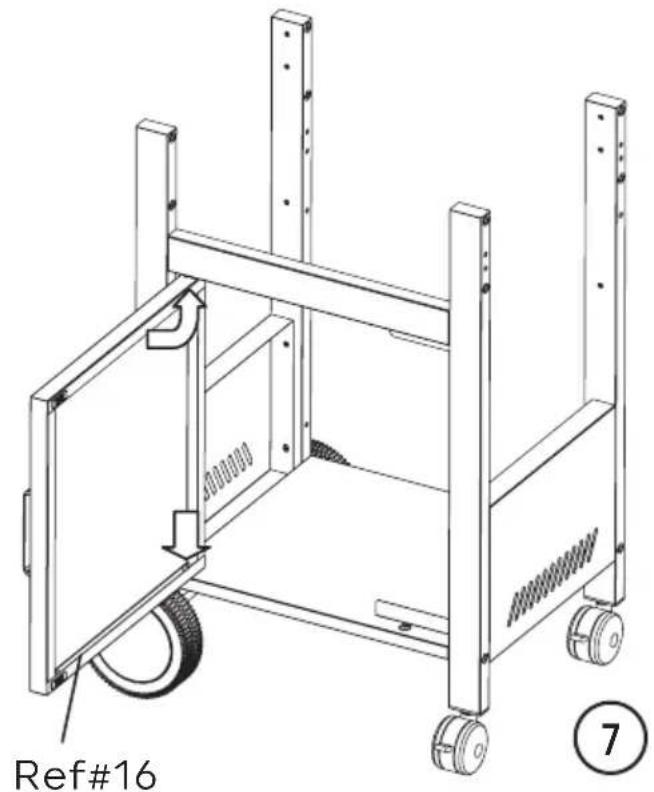
17 Trolley leg, front right 1
18 Trolley leg, rear right 1
19 Rollers (3^ ) 2
20 Trolley underbody 1
21 Door stopper 1
22 Hooks 1
23 Pressure Regulator 1
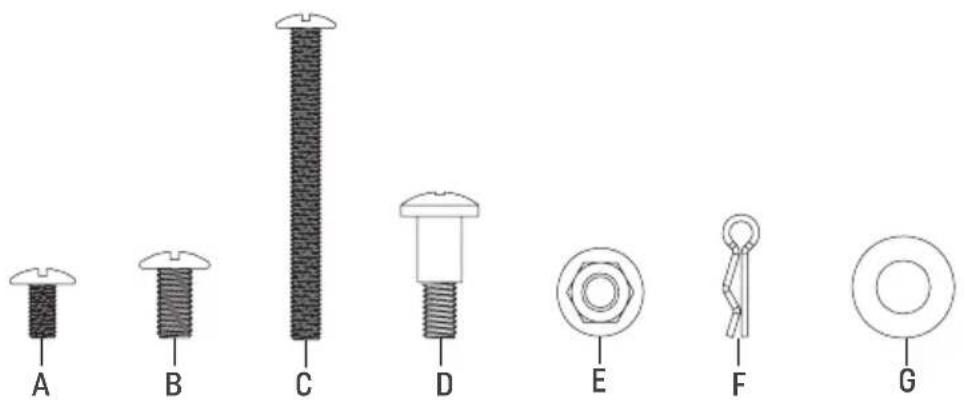
A M5 x 10 screw 12
B M6 x 12 screw 14
C M6 x 65 screw 12
D Long-axis screw 8
E M6 nut 2
F Clip 2
G Washer 2

Risk of injury
The gas barbecue has sharp edges in places. When performing assembly work, always wear safety gloves to avoid cuts.
Before assembly, remove all packaging material and protective film from the individual components.
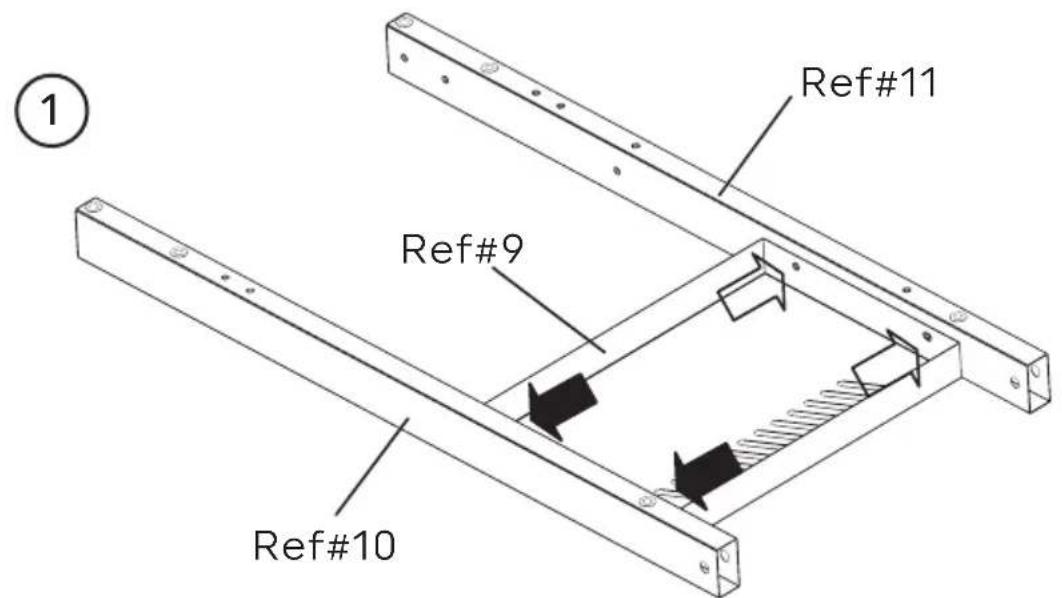
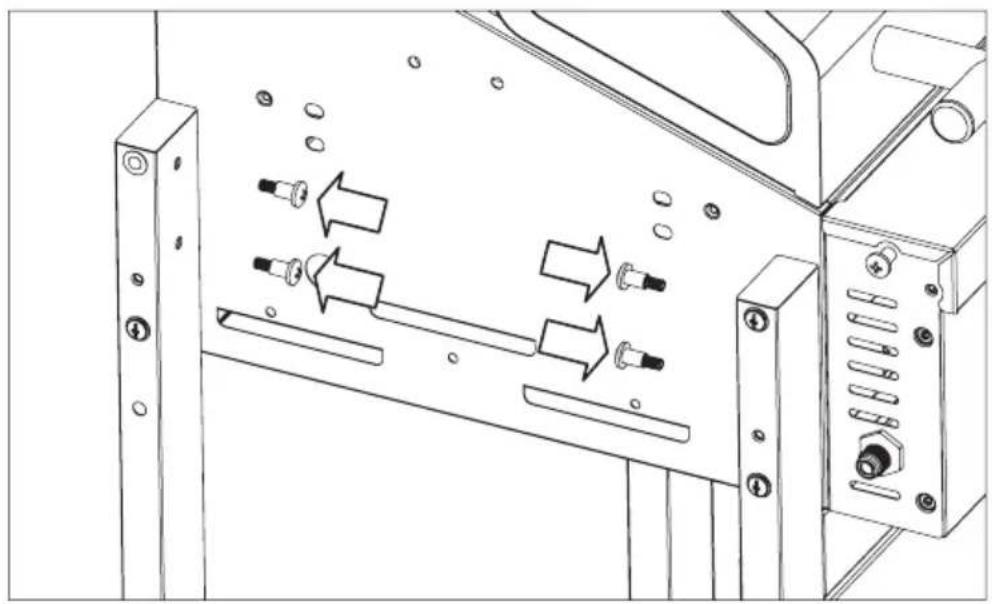
Ref # BM6×12×4 PCS
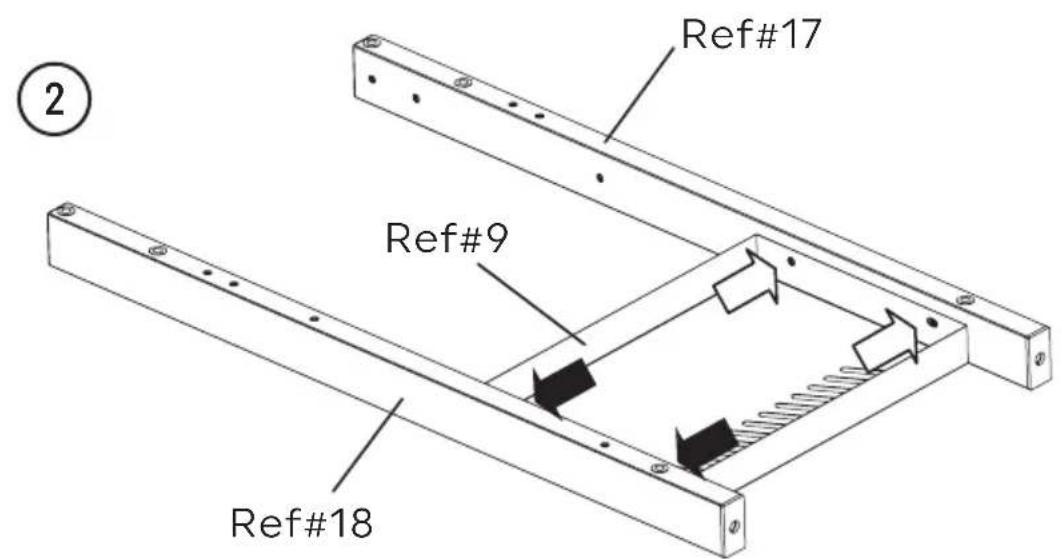
Ref # BM6×12×4 PCS
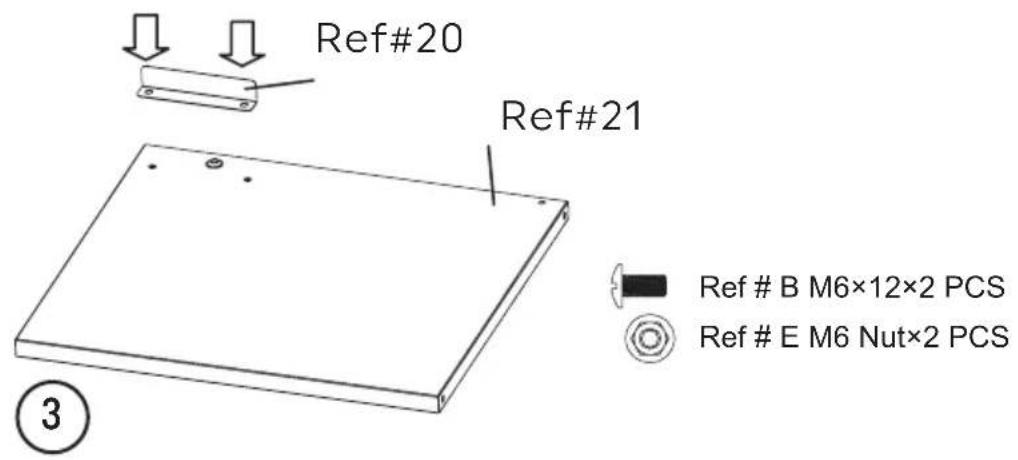
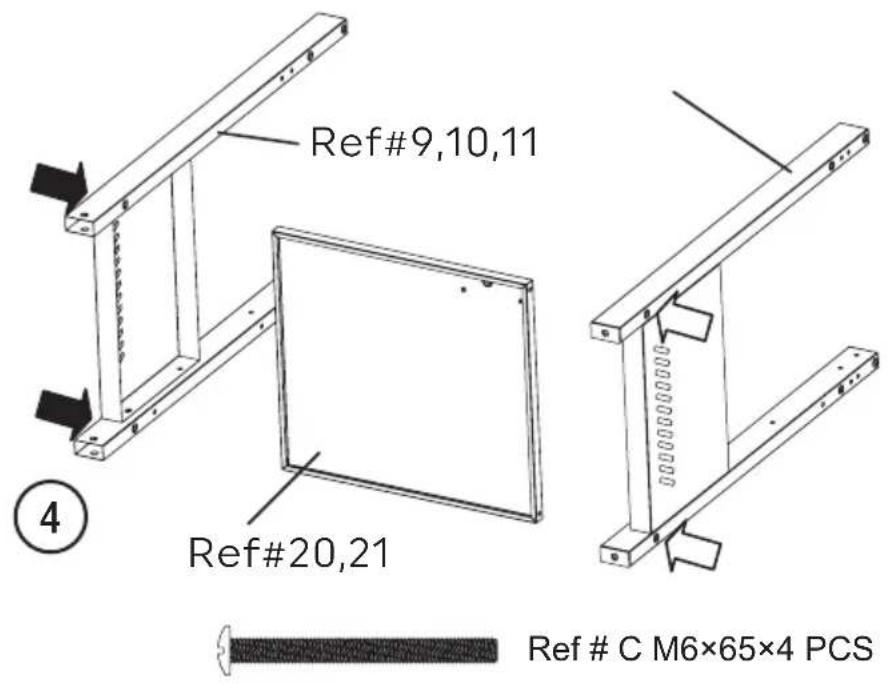
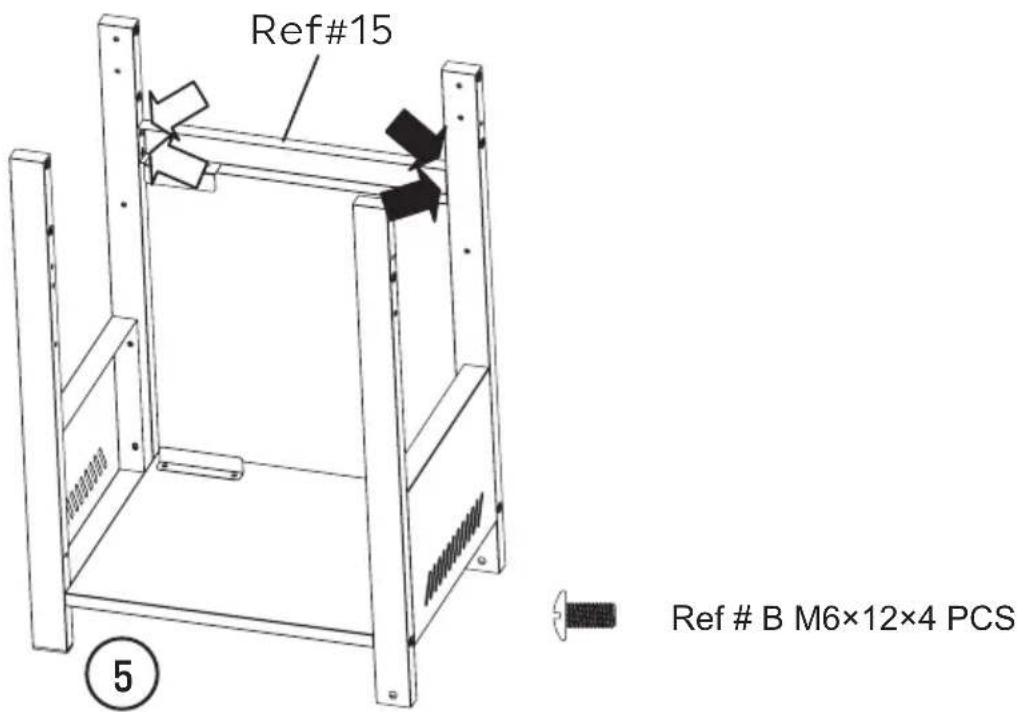
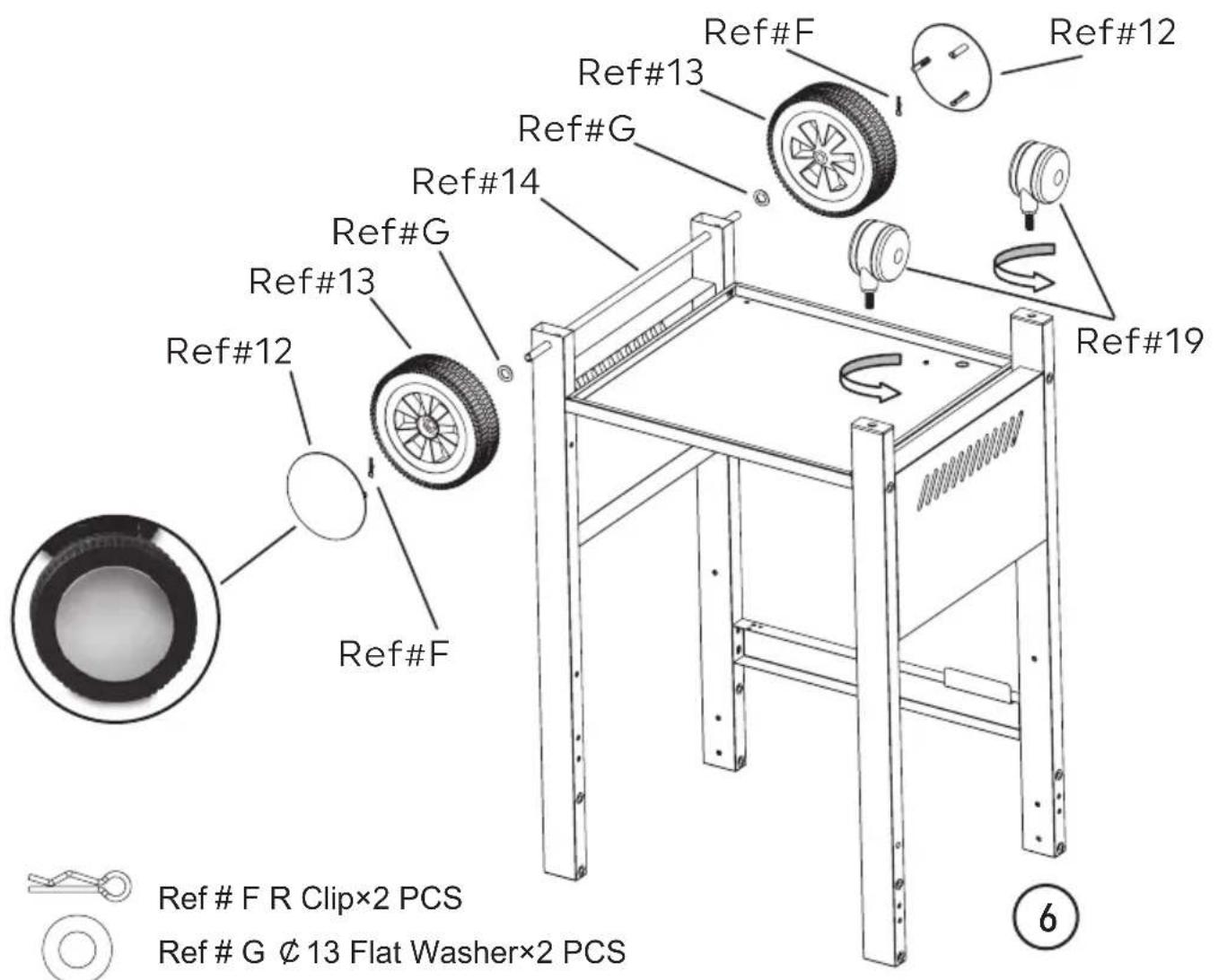
Ref # AM5×10×6 PCS
Ref # AM5×10×6 PCS
11
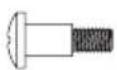
Ref # D Axis-long×8 PCS
(12)
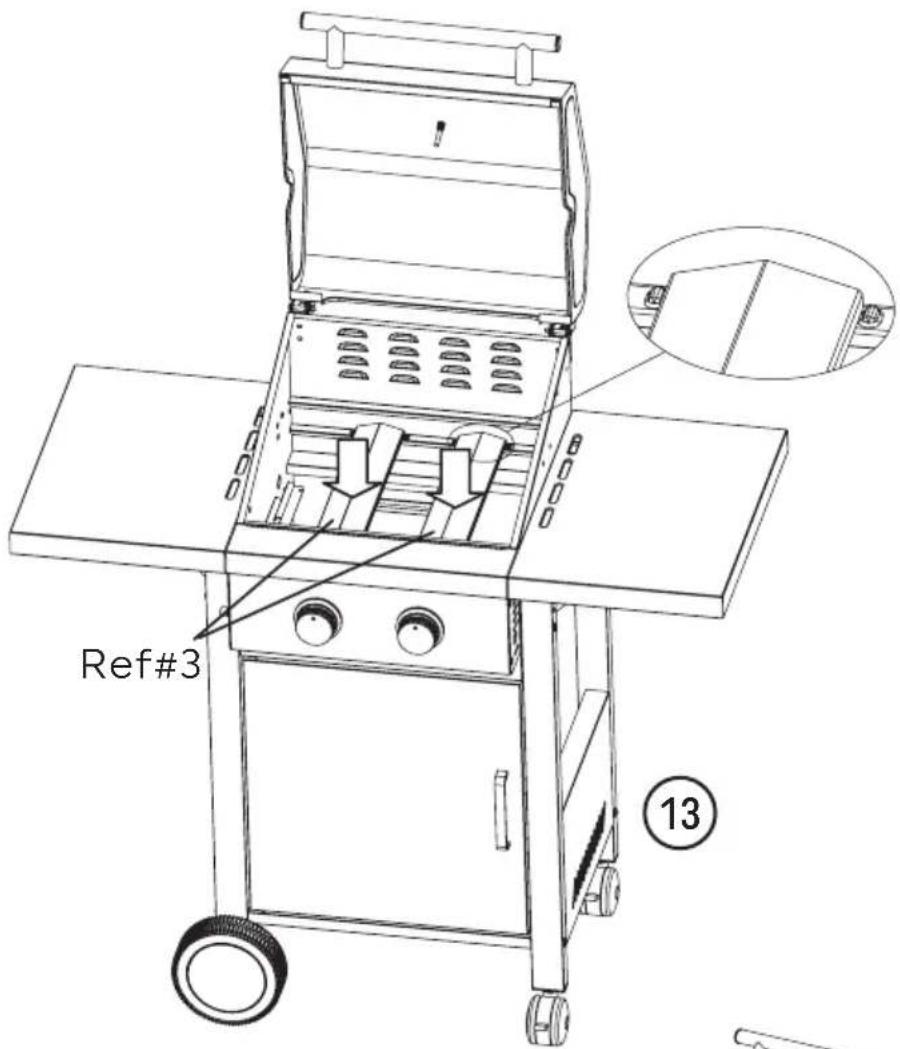
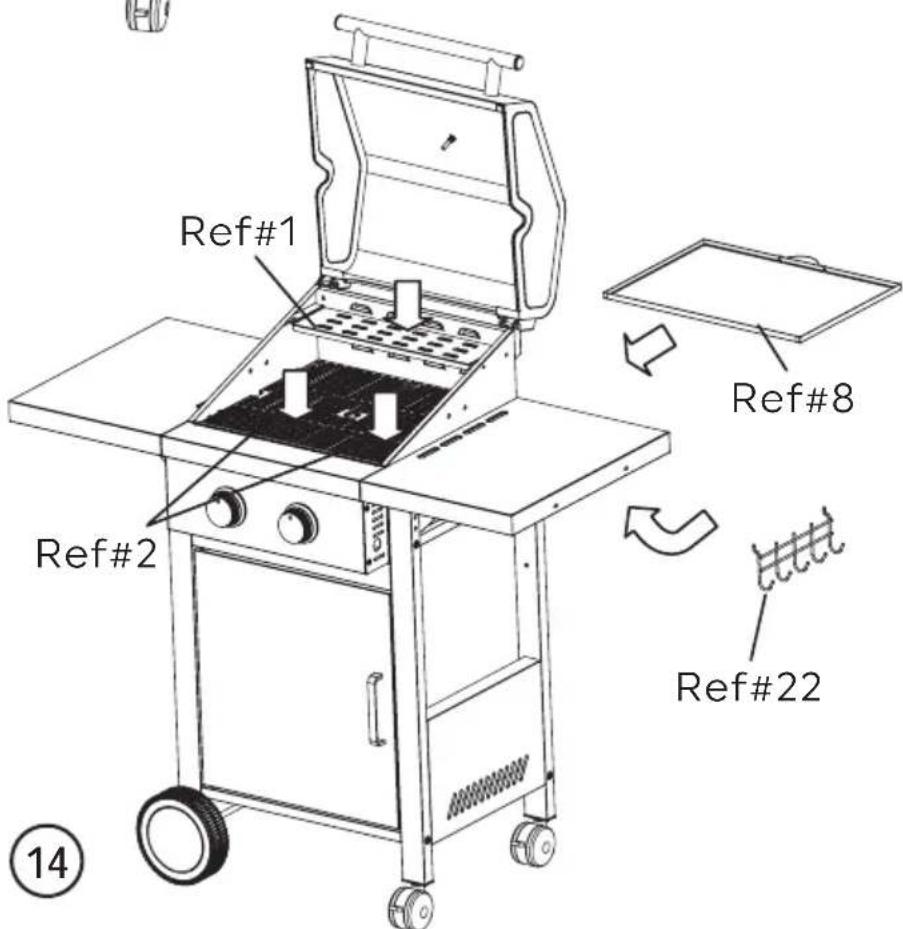
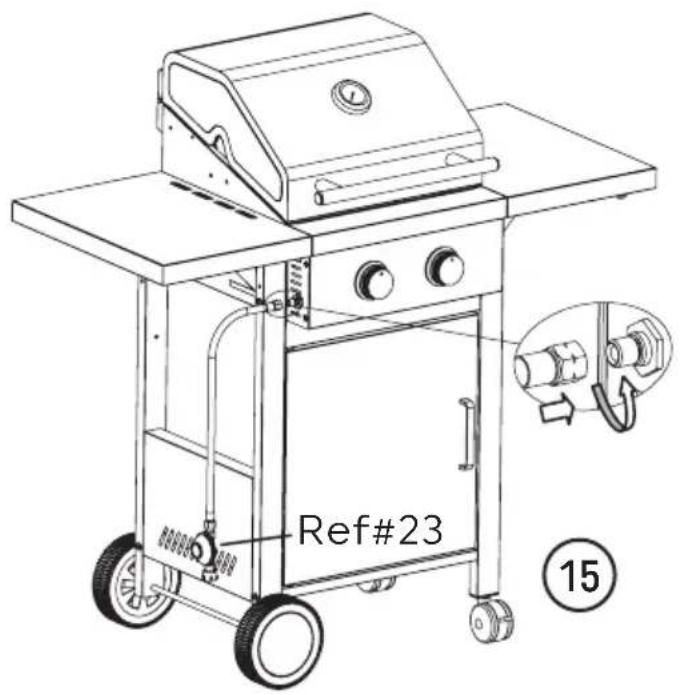
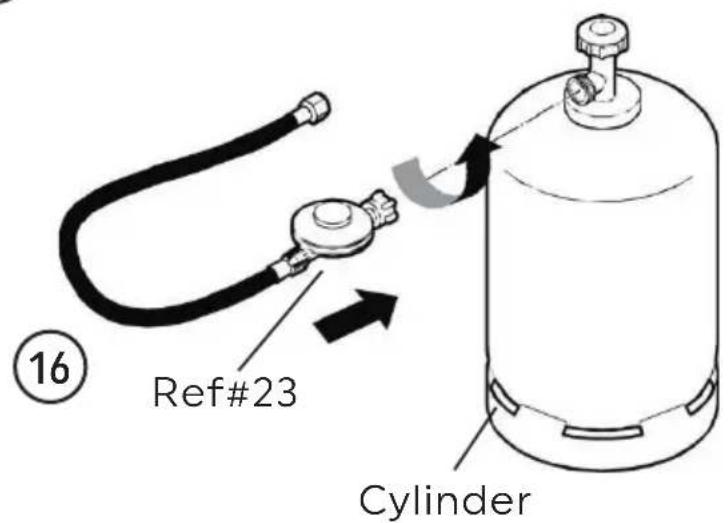
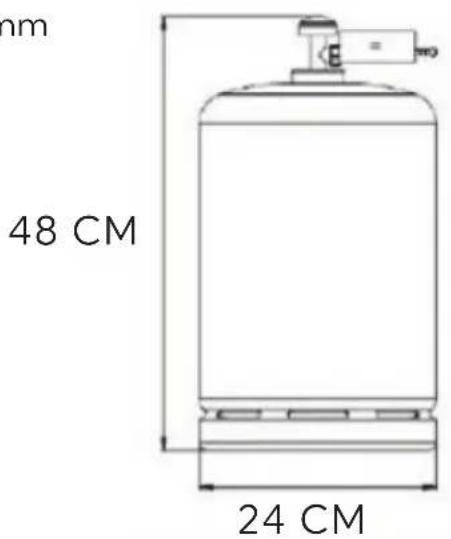
Permissible gas cylinder sizes
- 5 ~kg: 0.240 ~mm × 470 ~mm
The following parts are included in the delivery. They correspond to the applicable standards for the country to which the gas barbecue is shipped:
- Gas hose (pre-installed): CE-approved hose of sufficient length (max. 1.5 m) that allows for buckle-free assembly.
- Pressure regulator (pre-fitted to gas hose): non-adjustable, CE-appro
ved pressure regulator as per DIN EN 12864, max. 1.5kg / h , operating pressure: 50 mbar, corresponds to applicable gas cylinder type.
- Unscrew the protective cover from the screw connection on the gas barbecue. Attach the M6 nut on the end of the hose to the screw connection on the gas barbecue. Screw the M6 nut tight using a spanner.
- Place the gas cylinder into the trolley.
- Attach the M6 nut of the hose to
the screw connection on the pressure regulator and tighten the connection using a spanner.
4. Attach the M6 nut on the pressure regulator to the screw connection on the gas cylinder. Tighten the M6 nut by hand. Do not use any tools to do this, as they could damage the seal.
Leak test
Spray all sealing points with a standard, commercial leak detection spray or daub them with soapy water (mix ratio: 1 part soap to 3 parts water). Open the valve on the gas cylinder. Bubbles will form at leaking points. Close the valve of the gas cylinder.

If cooking with the hood closed, only use a small flame!
Always wear protective gloves when you are touching hot components while the gas barbecue is in use.
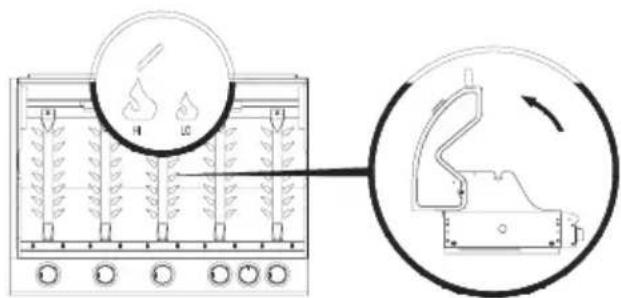
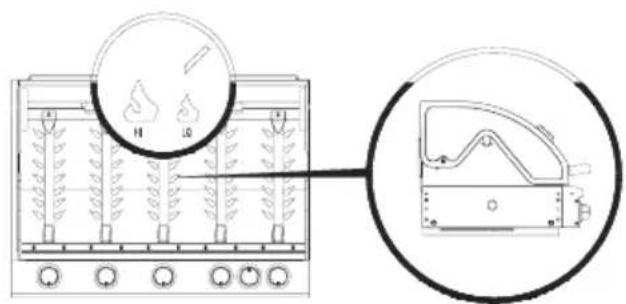
Before cooking on the gas barbecue for the first time, allow the burner to burn for 15 minutes without food. This removes any residue of chemicals used in production. If this results in a slight odour, do not need to worry - this is not important. Ensure that the gas barbecue is sufficiently ventilated. The colour of the internal area of the gas barbecue may change slightly. This is normal.
Switching on the gas barbecue
-
Open the gas barbecue cover.
-
Turn all dials clockwise to the "OFF" position.
-
Connect the pressure regulator to the gas cylinder.
-
Open the valve on the gas cylinder and perform a leak test, using a leak detection spray, to establish whether there is a leak between the pressure regulator and the gas cylinder.
-
It is possible to ignite each burner separately.
-
Push down on one of the dials and
keep it held as you twist it anti-clockwise towards the "HI" position. When doing this you will hear a ,clicking" sound. The burner ignites. If the burner does not ignite straight away, repeat this step 3 to 4 times.
-
Warning: If the burner does not ignite after several attempts, twist the dial clockwise back to the "OFF" position and close the valve of the gas cylinder. Wait 5 minutes and then perform these steps again, starting with step 4.
-
When you have ignited a burner, repeat steps 6 and 7 with the other dial to ignite the second burner.
-
Regulate the heat by turning the dial to the desired level between the highest (H1^ ) and lowest (uLOW^ ) settings.
Switching off the gas barbecue
To switch off the gas barbecue, close the valve of the gas cylinder and turn all dials clockwise to the "OFF" position.
BAKING IN THE GRATES
Grates made from cast iron must be baked in in order to protect the metal from rust and to create a non-stick surface. The baking in of cast iron can be done in 3 simple steps:
- Clean the cast iron grates with warm soapsuds. Rinse and wipe them dry.
- Grease the grates completely. Use grease with a high degree of saturated fatty acids e.g. coconut fat, coconut oil or lard.
- Place the grates on the grill and heat up to high temperature. The fat will be baked into the iron permanently through this, creating a protective layer.
REGULAR MAINTENANCE
After using the grill, it should be prepared for the next usage right away. Let the grill broil freely (i.e. without any food on the grill) in order to burn remains of food and fat from the grates, and clean the grates with a brush afterwards.
Do this as follows:
-
Remove all food from the grate, heat up the grill to the maximum and leave the flames burning for approximately 10 to 20 minutes while the lid is closed until smoke is no longer emitted from the grill.
-
To remove persistent remains, turn the cast iron grates facing downwards.
- Turn off the valve on the gas bottle (turn to OFF), then turn the switches to OFF on the grill (AUS).
- Now clean the grates with a long-handled steel wire brush. Hold the brush with gloves or potholders since the grill is still very hot.
- Drip rapeseed oil or sunflower oil onto a cloth and coat the grates to prevent initial rust.
After every 2-3 uses and after burning out and brushing the cast iron grates, it is recommended to clean dirty parts at the edge separately. Therefor take the grates out of the grill and scrub them carefully with warm water and a wire sponge. Afterwards wipe them dry thoroughly, grease the grates and insert them back into the grill.
If the grids should still develop rust stains, use steel wool to scrub it off until no rust is left. Clean the iron cast with water or warm soapsuds, wipe dry thoroughly and repeat the baking in process.
Store the grates in a dry place during winter if possible.
Fire and explosion hazard
- Do not use any flammable cleaning agents.
- Remove the gas cylinder before cleaning the gas barbecue.
- Before cleaning, wait until the gas barbecue has cooled down sufficiently.
- Clean the gas barbecue after each use.
- Remove the drip tray and dispose of the fat in an environmentally friendly
way.
-
Wipe stainless steel surfaces and cooking grates with a damp cloth, or clean these areas with hot water. If you require a cleaning agent, ensure that it is of a mild strength. Next, rinse the gas barbecue down with water. Allow it to dry fully before using it again. Then treat the stainless steel surfaces with a stainless steel cleaner.
-
Using a brush, remove any remnants of food from the burners.
-
In the rare event that a nozzle becomes clogged, unclog it using a nozzle needle.
-
In the rare event that a Venturi tube (gas-mix tube) becomes clogged, unclog it with a needle or a pipe cleaner.
- Store the gas barbecue in a dry room so that it is protected from frost.
Close the gas barbecue hood and place a cover over the appliance to protect it from dirt and damage.
Always close the valve of the gas
cylinder and keep the gas cylinder out of the reach of children.
- For storage instructions observe the information in the "Safety instructions" section. (p.29)
TECHNICAL INFORMATION
Model:
Barney
Manufacturer item No.: KYQ-M22
Springlane item No.: 120172
Burner - heat input: 6.3 kW
Burner - gas consumption: 450 g/h
Gas type: Butane (G30) and propane (G31)
Output pressure (for use of 50 mbar
propane/butane (G31/(G30):
This appliance has been tested and approved as per the EU/2009/142/EG DIN EN 498:2012 Norm for gas appliances. This appliance, in its delivered condition, is designed for operation with liquid gas.
EC countries – Category mbar – Burner - nozzle designation – Set at factory
AT, DE, CH
13P/B
50
0,75 mm
X
Recommended hose length: 0,8m
Gas cylinder: a conventional 5kg retail gas cylinder
can be used and attached to the gas
barbecue.
DISPOSAL/RECYCLING
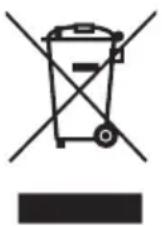
Our products are manufactured with the highest degree of care and are designed for a long durability. Regular maintenance and cleaning help to prolong durability. If the device is defective and cannot be repaired, it must not be disposed at home.
You must dispose the device at a respective place for recycling of electronic devices. With correct disposal and recycling you contribute to preserving the environment.
This appliance complies with the WEEE-Directive 2002/96/EC on the disposal of electrical and electronic equipment (WEEE).
CUSTOMER SERVICE
In principle, our products have a legal warranty duty of 2 years. Further claims can only be processed in conjunction with a proof of purchase. Wearing parts exclude any warranty claims, when usual abrasion has occurred. The durability is determined by the respective handling and use of the products and is thus variable.
For questions concerning handling and functionality of our products, please contact our customer-service:
Telephone number: +49 (0)800 270 70 27
This appliance complies with:
- European Directives for electromagnetic compatibility (EMC) 2004/108/EC
- Low Voltage Directive (LVD) 2006/95/EC
RoHS 2011/65/EU

Springlane GmbH hereby declares, that the ice cream canister meets the requirements of LFGB 2005 § 30 + 31 in the current version, with the legal limits adhered to. Compliance with the regulations refers to the date of preparation of this statement.
À PROPOS DE CETTE NOTICE
- Bring persons in the vicinity of the appliance to safety! If possible, close the valve on the gas cylinder. Cool the gas cylinder with water. While doing so, ensure your own safety. A spontaneous, explosive re-ignition is possible.
- In case of fire, filled pressurised
gas containers should be removed from the fire-hazard area. If this is not possible, you should prevent the pressurised gas containers from overheating by spraying them, from a safe distance, with water or another suitable substance.
- Directive CEM 2004/108/CE
- Directive de Basse Tension 2006/95/EC
RoHS2011/65/EU