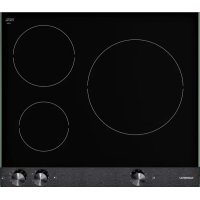
VI263620 - Cooker GAGGENAU - Free user manual and instructions
Find the device manual for free VI263620 GAGGENAU in PDF.


| Product type | Built-in induction hob |
| Brand | Gaggenau |
| Model | VI263620 |
| Number of cooking zones | 4 (includes a flexible cooking zone) |
| Control type | Rotary knobs with light ring |
| Display | Color-coded light ring (white, orange) |
| Power levels | 9 (1 to 9) |
| PowerBoost function | Quick heating of large quantities of water |
| Roasting probe function | Maintains pan temperature (5 levels) |
| Keep Warm function | Keeps warm and melts (butter, chocolate) |
| Residual heat indicator | Flashing orange light ring |
| Pan detection | Automatic shut-off if pan is unsuitable or absent |
| Child safety | Control lock (not explicit, but safety instructions) |
| Safety shut-off | Automatic shut-off in case of overheating or prolonged use |
| Surface material | Ceramic glass |
| Cleaning | Special ceramic glass cleaner, razor blade scraper for burnt-on soiling |
| Compatible accessories | Pans for roasting probe GP900001 (15 cm), GP900002 (19 cm), GP900003 (21 cm) |
| Power supply | 220-240 V, 50/60 Hz (standard estimation) |
| Installation | Built-in, connection by authorized technician |
| After-sales service | CA toll-free: 877 442 4436 |
| Warranty | See manual for conditions |
| Manual available in | French (FR, CA), English, Spanish and other languages on request |
Frequently Asked Questions - VI263620 GAGGENAU
User questions about VI263620 GAGGENAU
0 question about this device. Answer the ones you know or ask your own.
Ask a new question about this device
Download the instructions for your Cooker in PDF format for free! Find your manual VI263620 - GAGGENAU and take your electronic device back in hand. On this page are published all the documents necessary for the use of your device. VI263620 by GAGGENAU.
USER MANUAL VI263620 GAGGENAU
Use and care manual 3
text_image
Ø 11" (28) Ø 6" (15) Ø 7" (18)Table of Contents
▲ Safety Definitions 4
IMPORTANT SAFETY INSTRUCTIONS 5
Fire Safety 5
Cooking Safety 6
Burn Prevention 6
Child Safety 7
Cleaning Safety 7
Cookware Safety 8
Proper Installation and Maintenance 8
Electromagnetic Interference 9
Cooling Fan 10
Proposition 65 Warning 10
Causes of Damage 11
Overview 11
Protecting the Environment 12
Energy-Saving Advice 12
Cooking with Induction 12
Advantages of Induction Cooking 12
Cookware 12
Getting to Know your Appliance 14
Control Panel 14
Control Knob 14
Cooking Zones 14
Residual heat indicator 14
Operating the appliance 15
Setting the cooking zone 15
Chef's recommendations 15
PowerBoost Feature 17
Activating 17
Deactivating 17
Frying Sensor 17
Advantages When Frying 17
Frying Pans for the Frying Sensor 17
Temperature Settings 18
Frying Chart 18
Setting Procedure 20
Keep Warm Function 21
Activating 21
Deactivating 21
Cleaning and Maintenance 22
Daily Cleaning 22
Cleaning Guidelines 22
Cleaning Chart 22
Maintenance 23
FAQ 24
What to Do in the Event of a Fault? 26
Demo Mode 27
Customer Service 27
Additional information on products, accessories, replacement parts and services can be found at www.gaggenau.com and in the online shop www.gaggenau.com/zz/store
⚠ Safety Definitions
WARNING
This indicates that death or serious injuries may occur as a result of non-observance of this warning.
CAUTION
This indicates that minor or moderate injuries may occur as a result of non-observance of this warning.
NOTICE
This indicates that damage to the appliance or property may occur as a result of non-compliance with this advisory.
Note: This alerts you to important information and/or tips.

IMPORTANT SAFETY INSTRUCTIONS
READ AND SAVE THESE INSTRUCTIONS

WARNING
When properly cared for, your new appliance has been designed to be safe and reliable. Read all instructions carefully before use. These precautions will reduce the risk of burns, electric shock, fire, and injury to persons. When using kitchen appliances, basic safety precautions must be followed, including those in the following pages.
Examine the appliance after unpacking it. In the event of transport damage, do not plug it in.
This appliance is not intended for operation with an external clock timer or a remote control.
This appliance is not intended for use by persons (including children) with reduced physical, sensory or mental capabilities, or lack of experience and knowledge, unless they have been given supervision or instruction concerning use of the appliance by a person responsible for their safety.
Fire Safety
Do not allow pans to boil dry. Do not allow aluminum foil, plastic, paper or cloth to come in contact with a hot surface element, burner or grate. Improper installation of these protective liners may result in a risk of electric shock, or fire.
If the cooktop is near a window, forced air vent or fan, be certain that flammable materials such as window coverings do not blow over or near the burners or elements. They could catch on fire.
Always have a working smoke detector near the kitchen.
Never leave the cooktop unattended when in use. Boilovers cause smoking and greasy spillovers may ignite.

WARNING
TO REDUCE THE RISK OF A GREASE FIRE:
- Never leave surface units unattended at high settings. Boilovers cause smoking and greasy spillovers that may ignite. Heat oils slowly on low or medium settings.
- Always turn hood ON when cooking at high heat or when flambeing food (i.e. Crepes Suzette, Cherries Jubilee, Peppercorn Beef Flambé).
- Clean Ventilating Hoods Frequently. Grease should not be allowed to accumulate on hood or filter.
- Use proper pan size. Always use cookware appropriate for the size of the surface element.
In the event that personal clothing or hair catches fire, drop and roll immediately to extinguish flames.

IMPORTANT SAFETY INSTRUCTIONS
READ AND SAVE THESE INSTRUCTIONS
Have an appropriate fire extinguisher available, nearby, highly visible and easily accessible near the appliance.
Smother flames from food fires other than grease fires with baking soda. Never use water on cooking fires.

WARNING
TO REDUCE THE RISK OF INJURY TO PERSONS IN THE EVENT OF A GREASE FIRE, OBSERVE THE FOLLOWING:
- Do Not Use Water on Grease Fires - Smother fire or flame or use dry chemical or foam-type extinguisher.
-
SMOTHER FLAMES with a close-fitting lid, cookie sheet, or metal tray, then turn off the burner. BE CAREFUL TO PREVENT BURNS. If the flames do not go out immediately, EVACUATE AND CALL THE FIRE DEPARTMENT.
-
NEVER PICK UP A FLAMING PAN
-
You may be burned.
-
DO NOT USE WATER, including wet dishcloths or towels – a violent steam explosion will result.
-
Use an extinguisher ONLY if:
-
You know you have a Class ABC extinguisher, and you already know how to operate it.
- The fire is small and contained in the area where it started.
- The fire department is being called.
- You can fight the fire with your back to an exit.
Whenever possible, do not operate the ventilation system during a cooktop fire. However, do not reach through fire to turn it off.
Cooking Safety

WARNING
Use this appliance only for its intended use as described in this manual. NEVER use this appliance as a space heater to heat or warm the room. Doing so may result in overheating the appliance. Never use the appliance for storage.
Burn Prevention
DO NOT TOUCH SURFACE UNITS OR AREAS NEAR UNITS - Surface units may be hot even though they are dark in color. Areas near surface units may become hot enough to cause burns. During and after use, do not touch, or let clothing, potholders, or other flammable materials contact surface units or areas near units until they have had sufficient time to cool. Among these areas are the cooktop and areas facing the cooktop.
Do not heat or warm unopened food containers. Build-up of pressure may cause the container to burst and cause injury.
Always use dry potholders. Moist or damp potholders on hot surfaces may result in burns from steam. Do not let potholder touch hot heating elements. Do not use a towel or other bulky cloth.

IMPORTANT SAFETY INSTRUCTIONS
READ AND SAVE THESE INSTRUCTIONS
Always turn hood ON when cooking at high heat or when flambéing food (i.e. Crêpes Suzette, Cherries Jubilee, Peppercorn Beef Flambé).
Use high heat settings on the cooktop only when necessary. To avoid bubbling and splattering, heat oil slowly, on no more than a low-medium setting. Hot oil is capable of causing extreme burns and injury.
Never move a pan of hot oil, especially a deep fat fryer. Wait until it is cool.
Secure all loose garments, etc., before beginning. Tie long hair so that it does not hang loose, and do not wear loose-fitting clothing or hanging garments, such as ties, scarves, jewelry, or dangling sleeves.

WARNING
Risk of burns!
Metallic objects become hot very quickly on the cooktop. Never set down metallic objects such as knives, forks, spoons and lids on the cooktop.

WARNING
Risk of burns!
After each use, turn off the cooking zone using the control knob. Don't wait until the cooking zone automatically shuts off because there are no cooking vessels on it anymore.
Child Safety
When children become old enough to use the appliance, it is the responsibility of the parents or legal guardians to ensure that they are instructed in safe practices by qualified persons.
Do not allow anyone to climb, stand, lean, sit, or hang on any part of an appliance, especially a door, warming drawer, or storage drawer. This can damage the appliance, and the unit may tip over, potentially causing severe injury.
Do not allow children to use this appliance unless closely supervised by an adult. Children and pets should not be left alone or unattended in the area where the appliance is in use. They should never be allowed to play in its vicinity, whether or not the appliance is in use.

CAUTION
Items of interest to children should not be stored in an appliance, in cabinets above an appliance or on the backsplash. Children climbing on an appliance to reach items could be seriously injured.
Cleaning Safety
Clean Cooktop With Caution - If a wet sponge or cloth is used to wipe spills on a hot cooking area, be careful to avoid steam burn. Some cleaners can produce noxious fumes if applied to a hot surface.
Do not use steam cleaners to clean the appliance.

IMPORTANT SAFETY INSTRUCTIONS
READ AND SAVE THESE INSTRUCTIONS
Cookware Safety
Hold the handle of the pan when stirring or turning food. This helps prevent spills and movement of the pan.
Use Proper Pan Size.
The use of undersized cookware will expose a portion of the heating element or burner to direct contact and may result in ignition of clothing. Select cookware having flat bottoms large enough to cover the surface heating unit. This appliance is equipped with one or more surface units of different sizes. Proper relationship of cookware to heating element or burner will also improve efficiency.
Cookware not approved for use with ceramic cooktops may break with sudden temperature changes. Use only pans that are appropriate for ceramic induction cooktops.
Always position handles of utensils inward so they do not extend over adjacent work areas, burners, or the edge of the cooktop. This reduces the risk of fires, spills and burns.

WARNING
RISK of injury!
Inappropriate woks may cause accidents. Use only the wok provided by the manufacturer as a special accessory.

WARNING
RISK of injury!
When cooking with a double-boiler, the cooktop and cooking vessel may crack due to overheating. The cooking vessel in the double-boiler must not come in direct contact with the bottom of the pot filled with water. Use only heat-resistant cookware.

WARNING
Danger of injury!
Cookware may jump upward due to fluid trapped between the cookware bottom and cooking zone. Always keep cooking zone and cookware bottom dry.
Proper Installation and Maintenance
Have the installer show you the location of the circuit breaker or fuse. Mark it for easy reference.
This appliance must be properly installed and grounded by a qualified technician. Connect only to properly grounded outlet. Refer to Installation Instructions for details.
This appliance is intended for normal family household use only. It is not approved for outdoor use. See the Statement of Limited Product Warranty. If you have any questions, contact the manufacturer.

IMPORTANT SAFETY INSTRUCTIONS
READ AND SAVE THESE INSTRUCTIONS
Do not store or use corrosive chemicals, vapors, flammables or nonfood products in or near this appliance. It is specifically designed for use when heating or cooking food. The use of corrosive chemicals in heating or cleaning will damage the appliance and could result in injury.
Make sure reflector pans or drip bowls are in place - Absence of these bowls or pans during cooking may subject wiring or components underneath to damage.

WARNING
Failure to operate knobs properly may result in personal injury and damage to the appliance.
Do not operate this appliance if it is not working properly, or if it has been damaged. Contact an authorized servicer.
Do Not Cook on Broken Cooktop - If cooktop should break, cleaning solutions and spillovers may penetrate the broken cooktop and create a risk of electric shock. Contact a qualified technician immediately.

WARNING
If the surface is cracked, switch off the appliance to avoid the possibility of electric shock.
Do not repair or replace any part of the appliance unless specifically recommended in this manual. Refer all servicing to a factory authorized service center.
To avoid electrical shock hazard, before servicing the appliance, switch power off at the service panel and lock the panel to prevent the power from being switched on accidentally.
Electromagnetic Interference

WARNING
This induction cooktop generates and uses ISM frequency energy that heats cookware by using an electromagnetic field. It has been tested and complies with Part 18 of the FCC Rules for ISM equipment. This induction cooktop meets the FCC requirements to minimize interference with other devices in residential installation. Induction cooktops may cause interference with television or radio reception. If interference occurs, the user should try to correct the interference by:
- Relocating the receiving antenna of the radio or television.
- Increasing the distance between the cooktop and the receiver.
- Connecting the receiver into an outlet different than the cooktop.
It is the user's responsibility to correct any interference.

IMPORTANT SAFETY INSTRUCTIONS
READ AND SAVE THESE INSTRUCTIONS

CAUTION
Persons with a pacemaker or similar medical device should exercise caution when standing near an induction cooktop while it is in use. Consult your doctor or the manufacturer of the pacemaker or similar medical device for additional information about its effects with electromagnetic fields from an induction cooktop.
Proposition 65 Warning:
This product may contain a chemical known to the State of California, which can cause cancer or reproductive harm. Therefore, the packaging of your product may bear the following label as required by California:
STATE OF CALIFORNIA PROPOSITION 65 WARNING:
WARNING
Cancer and Reproductive Harm - www.P65Warnings.ca.gov
Cooling Fan
The cooktop is equipped with a cooling fan on its underside. Should the cooktop lie above a drawer, there must be no objects or paper in it. They may be sucked in and compromise the cooling of the appliance or damage the fan.
There must be a minimum distance of 34 " (20mm) between the content of the drawer and the fan input.
Causes of Damage
NOTICE
- Rough pot and pan bases scratch the cooktop.
- Never leave cookware cooking empty. This can cause damage.
- Do not place hot pots or pans on the control panel or the cooktop surround. This can cause damage.
- Damage can occur if hard or pointed objects fall on the cooktop.
- Aluminum foil and plastic containers can melt and stick on hot cooking zones. The use of oven protective foil on the cooktop is not recommended.
Overview
You will find the most frequently caused damage in the following table.
Damage Cause Remedy
| Stains Boiled-over food. Remove boiled-over food immediately with a glass scraper. | ||
| Unsuitable cleaning agent. Only use cleaning agents that are suitable for this type of cooktop. | ||
| Scratches Salt, sugar and sand. Do not use the cooktop as a work surface or storage space. | ||
| Cookware with rough bases scratch the cooktop. | Check the cookware. | |
| Discoloration Unsuitable cleaning agent. Only use cleaning agents that are suitable for this type of cooktop. | ||
| Pan abrasion. | Lift pots and pans when moving them. | |
| Blisters | Sugar, food with a high sugar content. | Remove boiled-over food immediately with a glass scraper. |
Protecting the Environment
Energy-Saving Advice
- Place a lid on cookware. Cooking with an uncovered pan will result in a considerable increase in energy use. Use a glass lid to provide visibility and avoid having to lift the lid.
- Use cookware equipped with a solid, flat bottom. Curved pan bases increase energy consumption.
- The diameter of the pan base must match the size of the cooking zone. Note: The manufacturer normally indicates the pan's upper diameter. This is normally greater than the diameter of the pan's base.
- Choose cookware of a size suited to the amount of food you are going to cook. A large pan that is only half full will use a lot of energy.
- Use a small amount of water when cooking. This saves energy, and vegetables retain a larger percentage of their vitamins and minerals.
- Select the lowest power level to maintain cooking. If the power level is too high, energy is wasted.
Cooking with Induction
Cooking with InductionAdvantages of Induction Cooking
Induction cooking is very different from traditional cooking methods, as heat builds up directly in the item of cookware. This offers numerous advantages:
- Saves time when boiling and frying.
- Saves energy.
- Easier to care for and clean. Spilled food does not burn on as quickly.
- Heat control and safety – the cooktop increases or decreases the heat supply as soon as the user changes the setting. The induction cooking zone stops the heat supply as soon as the cookware is removed from the cooking zone, without having to switch it off first.
Cookware
Only use ferromagnetic cookware for induction cooking, such as:
• Cookware made from enameled steel
• Cookware made from cast iron
- Special induction-compatible cookware made from stainless steel.
To achieve a good cooking result, the ferromagnetic area on the base of the pan should match the size of the element. If an element does not detect an item of cookware, try placing it on another cooking zone with a smaller diameter.
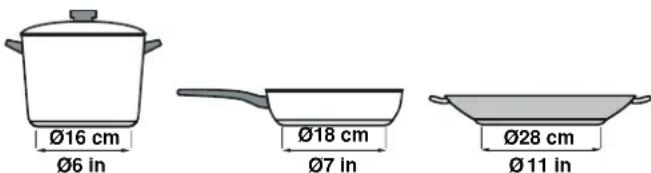
text_image
Ø16 cm Ø6 in Ø18 cm Ø7 in Ø28 cm Ø11 inSome induction cookware does not have a fully ferromagnetic base:
- If the base of the cookware is only partially ferromagnetic, only the area that is ferromagnetic will heat up. This may mean that heat will not be distributed evenly. The non-ferromagnetic area may not heat up to a sufficient temperature for cooking.
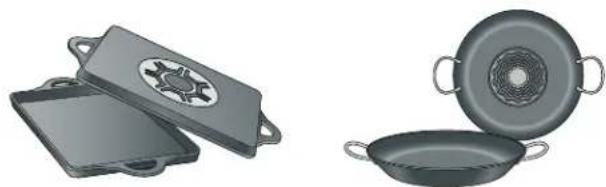
natural_image
Illustration of kitchenware including a cooking pan, lid, and pan with handles (no text or symbols)- The ferromagnetic area will also be reduced if the material of which the base of the cookware is made contains aluminum, for example. This may mean that the cookware will not become sufficiently hot or even that it will not be detected.
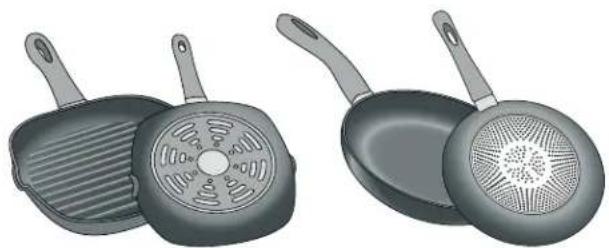
natural_image
Illustration of two cooking panes with different interior designs (no text or symbols)Unsuitable Cookware
Do not ever use adapter plates for induction or cookware made of:
• Traditional stainless steel
Glass
- Clay
Copper
- Aluminum
Properties of the Base of the Cookware
The material(s) of which the base of the cookware is made can affect the cooking result. Using pots and pans made from materials that distribute heat evenly through them, such as stainless-steel pans with a three-layer base, saves time and energy.
Use cookware with a flat base; if the base of the cookware is uneven, this may impair the heat supply.
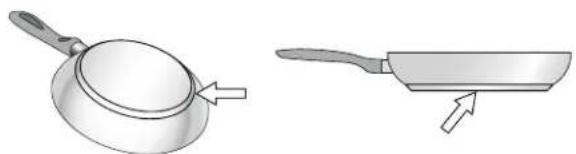
natural_image
Illustration of a cooking pan and its side view showing the lid and handle (no text or symbols)No pan or improper size
If no pan is placed on the selected element, or if it is made of unsuitable material or is not the correct size, the power level displayed on the element indicator will flash. Place a suitable pan on the element to stop the flashing. If you take longer than 90 seconds to place a suitable pan on the element, it will automatically turn off.
Empty Pans or Pans with a Thin Base
Do not heat up empty pans, or use pans with a thin base. The cooktop is equipped with an internal safety system. However, an empty pan may heat up so quickly that the "automatic shut-off" function may not have time to react, and the pan may reach very high temperatures. The pan base could melt and damage the cooktop glass. In this case, do not touch the pan and switch the cooktop off. If the cooktop fails to work after it has cooled down, please contact Customer Support.
Pan Detection
Each cooking zone has a lower limit for pan detection. This depends on the diameter of the ferromagnetic area of the cookware and the material of which its base is made. For this reason, you should always use the cooking zone that best matches the diameter of the base of the pan.
Getting to Know your Appliance
Page 2 contains a list of models and dimensions.
Note: Depending on the appliance model, individual details and colors may differ.
Control Panel
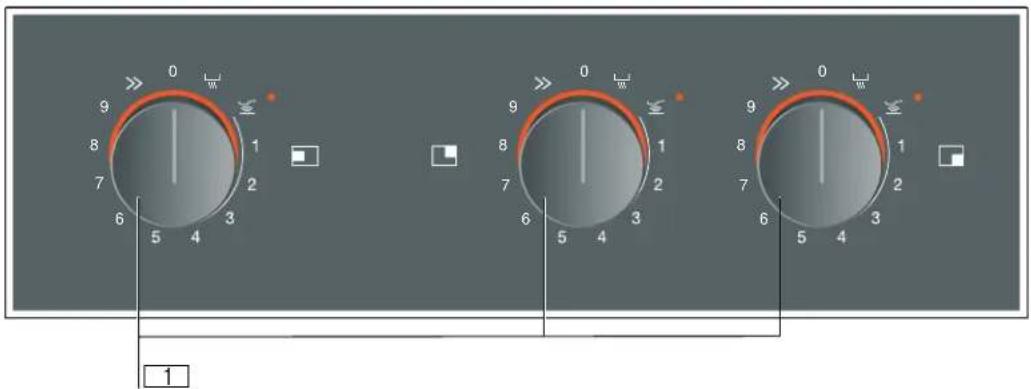
text_image
0 9 8 7 6 5 4 3 1 2 1 0 9 8 7 6 5 4 3 1 2 1 0 9 8 7 6 5 4 3 1Control Knob
1 Control knob
You can use the control knobs to set the power levels and other functions. You can turn the control knobs clockwise or anti-clockwise, starting from position 0.
Control knob positions
| 0 Cooking zone off | |
| Keep-warm function | |
| Frying Sensor | |
| ● | Frying sensor indicator |
| 1-9 Power levels | |
| 1-5 Temperature levels | |
| >> | PowerBoost function |
Display
● Frying sensor indicator
The control knobs have an illuminated ring with an illuminated symbol for each function. The illuminated ring changes color when particular functions or processes are activated.
Cooking Zones
Cooking Zone
| ○ Single cooking zone | Use cookware of suitable size. |
| Use only cookware suitable for induction cooking; see the section → "Cooking with Induction" | |
Residual heat indicator
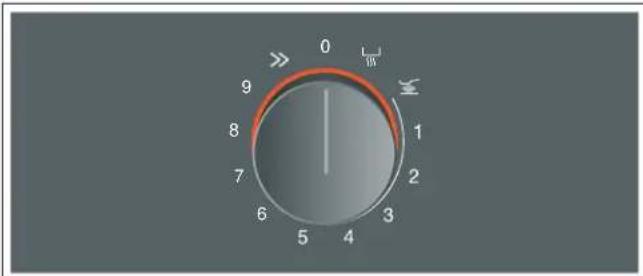
The hob has a residual heat indicator for every cooking zone. The illuminated ring around the control knob continues to flash orange until the cooking zone cools down. Do not touch the cooking zone while the residual heat indicator is still lit or immediately after it goes out.
text_image
0 9 8 7 6 5 4 3 2 1 E WIf you remove the cookware from the cooking zone during cooking, the control knob flashes orange. Turn the control knob to position 0.
If you switch off the cooking zone, the illuminated ring around the control knob flashes orange. Even if the hob has been switched off, the illuminated ring continues flashing until the cooking zone has cooled down.
Operating the appliance
This chapter explains how to set a cooking zone. The table shows heat settings and cooking times for various meals.
Setting the cooking zone
Use the control knob to set the power level you require.
0 Cooking zone off.
Power level 1 Lowest setting
Power level 9 Highest setting
Notes
- To protect the fragile parts of your appliance from overheating and electrical overloading, the cooktop may temporarily reduce the power automatically.
- In order to prevent the appliance from producing excess noise, the cooktop may temporarily reduce the power automatically.
Selecting a Heat Setting
Push in the control knob and turn it to the heat setting you require.
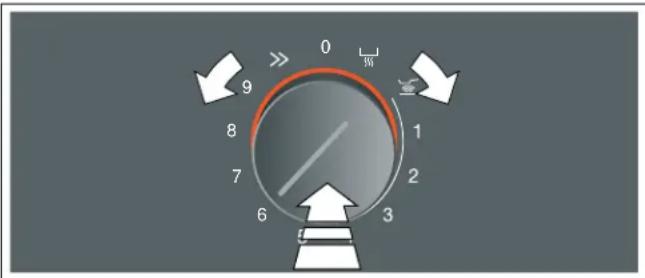
text_image
0 9 8 7 6 3 1 2 ↑The illuminated ring around the control knob turns orange. The power level has been set.
Switching off the cooking zone
Turn the control knob to the 0 position. The cooking zone switches itself off and the illuminated ring around the control knob flashes orange until the cooking zone has cooled down.
Notes
-
If there is no cookware on the cooking zone or if the cookware is not detected, the illuminated ring around the control knob turns white.
After approx. 30 seconds, the cooking zone will switch off.
In this case, the illuminated ring around the control knob flashes orange and white. Turn the control knob back to position 0; the illuminated ring stops flashing. -
Always remove cookware, saucepan lids or other metal objects from the hob after cooking. If you accidentally touch one of the control knobs or switch on one of the cooking zones when cleaning the worktop, these kinds of objects will heat up very quickly.
Chef's recommendations
Recommendations
- Stir occasionally when heating up purees, creamy soups and thick sauces.
- Use power level 8 or 9 for preheating.
- When cooking with the lid on, reduce the heat as soon as you see steam escaping. The cooking result is not affected by the steam escaping.
- Once cooking is complete, keep the lid on the cookware until you serve the food.
- Follow the manufacturer's instructions when cooking with a pressure cooker.
- To preserve the nutrients in food, avoid cooking it for too long.
- For a healthier result, make sure that the oil does not smoke.
• To brown food, fry it in small batches. - Cookware may reach high temperatures while the food is cooking. Always use oven gloves.
- For recommendations on energy-efficient cooking, see the section entitled → "Protecting the Environment".
Cooking table
The table shows which heat setting is suitable for each type of food. The cooking time may vary depending on the type, weight, thickness and quality of the food.
Power level Cooking methods Examples
| 8 - 9 Plate warming Water | ||
| Searing Meat | ||
| Heating Fat/oil, liquids | ||
| Bringing to a quick boil Soups, sauces | ||
| Blanching Vegetables | ||
| 6 - 8 Frying Meat, potatoes | ||
| 5 - 7 Frying Fish | ||
| 6 - 7 Frying Flour-based and/or egg-based dishes, e.g. pancakes | ||
| Cooking with the lid off Pasta, liquids | ||
| 5 - 6 Browning Flour, onions | ||
| Roasting Almonds, breadcrumbs | ||
| Frying Bacon | ||
| Reducing Meat stock, sauces | ||
| 4 - 5 Ongoing cooking with the lid off Potato dumplings, vegetable soups, stews, poached eggs | ||
| 3 - 4 Ongoing cooking with the lid off Boiled sausages | ||
| 4 - 5 Steaming Vegetables, potatoes, fish | ||
| Stewing Vegetables, fruit, fish | ||
| Braising | Beef olives, minced meat hot dogs, vegetables | |
| 2 - 4 Braising | Goulash | |
| 2 - 4 Cooking with the lid on | Soups, sauces | |
| 2 - 3 Defrosting | Frozen products | |
| Cooking with the lid on | Rice, legumes, vegetables | |
| Thickening | Egg-based dishes, e.g. omelette | |
| 1 - 2 Heating/keeping warm | Soup, vegetables in sauce | |
| 1 | Heating/keeping warm | Stew, e.g. lentil stew |
| Melting | Butter, chocolate | |
PowerBoost Feature
The PowerBoost function enables you to heat up large quantities of water more quickly than with power level 9.
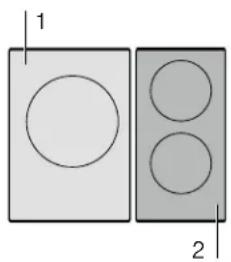
This function is available for all cooking zones, provided the other cooking zone in the same group is not in use. If it is, the illuminated ring will flash three times and three signals will sound. Then power level 9 will be set automatically without activating the function. Turn the control knob to the 0 position.
natural_image
Two geometric shapes: a square with a circle inside and a larger rectangle with two circles on top, labeled 1 and 2 (no text or symbols beyond labels)Activating
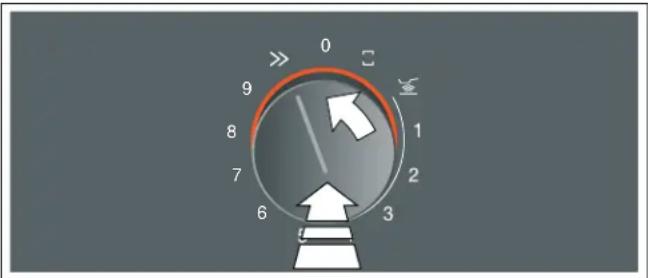
Push in the control knob and turn it to the >> position. A signal will sound; the illuminated ring around the control knob will go out and then turn orange.
text_image
0 9 8 7 6 3 1 2 ↑ →The function has now been activated.
Deactivating
Turn the control knob to the power level you require. A signal sounds; the illuminated ring around the control knob goes out and then turns orange.
The function has now been deactivated.
Note: In certain circumstances, the PowerBoost function may switch itself off automatically in order to protect the electronic elements inside the cooktop.
In this case, power level 9 is set automatically, the illuminated ring flashes three times and three signals sound.
Turn the control knob to position 0 or any power level.
Frying Sensor
This function can be used to fry food while maintaining the suitable frying pan temperature.
Advantages When Frying
- The cooking zone only heats up if this is required to maintain the temperature. This saves energy and prevents the oil or fat from overheating.
- The frying sensor function reports when the empty frying pan has reached the optimum temperature for adding oil and then for adding the food.
Notes
- Do not place a lid on the pan. Otherwise, the function does not activate correctly. You can use a splash guard to prevent splashes of grease.
- Use oil or grease that is suitable for deep fat frying. If butter, margarine, extra virgin olive oil, or lard is used, use heat setting 1 or 2.
- Never leave a frying pan, with or without food, unattended when it is being heated.
- If the temperature of the cooking zone is higher than that of the cookware or vice-versa, the frying sensor is not activated correctly.
Frying Pans for the Frying Sensor
Frying pans specifically suited for use with the frying sensor are available. This optional accessory can be purchased separately from specialist retailers or through our technical after-sales service. Always quote the relevant reference number.
• GP900001 - 6" (15 cm) frying pan.
• GP900002 - 7½" (19 cm) frying pan.
• GP900003 - 8 ^1/4 " (21 cm) frying pan.
These frying pans have a non-stick coating so that you only need a small amount of oil to fry food.
Notes
- The frying sensor has been configured specifically for this type of frying pan.
- Ensure that the diameter of the base of the frying pan corresponds to the size of the burner. Place the frying pan in the center of the burner.
- The frying sensor may not activate on the flex cooking zone if the frying pan does not match the size of the burner or if it is positioned incorrectly. See section
- Other types of frying pan may overheat. They may reach a temperature above or below the selected temperature setting. Select the lowest temperature setting to begin with and change it if necessary.
Temperature Settings
| Heat setting Suitable for |
| 1 Very low Preparing and reducing sauces, steaming vegetables, and frying food in extra virgin olive oil, butter, or margarine. |
| 2 Low Frying food using extra virgin olive oil, butter, or margarine, e.g. omelettes. |
| 3 Low – medium Frying fish and thick food, such as, meatballs and sausages. |
| 4 Medium – high Frying steaks (medium or well done), frozen breaded products, thin fried food, such as schnitzel, strips of meat, and vegetables. |
| 5 High Frying food at high temperatures, e.g. rare steaks (bloody), potato fritters, and fried potatoes. |
Frying Chart
The chart lists which heat setting is suitable for each type of food. The frying time may vary depending on the type, weight, size and quality of the food. Preheat the empty pan; add oil and food after the acoustic signal has sounded.
The set heat setting varies depending on the frying pan that is used.
| Temperature setting | Total frying time after the signal tone sounds (min) | |
| Meat | ||
| Schnitzel, plain or breaded 4 6 - 10 | ||
| Fillet 4 6 - 10 | ||
| Chops* 3 10 - 15 | ||
| Cordon bleu* 4 10 - 15 | ||
| Steak, rare ( 114 " / 3 cm thick) 5 6 - 8 | ||
| Steak, medium or well done ( 114 " / 3 cm thick) 4 8 - 12 | ||
| Chicken breast ( 34 " / 2 cm thick)* | 3 10 - 20 | |
| Sausages, pre-boiled or raw* | 3 8 - 20 | |
| Hamburgers, rissoles* | 3 6 - 30 | |
| Strips of meat, gyros | 4 7 - 12 | |
| Ground meat | 4 6 - 10 | |
| Bacon | 2 5 - 8 | |
| Fish | ||
| Fried whole fish, e.g. trout | 3 10 - 20 | |
| Fish fillet, plain or breaded 3 - 4 | 10 - 20 | |
| Scampi, shrimps | 4 4 - 8 | |
* Turn several times.
** Total cooking time per portion. Fry one after the other.
| Temperature setting | Total frying time after the signal tone sounds (min) | |
| Egg dishes | ||
| Pancakes** 5 1,5 - 2,5 | ||
| Omelet** 2 3 - 6 | ||
| Fried eggs 2 - 4 2 - 6 | ||
| Scrambled eggs 2 4 - 9 | ||
| Raisin pancake 3 10 - 15 | ||
| French toast** 3 4 - 8 | ||
| Potatoes | ||
| Fried potatoes (made from unpeeled boiled potatoes) 5 6 - 12 | ||
| Fried potatoes (made from raw potatoes) 4 15 - 25 | ||
| Potato pancakes** 5 2,5 - 3,5 | ||
| Swiss rösti 2 50 - 55 | ||
| Glazed potatoes 3 15 - 20 | ||
| Vegetables | ||
| Garlic, onions 1 - 2 2 - 10 | ||
| Zucchini, eggplants 3 4 - 12 | ||
| Peppers, green asparagus | 3 4 - 15 | |
| Braising vegetables (fried in fat but with no water added), e.g. zucchini, green peppers | 1 10 - 20 | |
| Mushrooms | 4 10 - 15 | |
| Glazed vegetables | 3 6 - 10 | |
| Fried onions | 3 5 - 10 | |
| Frozen products | ||
| Schnitzel | 4 15 - 20 | |
| Cordon bleu* | 4 10 - 30 | |
| Poultry breast* | 4 10 - 30 | |
| Chicken nuggets | 4 10 - 15 | |
| Gyros, kebab | 4 10 - 15 | |
| Fish fillet, plain or breaded | 3 10 - 20 | |
| Fish sticks | 4 8 - 12 | |
| French fries | 5 4 - 6 | |
| Pan-fried dishes, e.g. fried vegetables with chicken | 3 6 - 10 | |
| Spring rolls 4 10 - 30 | ||
| Camembert/cheese | 3 10 - 15 | |
| Sauces | ||
| Tomato sauce with vegetables | 1 25 - 35 | |
| Béchamel sauce 1 10 - 20 | ||
| Cheese sauce, e.g. Gorgonzola sauce | 1 10 - 20 | |
| Reduced sauces, e.g. tomato sauce, Bolognese sauce | 1 25 - 35 | |
| Sweet sauces, e.g. orange sauce | 1 15 - 25 | |
* Turn several times.
** Total cooking time per portion. Fry one after the other.
| Temperature setting | Total frying time after the signal tone sounds (min) | |
| Miscellaneous | ||
| Camembert/cheese 3 7 - 10 | ||
| Dried instant meals to which water is added, e.g. pasta dishes 1 5 - 10 | ||
| Croutons 3 6 - 10 | ||
| Almonds/walnuts/pine nuts 4 3 - 15 | ||
* Turn several times.
** Total cooking time per portion. Fry one after the other.
Setting Procedure
Select the appropriate temperature setting from the table. Place the empty cooking vessel on the cooking zone.
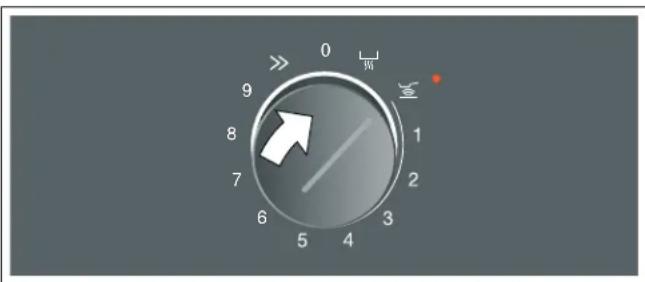
- Push in the control knob and turn it to the ✕ position. The illuminated ring around the control knob turns white.
After three seconds, a signal sounds, the indicator next to the symbol lights up.
text_image
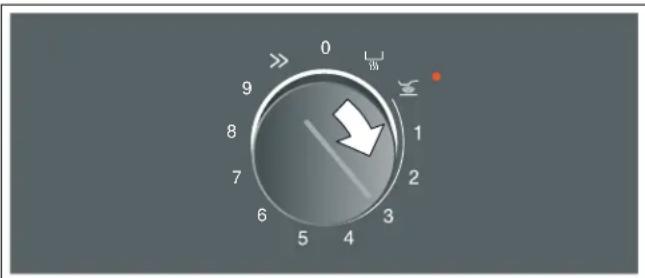
0 9 8 7 6 5 4 3 2 1 1 0 >> >> >> >> >> >> >> >> >> >> >> >> >> >> >> >> >> >> >> >> >> >> >- Use the control knob to select the temperature setting you require.
Note: Temperature settings 1 to 5 are available for this function; see temperature settings table.
text_image
0 9 8 7 6 5 4 3 2 1 0 35 →The function has now been activated.
The illuminated ring dims from white to orange while the appliance is heating up. An audible signal sounds when the set temperature has been reached.
- Once the frying temperature has been reached, add the fat and then the food to the pan.
Notes
- If a temperature level above 5 is selected, the illuminated ring flashes orange and white without activating the function. Select an appropriate temperature level.
- Turn the food so that it does not burn.
Switching off the frying sensor
Turn the control knob to the 0 position. The cooking zone switches itself off and the residual heat indicator lights up.
Keep Warm Function
This function is suitable for melting chocolate or butter and for keeping food warm.
Activating
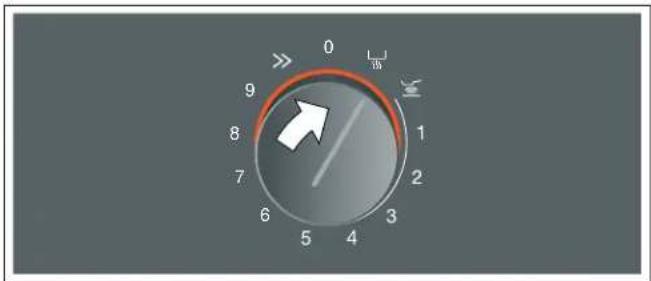
Push in the control knob and turn it to the ☐ position. The illuminated ring around the control knob will turn orange.
text_image
0 9 8 7 6 5 4 3 2 1 36The function has now been activated.
Deactivating
Turn the control knob to the 0 position. The cooking zone will switch itself off and the residual heat indicator will light up.
Cleaning and Maintenance
Daily Cleaning
Note: Recommended cleaners indicate a type of cleaner and do not constitute an endorsement of a specific brand.
Glass Ceramic Cooktop

CAUTION
Do not use any kind of cleaner on the glass while the surface is hot; use only the razor blade scraper. The resulting fumes can be hazardous to your health. Heating the cleaner can chemically attack and damage the surface.
Clean the surface when it is completely cool, with the following exception: remove dry sugar, sugar syrup, tomato products and milk immediately with the razor blade scraper (see cleaning chart).
Wipe off spatters with a clean, damp sponge or a paper towel. Rinse and dry. Use white vinegar if smudge remains; rinse.
Apply a small amount of the glass ceramic cooktop cleaner. When dry, buff surface with a clean paper towel or cloth.
Stainless steel side trim
Use a cleaning pad for this piece. For moderate or heavy soil, use a powder cleaner such as BonAmi® or SoftScrub® (without bleach).
Wipe using a damp sponge or cloth, rinse and dry.
Control knob
Wipe with warm soapy cloth, rinse and dry.
Cleaning Guidelines
When using a cleaner, use only a small amount; apply to a clean paper towel or cloth. Wipe on the surface and buff with a clean dry towel.
For best results, use cleaners such as glass ceramic cooktop cleaner, BonAmi®, Soft Scrub® (without bleach), and white vinegar.
Avoid these Cleaners
- Glass cleaners which contain ammonia or chlorine bleach. These ingredients may damage or permanently stain the cooktop.
- Caustic cleaners - cleaners such as Easy Off® may stain the cooktop surface.
- Abrasive cleaners.
- Metal scouring pads and scrub sponges such as Scotch Brite® can scratch and/or leave metal marks.
- Soap-filled scouring pads such as SOS® can scratch the surface.
- Powdery cleaners containing chlorine bleach can permanently stain the cooktop.
- Flammable cleaners such as lighter fluid or WD-40.
Cleaning Chart
Type of Soil Possible Solution
Dry sugar, sugar syrup, milk or tomato spills. Melted plastic film or foil. All these items REQUIRE IMMEDIATE REMOVAL. Failure to remove these immediately can permanently damage the surface.
Remove these types of spills while the surface is hot using the razor blade scraper. Use a new, sharp razor in the scraper. Remove pan and turn off the cooking zone. Wearing an oven mitt, hold scraper at 30° angle, using care not to gouge or scratch the glass. Push soil off the heated area. After the surface has cooled, remove the residue and apply the glass ceramic cooktop cleaner.

WARNING
Risk of injury!
The blade is extremely sharp. Risk of cuts. Protect the blade when not in use. Replace the blade immediately when any imperfections are found. Follow manufacturer's instructions.
Burned-on food soil, dark streaks, and specks
Soften by laying a damp paper towel or sponge on top of soil for 30 minutes. Use a plastic scrubber and glass ceramic cooktop cleaner or use the razor blade scraper. Rinse and dry.
| Type of Soil Possible Solution | |
| Greasy spatters Use a soapy sponge or cloth to remove grease; rinse thoroughly and dry. Apply glass ceramic cooktop cleaner. | |
| Metal marks: Iridescent stains | Pans with aluminum, copper or stainless steel bases may leave marks. Treat immediately after surface has cooled with glass ceramic cooktop cleaner. If this does not remove the marks, try a mild abrasive (Bon Ami®, Soft Scrub® without bleach) with a damp paper towel. Rinse and reapply glass ceramic cooktop cleaner. Failure to remove metal marks before the next heating makes removal very difficult. |
| Hard water spots:Hot cooking liquids dripped on surface | Minerals in some water can be transferred onto the surface and cause stains. Use undiluted white vinegar, rinse and dry. Recondition with glass ceramic cooktop cleaner.Remove boilovers and stains before using the cooktop again. |
| Surface scratches:Small scratches are common and do not affect cooking. They become smoother and less noticeable with daily use of the glass ceramic cooktop cleaner. | Apply glass ceramic cooktop cleaner before using to remove sand-like grains and grit such as salt and seasoning. Scratches can be reduced by using pans with bases that are smooth, clean, and dry before use. Use recommended glass ceramic cooktop cleaner daily. |
| NOTICEAvoid contact with surface by jewelry, wrist watches and metallic utensils. These can scratch the surface. Do not stack kitchen utensils or dishware on the appliance. | |
Maintenance
This appliance requires no maintenance other than daily cleaning. For best results, apply cooktop cleaning cream daily.
FAQ
Noises
Why can I hear noises while I'm cooking?
Noises may be generated while using the cooktop depending on the base material of the cookware. These noises are normal for induction technology. They do not indicate a defect.
Possible noises:
A low humming noise like the one a transformer makes:
Occurs when cooking at a high heat setting. The noise disappears or becomes quieter when the heat setting is reduced.
Low whistling noise:
Occurs when the cookware is empty. The noise disappears when water or food is added to the cookware.
Crackling:
Occurs when using cookware made from layers of different material or when using cookware of different sizes and different materials at the same time. The volume of the noise can vary depending on the quantity of food being cooked or the cooking method.
High-pitched whistling noises:
Can occur when two burners are used on the highest heat setting at the same time. The whistling noises disappear or become quieter when the heat setting is reduced.
Fan noise:
The cooktop is equipped with a fan that switches on automatically at high temperatures. The fan may continue to run even after you have switched off the cooktop if the temperature detected is still too high.
Cookware
Which types of cookware can be used with an induction cooktop?
For information on which types of cookware can be used with an induction cooktop, see the section entitled → "Cooking with Induction"
Why is the cooking zone not heating up?
The cookware is on a different cooking zone to the one that has been switched on.
Check that you have switched on the correct cooking zone.
The cookware is too small for the cooking zone that is switched on or it is not suitable for induction cooking.
Check that the cookware is suitable for induction cooking and that it is placed on the cooking zone that best corresponds to its size. For information on the type, size and positioning of the cookware, see the section entitled "Cooking with Induction".
Why is it taking so long for the cookware to heat up or why is it not heating up sufficiently despite being at a high power level?
The cookware is too small for the cooking zone that is switched on or it is not suitable for induction cooking.
Check that the cookware is suitable for induction cooking and that it is placed on the cooking zone that best corresponds to its size. For information on the type, size and positioning of the cookware, see the section entitled "Cooking with Induction".
Cleaning
How do I clean the cooktop?
Optimal results can be achieved with cleaning products specifically for use on glass-ceramic surfaces. Do not use harsh or abrasive cleaning products, dishwasher detergents (concentrates), or scouring pads.
You can find more information about cleaning and caring for your cooktop in the section on → "Cleaning and Maintenance"
What to Do in the Event of a Fault?
Generally, faults are easy to remedy. Please read the notes in the table before calling Customer Service.
CAUTION
Repairs should only be done by an authorized servicer.
Improper repair of your appliance may result in risk of severe physical injury or death.
Display Possible cause Solution
| None The power supply has been disconnected.The appliance has not been connected as shown in the circuit diagram.Electronics fault. If you are unable to rectify the fault, contact our technical after-sales service. | Use other electrical appliances to check whether a short circuit has occurred in the power supply.Make sure that the appliance has been connected as shown in the circuit diagram. | |
| The illuminated ring around the control knob is flashing orange and white | The cooking zone has been operating continuously for an extended period. | Turn the control knob to the 0 position. Switch the cooking zone back on. |
| The control knob has not been turned for an extended period. | ||
| The electronics have overheated and the affected cooking zone has been switched off.The electronics have overheated and all the cooking zones have been switched off. | Wait until the electronics have cooled down sufficiently before switching the cooking zone back on. | |
| Three signals sound and the illuminated ring lights up three times | The PowerBoost function has not been activated correctly. | See the section entitled → "PowerBoost Feature" on page 17. |
| The PowerBoost function has been deactivated automatically to protect the electronic elements inside the cooktop. | Turn the control knob to the 0 position. Switch the cooking zone back on as normal. | |
| The illuminated ring around the control knob is flashing orange quickly | The operating voltage is incorrect/out-side of the normal operating range. | Inform your electricity supplier. |
| The cooktop is not connected correctly | Disconnect the cooktop from the mains power supply. Make sure that it has been connected as shown in the circuit diagram. | |
Notes
- If the illuminated ring around the control knob is flashing orange quickly, disconnect the cooktop from the mains and then wait 30 seconds before reconnecting it. If this code is displayed again, contact the technical after-sales service and specify which fault code has appeared.
- If a fault occurs, the appliance does not switch to standby mode.
Demo Mode
If the illuminated ring around the control knob turns white and the cooking zone will not heat up, demo mode has been activated. Disconnect the appliance from the mains. Wait 30 seconds and then reconnect the appliance. Then deactivate demo mode within three minutes as follows:
- Turn the control knob anti-clockwise to position >>.
- Turn the same control knob clockwise to position ≈.
- Turn the same control knob anti-clockwise to position 0.
The illuminated ring around the control knob turns white.
The demo mode is deactivated.
Customer Service
If your appliance needs repairs, our Customer Service is there for you. We work hard to help solve problems quickly and without unnecessary service calls, getting your appliance back up and running correctly in the least amount of time possible.
When you call, please indicate the product number (E-Nr.) and serial number (FD-Nr.) so that we can support you in a qualified manner. You will find the data plate with these numbers on the bottom of the appliance. To avoid having to search when you need it, you can enter your appliance data and the Customer Service telephone number here.
E-Nr. FD-Nr.
Customer Service
Please read the use and care instructions provided with your appliance. Failure to do so may result in an error in using the appliance resulting in unnecessary service calls, which may not be covered by the warranty.
Please find the contact data of all countries in the enclosed customer service list.
To book a service visit and product advice USA 877 442 4436
toll-free
CANADA 877 442 4436
toll-free
Table des Matières
text_image
Ø16 cm Ø6 in Ø18 cm Ø7 in Ø28 cm Ø11 innatural_image
Illustration of three kitchenware items: a rectangular pan with a lid, a flat pan with a lid, and a wok (no text or symbols)natural_image
Illustration of two cooking panes with different interior designs (no text or symbols)natural_image
Illustration of a frying pan and its side view showing the exterior (no text or symbols)natural_image
Two geometric shapes: a square with a circle inside and a rectangle with two circles on top, labeled 1 and 2 (no text or symbols beyond labels)Activation
text_image
Ø16 cm Ø6 in Ø18 cm Ø7 in Ø28 cm Ø11 innatural_image
Illustration of kitchenware including a flat pan, lid with a decorative pattern, and a pan with a lid (no text or symbols)natural_image
Illustration of two cooking panes with different interior designs (no text or symbols)Recipientes no aptos
natural_image
Illustration of a frying pan and its side view showing the exterior (no text or symbols)natural_image
Two geometric shapes: a square with a circle inside and a rectangle with two circles on top, labeled 1 and 2 (no text or symbols beyond labels)Activar
1901 Main Street, Suite 600
Irvine, CA 92614
1-877-442-4436
www.gaggenau.com/us
© 2021 BSH Home Appliances