VI421 - Cooker GAGGENAU - Free user manual and instructions
Find the device manual for free VI421 GAGGENAU in PDF.


| Product Type | Freestanding Cooker |
| Brand | Gaggenau |
| Model | VI421 |
| Overall Width | 90 cm |
| Overall Height | 85 cm |
| Overall Depth | 60 cm |
| Weight | Approx. 80 kg |
| Power Source | Electric (220-240 V) |
| Oven Type | Multifunction electric oven |
| Oven Capacity | 76 L |
| Hob Type | Gas burners with electric ignition |
| Number of Burners | 5 |
| Oven Cleaning | Pyrolytic self-cleaning |
| Child Lock | Yes |
| Safety Features | Flame failure safety device, automatic shut-off |
| Energy Efficiency Class | A+ (oven) |
| Spare Parts Availability | Yes, through authorized service centers |
| Color | Stainless steel |
Frequently Asked Questions - VI421 GAGGENAU
User questions about VI421 GAGGENAU
0 question about this device. Answer the ones you know or ask your own.
Ask a new question about this device
Download the instructions for your Cooker in PDF format for free! Find your manual VI421 - GAGGENAU and take your electronic device back in hand. On this page are published all the documents necessary for the use of your device. VI421 by GAGGENAU.
USER MANUAL VI421 GAGGENAU
Operating and assembly instructions
VI 421
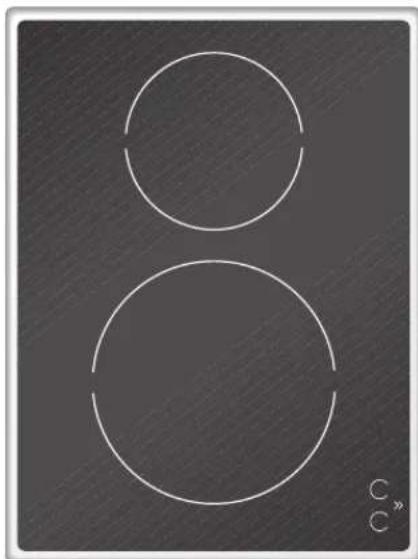
Induction cooktop
natural_image
Two white circles on a textured gray background, no text or symbols presentGAGGENAU
1. Important Notes Page 3-4
For your safety Page 3
Operating for the first time Page 4
About use Page 4
The advantages of cooking by induction Page 4
2. Features Page 5
Features
Special accessories Page 5
Page
3. Operation
Switching on and off Page 6
Indicator light / Pot recognition / Residual heat display Page 6
Booster function Page 7
Visual signals Page 8
Holiday safeguard Page 8
4. Settings table Page 9
5. Suitable cooking receptacles
and how to use them
Page 10
6. Cleaning and Care Page 11
Maintenance Page 12
8. Installation Page 13-16
Technical Data Page 13
Important notes on installation
Preparing the cabinet
Installing the control panel
Installing the cooktop
Page 13
Page 14
Page 15
Page 16
Congratulations on buying your new "Vario" appliance.
Before switching your appliance on for the first time, we would like you to familiarize yourself with your new appliance. In this manual you will find important notes on safety and operation. These will serve to ensure your personal safety and the lasting value of your appliance. Keep the instruction manual near your appliance for further reference.
You will find notes on Page 4 that you ought to observe before operating the appliance for the first time.
The chapters entitled "Features" and "Operation" tell you all about what your appliance can do and how you operate it.
The chapter entitled "Cleaning and Care" gives tips on how to keep your appliance looking good.
And now we wish you lots of fun cooking.

natural_image
Top-down view of a black electric stove with two circular cutouts and two side switches (no text or symbols)1. Important Notes
For your safety
Do not operate the appliance if it is damaged.
The appliance must only be connected by an authorised specialist, paying attention to the relevant regulations of the power supply companies and the regional construction regulations.
Observe the assembly instructions!
The appliance could be damaged if connected wrongly!
When connecting electrical appliances in the proximity of the cooktop, make sure that connecting cables do not come into contact with hot cooking surfaces.
Only ever operate the appliance under supervision. Observe caution with oils and fats. Overheated oils and fats can easily cause fires. Smother burning fat or oil. Never extinguish with water!
Caution: the appliance heats up during operation. Keep children away.
Do not operate the cooking position without pots and pans placed on them.
Do not heat up unopened tins on the hob. These may burst or explode.
To avoid jeopardising the electrical safety of the appliance, do not use high-pressure or steam jet cleaning devices.
This appliance is in full compliance with electromagnetic safety and compatibility standards. Persons fitted with pacemakers, hearing aids or other similar devices are not, however, recommended to use the appliance, as it is not possible to rule out interference which may adversely affect the correct working order of such devices.
Do not store any substances that are sensitive to high temperatures, or which pose a fire hazard (e.g. cleaning agents or spray cans), in drawers or cupboards under the appliance.
There are fans beneath the cooking hob. Warning! Small objects or pieces of paper kept beneath the cooking hob may either damage the fan if they are sucked into it or affect the cooling process. Do not place any objects in the cabinet underneath closer than 5 cm to the air intake. Remove any cooking foil / film.
Operation of the appliance must be discontinued immediately if improper use produces cracks, breaks or flaws on the cooking surface, with the result that live parts can come into contact directly or indirectly with seeping liquid or if there is a risk of injury. Remove the mains plug or switch off the corresponding mains fuse. Call after-sales service!
Isolate the appliance from the mains during every maintenance operation. To do this, remove the mains plug or switch off the corresponding fuse.
Repairs must be carried out by authorised specialists, thus ensuring electrical safety.
As the user, you are responsible for maintenance and proper use in the household. No warranty claims can be lodged for any damage resulting from failure to observe these instructions.
Note:
if you have fitted the appliance cover VD 400-000 (special accessory) on the appliance, it must not be closed until the appliance has cooled down completely. Do not operate the appliance with the cover closed! Heat development may damage the appliance and the cover. Do not use the appliance cover as a surface for placing objects or for keeping things warm.
Subject to technical change without notice.
Operating for the first time
Remove the packaging from the appliance and dispose of it according to local regulations. Be careful to remove all accessories from the packaging. Keep packaging elements and plastic bags away from children.
This appliance is labelled in accordance with the European Directive 2002/96/EG concerning used electrical and electronic appliances (waste electrical and electronic equipment – WEEE). The guideline determines the framework for
the return and recycling of used appliances as applicable.
Check the appliance for transport damage before installing it.
The appliance must be installed and connected by an authorised specialist before operation. Before operating the appliance for the first time, make sure that the mains connection is in proper working order.
The serial number of the appliance can be found on the quality control slip which is included with these instructions. This quality control slip should be kept, for guarantee reasons, together with your operating and assembly instructions.
Read through these instructions attentively before operating your appliance for the first time.
Thoroughly clean the appliance and accessories before using them for the first time. This will eliminate any ‘newness’ smells and soiling (see chapter “Cleaning and care”).
About use
The appliance is intended solely for household use and must not be put to any other uses.
Use the appliance to prepare meals only. Do not use the appliance to heat up the room in which it is installed.
The air inlets in the cabinet should not be covered in any way.
Do not use the cooking surface to store items. Do not place food wrapped in silver foil, cutlery, pot lids or any other kind of metal object on the induction cooking hob. Should the appliance be switched on accidentally, these objects will heat up very quickly and may produce burns.
Switch off the hob after use.
Always keep the cooking area dry and clean.
Built-in overheating protection prevents overheating of the appliance and of surrounding kitchen furniture.
In the event of malfunction, first check your household fuses. If the power supply is in proper working order, but the appliance is still not functioning, please inform your specialist dealer or your nearest Gaggenau customer service.
The advantages of cooking by induction
The heating process takes place at great speed within the receptacle used in the total absence of either flame or perceivable heat source. It is not necessary for heat to pass from the vitroceramic surface to the cooking receptacle. That is why cooking by induction offers the following advantages:
- Fast cooking and frying, saving on both time and energy consumption.
- The hob supplies or cuts heat once the control knob is activated. It even cuts the heat supply off should the receptacle be removed from the cooking plate without having been previously turned off.
- Splashes or spillages of foodstuffs do not burn on the cooking hob and smoke is not formed because the hob does not reach temperatures high enough to do so.
2. Features
Features

text_image
1 2 3 4 51 Induction cooking zone ∅ 15 cm (1400 W, with booster 1800 W)
2 Induction cooking zone ∅ 21 cm (2200 W, with booster 3300 W)
3 Display panel
4 Control knob for front cooking zone
5 Control knob for rear cooking zone
Special accessories
You can order the following special accessory:
VV 400-000 Connecting trim
VZ 400-000 Connecting trim with timer
VD 400-000 Appliance cover
3. Operation

text_image
Switching on 10 12 8 5 3 2 1 0 12 4 3 2 10 6 5
text_image
Switching off 0 12 1 2 3 4 5 6 7 8 9 10 11 12 13 14 15 16 17 18 19 20
text_image
Indicator light / Pot recognition / Residual heat displaySwitching on
Press down the control knob and turn it left or right to the required position (1-12). The luminous disc behind the control knob and the indicator light on the display panel light up, as long as the cooking zone is switched on.
During operation, a noise may be heard depending on the material of the pot, the amount of the contents and the selected cooking level. This is normal. The cooling fan of the induction unit may go on and off during operation.
Switching off
Fully turn the control knob to the OFF position.
The luminous disc goes off.
Please note: the induction cooking zone does not emit any warmth after being switched off.
Indicator light
The indicator light on the display panel lights, as long as the cooking zone is switched on.
Pot recognition
The indicator light on the display panel flashes and the cooking zone does not operate, if no pan or an unsuitable receptacle (too small, non-magnetic) has been placed on the cooking zone.
Residual heat display
Although induction-cooking plates do not reach the same high temperatures as traditional cooking plates, they can remain hot after cooking when used over long periods of time through contact with the heated receptacle. This is why the hob has a residual heat display. After switching off the indicator light will flash, as long as the cooking zone has not cooled down sufficiently to be touched safely.
Note: the duration of the residual heat display is based on the length of the operation and the cooking power level. The residual heat display may still flash for some time despite cooling down, depending on the food and the size of the cooking receptacle.
Booster function

text_image
Activating
text_image
Booster indicatorBoth cooking zones feature a booster function which will boost the power of the cooking zone for a short time. This allows you to heat up food even faster. If one cooking zone is operated with the booster function and the other cooking zone is being operated, the booster function will be de-activated and the cooking zone will operate at level 12.
Activating the booster function
Press down the control knob and turn it left to the booster symbol ☒The indicator light and the booster indicator on the display panel light up, as long as the booster function activated.
De-activating the booster function
Turn the control knob to the required position (1-12). The booster function is now de-activated. The booster indiator goes off.
Note: under certain conditions the booster function will be de-activated automatically in order to protect electronic components in your appliance.
Visual signals
| luminous disc behind indicator light operating mode the control knob on the cooker | ||
| ○ | ○ | appliance is OFF |
| ● | ● | appliance is ON, pot recognized, normal use |
| ● | ★ | appliance is ON, no pot recognized |
| ○ | ★ | appliance is OFF, residual heat display |
| ★ | ★ | overheating protection*, power cut* |
| ★ | ○ | holiday safeguard*, faulty installation (Connecting cable between the appliance and the control panel is not plugged in) |
Symbol description:

off

flashes

lights
*Turn control knob to 0, if the luminous disc behind the control knob flashes and the appliance does not heat up. Let overheated appliance cool down before switching back on.
Holiday safeguard (Automatic switch-off)
The appliance is set to automatically switch off should a longer period of time elapse without changing the settings. The switch-off time depends on the level of setting being used (between 1 to 4 hours). The luminous disc behind the control knob flashes. Turn the control knob to 0. Now the cooking zone can be switched on again as normal.
- Settings table
| Quantity | Heat | Ongoing setting 12 heat setting cooking time | cooking | Ongoing | |
| Melting | |||||
| Chocolate, chocolate coating, butter, honey 100 g - 1-2 - Gelatine 1 packet - 1-2 - | |||||
| Heating | |||||
| Canned vegetables 400 g-800 g 1-3 mins. 2-4 3-6 mins. | |||||
| Clear soup | 500 ml-1 litre | 2-3 mins. | 10-11 | 2-4 mins. | |
| Thick soup 500 ml-1 litre | 1-3 mins. 2-4 2-4 mins. | ||||
| Milk | 200 ml-400 ml | 1-3 mins. | 1-3* | 2-4 mins. | |
| Heating and keeping warm | |||||
| Stew (e.g. lentil stew) | 400 g-800 g 1-2 mins. 1-2 - | ||||
| Milk | 500 ml-1 litre | 2-3 mins. 1-3* | - | ||
| Defrosting and heating | |||||
| Frozen spinach | 300 g-600 g 3-4 mins. 3-5 5-15 mins. | ||||
| Frozen goulash | 500 g-1 kg | 3-4 mins. 3-5 20-30 mins. | |||
| Simmering | |||||
| Dumplings (1-2 liters water) | 4-8 pieces | 6-9 mins. | 7-9* | 20-30 mins. | |
| Fish | 300 g-600 g 3-6 mins. 7-9* | 10-15 mins. | |||
| Cooking | |||||
| Rice (with double the amount of water) | 125 g-250 g 2-4 mins. 3-5 15-30 mins. | ||||
| Rice pudding (500 ml-1 liter milk) | 125 g-250 g 3-5 mins. 2-4 25-35 mins. | ||||
| Potatoes boiled in their skins with 1-3 cups water | 750 g-1.5 kg | 3-5 mins. 6-8 30-35 mins. | |||
| Boiled potatoes with 1-3 cups water | 750 g-1.5 kg | 3-5 mins. | 6-8 | 15-25 mins. | |
| Fresh vegetables with 1-3 cups water | 500 g-1 kg | 3-4 mins | 6-8 | 10-20 mins. | |
| Pasta (1-2 litres water) | 250 g-500 g 6-9 mins. 9-10* 6-10 mins. | ||||
| Roasting | |||||
| Roulade | 4 pieces | 4-6 mins. 6-8 50-60 mins. | |||
| Pot roast 1 kg | 4-6 mins. 6-8 60-100 mins. | ||||
| Goulash | 500 g 4-8 mins. 6-8 50-60 mins. | ||||
| Frying | |||||
| Pancakes | - | 1-2 mins. | 9-10 | constant frying | |
| Cutlet, breaded | 1-2 pieces | 1-2 mins. | 9-10 | 8-12 mins. | |
| Steak | 2-3 pieces | 1-2 mins. | 10-11 | 8-12 mins. | |
| Fish fingers | 10 pieces | 1-2 mins. | 9-10 | 8-12 mins. | |
| Deep-fat frying (in 1-2 litres oil) | |||||
| Deep-frozen foods | 200 g per serving | 8-13 mins. | 11-12* | constant deep-fat frying | |
| Others | 400 g per serving | 8-13 mins. | 6-8* | constant deep-fat frying | |
| * Ongoing cooking without lidThe values given above must be looked upon as recommended values. | |||||
5. Suitable cooking receptacles and how to use them

natural_image
Four identical cooking pots with a diagonal line crossing them, no text or symbols presentEnergy saving tips
Werecommend that you use high quality pots and pans with thick flat bases. Uneven pan bases lengthen the cooking time unnecessarily.
Choose the correct sized pot or pan for the amount of food to be prepared. A large pan, which is only partly full will use much more energy.
Pots and saucepans should always be covered by a matching lid. The cooking time is shortened and the energy use reduced.
Switch the cooking level of the cooking zone down when necessary. Boiling water does not need to bubble.
Only ferromagnetic receptacles are suitable for cooking by Induction. To see if your receptacles are suitable, make sure that they are attracted to a magnet. Receptacles made of enamelled steel, cast iron or special stainless-steel receptacles (designed for cooking by induction) can all be used. Do not use receptacles made of thin normal steel or glass, earthenware, copper or aluminium.
When a cooking receptacle is made of unsuitable material or is too small for the cooking zone, then the cooking zone does not operate and the indicator light on the display panel flashes.
Ensure saucepans are not allowed to heat up when empty. Otherwise, both the saucepan base and the vitroceramic surface may be damaged.
Observe the manufacturer's instructions before using a special receptacle.
6. Cleaning and Care
Note: to avoid jeopardising the electrical safety of the appliance, do not use high-pressure or steam jet cleaning devices – risk of short circuits!
Caution, risk of burns! Before cleaning, please wait until the hob has cooled to hand-warm.
Please thoroughly clean the appliance before operating it for the first time and after every use.
Clean the hob with a damp, soft cloth or kitchen paper and the Gaggenau glass ceramic cleaner or similar cleaner suitable for glass ceramic cooktops. Polish with a soft, dry cloth.
The Gaggenau glass ceramic cleaner will coat the glass ceramic hob with a gleaming, dirt repellent film. This will help to preserve the attractive appearance of your hob over a long period of time and make it easier to clean as well.
Do not apply the cleaner while the hob is still hot as this may cause stains.
Do not use scouring agents, abrasives or chemically aggressive cleaners (for example oven cleaner)! Do not use any nitro polishing agents for cleaning! Do not use any abrasive sponges either.
Food with a high sugar content (e.g. boiled-over milk, jam) can damage the surface of your hob. Immediately remove such food using the glass scraper.
Iridiscent discoloration can be caused by the bases of some pots.
These do not interfere with the operation of the glass ceramic hob.
Please refer to the enclosed brochure for further notes on cleaning.
You can order our blade scraper (Order No. 087670) and the Gaggenau glass ceramic cleaner (Order No. 098690) from your Gaggenau dealer.
The frame of the hob should be cleaned using a soft, damp cloth and light soapy liquid or a commercially available stainless steel cleaner.
7. Maintenance
The appliance must always be disconnected from the mains when being repaired.
If the appliance does not function correctly, check the household fuses first.
If the power supply is functioning correctly, but your appliance still does not work, please contact your dealer or your local Gaggenau customer service agency. Specify the appliance type. The serial number and type of the appliance can be found on the quality control slip which is included with these instructions.
Repairs may only be carried out by authorised electricians, in order to guarantee the safety of the appliance.
Unauthorised tampering with the appliance will invalidate any warranty claims.
8. Installation
Technical Data
Total connected load: 3 600 W / 220-240 V
Important notes on installation
This appliance can be combined with all Gaggenau Vario 400 Series appliances.
This appliance may be installed in kitchen combinations made of wood or similar combustible materials without taking additional safety measures. The built-in furniture and worktop where the appliance is installed must be heat resistant up to temperatures of 200^ F/ 90^ C.
The appliance must only be connected by an authorised specialist, paying attention to the relevant regulations of the power supply companies and the regional construction regulations.
The mains connecting cable must at least correspond to type H 05 VV-F (3 x 1.5 mm). Pay attention to the data on the rating plate. The appliance must be properly grounded.
When connecting electrical appliances in the proximity of cooking surfaces, make sure that connecting cables do not come into contact with hot cooking surfaces.
The installation technician is responsible for the correct functioning of the appliance at the place of installation. He must instruct the user on how to disconnect the appliance from electricity in an emergency.
After unpacking, check the appliance for any transportation damage and report this immediately to the transportation company.
There must be a gap of at least 20 mm at the side between the appliance and any walls or furnishings.
Ventilation openings must be installed in the cabinet, in order to maintain sufficient air circulation for the underside of the appliance. Please refer to the installation drawing.
If all poles of the appliances cannot be isolated from the mains by removing an accessible plug, an isolating device with a contact gap of at least 3 mm must be installed (e.g. domestic fuse).
No warranty claims can be lodged for any damage resulting from failure to observe these instructions. Pay attention to the “Important notes” on page 3 and 4.
Subject to technical change without notice.
Preparing the cabinet
text_image
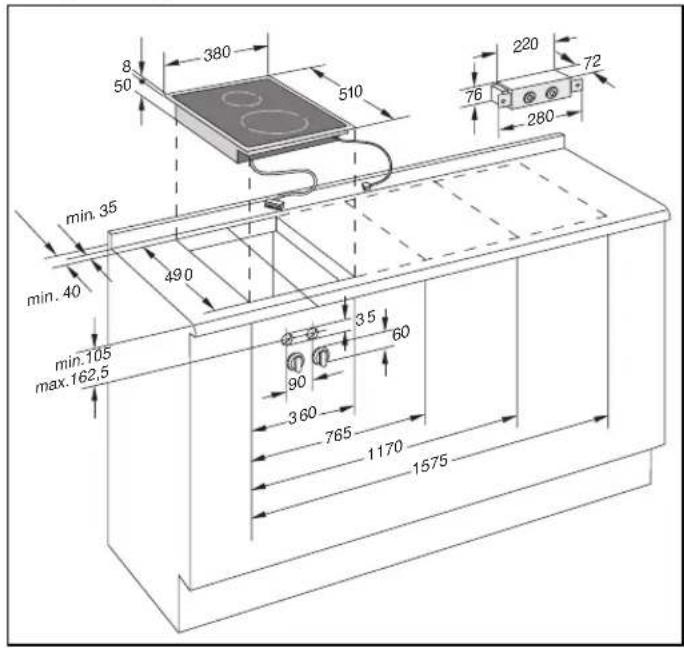
8 50 380 510 220 76 72 280 min. 35 min. 40 490 min.105 max.162,5 35 60 90 360 765 1170 1575- Cut out the recess for the hob in your worktop. Proceed as indicated on the installation sketch. The installation sketch contains the measurements of the space required for the trim between the appliances. Several appliances can also be installed in individual recesses, as long as a minimum clearance of 50 mm is kept to between the appliances.
- As shown in the installation sketch, drill the ∅ 3 5 mm holes to secure the control knobs in the cabinet front.
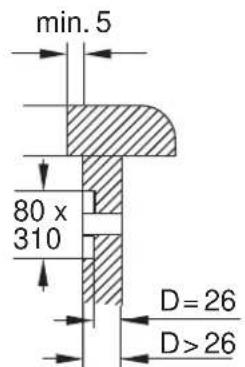
- If the cabinet front is thicker than 26 mm, the front must be routed from the back to max. 26 mm on an area of 80 x 310 mm.
text_image
min. 5 80 x 310 D = 26 D > 26
text_image
min. 5 16-26- It is possible to install the appliance above a ventilated built-in oven. Observe the installation instructions. Remove the rear wall of the kitchen cabinet to ensure air circulation of the appliance. Leave a ventilation gap of 20 mm behind the oven or the kitchen cabinet and the wall.
Installing the control panel
natural_image
Technical illustration of mechanical assembly with mounting brackets and gear components (no text or symbols)
natural_image
Two identical circular dial gauges with measurement markings, no visible text or symbols
natural_image
Technical illustration of a mechanical assembly with two circular components and alignment lines (no text or symbols)Note:
only install control panel with appliance of the corresponding type.
Before connecting the appliance, make sure the electricity is switched off at fuse point!
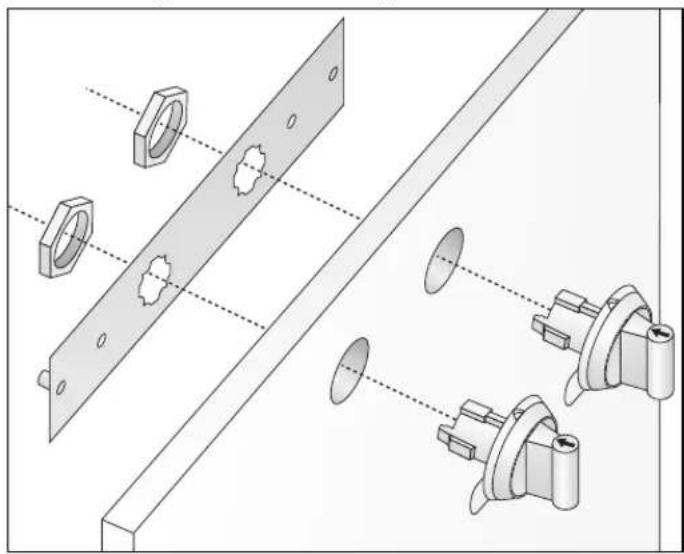
- Before installation, remove all styrofoam packaging from the control knobs and peel off the protective film behind the luminous discs.
- Hold the support plate from the rear against the cabinet front, insert control knobs into the holes, secure from the rear with the nuts. Take care to install control knobs in the correct order: left for front cooking zone, right for rear cooking zone.
- Secure the control panel with the included nuts onto the support plate.
Installing the cooktop

natural_image
Pure mechanical diagram showing a lever mechanism with no text, numbers, or symbols
natural_image
Pure mechanical assembly diagram showing a lever and two vertical supports with arrows indicating motion direction (no text or symbols)Please note when installing the appliance cover VD 400-000 (special accessory):
Two brackets are supplied with the cooktop. Screw the brackets on the rear of the cookop before installation (see installation instructions VD 400-000).
- Firmly plug the connecting cable in the cooktop and in the control panel (the plugs must lock into place).
- Insert the hob with the control panel on the front into the cut-out and align it.
Note: do not stick the hob onto the worktop with silicone.
- Secure the appliance on the worktop with the 4 clamping screws included.
- Connect the appliance to the electricity. Test that it functions correctly. If the luminous disc behind the control knob blinks, check the connecting cable between the appliance and the control panel is firmly plugged in.
GAGGENAU
GAGGENAU HAUSGERÄTE GMBH
CARL-WERY-STR. 34 · D-81739 MÜNCHEN
(089) 45 90-03
FAX (089) 45 90-23 47
www.gaggenau.com