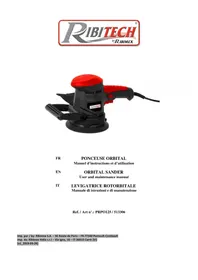
PRPO125 - Sander RIBIMEX - Free user manual and instructions
Find the device manual for free PRPO125 RIBIMEX in PDF.

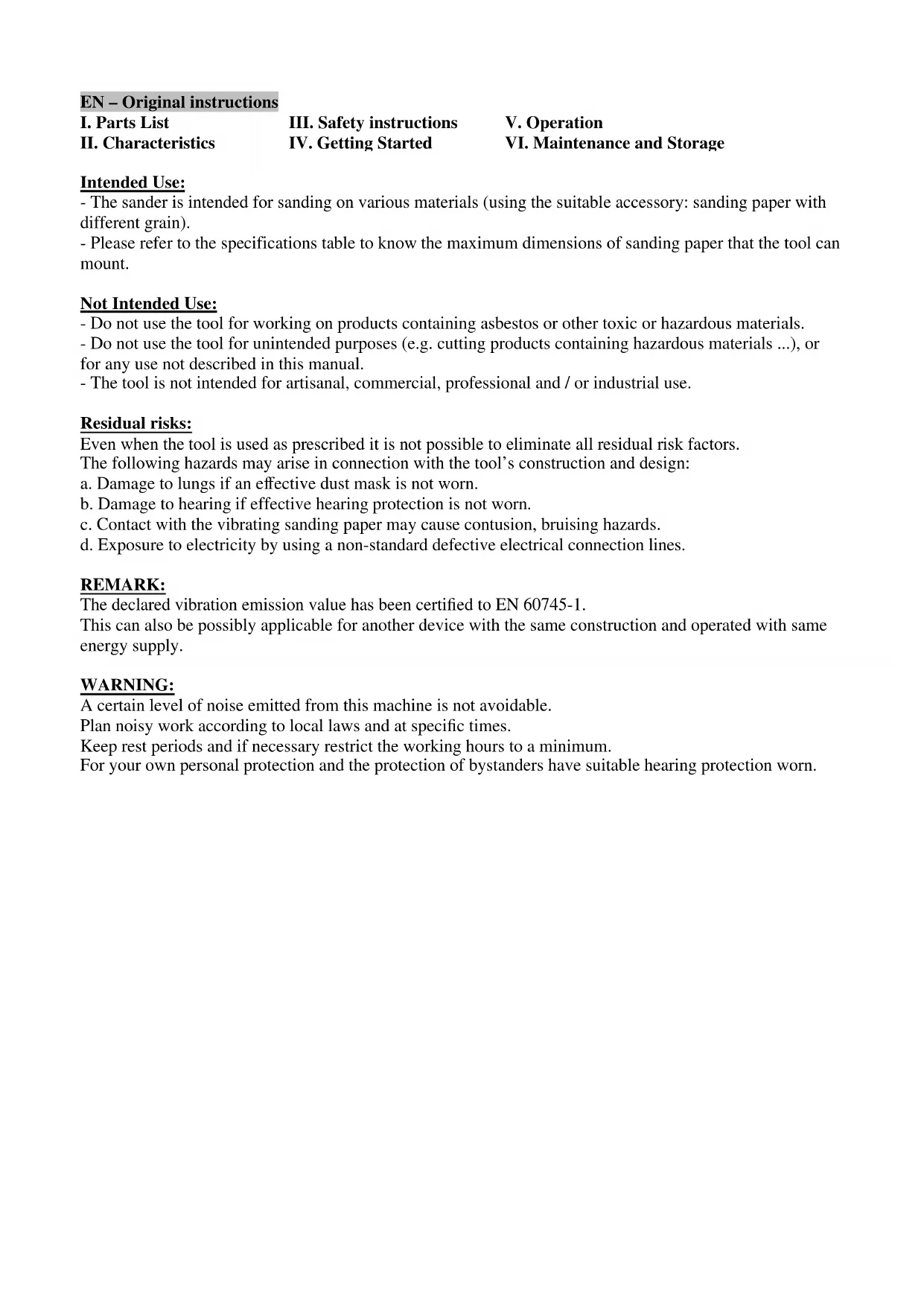


| Product type | Orbital sander |
| Brand | Ribimex |
| Model | PRPO125 |
| Intended use | Dry sanding of small surfaces, indoor household use |
| Motor type | Electric with double insulation (class II) |
| Power supply | Mains, 230 V ~ 50 Hz (typical estimate) |
| Rated power | 200 W (estimate) |
| Variable speed | Yes, by dial |
| Orbit diameter | Not specified, typical ~1.5 mm |
| Pad dimensions | Not specified, typical ~110 x 110 mm |
| Abrasive attachment type | Hook-and-loop (Velcro) |
| Dust collection bag | Included, empty regularly |
| Weight | Approximately 1.5 kg |
| Noise level | See characteristic table (not provided) |
| Vibration level | Certified according to EN 60745-1 |
| Required protective equipment | Safety glasses, dust mask, hearing protection, gloves |
| Maintenance | Clean with a soft cloth, do not immerse, empty dust bag |
| Repairability | Spare parts available, repair by qualified personnel only |
| Warranty | Conforms to legislation of the country of sale, covers material and manufacturing defects |
| After-sales service (SAV) | Ribimex, 56 Route de Paris, F-77340 Pontault-Combault, Tel: 08 92 35 05 77, Email: sav@ribimex.fr |
Frequently Asked Questions - PRPO125 RIBIMEX
User questions about PRPO125 RIBIMEX
0 question about this device. Answer the ones you know or ask your own.
Ask a new question about this device
Download the instructions for your Sander in PDF format for free! Find your manual PRPO125 - RIBIMEX and take your electronic device back in hand. On this page are published all the documents necessary for the use of your device. PRPO125 by RIBIMEX.
USER MANUAL PRPO125 RIBIMEX
User and maintenance manual
IT LEVIGATRICE ROTORBITALE
Ref./Art ^ :PRPO125/513306

AVERTISSEMENT :
Carefully read this instruction manual before operating this appliance.
Incorrect operation may cause injury and/or damages.
Please keep this manual for future reference.

AVVERTENZA:
EN - Original instructions
I. Parts List
II. Characteristics
III. Safety instructions
IV. Getting Started
V. Operation
VI. Maintenance and Storage
Intended Use:
-
The sander is intended for sanding on various materials (using the suitable accessory: sanding paper with different grain).
-
Please refer to the specifications table to know the maximum dimensions of sanding paper that the tool can mount.
Not Intended Use:
- Do not use the tool for working on products containing asbestos or other toxic or hazardous materials.
- Do not use the tool for unintended purposes (e.g. cutting products containing hazardous materials ...), or for any use not described in this manual.
- The tool is not intended for artisanal, commercial, professional and/or industrial use.
Residual risks:
Even when the tool is used as prescribed it is not possible to eliminate all residual risk factors.
The following hazards may arise in connection with the tool's construction and design:
a. Damage to lungs if an effective dust mask is not worn.
b. Damage to hearing if effective hearing protection is not worn.
c. Contact with the vibrating sanding paper may cause contusion, bruising hazards.
d. Exposure to electricity by using a non-standard defective electrical connection lines.
REMARK:
The declared vibration emission value has been certified to EN 60745-1.
This can also be possibly applicable for another device with the same construction and operated with same energy supply.
WARNING:
A certain level of noise emitted from this machine is not avoidable.
Plan noisy work according to local laws and at specific times.
Keep rest periods and if necessary restrict the working hours to a minimum.
For your own personal protection and the protection of bystanders have suitable hearing protection worn.
III. SAFETY INSTRUCTIONS

WARNING: Read all safety warnings and all instructions.
- Failure to follow the warnings and instructions may result in electric shock, fire and/or serious injury.
- Before using this power tool, please carefully read and understand all safety instructions
Save all warnings and instructions for future reference and use them to train others who may use this tool.
If you lend or pass this tool, be sure to attach these instructions so that any user can refer to them.
The term "power tool" in the warnings refers to your mains-operated (corded) power tool or battery-operated (cordless) power tool.
3.1- Symbols
Explanation of symbols on tool, when affixed.
| Do not expose to weather conditions (ex.: storm, rain, snow ...) or moisture. Do not use in damp or wet areas. | |
| Caution! Risk of injury and/or damage and/or deterioration of product in case of non-compliance to safety requirements. | |
| Read the instructions manual. | |
| Wear protective equipment: ear protection, goggles and face mask. | |
| Wear protective gloves and boots. | |
| Keep all your body parts away from moving parts. Do NOT touch the vibrating sanding paper nor the working plate. | |
| Keep persons (esp. children) and animals away from product and working area. | |
| Class II equipment. | |
| Warning: electric hazard. Disconnect product from its power source before maintenance, cleaning or any intervention on product; or when you do not use product. Disconnect product from its main power source, if product, power cable, or extension cord is damaged or cut during operation. Unplug product by pulling the plug. Do not pull the cable. | |
| Do not dispose of this product with household rubbish. Disposition of this product in the nearest recycle centre. Please contact your local authority or local recycle centre for further information for its safe disposal. |
3.2- General safety warnings for power tools
1) Work area safety
a) Keep work area clean and well lit. Cluttered or dark areas invite accidents.
b) Do not operate power tools in explosive atmospheres, such as in the presence of flammable liquids, gases or dust. Power tools create sparks which may ignite the dust or fumes.
c) Keep children and bystanders away while operating a power tool. Distractions can cause you to lose control.
d) Protect the stand, the workbench or the tool's installation location from children. Protect with padlocks, master switches, or by removing starter key (if equipped) to reduce the risk of accidents.
2) Electrical safety
a) Power tool plugs must match the outlet. Never modify the plug in any way. Do not use any adapter plugs with earthed (grounded) power tools. Unmodified plugs and matching outlets will reduce risk of electric shock.
b) Avoid body contact with earthed or grounded surfaces, such as pipes, radiators, ranges and refrigerators. There is an increased risk of electric shock if your body is earthed or grounded.
c) Do not expose power tools to rain or wet conditions. Water entering a power tool will increase the risk of electric shock.
d) Do not abuse the cord. Never use the cord for carrying, pulling or unplugging the power tool. Keep cord away from heat, oil, sharp edges or moving parts. Damaged or entangled cords increase the risk of electric shock.
e) When operating a power tool outdoors, use an extension cord suitable for outdoor use. Use of a cord suitable for outdoor use reduces the risk of electric shock.
f) If operating a power tool in a damp location is unavoidable, use a residual current device (RCD) protected supply. Use of an RCD reduces the risk of electric shock.
3) Personal safety
a) Stay alert, watch what you are doing and use common sense when operating a power tool. Do not use a power tool while you are tired or under the influence of drugs, alcohol or medication. A moment of inattention while operating power tools may result in serious personal injury.
b) Use personal protective equipment. Always wear eye protection. Protective equipment such as dust mask, non-skid safety shoes, hard hat, or hearing protection used for appropriate conditions will reduce personal injuries.
c) Prevent unintentional starting. Ensure the switch is in the off-position before connecting to power source and/or battery pack, picking up or carrying the tool. Carrying power tools with your finger on the switch or energising power tools that have the switch on invites accidents.
d) Remove any adjusting key or wrench before turning the power tool on. A wrench or a key left attached to a rotating part of the power tool may result in personal injury.
e) Do not overreach. Keep proper footing and balance at all times. This enables better control of the power tool in unexpected situations.
f) Dress properly. Do not wear loose clothing or jewellery. Keep your hair, clothing and gloves away from moving parts. Loose clothes, jewellery or long hair can be caught in moving parts.
g) If devices are provided for the connection of dust extraction and collection facilities, ensure these are connected and properly used. Use of dust collection can reduce dust-related hazards.
4) Power tool use and care
a) Do not force the power tool. Use the correct power tool for your application. The correct power tool will do the job better and safer at the rate for which it was designed.
b) Do not use the power tool if the switch does not turn it on and off. Any power tool that cannot be controlled with the switch is dangerous and must be repaired.
c) Disconnect the plug from the power source and/or the battery pack from the power tool before making any adjustments, changing accessories, or storing power tools. Such preventive safety measures reduce the risk of starting the power tool accidentally.
d) Store idle power tools out of the reach of children and do not allow persons unfamiliar with the power tool or these instructions to operate the power tool. Power tools are dangerous in the hands of untrained users.
e) Maintain power tools. Check for misalignment or binding of moving parts, breakage of parts and any other condition that may affect the power tool's operation. If damaged, have the power tool repaired before use. Many accidents are caused by poorly maintained power tools.
f) Keep cutting tools sharp and clean. Properly maintained cutting tools with sharp cutting edges are less likely to bind and are easier to control.
g) Use the power tool, accessories and tool bits etc. in accordance with these instructions, taking into account the working conditions and the work to be performed. Use of the power tool for operations different
5) Service
a) Have your power tool serviced by a qualified repair person using only identical replacement parts. This will ensure that the safety of the power tool is maintained
3.3- Specific Safety Instructions for sanders
1- This power tool is intended to function as a tool for sanding and polishing operations. Read all safety warnings, instructions, illustrations and specifications provided with this tool. Failure to follow all instructions listed below may result in electric shock, fire and/or serious injury.
2- This power tool is not recommended nor intended for cut-off operations. Operations for which the tool is not designed may create a hazard and cause personal injury.
3- Do not use accessories which are not specifically designed and recommended by the tool's manufacturer. It is not because an accessory can be attached to your tool; that it can assure safe operation.
4- The rated speed of the accessory must be at least equal to the maximum speed marked on the tool. Accessories operated faster than their rated speed can break and fly apart.
5- The dimensions and the thickness of your accessory must be within the capacity rating of your tool. Incorrectly sized accessories cannot be adequately guarded or controlled.
6- Only use power tool for dry works. Water entering power tool increases the risk of an electric shock.
7- Do not use damaged accessories.
Before each use, inspect the accessories such as abrasive paper for chips and cracks, sanding pads for cracks, tears or excess wear.
If tool or accessory is dropped, inspect for damage or install an undamaged accessory.
8- Wear personal protective equipment.
According to your application, use face shield, safety goggles or safety glasses.
As deemed appropriate, wear dust mask, hearing protectors, gloves and workshop apron capable of stopping small abrasive or workpiece fragments. The eye protection must be capable of stopping flying debris generated by various operations. The dust mask must be capable of filtrating particles generated by your operation. Prolonged exposure to high intensity noise may cause hearing loss.
9- Keep bystanders at a safe distance away from the working area. Anyone entering the work area must wear personal protective equipment. Fragments of workpiece or of a broken accessory may fly away and cause injury beyond immediate area of operation.
10- Always position the power cord clear of the moving accessory. Should you lose control of the tool, the cord may be cut or snagged and your hand or arm may be pulled into the spinning accessory.
11- Regularly clean the power tool's air vents. The motor's fan will draw the dust inside the housing and excessive accumulation of powdered metal may cause electrical hazards.
12- Do not operate the power tool near flammable materials. Sparks could ignite these materials.
13- Warning! Fire hazard! Avoid workpiece and/or power tool overheating.
Always empty the dust collection bag before taking a work break. Dust particles in the dust bag, micro filter, paper bag (or in the fabric dust bag or vacuum cleaner filter) may ignite on their own under unfavorable conditions, e.g. projection of sparks when sanding metal parts, in particular when the dust particles are mixed with residues of varnish, polyurethane or other chemical substances and the workpieces become very hot after a long period of work.
3.4- Specific Safety Instructions for sanding operations
Do not use oversized sandpaper pads for sanding platen.
Follow manufacturers' recommendations when selecting sandpaper. Larger sandpaper protruding
beyond the sanding platen presents a laceration hazard and may cause a fixing.
3.5- Additional Safety Instructions
a- Wear safety goggles
b- Set the On/Off switch to the "OFF" position when the power supply is interrupted, e. g., in case of a power failure or when the mains plug is pulled. This prevents uncontrolled restarting.
c- Keep your workplace clean. The mixture of materials is particularly dangerous. Dust from light alloys can burn or explode.
d- Never use the tool with a damaged cable. Do not touch the damaged cable and pull the mains plug when the cable is damaged while working.
If the supply cord is damaged, it must be replaced by the manufacturer, its service agent or similarly qualified persons in order to avoid a hazard. A damaged cable increases the risk of an electric shock.
e- Sanders for woodworking are tools where a considerable amount of dust is generated.
Avoid any accumulation of dust in the workplace. Dust can easily ignite.
Dust from materials such as paints containing lead, some wood, minerals or metals, can be harmful to health. Contacting or inhaling dust can cause allergic reactions and / or respiratory illnesses to the operator or to persons in the vicinity.
Certain dusts such as dust from oak or beech wood are considered to be carcinogenic, especially in combination with wood treatment additives (chromate, lazure).
Materials containing asbestos should only be worked by qualified persons.
-
If possible, use a dust extraction device suitable for the material.
-
Ensure your work area is well ventilated.
-
It is recommended to wear a respiratory device with a filtration level of class P2.
Observe the regulations specific to the materials to be treated in your country
f- Orbital sanders are operated with the platen fitted with abrasive paper in reverse position, is resting under the weight of the sander on a steel plate.
The abrasive paper should be replaced as required to avoid direct contact between platen and steel plate.
g- The tool should only be operated in the upright position where the platen is horizontal.
h- Block the workpiece. A workpiece clamped by suitable clamping devices or in a vice is better secured than held with the hands.
i- Keep the work area clean. Mixtures of materials are particularly hazardous. Light metal dust may be explosive or flammable.
j- Never use a power tool with a damaged cable. Never touch a damaged cable and immediately remove the plug of the power cable from the electrical outlet, in case the cable has been damaged during work. A damaged cable increases the risk of electric shock.
3.6- Residual risks
Even when the tool is used as prescribed it is not possible to eliminate all residual risk factors. The following hazards may arise in connection with the tool's construction and design:
a. Damage to lungs if an effective dust mask is not worn.
b. Damage to hearing if effective hearing protection is not worn.
c. Health defects resulting from vibration emission if the power tool is being used over longer period of time or not adequately managed and properly maintained.
3.7- Noise, vibrations and electromagnetic field information
a-Noise level

Wear hearing protection while operating the power tool.
The noise level has been measured in accordance with a standard test method (EN60745).
The declared noise level values are mentioned in the characteristics table.
b-Vibration level
The declared vibration total value has been measured in accordance with a standard test method and may be used for comparing one tool with another.
The declared vibration total value may also be used in a preliminary assessment of exposure.
Warning! The vibration emission during actual use of the power tool can differ from the declared total value depending on the ways in which the tool is used.
There is the need to identify safety measures to protect the operator that are based on an estimation of exposure in the actual conditions of use (taking account of all parts of the operating cycle such as the times when the tool is switched off and when it is running idle in addition to the trigger time).
Prolonged used of a tool (or other machines) may expose the operator to vibrations that may product white finger disease (Raynaud's syndrome) or carpal tunnel syndrome.
These conditions reduce the hand's ability to feel and regulate temperature, produce numbness and may cause nerve and circulation damage and tissue necrosis.
All factors that contribute to the white finger disease are not known.
Some of the factors mentioned in the development of the white finger disease are: cold weather, smoking and diseases or physical conditions that affect blood vessels and blood transportation, as well as, high vibration levels and long periods of exposure to vibration.
To help in the prevention and reducing the risk of the white finger disease, please note the following:
-- wear gloves and keep your hands warm;
-- maintain a firm grip at all times, but do not squeeze the handles with constant pressure,
-- take frequent pauses
The operator should closely monitor the condition of their hands and fingers, and if any of the symptoms appear, seek medical advice immediately.
c- Electromagnetic field
Warning! This machine produces an electromagnetic field during operation. This field may under some circumstances interfere with active or passive medical implants. To reduce the risk of serious or fatal injury, we recommend persons with medical implants to consult their physician and the medical implant manufacturer before operating this machine
3.8- Warning!
-
Never work on materials containing asbestos (as asbestos is considered carcinogenic).
-
Do not assume your knowledge of the tool. Remember that a split second of negligence is sufficient to cause serious damage and/or injury.
3.9- In the event of emergency
Stop immediately the tool and unplug from mains.
Assist the injured person with first aid and call for medical assistance as quickly as possible.
3.10- Do NOT use the tool:
-
For other uses that the one specified in this manual.
-
When tired or under the influence of drugs, alcohol, or medication.
-
In explosive atmosphere (e.g. in presence of flammable liquids, gas, dust ...)
-
If the product is damaged or if not fully or securely assembled.
-
If the switch is damaged and does not allow to stop the tool.
-
If the tool is not working properly, has been dropped, damaged, or dropped into water, do not attempt to repair it; bring it to your retailer for proper service, replacement or repair, or a person with similar qualification to avoid any danger.
IV. GETTING STARTED

Before any intervention on product, ensure that product is disconnected from its power source.
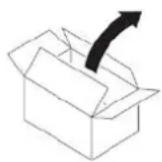
4.1- Unpacking
Remove product from its packaging.
Check that tool and accessories are not damage
4.2- Content
- 1 electric sander
-1 sandpaper - 1 dust collection bag
- 1 instructions manual
4.3- Fitting or replacing a sanding paper
-
CAUTION! Tool MUST be unplugged before performing this operation.
-
Position on the base plate a self-griping sanding paper with same dimensions (do not exceed the maximum dimensions given in table 1).
- Connect tool to mains and operate the tool with no load for at least 30s in a stable position.
- Immediately stop operating the tool if strong vibrations or any other defect is detected.
CAUTION: Before mounting a new abrasive sanding paper, remove dust and dirt from the sanding platen, e.g. with a brush. to ensure proper dust extraction, ensure that the perforated holes in the abrasive sheet and the sanding plate coincide.
WARNING: an abrasive sanding paper used on metal must not be used for other materials.
4.4- Inserting the dust collection bag
Insert the bag (8) onto the collection output (9) on the side of the tool.
4.5- Starting and Stopping (ON/OFF switching)
To start the machine: press down the lock button and then press the trigger switch.
To stop the machine: release the trigger switch.
4.6-Variable speed control
The speed can be adjusted up or down during operation with the thumb wheel (6).
The rotational speed to be used depends upon the material being worked upon.
V. OPERATION
5.1- Intended use
- The product is intended for domestic use (preferably indoors).
- The product is intended for dry sanding and scraping of small surfaces, within its specified limits.
- Use the power tool only for dry work. Water penetration into a power tool increases the risk of electric shock.
- Do not use the sander for working on products containing asbestos or other toxic or hazardous materials (e.g. lead based paints).
- This power tool may not be used for purposes outside the described scope.
- Do not use the tool for purposes not appropriate (eg cutting of products containing hazardous materials ...), or for any use not described in this manual.
- The tool is not intended for artisanal, commercial, professional and / or industrial use.
- Do not use other types of sandpaper other than those recommended by the manufacturer to avoid a hazard.
5.2-Operation
- Wear appropriate personal protective equipment and clothing for the work to perform.
- Prepare the workpiece.
- Clamp the workpiece, using a clamping device or blocks, to prevent it from moving during work.
- Plug the tool to a suitable power source (refer to specifications on the rating plate).
Lay the power cord to the back of the tool to prevent it from getting into the cutting area so as to avoid cutting or severing it.
- Firmly hold the tool by the handles grip. Adopt a balanced and stable position.
- Press the lock button and then the trigger switch to start the tool.
- Wait until machine / accessory has reached full speed before starting sanding.
- Place the accessory on the material. Do not make any sudden movements.
Guide the tool on the surface to be sanded by applying a constant pressure.
Do not exert excessive pressure on the machine, let the machine do the work.
Working by applying successive pressures may cause random sanding and likely to shorten the life of the accessory and tool.
Apply less pressure when the tool starts to vibrate heavily or reduce the speed with the thumb wheel (6).
- Once the work is finished, stop the tool by releasing the switch backwards.
Note: Do not touch the sandpaper or platen and do not put the machine down before it has come to a complete stop.

Before any intervention on product, ensure that product is disconnected from its power source.
Reminder: Make sure to maintain the machine in good working condition, carry out regular maintenance of the machine after each use and before storage. Any breach or default of adequate maintenance reduces the life of the machine and increases the risk of breakdowns and accidents.
To preserve the security system throughout the life of the machine, it is important to perform maintenance and proper cleaning. DO NOT use non-compliant replacement parts and do NOT dismantle yourself the machine or change the security features.
6.1- Maintenance
a) Clean plastic parts with a soft clean cloth.
Do not use aggressive cleansers (solvents or abrasive cleansers), or an abrasive sponge.
b) Do not put or immerse product in water or any other liquid.
Clean ventilation holes with a soft brush.
c) Dust collection bag: Regularly empty the bag.
6.2-Service
a) Have your power tool serviced by a qualified repair person using only identical replacement parts. This will ensure that the safety of the power tool is maintained.
b) Have your tool repaired by a qualified person
Unless otherwise indicated in this instruction manual, repairs or replacement of any damaged part in an authorised service centre is recommended.
This electric tool is in accordance with the relevant safety requirements. Repairs should only be carried out by qualified persons using original spare parts; otherwise this may result in considerable danger to the user. c) Maintain tool with care
Keep tool clean for better and safer performance.
6.3- Storage
Clean product.
Store product, instructions manual and accessories in its original packaging.
Product must be stored in a clean, dry location. Always lock up product and keep out of reach of children.
Always empty the bag before storing the machine.
6.4- Disposal
- Do not dispose the product with household garbage. Do not throw into the environment.
- Dispose of the product in a collection centre for waste of electrical and electronic equipment, or a waste drop-off centre; or seek advice from your local municipality.
- Disposal of the product, accessories and packaging should be carried out according to local regulations governing environment protection.
7-Warranty Information
The product is guaranteed in accordance with the legislation of the country of sale.
The guarantee starts from the date of purchase (subject to proof of purchase, i.e. Sales receipt with purchase date)
The guarantee only covers defects in materials or workmanship.
Repairs (under the guarantee) can only be performed by an authorized service centre.
When making a claim under the guarantee, the original sales receipt (with purchase date) must be submitted.
The guarantee does not apply in the following:
- Normal wear and tear (on the product itself or wear parts).
- Incorrect use, e.g. overloading of the device, use of non-approved accessories
- Abuse or damage to the product, and damage caused by external factors.
- Damage caused by non-compliance with the instructions and guidelines of the manual, e.g. connection to the wrong power source or non-compliance with instructions for assembly or installation.
- Partially or totally disassembled tool.
- Partially or completely modified tool with parts not recommended by the manufacturer.
- Damage or loss occurred during transportation.
Our warranty conditions are available from our STAV department [^*] and on our website.
Should you have any repair requests under the warranty, please contact your retailer or our STAV [^*] who will inform you on the procedure.
Should you have any parts and/or accessories request, you can contact our STAV [^*] to ask for the product exploded view by indicating our reference and the serial number or batch number appearing on the nameplate.
[^*] STAV = Technical and After-Sales Service department
STAV contact details: Ribimex, 56 Route de Paris, F-77340 Pontault-Combault.
Tel: 08 92 35 05 77 (0,34€/min; only in France); email: sav@ribimex.fr
Internet Website: www.ribimex.com