
TS2500 - Slicer MSW - Free user manual and instructions
Find the device manual for free TS2500 MSW in PDF.


| Product type | Thermal cutter |
| Brand | MSW |
| Model | TS2500 (15-2500) |
| Nominal power | 2200 W |
| Dimensions (L × W × H) | 720 × 250 × 375 mm |
| Weight | 9.5 kg |
| Engine displacement | 54 cm³ |
| Fuel tank capacity | 550 ml |
| Idle speed | 3170 rpm |
| Maximum engine speed | 12500 rpm |
| Maximum cutting speed | 5000 rpm |
| Maximum cutting depth | 83 mm |
| Fuel mixture | 40:1 (gasoline:oil) |
| Sound level L1 | 119 dB(A) |
| Engine type | 2-stroke |
| Blade type | Abrasive disc or cutting blade |
| Blade guard | Adjustable blade guard |
| Starting | Recoil starter |
| Main functions | Cutting hard materials (concrete, steel, masonry) |
| Safety | Trigger lock, blade guard, ON/OFF switch |
| Maintenance and cleaning | Regular cleaning of air filter, spark plug, belt; clean with a damp cloth |
| Spare parts and repairability | Blade, air filter, spark plug, belt, fuel filter available |
| General information | Compliant with safety standards; legal warranty of conformity |
Frequently Asked Questions - TS2500 MSW
User questions about TS2500 MSW
0 question about this device. Answer the ones you know or ask your own.
Ask a new question about this device
Download the instructions for your Slicer in PDF format for free! Find your manual TS2500 - MSW and take your electronic device back in hand. On this page are published all the documents necessary for the use of your device. TS2500 by MSW.
USER MANUAL TS2500 MSW
| Parameter description Parameter value | |
| Product name | GASOLINE CUT-OFF MACHINE |
| Model TS-2500 | |
| Rated power [W] 2200 | |
| Dimensions [mm] 720x250x375 | |
| Weight [kg] 9.5 | |
| Cubic capacity [cm³] 54 | |
| Fuel tank capacity [ml] 550 | |
| Idle speed [rpm] 3170 | |
| Fuel mixture ratio 40:1 | |
| Maximum cutting depth [mm] 83 | |
| Mileage [ft/h] 1.9 | |
| Maximum cutting speed [rpm] 5000 | |
| Maximum engine speed [rpm] 12500 | |
| L1[db] 119 | |
- GENERAL DESCRIPTION
The user manual is designed to assist in the safe and trouble-free use of the device. The product is designed and manufactured in accordance with strict technical guidelines, using state-of-the-art technologies and components. Additionally, it is produced in compliance with the most stringent quality standards.
DO NOT USE THE DEVICE UNLESS YOU HAVE THOROUGHLY READ AND UNDERSTOOD THIS USER MANUAL
To increase the product life of the device and to ensure trouble-free operation, use it in accordance with this user manual and regularly perform maintenance tasks. The technical data and specifications in this user manual are up to date. The manufacturer reserves the right to make changes associated with quality improvement. The device is designed to reduce noise emission risks to a minimum, taking into account technological progress and noise reduction opportunities.
LEGEND
| The product satisfies the relevant safety standards. |
| Read instructions before use. |
| The product must be recycled. |
| WARNING OR CAUTION OR REMEMBER: Applicable to the given situation (general warning sign). |
| Use ear protection. Exposure to loud noise may result in hearing loss. |
| Wear protective goggles. |
| Wear a dust mask (respiratory tract protection). |
| Wear protective gloves. |
| Wear head and face protection. |
| Wear foot protection. |
| Use an adjustable guard. |
| ATTENTION! Loud noise warning! |
| ATTENTION! Rotating parts, entanglement hazard! |
| ATTENTION! Fire hazard - flammable materials! |
| WARNING! Toxic substances, danger of poisoning! |
| ATTENTION! Hot surface, risk of burns! |
| CAUTION: Observe a safe distance from nearby bystanders. |
| CAUTION: Sharp elements. Limb cut hazard. |
| Do not smoke near the device. The device contains flammable substances. |
| CAUTION: Harmful fumes. |
| Do not operate the device in a closed room! |
| CAUTION: Shards! |
The terms "device" or "product" are used in the warnings and instructions to refer to GASOLINE CUT OFF MACHINE.
2.1.SAFETY IN THE WORKPLACE
a) Make sure the workplace is clean and well lit. A messy or poorly lit workplace may lead to accidents. Try to think ahead, observe what is going on and use common sense when working with the device.
b) Do not use the device in a potentially explosive environment, for example in the presence of flammable liquids, gases or dust. The device generates sparks which may ignite dust or fumes.
c) If you discover damage or irregular operation, immediately switch the device off and report it to the operator.
c) If there are any doubts as to the correct operation of
the device, control the manufacturer's support service. e) Do not attempt any repairs on the device. Do not attempt any repairs independently!
Children or unauthorised persons are forbidden to enter a work station. (A distraction may result in loss of control over the device).
g) Use the device in a well-ventilated space.
h) The device produces dust and debris during operation. It is important to protect bystanders from the dust, which can cause injury.
i) Regularly inspect the condition of the safety labels. If the labels are illegible, they must be replaced.
j) Please keep this manual available for future references. If this device is passed on to a third party, the manual shall be sent to the manufacturer and the manufacturer shall be notified.
k) Keep packaging elements and small assembly parts in a place not available to children.
1) Keep the device away from children and animals.
m) If this device is used together with another equipment, the remaining instructions for use shall also be followed.
n). Before starting work, clean the area of any objects that may damage the device or be thrown away and injure the user.
e) It is advisable to work in natural light or in artificial light with good visibility.
p) Do not use in very humid environments or in the direct vicinity of water tanks.
q) Prevent the device from getting wet.
REMEMBER! When using the device, protect children and other bystanders.
2.2 PERSONAL SALEY
a) Do not use the device when tired, ill or under the influence of alcohol, narcotics or medication which can significantly impair the ability to operate the device.
b) The machine may be operated by physically fit persons who are able to handle the machine, are properly trained, who have reviewed this operating manual and have received training in occupational health and safety.
c) The machine is not designed to be handled by persons (including children) with limited mental and sensory functions or persons lacking relevant experience and/ or knowledge unless they are supervised by a person responsible for their safety or they have received instruction on how to operate the machine.
d) When working with the device, use common sense and stay alert. Temporary loss of concentration while using the device may lead to serious injuries.
e) Use personal protective equipment as required for working with the device, specified in section 1 (Legend):
The use of correct and approved personal protective equipment reduces the risk of injury.
Do not overestimate your abilities. When using the device, keep your balance and remain stable at all times. This will ensure better control over the device in unexpected situations.
g) Do not wear loose clothing or jewellery. Keep hair, clothes and gloves away from moving parts. Loose clothing, jewellery or long hair may get caught in moving parts.
h Remove all adjusting tools or spanners before turning the device on. A tool or spanner left in the revolving part of the device may cause injury.
i) The device is not a toy. Children must be supervised to ensure that they do not play with the device.
j. The device should not be used in bad weather, e.g. strong wind, rain, storm or fog.
1) Do not use the product where it is impossible to take a stable position, e.g. on a slippery surface.
m) To avoid operator fatigue, use the device in the following cycles.
n do not operate the device in a tree, on a ladder etc. o Do not cut wood above shoulder height.
p) The device's handles must be clean, dry and free from grease and oil.
WARMING Risk of burns. The engine and exhaust become hot during operation and are still hot shortly after use.
f. During operation, the device generates an electromagnetic field around itself, which may cause erroneous operation of medical implants i.e. pacemakers, etc.
s) Do not put your hands or other items inside the device while it is in use.
2.3.SAFE DEVICE USE
a) Do not overload the device. Use the appropriate tools for the given task. A correctly selected device will perform the task for which it was designed better and in a safer manner.
b) When not in use, store in a safe place, away from children and people not familiar with the device who have not read the user manual. The device may pose a hazard in the hands of inexperienced users.
c) Keep the device in perfect technical condition. Before each use check for general damage and especially check for cracked parts or elements and for any other conditions which may impact the safe operation of the device. If damage is discovered, hand over the device for repair before use.
d) Keep the device out of the reach of children.
c) Device repair or maintenance should be carried out by qualified technicians only using original spare parts. This will ensure safe use.
f) To ensure the operational integrity of the device, do not remove factory-fitted guards and do not loosen any screws.
g) When transporting and handling the device between the warehouse and the destination, observe the occupational health and safety principles for manual transport. If applicable, which apply in the country where the device will be used.
h) Avoid situations where the device stops working during use due to excessive loading. This may result in overheating of the drive elements and damage to the device.
Do not touch articulated parts or accessories unless the device has been disconnected from the power source.
Do not leave this appliance unattended while it is in use.
k) Clean the device regularly to prevent stubborn grime from accumulating.
1. Do not work on two workpieces at the same time.
m) Do not cover the air intake and outlet
n) It is forbidden to interfere with the structure of the device in order to change its parameters or construction.
a) Keep the device away from sources of fire and heat. b) Oil leaking from the machine should be reported
to the appropriate services or comply with legal requirements applicable in the area of use.
EN
EN
q):Danger:Danger to health and the risk of explosion of the internal combustion engine
1) Poisonous carbon monoxide is present in the engine exhaust. Remaining in a carbon monoxide environment may lead to losing consciousness or even death. Do not run the engine in a closed space.
s). Protect the engine from heat, sparks and flame. Do not smoke near the machine.
It: Petrol is flammable and explosive. Before refuelling, the engine should be turned off and cooled down.
u) Warning! Risk of engine damage due to wrong fuel.
v) Remember to use the right proportions when mixing gasoline and engine oil.
w) After refueling, tighten the fuel filter cap securely and move at least 3 meters away from the fuel filling area before starting the engine.
x) Start cutting only after the machine is turned on.
y) A worn or damaged blade must be replaced immediately.
2) Do not start the device when there are unauthorized access rights.
(a) When using the machine do not hold other parts except the handles.
bb) If the blade comes into contact with a hard object, such as a wire, stop the engine immediately and check that the blade or other part has not been damaged.
cc) Never touch the spark plug or its wires when the engine is running as it may cause an electric shock
dd) When installing the cutting disc, pay attention to its direction of rotation and that it is correctly fitted. Check regularly if the disc is fitted correctly!
ee) Cut only in a straight line! There is a risk of damage to the cutting disc and uncontrolled movement of the machine when the cutting direction is changed.
f) A kickback may occur during operation. The most common reason is when the top of the device is applied to the workpiece.
gg) The cutting disc may be drawn forward uncontrollably during work. This occurs when the disc gets stuck in the gap or when the device is pressed too hard.
hh): Before each use, check that the disc guard is correctly fitted.
ii) The device is used for cutting hard materials such as concrete, masonry, steel. When cutting soft material, mind the increased risk of kickback.
jj Do not cover the ventilation openings!
ATTENTION! Despite the safe design of the device and its protective features, and despite the use of additional elements protecting the operator, there is still a slight risk of accident or injury when using the device. Stay alert and use common sense when using the device.
- USE GUIDELINES
The device is used for cutting hard materials such as concrete, masonry, steel.
The user is liable for any damage resulting from unintended use of the device.
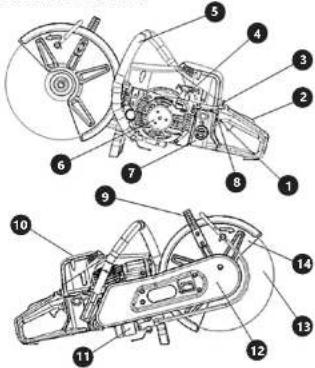
3.1.DEVICE DESCRIPTION
-
Throttle trigger
-
Throttle trigger blackage 3. Measured by the above
-
Manual choke (lever) 1. Stator handle
-
Stated handle 5. Front handle
-
Stander covi#e 7. Sutank
-
Fader rank
-
ON/OFF switch
-
Handic for adjusting the blade housing
-
Air filter cover 11. Air filters
-
Vellore 12. Belga
-
Black Cover 13. Blade
-
Blade housing
-
PREPARING FOR USE
APPLIANCE LOCATION
Only use the equipment in a well ventilated place. Do not operate the device in a closed room! Do not block out the air incurs. The side which the silencer is facing should be located at least 10m from the device, and the device, make sure that there are no third parties nearby. The device should be used on an oven, stable, clean, dry and fire-resistant surface which will ensure safe operation.
3.3.DEVICE USE
33.1 CUTTING TECHNIQUE
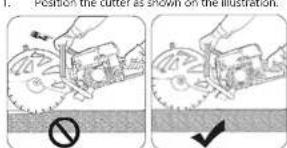
- Cut at full throttle.
- Start cutting gently without pressing the blade against the product to be cut.
- Move the blade slowly back and forth.
- For cutting, use the smallest possible part of the cutting disc.
- Use only cutting edges for cutting
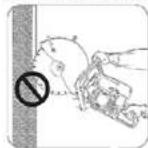
CAUTION: Avoid cutting by the use of the side of the blade. Also, do not pull the cutter to the side. It can damage or break the blade and injure the operator.
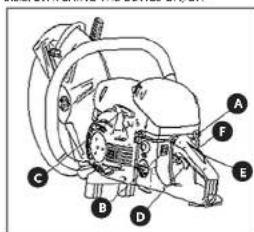
3.3.2.SWITCHING THE DEVICE ON/OFF
- Put the device on the ground and make sure that the blade can rotate freely after starting.
- Hold the rear handle with your right foot, and hold the front handle with your left hand.
the front handle with your left hand. Press the engine primer (E) several ti
4 Turn the switch (B) to the "1" position. - Pull out the manual choke (A).
- Pull the starter handle (C) several times. 7. Push down the manual choke (A).
- Pull the starter handle (C) a few tire
- Press the trigger (D) and the trigger blackage (E) simultaneously.
- Wait 2-3 minutes until the engine warms up before starting to cut.
- The engine will stop when switch (B) is in the "C" position.
3.3.3. OPERATION OF DEVICES PARTICULAR COMPONENTS 1) BLADES
BLADE TYPES:
a) Abrasive disc performance depends on the gradation and hardness of the bond connecting the abrasive grains.
b) Cutting blade when choosing a cutting blade, bear in mind that it should not have a lower rotational speed than the cutter, never use the blade that has fallen on the floor
BLADE COOLING:
Remember that the blade intended for water cooling should be cooled with continuous pouring until the end of work. The lack of cooling may damage the device. For a city-cutting blade that does not require water cooling, it is still recommended to cool it by lifting it every 30-60 seconds during cutting and letting it rotate in the air for 10 seconds. This way, it will not be damaged and stay sharp longer.
BLADE REPLACEMENT/ASSEMBLY
CAUTION. When selecting a blade, check if it is intended for this device. Do not use blades designed for stationary saws. 1. Loosen the blade's mounting bolt.
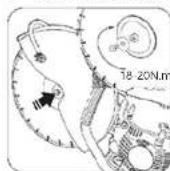
2 Remove the left flange.
3. Carefully remove the blade. 4. Remove the blade of the blade
4. Clean the inside of the black housing. 5. Place the blade on the right fence.
CAUTION: Pay particular attention to the correct assembly of the blade. The blade rotates in the direction shown on the illustration.
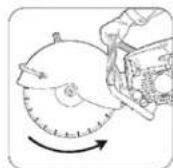
Put the left flange on.
7. Tighten the bolt with the correct torque (18-20Nm)
CHECKING BLADE ASSEMBLY
1. Check if the mounted blade has no scratches, curves
or cracks (over its entire surface).
CAUTION:For the blades to work properly,also check if the drive shaft and flanges
2. Check if the threads on the drive shaft are not damaged.
3. Check if the contact surface of the cutting blade and
the flange is free from foreign bodies. 4 Check if the hinges are not twisted
4. Check if the ranges are not checked, only if no damaged edges
5 Check if the mounted flanges are of the same size.
EN
2) FILTERS
FUEL FILTER
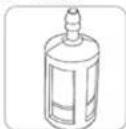
The fuel filter is located inside the tank.
The fuel filter cannot be cleaned, it must be replaced at least once a year.
AIR FILTER:
-
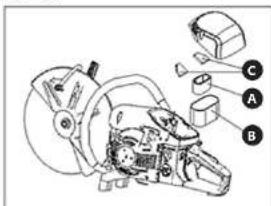
Must be cleaned regularly of dust and dirt.
-
The filter consists of A-a paper filter element, B-an air filter sponges, C-two inlet sponges.
To clean the filter, open the air filter cover, take out and wash the particular elements: wash the sponges in soapy water and rinse in clean water, blow and allow it to dry completely; gently blow or wipe the tissue elements, but do not clean it with water or compressed air;
- A contaminated air filter can cause a carburetor failure, starting problems, the reduction of engine power, the accelerated wear of engine parts.
The air filter should be replaced periodically with a new one.
3) SILENCER
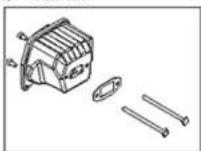
The silencer is an element that heats up very much during operation.
- It is designed to reduce noise and direct exhaust fumes away from the operator. The exhaust fumes from the silencer are hot and may contain sparks – keep them away from dry, flammable materials.
- Never use the device with a defective silencer.
- Check the condition of the silencer regularly.
4SPARKPLIG
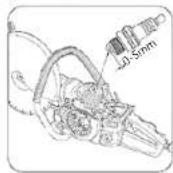
The spark plug should be replaced after about a month of operation or sooner.
- If the spark plug is dirty, clean it.
- Check the gap between the electrodes (it should be 0.5 mm).
- Dirty or worn plugs may cause difficulties with starting the device, incorrect operation of the device at idle speed or weaken engine power.
- To keep your plug plugs in a good condition, you need to ensure that the carburetor is correctly set, the corr fuel mixture is used, and the air filter is cleaned regularly.
5)DRIVE BELT ADJUSTMENT
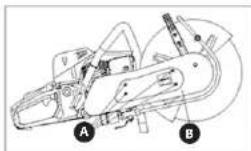
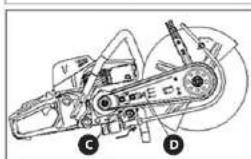
- Remove four bolts (A).
- Remove the cover (B).
- Loosen two bolts (C).
- Tighten the belt by tightening the bolts (D).
- When the correct belt tension is achieved, tighten the bolts (C).
- Put the cover (B) on.
lighten four bolts (A).
6) DEVICE COOLING SYSTEM
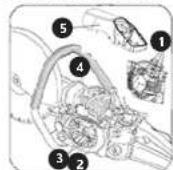
- Air inlet (the hole is on the cover of the starter).
- Air flow channel.
- Cooling fins on the flywheel.
- Cooling fins on the cylinder.
- Cylinder cover (brings cold air into the cylinder).
CAUTION: Dirty or blocked cooling system will overheat the device, which can damage the engine.
7) DISC WATER COOLING SYSTEM
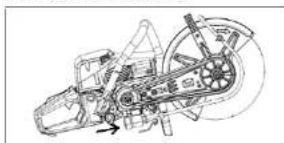
In order to cool the blade with water, connect the external water supply hose to the cooling cable with a quick release plate as shown on the above picture.
8) FUEL AND OIL - mixing and refueling
The device is equipped with a two stroke engine. Use an appropriate mixture of gasoline and oil in the proportion of 40:1 (gasoline:oil).
- Measuring the exact amount of gasoline and oil is necessary for the proper functioning of the device,
Remember to have good ventilation in the space where you use fuel and start the device at the distance of min. 3 m from the refueling point.
- Do not use waste oil.
- Use good quality gasoline, the lowest recommend octane number is 90 (using other fuel may a damage the engine).
- Petrol and oil should be mixed in a clean container intended for this purpose.
- Never refuel when the engine is running.
- When starting refueling, slowly unscrew the fuel cap and turn off the fuel cap.
- After refueling, clean around the fuel filler and then carefully and thoroughly tighten the fuel filler cap.
Check for fuel leaks before starting work.
3.4. TRANSPORT AND STORAGE
a) The device should be stored in a locked place so that it is out of the reach of children and unauthorized persons.
b) Remove the blade when storing or transporting the device.
c) The blades should be stored in dry, frost-free conditions.
d) Fuel must be stored in an approved and designated container.
c) if the device won't be used for a longer period of time, empty the fuel tank (the dispose of fuel in accordance with local regulations in force).
9.S.CLEANING
a) Unplug the mains plug and allow the device to cool completely before each cleaning, adjustment or replacement of accessories, if the device is not being used. Wait for the rotating elements to stop.
b) Use only non-corrosive cleaners to clean the surface. c) After cleaning the device, all parts should be dried completely before using it again.
d) Store the unit in a dry, cool place, free from moisture and direct exposure to sunlight.
c) Do not spray the device with a water jet or submerge it in water.
I) Do not allow water to get inside the device through vents in the housing of the device.
g) The device must be regularly inspected to check its technical efficiency and spot any damage.
h) Use a soft, damp cloth for cleaning.
b. Do not use sharp and/or metal objects for cleaning (e.g. a wire brush or a metal spatula), because they may damage the surface material of the appliance.
Clean the cooling system with the different kinds of brushes at least once a week.
3.6.MAINTENANCE
ATTENTION! This product's exploded view can be found on the last pages of the operating instructions (pp. 52).
1 Check if the throttle elements are working properly.
2. Clean the outside of the device
1. Check the tension of the drive belt
4. Check the condition of the cutting blade.
5. Check the starter and the starter cable, clean outside of air intake.
6. Check if all bolts are well tightened.
7. Check if the choke button is working properly.
8. Check the air filter sponges,
B) Weekly:
9. Check the air filter element
10. Check if the handles and anti vibration elements are not damaged.
11. Clean the spark plug and check the gap between the electrodes.
12. Clean the cooling fins on the cylinder and the Flywheel.
13. Check the silencer.
Monthly:
14. Check the slutsch.
15. Clean the outside of the carburetor.
16. Check and replace (if necessary) the fuel filter and the fuel line.

- Clean the inside of the fuel tank, 15. Check all cables and connections
DISPOSING OF USED DEVICES
Do not dispose of this device in municipal waste systems. Hand it over to an electric and electrical device recycling and collection point. Check the symbol on the product, instruction manual and packaging. The plastics used to construct the device can be recycled in accordance with their markings. By choosing to recycle you are making a significant contribution to the protection of our environment. Contact local authorities for information on your local recycling facility.
INSTRUKCJA OBSLUGI

DANE TECHNICZNE
Portes one protection auditive

Portezune projection ouvive


NAMEPLATE TRANSLATIONS
| 12345 | ● | ● | ● | ● | |
| DE Importeur Produktname Modell Leistung Maximale Motorlehzahl | |||||
| EN Importer Product Name Model Power Maximum engine speed | |||||
| PL | Importer | Nizawa productu | Model | Moc | Maksymalna prędkość silnika |
| CZ | Dvozce | Název vyrobu | Model | Jimenovity vykon | Maximäni otady motoru |
| FR | Importatür | Nom du produit | Modèle | Pulsance | Régime moteur maximal |
| IT | Importatore | Nome del prodotto | Modello | Potenza | Velocità massima del motore |
| ES | Importador | Nome del prodotto | Modelo | Potenza | Velocità maxima del motor |
| 6 | 7 | 8 | 9 | ||
| DE | Maximale Schmittgeschwindigkeit | Hubraum | Produktionsjahr | Ordnungsumme | |
| EN | Maximum cutting speed | Cubic capacity | Production Year | Serial No. | |
| PL | Maksymalna prędkość cieje | Pojemnośc siokowa | Rok produktji | Numeri seri | |
| CZ | Maximini zędnicy pychost | Zȩviny objem | Rok wyroby | Sériové c Istio | |
| FR | Vitssie de coupe maximale | Déplacement | Année de production | Numero di series | |
| IT | Velocità massima di taglio | Clindrata | Anno di produzione | Numero di series | |
| ES | Velocità maxima de corso | Clindrada individual | Aïda de production | Numero di series | |
MOBIL
M
MOTOR TECHNOLOGY

DE|EN|PL|FR|IT|ES|CZ

EG-Konformitätserklarung | EU Declaration of conformity | Deklaracja zgodnosci WE |
Declaration UE de conformite | Dichariaze di conformita UE | Declaracion UE de conformidad | Problacion a sbod 5S, 2021/13-05/168
Verantwortungstrager (Name, Adress) | Responsible entity (name, address) | Podmist odowiedzialny (nazwa, adres)
Rele Ropnol, N. Adre, 1 Reisabalb 1018101111111111111111111111111111111111111111111111111111
For the disposal of the device please consider and act according to the national and local rules and regulations.
CONTACT
expondo Polska sp. z o.o. sp. k.
- DO NOT USE THE DEVICE UNLESS YOU HAVE THOROUGHLY READ AND UNDERSTOOD THIS USER MANUAL
- EN
- 2) FILTERS
- FUEL FILTER
- AIR FILTER:
- 3) SILENCER
- 4SPARKPLIG
- 5)DRIVE BELT ADJUSTMENT
- 6) DEVICE COOLING SYSTEM
- 7) DISC WATER COOLING SYSTEM
- 9.S.CLEANING
- 3.6.MAINTENANCE
- INSTRUKCJA OBSLUGI
- DE|EN|PL|FR|IT|ES|CZ
- CONTACT
Brand : MSW
Model : TS2500
Category : Slicer