ManualGo.com
HBDP 23601 - Fridge HOOVER - Free user manual and instructions
Find the device manual for free HBDP 23601 HOOVER in PDF.



Download the instructions for your Fridge in PDF format for free! Find your manual HBDP 23601 - HOOVER and take your electronic device back in hand. On this page are published all the documents necessary for the use of your device. HBDP 23601 by HOOVER.
USER MANUAL HBDP 23601 HOOVER
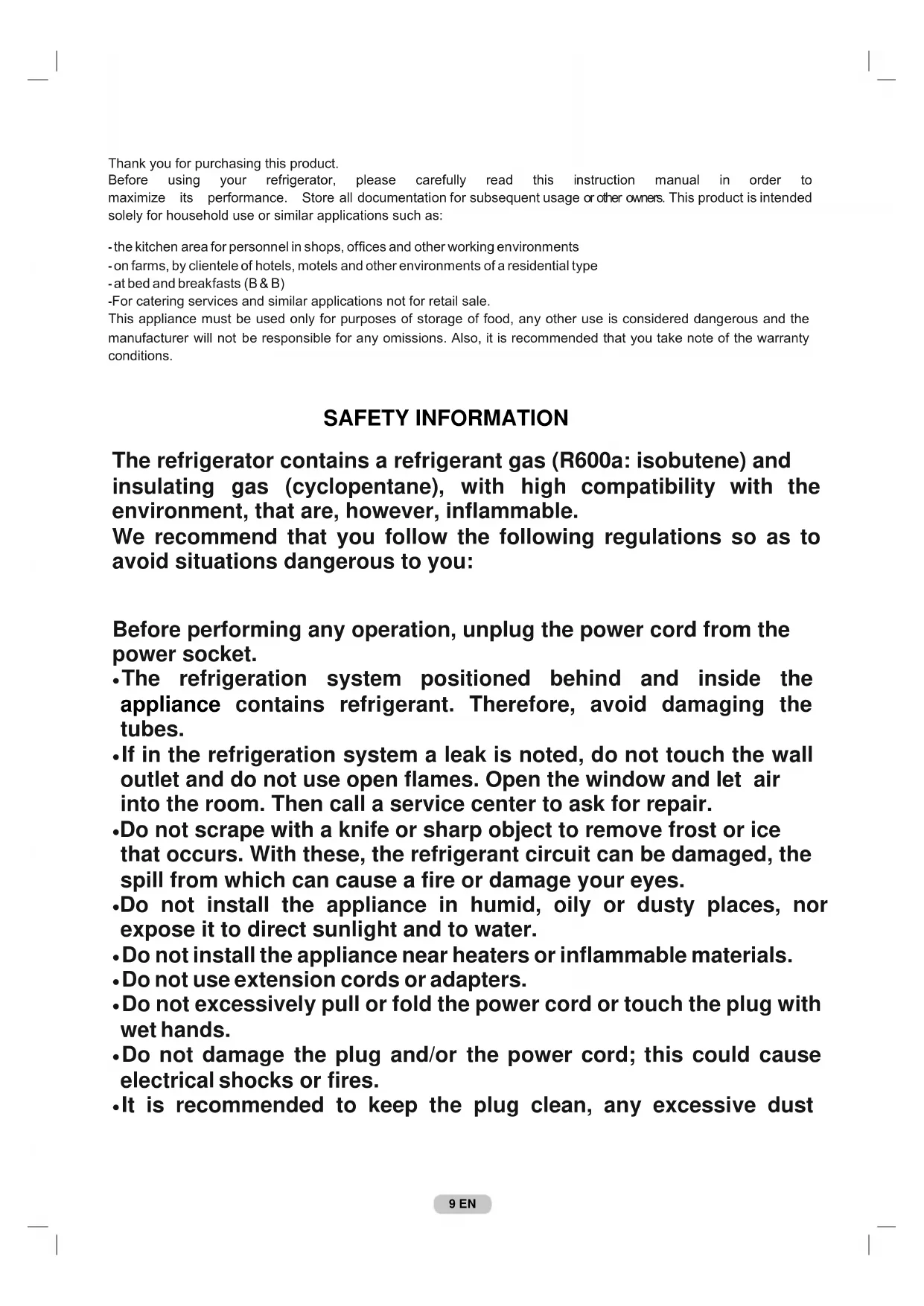
FUNZIONAMENTO Dimensioni degli scassi della colonna. IT 89 EN Thank you for purchasing this product. Before using your refrigerator, please carefully read this instruction manual in order to maximize its performance. Store all documentation for subsequent usage or other owners. This product is intended solely for household use or similar applications such as: -the kitchen areafor personnel in shops, offices and other working environments -on farms, byclientele of hotels, motels and other environments of a residential type -at bed and breakfasts (B& B) -For catering services and similar applications not for retail sale. This appliance must be used only for purposes of storage of food, any other use is considered dangerous and the manufacturer will not be responsible for any omissions. Also, it is recommended that you take note of the warranty conditions. SAFETY INFORMATION The refrigerator contains a refrigerant gas (R600a: isobutene) and insulating gas (cyclopentane), with high compatibility with the environment, that are, however, inflammable. We recommend that you follow the following regulations so as to avoid situations dangerous to you: Before performing any operation, unplug the power cord from the power socket. The refrigeration system positioned behind and inside the appliance contains refrigerant. Therefore, avoid damaging the tubes. If in the refrigeration system a leak is noted, do not touch the wall outlet and do not use open flames. Open the window and let air into the room. Then call a service center to ask for repair. Do not scrape with a knife or sharp object to remove frost or ice that occurs. With these, the refrigerant circuit can be damaged, the spill from which can cause a fire or damage your eyes. Do not install the appliance in humid, oily or dusty places, nor expose it to direct sunlight and to water. Do not install the appliance near heaters or inflammable materials. Do not use extension cords or adapters. Do not excessively pull or fold the power cord or touch the plug with wet hands. Do not damage the plug and/or the power cord; this could cause electrical shocks or fires. It is recommended to keep the plug clean, any excessive dust10 EN residues on the plug can be the cause fire. Do not use mechanical devices or other equipment to hasten the defrosting process. Absolutely avoid the use of open flame or electrical equipment, such as heaters, steam cleaners, candles, oil lamps and the like in order to speed up the defrosting phase. Do not use or store inflammable sprays, such as spray paint, near the appliance, it could cause an explosion or fire. Do not use electrical appliances inside the food storage compartments, unless they are of the type recommended by the manufacturer. Do not place or store inflammable and highly volatile materials such as ether, petrol, LPG, propane gas, aerosol spray cans, adhesives, pure alcohol, etc. These materials may cause an explosion. Do not store medicine or research materials in the appliance. When the material that requires a strict control of storage temperatures is to be stored, it is possible that it will deteriorate or an uncontrolled reaction may occur that can cause risks. Maintain the ventilation openings in the appliance enclosure or in the built-in structure, free of obstruction. Do not place objects and/or containers filled with water on the top of the appliance. Do not perform repairs on this appliance. All interventions must be performed solely by qualified personnel. This appliance can be used by children aged from 8 years and above and by persons with reduced physical, sensory or mental capabilities or with a lack of experience and knowledge; provided that they have been given adequate supervision or instruction concerning how to use the appliance in a safe way and understand the hazards involved. Children should not play with the appliance. Cleaning and user maintenance should not be made by children without supervisionRECOMMENDATIONS 11 EN
What to avoid... Do not install the fridge close to sources of heat. Do not alter plugs or use adapter plugs or extension leads. We recommend the following, for greater energy saving: - Do not put hot foods in the fridge. - Do not pack foods close together as this prevents air circulating. - Make sure foods do not touch the back of the fridge. - If the electricity goes off, do not open the fridge door. - Do not open or keep open the appliance doors for too long. - Do not set the thermostat on exceedingly cold temperatures. The fridge makes some noises when working. This is entirely normal and you might hear HUMMING, GURGLING, RUSTLING AND WHISTLING, as well as slight CLICKING OR JUMPING noises. Install the fridge leaving a gap between it and other furniture or appliances. Make sure accessories are installed properly. If you have followed the instructions, but your product continues to make irritating noises, other than those resulting from a normal functioning, please contact the technical support service.
WARNING: Keep ventilation openings, in the appliance enclosure or in
the built-in structure, clear of obstruction.
WARNING: Do not use mechanical devices or other means to
accelerate the defrosting process, other than those recommended by the manufacturer.
WARNING: Do not damage the refrigerant circuit.
WARNING: Do not use electrical appliances inside the food storage
compartments of the appliance, unless they are of the type recommended by the manufacturer. WARNINGS Adjust the feet to level the appliance. Make sure glass containers do not touch in the appliances. Do not install the appliance outside. The appliance works properly at the following temperature ranges: Climatic class: SN +10 +32°C Climatic class: N +16 +32°C Climatic class: ST +16 +38°C Climatic class: T +16 +43°C (See appliance‘s rating plate) CE Conformity
SCRAPPING OLD APPLIANCE
This appliance is marked according to the European directive 2012/19/EU on Waste Electrical and Electronic Equipment (WEEE). WEEE contains both polluting substances (which can cause negative consequences for the environment) and basic components (which can be re-used). It is important to have WEEE subjected to specific treatments, in order to remove and dispose properly all pollutants, and recover and recycle all materials. Individuals can play an important role in ensuring that WEEE does not become an environmental issue; it is essential to follow some basic rules: - WEEE should not be treated as household waste; - WEEE should be handed over to the relevant collection points managed by the municipality or by registered companies. In many countries, for large WEEE, home collection could be present. In many countries, when you buy a new appliance, the old one may be returned to the retailer who has to collect it free of charge on a one-to-one basis, as long as the equipment is of equivalent type and has the same functions as the supplied equipment. By placing the mark on this product, we are confirming compliance to all relevant European safety, health and environmental requirements which are applicable in legislation for this product.Replacing LED light board MAINTENANCE Proper maintenance will ensure a long life for your appliance. Remember to remove the plug before you clean/defrost the fridge, change the fridge light bulb, etc. Cleaning Clean the outside of the fridge at regular intervals with a damp cloth. Use a solution of bicarbonate of soda and water to clean the inside. Do not use abrasive products. An outlet for draining water is located in the middle of the back of the fridge. Make sure this outlet is not obstructed; clean regularly. Defrosting It is recommended to defrost the refrigerator each time an excessive layer of frost is formed, then leave the doors open with the apparatus switched off and avoid using sharp or mechanical objects (knives, scissors, etc) to remove the ice from the internal parts, in order to avoid damaging the refrigerating circuit. NOTE: a small amount of ice on the back of the fridge compartment is normal.
STORING AND FREEZING FOODS
To make sure foods retain their fl avour and substance and stay fresh, store them in the fridge compartment as shown in the fi gure below. Wrap foods in tin foil or cling fi lm or put them in closed containers. Frozen foods can be stored for approximately one month in compartments
See the table for storing foods in compartments. Foods can only be frozen in compartments. Trouble-shooting Please contact our service department if you have any diffi culties. However you can often solve small or apparently alarming problems yourself. In fact problems may be caused by incorrect use or installation or by unsuitable ambient conditions and in these cases you will be charged.
THE FRIDGE DOES NOT WORK
- Make sure the plug is inserted properly in the socket. - Make sure the thermostat is not set to „0“ or Stop. - Make sure the electricity is working.
THE FRIDGE IS NOT COLD ENOUGH
- Make sure the thermostat is set properly. Adjust to higher settings. - Make sure the fridge doors have not been left open for too long. - Make sure you haven‘t stored too much food in the fridge. - Make sure you haven‘t put hot foods in the fridge.
Make sure the door has not been left open for too long. Unplug the fridge, defrost and then turn it back on.
Make sure the thermostat is not set at a temperature which is too cold (high settings). Adjust to lower settings.
THERE IS TOO MUCH CONDENSATION
- Make sure the door has not been left open for too long. - Make sure you haven‘t stored too many fresh foods in the fridge. - Make sure you haven‘t put hot foods in the fridge. THERE IS WATER IN THE FRIDGE COMPARTMENT
A few drops of water on the sides of the fridge compartment is normal, particularly when a room is humid/damp. - Make sure the water outlet is not obstructed.
THE LIGHT DOES NOT WORK
- Make sure the plug is inserted in the socket properly. - Make sure the electricity is working. - Follow the instructions in the technical datasheet to replace the bulb. If the problem continues, contact our service department, giving the appliance number and serial number on the rating plate. FRIDGE AREA
MONTHS 12 EN If the product is equipped with LED lights, please contact with the techinical aisitance service in case of replacement. Compared to traditional light bulbs, LEDs last longer and are environmentally friendly. -AND
FOOD HYGIENE AND FRIDGE MANAGEMENT RULES
5 IT Dear client, apart from the instruction booklet, we recommend you read carefully the instructions contained in this information sheet. This will provide you with some important safety guidelines, as well as instructions on how to install and operate the temperature control dial. Should the temperature control dial be missing, please ask your distributor for it. This symbol indicates the coldest area of your fridge. This area is usually defi ned by the fruit and vegetable compartment(s) at the bottom and the symbol shown here at the top. In order to help you set your fridge properly, we have included a temperature control dial which will monitor the temperature in the area defi ned as the coldest. CAUTION: The indicator was designed to function exclusively in your fridge. It is not possible to use it in another fridge or for any other purposes. TEMPERATURE CONTROL By using the temperature control dial you will be able to check on a regular basis that the temperature of the coldest area is correct. If this is not the case, it will be necessary to change the position of the thermostat. A good use of the fridge and the compliance with food hygiene rules contribute to improving food storage. Clean the internal part of the fridge regularly with delicate products or with water and disinfectant in order to combat bacteria effectively. Remove all food packaging before placing it in the fridge (for instance yoghurt carton packages). Wrap the products systematically in order to avoid mutual contamination. Do not place any kitchenware or other containers inside the fridge after having already used them prior to washing up (for instance, spoons or knives contaminated by food). Wait for foodstuffs to have completely cooled down prior to storage (e.g. soups). Limit the number of door openings and in any case do not leave the doors open for a long time, in order to prevent the fridge temperature from rising. Place the foodstuffs so that the air may fl ow freely throughout the entire fridge. Store the foodstuffs according to their nature inside the appropriate compartments and in particular, place the following items in the coldest area: meat, poultry, cold meats or sausages, ready-made dishes, mixed salads, egg or cream based pastry products, fresh pasta, dough, pizza, fresh products and cheeses made of whole or pasteurised milk, ready-made legumes sold without plastic bag and more generally all fresh products with use-by date and associated with storage temperatures lower or equal to + 4°C.
CONTROLLED TEMPERATURE AREA
DETAIL TEMPERATURE CONTROL DIAL The room temperature and the frequency with which the fridge door is opened have an impact on the internal temperature. In order to maintain the correct temperature inside the fridge, check that the control dial is green (see Figure 1). If the control dial turns white (see Figure 2), it means that the temperature is too high. In that case, set the thermostat and wait 12 hours before re-checking. After charging the product or opening the door, it is normal for the control dial to turn white after a few seconds. fi gure 1 fi gure 2
CONTROL PANEL The ther mostat box to control the appliance is located inside the fridge compartment on the top right. To check whether the appliance is functioning, make sure that the thermostat knob is not set on "0".
he rating plate states the maximum quantity of foods that can be frozen, (see fi gure 2). Defrosting of the fridge compartment occurs automatically in this product. We recommend you defrost the freezer area when the layer of frost is more than 3 mm thick. A small amount of frost or drops of water on the back of the fridge compartment when the fridge is working is normal. Make sure the water outlet is always clean and make sure foods do not touch the back or sides of the freezer compartment.
mportant: if your ambient temperature is high, the appliance may operate continuously, thus building up excessive frost on the inner wall of the fridge. In this case, turn the fridge knob to a warmer setting (1-2). (Figure 2) N.B. Here you will fi nd your appliance rating plate: it includes all the data to be transmitted to the Customer Service should a fault arise.
emove the upper hinge and its spacers from the upper cross- beam.
emove the right lower hinge and refi t it on the opposite side.
emove the upper door.
eassemble the hinges and doors working from bottom to top 1
emove the hinge and its spacers.
PRODUCT DIMENSIONS AND BUILT-IN COMPARTMENT
INSTALLATION OF THE APPLIANCE IN THE COLUMN Secure the seal (supplied) to the appliance, on the opposite side from the hinges. Insert the appliance in the column, placing it on the opposite side of the hinges. Make sure the top connecting plate of the cabinet fi ts perfectly. Secure the appliance lower part using the supplied screws. Secure the appliance upper part to the cabinet, using the supplied screws. Click the ventilation grill.7 IT16 ENOnce the product has been embedded, place the rear part of the column in contact with the wall so as to prevent access to the compressor compartment. For the product to operate correctly it is essential to allow adequate air circulation so as to cool down the condenser located in the rear part of the appliance.For this reason, the column must be equipped with a rear chimney, whose upper opening must not be blocked and with a front slot which will be covered with a ventilation grill. 540 mm 50 mm 380 mm 50 mm The appliance is equipped with coupling devices for the appliancedoors with the column panels (loader slide).Dimensions of the gap to be left between the column and the ceiling. 50 mm
BUILT-IN COLUMN OF THE APPLIANCE
DOORS Secure the slide in the inner part of the panel of the built-in column at the desired height and at approx. 20 mm. From the outer wire of the door.Open the doors of the built-in column and the fridge. Position the built-in loader in the slide, then fi t it into the fridge door.Mark the fi xing points for the screws and drill with a bit of a diameter of 2.5.Connect the appliance door to the cabinet panel keeping theloader slots as guidelines.
PRECAUTIONS FOR THE CORRECT
in Bed and Breakfasts
(R600a: ) (cyclopentane),