RKB 300 - Fridge Scandomestic - Free user manual and instructions
Find the device manual for free RKB 300 Scandomestic in PDF.



| Product type | Refrigerator-freezer |
| Brand | Scandomestic |
| Model | RKB 300 |
| Climate class | SN-T (from +10°C to +43°C) |
| Power supply | 220-240 V ~ 50 Hz |
| Lighting power | 230 V, 10 W |
| Refrigerant | R 600a (isobutane) |
| Defrost type | Automatic for the refrigerator, manual for the freezer |
| Thermostat setting | 0 (off) to 7 (coldest) – recommended position: 5 |
| Refrigerator capacity | Not communicated |
| Freezer capacity | Not communicated |
| Number of shelves | Several (according to diagram: shelves, salad drawer, drawers) |
| Egg compartment | Yes |
| Bottle compartment | Yes |
| Adjustable feet | Yes |
| Cleaning | Warm water and baking soda for the interior; mild detergent for the exterior |
| Precautions | Do not use metal objects for defrosting; keep ventilation openings clear |
| Bulb replacement | Unscrew the old one, screw in a new one of 230 V, 10 W |
| Installation | Allow to rest for 2 hours before plugging in; free space of at least 12 cm at the back and sides, 30 cm above |
| Intended use | Domestic and indoor |
Frequently Asked Questions - RKB 300 Scandomestic
User questions about RKB 300 Scandomestic
0 question about this device. Answer the ones you know or ask your own.
Ask a new question about this device
Download the instructions for your Fridge in PDF format for free! Find your manual RKB 300 - Scandomestic and take your electronic device back in hand. On this page are published all the documents necessary for the use of your device. RKB 300 by Scandomestic.
USER MANUAL RKB 300 Scandomestic
natural_image
Pure mechanical diagram showing a rotating component with no text or symbolsFør ibrugtagning
Read the instruction carefully. To avoid any risk of personal injury, material damage or incorrect use of the appliance, be sure to observe the following safety precautions. (After reading these owner's instructions, please keep them in a safe place for reference). Remember to hand them over to any subsequent owner.
General
This product uses environment friendly refrigerant with the advantages of high energy efficiency compressor, high cooling capacity and ease of use.
REGULATIONS, WARNINGS AND IMPORTANT RECOMMENDATIONS
This product is in conformity with the European safety regulations in force relative to electrical equipment. It has undergone extensive trials and meticulous tests to evaluate safety and reliability.
Before using the appliance, carefully read this manual in order to know exactly what to do and what not to do.
Improper use can be dangerous, especially for children.
Before connecting the appliance, check that the data on the plate correspond to that of your system.
Do not litter the recyclable packaging material, but take it to a waste disposal plant for recycling.
The electrical safety of this appliance is ensured only if connected to an electrical system equipped with an efficient ground clamp in accordance with the law. It is obligatory to check this fundamental safety requirement. In case of doubt, request an accurate control of the system by a qualified technician (Act 46/90).
Some fundamental rules must be observed in the use of this appliance, as with any electrical equipment:
- do not touch the appliance with moist or wet hands or feet
- do not pull on the power supply cable to pull the plug from the socket
- do not expose the appliance to atmospheric agents
- do not allow children to use the appliance without supervision
- do not pull out or insert the plug with wet hands; before any cleaning or maintenance work, disconnect the appliance from the mains by either pulling out the plug or switching off the main system switch.
- in case of breakdown or improper functioning switch off the appliance and do not tamper with it.
Instruction for use
Identification of the appliance.
You will find an identification label inside the refrigerator nearby the fruit and vegetable compartment
Characterisitcs
The main characteristic of the refrigerator
- Automatic fridge defrost. The defrost water flows into a tray suituated on the compressor from which it evapoates by the heat generated during the process od refrigeration.
Warning
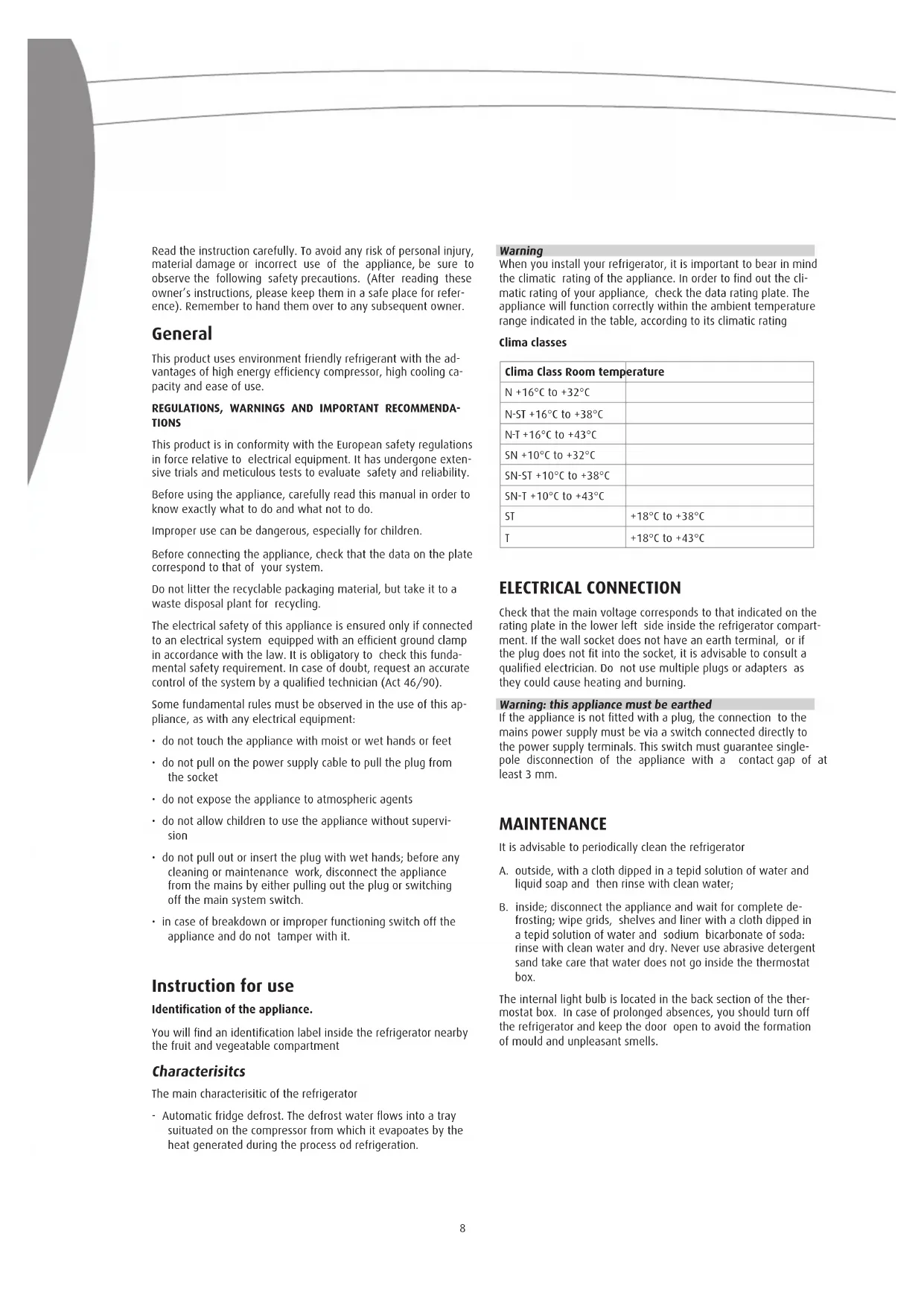
When you install your refrigerator, it is important to bear in mind the climatic rating of the appliance. In order to find out the climatic rating of your appliance, check the data rating plate. The appliance will function correctly within the ambient temperature range indicated in the table, according to its climatic rating
clima classes
| Clima Class Room temperature | |
| N +16°C to +32°C | |
| N-ST +16°C to +38°C | |
| N-T +16°C to +43°C | |
| SN +10°C to +32°C | |
| SN-ST +10°C to +38°C | |
| SN-T +10°C to +43°C | |
| ST | +18°C to +38°C |
| T | +18°C to +43°C |
ELECTRICAL CONNECTION
Check that the main voltage corresponds to that indicated on the rating plate in the lower left side inside the refrigerator compartment. If the wall socket does not have an earth terminal, or if the plug does not fit into the socket, it is advisable to consult a qualified electrician. Do not use multiple plugs or adapters as they could cause heating and burning.
Warning: this appliance must be earthed
If the appliance is not fitted with a plug, the connection to the mains power supply must be via a switch connected directly to the power supply terminals. This switch must guarantee single-pole disconnection of the appliance with a contact gap of at least 3 mm.
MAINTENANCE
It is advisable to periodically clean the refrigerator
A. outside, with a cloth dipped in a tepid solution of water and liquid soap and then rinse with clean water;
B. inside; disconnect the appliance and wait for complete defrosting; wipe grids, shelves and liner with a cloth dipped in a tepid solution of water and sodium bicarbonate of soda: rinse with clean water and dry. Never use abrasive detergent sand take care that water does not go inside the thermostat box.
The internal light bulb is located in the back section of the thermostat box. In case of prolonged absences, you should turn off the refrigerator and keep the door open to avoid the formation of mould and unpleasant smells.
AFTER SALES SERVICE
Before calling your local authorized agent if the refrigerator is not working check that the plug is properly inserted into the electric socket and that the thermostat is not set on position "0"; if the refrigerator is abnormally noisy, make sure it is perfectly leveled and that no external object is touching the back panel of the appliance; if the refrigerator does not produce enough cold, check that it has not been over loaded, that the door closes properly and that the condenser is not full of dust if you should notice an excess amount of water in the lower part of the refrigerator | (vegetable box and removable shelf), | check that the drain hole for defrost water is not clogged.
The buyer is responsible for damages caused by faulty installation, and not responsibility can be accepted if the appliance is not earthed in accordance with the national standards rules presently in force.
At the end of the functional life of the equipment which uses cooling gas R600a (isobutane) and inflammable gas inside the insulating foam, it must be placed in safety before sending it to the waste disposal. For this operation contact your dealer and the local authorities.
WARNING: Do not damage the refrigerant circuit

text_image
1 2 3 4 5 6 7 8 9 10 11 12Product Features
Main parts
- Top cover
- Thermostat
- Refergerator shelf
- Refergerator shelf
- Fresh fruit and salad drawer
- drawer
- drawer
-
Adjustable feet
-
Egg tray
-
Multipurpose food gurad
-
Multipurpose food gurad
-
Multipurpose food gurad
The above illustration diagram may be different of the product. All the detail is respected to the accurate product only.
Installation Instruction:
1 The appliance cannot tilt more than 45 degrees when you move it.
Do not put force on any part as the condenser, the door and handle. It will be deformed surfaces or disrupt the operation of the refrigerator.
2 Make sure there is enough space around refrigerator. It will help for the appliance for ventilation
3 The appliance should be keep away from any heat source and sunshine.
4 This product complies with directives 2006/95/EC (LVD) and 2004/108/EC (EMC)
5 For domestic and indoor use only. This product must be installed according to national fittings standards
6 Product must be grounded. If the socket outlet or supply mains don't have grounded connection, you must not connect the appliance.
7 If the supply cord is damaged, it must be replaced by the manufacturer, its service agent or similarly qualified persons in order to avoid a hazard.
8 This appliance is not intended for use by persons (including children) with reduced physical, sensory or mental capabilities, or lack of experience and knowledge, unless they have been given supervision or instruction concerning use of the appliance by a person responsible for their safety,
Children should be supervised to ensure that they do not play with the appliance.
9 CAUTION: In order to avoid a hazard due to inadvertent resetting of the thermal cutout, this appliance must not be supplied through an external switching device, such as a timer, or connected to a circuit that is regularly switched on and off by the utility
10 The plug must be accessible after the installation
11 WARNING: Keep ventilation openings, in the appliance enclosure or in the built-in structure, clear of obstruction.
12 WARNING: Do not use mechanical devices or other means to accelerate the defrosting process, other than those recommended by the manufacturer.
13 WARNING: Do not damage the refrigerant circuit.
14 WARNING: Do not use electrical appliances inside the food storage compartments of the appliance, unless they are of the type recommended by the manufacturer.
When storing food in the appliance, follow the recommendations below
Fresh Food Compartment
Dairy and muliti-purpose Guard
- Store fatty foods, like butter and cheese.
- Store small, packed foods, like milk, yogurt and beverages.
Egg tray
- Put eggs into the egg tray as shown in the figure and store the tray in a convenient place in one of the multi-purpose guards.
Refrigerator compartment: 1°C to 5°C
This is the area where the food should be stored to be kept cold:
- raw and uncooked foods should always be wrapped
- pre-cooked chilled foods, such as ready meals, meat pies, soft cheeses.
• Pre-cooked meats such as beef and ham, - prepared salads (including pre-washed salad greens, rice, potato salad mixed cut and pre packaged, etc.).
- desserts, such as fresh cheese, homemade products, and leftovers of the cream or cakes.
Crisper
Vegetables, fruit, fresh salads, unwashed lettuce, tomatoes, and radishes should be stored in this compartment.
NOTES:
Always place raw meat, fish and poultry on the lowest shelf of the refrigerator.
Ensure that food is well-wrapped or covered before it is stored. This will prevent food from dehydrating, deteriorating in colour or losing flavor and will help maintain freshness. It will also prevent cross-flavouring.
- Never let any oil or grease come into contact with the plastic fittings or door seals, as these materials easily become porous.
Freezer
Upper freezer drawer
Store packed frozen foods, like ice cream and bacon.
Middle/lower freezer drawer
Store fresh meat and fish or dried foods, which are divided into suitably sized portions.
Wrapping food
Pack the food in suitably sized portions for your household.
Vegetable and fruit portions should be no heavier than 1 kg, while meat portions can be up to 2.5 kg. Smaller portions freeze through more quickly and the quality is thereby maintained better when defrosting and preparing the food.
It is important to seal food in airtight bags or containers before freezing to prevent it from losing favor or dehydrating.
Wrap the food, press out any air and seal it airtight.
Suitable wrapping materials:
Plastic bags, cling-film, aluminium foil and freezer containers. These items are available from any dealer.
Unsuitable wrapping materials:
Wrapping paper, greaseproof paper, cellophane, bin bags or used carrier bags.
Suitable sealing materials:
Rubber bands, plastic clips, string, freezer tape or similar.
Plastic film and bags may be heat-sealed using a special sealing iron or press.
Before placing a package in the freezer, it should be clearly labelled with the contents and date of freezing.
Replace the Interior Lamp
1 Turn off the refrigerator and disconnect the plug from the outlet.
2 Press the base of the light cover to remove the light cover.
3 Remove the old bulb by turning it counterclockwise.
4 Replace a new bulb (10W) clockwise making sure you have correctly positioned the bulb.
5 Replace the light cover in the old location and click to put in place.
6 Reconnect the refrigerator to the electrical outlet and switch on.

natural_image
Simple line drawing of a mechanical device with rotating components and a pointer (no text or symbols)Operation preaction
1 Ensure the supply voltage of scoket are same as rating label.
2 The plug must be completed inserted to the wall socket.
3 Do not pour any liquid to the appliance.
4 Never store any explosive substances like gasoline, flammable liquid inside the appliance
First Time to use
1 When using the refrigerator for the first time, set the thermostat inside the refrigerator at 5 and connected to the socket without anything. Generally it will take 2-3 hours for the appliance reaches temperature, place the food inside.
2 The temperature of the refrigerator can be adjusted by rotating the disc of the thermostat. The five levels are best for most uses. The highest value on the disc of the thermostat, the maximum value of refrigeration.
3 Do not put too much food in the refrigerator. Just open the door so as to maintain a constant temperature of the refrigerator and save electricity.
4 Defrost the freezer when the layer of ice on the walls reaches 3-4 mm. During thawing, remove the food, set the thermostat at level 0 and open the door. When the ice has melted, remove water and dry the interior walls of the refrigerator. Then reset the thermostat to the desired level and restart the machine.
Warnings:
- When it thaws, do not use blades or metal objects to remove ice from the wall to avoid damage to surfaces.
- Do not store bottles flat in the freezer to prevent their breakage due to freezing.
- Reconnect the power by insert the plug to the socket after an interval of 10 minutes.
Maintenance & Cleaning
1 When cleaning the refrigerator, disconnect the plug. Rub with a cloth moistened with natural detergent, and then clean with fresh water.
2 Never use acids, chemicals, paint thinner, gasoline or similar to clean the refrigerator, because they may damage paint and plastic parts of it.
Troubleshooting
If the refrigerator does not run: make sure that
- Check the supply voltage is supplied
- Check that the power plug is correctly connected.
If the refrigerator does not become cold enough: make sure that
- The thermostat is set too low
- There is enough space around the refrigerator.
- The door is opened too frequently.
- Does sun shine on the appliance or are there heat sources nearby.
- Too many food inside the compartment
If frozen food found in the refrigerator are: make sure that
- The thermostat is set too high
- There are few foods in the refrigerator
If the refrigerator operates noisily: make sure that
- Check that the appliance is installed on a stable, level floor
- The refrigerator is too near the wall
- The food stored in the refrigerator touch each other.
Note:
During high relative humidity environment, condensation may occurred the surface of the refrigerator. This is not malfunction. Clean the surface. If the refrigerator is not working properly after all these checks, contact the service center without further delay.
The guarantee follows the instructions that you will find in the warranty conditions.
The bill of sale is the warranty, keep it. For any questions in the course of use, please contact your local service center.
Disposal
The European directive 2002/96/EC on Waste Electrical and Electronic Equipment (WEEE), requires that old household electrical appliances must not be disposed in the normal unsorted municipal waste stream. Old appliances must be collected separately in order to optimize the recovery and recycling of the materials they contain and reduce the impact on human health and the environment.
The crossed out "wheeled bin" symbol on the product reminds you of your obligation, that when you dispose of the appliance it must be separately collected.
Consumers should contact their local authority or retailer for information concerning the correct disposal of their old appliance.
Power Saving Tips
Install the appliance in a cool, dry room with adequate ventilation. Ensure that it is not exposed to direct sunlight and never put it near a direct source of heat (radiator, for example).
- Never block any vents or grilles on the appliance.
- Allow warm food to cool down before placing it in the appliance.
- Put frozen food in the refrigerator to thaw.
You can then use the low temperatures of the frozen products to cool food in the refrigerator.
- Do not keep the door of the appliance open for too long when putting food in or taking food out.
The shorter the time for which the door is open, the less ice will form in the freezer.