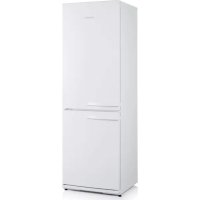
KS 9876 - Fridge SEVERIN - Free user manual and instructions
Find the device manual for free KS 9876 SEVERIN in PDF.


| Product type | Fridge-freezer combination |
| Brand | Severin |
| Model | KS 9876 |
| Dimensions (H x W x D) | 1850 x 600 x 650 mm |
| Weight | 67.5 kg |
| Energy class | A++ |
| Annual consumption | 227 kWh/year |
| Total refrigerator capacity | 210 L |
| Zero degree zone volume | 21 L |
| Freezer capacity | 88 L |
| Freezing capacity | 8 kg/24h |
| Power failure autonomy | 20 h |
| Climate class | N, ST (16-38 °C) |
| Noise level | 41 dB(A) |
| Power supply | 220-240 V ~ 50 Hz (see rating plate) |
| Refrigerator defrosting | Automatic |
| Freezer defrosting | Manual |
| Interior lighting | LED (not user-replaceable) |
| Reversible door | Yes (can be changed in workshop) |
| Refrigerant | R600a (isobutane) |
| Number of shelves | Several adjustable shelves + vegetable drawer |
| Door balconies | Yes, several |
| Maintenance | Clean with warm water and mild detergent; clean the condenser twice a year |
| Safety | Earthing required, instructions to avoid fire and injury |
| Warranty | 2 years against manufacturing defects |
Frequently Asked Questions - KS 9876 SEVERIN
User questions about KS 9876 SEVERIN
0 question about this device. Answer the ones you know or ask your own.
Ask a new question about this device
Download the instructions for your Fridge in PDF format for free! Find your manual KS 9876 - SEVERIN and take your electronic device back in hand. On this page are published all the documents necessary for the use of your device. KS 9876 by SEVERIN.
USER MANUAL KS 9876 SEVERIN
GB Instructions for use
Refrigerator 12
FR Mode d'emploi
Before using the appliance, please read the following instructions carefully and keep this manual for future reference. The appliance must only be used by persons familiar with these instructions.
Connection to the mains supply
- The appliance should only be connected to an earthed socket installed in accordance with the regulations. Make sure that the supply voltage corresponds with the voltage marked on the rating label.
- This product complies with all binding CE labelling directives.
- Do not operate this unit by means of a transformer.
- To prevent noise vibration, ensure that the power cord does not touch any part of the rear of the unit
General information
- This appliance is a compressor refrigerator, designed for the short-term storage of food in the main cabinet and long-term storage of food in the freezer compartment.
- Refrigeration appliances are classified into certain climate classes. Please refer to the product data sheet for information on the classifi cation for this unit.
- No responsibility is accepted if damage results from improper use, or if these instructions are not complied with.
Important safety instructions
This appliance is intended for domestic or similar applications, such as
- in shops, offices and other similar working environments,
-in agricultural areas,
-by customers in hotels, motels etc. and similar establishments,
-in bed-and breakfast type environments.
This appliance is not intended for commercial use, nor for use in the catering business or similar wholesale environments.
The cooling circuit in this appliance contains the refrigerant isobutane (R600a), a natural gas with a high level of environmental compatibility, which is nevertheless flammable. Ensure, therefore, that none of the components of the refrigerant
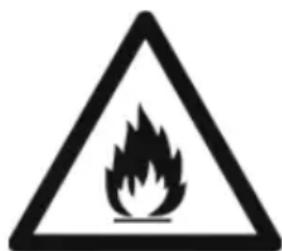
circuit become damaged during transportation and installation of the appliance. If damage to the cooling circuit does occur, do not switch on or connect the appliance to the mains power. In the case that there is an open fire or any other sources of ignition in the vicinity of the refrigerant gas, make sure it is removed immediately from this area and that the room is then thoroughly ventilated.
- Warning: Keep ventilation openings, in the appliance enclosure or in the built-in structure, clear of obstruction. Suffi cients ventilation must be ensured at all times.
- Warning: Do not damage the cooling circuit. Any escaping refrigerant causes damage to the eyes; there is also a danger of the gas igniting.
- Warning: Do not use any external device (e.g.; heaters or heating fans) to accelerate de-frosting; follow only the methods recommended in this manual.
- Warning: Do not operate any electrical appliances (e.g. ice makers) inside the storage compartment that are not specifically permitted in these instructions.
- Before it is connected to the mains power, the unit must be thoroughly checked for transport damage, including its power cord. In the event of any such damage being found, the appliance must not be connected to the mains.
This appliance is not designed for the storage of explosive substances such as aerosol cans with a flammable propellant. - If the unit is sold, handed over to a third party or disposed of at a suitable recycling facility, attention must be drawn to the presence of the insulation agent 'cyclopenthane' as well as to the refrigerant R600a.
In order to comply with safety regulations and to avoid hazards, any repairs or modifi cations to this unit must be carried out by our authorised service personnel, including the replacement of the power cord.
This appliance may be used by children (at least 8 years of age) and by persons with reduced physical,
sensory or mental capabilities, or lacking experience and knowledge, provided they have been given supervision or instruction concerning the use of the appliance and fully understand all dangers and safety precautions involved.
Children must not be permitted to play with the appliance.
Children must not be permitted to carry out any cleaning or maintenance work on the appliance.
- For frequent cleaning we recommend the use of warm water with some mild detergent. For detailed information on cleaning the appliance, please refer to the section De-frosting and cleaning.
- Caution: do not remove the cover of the interior LED light. In the case of any malfunction, please contact the customer service for assistance. (see appendix).
- To prevent the risk of personal injury or damage to the unit, it must only be transported while in its original packaging.
- Caution: Keep any packaging materials well away from children: there is a risk of suffocation.
- The ice removed from the unit during de-frosting is not suitable for human consumption.
- The power cord should be regularly examined for any signs of damage. In the event of such damage being found, the appliance must no longer be used.
- To avoid the risk of fire, do not place any thermo-electric appliances on top of the unit. Do not place liquid containers on top of the unit, to prevent any leaking or escaping liquid damaging the electrical insulation.
This unit is designed for storing food only.
- Alcoholic substances may be stored only in properly sealed containers and in upright positions.
- Do not store any glass bottles containing carbonated or other freezable liquids in the unit: such bottles may burst during the freezing process.
- To avoid the risk of food poisoning, do not consume food after its storage time has expired. Thawed foods must not be frozen a second time.
- Do not lean or put undue weight on the shelves, compartments, door etc.
- Protect the inside of the refrigerator at all times from open fl ames and any other sources of ignition.
- Remove the plug from the wall socket
-in case of any malfunction,
-before de-frosting,
-during cleaning,
-before maintenance or repair work is carried out.
- When removing the plug from the wall socket, never pull on the power cord; always grip the plug itself.
If the unit is not used for an extended period of time, we recommend keeping the door open.
We reserve the right to introduce technical modifications.
Familiarisation
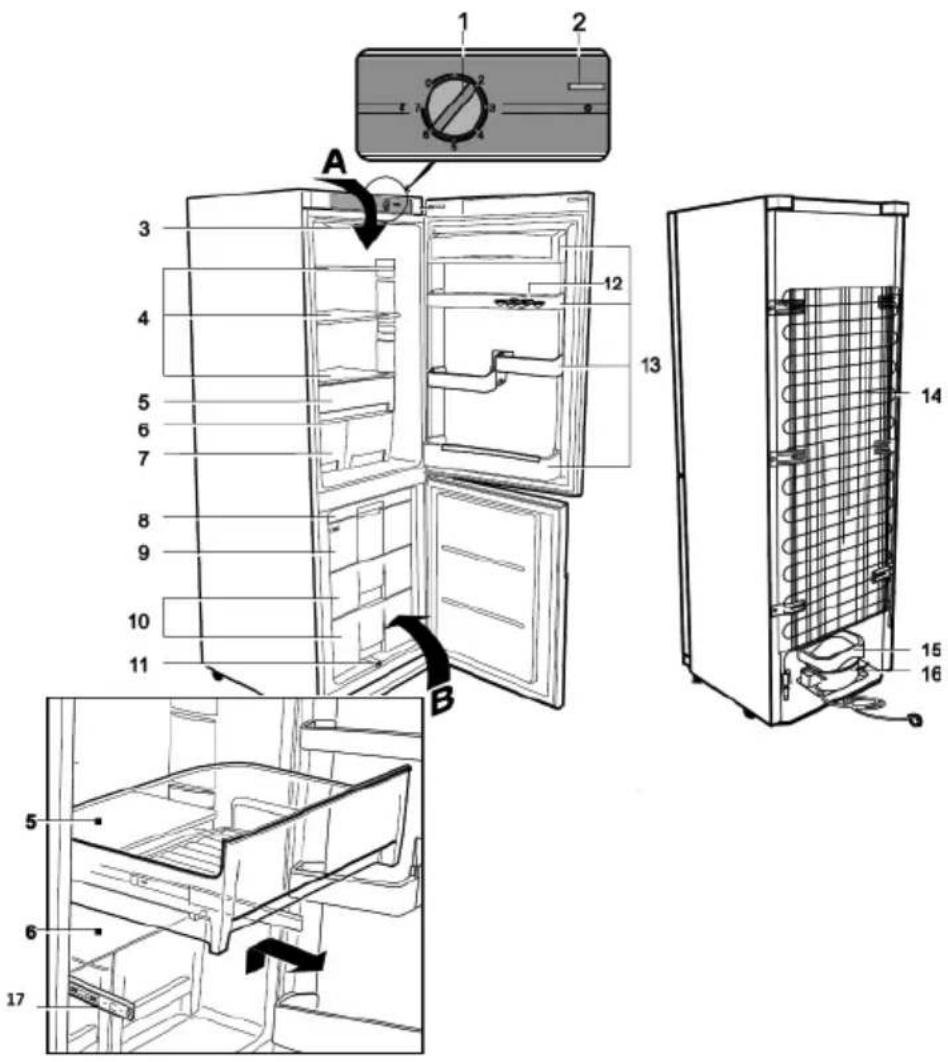
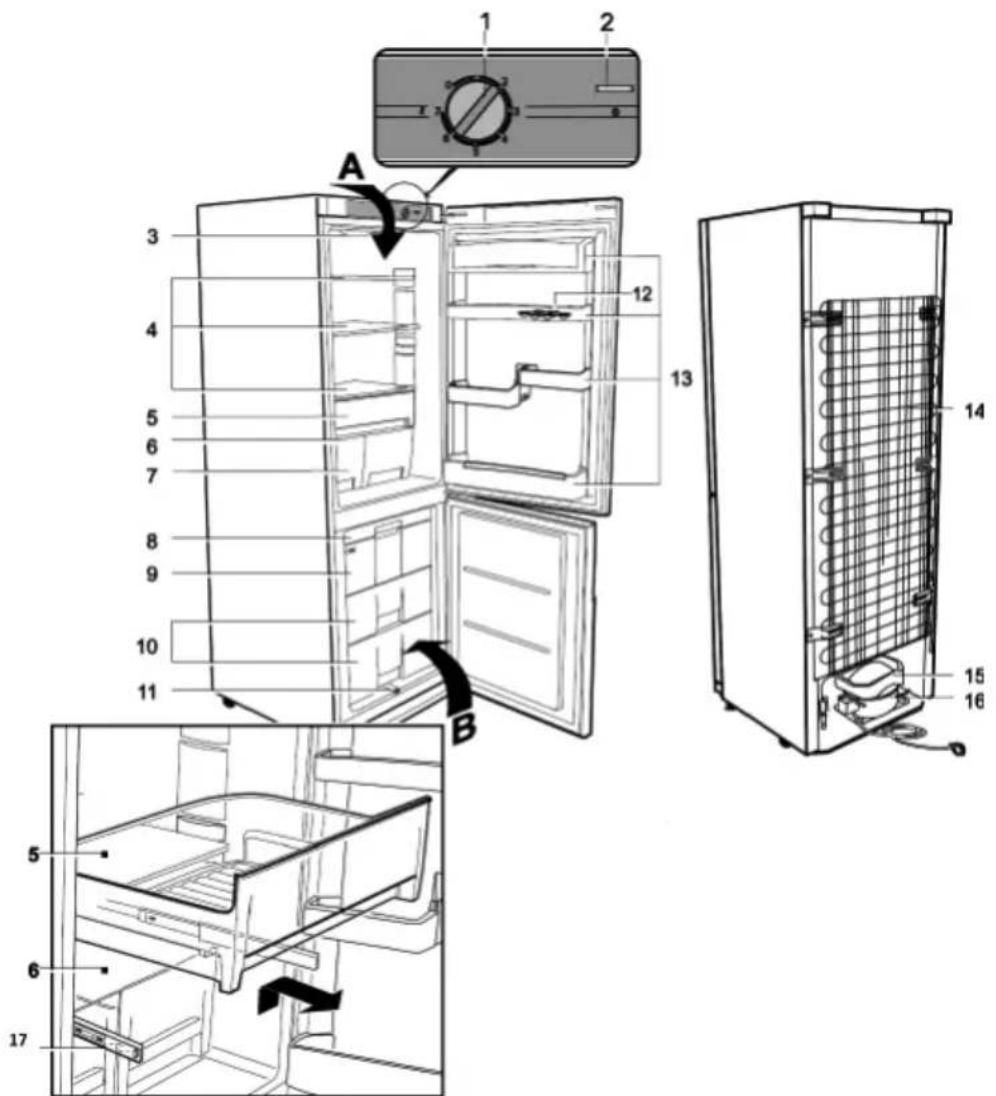
The components of your refrigerator-freezer unit may differ in quantity and design from those described here. This description refers to a unit of the group of two-compartment refrigerator-freezer combinations.
The unit consists of two parts: refrigerator (A) and freezer (B) cabinets.
The refrigerator cabinet contains a 'zero-degree zone' compartment.
The quick-freeze compartment inside the freezer cabinet carries the symbol × × ×
- Temperature control
- On/Off switch for interior light
- Interior light
- Storage shelves (height-adjustable)
- Zero-degree zone
- Glass storage shelf
- Vegetable/fruit fresh storage compartment
- Freezer tray
- Quick-freeze compartment
- Freezer compartments
- Freezer unit melt-water drain
- Egg storage
- Door storage
- Condenser
- Melt-water evaporation tray
- Compressor
- Support rails for zero-degree zone compartment
The zero-degree zone' compartment (5) sits on two support rails (17) and can be easily pulled out and removed.
Before using for the first time
- Remove any exterior and interior packaging materials completely, including the red transport securing devices.
The packaging materials must be properly disposed of.
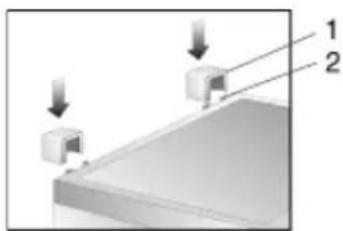
NOTE: When the door to the freezer unit is opened, a small red component will fall out; this is for transport only and can be disposed of. - Fit the two spacer elements (provided) into the corresponding guide slots on the rear.
Before it is connected to the mains, the unit must be thoroughly checked for transport damage, includin - Clean the unit as described in the section De-frosting and cleaning.
- For positioning, we recommend that you tilt the unit slightly backwards. In this way, the transport rollers can be used to move it to its intended place of installation.
The unit should only be transported in its vertical position; do not tilt any more than 30^
Once the unit has been positioned, wait for about 30 minutes before it is connected to the mains.
If the unit has been tilted more than 30^ during transport,
allow it to stand upright for at least 4 hours before it is connected to the mains.
- When the unit is first switched on, a slight 'new' smell may be noticed. However, this will disappear once the cooling process has begun.
Installation
The appliance should be set up in a well-ventilated, dry room.
It should be operated in conditions where the relative humidity is no more than 70% .
The product data sheet contains details of the ambient temperature range suitable for this appliance.
Do not use the appliance outdoors.
- Ensure that the plug is accessible and can be removed from the wall socket at any time.
- Do not expose the appliance to direct sunlight, and do not position it next to any heat sources (radiators, cookers etc). If this cannot be avoided, however, suitable insulation must be in installed between the heat source and the unit.
- The unit must not be installed inside a cabinet, nor directly below a hanging cupboard, shelf or similar object.
In the case of uneven floors, the adjustable feet on the unit can be used to compensate and ensure optimum stability.
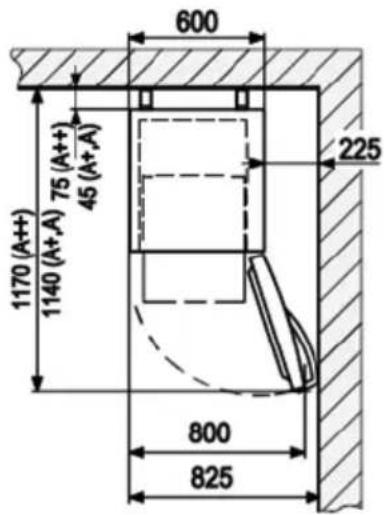
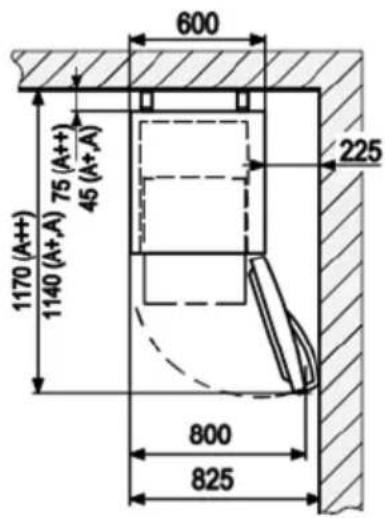
If the unit is installed next to a wall, a minimum lateral distance of 225mm is necessary, so that the doors can open
wide enough for the drawers to be taken out.
Set-up dimensions
Ventilation
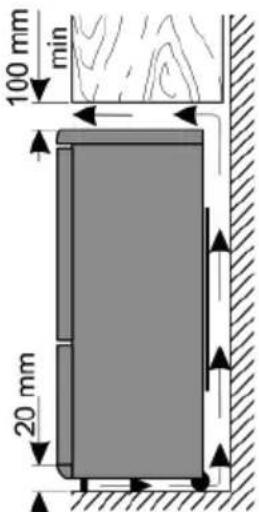
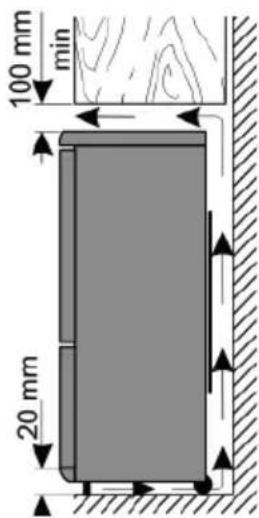
The heated air around the rear of the unit must be able to circulate freely. Therefore, ensure that the air circulation behind the unit is not obstructed.
Caution: Ensure at all times that the rear ventilation openings around the top cover are not obstructed.
Reversible door
If required, the door may be reversed, i.e. from right-tinged (default installation) to left-tinged.
Warning: Always disconnect the unit from the mains before any maintenance or repair work is carried out.
Before you get started, please note the following:
Always ensure that the correct number of washers is used on the hinge bolts.
So that the doors can close tightly against the frame, take the utmost care that they are properly aligned during reassembly.
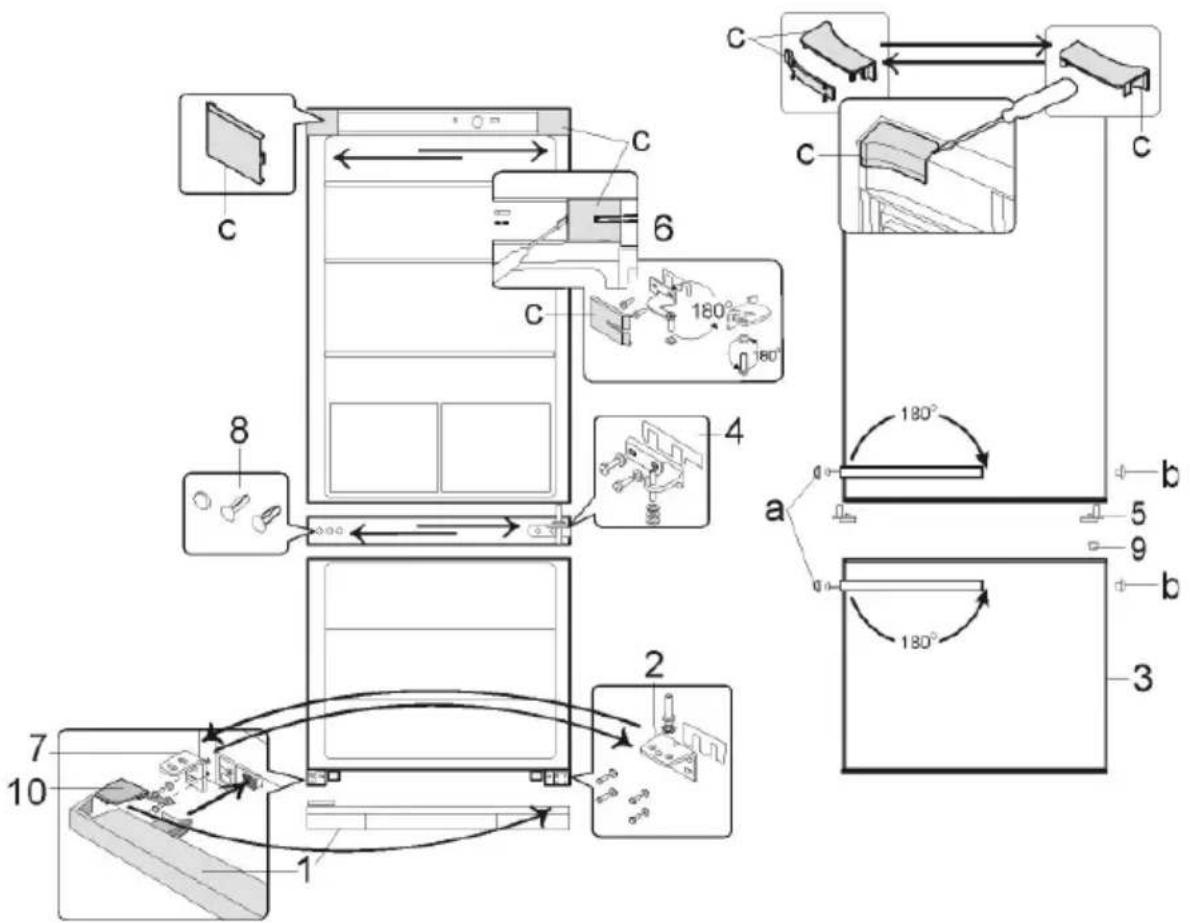
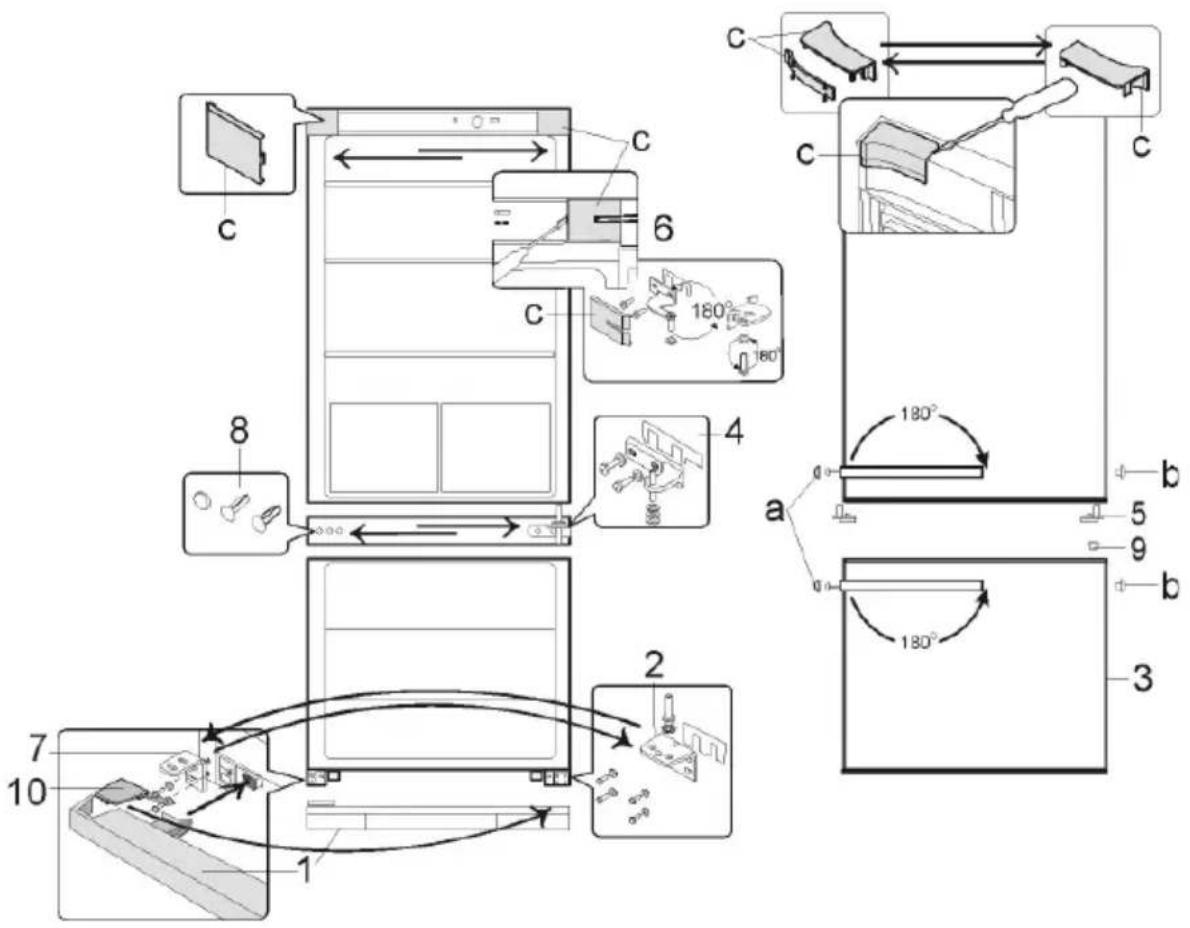
- Remove the four covers c from the housing and inside of
the door.
- Unscrew the hinge bolt on the inside of the door in the area c/6.
Caution: Support the door.
-
Take off the refrigerator door.
-
Take out the fi xing screws and remove the upper bracket 6.Note the small plastic plate underneath the bracket.
-
Turn the bracket 6 including the small plastic plate through 180^ and replace it on the other side of the refrigerator, using the two screw holes adjacent to each other.
-
Remove the hinge support 5 from the underside of the door and fit the hinge support provided on the opposite side.
-
Take out the covering caps and then remove the hinge support in the middle 4.
Caution: Support the door.
-
Take off the freezer door 3.
-
Remove the lower panel 1.
-
Take out the fixing screws and remove the bracket 2 with its hinge bolt.
-
Unscrew the hinge bolt, together with the washers, from the bracket, and fit it into the corresponding opening on the opposite side of the bracket.
-
Remove the bracket 7 and replace it with the holding bracket 2 with its hinge bolt.
-
Now install the holding bracket 7 in the previous position of the bracket 2.
-
Take out the sealing plugs 8 from the partition separating the refrigeration and freezer compartments and replace them in the openings on the opposite side.
-
Take out sealing plug 9 from the freezer door and replace it in the opening on the opposite side.
-
Place the freezer door onto the hinge bolt on holding bracket 2.
Caution: Support the door.
-
Turn the holding bracket 4 with its hinge bolt through 180^ , ensuring that the washers remain in place.
-
Replace the bracket on the opposite side on the freezer door and secure it with the screws.
-
Replace the covering caps over the screw heads.
-
Place the refrigerator door onto the hinge bolt on holding bracket 4.
Caution: Support the door.
-
Re-insert the hinge bolt of the bracket 6 into the refrigerator door.
-
Fit the four covers c over the bracket and the openings.
-
Remove the screw covering caps a and the sealing plugs b.
-
Take out the screws holding the door handles. Move the handle slightly towards the side with the screw and then pull the handle off to the front.
-
Fit the handles on the opposite side, using the fixing screws to secure them. Push the sealing plugs into the now empty openings in the door and replace the covering caps on the screw heads.
-
Take out the cover 10 from the lower panel 1 and replace it on the opposite side.
-
Replace the panel 1 on the appliance.
Temperature control
The unit is re-activated by connecting it to the mains. It is only switched off completely when the plug is removed from the wall socket.
The temperature in the refrigerator cabinet can be adjusted by setting the temperature control. Turning the control clockwise will decrease the temperature, while turning it anti-clockwise will increase it.
The medium settings are usually most suitable for home use.
We recommend using a thermometer to check the actual temperature inside the cabinet and make adjustments as necessary.
Following a power interruption, or if the unit has been switched off on purpose, it may take 3 to 5 minutes before it switches on again.
In position '0', the cooling function is switched off, though the appliance is still connected to the mains.
Interior lighting
Caution: do not remove the cover of the interior LED light. If there should be any malfunction, please contact the customer service for assistance.
Freezer compartment door
To ensure that frozen food will not de-frost prematurely, the door to the freezer compartment should be kept closed at all times. This will also prevent an undue build-up of ice and frost. Ensure, therefore, that the door is only opened briefly to place
food in the freezer compartment or to remove it.
Freezing and storing food
The temperatures inside the refrigerator cabinet and freezer compartment depend mainly on the ambient temperature, the temperature control setting and the amount of food stored.
Freezer compartment:
- The freezer compartment is designed for deep-freezing and long-term storage of frozen food, and for making ice cubes.
The quick-freeze compartment inside the freezer cabinet carries the symbol ****
To ensure that nutritious elements such as vitamins are not lost, fresh food should be deep-frozen right through as quickly as possible. To that effect, the prepared food should be placed into the freezer compartments, properly spaced in one or two rows. - Avoid contact with food that has already been frozen.
- Caution: Do not exceed the maximum freezing capacity per day. The product data sheet contains details of the maximum daily freezing capacity.
- Set the temperature control to Max. After 24 hours, once the food is well frozen, the temperature control can be set back to its original position.
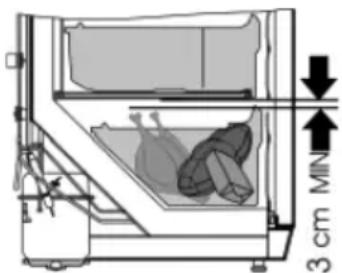
To ensure sufficient
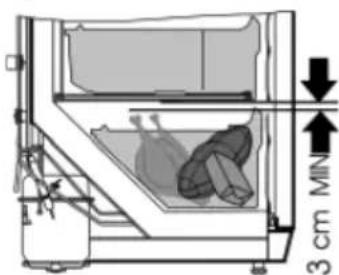
distribution of cold air, keep a minimum distance of 3cm between the vapouriser assembly and the tray containing the food to be frozen.
The time required to freeze food may be shortened by dividing it into smaller portions.
- Suitable packaging materials for frozen food are transparent (i.e. non-coloured) plastic wrap or bags, or aluminium foil. The packaging materials should be well aired before use; check that the package is air-tight before freezing the food. We strongly recommend that you label every item stored in the freezer with all relevant information such as type of food, freezing date and use-by date.
- Do not attempt to deep-freeze carbonated beverages, warm food or any kind of bottled liquids.
- Frozen food can be defrosted in the refrigerator. This way, the food is defrosted at a slower rate, retaining its taste. Furthermore, the frozen food helps to keep the temperature inside the refrigerator at its intended level.
Use-by dates for frozen food are specified (in months) in the table below.
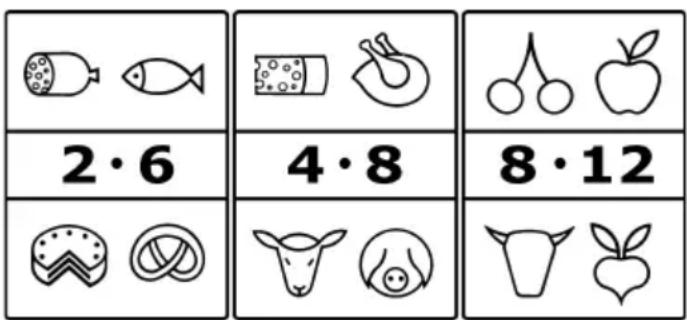
Do not exceed these storage times.
However, always observe the manufacturer's use-by dates for the frozen food.
- If the unit remains switched off for an extended period (eg during a power failure), the door should be kept closed; this will help to maintain the lowest possible temperature in the cabinet. The product data sheet contains detailed information of the maximum safe storage time in case of malfunction. Even a slight rise in the inside temperature will shorten the storage life of the food.
Zero-degree zone
- Keeps perishable foods - vegetables, meat, fish and dairy products - fresh for longer.
Main cabinet
- Different areas of the refrigerator cabinet are affected differently by the cooling effect. The warmest area is around the door in the higher part of the cabinet, the coldest around the rear wall and in the lower part of the cabinet.
The food should therefore be stored as follows: - On main cabinet shelves (from top to bottom): bakery items, ready meals, dairy products, meat, fish and cold meats/ sausages.
In the vegetable compartment: vegetables, salad and fruit.
In the door (from top to bottom): butter, cheese, eggs, tubes (eg mustard), small bottles, large bottles, milk and fruit-juice
tetra-packs.
- Initially, the temperature control should be set to position 4. If the cooling effect is too strong, lower it to position 1-3; if it is insufficient, raise it to 5-7.
If you notice frost on the rear wall, the most likely cause is that the door has been left open for too long, or that warm food has been placed inside the refrigerator or that the temperature control has been set too high.
Liquid or strong-smelling food, or food which is likely to absorb strong odours (e.g. cheese, fi sh, butter), should be stored separately or in hermetically sealed containers.
Warm food should be left to cool down to room temperature before being placed in the refrigerator.
Always ensure that the door is properly closed and that the seal is not obstructed by food stored inside the cabinet or door.
De-frosting and cleaning
Always remove the plug from the wall socket before cleaning.
Do not pour water over or inside the unit.
- For frequent cleaning we recommend the use of warm water with some mild detergent. To prevent any unpleasant odour within the refrigerator, it should be cleaned about once a month.
Any accessories should be cleaned separately with soapy water. Do not put them in a dishwasher.
- Do not use abrasives or harsh cleaning solutions or any cleaning agents that contain alcohol.
After cleaning, thoroughly clean all surfaces with fresh water before wiping them completely dry. When re-inserting the plug into the wall socket ensure that you have dry hands.
To save energy and to ensure optimum performance, the condenser (at the rear) as well as the compressor should be cleaned at least twice a year with a broom or a vacuum cleaner.
Take care not to remove or damage the rating plate inside the cabinet during cleaning.
When de-frosting the freezer compartment
Once the build-up of ice inside the freezer compartment has reached a thickness of 2 - 4mm it needs to be de-frosted. This should be done at least twice a year.
- Ensure that the plug has been removed from the wall socket.
- Remove all food from the compartment and store it in a cool location, eg together with pre-frozen freezer-packs in a closed plastic container. Note that, even with a slight increase in temperature, the storage life will be shortened and the food should be used as soon as possible.
Pull out the drain channel
from the freezer cabinet, turn it 180^ and secure it (see diagram). Place a suitable container underneath the channel outlet.
- Keep the door open. To accelerate defrosting, one or several containers with hot
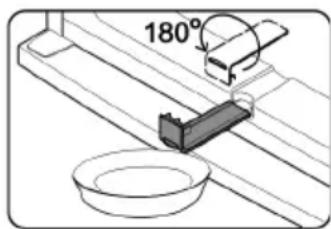
(but not boiling) water may be placed inside the freezer compartment.
- Warning: do not use any external device or other means (e.g. heaters or heating fans) to accelerate de-frosting.
After cleaning, ensure that the freezer compartment is thoroughly dried and set the temperature control to its maximum position. After 24 hours, it may turned back to its normal setting.
Defrosting the refrigerator cabinet :
The integral vapouriser is sealed in foam in the rear wall; you may therefore notice a build-up of frost around the rear area. This layer of frost will start melting when the compressor is not working. Through a system of hoses, the melt-water drains into the collection tray below the compressor, where it will be absorbed into the surrounding air. The unit does not therefore require de-frosting, but only proper cleaning instead.
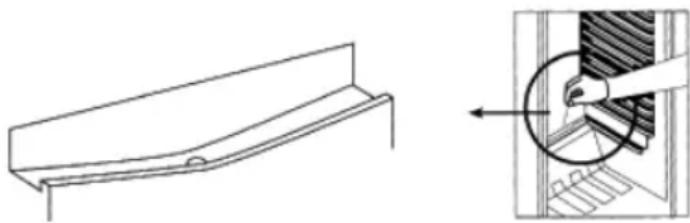
- To enable the melt-water to drain freely, always ensure that the channel and discharge opening in the cabinet are free of any blockage.
Any water collecting in the bottom should be removed.
Energy saving tips
- The appliance should be set up in a well-ventilated, dry room.
- Do not expose the appliance to direct sunlight, and do not position it next to any heat sources (radiators, cookers etc).
If this cannot be avoided, however, suitable insulation must be installed between the heat source and the unit.
- Do not cover the ventilation openings and grilles, and ensure sufficient air circulation behind the unit.
- The compressor (at the rear) should be cleaned at regular intervals. Accumulated dust causes an increase in energy consumption.
- Warm food should be allowed to cool down before it is stored inside.
- To prevent an increased build-up of ice, do not leave the doors open for too long when loading or taking out food.
- Frequent de-frosting helps to save energy. For detailed information on cleaning the appliance, please refer to the section De-frosting and cleaning.
- Do not set a lower-than-necessary temperature. For detailed information on the temperature settings, please refer to the section Temperature control.
Trouble-shooting
Certain typical sounds can be heard when the appliance is switched on. These sounds are:
caused by the electrical motor within the compressor assembly; during compressor start-up the sound level will be slightly higher for a limited period of time.
- caused by the cooling agent flowing through the circuit.
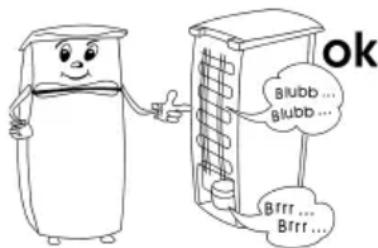
The following table lists possible malfunctions and their probable ca uses and solutions. In the event of operational problems, check first whether a solution can be found using this table. If the problem persists, disconnect the appliance from the mains power and contact our Customer Service Department.
| Problem Possible cause and solution |
| The appliance is not working at all. |
| There is a power failureThe main fuse has blown.The temperature control is set to ‘0’.The fuse in the wall socket (if applicable) has blown. This can be checked by connecting another electrical device to the socket and checking for function. |
| The temperature inside the freezer compartment is not low enough. |
| Too much food has been stored in the appliance.The doors are not properly closed.There is too much dust on the condenser.Insufficient ventilation: the unit is too close to a wall or other structure or object.The temperature control is set too low. |
| The normal operating sound changes or becomes louder. |
| Check for proper positioning (uneven floor?).Are any adjacent objects affected by the running of the cooling unit (i.e. causing them to vibrate?)Are there any objects on top of the unit which might be vibrating? |
| Water is collecting on the bottom of the unit. |
| The melt-water drain system is blocked. Remove the blockage and clean the system. |
Transporting the appliance
To prevent damage to the unit during transport, ensure that all accessories and components inside and around the appliance are securely fastened.
The unit must only be transported in its vertical position; do not tilt any more than 30^ .
Once the unit has been positioned, wait for about 30 minutes before it is connected to the mains.
If the unit has been tilted more than 30^ during transport, allow it to stand in an upright position for at least 4 hours before it is connected to the mains.
Disposal
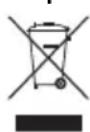
Devices marked with this symbol must be disposed of separately from your household waste, as they contain valuable materials which can be recycled. Proper disposal protects the environment and human
health. Your local authority or retailer can provide information on the matter.
The refrigerant and the chemical agent in the insulation foam must be disposed of through a competent agency. Take special care not to damage the cooling circuit before the unit is handed over for competent disposal.
Guarantee
This product is guaranteed against defects in materials and workmanship for a period of two years from the date of purchase. Under this guarantee the manufacturer undertakes to repair or replace any parts found to be defective, providing the product is returned to one of our authorised service centres. This guarantee is only valid if the appliance has been used in accordance with the instructions, and provided that it has not been modified, repaired or interfered with by any unauthorised
person, or damaged through misuse.
This guarantee naturally does not cover wear and tear, nor breakables such as glass and ceramic items, bulbs etc. This guarantee does not affect your statutory rights, nor any legal rights you may have as a consumer under applicable national legislation governing the purchase of goods. If the product fails to operate and needs to be returned, pack it carefully, enclosing your name and address and the reason for return. If within the guarantee period, please also provide the guarantee card and proof of purchase.
Information needed by the Customer Service Department Should repairs to the appliance become necessary, please contact our Customer Service Department, providing a detailed fault description and quoting the model number KS ... on the rating plate of the appliance (see picture). This information will help us to handle your request effi ciently.
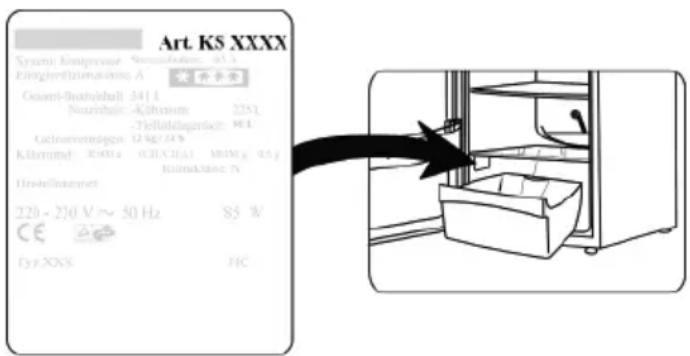
In case of any malfunction or other problem, please contact our Customer Services Department. The address can be found in the appendix to this manual.
Product data sheet
| Art. no. KS 9876 / 9877 | |
| Product category Refrigerator-freezer | |
| Energy efficiency classification | A++ |
| Energy consumption in kWh/year 227 | |
| The actual consumption depends on the pattern of use and the location of the appliance | |
| Total usable refrigerator capacity (litres) 210 | |
| Usable volume of zero-degree zone compartment (litres) 21 | |
| Usable capacity * * * * - Freezer unit (litres) | 88 |
| Frost-free : freezer unit no | |
| Frost-free : refrigeration unit yes | |
| Safe storage time in case of malfunction, hrs 20 | |
| Freezing capacity, kg/24h 8 | |
| Climate classifi cation N,ST | |
| Ambient temperature range, °C 16-38°C | |
| Noise emission 41 dB(a) | |
| Dimensions (H x W x D) in mm 1850 x 600 x 650 | |
| Weight (kg) 67.5 | |
| Electrical specifi cations See rating plate | |
Chere cliente, Cher client,
Compartment de congélation
Vriezer compartment deur
Vriezer compartment:
Compartmento principal del frigorifi co
Transport of apparatus
Regulator temperature
ObIaIOUIM BbICOKIM yPOBHeM 3KOJIOrnueCKoI COBMecTlMOCTN,HO,TEM He MeHee, rOpouH. Po3Tomy CJeDuET y6eINTbcra, YTO HN ODNH N3 KOMNoHErOB
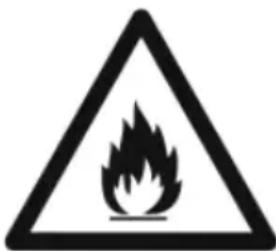
CNCTeMbI OXJIaXJDeHnI He 6bIINIOBpeKJdEHN BO BPEM TpaHCnOpTnPOBKN IYCTaHOBKn UkaΦa. EcIi CnCTema OXJIaXJDeHnI 6bIIn IOBpeKJdHa, He BKJIouaHTe NII IN He NODcoEINHnIte UkaΦ K CETn, a TaKKe YdaJInte NCTOChNK OTKpbITOrO PIIaMeHN IINI JIO60I dpyrO INCTOCHNk BO3rOpAHnI, HAXOJaUncR B6NI3N XJaDAreHTa, Nocne Yero TuaTeNbHO nPoBeTpIte KOMHaTy, B KOTOpO HaxoDnTcR UkaΦ.
- Празурждени. He 3arpoMoxJaTe BeHTnIaHIOHHbIe OTBepCTnI, HaxOJaUneCra Ha Kopnyce shkaopa nIIu BHyTpN Hero. B KomHaTe DoJxHa 6bITb NOCToRHHO OBeCneYeHa DOCTaTOUHa BeHTnIaZIa
- Ппсдурждени. He Доруckайт e nobpeхдени CNTeMbI OXJIaJxDiHЯ. BbIXOДЯши n3 CNTeMbI XJaIaIaREHT MOKET NOBpeINt b IJa3a; BO3MOxHO TAKKe BO3rOpaHne XJaIaIaReHtA.
- П dedурждени. He noIb3yItecb HnkaKIMN NOCTOPOHHIMnpncnocobJeHnAaMn (HaNPmep, HarpeBaTeJIaMNI nn TeNIOBeHTINrTOpaMn dIyckopeHnra pa3MopaxnBaHnRA WkaP; nCNoIb3yIe ToIbKO Te CnocO6bl, KOTOpBie peKOMeHDoBaHbIB HactoJcEM pyKOBODCTBE).
- PnpynpeKdHne. He nnoB3yIte BHyTpim MOp0nIbHOrO uKapa 3JIeKtpuYeCKne np6Opbl (HaPIMep, IbDOReHepaTOpbl), ecn 3TO CNeuaNbHO He OROBopeHo B HactoJem pyKOBoDCTBE.
- Ipeed BkIIOUeHnEM MOpO3INbHOro 6kaΦa B CeTb, erO HeOBxOJIMo TuaTeJIbHO IPOBepNTb Ha HAnuHe BO3MOXHOrO IOBpeJdeHnI prn TpaHcNtOpTnpOBKe, BkIIOUaI uHyp nITaHnI. He nCNoJIb3yIte aIppaT prn O6napyKeHnI IOBpeJdeHnI. He BkIIOUaIte erO B CeTb prn O6napyKeHnI IOBpeJdeHnI.
-Данньи annapat He npedha3naeHдя
XpaHeHn TaKnx B3pbIBOONachbIX BeIeCTB KaK, HApImep, a3p030JIbHbIe yNaKOBKn C TropOChMn npOpEnJIeHTaMn.
- Пи прахе плп подаче данного apapata TpeTbeC STOPOHE nIIN pni erO nepeDAue B COOTBETCTBYUO OPRaHn3aunIO DJIЯ pepepa6OTkn N yTNIIIN3aUNN Heo6xOIMO o6paTb BHIMaHne Ha HAIINuE B HEM I3OINpyUoero aReHTa - ZIKJIoNEHTaHa C5H10' a taKxe xnaJaTeHtA R600a.
B COOTBETCTBnC Tpe6oBaHnIyMn IpaBnI TexHnKn 6e3ONaCHOCTN IN DIA NCKIIOUeHn BO3MOXHO TO TaBMaTn3Ma JIO6oPemOH TTOr YcTPOJCTBa IN BHeceHne N3MeHEnB Eero KOHCTpyKlHi, BKIOUaY IN 3aMeHy UHypa NITaHn, DOJIKeH IPOUN3BOIDtbcra HaAM mABTOPIN3OBaHHbIM CepBVCbIM IepCOHaIOM. - 3TOT np60bop MOKET NcnoB3OBAbCra DeTbMn (He MnaIaIe 8-JeTHero Bo3pacta) n IInuamn C OrpaHnueHHbIMN cIN3UeCKmN, CEHCOPhIMN INy UMCTBeHHbIMN cNOco6HOCTaMn INn He 6IaIauIUMM DoCTaTOUHbIM ONbITOM n UMeHNEM TOIbKO pRyUCIOBUN, YTO OHn HAXoJrTCa IOD pINCMOTPOM INN POJUyn INHCTpykTAX NO IONb3OBAHIO DaHHbIM np60pOM, POJIHOCTbIO OCO3HaOT BCE ONaCHOCTN, KOTOpBIE MOryT pRn 3TOM BO3HnKHyTB, IN O3HaKOMJIeHbIC COOTBETCTBYOUIMN IpaBnAmn TexNHKn 6e3OnaCHOCTN.
He pa3pe7aIte DeTm IrgpaTb c np6opom.
-Детям можно разpeшать чистку и обслуживане прибopa толъко по писмотром.
-ДяTekушчNTKMBI peKOMeHnyem NCNoJIb3OBAbT TeNpyUBOy C MЯrKIM MOIOUIM CpeDCTBOM.Пинадлжно HxKHO MbITb OTdJIbHO B TeNIOMbIbHOB OBe. He MoITE INX B NocydomoeyHO MaUNHe. - PpEynpeXeHne! He ChnMaIte KpbIuKy co CBTeODIOHOJ lamNoOuKN BHyTpEnHrO OcBeUeHn. B cIyae kakOn-JIb6o HnOJaKn O6paTntEcB, NOxAlyNCTa, 3a NOMOuB BCepBnCHyO CnyK6y (CM. npInloXeHne).
YTO6bI He donyctntb TpaBMnpoBaHna IIOeHnn NOBpeXdEHNr MOpO3nJbHoro WkaΦa, eRo TpaHCnoptnpOBKa
OJnKHa OcyuIeCTBnTbCra TOJIbKO BOpunHaJIbHOyNAKOBe.ДЯ pacnaKOBn I yCTaHOBKn UkaΦa Tpe6yeTc2 YeNoBeka.
- Ppeynpexdne. Depxte ypaKOBouHbI MaTePnAJIb I HeIOCTyHOM dJa DeTe McTe, TAK KaK OHI PpeIcTAbJIOT onaCHOCTb ydysb!
- IeI, ydaJIeHHbI n3 uKaΦa BO BpeM pa3MopaxnBaHn, He npiroDeH dIg Notpe6JIeHN.
PeryIpaHNo npOBepaTe uHyp nHTaHnHa HauNue Bo3MOxHOro NOBpeXdEHHa. He noIb3yItecb annapatom npi O6hApUxHeHH NOBpeXdEHHa.
YTo6bI He DOnyCTNTb BO3HNKHOBHeHn IOXapa, He CTaBbTe 3NeKTPoHaIgBaTeJIbHbIe Ipn6Opbl Ha MOpO3NlBbHbIM ⅢKaΦ. He CTaBbTe HA MOpO3NlBbHbI WkaΦ eMKoCTn C XNDKOCTM: 3TO IIO3BOJNT He DOnyCTNTb yTeUKN IIN IPOJINBAHn JxIDKOCTn N IOBpeJDeHn 3JEKTPON3OJIaUN. - Anhny annapat npedha3naeH TOIbKO Iy XpaHeHn IINueBbIX PPOdyKTOB.
AnKOrOJIbHbIe HAnITKn HyXHO XpaHHTB B IIOIHO 3aKpbItbIX EMKOCTx N B BepTnKaJIbHOM IIOJKeHN.
He xpaHnTe B wkafty CTeKJIaHHbIe 6yTbIKN C ra3npoBaHHbIMN IIN DpyrIMN 3aMep3aOuIMN JxNkOcTREMn: TaKne 6yTbIKN MOrT B3OpBaTbC8 BO BpEmr npOceCa 3aMopaxnBaHn.
YTo6bI He DoynCTnTB NmueBOrO OTPaBHeHnA, He yNoTpe6JIaTe npOyKTbI nocLe nCTeueHnCpoka Hx XpaHeHn. Pa3MOpoxKeHHbI npOyKTbI HeJb3a 3amopaxNBaTB BTOPmHO.
He knaTe Ha noJIkn, B OTdJeHnHa nHa DBepy npOdyKtbl C HeOnyucTmBIM BECOM.
BepenTe BHTpeHHIO IO NOBepxHocb Mopo3nIbHorO uKapaOT OTKpItoro ORH N DpyrN X NCTOCHNKOB BO3ropaHn.
BbHMaTe 7TeNceJbHyO BnKy n3 po3eTKn - npn IIO6oHenoJaKe,
-pepa3mopaxnBaHneM, -peaNCTKoN. - nepa BbINOJIHeHnem pa60 nO TexHnueckomy 6cbnyKuBaHNIO nn peMOHTy MOpO3NJbHorO uKaFa.
- ПииИЗВеЧЕнИ 斯ТENTEЛьНОИ BИЛКИ ИЗ CTeHNOIpo3eTkn HNKOrДa He TЯHInTe 3a UHyp, БерптEcB ToJbKO 3a BИЛКY.
Ecnnu KaHe 6yndt nCnOJb3ObaTbcB TeYeHne IINTEJIbHOrO IepNoDa BpeMeHN, Mbl peKOMeHdyEM OCTaBHTb DBepy OTKpbIToN.
MblocTabIeM3aco6oBnPpABOBHOCNTbN3MeHeHNA KOHCTpyKUIO annapata.
UcTpoIcTBo
KOMHOENTbI Baaero XOJIoDnIbHnKa MOrTy OTJInuTaBcR
NO KOJIneCTBy I dN3aHy OT OINcaHhbIX B HAcToaem
pyKOBoDCTBe. HactoJee pyKOBOdCTBO OTHocNTcK aannapaty
n3 CeMeiCTBa DByXkAmePbIX XOJIOOnIbHO-MOp03nIbHbIX
annapaTOB.
Annapat coctoIT n3 DByx YacteI: xOIOINbHoro uKaΦa (A) mOp03nJIbHoro uKaΦa (B).
B xOIOINbHOM uKaΦy IMeETcT aK Ha3bIbAeMaJ «HyJIeBaJ 30Ha>.
Kamepa 6bICTPOI 3AMOP03KN BHYTPN MOP03INbHOrO uKapa IMeET CIMBOJ
- PerynTop temnepaTpybl
- BbIKHouateIb BHyTppeHHeOcBeUeHnA
3.лamnoчka BHyTpeneHrO OcBeHnHr - Nolkn (perynnyemble no Bicote)
- Hynéba 30ha
- CTeKnHna noIka
- OTdeneHne dIy xpaehn CBeHXOBOeN n pkyKTOB
- JIoTOK MOpO3nIbHoro 乌KaΦa
9.Отденингбictpo3amop03kn - OTdeneHnMopo3nBHorO uKaΦa
- Tcok Taon BObI n3 MOpO3nIbHOro uKaΦa
- Nkka xpaehnra
13.Дерпье noJIKI
14.ИсnapnteIb - PdDOn dIy nCnapeHry TaIOB BoDbI
- Komnpeccop
- OnopHbIe HnpaBraIOuIe KOHTeHepa OTdeneHnry HynEBOI 30HbI
KoHTeHep OTeHeHn HynEBoN 30hbl (5)OnnpaetcHa DBe HapBaJIHOuIe (17) N MoKeT JeIko BbIDBnraTbcn 3aDnBnraTbcr.
PepnepBbIM BkIIOueHHeM
IOnHocTbU ydaJIte BCE BHeuHne IN BHyTpEHnE yNaKOBouHbIe MaTePuaIbI, BKIOUaY npNCnocO6JeHnKpachoro cBETA dIra 3aunIbI annapaTa npITpaHCnpTIpOBKe.
- YnakoBOUHbIe MaTePnaIbI DoJIxHbI 6bITb yTUNIN3NPOBaHbI COOTBETCTBYOUM 06pa3OM.
IPIMMEAHNE.IpnOTKpbBaHnDbepbIMOPo3nBHO 1kaaPa BbInaTeMaJIeHbKn KOMNoHEHT KpaCHOrO cBeTa;OH npEHa3HaueH ToJIbKO DnTpAHCnOpTnPOBKN N NOJNeKNT
yTNIN3aUN.
BCTaBbTe DBe
nPoCTaBKN (BXOJrT B
KOMPJIeKT NOCTaBKN)
B COOTBeTcTBUOuNe
HaNPaBIAIOUcne Na3bI Ha
3aDHeN cTeHKe annapata.
- Ppeed BknoeHnem XoNoBnBnKa B CeTb erO HxHO TuaTeNbHO npOBepuTb Ha HAnuHe BO3MOXhIx NOBpeKdEHN BO BpEmr TpaHCnOpTnPOBKn, BkNoUaR n UHp nHTaHn.
BbIMOnTe XONODINbHnK B COOTBeTCTBnC yKa3aHnA M, npNBedeHHbIMn HnKe B pa3dene Pa3mopaxueaHue u Yucmka.
- Pny yctaHOBke annapata Mbl peKOMeHyem Bam cnerka HAKIOHHTb erO Ha3ad. 3TO N03BOJNT NcNOJIb3OBaTb TpaHCnOpTnpoBOUHbIe polNKn dIy nepemeueHnra annapata K MeCTy YCTaHOBKN.
Annapat cneinyet TpaHCnOpTnpoBaTb ToJIbKO B BepTKaJIbHOM NIOXeHIN; He HAKnoHrTe erO 6OJee YEM Ha 30^
Iocne yctaHOBN annapata nooKnTe npmepno 30 MNHT pepeB BKNOueHem eBO CeTb.
Ecnm TpaHcnpOpOBKn annapat HaKIOHnIb 60nee HEM Ha 30^ ,OCTaBbTe ero cTOrTB B BepTKaJIbHOM IIOJXeHN He MeHee HEM Ha 4 yaca nepeD BKIOUeHNEM B CETb. - Pn nepBOM BKNIOUeHm XOJIOINbHnKa MOXET NOBtbcr JeKm 3aIax, KOTOpbl, OJHAKO, Ncye3Het Nocne Haayana npouceca OxJaXdEHH.
YcTaHOBka
XoIOniNbHnK DoJIKeH 6bITb yCTaHOBHeB C cyXoKOMHaTe C xopoWei BEHTnJIaUeN.
XoIOniNbHnK DOnJKeH 3KcPiyAtnpOBaTbCp npOTHOCTeHbHO BnAaXHOCTn He 60nee 70%
HΦopMaIgO TempeaTyphOM dnaIana3OHe, B KOTOpOM MOKET NcONb3ObaTbcra 3OT aIcapaT, COePKNTCB TaJIue C TexHnueckmX XapakTepNCTKAMM.
He nCnoIb3yIte 3OT annapaT BHe nOmeueHnA.
Y6eIITecB HAnuHIOCTyNa K ITeNcBHO BnKe N B TOM, YTO ee MOxHO 6yDeT BbHyTb n3 PO3ETKn B JIO6oe BpEM.
He noBBepraIte XOJOnIbHbNK Bo3DeIcTBnIO nprMOro coJIneHOrO CBeta n He yCTaHaBnBaIte erO B6JIn3N IIO6bIX nCTOuHKnOB TEnna (paINaTOPOB, KxOHbIX pINT N. d.). EcNI 3TOrO n36ExKaTb HeIN3R, Heo6XoDmO yCTaHOBNTb COOTBeTcTBHyU O IN0JIaCmIO Mekdy annapaTom n nCTOUYHKOM TEnna.
He yctaHabnBaIte annapaT B ukafty n HENOCpeCTBeHHo NOd HABeCHbIM KxOHHbIM ukaΦOM, NOIKO NIN NOIO6HbIM PpeDMETOM.
Bcnyae ecnn noH HEPOBHbI, nI KOMneHcaunn HEPOBHOCTN I OecneueHNOITMAMbHOY CTOHNBOCTMOKHO NcONb30BaT HOXKX XOJIOINbHUKa.
Ecnn annapaT yctanabnBaetc 6n3Ko OT CTeHbI, Heo6xOIMO npedymOTpeTB c60ky OT annapata CBO6oHoe npoctpaHCTBO He MeHee 225 MM, TTo6bl DBePcbl MOJIN OKpbIBaTcR DOCTaTOUHO UInpOKO dJIa BbIDBXKeHn KOHTeHepOB.
YcTaHOBOHbIe pa3Mepbl
Bentnla
HarpeTbI B03dyx DOJIKeH CBO6OHO UPKyIINPOBaT bIOJIb 3aADHei CTeHN XoJODINbHnKa. IJa OToRcCneDyET y6eIITbcB B6ecPpenrTCTBeHHoU npKpyIuN BO3dyxa 3a XOIOINbHnKOM.
IpeDynpexKeHne! Bcerda cneiTe, yTo6bl BeHTnlaUHOHHbIe OTBepCTnHa 3aHHe nCTeHKe y BepXHeN KpbIuKN 6blIN OTKpbITbl.
IpehaeBbMaemdBepa
Pn Heo6xOIMOCn DBepy MoXHO nepeHaeBcNtB Ha npTyIO CTOpOHy, TO eTb C npABoN CTOpOHb (3aBOcka yCTaHOBka) HA JEBYIO.
Ppeynpexdne! Bcerda OTKJIOUaTe annapat OT ceTn Ipeep BBINONHeHem paBOT IO TEXHueCKOMy 06CnyKBAHIO nIpeMOHTy annapata.
Ipeepn haayamop paobtio obaTte, noxanynta, BHImaHne Ha cnedyuuee:
BCERda CLEINTe 3a TEM, YTO6bI BNHTbI DBePbIX NTeBb6bln yCTaHOBNEHbIC npaBNbHbIM KOJINueCTBOM uAio
TO6bI DBepcI IINOTHO PnneraJI K pame,CTapaNTecb KaK MOXHO TuaTeJIbHee BbIPOBHrTb IN npn o6paTHo c6OpKe.
- CHIMMTE YeTbIpe KpbIuKN (c) c Kopnyca n C BHyTpEHHei CTOpOHbl DBepubl.
- OTKpyTnTE BnHT KpenJIeHnIeTJn Ha BHyTpEHHeI CTopoHe DBePcbl B 3OHe (c/6).
PpeynpeKdene! PnndepkBaBte DBepy.
- CHIMITE DBEpy XOJIOJIbHnKa.
- BbHbTe KpeNexKhIe BNHTbI N CHIMITE BepxHn KPOHHTeH 6. O6paTHe BHMaHne Ha HAnuNe MaJIeHbKOIIaCTNKOBdTeaIN NOKPOHSTeHOM.
- ПовернITE Кронштейн 6 Вм ec Te C MaJeHbKoI nactNKOBДетаьк Ha 180°и yctaHOBnte erO Ha dpyryO CTOpOHy XOJOniNbHnka, ИСпОБ3уя DBa CMEXHBIX OTBepCTNЯ NOI BnHT.
- CHIMITE DEPkaTeIb neTn 5 C BHyTpEnHHei CTOpOHbI DBepuI yCTaHOBtE DEpKaTeIb neTn n3 KOMnJIeKTA NOCTaBKn Ha IpOTINBOJIOJXHyO CTOpOHy.
- CHIMITE KpbIuKN BnHTOB, a 3aTEM cpeHn IepKaTeNb DBepCbI 4.
PpeynpeKdene! PnpdepkBaIe Ibepu.
- CHINMTE DBepy MOpO3NJbHoro 3
- CHIMITE HIXKHOI naHEnb 1.
- BbHbTe KpeEnKhbIe BNHTbI IN CHIMnTe KPOHHTeH 2 BmecTe C BNHTOM KpeJIeHnNEITIN.
- BbIKpyTHe BnHT KpENIIeHnneTNI BMeCTe C wai6aMn 3 KPOHSTeHa n BCTaBbTe eRO B COOTBETCTBYIOOee OTBepCTne Ha npOTNBONIOXHO CTOPHe KPOHSTeHa.
- CHINMTE KPOHHTeH 7 uYCTaHOBtE BMeCTo Hero KPOHHTeH 2 BMEcTe C BNHTOM KpePnHeH NETTIN.
- Tocne 3Toro yCTaHOBNTe KPOHHTeH 7 Ha To MecTo, rDe
6bIyCTaHOBJENKPOHHTeH2.
- BbHbTe ynNoTHnIeNbHbIe 3aRnyuK8 n3 neperoOpKn, pa3dEJIHOUeXoJOnIbHbI IN MOpO3NJbHbI WkaΦbl, IN BCTaBBte INB OTBepCTHa npOTNBONIOXHO CTopoHe.
- BbHbTe yIINOTHTeJIbHyIO 3aIyUkY 9 n3 IBePcbl MOpO3nIbHOro UkaFa a N BCTaBbTe ee B OTBepCTne Ha npOTNBONIOJXHO CTopoHe.
- YcTaHOBnTe DBePuy MOpO3nIbHOro uKaΦa Ha BnHT nTnHa KpOHTeuHe 2.
PpeynpeXeHHe! PnpdepkBaBte DBepy.
- Nobeprnte KpoHsTeuH 4 C BHTOM KpeJIeHnIeTIN Ha 180^ , cIeJr, yTo6bI Wai6bI OCTaBAnCb Ha MeCTe.
- YctahOBITE KPOHHTeIN Ha IPOTNBOONIOXHyO CTOPHY DBePcbl MOpO3NJIbHO rKaFa n 3akpeNTe ERO BNHTAMN.
- YctaHOBNTe KpbIiHKn Ha IOnOBKn BnHTOB.
- YctaHOBNTe DBePuy MOpO3NJIbHOro UkaΦa Ha BnHT nTIN HA KPOHUsTeiHe 4.
PpeynpeXeHHe! PnpdepkBaBte DBepy.
- BCTaBbTe 6oPaTHO BnHT neTIN KPOHHTeHa 6 B DBepy MOpO3NtBHO 7kaFa.
- YctaHOBnTe YeTbIpe KpbIuKn (c) Ha KpoHHTeHnHa OTBepCTn.
- CHIMITE KpbIUKIN BINTOB (a) n yNIOHTHNTeHBHbIE 3arJyukn (b).
- BbHbTe BnHTbI KpEnneHnA DBePbIX pyeK. IoJaTe pyuKy cnerka B CTopoH, rDe HaxOaNTcBnHT, nocNe yero CHIMITE pyuKy.
- YctahOBtpe pyuHa npOTNBONIOxHyO CTOpOHy 3aФNKcpyTe INKpEnEKNbIMN BnHTamN.BCTaBbTe
ynIIOHTNtIELbHIE 3aIyUWKn B NyCTbIe OTBepCTnHa DBepeue HAdeHbTe KpbIuKoOpaTHo Ha rONOBKN BNHTOB.
26. CHIMMTE KpbIUKy 10 c HnXHne NaHeN 1 u yCTaHOBnTe ee Ha npOTNBONIOJNOxHyO CTOpOHy.
27. YctaHOBIne NaHEnb 1 o6paTHo Ha annapaT.
PerynpoBka TemnepaTpybI
AnnapaT haunhaet paobatb npn noikquehn erK cetn.
IIOHOCbO OH OTKHouaETcT OJIbKO IocNe N3BJIeEHnCteBOB BNJIKN 13 P03eTKN.
TemnepaTpaB XOJOniNbHOM ⅢKa4py peryInpyETc pyKoI TepMoCTata. PnIOBOPTe pyKn IIO YacOB O CTpeNke TemnepaTpa NOnHxAeTcA, a npN IOBOPTe npOTNB YacOBO CTpeNkn -NOBbIuaETCra.
IINCNOB3OBAHNA annapaTa B DOMaHnX yCNoBnX IyUWe BCErnoDxOJrT CpeHNHe yCTaBKn.
YTo6bI npOBepntb TeKyuTo TempeaTyB Wkafty, Mbl peKOMeHnyem NcNoJb30BaTb TepMometpN, ecn IOTpe6yeTcR, BblONHHTb Heo6xOdmyo perynnpOBky.
Pn npekpaueHn nTaHn nn npn HamepeHHOM OTKIOUeHN annapaT aMoxet npoTN OT 3 do 5 MNHyT, Ppexde yem OH BKNIOUHTC CHOBA.
Pn yctahOBke pyuKn B noLoXeHne '0' cyHKun OxnaKeHnO tKnIouaetc, oHaKo annapat BCE eue OCTaETc NOkNIOUeHHbIM K cetn.
BHytpenHee ocBeueHne
Ppeynpexdne! He cHmMaTe KpbIshky CO CBeToIOHOJ lamnoqKn BHyTpeHHeRo ocBeueHn. B cnUyae KaKoJ-Ni6o HepoJaKn 6bpaTntecb, noXaanyIcTa, 3a NOMOuB O cepBnCHyO cnYk6y.
Дерцamopo03nIbHoroшkaфa
YTo6bI He DonyCTnTb npexKDeBpeMeHHoro pa3MopaxkBaHn 3aMOpoxeHHbIX npOdyKTob, DBePca MOp03nIbHOro uKaΦa DoJIxHa Bcerda 6bITb 3akpytOB. 3TO TaKKe NOMoXeT u36eKaTb HeHyxHorO o6pa3OBAHn JbDa n HHe. Po3Tomy CneDInTe 3a TeM, YTo6bI DBepca OTKpbIBaNacb KpATKOBpeMeHHo N TOJbKO dIra TORo, YTo6bI NoLoXHTb npOdyKTb B MOp03nIbHbIMuKaΦ ININ B3rTb IX.
3amopaxnBaHne HpaHHeHnpoDyKTOB
Tempepatya BHytpn XOJIIOJINJBHOrO MOpO3NJBHOTo 1kaPob 3aBNCNT B OCHOBHOM OT OKpyKaIOUeI Tempepatypbl, IIOJOKeHnryuKIn TepMOCTata N KOJINUeCTBa 3aIOKeHHbIX npOyKTOB.
Mop03unbHbI ukaΦ
Mop03nIbHbI uKaΦ npedHa3NaYeH dIy6oKo3amOp03Kn I nIaI DOIroBpeMeHHOrO XpaHeHn3amOp0KeHHbIX pOdyKTOB, a TAKKe I nIpNIrTOBJIeHnKy6NKOB Ibda.
-Оделене 6бICTpo3amOp03KN B MOpO3nIbHOM uKaФу IMeET CmBOJ
YTo6bI o6ecneuTb coXpaHHeHne TaKHX NITaTeNbHbIX 3JIeMeHTOB KAK BUTaMnHbI, CBExNe IpoDyKTbI DOJXHbI 6bITb NOBepRHyTb InybokO3 ZamOp03Ke KAK MOxHO 6bICTpee. DnA 3tOro npiroTOBHeHHBe DnA XpaHEnr IpoDyKTbI HxHo
NOIOXNTB OTDJeHnMPO3NlBHOOkaΦa,OCTaBnJa MEXy HmN IpomexKyTKn B OINH INI Dba pra.
He donyckaiTe INCoppKoCHOBENc yke 3amopoxKeHHbIMn pOdyKTAMN.
- PpeDynpexdHne! He npEbyIaIe MaKcMaJIbHyO MOuHOCt b 3aMopaxNBAHnB D DeHb. MaKcMaJIbHaJ MOUHOCT b 3aMopaxNBAHnB D DeHb yKa3aHa B Ta6JInce C TexHuNECKIMn XapAKTepNCtIKAMn annapata.
YctaHOBnTe pyky TepMOCTata Ha Max. Ype3 24 yaca, KOrda npOyKTbI 6yDyt yXe XopoWIO 3amOpOXeHbI, TepMOCTaT MoXHO yCTaHOBnTB B nepBOHaayabHoe INoJoxHeH.
4TO6bIOBecCneHTb DOCTaTOUHOe pacnpedeJIeHHe XOIOHOHO BO3dyXa, Heo6xoJIMO, YTO6bl MEXdIy IcnapNTbHbIM 6IOKOM IOTKOM C npOyKTAMn DnA 3amopaxNBAHN6bIIO
Bpem3amop03KMOxHO COKpaTnTB,pa3eINMB 3amopaxnBaemI IpOdykTbHa He6oNbune NOpuN.
YnakoobHbIe MaTePnAbI, npiroDhbIe dIa 3amOpOKeHHbIX npoDyKTOB,doJXHbI 6bITbN3 npo3paHoi NOImepHOI pHeKN IIN naKeTob INI IN3 aIIOMHneBOI FOJIbI. Pepe3aMopaxNBaHiem npoDyKTOB yNaKOboHybe MaTePnaJIbI Heo6xOIMTo TsaTeNbHO npoBeTpNTb, a 3aTeM npoBepNTb, He npoynckAOT NOn BO3dyX.Mbl HactoTEnbHO peKomeHdyem Bam HaHocntb 3tIKeTKy Ha KaJdbI npoDyKT, XpahJusnCBy XoNoDnBnKe, c Yka3aHnEM TAKOI Heo6xOIMo INHΦopMaqnn KAK TUN, daTa 3amOpaxNBaHIn n Cpoka roDnOCTn npoDyKTA.
He nbitaeTecb noDBepratb rny6oko3amOp0Ke ra3npoBaHHbIe HAnNTK, TeNbIe npOyKTbI ININ JIO6bIe XNDKocTN B 6ytBtIKax.
3amopoxeHHbIe npOyKTbMoXHO pa3MOp03NtB BXoOniNbHOM uKafty.PnTakOM cnocObe npOyKbI pa3MopaxHBIOrMeDJIeHHee, CcoxpaHeHem CBOero BkyCa.Kpome TOrO, 3amopoxeHHbIe npOyKTbI NOMaHT NOdepxHBHyxHbI yPOBeHb TempePaTybl BXoOniNbHOM uKafty.
CpOKn roDHOCTn 3aMOpOKeHHbIX npOdyKTOB yKa3aHbI (B Mecraax) B HNXeepNBedeHHoT Ta6nue.
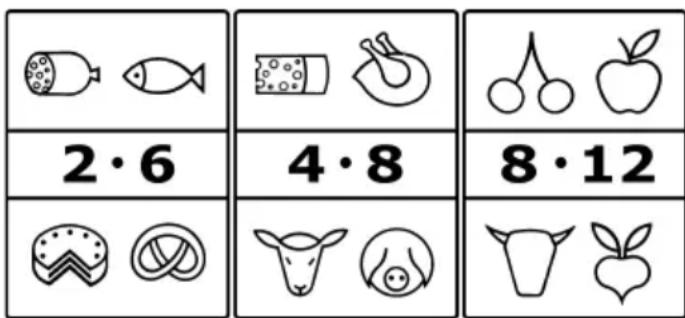
He npebbiwaiTe 3Tu cpoK XpaHEnHa.
Kpome Toro, Bcerda co6JIOdaIte cpoKxpaHEnn 3amopoxeHHbIX npOyKTOB, yKa3aHHbIe pOn3BOUInTeJIem.
EcnxOIOINbHcOCTaetcO TKNIOUeHHbIM Ha IINTeIbHbI nepIOB BpeMeHn (HaNPmEp, pni nepepbBe B 3HeprochabkeHn), DePKeTte DBepu 3akpblToi; 3TO NOMOXe CoXpaHHTb XOIOJIbHnke MaKcImaIbHO BO3MOXHyIO HN3KyIO TempepaTypy. INΦopMaqna O MaKcImaJIbHO BO3MOXHom BpeMeHn 6e30NaCHOrO xpaHEHn npOdyKTob Cnyae HeNoJaKn COePjNTcB Ta6nue cTexNueckmXapaKTEpcntkAmn annapata. DaJke He6oJIbWoe NOBbIWeHne TempeTaPyblBHyTpNi ShkaΦa npuBeDet K COKpaUeHNIO Cpoka rOJHOCTNI pOdyKTOB.
Hyneea 30ha
CoxpaHReT CBExeCTb CkOpONopTAAxxCr IpoDyKTOB, TAKNX KaK MAcO, pbI6a NMOOnHbIe IpoDyKtBI, B TeUeHne 6oJee DInITeJIbHOro BpeMeHn.
XoJooDbHbI uKaΦ
Pa3nHbIe 30hbl B xOIOINbHnke OXJaKaTcNpopa3Homy.Camra TeIIa3oHa HaxODITcY DBePcblB BepxHeuactn XOIOINbHnka,a Camra XOIOHNa-y 3aDHei CTeKN N B HIXKHeuactn XOIOINbHnka.
IcxOJa n3 3TO, npOyKtbi CneJeT XpaHnTB CJIeDyUoMm o6pa30M:
Ha nonkax xonodunbHoso ukaopa (CBepxy Bn3): KOHNTEpcKne N3dEINRA, rOToBbIE 6NIOda, MOnOCHbIe npOyKTbI, MRCO, Pb6y, XONODHbIE McCHbIE 6NIOda IN KOJIbAcbl.
- omdeneenu dna ooeue: oboun, canaT n pkykTbI.
e deepue (cBepxv Bn3): MacNo, cbip, rna, npnpaBbI B Tybax (Hanpimep, ropuuy), MaJeHbKne 6yTbIOouKn, 6oJIbUne 6yTbIKN, MONOKO n cpykTOBbie COKN ByNaKOBKe «TeTpanaK».
Bhaaane cneyetyctahOBnTb pyky tepmoCTata B noIOxHHe 4. Ecn oxnaKdaOoee deNCTBne CnUkOM cnIbHoe, erO HxKHOONH3NTb, nepeBeJa pyKy B noIOxHHe 1-3, a eCNI OHO HeIOCTaTOHOb, erO HxKHO NOBbICntb, pepeBeJa pyKBy nIOxHHe 5-7.
EcNn Bbl 3aMeTnHn Hn Ha 3aDHe CTeHKe, TO npuHno 3TOro YBnEeTcH, CKopee BCero, To, YTO DBepua ocTabaIacb OTKpbITOn CnWkOM DOnro nIN B XOJNDNbHK 6blNa NOXKeHa TEnJa Nnna Nn yCTabKa TeMnepaTypbl 6blNa CnWkOM BbICOKoN.
KnIqKoCTN, npOdyKTbIC nIbHbIM 3aIaxOM IIN npOdyKTbI, IMeIOJIe CBOJCTBO NOrIOUaTb CNIbHbIE 3aIaxN (HaIpIMep, cIbP, pb6a, CInBouHoe MacNo), Heo6xOIMO xpaHHTb OTdJIbHO B rEpMeTnueeCKn 3aKpbITOn Tape.
- PpexJe Yem noLoXnTb B XoNoDnBnK TeNblie npOdykTbI, IN CneJeYeToxJaNDtB Do KOMHaTHOH TempepaTypbl.
Bcerda npOBepaTe,TO DBePca NIOTHO 3AkpyTa,a repMeTuHOCb 3akpyTnHa He HapUHeA npOdyKTAMN, NOMeueHHbIMN B uKaΦ nIIN BDbepuy.
Pa3mopaxnBaHne n uCtka
Bcerda BbHMaTe WTeNceJbHyU BNky n3 po3eTKn nepeq YnCTKoXOJOuNbHnka.
HeJeTe Body Ha XoJIoNtBnK Nm BHyTp b erO.
ДЯ TeKUSeI YNCTKMBI peKOMeHnyem NcNoJb3OBAbTeNpyo BDOy C MArKIM MOIOUM cpeIcTBOM. Yo6bl
PpeDynpTeINb IoBHeHne HnpiTHoro 3aNaxa B XOJODINbHNKe, eRo HxKHO MbITb PpIMepHo OOnH pa3 B MeCra.
IpnHaJnExKHOCTN HxKHO MbITb OTDeJIbHO B TENIOI MbJIbHOI BOe. He MoTe INB NocydomOoeHoi MaunHe.
He nCnoB3yIte a6pa3nBhIe BeIecTBA nIN CnIbHOeIcTByIOUne MOUupe pAcTBOpbl, a TAKKe CNIPTOCoDEpKauine YNCTAUNe CpeDCTBa.
Iocne YnCTK TuaTeBHO O6MOte BCE NOBepxHOCTN HCTO BDO, Nocne Yero BbITpnte nx Hacyxo. Ppn BCTaBJeHN BUNK IN PO3ETky y6eDNTecb, yTO y Bac cyXne pyKn.
Дясбержениэлкгрзергинобсчени
ОТПИМАЛБНОЕ pa60Ты XOJOДИЛьнИКа Heo6XODIMO YICTNTb
ИСпAPITeJIb (Ha 3aДнeI CTeHKe), a TAKKE KOMPpeCCOP ПИ
ПOMOUII ΜEТКИ ИП NlIeCOCa He MeHee DByX pa3В rOД.
БудьтBEHIMaTeIbHbI,HTObI He OTOpBaTb HnH He IOBpeIITb BO Bpem YNCTKn 3aBOJcKyo TaJIuKy BHyTpN XOJOnIIbHnKa.
Pp na3MopaxnBaHm MOp03nBHoro kka
Korda cnoi Ibda B MOp03nIbHOM uKa4y DoCTnHET ToIuINbI 2-4 MM, ee Heo6xoJMo pa3Mop03ntb. 3TO CneJeYeT DeNaTb He MeHee DByx pa3 B roD.
- Y6eIntecb,уTO cTeBaB BnIka BbIHyTa n3 po3eTKN.
BbHbTe n3 uKaFa Bce npOdyKbI nNoJoxKe Ix B npOxAaHoe MeCTo, HAnpIMep, B pNactIKOBbl KOHeiHep BMeCTe C npeDbapntbHo 3aMOpOKeHHbIMn aKKyMyJIaTOpAMn XoJOnDa. ObpaTne BHNMaHne Ha To, YTO daKe np He3HaHTeJbHOM NobBiWeHm TemNepaTypbl cPOK xpaHeHnI npOdyKToB cokpaUaETCra Nix CNeDyET yNotpe6bNTb KaK MoXHO Ckopee.
I3BNeKeTe CnIBHOJ KAHaJI N3 MOpO3NbHOrO ⅢKaΦa, NOBepHrTe ero Ha 180^ n 3aΦnKcnpyTe (cm. cxemy). IocTaBbTe COOTBeTCTByIOuYO EMKoCTb IOd CnIBHOe OTBepCTne KaHaJa.
OCTaBbTe DBepeu OTKpbIToi. YTo6bl YcKOpNTb pa3MopaxnBaHne, B MOpO3NJIbHbI IkaΦ MoXHO NocTaNtB HeCKoJIbKO eMKoCTeC fOpAeY BOIo (Ho He C KInrTkOM). - PpeynpexdHne. He nCnoB3yute KaKHe-Jn6o BHeuHne npncnoc6JIeHnI nn DpyIne CpeIcTBa (HaNPmep, HArpeBaTeII INI TEINIOBEHTINrTOpbl) dIy yCKOpEHn pa3MopaxNBAHn.
Iocne OuNCTKMOPO3HbHO YoKaopa y6eIITecb,TO OH IIOHOCbIO BbICOX,NyCTaHOBtpepeyIaTOp TEMnepaTpybHa MaKcImaJIbHyO uCTaBky. Ype3 24 yaca peyIaTOp TEMnepaTpyb MOxHO ChOba yCTaHOBtB HOpMaJIbHoe IIOJoxHe.
Pa3mopakxueaHue xoJouNbHuKa
BHytpenHn nCnpnte3aIIT MOHTaxHOIeHO B CTeHKax annapata, NO3OMy Bbl MoKeTe 3aMeTNTb OTIOKeHne INHe Ha 3aHne CTeHke. Korda KOMpeccOp He pa6oTaET, 3TO T CNOINHE NaHnaet TaTb. TaTae BOda CTeKaET uePe3 CUNTcEmy IJNaHROB B NOdOH, yCTaHOBJIeHHbI NOd KOMpeccopom,
OTkyda OHa NOrloaetcOkpykaIOUHM BO3dyxOM. ITo 3ToI npuHHe annapaT He HxkdAeTcB pa3MopaxnBaHN, BmecTo 3Toro Tpe6yETc ToIbKO CBOEBpeMeHHa YNCTka.
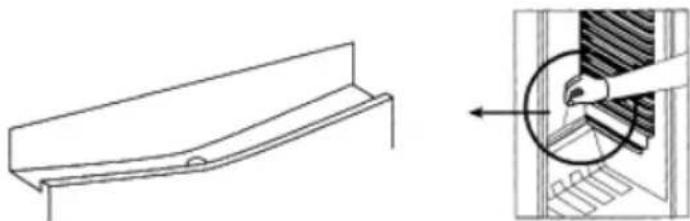
TO6bIOEcecneHTB CBO6OHNbI CTOK TaHOI BObl, BcERda npOBepaIte, YTO CNyCKHO KaHAN I CNIBHOE OTBepCTne CBO6OHNbI OT 3acopa.
- YdAnIe BOy, cKaJIINBaIOUcOHa dHe XoJIOuJIbHnka.
Pone3HbIe COBtI NO 3KOHOMN 3JIeKtpo3Heprn
XoIOJINbHnK DoJIKeH 6bITb yCTaHOBJeH B CyXOJ KOMHaTe C XPOUWe BEHTNJRAuEi.
He noBBepraTe XOIOJINJBHbNK BO3JeNCTBnIO IprMOrO coJIneHOrO CBeta n He yCTaHaBJIbAaIe erO B6JIIn3n JIO6bIX NCTOCHKOB TEnIIa (paINaTOPOB, KxOHHbIX PINT T. d.). EcNI 3TOrO n36EkaTb HeJIb3r, Heo6XoIMO yCTaHOBTb COOTBcETCTBYUUYIO N30JIaNIO MExkdy aannapatOM IN CTOHTHKOM TEnIIa.
He 3akpbBaIe BeHTnJIaHIOHHbIe OTBepCTN I peWETKIN oBecepeTe DoCTaTOHyU cnpKyJIaU IO B03dYxa BOKpyrannapaTa.
Heobxodmo perynnpHO ouuatab kOmnpccop (Ha 3aHne cTeHke annapata).HakanlnaioaJcra Ha KOMnpccope nbIb npBOND T KyBENueHNO NOTpe6JeHNA 3NeKTPOoHeprnn.
- PpeXeJe Yem IIOJoxHb TeIbIe npOdyKbI B XoIOJINbHNK, NaTe Nm DOCTaTOUHO OCTbIb.
YTo6bI He DoynctnTb yBEnHcHHe OToXeHnNbda, HE OCTaBnIyTe CNIuKOM DOJIO OTKpbITbIMN DBepCuXONoINbHnKa.KOrDa BblKnAteTe Nn DoCTaeTe PPOyKTH.
Yactoe pa3mopaxkuaHHe cnoc6ctByet cbepekeHHO 3neKtpo3Heprn. Yto6bI noIyUHTb 60nee noIpo6HyIO HΦopMaζuNo OvNCTKe annapata, o6paTntecb, POKaYNCTa.K pa3dEny Pa3mopaxkuaHue u OuycMka
He yctaHabnBaIte Tempepatpy Hnke Heo6xOIMo. UTo6bl nOnyUHTb 60one nOpO6HyIOHΦopMaunO o peryuNtpoBKe TempepatpybI, noXaJnyIcTa, K pa3dEny PeaynpoKa memnpamypbl.
Ponck nyctpaHne HncnpaBHOCTe
Korda np6op BkIIOueH, MoXHO yCbIwA Tb HeKOTOpBIE TINuHbIe WbMbI. 3TN WbMbI:
IPOUN3BOJTCN 3NEKTPODBINrAteIeM B KOMPpeccopHom y3JI; BO BpEma 3aIycka KOMPecccopa ypoBeHb 1yMa B XoIOJINbHnke 6BydTe BblSe B TeueHHe HeKOtOpOro BPemEH;
- PpOIN3BOJATcR XJaIaIeHTOM, UINPKUInpyUoIIMB CnCTeMe.
B npBHeEHHO 3decb Ta6nue nepeuHcneHb BO3MOxHbI HeNoJAdKn, INX BO3MOxHbI npuHbI n CnoO6bl yCTpaHEHr. PnB03HNKHOBeHHn pOBJem BO BpEma KcNpyaTcuIN XoNOJNbHnKa CHaHaJa npOBepbTe HAnuYe BO3MOxHOrO cnOc6a INy YcTpaHHeN B OToT Ta6nue.
Kuressaare: Toomas Teder FIE, Pikk 1B,
tel:45 55 978
Kaina: Ilmar Pauk Elektroponika FIE, Mae2S,
tel:4636379,5187444
Espana
Severin Electrodom. España S.L.
Plaza de la Almazara Portal 4, 1^ E.
45200 ILLESCAS(Toledo)
Tel: 925 51 34 05
Fax: 925 54 19 40
eMail: severin@severin.es
http://www.severin.es
France
SEVERIN France Sarl
4,rue de Thal
B.P.38
67211 OBERNAI CEDEX
Tel.: 03 88 47 62 08
Fax: 03 88 47 62 09
Greece
BERSON
C. Sarafi dis Bros. S.A.
Agamemnonos 47
176 75 Kallithea, Athens
Tel.: 0030-210 9478700
Philippos Business Center
Agias Anastasias & Laertou, Pilea
Service Post of Thermi
570 01 Thessaloniki, Greece
Tel.: 0030-2310954020
Iran
IRAN-SEVERIN KISH CO. LTD.
No.668,7th.Floor
Bahar Tower
Ave. South Bahar
TEHRAN - IRAN
Tel.:009821-77616767
Fax:009821-77616534
Info@iranseverin.com
www.iranseverin.com
Israel
Eatay Agencies
109 Herzel St.
Haifa
Phone: 050-5358648
Email: service@severin.co.il
Italia
via Dino Col 52r-54r-56r,
I-16149 Genova
Green Number: 800240279
Tel.: 010/6451102-010418609
Fax: 010/6425009
e-mail: videoelettronica@panet.it
Jordan
F.A. Kettaneh
P.O.Box 485
Amman, 11118, Jordan
Tel: 00962-6-439 8642
e-mail: app@kettaneh.com.jo
Korea
Jung Shin Electronics co., Ltd.
501, Megaventuretower 77-9
Moonrae-Dong 3ga, Yongdeungpo-Gu
Seoul, Korea
Tel: +82-22-637 3245~7
Fax:+82-22-6373244
Service Hotline: 080-001-0190
Latvia
SERVO Ltd.
Mr. Janis Pivovarenoks
Tel: +371 7279892
servo@alp0lo.lv
Lebanon
Khoury Home
7th Floor, Cité Dora 3 Building, Dora
P.O.Box 70611
Antelias, Lebanon
Telephone 01 244200,Fax 01 253535
eMail: info@khouryhome.com
Internet: www.khouryhome.com
Luxembourg
Ser-Tec
Ruedu Chateau d'Eua
3364 Leudelange
Tel.: 00352-379494402
Fax 00352-379494400
Macedonia
Agrotehna
St.Prvomajska bb
1000-Skopje
MACEDONIA
e-mail: servis@aqrotehma.com.mk
Tel: +3892/2445009 or -019
Fax:+38922463270
MagyarO
TFK Elektronik Kft.
Gyar u.2
H-2040 Budaörs
Tel.: (+36) 23444266
Fax: (+36) 23 444 267
Nederland
HAS b.v.
Stedenbaan 8
NL-5121 DP Rijen
Tel: 0161-22 00 00
Fax: 0161-290050
Norway
Lokken Trading AS
Trollasveien 34
1414Trollasen
Tel: 40 00 67 34
Fax: 66 80 45 60
Polska
SERV- SERWIS SP. Z 0.0.
UL.CYGANA4
45-131 OPOLE
Tel/Fax 0048774538642
Serbia and Montenegro
tel: +381-21-524-638
tel: +381-21-553-594
fax:+381-21-522-096
Slowak Republic
PREMT,s.r.o.
Skladova 1
917 01 Tmava
Tel: 033/544 7177
Finland
Oy Harry Marcell Ab
Rälssitie 6, PL 63
01511 Vantaa
Tel.: 00358 / 2 07 599 860
Fax: 00358 / 207599803
Svenska
Rakspecialisten HS
Mollevangsgatan 34
214 20 Malmö
Tel.: 040/12 07 70
Fax:040/6110335
Slovenia
SEVTIS d.o.o.
Smartinska 130
1000 Ljubljana
Tel: 0038615421927
Fax: 00386 1542 1926