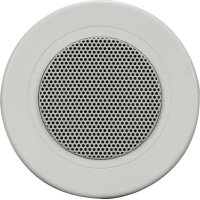
HS 1026 - Speaker RCF - Free user manual and instructions
Find the device manual for free HS 1026 RCF in PDF.



| Brand | RCF |
| Model | HS 1026 |
| Product type | In-ceiling speaker (flush mount) |
| Available colors | Chrome (HS 1026C), Gold (HS 1026G), White (HS 1026W) |
| Housing material | ABS plastic with metal grille on front |
| Mounting system | Flush mounting in drop ceiling (cutout Ø 92 mm) |
| RMS power rating | 6 W (100 V: 3-6 W / 70 V: 1.5-3-6 W) |
| Maximum power | 24 W |
| Frequency response | 220 Hz - 17 kHz |
| Sensitivity (1 W/1 m) | 89 dB |
| Maximum sound pressure (1 m) | 102 dB |
| Input voltage | 70 V or 100 V (constant voltage line) |
| Impedance (100 V) | 3330 Ω (3 W), 1660 Ω (6 W) |
| Impedance (70 V) | 3260 Ω (1.5 W), 1630 Ω (3 W), 815 Ω (6 W) |
| Coverage angle (-6 dB) | 500 Hz: 135°; 1 kHz: 170°; 2 kHz: 185°; 4 kHz: 90° |
| Dimensions (Ø x depth) | 104 x 91 mm |
| Weight | 550 g |
| Connection type | Screw terminals |
| Built-in filter | Yes (connection via +F terminal for use with subwoofer) |
| Power selection | By jumper on the line transformer |
| Cleaning | Soft dry cloth; avoid solvents, alcohol, gasoline |
| Operating temperature | Not specified in manual; indoor use recommended |
Frequently Asked Questions - HS 1026 RCF
User questions about HS 1026 RCF
0 question about this device. Answer the ones you know or ask your own.
Ask a new question about this device
Download the instructions for your Speaker in PDF format for free! Find your manual HS 1026 - RCF and take your electronic device back in hand. On this page are published all the documents necessary for the use of your device. HS 1026 by RCF.
USER MANUAL HS 1026 RCF
CAUTION - This symbol indicates important instructions for ensuring personal safety.

IMPORTANT NOTE - This symbol indicates instructions that must be followed to the letter in order to prevent possible damage to the equipment.

NOTE - This symbol calls attention to special instructions, suggestions, or other useful information.
NOTE
- RCF will not assume any responsibility for incorrect installation of the speaker.
SAFETY PRECAUTIONS
- Read the instructions - Before installing and using this product, please read carefully all the instructions for safety, installation, and operation provided in this manual.
- Keep the instructions - This manual is to be considered an integral part of the product, and must always accompany the unit when it changes ownership as a reference for correct installation and use as well as for the safety regulations.
- Cautions - Always read the notes preceded by the symbol , both on the product and in this manual, with particular attention, as they contain important information for personal safety.
- Follow the instructions - All the instructions in this manual for installation, use, and other must be followed to the letter.
- Water and humidity - Do not use this product near water or in particularly humid places, such as near a bathtub or sink, in a damp cellar, near a swimming pool, etc..
- Heat - Position the speaker far away from heat sources such as radiators, space heaters, air conditioners, or any other device that produces heat. Also avoid positions that are exposed to direct sunlight.
- Foreign bodies and liquids - Be careful not to allow any foreign bodies or liquids to get into the speaker.
- Situations requiring technical service - The speaker must be taken to the RCF SERVICE CENTRE in the following cases:
a. foreign bodies or liquids have got into the speaker.
b. the speaker has been exposed to rain.
c. the speaker does not function or functions abnormally, or shows a marked reduction in performance.
d. the speaker has been subject to strong impact or has been damaged.
-
Technical service - Do not attempt to make any repairs not described in this manual. When repairs are necessary, contact the RCF SERVICE CENTRE.
-
Accessories - Install and use the speaker only with the accessories specified by the manufacturer or supplied with the product (e.g. supports, stands, trolleys, etc.).
- Specifications - When installing and using the speaker, keep in mind the technical specifications indicated in the dedicated section of this manual.
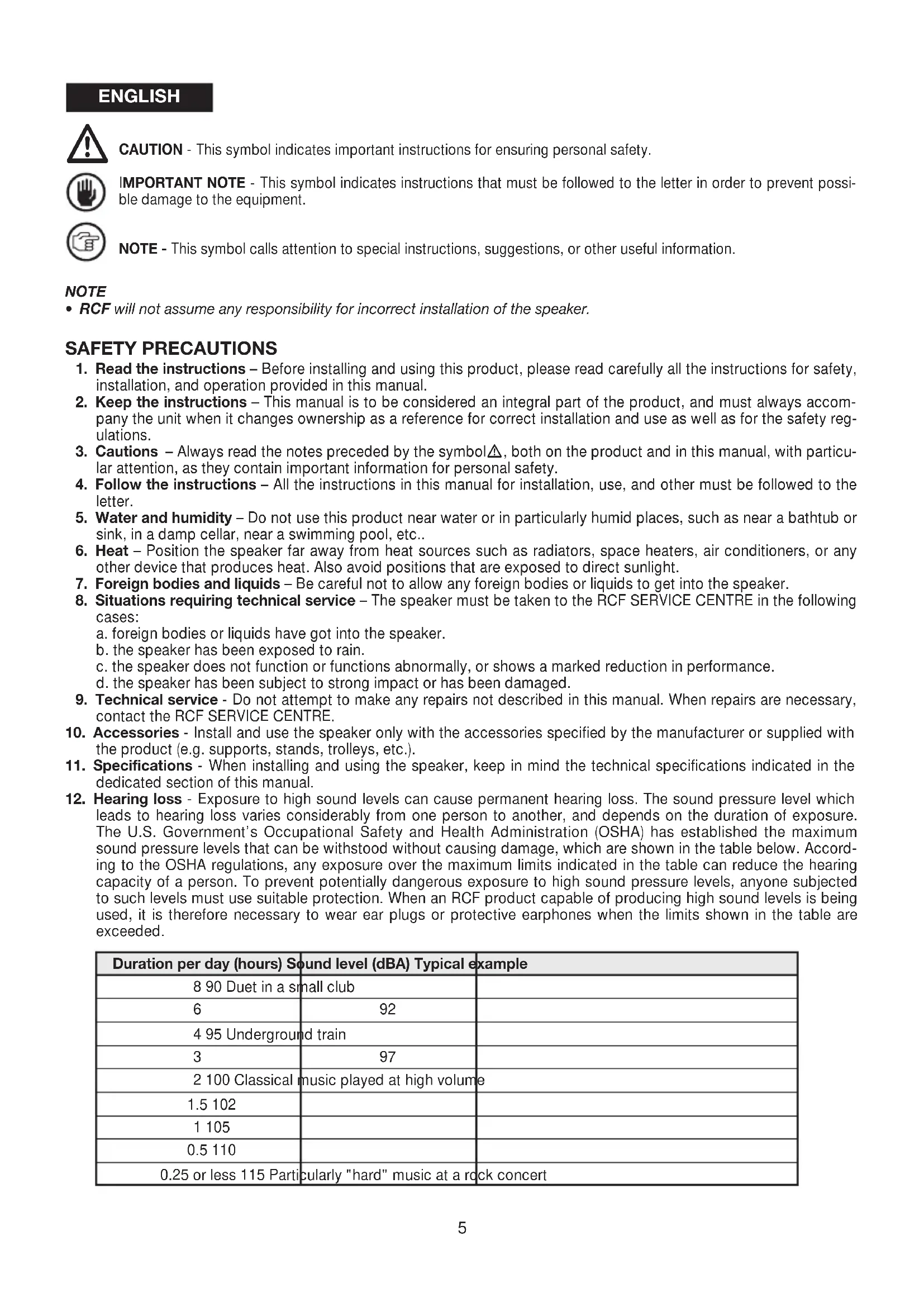
- Hearing loss - Exposure to high sound levels can cause permanent hearing loss. The sound pressure level which leads to hearing loss varies considerably from one person to another, and depends on the duration of exposure. The U.S. Government's Occupational Safety and Health Administration (OSHA) has established the maximum sound pressure levels that can be withstood without causing damage, which are shown in the table below. According to the OSHA regulations, any exposure over the maximum limits indicated in the table can reduce the hearing capacity of a person. To prevent potentially dangerous exposure to high sound pressure levels, anyone subjected to such levels must use suitable protection. When an RCF product capable of producing high sound levels is being used, it is therefore necessary to wear ear plugs or protective earphones when the limits shown in the table are exceeded.
| Duration per day (hours) Sound level (dBA) Typical example | ||
| 8 90 Duet in a small club | ||
| 6 | 92 | |
| 4 95 Underground train | ||
| 3 | 97 | |
| 2 100 Classical music played at high volume | ||
| 1.5 102 | ||
| 1 105 | ||
| 0.5 110 | ||
| 0.25 or less 115 Particularly "hard" music at a rock concert | ||
OPERATING PRECAUTIONS
- In outdoor use, avoid positioning the speaker in places that are directly exposed to harsh weather.
- Do not use solvents, alcohol, benzene, or other volatile substances to clean the external parts of the speaker.
CHARACTERISTICS
- "Spotlight" speakers that can be flush-mounted in false ceilings like normal halogen spotlights used in lighting systems.
- Body in plastic (ABS) with metal front grille.
Available in three colours: chrome (HS 1026C), gold (HS 1026 G), and white (HS 1026W).
Good acoustic features. - Transformer that enables connection with constant voltage lines at 70V and 100V .
- Possibility to select the sound power to be delivered from various values.
- Can be coupled with a subwoofer to improve low frequency reproduction.
- Quick and easy installation thanks to the spring hooks and the standard dimensions of the mounting hole.
- Connection by means of screw terminals.
- Extremely compact dimensions.
Excellent design.
INSTALLATION
CAUTION
- Speaker installation must only be carried out by qualified personnel in full respect for the safety standards.
- Speaker installation must be secure. Check to make sure that the support surface (e.g. panel, false ceiling, etc.) has the necessary mechanical characteristics to support the weight of the speaker without the danger of it falling and causing damage to persons or structures.
1) Make a hole of diameter 92mm in the false ceiling at the point selected for speaker installation.
2) Rotate the two spring hooks toward the rear part of the speaker and insert them in the hole made, as shown in Figure 1 on page 17.
3) Push the speaker at point "A" (Fig. 1) to insert it partially into the hole, as shown in Figure 2 on page 17.
4) Push the speaker at point "B" (Fig. 2) to insert it completely into the hole, securing it in the false ceiling as shown in Figure 3 on page 18.
5) Make the electrical connections as described in the section below.
CONNECTIONS
CAUTION
- For connecting the speaker, use only qualified and experienced personnel having sufficient technical knowledge or specific instructions for making the connections correctly and thus preventing any electrical dangers.
- To prevent the risk of electrical shock, do not make the speaker connections with the amplifier switched on.
- Before putting the speaker into operation, re-check that all the connections have been made correctly to ensure that there are no accidental short circuits which could give rise to dangerous electrical sparks.
- The entire sound system must be designed and installed in compliance with the current standards and regulations regarding electrical systems.

NOTES
- To prevent inductive phenomena from causing hum or disturbance which could jeopardize efficient system operation, the line that supplies the speaker should not be run together with electrical energy conductors, microphone cables, or low level signal lines coming from amplifiers.
- To minimize the inductive effects (hum) due to coupling with surrounding electrical fields, twist together the two conductors that supply the speaker.
- In connections with bipolar cables, use the type which has markings to distinguish the polarity (e.g. insulation of a different colour, different coloured wires, etc.).
The HS 1026 series speakers are designed for connecting to constant voltage audio lines at 70V or 100V . Connection to the audio line is made using the "M" terminal strip of the speaker (Fig. 4, page 18).
When making speaker connections, keep the following indications in mind:
- The output voltage of the amplifier must correspond to the input voltage of the speaker.
- The sum of the nominal power values of all the speakers connected to the audio line must not exceed the power of the amplifier.
- The connection should be made "in phase"; i.e. where the polarity of the amplifier output corresponds with the polarity of the speaker input.
CONNECTING THE SPEAKER USING A FILTER
This type of connection is recommended when the sound system includes a subwoofer for low frequency reproduction, or when you want to optimize speaker performance when it is used at maximum power (6W). To use the filter, connect the speaker using the terminals “-” (negative pole) and “+F” (positive pole) as shown in Figure 4 on page 18.
CONNECTING THE SPEAKER WITHOUT A FILTER
With this type of connection, the speaker is driven with all the frequencies transmitted by the amplifier. To exclude use of the filter, connect the speaker using the terminals “-” (negative pole) and “+” (positive) as shown in Figure 4 on page 18.
OUTPUT POWER SELECTION
All the speakers of the HS 1026 series are equipped with a line transformer, which makes it possible to select the power to be delivered from among various values. To select the power value, proceed as follows.
1) Making reference to the indications provided in correspondence with the line transformer input terminals, connect the connector "S" of the input wire of the speaker to the transformer terminal that corresponds to the desired output power, as shown in Figure 4 on page 18.

IMPORTANT NOTE
- To avoid damaging the speaker, never use the "6W / 70V" terminal of the transformer when the speaker is supplied with a 100V line.
HS 1026C · HS 1026G · HS 1026W SPECIFICATIONS
| Type Ceiling speaker | |
| Attachment system Flush-mounted | |
| Continuous nominal power* 6 W (100 V: 3-6 W / 70V: 1.5-3-6 W) | |
| Maximum power 24 W | |
| Impedance | [100 V]: 3330 Ω - 3 W; 1660 Ω - 6 W [70 V]: 3260 Ω - 1.5 W; 1630 Ω - 3 W; 815 Ω - 6 W |
| Frequency response 220 - 17,000 Hz | |
| Sensitivity (1W/1m) | 89 dB |
| Maximum sound pressure (1m/max. power) | 102 dB |
| Input voltage 70 V - 100 V | |
| Angle of coverage (-6 dB) [500 Hz] 135° | |
| [1000 Hz] 170° [2000 Hz] 185° [4000 Hz] 90° | |
| Dimensions (Ø x d) Ø 104 x 91 mm | |
| Weight 550 g | |
| Colour HS 1026C: chrome | |
| HS 1026G: gold HS 1026W: white | |
- Test long term with IEC spectrum.
FRANCAIS


