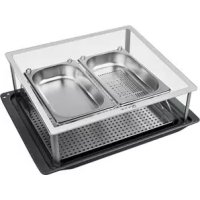
N8642X3 - Steamer NEFF - Free user manual and instructions
Find the device manual for free N8642X3 NEFF in PDF.

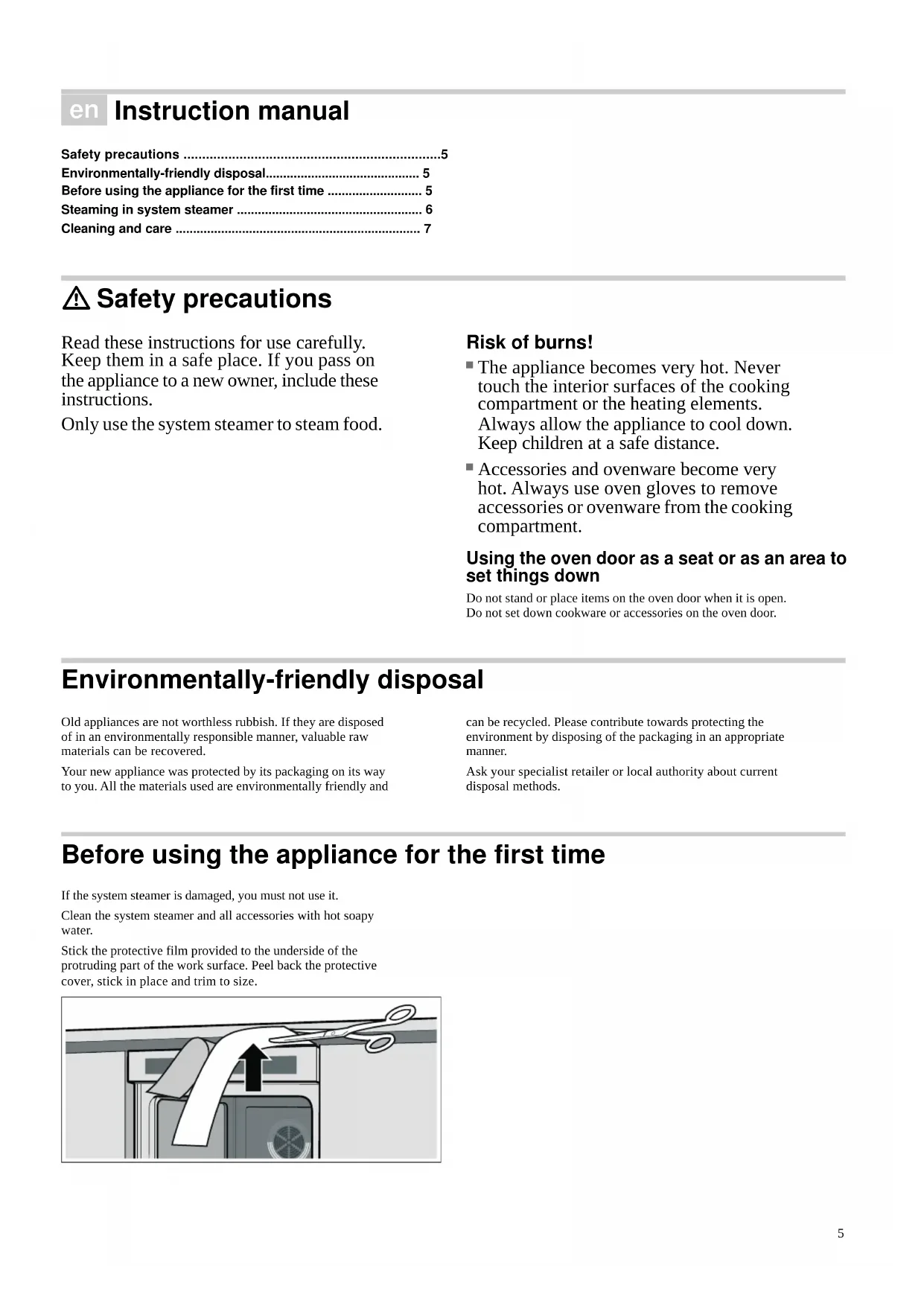


| Product type | Steam cooking system for oven |
| Brand | Neff |
| Model | N8642X3 |
| Standard water capacity | 500 ml |
| Water capacity for swelling foods | 750 ml |
| Included accessories | Deep soufflé dish, large steaming insert, small steaming insert, glass lid, support with cooking trays, rice and sauce container |
| Main material | Stainless steel |
| Preheating temperature | 150 °C |
| Preheating time | 10 minutes |
| Use | Steaming vegetables, meat, fish, eggs, rice, etc. |
| Cleaning and maintenance | Cleaning with hot water and dish soap; descaling with vinegar-based cleaner |
| Safety | Hot surface, use oven mitts; do not open the door during cooking; beware of hot steam |
| Original parts | Use exclusively the original parts provided |
| Number of pieces | 7 pieces |
Frequently Asked Questions - N8642X3 NEFF
User questions about N8642X3 NEFF
0 question about this device. Answer the ones you know or ask your own.
Ask a new question about this device
Download the instructions for your Steamer in PDF format for free! Find your manual N8642X3 - NEFF and take your electronic device back in hand. On this page are published all the documents necessary for the use of your device. N8642X3 by NEFF.
USER MANUAL N8642X3 NEFF
de Gebrauchsanleitung 2
en Instruction manual 5
fr Notice d'utilisation 8
nl Gebruiksaanwijzing 11
it Istruzioni per l'uso 14
es Instrucciones de uso 17
el Οδηγίες χρήσης 20
ru Правила пользования 23
N8642X3
System-Dampfgarer
System steamer
Nach dem Dämpfen
Safety precautions ....5
Environmentally-friendly disposal....5
Before using the appliance for the first time 5
Steaming in system steamer 6
Cleaning and care 7

Safety precautions
Read these instructions for use carefully. Keep them in a safe place. If you pass on the appliance to a new owner, include these instructions.
Only use the system steamer to steam food.
Risk of burns!
■ The appliance becomes very hot. Never touch the interior surfaces of the cooking compartment or the heating elements. Always allow the appliance to cool down. Keep children at a safe distance.
■ Accessories and ovenware become very hot. Always use oven gloves to remove accessories or ovenware from the cooking compartment.
Using the oven door as a seat or as an area to set things down
Do not stand or place items on the oven door when it is open. Do not set down cookware or accessories on the oven door.
Environmentally-friendly disposal
Old appliances are not worthless rubbish. If they are disposed of in an environmentally responsible manner, valuable raw materials can be recovered.
Your new appliance was protected by its packaging on its way to you. All the materials used are environmentally friendly and
can be recycled. Please contribute towards protecting the environment by disposing of the packaging in an appropriate manner.
Ask your specialist retailer or local authority about current disposal methods.
Before using the appliance for the first time
If the system steamer is damaged, you must not use it.
Clean the system steamer and all accessories with hot soapy water.
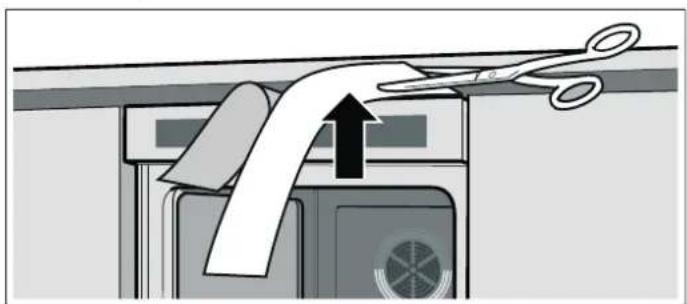
Stick the protective film provided to the underside of the protruding part of the work surface. Peel back the protective cover, stick in place and trim to size.
Steaming in system steamer
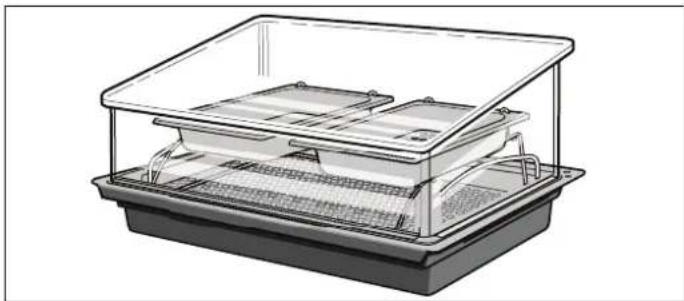
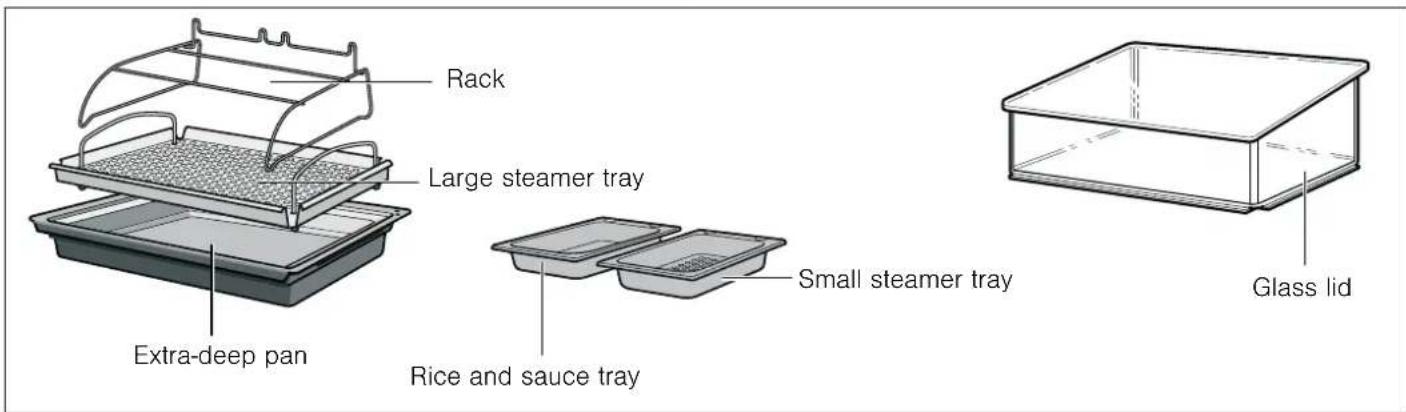
The essential elements of the system steamer are the extra-deep pan, the large steamer tray and the glass lid.
For larger quantities and for preparing rice or sauces, you can also use the rack with the cooking containers.
Only use the original parts supplied.
You can find further information about steaming in the enclosed booklet.
You can also use the extra-deep pan individually to prepare large quantities of bakes, for example.
Steam
Do not open the oven during cooking. Exception: When combining different foods that have considerable differences in their cooking times.
The cooking time is determined by the size of the food being cooked. If you are simultaneously cooking food with different cooking times:
■ Cut the food with the longer cooking time into smaller pieces
■ Lengthen the cooking time for delicate foods by cooking larger pieces.
In general, 500 ml of water (no distilled water) is used for steaming. Exception: Foods that soak up water (e.g. potatoes) and ingredients with long cooking times require 750 ml of water (see the cooking table or enclosed booklet).
- Preheat the oven for 10 minutes using ☐ Bottom heat at 150 °C or using 🌐 Steam cooking.
- Add the water to the extra-deep pan.
- Place the food in the system steamer.
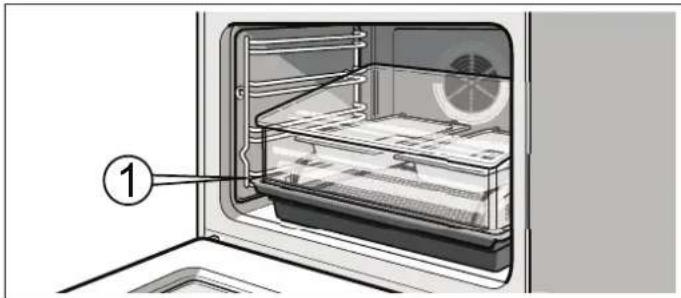
- Place the glass lid in position so that it is resting on the extra-deep pan all the way round.
- Insert the system steamer at level 1.
Risk of scalding!
Hot steam may escape when you open the oven door. Open the oven carefully after cooking.
- When cooking has finished, take the system steamer out of the oven. Use suitable oven gloves to do this.
- Set down the system steamer. Do not place it on the oven door.
Risk of scalding!
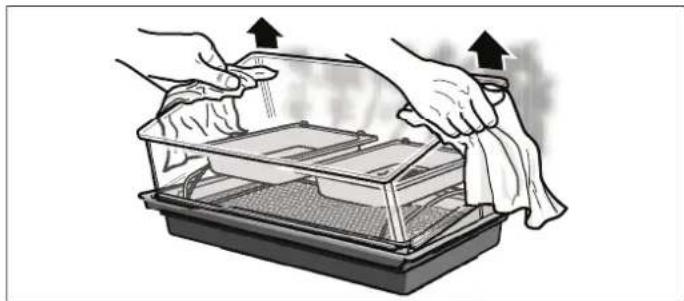
Hot steam will escape when you lift up the glass lid. Lift the glass lid at the rear so that the hot steam can escape away from you.
- Remove the glass lid.
After steaming
- Allow the cooking compartment to cool.
- Wipe out the cooking compartment with clean water.
- Using a soft cloth, wipe dry the cooking compartment, behind the door seal and the drip trough, and between the oven door and oven.
Cooking table
The values in the cooking table are guidelines and may vary depending on the type, size and freshness of the food to be cooked.
Do not defrost frozen food before steaming. The cooking time is extended by about 5 minutes.
| Food Preparation Steaming liquid | in ml | Cooking time in minutes | |
| Cauliflower Florets (with cut in stalk) 500 30 - 35 | |||
| Cauliflower Whole 500 35 - 40 | |||
| Cauliflower, frozen Florets 500 25 - 30 | |||
| Broccoli, fresh Florets (with cut in stalk) 500 30 - 35 | |||
| Broccoli, frozen Florets 500 25 - 30 | |||
| Peas, fresh 500 25 - 30 | |||
| Peas, frozen 500 20 - 25 | |||
| Fennel, fresh Halved, stalk removed 500 35 - 45 | |||
| Fennel, fresh | Slices | 500 20 - 25 | |
| Green beans | 500 30 - 40 | ||
| Green beans, frozen | 500 30 - 35 | ||
| Carrots | Slices, sticks | 500 35 - 40 | |
| Celeriac | Slices, sticks | 500 35 - 40 | |
| Leeks | Fine strips or diagonal slices | 500 30 - 35 | |
| Corn on the cob | Whole 750 55 - 60 | ||
| Pepper | Cut into strips, depending on ripeness | 500 30 - 40 | |
| Unpeeled boiled potatoes | Depending on size | 750 55 - 65 | |
| Brussels sprouts, fresh | Make a cut in stalk | 500 35 - 40 | |
| Brussels sprouts, frozen | 500 30 - 35 | ||
| Boiled potatoes | Narrow potato wedges | 750 30 - 35 | |
| Boiled potatoes | Quartered | 750 35 - 45 | |
| Courgettes Halved lengthways, slices | 500 25 - 30 | ||
| Asparagus spears | Depending on thickness | 500 35 - 45 | |
| Green asparagus | Depending on thickness | 500 30 - 40 | |
| Hard-boiled eggs | Up to 20 | 500 25 - 30 | |
| Royale | In porcelain cups | 500 35 - 40 | |
| Rice | 200 g rice and 350 ml water | 750 | 40 - 45 |
| Fish fillet | e.g. plaice | 500 20 - 25 | |
| Fish steaks | Approx. 150 - 200 g/slice, e.g. salmon, tuna | 500 | 25 - 30 |
| Fish portions | Approx. 200 - 250 g/piece, e.g. trout, mackerel | 500 | 20 - 25 |
| Large fish | Approx. 800 - 1000 g, e.g. trout, bream | 500 | 30 - 40 |
| Beef | Approx. 1000 g depending on thickness | 750 | 75 - 90 |
| Pork | Fillet approx. 500 g/piece | 750 40 - 50 | |
| Poultry | Approx. 200 g/piece, e.g. turkey and chicken breast | 500 | 35 - 45 |
Cleaning and care
Do not use scouring agents, corrosive materials or sharp objects to clean the appliance.
Remove limescale using an ordinary vinegar-based cleaner. Rinse with clean water and rub dry with a soft cloth.
Do not scrape off dried-on food residues. Instead, soften them by soaking in soapy water.
Na het stomen

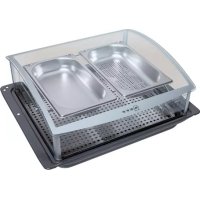
Brand : NEFF
Model : N8642X3
Category : Steamer