
CG40EAS(P)(LA) - Lawn mower HITACHI - Free user manual and instructions
Find the device manual for free CG40EAS(P)(LA) HITACHI in PDF.

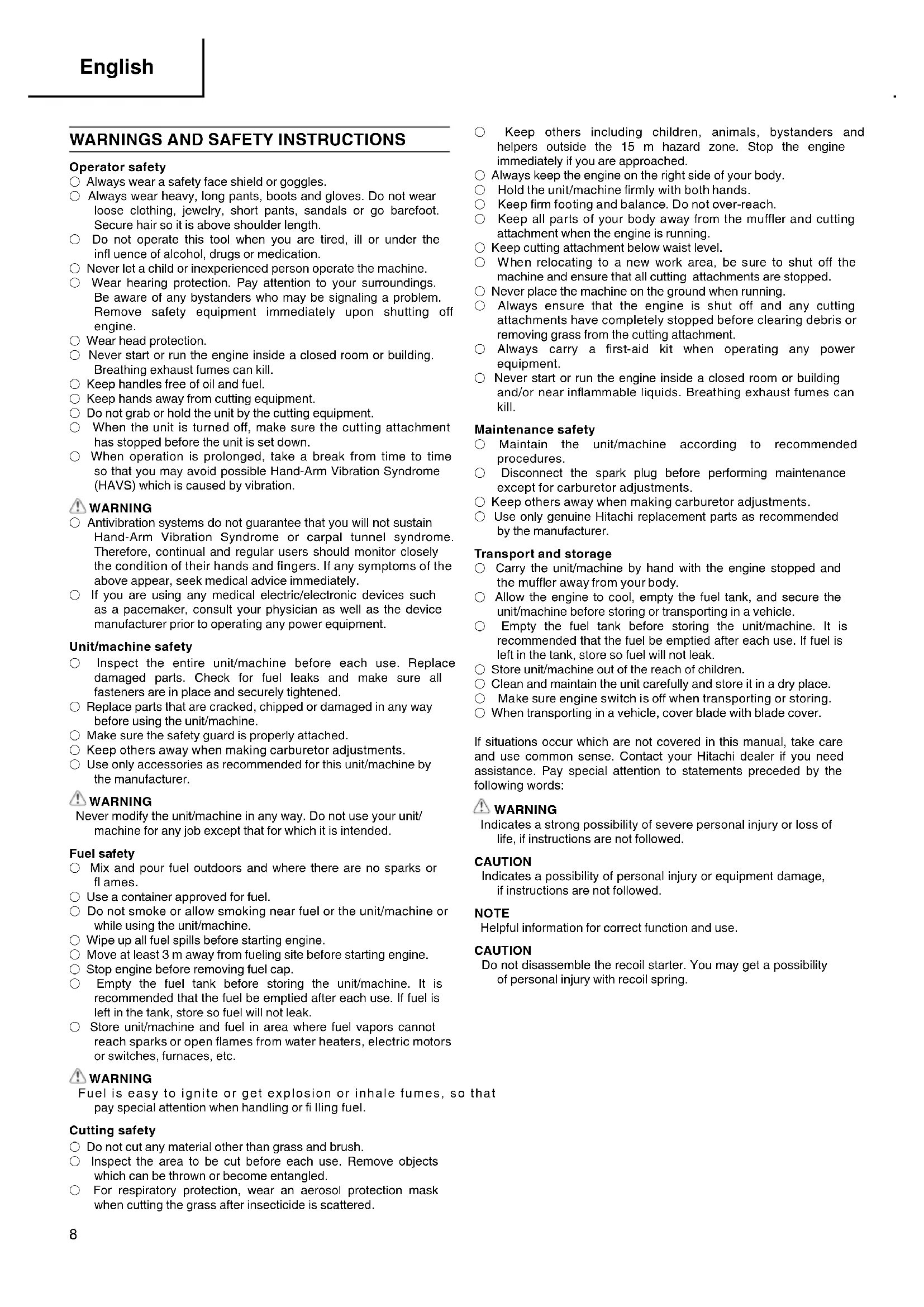


| Product type | Brushcutter / String trimmer |
| Brand | Hitachi |
| Model | CG40EAS(P)(LA) |
| Engine | 2-stroke, air-cooled |
| Displacement | 39.8 cm³ |
| Dry weight | 7.5 kg |
| Fuel tank capacity | 1.00 L |
| Spark plug | NGK BPMR6A or equivalent |
| Sound pressure level (LpA) | 90 dB(A) |
| Guaranteed sound power level | 110 dB(A) |
| Front handle vibrations | 5.2 m/s² (model CG40EAS(P)) |
| Rear handle vibrations | 6.9 m/s² (model CG40EAS(P)) |
| Cutting tools | Saw blade or nylon line head |
| Idle speed | 2500-3000 rpm |
| Maximum shaft speed | 9900 rpm |
| Fuel | Unleaded gasoline 89 octane + 2-stroke oil (25:1 to 50:1) |
| Nylon line diameter | 2.5 mm |
| Nylon line length | 11 to 16 cm |
| Safety perimeter | 15 m around the user |
| Safety devices | Blade guard, harness, emergency release tab, on/off switch |
| Routine maintenance | Air filter cleaning every 10h, fuel tank drain before storage |
| Angle gear lubrication | Every 50h, lithium-based multi-purpose grease |
| Included accessories | Multiple socket wrench, instruction manual |
Frequently Asked Questions - CG40EAS(P)(LA) HITACHI
User questions about CG40EAS(P)(LA) HITACHI
0 question about this device. Answer the ones you know or ask your own.
Ask a new question about this device
Download the instructions for your Lawn mower in PDF format for free! Find your manual CG40EAS(P)(LA) - HITACHI and take your electronic device back in hand. On this page are published all the documents necessary for the use of your device. CG40EAS(P)(LA) by HITACHI.
USER MANUAL CG40EAS(P)(LA) HITACHI
Brush Cutter Motorsense Debroussailleuse Decespugliatore Motor bosmaier Desbrozadoras Roçadora
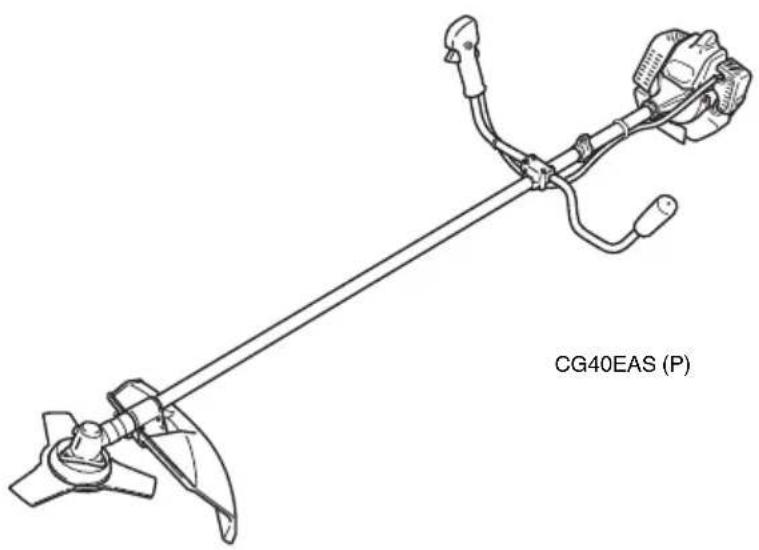
CG 40EAS (P)/CG 40EAS (LP)

Read the manual carefully before operating this machine.
NOTE: Some units do not carry them.
| Symbols WARNING The engine exhaust from this product contains chemicals known to the State of California to cause cancer, birth defects and other reproductive harm. | |||
| It is important that you read, fully understand and observe the following safety precautions and warnings. Careless or improper use of the unit may cause serious or fatal injury. | Max 9,900rpm | Shows maximum shaft speed. Do not use the cutting attachment whose max rpm is below the shaft rpm. | |
| Read, understand and follow all warnings and instructions in this manual and on the unit. | Gloves should be worn when necessary, e.g., when assembling cutting equipment. | ||
| Always wear eye, head and ear protectors when using this unit. | Use anti-slip and sturdy footwear. | ||
| Keep all children, bystanders and helpers 15 m away from the unit. If anyone approaches you, stop the engine and cutting attachment immediately. | Blade thrust may occur when the spinning blade contacts a solid object in the critical area. A dangerous reaction may occur causing the entire unit and operator to be thrust violently. This reaction is called blade thrust. As a result, the operator may lose control of the unit which may cause serious or fatal injury. Blade thrust is more likely to occur in areas where it is difficult to see the material to be cut. | ||
| Be careful of thrown objects. | Do not attach handle above this point | Indicate handle location. Do not attach handle above this point. | |
Contents
WHATIS WHAT
WARNING AND SAFETY INSTRUCTIONS 8
SPECIFICATIONS 9
ASSEMBLY PROCEDURES 10
OPERATING PROCEDURES 10
MAINTENANCE 11
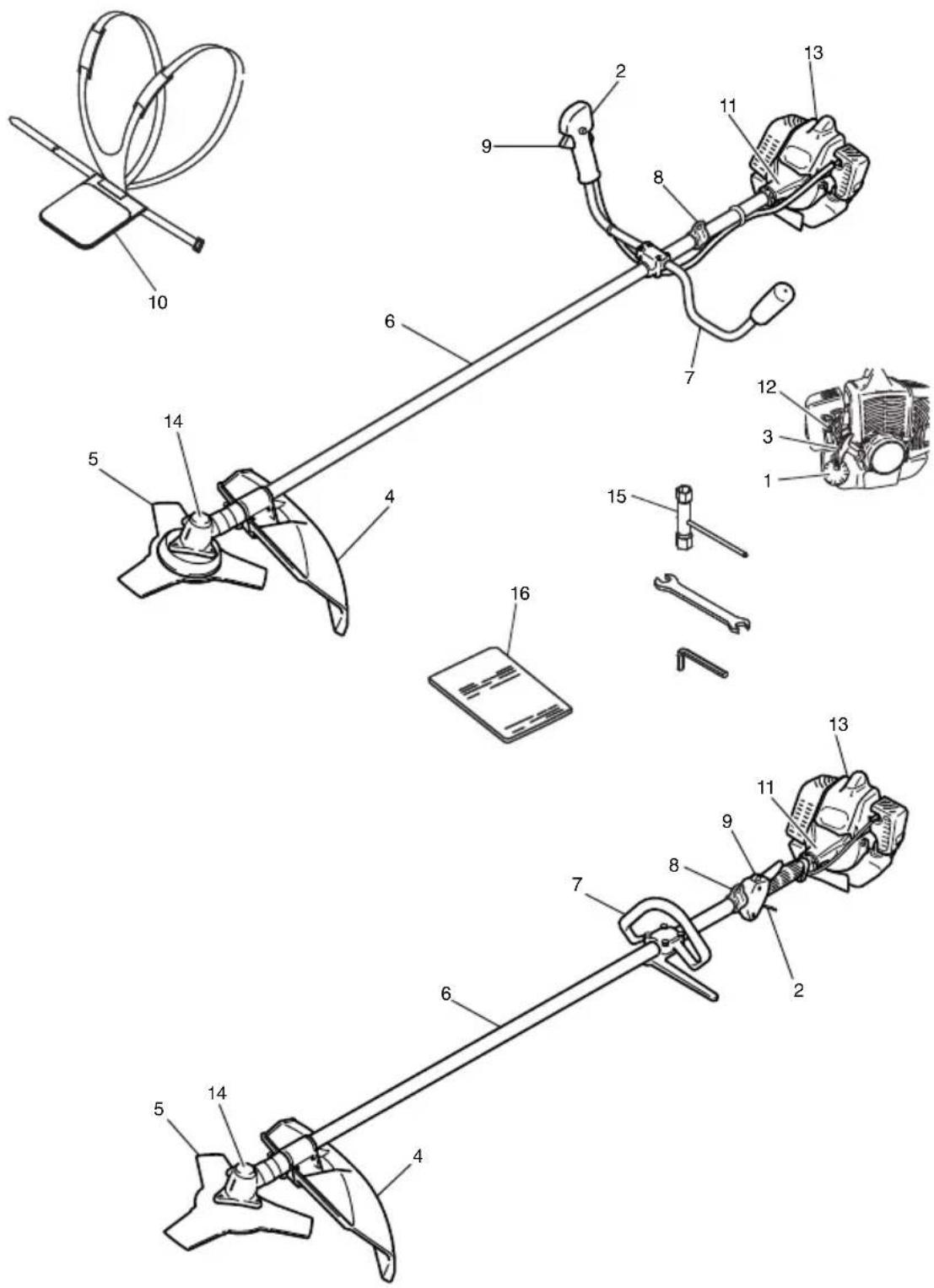
WHAT IS WHAT
Since this manual covers several models, there may be some difference between pictures and your unit. Use the instructions that apply to your unit.
- Fuel cap
- Throttle lever
- Starter handle
- Blade guard
- Cutting attachment
- Drive shaft tube
- Handle
- Suspension eyelet
- Ignition switch
- Harness
- Clutch case
- Choke lever
- Engine
- Angle transmission
- Combi box spanner
- Handling instructions
WARNING AND SAFETY INSTRUCTIONS
Operator safety
Always wear a safety face shield or goggles.
Always wear heavy, long pants, boots and gloves. Do not wear loose clothing, jewelry, short pants, sandals or go barefoot. Secure hair so it is above shoulder length.
Do not operate this tool when you are tired, ill or under the influence of alcohol, drugs or medication.
Never let a child or inexperienced person operate the machine.
Wear hearing protection. Pay attention to your surroundings. Be aware of any bystanders who may be signaling a problem. Remove safety equipment immediately upon shutting off engine.
Wear head protection.
- Never start or run the engine inside a closed room or building. Breathing exhaust fumes can kill.
Keep handles free of oil and fuel.
Keep hands away from cutting equipment.
Do not grab or hold the unit by the cutting equipment.
- When the unit is turned off, make sure the cutting attachment has stopped before the unit is set down.
When operation is prolonged, take a break from time to time so that you may avoid possible Hand-Arm Vibration Syndrome (HAVS) which is caused by vibration.
WARNING
Antivibration systems do not guarantee that you will not sustain Hand-Arm Vibration Syndrome or carpal tunnel syndrome. Therefore, continual and regular users should monitor closely the condition of their hands and fingers. If any symptoms of the above appear, seek medical advice immediately.
If you are using any medical electric/electronic devices such as a pacemaker, consult your physician as well as the device manufacturer prior to operating any power equipment.
Unit/machine safety
Inspect the entire unit/machine before each use. Replace damaged parts. Check for fuel leaks and make sure all fasteners are in place and securely tightened.
Replace parts that are cracked, chipped or damaged in any way before using the unit/machine.
Make sure the safety guard is properly attached.
Keep others away when making carburetor adjustments.
Use only accessories as recommended for this unit/machine by the manufacturer.
WARNING
Never modify the unit/machine in any way. Do not use your unit/ machine for any job except that for which it is intended.
Fuel safety
Mix and pour fuel outdoors and where there are no sparks or fl ames.
Use a container approved for fuel.
Do not smoke or allow smoking near fuel or the unit/machine or while using the unit/machine.
Wipe up all fuel spills before starting engine.
Move at least 3 m away from fueling site before starting engine.
Stop engine before removing fuel cap.
Empty the fuel tank before storing the unit/machine. It is recommended that the fuel be emptied after each use. If fuel is left in the tank, store so fuel will not leak.
- Store unit/machine and fuel in area where fuel vapors cannot reach sparks or open flames from water heaters, electric motors or switches, furnaces, etc.
WARNING
Fuel is easy to ignite or get explosion or inhale fumes, so that pay special attention when handling or fi Iling fuel.
Cutting safety
Do not cut any material other than grass and brush.
Inspect the area to be cut before each use. Remove objects which can be thrown or become entangled.
For respiratory protection, wear an aerosol protection mask when cutting the grass after insecticide is scattered.
- Keep others including children, animals, bystanders and helpers outside the 15m hazard zone. Stop the engine immediately if you are approached.
Always keep the engine on the right side of your body.
Hold the unit/machine firmly with both hands.
Keep firm footing and balance. Do not over-reach. - Keep all parts of your body away from the muffler and cutting attachment when the engine is running.
Keep cutting attachment below waist level. - When relocating to a new work area, be sure to shut off the machine and ensure that all cutting attachments are stopped.
Never place the machine on the ground when running.
Always ensure that the engine is shut off and any cutting attachments have completely stopped before clearing debris or removing grass from the cutting attachment.
Always carry a first-aid kit when operating any power equipment. - Never start or run the engine inside a closed room or building and/or near inflammable liquids. Breathing exhaust fumes can kill.
Maintenance safety
Maintain the unit/machine according to recommended procedures.
- Disconnect the spark plug before performing maintenance except for carburetor adjustments.
Keep others away when making carburetor adjustments.
Use only genuine Hitachi replacement parts as recommended by the manufacturer.
Transport and storage
- Carry the unit/machine by hand with the engine stopped and the muffler away from your body.
Allow the engine to cool, empty the fuel tank, and secure the unit/machine before storing or transporting in a vehicle.
Empty the fuel tank before storing the unit/machine. It is recommended that the fuel be emptied after each use. If fuel is left in the tank, store so fuel will not leak.
Store unit/machine out of the reach of children.
Clean and maintain the unit carefully and store it in a dry place.
Make sure engine switch is off when transporting or storing.
When transporting in a vehicle, cover blade with blade cover.
If situations occur which are not covered in this manual, take care and use common sense. Contact your Hitachi dealer if you need assistance. Pay special attention to statements preceded by the following words:
WARNING
Indicates a strong possibility of severe personal injury or loss of life, if instructions are not followed.
CAUTION
Indicates a possibility of personal injury or equipment damage, if instructions are not followed.
NOTE
Helpful information for correct function and use.
CAUTION
Do not disassemble the recoil starter. You may get a possibility of personal injury with recoil spring.
SPECIFICATIONS
| Model | CG40EAS (P) | CG40EAS (LP) |
| Engine Size (ml) 39.8 | ||
| Spark Plug NGK BPMR6A or equivalent | ||
| Fuel Tank Capacity (l) 1 | 00 | |
| Dry Weight (kg) 7.5 7.4 | ||
| Sound pressure level LpA (dB (A)) (EN27917) | 90 90 | |
| Measured sound power level LwA (dB (A)) | 108.8 | 105 |
| Guaranteed sound power level LwA (dB (A)) | 110 | 110 |
| Vibration level (m/s2) (ISO7916) | ||
| Front handle | - | 5.2 |
| Rear handle | - | 6.9 |
| Left handle | 3.4 | 5.5 |
| Right handle | 3.4 | 5.3 |
NOTE
Equivalent noise level/vibration level are calculated as the time-weighted energy total for noise/vibration levels under various working conditions with the following time distribution: 1/2 Idle, 1/2 racing.
* All data is subject to change without notice.
ASSEMBLY PROCEDURES
Drive shaft to engine (Fig. 1)
Loosen tube locking bolt (1) about ten turns so that the bolt point will not obstruct drive shaft tube to be inserted. When inserting drive shaft tube, hold the tube locking bolt outward preventing inside fitting from obstructing as well.
Some models may come with the drive shaft already installed.
NOTE
When it is hard to insert drive shaft up to the marked position on the drive shaft tube, turn drive shaft by the cutter mounting end clockwise or counter-clockwise. Tighten tube locking bolt lining up the hole in the shaft tube. Then tighten clamp bolt securely (1).
Installation of handle
WARNING
When you use steel/rigid blades on brush cutters, always use a barrier bar (2) and shoulder harness with the loop handle. (Fig. 2)
Attach the handle to the drive shaft tube with the angle towards the engine.
Adjust the location to the most comfortable position before operation.
NOTE
If your unit has handle location label on drive shaft tube, follow the illustration.
Remove the handle bracket (3) from the assembly. (Fig. 3)
Place the handles and attach the handle bracket with four bolts lightly. Adjust to appropriate position. Then attach it firmly with the bolts.
Attach the protection tube to the drive shaft or handle using cord clamps (4). (Fig. 4)
NOTE
If the protection tube is set apart from the handle or pipe, it will be caught by something during operation and it may cause serious injury. Do not set the protection tube apart from the handle or pipe.
Throttle wire / stop cord
Remove air cleaner cover. (Fig. 5)
Connect stop cords. (Fig. 6)
Insert the stay (5) under the nut (6) screwed onto the outer end of the throttle wire (7) and connect the end of the throttle wire (8) to the carburetor (9). Then tighten the nut (6) to secure the throttle wire to the stay (5). (Fig. 7)
NOTE
Check that the carburetor throttle returns to the idle position and also that it can be opened wide by operating the throttle lever.
Cover throttle wire and stop cords together with protective tube provided up to air cleaner cover. (Fig. 8)
Some models may come with the throttle wire and stop cords already installed.
Installation of blade guard (Fig. 9)
The guard bracket already mounted to the drive shaft tube.
Install the blade guard on drive shaft tube against angle transmission (10). Tighten the guard bracket firmly so that the blade guard does not swing or move down during operation.
CAUTION
The blade guard must be in place during operation.
If the blade guard is not in place, there is a possibility of serious injury.
Blade guards are equipped with sharp line limiter. Be careful with handling it.
NOTE
- When attaching the guard extension to the blade guard, the sharp line limiter must be removed from the blade guard.
To remove the guard extension, refer to the drawings. Wear gloves as the extension has a sharp line limiter, then push the two square tabs on the guard one by one in order after removed the screw. (Fig. 11)
Installation of cutting blade (Fig. 12)
When installing a cutting blade, make sure that there are no cracks or any damage in it and that the cutting edges are facing the correct direction.
Align the notch hole of the cutter holder with the hole on the gear case (Top the gear case) and insert the Allen wrench to stop turning. Turn the fixing nut clockwise and remove the fixing nut, protection cover, cutter holder cap, and toothed lock washers.
The installation of the cutting blade is as follows: insert the Allen wrench into the notch hole of the cutter holder and the hole on the gear case. Then, install the cutting blade (check the installing direction, as referring to Fig. 14), the cutter holder cap, protection cover and toothed lock washers onto the cutter holder in this order.
Finally, tighten the fixing nut securely by turning counterclockwise with the Combi box spanner. (Fig. 12)
CAUTION
When installing the cutting blade, set its center hole to the convex part of the cutter holder and hold it with the concave surface of the cutter holder cap. Then, tighten the fixing nut to prevent the cutting blade from being eccentric. (Fig. 12)
After installing the cutting blade, be sure to remove the Allen wrench and Combi box spanner.
Before operation, make sure the blade has been properly installed.
Before operation, check the cutter holder cap under the cutting blade for wear or cracks. If any damage or wear is found, replace it, as it is an article of consumption.
NOTE
The blade must be retained with a new cotter pin each time installed. (Fig. 12)
Installation of nylon head
Attach cutter holder (11) to the gear case. Insert an Allen into the hole in the gear case to attach winding protector (12) and attach nylon head (13) by turning it clockwise.
NOTE
Since cutter holder cap is not used here, keep it for next metal blade use.
OPERATING PROCEDURES
Fuel (Fig. 16)
WARNING
The brush cutter is equipped with a two-stroke engine. Always run the engine on fuel, which is mixed with oil.
Provide good ventilation, when fueling or handling fuel.
- Fuel is highly flammable and toxic and can result in serious injury if it is inhaled or comes into contact with your skin. Always handle fuel with care. Always have good ventilation when handling fuel inside building.
Fuel
Always use branded 89 octane unleaded gasoline.
Use genuine two-cycle oil or use a mix between 25:1 to 50:1, please consult the oil bottle for the ratio or Hitachi dealer.
If genuine oil is not available, use an anti-oxidant added quality oil expressly labeled for air-cooled 2-cycle engine use (JASO FC GRADE OIL or ISO EGC GRADE). Do not use BIA or TCW (2-stroke water-cooling type) mixed oil.
Never use multi-grade oil (10 W/30) or waste oil.
Always mix fuel and oil in a separate clean container.
Always start by filing half the amount of fuel, which is to be used. Then add the whole amount of oil. Mix (shake) the fuel mixture. Add the remaining amount of fuel.
Mix (shake) the fuel-mix thoroughly before filling the fuel tank.
Fueling
WARNING
Always shut off the engine before refueling.
Slowly open the fuel tank, when filling up with fuel, so that possible over-pressure disappears.
Tighten the fuel cap carefully, after fueling.
Always move the brush cutter at least 3m from the fueling area before starting.
Always wash any spilled fuel from clothing in soap.
Be sure to check for any fuel leakage after refueling.
Before fueling, clean the tank cap area carefully, no dirt falls into the tank. Make sure that the fuel is well mixed by shaking the container, before fueling.
Starting (Fig. 17)
CAUTION
Before starting, make sure the cutting attachment does not touch anything.
- Slide ignition switch (14) to RUN position. (Fig. 17) * Push priming bulb (17) several times so that fuel flows through return pipe. (Fig. 18)
- With the safety trigger (15) (if so equipped) pressed, pull throttle trigger and push throttle lock (16). Then slowly release the throttle trigger first, then the safety trigger. This will lock the throttle in starting position.
- Set choke lever to CLOSED position (18). (Fig. 19)
- Pull recoil starter briskly, taking care to keep the handle in your grasp and not allowing it to snap back. (Fig. 20)
- When you hear the engine want to start, return choke lever to RUN position (open). Then pull recoil starter briskly again.
NOTE
If engine does not start, repeat procedures from 2 to 5.
- After starting engine, pull throttle trigger to release throttle lock. Then allow the engine about 2-3 minutes to warm up before subjecting it to any load.
Cutting (Fig. 21, 22, 23)
- When cutting, operate engine at over 6500 rpm. Extended time of use at low rpm may wear out the clutch prematurely.
Cut grass from right to left.
Blade thrust may occur when the spinning blade contacts a solid object in the critical area.
A dangerous reaction may occur causing the entire unit and operator to be thrust violently. This reaction is called blade thrust. As a result, the operator may lose control of the unit which may cause serious or fatal injury. Blade thrust is more likely to occur in areas where it is difficult to see the material to be cut.
Wear the harness as shown in the figure. The blade turns counter-clockwise, therefore, be advised to operate the unit from right to left for efficient cutting. Keep onlookers out of working area at least 15m
NOTE
Press the quick release button or pull emergency release fl ap in the event of emergency. (Fig. 24)
How to use the shoulder harness
Wear the shoulder harness on your shoulder as shown Fig. 22 and hook it on the hanger of the machine. Adjust the length of the shoulder harness to the most comfortable position. (Fig. 22) To remove the machine from the shoulder harness, hold the main pipe of the machine firmly by one hand and then remove the hook (20) of the shoulder harness from the hanger (21). (Fig. 24-a)
How to reinstall the hook after using the emergency release pinch
It needs to go through the buckle (22) of the hook (20) to the metal plate (23) on the harness and go through the plate (24) of the emergency release pinch to the metal plate (23) on the harness. (Fig. 24-b)
After installing the buckle onto the harness, pull the hook (20) and make sure the hook (20) is securely fixed on the harness, then hook it to the hanger (21). (Fig. 24-a)
mediatelywith
- When using the machine, wear the shoulder harness and hold the machine correctly with both hands.
If you feel that there is something dangerous, separate the brush cutter from your body by pulling the emergency release pinch (19) of the harness to the direction of the arrow shown in Fig. 24-a.
If the cutting attachment should strike stones or other debris, stop the engine and make sure that the attachment and related parts are undamaged. When grass or vines wrap around attachment, stop engine and attachment and remove them.
NOTE
If you pull the emergency release pinch without holding the machine, the machine will fall to your feet. Pull the emergency release pinch while holding the main pipe of the machine by one hand.
Before operation, make sure that the emergency release pinch on the shoulder harness is working properly.
Stopping (Fig. 25)
Decrease engine speed and run at an idle for a few minutes, then turn off ignition switch (14).
WARNING
A cutting attachment can injure while it continues to spin after the engine is stopped or power control is released. When the unit is turned off, make sure the cutting attachment has stopped before the unit is set down.
How to use nylon head
When cutting, operate engine at over 6500 rpm. Extended use at low rpm may wear out the clutch prematurely.
This product is designed so that it will stop cutting when the nylon line becomes 16 cm or longer.
WARNING
A cutting attachment can injure while it continues to spin after the engine is stopped or power control is released. When the unit is turned off, make sure the cutting attachment has stopped before the unit is set down.
Set the engine speed as low as possible and tap the Head on the ground. (Fig. 26) Also, you can extend nylon line with hands but the engine must be completely stopped. (Fig. 27)
Adjust nylon line to proper length 11-14 cm before each operation.
MAINTENANCE
MAINTENANCE, REPLACEMENT OR REPAIR OF THE EMISSION CONTROL DEVICES AND SYSTEMS MAY BE PERFORMED BY ANY NON-ROAD ENGINE REPAIR ESTABLISHMENT OR INDIVIDUAL.
Carburetor adjustment (Fig. 28)
WARNING
The cutting attachment may be spinning during carburetor adjustments.
- Never start the engine without the complete clutch cover and tube assembled! Otherwise the clutch can come loose and cause personal injuries.
In the carburetor, fuel is mixed with air. When the engine is test run at the factory, the carburetor is basically adjusted. A further adjustment may be required, according to climate and altitude. The carburetor has one adjustment possibility:
T = Idle speed adjustment screw.
Idle speed adjustment (T)
Check that the air filter is clean. When the idle speed is correct, the cutting attachment will not rotate. If adjustment is required, close (clockwise) the T-screw, with the engine running, until the cutting attachment starts to rotate. Open (counter-clockwise) the screw until the cutting attachment stops. You have reached the correct idle speed when the engine runs smoothly in all positions well below the rpm when the cutting attachment starts to rotate.
If the cutting attachment still rotates after idle speed adjustment, contact your Hitachi dealer.
NOTE
Standard Idle rpm is 2500-3000 rpm.

When the engine is idling the cutting attachment must under no circumstances rotate.
Air filter (Fig. 29)
The air filter must be cleaned from dust and dirt in order to avoid:
Carburetor malfunctions
Starting problems
Engine power reduction
Unnecessary wear on the engine parts
Abnormal fuel consumption
Clean the air filter daily or more often if working in exceptionally dusty areas.
Cleaning the air filter
Remove the air filter cover and the filter (25). Rinse it in warm soap suds. Check that the filter is dry before reassembly. An air filter that has been used for some time cannot be cleaned completely. Therefore, it must regularly be replaced with a new one. A damaged filter must always be replaced.
Fuel filter (Fig. 30)
Drain all fuel from fuel tank and pull fuel filter line from tank. Pull fi lter element out of holder assembly and rinse element in warm water with detergent.
Rinse thoroughly until all traces of detergent are eliminated. Squeeze, do not wring, away excess water and allow element to air dry.
NOTE
If element is hard due to excessive dirt buildup, replace it.
Spark plug (Fig. 31)
The spark plug condition is influenced by:
An incorrect carburetor setting
Wrong fuel mixture (too much oil in the gasoline)
A dirty air filter
Hard running conditions (such as cold weather)
These factors cause deposits on the spark plug electrodes, which may result in malfunction and starting difficulties. If the engine is low on power, difficult to start or runs poorly at idling speed, always check the spark plug first. If the spark plug is dirty, clean it and check the electrode gap. Re-adjust if necessary. The correct gap is 0.6mm . The spark plug should be replaced after about 100 operation hours or earlier if the electrodes are badly eroded.
Muffler (Fig. 32)
Remove the muffler and clean out any excess carbon from the exhaust port or muffler inlet every 100 hours of operation.
Cylinder (Engine cooling) (Fig. 33)
The engine is air cooled, and air must circulate freely around engine and over cooling fins on cylinder head to prevent overheating. Every 100 operating hours, or once a year (more often if conditions require), clean fins and external surfaces of engine of dust, dirt and oil deposits which can contribute to improper cooling.
NOTE
Do not operate engine with engine shroud or muffler guard removed as this will cause overheating and engine damage.
Angle transmission (Fig. 34)
Check angle transmission or angle gear for grease level about every 50 hours of operation by removing the grease filler plug on the side of angle transmission.
If no grease can be seen on the flanks of the gears, fill the transmission with quality lithium based multipurpose grease up to 3/4. Do not completely fill the transmission.
Blade
WARNING
Wear protective gloves when handling or performing maintenance on the blade. (Fig. 35)
Use a sharp blade. A dull blade is more likely to snag and thrust. Replace the fastening nut if it is damaged and hard to tighten.
- When replacing blade, purchase one recommended by Hitachi, with a 25.4mm (one inch) fitting hole.
When installing a saw blade, always face the stamped side up. In the case of a 3 tooth blade, it can be used on either side.
Use the correct blade for the type of work.
When replacing blades, use appropriate tools.
- When cutting edges become dull, re-sharpen or file as shown in the illustration. Incorrect sharpening may cause excessive vibration.
Discard blades that are bent, warped, cracked, broken or damaged in any way.
NOTE
When sharpening blade it is important to maintain an original shape of radius at the base of the tooth to avoid cracking.
Nylon head
Nylon line replacement
Remove the cutting body cap by pushing inward the locking tabs on the side of the nylon head (Fig. 36). Take out the spool (Fig. 37), hook the new nylon line into the hole of the spool, then wind it around the spool (Fig. 38).
When the nylon line has been wound around the spool, temporarily fasten it in the opening of the spool at about 10cm from the end. (Fig. 39) Then thread the nylon line through the hole on the side of the nylon head and place the cutting body cap in reverse order of the cap removal. Pull the right and left nylon lines until they are secured about 15 - 16cm from the end. (Fig. 41)
NOTE
The nylon head is designed for nylon lines with an outer diameter of 2.5mm . Do not use nylon lines with a different outer diameter.
Make sure that the right and left nylon lines are of equal length since vibrations will otherwise increase.
Maintenance schedule
Below you will find some general maintenance instructions. For further information please contact your Hitachi dealer.
Daily maintenance
Clean the exterior of the unit.
Check that the harness is undamaged.
Check the blade guard for damage or cracks. Change the guard in case of impacts or cracks.
Check that the cutting attachment is properly centred, sharp, and without cracks. An off-centre cutting attachment induces heavy vibrations that may damage the unit.
Check that the cutting attachment nut is sufficiently tightened.
Make sure that the blade transport guard is undamaged and that it can be securely fitted.
Check that nuts and screws are sufficiently tightened.
Weekly maintenance
Check the starter, especially the cord and return spring.
Clean the exterior of the spark plug.
Remove it and check the electrode gap. Adjust it to 0.6 ~mm , or change the spark plug.
Clean the cooling fins on the cylinder and check that the air intake at the starter is not clogged.
Check that the angle gear is filled with grease up to 3/4.
Clean the air filter.
Monthly maintenance
Rinse the fuel tank with gasoline.
Clean the exterior of the carburetor and the space around it.
Clean the fan and the space around it.
SYMBOLBEDEUTUNGEN
WAARSCHUWINGEN EN VEILIGHEIDSINSTRUCTIES 40
SPECIFICATIONS. 41
MONTAGEPROCEDURES 42
BEDIENING 42
ONDERHOUD 44
WAT IS WAT
WAARSCHUWINGEN EN VEILIGHEIDSINSTRUCTIES
Cortar (Fig. 21, 22, 23)
| Item No. | Part Name Q'TY | |
| 1A Crank case ass'y 1 | ||
| 1 Ball bearing, 6202 2 | ||
| 2 Oil seal TC type 15 x 25 x 7 2 | ||
| 3 C r a n k c a s | ||
| 4 C r a n k c a s | ||
| 5 K n o c k p i n | ||
| 6 Gasket, crank case 1 | ||
| 7 Hex. socket Head Cap Screw M5 x 30 4 | ||
| 7A Spring washer 4 | ||
| 8 P i s t o n | ||
| 9 R i n g , p i s t | ||
| 10 Pin piston 10 x 30 1 | ||
| 11 Ring, snap 2 | ||
| 12 Crank shaft assy 1 | ||
| 13 Cylinder 1 | ||
| 14 Gasket, cylinder 1 | ||
| 15 Hex. socket Head Cap Screw M5 x 18 4 | ||
| 16 Spark plug BPMR6A 1 | ||
| 17 Woodruff key 3 x 13 x 5 | 1 | |
| 18 Magnet Ass'y 1 | ||
| 18-1 Rotor, magnet (with IG coil) 1 | ||
| 18-2 IG coil | 1 | |
| 19 Spacer, lg coil 2 | ||
| 20 Hex. socket Head Cap Screw M4 x 20 2 | ||
| 20A Spring washer 2 | ||
| 20B Plain washer 2 | ||
| 21 Hexagon nuts with flange 1 | ||
| 22A Wire, lead assy 1 | ||
| 23 Clutch assy 1 | ||
| 24 Clutch bolt 2 | ||
| 25 Clutch washer 8.2 x 18 x 1.2 | 2 | |
| 26 Wave washer 10 | 2 | |
| 27 Fan Cover Ass'y 1 | ||
| 27A Fan Cover Comp 1 | ||
| 27-1 Fan cover 1 | ||
| 27-2 Holder A 1 | ||
| 27-3 Holder B 1 | ||
| 27-4 Rubber, anti-vibration A 2 | ||
| 27-5 Rubber, anti-vibration B 1 | ||
| 27-6 Ball bearing 6202 2RZ 1 | ||
| 27-7 Circlips for holes-type A 35 1 | ||
| 27-8 Clutch drum assy 78 1 | ||
| 27-9 Circlips for shaft-type A 15 1 | ||
| 27-10 Hex. socket Head Cap Screw M5 x 25 2 | ||
| 27-10A Spring washer 2 | ||
| 27-10B Plain washer 2 | ||
| 27-11 Hex. socket Head Cap Screw M5 x 10 | 1 | |
| 27-11A Spring washer 1 | ||
| 29 Hex. socket Head Cap Screw M5 x 20 | 4 | |
| 29A Spring washer 4 | ||
| 31 Muffler ass'y 1 | ||
| 31A Heat shield A with Gasket 1 | ||
| 32A Gasket, Muffler 1 | ||
| 33 Plain washer 2 | ||
| 34 Hex. socket Head Cap Screw M6 x 70 2 | ||
| 35 Hex. socket Head Cap Screw M5 x 12 | 1 | |
| 35A Spring washer 1 | ||
| 35B Plain washer 1 | ||
| 36 Hex. socket Head Cap Screw M5 x 16 | 2 | |
| 36A Spring washer 2 | ||
| 36B Plain washer 2 | ||
| 37 Muffler cover 1 | ||
| 39 Gasket, insulator 1 | ||
| 40 Insulator 1 | ||
| Item No. | Part Name Q'TY | |
| 41 Hex. socket Head Cap Screw M5 x 25 2 | ||
| 41A | Spring washer | 2 |
| 41B | Plain washer | 2 |
| F 42 Gasket, carburetor 1 | ||
| R 43 Carburetor | 1 | |
| 44 | Cleaner body Ass'y | 1 |
| 44-1 | Cleaner Body | 1 |
| 44-2 | 6.5 spacer | 1 |
| 44-3 | Choke lever | 1 |
| 45 Wave washer 8 | 1 | |
| b 46Spit back shield 2 | 1 | |
| 47 | Cross recessed pan head screw PS M5 x 58 2 | |
| 48 | Air filter element | 2 |
| 49 | Cleaner Cover Comp | 1 |
| 49-1 | Cover, Cleaner 1 | |
| 49-2 | Knob, cover | 1 |
| 50 | Top cover (with spacer) | 1 |
| 52 | Cross recessed pan head screw PS M5 x 14 1 | |
| 53 Fuel tank Ass'y | 1 | |
| 53-1 | Fuel tank Comp | 1 |
| 53-2 | Pipe, return | 1 |
| 53-3 | Pipe, intake | 1 |
| 53-4 | Grommet | 1 |
| 53-5 | Clip , pipe | 1 |
| 53-6 | Filter Assy, Fuel tank | 1 |
| 53-7 | Tank cap comp | 1 |
| 53-7-1 | Tank cap | 1 |
| 53-7-2 | Holder, valve | 1 |
| 53-7-3 | Valve, fuel cap | 1 |
| 53-7-4 | Gasket, fuel cap | 1 |
| 53-7-5 | Cap, holder | 1 |
| 53-7-6 | Strap, fuel cap | 1 |
| 53-7-7 | Valve B, fuel cap | 1 |
| 53-7-8 | Filter, fuel cap | 1 |
| 54 Engine stand | 1 | |
| 55 Spacer fuel tank | 1 | |
| 56 | Hex. socket Head Cap Screw M5 x 25 1 | |
| 56A | Spring washer | 1 |
| 56B | Plain washer | 1 |
| 57 | Hex. socket Head Cap Screw M5 x 20 | 2 |
| 57A | Spring washer | 2 |
| 57B | Plain washer | 2 |
| 58 | Recoil starter ass'y 1 | |
| 59 | Hex. socket Head Cap Screw M5 x 20 4 | |
| 59A | Spring washer | 4 |
| 59B | Plain washer | 4 |
| 60 Pulley assy | 1 | |
| 61 | Hex. Nut style3 | 1 |

CG40EAS(P)
| Item No. | Part Name Q'TY | |
| 1 Gear Case Ass'y 1 | ||
| 2 Stop Ring 28 1 | ||
| 3 Stop Ring 12 1 | ||
| 4 | B e a r i n g | 6 |
| 5 | B e a r i n g | 6 |
| 6 | P i n i o n | 1 |
| 7 Bolt M5 x 12 1 | ||
| 8 Gear Case 1 | ||
| 9 Bolt M8 x 12 1 | ||
| 10 Blade Cover 1 | ||
| 11 | Bearing 6000/P5 | 1 |
| 12 Gear | 1 | |
| 13 Gear Shaft | 1 | |
| 14 | Bearing 6202/P5 | 1 |
| 15 | Stop Ring 35 1 | |
| 15A | Oil Seal TC Type 20 x 35 x 8 | 1 |
| 15B | Bushing | 1 |
| 16 Holder | 1 | |
| 17 Holder B | 1 | |
| 18 Washer 10 | 1 | |
| 19 | Left Nut M10 x 1.25 | 1 |
| 20 | Pin 2 x 16 | 1 |
| 21 | Screw M5 x 12 (Black) 3 | |
| 22 | Washer 6 | 1 |
| 23 | Screw M6 x 20 | 1 |
| 24 | Wire Clamp Band | 2 |
| 25 | Pipe Comp. 1 | |
| 26 | Rubber Cover | 5 |
| 27 | Oil-Bearing | 5 |
| 28 | Drive Shaft 1 | |
| 29 | Pipe | 1 |
| 30 | Clamp Ass'y | 1 |
| 31 | Screw M5 x 20 | 1 |
| 32 | Clamp | 1 |
| 33 | Harness Clamp | 1 |
| 34 | Nut M5 | 2 |
| 35 | Harness Ass'y | 1 |
| 36 | Lever Ass'y | 1 |
| 37 | Screw ST2.9 x 13 | 1 |
| 38 | Button | 1 |
| 39 | Spring | 1 |
| 40 | Clock Pin | 1 |
| 41 | Throttle Lever | 1 |
| 42 | Spring | 1 |
| 43 | Box, Right | 1 |
| 44 | Screw ST2.9 x 18 | 3 |
| 45 | Screw M5 x 30 | 1 |
| 46 | Cable Comp. | 1 |
| 47 | Tube (900±10 mm) | 1 |
| 48 | Stop Button Comp. | 1 |
| 49 | Safty Lever | 1 |
| 50 | Spring | 1 |
| 51 Box, Left | 1 | |
| 52 | Bolt M6 x 25 2 | |
| 53 | Cap, Lower | 1 |
| 54 | Bracket | 1 |
| 55 | Handle | 1 |
| 56 | Grip Left | 1 |
| 57 | Cap, Upper | 1 |
| 58 | Bolt M5 x 25 4 | |
| 59 | Nylon Cutter Head | 1 |
| 60 | Bracket | 1 |
| 61 | Screw M5 x 30 | 2 |
| 62 | Safety Guard | 1 |
| Item No. | Part Name Q'TY | |
| 63 | Screw M5 x 16 | 4 |
| 64 | Screw ST4.2 x 16 | 2 |
| 65 | Guard | 1 |
| 0 66 1 | Blade 2 R Z / P 5 | 1 1 |
| 0 67 1 | Guard As&Py 1 5 1 | |
| 68 | Blade (Blue) 1 | |
| 69 | Nylon Cutter Head Guard | 1 |
| 70 | Eye Protector | 1 |
| 71 | Spanner 17 x 19 | 1 |
| 72 | Spanner 4 | 1 |
| 73 | Spanner 8 x 10 | 1 |
| 74 | Saw Bit Cover | 1 |
| 75 | Screw M5 x 12 | 1 |
| 76 | Washer 5 (Zinc White) 1 | |
| 77 | Washer 5 | 1 |

CG40EAS(LP)
CG40EAS(LP)
| Item No. | Part Name Q'TY | |
| 1 Gear Case Ass'y 1 | ||
| 2 Stop Ring 28 1 | ||
| 3 Stop Ring 12 1 | ||
| 4 | B e a r i n g | 6 |
| 5 | B e a r i n g | 6 |
| 6 | P i n i o n | 1 |
| 7 Bolt M5 x 12 1 | ||
| 8 Gear Case 1 | ||
| 9 Bolt M8 x 12 5 | ||
| 10 Blade Cover 1 | ||
| 11 | Bearing 6000/P5 | 1 |
| 12 Gear | 1 | |
| 13 Gear Shaft | 1 | |
| 14 | Bearing 6202/P5 | 1 |
| 15 | Stop Ring 35 1 | |
| 15A | Oil Seal TC Type 20 x 35 x 8 | 1 |
| 15B | Bushing | 1 |
| 16 Holder | 1 | |
| 17 Holder B | 1 | |
| 18 Washer 10 | 1 | |
| 19 | Left Nut M10 x 1.25 | 1 |
| 20 | Pin 2 x 16 | 1 |
| 21 | Screw M5 x 12 (Black) 3 | |
| 22 | Washer 6 | 1 |
| 23 | Screw M6 x 20 | 1 |
| 24 | Wire Clamp Band | 2 |
| 25 | Pipe Comp. 1 | |
| 26 | Rubber Cover | 5 |
| 27 | Oil-Bearing | 5 |
| 28 | Drive Shaft 1 | |
| 29 | Pipe | 1 |
| 30 | Clamp Ass'y | 1 |
| 31 | Screw M5 x 20 | 1 |
| 32 | Clamp | 1 |
| 33 | Harness Clamp | 1 |
| 34 | Nut M5 | 1 |
| 35 | Harness Ass'y | 1 |
| 36 | Lever Ass'y | 1 |
| 37 | Screw M5 x 16 | 1 |
| 38 | Clamp | 1 |
| 39 | Box, Right | 1 |
| 40 | Rubber Cover | 1 |
| 41 Nut M5 | 3 | |
| 42 | Clamp | 1 |
| 43 | Stop Switch | 1 |
| 44 | Tine | 3 |
| 45 | Spring | 1 |
| 46 | Spring | 1 |
| 47 Safety Lever 1 | ||
| 48 | Spring | 1 |
| 49 | Throttle Lever | 1 |
| 50 | Cable Comp. | 1 |
| 51 | Tube (900±10 mm) | 1 |
| 52 | Screw M5 x 25 | 2 |
| 53 | Screw M5 x 30 | 1 |
| 54 | Box, Left | 1 |
| 55 | Handle Ass'y | 1 |
| 56 | Screw M5 x 30 | 4 |
| 57 | Handle | 1 |
| 58 | Rubber Cover | 1 |
| 58A | Handle Cover | 1 |
| 59 | Nylon Cutter Head | 1 |
| 60 | Bracket | 1 |
| 61 | Screw M5 x 12 | 1 |
| Item No. | Part Name Q'TY | |
| 62 | Washer 5 (Zinc White) | 1 |
| 63 | Washer 5 | 1 |
| 64 | Screw M5 x 30 | 2 |
| 0 65 1 | Safety Guard R Z / P 5 | 11 |
| 0 66 1 | Screw M5x 16 5 1 | 4 |
| 67 | Screw ST4.2 x 16 | 3 |
| 68 | Guard | 1 |
| 69 | Blade | 1 |
| 70 | Guard Ass'y 1 | |
| 71 | Blade (Blue) 1 | |
| 72 | Nylon Cutter Head Guard | 1 |
| 73 | Eye Protector | 1 |
| 74 | Spanner 17 x 19 | 1 |
| 75 | Spanner 4 | 1 |
| 76 | Spanner 8 x 10 | 1 |
| 77 | Saw Bit Cover | 1 |
| English | EC DECLARATION OF CONFORMITY | Nederland | ECVERKLARING VAN CONFORMITEIT |
| (Applies to Europe only)We declare under our sole responsibility that this product is in conformity with Directive 2006/42/EC, 2004/108/EC and 2000/14/EC.The following standards have been taken into consideration.ISO 7112/7113/7916/7918/8380/11682(EN ISO 12100-2, EN ISO 11806)Annex V (2000/14/EC): For information relating to noise emissions, see the chapter specifications.The European Standards Manager at Hitachi Koki Europe Ltd. is authorized to compile the technical fiie.This declaration is applicable to the product affi xed CE marking. | (Geldt alleen voor Europa)Wij verwlaren onder eigen verantwoordelijkheid dat dit product voldoet aan de richtlijn 2006/42/EC, 2004/108/EC en 2000/14/EC.De volgende standaards zichto toegepast.ISO 7112/7113/7916/7918/8380/11682(EN ISO 12100-2, EN ISO 11806)Aanvulling V (2000/14/EC): Voor informatie over de lawaai-emissie worden u verwezenaar het hoofdstuk met de specifie caties.De manager voor Europese normen van Hitachi Koki Europe Ltd.heeft de bevoedgheid tot het samenstellen van het technische bestand.Deze verwlichting is van toepassing op Produkten voorzien van de CE-marketeringen. | ||
| Deutsch | ERKLÄRUNG ZUR KONFORMITÄT MIT CE-REGELN | Espanol | DECLARACION DE CONFORMIDAD DE LA CE |
| (Gilt nur für Europa)Wir erklären eigenverantwortlich, dass diese Produkt den Bestimmungen der Richtlinien 2006/42/EG, 2004/108/EG und 2000/14/EG des Europäischen Rates entspricht.Die nachfolgenden Standards wurden in Betracht gezogen.ISO 7112/7113/7916/7918/8380/11682(EN ISO 12100-2, EN ISO 11806)Anhang V (2000/14/EG): Informationen zur Geräuschentwicklung finden Sie im Kapitel Spezifizierungen.Der Manager für europäische Standards bei der Hitachi Koki Europe Ltd. ist zum Verfassen der technischen Datei befugt.Diese Erklärung gilt für Produkte, die die CE-Markierung tragen. | (De aplicacionsole en Europa)Declaramos bajo esta exclusiva responsabilitad que este producto es conforme con las Direcitas 2006/42/CE, 2004/108/CE y 2000/14/CE.Se han tenido en consideracion las siguientes normas.ISO 7112/7113/7916/7918/8380/11682(EN ISO 12100-2, EN ISO 11806)Anexo V (2000/14/CE): Para mas informacion sobre la emisión de ruidos, consulte la seccion de especialificaciones.El Jefe de Normas Europeas de Hitachi Koki Europe autorizzato para recopilar ARCHivos tecnicos与此declaracion se aplica a los products con marcas de la CE. | ||
| Français | DECLARATION DE CONFORMITE CE(Concerne l'Europe uniquement)Nos déclarons sur la foi de notre seule responsabilité que ce produit est conforme aux dispositions des Directives du Conseil de l'Union europeenne 2006/42/EC, 2004/108/EC et 2000/14/EC.Les nonnes suivantes ont ete prises en considération.ISO 7112/7113/7916/7918/8380/11682(EN ISO 12100-2, EN ISO 11806)Annexe V (2000/14/EC): Pour les informations relatives aux émissions de bruits, reportez-vous au chapitre Caracteristiques.Le responsable des normes européennes d'Hitachi Koki Europe Ltd. est autorisé à compiler les données techniques.Cette déclaration s'applique aux produits designés CE. | Portugues | DECLARACION DE CONFORMIDADE CE(Aplica-se开放à Europa)Declaramos para os devidos efeitos que este produit cumpre os requisitos das directivas comunitarias 2006/42/CE, 2004/108/CE e 2000/14/CE.As seguintes normas harmonizadas foram aplicadas.ISO 7112/7113/7916/7918/8380/11682(EN ISO 12100-2, EN ISO 11806)Anexo V (2000/14/CE): Para obter mais informacoes relacionadas com emissões de ruido, consulte aspecificações do capitulo.O Gestor de Normas Europeias da Hitachi Koki Europe Ltd. está autorizzato a compiler o fi chiro técnico与此declaracion se aplica acos products designados CE. |
| Italiano | DICHiarAZIONI DI CONFORMITÀ CE(Si applica solo all'Europa)Dichiariamo molto la nostra esclusiva responsabilità che questo prodotto è conforme alle Direttive del Consiglio 2006/42/CE, 2004/108/CE e 2000/14/CE.Sono stati presi in considerazione i seguenti standard.ISO 7112/7113/7916/7918/8380/11682(EN ISO 12100-2, EN ISO 11806)Allegato V (2000/14/CE): Per informazioni riguardo alle emissioni di rumore, consultare le specifiche che del capitolo.II Responsabile delle Norme Europee di Hitachi Koki Ltd. è autorizzato a compilerare la scheda tecnica.Questa dichiarazione è applicabile ai prodotti cui sono applicati i marchi CE. | ||
| Representative offi ce in EuropeHitachi Power Tools Europe GmbHSiemensring 34, 47877 Willich 1, F. R. GermanyTechnical file at:Hitachi Koki Europe Ltd.Clonshaugh Business & Technology Park, Dublin 17, IrelandHead offi ce in JapanHitachi Koki Co., Ltd.Shinagawa Intercity Tower A, 15-1, Konan 2-chome,Minato-ku, Tokyo, Japan | CE31.1.2011F.TashimoVice-President & Director | ||

- Contents
- WHAT IS WHAT
- WARNING AND SAFETY INSTRUCTIONS
- Operator safety
- WARNING
- Unit/machine safety
- Fuel safety
- Cutting safety
- Maintenance safety
- Transport and storage
- CAUTION
- NOTE
- ASSEMBLY PROCEDURES
- Drive shaft to engine (Fig. 1)
- Installation of handle
- Throttle wire / stop cord
- Installation of blade guard (Fig. 9)
- Installation of cutting blade (Fig. 12)
- Installation of nylon head
- OPERATING PROCEDURES
- Fuel (Fig. 16)
- Fuel
- Fueling
- Starting (Fig. 17)
- Cutting (Fig. 21, 22, 23)
- How to use the shoulder harness
- How to reinstall the hook after using the emergency release pinch
- mediatelywith
- Stopping (Fig. 25)
- How to use nylon head
- MAINTENANCE
- Carburetor adjustment (Fig. 28)
- T = Idle speed adjustment screw.
- Idle speed adjustment (T)
- Air filter (Fig. 29)
- Cleaning the air filter
- Fuel filter (Fig. 30)
- Spark plug (Fig. 31)
- Muffler (Fig. 32)
- Cylinder (Engine cooling) (Fig. 33)
- Angle transmission (Fig. 34)
- Blade
- Nylon head
- Maintenance schedule
- Daily maintenance
- Weekly maintenance
- Monthly maintenance
- SYMBOLBEDEUTUNGEN
- WAT IS WAT
- WAARSCHUWINGEN EN VEILIGHEIDSINSTRUCTIES
- Cortar (Fig. 21, 22, 23)
Brand : HITACHI
Model : CG40EAS(P)(LA)
Category : Lawn mower