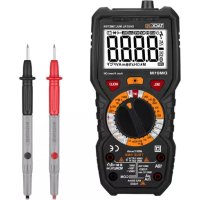
DM01M - Multimeter Tacklife - Free user manual and instructions
Find the device manual for free DM01M Tacklife in PDF.



| Product Type | Digital Multimeter |
| Brand | Tacklife |
| Model | DM01M |
| Dimensions (L × W × H) | 190 × 89 × 50 mm |
| Weight | Approx. 380 g (with batteries) |
| Power Supply | 4 AA 1.5 V batteries |
| Display | LCD 6000 counts with backlight |
| DC Voltage | 600 mV to 1000 V, accuracy ±(0.5% + 3 digits) |
| AC Voltage | 6 V to 750 V, accuracy ±(0.8% + 3 digits) to ±(1% + 10 digits) |
| DC/AC Current | 60 µA to 10 A (AC and DC), with protection fuses |
| Resistance | 600 Ω to 60 MΩ, accuracy ±(0.8% + 3 digits) to ±(1.2% + 30 digits) |
| Capacitance | 6 nF to 100 mF, accuracy ±(4% + 30 digits) to ±(5% + 3 digits) |
| Frequency | Up to 9.999 MHz, accuracy ±(1% + 3 digits) |
| Temperature | -20 °C to 1000 °C (with K-type thermocouple), accuracy ±(1% + 3 °C) |
| Special Functions | Diode test, audible continuity test, NCV detection, Live line test, hold (HOLD), backlight |
| Safety | CAT IV 600 V, CAT III 1000 V, pollution degree 2 |
| Fuses | FF 600 mA / 250 V (for mA) and FF 10 A / 250 V (for 10 A) |
| Maintenance | Clean the case with a damp cloth and mild detergent; clean input jacks with lubricant |
| Repairability | User replaceable batteries and fuses; professional service recommended for other repairs |
| Included Accessories | User manual, one pair of test leads, K-type thermocouple (depending on model) |
Frequently Asked Questions - DM01M Tacklife
User questions about DM01M Tacklife
0 question about this device. Answer the ones you know or ask your own.
Ask a new question about this device
Download the instructions for your Multimeter in PDF format for free! Find your manual DM01M - Tacklife and take your electronic device back in hand. On this page are published all the documents necessary for the use of your device. DM01M by Tacklife.
USER MANUAL DM01M Tacklife
This digital multimeter is designed and manufactured in compliance with IEC-61010 safety requirements on electronic measuring instruments and hand-held digital multi-meters. It is compliant with IEC-61010 requirements pertaining to 600V CAT IV, 1000V CAT. III and requirements on pollution degree 2. Please read carefully this Operation Manual and pay attention to safety guidelines before operating this meter.
1.1 Safety information
1.1.1 Safety instructions
- Before operating this meter, the operator must observe all standard safety procedures in the two respects below:
A. Safety procedures against electric shock
B. Safety procedures against unintended use
- To ensure your personal safety, please use the test lead that accompanies the meter. Before operating this meter, ensure that the test lead is flawless.
1.1.2 Safety considerations
- When the meter is used in the vicinity of the equipment that produces strong electromagnetic interferences, the reading on the meter will grow unstable and even produce serious errors.
- Don't operate the meter or pen-shaped meter whose appearance is damaged.
- The safety function of the meter will become null if the meter is not properly operated.
- The meter must be operated with great care when working in the vicinity of an exposed conductor or bus line.
- The meter is prohibited from being used in the vicinity of any explosive gas, vapor or dust.
- The measurement must be made with correct input terminals and functions and within the allowable measuring range.
- To prevent the meter from being damaged, the value to be input shall not exceed the extremes allowed by each measuring range.
- When the meter has already been connected to the line being measured, the operator is prohibited from touching the input terminal that is not in service.
- When the voltage measured exceeds 60Vdc or 30Vac (valid value), the operator shall be careful enough to avoid electric shock.
- When making measurement with a test lead, place your fingers behind its protective ring.
- When switching to another measuring range, be sure that test lead has already been taken off the measured circuit.
-
For all DC functions, to prevent potential electric shock as a result of incorrect reading, please first use AC functions to check the absence of any AV voltage. Then, select DC voltage measuring range equivalent to or greater than that for AC voltage.
-
Before the tests on electric resistance, diode, capacitor or continuity, the operator must cut off the power supply to the circuit to be measured, and discharge all high-voltage capacitors within the circuit to be measured.
- The electric resistance measurement or continuity test cannot be carried out in any live electrical circuit.
- Before the current measurement, the operator must first examine the protective tube of the meter. Before connecting the meter to the circuit to be measured, the operator must first power off the aforesaid circuit.
- Before repairing TV sets or measuring power switching circuit, the operator must be careful enough to prevent high amplitude voltage impulse from damaging the meter.
- This meter uses 4 × 1.5V AA batteries that must be correctly installed into the battery compartment
- When + appears, the batteries must be replaced immediately. The low level of a battery will result in incorrect reading on the meter, which is likely to bring electric shock or personal injury to the operator.
- In measurement, category III voltage and category IV voltage shall not exceed 1000V and 600V respectively.
- The meter shall not be in service if its case (or part of its case) is dismantled.
1.1.3 Safety symbol:
The safety symbols that appear on the meter's body and in this Operation Manual:
| A | Warning, an important safety symbol. The operator must consult this Operation Manual before using the meter. Unintended use may lead to the damage to the device or its components. |
| ~ | AC (alternating current) |
| = | DC (direct current) |
| ~ | AC/DC |
| ± | Ground |
| 回 | Double insulation protection |
| - | Fuse |
| CE | Compliant with European Union Directive |
| 4 | High voltage warning |
| CAT. III 1000 V | over-voltage protection |
| CAT. IV 600 V | over-voltage protection |
1.1.4 Maintenance practices for safety
- The operator must first pull out the test lead when the meter's case is opened or the battery cover is dismantled.
- The designated replacement parts must be used at the moment of maintenance.
- The operator must cut off all relevant power supplies before opening the meter. At the same time, the operator must avoid damage to the meter's elements by ensure that he himself doesn't carry any static.
- The meter can only be calibrated, repaired and maintained by professionals.
- When the meter's case is opened, the operator must understand the fact that the presence of some capacitance may promise the dangerous voltages even if the power supply to the meter is cut off.
- The operator should stop using and maintain the meter immediately if any abnormality has been observed on the meter. The operator must see to it that the meter cannot be in service unless it is proved conforming.
- When the meter is left idle for a long period, the operator shall remove the battery and place it in a place free from high temperature and humidity.
1.2 Input protection measures
- The meter can sustain the maximum input voltage of 1000V (DC) or 750V (AC) at the moment of voltage measurement.
- The meter can sustain the maximum AC voltage of 600V or equivalent voltage (valid value) when the tests on frequency, electric resistance, continuity and diode are carried out.
- The protective tube (FF600mA/250V) is used for protection purpose when A and mA current measurements are carried out.
2. A Schematic Diagram for the Meter
This meter is a hand-held digital multi-meter with the function of displaying True RMS. It is a large-screen LCD unit with backlight and illumination light functions so that the user can easily recognize reading. It is equipped with the function of overload protection and the indicator of battery under voltage. Either for professionals, factories, schools, enthusiasts or households, it is an ideal multi-functional meter.
2.1 A Schematic Diagram for the Meter
① Non-contact voltage detection area
② Non-contact voltage indicator
③ LCDscreen
④ key
⑤ Rotary switch
⑥ input socket
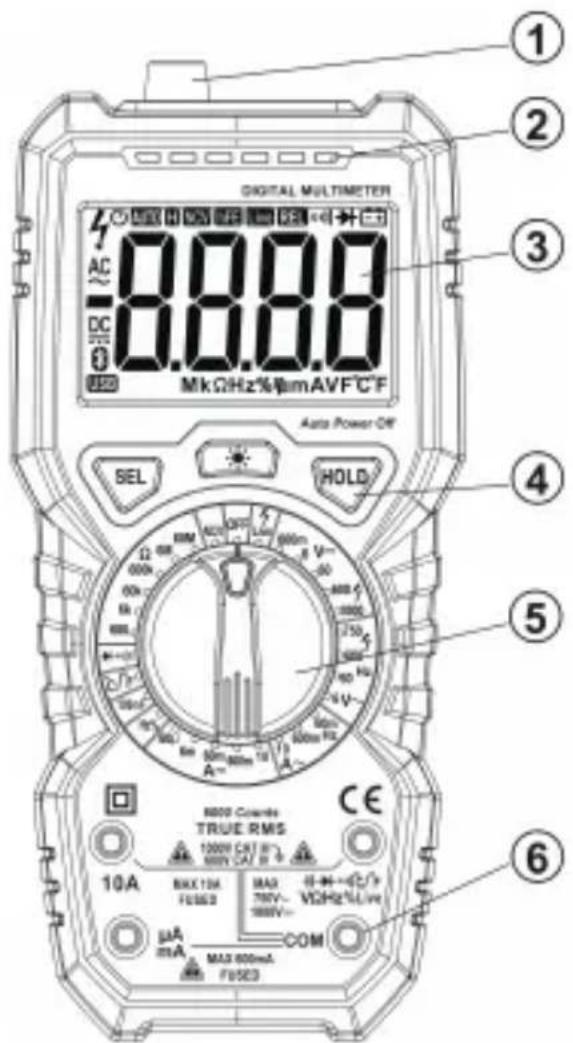
Physical appearance
2.2 Description of the symbols on the display unit
| Symbol | Description |
| - + | Battery Under Voltage indicator/ Low Battery A To avoid electric shock or personal injury as a result of incorrect reading, promptly replace the battery when the battery under voltage indicator appears. |
| ○ | Auto power off indicator |
| 4 | High voltage warning |
| ■ | Negative input polarity indicator |
| AC | Input voltage AC |
| DC | Input voltage DC |
| ○○ | Switching on/off test mode |
| → | Diode test mode |
| AUTO | Automatic range measurement mode |
| H | Data hold mode |
| C, F | Unit of temperature(℃: Celsius; F: Fahrenheit) |
| % | Duty ratio |
| NCV | Non-contact AC voltage detection mode |
| Live | Live line judgment mode |
Table.1 Symbols (Continued)
| V, mV | V: | V: the unit of volt |
| mV: | Millivolt, 1x10⁻³ or 0.001 volt. | |
| A, mA, ΩA | A: | Ampere, the unit of current. |
| mA: | Milliampere, 1x10⁻³ or 0.001 ampere. | |
| ΩA: | Microampere, 1x10⁻⁶ or 0.000001 ampere. | |
| Ω, kΩ, MΩ | Ω: | Ohm, the unit of electric resistance. |
| kΩ: | Kilohm, 1000 Ohm | |
| MΩ: | Megaohm, 1,000,000 ohm. | |
| MkHz | Hz: | Hz, the unit of frequency |
| KHz: | KHz, 1x10³ Hz. | |
| MHz: | MHz, 1x10⁶ Hz or 1000 KHz. | |
| mF, μF, nF | F: | Farad, the unit of capacitance. |
| mF: | Millifarad, 1x10⁻³ or 0.001 farad. | |
| μF: | Microfarad, 1x10⁻⁶ or 0.000001 farad. | |
| nF: | nF, 1x10⁻⁹ or 0.000000001 farad. |
2.3 Description of functional keys
| Key | Description of functions |
| SEL | SEL keys, e.g.Temperature measurement position: C mode or F mode.Frequency measurement position: HZ measurement mode or duty ratio (%) measurement modeAC voltage position and AC current position: press the key to select voltage/frequency mode or current/frequency mode in the AC voltage measurement mode or AC current measurement mode. |
| HOLD | Press the key to hold the measured value for the current moment Press the key again to cancel this function. |
| When Press the key, the backlight and the illumination indicator will be on; however, press on the same key again, you will turn off backlight and illumination indicator. If you don't press the key at all, the function will automatically be disassembled in 15 minutes. |
2.4 Description of input socket
| Input socket | Description |
| COM | All public input terminals to be measured are connected to test leads in black or the public output plugs of exclusive multi-function test sockets. |
| C/F V Ω Hz% lives | Positive input terminals (connected to a test lead in red) for capacitor measurement, diode measurement, beep on/off test, temperature measurement, voltage measurement, electric resistance, frequency, duty ratio and live/earth line judgment. |
| μA mA | μA and mA positive input terminal (connected to a test lead in red). |
| 10A | 10A positive input terminal (connected to a test lead in red). |
2.5 Accessories
| Operation Manual | One |
| Test lead | A pair |
| K-Type thermocouple(depends on different model, only for the meter with it) | A pair |
3. Operational guidelines
3.1 Normal operation
3.1.1 Hold mode
In the hold mode, the reading can be maintained on the display unit. Changing the measurement function position or pressing the key Hold again to exit the hold mode.
Hold mode: entry and exit
- Press the key "H" and the reading will be held and the symbol "H" will appear on the LCD screen.
- Press the key "H" again to restore the meter to its status for normal measurement.
3.1.2 Backlight & lighting
The meter is equipped with the functions of backlight and lighting so that the operator can access measurement results even if he is in a darker place. The backlight function can be enabled or disenabled by the steps below:
- Press the key to enable backlight and illumination light.
- Press the key again to manually disenable backlight and illumination light; wait for 15 seconds until the backlight and illumination light are automatically disenabled.
3.1.3 Auto power off
If no operations are made in 15 seconds following the initialization, the meter will sound to remind the operator to automatically cut off power supply and enter the state of dormancy. The meter can be rebooted when the operator presses any key in the auto power off mode.
3.2 Measurement guidelines
3.2.1 Measurement of AC voltage and DC voltage

to avoid any electric shock and/or damage to the meter,do not attempt a voltage measurement
if the voltage (valid value) is 1,000V for DC current or 750V for AC current.
To avoid any electric shock and/or damage to the meter, don't attempt to impose between any public terminal and ground any voltage whose valid value is over 1,000V for DC current or 750V for AC current.
- The meter provides DC voltage measuring ranges as follows: 600.0mV, 6.000V, 60.00V, 600.0V and 1000V, and AC voltage measuring ranges: 6.000V, 60.00V, 600.0V and 750V.
-
Measurement of AC voltage or DC voltage
-
Turn the rotary switch to the position V or V.
- Connect the test lead in black and test lead in red to COM input socket and V input socket respectively.
- Use another two ends of the test lead to measure the voltage of the circuit to be measured. (In parallel connection with the circuit to be measured)
-
Read the measured voltage value on LCD screen. When DC voltage measurement is attempted, the display unit will show the voltage polarity of the circuit connected to the pen-shaped meter in red. Notes:
-
Within the measuring range of DC voltage of 600mV and AC voltage of 6V, even if there is no input or no connection to the test lead, the meter will display some information. In this situation, press short circuit “V-Ω” and “COM” terminal to reset the meter to zero.
- Within the AC voltage function, press the key "SEL" to measure the frequency of the AC voltage source. Please refer to the relevant part for frequency measurement.
- The value of the AC voltage measured with this meter is True RMS (root mean square). These measurements are accurate for sine wave and other waves (without DC offset), square wave, triangular wave and step wave.
3.2.2 Electric resistance measurement

To avoid the meter or the measured equipment from damage, do not attempt a resistance
measurement unless the operator has already cutoff all power sources for the circuit to be measured
and fully discharged all high-voltage capacitors.
- Ohm is the unit of electric resistance () .
-
The measuring ranges of electric resistance of this meter are 600.0 , 6.000k , 60.00k , 600.0k , 6.000M and 60.00M .
-
Measurement of electric resistance
- Turn the rotary switch to the appropriate position.
- Connect the test lead in black and test lead in red to COM input socket and V/Ω input socket respectively.
- Use another two ends of the test lead to measure the electric resistance of the circuit to be measured.
- Read the measured electric resistance value on LCD screen.
Notes:
- The measured value of the electric resistance of the circuit differs a bit from the rated value of the electric resistance.
- To ensure measurement accuracy, in attempting a low resistance measurement, first put two pen-shaped meters in short circuit and capture the resistance reading of these short circuits. Then subtract the aforesaid reading from the measured resistance.
- At 60MΩposition, you have to wait a few seconds before the reading grow stable. This is quite normal for a high resistance measurement.
- When the meter is in open circuit, the display unit will show "OL" that indicates the measured value is over the measuring range.
3.2.3 Diode test
To avoid the meter or the measured equipment from damage, do not attempt a diode test unless the operator has already cut off all power sources for the circuit to be measured and fully discharged all high-voltage capacitors.
-
Diode test outside the circuit:
-
Turn the rotary switch to the position
- Connect the test leads in black and in red to COM input socket and V/Ωinput socket respectively.
- Connect the test leads in black and in red to the positive and negative poles of the diode to be tested respectively.
- The meter displays the forward bias value of the diode to be tested. If the polarity of the test leads is reversed, the meter will display "OL".
A normal diode still produces a forward voltage drop of 0.5V to 0.8V ; the reverse bias voltage reading depends on the variation in electric resistance of other channels between two pen-shaped meters.
3.2.4 Beep continuity test
To avoid the meter or the measured equipment from damage, do not attempt a beep continuity test unless the operator has already cut off all power sources for the circuit to be measured and fully discharged all high-voltage capacitors.
Steps for a continuity test:
- Turn the rotary switch to the position
-
Connect the test lead in black and test lead in red to COM input socket and V/Ω input socket respectively.
-
Use another two ends of the test lead to measure the resistance of the circuit to be measured. If the measured distance is no more than 40 , the sensor LED (green indicator) will be on and the beeper will sound continuously. If the measured resistance is between 40 and 60 , the sensor LED (red indicator) will be on.
3.2.5 Capacitance measurement
To avoid the meter or the measured equipment from damage, do not attempt a capacitance measurement unless the operator has already cut off all power sources for the circuit to be measured and fully discharged all high-voltage capacitors. Use the DC voltage position to determine that all capacitors have been discharged.
-
The measuring ranges for the capacitance of this meter are 6.000nF, 60.00nF, 600.0nF, 6.000μF, 60.00μF and 600.0μF, 6mF, 100mF.
Measurement of capacitance: -
Turn the rotary switch to the position 100mF
- Connect the test leads in black and in red to COM input socket and input socket respectively.
- Use another two ends of the test lead to measure the capacitance of the capacitor to be measured, and capture the measured value on LCD screen.
Note:
- The measurement of a large capacitance requires a given period of stabilization of reading.
- To avoid damage to the meter, the measurement of a capacitor with polarities requires much attention to its polarity.
3.2.6 Frequency measurement
To avoid any electric shock and/or damage to the meter, do not attempt a frequency measurement if the voltage is over 250V for DC current or AC current(valid value).
Frequency measurement:
- Turn the rotary switch to the position HZ% .
- Connect the test leads in black and in red to COM input socket and Hz input socket respectively.
- Use another two ends of the test lead to measure the frequency of the circuit to be measured.
- Read the measured frequency on LCD screen.
3.2.7 Current measurement
Do not attempt a measurement on the current in a circuit, if when the voltage between the open-circuit voltage and the ground is over 250V . If the fuse is blown at the moment of measurement, you are likely to damage the meter or get yourself hurt.
To avoid any damage to the meter or equipment to be measured, do not attempt a current measurement unless you have examined the meter's protective tube. In attempting a measurement, you should use the correct input sockets, function positions and measuring ranges. When a test lead is inserted into the current input socket, do not put the other end of the test lead in parallel connection with any circuit.
- The meter provides DC current measuring ranges as follows: 60 A , 6mA, 60.00mA, 600.0mA and 10.00A; and AC current measuring ranges: 60.00mA, 600.0mA, and 10.00A.
-
Measurement of current:
-
Turn the rotary switch to the appropriate position.
- Connect the test lead in black to COM input socket. Connect the test lead in red to a mA input socket when the measured current is less than 600mA ; connect the test lead in red to a 10A input socket when the measured current is 600mA 10A .
- Disconnection of the circuit to be measured Connect the test lead in black to the end of disconnected circuit (the voltage is lower) and connect the test lead in red to the end of the disconnected circuit (voltage is higher).
- Connect the power to the circuit and capture the displayed reading. If the display unit only shows "OL", it means the input is over the selected measuring range. At this moment, turn the rotary switch to a higher measuring range.
3.2.8 NCV test (non-contact voltage detection)
Turn the rotary switch to NCV position, and place the top of the meter approach the conductor. If the meter detects the AC voltage, the indicators for signal density (high, medium and low) will be on in accordance with the detected density, while the beeper will sounds alarms at different frequencies.
Note:
- Voltage may still remain in the absence of any indication. The operator shall not rely on non-contact voltage detector to check the presence of voltage. The detection operation may be affected by various factors, including socket design, insulation thickness and type.
- When the voltage is input into the meter's input terminal, the voltage sensor LED may be on as a result of induced voltage.
- External sources of interference (like flashlight and motor) may trigger non-contact voltage detection.
3.2.9 Live line test
- Turn the rotary switch to the position Live.
- Connect the test lead in red to Live input socket.
- When a single test lead is inserted into jack L of power socket or approaches a live conductor, if the meter detects AC voltage, the meter's indicator for the intensity (high, medium and low) of induced voltage signal will be on and the beeper sounds alarms for different intensities.
3.2.10 Measuring temperature(depends on different model,only for the meter with it)
Put the range switch at the gear of C/F. Insert the red plug of the thermocouple into the end of C, and insert the black plug of the thermocouple into COM socket. Directly read the temperature value from the display screen after the reading is stable.
Notes: The maximum measuring temperature for the K-type thermocouple dispatched at random is 250^ , and its instant measuring value can reach 300^ .
4. Technical parameters
4.1 Overall parameters
- Operating environment:
600V CAT IV and 1000V CAT. III Pollution level: 2
Altitude < 2000m - Working temperature & humidity: 0~40OC (The requirements will not be considered when temperature is less than 10^ and relative humidity is below 80% ).
Storage temperature & humidity: -10~60OC (batteries shall be removed when RH is below 70%). - Coefficient of temperature: 0.1 × accuracy/ OC (<18 OC or >28 OC).
- Allowable max voltage between terminal to be measured and ground: 1000V DC or 750V AC (valid value)
- Protection of protective tube: mA position: protective tube FF 600mA/250V; A position protective tube FF 10A/250V
- Rotation rate: approximately 3 revolutions/second
- Display unit: 6000 counts displayed on LCD screen. Automatically display the symbol for unit in accordance with measurement function position.
- Outrange indication: the LCD screen will display "OL".
- Battery Low indication: " " will appear when the battery's voltage is below the normal working voltage.
- Input polarity indication: “-” will automatically appear.
Power: 4 x 1.5V AA battery - Dimensions: 190 mm( L) × 89 mm( W) × 50 mm( H) .
Weight: approximately 380g (inclusive of batteries)
4.2 Precision indicator
Accuracy: ± (% reading + digit) The accuracy warranty will run for 1 year upon the ex-factory date.
Reference conditions: ambient temperature is between 18^ and 28^ and relative humidity is no more than 80% .
4.2.1 DC voltage
| Measuring range | Resolution | Accuracy |
| 600mV | 0.1mV | ±(0.5% Reading + 3 digits) |
| 6V | 1mV | |
| 60V | 10mV | |
| 600V | 100mV | |
| 1000V | 1V | ±(0.5% Reading + 3 digits) |
- Input impedance:10MΩ
- Maximal input voltage: 1000Vdc or 750Vac valid value
4.2.2 AC voltage
| Measuring range | Resolution | Accuracy |
| 6V | 1mV | ± (0.8% readings +3 digits) |
| 60V | 10mV | |
| 600V | 100mV | ± (1% readings +10 digits) |
| 750V | 1V |
- Input impedance:10MΩ
- Maximal input voltage: 1000Vdc or 750Vac valid value
- Frequency response: 40Hz-1kHz True RMS
4.2.3 Frequency
| Measuring range | Resolution | Accuracy |
| 9.999Hz | 0.001Hz | ± (1% Reading + 3 digits) |
| 99.99Hz | 0.01Hz | |
| 999.9Hz | 0.1 Hz | |
| 9.999KHz | 0.001 KHz | |
| 99.99KHz | 0.01 KHz | |
| 999.9KHz | 0.1 KHz | |
| 9.999MHz | 0.001MHz |
- Input voltage range: 200mV - 10V ac valid value
- Overload protection: 600V DC/AC
4.2.4 Electric resistance
| Measuring range | Resolution | Accuracy |
| 600Ω | 0.1Ω | ±(0.8% Reading + 3 digits) |
| 6kΩ | 1Ω | |
| 60kΩ | 10Ω | |
| 600kΩ | 100Ω | |
| 6MΩ | 1kΩ | |
| 60MΩ | 10kΩ | ±(1.2% Reading + 30 digits) |
- Overload protection: 600V DC/AC
- Open-circuit voltage: 1V
4.2.5 Diode
| Functions | Measuring range | Resolution | Testing conditions |
| Diode test | 0-3V | 0.001V | Forward DC current: approximately 1mA; Open-circuit voltage: approximately 3.2V. The display unit shows the approximate value of the diode's forward voltage drop. |
- Overload protection: 600V DC/AC
4.2.6 Beeper continuity
| Functions | Measuring range | Resolution | Description | Testing conditions |
| 0.1 | 600Ω | 0.1Ω | When the built-in beeper sounds and the accompanying red indicator is on, the measured resistance shall not be over 30.Ω The red indicator will be on when the resistance is 40Ω-60Ω. | Open-circuit voltage: approximately 1V |
- Overload protection: 600V DC/AC
4.2.7 Capacitor
| Measuring range | Resolution | Accuracy |
| 6nF | 0.001nF | ± (4.0% Reading +30 digits) |
| 60nF | 0.01nF | ± (4.0% Reading +3 digits) |
| 600nF | 0.1nF | |
| 6μF | 1nF | |
| 60μF | 10nF | |
| 600μF | 100nF | |
| 6mF | 1uF | |
| 100mF | 0.01mF | ± (5.0% Reading + 3 digits) |
- Overload protection: 600V DC/AC
4.2.8 DC current
| Measuring range | Resolution | Accuracy |
| 60μA | 0.01μA | ±(0.8% Reading + 3 digits) |
| 6mA | 0.001mA | |
| 60mA | 0.01mA | |
| 600mA | 0.1mA | |
| 10.00A | 10mA | ±(1.2% Reading + 3 digits) |
- Overload protection: protective tube for mA measuring range (FF600mA/250V); protective tube for 10A measuring range (FF10A/250V).
- Maximal input current: mA position: 600mA DC/AC (valid value);
- 10A position: 10A DC/AC (valid value)
- When the measured current is over 5A, the duration of continuous measurement shall not be over 10 seconds. The current measurement shall be carried out 1 minute after the completion of previous measurement.
4.2.9 AC current
| Measuring range | Resolution | Accuracy |
| 60mA | 0.01mA | ±(1% Reading + 3 digits) |
| 600mA | 0.1mA | |
| 10A | 10mA | ±(1.5% Reading + 3 digits) |
- Overload protection: protective tube for mA measuring range (FF600mA/250V); protective tube for 10A measuring range (FF10A/250V).
- Maximal input voltage: mA position: 600mA DC/AC (valid value);
- 10A position: 10A DC/AC (valid value)
- When the measured current is over 5A, the duration of continuous measurement shall not be over 15 seconds. The current measurement shall be carried out 1 minute after the completion of previous measurement.
- Frequency response: 40Hz-1kHz True RMS
4.2.10 Temperature (depends on different model, only for the instruments with it)
| Measuring range | Resolution | Accuracy | |
| °C | 1°C | -20 °C ~ 1000 °C | ± (1.0%+3) reading |
| °F | 1°F | -4°F ~ 1832°F | ± (1.0%+3) reading |
- Overload protection: 600V DC/AC
5. Meter maintenance
This section provides the basic information on maintenance, including the descriptions about replacement of protective tubes and batteries. Do not attempt the meter maintenance unless you are experienced in maintenance and have read the information on calibration, performance test and maintenance.
5.1 General maintenance
To avoid any electric shock or damage to the meter, do not attempt to clean the inside of the meter. You must remove the line connecting a test lead to input signals, before opening the case or battery cover.
- You must regularly use damp cloth and a small quantity of detergent to clean the meter's shell. Don't attempt the use of any aberrant or chemical solvent.
-
The dirty or damp input socket may affect reading.
Steps for cleaning input sockets: -
Disenable the meter and pull all test leads out of the input socket.
- Clean up all dirty substances on sockets.
- Use a new cotton ball with a detergent or lubricant to clean each socket, because lubricant can prevent the socket vulnerable to dampness from pollution.
5.2 Battery & fuse replacement
To avoid any electric shock or personal injury as a result of incorrect reading, replace batteries once the symbol " appear on the display unit.
Only the designated fuse (600mA/250V,10A/250V quick-acting fuse) can be used.
To avoid any electric shock or personal injury, don't attempt to open the battery cover to replace batteries, unless you have already powered off the device and carried out an examination to ensure that the test lead has been disconnected from the circuit to be measured.
-
Batteries must be replaced by the following steps:
-
Cut off the power to the meter.
- Pull all test leads out of the input socket.
- Use a screw driver to unscrew the bolts that are used to fix battery cover.
- Take off the battery cover.
- Remove the old batteries or the damaged protective tubes.
- Make replacements with new 4x 1.5 V AA batteries or new protective tubes.
- Remount the battery cover and fix a bolt.
1. Allgemeine Information
Table.1 Symbols (Continued)
| V, mV | V: | V: Einheit der el. Spannung |
| mV: | Millivolt, 1x10⁻³or 0.001 volt. | |
| A, mA, μA | A: | Ampere, Einheit des el. Stromes |
| mA: | Milliampere, 1x10⁻³or 0.001 ampere. | |
| ΩA: | Microampere, 1x10⁻⁶or 0.000001 ampere. | |
| Ω, kΩ, MΩ | Ω: | Ohm, Einheit des el. Widersandes. |
| kΩ: | Kilohm, 1000 Ohm | |
| MΩ: | Megaohm, 1,000,000 ohm. | |
| MkHz | Hz: | Hz, Einheit der Freqenz |
| KHz: | KHz, 1x10³ Hz. | |
| MHz: | MHz, 1x10⁶ Hz or 1000 KHz. | |
| mF, μF, nF | F: | Farad, Einheit der el. Kapazität |
| mF: | Millifarad, 1x10⁻³or 0.001 farad. | |
| μF: | Microfarad, 1x10⁻⁶or 0.000001 farad. | |
| nF: | nF, 1x10⁻⁹or 0.000000001 farad. |
| Eingangsbuchse | Beschreibung |
| COM | All public input terminals to be measured are connected to test leads in black or the public output plugs of exclusive multi-function test sockets. |
| C/F V Ω Hz% lives | Positive input terminals (connected to a test lead in red) for capacitor measurement, diode measurement, beep on/off test, temperature measurement, voltage measurement, electric resistance, frequency, duty ratio and live/earth line judgment. |
| μA mA | μA and mA positive input terminal (connected to a test lead in red). |
| 10A | 10A positive input terminal (connected to a test lead in red). |
2.5 Lieferumfang
Multimeter
- The measurement of a large capacitance requires a given period of stabilization of reading.
- To avoid damage to the meter, the measurement of a capacitor with polarities requires much attention to its polarity.
- Protection de surcharge: 600V DC/AC
4.2.8 courant continu
| Plage de mesure | Résolution | Précision |
| 60μA | 0.01μA | ±(0.8% de l'affichage + 3 chiffres) |
| 6mA | 0.001mA | |
| 60mA | 0.01mA | |
| 600mA | 0.1mA | |
| 10.00A | 10mA | ±(1.2% de l'affichage + 3 chiffres) |
- Protection de surcharge: 600V DC/AC
Table.1 Symbols (Continued)
| V, mV | V: | V: launidad de voltios |
| mV: | Milivoltios, 1x10⁻³ o 0.001 voltios. | |
| A, mA, ΩA | A: | Ampere, launidad de corrente. |
| mA: | Miliamperios, 1x10⁻³ o 0.001 amperios. | |
| ΩA: | Microamperios, 1x10⁻⁶ o 0,000001 amperios. | |
| Ω, kΩ, MΩ | Ω: | Ohm, launidad de la resistencia electrica. |
| kΩ: | Kilohm, 1000 Ohm | |
| MΩ: | Megaohmio, 1.000.000 ohmios. | |
| MkHz | Hz: | Hz, launidad de Frequencia |
| KHz: | KHz, 1x10³ Hz. | |
| MHz: | MHz, Hz 1x10⁶ o 1.000 KHz. | |
| mF, μF, nF | F: | Farad, launidad de capacité. |
| mF: | Millifarad, 1x10⁻³ o 0.001 faradios. | |
| μF: | Microfaradios, 1x10⁻⁶ o 0,000001 faradio. | |
| nF: | nF, 1x10⁻⁹ o 0.000000001 faradio. |
3. Linee guida operative
Shenzhen Temie Technology Co. Ltd.
Web:www.tacklifetools.com
E-mail: support@tacklife.net
ADD:No.31, Qing Linxi Road, Longgang District,
Shenzhen, Guangdong, China 518172 CN




Made in China



- Safety information
- Safety instructions
- Safety considerations
- Safety symbol:
- Maintenance practices for safety
- Input protection measures
- A Schematic Diagram for the Meter
- A Schematic Diagram for the Meter
- Description of the symbols on the display unit
- Description of input socket
- Accessories
- Operational guidelines
- Normal operation
- Hold mode
- Backlight & lighting
- Auto power off
- Measurement guidelines
- Measurement of AC voltage and DC voltage
- Electric resistance measurement
- Notes:
- Diode test
- Beep continuity test
- Capacitance measurement
- Note:
- Frequency measurement
- Current measurement
- NCV test (non-contact voltage detection)
- Live line test
- Measuring temperature(depends on different model,only for the meter with it)
- Technical parameters
- Overall parameters
- Precision indicator
- DC voltage
- DC current
- AC current
- Temperature (depends on different model, only for the instruments with it)
- Meter maintenance
- General maintenance
- Battery & fuse replacement
- Allgemeine Information
- Lieferumfang
- courant continu
- Linee guida operative
Brand : Tacklife
Model : DM01M
Category : Multimeter