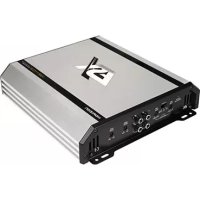
HXE110.2 - Receiver ESX - Free user manual and instructions
Find the device manual for free HXE110.2 ESX in PDF.



| Product type | 2-channel audio amplifier |
| Brand | ESX |
| Model | HXE110.2 |
| Technology | Class A/B |
| RMS output power (14.4 V) | 2 x 150 W @ 4 Ω, 2 x 250 W @ 2 Ω, 1 x 500 W @ 4 Ω bridged |
| Speaker impedance | 2 - 8 Ω |
| Total harmonic distortion | 0.5 % @ 5 W |
| Damping factor | 240 |
| Signal-to-noise ratio | 92 dB |
| Input sensitivity | 0.1 - 7 V |
| High-pass / band-pass filter | 10 - 250 Hz @ 12 dB/octave |
| Low-pass / band-pass filter | 50 - 250 Hz @ 12 dB/octave |
| Band-pass mode | Yes |
| Bass boost | 0 - 12 dB @ 45 Hz |
| Bass level remote | Yes |
| Low-level inputs (RCA) | Yes |
| Low-level outputs (RCA) | Yes |
| Power supply | 9 - 15 V |
| Fuse | 1 x 30 A |
| Dimensions (W x H x D) | 222 x 51 x 262 mm |
| Weight (estimated) | Approximately 2 kg |
| Care and cleaning | Clean with a soft, dry cloth. Protect from moisture, dust, and dirt. |
| Safety | Disconnect the battery before installation. Use an external fuse near the battery. Do not operate with too low impedance. |
| Spare parts and repairability | Replaceable fuse. Contact a specialized installer for repairs. |
| General information | Intended for use in a 12 V vehicle with negative ground. Subject to technical modifications. |
Frequently Asked Questions - HXE110.2 ESX
User questions about HXE110.2 ESX
0 question about this device. Answer the ones you know or ask your own.
Ask a new question about this device
Download the instructions for your Receiver in PDF format for free! Find your manual HXE110.2 - ESX and take your electronic device back in hand. On this page are published all the documents necessary for the use of your device. HXE110.2 by ESX.
USER MANUAL HXE110.2 ESX
| HXA100.2 | |
| Technology Class A/B | |
| Channels 2 | |
| Output Power RMS (14.4 V) @ 4 Ω @ 2 Ω @ 4 Ω bridged | 2 x 70 W 2 x 110 W 1 x 220 W |
| Loudspeaker impedance 2 - 8 Ω | |
| Total Harmonic Distortion @ 5 W 0.5 % | |
| Damping factor 240 | |
| Signal-to-noise ratio 92 dB | |
| Input sensitivity 0.1 - 7 V | |
| High pass / bandpass filter 10 - 250 Hz | @ 12 dB/octave |
| Low pass / bandpass filter 50 - 250 Hz | @ 12 dB/octave |
| Bandpass mode | ✓ |
| Bass boost 0 - 12 dB @ 45 Hz | |
| Bass level remote controller | ✓ |
| Low level inputs (RCA) | ✓ |
| Low level outputs (RCA) | ✓ |
| Operating voltage 9 - 15 V | |
| Fuse 1 x 30 A | |
| Dimensions | |
| Width | 222 mm |
| Height | 51 mm |
| Length | 262 mm |
Technical changes and errors reserved






CAUTION
Please read these operating instructions completely before starting the installation and putting the device into operation.
INTENDED USE
This product is designed to operate in a vehicle with an on-board voltage of +12V with negative ground. The device functions as an audio amplifier that is used within a vehicle sound system. If you have any questions about product safety, please contact: amplifiers@audiodesign.de
DISPOSAL/RECYCLING
If you have to dispose the device and its components, please note that no electronic devices must be disposed in the household waste. Dispos of the device and its components at a suitable recycling facility in accordance with local waste regulations. If necessary, consult your local authority or dealer.

More information at www.audiodesign.de/english/disposal
IMPORTANT NOTES PRIOR TO INSTALLATION
- Attach the device to a suitable mounting location in the vehicle by using screws. Make sure that the device cannot vibrate while driving and that it is screwed tightly.
- During installation, make sure that no parts that are standard in the vehicle, such as cables, on-board computers, seat belts, tank or similar parts, are damaged or removed.
- Make sure that the device receives sufficient cooling at the installation location. Do not mount the device in closed housings that are too small without air circulation or near heat-radiating parts or electronic controls of the vehicle.
- All cables should be kept as short as possible to avoid losses and interference.
- Protect the device from moisture, dust and dirt.
- Make sure that the input/output cables are far enough away from the power supply cables, otherwise interference may occur.
- The performance and reliability of the sound system depends on the quality of the installation. It is best to have the installation carried out by an installation specialist.

CAUTION
Before you start with the installation, disconnect the ground (-) terminal of the vehicle battery to avoid short circuits and damage.
POWER SUPPLY AND TURN-ON CONNECTION
To connect the power supply, only use power cables that are sufficiently dimensioned (See page 43, fig. 5). The cross-section of the cables must be the same size for +12V and ground.
First establish a connection between the GND terminal of the amplifier and a suitable ground point on the vehicle body (Fig. 2.1). To guarantee a good connection, remove any dirt and rust from the ground point.
Then connect the +12V terminal of the amplifier to the positive terminal of the vehicle battery (Fig. 2.3).
In addition, the positive power cable must be protected with another fuse near the battery (Fig. 2.5). This fuse is not included in the scope of delivery and should have the same fuse value as the included fuse. For safety reasons, the cable length from the positive terminal of the battery to the fuse must be less than 30~cm
Then connect the power cable of the car radio to the REM terminal (Fig. 2.3) of the amplifier. A cable with a cross-section of approx. 0.5mm^2 is sufficient for this connection.
LOUDSPEAKER CONNECTION
- The total impedance must be not lower than 2 per loudspeaker output
- The total impedance must be not lower than 4 per two bridged loudspeaker outputs
CAUTION: If the amplifier is operated with speaker impedances that are too low, it could be overloaded and thus permanently damaged.
STATUS LED
The POWER/PROTECTION LED (Fig. 1.1) lights up blue, when the amplifier is in operation.
The POWER/PROTECTION LED (Fig. 1.1) lights up red, when the device is overheated or an error has occurred. After cooling down, the device should work again. If the error persists, please note the information in the section TROUBLESHOOTING.
HIGH PASS FILTER
If the amplifier is to be used for mid-range/tweeter loudspeakers, set the switch X-OVER MODE (Fig. 1.3) to HP. Then set the desired crossover frequency on the HIGH PASS controller (Fig. 1.2). Thus to that only the frequencies above the chosen crossover frequency will be amplified. This effectively minimizes distortions and overloads at lower frequencies. A good point to start is at 125Hz .
If you use big loudspeakers (>20cm) set X-OVER MODE (Fig. 1.3) to FULL. In this case, the HIGH PASS controller (Fig. 1.2) is without function.
LOW PASS FILTER
If the amplifier is to be used with a subwoofer, set the switch X-OVER MODE (Fig. 1.3) to LP/BP. Set the desired crossover frequency by using the controller LOW PASS (Fig. 1.4). Thus to that only the frequencies below the chosen crossover frequency will be amplified and the subwoofer plays more precise and efficient.
In LP/BP mode, the controller HIGH PASS (Fig. 1.3) can also be used to limit the frequency response downwards, for example to produce a bandpass/subsonic signal.
CAUTION: If the controller HIGH PASS (Fig. 1.2) is set higher than the controller LOW PASS (Fig. 1.4), no audio signal is heard.
LOW LEVEL OUTPUTS
The input signal of LINE INPUT (Fig. 1.6) is passed on in stereo to LINE OUTPUT (Fig. 1.5) and enables the connection of another amplifier.
LOW LEVEL INPUTS
The low level inputs on LINE INPUT (Fig. 1.6) are suitable for connecting RCA cables if your car radio has RCA preamplifier outputs. Then connect the RCA sockets with the RCA cables from the car radio.
A spatially separate installation, i.e. installing the power cable in the left cable duct and the RCA cables in the right cable duct of the vehicle or vice versa, is recommended to reduce interference.
REMOTE
With the included remote, the bass level can be adjusted e.g. from the driver's seat. Connect the remote at the REMOTE terminal (Fig. 1.7) with the included cable. The remote control should only be used when the amplifier is operated in LP/BP mode with a subwoofer.
BASS BOOST
With the BASS BOOST controller (Fig. 1.8) you can adjust the bass level between 0-12 dB. Use this controller carefully to avoid distorted playback.
INPUT SENSITIVITY
Turn the LEVEL INPUT controller (Fig. 1.9) counterclockwise to the MIN position. Then turn the volume control on the car radio to 80% - 90% of the maximum volume. Now slowly turn the LEVEL INPUT controller (Fig. 1.9) clockwise until you hear slight distortion from the speakers. Then turn back the LEVEL INPUT controller (Fig. 1.9) a little until you can no longer hear any distortion.
FIGURES (P. 40-43)
CONNECTIONS AND CONTROLLER (FIG. 1)
(1) Status LED
(2) Rotary controller for high pass / bandpass filter
(3) Crossover selector switch
(4) Rotary controller for low pass / bandpass filter
(5) Low level output RCA jacks
(6) Low level input RCA jacks
(7) Terminal for the included bass level remote controller
(8) Rotary controller for bass boost
(9) Rotary controller for input sensitivity
POWER SUPPLY AND TURN-ON CONNECTION (FIG. 2)
(1) GND terminal for the ground connection
(2) REM terminal for the turn-on signal from the car radio
(3) +12V terminal for the positive connection from the vehicle battery
(4) External cable fuse for +12V power wire (not included in the scope of delivery)
2-CHANNEL OPERATION (FIG. 3)
(1) Audio signal L from the car radio
(2) Audio signal R from the car radio
(3) Loudspeaker L +/- (2 - 8 Ω)
(4) Loudspeaker R +/- (2 - 8 Ω)
MONO OPERATION (FIG. 4)
(1) Audio signal L/SUB from the car radio
(2) Audio signal R/SUB from the car radio
(3) Bass level remote controller
(4) Subwoofer bridged R-/L+ (4 - 8 Ω)
POWER SUPPLY CABLES (FIG. 5)
Please note the recommendations on page 43 for the cable length and the cable cross-section of the power cables in order to ensure an adequate and safe power supply for the amplifier.
TROUBLESHOOTING
| NO FUNCTION / POWER LED IS OFF |
| First check the fuse of the installed power cable on the vehicle battery |
| The fuse is defective?Replace the defective fuse with one of equal value, but never with a higher value.The fuse fails again.In this case there appears to be a short circuit between the fuse and the device. To do this, check the entire length of the +12V power cable from the battery to the device for damage and whether there is a short circuit to ground, e.g. a contact with the vehicle chassis or body. If necessary, replace the defective power cable. |
| The fuse is apparently okay?Use a standard 12 volt voltmeter to check the voltage between the +12V connection and the ground connection on the device.There is no voltage.Use the voltmeter to check the fuse located near the vehicle battery to see if there is voltage between the output and ground.If there is no voltage there, either the fuse holder or the fuse is defective, even though it appears to be okay. If necessary, replace the fuse holder or fuse.There is voltage.If you operate the device with a turn-on cable (REM) from the car radio to the REM connection of the device:A turn-on cable (REM) is connected to the REM connection of the device.Use the voltmeter to check whether there is voltage between the device's REM terminal and ground. The car radio must be switched on.There is no voltage 查查 the turn-on cable from the device to the car radio for a short circuit or damage. If necessary, replace the turn-on cable.There is voltage.The device is probably malfunctioning or defective. Contact your specialist dealer.If you operate the device with the speaker signals (high level mode) without turn-on cable:Check the speaker cables from the car radio to the device for short circuits or damage. If necessary, replace the speaker wires or insulate the damaged area. |
| PROTECT LED IS ON |
| Check the following steps: |
| Short circuit on the speaker cablesFirst disconnect all speaker cables from the amplifier. Use a multimeter to check the ohmic impedance of each loudspeaker by measuring between its plus and minus lines. With standard loudspeakers the value fluctuates between 3 and 5 ohms. The values for low-resistance subwooers can be lower.The measurement shows a resistance value of less than 0.5 OhmsThen there is a short circuit. Remove the cables of the affected loudspeaker at its connections. Now use the multimeter to check the ohmic impedance directly at the loudspeaker connections by measuring between the plus and minus connections.The measurement shows a resistance value of more than 0.5 OhmsThe speaker is fine, so the speaker cables appear to be defective and causing a short circuit. Replace the defective speaker cable.The measurement shows a resistance value of less than 0.5 OhmsThe speaker appears to be defective and causes an short circuit. Replace the defective speaker. |
| The load impedance of the loudspeakers or the subwoofer is too lowCompare the ohmic impedance of the connected loudspeaker or subwoofer with the technical specifications of the amplifier. For example, if the amplifier is only designed for 2 or 4 ohm operation, no loudspeaker with less than 2 ohms may be connected. |
| The cross-section of the power cables is too smallIf the cable cross-section is too small, this leads to an increased ohmic resistance and thus to a voltage drop (voltage loss). This indicates that the amplifier consumes more power. The increased power consumption results in a significantly higher heat development and the amplifier switches to thermal protection mode. If necessary, lay power cables with a larger cable cross-section. |
| The amplifier is overheatedEvery amplifier requires sufficient air circulation to be able to dissipate the heat generated during operation. If necessary, change the installation position in favor of better cooling of the amplifier or ensure better air circulation at the installation location.Turn off the sound system and wait about half an hour for the amplifier to cool down again. With very hot outside temperatures and strong sunlight, enormous heat develops inside the vehicle. The amplifier then activates its thermal protection circuit to prevent damage. After cooling down, the amplifier works properly again. |
TROUBLESHOOTING
| NO SOUND / POWER LED IS ON |
| Check the following steps: |
| Low level mode: Are the RCA cables on the car radio and the device connected correctly?The RCA cables are connected correctly.An RCA cable could be defective. Check the function of the RCA cables on another audio device. If necessary, replace the defective RCA cable. |
| High level mode: Are the speaker cables connected correctly to the car radio and the device's high level inputs or to the high level cable connector?The speaker cables are connected correctly.A speaker cable could be defective. If necessary, replace the speaker cable or insulate the damaged area. |
| Are the speaker cables between the speakers or subwoofer connected correctly to the speaker outputs on the device?The speaker cables are connected correctly.A speaker cable could be defective. If necessary, replace the speaker cable or insulate the damaged area. |
| Is the respective high-pass filter or subsonic filter on the device set higher than the low-pass filter?Then slowly turn down the high pass filter or subsonic filter control until you hear the sound. |
| Are the speakers or subwoofer working?Hold a standard 9 volt block battery to the connections of the speaker or subwoofer.A faint cracking noise can be heard.Speaker or subwoofer is fine.Noticing can be heard.Speaker or subwoofer could be defective. If necessary, replace the defective component. |
| Are the settings on the car radio set correctly?Check the fader and balance settingsCheck whether mute is enabledCheck whether a high-pass or low-pass filter is activatedCheck whether playback is pausedCheck source signal settingsCheck whether any subwoofer output is activated |
| AUDIBLE NOISES (ENGINE SPEED-DEPENDENT) |
| Check the following steps: |
| Have the RCA cables been laid separately from the power cable in the vehicle?If necessary, re-route the cables and make sure that the RCA cables are laid separately from the power cable on the left and right of the vehicle. |
| Is the ground connection of the device connected correctly?Make sure that the ground connection of the device is not connected directly to the negative terminal of the vehicle battery. Select a suitable ground point on the vehicle body to connect. If necessary, use contact spray to improve the conductivity of the connections. |
| Is the conductivity of the vehicle battery ground cable to the body okay?Make sure that the ground connection of the vehicle battery has a stable and conductive connection to the body. If necessary, use contact spray to improve the conductivity of the connections. |
| AUDIBLE DISTORTION OR HISSING NOISES |
| Check the following steps: |
| Is the input level controller on the device set too high?Slowly turn the controller down until you hear a clean audio signal. |
| Is the bass boost on the device set too high?Slowly turn the controller down until you hear a clean audio signal. |
| Is the loudness function on the car radio set too high?Disable loudness or turn down the loudness setting until you hear a clean audio signal. |
| Are the EQ and sound settings on the car radio set too high?Turn down the treble, mid and bass settings or turn off the equalizer until you hear a clean audio signal. |
CHARACTERISTIQUES
The low level inputs on LINE INPUT (Fig. 1.6) are suitable for connecting RCA cables if your car radio has RCA preamplifier outputs. Then connect the RCA sockets with the RCA cables from the car radio.
A spatially separate installation, i.e. installing the power cable in the left cable duct and the RCA cables in the right cable duct of the vehicle or vice versa, is recommended to reduce interference.
REMOTE DE NIVEAU DE BASSES
www.audiodesign.de - www.esxaudio.de
© Audio Design GmbH, All Rights Reserved