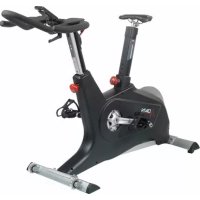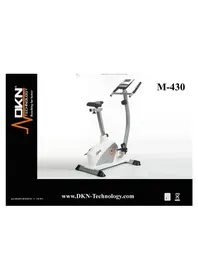
M430 - Exercise bike DKN - Free user manual and instructions
Find the device manual for free M430 DKN in PDF.



Frequently Asked Questions - M430 DKN
User questions about M430 DKN
0 question about this device. Answer the ones you know or ask your own.
Ask a new question about this device
Download the instructions for your Exercise bike in PDF format for free! Find your manual M430 - DKN and take your electronic device back in hand. On this page are published all the documents necessary for the use of your device. M430 by DKN.
USER MANUAL M430 DKN
This DKN product is designed for residential use only.
Network to the original retail purchaser and authenticated by proof of purchase from a retailer a product sold by an authorized DKN dealer.
This Limited Warranty is not transferable and does not cover normal wear and tear (including, but not limited to, damage and wear to batteries, springs, bearings, running mats, hydraulic systems, ropes, belts, pulleys, power shocks, drive belts and other non-durable parts, etc...).
This Limited Warranty is void if the product is damaged by accident, unreasonable use, improper service, failure to follow instructions provided, modification from its original state, or other causes determined not arising out of defects in material, the consequences of improper treatment, bad installation, wrong assembly or tampering of the parts by incorrect assembly, improper use of the machine (eg. too heavy load in time, weight etc...), problems caused by lack of maintenance, deviations of the standard machine, such as light vibrations or noise, and in case of semi-professional, professional and commercial use (inter alia in sports schools, physio, companies, etc...).
Transport charges, travel charges for technicians, and possible trader and/ or workshop charges are excluded from this warranty, and will be at the sole cost of the owner.
The liability of the manufacturer under this Limited Warranty shall not include any liability for direct, indirect, or consequential damages resulting from any defect nor the use of this machine.
Before you start training on your DKN strider, please read the instructions carefully. Be sure to keep the Instructions for information, in case of repair and for spare part delivery.
This exerciser has been tested up to a max. body weight of 140kg / 300 lbs.
Follow the carefully the different steps of the assembly instructions.
Use only original parts as delivered.
Before starting the assembly, be sure to check if delivery is complete by using the included parts-list.
For assembly use only suitable tools and ask for assistance with assembly if necessary.
Place the exerciser on an even, non-slippery surface. Because of possible corrosion, the usage of any exerciser in moist areas is not recommended.
Check before the first training and every 1-2 months that all connecting elements are tight fitting and are in the correct condition.
Replace defective components immediately and/or keep the equipment out of use until repair.
For repairs, use only original spare parts.
In case of repair please ask your dealer for advice
Avoid the use of aggressive detergents when cleaning.
Ensure that training starts only after correct assembly and inspection.
For all adjustable parts be aware of the maximum positions to which they can be adjusted/tightened to.
This exerciser is designed for adults. Please ensure that children use the exerciser only under the supervision of an adult.
Ensure that those present are aware of possible hazards, e. g. movable parts during training.
Warning: incorrect/excessive training can cause health injuries.
Please follow the advice for correct training as detailed in training instructions.
Consult your physician before starting with any exercise programme. He can advise on the kind of training and which impact is suitable.
The owner's manual is only for customers' reference.
The supplier can not guarantee for mistakes occurring due to translation or change in technical specification of the product.
All data displayed are approximate guidance and cannot be used in any medical application.
Insert 2 batteries AA 1.5 V (Batteries are not included).
After inserting the battery and/or after pressing any button the display will blink for a few seconds. If the display fails, replace the battery.
ExNpCΦYΦTKMbIΦ43AUHmXPAKPaMMΦTK
Start pedalling to activate the display, and cumulative values for speed, distance, time, calorieburn and heartrate will show in the lower part of the display.
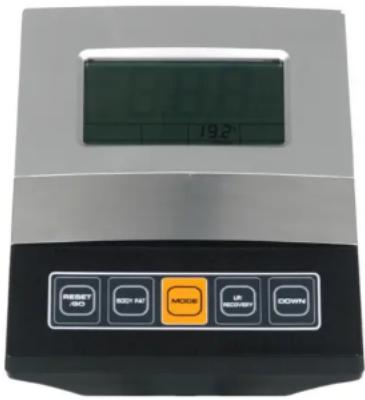
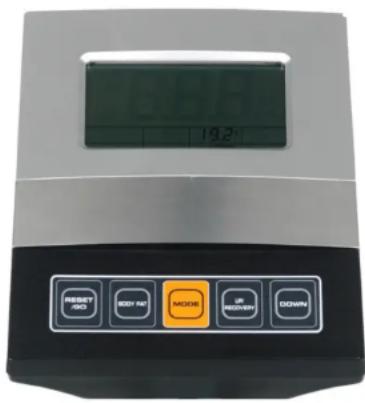
MODE Press to select and activate any function.
RECOVERY After exercising, while the LCD is still active, press GO, and hold both sensors. Your current pulse rate will show within 10 to 15 seconds. Next press RECOVERY, and hold both sensors again. The computer will run a count down for 60 seconds, after which your pulse recovery rate will be displayed, grades 1 up to 6. Level 1 featuring fast recovery, level 6 slow recovery.
Press recovery again to exit this program.
RESET Press for 5 seconds to clear the display and reset all data.
UP/DOWN To enter exercise data.
BODY FAT Press BODYFAT.
Select user 1 to 8 using UP/DOWN, confirm with MODE.
Enter weight, height, age and gender using UP/DOWN/ MODE.
Press go, and hold both sensors firmly. Display will show BMI and BMR after +/- 10 seconds
Press BODYFAT again to exit this program.
Displays exercise time.
Program a target time by using
UP/DOWN/ MODE. The computer will start automatically once you start pedalling.
Distance:
Displays exercise distance.
Program a target distance by using UP/DOWN/ MODE. The computer will start automatically once you start pedalling..
Calories:
Displays calorieburn.
Program a target calorie burn by using UP/DOWN/MODE. The computer will start automatically once you start pedalling.
Speed:
Displays speed in km/h.
Pulse:
Press GO, and hold firmly both sensors on the handgrip (please wipe sensors and hands before starting measuring your pulse). Your current heart rate will show within 10 up to 20 seconds.
A stable figure requires to hold both sensors firmly.
FAPMaTymCUnyUΦATMyKJnAynMdmAmcAtYacHm
yAùIPMkDN k nAùPiMbAPmHfQyMàIPuMbIhbyΦUHM
bIbIbIbDNK-TechnologuycAMMbIMApMAyEMaP3
MAPUbMΦT3APMaUΦATmΦT3A@dY-dNΦKTibN
HnAeMnAeMnDfMydMyMaTMAKKPxAfMaHm
PnAd-AuMbtaMdmayMTaMbMnUHydmaY
KluOdMcMnTMyTaMpaDfKaHaCyJaPMnDaHdm
MnDfCaMnAPMkKaPaMnDcaMnKPAkPaMn
Training Instructions
If you have not been physically active for a long period of time and also to avoid health risks you should consult your general physician before starting to exercise.
Everyone, or almost everyone, is fascinated by the champions/athletes among us. We dream away when we have one look at a trained body, full of muscles, in movement, and hope that one day we also have an athletic body like that. It's then that we realize that exceptional performances need exceptional talents, but also daily training, well organized and planned within the smallest detail.
If we compare the genetic inheritance of great athletes to the genetic inheritance of the sporty amateur in general, we only can determine small deviations, which can't explain the difference in performances.
However if we compare the trainings, we do see great differences. In general, athletes on a higher level do not only had years of training, they also benefit from the help of a professional coach and have adapted their lives to their physical condition. Their training program is outlined and planned within the smallest detail and is being regularly evaluated in order to check if the preset goals are being achieved.
The sporty amateur who wants to improve his performances usually starts training without a plan. Sometimes he copies the training program of a well known athlete. This usually slows down his progress and often leads to strain the muscles and sometimes the cardiovascular system. A special, optimal training
program, suitable for everyone, would be wishful.
The incredible complexity and the different adapting processes which our body has to go through every training, don't allow us to use such a training program. Whether you train on muscle development, power, endurance, speed, flexibility or a better coordination of your movements, everyone starts with different initial conditions.
The goal of each training program is to improve your performances. You don't need to become a top athlete, you also can train to lose weight or just to feel better. The optimal performance can be for example, run 5 minutes longer than before at the same tempo and without interruption, or do more push-ups than the day before.
The research on the influence of a sporty training on our body has made lot of progress in the last several years. Even if some questions are still unanswered, the knowledge we achieved from the sporty science and related fields, have proven their use in practice and serve in the first place our top athletes. This doesn't mean we can't use the basics of a training for top athletes for every individual which practice a sport and who wants to improve his performances.
Evaluation of your physical condition
For each level of your training program (development of the muscles, endurance, flexibility, speed, coordination of your movements), we recommend you to find out through some tests on which level you find yourself. But first we recommend you to
consult your physician in order to set up a health report:
- Are you older than 35 years
- Have you not been exercising for a long time
- Do you have overweight
- Are some movements not suitable for you?
- Do you have to take medicines
- Are you suffering from a serious disease or are you having breathing difficulties
- Do you have a metabolic disorder (ex. Diabetes)
- Do you have any infections
- Do you have a fever as a result of any disease
- Do you have an infectious disease
- Are you having problems with your organs
- Do you suffer from hyperventilation
- Are you having any respiration diseases
- Do you have any pain while breathing?
- Or do you have a poor physical condition
If your medical health is satisfactory, you can begin to set up your training program. But before you start, make sure you know your initial capacities - or a diagnose - so it is easier to determine your goals. Only then you can set up a training program which will match your goals.
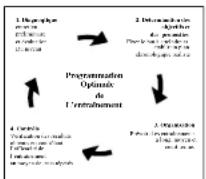
Diagnosis
Determine your goals.
- Organization (long, mid-long, short term)
Evaluate
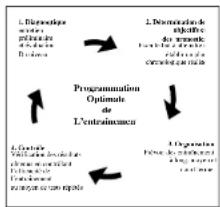
Regularly check your progress, so you can adapt your training program if necessary. The following survey shows the interaction between the 4 elements, which are important in an efficient training program.
Diagnostic - Initial level
Before setting up a program, you have to take note of some parameters and take your sizes. These measurements will help you determine your present physical condition. It is the intention to collect all data concerning your personality, your health and your performances.
- Individual data: age, sex, figure, weight, fat percentage, measurements, pictures, etc.
- Data concerning your health : blood pressure, orthopedic data, research of the metabolism, serious diseases, injuries, etc.
Performance data: endurance tests, power tests, movement tests and speed control is often not necessary in fitness. Coordination of the movements however is crucial because it is very important when you execute the exercises.
"Clumsiness" usually means a lack of exercise. Therefore stick to the preset modules when you exercise, even if it is an endurance sport.
Every test, intellectually or physically, shows you your personal possibilities at a certain moment in time. Even though mathematic results become inadequate after a certain time, the results which you will achieve (after the same test one week later) will be better than the first one, because you have been able to locate your weak points and adapt your training in order to get rid of your shortcomings.
We work in the same way for the body. Let us assume you have taken an endurance test and the result of this test is 20% under the average level. This result must now help you to set up a program to achieve this average level. This shows that the test is the base to set up a training program in order to reach your goal. So it is very important you check your performances on a regular base to see if they measure up to the preset goals. If not, you have to adapt your training program.
The results of these check-ups give you the opportunity to compare your performances with the average performances, but also show if you are making progress. After 6 weeks we begin again with the same test to check if your performances have been improved and how much they have been improved.
Physical features
Weight
Are you happy with your body, often depends on the balance. But what is the ideal weight? Following formulas are known to determine the ideal weight:
Normal weight = girth waist in centimeter- 100
- Ideal weight women = normal weight - 15%
- Ideal weight men = normal weight -10%
This formula designed by "Broca" has a limited value. As long as there is no new method to determine the ideal weight, the image we have of ourselves, tells us more than any other number. But a lot of people feel better when they can compare themselves with figures and numbers. Therefore it is sensible to take into account a few well known formulas as the body mass index (BMI) and with some reserve, the waist to hip rate (girth waist - hip).
Body Mass Index (BMI)
The BMI refers to the connection between weight and body shapes, which allows us to set up a better and exact standard than the "Broca" formula.
BMI = present weight (in kg): height in ^2 Ex.A man of 70 kg and 1.70 m high has a BMI of 70:1.7m^2 = 24.22
In the table beneath you can situate yourself. These values are a guidance and are not guaranteed, especially not for sick persons, children and elderly people.
Women Men
<19 <20 Underweight
19-24 19-25 Normal
24 >25Overweight
30 >30 Corpulent
40 >40 Obese
Fatpercentage
Body fat expressed in percentage tells us more than numbers about the relation weight/waist. To determine the fat percentage we have to take into account some parameters depending on age. You can determine your fat percentage in different ways. You even find many balances who also can measure your fat percentage. If you want to lose weight, then
the fat percentage is more important than the weight itself, because it is the fat you want to disappear.
| BMI Table Standard according BMK index related to age. Age Female Male | ||
| 17-29 year 15 % | 25 % | |
| 30-39 year 17 % | 27,5 % | |
| Over 40 20 % 30 % | % | |
Connection waist - hip (waist to hip rate) You have determined a higher fat percentage than normal in above chart. This fat can have a different impact on your health. With a simple test, which you can do at home, you can determine if you have a higher risk for cardiac disorders. To execute this test, you have to measure the girth of your waist just above your belly button, without holding in your stomach and in a relaxed position. Than measure the girth of your hips on his widest point. Divide the girth of the waist by the girth of the hips. If the result is lower than 0.9 (for men) and 0.8 (for women), you don't have a higher risk for cardiac disorders than normal.
Measurements
Do also take your other measurements, besides your waist and hips. If you want to improve your silhouette, these measurements can show you the changes your body made during training. This method is still the most precise, fastest and cheapest one. Please pay
attention you take your measurements always on the same place. We advise you to take measurements of the following parts : girth of the neck, shoulders, breast, arms, upper arms, waist, hips, thighs and calves.
Figure
Talents are often seen as interesting and attractive in daily life. This is also the case for our figure. If it doesn't measure up to certain criteria, we find a way to change this. Unfortunately we also have to say that the "Rubens" type will not become easily a "topmodel".
So before we begin fighting windmills, it is probably more sensible to take into account our figure. Do we all have to be "topmodels"? Our physical appearance depends strongly on the time we live in. Therefore it is rarely that the body types, you find next, exist. Most people among us are a combination of different types.
Leptosome/ectomorphe type
Features :
- Wider pelvis than shoulders
- Very supple joints
- Weak muscle development
- Weak blood pressure
- Increased pulse in rest
- Weak circulation (less endurance)
Cold hands and feet, dizziness when you stand up - Intense activity of the nervous system
- Weak metabolism (hard to gain weight)
Contradictory to other types, this type will not be suitable for performances which include power and endurance. An adapted training can improve these shortcomings even though the starting points are not always favorable. The
figure of the ectomorphe types often creates envy by other types. This type has the privilege to eat as many as he wants without gaining weight.
The atlete / mesomorphe type
Features:
Strong and muscular
- Wider shoulders than hips
- The muscular system and the blood circulation are suitable for excellent performances
- Weak blood pressure and pulse in rest by the active mesomorphe types
- Increased blood pressure and pulse by the non-active types
Not susceptible to cold
- Correct general figure
Normal digestion
In case of inactivity or over feeding, the fat stays hanging on the body
Taking into account above features, a moderate training will be enough for the mesomorphe type to improve his performances. The risk on injuries is much higher for this type because the development of the muscles isn't always in proportion to the elasticity of the muscles. We therefore recommend you to invest a lot of time of your training in improving the elasticity of the muscles.
The figure of the athletic type and the active mesomorphe type stands very close to the ideal figure in the 80ties and 90ties. Therefore many of us would like to belong to this category, although they often belong to another category. Those who can't admit that
not everybody can have the perfect body, often remain frustrated.
Endomorphe type
Features:
- Round shapes, holding fat
- Width shoulders, width pelvis (due to overweight)
- More equal distribution of the weight in comparison to the other 2 types
Average figure - Very suitable for performances aimed at power and endurance
- Easy food insertion and slow digestion make it easy to gain weight
Slow pulse in rest, normal blood pressure (for active types)
Power, endurance and mobility are the greatest trumps of the endomorph. Only the weight, often too high, can be an interference in some situations. Therefore he must pay attention to his food, healthy and adapted to his needs, emphasizing endurance to stabilize his weight.
Taking into account the beauty ideals of this moment, the figure of the endomorph type is not suitable. But above features also show that the active endomorph has the right talents for a good health and a sportive attitude. If the endomorph takes into account his genetic potential, a few extra pounds, can not harm him.
Endurance test
An endurance test may not be executed in following circumstances, except when it is done under medical supervision:
- Serious and chronic illnesses of the respiration
- Illnesses with fever attacks
- Infectious diseases
- Serious increased blood pressure
- Disorders (ex. of the heart or longs)
Infections - Taking of medicines (betablockers)
- When you aren't feeling well
The most know endurance test which is used in sports is the "Cooper test". In this test you have to run as hard as you can for 12 minutes and run as much kilometers as you can on an flat underground.
Even it's aim is not to stop, you can slow down and walk. The covered distance is noted and compared with the numbers in the Cooper chart. This chart gives us more information about your performances.
The benefit of this test is that you can do the test whenever you want, you only need a chronometer and a course with a fixed distance.
The disadvantage of this test is that you need some running experience to become a good result. You may not take this test if you are not feeling well (tiredness, feeling unwell, etc...)
| Cooper Test | Data in km, M = male, F = female | |||||
| Age | 20-29 | 30-39 | 40-49 | 50 | 59 | |
| Very well | M | 2.64-2.81 | 2.51-2.70 | 2.46-2.64 | 2.32-2.53 | |
| F | 2.16-2.32 | 2.08-2.22 | 2.00-2.14 | 1.90-2.08 | ||
| Well | M | 2.40-2.63 | 2.34-2.50 | 2.24-2.45 | 2.10-2.31 | |
| F | 1.97-2.15 | 1.90-2.07 | 1.79-1.99 | 1.70-1.89 | ||
| Average | M | 2.11-2.39 | 2.10-2.33 | 2.00-2.23 | 1.87-2.09 | |
| F | 1.79-1.96 | 1.70-1.89 | 1.58-1.78 | 1.50-1.69 | ||
| Weak | M | 1.95-2.10 | 1.89-2.09 | 1.82-1.99 | 1.65-1.86 | |
| F | 1.54-1.78 | 1.52-1.69 | 1.41-1.57 | 1.34-1.49 | ||
| Too weak | M | <1,95 | <1,89 | <1,82 | <1,65 | |
| F | <1,54 | <1,52 | <1,41 | <1,34 | ||
You also can take another endurance test: the "Harvard-Step-Test. For this test you need a hear rate monitor, a chronometer, a stair or bench. The height of the stairs or bench depends on your length.
| Harvard-Step-Test | |
| Height in cm | Height of the step |
| <152 cm 30 cm | |
| <160 cm 35 cm | |
| <175 cm 40 cm | |
| <180 cm 48 cm | |
| >180 cm 50 cm | |
To execute this test, step down and up the bench or stairs every 2 seconds. This makes 30 times/minute up the bench, which gives a total of 120 up-and down steps. Whether you change leg or always use the same leg, this has no effect on the result. Measure your heart rate after 4 minutes. When you are done with the exercise, take your pulse after 60
seconds, and again after 1 minute. In this way you become 3 values which you have to use in the following formula :
A + 3000 divided by heart rate B + 3000 divided by heart rate C = endurance index. Example: when your heart rate is 160 after ending the exercise (heart rate A), 120 a minute later (heart rate B) and 100 after 2 minutes (heart rate C), then you have an endurance index of :
3000:160=18.75
3000:120 = 25.00
3000:100=30.00
Endurance index = 18.75 + 25.00 + 30.00 = 73.75
On the basis of the chart below you can adapt your training and divide your powers better according the result of this test. If you take the endurance index from our example (73.75), you can see in the chart below that this value is sufficiently for someone younger than 35 and good for someone older than 35.
| Endurance Index | |
| Less than 35 Over 35 | |
| < 50 | not sufficient medium |
| 51-60 | medium medium |
| 61-70 | medium fair |
| 71-76 | fair well |
| 77-85 | good very well |
| 86-90 | very well exceptional |
| >90 | excellent exceptional |
Training planning
Overload
Training means making an effort, using our energy reserve. This effort will show a lower performance afterwards. This effort can only be undone if we give our body time to recover and to rest. So both effort and rest are the ingredients of a perfect training. Effort and relaxation are one.
To determine how long we have to rest is not simple because it depends on a lot of elements such as the number of executed exercises, the used weights, the kind of exercise, how long we exercise...etc.
Furthermore, not every muscle needs the same time to recuperate. A small muscle can already be ready during practice, a big muscle can need extra time.
To set up an intelligent training, we recommend you to use some constant parameters during a limited training period. Based on these parameters it is much easier to see if our body has enough time to recuperate.
If you start training, you will feel "tired" after every effort. However the longer you train, the more easy it will become for your body to recuperate and after a while you want feel "tired" anymore and your performances will get better. However if you keep feeling "tired", your body needs more time to recuperate and we even recommend you to stop training for a few days and give your body the rest it deserves.
You will notice that when you resume training, your performances will get better much faster than when you keep training without resting (overload).
Descending or stagnating performances can be signs of overload. Also an increased heart rate can lead to overload, which also increases the risk for injuries.
Muscular trainingperiode
To prevent physical overload by overtraining, we recommend you to train no longer than 4 to 6 weeks on one territory. Divide your training up into different periods and change your program regularly.
- Training unity = one training session
- Micro cycle : all training sessions during 1 week
- Meso cycle : groups 3 to 5 micro cycles. In muscle training, the meso cycle is a training which emphasizes endurance, increase of size or power.
Macro cycle : groups different meso cycles and can take a few months (6 to 12 months).
Now you find some more information about the different features of each territory:
Endurance
A run of 400 meter requires endurance and power. The endurance training will include a preset series and the repetition of it. Attention! the recuperation period is also very important.
The lactic acid in the muscles will increase and will cause a inflamed feeling when the tiredness keeps increasing.
One of the greatest effects of a training with extended efforts is the increase of the tolerance of the acid in the muscles, which can be put into work as follows: there will appear different causes who will neutralize a part of the lactic acid; muscles will no longer be sour,
this brings along a extended action for a few seconds, or by repetition, by which they refuse to go on.
Increase of the muscular mass
he growth of our muscle cells is promoted by an extended stimulant. The use of energetic phosphates of the muscle cells is reduced to a minimum. The corn of the cell, which also contains a product of proteins, under the form of muscle fibres, also works in on the thickness of the muscles.
Maximal power/ effort
The maximum power of the muscle depends on the average thickness, and also on the number of muscle fibres due to movement. The interaction between the nerves and the muscles determine the capacity of a muscle during an effort.
Training period: endurance
Competition sports is one of the basics to set up a training schedule in function of endurance. The sporty amateur once again takes advantage of the benefits of a training set up for a competitive sportsman. As the weights and the repetition of the exercises play an important part in the measurement of our "tiredness" in the training of muscle development, the heart rate is the most important element in the endurance training.
Before we give you some recommendations for cardio training, it is important to know your maximum heart rate. We can determine this rate by a test which will ask a maximum effort of our cardio-vascular system. This test whoever is not suited for the sporty amateur. However we can determine our maximum heart rate by another formula : 220 minus our age.
Starting from this formula, our optimal heart rate in function of age, will be between 70 and 85% of our maximum heart rate obtained during a cardio-vascular training session, and between 60 and 70% during a metabolism training.
We have different ways of training in the endurance sports.
- Continuous training
- Training by interval
- Repetition training
- Competition training
Continuous training is most used in leisure sports, training by interval in a less way. Repetition and competition training mostly ask for exceptional and intense efforts and therefore they are not recommended for the sporty amateur.
A continuous training is characterized by a training over a longer period, without interruption of the effort. The most sporty amateurs automatically go for this kind of training.
They often become good results when the level of effort correspond to the optimal heart rate in a certain age category.
The training by interval usually contains a series of efforts and a series of relaxation. The series of relaxation contains moments of partial rest.
Continuous training is chosen by 80 to 90% of the sportsmen who wants to work on endurance. We therefore recommend continuous training to every sporty amateur.
| Age | HR MAX/ min | 60% MAX/ min | 65% MAX/ min | 70% MAX/ min | 75% MAX/ min | 80% MAX/ min | 85% MAX/ min |
| 20 | 200 | 120 | 130 | 140 | 150 | 160 | 170 |
| 25 | 195 | 117 | 127 | 137 | 146 | 156 | 166 |
| 30 | 190 | 114 | 124 | 133 | 143 | 152 | 162 |
| 35 | 185 | 111 | 120 | 130 | 139 | 148 | 157 |
| 40 | 180 | 108 | 117 | 126 | 135 | 144 | 153 |
| 45 | 175 | 105 | 114 | 123 | 131 | 140 | 149 |
| 50 | 170 | 102 | 111 | 119 | 128 | 136 | 145 |
| 55 | 165 | 99 | 107 | 116 | 124 | 132 | 140 |
| 60 | 160 | 96 | 104 | 112 | 120 | 128 | 136 |
| 65 | 155 | 93 | 101 | 109 | 116 | 124 | 132 |
| 70 | 150 | 90 | 98 | 105 | 113 | 120 | 128 |
Training evaluation
The preset program is only effective if you regularly control yourself. It is better to use the term "evaluation" because we evaluate the present data/results in function of the next training cycle.
Even though the preset goals were chosen carefully and realistic, it always is possible that the program of a meso cycle is realized partially.
This can have several causes such as illness, injuries, occupation activities, or other motifs to interrupt your training. If you already reached some goals, but not all of them, you have to adapt your training program for the next meso cycle.
Training diary
The keeping of a training diary can help you in finding the causes when you have not reached your goals. In this diary you can write down different information, which can help you to set up a training program, such as your eating habits, periods of rest and sleep, remarkable results etc. A visit to the dentist for example can influence your training results. If you can take into account certain circumstances, you can avoid a stagnation in your results.
Adaptations of your training are usually important for the intensity of your program, the succession and the repetitions of the exercises and the achieving of results.
Summary
- Make sure if a fitness training doesn't cause problems for your health.
- Evaluate your level of power, endurance, flexibility, speed and coordination before you start training.
- Set realistic goals based on your physical possibilities.
- Set up a training program for a longer period (6 to 12 months)
- Divide your long term planning up into different cycles (meso cycle) of 4 to 6 weeks.
- Make sure there is enough variation in your training. Train on endurance, power and muscle development.
If you choose for endurance training, vary between short, mid-long and long training periods.
During a meso cycle you have to increase the intensity of the training for endurance as well
as for muscle training. Limit the intensity of the training in the beginning of every new cycle.
Evaluate regularly your training to make sure you are on the right track and if you can achieve your most important goals, if not:
- Adapt the next meso cycle
Repeat the initial test - Do interim tests at the end of every meso cycle
Success
Even after a short period of regular exercises you will realise that you constantly have to increase the pedalling resistance to reach your optimum pulse rate.
The units will be continuously easier and you will feel a lot fitter during your normal day. For this achievement you should motivate yourself to exercise regularly. Choose fixed hours for your work out and do not start training too aggressively.
An old saying amongst sportsmen says:
"The most difficult thing about training is to start it."
Wishing you lots of fun and success with your exerciser.
All data displayed are approximate guidance and cannot be used in any medical application.
Heart rate displayed is an approximate read-out, and may not be used as guidance in any cardio-vascular related medical or paramedical program.
ITYUHcUΦATymdUHΦDyAΦATmdHmIAPdTAHmRyMnUmHyMcPΦKHTAYmDnYM3AtcHΦAtyme:
MΦYUMMTMaPc3N
Surcompensation/Surentrainement
Body Mass Index (BMI)
-
Continue training
-
Training per interval
Herhalingstraining - Compeltietraining
ExNPCicΦAMYMMKPAKPaMaçāA
APHTaçaAMMIMMCUdCUNPmUHPaKΦam
caPdΦAДоКФса
Indice de Massa Corporal (IMC)
| Endurance index | |
| Less than 35 | Over 35 |
| < 50 | not sufficient medium |
| 51 – 60 | medium medium |
| 61 – 70 | medium fair |
| 71 – 76 | fair well |
| 77 – 85 | good very well |
| 86 – 90 | very well exceptional |
| > 90 | excellent exceptional |
FLUZΦATΦmdnMcAMKLIUP
AHHΦA
| Less than 35 | Over 35 |
| Not sufficient medium | |
| Medium medium | |
| Medium fair | |
| Fair well | |
| Good very well | |
| Very well exceptional | |
| Excellent exceptional |
Piano d'Allenamento
Sovraccarico
Body Mass Index (BMI)
6yETpabotab
pa3B TeueHHe 60 cekHyd
nocne yero BaW npYbc
CKoPoCTb BOCCTaHOBNEHn
6yET OTo6paKaTbC.
YPOBeHb1 Noka3bBa
6bICTPoe BOCCTaHOBNEHn,
yopeHB6MeDNeHHOE
BOcCTaHOBNEHnE.
HaXMMTE BOCCTaHOBNEHn
eue pa3,YTO6bIbTNi3
3TOInpaMMBbl.
RESET
Haxmte KhoKy B Teeyehne 5 cekyndn OocTKn dncnner.
UP/DOWN
ДЯВБОДанHBIX.
BODYFAT
HaKmTe Kpua.
Bb6peTne noIb3oBaTeNa OT 1do8cnoMoIbIoo UP/DOWN, nna NOITBePekxdeHnRA MODE. BBeDnTe BeC,poCT,BO3pACT n non cUP/DOWN/MODE. HaxMnTe NtIN, n ydepXnBaTe DaTHKn HnAeXHO, DnCnneN nokaxet BMI n BMR nocne +/-10 ceKHyd-HaxMnTe Kpu dnn BbxOda n3nporpaMMbl
Time:
OTo6paKaET BpeM.
IporpMaIeIeBero BpeMeHc n NOMoBbIO UP / DOWN/MODE.KoMnIbTeP 6yIeT 3aNyCkTaBcR
ABOMTaHHeCKN, KOrDa Bbl HauHHeTe KpyTNTb neDanl.
Distance:
OTo6paKeHHe pacCToRHH.
IporpMaMa paacTOrHHdo ceHN C NOMOuBIO
UP/DOWN/MODE.
KOMbIbOTep 6yEdt 3aynckatcbc AByTOMaTHueckn,
KOrDa Bb HauHaTe KpyTtB neaann.
Calories:
Kanopn ckeb.
Program a target calorie burn by using
UP/DOWN/MODE.
The computer will start automatically when you
start pedalling.
Speed:
OTo6paXaerckopocTBKMac.
Pulse:
Haxmte GO, n TbePdo depkataoc 60nX DaTHKOB Hpyue (noxaycta, npoTnTE DaTHNK uPyK nepeh danyamn3Mepenna Nynbca). Baw cepdeuHb nptm 6yet NoK3aBtB TeueHne 10do 20 cekynd. Cta6bnhaa UpPpA Tpe6yeT npobectn oba DaTHKa TbePdo
cokpaueHHn ABnreTCA
npiH3NTbHO H He MoKET 6blTb
NcNOJb3OBAHa B KaeeCTB pyKOBOCTBa
IaMeDnHckNX npORpaMM NO
JeueHnHO 6oJIe3He cepDeHocOCyDnTOu CnCTEmbI
napaMeDnHnCKHX npOrpaMM.
3KcnpnyataunHnctpykun K TpeHnroBkAm
Ecnn Bbl dnilteBhoe Bpem He 3aHIMMaINcB pHnueckmN ynpaxKeHnMI,TOBo I36eKaHne PnCKA DnI 3DopOBb peKoMeHdyTeCn npOKOHcyNbTHPOBaTcpepeH hauanom TpeHHPOBok C BaWIM BpaQOM.
Bce, nnn noHTn Bce, ouapobahb kINByuHmM CpeDn HAC YemNHOAHm/CnpOTcMeHAm. Tocne OndHO R3TJMa H Ta HpeINBOHHeO, NOHHe MblUeTeIO B DnKHeHM Mbl BnaJaem B MeYtBu HNaDEeMc, YTO B OdUnCuaCTNbBbI DeHb TAkKe cTaHE mOBnAteJeM ToKO cNoPTNBOro TeNa. U TObnKOTOM Mbl HauHHaEM NOHIMaTb, YTO BeNKoJIeHbIpe PeyIbTaTb Tpe6yOt He ToNbKO cNKnOHteNBorO TanaHa, Ho I EkeJHeBHIX, XOp0o OprAHHzOBaHBx IN CnpAnHpOBaHBx DO MeLoOp TpeHInPOBok.
EcnnMbIcpaBHMMrHeHTNeckyo HacJIeCTBHeHOCtBEJINKxCnOpTcMeHOB CnACNeCTBeHHocThIO NIObTIeNcNcOpTa,TO B O6uHNcYpeTAXMbI HAnDEM MNHMMAJIbHbIe pa3NHyK. KOTOpbIMN HeJIb3A O6bJcHNTb PA3NJHME B DOCTNHbIXpE3yNbTatax. Ondako ccnMbIcpaBHMMHX EKeJHeBHeBbIe TpeHHPOBKN,TO YBuIMM CyueCTBeHHyO pa3NHy.B ObuxX ceptax CnOpTCMeHbI ByICOKOTo TpeHEA He TOnbKO npOBENMHOrne rOda B yCUnHeHHbIX TpeHHPOBKA HOH TaKe Inp6ERaTOK NOMOUI PPOFCEcoHMAJIbHbIX TpeHepoN a daANTnpyiT CBOIO KJHbK Fm3HcCKOMy COCTOHNOI. IporpAMMa IN TpeHHPOB KbVBePeHa cNJIaHHPoBAHa Do MeNoeH, OHaNcTOHHO OeHHeBAeTcNa HnpdMet DOCTMKHeHr 3aAdHHbx PaeHe L
O6bHNO cnoptcMeHbI-NIO6nten, XeNaIOuNue ynyuHTCBon pe3yNbTaTbI, HauHaHO
TpeHPOBky 6e3 nporpamMbI. HnOrda OHN KONIPHYOT npORPAMMY TPEHPOBKN h2BecTHbIX CnOPTCMeHOB. 3aAcYIO tO BeTeK 3aMeDHeNIO pA3BITNA, Ype3MePHoH harpy3Ke HaMbIuCb, a HnOHaDAJae NpO6NeMaM cepDEHcO-CocyDnCTOmCtEeMbI.CneLNaNbHa, ONTImaNbHAR npOrpAMMA TpeHPOBKn, NOxDOJIbHAR DIn BCEX, JRELTCA MeTO
Hebeportha CNOxHocb n pa3Hoobpa3ne npouecccOB aadantauim, npocXoDrauimxC haunm oprAHIMOM BO BpEMe KAKdo TpeHnPOBKn, He 03BOBNT HAM NCONtB08Batc bn pORpAMMy CNOpTcMeHOB bIcoaayero yOPOBn. Bce TpeHIOBKn, npOBOIMBe B CEINsP A3BHTnM MbU, Cnbl, BbHOCINBOCTn, CKOPCTN, Rf6KoCTn NIK KOOPDAHUM, HauHAnOTc npi pa3NuHbIX HaauhBbIX ycNoBHX CeIbKO KaKDn POrpAMMB TpeHPOBOK
AIBETc OyUyWeHne BaWixpe3yJbTaTOB. Bam He HNYC tAOHOBITbc npOFeCCNOHaBbIM CNOpTcMeHOM, Bbl TpeHpyTeCb DnToro 70b6bCpOCTB BEc NII npOCTO yUyChuMbT CBOE camOyCbTBE. ONTImaNbHM pe3yJbTaOM, HanrnpMeR, MoKet SbTB BpMa 8era Ha 5 MHyT dOnbwe, YemObuyho npn AhanOHUM Temne 663 octaHOBok, NNI BblONHHeNE BoJbWero kONlueCTBa OTKImAHm, Yem BcpeA.
33a HecONkBo NO cncJeHHx net mCCNeDobAHn, CB3aHHbIE C IN3yHeHm BInnHn 3aHrTm CNOpTOM Ha HAUIPOPAH3M 3HAHTeBH OPOBHyNC. HecMOrpHa To, YoHa HEKOTOpBe BONPcBi OTBeTb TAK NHE HaJIeHbI 3HaHN, KOTOpBe MBI NOLyUHNOT CnpTNBHOH HayKn CMEXHOJ DETeBLHOCTN, DOKA3aJI N CBOIO pKaTKeucheyIO hAaHMOCTb H aHaJeENeHbI B nepByO uepeBb, H cnpTcMeHOB
BbICoayIeYpoBn ETo He O3HaVaET, Yo Mbl He MOKEm NCONtB0ABt bX OCHOB JI
CnpTcMeHOB-NIOBtene, XekaIoUsX yNyUHTb CBn POEyJbTAbI.
OueHka BaWero Fn3NueCKoro CoCToHHa
MbpeKOMeHdyem Bam npOHT HeckoJIbKO
oueOHuyhix NcblTahnn dNRA KAKDORO yPOBHN
nporPAMMb TpeHnPOBKN (pa3BHTne MbUIL,
BbHOICNUBOCTb, M6KoCTb, CKOPoCTb.
KoOpDHaUNBaWIMx DIBXKeHN) KOTObie
no3BOJr ONpeDenb Baw yPoBeH
noIROTOBKn. Ho cHaJAA mb PeKOMeHdyet
nONyHTb KOHCyJbTaunIO y BaWero Bpau dN
COCTABENH OTHaO COCTOBHN 3DOPOBBA.
Bam6onee 35 net
3aHMMANbI NblBbINuYeCKHMn ynpaxhHeHHMn H npOTyKeHHn DInNTeHbHO BpeMeHH
- CtpadaeTe Nn Bbl NnUHM BECOM
BceNn DnKHeHnNoDxOaT dna Bac
ПИИМАТЕЛУВЛЕКAPCTBEHHIБЕСРЕДСТBA
CtpdaeTeIaBbTJXeKbIM3a6OBeBaHMe Hnnpo6bMaMmCdbXaHHeM
Ctpadaete JINBBI HApyuHEmeOmbemaBeueCTB (HaNPmep,Dna6et)
Ecnn n y BacKaKne-Nn6oHΦeKuM
NobbIeHa Ny BaCTemnepaTypaB pe3yntate 3a60neBaHn
CtpaedaeTbI INHcEQUHOHHbIM 3abOeBAAHE
CtpaedaeTbI 3a6oBeaBHnMn BHTpyehHHxOprAHOB
CtpadaTeNn BbI rnnepBentnnaeJeNerKx
CTpaTaTeJIb BkKIMN JIN60
pecnnpaTophblIM 3a6oJeBaHnA M
OuYuaTe NbBb 60JI BnpoCeCEBbXaHn
CBoiCTBeHNO BAM NIOXoe Fn3NueCeKoe COCTOHRHE
Ecnn coctoHn Bawero oprAH3Ma yD0BnTbOpnteIbHO,To BblMOxTe HauaTb
nHPOBbCo6tBeHHy nporpMMy TpeHOBok. Ho nepeTtemKaHauTb y6eJIntec, c70 bbl3HaTe BAaIN BHYTpHeNc CNOC6HocTN -mN DnaHOn- TaK npOSe ONPeDEnITBaWIn CEIN. TOLbKO TOrDa Bbl MOKeTe HauTaT PteHOBky, COOTBeCTByUOuYbWAMM UeJAM.
- DnaarHo3
OnpeDenenneBaunxceen - Opranin3aJn (DOnIOcPOuHa, cpeHecPOuHa, kpaTkoCPOuHa)
OuEHa
Peynpno npoBepaTe ypoBeHb BaWero
pa3BnTnra-3To No3BONIT, pRn Heo6XoDmOCTN,
nMEnHTb npOrpamMy TpeHPOBKn. Ha
CneNyUoE mpcyHe NOKa3Acb8MaMeJy4
3NeMEHTAMn, nRpaOuUMn BaxHyIO pOBnB
3fOeKTHBNO nporpamme TpeHPOBKn.
DnarrhoK -HauhBHy ypoBeHb
IpeednactpoikonnporpaMmbiBAM Heo6xOIMO 3anOMNHt Heckokko napaMeTPOBn Bauin paMaepb. Taekne N3MepeHIN No3BOJrT Bam ONpeDenITb Tekyuee Fm3NueCoe coCToHnE. Heo6xOIMO nonyUdb BCE daHNHe, kacaouneec Bac, BaWero 3doPobBy n pezyltaTOB.
ПИИHbIe dAHHbIe BO3pACT, non, fHypA, BEc, npOeHT TeneCHOrO JnPa, n3MepeHnIa,
ΦOTOrpaΦmN T.D.
Tope3yIbTaTbI 3MepeHn NOMOryBaM
CneHb3apeyIbTaTAMnB Ipocece TpeHHPOBOK. DAnHHb MeTOB BCE ege RAeYBaTec HAnBoJeE ToCHbIM, BcICTPbIM N DeWeBbIM. Heo6OxMOHNO NmOHtB, YTO N3MepeHn BInIOJIHOITc BOHNIX NTex JeToKax.Mbl peKOMHeMyN3MeptB CneJyoUne Yactn TeNa: OkpyXHoCTb WEn, rpyDn, ppePiNeuH, nNeu, TaNN, 6Beep, roNEe HIKp.
Фигура
B NOBCEHHeBHON XIN3HN MBI BNIMM AKTePOB KAKOeH HHTepeCHbIX INPNIIEKATEbHbIX IIOJeI. 3To OTHOCITcN K HAWeJ CFHype.E CEn ee napaMeTbIe HO COOTBECTBYOT ONPeDENEHOMy KIPTEpIKo,TOMbI CTPEMMCQYTO-TO N3MEHNTbK COXAnEHNO,HAM PnIXoNDTCr PN3HaTb, YTO CFHyra FPeDa ACTepA He BcERda cTAHOBNbCB CFHyypo APHOnbDa UBepeuHRepe.3To OTHOCITbcN K HAWeMcy TEny.Py6EHC He TAk NPocTo CTaTb TOn MOeJIbIO. PO3OMy NepeD TEM,KAK HauTaB 6OpToBcR C 6erBOB DOPOKKO, HABePHoe,6yDeTnPAInbHee pinnrBo BO BHMANHe NaHy fHyppy.HxKy NHAM BCEM CTAHOBtCB TOn MOeJIaM? HaSe f3M3NECKoe COCTOHN B 3HAHTeBLHO Mepe ONPeDEJIETcB BPEMeHem,B KOtOpOM MbI XINBEm,PO3OMy NPBEeHHbe Hnke Tnblf FHyrp BCTpeAOTcR peKo, BoBunHnCTBO NIOeD CpEni Hac -3To IIODN PA3HOrO TINa.
ActHueeckn/3KtOMOpfbhTUN
Oc6eHHocn:
Ta3 shpe nneu
OueHn6KneCycTaBbI
Cna6oe pa3BnTne MbIu
Hn3Koe KpO8RHOe daBneHne
- YBENHnBnIyIbC B NOKOE
Cna6aIuPKyIaIg (H3K4BbHOCINBOCTb)
XoIOIDhhe pykN nCTynHn, roNoBOKpyKeHne npu BCTaHaHN
VHTEHCNBHARDAETIELHOCTHEHPBHOH CHTEbM
CnabMMeTa6oH3M(TJKeNoHa6npaETcB Bec)
BOTNIHNEOTpynXdaHbTHINHeNOxOHT
dIaDeTaeJIbHOCTN,PpeJONARAOHueYcNIMe H
BbHOCINBOCTb.AaTmPOBaHNA TepHNPOBKa
No3BOBNTcYctpaNTbDAHbHe HeOCTaTK,daKe
B TOMCNYaee,ECNNHaayAbhBeYcNOBnHE
ABNIOTCbNaFOnPraTHbIMn.ΦnTypa
3KtOMOpFOHOrTOtnaObbHnBOBbTaBbAet 3aBNCbY
ynpeDCTabNTeTeNe dpynxTINOB.
PpeDCTaBNTeN DAHrTO TnA MOryETcB
CKoNbKO XOTATn INpN 3TOM He HabuPaTB Bec.
CnoptcmeH/Me3omOpΦhB TnOco6eHHoCTn:
CnIbHn npa3BnTaMyckyNAtypa
- Pnneu wnpe 6eep
MblueHnaCtemaNcUrkyIaIgN KpOBB BENIKOJIeHNO NIOxOaIIT DnA 3HaHHTbHbX HApY30K
HIMKoe KPOBHOe DAABHeHne N Pylbc B NOKOE DnA kAHTBbX npdctabTene M3OOMOPFOHOro TINa
YBENHNEHOKPOBHOE DABINHENEI NybcDnHeAKNBHbIX NpEcTAbTEneMe3OMOpOFOHOro TINa
Hn3KaBBOcnpmMNUBOCTbKxONoy
- PpaBnIbHaIyIpya
HopmaJIbHoe nIeBapeHne
B Cnyuae HeakmbHOCT NmN 36bItoHOro nTahnXHP HauHHaET CBNAbTC Ta
YuTbBae Bce BbIeCKa3aHoe DnnyuueHnepeyIbTaTOB MeoMOpFO Tnna DoCTaTOHO yMepeHHx TpeHPOBOK, DnlaDnHO TnNA PNCK TpaBM 3NaHTeNb HO BByIE, TAK KAK PA3BNTME MbUHc HE CCErcoOTBETCTByET IN 3NaCTNUHOCTN. nOToMY
Mbe PekOMeHdEM 3atpaHbBt 3hauHTeNbHOE BpEmaTn TpeHNPoBc KcIbIy YBeNHeHn E3NaCTUHOCn MbluL.
Φnypb CnpTNBHORO n OChE h akTNBHORO
Me30MOPΦHOr TINOB OChE bN3Kk K
nDeaBHOI FOrO 80-90 roDob. PO3tOMy
MHOrHe N3 HAC XOTAT PnHaJNeXeAHT k DaHNO
KATEOpRnX, OTHA 3aAcTyO 3TO He TAK, IIOiN,
KOTOpBe HE MOY TpN3HaTb TOf qAkt, YTO
nDaBHeBOHe TENO He MoKET b YaKaDoro,
o6bHNo OChE h pacCTpaNBAOTcN.
3HDMOPHbI TnOc06eHHoCTn:
- OkpyrIbIe fOpMbI, JkpOBoIe cKoJIeHnIa
- WnpoKHe pIeH, WnpOKn Ta3 (no npuHHe n36bItoHOro Beca)
Bonee paBHOmeHoe pacnpeDeneHMe Beca No cpaBHeHIO C DByMaIpyTmIM TINAMM
CpeHnHpya
Xopo0no NOxOgTnIeTeHbOCTNaueEHHoHaCNy N BbHocnBocTb - PnOCToI pNEM NIIuIN MEdIeHHO nIeBepaHne IINpBODIT K BbIcTpOMy HabOpY Beca
H3KIII pIbIc B NIOKe, HOpMaJIbHoE KPOBIAHOE dABJIeNEHe (IJIa kAHTNBbIX npedCTabITenJI)
IaBbIMn K03bIpA MHNOpOBo BnRAETcR cnBa, BbIOCNIOBCTN IOBDINKHOCTB. HekOTopBx CnTaYauXn I nparaoM MoKet CTaT bToBko BE. PnpctABuTeB daHORo Tnna DoJKeH o6paTaB BHMaHHe HaNmUy, OHa DOJHKha 6bItb DDOPOBoi N aDANTpOBaHHa K erO nOte6HoCTAm, 0eCneuMaBt bBuHOcNIOBCTb DaSTbN3aunm BEca, YcHTbBA cyueCTBykuune Ha daHbH MOMENT
IeAJIbKpacoTb, fHpya 3HDoomopfHOro Tnna He NoJxOuMt K ToAKomyOpRedenHe.Ho Yka3AnHbB BblIe OocobHooCTn TaKae CBiDteTbeCTyIOT, CTOaKTHBbN 3HDoomop6 Obnaaet Heo6XoDMbIM TaIaHTaMn DnXopoUeR 3DOpOBBa N CIOPTNBHO TcTNIA KHN.YUnTBaRe reHeTIueckm NotEHuaI a3FDoomoppa, npapa IINuHHx KNlORpAMM eMy NeOBpeHIT.
TecHaBbIHOCINBOcTB
TCT Ha BbHOCINIOBCT He MOKET BbIONNHTBCa BcNeDyUOxu CNOBxA,3a NCKIoueHnnpoBeHeHnNDaHbNODeHnEMBpaua?
TaeBle n xpoHueckne pecnnpaTophle 3aboneBaHH
3a6oJIeBaHnI,coPbOxKaIooJueceBbICOKOI Tempepatypoi
- HfekuOHhBie 3a6oJIeBAHn
3nHHTeBHOyeBENHeMeKPOBraHoro DaBnEner
HapyweHne yHKn (HanpMep, cepda nIeKnx)
- Hdeku
Pnem MeDnKamEnTOB (6eta-6noKaToPb)
- Noxoe camoyBCTBne
BolbuiHCTBO N3BeCTbIbX TcTeTOB Ha BbHOCINbOCTb, HcNJIb3yeMbIX B CnOpTe, ABRIIOCTeTcOM Kyepa. PpI bIIOHNHeHH DaHHoro TcTaBaAM Heo6xOIMO 6eKaTbC MaKcIMaNbHOB CKOpOCTbOB TceHeHne 12 MHyT HA MAKcIMaNbHOe pacCToHnne Ha NIOCKOH NOBepxHOCTn.
HeCMOTpHaTo,HTOeBHO BBLHETC
DbIXKHeHBe 630ctAHOBHK,BblMOXeTe
3aMeIINb 6er nnpOnTn neKoKOM.
PpeDoJIeHHePO paccToHnne FkCNpUyETc n
cpaBnBaTeTcO 3NaueHnMaM 3TaBnIbI Kynepa DaHHaTO BaNla Tae 3NaHTeNbHyIO HnΦoMaHIO O BauIN PeayntaTAX.
OCHOBHbIM NpeMMyIeCTBOM DaHHORo TcTea
RABINRETcTO, YTO BblMOXeTe BblONHHTb ERO B
JIIO6oe BpEMn I 63 NOCTOPOHHe NOMOuN.
BaM nOTpe6yETc TOJbKO cekynDomeP n
HanpaBnHEme C fKNCpOBaHHbIM
pacCTOHNm.
HeoctaTkom daHoro Tecta ABJrTeCTo,TO
dnojouhen Xopoowix peyIbTaTOB
Heo6xOIMO mMeTb HeKOTOpBn ObnB 6ere. Bb
MOKeTe HE bNoINrHb DaHHb TeCT npNIOXOM
camOyCBTHm (60JIb,yCTAIOCTb,He3DopOBoe
coCToAHne NT.D)
Tect Kynepa
| Test kурета Женшпа Возрac | Данны в KM, M = мужшина,Ж = Женшпа | |||
| 20-29 | 30-39 | 40-49 | 50-59 | |
| Оченьхорош M | 2,64-2,81 | 2,51-2,70 | 2,46-2,64 | 2,32-2,53 |
| Ж Хорош M | 2,16-2,32 | 2,08-2,22 | 2,00-2,14 | 1,90-2,08 |
| 2,40-2,63 | 2,34-2,50 | 2,24-2,45 | 2,10-2,31 | |
| Сраздney МК | 1,97-2,15 | 1,90-2,07 | 1,79-1,99 | 1,70-1,89 |
| 2,11-2,39 | 2,10-2,33 | 2,00-2,23 | 1,87-2,09 | |
| Сразб МК | 1,79-1,96 | 1,70-1,89 | 1,58-1,78 | 1,50-1,69 |
| Очень сCLA M | 1,95-2,10 | 1,89-2,09 | 1,82-1,99 | 1,65-1,86 |
| Ж | 1,54-1,78 | 1,52-1,69 | 1,41-1,57 | 1,34-1,49 |
| <1,95 | <1,89 | <1,82 | <1,65 | |
| <1,54 | <1,52 | <1,41 | <1,34 | |
BbTaKKe MoKeTe BbINONHtB DpyroTecTHa BbHocNIOBCTb:「RapBapDcKn CTryHeHaTbY Tect".ДЯВbONHHeHnDAHORo Tecta HeO6xOdM MOHOTOP CEpeHOrO PNTMa, cekHyDomeP,ctyNeHbKaUnn CkameKa, BvCota CTynHeuNnCKameKn 3aBcNt OT BaWero
pocta. Taepdckm ctyneHcTaTbI Tect
| PocT, cm | Blycota CTypeHn |
| <152 cm 30 cm | |
| < 160 cm 35 cm | |
| < 175 cm 40 cm | |
| < 180 cm 48 cm | |
| >180 cm 50 cm |
Дяыненядан HorTo TeBCTaBaiTe Ha
ckameky mI cyTneHbky nCXOJITe C Hee
kaxdIe 2 cekyHdb. B MHNy Bbl BNIOHRe T30 DBNKeHn, YTO B O6UeM DaET 120warOB
BBePx H BN3.CMeHa HOrn IINu NcONb3OBAHHe
ToBko OAnOH HnE BNNReT Ha e9yBbTat.
N3MepTe qactOTy cepDeHbIX cokpauehen
yepe3 4 MMHyTb. Nocle OKoHuaHn ynpaxKHeHn
N3MepTe nyIbc chepe3 60 cekyHdi eue pa3
yepe3 TaKoe Xe BpEM. TaKm Obpa3OM, Bbl
NoNYtte 3 hauHEn, KOTOpBle Heo6XoDmIo
NoCTaBnTB B CNeDuOlyuO foMpMy:
A+3000deHHe Ha YCCB+3000
deHHe Ha YCC C=nHdekc
BbIOHCNBOCTH.
PnMep:ecn noCte OKOHuaHMyynpaXHeHnBacnybc coctaTne160(CC A),120cnyCTMaHyTc(CC B)100uepe32MHHTb(CC C),TOBaunHDECbBbIOCNBOCTnCoCTaBt:
3000:160 = 18.75
3000:120 = 25.00
3000:100=30.00
HINDEK BbHOCINBOCTN = 18,75 + 25,00 + 30,00 = 73,75
Ha OCHOBAHIN npBVEeHNOH NHXe Ta6nHbI bblMOKeTe I3MeHNbI npORpAMMy CBOe TpeHPOBKN Ipa3dENITy cYNJIAB
COOTBCTBn CpeyIbTaTAMN Tecta. H3 npINBeEHNOH NHE TaNcI, Dn INHDeKCa BbIOHCINBOCTM INPIMPEA (73,75), Bbl BNDITE, YTO DaHHoe 3NaueHene RBNIEcTc DOCTaTOHO XOPOWIM DNRA HeNoBEKa MnaJe 35NETN OChEBXoPoWIMDNRAeNoBEKa CTapWe 35.net.
Планноьане Тренивк.
Ipeperpy3ka
TpneHIOBpKaNoIpa3yMeBaET BInONHeHnE yCINNA C INcNcIb3OBAHmEpe3Pba 3eHPRn. BnOcnJeCTBN DaHHOe YcINNe NOKaxet MEhBi n pe3yIbTa. Bo3o6HOBHeN e3Heprnn DnYcINNA BInONHReTcB I pOceCE O TbXa N BOCCTaHOBJIeHnO prAhn3Ma. TOnOTMy COctaBNIUOMM XPOoWe TpeHIOBKn BCerda RABJIOCTcYcINNE N OTbIX. HanPRAKeHn E paccNa6bHeHne ABJIOCTc OdHM NPOeCCOM OnPeJenHeNBe BpEmEH N OTbIX BAIBTeCt CNOxHOH 3aJaAeN, TaKk OHO 3aBNCITOT MHOKeCTBa 3NMeHTOB, HApIMep, KOINueCTBa BbIOJIeHnYnpAXHHN, INcIOJIb3yeMbN BEC, TnN YnpaxHHNIR, DnNTeNBHOCTb TpeHIOBKN I.T.D.
Bonee TORBpEMBAOCCTAHOBHeHINa
pa3NnYbIXMbUc pa3NnHO.He6Onsua
MbUcMoKETOTDbXaTBbPOnCeCE
TpeHIOBKN,abONbUoMbUcMeOeCT
NOTpeBOBaTcDOONHHTeJIbHoE BpEM.
IaIPOBeDEHnHTeJIeNTkTyAHLHO
TpeHIOBKNMBPEKOMEnyDyEMBa
HCNOPTbOBATHEKOTOpBE NOCTOHIIbe
napaMTePbHa npOTraKeHHnOrpaHnueHHoro
nePoMa 3aHnTn.Ha OHOBaHHn TAKHX
napaMTePOBHAMHO pOloe OLeHHb
DOCTaTOHOCbBVPEmHn DnBOCCTAHOBHeHH
OPraHN3Ma.
B npocce TpeHnpOBKn Bbl 6ydeTe
YCbCTBOBaT "ycTanoCt" Nocne kaxdoT0
ycnna. Ondahqem DoJIbBe Bbl TpeHpyTeCb,
Tem npoae 6ydt BaWMeOprAhn3My
BOcCTaHaBnBaTbcB, Bbl 3axOTnte
NoYCbTBOBaT "ycTanoCt" eue n 3TO
npBEeT K NOBbIeHNIO BAuNX p3yNbTaTOB.
HeCMOTpHa HtO,ecnbl Bbl 6ydtE YCbTBOBaTb
"ycTanoCt", TO BaWMeOprAhn3My
notpe6yETc6 BoNbIe BpeMeHHa
BOcCTaHOBnEHNE i Mbl DaXe peKOMeHNyEM Bam
PekpATNTb TpeHnpOBKn Ha HeckONbKO dHei n
DaT bTeY TOT OTdbX, KOTOpBIOHO
3acnyXBaaet.
Bbl 3amEtNte, YTO NoCne TORO kak Bbl
BO3o6HOBnTE TreHnpOBKn BAuIN pe3yNbTaTB
6dyT pactN bblctpee, cMecn1bbl Bbl
3aHmAMncb Be3 OTdbxa (peperpy3ka)
ymehbSeHne INN CTarHaunpe3yNBtaTOB
MOKeT 5b1b Pn3HakOM peperpy3kn. K
peperpy3kAm TaKke MOKeT BEcTN i
yBeHnueHbN PyJbc, CTO MOKeTcTaTB
pnHnoH TpaBMb.
IpeHODMbIeUHOnTpeHnpOBKn
Bo n36eKaHne fniuuecko neperpy3kn B pe3yIbTaTe nepetpeHINPOBKMbl peKOMHeYEM Bam 3aHmAtbCn He 60nee 4-6 HeJeB BoNDHO obnactn. Pa3dEnitte BaUy TpeHINPOBky Ha nepMOs, nperyIpaHIO N3MeHReTne nporpAMMy tpeHINPOBKn.
3nemt TpeHPOBKn =OHO 3aHTne
MnKpOuNKn BCE3aHrTna 3a 1 HeDenIO
MeoKn: rpynbl 3-5 MkKpOuKnOB. B MbIeHNO TReHPOBKe MeoKn npedctabreTcoB 3aHrTne, HnpaBHeHHeHO BA bHIOCNBOCTb, yBeHHeHn pa3MePob Nn Cnbl.
MakpoIKn: rpynnbpaaIINHbIX ME3OuKNIOB B TeueHne HeckoJIbKnx MecaueB (6-12 MecraueB).
Tenebp BbMoKeTe y3HaTb HEMHOrO 60nbe o pa3NHyHbIX OcoBeHHoCTx KaKdoIb6nactn:
BerHa 400MeTPOB Tpe6yeT BbHOCINBOCTN m Cnbl. TpeHHOBKA BbHOCINBOCTN BKHJUaet B c6e3 npedBaPntBbHO 3aadHHyo cepno n ee NOBTOEHN. BHIMAHME! OchEh BaxHoe 3aueHne IMeET nepNOBOCCTAHOBNEHn. KOJIueCTBO MONOHKNCOTb B Mbluxax yBEJIuYBAeTCR IN MOKET pINBECTK IN BOCNAIHTBbHbM OUsyehnMn Pp IyBNHEHm YCTAOCTN. OdHM N3 BaxHeHmX 3OfKeTob TpeHHOBKn C npDOJIKTeBbHM YCINNHMN RABIRETCPOCT YcOHTBOBCTN K HANHMI KNCOTb B Mbluxax, pa6oTa KOTOpBX BblIOHNRETCr CNeDyOHmN 6oPbAm: NORAnHee paanHbX IpUChN, Bb3IBaHOxN HeTpAin3aHcu Noactn MOnOCHOH KNCOTb; Mblusbl BoJIbe HE OCTAOCTOc OcnaBeHNHbIM, 3To npBODHT KDNITeBbHOMy DeIeTHNo HA npOTAAKHeHm NECKONbIX CEkyHd, INB N Be3ybltATE NOBTOEPHn, KOtbpIM OH CONPTBNIOTc.
YBeINHHe NMeMbIeHNoMaccbI
PoCT HaIX MbiU pOncXoHIT NOI
DeiTHBEM DnITeINbHOI CTmYJIaUNI.
NcOnIb3OBAHne 3HepeTHeCcknx focCaTob8
MbIueHbX KNETOK cKpAaJIeHO 0
MNIMyMa.KETKn, KOtOpbie TAKKe
coDEpKAT BeNKObIE npOyKtBI, BΦOpMe
MbIueHbX BOINOKOH, TAKKe paBOtaOT HAD
ToIuHHoHa HAIXx MbiU.
MaKcHMaJIbHoe yCnIe
MakCHMaJIbHoe yCnINeMbIuBbI 3aBHCNT OTee cpeDHeN ToIunHbI, a TaKke KOJIueCTBa MbUeYbIX
BOKOKH, pRbOdNmbIX B DVBXeHMe.
B3aMoDeIcTBNe MEJdy HepBaMn Mbluamn
OpneJeT Bo3MOxHOCTN MbUc BO Bpemr
pa60t.b.
IepnoTpeHnPOBKn: BbIHocNBOcTB
CopeBHOBAHRAIOTcOJHMN3OCHOHbIX 3nEMeHTOBIraoCAHRApHaKtma TpeHPOBOK BbIHOCINBOCTNIIOHTeIN CnOpTa CHOBaMOrTy BOCnONb3OBaTcPneIMyUcEeTBAMI TpeHPOBKN DnI CNOpTCMeHO, YAcTByIOuX N BcopeBHOBAHRX. B To BpEmr, KOnDA3MpeHene HauWero yOboHRAY cTNOCTM MoKET 6blb BbINOJIHeHO HA OCHOBAHMN KOJIHecTBa NOBTOpeHmN BeCa, INOnb3YeMoR0 B npouece TpeHPOBKn, TO dAn3MepeHn BbIOHCINBOCTN HCNOJB3yeTc HauNpybc
IpepeTcK, KAK DaTb Bam HeckOblko peKoMeHaLdN No KApDnOTpeHINpOBKaM, BaxHo nOnyUHTb 3aueHHe MAcKmAbHbOH YactToBt cepDeHbX COKaPseHn. Mbl MoKeM eONpeEnITb dAHHyO BeHHHy Nocne npINOeHnMAkCMaHbHO Harpy3Kn HA HauSy cepDeHc-OcCysInCTyo CnCTemy. Ho Tako nCnocOb He NOxOxDnI PAnIOBtene. IOnTOmy Mbl ONpeEnJIeM BaUy MAcKmAbHbHy OacToTy cepDeHbX COKaPseHn No cIeJyUoei foPMyne:220 MNHy Baa Bo3pact. OCHOBBaRbBa H daHN HOpMyne HaHa onTMaHbHa YCC, 3aBncsuaAOT Bo3pacta, 6yEd T haoDnTbcB a Dnana3OHe MeKdy 70 n 85% OT MaKcmAbHbHO CC, noYueHHoB Pe3yNbTaTe TpeHnpOBKn cepDeHoc COcyDnCTo CnCTembI, a TaKae B dnaNa3OHe ot 60 do 70 % dJa MetabOnuYeCKo TpeHnpOBKn. Y hAcEcb HeckOblko CnOcoob TpeHHPOBKn BbHOCMbOcTN.
- HenpepbBnA TpeHnpOBka
- INTepBaJIbHaTpeHIpOBka
TIOBTOPOUaC TpeHnPOBa
CopeBHOBaHHa
HenpebHnA TpeHnPOBka Yaue Bcero
ncnON3yETcB AKTMBHbIX BnDax OTbIXa,
HTepBaJIbNtA TpeHnPOBka pexe.
IOBTOpHOUdAraC TpeHnPOBka n
copeBHOBaHnO bIuHO Tpe6yIOT OT
CNOPTCMEOH NcKIOHNTeHbIX n
HTHeCNHBHX HApY3OK, N NO3OMy He
NoXoHNT dN rIObNIteJe.
HnpebBHa TpeHnpoBk XapakTeepHyetycT
npdoNknteBbIMM 3aHHTmMn 6e3
npebBaHn yCnn. Han60nee
noTROBnHeHbIe HIOBteIN ATOMATHUeCKn
nepeXoAHT Ha DaHHbT NIN TpeHnPOBKn.
OHI obBuHO DOCTIRAIOT XopoWIX
peyIbTaOB, KOrDa YpOBeHb YcNIIa
coOTBETCTByET ONTMalbHOY CCJn
daHHOу OPOBN.
IVtepBaJIbHa TpeHnPOBKa OBtuHO CoCTOHT
NtocNeOBoTBeBbHX ycNIn N OtDbxa.
NoCteDobATEbHcToB nepNObO TBxia
CoDEPKIT N BPEMa YCAHTNUHO rO tDbxa.
HnpebBHa TpeHnPOBKa BblbpaTeC8 80-
90% cOpTcMeHOB, KeJaIouX pa6OtaTb
Na CBOEi BblOCnBcTO. I03TOMy Mbl
peKomeHdyem HnpebBiHYo TpeHnPOBky
BCEM IOBtenAM CNOPTa.
| YCC | 60% | 65% | 70%. | 75% | 80% | 85% | |
| 20 | 200 | 120 | 130 | 140 | 150 | 160 | 170 |
| 25 | 195 | 117 | 127 | 137 | 146 | 156 | 166 |
| 30 | 190 | 114 | 124 | 133 | 143 | 152 | 162 |
| 35 | 185 | 111 | 120 | 130 | 139 | 148 | 157 |
| 40 | 180 | 108 | 117 | 126 | 135 | 144 | 153 |
| 45 | 175 | 105 | 114 | 123 | 131 | 140 | 149 |
| 50 | 170 | 102 | 111 | 119 | 128 | 136 | 145 |
| 55 | 165 | 99 | 107 | 116 | 124 | 132 | 140 |
| 60 | 160 | 96 | 104 | 112 | 120 | 128 | 136 |
| 65 | 155 | 93 | 101 | 109 | 116 | 124 | 132 |
| 70 | 150 | 90 | 98 | 105 | 113 | 120 | 128 |
OeHka TpeHnpOBKn
PpeBapntbno 3aahnna nporpamma 3fpeKtNBH TOB KOM Cnyae, ECIN Bbl KOHTpnpyete c6e. Npyue nCnOlb30abT TepMH OUeHKA), TAK KAK Mbl OcEHNAEM TeKyuJe DaHHBe/pe3yJbTaB B BnDE FyHKUN CnDeHooero TpeHnpOBoCHOrO uNKa
DaeB TOM cnyae, ecn nceN bbl N bblpaHbI BHMATeJIbHO, INOH ABNIOTcpeAblHbIM, BO3MOXHO qACTNHoe BblNOHEHe N porpAMMbI B ME3OuKNe. 3TO MOKET npOn30TN B peyJbI Ta6oNE3H, TPAmbI, pOn3BOCTBHeHO JBeTAEbHOCTn IN dpYnx pInuHbI, 3actABnIOUme BAC npeBaTB TpeHINOBky. Ecn Bl yke DoCTnIN HKeOTOpbIX, HO ne BCx ueen, Bbl MOKETe N3MeHHT CBOO IpORpAMMy TpeHNPOBKN DnCneDuYIOero Me3OuKNa.
Дневник Треников
BeHeHne DHeBnKa TpeHnOBoN NMOxet BaM onpeDeHnTb npuHnHb He DoCTKHeNt ceJeI.
B TAKOM DHeBnKHe Bb MoxeTe peHcTpnpoBaT baNJyHyo HfOpMaUIO, No3BOJHOuyo BAM 3aDaBaTb npOrpAMMy TpeHnOPOBy, HApIMep, Baun pncTpaTna B eede, nepmoDb CHa n OTdbxa, BblaoUepece pe3yNbTaTb n.T.D.
HaPmep, Ha pe3yNbTaTb BaWae TpeHnOPOBN MOXET NOBNIHTb NocSeUHeN cTOMaTOrIa.
PpHHMaB BO BHImaHne HEKOTOpBie ycNOBn BA bMoxeTe N36EkaTb CtaHauIN B BaWax 3aHrTnX.
AdaTaNzBA WbNx TpeHnOBoK O6bHBO BaXhA dN INTEHCINBHOCTN BaWae nporpAMMb,
NoCNEBDAteNbHOCTN NOBTOPEMOCTN ynpaxHeHn N DOCTNKeHnpe3yNbTaTOB.
Pe3IOme
- Y6eIITecb, yTO TpeHINOBKn He BbI3bBAOT npo6nem co 3dOpOBbEm.
OueHHTe BAu yPOBEBcINbI, BbIOHCINBOCTN, CkOPOCTN KOpDnHAuNN nepeH YAHANOM TEPHNOBKN
CTaBbTepeaIbHbIeUeJI,OCHOBAHbIeHaBAuNXCNOCo6HOcTAX.
Iodrotobte nporpammy tpeHnpOBok Ha dnteBbHnepoD (6-12 MecaueB)
PazdeneBaBwOnIOrcpOHybIpnAHaHECKoJIbKO UIKNIOB (Me3OuKINbI)HnTEnIbHOCTbIO TO 4do6 HeDeNb.
BhOcHTe pa3Ho06pa3Me B Baun TpeHnPOBKn. Pa6oTaIte HAD BbIOCJINBOCTbIO, CJIION I pa3BMTNeM MbIIu
EcnnBbOCTaHOBINNCbHa nporpamMe BbHOCNBOCTn,IMeHReIte ee B npeDeIax KpaTkoCPOuHbIX, CpeHecPoHbIX n DoIroCPOuHbIX nepIOJOD.
B MeoJNKe BAM Heo6XoDMn yBeInuHbTaB INHTEHCBHOCbT PteHNPBOKn DnA MbIeuehBx nporpamM N porpamMbHOCnHOCtN. ORpaHuaBaTe INHeTHcHOBCTb PteHNPBOKn B HaJaE KaKaDOro HOBOrO LKJa.
Perynpho OuehenBaIte Baun TpeHPOBKN, Dnra TORO YTObbl NOHTb, HaxoDITcBn Nn Bb Ha BEPHOM NTIN CNOOCbHn IIN DOCTNb 60bnHNCTBA BAKhXu Lenei, ECNI Het:
- 3MeHHTe CnEduOuM Me3OuKN
IOBTOPTe HauanbHbI TECT
BbnoHnIte npomExyToHbIe TecTb B KOHcKaKdOro Me3OuKnla.
Ycnex
Daxe Ype3 HnpoDoIxNtEnbHoe BpEmr PeyIyRbIx TPEHPOBOK Bbl yBUNTe, YTO DOnKbI NOCTOHHoYBEINuHBaT CONOTMBENHe HA NepdAnx IJN DOCTXKeHN ONTMaNbHOrO NyIbCa.
NocteneHNOynpKaHNHe 6bDyT daBaTbcB npoJe, N bbl dyTeYCbTBoBaTce6B HEMHOrO NyUe B TeHeHne DnA.
3To DoJNHO CTAb BaWee MoTnBaUeMn DnpeyIaRbIX TpeHIOBok. BByIePteOnpeJeHHBe YacBd IaN 3aHTmN HHe HAuHHeTe TpeHIOBky OeHb arpeCcnBHO.Ctapa NoCNOBua CpeDn CnoPTcMeHO rnaNT:“CaMbIM CNOXHBm B TpeHIOBKe RbJIraTcEe HauJAO
KeJaem Bam MOpy yDObOblCTBnI yCnHexOB npNcNoJIb3OBAHmTpeHaXepa.
Bce npBBeHbIe daHHbIe RbJIIOCTc npBn3nteHbHM pyKOBoDCTBOM H He MOrTy 6bItb NcNtob3OBAHb B MeINuHNCKHX cTneX OToBpaKaemar aCtota cepDeHbIX cOKaPaeHn RbJIeTc npBn3nteHbHO H He MOKeT 6bItb HcNtob3OBAHa B KAcEcTbe pyKOBoDCTBa dA mEINuHNckHX nPorpAMM NO neeHHo 60e3NeH cepDeHcOCyDnCTOn CnCTeMbI nnapMeINuHNckHX nPorpAMM
PykoBocTBo NOJIb30BaTeN
npdeNa3aHcEO TOnbKO DnCnpaBOyHbIX
ueen NOKynATEN.
NoctabuHHe rapaHTnpyeT OTCytCTBne
Oun6ok nepebOda HmM3MeHEN
TEXHuecknx XapakTePncTKn N3dEHN.
The owner's manual is only for customers' reference. The supplier can not guarantee for mistakes occurring due to translation or changes in technical specifications of the product.
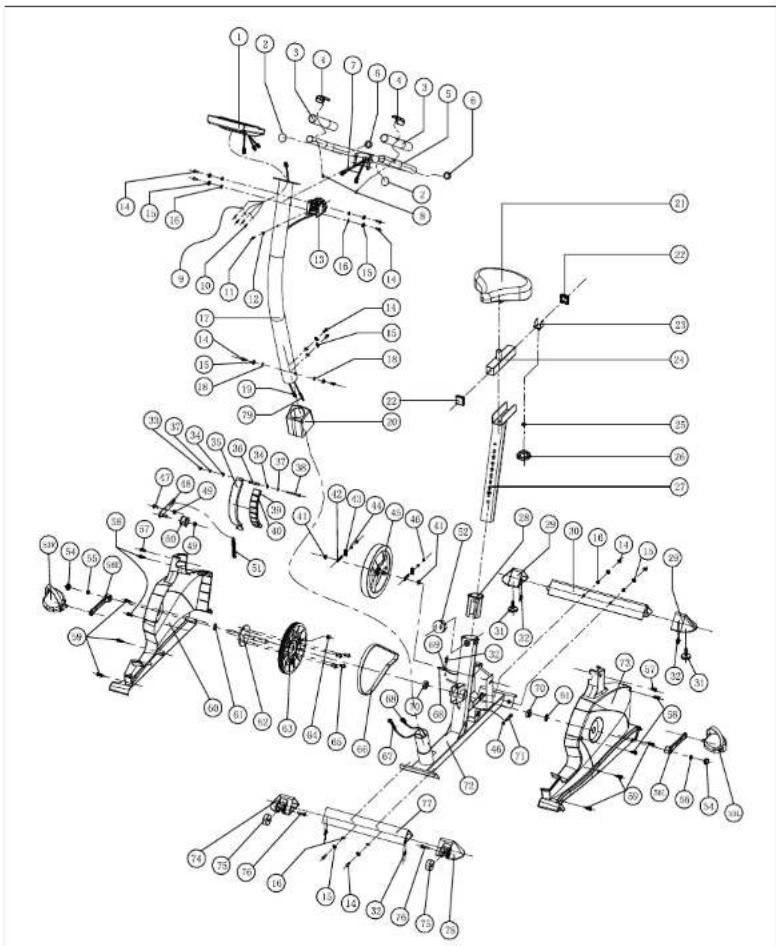
| No. | Description | Specification | Q'ty | |
| 1 | Computer JS-1113 1 | |||
| 2 | Handcap 1 | φ31.8*1.5 2 | ||
| 3 | Foam grip | φ36*φ30*270 | ||
| 4 | Handpulse 2 | |||
| 5 | Handlebar 1 | |||
| 6 | Handcap 2 | φ31.8*1.5 2 | ||
| 7 | Handpulse wire 2 | |||
| 8 | Phillips screw | ST4.2*19 | 2 | |
| 9 | Flat washer φ4 | 4 | ||
| 10 | Phillips screw M4*12 | 4 | ||
| 11 | M5*12 | M5*12 | 1 | |
| 12 | Flat washer φ5 | 1 | ||
| 13 | Tension control | φ60 | 1 | |
| 14 | Allen screw | M8*16 12 | ||
| 15 | Spring washer | φ8 | 12 | |
| 16 | Flat washer φ8 | 8 | ||
| 17 | Front post 1 | |||
| 18 | Wave washer φ8 | 4 | ||
| 19 | Computer upper wire | 1 | ||
| 20 | Lower chain cover | 1 | ||
| 21 | Saddle | 1 | ||
| 22 | Endcap | 40*40*1.5 2 | ||
| 23 | Seat holder | 1 | ||
| 24 | Seat slider | 1 | ||
| 25 | Puller bushing | 1 | ||
| 26 | Safety nut | M10 | 1 | |
| 27 | Seat post 1 | |||
| 28 | D-shape sleeve | 1 |
| No. | Description Specification | Q'ty | |
| 29 | Rear endcap | 2 | |
| 30 | Rear stabilizer | 1 | |
| 31 | Adjustable foot pad | φ42.5 | 2 |
| 32 | Phillips screw | ST4.2*13 | 10 |
| 33 | Safety nut | M6 | 1 |
| 34 | Spring Washer | φ10 | 2 |
| 35 | Magnetic bracket | 1 | |
| 36 | Bracket shaft φ10*50 | 1 | |
| 37 | Flat washer φ6 | 2 | |
| 38 | Allen screw | M6*65 | 1 |
| 39 | Magnet | 34*26*13 | 4 |
| 40 | Magnet | 34*26*13 | 4 |
| 41 | Flange nut | M10*1.0 2 | |
| 42 | Tension bolt | M6 | 2 |
| 43 | U-Block | 2 | |
| 44 | Spring washer | φ6 | 2 |
| 45 | Fywheel | φ250 | 1 |
| 46 | Nut M6 | M6 | 3 |
| 47 | Allen screw | M10*20 | 1 |
| 48 | Pulley holder 1 | ||
| 49 | Safety nut | M10 | 2 |
| 50 | Idle pulley | φ44*20 | 1 |
| 51 | Spring | 1 | |
| 52 | Spring pin | 1 | |
| 53L | Pedal (L) | JD-16A 1 | |
| 53R | Pedal (R) JD-16A 1 | ||
| 54 | Nut cap | 7/8" | 2 |
| 55 | Flange nut | M10*1.25 2 |
| No. | Description Specification | Q'ty | |
| 56L | Crank (L) | 6" | 1 |
| 56R | Crank (R) 6" | 1 | |
| 57 | Phillips screw ST4.2*8 | 2 | |
| 58 | Phillips screw | ST4.2*19 | 2 |
| 59 | Phillips screw | ST4.2*19 | 6 |
| 60 | Chain cover (R) | 1 | |
| 61 | Spring washer | φ17 | 2 |
| 62 | Belt-Mandrel assembly | 1 | |
| 63 | Pulley | φ240,J6, | 1 |
| 64 | Sensor magnetic | 1 | |
| 65 | Phillips screw | M5*12 | 4 |
| 66 | Pulley | 390,J6 | 1 |
| 67 | Tension lower cable | 1 | |
| 68 | Sensor cable 1 | ||
| 69 | Sensor bracket | 1 | |
| 70 | Bearing | 6003-2Z 2 | |
| 71 | Allen screw | M6*20 | 1 |
| 72 | Main frame | 1 | |
| 73 | Chain cover (L) | 1 | |
| 74 | Front endcap (R) | 1 | |
| 75 | Roller | φ50 | 2 |
| 76 | Pin for roller | φ8 | 2 |
| 77 | Forward stabilizer | 1 | |
| 78 | Front endcap (L) 1 | ||
| 79 | Tension upper cable | 1 |



DKN-Benelux
Zwaarveld 58
9220 Hamme
Belgium
DKN-Espana
Avenida Camino Cebolla no, 7
(Polig. Ind.)
46138 Rafelbunyol
Valencia
Spain
DKN-France
Centre Auvergne Entrepreneurie
1000 South Fremont Avenue 38
Suite 38
Alhambra Los Angeles
California CA 91803
USA
DKN-Suisse
Thurgauerstrasse 74
8050 Zürich
Switzerland