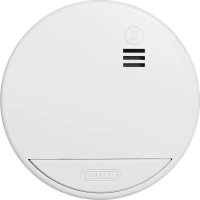
RWM100 - Smoke detector ABUS - Free user manual and instructions
Find the device manual for free RWM100 ABUS in PDF.



| Product Type | Optical Smoke Detector |
| Brand | Abus |
| Model | RWM100 |
| Dimensions (diameter x height) | 102 mm x 36 mm |
| Power Supply | 1 lithium battery 3 V (included) |
| Battery Life | Up to 5 years |
| Alarm Sound Level | At least 85 dB at 3 m |
| Detection Range | Up to 40 m² indoors |
| Operating Temperature Range | 0 °C to +45 °C |
| Operating Humidity | 10 % to 90 % |
| Detection Principle | Photoelectric Reflection |
| Optical Indication | Flashing LED every 6 minutes (normal operation) |
| Test/Stop Button | Yes |
| Silence Function (Mute) | Yes, approximately 9 minutes |
| Mounting | On ceiling, at least 15 cm from walls and 50 cm from corners |
| Recommended Number of Detectors | One per room (living room, bedrooms, hallways) |
| Standards | EN 14604:2005, DIN 14676 |
| Warranty | 2 years (excluding battery) |
| Maintenance | Cleaning by vacuuming or blowing; annual test |
| Detector Lifespan | 10 years maximum |
| Repairability | Not user-repairable; do not open |
| Delivery Contents | Detector, battery, mounting materials, manual |
Frequently Asked Questions - RWM100 ABUS
User questions about RWM100 ABUS
0 question about this device. Answer the ones you know or ask your own.
Ask a new question about this device
Download the instructions for your Smoke detector in PDF format for free! Find your manual RWM100 - ABUS and take your electronic device back in hand. On this page are published all the documents necessary for the use of your device. RWM100 by ABUS.
USER MANUAL RWM100 ABUS

Security Tech Germany

Security Tech Germany
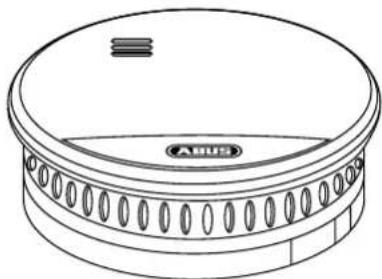
User manual
Smoke alarm devices
127464-2005
AC208

A012
GDP 107HMS52,
GBP 21563989
ABUS | D 58292 Wetter (Germany)
www.abus.com
AABUS 06/2015
Please read carefully through this instruction for use before starting up! Smoke detectors help save lives! Please keep save this instruction for use!
Device description
3
-18--19-
Device description
Contents
Device description 18
Safety information 20
Warranty 22
Declaration of conformity and declaration of performance 23
Commissioning and hardware Installation 24
Cleaning and disposal | Maintenance and inspection 28
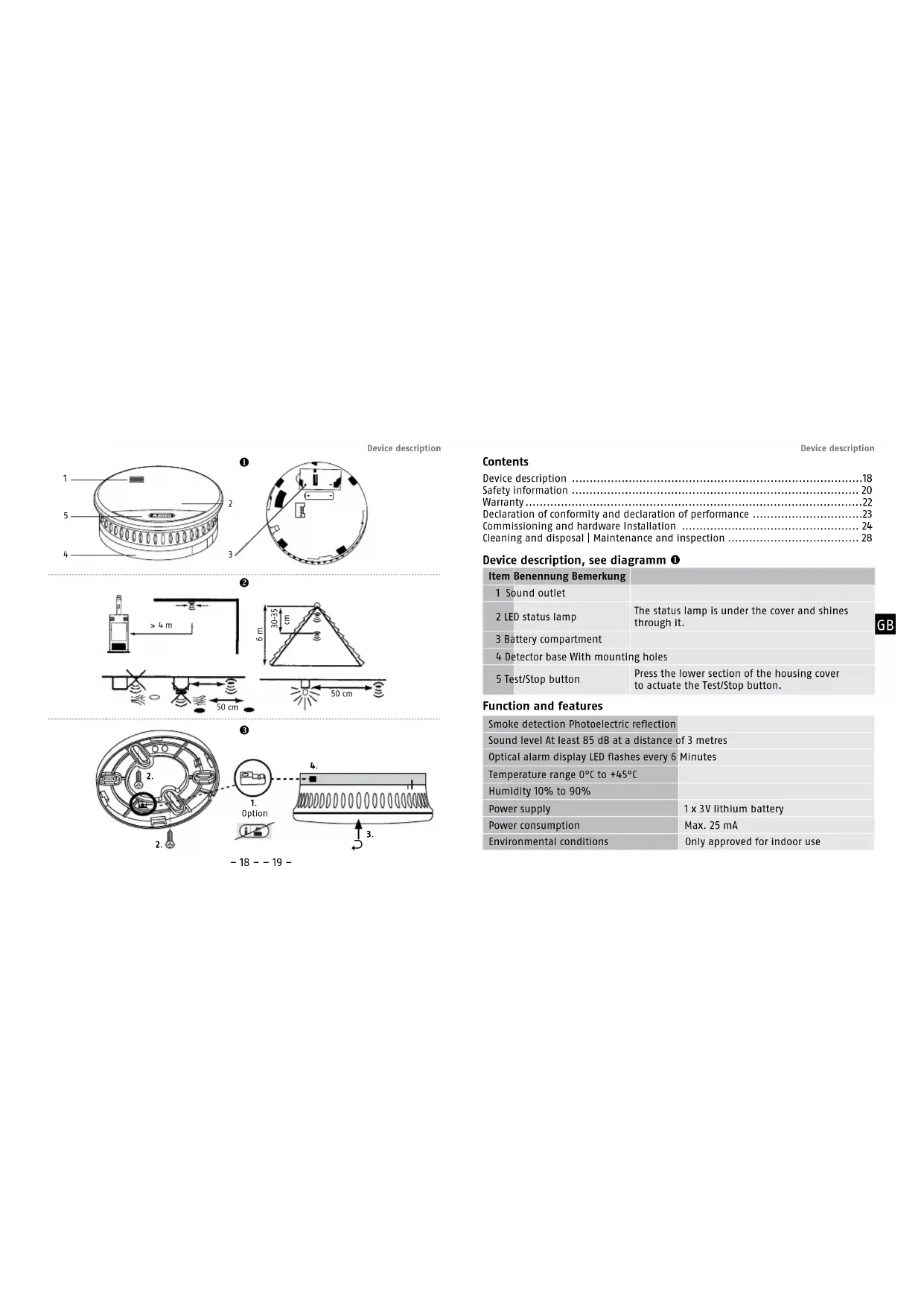
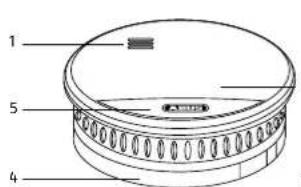
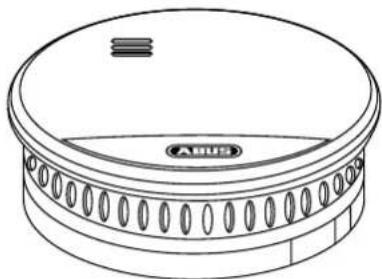
Device description, see diagramm 1
| Item Benennung Bemerkung | |
| 1 Sound outlet | |
| 2 LED status lamp | The status lamp is under the cover and shines through it. |
| 3 Battery compartment | |
| 4 Detector base With mounting holes | |
| 5 Test/Stop button | Press the lower section of the housing cover to actuate the Test/Stop button. |
Function and features
| Smoke detection Photoelectric reflection | |
| Sound level At least 85 dB at a distance of 3 metres | |
| Optical alarm display LED flashes every 6 Minutes | |
| Temperature range 0°C to +45°C | |
| Humidity 10% to 90% | |
| Power supply | 1 x 3V lithium battery |
| Power consumption | Max. 25 mA |
| Environmental conditions | Only approved for indoor use |
Device description Safety information
| Battery service life | RWM50: 1-2 years RWM100: up to 5 years |
| Audible battery warning Approx. 30 days before discharge | |
| Height 36 mm | |
| Diameter 102 mm | |
| Applied standards Area of application | EN 14604-2005 DIN 14676 |
The manufacturer reserves the right to make technical modifications at any time.
Scope of delivery
RWM50/RWM100 smoke detector, including battery
This user manual
Installation material
Explanation of symbols
The following symbols are used in this manual and on the device:
Safety information
| Symbol | Signal word | Meaning |
| ! | Warning | Indicates risk of injury or health hazards. |
| ! | Warning | Indicates risk of injury or health hazards caused by electrical voltage. |
| ! | Important | Indicates possible damage to device/accessories. |
| i | Note | Indicates important information. |

Warning
-
The smoke detector does not detect gas, steam, heat or fire/flames. Detectors with special sensors are required for this.
-
People with hearing impairments may not be able to hear the alarm. Special alarms with visible signalisation are available for such cases.
- Smoke detectors help save lives. Therefore, for safety's sake, you should regularly test the battery and the operation of the detector. For day-to-day use, remember that the smoke detector cannot prevent fires but simply provides signalization in the event of one. For your own safety, please replace smoke detectors every ten years at the latest.
- Very high electromagnetic radiation can cause malfunctions. Therefore, do not install the detector near strong magnets or devices which produce electromagnetic radiation.
The smoke detector works optically by measuring smoke particles that penetrate into its measurement chamber.
When the alarm threshold is exceeded, a loud alarm sounds. The alarm is switched off as soon as there is no more smoke in the measuring chamber.
Surveillance area: 40m^2 within a room
- Battery operated (1 x 3V battery)
Automatic battery state monitoring
- Battery compartment check (the smoke detector can only be installed when the battery is fitted)
Optical LED indicator lamp and acoustic alarm
- Simple installation
Warranty:
- ABUS products are designed and manufactured with the greatest care and tested according to the applicable regulations.
- Notwithstanding statutory warranty claims, ABUS August Bremicker Söhne KG, Altenhofer Weg 25, 58300 Wetter therefore offers a two-year warranty on the RWM50 and RWM100 VdS smoke detectors, starting on the date of sale to the consumer.
- The warranty only covers defects caused by material or manufacturing errors. If there are demonstrable material or manufacturing errors, the smoke detector will be repaired or replaced at the manufacturer's discretion.
- In such cases, the warranty end when the original warranty period of 2 years expires. All further claims are expressly rejected.
- The warranty does not cover the batteries supplied.
- ABUS will not be held liable for defects and damage caused by external influences (e.g. transport, use of force, operating errors), inappropriate use, normal wear and tear or failure to observe the instructions in this manual.
- In the event of a warranty claim, the original receipt with the date of purchase and a short description of the problem must be supplied along with the smoke detector.
- If you discover a defect on your smoke detector which existed at the time of purchase, contact your dealer directly within the first two years.
Proper use
Only use the device for the purpose which is was designed and built for. Any other use is considered inappropriate. This device may only be used for the following purpose(s):
- Detecting fire/smoke in private households
Declaration of conformity
ABUS August Bremicker Sohne KG, Altenhofer Weg 25, 58300 Wetter, hereby declares that the RWM50/RWM100 complies with the basic requirements and other relevant terms of the 2004/108/EG. For further information on the CE declaration or to view the CE declaration, please get in touch with ABUS August Bremicker Sohne KG, Kundenservicecenter, Altenhofer Weg 25, 58300 Wetter.
Declaration of performance 2015RWM50/2015RWM100
This smoke detector has been tested and certified as a construction product in accordance with Regulation EU 305/2011. It has been manufactured subject to monitoring by regular and independent inspections for unchanges in compliance with legal and normative requirements.
Please enter the smoke detector model (RWM50 or RWM100) in the search field at the top right and then go to downloads. Double click to select the declaration of performance. In addition, you can also find here the data sheet and operating instructions for the smoke detector.

Warning
Observe the following instructions to prevent any failure of the device: - Do not cover the device.
- Do not paint over the device or cover it with wallpaper.
- Never open the device or attempt to repair it, as its function can then no longer be guaranteed. Failure to observe this instruction will invalidate the warranty.
- Do not use the device if it has been dropped or damaged in any other way.
- If you pass on the device to someone else, you must include this user manual.
Safety information
Before operation

Warning
- Keep children away from the packaging - there is a risk of suffocation.
- Remove all packaging material before using the device.
What to do when you hear the alarm
- Leave the premises immediately. Every second counts - there is no time to get dressed or gather valuable belongings. Use the emergency escape routes.
- Warn your fellow residents and make sure they also leave - especially children and people with impaired hearing.
- Do not open doors without first checking the surface. Do not open a door if it is hot or you see smoke under it. Use an alternative escape route. If the surface is cool, push against it with your shoulder, slightly open it and be prepared to close it again if there is heat, smoke or fire behind it.
- If there is smoke in the air, keep close to the floor and breathe through a damp cloth if possible.
- Close the doors after leaving the room.
- Once you have left the building, go to the agreed assembly point and do not go back inside.
- Call the fire brigade from outside the burning building.
- Notify the fire brigade of the situation inside the building.
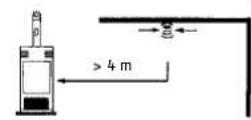
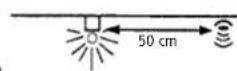
For recommended installation locations, see the diagram 2
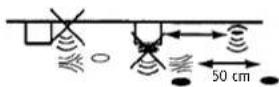
- Position the smoke detector directly on the ceiling in the centre of the room.
- Priority rooms: living rooms, bedrooms and children's playrooms.
- If you have more than one bedroom, each one should be fitted with a smoke detector.
- To monitor corridors, you should also fit smoke detectors there, because stairwells are particularly susceptible to fires due to the chimney effect. Long corridors might require several smoke detectors.
Putting into operationPutti
The distance between smoke detectors should not be more than 8 metres.
- When fitting on the ceiling, make sure that the smoke detectors are at least 15cm from the side walls and 50cm from the corners.

Warning
Avoid the following locations to prevent malfunctions of the smoke detector:
- Places where expected temperature variations are greater than the ambient operating temperature (+0^ to +45^)
- laces where draughts can keep smoke away from the detector, such as near windows, doors or ventilation shafts.
- Places where vapour, increased air humidity or exhaust fumes may trigger false alarms, e.g. in kitchens, bathrooms or garages.
- Places where dust or dirt could impair the function of the smoke detector.
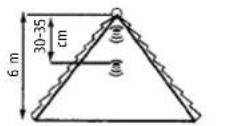
- The highest point in rooms with gable ceilings. The distance to the highest point of the gable should be at least 30~cm .
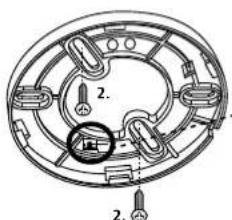
For installation and attachment, see the diagram ⑧

Warning
- When marking out the drill holes, make sure there are no electrical wires or cables, pipes or other important components behind them.
If in doubt, consult an expert before drilling.
- If you are fitting the smoke detector in a vehicle (such as a camper or caravan), you must contact the manufacturer or your local dealer first for information on the most suitable location.
Putting into operation
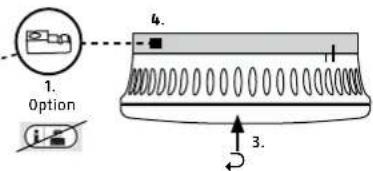
- Loosen the smoke detector from the base of the housing by turning it anticlockwise. Mark the drill holes through the base.
- Drill the holes, put in the plugs and screw in the base.
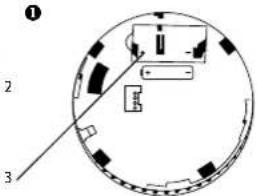
- Remove the transport safety device (discharge protection for the battery) on the negative battery terminal of the detector (see the diagram 0) and fasten the smoke detector by twisting it clockwise onto the base. The detector has a safety device that prevents installation without a battery.
- If you cannot fasten the smoke detector to the base: Check whether the battery is correctly inserted and connected.
Operation and function (test)
The smoke detector is ready for use as soon as you put in the battery.
- Under the housing cover there is an indicator lamp which flashes every 344 seconds (about 6 minutes) to show that the battery is correctly inserted and is delivering enough power to generate an alarm.
- Check the function of the smoke detector at regular intervals. Press the lower section of the housing cover for 5 seconds. If you hear a signal, the device is working properly and can be fastened. By testing the device electronics, the mute function is automatically activated for 9 minutes, during which time the LED will flash once every 10 seconds. After this 9-minute period, the detector will automatically return to normal operating mode, in which the LED will again flash once approximately every 6 minutes.
- Alternatively, you can use the RM test spray available from ABUS to test the smoke detector. If the RM test spray enters the detection chamber, an alarm should sound, so that you can test whether the detector is working properly.
Attention, loud alarm sound, hearing protection use!

Putting into operation
Replacing the battery
- If the battery is low, the smoke detector beeps once every 43 seconds (for up to 30 days) to remind you to replace the battery.
- You must change this battery when you hear this signal.
- Loosen the detector from the detector base by turning it in an anticlockwise direction, remove the old battery and insert a new battery into the detector with the correct polarity (see diagram 1).
Even so, the smoke detector remains functional in this condition. - You must test the smoke detector each time you change the battery.
- Carry out the test as detailed above.

Note
To ensure a long service life and reliable operation, we recommend using the following high-quality batteries:
RWM50: DESAY CR123A, Ramway CR123A, Duracell Ultra 123
RWM100:EVE CR123A, PAIRDEER CR123A
Alarms and error signals
When the alarm threshold is exceeded, a loud alarm sounds.
The alarm continues sounding as long as there is smoke in the detection chamber.
- The alarm is only switched off when there is no more smoke in the detection chamber.
What to do if there is a false alarm?
A false alarm can occur due to very high air humidity, the build-up of smoke whilst cooking or a large build-up of dust, or smallest insects for example.
-
If the alarm sounds, first get yourself to safety. If you are certain that it is a false alarm, you can switch the alarm mute for about 9 minutes by pressing the test/stop button.
-
The smoke detector will switch off automatically once the smoke particles have left the smoke chamber inside the detector.
Mute:
The alarm can be deactivated by pressing the test/stop button temporarily for about 9 minutes. If the mute function is active, the red LED will flash once approximately every 10 seconds. If, after this 9-minute mute period, fire smoke is still detected in the smoke measuring chamber, the acoustic alarm will sound again. Only activate the alarm mute function when you are absolutely sure that you can exclude a cause of fire!

Note
- Protect the device from dust, dirt and moisture.
Maintenance and inspection
A smoke detector must always be at least once a year in accordance with DIN 14676 are checked for functionality. A functional test can be triggered by prolonged activation of the test/stop button with this smoke alarm (5 in Figure 1).
The LED then flashes quickly and it is a confirmation tone.
Cleaning
- Dusty detectors must be cleaned. You can clean dust from the air vents of the detector using a vacuum cleaner or compressed air. If necessary, you can remove the dust with a brush.
- When changing the battery, carefully clean the detection chamber with a vacuum cleaner to remove any dust or dirt.
- You can clean the surface using a cloth slightly dampened in soapy water.

Important
- Do not allow water to penetrate inside the device.
-
Do not clean the device in a dishwasher.
-
Do not use sharp, pointed, abrasive or corrosive cleaning materials or brushes.
-
Do not use chemicals.
- Do not use flammable liquids for cleaning.
Information on the EU directive on waste electrical and electronic equipment
To protect the environment, do not dispose of the device with domestic refuse at the end of its service life. It can be disposed of at one of the appropriate collection points in your country. Please obey your local regulations when disposing of material

Dispose of the device in accordance with EU directive 2002/96/EC - WEEE (Waste Electrical and Electronic Equipment). If you have any questions, please contact the department of your local authority which is responsible for waste disposal. Used equipment can be disposed of, for example, by your local or municipal authority, the local waste disposal
company or your dealer.
Information on handling batteries
- Make sure that batteries are kept away from small children. Children may put batteries in their mouths and swallow them. This can cause serious harm to their health. If this happens, consult a doctor immediately.
- Do not charge normal batteries, heat them up or throw them into naked flames (they may explode).
- Change low batteries in good time.
- Always change all the batteries at the same time and use batteries of the same type.
Cleaning and disposal

Important
Leaky or damaged batteries can cause chemical burns in contact with the skin. In this case, wear protective gloves. Clean the battery compartment with a dry cloth.
- Do not charge normal batteries, heat them up or throw them into naked flames (they may explode).
Important information on disposing of batteries
Your product uses batteries which are subject to the European directive 2006/66/EC and may not be disposed of with domestic refuse. Find out about the regulations for the separate collection of batteries which apply in your country. Proper disposal of batteries helps prevent harm to health and the environment.
Batteries that contain harmful chemicals are labelled with these signs:

Pb Cd Hg
Pb = battery contains lead
Cd = battery contains cadmium
Hg = battery contains mercury
Note
RWM50/RWM100

Security Tech Germany
Subject to technical alterations. No liability for mistakes and printing errors. ABUS | D-58292 Wetter (Germany)
www.abus.com
ABUS 06/2015
For installation and attachment, see the diagram ③
Mise en service

Avertissement
RWM50: DESAY CR123A, Ramway CR123A, Duracell Ultra 123
RWM100:EVE CR123A, PAIRDEER CR123A
Nettoyage, elimination

Important
Security Tech Germany

Security Tech Germany
ABUSD-58292Wetter (Germany)
www.abus.com
ABUS 06/2015




- Contents
- Scope of delivery
- Explanation of symbols
- Warning
- Warranty:
- Proper use
- Declaration of conformity
- Declaration of performance 2015RWM50/2015RWM100
- Before operation
- What to do when you hear the alarm
- For recommended installation locations, see the diagram 2
- For installation and attachment, see the diagram ⑧
- Operation and function (test)
- Replacing the battery
- Note
- Alarms and error signals
- What to do if there is a false alarm?
- Mute:
- Maintenance and inspection
- Cleaning
- Important
- Information on the EU directive on waste electrical and electronic equipment
- Information on handling batteries
- Important information on disposing of batteries
- RWM50/RWM100
- For installation and attachment, see the diagram ③
- Avertissement
Brand : ABUS
Model : RWM100
Category : Smoke detector