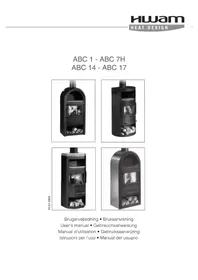
ABC 14 - Fireplace Hwam - Free user manual and instructions
Find the device manual for free ABC 14 Hwam in PDF.


| Product type | Fireplace / Wood stove |
| Brand | Hwam |
| Model | ABC 14 |
| Main fuel | Wood (birch, beech) – briquettes allowed |
| Nominal draft | 15 Pa |
| Minimum chimney cross-section | 150 mm |
| Rear distance (combustible wall) | 20 cm |
| Side distance (combustible wall) | 30 cm |
| Front distance (protected area) | 77 cm |
| Furniture distance forward | 80 cm |
| Flue outlet | Rear and top |
| Adjustment system | Automatic with adjustment rod and swivel damper |
| Internal plates | Smoke plate, guide plate, grate cover plate |
| Glass cleaning | Steel wool sponge (cold stove) |
| Daily maintenance | Vacuum cleaner with soft brush or cloth |
| Annual maintenance | Complete cleaning, check of seals, greasing of fittings |
| Maximum combustion | 2.0 kg of wood per hour |
| Warranty | Subject to regular maintenance |
| Materials | Steel, ceramic insulation |
| Glass | Ceramic glass |
Frequently Asked Questions - ABC 14 Hwam
User questions about ABC 14 Hwam
0 question about this device. Answer the ones you know or ask your own.
Ask a new question about this device
Download the instructions for your Fireplace in PDF format for free! Find your manual ABC 14 - Hwam and take your electronic device back in hand. On this page are published all the documents necessary for the use of your device. ABC 14 by Hwam.
USER MANUAL ABC 14 Hwam
Installation 18
Firing manual 20
Maintenance 22
Operational problems 23
Inhaltsverzeichnis
ABC 14ABC 1B4 ABC 17
ABC 17
A.
E.
E1
E2
C.
C2
D.
Loven
Expt 1 (Mehchhbeigag zibng)
Aafagge
HAWAM Heat Design AS, Nydamavese 53, DK-8362 Hening
Nernstnererbeitzung
11.0kW
KunzBeschreitung
Kammingen aus Staatsbuch, Rod. Aschakainen, Breivastigfagerbuch
Installation of your woodburning stove must always comply with local building regulations. It is a good idea to consult with your local chimney sweep before installing, since he will be the one to sweep the chimney and stove.
Room requirements
There must be a constant supply of fresh air to the room in which the stove is to be installed. A window that opens or an adjustable air vent should suffice, but it is also possible to connect the stove to an ABC fresh air system.
Load-bearing capacity of floor
Before installing the stove, you must ensure that the load-bearing capacity of the floor can withstand the weight of the stove and the chimney. The weight of the stove is indicated in the brochure, and that of the chimney should be calculated according to its dimensions and height.
Distance to inflammable materials
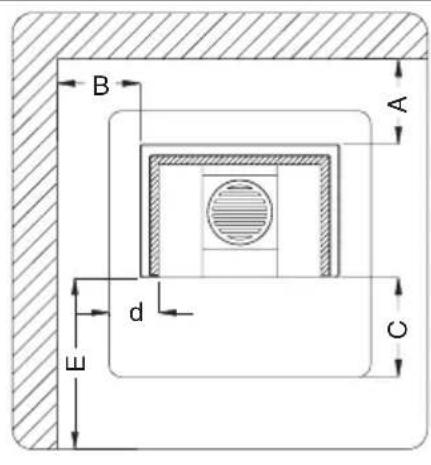
Your ABC woodburning stove should always be installed on a non-combustible hearth. If it is installed on a wooden floor or similar, the floor must be covered with a non-combustible material to a distance of 30~cm in front of the stove and 15~cm to each side measuring from the door of the combustion chamber. A 2mm thick ABC stove hearth will, in addition, cover the area underneath the stove.
| ABC model no. (Sectional view A on page 3) | 1 | 7H | 14 | 17 |
| 1. Recommended for brick wall, cm | 10 | 10 | 10 | 10 |
| 1. For inflammable back wall, cm | 20 | 20 | 20 | 20 |
| 2. For inflammable side wall, cm | 25 25 25 | 25 | ||
| 3. Fireproof area in front, cm | 30 | 30 | 30 | 30 |
| 4. Fireproof area in front, cm | 73 | 77 | 77 | 77 |
| 5. From opening to edge of plate, cm | 15 | 15 | 15 | 15 |
| 6. Distance to furnishings in front, cm | 80 80 80 | 80 |
Chimney requirements
The chimney must be of a sufficient height to enable an adequate draft and to prevent smoke problems.
| ABC model no. | 1 | 7H | 14 | 17 | |||
| Chimney draft nominal Pa. | 11 | 15 | 13 | 15 |
The chimney must have a minimum opening equivalent to 0.15cm . The chimney opening should always be at least the size of the outlet socket of the stove. The chimney must have an easily accessible soot door.
Air damper
We recommend that the chimney or the pipe is equipped with a damper so that the chimney draught can be regulated on days with strong winds. It is not allowed that the damper close the pipe totally. There must always be a free area of min. 20% of the total opening of the chimney or the pipe.
Requirements to smoke gas damper
If a smoke gas damper is mounted, it must be manually operated as well as easy to operate. Its position must be visible and stable. The damper must not be capable of closing completely tight. This is ensured by a cutting out in the damper of at least 20% of the damper's the area, however at least 20~cm^3 .
Fitting the loose parts
Before the stove is installed, you must ensure that all loose parts are fitted correctly.
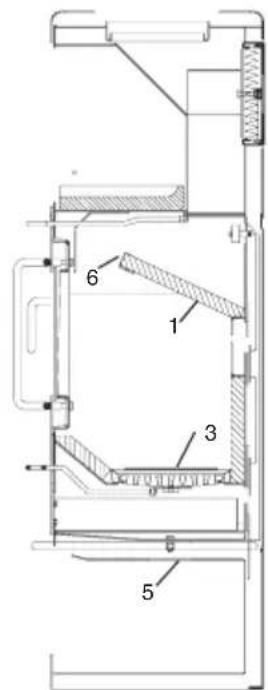
Verticalcross-section of the stoves (Vertical view B on page 3)
B1:ABC1
B2:ABC7H
B3:ABC14
B4:ABC17
- Smoke shelf. Fits on top of side panels and should always be pushed right back against the back panel.
- Baffle plate. Should always be fitted.
- Cover plate. Should always cover the grate.
- Ember/log guard. Place this inside the door.
- Heat guard. Should always be in place.
- Smoke shelf support. The front edge of the smoke shelf is protected by a U-shaped rail which should always be in place (only Skamolex shelves).
- In order to dismount the smoke shelf, it will first be necessary to dismount one side panel. Lift up the smoke shelf and pull the edge of the side panel which is furthest away from you towards the middle, until it freely passes smoke shelf support at front edge.
- In the ABC 1 model, the bottom panel must be removed first.
Connection to chimney
ABC 1, 7H, 14 and 17 have both rear and top smoke outlet that can be connected to an approved steel chimney on top or directly out at the rear to a brick chimney.
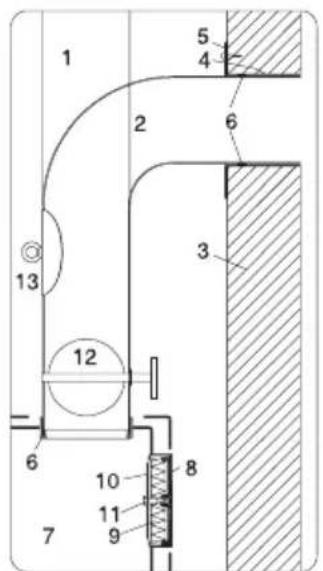
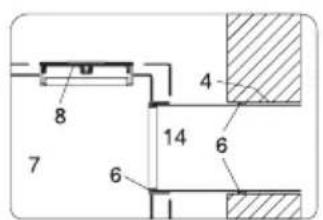
Vertical cross-section of smoke flue (Vertical view C on page 3)
C1: Top smoke outlet
C2: Rear smoke outlet
- Steel chimney.
- ABC flue gas elbow. Fits into smoke flue socket.
- Brick-built jamb of flue.
- Built-in pipe sleeve. Fits smoke flue.
- Wall rosette. Covers disruption to wall around pipe sleeve.
- Joint. Sealed with packing material.
- Smoke flues of the ABC stove.
- Cover for back outlet/hotplate for top outlet.
-
Isolation. 2.5 cm thickness.
-
Inside cover.
-
Fitting bolt.
- Smoke flue regulating damper.
- Soot door.
- Smoke pipe for rear outlet (remove cover and inner cover plate).
Cover plate
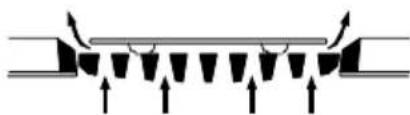
(Vertical view D on page 3)
Your ABC woodburning stove is supplied with a loose cover plate for the shaking grate. This is a 3mm thick iron plate. It is placed on top of the shaking grate and prevents the embers from falling into the ash pan. The cover plate is raised approx. 8mm above the grate, thus ensuring that the automatically controlled primary combustion air is distributed evenly at the base of the combustion chamber.
Chimney
The chimney is the "engine" of the stove and it is crucial for the functioning of the woodburning stove. The chimney draft provides a partial vacuum in the stove. This vacuum removes the smoke from the stove, sucks air through the dampers for the so-called glass pane rinse which keeps the glass free of soot, and sucks in air through both primary and secondary dampers for the combustion.
The chimney draft is created by the differences in temperature inside and outside the chimney. The higher the temperature within the chimney, the greater the draft. It is crucial, therefore, that the chimney is warmed up properly before closing the damper and limiting the combustion in the stove (a brick chimney takes longer to warm up than a steel chimney).
Even a good chimney can function badly if it is not used correctly. Similarly, a bad chimney may function well if used correctly.
As ABC stoves have a high efficiency, it is important to have the right chimney draft, 10-15 Pa.
Firing manual - wood
When you light up for the first time, you must do this very carefully as all materials must be heated gradually. The coating on the stove will be cured the first time the stove is lit, and this may create an odour. Ensure for adequate ventilation. The service handles are placed behind the extractor, under the lid.
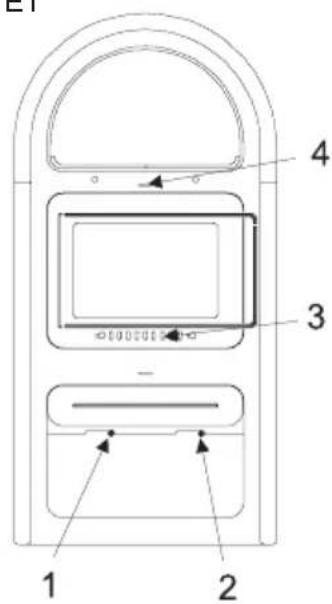
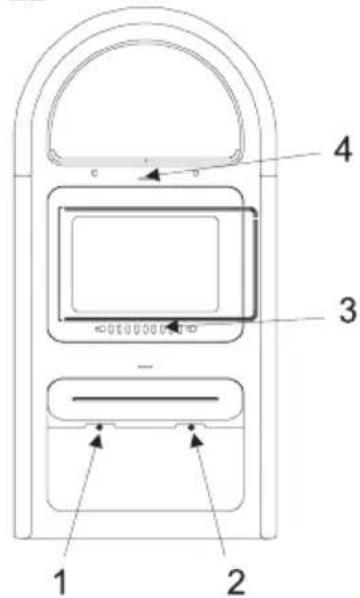
(Vertical view E on page 4)
E1. Firing
Push both regulating rods (1 and 2) at the base of the stove as far right as possible and fully open sliding damper in door. By-pass dampers (4) on ABC 7H and 17 should be pulled out fully. Place 2 ABC firelighters in the stove. On top of this, place an amount of split kindling wood equivalent to two logs (approx. 2kg ). Now light up. Keep door slightly open until there is no more condensation (approx. 5-10 minutes). Shut the door and when the kindling has become a solid mass of glowing embers, stoke up with small pieces of firewood and push the regulating rod (1) to the middle position.
Important! Do not open the ash pan lighting up and always keep it closed when the stove is in use, if not you can destroy the automatic control.
E2. Burning
When there are no more visible yellow flames, and a right Ember is there, you can fire again. A right Ember is when all the bottom is covered, and the glows are lighting in a ring around the shaking grate. Add 2-3 pieces of firewood, weighing approx. 1kg each. When firing the first time, the sliding damper (3) is also regulated to the middle position. By-pass dampers (4) on ABC 7H and 17 should be pushed in fully.
When in continuous use, no further adjusting is necessary. This is done automatically. However, the temperature can be adjusted up or down by the regulation of the left rod. Moving the rod to the left reduces burning and prolongs the burning time. Moving the rod to the right rises the temperature and reduces the burning time.
With both dampers (1 and 2) in the middle position, the highest efficiency is achieved. Postpone every new firing till the Ember is suitably low.
Firing with coal, briquettes and coke
When firing with coal or coke, a coal insert must be used. Place fuel in the insert (the briquettes on the wood embers). Close right regulating rod (secondary) completely and open temperature control fully, until the fuel is glowing well. Remember that the temperature control must be re-closed after this.
Firing in general
Quick or strong heat is obtained by burning many small pieces of wood.
Maximum amounts of fuel
The stove is intended for a maximum hourly burning of the following max. amounts of fuel:
- 2.4 kg wood
1.3 kg coal
1.6 kg briquettes or
0.9 kg coke
Should these limits be exceeded, the stove will no longer be covered by the factory guarantee, and it may be damaged due to excessive heat.
Prolonged burning time
Prolong the burning time by burning a few (at least 2) very large pieces of wood whilst at the same time closing the temperature controls down. To extend burning time, the sliding damper in the door should be regulated down to the half open position. Shutting the damper down further may result in the glass sooting up.
Insufficient firing
If the fireproof materials in the combustion chamber are blackened after a heating session, the stove is polluting, and the automatic air flow regulation system is not functioning properly. It will be necessary, therefore, to open the temperature control and, possibly, also to open the sliding damper in the door. Also, it may be necessary to burn more wood.
Cleaning the glass
We recommend wiping the glass after a heating session. This is best done using paper towel or steel wool. A cold pane is best cleaned using steel wool.

Types of fuel
We recommend using birch or beechwood, which has been split and stored for at least one year outdoors under cover. Wood stored indoors tends to become too dry and burn too quickly.
Briquettes give off a lot of heat. Certain types expand considerably, thus causing an uncontrollable combustion.
Coal burns at a high temperature and makes a lot of soot. Coal must be burned using the coal insert.
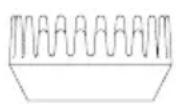
Coke burns at a high temperature and makes a lot of soot. Coke must be burned using the coal insert. Coke causes severe wear and tear to stove and combustion chamber and, consequently, reduces the life of the stove and chimney considerably.
The stove is DS-approved for the firing of wood only. No particle board, lacquered, painted or treated wood, plastics, or rubber may be used.
Cleaning
Any maintenance of the stove should only be carried out when it is cold. Daily maintenance is limited to vacuum cleaning the stove externally, using the soft brush attachment. You can also dust the stove using a dry, soft cloth or brush, but on a cold stove only.
Once a year, the stove should be thoroughly serviced. The combustion chamber should be cleared of ashes and soot. Door and fittings should be lubricated using a copper-based grease.
Before brushing clean, move the control rod to the far left in order to avoid soot and ash getting into the automatic controls.
The smoke shelf and baffle plate is removed from the stove before cleaning. At stoves with cooking section it is only necessary to remove the smoke shelf.
- First lift the smoke shelf (1) from the rail at the base (2). Next, lower it under the holders (3) and slide out at an angle.
- The baffle plate (4) is lifted from the holders (5), under the top plate and edged out
- If the baffle plate (6) has to be removed from stoves with cooking section, the bottom stones are removed from the cooking section. After this the screws (7) are dismounted. If necessary change the screws when remounting.
Ashes
The ash pan is best emptied by pulling a rubbish bag over the pan, tipping it and then carefully pulling it out of the bag. Ashes are disposed of via the domestic rubbish collection.
Please note that there may be embers in the ashes for up to 24 hours after the fire has gone out!!!
Insulation
The efficient, but porous insulation of the combustion chamber may, in time, become worn and damaged. Cracks in the insulation have no effect on the efficiency of the stove. The insulation should be replaced, however, when due to wear and tear it is reduced to less than half the original thickness.
Door/glass
Check that the air ducts in the frame of the lid are free from ash and soot. The lowest duct, especially, should be vacuum cleaned often.
If the glass is blackened with soot, it can easily be cleaned using steel wool. Check frequently to ensure that seals in the door and ash pan are intact and not brittle. Failing this, they should be replaced. Use original seals only.
Ceramic tiles
Certain types of ceramic tile will craze on the surface. To avoid dirt getting into the pores of the crazed surface, the tiles should only be cleaned when cold. Wipe using a dry, soft cloth without detergents.
Surface
The surface normally requires no treatment. Any damage to the coating may be remedied using a Senotherm spray.
Guarantee
The guarantee does not cover damage due to insufficient maintenance!
Blackened glass
The wood is too damp. Only use wood stored for at least 12 months under cover and with a moisture level not exceeding 18% RH.
Insufficient intake of secondary air for glass pane rinse. Open sliding damper in the door.
Smoke in the room when opening door
- By-pass damper or chimney damper can be closed. Open these.
- Missing chimney draft.
- Soot door leaking or dislodged. Replace or refit.
- Never open the door when there are still flames on the wood.
Uncontrollable combustion
Faulty seal in door or ash pan. Fit new seal.
Check that the automatic air flow regulation system works properly: Check for leaks. Briefly shut temperature control, secondary regulating rod and sliding damper. If this does not dampen the combustion, the automatic system may have a leak.
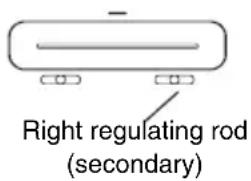
If there is an excessive chimney draft, it may be necessary to close the right regulating rod (secondary). Close all dampers when the stove is not in use.
If the steel plates in the combustion chamber develop scales or become deformed, this is due to excessive heat. Stop using the stove and contact manufacturer.
Contact the manufacturer if you have operational problems that you can not solve yourself.
B1:ABC1
B2: ABC 7H
B3:ABC14
B4:ABC17
www.hwamheatdesign.com