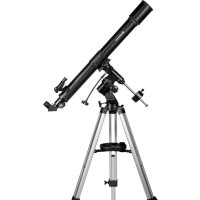
LYRA 70900 EQSKY - Telescope BRESSER - Free user manual and instructions
Find the device manual for free LYRA 70900 EQSKY BRESSER in PDF.


| Product type | Refractor telescope |
| Brand | Bresser |
| Model | LYRA 70900 EQSKY |
| Mount type | Equatorial mount (parallactic) with manual control cables |
| Objective diameter (aperture) | 70 mm |
| Focal length | 700 mm |
| Maximum magnification (with 3x Barlow lens) | 525x (with 4 mm eyepiece) |
| Supplied eyepieces | 20 mm and 4 mm (typical value, 3 eyepieces according to manual) |
| Barlow lens | 3x included |
| Finder | Red dot LED finder, adjustable |
| Focusing | Micrometer adjustment screw (Maksutov) or focus knob |
| Included accessories | Zenith mirror, smartphone holder, counterweight, accessory tray, control cables |
| Power supply | Battery for LED finder (to insert) |
| Tripod dimensions | Adjustable height, spreader, and steel legs |
| Approximate weight | Approximately 10 kg (with counterweight) |
| Care and cleaning | Clean the lenses with a soft, lint-free cloth (microfiber); for stubborn stains, slightly dampen with a glasses cleaning product. Protect from dust and moisture. |
| Safety | Never look directly at the sun or near it – risk of blindness. Keep children away from packaging. Do not point the device at the sun – risk of fire. |
| Spare parts and repairability | In case of defect, contact the dealer. Do not disassemble yourself. Consult www.bresser.de/warranty_terms for warranty. |
| Intended use | Astronomical and terrestrial observation (with optional erecting lens) |
| General information | 82-page manual available in multiple languages. Astronomy software and Moon map downloadable. |
Frequently Asked Questions - LYRA 70900 EQSKY BRESSER
User questions about LYRA 70900 EQSKY BRESSER
0 question about this device. Answer the ones you know or ask your own.
Ask a new question about this device
Download the instructions for your Telescope in PDF format for free! Find your manual LYRA 70900 EQSKY - BRESSER and take your electronic device back in hand. On this page are published all the documents necessary for the use of your device. LYRA 70900 EQSKY by BRESSER.
USER MANUAL LYRA 70900 EQSKY BRESSER
Never attempt observing the sun with this telescope! Especially keep it in mind while the telescope is used by children! Observing the sun - even for a very short time - will cause blindness! Packing material (plastic bags, rubber bands etc.) has to be kept out of reach of children!
(FR) AVERTISSEMENT!
HnKOrda He CmOTpHTe Ha CoINHe B TeJIeCKOn HIn HeBOOpyKeHHbIM B3rIaOM! 3To MOxET Bbl3BaTb Heo6paTHMbIe IOBpeXdEHHa 3peHHa N pINBeCTN K CJENOTE! YnaKOBOUHbI MaTePHaIbI cJeIyEt DePxAbTB MeCTax, HeIOCTynHbIX dnn dTei.
(DE) Gebrauchsanleitung 6
(GB) Instruction Manual 11
(FR) Mode d'emploi 16
(IT) Istruzioni per l'uso 22
(ES) Instrucciones de uso 28
(PT) Instruções de utilização 33
(NL) Gebruiksaanwijzing 38
(FI) Kayttöohje 43
(NO)Instruksjonshandbok 48
(DK) Instruktionsbog 53
(GR) O8nyiecs xphons 58
(PL)Instrukcja Obstugi 64
(CZ) Návod k použiti 69
(RU)PykoBoDCTBO noIb3OBaTeIa 74
Downloads:
- Astronomy software
- Moon map
- Instruction Manual
Durchmesser: 3.476 km
About this Instruction Manual
Please read the safety instructions in this manual carefully. To avoid damage to the unit and the risk of injury, only use this product as described in the manual.
Keep the instruction manual handy so that you can easily look up information on all the functions.

DANGER!
You will find this symbol in front of every section of text which deals with the risk of severe injury or even death in the event of improper use.

ATTENTION!
You will find this symbol in front of every section of text which deals with the risk of damage to property or the environment.
Intended Use
This product is intended only for private use.
It was developed for the magnified display of things in nature.
General Warning

RISK OF BLINDNESS!
Never use this device to look directly at the sun or in the direct proximity of the sun. There is a RISK OF BLINDNESS!

RISK OF CHOKING!
Children should only use the device under adult supervision. Keep packaging material (plastic bags, rubber bands, etc.) out of the reach of children! There is a RISK OF CHOKING!

FIRE RISK!
Do not place the device - in particular the lenses - in direct sunlight. The concentration of light could cause fire.

ATTENTION!
Do not disassemble the device. In the event of a defect, please contact your dealer. He will contact the Service Centre and can send the device in to be repaired, if necessary.
Do not expose the device to high temperatures.

Privacy PROTECTION!
This device is intended only for private use. Please heed the privacy of other people. Do not use the device to look into apartments, for example.
Accessories may vary depending on the model.
All parts (Fig. 1-3)
Telescope tube
LED Viewfinder scope
Adjusting screws
4 Barrel opening
Objective
Eyepiece connection
Focus wheel / Focus knob (Maksutov)
8 Tube rings
9 Mount
10 Accessory tray
1 Adjusting-screws (tripod)
17 Fastening screw for accessory tray (middle)
Tripod legs
Flexible shaft for declination adjustment
Flexible shaft for right ascension adjustment
16 Tripod spider
Weight + pole
Eyepieces
Diagonal mirror
20 Barlow lens
Holder (accessory tray)
Smartphone holder

NOTE!
The right ascension axis (green line, Fig. 16) is also called the axis of sidereal time on the meridian. The declination axis (blue line, Fig. 16) is also called the elevation axis.
Parts (Fig. 16): The Mount
A Main tube clamp
B Focus wheel
Scale of the declination-axis
Fixing screw of the declination-axis
E Fine-adjustment of the declination-axis
F Scale for setting degrees of latitude
G Latitude adjustment setting and adjusting screw
H Counterweight with fixing screw
Right ascension axis setting screw
J Right ascension axis scale
K Right ascension axis fine adjustment
Fixing screw for horizontal adjustment
M Holder for optional R.A. motor
N Clutch for R.A. motor
Transmission gear for R.A. motor
Part I - Construction
1. General/Location:
These instructions detail the assembly and use of refracting and reflecting telescopes as well as Maksutovs with equatorial mountings (also called German mountings). Parts of these instructions hence contain differing instructions for the different telescope models.
Before you begin construction, you must choose a suitable location for your telescope. It will help you, if you build this appliance in a place, where you have a clear view of the skies, a stable footing and sufficient space around you.
Remove all the parts from the packaging first. Check, using the diagram, whether all the parts are there.

IMPORTANT!
Only do the screws up finger tight and avoid over tightening them.
2. Tripod
The tripod legs are pre-installed and already connected to the tripod head (Fig. 5, X) and tripod spider (Fig. 1, 16). Remove the tripod from it's packaging and place it upright with the feet at the base. Take two of the legs and carefully pull them apart until they are in the fully open position. The entire weight of the tripod rests on one leg during this procedure. Then set the tripod upright again.
Now extend each individual tripod leg to the desired length (see Fig. 4) and then tighten the clamping screw on each (Fig. 4, 11) (a total of 3) until they are all hand tight. Do not overtighten them. The clamping screws serve to set the tripod leg interior segments to the desired height.

NOTE!
The right ascension axis (green line, Fig. 16) is also called the axis of sidereal time on the meridian. The declination axis (blue line, Fig. 16) is also called the elevation axis.
3. Mounting
Next the mounting (Fig. 1, 9) is fastened to the tripod head (Fig. 5, X). To do so insert the mounting from above in the tripod head and turn the knurled screw hand tight from below.
First prepare the mount (Fig. 1, 9), put the weight on the weight shaft pole (Fig. 7, X) and then screw it securely into the mount from below.
The tube ring (Fig. 1+3, 8) should now be placed on the mount and fixed with the screw (Fig. 8, X).
Maksutov optics have no tube-clamp. The rail is placed directly on the mount.
4. Accessory tray:
First unscrew the fastening screw for the accessory tray (12). Now insert the accessory tray (10) as seen in Fig. 6. Lastly screw the fastening screw (12) in the middle tightly, to secure the accessory tray (10).
5. Tube:
5.1 To mount the telescope tube (Fig. 1, 1) you undo the screw on the tube ring (Fig. 9, X) and open up the ring.
5.2 Now you place the tube in the centre of ring and close the ring up. Now secure the mounting by tightening the screw.
Note: The main tube clamp may have 2 screws depending on model (Fig. 9b). Mounting the main tube is in principle as given here.
6. Inserting the eyepiece
6.1. On refracting telescopes
Two eyepieces (Fig. 2, 18) and a star diagonal prism (Fig. 2, 19) are supplied as standard with this telescope.
With the eyepieces, you can decide which magnification you want for your telescope.
Before you insert the eyepiece and the star diagonal prism, you must remove the dust-protection-cap from the eyepiece connection tube (Fig. 1, 6).
Loosen the screw (Fig. 12, X) on the eyepiece connection tube and insert the star diagonal prism. Retighten the screw (Fig. 12, X) on the eyepiece connection tube.
Then open and close the clamping screw (Fig. 13a, X) to fasten the 20mm eyepiece in the zenith mirror in the same way.
Make sure that the eyepiece is pointing vertically upwards. Otherwise loosen the screw (Fig. 12, X) on the eyepiece connection tube and rotate the star diagonal prism into the vertical position.
6.2. On reflecting telescopes
Please loosen the clamping screw on the eyepiece supports (Fig. 1, 6). Remove the eyepiece supplied (Fig. 2,18) with the 20mm maximum focal length and insert it directly in the eyepiece supports. Hand tighten the clamping screws (Fig. 3b, X). Remove the dust cap from the main tube end.
RISK OF BLINDNESS!
Never use this device to look directly at the sun or in the direct proximity of the sun. There is a RISK OF BLINDNESS!
7. Assembling the LED Viewfinder scope
Note: The LED Viewfinder has a battery safeguarded against discharge with plastic foil when shipped. This must be removed before first use (Fig.1d).
Viewfinder scope assembly
LED Viewfinder scope with Quick Insert
The LED Viewfinder scope (Fig. 1a) and mounting constitute a single unit. Slide the foot of the LED Viewfinder scope completely into the appropriate base on the telescope main tube (Fig. 10, X). The Viewfinder scope mounting will snap in place. Important. Make sure the LED Viewfinder scope lens points towards the main tube end (Fig. 1, 4).
8. Aligning the Viewfinder scope
The LED Viewfinder scope must be adjusted before use. This means that the LED Viewfinder scope and the telescope tube must be aligned in parallel.
Insert the eyepiece with the greatest focal length in the zenith mirror (Fig. 13a, refracting telescopes only) or directly in the eyepiece supports (Fig. 13b, reflecting telescopes only). Point the telescope at a significant object approximately 300 meters away (e.g. house gable, church tower top, etc.) and adjust until it appears in the centre of the field of vision (Fig. 15 A).
Then turn the LED Viewfinder scope (Fig. 1, 2) on using the On/Off switch (Fig. 1b, Z). Select setting 2^ in daylight, setting 1^ for nighttime.
Look through the LED Viewfinder scope and align it by turning the horizontal (Fig. 1b, X) and vertical (Fig. 1b, Y) adjustment screws until you see the red dot in the centre of the image (Fig. 15, C). Viewfinder scope and telescope are now adjusted to one another.
9. Protection-caps:
In order to protect the inside of your telescope from dust and filth, the tube opening is protected by a dust-protection-cap.
For observation remove the cap from the opening.
10. Flexible shafts
To ease precise adjustment of the declination and right ascension axes flexible shafts are installed in the holding devices of both axes provided for the purpose (Fig. 14, X).
The long flexible shaft is mounted parallel to the telescope barrel (Fig. 1, 14). It is secured in place with a clamping screw in the axis notch provided.
The short flexible shaft is 1, 15) is mounted laterally. It too is secured in place with a clamping screw in the axis notch provided.
Your telescope is now ready for use.
Part II - Handling
1. Telescope mount:
The following points of information are important for positioning and tracking accuracy of your telescope during night time observation.
Your telescope has a so called equatorial mount. The main attribute of this mount is that it has two perpendicular axes which rotate to one another. (Fig 16, a+b).
The so-called right ascension axis (or RA or axis of sidereal time on the meridian) (Fig. 16, b) must be aligned parallel to the earth's polar axis (Fig. 26, c). The coordinates are found in e.g. celestial charts and programs.
Manually operate the right ascension axis via the flexible shaft (Fig. 1, 15) to constantly compensate for the earth's rotation by turning it in the opposite direction.
As this axis must thus constantly be moved in a controlled manner using the flexible shaft an electric tracking accessory would be sensible (the necessary equipment for this is already installed - sh. parts - assembly)
2. Setup:
A dark place is essential for observations because light of all kinds (e.g. street lamps) disturb the visible details of the sky. If you leave a bright room at night, your eyes need approximately 20 minutes to reach full night adaptation. After this time, your observations can be started.
Don't observe from enclosed areas and put your telescope in location, with the accessories, 30 mins before beginning observation, in order to guarantee a temperature balance.
You should also make sure that the telescope is placed on a stable and even ground.
3. Balance:
To avoid demages from sensitive parts of the mount, the two axes must now be balanced before observation.
I.e. the declination axis and the horary axis are correct, to make working of the telescope easy and precise.
The horary axis is balanced by loosening the fixing screws (Fig. 16 I) and tilting the weight pole into a horizontal position. Now adjust the counterweight (Fig. 16 H) on the pole, until the tube and the weight remain in this horizontal position. Retighten the fixing screw (Fig. 16 I) on the horary axis.
The declination axis is balanced by loosening the fixing screw (Fig. 16 D) on the declination axis. Then loosen the screws on the tube mounting (Fig. 16 A) and move the tube as long as it remains in a horizontal position. Don't forget to retighten the fixing screws again.
4. Adjustment:
To set the latitude axis (Fig. 16, F) (polar height) loosen the fixing screw (Fig. 18, X) and adjust the polar height using the adjusting screw (Fig. 18, Y).
The latitude scale has to be adjusted according the local latitude (e.g. Munich 48^ Hamburg 53^ )
Don't forget to tighten the fixing screw afterwards. Now set the Declination axis (Fig. 16 C) to 90^ by loosening and retightening the screw (Fig. 16 D). The telescope tube is now pointing to the celestial pole.

NOTE!
The latitude of your observation site can be found in maps or in the internet. A good source of information is www.heavens-above.com. After checking "anonymous user" > "select" you may choose your land and city.
5. Polar alignment
Align the telescope with the barrel opening at the front to north. To do this loosen the fastening screw (Fig. 19). You can then turn the barrel until it faces exactly northwards. If necessary, use a compass. Then tighten the fastening back up again.
Examine whether your telescope is mounted as shown in Fig. 28. The counterweight (Fig. 28 X) points to the floor and makes together with the tube a vertical axis.
In this position Polaris is visible in the viewfinder; it is the brightest star in the polar region (Fig. 27). If it is also seen in the field of view of the 20mm eyepiece, polar alignment is reached.
This alignment requires little patience but results in accurate pointing.
The declination scale should now be set to "9" (90^) . After doing this, you can use the dec. and R.A. scale to find celestial objects (also see part II - 13).
Once adjusted as above you can utilise the celestial object search facility using the scales (see also 3.1. Feasible Observation Objects).
6. Viewfinder scope
Your telescope is now roughly aligned and set.
To arrive at a comfortable observation position carefully undo the main tube mounting screws (Fig. 9, X) until you can rotate the telescope main tube. Move eyepiece and LED Viewfinder scope until the position is comfortable for you.
Fine adjustment is done with the aid of the Viewfinder scope. Look through the LED Viewfinder and try to align it with the polar star (Fig. 27) with the help of the red dot (Fig. 15). In precisely adjusting your telescope you will find the shaft (Fig. 16, K) of the hour axis (Fig. 16, b) and that (Fig. 16, E) of the declination axis (Fig. 16, a) helpful.
7. Observation
Once you have set the polar star in your LED Viewfinder scope, you will be able to view it through your telescope eyepiece.
If necessary, you can with help of the flexible handles align the star more exactly, just as you can adjust the definition by using the focussing wheel (7).
Furthermore, you can now, by changing the eyepiece, increase the magnification. Note that the magnification of the stars can hardly be seen.

NOTE!
Eyepieces enlarge the (not directly visible) picture of the telescope's prime focus. The less the eyepiece's focal lengths is, the stronger is the magnification. So various eyepieces are needed to reach different magnifications. Begin every observation with a low magnification (20mm eyepiece).
8. Find a star:
Initially it will be difficult for you to find your bearings in the firmament, since the stars and the constellations are always moving and according to season, date and time their position in the heavens will change. The pole star is the exception. It is a fixed star and the starting point for all star maps.
At the beginning, you should look at some well known constellations and star groups order that are visible the whole year over. The position of the heavenly bodies is however dependent on date and time.
If you have aligned your telescope accurately on one of these stars, you will find that it has vanished your visual field after a few minutes. To even out this effect, you must turn the flexible handle (Fig. 16 K) the horary axis and your telescope will follow the trajectory of this star.
9. Part circles:
Stars and other heavenly bodies are positioned in the heavens by coordinates. The place of a star is fixed in the universe by the rectascension (horary) and by the declination.
Declintion (Fig. 16 C) is the spacing of a heavenly body from the Heaven's equator, in angle degrees. To the north of the equator, the degree number is positive. If the star is to the south of the equator, the degree number is negative.
Rectascension (Fig. 16 M) a measured distance of a star from the heavens equator in sideral (star) time. The vernal equinox is the point where the ecliptic meets the equator (Fig. 26 e) at the beginning of spring. The value of the daily heavenly revolutions is counted in the tempo of a 24 hour clock.
For more accurate information look at your star maps and corresponding compartment-literature (special-accessories).
10. Accessories
Your telescope is supplied with a number of accessories as standard (Fig. 2). Depending on model this may include the following.
10.1.Eyepieces
Change eyepieces to change your telescope's magnification.
Formula for calculating magnification:
Focal length of the telescope : focal length of the eyepiece = magnification
Beispiele:
| Focal length telescope | Focal length eyepiece | Magnification | Magnification with 3x Barlow lens |
| 700 mm 20 m | m 35X 105X | ||
| 700 mm 4 mm | 175X525X |
10.2. Zenith mirror (refraction telescope only)
The zenith mirror reverses (Fig. 2,19) reverses the image (mirror image) and is therefore used only for celestial observation.
10.3.Barlow lens
A Barlow increases magnification three times over.
10.3.1 Assembling and using refracting telescopes
If you use a refracting telescope the Barlow lens should only be inserted in the zenith mirror (Fig. 13a, X). Remove the eyepiece from the zenith mirror and replace it with the Barlow lens. Then first insert the eyepiece with the greatest focal length and then hand tighten the clamping screw to affix it in place (Fig. 24).
10.3.2 Assembling and using reflecting telescopes/Maksutovs If you use a reflecting telescope please undo the clamping screw on the eyepiece supports (Fig. 13b, X) and remove the eyepiece from those supports. Then insert the Barlow lens straight in the supports and hand tighten the clamping screw. Finally first insert the eyepiece with the greatest focal length in the Barlow lens and then fasten it in place with the clamping screw (Fig. 24).
10.4 Smartphone holder
Insert the eyepiece into the smartphone holder and tighten the screw (Fig. 25, X) to the bracket firmly. Then set the smartphone holder with the eyepiece into the eyepiece connection (6) or the diagonal mirror (19) (refractor telescopes) and tighten the clamping screws (Fig. 25, Y) by hand firmly. Now start your smartphone camera app and press your smartphone on the suction cups. Make sure that it is properly secured. The camera should rest just above the eyepiece. Place the smartphone exactly over the eyepiece, so that the image is exactly centered on your display. It may be necessary to use the zoom function to fill out the whole screen of your smartphone. The suction cups must be dry, clean and free from all kinds of dust and dirt. We assume no responsibility for dropped and broken smartphones due to incorrect handling.
11. Dismantling:
After a hopefully interesting and successful observation, it is recommended that you store the entire telescope in a dry, well aired area. On some telescopes the tripod and mount can easily be separated. The adjustments to the mount will remain intact. Don't forget to put the dust-protection-caps onto the tube opening and onto the eyepiece connection. Also, you should stow all the eyepieces and optical accessories into their corresponding receptacles.

NOTES on cleaning
Clean the lenses (eyepiece and/or lens) with a soft and lint-free cloth only (e.g. microfibre). Do not apply excess pressure to the cloth so as to avoid scratching the lenses.
To remove more stubborn dirt, moisten the cleaning cloth with an eyeglass-cleaning solution and wipe the lenses gently.
Protect the device from dust and moisture! After use - in particular in situations of high humidity - let the device acclimate for a short period of time, so that the residual moisture can dissipate.
Part III - Appendix
1. Possible observation targets
In the following, we like to present to you a choice of very interesting and easy-to-find celestial objects. On the depending pictures at the end of the manual you will see how they will appear in the eyepiece of your telescope:
The moon (Fig. 31)
The moon is the only natural satellite of the earth.
Diameter: 3,476 km
Distance: 384,000 km (average)
The moon is well-known since thousands of years. He is the second-brightest celestial object after the sun. Because the moon circles around the earth, he changes periodically its inclination to the sun; therefore we see changing phases. The time for one complete lunation is 29.5 days (709 hours).
Constellation Orion: The great Orion nebula / M 42 (Fig. 32)
Right Ascension: 05h 33' (hours : minutes)
Declination: -05^25' (Degrees : minutes)
Though it is 1,600 light years away, the Orion nebula (M 42) is the brightest nebula object at the sky - visible even with naked eyes and a worthwhile object for telescopes of all kinds and sizes. It consists of a gigantic cloud of hydrogen gas with a diameter of hundreds of light years, taking a field on the sky of 10^ .
Constellation Lyra: The Ring Nebula / M 57 (Fig. 33)
Right Ascension: 18h 52
Declination: +32^58'
Distance: 4,100 light years
The famous Ring Nebula is often called the prototype of planetary nebulae; he belongs to the northern hemisphere summer sky's pieces of splendour. Recent investigations have shown that he is a ring of light-emitting matter that surrounds its central star (only visible in bigger telescopes). If one could look onto its top, he would see a structure like the Dumbbell Nebular / M 27
Constellation Vulpecula (little fox):
The Dumbbell Nebula / M 27 (Fig. 34)
Right Ascension: 19h 59'
Declination: +22^43'
Distance: 1,250 light years
The Dumbbell Nebula / M 27 was the first planetary nebula ever found. On July 12th, 1764, Charles Messier discovered this new and fascinating class of objects. We can see it directly from its equatorial pane. If it could be viewed from top, we would appear like the Ring Nebula / M 57. This Object can even be viewed at average weather conditions at low magnifications.
2. Troubleshooting:
Mistakes: Help:
No picture Remove dust protection cap and sunbathe-shield from the objective opening.
Blurred picture Adjust focus using focus ring
Focus knob The Maksutov design may require more than 20 revolutions at the focusing knob to obtain a sharp image.
No focus possible Wait for temperature to balance out
Bad picture Never observe through a glass surface
Viewing object visible Adjust finder (See Part I: in the finder, but not 8. Construction) through the telescope
Heaviness in the flexible Telescope and counter handles on the axis weight not balanced over the shaft Despite using star The star diagonal prism diagonal prism should be vertical in the picture is the eyepiece connection "crooked"

DISPOSAL
Dispose of the packaging materials properly, according to their type (paper, cardboard, etc). Contact your local waste disposal service or environmental authority for information on the proper disposal.
Please take the current legal regulations into account when disposing of your device. You can get more information on the proper disposal from your local waste disposal service or environmental authority.
Downloads:
- Astronomy software
- Moon map
- Instruction Manual
The regular guarantee period is 2 years and begins on the day of purchase. To benefit from an extended voluntary guarantee period as stated on the gift box, registration on our website is required.
You can consult the full guarantee terms as well as information on extending the guarantee period and details of our services at www.bresser.de/warranty_terms.
Informations generales
LUNE (illustration 31)
Advertencias de character general

jExiste PELIGRO DE CEGUERA!
BESCHERMING van privacy!
10.4 Smartphone-holder
Del I - Sammensening
1. Generelt/plassering:
Adskil违法犯罪. Adskil isn't a good idea to tell him the truth of the crime. He's going to tell him that he's going to be charged for it.
10.4 Smartphone-faste
5. Nolik Euoypuaian:
Euoypaiae to nAeknio e to atoEvtoniT npooa otnv KATEBuvon tou bopp. Pocto Toe Eepovete Tov koxia aaoaianc (anEik.19).Tupa unopoeite vao tpeyete sov evtoniatn taekoniou Euuypapcavctac oipibpcoc to bpp. Napte evexaeovacn Bonieia pia cnuEicac. Katoniv apiyetye naI Tov koxia aoaianc.
EeYTe ATo TnAekonio aoc eivao tOAnC paivato anTnV anEIK.28
oTnevo.To aTlBapoo (aneik.28,X) 0eixveipoc to Ebaoc kai
oxmaicEi eoi aI Me To EvToTmIoT nEvav KcBeto Eaovva.
^ autnTn theonBleienetdeiaoutoaONeutikou opavou Tnv noikn TepioxynrTOV noikocatepacivaoTOwTeivotepoavtkiejevo aunTnV Tnpiox.(27)
Autoc npentie toe va aivetai kai oTo Kevtpo Tou otIKou nEoiu Tou pioooauiou oakou (f=20 xI.). H noAki eUbupaoiion exei eTtueuxBe. Auto To aniaipo anaierte liyo unopovn, oAc vtaueiBd oWcKaTtov avCnntno mew oupvavov ouvtayevw v TduvaTOTnTa iac KaNc tonOeTnncs.
^ autn Tnv nolki eBuypauon 0 npertei va piokovtoi oxpiko Kukoi (Kiluacec) Tou Oeov anoklanoc (atEIK.29) 0709" (= 90) Kai Tou aov ouvtayevnc (aneik.30) 070( = 0 apec). Evexoeewc npertie va npiotepeske Taic duo kuiakce, tpooektiKo otic avloeyc tue (euuypumuevec kahe opa ata bEn).
Anokian: +32:58 (mupe; eT
AnoTaan: 4.100 Etn foTos
To diaanpo daKTuaioiEicveeawma M57 oTov aoteipiao Aieepewpeitaouxwocxpaktnpiatiko deiyuvaevocnavntkouveeAiaotc? auto unayetai ota apiotoupynataou Tpuov ouavou Tou Bopeiou Huaapioiu. NeotepepeuevceouvdeEei, otipokitea kata naoi thavotna yia eva doktuaio (doKTuaioei) ano wteivox foTaobaoauoo uyn, noonio nepibaaTe to kevtpiKO aotpo (movo meyauutepa tnaekonia opatn) kai oxia ia ophiikn ealeiosiDc buplav. Av npatnpouoe kaveic to doktuaioeDEC veeAomega anto to naivo enineo, oxaioae auto me to vefeawma NTouptle M27. 2' auto to avtkeiuevo bienoue akpiwcTovnoTOUveAawatoc.
AotepiooC AaetouδαkI / M27 (aTειK. 34)
ΣuvTeayμevn: 19:59.6 (ωεε; λεπτα)
Anokian: +22:43
poipcs: 1
Anoataa: 1.250 etn foTOc
To vepawma Ntoumu M27 nveeawma Xavte a 0AaienouakniTav Tnpo TnVNTKO vepawma, To onio eixe avkaauptei.
TIC 12. Iouiou 1764 oaxkaiupe O Charles Messier autn Tnv eox kai EvTTWIOAKI KATNYOPIA AVTEJEVEWv. BLEIOUe auTO AVTKEJEUVOxov akpioc anto EITIEBO TO iAnepiou TO Av OEAETKEIAEKAEV TO vepawma Ntoumu ano evav TO naowou TO, Oa EINEKUVEi TI Anov TO axmu Evoc BAKTUIAO KOn EEXI TNV, TIV ONIOYwipoue anTO BAKTUIOEIDc VEPAWMA M57.
Auto to avtkiejevo mnpoei kaveic va to dei kaia kai eptpiec kaipikcs auovnkec me ikpn neyevuon.
2. I 王 v
Aa0c:BoH8εiα:
Kaia eikova? aTOpakpuveTo KaTAKI npoataiaac akovnAnTo otOio TOAVTKIEVEVIKOU fakoU.
Oaun Eikov? npoBaivete oe puogion Eukpiveiaoc 0to daKTUIOEATiAc
Koumi eiaocn H doun twv naeokoniaw Maksutov (tneakomia Maksutov) mnpei va aonitie naov ano 20 nepiatofoec tou koumiou eiaocns yia tn vntireuEukpivouc Eikovac.
Pueian eukpiveac dev avoavete Tnv Ejawon evat duvart? 3epokpaiaoc (np. 30 aeTTa)
Kakéikov? mny npatnpeite nore diqou evocuaonivaia
AvtkeiEvopatnpano stpuOthionokotikou oKOTIKOpyavo,aaOxipoyavou (AETe TmIα1-8.) opato tNaeKoTIO?
AuaokolokivtniynlataonTou Eiaoponeite Tnaekomio αGovαμawtwvαtpaKTw? Kα αvtβapo
Pap to ZeviKATOPTo o To pakop npoo00auiou npentie EIOVAOZEVIGKOATNTPO? VvEUVuypauuizetai KαβεTWC

ANOPPIH
Expiote Ta uikα ouakeuaia c μetαEu Touc yia tn diαθean. Npnpoepicys iaytnv npaBentouevn diαθean npexovtai anTnv TOnkui nppeia diαθeanc atoppmuataw n Tny nppeia NeipβaAovtoc.
PooexeK KAta TnV aOppiyn Tnc ouakeunc TNC iXauoaevovikecdiataegic, Nnpofoepies Yia Tn Oawtn diAeon npExovTai AIO TIC KOIVOTIEC utnpaeicdiAeocntopppmuatow n Tnv Ytnpeia PepiBaalovtoc.
Downloads:
O pykoBODCTBE noJIb3OBaTeIN
BHHMaTeJbHo npOHTHe daHHoe pyKOBoDCTBO noJIb3ObaTeJIa.
HenpabInbHoe HcONbIbOBAHeHn IOnCBNYKBaHBe nPb6opa MoKET npBecTn KtpaMm HnIO NBpeXKeHIO camoro np6opa.
DejHKe TaHHoe pyKOBoDCTBO nO pKOB B KaeeCTBe cnpaBoUHHa Ka npaBnIaM 3KnpyaTuHn Mepa npeOtoOpxHocTH.

ONACHO!
3TOT CMBON HCNOLb3yETCB DAHOM PYKOBODCTBE Dn PBNBLECHN BHNMAHNA K DEIcTBNA, KOTOpBle MORYT NOBLech 3a COsO BceB3Hbe TpaBMbl C Heo6paTHMbIM NocNEeCTBnAM NH NteTanBhlN CXOJ.

OCTOPOHHO!
OTCNMBONHCNOLb3yETCBDAHHOMpyKOBOCTBe
IINPnBNEUeHNNBHMMAHNIKDECTBNIM,KOTOpBIE
MOrYTnpNBecTNKNOBpeXdEHNm pnpobpaNN
OKpyKaUoSe Cpebl.
PpeHa3NaueHne
3TOT np6op npedna3HaueH nlaactHO nCnOlb30BaHn.
3TOT np6op cnocoben ybeuHbAtb n3o6paJxne npipOdbix 06bekTOB.
06uee npedynpeKdHne

PNC CNEOTE!
HnKOrDa He nCnOlb3ayIte 3OT npN6Op IaIry3yueHnIe coINHa. 3To MoKeT pInBeCTN K cepB3bIM NOBpeJdeHNM CETaTHn rna3a N daKe CJIENOTE!

PNCYdUbI
PazpeaIeTETMnB0BAtc3TIM npHbOpOMToNbKoNo pIpcMOTpOM Bzocnblx.YankoobHbte MaTePnAbblcNeyet DepKaTbMeCTA,HeDCTOYNhXDnIeTeJ.

BO3MOHEH nokap!
He octablanthe npnbop nnnnH3bI NOD npmbIM CONHeuHbIM CBetOM. CphiocypobAHhble nyuMOT npBecTN K noKapy.

OCTOPOHHO!
Hepa3npaIte np6op camoTcTEnbHO. B cnuyae o6hApyKeHH DepeKToB 06paTHeCb K BaUeMy NoCTabUHky. CBr3aBUnCbC cBepNCbHM CEHTPOM pON3BtTeNla, NoCTabUHK MoKET NO Heo6XdoHMOCT HapRaBHT BaW np6Op HaPEMOHT.
He donyckaiahe harpebaHna yctpoiCTBa do BbICOKo TMnepaTpybl.

3AUHTA cactHOHJH3HNI
OHTHNECKNe pnp60pI npedHa3HaeHb I nA qactHO HcNlOB3oBAHn. He cNIOB3yTe Bau TeneckOn dna HabIOHDHeH 3a DpyrMn NIOBm.
KOMJIeKTAuRA MOXET N3MeHrTbC8 B 3aBHCIMOCTN OT MOJENH.
Bce qactn (pnc. 1-3)
Tpy6a teneckona
OnTnueckn NCKaTeNb nH NCKaTeNb c KpaCHO TQKO
3IOCTNPOBOUHbIE BnHTbI NCKaTeJI
OTBepCtne Tpy6bl
5 JInH3a 06BeKTHBa
ΦOKyCnPoBOuHbY3eN
7 Pyukn oKycnpOBKn / Pyuka oKycnpOBKn (TeNEcKoN MaKcyToba)
3aJHmTpy6bI
MOHTINPOBKA
10 NotOK dnn akceccyapOB
ΦHKcATOp BBICOTb HOKeTpeHOrn
BnHT KpennneHnIOTOK nAakceccyapOB (ueHTpaBbH)
HokkntpeHorn
Puyka TOHKNX DINKHeHH IO OCN CKNHOHeHH
15 Puyka ToHkNx DnBKeHn no OcN nprrMO rOBCXoKdHn
6 Pacnopka TpeHOTn
17 IpoTnBOBc n CTaJIbHOI CTePKeHb
18 Okylnpa
Dnaorohalbna npn3Ma
20ПинзаБарноy
1 Depehtenb (ItoK dnn akceccyapOB)
1 DepeKaTeIb cMaprTfoHa

BaxHo:
Ocb npMOrO BOCOXJDEHn(3eHnA LHHn. pnc. 16 TaKe HeBaIOT OcBIO 3Be3dHO BpEmHeM MEpDnaHa
OcbcknoheHn (CNHn nnHn, pnc. 16) -ocbnoDbeMa.
YacTH (pHc. 16): MoHTIPOBka
A 3aKIM Tpy6bl
B PyuKn OOKyCnPOBKn
C Lkana och CKIOHEHH
D ΦHKCaTOp OCh CKNoHeHn
E Pyka ynpabHeHHr TOHKIMn DnKHeHnMn NO OCN CKIOHeHH
F Kanaa wipot
G Bonbl HaKIOHa NoIaRHOH OCH NO IINPOTe MeCTa Ha6IOeHH
H IpOTnBOBEC CO CTONOPHBIM BNHTOM
ΦHKCaTOP OCN pRMOBOBCXOXHENH
J kana ocn npMoro BOCXOXeHHA
K PyuKa ynpaBHeHr ToHKmN DnKHeHrMaM N OcN npRMOBOC-XOJDeHr
L ΦικcaTOp no a3HMyTy
M DepeKaTeIb 3JIeKTpOpiPnB0da npMOrO BOCXoKdEHH
N CuenneHHe 3nEeKtpnpnbOda npMOro BOCXQKeHHA
O Npepa a 3neKtpnpB0da npMOro BOCXKeHn
Yactb 1-C6opka
1.BBeHeHne/Pa3MeueHne
JaHHeO pyKOoDCTBO NOpO6HO ONcBbAet c6Opky n npMeHeHne TEeCKONOB-pePakTOPO, TELeCKONOB-pePNeKToPOB n TELeCKONOB MaKcyTOba C kBAtOPaHbHbIMMOHTPOBkAMn (TakKe H3BeCtHBIMn IOd HABaHmE HeMeKINX MOHTPOBOK). Pa3DeIby pyKOoDCTBa CoepKat pa3HHhble yka3AnHn Dn PA3HbX MoDEnei TENECKONOB.
IpeKHe Yem Hauatb C6opky Teneckona, HAO HAIITN IINr Hrero NOxODAJIeMecTO. LyuHs BCERO CObnpaTb TeneCKON B TAKOM MecTe, rDeXopo0o BnHO He6o, eCTb POBHaH HEnoDbNKHa NIOuaKa n DOCTAToCHo MecTa BOKpyr.
Chauana doctahte n3 ynakobkn BCE deTaan. Y6eintecb, TTO BCE ha Mecte.

BaHHo:
3aKpyuBaIte BnHTbI rAknOCTOpOXH0, YTO6bl He copBaIbpe3b6y.
2. Tpehora
HoxknpTeHOr npedBapntelbHo yctaHOBeHbI coeHNHeBc BepxHe aactbIO TpeHOrn (pnc.5,X) n paacnopKo (pnc.1,16).BbHbTe TpeHory m yapanokKn n noCTabte ee nprMo.Pa3DbHbTe Dbe HOKKn TpeHOrn do KOHa. Pn tOm BEc TpeHOrn pnxOAnTcRa Ha oDHy HOKky. 3aTeM CHOba yctaHOBtE TpeHory npmo.
Tepeb BbIDMHbTE KaJdyHO HOKky TpeHOrn Ha HyKHyO dNHy (cM. pnc. 4) n3aTHnTE KCaKcatop Ha KaKdoH OKKe (pnc. 4, 11). He copBnte pe3b6y Ha KCaKcatopax.

BaXHO:
ПлОжне на loТOK Ддя akceccуарOB ManeHbКИ cnIPTOBO ypoBEB: 3TO nOMoKet Bam yCTaHOBNtБ TENECKON pRMO.
3. MoTHnPoBka
Tenepb cneayet yctaHOBHT MOHTnPOBky (pnc. 1, 9) Ha TpeHory (pnc. 5, X). Nocne pa3MeueHHMOHTnPOBKn B BepxHeJ qactn TpeHorn 3aTHNrte PnKcatop B eE HnKHeJ qactn.
Iocne 3TOBOCTABBe WtAHry npOTnBOBeca (pnc.7,X) B COOTBetCTByOuuee OTBepCTHe MOHTPOBKN (pnc.1,9) n 3akpyTInTe ee, a 3aTEM HaDeHbTe camn npOTnBOBecbl. Tepeb Ha MOHTPOBky cIeNyet yCTaHOBTb 3axm Tpy6bl (pnc.1+3,8), 3akpenNB ero fKcatopom (pnc.8,X).
B ONTINHECKO CXeMe MaKcyTOBa HET 3aXHMoB Ha Tpy6e. PeiKa CTaBNTCR pRMO HA MOHTNPOBky.
4. ItoKdIaKceccyapOB
BbikpyTNE BnHT KpennHnna Notka (12). YcTaHOBnTe NotOK (10), KaK nok3aHaHO Ha pnc. 6. Tyro 3akpyTne BnHT KpennHnna (12) B cepenHe Notka, yTO6bI 3aФнсрOBaTb erO (10).
5. Tpy6a
YTo6bI yctaHOBnTb Tpy6y TeNeckona (pnc. 1, 3 n 10), ocna6bTe BnHT ha 3aJHMe Tpy6b (Pnc. 9, X) n packpoTe 3aJHIM. NOMeCTHe Tpy6B V ceHtp 3aKIma n 3akpoTe erO. Tenepb 3aKpeNITE KOHcTpyKuHIO, 3aTHyHB BnHT.
BauHHO: B 3aBnCHMOCTH OT MOJeH, y 3aKHMa Tpy6bMoHET 6bTb 2 BnHTa (pHc. 9b). PpHHuN C6OpKn OT 3TOrO He H3MeHHT- cH.
6.YctahOBkaOkylnpa
6.1.Teneckonbl-pepaktopbl
B komnneke K teneckony noctabnhotc Dba Okynpa (pnc 2,18) n dharoHaIbHa np3Ma (pnc.2,19).
KaJdbOkynp daet Cb0e yBENHueHne, TAK YTO BbIb6paTe HjKhbB 3aBcIMCNOCTN O pOBODMbIX HaBIODEHN. IpeXde Yem YctAHOBITb OKynp IN pN3My, CNeDyET CHrTb C FOKYcHPOBOHOrO y3na bIJIe3aunHTHyO KpbIbKU (pnc.1,6).
Ocna6bTe cTOnOpHbIe BnHTbI (pnc. 12, X) Ha ty6yce fokycepa n BCTaBBTe dHaRoHaJIbHyIO np3My. 3aTHInTe BnHTbI (pnc. 12, X).
YCTAHOBITE OKyIpB pInHmHO OTBepCTHe dHaRoHaJIbHO pN3MbI TAKIM J6O6pa3OM, PpeDabPHTeJbHO Ocna6NB CTOnOpHb BNHT (PNC. 13a,X).3aTnHTE BnHT.
Y6eHNTecb, yTO OKyIaPc CMOTpH BBePx. Ecln 3To He TaK, ocla6bTe BHT (pnc.12,X) Ha ty6ye cokycepa H noBepHnte dnaorHaNbHyo np3My.
6.2.Teneckonb-pefneKTopb
Ocna6bTe cTOnOpHb BnHT HaTy6yce oKycepa (pnc.1,6).Bo3bMnte nocTAbnEmbB KOMNKeTE OKyIaR (pnc.2,18) INCTaBtEeroBΦokCycep. 3aTnHHe cTOnOpHb BnHT (pnc.13b,X).CHmIte NpIe3aunTHyo kpbIshky C Tpy6bTe Teneckona.
PNCCKCNENOTE!
HnKOrDa He nCOnb3yIe 3OT npN6Op dIaN3yuEHHoConHa.3O ToMeKt npBecTH N Cepb3hBMnOBpeJHeHm cTatKn rnaa H daKe CJENOTE!
7. NcKaTeIb c KpaChO rToKoI
BANKO: 4to6b6atapeHa NcATEH C KpachOH ToKo He pa3prKaIanacb, OHa OephyTa PnEHKo. He 3a6yDbTe ChrTb PnEHKy nepeH HcNoJIb3OBAHHem Teneckona (Pnc.1d).
YcTaHOBHa HcKaTeJIa: HcKaTeJIb c KpaCHOI ToCHOI - 6bICTpar YcTaHOBHa
NcATEb c KpaCHoTouKoI (PNC.1a) n erO KpennneHne COCTABnIO T EINHOe eJeoe.BCTaBte KpennneHne B pAmoyrBohni na3 Ha tpy6 TeNEckona (PNC.10, X) do ueuKa. NcATEb yctAHOBnEh.
BANKO: Y6eHInTeCb, 70 INCKaTeIb HAnpaBHeN B Ty JKe CTOpOHy, 70 IN cam Teneckon (pnc. 1, 4).
PpHMOE BOCXOXDeHHe: 19459
CKIOHHeH: +22° 43
PacctoHHe: 1250 CBeTObIx IET
Tymahnoctb Tahtenb (M27) nepba otKpTaTn pnaHetapHa TymaHocb. 3apb Meccbe 6hApyn 3OT HOB bNHe 6eChbIX 06BeKTOB 12 nOla 1764 rda. Mbl haoiaem 3Ty TMAHOCb B eE 3KBaTOPnAbHO HnOcOCTh. Ecnbl MoHO bNo BnTe b cEBpy, Oha bIa b6 NoXoKA HA TymaHocb KonbuO (M57). 3OT 06BeKT MOHO BnTe b daKe Ha ManbIX yBENHEnx npu 06BuHbN rnoDHBx ycOBHX.
2.YctpaHHe npo6IeM
OuH6Ka: NmOoub:
HETn3o6paKeHnA ChmMnte C Tpy6bI nbHea3auTHyO KpbuKny 6NeHy.
H3o6paKaHe HeeTKeoe
OtperynpyIe foKyc c nMOuBHO pyuek fokycnpoBkn
PyuKaΦOyCnPoBKn (TeNeckon MaKcyToba)
B Teneckonax Makcytoba dans NonyeHHa YETKORI 1306baXekHHa MOKet notpe6oBaTc bOoe 20 NOBOPOTBpyuKΦokycnpOBKn.
Teeneckon He cfoKycnpoBaTb NdoXnnte, noka Teeneckon aanThpyetc K TemnepaType
H3o6paXeHHe nIOxoE HnKOrHa He Ha6IIOaIte Ype3 CTekNo.
HaBIOJaEeMbI O6BeKT BnDEH B NCKaTeNe,HO He BnDEH B TeteKON
HactpoTe NcKaTeInb (CM. Yactb 1 n.8)
PyuKTHOKX DmHEHNOBOPaMHBaHTC yCNHEM
Teneckon n npotnbOBeC He c6aanHCnpoBaHbI
HecmOTPrHa HcNoIb3ObaHne
HnaRoHaJIbHO npn3Mb,
KapTnHka NcKaKeHa
HnrohaHbna np3Ma DOnJXHa HaxoDnTbCra B Tybce FoKCyepa B BEptNaBbHOM NIOJoxEHNI

YTNIN3AUIN
Yttnn3npyte ynaokOBky kak npElnncAHO 3akoHOM. Pn Heo6xOaHmOCTn pOkoHcyIbTpyIteC b MeCTbH M BJIaCTMn.
Pn ytni3auny cTpoCTBa co6JIOaIte deIcTByUOJIme 3aKoHOATEbHbE HOpMb.IHFOpMaUNIO npAbnBhoYtni3aunm MOKHO NOnyHTB B KOMMyHANbNo CnyKBe ytni3aunm INB OdTene No 3aunTe OKpyKaIOuSe Cpebl.
Downloads:
- ActpoHOMnueckoe IIO
KapTaJyHbI
PykoBoCTBO noIb3ObaTeTn

- (FR) AVERTISSEMENT!
- Downloads:
- About this Instruction Manual
- DANGER!
- ATTENTION!
- Intended Use
- General Warning
- RISK OF BLINDNESS!
- RISK OF CHOKING!
- FIRE RISK!
- Privacy PROTECTION!
- Accessories may vary depending on the model.
- All parts (Fig. 1-3)
- NOTE!
- Parts (Fig. 16): The Mount
- Part I - Construction
- General/Location:
- IMPORTANT!
- Tripod
- Mounting
- Accessory tray:
- Tube:
- Inserting the eyepiece
- On refracting telescopes
- On reflecting telescopes
- Assembling the LED Viewfinder scope
- Note: The LED Viewfinder has a battery safeguarded against discharge with plastic foil when shipped. This must be removed before first use (Fig.1d).
- Viewfinder scope assembly
- LED Viewfinder scope with Quick Insert
- Aligning the Viewfinder scope
- Protection-caps:
- Flexible shafts
- Part II - Handling
- Telescope mount:
- Setup:
- Balance:
- Adjustment:
- Polar alignment
- Viewfinder scope
- Observation
- Find a star:
- Part circles:
- Accessories
- 10.1.Eyepieces
- Formula for calculating magnification:
- Zenith mirror (refraction telescope only)
- 10.3.Barlow lens
- Assembling and using refracting telescopes
- Smartphone holder
- Dismantling:
- NOTES on cleaning
- Part III - Appendix
- Possible observation targets
- The moon (Fig. 31)
- Constellation Orion: The great Orion nebula / M 42 (Fig. 32)
- Constellation Lyra: The Ring Nebula / M 57 (Fig. 33)
- Constellation Vulpecula (little fox):
- Troubleshooting:
- DISPOSAL
- Informations generales
- LUNE (illustration 31)
- Advertencias de character general
- jExiste PELIGRO DE CEGUERA!
- BESCHERMING van privacy!
- Smartphone-holder
- Del I - Sammensening
- Generelt/plassering:
- Smartphone-faste
- Nolik Euoypuaian:
- AotepiooC AaetouδαkI / M27 (aTειK. 34)
- I ° 王 v
- Aa0c:BoH8εiα:
- ANOPPIH
- O pykoBODCTBE noJIb3OBaTeIN
- ONACHO!
- OCTOPOHHO!
- PpeHa3NaueHne
- 06uee npedynpeKdHne
- PNC CNEOTE!
- PNCYdUbI
- BO3MOHEH nokap!
- 3AUHTA cactHOHJH3HNI
- KOMJIeKTAuRA MOXET N3MeHrTbC8 B 3aBHCIMOCTN OT MOJENH.
- Bce qactn (pnc. 1-3)
- BaxHo:
- YacTH (pHc. 16): MoHTIPOBka
- Yactb 1-C6opka
- 1.BBeHeHne/Pa3MeueHne
- BaHHo:
- Tpehora
- MoTHnPoBka
- ItoKdIaKceccyapOB
- Tpy6a
- 6.YctahOBkaOkylnpa
- 6.1.Teneckonbl-pepaktopbl
- 6.2.Teneckonb-pefneKTopb
- PNCCKCNENOTE!
- NcKaTeIb c KpaChO rToKoI
- 2.YctpaHHe npo6IeM
- OuH6Ka: NmOoub:
- YTNIN3AUIN
Brand : BRESSER
Model : LYRA 70900 EQSKY
Category : Telescope