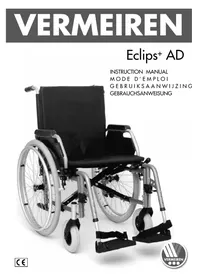
Eclips plus AD - Wheelchair Vermeiren - Free user manual and instructions
Find the device manual for free Eclips plus AD Vermeiren in PDF.



Frequently Asked Questions - Eclips plus AD Vermeiren
User questions about Eclips plus AD Vermeiren
0 question about this device. Answer the ones you know or ask your own.
Ask a new question about this device
Download the instructions for your Wheelchair in PDF format for free! Find your manual Eclips plus AD - Vermeiren and take your electronic device back in hand. On this page are published all the documents necessary for the use of your device. Eclips plus AD by Vermeiren.
USER MANUAL Eclips plus AD Vermeiren
Instructions to the specialist dealer
This instruction manual is part and parcel of the product and must accompany every product sold.
Version: A, March 2011
All rights reserved, including translation.
No part of this manual may be reproduced in any form what so ever (print, photocopy, microfilm or any other process) without written permission of the publisher, or processed, duplicated or distributed by using electronic systems.
© N.V. Vermeiren N.V. 2011

1.1 Intended Use 3
1.2 Technical specifications 4
1.3 Components 5
1.4 Accessories 5
1.5 Location identification plate.. 5
1.6 Explanation of symbols 5
1.7 Safety rules 6
2 Use 6
2.1 Carrying the wheelchair 6
2.2 Mounting the rear wheels.. 7
2.3 Unfolding the wheelchair 7
2.4 Mounting or removing of the footrests 7
2.5 Operating the brakes.. 7
2.6 Mounting or removing of arm supports 8
2.7 Transfer in and out the wheelchair 9
2.8 Correct position in the wheelchair 9
2.9 Riding the wheelchair 9
2.10 Moving on slopes 10
2.11 Negotiating steps or kerbs 10
2.12 Fold up the wheelchair 11
2.13 Taking off the wheels 11
2.14 Transport in the car. 12
2.15 Use of the wheelchair as seat in a motor vehicle 12
3 Installation and adjustment 14
3.1 Tools 14
3.2Manner of delivery 14
3.3 Adjusting the seat height and seat angle 15
3.4 Seat width adjustment 17
3.5 Seat 18
3.6 Back 19
3.7 Adjust the brakes 20
3.8 Adjusting of the footrests 20
3.9 Adjusting of the pushing handles 21
3.10 Adjusting of the tip cap 22
3.11 Adjusting the stability and the maneuverability 22
4 Maintenance 22
4.1 Regular Maintenance 22
4.2 Shipping and storage 23
4.3 Care 23
4.4 Inspection 24
4.5 Disinfection 24
5 Guarantee 26
Disposal 26
Declaration of conformity 26
Maintenance plan 27
Disinfection book 27
Preface
First of all we want to thank you for putting your trust in us by selecting one of our wheelchairs.
The Vermeiren wheelchairs are the result of many years of research and experience. During the development, special attention was given to the ease of use and the serviceability of the wheelchair.
The expected lifetime of your wheelchair is strongly influenced by the care and maintenance of the wheelchair.
This manual will help you get acquainted with the operation of your wheelchair.
Following the user instructions and the maintenance instructions are an essential part of the warranty.
This manual reflects the latest product developments. Vermeiren has the right to introduce changes without the obligation to adapt or replace previously delivered models.
For any further questions, please consult your specialist dealer.
1 Productdescription
1.1 Intended Use
The wheelchair is intended for people with walking difficulties or no walking abilities.
The wheelchair is designed to transport 1 person.
The wheelchair is suited for indoor and outdoor use.
The user can propel the wheelchair by himself or have the wheelchair pushed by an attendant.
The different types of fittings and accessories, and the modular construction allow full use by persons disabled by:
- paralysis
- loss of limbs (leg amputation)
- limb defects or deformations
- stiff or damaged joints
- heart insufficiencies and poor blood circulation
balance disturbances - cachexia (decrease in muscle)
and also for aged persons.
When providing for individual requirements:
- body size and weight (max. 130kg (286.6 lb.))
- physical and psychological condition
residential circumstances
environment
should be taken into consideration.
Your wheelchair should only be used on surfaces where all four wheels are touching the ground and where there is sufficient contact to propel the wheels equally.
You should practice for use on uneven surfaces (cobblestones, etc.), slopes, curves and to get past obstacles (kerbs, etc.).
The wheelchair should not be used as a ladder, nor is it a transport for heavy or hot objects.
When used on mats, carpeted floors or loose floor coverings, the floor covering can get damaged.
Use only Vermeiren approved accessories.
The manufacturer is not liable for damage caused by the lack of or improper service or as a result of not following instructions from this manual.
Compliance with the user and maintenance instructions are an essential part of the guarantee conditions.
1.2 Technical specifications
Technical terms below are valid for the wheelchair in standard settings.
If other footrest / arm support or other accessories are used, the tabulated values will change.
Table 1: Technical specifications Eclips+ AD
| Make | Vermeiren | |||||
| Address | Vermeirenplein 1/15, B-2920 Kalmhout | |||||
| Type | Manual wheelchair | |||||
| Model | Eclips+ AD | |||||
| Maximum occupant mass | 130 kg (286.6 lb.) | |||||
| Description | Min. | Max. | ||||
| Overall length with legrest | 1040 mm (40.94 in.) | |||||
| Effective seat width | 390 mm(15.35 in.) | 420 mm(16.54 in.) | 440 mm(17.32 in.) | 460 mm(18.11 in.) | 480 mm(18.90 in.) | 500 mm(19.69 in.) |
| Overall width (depends on the seat width) | 590 mm(23.23 in.) | 620 mm(24.41 in.) | 640 mm(25.20 in.) | 660 mm(25.98 in.) | 680 mm(26.77 in.) | 700 mm(27.56 in.) |
| Folded length | 1040 mm (40.94 in.) | |||||
| Folded width | 300 mm (11.81 in.) | |||||
| Folded height | 910 mm (35.83 in.) | 1015 mm (39.96 in.) | ||||
| Total mass | ± 17 kg (37.48 lb.) | |||||
| Mass of heaviest part | 9,55 kg (19.84 lb.) | |||||
| Masses of parts that can be dismantled or removed | Foot supports: 1,90 kg (4.19 lb); Arm supports: 1,40 kg (3.09 lb); Rear wheels: 4,15 kg (8.82 lb) | |||||
| Static stability downhill | 7,5° (in standard configuration) | |||||
| Static stability uphill | 5° (in standard configuration) | |||||
| Static stability sideways | >16° (in standard configuration) | |||||
| Obstacle climbing | 60 mm (2.36 in.) | |||||
| Seat plane angle | 0° | 13° | ||||
| Effective seat depth | 420 mm (16.54 in.) | |||||
| Seat surface height at front edge | 430 mm (16.93 in.) | 530 mm (20.87 in.) | ||||
| Backrest angle | 0° | 13° | ||||
| Backrest height | 420 mm (16.54 in.) | 460 mm (18.11 in.) | ||||
| Distance between footrest and seat | 390 mm (15.35 in.) | 460 mm (18.11 in.) | ||||
| Angle between seat and footrest | -3° | 10° | ||||
| Distance between armrest and seat | 220 mm (8.66 in.) | |||||
| Front location of armrest structure | 380 mm (14.96 in.) | |||||
| Handrim diameter | 535 mm (21.06 in.) | |||||
| Horizontal location of axle (deflection) | -47 mm (-1.85 in.) | 19 mm (0.75 in.) | ||||
| Minimum turning radius | 1530 mm (60.24 in.) | |||||
| Diameter Krypton PU Rear wheels | 24" | |||||
| Tyre pressure, rear (driving) wheels | Max. 3.5 bar | |||||
| Diameter Krypton PU steering wheels | 200 mm (8 in.) | |||||
| Tyre pressure, steering wheels | Max. 2.5 bar | |||||
| Storage and use temperature | + 5 °C (+41 °F) | + 41 °C (+106 °F) | ||||
| Storage and use humidity | 30% | 70% | ||||
| We reserve the right to introduce technical changes. Measurement tolerance ± 15 mm / 1,5 kg / ° (0.59 in. / 3,3 lb. / 1,5°) | ||||||
The wheelchair complies to the requirements set up in:
ISO 7176-8: Requirements and test methods for static, impact and fatigue strengths.
ISO 7176-16: Resistance to ignition of upholstered parts
ISO 7176-19: Wheeled mobility devices for use as seats in motor vehicles.
1.3 Components
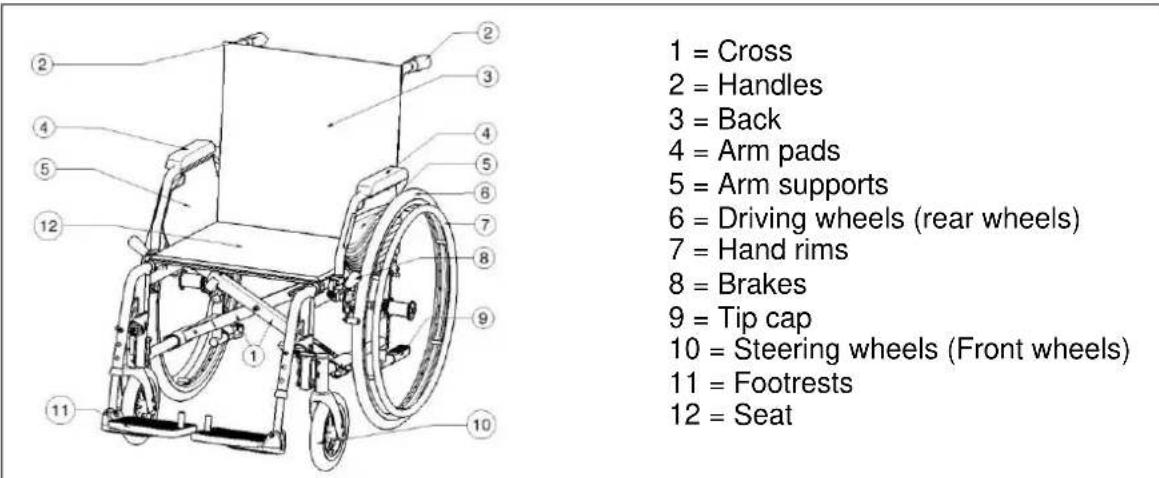
1.4 Accessories
The following accessories are available for the Eclips+ AD:
- Anterior pelvic belt (B58) for mounting on the tubes of the back
- Anti-tipping device (B78) for mounting on the bottom frame
- Drum brakes for the attendant (B74) for mounting on the push handles
1.5 Location identification plate
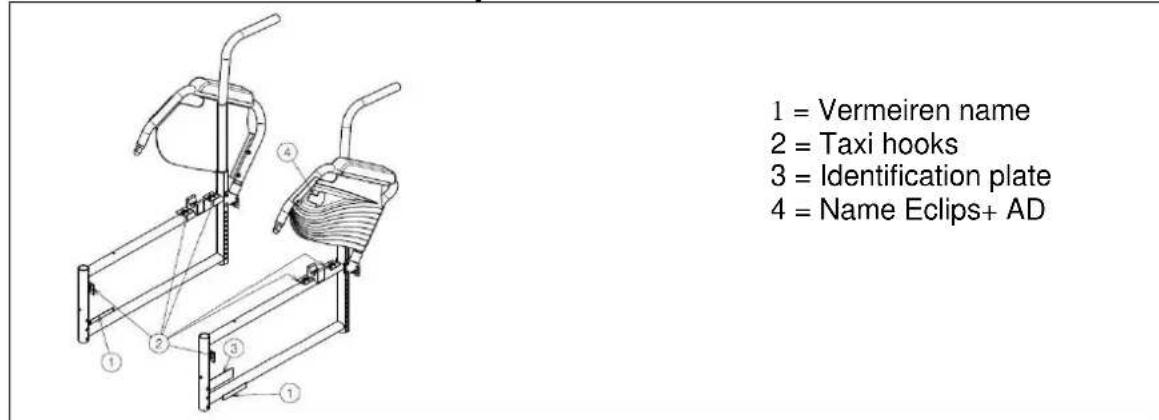
1.6 Explanation of symbols

Maximum mass

Indoor and outdoor use

Down slope

Up slope
CE conformity
1.7 Safety rules
To prevent injury and/or damage to your wheelchair, make sure that no objects and/or body parts are caught in the spokes of the driving wheels.
The parking brakes should be applied before getting into and out of the wheelchair.
When getting into and out of the wheelchair, do not stand on the footplates. These should be folded up beforehand, or the leg supports should be swung completely outwards out of the way.
Investigate the effects of shifting the centre of gravity on the behavior of the wheelchair, for example on up or down gradients, on laterally sloping ground, or when overcoming obstacles. Obtain support from an attendant.
If you want to pick up something (lying in front of, on the side, or to the rear of the wheelchair), you should not lean too far out to avoid tipping over.
When moving through doors, arches, etc. ensure that there is enough room at the sides so that you do not get your hands or arms caught or crushed and that there is no damage to the wheelchair.
Only use your wheelchair according to regulations. For example, avoid uncontrolled rolling against obstacles (steps, kerbs, doorframes, etc) or dropping down from ledges. The manufacturer cannot assume liability for damage caused by overloading, collision or other improper use.
Stairs may only be negotiated when aided by another person. If furnishings like drive-on, ramps or lifts are available, use them.
When moving on the public highway, you are subject to the rules of the road.
When driving your wheelchair, you should not be under the influence of alcohol or medicine as in the case of driving other vehicles. This also applies to indoor driving.
When travelling outdoors, adapt your driving to weather and traffic conditions.
When transporting the wheelchair, never pick it up by grasping movable parts (armrests, leg supports, etc.)
To be better visible when driving in the dark, wear the brightest possible clothing on clothes with reflectors, and check that the reflectors mounted on the sides and rear of the wheelchair are clearly visible.
Be careful when using possible causes of fire such as cigarettes since they may set the seat and back covers alight.
Never exceed the maximum load of 130kg (286.6 lb.).
2 Use
This chapter describes the everyday use. These instructions are for the user and the specialist dealer.
The wheelchair is delivered fully assembled by your specialist dealer. The instructions intended for the specialist dealer on how to set up the wheelchair are given in 3 .
2.1 Carrying the wheelchair
The best way to carry the wheelchair is to make use of the wheels and roll the wheelchair.
If this is not possible (e.g. when the rear wheels are taken off for transportation in a car), firmly grasp the frame on the front and the grips. Do not use the foot or arm rests or the wheels to grasp the wheelchair.
2.2 Mounting the rear wheels
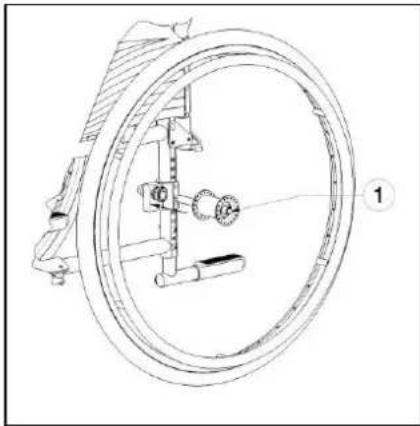
- Take the rear wheel and push on button ①.
- Keep the button pushed in and mount the rear wheels axle till it stops.
- Release the button
- Check that the wheel is secured.
2.3 Unfolding the wheelchair
CAUTION: Risk of clamping - Keep fingers away from moving parts of the wheelchair.
- Position yourself behind the wheelchair.
- Use the hand-grips to open the wheelchair as much as possible.
- Position yourself at the front of the wheelchair.
- Push both seating tubes down till they are fixed in their position.
2.4 Mounting or removing of the footrests

The mounting of the footrests is done as follows:
- Hold the footrest sideways at the outside of the wheelchair frame and mount the tube hood into the frame.
- Swing the footrest inwards till it clicks in position.
- Swing the foot plate downwards.
To take off the footrests:
1.Pull handle ②
2. Swing the footrest to the outside of the wheelchair till it comes loose from the guidance
3. Pull the footrest from tube hood ①.
2.5 Operating the brakes
WARNING: The brakes are not used to slow down the wheelchair during movements - Use the brake only to prevent the wheelchair from unintended movements.
WARNING: Good operation of the brakes is influenced by wear and contamination of the tires (water, oil, mud, ...) - Check the condition of the tires before each use.
WARNING: The brakes are adjustable and can wear - Check the operation of the brakes before each use.
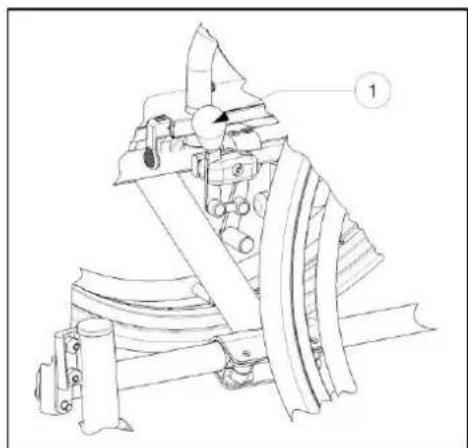
To apply the brakes:
- Push the brake handles ① forward till you feel a distinctive click.
CAUTION: Risk of unintended movement - Make sure the wheelchair is on a flat horizontal surface before releasing the brakes. Never release both brakes simultaneously.
To release the brakes:
- Release one brake by pulling the handle ① backwards.
- Hold the hand-rim of the release wheel with your hand.
- Release the second brake by pulling the handle backwards.
2.6 Mounting or removing of arm supports
CAUTION: Risk of clamping - Keep fingers, buckles and clothes away from the bottom side of the arm support.
The arm supports of the wheelchair can be mounted by following instructions.
- Mount the rear tube of the arm rest in tube hood ①.(Fig A)
- Make sure the arm support is mounted very well.
- Fold the arm rest forward.
4.Pull the lever ② on tube hood ③ upwards.(Fig B) - Click the front tube of the arm rest ④ in tube hood ③.(Fig B)
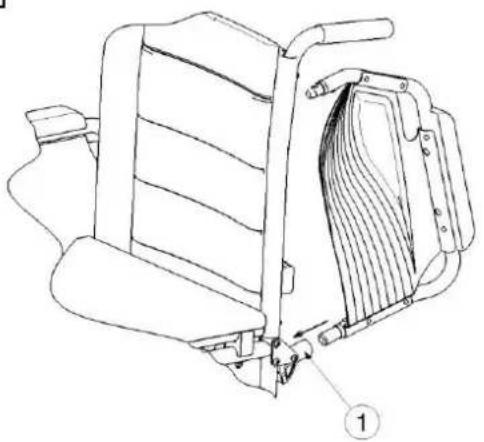
A
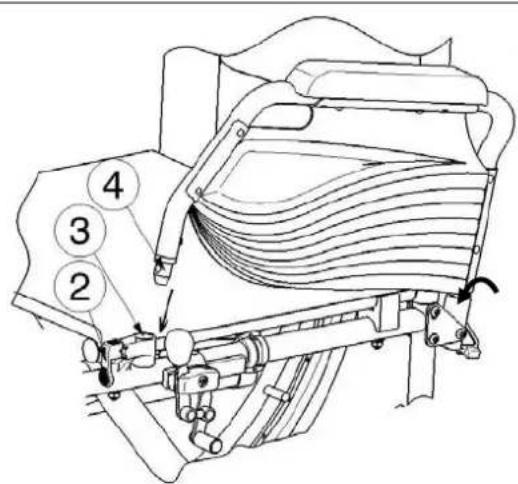
B
To open and remove the arm rest:
1.Pull lever ② and pull the front of the arm rest ① upwards.(Fig C)
2. Fold the arm rest backwards.
3. To remove the arm rest, pull the rear of the arm support from tube hood ③ (Fig D)
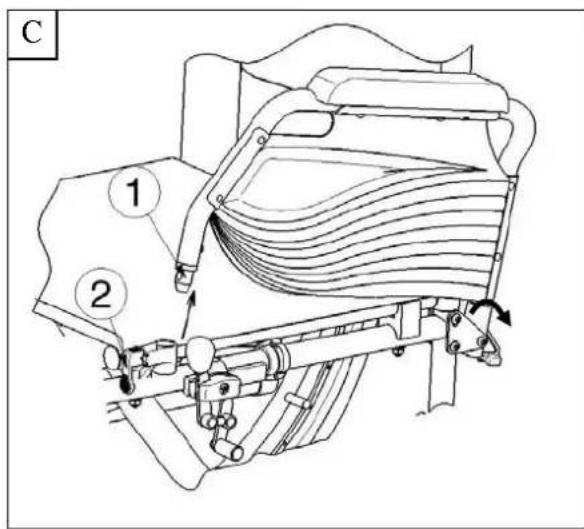
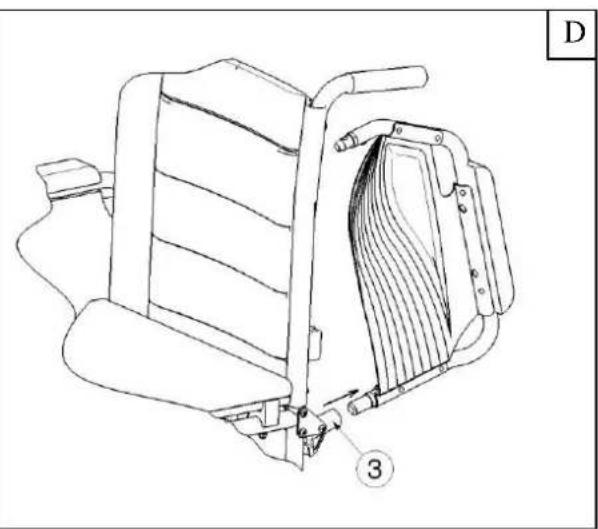
2.7 Transfer in and out the wheelchair
CAUTION: In case you can not perform the transfer in a safe manner, ask someone to assist you.
CAUTION: Risk of tipping over of the wheelchair - Do not stand on the foot plates.
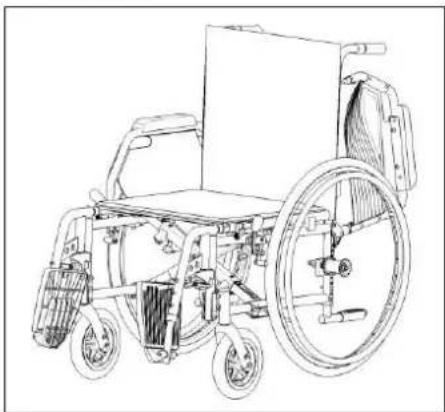
- Position the wheelchair as close as possible to the chair, couch or bed to/from you wish to transfer.
- Check both brakes from the wheelchair are in the on position.
- Fold the foot plates upwards to prevent standing on them.
- If the transfer is on the side of the wheelchair, fold the arm support on that side upwards. (see § 2.6)
- Transfer to/from the wheelchair.
2.8 Correct position in the wheelchair
Some recommendations for a comfortable use of the wheelchair:
- Position your backside as close as possible to the back rest.
- Make sure your upper legs are horizontal - If needed adjust the length of the foot rests. (see § 3.9.1)
2.9 Riding the wheelchair
WARNING: Risk of clamping – Prevent your fingers from being caught by the wheels spokes.
WARNING: Risk of clamping - Be careful passing through restricted passages (e.g. doors).
WARNING: Risk of burns - Be careful when driving in hot or cold environments (sunshine, extreme cold, saunas, etc.) for a sufficient amount of time and when touching - Surfaces can assume the environment temperatures.
- Release the brakes.
- Take both hand rims at their highest position.
- Lean forward and push the hand rims forward until straight arms.
- Swing your arms loosely back to the hand rims topside and repeat the movement.
2.10 Moving on slopes
WARNING: Control your speed - Moving on slopes as slow as possible.
WARNING: Consider the capacities of your attendant - If your attendant does not have enough force to control the wheelchair, put on the brakes.
WARNING: Risk of tipping over - Lean forward to move your centre of gravity forward. To improve a better stability.
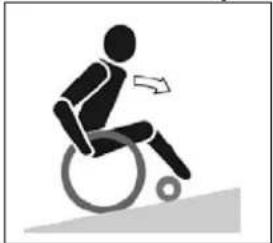
- If available on the wheelchair, wear the safety belt.
- Do not attempt moving on too high slopes. The maximum slope angles (upwards and downwards) are mentioned in table 1.
- Ask an attendant to help you moving on the slope.
- Lean forward to move your centre of gravity forward.
2.11 Negotiating steps or kerbs
2.11.1 Getting down steps or kerbs
Riding down low kerbs can be done moving forwards. Make sure that the foot rests do not touch the ground.
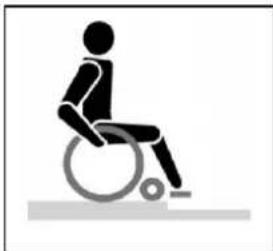
A practiced user can negotiate small steps or kerbs by himself:
WARNING: Risk of tipping over - If you do not have enough experience with your wheelchair, ask assistance of an attendant.
- Bring balance on the rear wheels to reduce the pressure on the front wheels.
- Negotiate the kerbs.
Higher kerbs can be taken forward with an attendant:
- Ask the attendant to tip the wheelchair slightly backwards.
- Get past the kerbs while moving on the rear wheels.
- Put the wheelchair back on the four wheels.
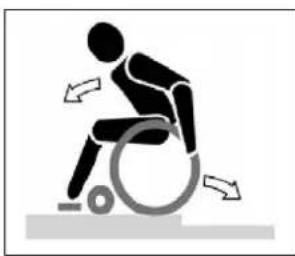
An experienced user can negotiate higher kerbs by himself. This is best done backwards.
- Turn the wheelchair to have the rear wheels facing the kerb.
- Lean forward to move your centre of gravity forward.
- Move the wheelchair close to the kerbs.
- Use the hand rim to roll-off wheelchair from the kerb in a controlled manner.
2.11.2 Moving up steps or kerbs
Moving up steps or kerbs with attendant as follows:
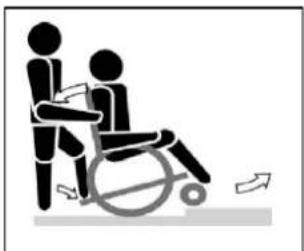
- Prevent the foot rests from touching the kerb.
- Ask the attendant to tip the wheelchair backwards, just enough to move the front wheels over the kerb.
- Lean backwards to move your centre of gravity above the rear wheel.
- Place the front wheels on the kerb.
- Roll rear wheels of the wheelchair over the kerb.
Higher kerbs are negotiated backwards:
- Turn the wheelchair to have the rear wheels facing the kerb.
- Lean backwards and move your centre of gravity above the rear wheels.
- Ask the attendant to pull the wheelchair on the kerb.
- Take back the normal position in the wheelchair.
An experienced user can negotiate kerbs by himself:
WARNING: Risk of tipping over - If you have not enough experience to control the wheelchair, get help from an attendant.
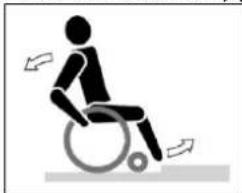
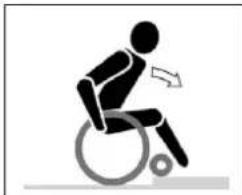
- Drive until the kerbs.
- Ensure that the footrest do not touch the kerbs.
-
Lean backwards so you are balancing on the rear wheels.
-
Role the frontwheels balancing over the kerbs.
- Bend forward for more stability.
- Role the rear wheels over the kerbs.
2.11.3 Taking of stairs
Taking of stairs while you staying in the wheelchair shall be according following rules:
WARNING: Risk of tipping over - Taking of stairs shall always with 2 attendants.
- Remove the footrests.
- One attendant tip the wheelchair slightly backwards.
- The second attendant take the front of the frame.
- Stay calm, avoid sudden movements and keep your arms inside the wheelchair.
- Take the steps on the rear wheels of the wheelchair.
- Mounting the footrests back after taking the stair.
2.12 Fold up the wheelchair
CAUTION: Chance of pinching - Do not place fingers between the components of the wheelchair.
- Fold or remove the footplates (see § 2.4).
- Take the seat on the front side and backside and pull it up.
2.13 Taking off the wheels
To facilitate the transport off the wheelchair the rear wheels can be taken off:
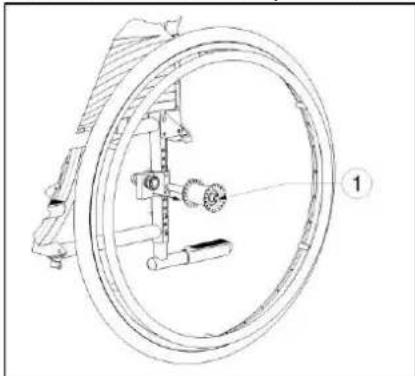
- Make sure the brakes standing in the off position.
- Take the wheelchair to the side frame where you want to remove the wheel.
- Press the button ① in the center of the wheel hub.
- Pull the wheel away from the frame.
2.14 Transport in the car
WARNING: Risk of injury - See that the wheelchair is attached properly. So you can avoid injury from the passengers during collision or sudden braking.
WARNING: Risk of injury - Use for attaching the wheelchair and passenger NEVER the same seatbelt.
- Remove footrests and accessories.
- Store footrests and accessories safely.
- If possible, fold the wheelchair and remove the wheels.
- Place the wheelchair in the luggage place.
- If the wheelchair and the passenger compartment is NOT separated, attach the frame of the wheelchair securely to the vehicle. You can use the available safety belts in the vehicle.
2.15 Use of the wheelchair as seat in a motor vehicle
WARNING: The wheelchair has passed the crash of ISO 7176-19: 2008 and, as such, has been designed and tested for use only as forward-facing seat in a motor vehicle.
WARNING: The wheelchair's pelvic belt alone is not suited as an occupant restraint belt.
The wheelchair is tested using the four-point strap-tie system and a 3-point occupant-restraint system.
Whenever feasible, use the seat of the vehicle and store the wheelchair in the cargo area.
Steps to secure the wheelchair in a motor vehicle:
- Check that the vehicle is equipped with a suitable wheelchair tie down and occupant-restraint system, conform ISO 10542.
- Check that the components of the wheelchair tie down and occupant restraint system are not frayed, contaminated, damaged or broken.
- If equipped with an adjustable seat and/or back tilt, make sure that the wheelchair user is sitting as upright as possible. If the user's condition prevents this, a risk assessment should be done to evaluate the user's safety during transit.
- Remove all mounted accessories such as trays and respiratory equipment, and secure them in a safe place.
- Position the wheelchair facing forward in the travelling direction, centrally between the tie-down rails mounted in the floor of the vehicle.
- Make sure that the indicated zones around the wheelchair user are clear from rigid vehicle parts.
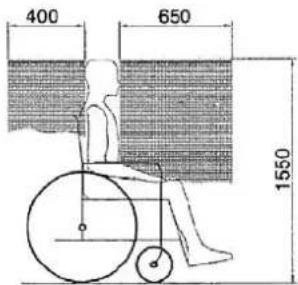
figure 1
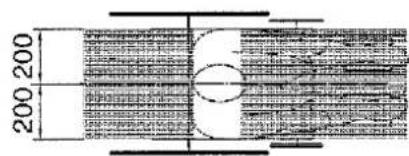
figure 2
- Mount the front securement straps according to the instructions of the strap-system manufacturer at the indicated place. (figure 3)
This place is marked on the wheelchair with a symbol. (figure 4)
- Roll back the wheelchair until the front straps are tight.
- Apply the wheelchair brake.
- Mount the back securement straps according to the instructions of the strap-system manufacturer at the indicated place. (figure 3)
- This place is marked on the wheelchair with a symbol. (figure 4)
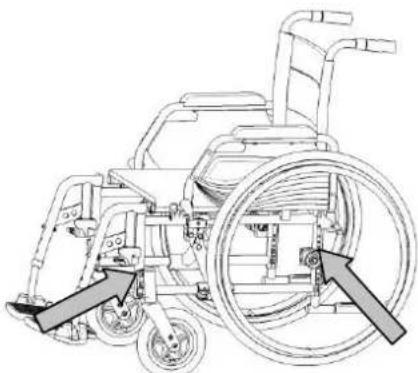
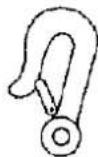
figure 4
figure 3
Steps to secure the wheelchair user:
- Remove both arm rests.
- If present, attach the wheelchair's pelvic belt.
- Attach the occupant restraint belts according to the instructions of the strap-system manufacturer.
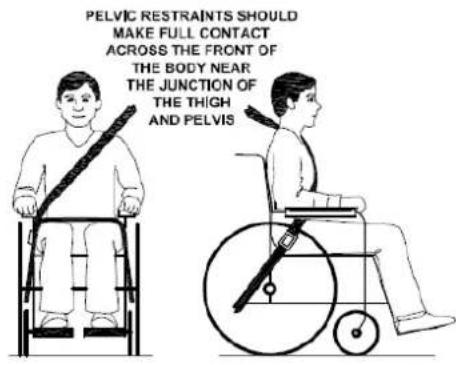
- Wear the pelvic belt low across the front of the pelvis, so that the angle of the pelvic belt is within the preferred zone of 30^ to 75^ to the horizontal, similar to that shown below.
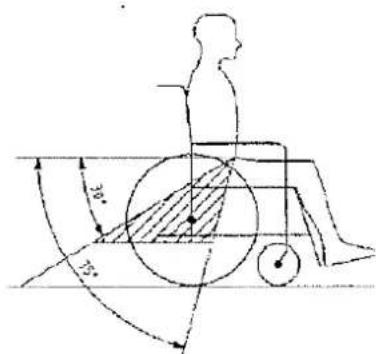
- A steeper (greater) angle within the preferred zone is desirable.
- Adjust the belt tightly according to the instructions of the strap-system manufacturer, consistent with the user's comfort.
- Ensure that the restraint belt connects in a straight line to the anchor point in the vehicle and that no bends in the belt are visible, for instance at the axle of the rear wheel.
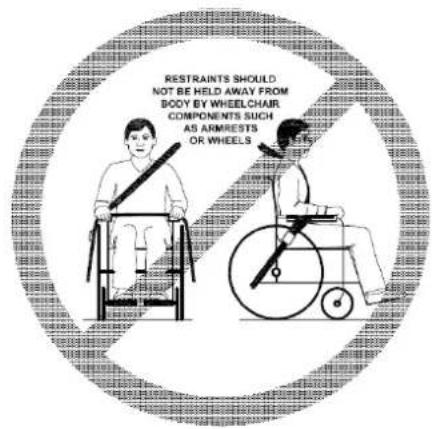
- Install the arm rests, if desired. make sure that belts are not twisted or held away from the body by wheelchair components such as arm rests or wheels.
3 Installation and adjustment
The instructions in this chapter are for the specialist dealer.
The Vermeiren Lightweight wheelchairs Eclips+ AD has been designed entirely for your comfort. This wheelchair can be adjusted to individual requirements as explained below.
To find a service facility or specialist dealer near you, contact the nearest Vermeiren facility. A list of Vermeiren facilities can be found on the last page.
WARNING: Risk of unsafe settings - Use only the settings described in this manual.
WARNING: Variation of allowed adjustments can still change the stability of your wheelchair (tilt back or sideways).
3.1 Tools
To set up the wheelchair the following tools are needed.
Wrench set n^10 to n^19
- Allen key set n^4 to n^5
- Screwdriver Phillips head
3.2 Manner of delivery
The Vermeiren Eclips+ AD shall be delivered with:
1 frame with arm supports, rear and front wheels (seat height of 500 mm - 19.69 in., seat angle of 7^ )
1 pair footrests
- Tools
- Manual
- Accessories
3.3 Adjusting the seat height and seat angle
WARNING: Risk of injury - Make sure that all screws are properly tightened with the appropriate tool.
WARNING: Risk of tipping over - When the driving wheels are adjusted, the position of the wheels are altered.
When adjusting the height of the seat the wheel may not touch the armrest. Maximum height adjustment is when the wheel do not touch the armrest.
The Vermeiren Eclips+ AD is adjustable in 4 seat heights and different seat angles by changing the wheels position. At each height there is a different setting of the front and rear wheels.
The summary of the different seat heights by a standard seat angle 7^ is tabulated below.
Table 3: Seat heights Eclips+ AD
| Seat height | Rear wheel | Front wheel | |||
| ∅ | Holes | ∅ | Adapter B / fork | Holes | |
| 430 mm (16.93 in.) | 22" | Hole 9 and 11 | 200 mm | Short | Hole 2 and 3 |
| 470 mm (18.50 in.) | 24" | Hole 8 and 10 | 140 mm | Standard | Hole 2 and 3 |
| 500 mm (19.69 in.) (Standard) | 24" | Hole 6 and 8 | 200 mm | Standard | Hole 2 and 3 |
| 530 mm (20.87 in.) | 24" | Hole 4 and 6 | 200 mm | Standard | Hole 1 and 2 |
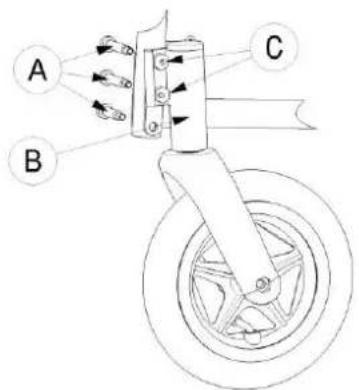
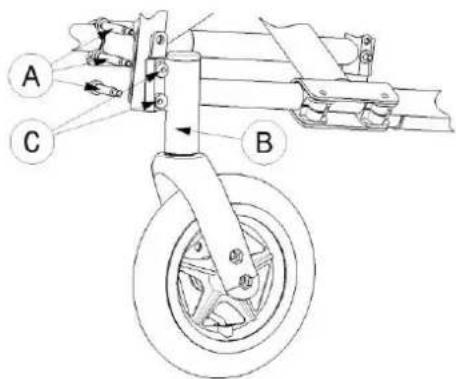
Change the seat height and seat angle according the following steps (refer to the figure on the next page):
-
Front wheel:
-
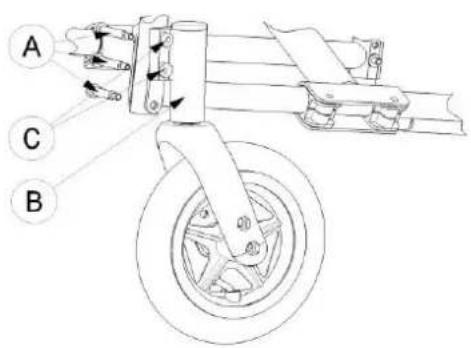
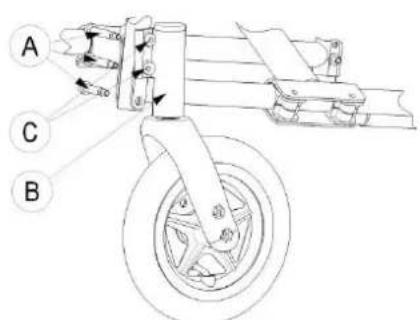
Loosen the screws A from the steering wheel adapter B.
- Choose correct size for the adapter and fork.
- Place the steering wheel adapter in the desired position.
- Tighten the screws properly.
-
Change diameter of the steering wheel if necessary (only for seat height 470 mm(18.5 in.)).
-
Rear wheel:
-
Remove the rear wheels (see §2.13).
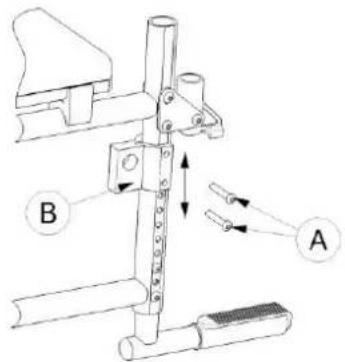
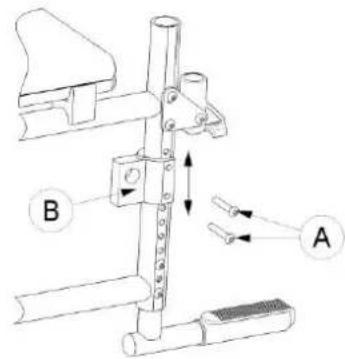
- Loosen the fixing screws A from the rear axle block B
- Push the axle block ⑧ upwards or downwards to the desired height.
- Tighten the screws properly.
- Mount the rear wheels.
- Adjust the brakes according 3.8
Front wheel
Axle plate rear wheels
Seat height 430 mm (16.93 in)
Seat height 470 mm (18.50 in)
Seat height 500 mm (19.69 in) (standard)
Seat height 530 mm (20.87 in)
Adjustment of the slope nuts from the steering wheels.
WARNING: Risk of injury - Make sure that all screws are properly tightened with the appropriate tool.
WARNING: Risk of injury - Make sure that the eccentric screw settings are identical on both front-wheel adapters and, before using the wheelchair.
This figure illustrates the principle. The position of the screw thread is indicated by a number.
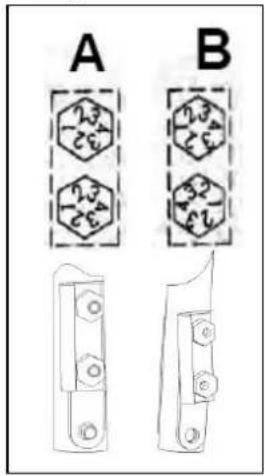
A Shows the frame when the seat is horizontal and the adapter is perpendicular to the ground.
B Shows the frame when the seat is tilted slightly and the adapter is not perpendicular.
3.4 Seat width adjustment
The wheelcair can be adjusted to seat widths of 390 mm to 500 mm (15.35 lb. to 19.69 lb.). The straps on the seat and rear covers must be loosened completely beforehand. (see the Chapters "Seat" and "Back").
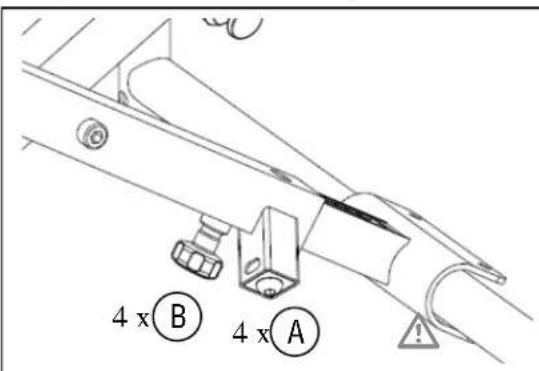
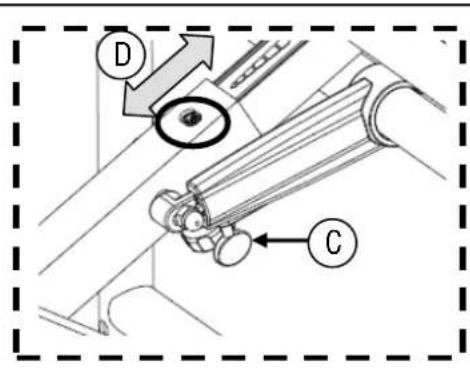
A Loosen the 4 locking screws on the spacer guide (these are located on the two top and bottom ends of the cross-hinged tubing) with an appropriate Allen key.
B Loosen the four Phillips screws alongside the locking screws on the brackets for the hinged tubing. These are located on the top and bottom end of the cross-hinged tubing.
C Turn the disc screws on the two boomerangs so that they can telescope freely.
D Pull the hinged tubing at each end to the required seat width. The cross-hinge components have been drawn out to the required width when the required lengths can be precisely seen in all four fields on the cross-hinged tubing and the Phillips screws (B) engage on their own.
The screws (A) and (B) must then be retightened properly.
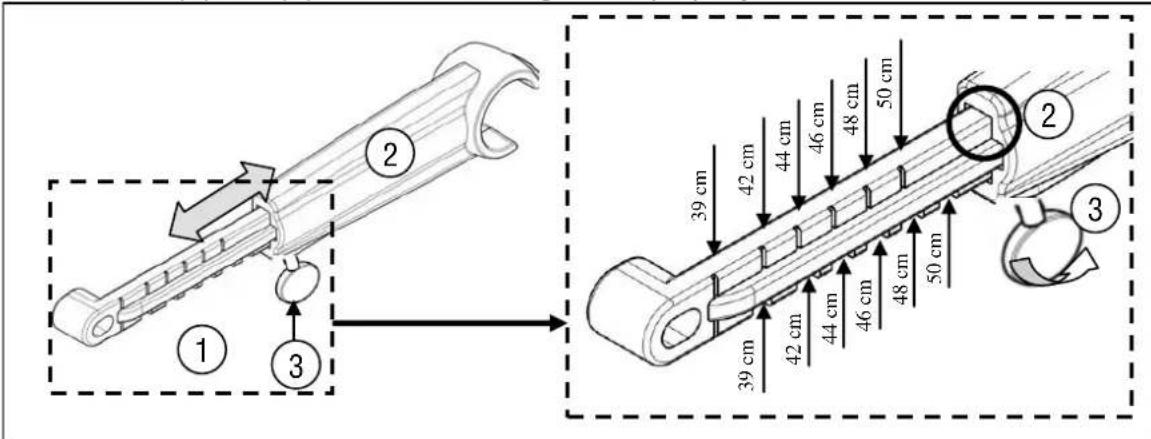
To secure the boomerangs properly, notches have been put on the side of the inner telescope rail (1) that indicate the seat width settings 390mm , 420mm , 440mm , 460mm , 480mm and 500mm . When the boomerangs are pushed together, these notches must fit exactly to the edge of the outer telescope rail (2). Then secure the disc screws (3) in such a way that they can be tightened fully. If the disc screws (3) cannot be tightened so they are flush, it will be because they are not settled in their intended recesses, so they cannot be secured properly.
If the disc screws are not tightened so they are flush, and if they are not settled in the recesses in the inner telescope rail, they can get damaged and restrict seat width adjustments in the future.
3.5 Seat
WARNING: Risk of injury - Make sure that all screws are properly tightened with the appropriate tool.
WARNING: Risk of injury - Ensure that all the securing straps are sufficiently tightened and do not hang through.
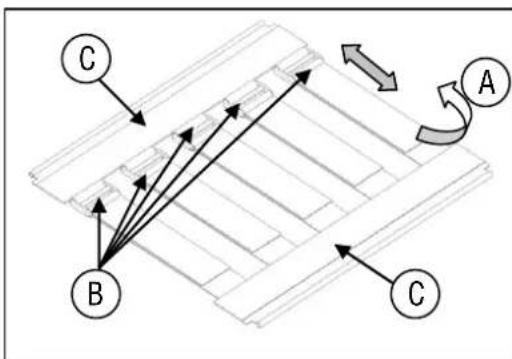
The seat can be used for a seat width of 390 mm to 500 mm. Loosen the Velcro fastening on all 5 straps (A) and pull the straps to the length you require by pulling them through the flaps (B).
When you have adjusted the straps to the required length, fasten them back up. The cushions can now be added to the seat by fitting the cushion straps to the side-straps on the adjustable seat.
The seat frame is available in one of three seat depths 42 cm, 44 cm, 46 cm (16.54 in., 17.32 in. and 18.11 in.).
The standard seat depth of the cover is 42cm (16.54 in.). To close the gap between the back frame and the seat, fold the flap of the backrest under the seat ( Velcro fastening).
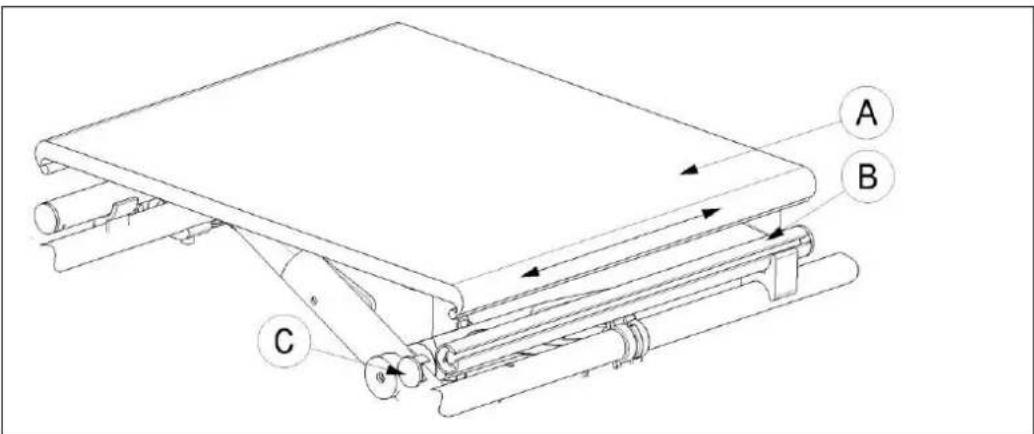
Changing the seat cover as follows:
- Remove the screw at the front end of the seat frame.
- Pull the locking pin out.
- Now the seat A can be removed by pulling it gently forwards out the groove of tube B. Do the reverse when you want to replace the seat.
3.6 Back
WARNING: Risk of injury - Make sure that all screws are properly tightened before using the wheelchair.
WARNING: Risk of injury - Ensure that all the securing straps are sufficiently tightened and do not hang through.
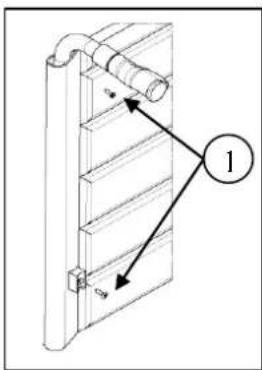
The height of the back can be adjusted by setting the entire back tube.
For adjusting the height of the back cover, loosen the fixing screws ① behind the back tube. Then you can move the cover upwards or downwards. There are fixing holes every 20mm (0.79 in.) in the back tube where the screws can be retightened.
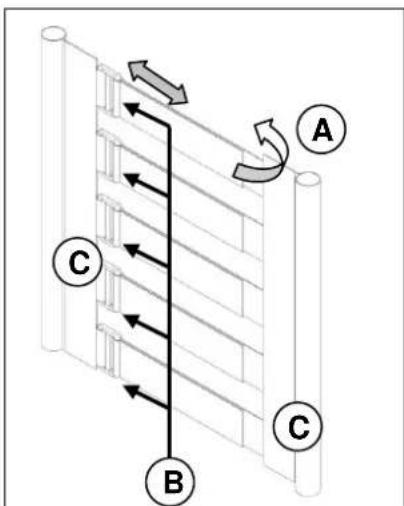
The back can be used for a seat width of 390mm to 500 mm. Loosen the Velcro fastening on all 5 straps (a) and pull the straps to the length you require by pulling them through the flaps (B). When you have adjusted the straps to the required length, fasten them back up. The rear cushion can now be attached to the front of the cover by fastening the straps on the rear cushion to the side-straps (C) on the adjustable seat.
The rear flap is drawn over the top end of the rear cover and can be fastened backwards to the cover.
3.7 Adjust the brakes
WARNING: Risk of injury - Brakes may only be adjusted by your specialist dealer.
Adjust the brakes according following rules:
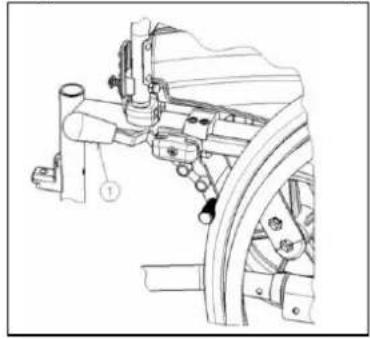
- Install the wheels according 2.2
- Disconnect the brakes by pulling lever ① backwards.
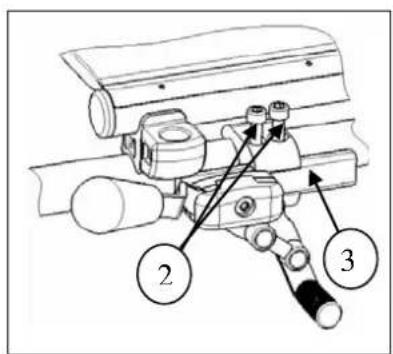
- Loosen the bolts ② so the brake mechanism can slide over the guide ③
- Pull the brake mechanism over the guide ③ to the desired position.
- Retighten the bolts ②.
- Check working of the brakes.
- If necessary repeat the above steps until the brakes are adjusted well.
3.8 Adjusting of the footrests
3.8.1 Length of the footrests
CAUTION: Risk of damage - Avoid that the footrests make any contact with the ground. Keep a minimum distance from 60 mm (2.36 in.) above the ground.
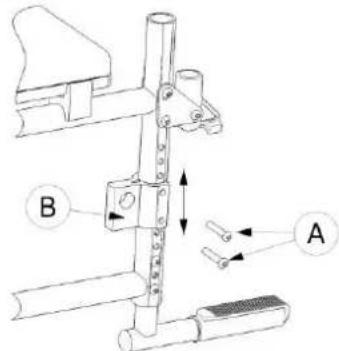
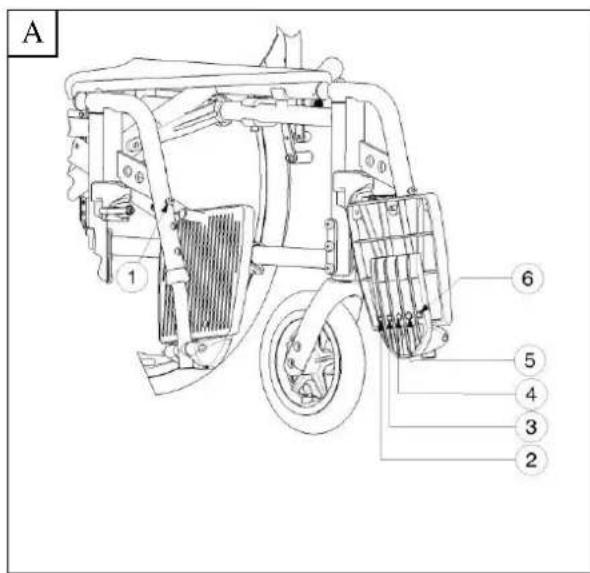
Adjust the length of the footrests as follow (in three different positions): (Fig A)
- Remove the screw ①.
- Adjust the length of the footrest to a comfortable length.
- Tighten the screw ① properly.
3.8.2 Depth of the footplate
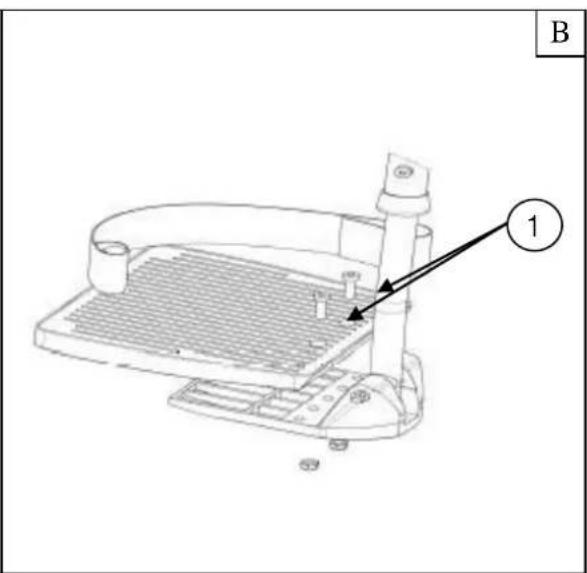
Adjust the depth of the footplate as follow (in three different positions):
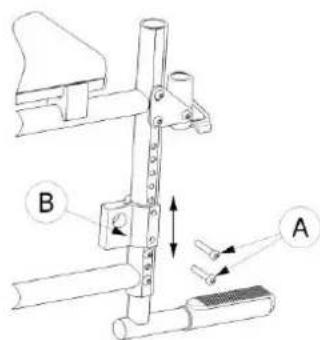
- Remove the screws ①. (Fig B)
- Adjust the depth of the footrest to a comfortable position (Fig A).
Position 1: hole 2 and 4
Position 2: hole 3 and 5
Position 3: hole 4 and 6
- Tighten the screws properly ①. (Fig B)
3.9 Adjusting of the pushing handles
WARNING: Risk of injury - Make sure that all screws are properly tightened with the appropriate tool.
WARNING: Risk of tipping over - Make sure that the tubes of the pushing handles are positioned identically on both sides.
3.9.1 Pushing handles
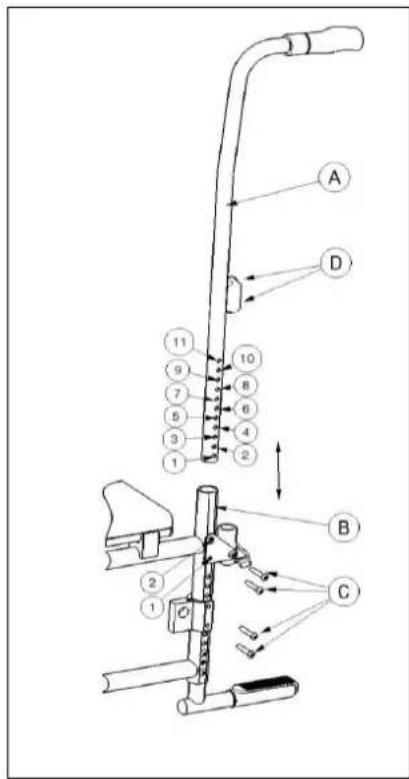
The tube handle is fixed to the back frame B.
Adjust the height of the pushing handles as follow:
- Remove the arm supports.
- Remove the screws
- Remove the screws ① for suspending the armrests.
- Pull the tube handle to the desired height.
Table 4: Pushing handle heights
| Pusing handle height | Tube handles A | Tube frame B |
| 910 mm (35.83 in.) (Standard) | Hole 9 and 11 | Hole 1 and 2 |
| 925 mm (36.42 in.) | Hole 8 and 10 | Hole 1 and 2 |
| 940 mm (37.00 in.) | Hole 7 and 9 | Hole 1 and 2 |
| 955 mm (37.60 in.) | Hole 6 and 8 | Hole 1 and 2 |
| 970 mm (38.19 in.) | Hole 5 and 7 | Hole 1 and 2 |
| 985 mm (38.78 in.) | Hole 4 and 6 | Hole 1 and 2 |
| 1000 mm (39.37 in.) | Hole 3 and 5 | Hole 1 and 2 |
| 1015 mm (39.96 in.) | Hole 2 and 4 | Hole 1 and 2 |
- Retighten all the fixing screws 1 properly.
3.10 Adjusting of the tip cap
WARNING: Risk of injury - Make sure that all screws are properly tightened with the appropriate tool.
A tip cap is mounted on the lower right back frame that can be adjusted in its height depending on the seat height of the wheelchair.
The tip cap can be placed in 2 different positions with a difference of 15mm (0.59 in.). (The wheelchair with seat height 500mm (19.69 in.) is the tip cap height adjustable in 150mm and 165mm (5.91 in. and 6.50 in.).
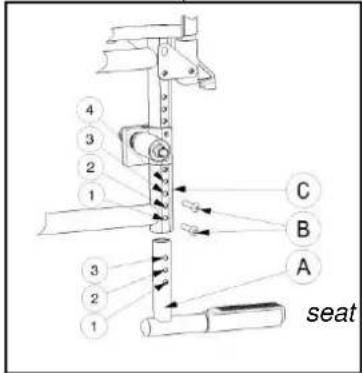
- Remove the screws B
- Adjust the height of the tip cap to a comfortable position.
| Tip cap height | Tube tip cap A | Tube frame C |
| 150 mm (5.91 in.) (Standard) | Hole 1 and 3 | Hole 1 and 3 |
| 165 mm (6.50 in.) | Hole 1 and 3 | Hole 2 and 4 |
Table 5: Tip cap heights for wheelchair with standard
- Tighten the screws properly ①. (Fig C)
If an anti-tip device is installed, it replaces the addition of the tipping lever and can be used accordingly.
3.11 Adjusting the stability and the maneuverability
WARNING: Risk of injury - Make sure that all screws are properly tightened with the appropriate tool.
WARNING: Risk of injury - Make sure that the axle adapters ① of the rear wheels on both sides are mounted in the same position.
WARNING: Risk of tipping over - Be aware that you change the stability of the wheelchair.
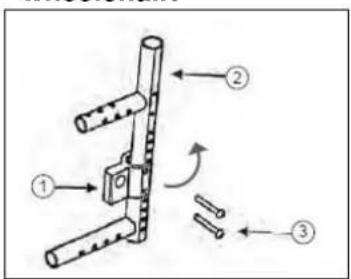
The driving wheels are mounted in an axle adapter ① at the bottom of the back frame ②.
- Loosen the fixing screws ③.
- Turn the axle adapter ① to the back until the axle mounting is behind the back frame.
- Tighten the screws properly ③.
- Adjust the brakes.
4 Maintenance
Lifetime of the wheelchair is influenced by its use, storage, regular maintenance, servicing and cleaning.
4.1 Regular Maintenance
The maintenance activities to ensure a good condition for your Vermeiren wheelchair are described below:
Before every ride
- Check the tyres and make them clean. If necessary change the tire.
- Check screw fastenings are secured.
- Check the brakes and adjusted if necessary.
-
Check the wheelchair (cleanliness, cracks, damage on structural parts ... ) and make it clean. If necessary change the coating.
-
Every 8 weeks: inspected and lubricating or adjusting from
Arm supports
Footrests
- Brake lever
Wheel axles
- Every 6 months or for every new user
General review
Disinfection
- Frontwheels, possibly clean bearings
For your convenience, on the back of this manual is a maintenance plan.
Repairing and assembling of spare parts for your wheelchair may only be performed by the specialist dealer.
Only authorized Vermeiren spare parts may be installed.
4.2 Shipping and storage
The shipping and storage of the wheelchair shall be according following instructions:
- Store in a dry place (between +5^ and +41^ ).
The relative humidity of the air should be between 30% and 70% . - Provide sufficient covering or packaging to protect the wheelchair from rust and foreign bodies. (e.g. salt water, sea air, sand, dust).
- Store all removed parts together in one place (or mark them if necessary) to avoid mixing up with other products when re-assembling.
- Components must be stored without being subjected to strains (Do not put too heavy parts on the wheelchair, not clamping between something, ...).
4.3 Care
4.3.1 Seat and back cushion
The cleaning of the Seat and back cushion shall be according:
- Clean Seat and back with a cloth moistened with hot water. Be aware that you do not soak the seat and back cushion.
- Use a mild commercial detergent for removing stubborn dirt.
Stains can be removed by using a sponge or a soft brush. - Do not use strong cleaning liquids like solvents, nor use hard brushes.
- Never clean with steam and/or pressure washers.
4.3.2 Plastic parts
Clean plastic parts of your wheelchair with commercial plastic cleaners. Only use a soft brush or soft sponge. Examples of plastic parts are the armrests, footrests, handles, tyres and ...
4.3.3 Coating
The high quality of the surface layer guarantees optimal protection against corrosion. If the outer coat is damaged by scratching or in some other way, get your specialist dealer to repair the affected surface.
When cleaning, only use warm water and normal household detergents and soft brushes and cloths. Ensure that no wetness gets into the tubes.
Initially the zinc parts only require rubbing with a dry cloth. Stubborn dirt can best be removed by using a suitable commercial zinc polish.
4.4 Inspection
In principle we recommend one inspection every year, and a minimum of one before usage is resumed. All of the following checks must be performed and documented by authorized persons:
- Check the frame parts and the hinged tubes for plastic deformation, cracks and impaired functioning.
- Visually check for damage to the paintwork (danger of corrosion)
- Check the operation of the wheels (free running, level rolling, axle play, tyres, profile, condition of the rims, air pressure in the case of air tyres, floating axles, etc.)
- Check the solidity and seating of all screws.
- Verify the amount of grease on the metal joints of movable parts
The condition and security of the guides and axles of the steering wheels - Visually check all plastic parts for cracks and brittle spots
- Check the functioning of the armrests and leg supports (locking, load, deformation, wear caused by loads).
- Check the operation of other detachable parts (example: anti-tipping device, personal safety belt, fitting back/seat, etc.)
- Completeness of the delivery condition, instruction manual available?
The service must only be signed off in the maintenance plan if a minimum of all the above-mentioned aspects have been checked.
4.5 Disinfection
WARNING: Dangerous Products - The use of disinfectants is restricted to authorized personnel.
WARNING: Dangerous Products, change on irritate your skin - You should wear suitable protective clothing because the disinfectants could irritate your skin. For this purpose you should also take note of the product information of the solutions concerned.
All parts of the wheelchair can be treated by scrubbing with a disinfectant.
All steps taken to disinfect rehabilitation equipment, their components or other accessory parts are to be recorded in a disinfection report containing a minimum of the following information (with product documentation appended):
Table 6: Example of a disinfection book
| Date of the disinfection | Reason | Specification | Substance and concentration | Signature |
Abbreviations used in column 2 (reason):
V = Suspected infection IF = Infection case W = Repetition I = Inspection
For a blank sheet of a disinfection book see § 9.
The recommended disinfectants for scrubbing (based on the list provided by the Robert Koch Institute, RKI) are standing in the table below. The current state of the disinfectants included in the RKI list can be obtained from the Robert Koch Institute (RKI) (homepage: www.rki.de).
Table 7:Disinfectants
| Active substance | Product name | Laundry disinfection | Surface disinfection (scrubbing/wiping disinfection) | Disinfection of excretions 1 part sputum or stools + 2 parts diluted solution or 1 part urine + 1 part diluted solution | Area of effectiveness | Manufacturer or Supplier | |||||||
| Sputum | Stools | Urine | |||||||||||
| Diluted solution | Time to take effect | Diluted solution | Time to take effect | Diluted solution | Time to take effect | Diluted solution | Time to take effect | Diluted solution | Time to take effect | ||||
| % | Hr. | % | Hr. | % | Hr. | % | Hr. | % | Hr. | ||||
| Phenol or phenol derivative | Amocid | 1 | 12 | 5 | 6 | 5 | 4 | 5 | 6 | 5 | 2 | A | Lysoform |
| Gevisol | 0,5 | 12 | 5 | 4 | 5 | 4 | 5 | 6 | 5 | 2 | A | Schülke & Mayr | |
| Helipur | 6 | 4 | 6 | 4 | 6 | 6 | 6 | 2 | A | B. Braun | |||
| m-cresylic soap solution (DAB 6) | 1 | 12 | 5 | 4 | A | ||||||||
| Phenol | 1 | 12 | 3 | 2 | A | ||||||||
| Chlorine, organic or inorganic substances with active chlorine | Chloramin-T DAB 9 | 1,5 | 12 | 2,5 | 2 | 5 | 4 | \( A^1 B \) | |||||
| Clorina | 1,5 | 12 | 2,5 | 2 | 5 | 4 | \( A^1 B \) | Lysoform | |||||
| Trichlorol | 2 | 12 | 3 | 2 | 6 | 4 | \( A^1 B \) | Lysoform | |||||
| Per combinations | \( Apesin AP100^2 \) | 4 | 4 | AB | Tana PROFESSIONAL | ||||||||
| \( Dismozon pur^2 \) | 4 | 1 | AB | Bode Chemie | |||||||||
| \( Perform^2 \) | 3 | 4 | AB | Schülke & Mayr | |||||||||
| \( Wofesteril^2 \) | 2 | 4 | AB | Kesla Pharma | |||||||||
| Formaldehyde and/or other aldehydes or derivatives | Aldasan 2000 | 4 | 4 | AB | Lysoform | ||||||||
| Antifect FD 10 | 3 | 4 | AB | Schülke & Mayr | |||||||||
| Antiseptica surface disinfection 7 | 3 | 6 | AB | Antiseptica | |||||||||
| Apesin AP30 | 5 | 4 | A | Tana PROFESSIONAL | |||||||||
| Baciloidc special | 6 | 4 | AB | Bode Chemie | |||||||||
| Buraton 10F | 3 | 4 | AB | Schülke & Mayr | |||||||||
| Desomed A 2000 | 3 | 6 | AB | Desomed | |||||||||
| Hospital disinfectant cleaner | 8 | 6 | AB | Dreiturm | |||||||||
| Desomed Perfekt | 7 | 4 | \( AB^* \) | Desomed | |||||||||
| Formaldehyde-solution (DAB 10), (formaline) | 1,5 | 12 | 3 | 4 | AB | ||||||||
| Incidin Perfekt | 1 | 12 | 3 | 4 | AB | Ecolab | |||||||
| Incidin Plus | 8 | 6 | A | Ecolab | |||||||||
| Kohrsolin | 2 | 12 | 3 | 4 | AB | Bode Chemie | |||||||
| Lysoform | 4 | 12 | 5 | 6 | AB | Lysoform | |||||||
| Lysoformmin | 3 | 12 | 5 | 6 | AB | Lysoform | |||||||
| Lysoformmin 2000 | 4 | 6 | AB | Lysoform | |||||||||
| Melsept | 2 | 12 | 4 | 6 | AB | B. Braun | |||||||
| Melsitt | 4 | 12 | 10 | 4 | AB | B. Braun | |||||||
| Minutil | 2 | 12 | 6 | 4 | AB | Ecolab | |||||||
| Multidor | 3 | 6 | AB | Ecolab | |||||||||
| Nuscosept | 5 | 4 | AB | Dr. Nusken Chemie | |||||||||
| Optisept | 7 | 4 | \( AB^* \) | Dr. Schumacher | |||||||||
| Pursept-FD | 7 | 4 | \( AB^* \) | Merz | |||||||||
| Ultrasol F | 3 | 12 | 5 | 4 | AB | Fresenius Kabi | |||||||
| Amphoteric surfactants (amfotensiden) | Tensodur 103 | 2 | 12 | A | MFH Marienfelde | ||||||||
| Lye | \( Lime-milk^3 \) | 20 | 6 | \( A^3 B \) | |||||||||
Kindly consult your specialist dealer if you have queries on matters related to disinfection; he will gladly assist you.
5 Guarantee
Excerpt from the "General Business Conditions":
(…)
- The guarantee period for warranty claims is 24 months. As a result of our superior quality requirements, we can increase the time bar on warranty claims beyond these fundamental, statutory requirements for
(…)
-Frame and cross-hinge of wheelchairs
4 years
The guarantee excludes damage arising from structural changes to our products, insufficient maintenance, defective or improper handling or storage or the use of non-original parts. Likewise, the guarantee excludes parts or working parts subject to natural wear and tear.
(…)
6 Disposal
When disposing of the wheelchair, contact your local disposal centre or return the product to your specialist dealer who, after submitting it to a hygienic procedure, will be able to send it back to the manufacturer who will dispose of and recycle it correctly, separating it into its component materials.
Packaging materials can be taken to disposal or recycling centers or to your specialist dealer.
7 Declaration of conformity
The manufacturer or his authorized representative :
N.V. VERMEIREN N.V
Address:
Vermeirenplein 1/15
2920 Kalmthout
Belgium
declares under his sole responsibility that the CE marked medical devices :
Productgroup:
Manual wheelchairs
Brand:
Vermiren
Type:
Eclips+AD
have been classified as class I, according to annex IX MDD 93/42/EEC, rule 1,
and is manufactured in full conformity with the European instructions below including the latest modifications - and with the national law, that organizes this directions :
Medical devices directive MDD 93/42/EEC (inclusive amendments directive 2007/47/EC)
and is in conformity with the relevant European harmonized standards:
EN 12182-1999, EN 12183-2009
8 Maintenance plan
| Date | Maintenance | Remarks | Paraph |
| 1/1/2011 | Greasing and general servicing | non | |
9 Disinfection book
| Date of the disinfection | Reason | Specification | Substance and concentration | Signature |
| Abbreviations used in column 2 (reason):V = Suspected infection IF = Infection case W = Repetition I = Inspection | ||||
Table des matieres
Preface 2
V = Infection suspectée IF = Cas d'infection W = Répartition I = Inspection
The wheelchair was serviced:
- a dismount, modification of repair carried outside of our company and/or official Vermeiren
-
involvement in an accident,
- a disbursement modification or repair carried outside.
-
damage during transport, der Garantie ausgenommen.
- damage due to incorrect usage of the wheelchair.
This warranty is not valid in case of:
valid when parts are replaced by Vermeiren in Belgium.
In order (a) claim to warranty, part B of this card has to be given to your official Vermerien dealer. The warranty is only
APPLCAONDS In order to claim his warranty, part "B" of this card has to be
APPRAOCATION CONDITIONS
the replacement of defective or spare parts. engenhenden Endkontrolle unterzogen, eventuall verhandene Mangel aufzuwirks
multiposition wheelchairs 3 years. This warranty is limited to Bevor Ih Rollstuhl unser Werk verlassen h
beds and other products: 2 years (batteries 6 months) and nach dem neuesten Stand der Technik mo
We offer 5 years of warranty on standard wheelchairs, lightweight wheelchairs 4 years. Electronic wheelchairs, tricycles,duke verwendet werden, die in
CONTRACTUAL WARRANTY GARANTIERKLRUNG We offer a wide range of standard wheelbase, light.
.
DEUTsCH
Belgium
N.V. Vermeiren N.V.
Vermeirenplein 1/15
B-2920 Kalmhout
Tel: +32(0)3 620 20 20
Fax: +32(0)3666 4894
website: www.vermeiren.be
e-mail: info@vermeiren.be
France
Vermeiren France S.A.
website: www.realtime.it
e-mail: info@realtime.it
Poland
Vermeiren Polska Sp. z o.o
ul. Laczna 1
PL-55-100 Trzebnica
Tel: +48(0)71 387 42 00
Fax: +48(0)71 387 05 74
website: www.vermeiren.pl
e-mail: info@vermeiren.pl
Spain
Vermeiren Iberica, S.L.
Trens Petits, 6. - Pol. Ind. Mas Xirgu.
17005 Girona
Tel: +34 902 48 72 72
Fax: +34 972 40 50 54
website: www.vermeiren.es
e-mail: info@vermeiren.es
Germany
Tel: +43(0)732 37 13 66
Fax: +43(0)732 37 13 69
website: www.vermeiren.at
e-mail: info@vermeiren.at
Switzerland
Vermeiren Suisse S.A.