SBM 20 - Blood pressure monitor SANITAS - Free user manual and instructions
Find the device manual for free SBM 20 SANITAS in PDF.



| Brand / Model | Sanitas SBM 20 |
| Product type | Upper arm electronic blood pressure monitor |
| Measurement method | Oscillometric, non-invasive |
| Pressure measurement range | 0 – 300 mmHg |
| Systolic / Diastolic measurement range | Systolic: 50 – 250 mmHg Diastolic: 40 – 180 mmHg |
| Pulse measurement range | 40 – 160 beats/min |
| Blood pressure accuracy | ± 3 mmHg |
| Pulse accuracy | ± 5% of displayed value |
| Memory | 2 × 30 values, with average and graphic |
| Cuff supplied | Arm circumference 22 – 32 cm |
| Power supply | 4 AA 1.5 V batteries (alkaline LR6) or mains adapter (optional, ref. 071.01) |
| Dimensions | W110 × 170 × H58 mm |
| Weight | Approx. 265 g (without batteries) |
| Operating temperature | +10 °C to +40 °C, humidity ≤ 85% |
| Storage temperature | -5 °C to +50 °C, humidity ≤ 85% |
| Main functions | Blood pressure/pulse measurement, Fuzzy Logic, arrhythmia detection, auto shut-off, two-user memory |
| Cleaning and care | Damp cloth, do not immerse, no solvents |
| Safety | Type BF applied part, standards EN1060-1/3/4, electromagnetic compatibility EN60601-1-2 |
| Spare parts and repairability | Cuff (ref. 162.361 for large arm), mains adapter (ref. 071.01); repairs by manufacturer only |
| Warranty | Legal warranty, opening the device voids warranty |
Frequently Asked Questions - SBM 20 SANITAS
User questions about SBM 20 SANITAS
0 question about this device. Answer the ones you know or ask your own.
Ask a new question about this device
Download the instructions for your Blood pressure monitor in PDF format for free! Find your manual SBM 20 - SANITAS and take your electronic device back in hand. On this page are published all the documents necessary for the use of your device. SBM 20 by SANITAS.
USER MANUAL SBM 20 SANITAS
Blood pressure monitor
F Mode d'emploi
Tensiometre
Ipn6op IJIy n3MepeHnY
With the blood pressure computer, you can measure your blood pressure quickly and easily, store the measurements and display their course and the average measurement. The computer is used for non-invasive measurement and monitoring of your arterial blood pressure levels.
Regular checks on measurement precision must be carried out if the monitor is used for commercial purposes.
The computer complies with the requirements of the European Directive for Medical Products, the German Medical Product Act as well as the European stand ards EN1060-1 (Non-invasive blood pressure measuring devices Part 1: General requirements) EN1060-3 (Non-invasive blood pressure measuring devices Part 3: Supplementary requirements for electromechanical blood pressure measuring systems), EN 1060-4 (non-invasive blood pressure monitors, Section 4: Test procedure for determining measurement precision). For private use also, we recommend that you have the measuring accuracy checked by the manufacturer at 2-yearly intervals.
Keep these operating instructions available for further use and also make them available to other users.
2. Caution - For Your Safety!
- The upper arm blood pressure monitor is used for non-invasive measurement and monitoring of adults' arterial blood pressure.
Always measure your blood pressure at the same time of day in order to ensure comparability of the readings.
Relax for about 5 minutes before every measurement. - Wait 5 minutes between successive measurements.
- The measurements you make yourself are only for your information – they are no substitute for a medical examination! Discuss your readings with your doctor and on no account make your own medical decisions (e.g. drugs and their dosages).
- The accuracy of measurement is reduced if the circulation to an arm is reduced because of chronic or acute vascular disease (including narrowing of blood vessels).
- Measuring errors can occur in diseases of the cardiovascular system, as well as with very low blood pressure, irregular blood circulation and arrhythmia and also in the case of other symptoms.
- The blood pressure computer consists of precision-made electronic components. The measuring accuracy and life of the computer depend on the care with which it is treated:
- Protect the computer from shocks and be careful not to drop it,
- Protect it against moisture, dirt, wide fluctuations in temperature and the direct rays of the sun,
-
Only ever use the cuffs provided with the monitor or original replacement cuffs. Otherwise incorrect results will be recorded.
-
To prevent any hazard as a result of the cuff tube, keep the tube out of children's reach and never put it round your neck.
-
Do not use it in areas where there are strong electromagnetic fields, i.e. keep it away from transmitters and mobile phones.
-
Do not press buttons without the cuff fitted.
- Use the appliance only on people with an upper arm circumference that is within the range recommended for this appliance. As a rule, these are adults.
- If the computer is not used for a lengthy period of time, it is advisable to remove the batteries.
- Keep the batteries out of reach of children. Batteries do not belong in domestic waste.
- Dispose of batteries at the appropriate collection points.
- Do not open the computer. Failure to comply invalidates the warranty. You must not adjust or repair the computer yourself or its correct function will no longer be guaranteed.
- This unit is in line with European Standard EN60601-1-2 and is subject to particular precautions with regard to electromagnetic compatibility (EMC). Please note that portable and mobile HF communication systems may interfere with this unit. For more details, please contact customer service at the address indicated.
3. Table for classification of blood pressure values (unit of measurement mmHg) for adults:
Range Systolic Diastolic Action
| Hypotonia Check with (degraded blood pressure) lower than 105 lower than 60 doctor | ||||
| Normal range between 105 and 120 between 60 and 80 Self check | ||||
| Pre-hypertensive blood pressure range* | between 120 and 140 doctor | between 80 and 90 | Check with | |
| High blood pressure - degree I | between 140 and 160 doctor | between 90 and 100 | Consult your | |
| High blood pressure - degree II | higher than 160 doctor | higher than 100 | Consult your | |
(*) Blood pressure range that might transfer to high blood pressure
Adapted from JNC 2003
4. Device description
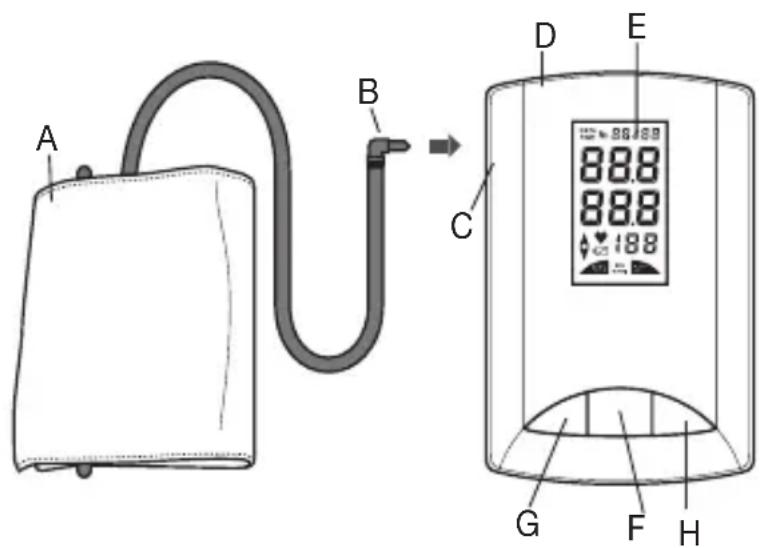
A Cuff
B Cuff connector
C Cuff connector port
D Network adapter port (rear)
E Display
F ON/OFF button
G Memory button M1
H Memory button M2
This device is designed to measure the blood pressure and pulse rate on upper arms of adults.
5. Preparation
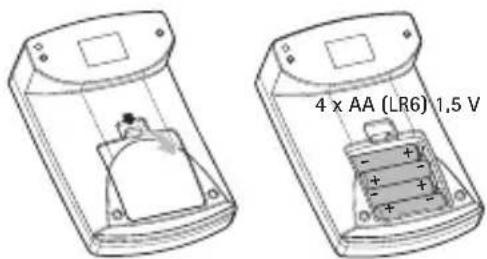
5.1 Inserting the batteries
-
Remove the battery cover from the back of the monitor. Insert four AA 1.5 V alkaline batteries. making absolutely sure that you insert them with the correct polarity as marked. Never use rechargeable batteries.
-
Replace the battery cover carefully. Now you can set the date and time.
5.2 Setting the date and time
- First the year starts blinking. Press M1 to increase numbers, or M2 to decrease. Set the year accordingly and confirm with the ON/OFF button.
Using the M1 and M2 buttons, now enter the month. Confirm with the N/OFF button. - Now enter the day using the M1 and M2 buttons. Confirm with the N/OFF button.
- Now you can set the time. This is displayed in 24-hour mode. First enter the hours, confirm with the ON/OFF button and then enter the minutes. Once this is confirmed using the ON/OFF button, the device automatically returns to normal time mode.
5.3 Changing batteries
If the battery change is linking, the batteries are already too low. Even though measurement is still possible, the batteries should be replaced soon. If the battery change is continuously illuminated, measurement is no longer possible and you must replace all the batteries. Once batteries have been removed from the device, the time must be reset. Any measurement results that have been stored are however retained.
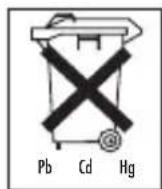
Used batteries do not belong in the household waste. You are legally obliged to dispose of the batteries. Dispose of them via your specialist electrical supplier or local collecting point for recyclable waste. Note: Batteries containing pollutant substances are marked as follows: Pb = Battery contains lead, Cd = Battery contains cadmium, Hg = Battery contains mercury. The battery contained in this instrument is pollutant-free.
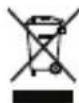
Please dispose of the appliance in accordance with the Directive 2002/96/EC on Waste Electrical and Electronic Equipment (WEEE). In case of queries, please contact the municipal authorities responsible for waste disposal in your area.
5.4 Mains operation
You can also operate this device with a mains adapter. No batteries should be in the battery compartment for this. The mains adapter is available from retailers or from the service address under order no. 071.01.
The blood pressure monitor should only be used with the mains adapters specified here. The mains adapter should only be connected to the mains voltage indicated on the rating plate. Once you have disconnected the device from the mains, the date and time on the blood pressure monitor are lost. Any measurement results that have been stored are however retained.
6. Fixing the cuff
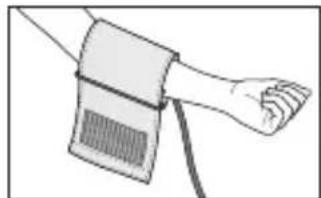
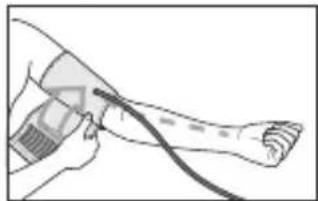
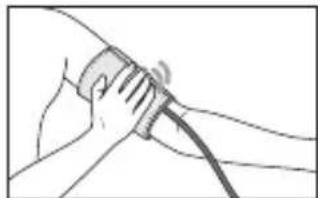
Fit the cuff round your bare left upper arm. Blood circulation in the arm should not be restricted by tight clothing or other objects. The cuff should be placed on the upper arm so that the lower edge is 2 to 3cm above the bend of the elbow and above the artery. The tube should be in line with the centre of the palm.
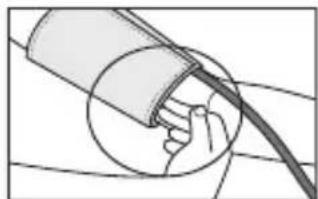
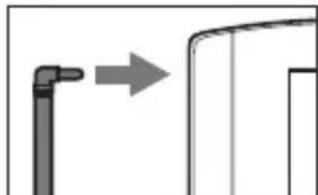
Now place the free end of the cuff snugly, but not too tightly, around the arm, and fix it with the Velcro fastener. The cuff should be fitted tight enough to allow just two fingers to fit beneath the cuff. Insert the cuff tubing into the socket for the cuff attachment. The blood pressure apparatus may only be used with the original cuff. The cuff is suitable for an arm circumference of 22 to 32cm .
A larger cuff for upper arm circumferences from 32 to 42~cm is available from retailers or the service address under order no.162.361.
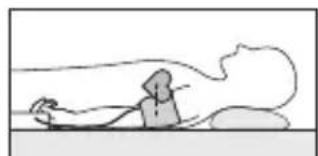
7. Correct measurement position
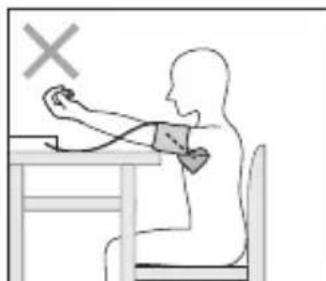
You can perform the measurement either sitting or lying down.
Always make sure that the cuff is on a level with your heart. To avoid distorting the measurement, it is important that you remain calm during measurement and do not speak.

8. Measuring your blood pressure
- Put on the cuff as described above and take up the position in which you wish to perform the measurement.
- Switch on the device with the ON/OFF button.
-
A self-test runs, during which all display elements are illuminated briefly, and then measurement starts. While the cuff is being pumped up, the symbol A is displayed. Pressure is increased to 180mmHg . If this pressure is not sufficient, the device automatically pumps another 30mmHg (fuzzy logic).
-
When the pressure in the cuff is slowly released and the pulse is recorded, the symbol appears.
- Once measurement has ended, residual air pressure is released very quickly and the symbol v appears. pulse, systolic and diastolic pressures are displayed.
- Now press memory keys M1 or M2 to select the required user memory. If you do not select any user memory, the measurement result is assigned for storage in the user memory which was last used. The symbol 'M1' or 'M2' appears accordingly in the display.
- You can interrupt measurement at any time by pressing thaN/OFF button.
- Switch off the blood pressure monitor with the ON/OFF button. The measurement result is then saved to the selected user memory. If you forget to switch off the device, it switches off automatically after approx. 3 minutes. Even then, the result is still saved to the selected user memory.
Wait at least 5 minutes before any new measurement!
9. Memory recall
You can recall stored results from the two user memories and display averages.
- Press memory buttons M1 or M2. First the average is displayed of all the results held in this user memory. This is indicated by reading 'A'.
- Continue pressing the memory button to recall other individual measurement results - the first result to appear is that of the most recent value measured. These individual values are indicated by memory location numbers 1 to 30. After approx. 4 seconds, the date of the respective measurement result is displayed and then the time after a further 4 seconds.
- Once 30 individual values are in the memory, the oldest value is deleted in order to make room for the new measured value.
- Switch off the device using the ON/OFF button or else the device will switch off automatically after approx. 30 seconds.
Note: You can also use the two user memories to save measurement results separately, e.g. in the morning and evening.
Deleting saved values
You can delete saved values individually or else you can delete all of them.
- To delete individual values, first select the stored value you wish to delete and keep memory button M1 or M2 depressed. The display starts blinking. Keep holding the button depressed until the display has completely cleared.
- To delete an entire user memory, you have to select the appropriate user memory. The average is displayed and indicated with 'A'. Hold the memory button M1 or M2 depressed until the display starts blinking and keep the button depressed until the display completely clears.
10. Cleaning
Clean your blood pressure computer carefully only with a slightly moistened cloth.
- Do not use detergents or solvents.
- On no account must you immerse the computer in water, otherwise liquid can enter it and cause demage.
- When storing the device, make sure that no heavy objects are placed on top of it. Remove the batteries. The cuff tube should not have any sharp kinks
11. Error recovery
Error messages may appear if
you move or talk during measurement (ERR 1)
the cuff tube is not inserted properly (ERR 2)
the ON/OFF button is pressed when inserting the batteries
the cuff is inflated for longer than 20 seconds (ERR 2)
blood pressure is unusually high or low (ERR 1)
- inflation pressure is higher than 300mmHg (ERR 330)
In the above cases, you must repeat the measurement. Make sure that the cuff tube is properly inserted and that you do not move or talk. Put the batteries back in if necessary, or else replace them.
12. Specifications
Model No. SBM 20
| Method of Measurement Oscillometric, non-invasive blood pressure measurement on the upper arm | |
| Range of Measurement Pressure 0-300 mmHg, systolic: 50-250 mmHg, diastolic 40-180 mmHg, pulse 40-160 beats/minute | |
| Accuracy of the pressure reading systolic ± 3 mmHg / diastolic: ± 3 mmHg / pulse: ± 5% of the isplayed value | |
| Measuring uncertainty max. permissible standard deviation according to clinical testing in accordance with EN 1060-4: systolic: 8 mmHg / diastolic: 8 mmHg | |
| Sets of Memory 2 x 30 memory places | |
| Unit Dimension L110 x W170 x H58 mm | |
| Unit Weight- Approx. 265 g | |
| Cuff Size Wrist circumference approx. 22-32 cm | |
| Operating Temperature +10 °C to +40 °C, ≤85% RH | |
| Storage-Temperature -5 °C to +50 °C, ≤85% RH | |
| Power Supply 4 x 1,5 V AA batteries (alkaline type LR6) | |
| Battery Life For approx. 300 measurements, depending on blood pressure level or inflation pressure | |
| Accessories instruction manual, 4 pcs “AA” battery | |
| Classification Application part Type BF | |
| Key to symbols: Important! Read the operating instruction | |
| Application part Type BF |
These specification are subject to change without notice for purpose of improvement.
FRANÇAIS
1. Présentation
BbIMoXeTe BbI3BaTb N3 NaMRTN DaHHbIe pa3deIOB NaMRTN IaY DByX NOIb3OBaTeJIe N yBnDeTb CpeHIOB EINuHy.
- Haxmte Ha KhoNky namTu M1 nnM2. Chayala nokaxetc rpeHnB eHnHa dIy BceX n3MepeHn B daHHoM pa3dene namTu. OHI noRbTc npD py6pIKoA
- Ppi cIeIyUoIeM hXaTn Ha KHOKny pAmrN 6ydyT NOKa3aHbI NocIeIyUOuIe pe3yIbTaTbI OTdJIbHbIX n3MepeHn - IpeJxDe Bcero BeINuHa pe3yIbTaT a CmBIX NocJeDnX n3MepeHn. 3TN OTdJIbHbIE BeINuHbI 6ydy T npEcdTaBHeB B AyeKax pAmrN IOd HomepAMn O1 Do 30. PpIMepHo uePe3 4 cekynbI NOBNTcA dTa I eue uepe3 4 cekynbI - BpEmr, KOrda bbl nOnyuH coOTBETCTByIOU nn pe3yIbTaT n3MepeHn.
- EcIn B nAMrTu yKe coXpaHeHO 30 OTdEnbHbIX BeINuHN, cAmar CTapaR 6yDet CTupaTbCn I3 nAMrTu, OCBO6OxJaA MeCTO dIra HOBOro pe3yJbTaTaN3MepEHn.
- BbIKIIOHTe annapaT, noJIb3yrcb KHOJKOB BKJ./BbIKJ., INI OH aBTOMATUeCKN OTKIIIOHTcA npIMepHO uepe3 30 cekyHd.
Yka3aHne: Pn 3aHeCenB namTb pe3yIbTaTOB n3MepeHn Bbl MoXeTe nCNoIb3OBaTb N o6a pa3dena naTn IJn POJIb3OBaTeJe,-- HApPIMep, pa3dJIbHO 3anOMHaTb yTpEHnE N BeuepHne noka3aTeHn.
YdaJIeHHe n3 namrTO COxpaHeHHbIX BeJIuHn
Bb mokeTe ydaNTb n3 naTn OTdeJIbHbIe nn COxpaHeHHbIe pe3yJbTaTbI n3MepeHn.
- Дя удалени OTдьнбix pe3yntaTOB ChaаJa BA Bi6epTe COxpaHeHHyO B namTn BeHnHy и habKMITE n DepxKNTe HaxaToI KhoNky namrM1 uIn M2. DepxKNTe KhoNky haxaToI, POKA BCE NOKa3AHN NOHOCbI O He IcYe3HyT.
- Чтобы сөрети зл памгтп Всь даньл ра3дел польбоватя в сөлom, Bы дохнbl Bыбрathь COOTВETCTBYUOин pa3дел памгт. BydET nOKa3aHa ee cpeHЯ BElnuHa noD pa3deIOM „A". Habmiteи Depxnte haxatoy nAMrtn M1 nII M2, nOKa He 3amraIoT nOKa3aHnIи daJIbSe, nOKa BCE nOKa3aHnI NOHOCtBu He nCue3HyT.
10. yxOa
- Pnp6op IaI N3MepeHn KPOBHOrO DaBJeHn CNeDyET YNCTNTb OCTopoXHO npI NOMOcN CJIerKa CMOeHHo TKaHn.
3anpeaetcnaNoIb3ObaHne uCTaunx CpeDCTB nJIn pactBopnteJe.
He donyckaTe nonaadaHne np6opa B Body, T.K. B pe3yIbTaTe B Hero MOxET npOHKnHyTb XnKDocTb N NOBpeDntb np6op. - Ppi xpaehnn annapata Ha Hero HeIb3a CTaBnTb TAnKeIbIe npEIMeTbl. 3anpeuaetc CnIbHO neperrnbat coeHNHTeHHy TOpy6ky MaHKeTbl.
11. YctpaHHe HEnCnPaBHOCTeI
Annapat MoXeT daBaTb HeBepHbIe noka3aHn, ecIn:
- Bby ueBentecb nI npa3roBapnBaete BO BpeM npoBeHnN 3mepenHn, (ERR 1)
- HenpaBnIbHO BCTaBneHa CoeDHHTeJIbHa Tpy6Ka MaHKeTbI, (ERR 2)
BO Bpemr yctaHOBKn 6aTapeek 6bJa HaKaTa KHONKa BK./BbIKI, - HargheTaHne BO3dyxa npoJOnJaetcdoJIbwe 20 cekyH, (ERR 2)
- BeINuHa apTePnAJIbHOrO daBHeHn ype3BbUaHNo BeINKa nI IN Hn3Ka, (ERR 1)
-Давлиеные наразаетсь виши, чим до 300 мг рт. ст. (ERR 330)
B noo6hbx cnyaax u3mepeHne cJe dyet nobTopntb. CJeIte, yTO6bl coeHNHTbHa Tpy6ka MaHXeTbI 6blA BCTaBnEHa npaBnBHO, He ueBeJIInTEcb N He pa3ROBaNBaTe BO BpEMBAINONHeHn u3MepeHn. Ppr HEO6xOIMOCtN nepeyctaHOBtE 6aTaapeKn IIN 3aMeHnte INX.
12. TexHnueckne daHHbIe
MoeIb Nc SBM 20

- Caution - For Your Safety!
- Table for classification of blood pressure values (unit of measurement mmHg) for adults:
- Device description
- Preparation
- Inserting the batteries
- Setting the date and time
- Changing batteries
- Mains operation
- Fixing the cuff
- Correct measurement position
- Measuring your blood pressure
- Memory recall
- Deleting saved values
- Cleaning
- Error recovery
- Specifications
- FRANÇAIS
- Présentation
- YdaJIeHHe n3 namrTO COxpaHeHHbIX BeJIuHn
- yxOa
- YctpaHHe HEnCnPaBHOCTeI
- TexHnueckne daHHbIe
Brand : SANITAS
Model : SBM 20
Category : Blood pressure monitor