BO710EQN - Cooker BOMPANI - Free user manual and instructions
Find the device manual for free BO710EQN BOMPANI in PDF.



Frequently Asked Questions - BO710EQN BOMPANI
User questions about BO710EQN BOMPANI
0 question about this device. Answer the ones you know or ask your own.
Ask a new question about this device
Download the instructions for your Cooker in PDF format for free! Find your manual BO710EQN - BOMPANI and take your electronic device back in hand. On this page are published all the documents necessary for the use of your device. BO710EQN by BOMPANI.
USER MANUAL BO710EQN BOMPANI
- 2005/32/CE (Energy-using Products)
PREMESSA
ACCENSIONEL BRUCIATORE FORNO
-struments
- sensibility
- sensibility to the effects of a drug, such as alcohol and tobacco.
- sensitivity to the effects of a drug, such as alcohol and tobacco.
- sensitivity to the effects of a drug, such as alcohol and tobacco.
- sensitivity to the effects of a drug, such as alcohol and tobacco.
- sensitivity to the effects of a drug, such as alcohol and tobacco.
- sensitivity to the effects of a drug, such as alcohol and tobacco.
- sensitivity to the effects of a drug, such as alcohol and tobacco.
- sensitivity to the effects of a drug, such as ethanol.
- sensitivity to the effects of a drug, such as alcohol and tobacco.
- sensitivity to the effects of a drug, such as alcohol and tobacco.
- sensitivity to the effects of a drug, such as alcohol and tobacco.
- sensitivity to the effects of a drug, such as alcohol and tobacco.
- sensitivity to the effects of a drug, such as alcohol and tobacco.
- sensitivity to the effects of a drug, such as alcohol and tobacco.
- sensitivity to the effects of a drug.
- simbolo :cottura convenzionale forno "statico", la temperatura del forno viene regolata mediante la manopola del termostato.
- symbolo accensione grill;
USO ACCESSORI DEL FORNO
145 1,0 kW - Plaque Normale
1,5 kW - Plaque Rapide
0 180 1,5 kW - Plaque Normale
2,0 kW - Plaque Rapide
PUISSANCES DES ELEMENTS
resistance sole 1,5 kW
Technical data and specifications 19
Installation 20-21
Ventilation 20
Positioning 20
Fitting the feet 20
Gas connection 20
Adapting to different types of gas 20
Replacing the injectors 20
Regulating the air 20
Minimum setting 21
Electrical connection 21
Electric ignition 21
Safety device 21
For the user 22-25
Ventilation 22
Igniting the burners 22
Igniting the gas oven 22
Igniting the gas grill 22
Safety device 22
Electrical switch-on 22
Using the gas hob 22
Using the electric hot-plates 22
Using the gas oven 22
Using the gas or electric grill 22
Using the static electric oven 4 23
Using the static electric oven 4 "new" 23
Using the electric fan oven 4 23
Using the multifunction electric oven 4 23
Using the multifunction electric oven 23
Using the rotisserie 23
Using the minute minder 23
Using the single-control cooking timer 24
Warming compartment 24
Removing the oven door 24
Using oven accessories 24
Advice and precautions 24
European Directive 2002/96/EC (WEEE) 25
European Regulation 1935/2004 25
Figures 58-60
- Thank you for choosing one of our quality products, capable of giving you the very best service. To make full use of its performance features, read the parts of this manual which refer to your appliance carefully. The Manufacturer declines all responsibility for injury or damage caused by poor installation or improper use of the appliance.
- To ensure its appliances are always at the state of the art, and/or to allow constant improvement in quality, the manufacturer reserves the right to make modifications without notice, although without creating difficulties for users.
-
When ordering spare parts, inform your dealer of the model number and serial number punched on your appliance's nameplate, visible inside the warming compartment or on the back of the cooker.
-
APPLIANCE COMPLYING WITH THE FOLLOWING DIRECTIVES:
-
EEC 2009/142/CE (ex 90/396)
- 2006/95/EC Low Voltage (replaces 73/23/EEC and subsequent amendments)
- EEC 2004/108 (radio-frequency interference)
- European Regulation 1935/2004 (materials in contact with food)
- European Regulation 1275/2008
- EEC 40/2002
- EEC 92/75
-2002/96/EC (WEEE) - 2005/32/CE (Energy-using Products)
FOREWORD
- Refer only to the headings and sections covering accessories actually installed on your cooker.
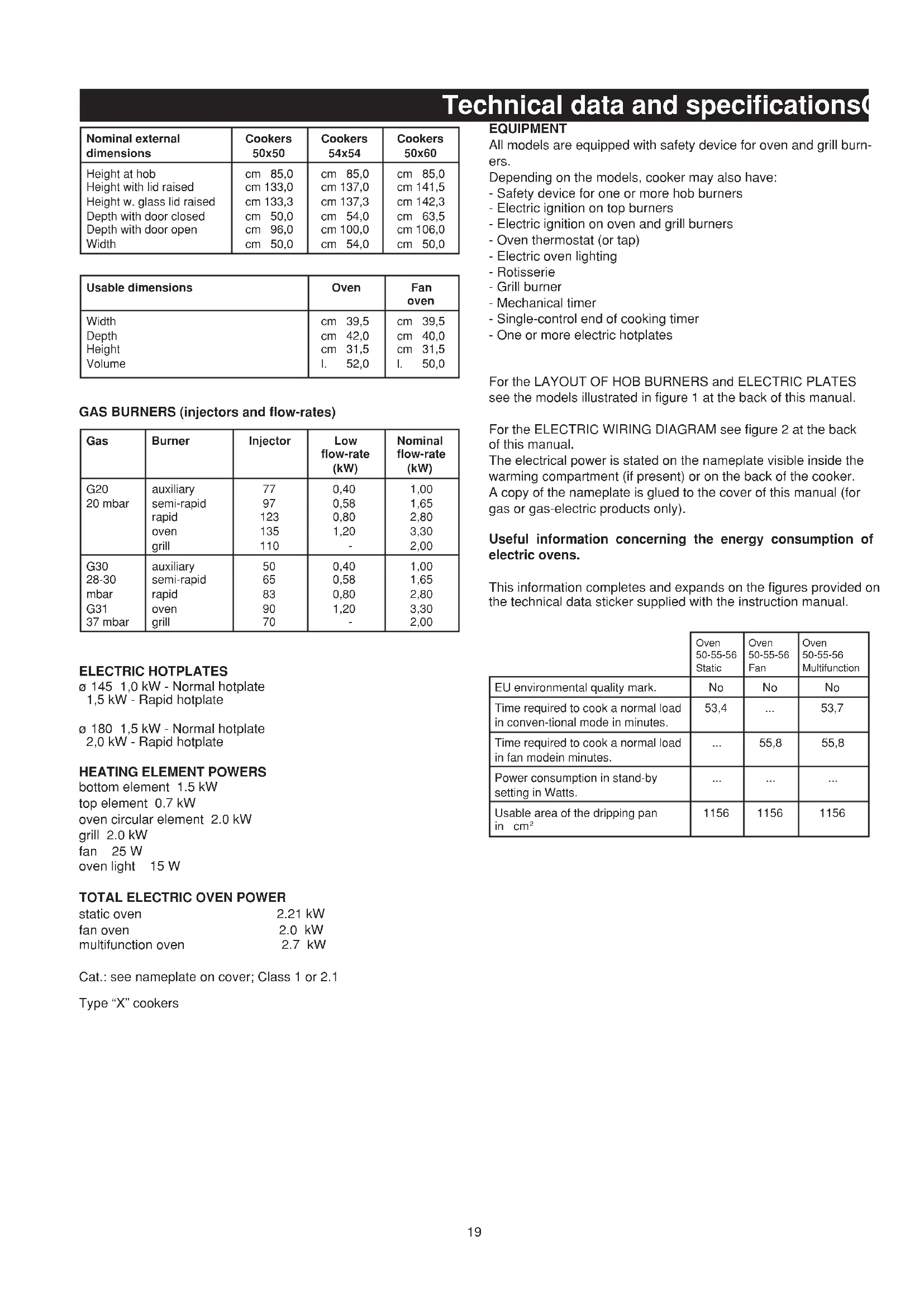
Technical data and specifications
| Nominal external dimensions | Cookers 50x50 | Cookers 54x54 | Cookers 50x60 | |||
| Height at hob | cm | 85,0 | cm | 85,0 | cm | 85,0 |
| Height with lid raised | cm | 133,0 | cm | 137,0 | cm | 141,5 |
| Height w. glass lid raised | cm | 133,3 | cm | 137,3 | cm | 142,3 |
| Depth with door closed | cm | 50,0 | cm | 54,0 | cm | 63,5 |
| Depth with door open | cm | 96,0 | cm | 100,0 | cm | 106,0 |
| Width | cm | 50,0 | cm | 54,0 | cm | 50,0 |
| Usable dimensions | Oven | Fan oven |
| Width | cm 39,5 | cm 39,5 |
| Depth | cm 42,0 | cm 40,0 |
| Height | cm 31,5 | cm 31,5 |
| Volume | I. 52,0 | I. 50,0 |
GAS BURNERS (injectors and flow-rates)
| Gas | Burner | Injector | Low flow-rate (kW) | Nominal flow-rate (kW) |
| G20 | auxiliary | 77 | 0,40 | 1,00 |
| 20 mbar | semi-rapid | 97 | 0,58 | 1,65 |
| rapid | 123 | 0,80 | 2,80 | |
| oven | 135 | 1,20 | 3,30 | |
| grill | 110 | - | 2,00 | |
| G30 | auxiliary | 50 | 0,40 | 1,00 |
| 28-30 | semi-rapid | 65 | 0,58 | 1,65 |
| mbar | rapid | 83 | 0,80 | 2,80 |
| G31 | oven | 90 | 1,20 | 3,30 |
| 37 mbar | grill | 70 | - | 2,00 |
ELECTRIC HOTPLATES
0 145 1,0 kW - Normal hotplate
1,5 kW - Rapid hotplate
0 180 1,5 kW - Normal hotplate
2,0 kW - Rapid hotplate
HEATING ELEMENT POWERS
bottom element 1.5 kW
top element 0.7kW
oven circular element 2.0 kW
grill 2.0 kW
fan 25W
oven light 15 W
Cat.: see nameplate on cover; Class 1 or 2.1
Type "X" cookers
EQUIPMENT
All models are equipped with safety device for oven and grill burners.
Depending on the models, cooker may also have:
- Safety device for one or more hob burners
- Electric ignition on top burners
- Electric ignition on oven and grill burners
- Oven thermostat (or tap)
- Electric oven lighting
- Rotisserie
- Grill burner
- Mechanical timer
- Single-control end of cooking timer
- One or more electric hotplates
For the LAYOUT OF HOB BURNERS and ELECTRIC PLATES see the models illustrated in figure 1 at the back of this manual.
For the ELECTRIC WIRING DIAGRAM see figure 2 at the back of this manual.
The electrical power is stated on the nameplate visible inside the warming compartment (if present) or on the back of the cooker. A copy of the nameplate is glued to the cover of this manual (for gas or gas-electric products only).
Useful information concerning the energy consumption of electric ovens.
This information completes and expands on the figures provided on the technical data sticker supplied with the instruction manual.
| Oven 50-55-56 Static | Oven 50-55-56 Fan | Oven 50-55-56 Multifunction | |
| EU environmental quality mark. | No | No | No |
| Time required to cook a normal load in conventional mode in minutes. | 53,4 | ... | 53,7 |
| Time required to cook a normal load in fan modein minutes. | ... | 55,8 | 55,8 |
| Power consumption in stand-by setting in Watts. | ... | ... | ... |
| Usable area of the dripping pan in cm2 | 1156 | 1156 | 1156 |
GB
Installation
INSTALLATION
The appliance must be installed by qualified staff working in accordance with the regulations in force.
Before installing, ensure that the appliance is correctly preset for the local distribution conditions (gas type and pressure).
The presettings of this appliance are indicated on the nameplate shown on the cover.
This appliance is not connected to a flue gas extractor device. It must be installed and connected in accordance with the regulations in force.
This appliance may only be installed and may only operate in rooms permanently ventilated in accordance with national regulations in force.
VENTILATION
The rooms in which gas appliances are installed must be well ventilated in order to allow correct gas combustion and ventilation.
The air flow necessary for combustion is at least 2m^3 /h for each kW of rated power.
POSITIONING
Remove the packaging accessories, including the films covering the chrome-plated and stainless steel parts, from the cooker.
Position the cooker in a dry, convenient and draft-free place. Keep at an appropriate distance from walls which may be damaged by heat (wood, linoleum, paper, etc.).
The cooker may be free-standing (class 1) or between two units (in class 2 st 2-1) the sides of which must withstand a temperature of 100^ and which must not be higher than the working table, in the event of different installation arrangements with a side wall above the working table, the wall must be at least 20~cm from the top of the appliance.
FITTING The FEET (present only in a few models)
Cookers are equipped with adjustable feet to be screwed into their front and rear corners respectively. The feet allow the height of the appliance to be adjusted, in order to set it flush with the adjoining unit, to level it with other worktops and to ensure even distribution of the liquids in pans. See fig. 18
CONNECTING TO The GAS SUPPLY
Before connecting the cooker, check that it is preset for the gas to be used. Otherwise, make the conversion as described in the section headed "Adapting to different gas types". The connection is on the right; if the pipe has to pass behind the cooker, it must be kept low down where the temperature is about 50^ .
- Rigid connection (see fig. 3 A + B)
The connection to the mains gas supply may be made using a rigid metal pipe or with a metal hose. Remove the hose connector (if already fitted) and screw the rigid union onto the threaded connection of the gas train (see fig. 3A). The union for rigid connection may already be fitted on the gas train, or may be amongst the cooker accessories. Otherwise, it can be obtained from your dealer.
If national regulations permit, a metal hose complying with the national standards can be screwed directly onto the threaded connection of the gas train, fitting a seal (see fig. 3B). However, users are strongly recommended always to fit the rigid union.
- Connection using a rubber hose (see fig. 3C). (For butane/propane gas only).
Connect a rubber hose carrying the conformity mark currently in force to the hose connector. The hose must be replaced at the date indicated at the latest, and must be secured at both ends using standard hose clamps. It must be absolutely accessible to allow its condition to be checked along its entire length.
CAUTION:
- Use of the hose connector is only permitted for free-standing installation. If the appliance is installed between two class 2 st. 2-1 unions, the rigid union is the only form of connection permitted.
IMPORTANT:
- After installation, check that the connections are airtight.
- For operation with butane/propane, check that the gas pressure is as indicated on the nameplate.
- Use only standard rubber hoses. For LPG, use a hose which complies with the national regulations in force.
- Avoid sharp bends in the pipe and keep it well way from hot surfaces.
References to the regulations covering the gas connection to the appliance: ISO 7-1.
ADAPTING TO DIFFERENT TYPES OF GAS
- Remove the grid, the burner caps (A), and the burners (B);
- Unscrew and remove the injector in the bottom of each injector holder (C);
- replace the injector in accordance with the table in page 19 using a 7mm socket wrench, tighten and screw right down;
- check that the system is gas-tight;
- replace the burners, the burner caps and the grid.
IMPORTANT:
- Never over-tighten the injectors;
- after replacing, check that all the injectors are airtight.
REPLACING The hOB BURNER INJECTORS (Fig. 4)
- Remove the lid of the cooker by lifting it off its supports;
- remove the grids, burner caps and burners, lifting them off;
- unscrew the 2 screws (above) or nuts (below) at the back which secure the work top, and pull it out forward.
- remove the mixer pipes and replace the injectors using a 7 mm socket wrench.
REPLACING The OVEN BURNER INJECTOR (Fig. 5)
- Loosen the screw which secures the bottom of the oven;
- remove the oven bottom (pulling it forward);
- remove the oven burner, after taking out the screw which secures it;
- replace the injector using a 7 mm socket wrench.
REPLACING The GRILL BURNER INJECTOR (Fig. 6)
- Remove the burner after taking out the two screws which secure it;
- replace the injector using a 7 mm socket wrench.
IMPORTANT:
- Never over-tighten the injectors;
- after replacing, check that all the injectors are airtight.
REGULATING The BURNER AIR
Refer to the table below (indicative values) for regulation of the gap H in mm (fig. 6 for the grill).
| Burner | G20 20mbar G25 25mbar | G30 28-30mbar G31 37mbar |
| Oven | - | - |
| Grill | 4 | 8 |
Check operation of the burner:
- Ignite the burner at maximum flame;
- the tongue of the flame must be clear and with no yellow tip, and must adhere closely to the burner. If too much air is supplied, the flame detaches from the burner and may be dangerous. If the air supply is insufficient, the flame has a yellow tip and soot may form.
SETTING hOB BURNER MINIMUM LEVELS
If the cooker is to work on bottled gas (butane/propane), the tap by-pass must be screwed right down.
The cooker may be equipped with type A taps, with by-pass inside (accessed by inserting a small screwdriver into the rod) or type B
GB
Installation
taps, with by-pass on the outside on the right (accessed directly). See figure 7.
If the cooker is to work on natural gas, proceed as follows for both types of tap:
-
Ignite the burner at maximum flame;
-
pull off the knob, without using a lever against the control panel, which might be damaged;
- access the by-pass with a small screwdriver and back off by about 3 turns (turning the screwdriver anti-clockwise);
- turn the tap rod anti-clockwise again until it stops: the burner will be at maximum flame;
- screw the by-pass slowly back in, without pushing the screw-driver, until the flame has apparently shrunk to 1/4 of the maximum size, checking that it is sufficiently stable even in quite strong draughts.
SETTING OVEN BURNER MINIMUM LEVELS
If the cooker is to work on bottled gas (butane/propane), the thermostat by-pass must be screwed right down.
If the cooker is to work on natural gas, proceed as follows:
- Remove the oven bottom (loosen the screw to remove the bottom);
- ignite the oven burner, turning the knob pointer to the maximum setting;
- shut the oven door;
- access the thermostat or tap by-pass (see fig. 8);
- back off the thermostat by-pass by about 3 turns;
- after 5 or 6 minutes, turn the knob pointer to the minimum setting;
- slowly re-tighten the by-pass, watching the flame decrease in size through the window in the closed oven door until the tongue of the flame is about 4mm long. Never keep the flame too low. It must be stable even when the oven door is opened or closed quickly;
- turn off the burner and replace the oven bottom.
CONNECTING TO The ELECTRICAL MAINS
Before making the connection, check that:
- the mains voltage is as indicated on the nameplate;
- the earth connection is in good working order.
For direct connection to a power mains, a device that ensures disconnection from the mains must be installed, with a opening distance for the contacts that allows for a complete disconnection under conditions of category III electrical overload, in conformity with the installation instructions.
If the appliance power lead is not fitted with a plug, use an approved standard type, remembering that: - the green-yellow wire must be used for the earth connection;
- the blue wire is the neutral;
- the brown wire is live;
- the lead must never touch hot surfaces over about 75 degrees C;
- replacement leads must be of type H05RR-F or H05V2V2-F of suitable size (see diagrams in fig. 2).
- if the appliance is supplied without lead, using type H05RR-F or H05V2V2-F cable of suitable size (see diagrams in fig. 2).
IMPORTANT: the manufacturer declines all liability for damage due to failure to comply with the regulations and standards in force. Check that the appliance is correctly connected to the earth (see diagrams in fig. 2 at the back of the manual).
FOR COOKERS WITH ELECTRIC IGNITION
The correct gaps between the electrode and the burner are shown in figures 5 and 6.
If no spark is generated, do not keep on trying as this might damage the generator.
Possible causes of malfunctions:
- spark plug damp, dirty or broken;
- electrode-burner gap not correct;
- spark plug wire broken or without sheathing;
-
spark discharging to earth (to other parts of the cooker);
-
generator or microswitch damaged;
- air has built up in the pipes (particularly if the cooker has been out of use for a long time);
- air-gas mixture incorrect (poor fuel setting).
The SAFETY DEVICE
The correct gap between the end of the thermocouple sensor and the burner is shown in figures 5 and 6.
To check that the valve is working properly, proceed as follows:
- ignite the burner and leave it to work for about 3 minutes;
- turn off the burner by returning the knob to off position ( );
- after 90 seconds for hob burners, 60 seconds for oven and grill
burners, turn the knob pointer to the "on" position;
- release the knob in this position and move a burning match towards the burner; IT MUST NOT IGNITE.
Time needed to excite the magnet during ignition: 10 seconds approx.
Automatic tripping time, after flame has been turned off: not more than 90 seconds for hob burners; not more than 60 seconds for oven and grill burners.
IMPORTANT:
- Before doing any work inside the cooker, disconnect the mains plug and shut the gas tap.
- Never use matches to check the gas circuit for leaks. If a specific control device is not available, foam or very soapy water can be used.
- When re-closing the hob, check that the electrical wires of the spark plugs (if present) are not close to the injectors, so that they cannot run across them.
GB
For the user
HOW TO USE THE COOKER
VENTILATION
All gas cooking appliances produce heat and moisture in the rooms where they are installed. Take care to ensure that the kitchen is well ventilated; keep the ventilation openings unobstructed or install an extractor hood with fan.
In case of intensive or prolonged use, additional ventilation may be required; open a window, or increase the extractor fan power.
IGNITING THE HOB BURNERS
- Press the knob and turn it anti-clockwise until it reaches the symbol on the control panel (maximum flame position);
- at the same time, move a burning match towards the burner head;
- to reduce the flame, turn the knob further in the same direction until its pointer is against the symbol (minimum flame position).
FOR HOB BURNERS EQUIPPED WITH SAFETY DEVICE
- Press the knob and turn it anti-clockwise until it reaches the symbol on the control panel (maximum flame position);
- move a burning match towards the burner, keeping the knob pressed right dow for about 10 seconds;
- then release the knob and check that the burner remains on. Otherwise, repeat the operation.
IGNITING THE OVEN BURNER
- Open the oven door;
- press the knob and turn it anti-clockwise to the maximum flame position;
- move a burning match towards the hole in the centre of the oven bottom and press the knob right down (see fig. 9);
- check that the burner has ignited, looking through the hole in the centre of the bottom, keeping the knob pressed all the time;
- after about 10 seconds, release the knob and check that the burner remains on. Otherwise, repeat the operation.
IGNITING THE GRILL BURNER (GAS GRILLS)
- Fit the control knob guard as shown in fig. 12;
- press the oven knob and turn it to the right until it reaches the stop;
- move a burning match towards the perforated burner pipe and press the knob right down (see fig. 10);
- check that the burner has ignited, keeping the knob pressed down;
- after about 10 seconds, release the knob and check that the burner remains on. Otherwise, repeat the operation.
SAFETY DEVICE
Burners equipped with this device have the advantage that they are protected if they accidentally go out. If this occurs, the supply of gas to the burner concerned is automatically cut off, preventing the hazards deriving from a leak of unburnt gas. The gas supply must be cut off within no more than 60 seconds for the oven and grill burners or 90 seconds for the hob burners.
FOR COOKERS WITH ELECTRIC IGNITION
All the above applies, except that the match is no longer required; a spark is obtained by pressing the button on the control panel once or more, or by pressing the knob of the burner to be ignited. If electronic ignition is difficult with some types of gas, set the knob on the low (small flame) setting.
- For cookers with electric ignition of the oven and grill burners, ensure the oven door is completely open when these burners are ignited;
- Do not operate the ignition device for more than 10 seconds when igniting the oven and grill burners. If the burner has not lit after these 10 seconds, stop using the device, leave the door open and wait one minute before trying again to ignite the burner. If the
ignition device malfunctions again, light the burner with a match and call the after-sales service.
IMPORTANT:
- Difficulty in igniting burners is normal if the cooker has been out of use for some time. The air accumulated in the pipes will be expelled in a few seconds;
- Never allow too much unburnt gas to flow from the burners. If ignition is not achieved within a relatively short time, repeat the procedure after returning the knob to the off position (●);
- when the oven and grill are lit for the first time, a smell may be noticed and smoke may come out of the oven. This is because of the surface treatment and oily residues on the burners.
HOW TO USE THE HOB BURNERS
Use pans of diameter suitable for the burner type. The flames must not project beyond the base of the pan. Recommended sizes:
- for auxiliary burners = pans of at least 8 cm
- for semi-rapid burners = pans of at least 14 cm
- for rapid burners = pans of at least 22 cm.
N.B.: Never keep the knob at settings between the maximum flame symbol and the off position ( .
FOR COOKERS EQUIPPED WITH ELECTRIC HOTPLATES
The different heat settings are obtained as follows:
- 1 = minimum setting for all hotplates;
- 6 = maximum setting for normal and rapid hotplates (with red disc);
-0=off.
Pans must never be smaller in diameter than the hotplates and their bottoms must be as flat as possible (see fig. 11).
IMPORTANT:
- Never leave hotplates on without pans, except when first used; leave for about 10 minutes to dry oil or moisture residues;
- if the hotplate is to be out of use for a long time, apply a little grease to its painted surface;
- do not allow spills to burn onto the hotplate, requiring the use of abrasive cleaners.
- After igniting the burner, leave the oven to heat up for about 10 minutes;
- place the food for cooking in an ordinary oven dish and place it on the chrome-plated shelf;
- place the food in the oven, using the shelf on the third pair of runners whenever possible, and turn the knob pointer to the desired setting;
- cooking can be observed through the window in the door with the oven light on. This will avoid opening and closing the door frequently, unless oil or fat has to be added to the dish.
N.B.: For cookers without thermostat:
- with the knob on the maximum setting = 270 degrees C
- with the knob on the minimum setting = 150 degrees C
- All other temperatures between 150 and 270 degrees C are obtained approximately by positioning the knob between the maximum and minimum settings.
Never leave the knob in positions between the maximum symbol
and the off setting (o).
- fit the knob guard (see fig. 12);
- light the burner and wait a few minutes to give the burner time to warm up;
- place the foods on the chrome-plated shelf;
- insert on the highest runner;
- insert the drip tray on the bottom runner;
- gently close the oven door, resting it against the knob guard;
- after a few minutes, turn the food to expose the other side to the infrared radiation (the cooking time depends on the type of food and personal taste).
GB For the user
The table below "Food to be grilled" will serve as a guide.
N.B.: the first time the grill is used smoke will come out of the oven. Before inserting foods for cooking, wait until any oil residues on the burner have completely burnt away. The grill must only be used at its full rated heat.
IMPORTANT: accessible parts may be hot when the grill is in use! Keep children well away.
- ignite the grill heating element;
- place the foods on the chrome-plated shelf;
- insert on the highest runner;
- insert the drip tray on the bottom runner;
- gently close the oven door;
- after a few minutes, turn the food to expose the other side to the infrared radiation (the cooking time depends on the type of food and personal taste). To see table "Food to be grilled"
The grill element in the top of the oven is switched on by turning the thermostat knob clockwise to the grill symbol on the control panel.
The red light will come on to show the element is in operation.
STATIC ELECTRIC OVEN 4
With different heating elements controlled using a selector switch and regulated by a thermostat, starting from the 0 (off) position, as the knob is turned clockwise the settings available are:
- symbol :the oven light is switched on (it will always remain on even when the knob pointer is turned to the other settings).
- symbol —grill (in top of oven) is switched on.
- symbol _z : roaster switches on with grill on.
- symbol oven top and bottom elements switch on (conventional cooking function).
N.B. - The yellow light switches on and off as the thermostat is tripped.Before placing food for cooking inside, allow the oven to heat up for at least 10 minutes.
STATIC ELECTRIC OVEN " 4 New "
With different heating elements controlled using a selector switch and regulated by a thermostat, starting from the 0 (off) position, the knob can be turned clockwise to the following settings:
- symbol :oven lamp on (it will remain on even if the knob pointer is turned to the other settings).
- symbol :slow cooking using the bottom element; the oven temperature is regulated using the thermostat knob.
- symbol :conventional "static" oven cooking, the oven temperature is controlled using the thermostat knob.
symbol O:grill on.
N.B. - The yellow light switches on and off as the thermostat is tripped. Before placing food inside, allow the oven to heat up for at least 10 minutes.
ELECTRIC FAN OVEN WITH 4 COOKING PROGRAMS
With different heating elements controlled using a selector switch and regulated by a thermostat, starting from the 0 (off) position, the knob can be turned clockwise to the following settings:
-
symbol even lamp on (it will remain on even if the knob pointer is turned to the other settings).
-
symbol : operation of fan.
- symbol ③ooking with fan oven, on one or two levels, the oven temperature is controlled using the thermostat knob.
symbol : grill on.
N.B. - The yellow light switches on and off as the thermostat is tripped.
Before placing food for cooking inside, allow the oven to heat up for at least 10 minutes.
MULTIFUNCTIONS ELECTRIC OVEN 4 POSITIONS
With different heating elements controlled using a selector switch and regulated by a thermostat, starting from the 0 (off) position, the knob can be turned clockwise to the following settings:
- symbol : oven lamp on (it will remain on even if the knob pointer is turned to the other settings).
- symbol conventional "static" oven cooking, the oven temperature is controlled using the thermostat knob.
- symbol ① smoking with fan oven, on one or two levels, the oven temperature is controlled using the thermostat knob.
symbol grill on;
N.B. - The yellow light switches on and off as the thermostat is tripped. Before placing food inside, allow the oven to heat up for at least 10 minutes.
MULTI-FUNCTION ELECTRIC OVEN
With different heating elements controlled using a selector switch and regulated by a thermostat, this oven offers various cooking methods.
There are three principle sources of heat:
a) Forced heat diffusion (fan oven).
b) Spontaneous heat diffusion (static oven).
c)Infra-red rays (grill).
Starting from the 0 (off) position and turning the selector knob clockwise, the following settings are obtained:
symbol oven light and red light on, fan running.
-
symbol conventional oven cooking without fan, the oven temperature is regulated by means of the thermostat knob.
-
symbol :fan oven cooking on one or two levels, the oven temperature is regulated by means of the thermostat knob.
-
symbol fan oven cooking on one or two levels, the oven temperature is regulated by means of the thermostat knob.
-
symbol :grill (in top of oven) on, the thermostat knob must be on the maximum temperature setting.
-
symbol +3:grill (in top of oven) on, the thermostat knob must be on the maximum temperature setting. The roaster is in operation.
-
symbol fan oven cooking and grill (in top of oven) on, the oven temperature is regulated by means of the thermostat knob. The roaster is in operation.
In all positions except zero (0) the red warning light and the oven light are on.
NOTE: The yellow warning light comes on according to thermostat variations. Before putting food in to be cooked, the oven should be pre-heated for at least 10 minutes.
HOW TO USE THE ELECTRIC GRILL WITH ELECTRIC OVEN
- For models with "Electric Oven" only, controlled by two knobs separately (selector-thermostat), grilling is permitted with the door closed, without using the front side. Temperatures above 200^ must not be used when grilling with the door closed.
HOW TO USE THE ROTISSERIE
a)Grilling with the door open.
- fit the control knob guard as shown in figure 13.
- ignite the grill burner, or switch on the grill element;
- impale the meat for cooking on the spit and fix it in the centre of the two forks;
- insert the end of the spit into the motor drive socket;
GB
For the user
- remove the handle from the spit;
- place the drip tray on the bottom runner of the oven;
- gently close the oven door, resting it against the knob guard;
- start the rotisserie motor by pressing the switch on the symbol.
- baste the meat from time to time. When cooked, screw the handle onto the spit and remove from the motor drive socket.
b)Grilling with the door closed.
- as above without using the knob protection as shown in fig.13
CAUTION: The spit forks may have sharp points. Handle with care.
HOW TO USE THE MINUTE MINDER (Fig. 14)
Set the cooking time considered necessary by turning the timer knob clockwise. An alarm will sound at the end of the preset time.
USE OF SINGLE-CONTROL END OF COOKING TIMER (WITHOUT CLOCK) (Fig. 15)
This allows the cooking time to be programmed.
Operation:
- Move the knob to the desired cooking time (120 mins max. for the electric oven; 100 mins max. for the gas oven).
- Choose the temperature using the thermostat knob and move the selector knob to the required cooking method.
- When the programming knob is at the 0 position the oven will switch itself off. This is automatic.
- Move the thermostat knob back to symbol
- Move the selector knob to symbol 0.
N.B. If the timer is not used, the oven programming knob is to be set to the manual position .
WARMINGCOMPARTMENT
To open the warming compartment, open the flap door with one hand (see figure 16).
To close the warming compartment, simply press the flap door back into place.
REMOVING THE OVEN DOOR
The door can be removed for easier oven cleaning, proceeding as follows:
- fully open the door.
- insert two small coins (e.g. 10 Euros) into the two slots in the hinges.
- close the door until the coins start to prevent it closing further (fig. 17).
- close the door some more and lift it off, holding it at the sides and moving it slightly forward; this is the point at which the door can be removed easily.
- to put the door back in place, return the hinges to their positions, checking that they have fitted into their seats.
- lower the door completely and remove the coins inserted earlier.
- fully close the door.
- always inspect the oven door gasket and if worn have it replaced at once by the after-sales service.
HOW TO USE OVEN ACCESSORIES
- The oven shelf is designed to take normal oven dishes for cooking sweets or roasts, or is used without a pan for cooking foods under the grill.
- The drip pan under the grill is used to collect juices, which drip from the food that is cooked directly on the grill.
The drip pan can also be used for cooking
- Remember that cooking times may vary if food is cooked on two shelves at the same time.
GENERAL PRECAUTIONS
- This appliance must not be used by those with reduced mental or motor capacities (including children), or by those who are not experienced or know how to work it, unless supervised or instructed on its use by safety personnel.
Children must be supervised to ensure that they do not play with the appliance. - Always disconnect the power supply before any work inside the oven or where live parts may be accessed.
- Never use the warming compartment for storing inflammable liquids or items which do not withstand heat, such as wood, paper, aerosol cans, matches, etc.
- Make frequent checks on the rubber connection hose, ensuring that it is well away from hot surfaces, that there are no sharp bends or kinks, and that it is in good condition. The hose must be replaced at the latest at the indicated date and must be secured at both ends using a standard hose clamp.
- If taps become stiff to operate over time, contact the After-Sales service.
- Wash enamelled or chrome-plated parts with soapy lukewarm water or non-abrasive detergents. A metal brush may be used to
remove deposits from hob burners and flame caps. Dry thoroughly. - Never use abrasives to clean enamelled or chrome-plated parts. - Do not use too much water when washing the hob. Take care that no water or other substances enter the burner housing holes, as this may be dangerous.
- The spark plugs for electric ignition must be kept clean and dry; always check after use, particularly if there have been drips or overflows from pans.
- Never close glass lids until the hob burners or hotplates have cooled completely; it might shatter or crack.
- Never knock enamelled parts or ignition spark plugs (where present).
- The main or wall gas tap should be turned off when the cooker is not in use.
- Never move the cooker by means of the handle.
- Do not clean the glass doors of the oven with rough, abrasive materials or sharp metal scrapers, since they may scratch the surface and cause the glass to shatter.
- Do not use vapor jets to clean the appliance.
- The cooker does not have an installation stand.
CAUTION: The use of a gas cooking appliance results in the production of heat, moisture and products of combustion in the room in which it is installed. Ensure that the kitchen is well ventilated especially when the appliance is in use: keep natural ventilation holes open or install a mechanical ventilation device (mechanical extractor hood).
CAUTION: This appliance is for cooking purposes only. It must not be used for other purposes, for example room heating.
No liability is accepted for injury or damage caused by poor installation or improper use of the cooker.
In case of malfunctions, particularly gas leaks or short-circuits, contact your engineer without delay.
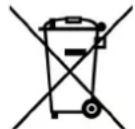
EUROPEAN DIRECTIVE 2002/96/EC (WEEE): INFORMATION FOR THE CONSUMER
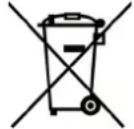
Fig. A
This information is strictly addressed to those who have a product showing the symbol below (Fig.A). This symbol is indicated on the technical data sticker (rating label) placed on the product itself. This symbol indicates that the appliance is considered as Waste Electrical and Electronic Equipment and complies with the European directive 2002/96/EC (WEEE).
Therefore this product is not to be treated as household waste. Instead it shall be handed over to the applicable collection point for the recycling of electrical and electronic equipment or it can be handed back to the retailer when you want to purchase a new equivalent product.
The consumer is responsible for a correct disposal of the product towards an appropriate collection point.
Otherwise the consumer can be exposed to a penalty sanction by laws in force for waste disposal.
Appropriate separate waste collection followed by recycling the product, the treatment and compatible environmental disposal contributes to avoid negative effects towards the environment and health and helps to recycle material which the product is composed of.
For more detailed information regarding the available waste collection systems of this product please contact your local city office or contact the retailer where the product was purchased.
The manufacturers and importers will obey to their responsibility for recycling, treatment and compatible environmental disposal by participating directly and through a joint cooperative system.
EUROPEAN REGULATION NO 1935/2004 - MATERIALS IN CONTACT WITH FOOD. NOTICE TO USERS.

The symbol shown here, which appears on the packaging, indicates that the materials in this product which may come into contact with food are compliant with the requirements of European Regulation No 1935/2004.
Inside the oven chamber, food might come into contact with oven shelves, dripping pans, pastry trays, oven door glazing, rubber gaskets, rotisserie spits, and the sides of the oven itself.
On the hob, contact is possible with pan stands, burners and the hob skin.
In the food-warmer, contact may occur with the sides of the compartment.
RU
Copexahne
BcTyIeHne
Директва 2002/96/EC (WEEE). 26
TexHHueckne daHHbIe H XapaKTePcTHKn 27
YcTaHOBka 28-29
BcHTnJIaHnI NOMCCHN 28
Pa3MeHHe 28
IopKJIIOUeHHe Kra3OpacnpdeJeHTeJbHOc cETn 28
HactpoKaHa pa3JnHbIe TnBt Ra3a 28
3aMeHa KHKJIepOB 28
PeryJnpoBka noaH Bo3dyxa 28
PeryIupOBKa MHHMaJIbHOrO IJaMeHN 29
IoiKJIIOueHHe KJIeKTPocetn 29
3Jektpueckoe 3axnraHne 29
IpeoXpaHHTeBHOcra3OKOHpOJIbHOe yCTPOIcTBO 29
Hnfoopmaaia JIJI noTpeBHTeJei 30-33
Bentnlaa nOmeHH 30
3axnraHne ropeJok 30
BkIIOeHHe ra3OBOn dyXOBKn 30
BkIIOUCHHe ra3OBOrO rpnna 30
PpeOxpaHHTeJIbHOe yCTPOHCTBO r30KoHTpOJr 30
3Jektpnueckoe 3axnraHne 30
HcnoB30BaHHe ra3OBbIX ropeJok pa6oey
IOBepxHocTHIHTbI 30
HcnoB3OBaHnC 3JcktpnccKHX KOHOpok 30
HcnoJIb3oBAHHe ra3OBoi dyXOBKN 30
HcnoB3OBaHHe ra3OBOrO HnH 3JKeTpHuEcKO rPHJ 31
HcnoB3OBaHHe KOHBekunHOHHoT 3JektpueckOn dyXOBKn ...31
HcnoIb3OBaHHe 3JIeKTPHueCKOINyXOBKN C nCTEmoI
BcHTnJIauiu 31
HcnoJb3oBaHHe 3JIeKTPnueckO KOMBHHPOBaHHOH
DyXOBKn 31
3JIKTPUeCKA CTATUeCKA DYXOBKA
CDBYMOOPRAHAMUYNPABJIENH 31
HcnoJb3OBaHHc 3NCKTpHcckO
MHOROΦyHKUHOHaJIbHON DYXOBKN 32
3JEKTPHueCKAR DYXOBKA CCHCTEMOH BEIHINJINH "4" 32
HcnoJIb3OBaIIHe BepTeJa 32
HcnoJb3OBaHne TaHmepa 32
HcnoJb3OBAHnC nporpaMMnpyoUeO
yctpoHCTBa6e3YacOB 32
OTeJIeHnpepaorpeBa TapeJIOK 33
PekomehdaunnoTexnke6e0nacHoc3n 33
PncyHK 58-60
Haia pma 6laorapht Bac 3a Bb6op H nokynky Ondoro H3 HaHHx BbCOKOKaeeCTBHeHbIX H3deHm. Mbl ropno HnceMc, yTO B BauHX pykax HAHN PHTb 6ydyT yHKUHOHPOBaTc MAKHMaJIbHOI OTdAeH N HAUYHMn pe3yJbTaTAMn, ONpaBbBA8 BCE BaHn OKnHaHH. C 3TOI cJIbIO npelnaeraem Bam BHMaTeJBHO IpOHTaTB HactoHiee pyKOBODCTBO H nPndepKHBaCerTex Ero yKa3AHN. IpepeHnTeO npH6pax NHCTeMAX, KOTOpBMn OCHaHnBAHIIa NHTa. AΦpHKa -N3- ROTOBHTeJI CHHMaET Cce6BcKyIO OTBeTcBEHHOCt 3a NOBpeXDeHH. HCHnPabHIOCTn HccuACTHbc CnyH, Bb3BaHIIbe HCCO6NoCHHcEM peKOMeHdaun No yCTaHOBKe HcKnJIyataUNn PINTbI.
-TOI TO,TOBb BbIyckaTb IIHTb B COOTBeCTBHH C COBpeMeHHbIM TCHIOJHuecckHMn PwHm H/Hn DIA NOCTOBHORO IOBBHIN HAeCTBa HaHX H3JeHN, fo6pHKa OCTaJIeT 3a COoB npABO BHeceHN KaKHX-JHbO H3MeHeHH DaXe 63 PpeBapHTeBHorO PpeDynpexdHnn. YTO,ODHAKO, He BblsBACT np6JIem Hn 3AtpyHCHn pN EKCIyatauHn.
- ECJH BO3HHKHT Heo6xOHNOCtB 3aKa3a 3aNacteH, HAO CTeJIb 3aIPOC BaHEMy npOABUY. Ie CJeDyET Yka3aTb HOMep MOeIH H OHomep cepHH NHTb, «PONITAMNOBAHIIIE Ha a6phuHoi ONO3Hae TaBJHO TabeHc. 3Ta TabJUc4 MoKeT b6tB paCNOIOKeHa BHYTpH OTDeHeHn Pa3OTpeBa TaPEJOK (ecJH eCTb) HIN HAaDHe CTOpOE IIHTbl.
- IHTA COOTBETCTBYET HOPMaTHBaM
-CEE2009/142/(ex-90/396)
-2006/95/CE no Hn3Komy HanpXeHHIO (3aMeHReT 73/23/EEC n nocJeyoune
nonpaBkn)
- CEE 2004/108 (po urovn[ radiopomex)
- EBPOIENCKNI PEGIAMEHT Ng 1935/2004 (kontaktirovanie s pi)evymi produktami)
-EBPONEENCKN PEGLAMEHT No 1275/2008
-CEE 40/2002
-CEE92/75
-2002/96/EC(WEEE)
2005/32/CE (Energy-using Products)
IIOJCHEHIE
-BHactoIeMpyKOBOCTBEIpeCTABJHOHT HHTepec TOJIbKO Te npaparpafoHn pa3deJI, rDe roBOpHTbcO pnhopax, KOTOpBMN OchauenaBaHaIINTa.
Директва 2002/96/EC (WEEE):Инфорmaцьдпг NOььзOBaTeJIeN

(pnc.A)
DaHHbIe CBeDeHnI npEHa3NaueHbI IINb ToNko OJr oBnaaTeJe IpmbOpOB, IMHeOuNX CmMBON (PNC. A) Ha cAMOKNeJeuCe 3TNKeTke C TexHnueCKMn DaHHbIMn, HAKneeHHoH Na N3denn (NaCnOpTHa Ta6JIuYka).
3TOT CnMBOI O6OHaueAET, YTO npOdyKUIN KNaaccNpHIpOBaHa NO DeIcTByIOUM HOpMaB B KaueCTBe 3JIeKTPnueCKORO INI INJ3JIeKtpOHHO O6OpYDoBaHnI, INTO OHA COOTBeTCTByET DInpeKtNB2002/96/EC (WEEE).
CneIOBaTeNbHO,B KOHc eCBOero cPOKa 3KcNlIyatauIN OHa
DOJIIXHA nepepaTaTbIBaTbCRA OTDeNbHOOTbTOBbIX OTXoOB,
NYTEM 6ecnnaTHOH CdaU B NyHK TcOpa 3NeKtprueckoro IN
3JeKtpoHHORO oOpdyOBAHNA,NJIN Xe CdaBaE ee DnCTpn6bHOTopy
BMOMeHT NOKyIKN HOBOR,3KBUNBaENTHO O6OpdyOBAHNA.
IOnb3OBaTeNb Hecet OTBcTcBHeHocTh 3a CdaNy npnbopa B KOHueero 3KcNpyataunn B NyHKtbl c6opa BTOpcbipy, B npOTNBOMCnyae K Hemy 6dyT npImeHehbl caHKUIN, ppeDyCMOTpeHHbIE 3aKOHODateJIbCTBOM B oBnaCTn OTXoIOB.
IinΦepeHnnpoBaHHb c6op OTXODOB dnn IX nocJeDyUoSei nepepa6OTKn, o6pa6OTKn u Tynl3aun, COBMecTmblx C OkpykaHoue cpeOn, No3BOJraT n36ExaTb OTPuCaTeNbHO BO3dECTBnHa Na npnpOdy u 3doPobBe, a TaKKe cnOCo6CTByET NOBTOPHOMY nCnOJIb3OBAHnIO MaTePnaJOB, IN3 KOTOpBX IN3rTOBJIeHa npOdykU.
Длл NOлученя 60лee DeТальнои ИнфорmaциоБ ImeIoUxxCnCCTeMax c6opa OTXODB CNeDyET O6paaTbC8 B MeCTHyOcIy6bI NO nepepa6obotke OTXODOB,ИЛN Xe B MaRa3INH, B KOTOpOM 6blkynen np6op.Ppon3BODInTeIN N IMNOpTebpI Hecyt OTBETCTBeHHocTB 3a nepepa6otky,Obpa6otKy uYtNi3aциLO,He 3aTrp3HЯIOUIne OkpykaIOU cyEpy,Kak HENOCpeDCTBeHHO,TaK I yuactByA KOLNEKTNUBHOI CNTeMe.
EBPONEENCKN PEGLAMENT No 1935/2004 - MaTePnaIbI, npEHa3NaeHHBle DnA KOHTaC nIuSeBBIMn IpOdyKTamN. INHOpMaun NOJb3OBaTeJAM.

PnBBeHbHbHa pncyHke cHMBoJ, KOTOpb HmEeTcHa yNaKOBKe, yKa3bBaet Ha To, YTO MaTePnaJIbI 3TOrO N3DeJIa, BO3MOXHO BCTyNaIOUe B KOHTaKT C NIIuSeBbIMN PPOdyKTAMN, COOTBeTCTBYOT Tpe6OBaHnM EBponeckoro perJaMehta Ng 1935/2004.
BHytpn noNoCTn DxyOBKn nIeBbIe npOdykTbI MOrY T BcTyNaTb B KOHTaKT C:peWetKamN DxyOBKn, npOTNBHMy, PINTAMN DnA BblneKn KOHNTEpCKNX n3DeJIn, CTeKNOM DBepCuDxyOBKn, pe3HOBbIMy yNtOHeHnARMn, BepTeJOM, CTeHKAmDxyOBKn.
Ha nIte - c peWetkamn, KOHΦopKamn m MetaJInecko nOBepxHOCTbIO nIITbI.
BraNke dna pa3oRpeBa nuiu-cero cTeHKamn.
T30BbIE TOPEJIKN (KHKJIepbMMOIHIOCTN)
KpyROBOCOPOTHBIEHcDyXOBKN2.0KBT
rpuib 2.0kBT
KpbjIbuaTka 25BT
OCBHeHn dyXOBKn 15BT
HIAHMOHOCTB3JEKTPUECKO DYXOBKN
CTaTHuecka dyXOBka 2,21 KBT
DyXOBKa CCHCTCMOHN BcHTHJAAHH 2.0 KBT
MHOROyHKUHOHaJIbHaA dyXOBKa 2,7 KBT
KaT:cmOTPNΦaOpHHyTO TaJIHKy Ha 06JIOKKe
KJacc 1 JnJxke 2-1
CTCNCHB TcIIIN3OJIAUH X
KOMIIIEKTALIN
IIHTB Bcex MOneJyKOMNJIeKTOBaHbI npOxpaHHTeJIbHbIM yCTPOINCTBOM IIA TpeJIOK DxyOBKn HprJIA.
KpOcTOFO,B3aBHCMOCTHOTMOeJIH,BKOMIIJCKTaUHOIINHTb BXODHT:
-IpdeoxpaHTeHbHoe yCTPOIcTBO rAOKOHTPOJI dIg OHOH HnHECKOJIbKHX TpeJOK paOoey NOBepxHOCTN IINTbI
-3Jektpueeckoe 3aKnHaHne ropeJok paobouen nobepxHocTH
3JcktpHueCKOe 3aKHHnE TOpCIOK DxyOBKn HprnIa
- TepMoperyTOp (HJN KpaH) JIAyXOBKN
3JCKTPHueCCKOCOCBcHHeDyXOBKN
- Bepre
-ΓopeKαДЯгИя
MxhaHnCckn TaHmep
- HcnoJb3ObaHHe nporpaMMpyoIero
yctpoHCTBa6c3acOB
-0nHaHHeckKbko3eKtpueckx KOHΦopok
PACIOLOXHEHNE FOPEJOK HA PAOEHN NOBEPXHOCTN cmotpn mo-EN Ha pncyHke 1 B KOHue HAcToaero pykoBOcTba.
CXEMYIOIKIIOUeyHNAJIEKTPOCETNcmotnHa pncyHke 2B KOHc HAcTOnuCRO pyKOBOCTBa.
3Jektpnuecka MoHOCb yka3Ha Ha pa6pnuHOn ONo3HaBaTeJIbHO TaJIHcK. 3Ta TaIbJIHcKa MOKeT 6bITb pacnoIOKeHa BHyTPn OTDeHe HpaOreBa TaepIOK (ecJIH eCTb) Hn Ha 3aDHe n CToPOHe IIHTb.
OINH K3EMIIp 3TOI Ta6NIUKN HaKJIeCH Ha 0IOXKE HAcTOrIeGPOyKOBOCTBa(ToJIbKO IJRA TAOBIX HIN KOM6HHNPOBAHHIX NINT)
Ione3hie CbeHnB OblaCTn 3HeprnoTpe6JeHn 3NeKtpuecknx DxyxOBok.
3TN CBeHnna 3aBepaIOT n DOnOJIHraIOT INHΦOpMaIIO, npNBeDEHHyIO Ha HAKNeIKe C TexHnueCKIMn DaHHbIMN B pyKOBoDCTBE NO 3KcPnyatauIN
- HN B KOEM CJYUae He 3aTAYBaTB NJINHINE HIXEKTObl
IPOUN3BCJIAAMCHy,INPOKOHPTPOJNPOBA Tb TcPMcTHUHOCTBra3a.BCCX HJKeKTopOB.
3AMEHAKKJIEPA TOPEKIN DYXOBKN (pnc 5)
OTBHTHTB HHT,KPENPAHIN DHO DYXOBKH.
CHrTBdHOdyXOBKn(IpOaBnHyBcROBncPcD)
-BbHytb ropeJky dyXOBKn,OTBnHTNB npeBaPHTeJIbHO KpeIaHne ee BnHT.
-3aMeHHTb KHKJep, HcnoJIb3yra TopueBOI Tpy6aTbI KIOU pa3MePOM 7 MM.
3AMEHAKNEPOB FOPEIKIPTNIA (pnc.6)
CHHMMTe IopeKy, IIpeBaPHTeJIbHO OTKpyTINB JBa KpeIaIIne ee BnHTa
3aMeHHTe JHKnep, HcnoJb3yra TOpueBOI TpyuAtbI KJIou Ha 7 MM.
PEKOMEHDAUHH
- pN yCTaHOBKe JHKJIePOB HNKOTa H3JINHe He 3aTnBaHTe HX KJIIOUOM
- TocJie 3ameHbBceX XnKJIepOB IpoBepbTe Hx Ra3OHeIPOHHae-MOCTb.
PERYJINPOBKAIODAUHBO3DVAXATOPEKKAM
BHHMaTeJbHo paccMOTpHTe HnHexepnBCdCHHyTO TabHcy (opcHTnp BOUHbIe daHHbIe) dIpyrNpOBaHnI npaMeTpHa, BbipaxeHHoro B MM. Ha PNC. 6 JIg rPHJIg.
PpOBepuTb yHKUHOHPOBaHne ropeJIOK
RU
YCTAHOBKA
YCTaHOBNTIPOTHBCHB CAMOM H3y DYXOBKN
-3akpoHTe IBepeIy dyXOBKn, npHcJIOHrae ee K 3aIHTHOIJIahKe.
-3aNyCTHTe BepTeJ,HaXHMma Ha CnEuaHBbHbBbKIOuATEJB. BpcmOT BpcmHn NOINBaHTe KHPOM Mco. Korda Mco 6ydtroTOBO,3aKpyTHTe Ha BepTeJ CnEuaHBHyO PYkU H BBHbTe ero H3 CTyHHbMHKPODBrfAeJIa
b)Длгп�отовьнгь Ha rрисе 3akpbitOn DBepceN.
- KaK yKa3aHO BblIe, 6e3 nCnOJIb3OBaHnI 3aUHTbI pyuKn, KaK nOKa3aHO Ha pnc.13
BHIMAHHE! BHINBepTeJa MORY HmEtb 3aOcPtEHhbc KOHbI, HO3OMy INHcIOJIb3OBaHH INX CJIeYc T IPOBJIbTb OCToPo)HOCTb.
DXYXOBKACTEPMOPEYJARTOPOM
EcHn BO Bpem npHrOToBHeHH nHnn 6yUyT 3aMeueHbI nepeNaDbI TEMHePaTypbH NtKIOHeHHN DeHCTBHTeJIbHOIT EMHePaTypbOT yCtAHOBHeHH, Heo6xOdmo Bb3BaTb CneuHaJIHcTa H PpOBepHTb FyHKUOHPOBaHHe TepMOperyJITopa.
HICIOJIb3OBAHNE MEXAHUeCKOTo TAHMEPA (pHc. 14)
YcTaHOBHTe BpEm, Heo6XoHMoe IJI pHrTOBJIeHN IINH, NO-BopaUHbA pyuKy TaMepa no yacOBOn CTpeJIke. No HCTeueHHN YcTaHOBJIeHHOr BpEmn Bbl ycIbHIte 3BOHOK, N3BeIIaIOHn O6 OKOHaHHn pHiROToBJIeHN.
HcIOJIb3OBAHHe IPOIPOPMMPYIOUeYO YCTPOICTBA E3 YACOB (pnc.15)
3To IporpaMMpyIOoe yCtpoHCTBO IO3BOJnEITIPOrpaMMpOBaHHe BPCMCHN OKOHuaHHI INHROTOBJIChIIINH.
ΦyHKUHNOHPOBaHN.
-YcTaHOBHTeKeJaemoe BpEmr npHrTOBJIeHHa (MaKCHymM 120 MHyT JIJIeKtpueckoI dYXOBKn H MaKCHymM 100 MHyT JIra3OBOH dYXOBKn).
Pn NMOOuHpyK TcpeMOpCryAITopa Bb6cpHTe TcMnCpaTy H yCTAHOBHTe NepeKIOHaTeJIb Ha JeJaEMOM CIOCO6e PnHrTOBJIe HIIa.
-Korda pyka nporpammatopa dnoed no HyleBOro noJIOxehn (0), nHua 6ydt roTOba H dyXOBKa aBTOMaTHueeCKN OTKIOHTc.
- PocJIe 3Toro nepeBeDHTe pyUk TePmOperyJrTota B noJoKeHHe
YcTaHOBHTC NcpeKJIouaTcJIb B HUJCBOc NOJIOXCHNC 0.
TPHMEUAHHE: Be3 HcNoJIb3OBAHHN IporpamMHyIOIeero yCTPOHCTBa DyXOBKa FyHKUHOHpyCT ToJIbKO B TOM Clyuac, KOrda pyka nporpamMaTopa YcTaHOBJIeHa B NoJIOxehHe pyHoro peKIMa,
O6O3HaYCHHOC CHMBOJOM
OTJEIEHNE PA30FPEBA TAPEJIOK
YTo6bl OTKpbItb OTdeneHne pa3orpeBa tapenok noDnHmnte pykoiOTKnHyIO naneBb (CMOpri pnc.16).
TTo6b3aKpbItbOTdEHeHne DOCTaTOHNO ONyCTnTB OTKnHyIO naHeB.
DEMOHTAX DBEPUbyIyXOBKN
BepaMOKETCHIMATbCnIg60JIe yOoBHOn OuHcTKn DyXOBKn, BbIOHRe CNeDyIOUne HNCTpyKUnn:
-NonHOCTbIO OTKpoTe DBepeUy.
- BCTaBbTe DBe MOHeTbI NO 10 ceHToB B DBe ue JIn neTeJIb.
- 3akpoTe DBepuy Do TOrO, KaK Bbl NocYbCTByeTe COnpOTnBJIeHne MoHET (Pnc.17).
- npdoJnkaTe 3aKpbBaTb DBepy, Nocne Yero NOpHmnte ee, B3aBmncb 3a 6oka, n cIeRk a CMeCTnte BnpeEi. Nocne 3tOrO dBepy MoXHO 6ydt JERKO CHrTb.
-ДЯ yCTaHOBK nDBepcIb Ha MeCTO BCTaBbTe NETIN B INx N3HaJaJIbHOe NOJIOKeHne, y6eINBWHScb, YTO OHN NOLHOCTbIO BOUJIIN B rHe3da.
RU
HHΦOPMAUЯДЛЯ NOTPEBNTEJIEN
-3aTeM NOHOCbI ONyCTIe DBepuY N BbIHbTe paHee BCTabJIeHHbIe MOHEtbl.
-3akpoTe DBepy Do NIOXeHn POJHOrO 3akpbTn.
- Bcerda npoBepraTe coxpaHHocb yIINOTHeHn IDBepcIyDyXOBKn; B Cnyae ee n3HOca HemeJeHNO 3aMeHnte ee B cepBCHOM ceHTpe
IIPHHAJIJEKHOCTN DYXOBKN
Ha peHTky dYXOBKN CTABTcH NMeOuHecB HnpOaKe npOTNBHn IINpHROTOBIOHn CnaIKHX 6JIoI, KApKOrO n3 Mca H. McoMOxHO paCNOJIOXHTb IIpMo Ha peHTke,- TaKOH cNOCo6 Ha3bBaCTcR MaCO HA rPHNC.
PpOuBHeB pa3MeaetcnopeWtKo n cnyknt dna c6opacTeKaIooero coka npiroTaBnBaembIX npOdyKToB Ha peWetke. PpOuBHeB MoXHO NcONb3OBaTb n dN rTOBKn 6JIO
-ECINBapka IPOH3BOJNTcB DYXOBKe CCHCTeMOI BEHTHJIAUHH,TO MOXHO ODHOBPCMCHHO NOMCCTHTb DBC PEWETKN. PnH 3TOM HxKHO IMeTB B BVy, YTO eCLN IPODyKTb OTJNUaOTc MEXdy COBIO KAcyeCTBy H KOJIuYeCTBy, To, ECTeCTBeHHO, H CpOKH rTOOBHOCTH MOrTy bblbIMH.
OEUINE PEKOMEHDAUHN H PPEUYIPEKDEEHN IIO TEXHME E3ONA CHOCTN YXOy 3A JINTOH
Ipcd IIO60I ONcpaHcH IO TxO6cIyKHNbHHIO. HCTKE HIN peMOHTy BHyTpH dyXOBKN Be3e, Tde cyuieCTByET ONaCHOCTb CONPHKOCHOBEHNC HAxoJIMHMcN NOI HaPpKeHHEM DeTaJIaMH, OTKJIouaHne PINTy OT JTeKTPoCeTH.
He HcnoIb3yHte OTdeJeHHe pa3OrpeBa TaPeJOK H OTdeJeHHe pa3MeIeHHra3OBORo BaJIIOHa dJI XpaHEHH BOCJIaMeHHIOH XXr KHKocTeH NHN HeycToHbBIX K DeHCTBnIO TempeaTybl MaTePnaIOB, TaKHX KaK DepeBO, 6ymara, a3pO3OJIH, KHKOCTHn Ra3bI NOd DaBJIeHHem, cNNUKn H T. J.
- qacto npOBepnIe coCtOaHHe ⅢaHa,coeHNHIOero pINTy C HcTOUHHKOM NOaun rasa.ObpaHTe BHMaHHe Ha To, UTObOH 6bl IOCTaTOUHO ydaJIeH OT HarpeBaIOHXCS CTCHOK.,UTObHc 6blIO CNbHbIX H3INbOB,NEpeKaTH NIIIOBpeXKeHNI IIIaHaRr. Ipn ObHApYKeHHIOBpeXKeHNI HAO HeMeJLeHHo POnH3BeCTN 3ameHy IIaHaR.B JIObOM cIyuae erO HeoXoHMO 3ameHrtb B ycTaHOBJeHHbI cPok.Oba KOHua IIIaHaRr DOJXbI 6bl3aKepeIJIeHbI pNn IonoHcTaNapTHbIX rapAHTpyHx 6e3ONaCHOCTb 3aKHMOB.
Bcnyac,ecnHco BpeMeHem KpaH noaunra3a6ydet OKpbBaTbC Tpydom,peKOMeHdyetc Bbl3BaTb CneuaJIncta TexHHuecko CJyX6bl.
IJIaOUICTKIN3MaJINHPOBaHHbIXHINXPOMHPOBaHHbIXaCTeI IINTBI pIMHeHITe TEnLyIOMbLYHyIO BDOY HIN Hea6pa3NBbIE MOUHcCpECDtBA.IIg OUICTKNROPcIOK pa6Oey IOBcpxHOCTN IpacCeKaTeJeIJIaMeHNMOXHOHCIOJB3OBaTB MetaJIINueCKyIO 1TOUYI JIAyDAJCHNHaKHIN.AKKypATHO BbICyUNBaNTc OHN IIHbIe NOBepxHOCTH.
-HeIpHMeHnTe a6pa3HBHbIe MOIOuHcpeCTBa IJIa YHCTKN 3MaJIHPOBAHHbIX HIN XpOMHPOBAHHbIX uactcN.
- Ipn YnCTKe CTapaHTecb He 3aHbTaB BoDo npaOuyo NOBepxHocTb H36caHc nonaHaHH BOnbH Nn MOIOcRO CpCCTBa B OTBePcTH RopeJOK.
-Bcerda NODepkHbAHTe B UHCToTe CBeU INJRAHHN (ecnn HMeIOTc) INPocyHHBaHTe HX NOCJIe KaKDOHNCNOB3OBAHNNIINbI, OOC6EHHO ECINB PPOECE PnHROTOBHeHHNHN3 KAcTpOJIb BBtCKaJIa KHIOKCTb.
-ECJH NJIHTA YKOMJIeKTOBaHa CTeKJIHHoN KpbIiKOH, HNKOrJa He 3aKpbIbAIte KpbIiKy Do TcX NOP, NOKa HC OCTbIHyt ROpCLKN HJH 3JIeKTPoKOHfopKn pa6OueH NOBepxHocTH. KpbIIka MoKeT TpeCyTb HJH pa3bHtbcra.
-He noIDBeprAHTe yIapam 3MaJIHPOBaHHbIe qactn IJIHTbI H CBeHN 3JIeKTPo3aXnHaHH (ecJH ecTb).
-He6epntecb3a pykyIJIpeHocApNTbl.
-Данньпрбор Heпpeна3нayehДЯИСNOЛьЗOBAHЯлIOьмIC OрранчehньIMФи3NueckmIM NIN DBIraTeHbHbIMCnOCO6HOCTMn (BKNIOUyAЯ DeTe),JI60 HeONbITbIMN ININ He3HaKOMbIMN C yCTpoiCTBOM,3a NCKIIOUeHMe CnyuaeB pImMeHHeNIAp6oP aND Ha3OpOM NIN CJIeDyR NHTpyKuYMaM LIna,OTBeTCTBeHHORO 3a 6e3OanachocTB.CneNTb,YTObI,DETN HeIrpaJIc n Pp6Opom.
Φa6pHKa - H3ROTOBHTeJIb HC HecET OTBCCTBEHHOCTH 3a NOBpeKdHnH, HeHCnpaBHocTHn HeCuaTbIe CJyuaH, Bb3BaHHbIe
HecobIIOeHHem peKoMeHdauHn NO ycTaHOBKe H 3KcJIyatauHn I.IHTbl.
-ДячNTКСТКЛHнБИДБЕUEДУХOBКНЕСLEДYEETNCOJIb3OBAТгрьileabpa3INBHLeMaTePnAnblINIOCTpIbeMeTaNIIueckneCKpe6KN,TAKKAKOHMOYrnoqapanaTbNOBepxHocTBnpa3NtBcTEKNo.
- He nCnoIb3OBAbT npoBblne noIIpOBuNkn dIy NcCTKn yCtpoNCTBa.
-ДяуctaHOBKNПNTbI NOdYmHe npedyCMOTpeH
BHIMAHHE: IcnoIb3oBAHHe ra3oBOI pINIbIg rOToBKn npINBOJNT KOBpa3oBAHIO n36blTOHOro TEIIa, BNaxKHOCTN INpoDyKTOB rOpEHnB NOMeUeHN, Ige OHa yCTaHOBJeHa. Y6eIntecb, cTO KYXOHoe NOMeUeHne XopoIo npoBeTpNBaeTcR, OC6eHHO pIN BKNIOeHHO pINTE: He 3aKpbIbAIte eCTeCTBeHHbIE BEHTINLAIOHHbIE OTBepCTNIAOTKPOITe INI yCTaHOBInTe yCTpOInCTBO MExaHHeCKoB BeHTINLAICIN (BbTTKKa).
BHIMAHHE: 3Ty nnHTy MoXHO NcNoIb3OaTb TOnbKO dIpynpiroTOBHeHn Hne. He nCNOb3yTe ee dIy INhIx cenei, Hanpimep, dIry o6orpeBa nomeueHn
BcIyHc HcHcPiBaHocTH NHTb,OBHApYKCHN yTcKN rA3a HIN NOBpeKdEHHN 3JIeKTPoPnPoBOdkn HeMeJLeHHO 6pATHTecb B IeHTP TEXO6ClyKHBaHHN II BB3OBNTC CInCuHaJInCTa.
Дя onpeJeHЯ DaTbI BbInyCa npB6opa npOBepTe 9-3HaHbI cepHbI HOMep, yKa3aHHbI Ha cepe6pntO n TtKeTKe, Ha pyKOBoDCTBe NO kCnnyaTaunu H a CamOM np6ope:
AABBCDDD
AA=TOI BbIYCKA (Hanpimep:99=1999,00=2000,uT.IB=HEJIy BbIYCKA (Hapimep:03 TpeTbIeHeJeIraA A) C=ENb BbIYCKA (Hapimep:1=nOHeJeIbHnK HeJeIN BB,2=BTOPHK,
3=cpeda,4=ETBepr,5=NTNua,6=cy660ta)
DDDD: nopAdkOBbHOMep BbyNcKa (HaNPmep: 0004: YeTbeTpA
TNTa, BInyuSeHHaB a DeHb C HeJeN BB rOda AA).
PT
Índice
Introdução
0 145 1,0 kW - Disco Normal
0 145 1,0 kW - Kavovikη Eotia
1,5 kW - Etio Taxeia
0 180 1,5 kW - Kavovikη Eotia
2,0 kW - Etia Taxεiα
IXEIE EETION
katawaviotaon 1,5 kW
Directiva 2002/96/EC (RAEE) .57
Reglamento Europeo n° 1935/2004. .57
Figuras 58-60
0 145 1,0 kW - Placa normal