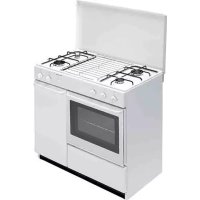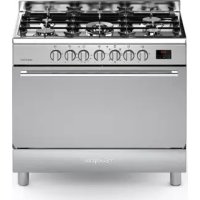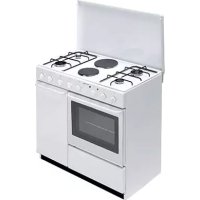
BI940EBL - Cooker BOMPANI - Free user manual and instructions
Find the device manual for free BI940EBL BOMPANI in PDF.



User questions about BI940EBL BOMPANI
0 question about this device. Answer the ones you know or ask your own.
Ask a new question about this device
Download the instructions for your Cooker in PDF format for free! Find your manual BI940EBL - BOMPANI and take your electronic device back in hand. On this page are published all the documents necessary for the use of your device. BI940EBL by BOMPANI.
USER MANUAL BI940EBL BOMPANI
Operating Instructions COOKER
Contents
Warnings 6
Technical data and specifications 18
Installation 19 - 20
Using the safety chain 19
Ventilation 19
Positioning 19
Fitting the feet 19
Balancing the lid 19
Gas cylinder connection 19
Gas connection 19
Adapting to different types of gas 19
Replacing the injectors 19
Minimum setting 19
Electrical connection 19
Electric ignition 20
Safety device 20
For the user 20 - 22
Ventilation 20
Igniting the burners 20
Igniting the gas grill 20
Safety device 20
Electrical switch-on 20
Using the gas hob 20
Using the electric hot-plates 21
Using electric grill with oven electric 21
Using the static electric oven 4 ...... 21
Using oven accessories 21
Removing the oven door....21
European Directive 2012/19/CEE (WEEE) .... 21
European Regulation 1935/2004 22
Figures 23 - 24

Italiano
Avvertenze
- The appliance and its accessible parts become hot during use. Care should be taken to avoid touching heating elements. Children less than 8 years of age shall be kept away unless continuously supervised.
- This appliance can be used by children aged from 8 years and above and persons with reduced physical, sensory or mental capabilities or lack of experience and knowledge if they have been given supervision or instruction concerning use of the appliance in a safe way and understand the hazards involved.
- Children shal not play with the appliance. Cleaning and user maintenance shall not be made by children without supervision.
- WARNING: Unattended cooking on a hob with fat or oil can be dangerous and may result in fire. NEVER try to extinguish a fire with water, but switch off the appliance and then cover flame e.g. with a lid or a fire blanket.
- The internal surfaces of the compartment( where present) may become hot.
- Remove any liquid from the lid before opening it.
- WARNING: Ensure that the appliance is switched off before replacing the lamp to avoid the possibility of electric shock.
- The appliance becomes very hot during use. Care should be taken not to touch the heating elements inside the oven.
- Accessible parts may be hot when the heating element is in use. Keep children well away.
- For direct connection to a power mains, a device that ensures disconnection from the mains must be installed, with a opening distance for the contacts that allows for a complete disconnection under conditions of category III electrical overload, in conformity with the installation instructions.
- Always disconnect the power supply before any work inside the oven or where live parts may be accessed.
- Never use the warming compartment for storing inflammable liquids or items which do not withstand heat, such as wood, paper, aerosol cans, matches, etc.
- Make frequent checks on the rubber connection hose, ensuring that it is well away from hot surfaces, that there are no sharp bends or kinks, and
that it is in good condition. The hose must be replaced at the latest at the indicated date and must be secured at both ends using a standard hose clamp.
- If taps become stiff to operate over time, contact the After-Sales service.
- Wash enamelled or chrome-plated parts with soapy lukewarm water or non-abrasive detergents. A metal brush may be used to remove deposits from hob burners and flame caps. Dry thoroughly.
- Never use abrasives to clean enamelled or chrome-plated parts.
- Do not use too much water when washing the hob. Take care that no water or other substances enter the burner housing holes, as this may be dangerous.
- The spark plugs for electric ignition must be kept clean and dry; always check after use, particularly if there have been drips or overflows from pans.
- Never close glass lids until the hob burners or hotplates have cooled completely; it might shatter or crack.
- Never knock enamelled parts or ignition spark plugs (where present).
- The main or wall gas tap should be turned off when the cooker is not in use.
- Never move the cooker by means of the handle.
- Do not clean the glass doors of the oven with rough, abrasive materials or sharp metal scrapers, since they may scratch the surface and cause the glass to shatter.
- Do not use vapor jets to clean the appliance.
- The cooker does not have an installation stand.
- The appliance is not intended to be controlled by an external timer or a separate remote control device.
- CAUTION: The use of a gas cooking appliance results in the production of heat, moisture and products of combustion in the room in which it is installed. Ensure that the kitchen is well ventilated especially when the appliance is in use: keep natural ventilation holes open or install a mechanical ventilation device (mechanical extractor hood).
- CAUTION: This appliance is for cooking purposes only. It must not be used for other purposes, for example room heating.
No liability is accepted for injury or damage caused by poor installation or improper use of the cooker.
In case of malfunctions, particularly gas leaks or short-circuits, contact your engineer without delay.
IT
Introduzione
USO ACCESSORI DEL FORNO
ø 145 1,0 kW - Plaque Normale
∅ 180 1,5 kW - Plaque Normale
PUISSANCES DES ELEMENTS
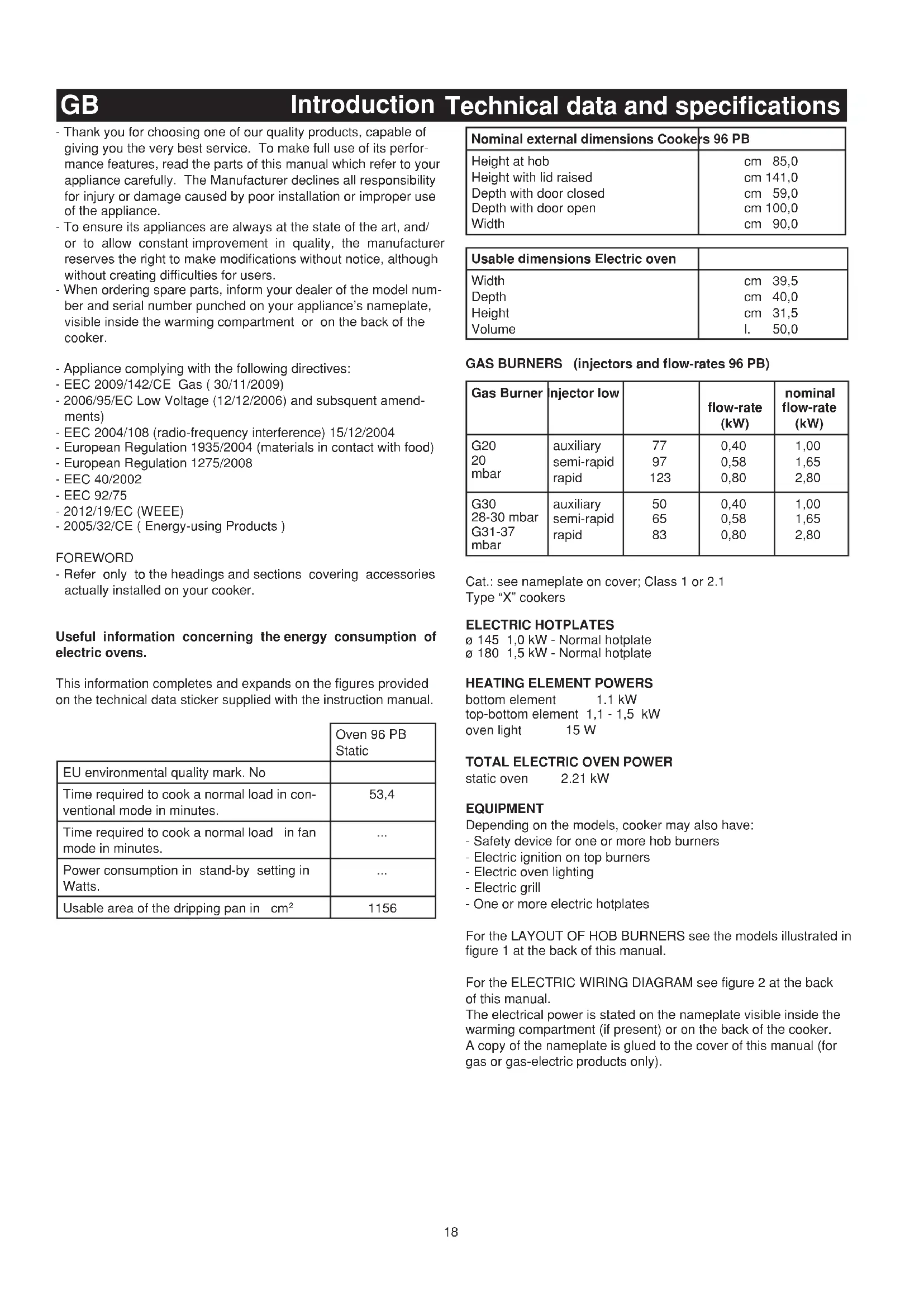
Introduction Technical data and specifications
- Thank you for choosing one of our quality products, capable of giving you the very best service. To make full use of its performance features, read the parts of this manual which refer to your appliance carefully. The Manufacturer declines all responsibility for injury or damage caused by poor installation or improper use of the appliance.
- To ensure its appliances are always at the state of the art, and/or to allow constant improvement in quality, the manufacturer reserves the right to make modifications without notice, although without creating difficulties for users.
-
When ordering spare parts, inform your dealer of the model number and serial number punched on your appliance's nameplate, visible inside the warming compartment or on the back of the cooker.
-
Appliance complying with the following directives:
- EEC 2009/142/CE Gas (30/11/2009)
- 2006/95/EC Low Voltage (12/12/2006) and subsequent amendments)
- EEC 2004/108 (radio-frequency interference) 15/12/2004
- European Regulation 1935/2004 (materials in contact with food)
- European Regulation 1275/2008
- EEC 40/2002
- EEC 92/75
- 2012/19/EC (WEEE)
- 2005/32/CE (Energy-using Products)
FOREWORD
- Refer only to the headings and sections covering accessories actually installed on your cooker.
Useful information concerning the energy consumption of electric ovens.
This information completes and expands on the figures provided on the technical data sticker supplied with the instruction manual.
| Oven 96 PB Static | |
| EU environmental quality mark. No | |
| Time required to cook a normal load in conventional mode in minutes. | 53,4 |
| Time required to cook a normal load in fan mode in minutes. | ... |
| Power consumption in stand-by setting in Watts. | ... |
| Usable area of the dripping pan in cm^2 | 1156 |
| Nominal external dimensions Cookers 96 PB | |
| Height at hob | cm 85,0 |
| Height with lid raised | cm 141,0 |
| Depth with door closed | cm 59,0 |
| Depth with door open | cm 100,0 |
| Width | cm 90,0 |
| Usable dimensions Electric oven | |
| Width | cm 39,5 |
| Depth | cm 40,0 |
| Height | cm 31,5 |
| Volume | l. 50,0 |
GAS BURNERS (injectors and flow-rates 96 PB)
| Gas Burner | njector low | flow-rate (kW) | nominal flow-rate (kW) | |
| G20 | auxiliary | 77 | 0,40 | 1,00 |
| 20 | semi-rapid | 97 | 0,58 | 1,65 |
| mbar | rapid | 123 | 0,80 | 2,80 |
| G30 | auxiliary | 50 | 0,40 | 1,00 |
| 28-30 mbar | semi-rapid | 65 | 0,58 | 1,65 |
| G31-37 mbar | rapid | 83 | 0,80 | 2,80 |
Cat.: see nameplate on cover; Class 1 or 2.1
Type "X" cookers
ELECTRIC HOTPLATES
∅ 145 1,0 kW - Normal hotplate
∅ 180 1,5 kW - Normal hotplate
HEATING ELEMENT POWERS
bottom element 1.1 kW
top-bottom element 1,1 - 1,5 kW
oven light 15 W
Depending on the models, cooker may also have:
- Safety device for one or more hob burners
- Electric ignition on top burners
- Electric oven lighting
- Electric grill
- One or more electric hotplates
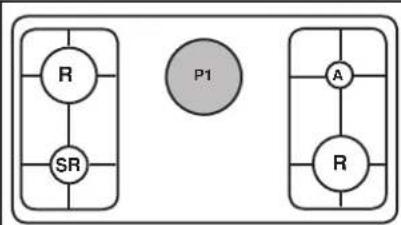
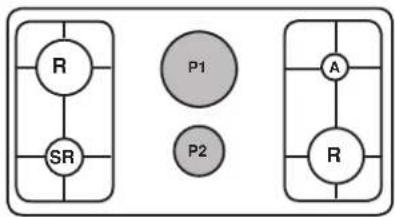
For the LAYOUT OF HOB BURNERS see the models illustrated in figure 1 at the back of this manual.
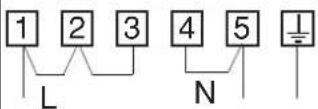
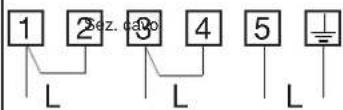
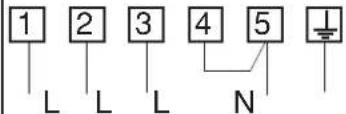
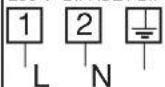
For the ELECTRIC WIRING DIAGRAM see figure 2 at the back of this manual.
The electrical power is stated on the nameplate visible inside the warming compartment (if present) or on the back of the cooker.
A copy of the nameplate is glued to the cover of this manual (for gas or gas-electric products only).
GB
Installation
INSTALLATION
The appliance must be installed by qualified staff working in accordance with the regulations in force.
Before installing, ensure that the appliance is correctly preset for the local distribution conditions (gas type and pressure). The presetings of this appliance are indicated on the nameplate shown on the cover. This appliance is not connected to a flue gas extractor device. It must be installed and connected in accordance with the regulations in force. This appliance may only be installed and may only operate in rooms permanently ventilated in accordance with national regulations in force.
SAFETY CHAIN
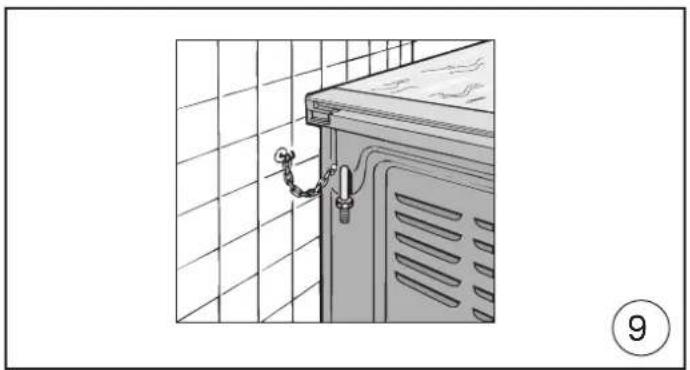
! In order to prevent the appliance from overturning accidentally, for example in case of a children climbing onto the oven door, the safety chains MUST be installed!
The cooker is provided with safety chains that must be fixed with a screw (not supplied as accessory) on the wall behind the appliance, at the same height as the fixing point on the appliance.
Make sure that the chains are fixed in the back of the cooker, as shown in the fig. 9, in such way to be tight and parallel to the floor. ! When the installation process is complete, the chains must be kept in tension!
VENTILATION
The rooms in which gas appliances are installed must be well ventilated in order to allow correct gas combustion and ventilation. The air flow necessary for combustion is at least 2 m^-3/h for each kW of rated power.
POSITIONING
Remove the packaging accessories, including the films covering the chrome-plated and stainless steel parts, from the cooker.
Position the cooker in a dry, convenient and draft-free place. Keep at an appropriate distance from walls which may be damaged by heat (wood, linoleum, paper, etc.).
The cooker may be free-standing (class 1) or between two units (in class 2 st 2-1) the sides of which must withstand a temperature of 100^ C and which must not be higher than the working table.
FITTING THE FEET (LEVELLING)
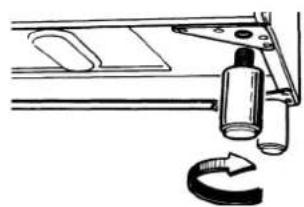
Cookers are equipped with adjustable feet to be screwed into their front and rear corners respectively. The feet allow the height of the appliance to be adjusted, in order to set it flush with the adjoining unit, to level it with other worktops and to ensure even distribution of the liquids in pans. See fig. 3.
BALANCING THE LID
Models equipped with plate glass lids are fitted with special balanced springs. These are fitted into the hinge to provide smooth, gentle lid closure.
GAS CYLINDER CONNECTION
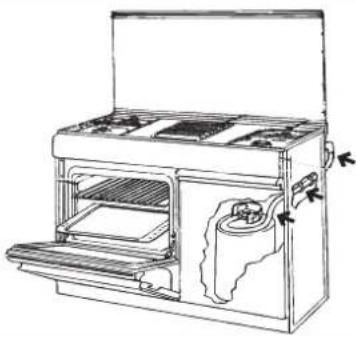
Make the connection to the butane-propane cylinder using an approved hose from 75 to 80 cm long, following the route shown in figure 4. The hose must not touch the side near the oven. The maximum gas cylinder size is diameter 31 cm and height 60 cm, with capacity from 10 to 13 kg.
CONNECTING TO THE GAS SUPPLY
Before connecting the cooker, check that it is preset for the gas to be used. Otherwise, make the conversion as described in the section headed "Adapting to different gas types". The connection is on the right; if the pipe has to pass behind the cooker, it must be kept low down where the temperature is about 50 degrees C.
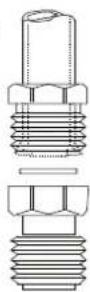
- Rigid connection (see Figure 5, diagram D):
The connection to the mains gas supply may be made using a rigid metal pipe (D). Remove the hose connector and screw the rigid union onto the threaded connection of the gas train. The union for rigid connection is amongst the cooker accessories.
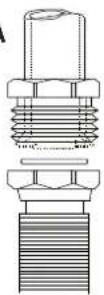
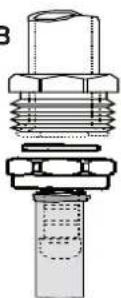
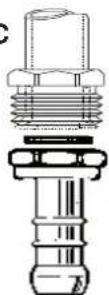
- Connection using a rubber hose (see Figure 5, diagrams B and C):
Connect a rubber hose carrying the conformity mark currently in force to the hose connector. The hose must be replaced at the date indicated, and must be secured at both ends using standard hose clamps. It must be absolutely accessible to allow its condition to be checked along its entire length.
- Connection using a metal hose (see Figure 5, diagram D):
Make the connection using a hose which complies with national standards, screwing it onto the connector with a ring seal, which is delivered amongst the cooker accessories.
- After installation, check that all connections are airtight.
- For operation with butane/propane, check that the gas pressure is as indicated on the nameplate.
IMPORTANT:
- Use only standard rubber hoses. For LPG, use a hose which complies with the national regulations in force.
- Avoid sharp bends in the pipe and keep it well away from hot surfaces.
References to the regulations covering the gas connection to the appliance: ISO 7-1.
ADAPTING TO DIFFERENT TYPES OF GAS
If the cooker is not already preset to operate with the type of gas available, it must be converted. Proceed as follows:
- Replace the injectors (see table on page 18);
- regulate the primary air flow;
- regulate the minimum settings.
N.B.: every time you change the type of gas, indicate the new type of gas on the serial number label.
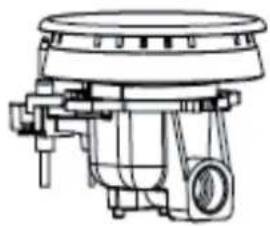
REPLACING THE HOB BURNER INJECTORS (Fig. 6)
- Remove the grid, the burner caps (A), and the burners (B);
- Unscrew and remove the injector in the bottom of each injector holder (C);
- replace the injector in accordance with the table in page 18 using a 7 mm socket wrench, tighten and screw right down;
- check that the system is gas-tight;
- replace the burners, the burner caps and the grid.
IMPORTANT:
- Never over-tighten the injectors;
- after replacing, check that all the injectors are airtight.
SETTING HOB BURNER MINIMUM LEVELS
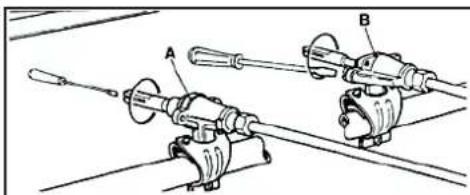
If the cooker is to work on bottled gas (butane/propane), the tap by-pass must be screwed right down. The cooker may be equipped with type A taps, with by-pass inside (accessed by inserting a small screwdriver into the rod) or type B taps, with by-pass on the outside on the right (accessed directly). See figure 7.
If the cooker is to work on natural gas, proceed as follows for both types of tap:
- Ignite the burner at maximum flame;
- pull off the knob, without using a lever against the control panel, which might be damaged;
- access the by-pass with a small screwdriver and back off by about 3 turns (turning the screwdriver anti-clockwise);
- turn the tap rod anti-clockwise again until it stops: the burner will be at maximum flame;
- screw the by-pass slowly back in, without pushing the screw-driver, until the flame has apparently shrunk to 1/4 of the maximum size, checking that it is sufficiently stable even in quite strong draughts.
CONNECTING TO THE ELECTRICAL MAINS
Before making the connection, check that:
- the mains voltage is as indicated on the nameplate;
- the earth connection is in good working order.
If the appliance power lead is not fitted with a plug, use an approved standard type, remembering that:
- the green-yellow wire must be used for the earth connection;
- the blue wire is the neutral;
GB
Installation
For the user
- the brown wire is live;
- the lead must never touch hot surfaces over about 75 degrees C;
- replacement leads must be of type H05VV-F of suitable size (see diagrams in fig. 2).
- if the appliance is supplied without lead, using type H05VV-F cable of suitable size (see diagrams in fig. 2).
The plug must be easily accessible after the appliance is installed.
IMPORTANT: the manufacturer declines all liability for damage due to failure to comply with the regulations and standards in force. Check that the appliance is correctly connected to the earth (see diagrams in fig. 2 at the back of the manual).
FOR COOKERS WITH ELECTRIC IGNITION
If no spark is generated, do not keep on trying as this might damage the generator.
Possible causes of malfunctions:
- spark plug damp, dirty or broken;
- electrode-burner gap not correct;
- spark plug wire broken or without sheathing;
- spark discharging to earth (to other parts of the cooker);
- generator or microswitch damaged;
- air has built up in the pipes (particularly if the cooker has been out of use for a long time);
- air-gas mixture incorrect (poor fuel setting).
THE SAFETY DEVICE
To check that the valve is working properly, proceed as follows:
- ignite the burner and leave it to work for about 3 minutes;
- turn off the burner by returning the knob to off position (●);
- after 90 seconds for hob burners, 60 seconds for oven and grill burners, turn the knob pointer to the "on" position;
- release the knob in this position and move a burning match towards the burner; IT MUST NOT IGNITE.
Time needed to excite the magnet during ignition: 10 seconds approx.
Automatic tripping time, after flame has been turned off: not more than 90 seconds for hob burners; not more than 60 seconds for oven and grill burners.
IMPORTANT:
- Before doing any work inside the cooker, disconnect the mains plug and shut the gas tap.
- Never use matches to check the gas circuit for leaks. If a specific control device is not available, foam or very soapy water can be used.
- When re-closing the hob, check that the electrical wires of the spark plugs (if present) are not close to the injectors, so that they cannot run across them.
HOW TO USE THE COOKER
VENTILATION
All gas cooking appliances produce heat and moisture in the rooms where they are installed. Take care to ensure that the kitchen is well ventilated; keep the ventilation openings unobstructed or install an extractor hood with fan.
In case of intensive or prolonged use, additional ventilation may be required; open a window, or increase the extractor fan power.
IGNITING THE HOB BURNERS
- Press the knob and turn it anti-clockwise until it reaches the symbol on the control panel (maximum flame position);
- at the same time, move a burning match towards the burner head;
- to reduce the flame, turn the knob further in the same direction until its pointer is against the symbol (minimum flame position).
FOR HOB BURNERS EQUIPPED WITH SAFETY DEVICE
- Press the knob and turn it anti-clockwise until it reaches the symbol on the control panel (maximum flame position);
- move a burning match towards the burner, keeping the knob pressed right dow for about 10 seconds;
- then release the knob and check that the burner remains on. Otherwise, repeat the operation.
SAFETY DEVICE
Burners equipped with this device have the advantage that they are protected if they accidentally go out. If this occurs, the supply of gas to the burner concerned is automatically cut off, preventing the hazards deriving from a leak of unburnt gas. The gas supply must be cut off within no more than 60 seconds for the oven and grill burners or 90 seconds for the hob burners.
FOR COOKERS WITH ELECTRIC IGNITION
All the above applies, except that the match is no longer required; a spark is obtained by pressing the button on the control panel once or more, or by pressing the knob of the burner to be ignited. If electronic ignition is difficult with some types of gas, set the knob on the low (small flame) setting.
- For cookers with electric ignition of the oven and grill burners, ensure the oven door is completely open when these burners are ignited;
- Do not operate the ignition device for more than 10 seconds when igniting the oven and grill burners. If the burner has not lit after these 10 seconds, stop using the device, leave the door open and wait one minute before trying again to ignite the burner. If the ignition device malfunctions again, light the burner with a match and call the after-sales service.
IMPORTANT:
- Difficulty in igniting burners is normal if the cooker has been out of use for some time. The air accumulated in the pipes will be expelled in a few seconds;
- Never allow too much unburnt gas to flow from the burners. If ignition is not achieved within a relatively short time, repeat the procedure after returning the knob to the off position (●)
- when the oven and grill are lit for the first time, a smell may be noticed and smoke may come out of the oven. This is because of the surface treatment and oily residues on the burners.
HOW TO USE THE HOB BURNERS
Use pans of diameter suitable for the burner type. The flames must not project beyond the base of the pan. Recommended sizes:
- for auxiliary burners = pans of at least 8 cm
- for semi-rapid burners = pans of at least 14 cm
- for rapid burners = pans of at least 22 cm.
N.B.: Never keep the knob at settings between the maximum flame symbol 🔊 and the off position ( 🔊.
FOR COOKERS EQUIPPED WITH ELECTRIC HOTPLATES
The different heat settings are obtained as follows:
- 1 = minimum setting for all hotplates;
- 6 = maximum setting for normal and rapid hotplates (with red disc);
- 0 = off.
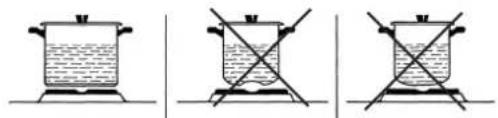
Pans must never be smaller in diameter than the hotplates and their bottoms must be as flat as possible (see fig. 8).
IMPORTANT:
- Never leave hotplates on without pans, except when first used; leave for about 10 minutes to dry oil or moisture residues;
- if the hotplate is to be out of use for a long time, apply a little grease to its painted surface;
- do not allow spills to burn onto the hotplate, requiring the use of abrasive cleaners.
HOW TO USE THE ELECTRIC GRILL WITH ELECTRIC OVEN
- For models with “Electric Oven” only, controlled by two knobs separately (selector-thermostat), grilling is permitted with the door closed, without using the front side. Temperatures above 200°C. must not be used when grilling with the door closed.
- ignite the grill heating element;
- place the foods on the chrome-plated shelf;
- insert on the highest runner;
- insert the drip tray on the bottom runner;
- gently close the oven door;
- after a few minutes, turn the food to expose the other side to the infrared radiation (the cooking time depends on the type of food and personal taste).
To see table "Food to be grilled"
The grill element in the top of the oven is switched on by turning the thermostat knob clockwise to the grill symbol on the control panel.
The red light will come on to show the element is in operation.
| Food to be grilled | Time minutes | |
| 1st side | 2nd side | |
| Thin pieces of meat | 6 | 4 |
| Fairly thick pieces of meat | 8 | 5 |
| Thin fish or fish without scale | 10 | 8 |
| Fairly thick fish | 15 | 12 |
| Sausages | 12 | 10 |
| Toasted sandwiches | 5 | 2 |
| Small poultry | 20 | 15 |
The appliance becomes very hot during use. Care should be taken not to touch the heating elements inside the oven.
IMPORTANT: accessible parts may be hot when the grill is in use! Keep children well away.
STATIC ELECTRIC OVEN 4
With different heating elements controlled using a selector switch and regulated by a thermostat, starting from the 0 (off) position, as the knob is turned clockwise the settings available are:
- symbol ☐: the oven light is switched on (it will always remain on even when the knob pointer is turned to the other settings).
- symbol □: grill (in top of oven) is switched on.
- symbol :roaster switches on with grill on.
- symbol □:oven top and bottom elements switch on (conventional cooking function).
N.B. - The yellow light switches on and off as the thermostat is tripped. Before placing food for cooking inside, allow the oven to heat up for at least 10 minutes.
HOW TO USE OVEN ACCESSORIES
- The oven shelf is designed to take normal oven dishes for cooking sweets or roasts, or is used without a pan for cooking foods under the grill.
- The drip pan under the grill is used to collect juices, which drip from the food that is cooked directly on the grill. The drip pan can also be used for cooking
- Remember that cooking times may vary if food is cooked on two shelves at the same time.
- The oven is provided with a stop system to extract the racks and prevent them from coming out of the oven (1). As shown in the drawing, to extract them completely, simply lift the racks, holding them on the front part, and pull (2), see fig.10
REMOVING THE OVEN DOOR
The door can be removed to clean the oven in an easier way following this instructions:
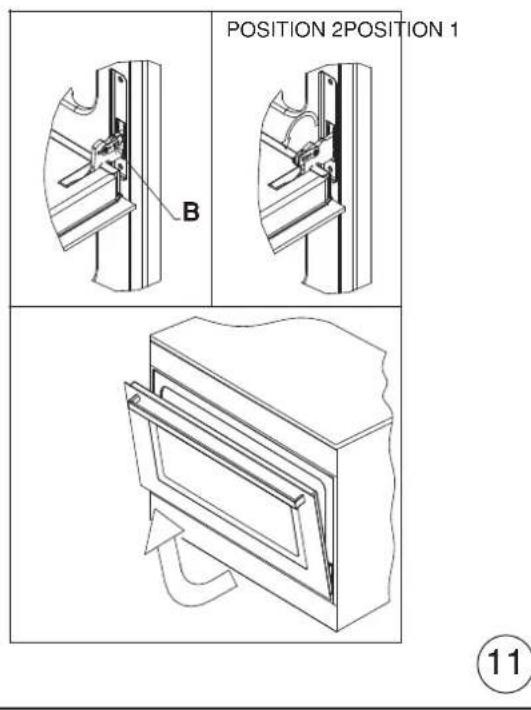
1) Open the door completely.
2) Turn the two levers "B" bringing them from position 1 to position 2 (see fig.11).
3) Close the door slowly to a stop, grab it with both hands from side to side, close it further and pull it by lifting it upwards.
4) To replace the door you must follow the procedure in reverse order, insert the two hinges in their seats and open the door completely.
5) Turn the two levers "B" bringing them back in position 1.
6) Close the door normally.
EUROPEAN DIRECTIVE 2012/19/EEC (WEEE): INFORMATION FOR THE CONSUMER

Fig. A
This information is strictly addressed to those who have a product showing the symbol below (Fig.A). This symbol is indicated on the technical data sticker (rating label) placed on the product itself. This symbol indicates that the appliance is considered as Waste Electrical and Electronic Equipment and complies with the European directive 2012/19/EEC (WEEE).
Therefore this product is not to be treated as household waste. Instead it shall be handed over to the applicable collection point for the recycling of electrical and electronic equipment or it can be handed back to the retailer when you want to purchase a new equivalent product.
The consumer is responsible for a correct disposal of the product towards an appropriate collection point.
Otherwise the consumer can be exposed to a penalty sanction by laws in force for waste disposal.
Appropriate separate waste collection followed by recycling the product, the treatment and compatible environmental disposal contributes to avoid negative effects towards the environment and health and helps to recycle material which the product is composed of. For more detailed information regarding the available waste collection systems of this product please contact your local city office or contact the retailer where the product was purchased.
The manufacturers and importers will obey to their responsibility for recycling, treatment and compatible environmental disposal by participating directly and through a joint cooperative system.
EUROPEAN REGULATION NO 1935/2004 – MATERIALS IN CONTACT WITH FOOD. NOTICE TO USERS.

The symbol shown here, which appears on the packaging, indicates that the materials in this product which may come into contact with food are compliant with the requirements of European Regulation No 1935/2004.
Inside the oven chamber, food might come into contact with oven shelves, dripping pans, pastry trays, oven door glazing, rubber gaskets, rotisserie spits, and the sides of the oven itself.
On the hob, contact is possible with pan stands, burners and the hob skin.
In the food-warmer, contact may occur with the sides of the compartment.
flowchart
graph TD
    A["R"] --> B["SR"]
    C["P1"] --> D["R"]
    E["A"] --> F["R"]
    style P1 fill:#ccc
    style A fill:#fff,stroke:#000
    style C fill:#ccc,stroke:#000
    style E fill:#fff,stroke:#000
A = AUSILIARIO
=AUXILIAIRE
=AUXILIARY
SR = SEMIRAPIDO
= SEMIRAPIDE
= SEMI-RAPID
R = RAPIDO
= RAPIDE
= RAPID
flowchart
graph TD
    subgraph LeftSquare
        R1["R"] --> R2["SR"]
        R2 --> R3["SR"]
    end
    subgraph RightSquare
        P1["P1"] --> P2["P2"]
    end
    R1 --> P1
    R2 --> P2
    P1 --> A["A"]
    P2 --> R3["R"]
    style P1 fill:#ccc
    style P2 fill:#ccc
    style A fill:#fff
    style R1 fill:#fff
    style R2 fill:#fff
    style P1 fill:#ccc
    style P2 fill:#ccc
P1 = PIASTRA ∅ 180
= PLAQUE ∅ 180
= HOTPLATE ∅ 180
P2 = PIASTRA ∅ 145
= PLAQUE ∅ 145
= HOTPLATE ∅ 145
1
SChEMA DI COLLEGAMENTO SChEMA DES BRANCHEMENTS CONNECTION DIAGRAM
230 V BIFASE / BIPHASE / TWO-PHASE
400 V MONOFASE + NEUTRO / MONOPHASE + NEUTRE / SINGLE-PHASE + NEUTRAL
Sez. cavo
Section câble
Wire gauge
3×6 mm²
230 V TRIFASE / TRIPHASE / THREE-PHASE
Section câble
Wire gauge
4×4 mm²
400 V TRIFASE + NEUTRO / TRIPHASE + NEUTRE / THREE-PHASE + NEUTRAL
text_image
1 2 3 4 5 L L L NSez. cavo
Section câble
Wire gauge
5×2.5 mm²
230 V BIFASE / BIPHASE / TWO-PHASE
Sez. cavo
3.5 kW
2,2 - 3,5 kW
0 - 2.2 kW
3x2.5 mm²
3×1.5 mm²
3×1 mm²
Section cable
Wire gauge
2
natural_image
Diagram of a mechanical assembly with a cylindrical component and a curved arrow indicating rotation (no text or symbols)3
natural_image
Line drawing of a portable oven with grilles and a lid, showing internal compartments and ventilation duct (no text or symbols)4
A
B
C
D
5
natural_image
Technical line drawing of a mechanical device with no visible text or symbolsA
— B
C
6
natural_image
Technical line drawing of two mechanical components labeled A and B, with no visible text or symbols.7
text_image
Diagram showing three experimental setups with heating and cooling cycles, each marked with a cross symbol indicating resistance or pressure.8
Figure/Figures/Figures
natural_image
Diagram of a cabinet or enclosure with a chain attached to the door, set against a tiled wall background (no text or symbols)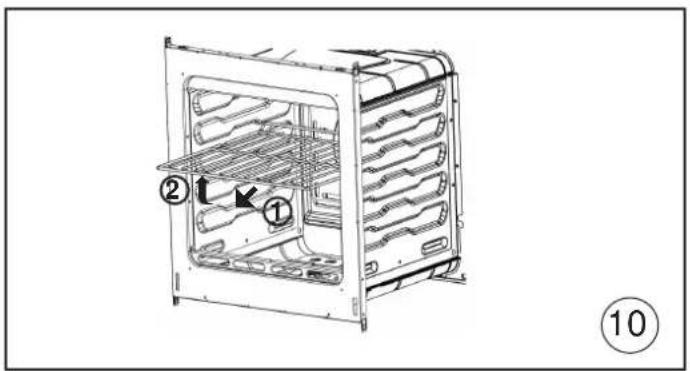
text_image
Technical diagram of an oven with labeled parts and numbered annotations