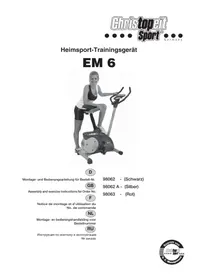
EM 6 - Exercise bike Christopeit - Free user manual and instructions
Find the device manual for free EM 6 Christopeit in PDF.


| Technical Features | Christopeit EM 6 exercise bike with magnetic resistance, 8 resistance levels, LCD screen displaying time, distance, calories, and speed. |
|---|---|
| Dimensions | Dimensions: 108 x 45 x 130 cm, Weight: 25 kg. |
| Usage | Ideal for home training, suitable for users of all levels, easy to assemble and use. |
| Maintenance | Regularly check the tightening of screws and bolts, clean the frame and components after use. |
| Safety | Use on a flat surface, ensure the bike is stable before starting training, do not exceed the recommended maximum weight. |
| General Information | 2-year warranty, customer support available for technical assistance, user manual included. |
Frequently Asked Questions - EM 6 Christopeit
User questions about EM 6 Christopeit
0 question about this device. Answer the ones you know or ask your own.
Ask a new question about this device
Download the instructions for your Exercise bike in PDF format for free! Find your manual EM 6 - Christopeit and take your electronic device back in hand. On this page are published all the documents necessary for the use of your device. EM 6 by Christopeit.
USER MANUAL EM 6 Christopeit
Assembly and exercise instructions for Order No.
F
Programme 2 -7: Fitness
- Summary of Parts Page 3 - 4
- Important Recommendations and Safety Information Page 15
- Parts List Page 16 - 17
- Assembly Instructions With Exploded Diagrams Page 18 - 20
- Computer instructions Page 21 - 24
- Training Instructions Page 24
Dear customer,
We congratulate you on your purchase of this home training sports unit and hope that we will have a great deal of pleasure with it. Please take heed of the enclosed notes and instructions and follow them closely concerning assembly and use.
Please do not hesitate to contact us at any time if you should have any questions.
Important Recommendations and Safety Instructions
Our products are all tested and therefore represent the highest current safety standards. However, this fact does not make it unnecessary to observe the following principles strictly.
- Assembly the machine exactly as described in the installation instructions and use only the enclosed, specific parts of the machine contained in the parts list. Before assembling, verify the completeness of the delivery against the delivery notice and the completeness of the carton against the parts list in the installation and operating instructions.
- Check the firm seating off all screws, nuts and other connections before using the machine for the first time and at regular intervals to ensure that the trainer is in a safe condition.
- Set up the machine in a dry, level place and protect it from moisture and water. Uneven parts of the floor must be compensated by suitable measures and by the provided adjustable parts of the machine if such are installed. Ensure that no contact occurs with moisture or water.
- Place a suitable base (e.g. rubber mat, wooden board etc.) beneath the machine if the area of the machine must be specially protected against indentations, dirt etc.
- Before beginning training, remove all objects within a radius of 2 metres from the machine.
- Do not use aggressive cleaning agents to clean the machine and employ only the supplied tools or suitable tools of your own to assemble the machine and for any necessary repairs. Remove drops of sweat from the machine immediately after finishing training.
- Your health can be impaired by incorrect or excessive training. Consult a doctor before beginning a planned training programme. He can define the maximum exertion (pulse, Watts, duration of training etc.) to which you may expose yourself and can give you precise information on the correct posture during training, the targets of your training and your diet. Never train after eating large meals.
- Only train on the machine when it is in correct working order. Use original spare parts only for any necessary repairs.
- When setting the adjustable parts, observe the correct position and the marked, maximum setting positions and ensure that the newly adjusted position is correctly secured.
- Unless otherwise described in the instructions, the machine must only be used for training by one person at a time.
- Wear training clothes and shoes which are suitable for fitness training with the machine. Your clothes must be such that they cannot catch during training due to their shape (e.g. length). Your training shoes should be
appropriate for the trainer, must support your feet firmly and must have non-slip soles.
- If you notice a feeling of dizziness, sickness, chest pain or other abnormal symptoms, stop training and consult a doctor.
- Never forget that sports machines are not toys. They must therefore only be used according to their purpose and by suitably informed and instructed persons.
- People such as children, invalids and handicapped persons should only use the machine in the presence of another person who can give aid and advice. Take suitable measures to ensure that children never use the machine without supervision.
- Ensure that the person conducting training and other people never move or hold any parts of their body into the vicinity of moving parts.
- At the end of its life span this product is not allowed to dispose over the normal household waste, but it must be given to an assembly point for the recycling of electric and electronic components. You may find the symbol on the product, on the instructions or on the packing.
The materials are reusable in accordance with their marking. With the re-use, the material utilization or the protection of our environment. Please ask the local administration for the responsible disposal place.
-
This machine is a speed-independent machine.
-
The machine is equipped with 16-speed resistance adjustment. This makes it possible to reduce or increase the braking resistance and thereby the training exertion. Pressing the button " - " for the resistance setting towards stage 1 reduces the braking resistance and thereby the training exertion. Pressing the button "+" for the resistance setting towards stage 16 increases the braking resistance and thereby the training exertion.
- The maximum permissible load (=body weight) is specified as 150kg .
Parts List - Spare Parts List EM 6 Order No.98062,98062A,98063
Technical data: Issue: 01.10.2008
Ergometer of class HA/EN 957-1/5 with high accuracy
Magnetic brake system with approx. 8 KG fly wheel
Motor- and Computer-controlled resistance, with 16 manually adjustable load steps
6 installed programs; 3 heart rate programs; 4 individual programs
1 speed independent program, power control in steps of 10 Watt (30 - 300 Watt)
1 Body fat program; Hand Pulse measurement; handlebar adjustable
Saddle horizontally- vertically- and inclination adjustable
Wheels for easier transportation; Power plug (Adapter)
Computer, showing at same time: Speed, time, distance, approx. calories, body fat analysis,
Pedal revolutions per minute, Watt and heart rate.
Input of limits for time, distance and approx. calories
Announcement of higher limits and Fitness test announcement
Max. body weight 150 KG
Space requirement approx. L 112, W 56, H 140 cm
Please check after opening the packing that all the parts shown in the following parts lists are there. Once you are sure that this is the case, you can start assembly.
Please contact us if any components are defective or missing, or if you need any spare parts or replacements in future:
Assembly Instructions
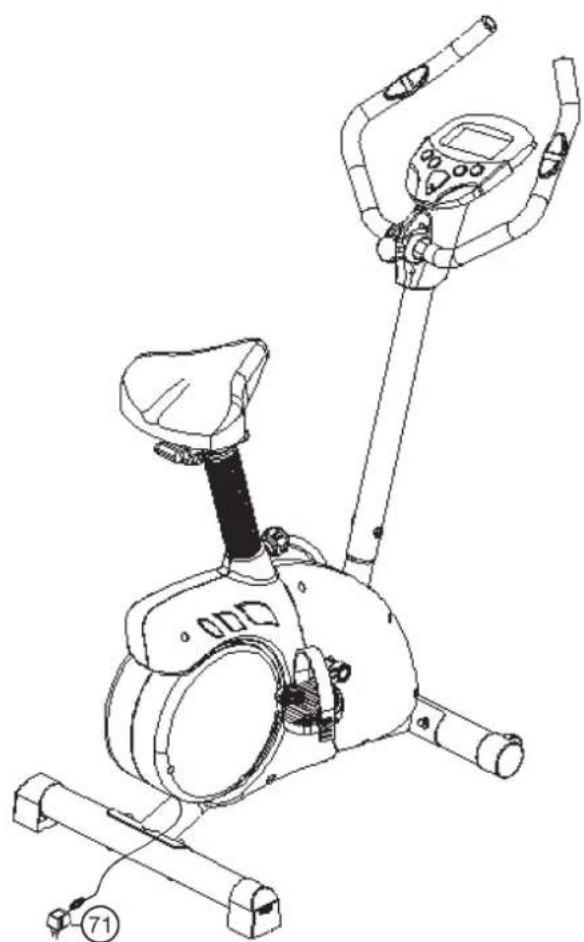
Remove all the separate parts from the packaging, lay them on the floor and check that all are there on the basis of the packing list in these instructions for assembly and use. Please note that a number of parts have been connected directly to the main frame and preassembled. In addition, there are several other individual parts that have been attached to separate units. This will make it easier and quicker for you to assemble the equipment.
Step 1:
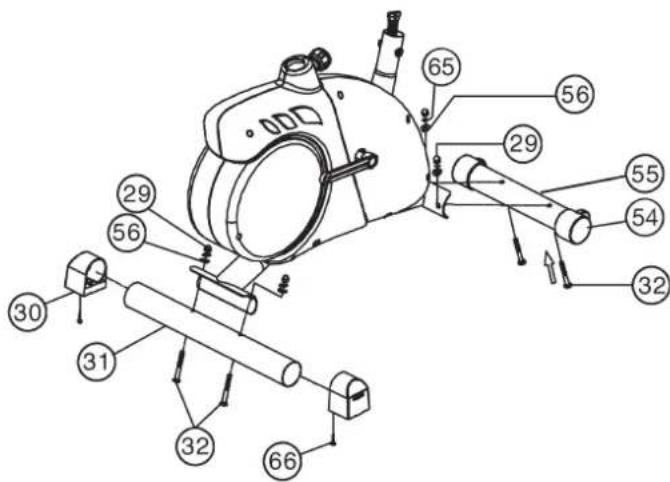
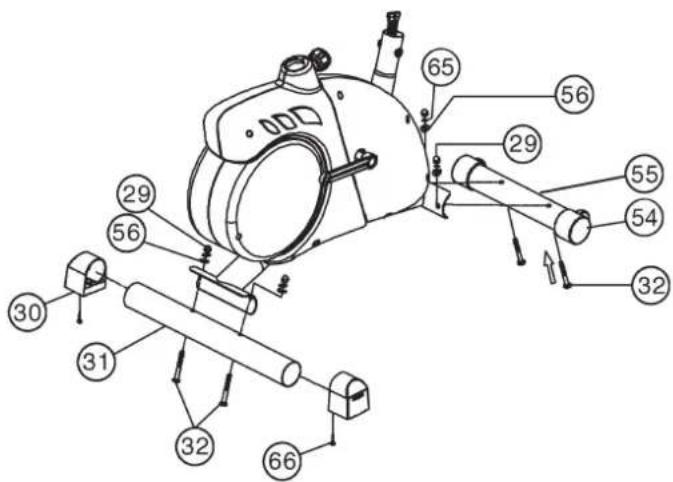
Attach the stabilizer (31) + (55) at main frame (28).
- Attach the front foot (55) with the preassembled transport rollers (54) to the main frame. Do this with the two screws (32), washers (56), spring washers (65) and cap nuts (29).
- Push the end caps (30) onto the rear foot and secure the position with screw (66).
- Attach the rear foot (31) to the main frame. Do this with the two screws (32), washers (56), spring washers (65) and cap nuts (29). After assembly has been completed, you can compensate for minor irregularities in the floor by turning the adjusting screw of end cap (30). The equipment should be set up that the equipment does not move of its own accord during a training session.
Step 2:
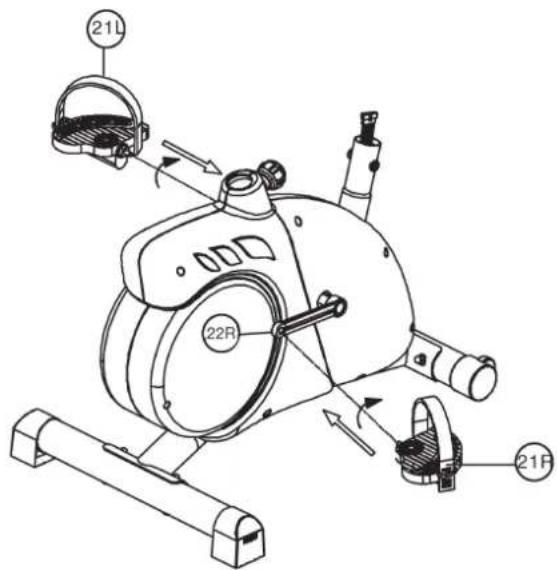
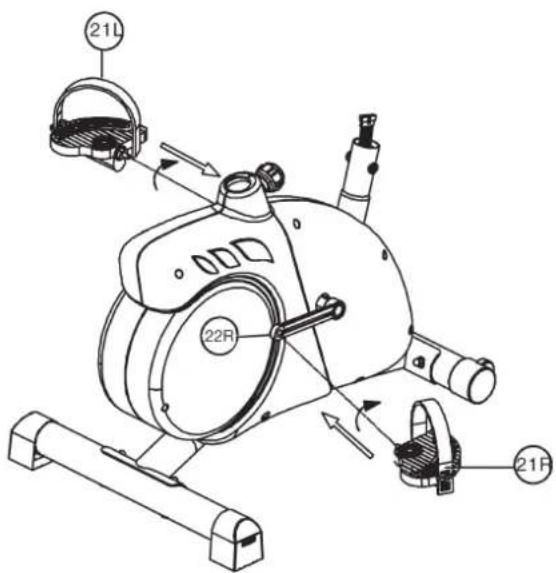
Attach the pedal (21) at pedal crank (22).
- Screw the right pedal (21R) into the locator in the right-hand side (as seen in operation) for the pedal crank (22R) (warning! the screw direction is clockwise).
- Screw the left pedal (21L) into the locator in the left-hand side (as seen in operation) for the pedal crank (22L) (Warning! the screw direction is anticlockwise).
- Then mount the pedal straps left and right on the associated pedals. (The pedals are signed with for Left and for Right.)
Step 3:
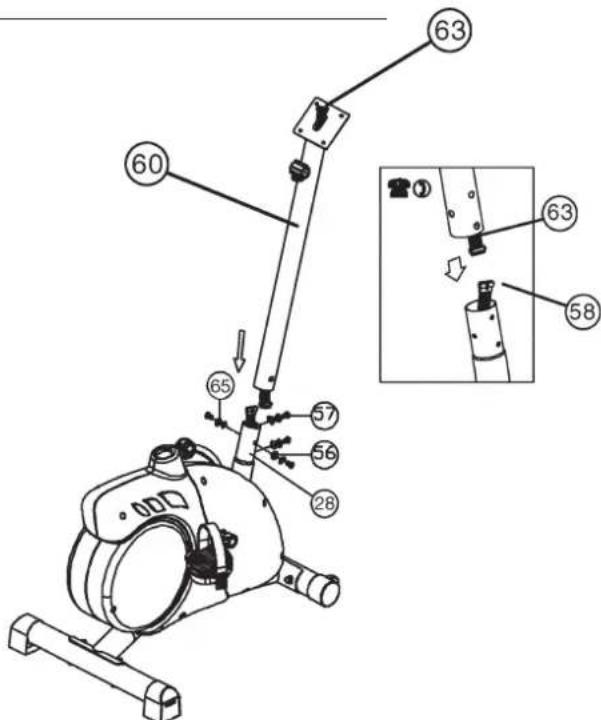
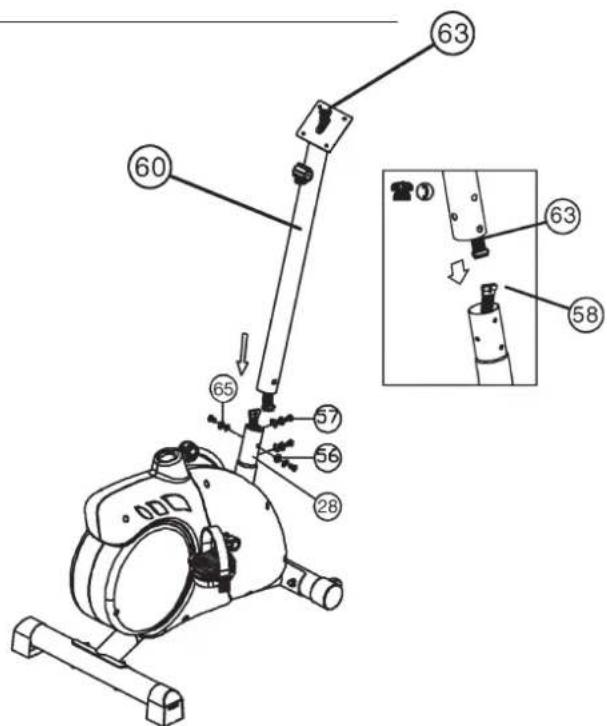
Attach the front post (60) at main frame (28).
- Hold the handlebar support (60) with the computer cable (63) Against the main frame holder. Connect the plug for the computer cable (63) coming out of the bottom of the handlebar support (60) of the computer with the matching plug for the motor cable (58) coming out of the main frame (28). 2. Place the handlebar support (60) in the locator provided for it in the main frame (28). Ensure that the cable connections made in step 3 are not squashed. When putting the steering tube in place, push the former slowly down into the locator in the main frame. Screw the handlebar support (60) onto the base frame (28) with the screws (57), spring washers (65) and washers (56).
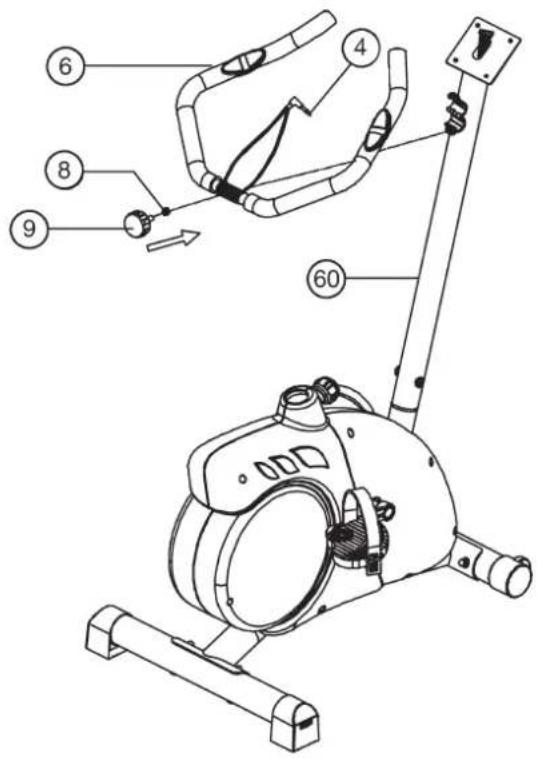
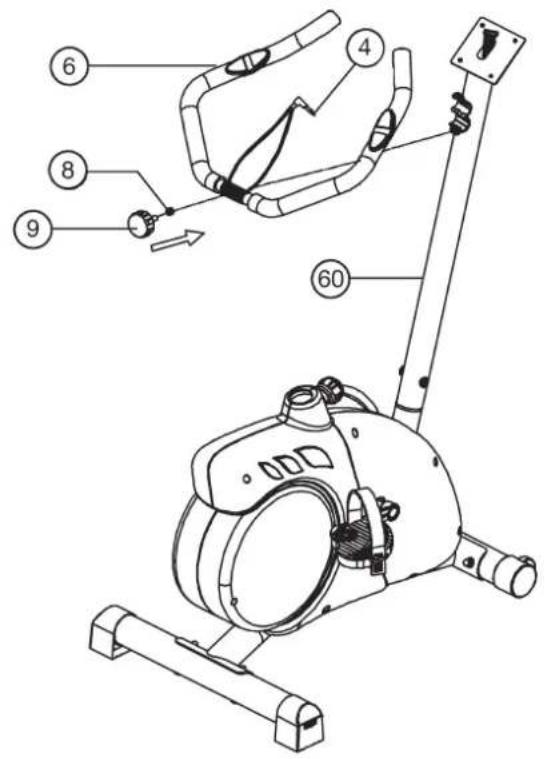
Step 4: Attach the handlebar (6) at handlebar support (60).
- Guide the preassembled handlebar unit (6) through the upper part of the handlebar post (60) and close the bracket of handlebar holder.
- Screw the handlebar (6) in desired position at the handlebar post (60) with washer (8) and handlebar screw (9).
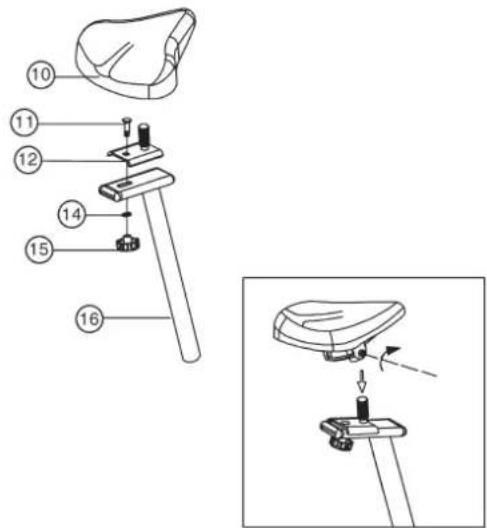
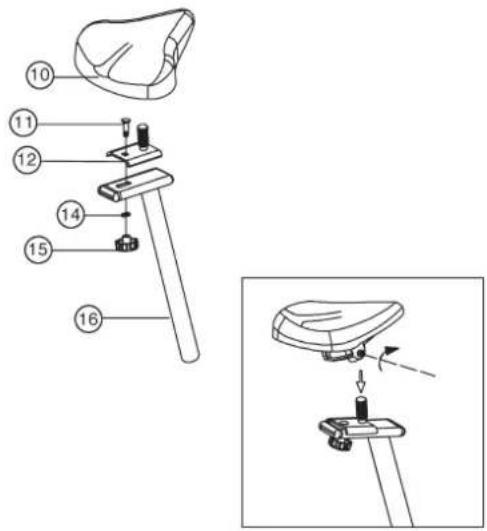
Step 5: Attach the saddle (10) at saddle slide (12).
- Push the saddle (10) with saddle bracket into the saddle slide (12) and tight it up in desired position.
- Place the saddle slide (12) into the holder of saddle post (16), set it at the desired position and screw it onto the saddle support (16) by screw (11) washer (14) and star grip nut (15).
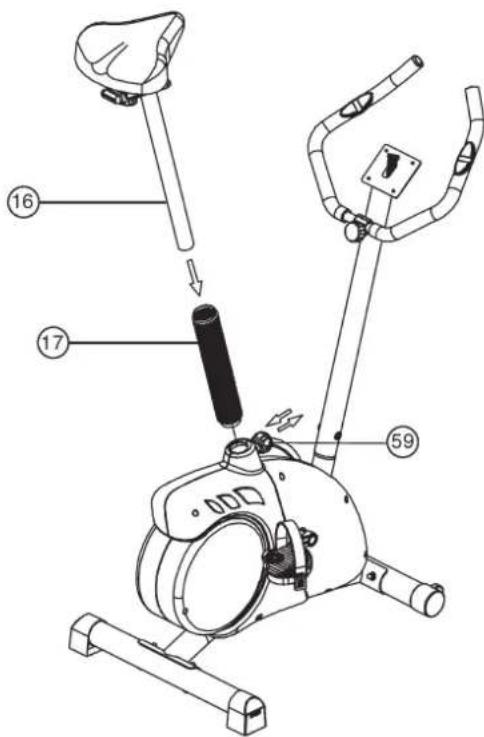
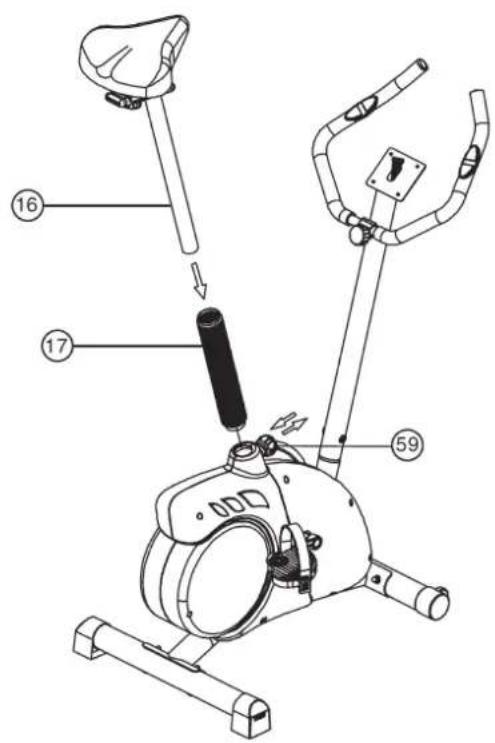
Step 6: Attach the saddle support (16) at main frame (28).
- Push the saddle support wrapping (17) over the saddle support tube (18). Place the saddle support (16) into the matching locator in the main frame (28), set it at the desired position and lock it by inserting the bolt with the quick release (59) in place and doing it up tight.
(The setting of the saddle support can be adjusted easily as desired later through turning and pulling the quick release (59).) Furthermore, you must ensure when setting this desired position that the seat pillar is not pulled out of the main frame further than the highest setting position, which is marked.
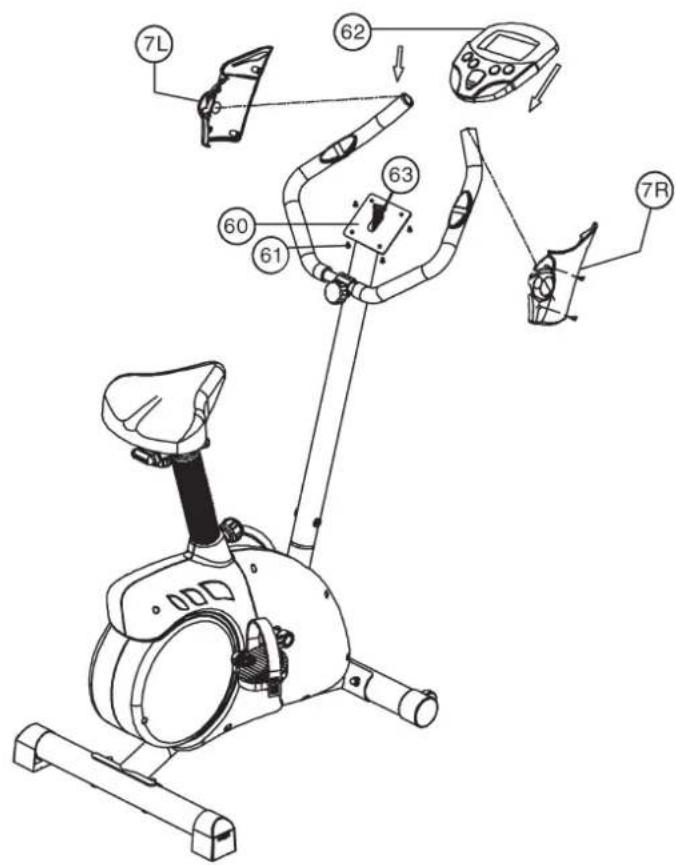
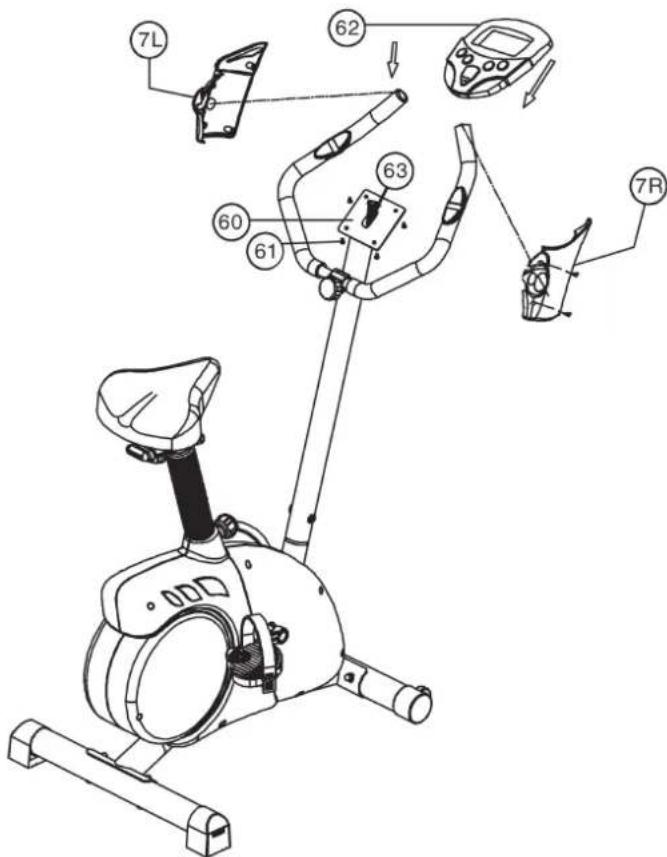
Step 7: Attach the computer (62) at handlebar support (60).
- Push the plug of the connecting cable (4) projecting from the handlebar support (60) into the associated socket of the computer (62).
- Place the computer on the plate provided for it on the handlebar support (60) and attach it with the screws (61).
- Push the plug of the pulse cable (4) projecting from the handlebar (6) into the associated socket of the computer (62).
- Attach the handlebar covers (7) at the handlebar holder of handlebar support (60) with screws (64).
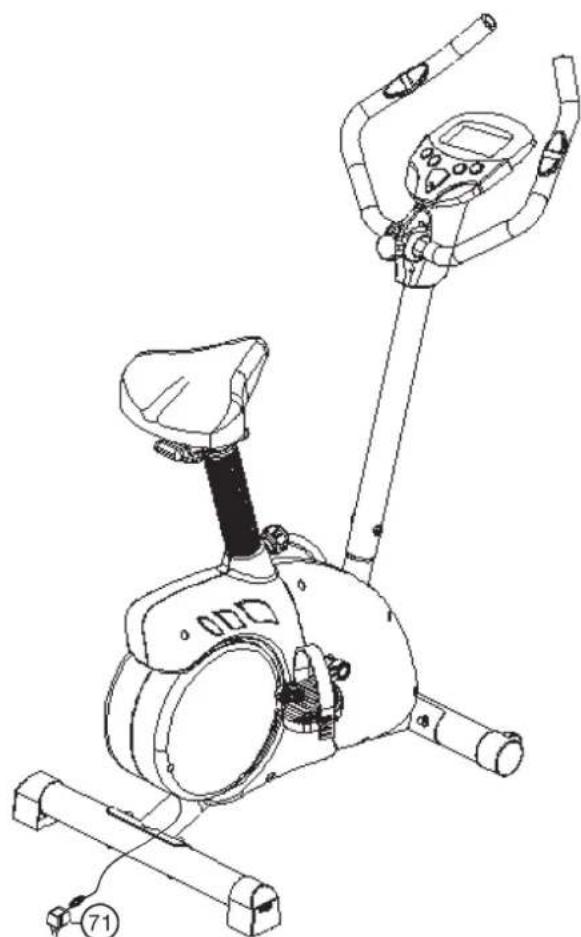
Step 8: Attach the power.
- Please insert the plug of adaptor (71) to the jack of chain guard.
- Please insert the plug of adaptor (71) to the jack of wall power (230V-50Hz).
Step 9:
Checks
- Check the correct installation and function of all screwed and plug connections. Installation is thereby complete.
- When everything is in order, familiarise yourself with the machine at a low resistance setting and make your individual adjustments.
Note:
Please keep the tool set and the instructions in a safe place as these may be required for repairs or spare parts orders becoming necessary later.
TRAININGSCOMPUTER
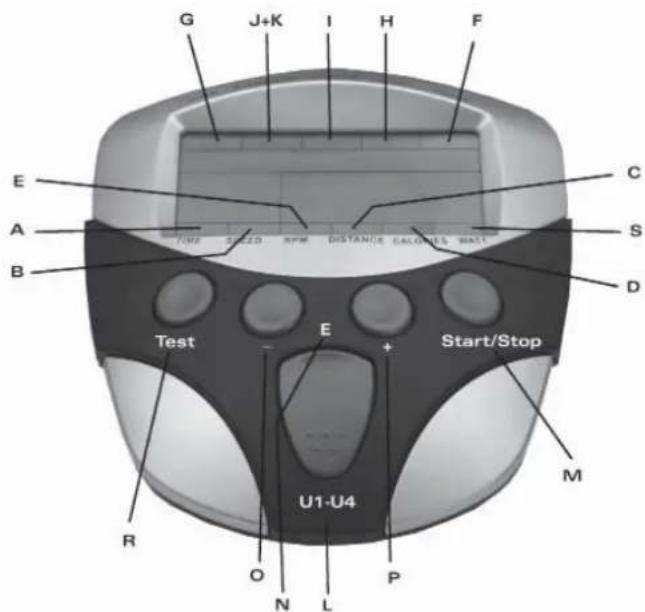
A Time
B Speed / Km/h
C Distance
D KJoule
E BPM
F Pulse
G U1-U4
H Level of resistance
Program No.
J Stop - display
K Start - display
U1-U4-Key
M Start-Stop-key
N Enter -key
O -key
P +key
R Fitness - key
S Watt
Computer instruction
The monitor is designed for programmable magnetic bikes and introduced with the following categories:
Key Functions about Displays; Operating Ranges; Things You Should Know Before Exercising; Operation Instructions
KEY FUNCTIONS
There are total 6 keys: START/STOP (S), ENTER (E), U1 - U4, UP (+), DOWN (-), and RECOVERY (Test).
"S" -key: Starts or stops the chosen program and resets the monitor by pressing and holding for 2 seconds.
"E" -key: Chooses the functions from PROGRAMS, GENDER, TIME, HEIGHT, WEIGHT, DISTANCE, WATT, TARGET HEART RATE, AGE, and 10 columns. The chosen function shall file ash. Please note that not all the functions can be selected in every program according to the types of each program.
"U1-U4"-key: Changes the displays of the values between U1 -U4.
^ +^ (up)-key: Selects or increases the values of PROGRAMS, GENDER, TIME, HEIGHT, WEIGHT, DISTANCE, WATT, TARGET HEART RATE, AGE, and 10 columns.
"-" (down)-key: Selects or decreases the values of PROGRAMS, GENDER, TIME, HEIGHT, WEIGHT, DISTANCE, WATT, TARGET HEART RATE, AGE, and 10 columns.
Test -key: Starts the function of PULSE RECOVERY.
ABOUT DISPLAY
A. START: Indicates the program selected has started.
B. STOP: Indicates the program selected has stopped and users are free to change the programs and the value of functions applied.
C.PROGRAM: Indicates the programs selected from PROGRAM 1 to PROGRAM 13.
D. LEVEL: Indicates the level of loading selected from LEVEL 1 to LEVEL 16.
E. GENDER: Indicates the gender (Male or Female) selected (M/F).
F. TIME/HEIGHT/WEIGHT Display: Indicates only of TIME, HEIGHT, and WEIGHT displayed depending on the programs.
G. RPM/SPEED/ AV/SPEED /KMH (MPH) Display: Indicates value of RPM, SPEED, and KMH (MPH) displayed depending on the programs.
H. DISTANCE/ODO/FAT% Display: Indicates value of DISTANCE and FAT% displayed depending on the programs.
I. KJOULE/WATT/BMR Display: Indicates value of KJOULE, WATT, and BMR displayed depending on the programs.
J. TARGET H.R./BMI/AGE Display: Indicates value of TARGET HEART RATE, BMI, and AGE displayed depending on the programs.
K. HEART RATE/BODY TYPE Display: Indicates value of HEART RATE and BODY TYPE displayed depending on the programs.
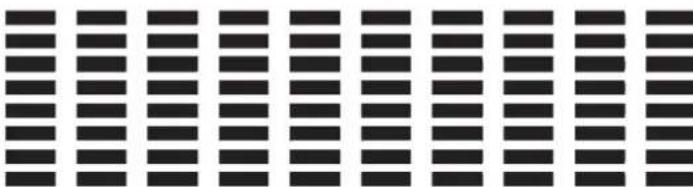
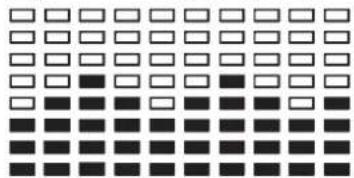
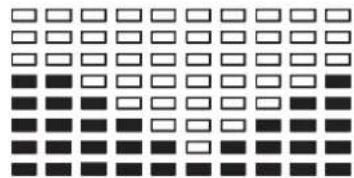
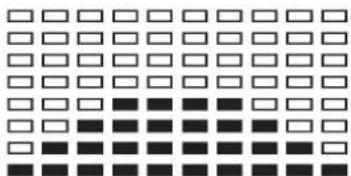
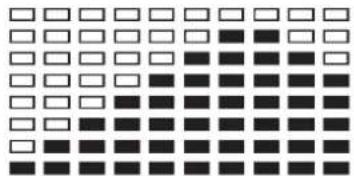
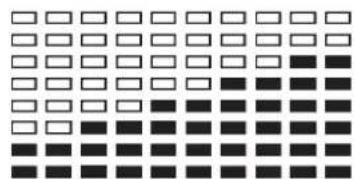
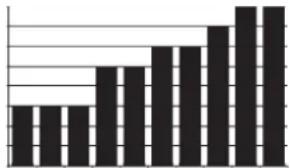
L. LOADING Profi les: There are 10 columns of loading bars, and 8 bars in each column. Each column represents 3 minutes workout (without the change of TIME value), and each bar represents 2 levels of loading.
Operating Ranges
| Values | Range (Count up) | Count down | Preset | Increment (Decrement) |
| PROGRAM | 1 ~ 15 | 15 ~ 1 | 1 | 1 |
| LEVEL | 1 ~ 16 | 16 ~ 1 | N/A | 1 |
| GENDER | Male, Female | N/A | Male | N/A |
| TIME | 0:00 ~ 99:00 | 99:00 ~ 5:00 | 0:00 | 1:00 |
| HEIGHT (cm) | 110.0 ~ 199.5 | 199.5 ~ 110.0 | 175.0 | 0.5 |
| WEIGHT (kg) | 10.0 ~ 199.8 | 199.8 ~ 10.0 | 70.0 | 0.2 |
| DISTANCE | 0.0 ~ 999.0 | 999.0 ~ 1.0 | 0.0 | 1.0 |
| WATT | 30 ~ 300 | 300 ~ 30 | 100 | 10 |
| TARGET H.R. | 60 ~ 220 | 220 ~ 60 | 90 | 1 |
| AGE | 10 ~ 99 | 99 ~ 10 | 30 | 1 |
Things You Should Know Before Exercising
A. The values calculated or measured by the computer are for exercise purpose only, not for medical purpose.
B. The Variables May Need To Change In The Programs:
Programs
Variable
P1-P7 Time,Distance,Kal.
P8 Time, Distance, Kal., 10 Intervals
P9 Time, Distance, Watt
P10 - P12 Time, Distance, Kal., Age, Target HR
P13 Gender, Height, Weight, Age
Please note that only 1 value of TIME or DISTANCE can be adjusted. Both adjustments do not exist at the same time. For example, the value of DISTANCE is 0.0 while the value of TIME is adjusted to be any number except 00:00 .
C. Programs Selection:
There are 13 programs with 1 Recovery including 1 Manual Program, 6 Preset Programs, 1 Speed Independent Program, 3 Heart Rate Control Programs, 1 Body Fat Program, 4 User Setting Programs, and 1 Pulse Recovery Measuring.
D. Program Graph:
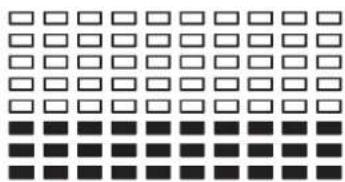
Each graph shown is the profle of the loading in each interval (column). With the value of TIME counting up, each interval is 3 minutes that all the columns make up 30 minutes. With the value of TIME counting down, each interval is the value of setup TIME divided by 10. For example, if the time value is setup to 40 minutes, each interval will be 40 minutes divided by 10 intervals (40 / 10 = 4) . Then, each interval will be 4 minutes.
The following graphs are all the profles in the monitor.
Program 1 (Manual)
Program 2 (Polling)
Program 4 (Fat Burn)
Program 5 (Ramp)
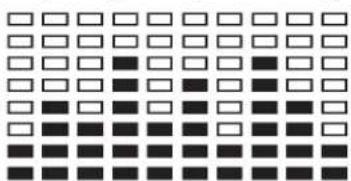
Program 7 (Random)
Program 8 (U1 - U4)
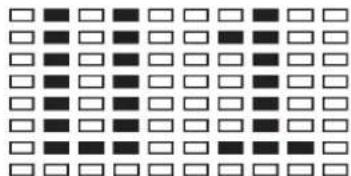
Program 9 (Speed Independent)
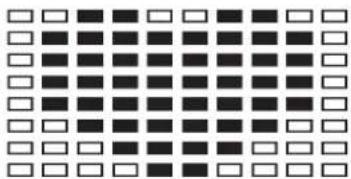
Program 10 (60% H.R.C.)
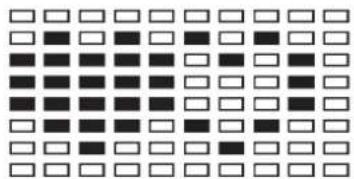
Program 11 (75% H.R.C.)
Program 12 (85% H.R.C.)
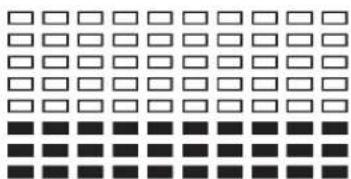
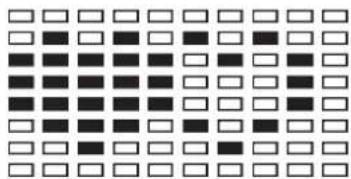
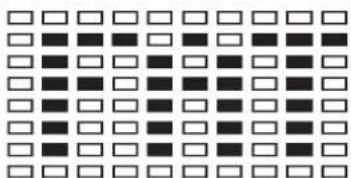
Program 13 (Body Fat)
E. Body Types:
There are 9 body types divided according to the FAT% calculated. Type 1 is from 5% to 9% . Type 2 is from 10% to 14% . Type 3 is from 15% to 19% . Type 4 is from 20% to 24% . Type 5 is from 25% to 29% . Type 6 is from 30% to 34% . Type 7 is from 35% to 39% . Type 8 is from 40% to 44% . Type 9 is from 45% to 50% .
F. BMR: Basal Metabolism Ratio
G. BMI: Body Mass Index = Bodyweight : bodyheight2
Operation Instructions
A. Exercising with a Specific Goal:
- TIME Control: Sets up a period of time to exercise.
- DISTANCE Control: Sets up a certain distance to exercise.
- BODY FAT Control: Computer designs various programs for different people with different body fat ratio.
- WATT Control: Keeps different bodies burning in desire WATT consumed.
- Heart Rate Control: Keeps users to exercise under a safe heart-beating condition
B. Pulse Rate:
The whole set of heart rate detector include 2 sensors each side. Each sensor has 2 pieces of metal parts. The correct way to get detected is to gently hold both metal parts each hand. With the good signals picked up by the computer, the heart mark in the HEART RATE/BODY TYPE Display shall flash.
C. Manual Program:
PROGRAM 1 is a manual program. Press ENTER key to select TIME, DISTANCE, and AGE. Then, press n + a or -a key to adjust the values. The default level of loading is 6. After pressing S key to exercise, please also apply the heart rate detector appropriately. Users may exercise in any desire level (by pressing n + a or -a during the workout) with a period of time or a certain distance. With the input of age, the computer may suggest a target heart rate to exercise. The suggested heart rate is 85% (220 - age) . So, if the heart rate detected equals to or greater than the TARGET H.R., the value of HEART RATE will keep flashing.
Please note that it is a warning for users to slow down or to lower the level of loading.
D. Preset Programs:
PROGRAM 2 to PROGRAM 7 are the preset programs. Press "E" key to select TIME, DISTANCE, and AGE. Then, press "+" or "-" key to adjust the values. Users may exercise with different level of loading in different intervals as the prof les show. After pressing START/STOP key to exercise, please also apply the heart rate detector appropriately. Users may also exercise in any desire level (by pressing "+" or "-" during the workout) with a period of time or a certain distance. With the input of age, the computer may suggest a target heart rate to exercise. The suggested heart rate is 85% (220 - age). So, if the heart rate detected equals to or greater than the TARGET H.R., the value of HEART RATE will keep flashing.
Please note that it is a warning for users to speed down or to lower the level of loading.
E. User Setting Programs:
Program 8 if the user-setting program that store the calculated values from U1 - U4. Users are also free to edit the values in the order of TIME, DISTANCE, AGE, and the level of loading in 10 intervals. The values and profi les will be stored in the memory after setup. After pressing ^ 串 S key to exercise, please also apply the heart rate detector appropriately. Users may also change the ongoing loading in each interval by pressing ^ 串 + ^ 串 or ^ 串 - ^ 串 key, and they will not change the level of loading stored in the memory. With the input of age, the computer may suggest a target heart rate to exercise. The suggested heart rate is 85% (220 - age). So, if the heart rate detected equals to or greater than the TARGET H.R., the value of HEART RATE will keep flashing.
Please note that it is a warning for users to speed down or to lower the level of loading.
F. Speed Independent Program:
Program 9 is a Speed Independent Program. Press "E" key to select the values of TIME, DISTANCE, WATT, and AGE. Then, press "+" or "-" key to adjust the values. After pressing "S" key to exercise, please also apply the heart rate detector appropriately. During the exercise, the level of loading is not adjustable. In this program, computer will adjust the level of loading according to the value of WATT setup. For example, the level of loading may increase while the speed is too slow. Also, the level of loading may decrease while the speed is too fast. As a result, the calculated value of WATT will close to the value of WATT setup by users. With the input of age, the computer may suggest a target heart rate to exercise. The suggested heart rate is
85% (220 - age). So, if the heart rate detected equals to or greater than the TARGET H.R., the value of HEART RATE will keep flashing.
Please note that it is a warning for users to speed down or to lower the level of loading.
G. Heart Rate Control Programs:
Program 10 to Program 12 are the Heart Rate Control Programs. In Program 10 to Program 12, press "E" key to select TIME, DISTANCE, and AGE. Then, press "+" or "-" key to adjust the values. Users may exercise in a period of time or a certain distance with 60% Max Heart Rate in Program10, 75% Max Heart Rate in Program 11, and 85% Max Heart Rate in Program 12. After pressing "S" key to exercise, please also apply the heart rate detector appropriately. In these programs, the computer will adjust the level of loading according to the heart rate detected. For example, the level of loading may increase while the heart rate detected is lower than TARGET H.R. Also, the level of loading may decrease while the heart rate detected is higher than TARGET H.R. As a result, the user's heart rate will be adjusted to close the TARGET H.R. in the range of TARGET H.R. -5 and TARGET H.R. +5.
H. Body Fat Program:
Program 13 is a special program designed to calculate users' body fat ratio and to design a specific loading profile for users. With 9 different body types, the computer can generate 9 different profiles for each. Press "E" key to select GENDER, HEIGHT, WEIGHT, and AGE. Then, press "+" or "-" key to adjust the values. After pressing "S" key to calculate body fat, please also apply the heart rate detector appropriately. Then, the calculation values of FAT%, BMR, BMI, BODY TYPE, will show up shortly.
I. Pulse Recovery:
It is a function to check the condition of pulse recovery that is scaled from 1.0 to 6.0 while 1.0 means the best and 6.0 means the worst and the increment is 0.1. In order to get rated correctly, users must test it right after the workout finished by pressing "Test" key and then stop exercising. After the key is pressed, please also apply the heart rate detector appropriately. The test will last for 1 minute and the result will show in the display.
Training instructions
You must consider the following factors in determining the amount of training effort required in order to attain tangible physical and health benefits:
1. Intensity:
The level of physical exertion in training must exceed the level of normal exertion without reaching the point of breathlessness and / or exhaustion. A suitable guideline for effective training can be taken from the pulse rate. During training this should rise to the region of between 70% to 85% of the maximum pulse rate (see the table and formular for determination and calculation of this).
During the first weeks, the pulse rate should remain at the lower end of this region, at around 70% of the maximum pulse rate. In the course of the following weeks and months, the pulse rate should be slowly raised to the upper limit of 85% of the maximum pulse rate. The better the physical condition of the person doing the exercise, the more the level of training should be increased to remain in the region of between 70% to 85% of the maximum pulse rate. This should be done by lengthening the time for the training and / or increasing the level of diffi culty.
If the pulse rate is not shown on the computer display or if for safety reasons you wish to check your pulse rate, which could have been displayed wrongly due to error in use, etc., you can do the following:
a. Pulse rate measurement in the conventional way (feeling the pulse at the wrist, for example, and counting the number of beats in one minute).
b. Pulse rate measurement with a suitable specialised device (available from dealers specialising in health-related equipment).
2.Frequency
Most experts recommend a combination of health-conscious nutrition, which must be determined on the basis of your training goal, and physical training three times a week. A normal adult must train twice a week to maintain his current level of condition. At least three training sessions a week are required to improve one's condition and reduce one's weight. Of course the ideal frequency of training is five sessions a week.
3. Planning the training
Each training session should consist of three phases: the warm-up phase, the training phase, and the cool-down phase. The body temperature and oxygen intake should be raised slowly in the warm-up phase. This can be done with gymnastic exercises lasting 15 to 20 minutes.
Then the actual training (training phase) should begin. The training exertion should be relatively low for the first few minutes and then raised over a period of 15 to 30 minutes such that the pulse rate reaches the region of between 70% to 85% of the maximum pulse rate.
In order to support the circulation after the training phase and to prevent aching or strained muscles later, it is necessary to follow the training phase with a cool-down phase. This should be consist of stretching exercises and / or light gymnastic exercises for a period of five to ten minutes.
4. Motivation
The key to a successful program is regular training. You should set a fixed time and place for each day of training and prepare yourself mentally for the training. Only train when you are in the mood for it and always have your goal in view. With continuous training you will be able to see how you are progressing day by day and are approaching your personal training goal bit by bit.

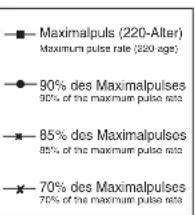
Calculation formula: Maximum pulse rate = 220 - age (220 minus your age)
90% of the maximum pulse rate = (220 - age) x 0.9
85% of the maximum pulse rate = (220 - age) x 0.85
70% of the maximum pulse rate = (220 - age) x 0.7

Sommaire
Chere cliente, cher client,
Programmes 2-7: Fitness
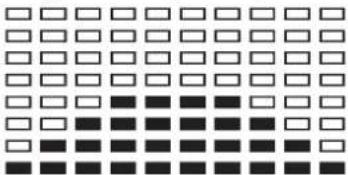
Programma 4 (fi tness)
Programma's 2-7:fitness
3. Planning van de training
6 BCtpoEHhblnporpamm TpeHnpOBKn, 3 nybc03aBNCMBle nporpaMMbl
4 nporpammbi pyHoi yCTaHOBKn, 1 nporpamma onpeJeHnHn npoehTHoro coepxHaH
1 He3aBNCHMg OT CKOPOCTb BpaueHn IPOpDAMMa (pevNMDOBKa cnpOTNBHeHn: 30 - 300 BT
cwarom10BT)
N3mepenhe npbca daTnKamHa pykortkax, TpaHcnpotpoBOHbE pONIK BnepeDN, 6nOK
NHTAHMR,DMTHEC-TECT
TOpuHTaJIbHoe IN BepTuKAbIbHoe peRyIINpOBAHnE cedna,peRyIINpOBKa HaKnOHa pyra n ceDna
KoMbToPc OaHOBpeMeHHOn HnDnKaunen CneDyUOux NapaMeTpOB:BpeM,CKopocTb
Ductanu, npn. pacxod kanoepn, npoenthoe coepxahne knpa, yactota bpaene
neJaneH,Harpy3kaB BATTax nynbc
Bo3MOxHocTb 3aDaBaTb co6cTBeHHbI npaMeTpbl: Bpem, MCTaHua n npn6n, pacxo
N3BeeHHe O nppeBbIeHm 3aDaHHbIX npaMetPOB
MaKcHmAlbHbB Bec nonb30BaTeRa: 150 K
ChnB ynaKOBky, npoBepbTe No cnNcKy, BCE JI nDeTaN Ha MeCTe. EcIn Bce B nopAKe, To MoXHo HauHnTa b c6OpKy. EcIn KaKoHn6yNb arperaT He B nopAKe NnO TcyTCTByeT, ObaPaaaTecb K HA:
PykoBoDCTBO no MoHTaKy
IoxaJynta, BbHbTe BCE OTdJIbHbIe qactn n3 Kopo6Kn n npOBepbTe INx HA KOMNtKTHOCTb B COOTBETCTBm CO CneuΦkaUne. PpIMNTe BO BHMaHHe, YTO HEKOtOpBe qactn npeDbapnteJbHo CMHTnpoBaHbl.
llar 1: MoHTaX HOxEK (31+55) Ha oCHOBHyIO pamy (28)
1.CMOHTpyTe nepeDIOHOxKy (55) C TpaHCnOPTnpOBoHbIMPOJNKAMn (54) Ha oCHOBHyIO pamy (28).NcNoIb3yIe DnA 3TOrO NO dBa 60Ta (32), nOdknaIbHbIe Wai6bi (56), npyXHHbIe Wai6bi (65) N KOnIIaYKOBbIe raIKn (29).
2.BCTaBBTe KOHcEBBe KOJIaauKn (30)Ha 3aDHIIO HOxKy (31) INpIKpeINTe HX C NOMOuBIO 6oTOB (66).
Iocne toro, kak BbI cMOHTnpOBaII Becb TpeHaxKe, npaBnIbHO BbCTaBNTe KOMNEHCATOpbl HEOBHOCTn NOA. 3TNMB bI pEynpeDInTe HENpeHaMepeHHBe DmXKeHH TpeHaxKePA BO BPEM TpeHypOBKn.
3.CMOHTpyuTe 3aHIO HOKky (31) Ha OCHOBHyO pamy (28).IcnoJIb3yUte DnTOro no DaBa 60Ta (32),NoDKlaHbIe Wai6bi (56),npyXHHbIe Wai6bi (65) n KOnnaqKobIe raKn (29).
MOnTaX neJaIe (21L+21R) 7aTuHbI neJaIe (20L+20R)
- PnkpnyTe npabyIO neaIb (21R) Ha watyH neaII (20R), HaxoHuaIc C npaBOI CTOpOHb I HAnpabLeHIn DnIXeHnR. (BHMaHne! HAnpaBHeHne 3akpyuBaHn8 BoNTa: no YacobO CTpeJIke).
- PnKpyTne neByo neaBb (21L) Ha waTyH neaIIN (20L), HaxOJaunmca C neBOI CTOpOBi B HAnpaBHeHH DBNKeHn. (BHMaHne! HAnpaBHeHne 3AkpyHbAHn6 BoNTa: npOTNB HacOBH CTpeKN).
3.YCTAHOBNTeΦHKCNPYIOUneJIENTbINEaJIeHaCOOTBETCTBYIOUne neaII.
IynpoueHn MONTaxa IeBaI neJaIb 6o3HaueHa 6yKBoI L, a npabar neJaIb 6o3HaueHa 6yKBoI R.
Iar 3: MoHTax onOpHoi Tpy6bl pyra (60) Ha oChOBHyO pamy (28)
1.Bo8bMnTe onOpHyIO Tpy6y pyra (60) cnpedBapntelbHO CMoHTPOBaHHbIM CoeHNHtEnbHbIM Ka6enem (63). CoeHNHte wTekep KOMNbIOTepHorO Ka6ena (63), BbIXoJaun m3 onOpHOr Tpy6b pyra (60), co WTekepor cepBODburatela (58), BbIXoJaero n3 OCHOBHpaMbI (28).
2.Bctabte onopnyo Tpy6y pyra (60)b COOTBeTCTByuOuee KpeIneHHe Ha OCHOBHO pame (28).ObpaTne BHMaHHe Ha To, YTo6b Ka6ebHoe CoEINHEHHe He 3aueMnAnocb, n MeJeHHO BCTabTe ONOpHyTOpy6y pyra (60)B COOTBeTCTByIOuee KpeIneHHe Ha OCHOBHO pame. PpIKpyTnte onOpHyTOpy6y pyra (60)K OCHOBHO pame (28)c NOMOuBo 6oNTOB (57), npyXHHbIX wai5 (65) nnoKnaAHHx wai6 (56).
Uar 4: MoTaxk pyna (6) Ha onophyio Tpy6y pyna (60)
- PoiBBeInTe pyIb (6) K OTKpbItOMy KpennneHIO pyIa HA onOpHOI Tpy6y pyIa (60) n 3akpoIte erO HAD pyIeM (6).
- HadeheIte nooknaHyo wai6y (8) Ha rpi6koBb 6oT (9) n npKpyTne IMn pylb (6) K onopHO Tpy6e pya (60).
Iar 5: MoTaxK ceNa (10) n caIa3OK ceIa (12) Ha onOpHyIO Tpy6y ceIa (16)
1.BctabTe ceNo (10) KpenIeHemc CeNa B cana3Kn ceNna (12) N Kpenko PnKpyTne B JKeJaEMOM HAKNOHe.
2.Bctabte caana3kn ce1na (12) B KpenneHHe Ha onopHOn Tpy6e ce1na (16) n 3akpeNTe B JKeJaEMOM Tropn3oHTaJIbHOM NonoXKeHN C NomoUbK np6koB Wau6bl (15), NOkNlaHOn Wau6bl (14) n 60ntA (11).
Iar 6: MoHTax onOpHou Tpy6bI ceJa (16) Ha ochOBHyO pamy (28)
1.BCTABTe MaHKeTy onOpHou Tpy6bI ceHa (17) Ha onOpHyIO Tpy6y CeHa (16) nB COOTBEcTcByIOuOe KpENJIeHHe HA OCHOBn PAME (1) n3aФINKcPuyTe ee B JekAemOM NOnOKeHHn C NOMOuBIO bIcTPOeIcTBUoIero 3aTbopa (59).
(5bIcTpoJeCTByoU3aTbOp (59)doJxHb6bITb HEMHORO Ocna6JIeN NOpeCDTBOM He6oJIbUoro NOBOPaUBAHn, Nocne 3TORO OH BbITraNBaeTCA DnA OCB6OKeJDeHHN KCAuHN BICOTb N BcICota CeJa MoKET 6bIt nepeCTaBHe. Nocne JenaemOn HAcTpKN CHOBA 3aKpeNTb 6bIcTpoJeCTBVOU3aTbOp (59)NOpeCDTBOM 3aKpyuNBAHn.
War 7: MoHTaX KOMNbIOTepa (62) Ha onOpHyIO Tpy6y pyJn (60)
- Bctabte wTekep KOMnbIOTepHoro Ka6eNa (63), BbIXOaun Cbepxu n3 onOpHn Tpy6bl pyna (60), B COoTBETCTByIOoee rHe3do, HaxOJaueecn Ha o6paTHOH CTOPHOKOMNbIOTepa (62).
- PnpnoKnTe KOMnbIOTep Ha depKaTeIb KbomblOtepa, HaxoRaunCHa onOpHOn Tpy6e pyJra (60), nKpEnKO npNKpyTne erc nOMouBIO 6oTTOB (61).
3.BCTaBbTe WTeKepe Ka6eIaN3MepeHn PyIbca (4), BbIXoJaIuN n3 pyIa, B COOTBeTcByIOoe rHe3do Ha KOMNbIoTepe (62). - BCTaBte oboJouKnykoAeTKn Stecken (7L+7R) Ha pynb KpenKo npkpyTne C nOmoUb60JTOB (64).
War 8: IopKIOUeyHe 6JOKa NHTAHN
1.BCTaBBTe 6TKepe 6noka nntAHn7 (71) B COOTBETCTBYIOuee rHe3do Ha 3aHEm KOHue 05uBKN.
2.BCTABTe 6JOK NITAHIN71B WtENCeNbHyIO pO3eTKy (230V/50Hz).
War 9: KoHTpoB
- Поберпс Бсоаннгьи Ha npaBnHcObTb c6opKn n npobednte
Поберку ФункюньhoCTN. Рп ATOM MOHTax ChNTaETCR
3akOHyHeblM.
2.EcnnBceBnpAKe, npOBeHnTe np6HyIO TpeHnPoBky npn MaehbKo HArOy3Ke, INHnBuNvAaNbHO HAcTPONe TpeHaXeD.
3ameyane: Poxanycta, coxpaHnTe Habop IHCTpyMeHTOB nIPONCJeDyoUnx BO3MOKbHX pMoHTOB INHCTpyKcNIO MOHTaKy dIb BO3MOXbHX 3aKa3O8 3anachbIX qacte.
TRAININGSCOMPUTER

KoMnBIOTeP
A Bpemr
BCKOpocTb/KM/Yac
C PaCToHHe
D KnloJxoyNb
E O6/MnH = O6apoTaM neJaIe/NMH
F nybc/Tun Tena
G U1-U4
H CtyneHb Harpy3Kn = TopMo3HaH Harpy3Ka
I Home nporpaMmB
J CTOn yKa3aTeNb
K cTap yKa3aTeNb
L KlaBnUa (U1-U4)
M CTapT-CTon-KHONKa (Start/Stop)
N Khonka BBOda n noTBePKeHnA (E)
O Khonka (-)
P KhoKa (+)
R KJnabNwA qNTHEc-TEcTa (Test)
S BATT
NctpyKuNA K KomnbIOTepy
Komblotep Baawero 3prometpa Oeyb ydo6e H BocnykBaHn. TaKaBce FyHKUHOHaBbIe DaHHbe OndOBpeMeHNO BbBOJrTa Ha DnCnJIe, NCKIOHaeTc He06XoIMOCTb NOCTOHHORO NepeKIOJeHHeN I BeCb TpeHPOBOChN Ipocecc MOxHO KOTpONoBaTb ONDHM B3rJaOM. 3ToT annapat HBNIEcTc AnnapaTOM HeABNCiMOT YncNA oOpOTob, BaWa Jenaemaar Harpy3ka peYInpEeTC KompBtpoPOM, KOTopbI He3abnMo OT YacTObI BpaSeHn neJaen ynpaBnET TOPMO3OM.
BknioueHne:
1) BCTABTE WTEKEP 6NOKA NITAHINB COOTBETCTBYIOOEE rHE3do HA annapate. NOBATCR 3BYKOBOI CUNHAI-BCE NOKAaTeEN HA KOMNbIOTepe NOBATCR Ha 2 CEK N VCTAOBTCTRAH00 INN
2) 7TeKepeykeCTabnEn/KomnbIOTepABTOMaTHeCKNOTKIOUHINCA. IocpdeCTbOM Haxatna Ha NkOyIO KHOKNy -nn OobopoTa neJaen - KOMNbIOTep ABTOMaTHeCKN BKIOUaTeCn.
BbIKJIIOueHHe:
KOMIbIOTep OTKNIOHaETcCaMOCToAteNbHO eCn60onee 4MnH.Annapatom He NoNb3OBaINCb
Pocne OKOHuaHn TpeHnpOBKn Heo6xOaHMo BbItaunTb WTeKepe H3 rHe3da.
KnaBn
Bcero 6 KnaBn: START(CTapT)/STOP(CToN) (S), EINGABE(BBoD) (E), (U1 - U4), AUF(BBepx) (+), AB(BHm3) (-), and TEST(TecT) (Test).
,S^ :CTapTnINOcTAHOBKA TpeHnpOBKN BbIbpaHHoN IpORpAMMe.B STOPP(CTon)-MoYCe CBeNTCRA STOPP- INHnKaun J.KOMnbIOTeP HauHaHeT cHTaTB TOJbKO nocne HaxaTHN KONKN ,S^
Ecnn depkaTb KONky, S" 60onee 3 cek. HaxaToB BCE daHHbIe yCTaHabNBAOTcH a HyIb T.e. Ha HauaNbHyIO CTADIO.
E":npn nOMOuBBOHON- noDTBepKdaHOue KnaBUN(N) npOn3BOuNTcRnepeMeueHBeOBNaCTb CNeDyUoey HAcTpaEBaEMo FyHKun. Bb6panHn 3aDaBaMaer FyHKmra Muraet, Nocne Yero NyTEM KNABI + (O) n-(P) BBeNITE HeoBXoDMbIe daHHbIe n eue pa3 HaKMITE KnaBnuy,E" DaHHbIe FxNCpYOTCR. OJHOBpeMeHHOHaHHaTe MIRatb CneDyUoo ne Ione DRA BBeDEHn DAHHbIX
"U1-U4": BC nOMOuBIO 3ToI KNAuBnB Bb MoXeTe yCTaHaBnBaTb INHINBNUvAHLbIe NOkAaTeNn NOIb3OBaTeN (U1-U4).
Test":(Tec) npn NOMOUI 3TOI KNABUNMOXHO ONpeJeNTb BAUY OueHky cnTHeca (TpneHUPOBAHHOCTN)
“”M,“”:3TUMKJIABUAMN+/-BblMOKeTe N3MeHrTb 3aJaBaAeMbIE BENHHBI (TONbKO PNP MIRAOSe HINDKAUNH).
- HdMkaTopbi
START: INHdNkatop CTapTOBOrO MOyca. Bce NMeIOUneC RAHHbIe NOKa3bIBaHOcR Ha DCnnee.
STOP: INHdkatop CTON MOyca. BO3MOxEH BBOD daHHbIX.
PROGRAMM: INHdkaTop yctahOBHeHHo nporpaMMbO t 1-13. (nporp.. 1 - 7 = 中THeC nporpaMma; Iporp.8=INHdbuAalbHbe nporpaMMbI Iporp..9=BattnporpaMma; nporp..10-12=Piorp. no nybcy)
STUFE: INdkaTOp Bb6paHNo CTyneH Harpy3Kn OT 1-16. HeM Bblue YncNo TEM Bblue Harpy3Ka.
K HEMY OTHOCNTCA WTPNXOBO INHINKATop KOTOPB IMeET 8ROPN3OHaIbHBIX WTPNXOB.KaxdbI WTPNX IMeET DBE BEINHHBI (K npmepy: 3 wtpxa 3TO ypOBeH5 mnn6) TOHy BOENHY MOXHO CHITaTB B yka3atene (H) STUFE.3Ty Harpy3ky MOxHO B IIO6OE Bpemr N3MeHHTB BO BCEN PORPMAX C KnaBnAMM+ -1-
NJI: Yka3aTeIb nona myxckoM (M) / XeHcKn (F). (3aJaETcTOnbKO B nporpamme 13)
ZEIT,Bpemr,TIME yctaHOBKn BpeMeHN B MHyTax N cek. MoKHMAbHOrO 99:00 MIn. BBoI npOn3BODNTcB MHyTax, ChET BBepx Hn3 npOn3BODNTcB CekyHdx. B nporpamMax 2-12. MmHmAbHoe 3aDaBaEMOE Bpemr 5 MIn. 3aDaBaTbcM MoKet Bpemr nn pactoHHne ToJIbKO pa3deJIbHo
/GRLAE,Poct,HIGHT/GEWICHT,Bec,WIGHT:
BBOIDnHnDnKaunpoCTaNBeCAToJbKO Bnporpamme 13.
U/min,06/MnH/SPEED,CKopoctb/km/h, KM/acy: Yka3aTeNb 06/MnH nCKOPOCTb B KM/acy.
ENTFERNUNG, PactoHne: BDOiNyka3aTeIb pactoHn. YcTaHaBnBaetcr ot 0-999 km. CHTbIBaHne npO3BOuNTcB O,1km. PactoHne n BpeMa He MORYT OJHOBpeMeHHO 3aDaBaTbcra.
FETT %,Kup %: Yka3aTeNb npoUeHTyaJIbHOB BEmuHbI Xupa B TeNe ncNoJIb3OBAHne TOnbKO B nporpamme 13
KJOULE/WATT/BMR, KIIOJXOYJIb/BATT/BMR:B INHINKaTope yka3bIAHOCTaTOLBKO KINIOJXOYNI. InepeChTe JxOyNe B KaOpn n O6paTHo pImeHnTe fOpMny: 1 xOyJIb = 0,239 kaOpn, Hn
1kanaopn4,186dx.BBeDeHHe BENHHB DKOyJHX HeBO3MOxEH NOTOMKAK OHN ABTomaHTeCKN BbICHTbIBAIOCTK COMNbIOTepom 3BaTTOB.
Pn nomooun (F) KnaBnMoKHO nepeKeHouaTb HnDnKauHIO MeKdy KNoBaT N DKOyJAMN IOpaTHO KOMNbOTep TOnHO qNKcnpyeT O6bEM 3aTpaeHHo 3Heprn B Batax.
BMR (B napeboe c aHnnckoro yHdAmteTalbHoe NMeHeHne 0MeHaBeuecTB) =3Hepn pacxoayemTo TLOM B HenoDBHXHom COCTOHN.3OT nokataTe b pauchtibaeTcno fOpmye KOTopar BKIOHaeT Bce6BbeNbnbKk Boc, Poct, BeNnuHy knpa B Tepe, Bo3pact nIoi. (TonkbKnB nporpaMMe 13)
PULSOBERGRENZE, Bepxhee orpaHueHne npbca/BMI/ ALTER,Bo3pact:ImeetcB nporpammax 1-8 (HeT B nporpammax 10-12). Pocne BBOda Bo3pacta KOMbIOTeP pachITbIaEBat BepXHH DOnyCTnMbI dNBAwero Bo3pacta NBybc(FCOpMyna:(220-BO3pact) x 0.85),KOTopbl H N B KOEM CNYae HeNB3pepcTyNaTb.PnDocTnxKeHNTO TToB EINuHb HauHaHaET MIRATb INDInKaTOp NBybCa.BAM HeO6xoJIMO TOrDa HEmeDNeHoo yMeHbWHTb YPOBEHb Harpy3Kn.
IpeJnaraeTcB nporpamMax 10-12.B nporpaMMe 10-12: TpeHnpoBOuHaN nporpamma c 60% /75% mnn 85% Baaew MHF(MakcmmabHO 华actotoi cepua).Iocne BbOa Baawero Bo3pTa paCHTbBaTeCra Bwae MHF KOTOPaI Jn KaKdoI nporpaMMbl nepeCHTbBAeTcB I npoceTHOM OTHoWeHN. INdkaunA kTyAynbHO pNybcApov3BOUITcR B OKowke, F" IokaTeB BaWero Bo3pTa.C BMl (YkaatEnb COCTOHHN HNTHeCa tena) = Bec TeLa : PocTI
HEART RATE,ka3aTeNb nyIbca/BODY TYPE,Tn Tena: 3decb noka3bIbaeTcA kTyIbHbI pyIbC. PpI 3OM npEINOyTeHne DaETc H3MepeHHIO NyTem pyHbIX ceHCOPOB A He N3MepeHHM pI NOMOUI rpydHorO daTnuKa. DnA AKTNBupoBaHHa Zamepa NylbCa HyxHO o6ra3aTeNbHO hXaTb (S)-KnabNHy.
Ha ochobahn paacHTaHHo npoehTyalbHOJdoJIu KupaB TeJe MOxHO nOpa3dEINb 9 TnOB Tea:
Tun 1 XinpoBaYacrb 5% -9%
Tun 2 XinpoBaHa cactb 10%-14%;
Tn3KnpoBaar 15%-19%;
Tn4KnpoBaYacTb 20%-24%;
Tn5XkpObaHacb 25% -29%
Tun 6 XinpoBar yactb 30% -34%
Tn7XkpObaYacTb 35% -39%
Tun 8 XkpObaa Yactb 40%-44%;
Tun 9 XkpObaa YacTb 45% -49%
COOTBETCTBYIOUeMY Tnny Tena B nporpaMMax 14 n 15 npednaiaotc COOTBETCTBYIOUne TpeHnpOBOHbIe nporpaMMbl
PpOfnHb Harpy3K: XeNaemyI npDoJnKTeBHOCTb TpeHnpOBM MoKHO BbICTaBb paNoHe IHNdkauM A / PyTem BBoDa BPemEH. 3TO BpE MAnTc CnCTeMoB B cneDyUoE MopRKe: KaXdA KOLOHHa Ha OCN BpEmEH (rpo3oHTaB) = 1/10 3aDabAeMOrO BPemEH K pImepy 3aDaHO TpeHnpOBOuHoe BpEM = 5MnH. = KaXdA KOLOHKA paBaH 30 cek, TpeHnpOBOuHoe BpEM = 10 MnH. = KaXdA KOLOHKA = 1 MnH. KaXdA n3 10 KOLOHOK COOTBeTCTByET TAKOMy BPemEHOMY INTEbpany. PyTEM MRAHN KOLOHKN BUnEh OTpe30k BPemEH. Ecnn BPemHE 3aJaETcA TO KaXdA KOLOHKA paBaH 3Mn. TpeHnpOBK Nocce Yero MOrHaNE nepeXoDNT C KOLOHKN 1 Ha KOLOHKY 2 NT.D. Do 30 MnH. Ppi OCTahOBKe nporpaMMbl KnaBnWe "S" - OCTaHaBnBAeTCr OTCChET BPemEH npi NOBtOPHom HkaKaTm KnaBnSi (S)- BPemO TcunTBiBaetC daNbwe C MeTa rDe 6blno octaHOBNeHO. Bbcota KoLOHOK = Harpy3Ke
BbIe 6bnKa=Bblse Harpy3ka HsK4a BnKa =HsK4a Harpyska KaKbIe cemTeBnKn coepknt 2-e BeNINHbI
KaJdAaN3 10BanO CooBETCTbEyT O/1-1o3aHaoRo TpeHIOBOHOHO
BpeMeHH
Tretwiderstand/Harpy3ka:Пип NMоци KJIaBnI +/ - Bbl MoKTe BO BCEx nporpamMax yctaHOBt b ONtMaJIbHyO Harpy3ky.
N3meHHe BnHO no Bbcote KOHOK n BnHnKauu (H) STUFE -em BbIe KOONK Tem Bblue Harpy3ka. K kaxdomy cerMeHT KoONK OTHOCATc DBe BeHNHbI (K npmepy. 3 cerMeHT COOBETCTByeT CTyneH 5 n 6, n nn CerMeHT 7COoBETcByeT CTyneH 13 n 14) BblpaHHa BeMNHa BnDa HnDkatope STUFE . N3meHHe BNIOH Tn DeNCTBYOuy IO nocne dyouche No3nnn BpemHn. Bicota KOONOK yKa3bIbaet BeHNHny Harpykn Ho He npoPnB doporn.
PpOxKdHHe nporpaMMbI nOKa3bIbAIOCTcHa dncnnee rpaCnueckn. KaJdAn nporpaMMA npoteKaET no yka3aHHoN cxEMe Ha dncnnee. Nocne HAcTpoiKn nporpaMMbI o63aTeNbHO nepeH hauaIOM TpeHNPoBKN hXaTaB KnaBnuy, S"-B npotNBHom cnyae He 6ydet nOKa3bIbATcbc Yactota nylbca,BatbI NT.D.
Bce pacHTaHHbIe n yKa3bIbAemblie BENnHbI HEnb3r npImeHb B MeuHcknx cIeJx N CnyKAT TOnbKO dN KOHTpOra
BbOdmbie BEnuHbI No nporpaMMaM
Iporpamma Iokaataenb
P1-P7 Bpem, Ductanua, KaOpnn
P8 Bpem, NcTanu, Kanopn, 10 nHTepBaIOB
P9 BpeM,InctaHnBatt
P10-P12 Bpem, nctanua, Kaopn, Bo3pact, mKc. nybc
P13 Non, Bec, Poct, Bo3pact
063op nHdNkaun:
© by Top-Sports Gilles GmbH
D-42551 Velbert (Germany)
