USER MANUAL RCS3535CB RYOBI
Important!
It is essential that you read the instructions in this manual before assembling, maintaining and operating this machine.


| Attention ! | Il est indispensable que vous lisiez les instructions contenues dans ce manuel avant le montage et la mise en service de l'appareil. |
| Important! | It is essential that you read the instructions in this manual before operating this machine. |
| Wichtig! | Es ist unerlässlich, dass Sie die Anweisungen in dieser Bedienungsanleitung lesen bevor Sie diese Maschine starten oder bedienen. |
| ¡Importante! | Es esencial leer las instrucciones de este manual antes de comenzar a utilizar este equipo. |
| Importante! | Leggere e seguire attentamente le istruzioni contenute nel presente manuale prima di utilizzare questo prodotto. |
| Importante! | É fundamental que leia as instruções deste manual antes do arranque e funcionamento desta máquina. |
| Belangrijk! | Het is van groot belang dat u de instructies in deze handleiding leest vóór u dit apparaat inschakelt en ermee gaat werken. |
| Viktigt! | Det är nödvändigt att läsa instruktionerna i den här manualen innan start och användning av den här maskinen sker. |
| Vigtigt! | Inden du begynder at bruge maskinen, er det vigtigt, at du læser denne brugevejledning. |
| Viktig! | Det er nødvendig at du leser anvisningene i denne manualen før du starter og tar i bruk maskinen. |
| Tärkeääl Lue käyttöohjeet, ennen kuin alat käyttää tätä laitetta. |
| Fontos! Fontos, hogy a gép használata előtt elolvassa a kézikönyvben található utasításokat. |
| Dûležité! Před spuštěním a obsluhou tohoto přístroje je třeba přečíst pokyny v tomto návodu. |
| Важно! Перед началом работы с аппаратом полностью прочитайте данное руководство. |
| Important! | Este esențial să citiți instrucțiunile din cadrul acestui manual înainte de pornirea și operarea acestui aparat. |
| Wažne! Bardzo ważne jest, aby zapoznać się z podręcznikiem obsługi przed rozpoczęciem korzystania z tego urządzenia. |
| Pomembno! Bistvenega pomena je, da si pred uporabo naprave preberete ta navodila za uporabo. |
| Važno! Vrlo je važno da ste prije pokretanja i rada s ovim strojem pročitali upute u ovom priručniku. |
| Oluline! Enne kõrgsurvepesuri (edaspidi: pesur) käivitamist ja kasutama hakkamist tuleb käesolevas juhendis esitatud juhised kindlasti läbi lugeda. |
| Svarbi informacija! | Prieš pradedant darba su šiuo instrumentu, būtina perskaityti čia pateikiamas instrukcijas. |
| Svarīgi! | Ir ļoti svarīgi, lai jūs izlasītu visas instrukcijas šajā rokasgrāmatā, pirms montēt un lietot šo mašīnu. |
| Dôležité! | Pred spustením a obsluhou tohto zariadenia je dôležité, aby ste si prečítali pokyny v tomto návode. |
| Важно! | От изключителна важност е да прочетете инструкциите в това ръководство, преди да стартирате и използвате тази машина. |
Sous réserve de modifications techniques / Subject to technical modifications / Technische Änderungen vorbehalten / Bajo reserva de modificaciones técnicas / Con riserva di eventuali modifiche tecniche / Com reserva de modificações técnicas / Technische wijzigingen voorbehouden / Med förbehåll för tekniska ändringar / Med forbehold for tekniske ændringer / Med forbehold om tekniske endringer / Tekniset muutokset varataan / Υπό την επιφύλαξη τεχνικών τροποποιήσεων / A műszaki módosítás jogát fenntartjuk / Změny technických údajů vyhrazeny / Могут быть внесены технические изменения / Sub rezerva modificațiilor tehnice / Z zastrzeżeniem modyfikacji technicznych / Tehnične spremembe dopuščene Podložno tehničkim promjenama / Teknik düzeltmeler hakkı saklıdır / Tehnilised muudatused võimalikud / Pasiliekant teisę daryti techninius pakeitimus / Paturam tiesības mainīt tehniskos raksturlielumus / Technické zmeny vyhradenė / Подлежи на технически модификации
Français
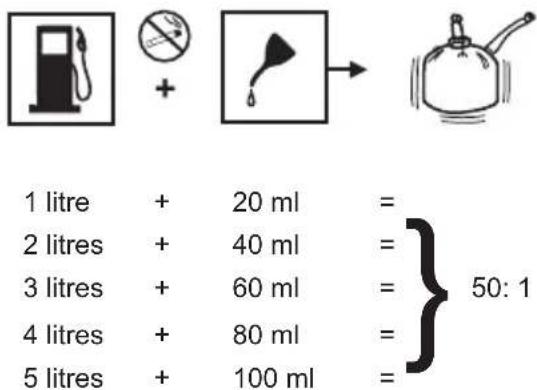
| 1 litre | + | 20 ml | = |
| 2 litres | + | 40 ml | = |
| 3 litres | + | 60 ml | = |
| 4 litres | + | 80 ml | = |
| 5 litres | + | 100 ml | = |
Your chainsaw has been engineered and manufactured to Ryobi's high standard for dependability, ease of operation, and operator safety. When properly cared for, it will give you years of rugged, trouble-free performance.
Important! It is essential that you read the instructions in this manual before operating this machine.
Thank you for buying a Ryobi product.
SAVE THIS MANUAL FOR FUTURE REFERENCE
INSTRUCTION
This product has many features for making its use more pleasant and enjoyable.
Safety, performance, and dependability have been given top priority in the design of this product making it easy to maintain and operate.
Figure 1a – General overview of the chainsaw
- Starter grip
- Trigger release
- Throttle trigger
- Starter housing
- Chain lubricant cap
- Rear handle
- Engine cover
- Front handle
- Front hand guard/chain brake
- Clutch cover
- Chain tensioning dial
- Clutch cover lock knob
- Bumper spike bar
Figure 1b – General overview of the chainsaw
- Primer bulb
- Ignition switch
- Choke lever
- Fuel cap
Figure 2 – Saw chain
- Flats on drive links
Figure 7 – Chainsaw brake – brake position
- Brake position
Figure 8 – Chainsaw brake – run position
- Run position
Figure 9 – Chainsaw starting position
- Starter grip
Figure 10 – Ignition switch
- Ignition switch in the run position
Figure 11
- Primer bulb
Figure 12
-
Choke lever
-
Start position
-
Run position
Figure 13
-
Trigger release
-
Throttle trigger
Figure 14
- Ignition switch in the stop position
Figure 15
- Idle speed screw "T"
Figure 16
-
Pull
-
Push
Figure 17
- Kickback danger zone
Figure 18
- Rotational kickback
Figure 19
-
Proper hand grip position
-
Improper grip
-
Proper grip
Figure 20
- Chain line
Figure 21
-
Chain line
-
Thumbs on underside of handle bar
-
Straight arm
Figure 23
-
Planned line of fall
-
135 degree from planned line of fall
-
Path of safe retreat
Figure 24
-
Hinge - 5 cm or 1/10 diameter
-
Back cut
-
Notch approx. 1/3 diameter of the trunk
Figure 25
-
Back cut
-
Hinge
Figure 26
- Wedge
English
-
Vertical cut
-
Lodge section
-
Horizontal cut
- Kickback
- Wedge
-
Log supported at one end
-
Finishing cut
-
Load
-
1st cut 1/3 diameter
-
Log supported at both ends
- Overbucking
- Underbucking
-
Second cut
-
Load
-
1st cut 1/3 diameter
-
Finishing cut
- Cut limbs one at a time and leave support limbs under tree until log is cut
- Springpole
- Run position
- Clutch cover
-
Chain drive links
-
Cutters
-
Chain rotation
- Bar groove
Figure 41
-
Adjusting pin
-
Chain tensioning pin hole
-
Sprocket
-
Clutch cover
-
Rotate clutch cover knob clockwise to secure
-
Clutch cover lock knob
-
Chain tensioning dial
-
Loosen chain
-
Tighten chain
- Raker (depth gauge) clearance
- Inspect drive sprocket
-
Gullet
-
Heel
-
Rivet hole
-
Top plate
-
Cutting corner
-
Side plate
-
Depth gage
-
Toe
-
Left hand cutters
-
Right hand cutters
-
Top plate filing angle
-
Correct
-
Less than 30 degree
-
More than 30 degree
-
Incorrect
-
Correct
-
Side plate filing angle
-
Hook
-
Backward slope
- Raker (depth gauge) clearance
-
Depth gauge jointer
-
Flat file
- Restore original shape by rounding the front
- Lubricating hole
- Engine cover
English
Figure 59
- Air filter
Figure 61
- Idle speed screw "T"
Figure 62
-
Chain brake
-
Chain lubricant cap
-
Fuel cap
-
Post
-
Starter cover
-
T25 Torx Screwdriver
Figure 63
- Clean Engine fins
Figure 64
- Clean flywheel fins
Figure 65
- Fuel filter
Figure 67
-
Deflector
-
Deflector retaining nut
-
Spark arrestor
-
Gasket
-
Silencer
-
Bumper spike bar
-
Bolt & nut
Figure 68
- Clean the chain brake
NTENDED USE
This chainsaw is designed for cutting branches, trunks, logs and beams of a diameter determined by the cutting length of the guide bar. It is only designed to cut wood. It is only to be used outdoors, by adults.
Do not use the chainsaw for any purpose not listed above. This chainsaw is not to be used for professional tree services. It is not to be used by children or by persons not wearing adequate personal protective equipment and clothing.
RESIDUAL RISKS:
Even when using the chainsaw as intended, there remains a residual risk of harm which cannot be fully prevented. The following list of potential hazards should be read and understood. You should pay extra attention and care to these items to reduce the risk of injury.
■ Contact with exposed cutting teeth and saw chain.
■ ccess to rotating parts (the saw chain)
■ Unexpected, abrupt movement (kick back) of the guide bar.
■ Flying chain parts (thrown off or broken)
■ Flying material (cut from the work piece)
■ Inhalation of saw dust and particles or emissions from the petrol engine.
■ Skin contact with petrol / oil.
■ Loss of hearing if no hearing protective equipment is worn during use.
GENERAL SAFETY RULES

WARNING
Read and understand all instructions. Failure to follow all instructions listed below may result in fire and/or serious personal injury.
READ ALL INSTRUCTIONS
- Know your tool. Read the operator's manual carefully. Learn the saw's applications and limitations as well as the specific potential hazards related to this tool. We recommend you attend a professional training course to increase your awareness and proficiency in all chainsaw operations.
■ Kickback may occur when the nose or tip of the guide bar touches an object, or when the wood closes in and pinches the saw chain in the cut. Tip contact in some cases may cause a lightning-fast reverse reaction, kicking the guide bar up and back toward the operator. Pinching the saw chain along the top of the guide bar may push the guide bar rapidly back toward the operator. Either of these reactions may cause you to lose control of the saw, which could result in serious personal injury. Do not rely exclusively upon the safety devices built into the saw. As a chainsaw user, you should take every step to keep your cutting jobs free from accident and injury.
■ With a basic understanding of kickback, you can reduce or eliminate the element of surprise. Sudden surprise contributes to accidents.
- Keep a good firm grip on the saw with both hands when the engine is running. Place your right hand on the rear handle and your left hand on the front handle with your thumbs and fingers encircling the chainsaw handles. A firm grip together with a stiff left arm will help you maintain control of the saw if kickback occurs.
■ Make sure that the area in which you are cutting is free from obstructions. Do not let the nose of the guide bar contact a log, branch, fence, or any other obstruction that could be hit while you are operating the saw.
■ Always cut with the engine running at full speed. Fully squeeze the throttle trigger and maintain a steady cutting speed.
English
■ Do not overreach or cut above chest height.
■ Follow the manufacturer's sharpening and maintenance instructions for the saw chain.
■ Only use replacement bars and chains specified by the manufacturer or the equivalent.
■ Do not operate a chainsaw with one hand. Serious injury to the operator, helpers, bystanders, may result from one-handed operation. A chainsaw is intended for two-handed use.
■ Do not operate a chainsaw when you are fatigued. Fatigue causes carelessness. Be more cautious before rest periods and towards the end of your shift. Never operate a chainsaw when under the influence of medication, drugs, or alcohol.
■ Use safety footwear. Do not wear loose clothing. wear protective gloves and clothing(class1), and eye, hearing, and head protection devices.
■ Heavy protective clothing may increase operator fatigue, which could lead to heat stroke. During weather that is hot and humid, heavy work should be scheduled for early morning or late afternoon hours when temperatures are cooler.
■ Do not stand on any unstable surface while using the chainsaw, that includes ladders, scaffolds, trees, etc. always keep a sound and firm footing.
■ Use caution when handling fuel. Move the chainsaw at least 10 metres from the fuelling point before starting the engine.
■ Do not allow other persons to be near the chainsaw when starting or cutting with the chainsaw. Keep bystanders and animals out of the work area.
■ Do not start cutting until you have a clear work area, secure footing, and a planned retreat path from the falling tree.
- Keep all parts of your body away from the saw chain when the engine is running.
■ Always carry the chainsaw with the engine stopped and the brake engaged, the guide bar and saw chain to the rear, and the Silencer away from your body. When transporting the chainsaw, use the appropriate guide bar scabbard.
■ Do not operate a chainsaw that is damaged, improperly adjusted, or not completely and securely assembled. Be sure that the saw chain stops moving when the throttle control trigger is released.
■ Shut off the engine before setting the chainsaw down. Do not leave the engine running unattended. As an additional safety precaution, apply the chain brake prior to setting down the saw.
■ Use extreme caution when cutting small-size brush and saplings because slender material may catch the
saw chain and be whipped toward you or pull you off balance.
■ When cutting a limb that is under tension, be alert for spring back so that you will not be struck when the tension in the wood fibres is released.
- Keep the handles dry, clean, and free of lubricant or fuel mixture.
■ Beware of carbon monoxide poisoning. Operate the chainsaw only in well-ventilated areas.
■ Do not climb a tree to use the chainsaw, unless you have been specifically trained to do so.
■ Do not operate the chainsaw from a ladder; this is extremely dangerous.
■ All chainsaw service, other than the items listed in the instruction manual and all maintenance should be performed by competent chainsaw service personnel. (For example, if improper tools are used to remove the flywheel or if an improper tool is used to hold the flywheel in order to remove the clutch, structural damage to the flywheel could occur and subsequently could cause the flywheel to burst.)
■ Always have a fire extinguisher available when using a chainsaw.
■ Use only the replacement guide bars and low kickback chains specified for the saw.
- Do not adapt the powerhead to a bow guide or use it to power any attachments or devices not listed for the saw.
- The petrol powered saw is intended for infrequent use by homeowners, cottagers, and campers, and for such general applications as clearing, pruning, cutting firewood, etc. It is not intended for prolonged use. Prolonged periods of operation can cause circulatory (white finger) problems in the user's hands due to vibration. For such use, it may be appropriate to use a saw having an anti-vibration feature.
■ Save these instructions. Refer to them frequently and use to instruct other users. If you loan someone this tool, loan them these instructions also.
SPECIFIC SAFETY RULES

WARNING
The warnings, labels, and instructions found in this section of the operator's manual are for your safety. Failure to follow all instructions may result in serious personal injury.
■ Do not cut vines and/or small underbrush (a diameter of less than 3 in.)
■ Silencer surfaces are very hot during and immediately after operation of the chainsaw; keep all body parts away from the Silencer. Serious burns may occur if contact is made with the Silencer.
English
■ Always hold the chainsaw with both hands when the engine is running. Use a firm grip with thumbs and fingers encircling the chainsaw handles.
■ Never let anyone use the chainsaw who has not received adequate instructions in its proper use. This applies to rentals as well as privately owned saws.
■ Before you start the engine, make sure the saw chain is not contacting any object.
■ Wear snug-fitting clothing. Always wear heavy, long trousers, boots, and gloves. Do not wear jewellery, shorts, sandals, or go barefoot. Loose fitting clothing could be drawn into the engine or catch the chain or underbrush. Wear overalls, jeans, or chaps made of cut-resistant material or ones that contain cut-resistant inserts. Secure hair so that it is above shoulder level.

WARNING
Wear safety clothing which is designed for chainsaw operators.
■ Wear non-slip safety footwear and heavy-duty gloves to improve your grip and to protect your hands.
■ Wear eye protection which is marked to comply with EN 166, as well as hearing and head protection, when operating this equipment.
- Keep bystanders and animals out of the work area. Do not allow other persons to be nearby during starting or cutting with the chainsaw.
Note: The size of the work area depends on the job being performed as well as the size tree or work piece involved. For example, felling a tree requires a larger work area than making other cuts (i.e., bucking cuts, etc.).
■ Follow the sharpening and maintenance instructions for the saw chain.
■ Never operate a chainsaw that is damaged, improperly adjusted, or has been modified (particularly guards or safety devices), or is not completely and securely assembled. Be sure that the saw chain stops moving when the throttle control trigger is released. If the saw chain moves at idle speed, the carburettor may need adjusting. Refer to Adjusting the Carburettor in the Maintenance section of this manual. If the saw chain still moves at idle speed after adjustment has been made, contact an authorized service centre for adjustment and discontinue use until the repair is made.
REFUELING (DO NOT SMOKE!)
■ To reduce the risk of fire and burn injury, handle fuel with care. It is highly flammable.
■ Mix and store fuel in a container approved for petrol.
■ Mix fuel outdoors where there are no risks from sparks or flames.
■ Select bare ground, stop the engine, and allow it to cool before refuelling.
■ Loosen the fuel cap slowly to release any pressure and to keep fuel from escaping around the cap.
■ Tighten the fuel cap securely after refuelling.
■ Wipe spilled fuel from the unit. Move 10 metres away from refuelling site before starting engine.
■ NEVER attempt to burn off spilled fuel under any circumstances.
This product is very noisy when operating, to prevent long term hearing damage, wear hearing protection and keep other persons at least 15m away from the work area. Operating similar tools nearby increases risk of injury.
Use of hearing protection reduces the ability to hear warnings (shouts or alarms). The operator must pay extra attention to what is going on in the work area.
KICKBACK
■ Kickback is a dangerous reaction that can lead to serious injury. Do not rely only on the safety devices provided with the saw. As a chainsaw user, you must take special safety precautions to help keep your cutting jobs free from accident or injury. See the General Safety Rules and Operation sections of this manual for added information on kickback and how to avoid serious personal injury.
English
SYMBOLS
Some of the following symbols may be used on this product. Please study them and learn their meaning. Proper interpretation of these symbols will allow you to operate the tool better and safer.
| SYMBOL | NAME | DESIGNATION / EXPLANATION |
 | Safety Alert | Precautions that involve your safety. |
 | Read The Operator's Manual | To reduce the risk of injury, user must read and understand operator's manual before using this product. |
 | Wear Eye, Hearing, and Head Protection | Always wear eye protection with side shields marked to comply with EN 166 as well as hearing and head protection when operating this equipment. |
 | No Smoking | No smoking, sparks, or open flame. |
 | Operate With Two Hands | Hold and operate the saw properly with both hands. |
 | One Handed | Do not operate the saw using only one hand. |
 | Carbon Monoxide | Engines produce carbon monoxide which is an odorless, deadly poison. Do not operate in an enclosed area. |
 | Kickback | DANGER! Beware of kickback. |
 | Bar Nose Contact | Avoid bar nose contact. |
 | Wear Gloves | Wear non-slip, heavy-duty protective gloves when handling the chainsaw. |
 | Petrol and Lubricant | Use unleaded petrol intended for motor vehicle use with an octane rating of 91 [(R + M)/2] or higher. This product is powered by 2-stroke cycle engine and requires pre-mixing petrol and 2-stroke lubricant. |
 | Keep Bystanders Away | Keep all bystanders and animals at least 15m away. |
 | Chain Oil Fill / Oil Pump | Add bar and chain oil every time you add fuel to the chainsaw. |
English
SYMBOLS
The following signal words and meanings are intended to explain the levels of risk associated with this product.
| SYMBOL | SIGNAL | MEANING |
 | DANGER | Indicates an imminently hazardous situation, which, if not avoided, will result in death or serious injury. |
 | WARNING | Indicates a potentially hazardous situation, which, if not avoided, could result in death or serious injury. |
 | CAUTION | Indicates a potentially hazardous situation, which, if not avoided, may result in minor or moderate injury. |
| CAUTION | (Without Safety Alert Symbol) Indicates a situation that may result in property damage. |
SERVICE
Servicing requires extreme care and knowledge and should be performed only by a qualified service technician. For service we suggest you return the product to your nearest AUTHORISED SERVICE CENTER for repair. When servicing, use only identical replacement parts.

WARNING
To avoid serious personal injury, do not attempt to use this product until you read thoroughly and understand completely the operator's manual. If you do not understand the warnings and instructions in the operator's manual, do not use this product. Call Ryobi customer service for assistance.

WARNING
The operation of any power tool can result in foreign objects being thrown into your eyes, which can result in severe eye damage. Before beginning power tool operation, always wear safety goggles, safety glasses with side shields, or a full face shield when needed. We recommend Wide Vision Safety Mask for use over eyeglasses or standard safety glasses with side shields. Always use eye protection which is marked to comply with EN 166.

WARNING
Long term inhalation of the engine's exhaust fumes, chain oil mist and sawdust can result in serious personal injury.
SAVE THESE INSTRUCTIONS AND PASS THEM ON IF THE SAW IS TO BE USED BY ANOTHER PERSON
English
GLOSARY OF TERMS
Skating
When the chain saw fails to dig in during a cut, the guide bar can begin hopping or dangerously skidding along the surface of the log or branch, possibly resulting in the loss of control of the chain saw. The sideward motion of the guide bar can increase the risk of kickback. To prevent or reduce this skating, hold the chain saw with two hands and make sure the saw chain establishes a groove for cutting.
Bucking
The process of cross cutting a felled tree or log into lengths.
Bouncing
Never cut small, flexible branches or brush with your chain saw. Their size and flexibility can easily cause the saw to bounce toward you or bind up with enough force to cause a kickback. The best tools for that kind of work are a hand saw, pruning shears, an axe and other hand tools.
Chain Brake
A device used to stop the saw chain.
Chainsaw Powerhead
A chainsaw without the saw chain and guide bar.
Clutch
A mechanism for connecting and disconnecting a driven member to and from a rotating source of power.
Drive Sprocket or Sprocket
The toothed part that drives the saw chain.
Felling
The process of cutting down a tree.
Felling Back Cut
The final cut in a tree felling operation made on the opposite side of the tree from the notching undercut.
Front Hand Guard
A structural barrier between the front handle of a chainsaw and the guide bar, typically located close to the hand position on the front handle, and sometimes employed as an activating lever for a chain brake.
Front Handle
The support handle located at or toward the front of the chainsaw. This handle is for the left hand.
Guide Bar
A solid railed structure that supports and guides the saw chain.
Kickback
The backward or upward motion, or both, of the guide bar occurring when the saw chain near the nose of the top area of the guide bar contacts any object such as a log or branch, or when the wood closes in and pinches the saw chain in the cut.
Kickback (Pinch)
The rapid pushback of the saw which can occur when the wood closes in and pinches the moving saw chain in the cut along the top of the guide bar.
Kickback (Rotational)
The rapid upward and backward motion of the saw which can occur when the moving saw chain near the upper portion of the tip of the guide bar contacts an object, such as a log or branch.
Low-Kickback Chain
A chain that complies with the kickback performance requirements of ISO 9518 when tested on a representative sample of chainsaws.
Normal Cutting Position
Those positions assumed in performing the bucking and felling cuts.
Notching Undercut
A notch cut in a tree that directs the tree's fall.
Rear Handle
The support handle located at or toward the rear of the saw. It normally contains the throttle. This handle is for the right hand.
Reduced Kickback Guide Bar
A guide bar which has been demonstrated to reduce kickback significantly.
Replacement Saw Chain
A chain that complies with the kickback performance requirements of ISO 9518 when tested with specific chainsaws. It may not meet the ANSI performance requirements when used with other saws.
Saw Chain
A loop of chain having cutting teeth that cut the wood and that is driven by the motor and is supported by the guide bar.
Springpole
A small tree (sapling) or limb that is bent or trapped under tension. It may "spring back" rapidly when cut, causing a dangerous situation.
English
TECHNICAL
| Model name | RcS3535B | RcS3535cB | RcS4040cB |
| Description | 42cc 35cm (14") CE saw | 42cc 35cm (14") CE saw | 42cc 40cm (16") CE saw |
| Weight - No bar, chain, fuel | 4.7 kg | 4.7 kg | 4.7 kg |
| Fuel tank capacity | 340 cm3 | 340 cm3 | 340 cm3 |
| Lubricant tank capacity | 192 cm3 | 192 cm3 | 192 cm3 |
| Bar length | 35 cm | 35 cm | 40 cm |
| Usable cutting length | 33.3 cm | 33.3 cm | 37.0 cm |
| Chain pitch | 9.53 mm (0.375 inch) | 9.53 mm (0.375 inch) | 9.53 mm (0.375 inch) |
| Chain gauge | 1.27 mm (0.05 inch) | 1.27 mm (0.05 inch) | 1.27 mm (0.05 inch) |
| Chain type | 3/8" low profile full complement | 3/8" low profile full complement | 3/8" low profile full complement |
| Drive sprocket | 6 teeth x 3/8" | 6 teeth x 3/8" | 6 teeth x 3/8" |
| Engine displacement | 42 cm3 | 42 cm3 | 42 cm3 |
| Maximum engine power(ISO 7293) | 1.7 kW | 1.7 kW | 1.7 kW |
| Minimum engine speed with attachment | 11,000 min-1 | 11,000 min-1 | 11,000 min-1 |
| Maximum engine speed with attachment (reference only) | 12,500 min-1 | 12,500 min-1 | 12,500 min-1 |
| Idling engine speed | 2,600-3,600 min1 | 2,600-3,600 min-1 | 2,600-3,600 min-1 |
| Specific fuel consumption at maximum engine power | 426 g/kw.h | 426 g/kw.h | 426 g/kw.h |
| Sound pressure level (ISO 22868) | LpAav: 101 dB(A), KpA=3 dB(A) | LpAav: 101 dB(A), KpA=3 dB(A) | LpAav: 101 dB(A), KpA=3 dB(A) |
| Sound power level (ISO 22868) | 112 dB (A) | 112 dB (A) | 112 dB (A) |
| Vibration (ISO 22867): - Front Handle - Rear Handle | Carlton /Oregon 8.2 m/s2, K=1.5 7.7 m/s2, K=1.5 | Carlton /Oregon 8.2 m/s2, K=1.5 7.7 m/s2, K=1.5 | Carlton /Oregon 8.2 m/s2, K=1.5 7.7 m/s2, K=1.5 |
English
Bar & Chain (Note: Carlton guide bar only use with Carlton saw chain, and Oregon guide bar only use with Oregon saw chain)
| Model name | RCS3535B | RCS3535CB | RCS4040CB |
| Guide bar (no silkscreen) - Carlton part number - TTI part number - Color | 14-10W-N1-MHC UNB Y 308714003 Yellow | 14-10W-N1-MHC UNB Y 308714003 Yellow | 16-10W-N156-MHC UNB Y 308946004 Yellow |
| Chain - Carlton part number - TTI part number | N1C-BL-52E B 901213001 | N1C-BL-52E B 901213001 | N1C-BL-56E B 901213002 |
| Guide bar (no silkscreen) - Oregon part number - TTI part number - Color | 140 SDEA041 \ Y 300961008 Yellow | 140 SDEA041 \ Y 300961008 Yellow | 160 SDEA041 \ Y 308109004 Yellow |
| Chain - Oregon part number - TTI part number | 91P-52P 901213011 | 91P-52P 901213011 | 91P-56P 901213012 |
Bar & Chain
| Guide bar | CSA035 | CSA035 | CSA047 |
| Chain | CSA044 | CSA044 | CSA046 |
English
ASSEMBLY

WARNING:
If any parts are damaged or missing do not operate this product until the parts are replaced. Failure to heed this warning could result in serious personal injury. This product has been shipped completely assembled.

WARNING:
Do not attempt to modify this product or create accessories not recommended for use with this product. Any such alteration or modification is misuse and could result in a hazardous condition leading to possible serious personal injury.
NOTE: The chainsaw has been fully factory tested. It is normal to find some slight lubricant residue on the saw. Read and remove all hang tags and store with the Operator's Manual.

WARNING:
Before first use, it is essential that you follow the 'Chain Adjustment' guide (following this section) to ensure the bar and chain have not become loose in transit. Never operate a chainsaw with incorrectly adjusted chains. Failure to follow these steps could result in severe personal injury.
UNPACKING
■ Carefully remove the product and any accessories from the box. Make sure that all items listed in the packing list are included.
■ Inspect the product carefully to make sure no breakage or damage occurred during shipping.
■ Do not discard the packing material until you have carefully inspected and satisfactorily operated the product.
■ If any parts are damaged or missing, please call your Ryobi service centre for assistance.
PACKING LIST
Chainsaw
Scabbard
Combination Wrench
2-Cycle Engine Lubricant
Bar and Chain Lubricant
Case (RCS3535CB / RCS4040CB)
Operator's Manual
ADJUSTING THE cCHAIN TENSION
See Figures 2-3, 37, 42-45.

WARNING:
Never touch or adjust the chain while the motor is running. The saw chain is very sharp. Always wear protective gloves when performing maintenance on the chain.
■ Stop the engine before setting the chain tension.
■ Slightly loosen the clutch cover lock knob by pressing in and rotating counter clockwise. (Figures 37)
■ Turn the chain tensioning dial clockwise to tension the chain. (Figures 44)
Note: A cold chain is correctly tensioned when there is no slack on the underside of the guide bar, the chain is snug, and it can be turned by hand without binding.
■ Re-tension the chain whenever the flats on the drive links hang out of the bar groove. (Figures 3)
Note: During normal saw operation, the temperature of the chain increases. The drive links of a correctly tensioned warm chain will hang approximately 1.2mm out of the bar groove. The tip of the combination wrench can be used as a guide to help determine the correct warm chain tension.
Note: New chains tend to stretch; check the chain tension frequently and tension as required. This is the same for a NEW tool.
■ Lift the tip of the guide bar up to check for sag. (Figures 43)
■ Release the tip of the guide bar and turn the chain tensioning dial clockwise. Repeat this process until sag does not exist.
- Hold the tip of the guide bar up and tighten the clutch cover lock knob securely. The chain is correctly tensioned when there is no sag on the underside of the guide bar, the chain is snug, but it can be turned by hand without binding. Ensure that the chain brake is not set.
Note: If chain is too tight, it will not rotate. Loosen the clutch cover lock knob by pressing in and slightly rotating counter clockwise, then rotate the chain tensioning dial counter clockwise. Lift the tip of the guide bar up and retighten the clutch cover lock knob securely. Ensure that the chain will rotate without binding.
OPERATION

WARNING:
Do not allow familiarity with this product to make you careless. Remember that a careless fraction of a second is sufficient to inflict serious injury.
English

WARNING:
Always wear safety goggles or safety glasses with side shields when operating power tools. Failure to do so could result in objects being thrown into your eyes resulting in possible serious injury.

WARNING:
Do not use any attachments or accessories not recommended by the manufacturer of this product. The use of attachments or accessories not recommended can result in serious personal injury.

WARNING:
Wear eye protection which is marked to comply with EN 166, as well as hearing and head protection, when operating this equipment. Failure to heed this warning could result in serious personal injury.

WARNING:
Exposure to vibrations through prolonged use of petrol powered hand tools could cause blood vessel or nerve damage in the fingers, hands, and joints of people prone to circulation disorders or abnormal swellings. Prolonged use in cold weather has been linked to blood vessel damage in otherwise healthy people. If symptoms occur such as numbness, pain, loss of strength, change in skin color or texture, or loss of feeling in the fingers, hands, or joints, discontinue the use of this use of this tool and seek medical attention. An anti-vibration system does not guarantee the avoidance of these problems. Users who operate power tools on a continual and regular basis must monitor closely their physical condition and the condition of this tool.
KNOW YOUR Chainsaw
See Figures 1a - 1b.
The safe use of this product requires an understanding of the information on the product and in this operator's manual as well as knowledge of the project you are attempting.
Before use of this product, familiarise yourself with all operating features and safety rules.
Bumper Spike - The integral bumper spike (see figure 1) may be used as a pivot when making a cut.
CHOKE LEVER
The choke lever opens and closes the choke valve in the carburettor. Positions available include FULL CHOKE and RUN.
FRONT HAND GUARD/ CHAIN BRAKE
The chain brake is designed to quickly stop the chain from rotating. When the front hand guard/ chain brake is pushed toward the bar, the chain should stop immediately. The chain brake does not prevent kickback.
GUIDE BAR
The factory-equipped guide bar has a small radius tip that offers reduced kickback potential.
The low kickback saw chain helps minimize the force of a kickback reaction by preventing the cutters from digging in too deeply at the kickback zone.
PRIMER BULB
The primer bulb pumps fuel from the fuel tank to the carburettor.
THROTTLE TRIGGER
The throttle trigger is used for controlling chain rotation.

WARNING:
Always shut off engine before fuelling. Never add fuel to a machine with a running or hot engine. Move at least 10 metres from refuelling site before starting the engine. DO NOT SMOKE! Failure to heed this warning could result in serious personal injury.
FUEL AND REFUELING
HANDLING THE FUEL SAFELY

WARNING:
Check for fuel leaks. If any are found, correct them before using the saw to prevent fire or burn injury.
■ Always handle fuel with care; it is highly flammable.
■ Always refuel outdoors, do not inhale fuel vapours.
- Do not let petrol or lubricant come in contact with skin. If contact does occur wash immediately with soap and plenty of water
- Keep petrol and lubricant away from the eyes. If gasoline or lubricant comes in contact with the eyes, wash them immediately with clean water. If irritation is still present, see a doctor immediately.
■ Clean up spilled fuel immediately. Refer to Refuelling in the Specific Safety Rules section of this manual for additional safety information.
MIXING THE FUEL
- This product is powered by a 2-cycle engine and requires pre-mixing petrol and 2-cycle lubricant. Premix unleaded petrol and 2-cycle engine lubricant in a clean container approved for petrol.
- This engine is certified to operate on unleaded petrol intended for automotive use with an octane rating of 91 or higher.
English
- Do not use any type of pre-mixed petrol/lubricant from fuel service stations; this includes the pre-mixed petrol/lubricant intended for use in mopeds, motorcycles, etc.
■ Use a high quality 2-cycle self-mixing lubricant for air-cooled engines. Do not use automotive lubricant or 2-cycle outboard lubricant.
■ Mix 2% lubricant into the petrol. This is a 50:1 ratio.
■ Mix the fuel thoroughly and each time before fuelling.
■ Mix in small quantities. Do not mix quantities larger than usable in a 30-day period. A 2-cycle lubricant containing a fuel stabilizer is recommended.
NOTE: Fuel system damage or performance problems resulting from the use of an oxygenated fuel containing more than the percentages of oxygenates stated previously are not covered under warranty.
FILLING THE FUEL TANK
See Figure 5.
■ Clean the surface around the fuel cap to prevent contamination.
■ Loosen the fuel cap slowly.
■ Carefully pour the fuel mixture into the tank. Avoid spillage.
■ Prior to replacing the fuel cap, clean and inspect the gasket.
■ Immediately replace the fuel cap and hands tighten it. Wipe up any fuel spillage.
Note: It is normal for the engine to emit smoke during and after the first use.
ADDING BAR AND CHAIN LUBRICANT
See Figure 6.
Use Ryobi Bar and Chain Lubricant. It is designed for chains and chain oilers, and is formulated to perform over a wide temperature range with no dilution required. The chainsaw should use approximately one tank of lubricant per tank of fuel.
Note: Do not use dirty, used, or otherwise contaminated lubricants. Damage may occur to the lubricant pump, bar, or chain.
■ Carefully pour the bar and chain lubricant into the lubricant tank.
■ Fill the lubricant tank every time you fuel the engine.
Check the operating condition of the chain brake prior to each use.
■ Engage the chain brake by rotating your left hand around the front handle, allowing the back of your hand to push the chain brake lever/hand guard toward the bar while the chain is rotating rapidly. Be sure to maintain both hands on the saw handles at all times.
■ Reset the chain brake back into the RUN position by grasping the top of the chain brake lever/hand guard and pulling toward the front handle until you hear a click.

WARNING:
If the chain brake does not stop the chain immediately, or if the chain brake will not stay in the run position without assistance, take the saw to an authorised service centre for repair prior to use.
STARTING THE ENGINE
See Figures 8 - 13.
Starting the product differs depending on whether the engine is cold or warm.

WARNING:
Keep your body to the left of the chain line. Never straddle the saw or chain, or lean over past the chain line.
■ Place the chainsaw on level ground and ensure that no objects or obstructions are in the immediate vicinity that could come in contact with the bar and chain.
■ Hold the front handle firmly with your left hand and put your right foot onto the base of the rear handle.
To start a cold engine:
■ Turn on the ignition switch.
■ Make sure the chain brake is in the run position by pulling back on the lever/hand guard.
■ Fully press and release the primer bulb at least 7 times.
■ Pull choke lever all the way out to START position.
English
■ When the temperature is above 10° C, pull the starter grip until the engine attempts to start, but no more than 3 times. When the temperature is below 10° C, pull the starter grip until the engine attempts to start, but no more than 5 times.
■ Push choke lever to RUN position. Pull starter grip until engine runs.
Note: Allow the saw to run in this position 15-30 seconds, depending upon the temperature.
■ Depress the trigger release and squeeze and release the throttle trigger to return the engine to idle after a total run time of at least 30 seconds.
CAUTION:
Failure to release throttle when chain brake lever is in the brake position will result in serious damage to the unit. Never squeeze and hold the throttle trigger while the chain brake is in the brake position.
To Start a Warm Engine:
■ Turn on the ignition switch.
■ Make sure the chain brake is in the run position by pulling back on the lever/hand guard.
■ Keep choke lever on RUN position.
■ Pull starter grip until engine runs, but no more than 5 times. If engine does not start after 5 pulls, use cold engine starting procedure.
■ Squeeze and release the throttle trigger to return the engine to idle.
STOPPING THE ENGINE
See Figures 7 and 14.
Release the throttle trigger and let the engine return to idle. To stop the engine, move the ignition switch to the stop (0) position. Do not put the chainsaw on the ground when the chain is still moving. For additional safety, set the chain brake when the saw is not in use.
In the event that the ignition switch will not stop the saw, pull the choke lever out to the fully extended position (Full Choke) and engage the chain brake to stop the engine. If the ignition switch will not stop the saw when set to the stop position, have the ignition switch repaired before using the chainsaw again to prevent unsafe conditions or serious injury.
NOTE: When you are finished using the saw, always relieve tank pressure by loosening, then retightening, the chain lubricant and fuel caps. Allow the engine to cool before storing.
ADJUSTING IDLE SPEED
See Figure 15.
■ If the engine starts, runs, and accelerates, but will
not idle, turn the idle speed screw "T" clockwise to increase idle speed to 2600\~3600 rpm.
If the chain turns at idle, turn the idle speed screw "T" counter clockwise to reduce the idle RPM and stop the chain movement. If the saw chain still moves at idle speed, contact an authorised service centre for adjustment and discontinue use until the repair is made.

WARNING:
THE SAW CHAIN SHOULD NEVER TURN AT IDLE. Serious personal injury may result from the saw chain turning at idle.
PULL AND PUSH
See Figure 16.
The reaction force of the saw is always opposite to the direction the chain is moving. Thus, the operator must be ready to control the PULL when cutting on the bottom edge of the bar and the PUSH when cutting along the top edge.
Note: The chainsaw has been fully factory tested. It is normal to find some slight lubricant residue on the saw.
KICKBACK PRECAUTIONS
See Figures 17 - 18.
Rotational kickback occurs when the moving chain contacts an object at the Kickback Danger Zone of the guide bar. The result is a lightning-fast reverse reaction, which kicks the guide bar up and back towards the operator. This reaction can cause loss of control, which can result in serious injury.
PREPARING FOR CUTTING PROPER GRIP ON HANDLES
See Figure 19.
See General Safety Rules for appropriate safety equipment.
■ Wear non-slip gloves for maximum grip and protection.
■ Hold the saw firmly with both hands. Always keep your left hand on the front handle and your right hand on the rear handle so that your body is to the left of the chain line.

WARNING:
Never use a left-handed (cross-handed) grip or any stance that would place your body or arm across the chain line.
- Maintain a proper grip on the saw whenever the engine is running. The fingers should encircle the handle and the thumb is wrapped under the handlebar. This grip is least likely to be broken by a kickback or other sudden reaction of the saw. Any grip in which the thumb and fingers are on the same side of the handle is dangerous because a slight kick of the saw can cause loss of control.
English

WARNING:
See Figure 20
DO NOT operate the throttle trigger with your left hand and hold the front handle with your right hand. Never allow any part of your body to be in the chain line while operating a saw.
PROPER CUTTING STANCE
See Figure 21.
■ Balance your weight with both feet on solid ground.
- Keep left arm with elbow locked in a "straight arm" position to withstand any kickback force.
- Keep your body to the left of the chain line.
- Keep your thumb on underside of handlebar.
WORK AREA PRECAUTIONS
See Figure 22.
■ Cut only wood or materials made from wood
■ Never allow children to operate the saw. Do not Allow persons to use this chainsaw who have not read this operator's manual or received adequate instructions for the safe and proper use of this chainsaw.
- Keep helpers, bystanders, children, and animals, a SAFE DISTANCE from the cutting area. During felling operations, the safe distance should be a least twice the height of the largest trees in the felling area. During bucking operations, keep a minimum distance of 5 metres between workers.
■ Always cut with both feet on solid ground to prevent being pulled off balance.
■ Do not cut above chest height as a saw held higher is difficult to control against kickback forces.
■ Do not fell trees near electrical wires or buildings. Leave this operation for professionals.
■ Cut only when visibility and light are adequate for you to see clearly.
BASIC OPERATING/CUTTING PROCEDURES
Practice cutting a few small logs using the following technique to get the "feel" of using the saw before you begin a major sawing operation.
■ Take the proper stance in front of the wood with the saw idling.
■ Accelerate the engine to full throttle just before entering the cut by squeezing the throttle trigger.
■ Begin cutting with the saw against the log.
- Keep the engine at full throttle the entire time you are cutting.
- Allow the chain to cut for you; exert only light downward pressure. Forcing the cut could result in damage to the bar, chain, or engine.
■ Release the throttle trigger as soon as the cut is completed allowing the engine to idle. Running the saw at full throttle without a cutting load can result in unnecessary wear to the chain, bar, and engine.
■ Do not put pressure on the saw at the end of the cut as this may cause the saw to drop in an unsafe
manner.
FELLING TREES IN HAZARDOUS CONDITIONS WARNING:

Do not fell trees during periods of high wind or heavy rain. Wait until the hazardous weather has ended. When felling a tree, it is important that you heed the following warnings to prevent possible serious injury.
■ Do not cut down trees having extreme lean or large trees with rotten limbs, loose bark, or hollow trunks. Have these trees pushed or dragged down with heavy equipment, then cut them up.
■ Do not cut trees near electrical wires or buildings.
■ Check the tree for damaged or dead branches that could fall and hit you during felling.
■ Periodically glance at the top of the tree during the back cut to assure the tree is going to fall in the desired direction.
■ If the tree starts to fall in the wrong direction, or if the saw gets caught or hung up during the fall, leave the saw and save yourself!
PROPER PROCEDURE FOR TREE FELLING
See Figures 23 - 26.
- Pick your escape route (or routes in case the intended route is blocked). Clear the immediate area around the tree and make sure there are no obstructions in your planned path of retreat. Clear the path of safe retreat approximately 135° from the planned line of fall.
■ Consider the force and direction of the wind, the lean and balance of the tree, and the location of large limbs. These things influence the direction in which the tree will fall. Do not try to fell a tree along a line different from its natural line of fall.
- Cut a notch about 1/3 the diameter of the trunk in the side of the tree. Make the notch cuts so they intersect at a right angle to the line of fall. This notch should be cleaned out to leave a straight line. To keep the weight of the wood off the saw, always make the lower cut of the notch before the upper cut.
■ Make the back cut level and horizontal, and at a minimum of 2 in. above the horizontal cut of the notch.
Note: Never cut through to the notch. Always leave a band of wood between the notch and back cut (approximately 2 in. or 1/10 the diameter of the tree). This is called a "hinge" or "hinge wood." It controls the fall of the tree and prevents slipping or twisting or shoot back of the tree off the stump.
■ On large diameter trees, stop the back cut before it is deep enough for the tree to either fall or settle
English
back on the stump. Then insert soft wooden or plastic wedges into the cut so they do not touch the chain. Drive wedges in, little by little, to help jack the tree over.
■ As tree starts to fall, stop the chainsaw and put it down immediately. Retreat along the cleared path, but watch the action in case something falls your way.

WARNING:
Never cut through to the notch when making a back cut. The hinge controls the fall of the tree, this is the section of wood between the notch and back cut.
REMOVING BUTTRESS ROOTS
See Figure 27.
A buttress root is a large root extending from the trunk of the tree above the ground. Remove large buttress roots prior to felling. Make the horizontal cut into the buttress first, followed by the vertical cut. Remove the resulting loose section from the work area. Follow the correct tree felling procedure as stated in Proper procedure for tree felling after you have removed the large buttress roots.
BUCKING
See Figure 28.
Bucking is the term used for cutting a fallen tree to the desired log length.
■ Cut only one log at a time.
■ Support small logs on a saw horse or another log while bucking.
- Keep a clear cutting area. Make sure that no objects can contact the guide bar nose and chain during cutting, this can cause Kickback. Refer to Kickback in the Specific Safety Rules section of this manual for more information.
■ During bucking operations, stand on the uphill side so that the cut-off section of the log cannot roll over you.
■ Sometimes it is impossible to avoid pinching (with just standard cutting techniques) or difficult to predict which way a log will settle when cut.
BUCKING WITH A WEDGE
See Figure 29.
If the wood diameter is large enough for you to insert a soft bucking wedge without touching the chain, you should use the wedge to hold the cut open to prevent pinching.
BUCKING LOGS UNDER STRESS
See Figure 30.
Make the first bucking cut 1/3 of the way through the log and finish with a 2/3 cut on the opposite side. As you cut the log, it will tend to bend. The saw can become pinched or hung in the log if you make the first cut deeper than 1/3 of the diameter of the log.
Give special attention to logs under stress to prevent the bar and chain from pinching.
OVERBUCKING
See Figure 31.
Begin on the top side of the log with the bottom of the saw against the log; exert light pressure downward. Note that the saw will tend to pull away from you.
UNDERBUCKING
See Figure 32.
Begin on the underside of the log with the top of the saw against the log; exert light pressure upward. During under bucking, the saw will tend to push back at you. Be prepared for this reaction and hold the saw firmly to maintain control.
BRANCH TRIMMING AND PRUNING
See Figures 33 - 34.
■ Work slowly, keeping both hands on the saw with a firm grip. Maintain secure footing and balance.
- Keep the tree between you and the chain while limbing.
■ Do not cut from a ladder. This is extremely dangerous. Leave this operation for professionals.
■ Do not cut above chest height. A saw held higher than chest height is difficult to control against kickback.

WARNING:
Never climb into a tree to limb or prune. Do not stand on ladders, platforms, a log, or in any position which can cause you to lose your balance or control of the saw.
■ When pruning trees it is important not to make the flush cut next to the main limb or trunk until you have cut off the limb further out to reduce the weight. This prevents stripping the bark from the main member.
■ Under buck the branch 1/3 through for your first cut.
■ Over buck the branch to drop it.
■ Finish by cutting smoothly and neatly against the main member so the bark will grow back to seal the wound.

WARNING:
If the limbs to be pruned are above chest height, hire a professional to perform the pruning.
CUTTING SPRINGPOLES
See Figure 35.
A springpole is any log, branch, rooted stump, or sapling which is bent under tension by other wood so that it springs back if the wood holding it is cut or removed. On a fallen tree, a rooted stump has a high potential of springing back to the upright position during the bucking cut to separate the log from the stump. Watch out for springpoles — they are dangerous.
English

WARNING:
Springpoles are dangerous and could strike the operator, causing the operator to lose control of the chainsaw. This could result in severe or fatal injury to the operator.
MAINTENANCE

WARNING:
When servicing, use only identical Ryobi replacement parts. Use of any other parts may create a hazard or cause product damage.

WARNING:
Always wear safety goggles or safety glasses with side shields during power tool operation or when blowing dust. If operation is dusty, also wear a dust mask.
GENERAL MAINTENANCE
Avoid using solvents when cleaning plastic parts. Most plastics are susceptible to damage from various types of commercial solvents and may be damaged by their use. Use clean cloths to remove dirt, dust, lubricant, grease, etc.

WARNING:
Do not at any time let brake fluids, petrol, petroleum-based products, penetrating lubricants, etc., come in contact with plastic parts. Chemicals can damage, weaken or destroy plastic which may result in serious personal injury.
LUBRICATION
All of the bearings in this product are lubricated with a sufficient amount of high grade lubricant for the life of the unit under normal operating conditions. Therefore, no further lubrication is required.
REPLACING THE GUIDE BAR AND CHAIN
See Figures 36 - 45.

DANGER:
Never start the engine before installing the guide bar, chain, clutch cover, and clutch drum. Without all these parts in place, the clutch can fly off or explode, exposing the user to possible serious injury.

WARNING:
To avoid serious personal injury, read and understand all the safety instructions in this section.
■ Always place the switch in the stop "0" position before you work on the saw.
■ Make sure the chain brake is not set by pulling the chain brake lever/hand guard towards the front handle to the run position.
NOTE: When replacing the guide bar and chain, always use the specified bar and chain listed in the Bar and Chain Combinations section later in this manual.
■ Wear gloves when handling the chain and bar. These components are sharp and may contain burrs.
■ Press in on the clutch cover lock knob and rotate counter clockwise until the clutch cover can be removed.
■ Remove the bar and chain from the mounting surface.
■ Remove the old chain from the bar.
- Lay out the new saw chain in a loop and straighten any kinks. The cutters should face in the direction of chain rotation. If they face backwards, turn the loop over.
■ Place the chain drive links into the bar groove as shown.
■ Position the chain so there is a loop at the back of the bar.
■ Hold the chain in position on the bar and place the loop around the sprocket.
■ Fit the bar flush against the mounting surface so that the bar studs are in the long slot of the bar.
■ Replace the clutch cover ensuring that the adjusting pin in the clutch cover is in the bar chain tensioning pin hole.
■ Replace the clutch cover and rotate clutch cover lock knob just enough to hold the cover in position.
NOTE: The bar must be free to move for tension adjustment.
■ Remove all slack from the chain by rotating the chain tensioning dial clockwise until the chain seats snugly against the bar with the drive links in the bar groove.
■ Lift the tip of the guide bar up to check for sag.
■ Release the tip of the guide bar and turn the chain tensioning dial clockwise. Repeat this process until sag does not exist.
- Hold the tip of the guide bar up and tighten the clutch cover lock knob securely. The chain is correctly tensioned when there is no sag on the underside of the guide bar, the chain is snug, but it can be turned by hand without binding. Ensure that the chain brake is not set.
Note: If chain is too tight, it will not rotate. Loosen the clutch cover lock knob by pressing in and slightly rotating counter clockwise, then rotate the chain tensioning dial counter clockwise. Lift the tip of the guide bar up and retighten the clutch cover lock knob securely. Ensure that the chain will rotate without binding.
CHAIN MAINTENANCE
See Figures 45 - 47.
English

WARNING:
Check that the switch is in the STOP "0" position before you work on the saw.
Use only a low-kickback chain on this saw. This fast-cutting chain provides kickback reduction when properly maintained.
For smooth and fast cutting, maintain the chain properly. The chain requires sharpening when the wood chips are small and powdery, the chain must be forced through the wood during cutting, or the chain cuts to one side. During maintenance of the chain, consider the following:
■ Improper filing angle of the side plate can increase the risk of severe kickback.
■ Raker (depth gauge) clearance.
- Too low increases the potential for kickback.
- Not low enough decreases cutting ability.
■ If the cutter teeth hit hard objects such as nails and stones, or are abraded by mud or sand on the wood, have an authorised service centre sharpen the chain.
Note: Inspect the drive sprocket for wear or damage when replacing the chain. If signs of wear or damage are present in the areas indicated, have the drive sprocket replaced by an authorised service centre.
NOTE: If you do not fully understand the correct procedure for sharpening the chain after reading the instructions that follow, have the saw chain sharpened by an authorised service centre or replace with a recommended low-kickback chain.
SHARPENING THE CUTTERS
See Figures 48 - 51.
Be careful to file all cutters to the specified angles and to the same length, as fast cutting can only be obtained when all cutters are uniform.

WARNING:
The saw chain is very sharp. Always wear protective gloves when performing maintenance to the chain to prevent serious personal injury.
■ Tension the chain prior to sharpening. Refer to Adjusting The Chain Tension.
■ Use a 5/32 in. (4 mm) diameter round file and holder. Do all of your filing at the midpoint of the bar.
- Keep the file level with the top plate of the tooth. Do not let the file dip or rock.
■ Using light but firm pressure. Stroke towards the front corner of the tooth.
■ Lift the file away from the chain tooth on each return stroke.
- Put a few firm strokes on every tooth. File all left hand cutters in one direction. Then move to the other side and file the right hand cutters in the opposite direction.
■ Remove filings from the file with a wire brush.
CAUTION:
A dull or improperly sharpened chain can cause excessive engine speed during cutting, which may result in severe engine damage.

WARNING:
Improper chain sharpening increases the potential of kickback.

WARNING:
Failure to replace or repair a damaged chain can cause serious injury.
TOP PLATE FILING ANGLE
See Figure 52.
■ CORRECT 30° – file holders are marked with guide marks to align file properly to produce correct top plate angle.
■ LESS THAN 30° – for cross cutting.
■ MORE THAN 30° – feathered edge dulls quickly.
SIDE PLATE ANGLE
See Figure 53.
■ CORRECT 80° – Produced automatically if you use the correct diameter file in the file holder.
■ HOOK – “Grabs” and dulls quickly; increases the potential of KICKBACK. Results from using a file with a diameter too small or a file held too low.
■ BACKWARD SLOPE – Needs too much feed pressure; causes excessive wear to the bar and chain. Results from using a file with a diameter too large or file held too high.
MAINTAINING DEPTH GAUGE CLEARANCE
See Figure 54 - 56.
- Maintain the depth gauge at a clearance of .025 in. Use a depth gauge tool for checking the depth gauge clearances.
■ Every time the chain is filed, check the depth gauge clearance.
■ Use a flat file and a depth gauge jointer to lower all gauges uniformly. Use a .025 in. depth gauge jointer. After lowering each depth gauge, restore original shape by rounding the front. Be careful not to damage adjoining drive links with the edge of the file.
■ Depth gauges must be adjusted with the flat file in the same direction the adjoining cutter was filed with the round file. Use care not to contact cutter face with flat file when adjusting depth gauges.
MAINTAINING THE GUIDE BAR
See Figure 57.

WARNING:
Make sure the chain has stopped before you do any work on the saw.
English
Every week of use, turn over the guide bar on the saw to distribute the wear for maximum bar life. The bar should be cleaned every day of use and checked for wear and damage. Feathering or burring of the bar rails is a normal process of bar wear. Such faults should be smoothed with a file as soon as they occur.
A bar with any of the following faults should be replaced:
■ Wear inside the bar rails that permits the chain to lay over sideways
■ Bent guide bar
■ Cracked or broken rails
■ Spread rails
Lubricate guide bar sprockets weekly. Using a grease syringe, lubricate weekly in the lubricating hole. Turn the guide bar and check that the lubrication holes and chain groove are free from impurities.
CLEANING THE AIR FILTER
See Figures 58 - 59.
■ Activate the chain brake.
■ Remove the two screws holding the Engine cover.
■ Lift the front of the Engine cover past chain brake lever.
■ Lift the back of the Engine cover past the handle.
■ Before removing the air filter from the carburettor, blow or brush as much loose dirt and sawdust from around the carburettor and chamber as possible.
Note: Make sure to pull the choke rod out to keep the carburettor from being contaminated.
■ Lift the air filter off the air filter base.
Choose one of the following cleaning options:
■ To lightly clean, tap the filter against a smooth, flat surface to dislodge most saw dust and dirt particles.
■ After every 5 hours of operation, clean in warm soapy water, rinse, and let dry completely. Replace with a new filter after every 25 hours of use.
Note : An alternate method is to clean the filter with compressed air. Always wear eye protection to avoid eye injury.
■ Reinstall the air filter.
Note : If you use an air hose for drying, blow through both sides of filter.

CAUTION:
Make sure the air filter is correctly replaced before reassembly. Never run the engine without the air filter, serious damage could result.
CLEANING THE STARTER UNIT
See Figure 60.
Use a brush to keep the cooling vents of the starter assembly free and clean of debris.
ADJUSTING THE CARBURETTOR
See Figure 61.
Before adjusting the carburettor:
■ Use a brush to clean the starter cover vents.
■ Clean the air filter. Refer to Cleaning the Air Filter in the Maintenance section of this manual.
■ Allow the engine to warm up prior to adjustment of engine idle speed.

WARNING:
Weather conditions and altitude may affect carburetion. Do not allow bystanders close to the chainsaw while adjusting the carburettor.
Idle Speed Adjustment - The idle speed adjustment controls how much the throttle valve stays open when the throttle trigger is released. To adjust:
■ Turn idle speed screw "T" clockwise to increase idle speed.
■ Turn idle speed screw "T" counter clockwise to decrease idle speed.

WARNING:
THE SAW CHAIN SHOULD NEVER TURN AT IDLE. Serious personal injury may result from the saw chain turning at idle.
CLEANING THE ENGINE
See Figures 58, 62-64.
Clean the Engine fins and flywheel fins with a brush periodically. Dangerous overheating of the engine may occur due to impurities on the Engine.

WARNING
Never run the saw without all the parts, including the clutch cover and starter housing, securely in place.
Because parts can fracture and pose a danger of thrown objects, leave repairs of the flywheel and clutch to factory trained authorised service centre personnel.
■ Remove the screws and Engine cover as described previously.
■ Clean the Engine fins.
■ Lift the chain brake over the post.
■ Lay the chainsaw on its side with the bar and chain on the ground.
■ Remove the chain lubricant and fuel caps.
■ Remove the three screws that hold the starter housing in place.
■ Lift off the starter cover and set aside.
■ Replace chain lubricant and fuel caps to prevent contamination during cleaning.
■ Clean the flywheel fins.
■ Replace the starter housing. Reinstall screws and secure.
■ Replace the chain lubricant and fuel caps.
English
■ Replace the Engine cover. Reinstall screws and secure.
■ Replace the chain brake on the post.
NOTE: Check to ensure that the air filter is in the proper position before reinstalling the Engine cover.
NOTE: If you notice a power loss with the petrol powered tool, the exhaust port and Silencer may be blocked with carbon deposits. These deposits may need to be removed to restore performance. We highly recommend that only qualified service technicians perform this service.
CHECKING THE FUEL FILTER
See Figure 65.
Check the fuel filter periodically. Replace it if contaminated or damaged.
REPLACING THE SPARK PLUG
See Figure 66.
This engine uses a Champion RCJ4 or RCJ6Y or NGK BPMR7A with .025 in. electrode gap. Use an exact replacement and replace every 50 hours or more frequently, if necessary.
■ Remove the spark plug lead, by carefully rotating back and forth whilst gently pulling upwards
■ Loosen the spark plug by turning it counter clockwise with a wrench.
■ Remove the spark plug.
Hand thread the new spark plug, turning it clockwise. Tighten securely with wrench.
Note: Be careful not to cross-thread the spark plug. Cross-threading will seriously damage the Engine.
■ Re-attach the spark plug lead by pressing firmly onto top of spark plug
INSPECTING/CLEANING THE SPARK ARRESTOR SCREEN
See Figure 67.
The Silencer is equipped with a spark arrestor screen.
A faulty spark arrestor screen can create a fire hazard. Through normal use the screen can become dirty and should be inspected weekly and cleaned as required.
Always keep the Silencer and spark arrestor on the saw in good condition.

WARNING
Silencer surfaces are very hot during and after operation of the chainsaw. To avoid serious personal injury, keep all body parts away from the Silencer.
■ Allow the Silencer to cool.
■ Remove the deflector retaining nut.
■ Remove the deflector to access the spark arrestor screen and gasket.
If dirty, clean the spark arrestor screen with a small wire brush. Replace the screen if it is cracked or otherwise deteriorated. To obtain a replacement spark arrestor, contact your Ryobi service centre.
INSPECTING AND CLEANING THE CHAIN BRAKE
See Figure 68.
■ Always keep the chain brake mechanism clean by lightly brushing the linkage free from dirt
■ Always test the chain brake performance after cleaning. Refer to Operating Chain Brake for additional information.

WARNING:
Even with daily cleaning of the mechanism, the dependability of a chain brake to perform under field conditions cannot be certified.
STORING THE PRODUCT
■ Clean all foreign material from the product. Store it in a well-ventilated place that is inaccessible to children. Keep away from corrosive agents such as garden chemicals and de-icing salts.
■ Observe local regulations for the safe storage and handling of petrol.
When storing 1 month or longer:
■ Drain all fuel from tank into a container approved for petrol.
■ Run the engine until it stops. This will remove all fuel-lubricant mix that could become stale and leave varnish and gum in the fuel system.
■ Squeeze primer bulb several times to purge fuel from carburettor.
■ Drain all bar and chain lubricant from tank into a container approved for lubricant.
■ Always place the scabbard over the guide bar and chain before transporting or storing the unit.
MAINTENANCE SCHEDULE
Check:
Fuel mixture level .... Before each use
Bar lubrication .... Before each use
Chain tension. . . . . . . . . . . . . . . . . . . . . . . . . . Before each use
Chain sharpness...... Before each use
For damaged parts .... Before each use
For loose fasteners .... Before each use
For loose parts. . . . . . . . . . . . . . . . . . . . . . . Before each use
Chain brake function. . . . . . . . . . . . . . . . . . . Before each use
For fuel leaks.... Before each use
Inspect and Clean:
Bar......Before each use
Complete saw .... After each use
Air filter....Every 5 hours*
Chain brake....Every 5 hours*
Replace spark plug Yearly
Replace fuel filter Yearly
* Hours of Operation
English
TROUBLESHOOTING
| PROBLEM | POSSIBLE CAUSE | SOLUTION |
| Engine will not start.[Make sure ignition switch is in the RUN(I) position]. | No spark.Engine is flooded. | Clean or replace spark plug. Reset spark plug gap. Refer to Spark Plug Replacement earlier in this manual.With the ignition switch OFF, remove spark plug. Move choke lever to run position (pushed in completely) and pull starter cord 15 to 20 times. This will clear excess fuel from engine. Clean and reinstall spark plug. Set ignition switch to run (I) position. Push and fully release primer bulb 7 times. Pull starter three times with choke lever at run. If engine does not start, move choke lever to FULL choke and repeat normal starting procedure. If engine still fails to start, repeat procedure with a new spark plug. |
| Engine starts but will not accelerate properly. | Carburettor requires “L” (Low jet) adjustment. | Contact an authorised service centre for carburettor adjustment. |
| Engine starts, then dies. | Carburettor requires “L” (Low Jet) adjustment. | Contact an authorised service centre for carburettor adjustment. |
| Engine starts but will not run properly at high speed. | Carburettor requires “H” (High jet) adjustment. | Contact an authorised service centre for carburettor adjustment. |
| Engine does not reach full speed and/or emits excessive smoke. | Lubricant/fuel mixture incorrect.Air filter dirty.Spark arrester screen dirty.Carburettor requires “H” (High jet) adjustment. | Use fresh fuel and the correct 2-cycle lubricant mix ratio.Clean air filter. Refer to Cleaning the Air Filter in the Maintenance section of this manual.Clean spark arrestor screen. Refer to Inspecting/Cleaning the Spark Arrestor Screen in the Maintenance section of this manual.Contact an authorized service centre for carburettor adjustment. |
| Engine starts, runs, and accelerates but will not idle.Chain turns at idle. | Carburettor requires adjustment to idle speed.Carburettor requires adjustment to idle speed.Air leak in the intake system. | Turn idle speed screw “T” clockwise to increase idle speed. Refer to Adjusting the Carburettor in the Maintenance section of this manual.Turn idle speed screw “T” counter clockwise to decrease speed. Refer to Adjusting the Carburettor in the Maintenance section of his manual.Contact an authorised service centre for a rebuild kit. |
English
| PROBLEM | POSSIBLE CAUSE | SOLUTION |
| Bar and chain running hot and smoking. | Chain lubricant tank empty. | Lubricant tank should be filled every time fuel tank is filled. |
| Chain tension is too tight. | Tension chain per instructions inAdjusting the Chain Tensionin theMaintenancesection of this manual. |
| Oiler is not functioning. | Run at half throttle 30 to 45 seconds. Stop saw and check for lubricant dripping from guide bar. If lubricant is present, the chain may be dull or bar may be damaged. If no lubricant is present contact an authorised service centre. |
| Engine starts and runs, but chain is not rotating. | Chain brake is engaged. | Release chain brake. Refer toOperating the Chain Brakein theOperationsection of this manual. |
| Chain tension is too tight. | Tension chain per instructions inAdjusting the Chain Tensionin theMaintenancesection of this manual. |
| Guide bar and chain assembled incorrectly. | Refer toReplacing the Guide Bar and Chainin theMaintenancesection of this manual. |
| Guide bar and/or chain are damaged. | Inspect guide bar and chain for damage. |
| Drive sprocket teeth damaged | Contact an authorised service centre for drive sprocket replacement. |
Deutsch
Do not fell trees during periods of high wind oder heavy rain. Wait until the hazardous weather has ended. When Fällen a tree, it is important that you heed the following ACHTUNGs to prevent possible serious injury.
■ Replace the Kupplung cover ensuring that the adjusting pin in the Kupplung cover is in the Schiene Kette tensioning pin hole.
■ Replace the Kupplung cover und rotate Kupplung cover lock knob just enough to hold the cover in position.
DAS PRODUKT AUFBEWAHREN