NIKKOR ED 1200MM F/11 IF - Camera lens NIKON - Free user manual and instructions
Find the device manual for free NIKKOR ED 1200MM F/11 IF NIKON in PDF.


User questions about NIKKOR ED 1200MM F/11 IF NIKON
0 question about this device. Answer the ones you know or ask your own.
Ask a new question about this device
Download the instructions for your Camera lens in PDF format for free! Find your manual NIKKOR ED 1200MM F/11 IF - NIKON and take your electronic device back in hand. On this page are published all the documents necessary for the use of your device. NIKKOR ED 1200MM F/11 IF by NIKON.
USER MANUAL NIKKOR ED 1200MM F/11 IF NIKON
Depth-of-field table
Lens care Page 27
Deutsch
| スリーナ カメラ | A/L | B | C | D | E | G1 | G2 | G3 | G4 | H1 | H2 | H3 | H4 | J | K/P | M | R | T |
| F 3 | ● | ◎ | ● | ◎ | ◎ | ○ | ◎ | ● | ● | ● | ● | |||||||
| F 2 | ● | ◎ | ● | ◎ | ◎ | ○ | ◎ | ● | ● | ● |
■TLRECONBA-TC-200装着的场合*
| ス克莱ーナ カメラ | A/L | B | C | D | E | G1 | G2 | G3 | G4 | H1 | H2 | H3 | H4 | J | K/P | M | R | T |
| F 3 | ● | ◎ | ○ | ○ | ◎ | ● | ● | ● | ◎ | |||||||||
| F 2 | ● —1/2 | ◎ —1/2 | ○ | ○ | ◎ —1/2 | ● —1/2 | ● | ● —1/2 |
| スケーナ カメラ | A/L | B | C | D | E | G1 | G2 | G3 | G4 | H1 | H2 | H3 | H4 | J | K/P | M | R | T |
| F 3 | ● | ◎ | ○ | ○ | ◎ | ● | ● | ● | ● | |||||||||
| F 2 | ● | ◎ | ○ | ○ | ◎ | ● | ● | ● |
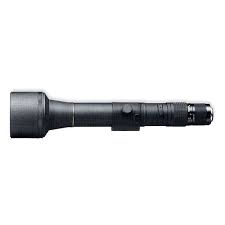
1 Built-in telescopic lens hood
2 Tripod collar locking screw
3 Insertion-type filter holder
4 Preset ring locking screw
5 Focusing ring
6 Distance scale
7 Aperture scale
8 Built-in rotatable tripod mounting collar
9 Shoulder strap eyelet
10 Distance scale/aperture index
11 Aperture ring
12 Aperture-direct-readout scale
13 Meter coupling ridge
14 Aperture indexing post
FOREWORD
Belonging to a new generation of super-telephoto lenses, the Nikkor ED 1200mm f/11 IF offers unparalleled image quality and handling ease, plus automatic diaphragm operation.
The use of Extra-low Dispersion (ED) glass in the lens design drastically reduces chromatic aberration (i.e., the inability of a lens to bring all wavelengths of visible light, especially red and blue, into the same plane of focus). The result is images that are crisp and virtually free of "color fringing" even when the lens is used wide open at its maximum aperture. Nikon Integrated Coating (NIC) is applied to the surfaces of lens elements to reduce flare and improve contrast and color rendition.
For improved handling, this lens utilizes Nikon's Internal Focusing (IF) system, in which the lens elements are moved internally. Without the traditional focusing helicoid, there is no increase in the overall length of the lens as it's focused closer; thus, it is much easier to hand hold. In high or low temperatures, the focal length of the lens might be slightly different when compared with what it is in ordinary temperatures. In this case, you can rotate the focusing ring of the lens slightly beyond the infinity position to focus accurately. In addition, the lens is lighter and more compact than previous models at the same focal length. Other convenient features include a built-in telescopic lens hood, built-in tripod mounting collar, presettable focusing ring for rapid refocusing to a certain distance, and full aperture through-the-lens metering with AI-type Nikon and Nikkormat cameras*.
The ED 1200mm f/11 IF has special insertion-type filter holders accepting either 39mm screw-in or gelatine filters. Because of its extremely long focal length, this lens is perfectly suited for a wide variety of situations, including photojournalism, sports and wildlife photography, as well as taking pictures of the sun and moon themselves.
- This lens is not equipped with a meter coupling shoe. When the lens is attached to a non-AI Nikon camera, measure the exposure via the stop-down method. (Please refer to the camera's instruction manual for details.)
MOUNTING ON A TRIPOD
For maximum picture sharpness and freedom from camera shake, the use of a tripod is recommended at all times. The Nikkor ED 1200mm f/11 IF is incorporated with a sturdy, fully rotatable (360^) built-in tripod mounting collar for just such purposes. To attach to the tripod, position the collar tripod socket on the tripod screw and tighten. To rotate the lens (with attached camera) for vertical or horizontal format, loosen the collar locking screw, rotate the lens to the desired position, and retighten the locking screw to secure the assembly. For convenience while positioning, index marks are provided at 90^ intervals around the tripod collar.
PRESET FOCUSING
The focusing ring is fitted with a special ring for use when rapid refocusing to a specific object distance is desired; the click-stop action of the ring enables operation "by touch" for greater speed. To preset the lens, loosen the preset ring locking screw, rotate the focusing ring as far as it will go in either direction, turn the focusing ring back to the desired focus setting, and tighten the preset ring locking screw to set the click-stop position.
DEPTH-OF-FIELD INDICATORS
Depth of field (i.e., the zone of acceptable image focus) can be checked by reading the color-coded depth-of-field indicators engraved on the lens barrel. The pairs of colored lines on either side of the white distance scale index line correspond to f/numbers of the same color on the aperture scale. You can also observe the depth of field through the viewfinder by simply pressing the depth-of-field preview button on the camera body.
FILTERS
C
The Nikkor ED 1200mm f/11 IF uses standard Nikon 39mm screw-in filters mounted on a filter holder which is inserted into the body of the lens just behind the tripod mounting collar. To gain access to the filter holder for filter changing, press and turn the knob on the filter holder 90^ counterclockwise until the white line on the knob is at right angles to the axis of the lens. The filter holder will come free and can be lifted out of the lens. Unscrew the filter and replace it with the one you wish to use. Lock the filter holder back in place by reversing the above procedure. A special filter holder is provided with this lens which accepts gelatine filters. To fit the filter, release the catch, flip open the filter plates, insert the gelatine filter, close the plates and cut off the excess with a sharp knife. The filter holder can then be mounted in the usual way. Please note that due to a slight difference in thickness between gelatine and glass filters, some focus shift may occur when changing from one type of filter to the other; this discrepancy is easily corrected, however, by slightly shifting the focus setting. A filter must be mounted in the lens at all times.
RECOMMENDED FOCUSING SCREENS
Various interchangeable focusing screens are available for F2 and F3 Nikon cameras to suit any type of lens or picture-taking situation. Those which are recommended for use with this Nikkor ED 1200mm f/11 IF lens are listed below.
| Camera\Screen | A/L | B | C | D | E | G1 | G2 | G3 | G4 | H1 | H2 | H3 | H4 | J | K/P | M | R | T |
| F 3 | ● | ◎ | ● | ◎ | ◎ | ◎ | ◎ | ● | ● | ● | ● | |||||||
| F 2 | ● | ◎ | ● | ◎ | ◎ | ◎ | ◎ | ● | ● | ● |
- When the Teleconverter TC-200 is attached to this lens, use the following table*:
| Camera\Screen | A/L | B | C | D | E | G1 | G2 | G3 | G4 | H1 | H2 | H3 | H4 | J | K/P | M | R | T |
| F 3 | ● | ◎ | ○ | ○ | ◎ | ● | ● | ● | ● | |||||||||
| F 2 | ●-1/2 | ◎-1/2 | ○ | ○ | ◎-1/2 | ●-1/2 | ● | ●-1/2 |
*Vignetting or other performance deterioration may be noticeable in the image recorded on the film.
- When the Teleconverter TC-300 is attached to this lens, use the following table:
| Camera\Screen | A/L | B | C | D | E | G1 | G2 | G3 | G4 | H1 | H2 | H3 | H4 | J | K/P | M | R | T |
| F 3 | ● | ◎ | ○ | ○ | ◎ | ● | ● | ● | ● | |||||||||
| F 2 | ● | ◎ | ○ | ○ | ◎ | ● | ● | ● |
- When the Teleconverter TC-14 is attached to this lens, use the following table.
| Camera\Screen | A/L | B | C | D | E | G1 | G2 | G3 | G4 | H1 | H2 | H3 | H4 | J | K/P | M | R | T |
| F 3 | ● | ◎ | ○ | ○ | ◎ | ● | ● | ● | ● | |||||||||
| F 2 | ● | ◎ | ○ | ○ | ◎ | ● | ● | ● |
= Excellent focusing
= Acceptable focusing
The split-image rangefinder, microprism or crosshair area is dim. Focus on the surrounding matte area.
= Acceptable focusing
Slight vignetting or moiré phenomenon affects the screen image, but the image on film shows no trace of this.
= Exposure measurement not possible
Lens/screen combination permits focusing operation only.
Blank means not usable.
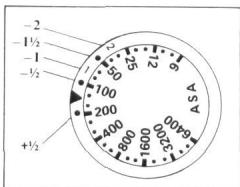
The numbers (e.g. -12 ) in the table mean that the film speed (ASA/ISO) should be set against the proper compensating mark, as shown in the diagram.
When no exposure correction is indicated, the film speed (ASA/ISO) in use should be opposite the index.
SPECIFICATIONS
Focal length: 1200mm
Maximum aperture: f/11
Lens construction: 9 elements in 8 groups
Picture angle: 2^
Distance scale: Graduated in meters and feet from 14m (45 ft) to infinity ()
Aperture scale: f / 11 f / 32 on both standard and aperture-direct-readout scales
Diaphragm: Fully automatic
Exposure measurement: Via full aperture method; meter coupling ridge provided for AI cameras
Focusing system: Nikon Internal Focusing System
Tripod mounting: Via built-in tripod mounting collar; collar rotatable 360^ on lens to permit vertical format picture-taking; positioning index marks provided at each 90^ of rotation; collar locking screw provided
Lens hood: Telescopic type; built into front of lens
Filters: Built-in insertion-type filter holders accept 39mm screw-in or gelatine filters
Mount:Nikon bayonet mount
Attachment size: 122mm (P = 1mm)
Dimensions: 134mm × 577mm long (overall); 569mm extension from flange
Weight: Approx. 3900g
| Accessories | |
| Slip-on leather front lens cap | 122mm screw-in filters |
| Rear lens cap LF-1 | Teleconverter TC-200 |
| Built-in 39mm screw-in filter L37C | Teleconverter TC-300 |
| Gelatine slip-in filter holder | Teleconverter TC-14 |
| Other 39mm screw-in filters | Aluminum Trunk CT-1203 |
ABOUT THE NIKKOR ED-SERIES
Correction of chromatic aberration in camera lenses has been limited, for the most part, to the use of techniques which bring two wavelengths of light, normally blue and red, to a common focus. Although known as "achromatic," lenses employing these designs exhibit a certain amount of undesirable residual dispersion (called the "secondary spectrum") which limits image contrast and sharpness, particularly at full aperture. Telephoto lenses are most prone to the ill effects of chromatic aberration, since secondary spectrum increases with focal length.
The Nikkor ED-series consists of telephoto and super-telephoto lenses fitted with elements made of a Nippon-Kogaku-developed special optical glass called Extra-low Dispersion (ED) glass. Although the optical characteristics of this new glass are similar to those of calcium-fluorite crystal, ED glass possesses a more constant refractive index over a wide range of temperatures and will, therefore, cause less of a focus shift. Also, ED glass is much harder and more resistant to scratches, enabling its use for front and rear lens elements to obtain optimum correction of chromatic aberration over the widest possible wavelength range. Some lenses within the ED-series, such as this Nikkor ED 1200mm f/11 IF, have been so fully corrected that image sharpness extends uniformly to the infrared region; for these lenses, corrective refocusing for infrared exposures is unnecessary. The remaining lenses have been built exceptionally compact due to the use of ED glass elements; for these lenses, however, corrective refocusing for infrared photography is necessary. Regardless of which type, ED-series lenses offer exceptional sharpness and full contrast for the most precise photography under the widest conditions.
NOMENKLATUR
| Kamera | MatscheibeA/L | B | C | D | E | G1 | G2 | G3 | G4 | H1 | H2 | H3 | H4 | J | K/P | M | R | T |
| F 3 | ● | ◎ | ● | ◎ | ◎ | ◎ | ◎ | ● | ● | ● | ● | |||||||
| F 2 | ● | ◎ | ● | ◎ | ◎ | ◎ | ◎ | ● | ● | ● |
| Kamera | Mattscheibe | A/L | B | C | D | E | G1 | G2 | G3 | G4 | H1 | H2 | H3 | H4 | J | K/P | M | R | T | |
| F 3 | ● | ● | ○ | ○ | ○ | ● | ● | ● | ● | ● | ||||||||||
| F 2 | ● -1/2 | ● -1/2 | ○ | ○ | ○ | ● -1/2 | ● -1/2 | ● | ● -1/2 | |||||||||||
| Kamera | Mattscheibe | A/L | B | C | D | E | G1 | G2 | G3 | G4 | H1 | H2 | H3 | H4 | J | K/P | M | R | T |
| F 3 | ● | ◎ | ○ | ○ | ◎ | ● | ● | ● | ● | ||||||||||
| F 2 | ● | ◎ | ○ | ○ | ◎ | ● | ● | ● |
| Kamera | MattscheibeA/L | B | C | D | E | G1 | G2 | G3 | G4 | H1 | H2 | H3 | H4 | J | K/P | M | R | T |
| F 3 | ● | ◎ | ○ | ○ | ◎ | ● | ● | ● | ● | |||||||||
| F 2 | ● | ◎ | ○ | ○ | ◎ | ● | ● | ● |
= Hervorragend geeignet
| Vere Boitier | A/L | B | C | D | E | G1 | G2 | G3 | G4 | H1 | H2 | H3 | H4 | J | K/P | M | R | T |
| F 3 | ● | ◎ | ● | ◎ | ◎ | ◎ | ◎ | ● | ● | ● | ● | |||||||
| F 2 | ● | ◎ | ● | ◎ | ◎ | ◎ | ◎ | ● | ● | ● |
| Boitier Verre | A/L | B | C | D | E | G1 | G2 | G3 | G4 | H1 | H2 | H3 | H4 | J | K/P | M | R | T |
| F 3 | ● | ◎ | ○ | ○ | ◎ | ● | ● | ● | ● | |||||||||
| F 2 | ●-1/2 | ◎-1/2 | ○ | ○ | ◎-1/2 | ●-1/2 | ● | ●-1/2 |
| Boitier\Vere Verre | A/L | B | C | D | E | G1 | G2 | G3 | G4 | H1 | H2 | H3 | H4 | J | K/P | M | R | T |
| F 3 | ● | ◎ | ○ | ○ | ◎ | ● | ● | ● | ● | |||||||||
| F 2 | ● | ◎ | ○ | ○ | ◎ | ● | ● | ● |
| Boitier Verre | A/L | B | C | D | E | G1 | G2 | G3 | G4 | H1 | H2 | H3 | H4 | J | K/P | M | R | T |
| F 3 | ● | ◎ | ○ | ○ | ◎ | ● | ● | ● | ● | |||||||||
| F 2 | ● | ◎ | ○ | ○ | ◎ | ● | ● | ● |
= Mise au point excellente
= Mise au point acceptable
Monture: Baïnonnette Nikon
Diametre frontal: 122mm a vis (P = 1mm)
Dimensions: 134mm × 577mm longueur (totale); 569mm extension de l'embase
Poids: Env. 3900g
| Pantalla Cama | A/L | B | C | D | E | G1 | G2 | G3 | G4 | H1 | H2 | H3 | H4 | J | K/P | M | R | T |
| F 3 | ● | ◎ | ● | ◎ | ◎ | ○ | ◎ | ● | ● | ● | ● | |||||||
| F 2 | ● | ◎ | ● | ◎ | ◎ | ○ | ◎ | ● | ● | ● |
| Pantalla Cama | A/L | B | C | D | E | G1 | G2 | G3 | G4 | H1 | H2 | H3 | H4 | J | K/P | M | R | T |
| F 3 | ● | ◎ | ○ | ○ | ◎ | ● | ● | ● | ◎ | |||||||||
| F 2 | ● -1/2 | ◎ -1/2 | ○ | ○ | ◎ -1/2 | ● -1/2 | ● | ● -1/2 |
| Pantalla Camara | A/L | B | C | D | E | G1 | G2 | G3 | G4 | H1 | H2 | H3 | H4 | J | K/P | M | R | T |
| F 3 | ● | ◎ | ○ | ○ | ◎ | ● | ● | ● | ● | |||||||||
| F 2 | ● | ◎ | ○ | ○ | ◎ | ● | ● | ● |
| Pantalla Cama | A/L | B | C | D | E | G1 | G2 | G3 | G4 | H1 | H2 | H3 | H4 | J | K/P | M | R | T |
| F 3 | ◎ | ◎ | ○ | ○ | ◎ | ◎ | ◎ | ◎ | ◎ | |||||||||
| F 2 | ◎ | ◎ | ○ | ○ | ◎ | ◎ | ◎ | ◎ |
= Excelente
= Enfoque acceptable
*By using Internal Focusing (IF), the closest focusing distance of this lens is shorter than previous models at the same focal length, which utilized traditional helicoid focusing.
LeNs取扌上の二注意
- Although you should always keep the lens surfaces clean, rough cleaning must be avoided. Wipe with a soft, clean cotton cloth moistened with alcohol to remove grease or fingerprints from the lens surfaces.
If you use ether in cleaning the lens, a smudge sometimes appears on the surface of a multi-coated lens. If this happens, wipe it again with a cotton cloth moistened with alcohol. - To protect the lens surface from dirt or damage, the use of a UV filter is recommended at all times. The lens hood also helps to protect the lens.
- Keep the lens cap in place whenever the lens is not in use.
- Attach both the front and rear caps when the lens is stored separately.