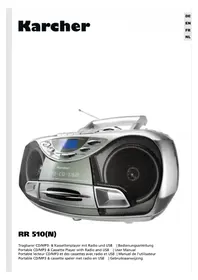
RR 510 - Cd player/recorder Karcher Audio - Free user manual and instructions
Find the device manual for free RR 510 Karcher Audio in PDF.



| Product Type | Portable CD player/recorder with FM radio, cassette and USB |
| Brand | Karcher Audio |
| Model | RR 510 |
| Dimensions (W x H x D) | Approx 360 x 215 x 185 mm |
| Weight | Approx 2 kg |
| Mains power supply | AC 100-240V ~ 50/60 Hz |
| Battery power supply | DC 9 V (6 UM-2/C 1.5 V batteries, not included) |
| Power consumption (max) | 9 W |
| Radio reception bands | FM 87.5 – 108 MHz |
| CD player | Digital audio system, 1-bit DAC, 8x digital filter |
| Supported CD formats | CD-DA, MP3, WMA |
| Cassette player | 2 stereo channels, response 125 – 6300 Hz, wow and flutter 0.35% WRMS |
| USB port | Play MP3/WMA files from USB flash drive (no extension cable) |
| Speaker impedance | 8 ohms |
| Headphone impedance | 32 ohms |
| CD/USB playback functions | Play, pause, stop, skip, fast forward/rewind, repeat (track/album/all), random, intro, program |
| Radio presets | 20 FM stations |
| Auto standby | After about 1 hour without audio signal (except in radio mode) |
| Maintenance and cleaning | Disconnect before cleaning; use a dry cloth; do not use chemicals |
| Safety | Instructions: avoid water, heat, objects/liquids; disconnect during storms; repair by qualified personnel |
| Spare parts and repairability | Internal repair reserved for qualified technician; no retail parts available |
| General information | Class 1 laser diode; recycle at end of life via waste collection center |
Frequently Asked Questions - RR 510 Karcher Audio
User questions about RR 510 Karcher Audio
0 question about this device. Answer the ones you know or ask your own.
Ask a new question about this device
Download the instructions for your Cd player/recorder in PDF format for free! Find your manual RR 510 - Karcher Audio and take your electronic device back in hand. On this page are published all the documents necessary for the use of your device. RR 510 by Karcher Audio.
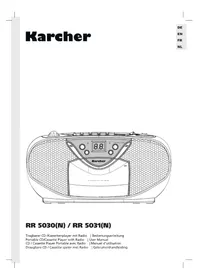
USER MANUAL RR 510 Karcher Audio
natural_image
Exterior view of a portable Karcher MP3 CD/USB portable radio cassette player (no visible text or symbols on the device body)RR 510(N)
natural_image
Illustration of two cassette tapes with a curved arrow indicating transformation (no text or symbols)Hinweis:
natural_image
Illustration of a cassette tape with a cylindrical pin and textured body (no text or symbols)Pflege
- Read Instructions - All the safety and operating instructions should be read before the appliance is operated.
- Retain Instructions - The safety and operating instructions should be retained for future reference.
- Heed Warnings - All warnings on the appliance and in the operating instructions should be adhered to.
- Water and Moisture – Do not use the apparatus near water (e.g. bath tub, sink, swimming pool) or in wet places or tropical climates. Do not place objects filled with liquids, such as vases, on top of the apparatus. Do not expose the apparatus to dripping or splashing.
- Setup – The apparatus should only be placed on a stable, flat surface. Do not let the apparatus fall down or expose it to shock.
- Wall or Ceiling Mounting - The appliance should be mounted to a wall or ceiling only as recommended by the manufacturer.
- Ventilation - The appliance should be situated so that its location or position does not interfere with its proper ventilation. For example, the appliance should not be situated on a bed, sofa, rug, or similar surface that may block the ventilation openings; or, placed in a built-in installation, such as a bookcase or cabinet that may impede the flow of air through the ventilation openings.
Ensure a minimum distance of 5 cm around the apparatus for sufficient ventilation. Ensure that the ventilation is not impeded by covering the ventilation openings with items such as newspapers, table-cloths, curtains, etc.
- Heat - The appliance should be situated away from heat sources such as radiators, heat registers, stoves, or other appliances (including amplifiers) that produce heat.
- Power Sources - The appliance should be connected to a power supply only of the type described in the operating instructions or as marked on the appliance.
- Cables and Plugs – The mains plug shall remain readily operable. All cables should be routed so that they are not likely to be walked on or pinched by items placed upon or against them, paying particular attention to cords at plugs, convenience receptacles, and the point where they exit from the appliance.
- Cleaning - The appliance should be cleaned only as recommended by the manufacturer. Clean by wiping with a dry and clean cloth. Do not use chemical cleaners or detergents. Always pull the mains plug before cleaning the unit.
- Non-use Periods - The power cord of the appliance should be unplugged from the outlet when left unused for a long period of time.
- Object and Liquid Entry - Care should be taken so that objects do not fall and liquids are not spilled into the enclosure through openings.
- Damage Requiring Service - The appliance should be serviced by qualified service personnel when:
a) The power-supply cord or the plug has been damaged; or
b) Objects have fallen, or liquid has been spilled into the appliance; or
c) The appliance has been exposed to rain; or
d) The appliance does not appear to operate normally or exhibits a marked change in performance; or
e) The appliance has been dropped, or the enclosure damaged.
- Servicing - The user should not attempt to service the appliance beyond that described in the operating instructions. All other servicing should be referred to qualified service personnel.
- Open Fire – Keep the apparatus away from open fires. Do not place naked flame sources, such as lighted candles on the apparatus.
- Thunderstorms – During a thunderstorm the mains plug should be unplugged.
- Safety Check – After servicing the technician should conduct a safety check in order to ensure that the apparatus is working properly and safely.
-
Batteries – Always place batteries in the correct polarization into electrical components. Danger of explosion if battery is incorrectly replaced. Replace only with the same or equivalent type. Do not mix old and new batteries. Take attention to the environmental aspects of battery disposal. Batteries shall not be exposed to excessive heat such as sunshine, fire or the like. Remove batteries before disposing of the product.
-
Volume Levels – To prevent possible hearing damage, do not listen at high volume levels for long periods.
- Headphones – Excessive sound pressure from earphones and headphones can cause hearing loss.
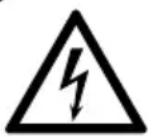
CAUTION
RISK OF ELECTRIC SHOCK
DO NOT OPEN

WARNING: To reduce the risk of fire or electric shock, do not expose this appliance to dripping or splashing.
WARNING: To reduce the risk of electric shock, do not remove cover (or back). No user serviceable parts inside. Refer servicing to qualified service personnel.
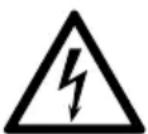
The lightning flash with arrowhead symbol within an equilateral triangle is intended to alert the user to the presence of uninsulated dangerous voltage within the product's enclosure that may be of sufficient magnitude to constitute a risk of electric shock to persons.

The exclamation point within an equilateral triangle is intended to alert the user to the presence of important operating and maintenance (servicing) instructions in the literature accompanying the appliance.
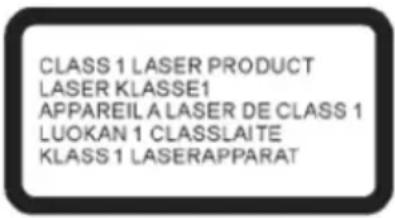
DO NOT STARE INTO BEAM – INVISIBLE LASER RADIATION

Batteries
Batteries may not be disposed of in regular house hold trash. Every consumer has the obligation to return batteries to special disposal locations.
Disposal of Used Electrical & Electronic Equipment
The meaning of the symbol on the product, its accessory or packaging indicates that this product shall not be treated as household waste. Please, dispose of this equipment at your applicable collection point for the recycling of electrical & electronic equipments waste. By ensuring the correct disposal of this product, you will help prevent potential hazards to the environment and to human health, which could otherwise be caused by unsuitable waste handling of this product. The recycling of materials will help conserve natural resources. For more detailed information about recycling of this product, please contact your local city office, your household waste disposal service or the shop where you purchased the product.
- Handling discs
• Always keep the CD compartment shut to prevent dust or dirt from getting into the CD mechanism.
- Do not touch the recorded surface.
- Do not stick paper or write on either side of the CD.
- Do not bend the CD.
- Only handle a disc on its outer edges.

- Storing discs
• To avoid scratches/damages always put CDs back into their cases after use.
- Do not expose CDs to direct sunlight, dust, dirt, high temperatures, high humidity or water.
-
Cleaning discs
-
Use a soft cloth to wipe fingerprints and dust from the disc surface.
- Carefully move the cloth from the center of the disc to its edge:
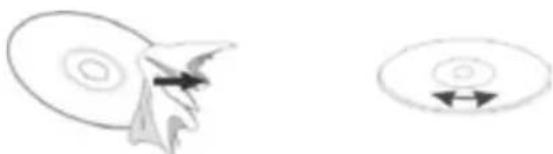
Correct False
- Never use benzene, thinners, record cleaner fluid or antistatic spray to clean CDs.
- Compatibility
- Due to the numerous compression methods, some discs may not play.
Further Notes on the Device
Setting a safe volume level
- If you continually listen to loud music, your hearing gradually adapts to it and gives you the impression that the volume is lower.
• What seems normal to you can be already for long time too loud and unhealthy.
• To protect yourself from this, set the volume to a low level. - Increase the volume slowly.
- Damage to your hearing can be extensive and cannot be reversed.
- If you notice a hearing problem, please consult a doctor.
Condensation
- Condensation may occur when moving the device from a cold to a warm environment. If there is moisture inside the player, it may not operate properly.
- Don't turn on the device and wait about one hour for the moisture to evaporate.
Saving energy
- If there is no audio signal within approximately one hour, the unit will switch into standby mode automatically (except in radio mode).
- If the unit is not used for a long period of time, it should be unplugged from the AC socket and batteries should be removed.
Unpacking
• Take out carefully the unit from the packing. Please keep the packing for further use.
- Carefully remove possible protection cardboards and slipcovers.
Location of Controls

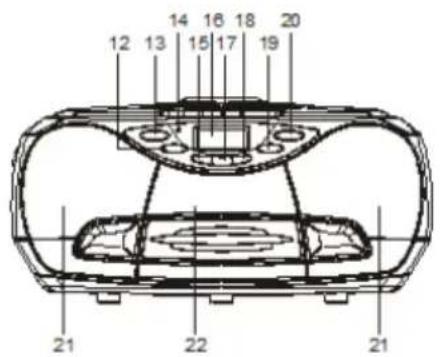

- VOLUME CONTROL
- PHONES JACK
- HANDLE
- CD DOOR
- CD DOOR OPEN AREA
- USB PORT
- CASSETTE PAUSE BUTTON
- CASSETTE STOP/EJECT BUTTON
- CASSETTE FAST FORWARD BUTTON
- CASSETTE REWIND BUTTON
- CASSETTE PLAY BUTTON
- TUNING-/SKIP/SEARCH DOWN BUTTON
-
TUNING+/SKIP/SEARCH UP BUTTON
-
STANDBY INDICATOR
- MEMORY/PROGRAM/MODE BUTTON
- LCD DISPLAY
- POWER (ON/OFF)/SOURCE BUTTON
- 10+/ALBUM BUTTON
- CH-/STOP BUTTON
- CH+/PLAY/PAUSE BUTTON
- SPEAKERS
- CASSETTE DOOR
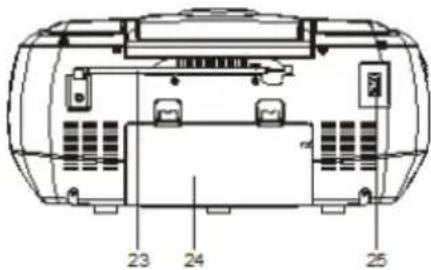
- FM TELESCOPIC ANTENNA
- BATTERY COMPARTMENT
- AC SOCKET
Power Supply
Battery Operation
- Remove the Battery Compartment Cover by gently pushing the clips downward and outwards.
- Install 6 x 'C' size batteries (UM-2 or equivalent) and take care that the correct polarities are observed.
- Replace the battery compartment cover.
Notes:
- The AC line cord must be removed for battery operation.
- To avoid damage which may result from leaking batteries, remove the batteries when they become exhausted or when the unit is not to be used for a long period of time.
AC Mains Operation
- Before making any connections, check that the voltage marked on the rating label located at the bottom of the unit corresponds with your household supply.
- Insert the AC line cord plug into the AC INPUT SOCKET of the unit and plug the other end of the cord into a standard household supply outlet.
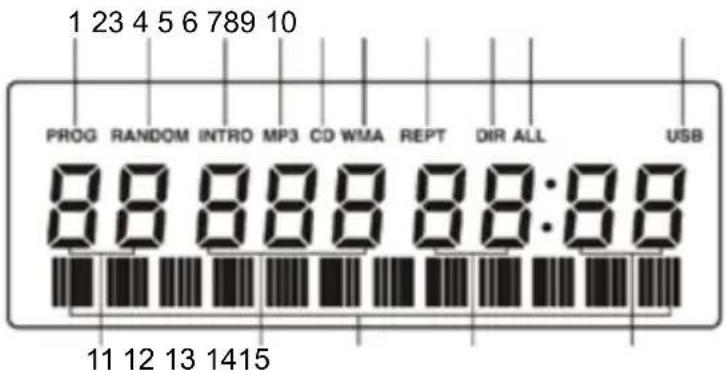
- "PROG" shows during Programming and in programmed play.
- "WMA" shows when the file played is in WMA format.
- "MP3" shows when the file played is in MP3 format.
- "CD" shows when the disc played is a CD-DA.
- "REPT" shows when in current track repeat mode.
- "DIR" shows when in album repeat mode.
- "ALL" shows when in all tracks repeat mode.
- "INTRO" shows when in INTRO playback.
- "RANDOM" shows when in RANDOM playback.
- This shows when the player reads data from USB data traveller.
- This figure is the album number of the disc/USB played.
- This figure is the track number of the current disc/USB.
- This figure is the elapsed minutes of the track played.
- This figure is the elapsed seconds of the track played.
- English Text display. The information of the current track is displayed scrolling forward in MP3 playback.
Radio
- The STANDBY indicator will light up once the unit is connected to the power supply. Turn the unit on by pressing the POWER (ON/OFF)/SOURCE button.
- Press the POWER (ON/OFF)/SOURCE button repeatedly to select the radio mode ("TUNER" is shown in the display).
- Select a desired radio station by pressing the TUNING-/SKIP/SEARCH DOWN or TUNING+/SKIP/SEARCH UP button repeatedly.
- To automatically search for the next available radio station, press and hold for 2 seconds the TUNING-/SKIP/SEARCH DOWN or TUNING+/SKIP/SEARCH UP button.
- If a station is broadcasting stereo, "ST" will be shown in the bottom left corner of the display.
- Rotate the VOLUME CONTROL to set the volume as desired.
- To switch the unit into standby mode, press and hold for 2 seconds the POWER (ON/OFF)/SOURCE button.
Note:
- The FM telescopic antenna is directional. When you are receiving an FM broadcast, fully extend the telescopic antenna and rotate it for the best reception.
Radio Station Presets
This unit enables you to store up to 20 radio stations.
-
Select a desired radio station and then press the MEMORY/PROGRAM/MODE button to store the current station. The memory number flashes on the screen.
-
Use the CH-/STOP button or the CH+/PLAY/PAUSE button to select the corresponding memory number among P-01 \~ P-20 for storing the station.
- Confirm your selection by pressing the MEMORY/PROGRAM/MODE button.
- Repeat steps 1 - 3 to store up to 20 radio stations in the memory.
- To recall a preset station press the CH-/STOP button or the CH+/PLAY/PAUSE button repeatedly in radio mode until you reach the desired memory number.
Cassette Playback
PLAY button
Press the PLAY button to start playing a cassette.
REWIND button
Press the REWIND button to rewind a tape quickly. Press STOP/EJECT button to release the button at the end of the tape.
FAST FORWARD button
Press the FAST FORWARD button to advance the tape quickly. Press STOP/EJECT button to release the button at the end of the tape.
STOP/EJECT button
Press the STOP/EJECT button to cancel a selection, i.e., press this button during cassette play to stop the tape.
In stop mode, press the button to eject the cassette.
PAUSE button
The PAUSE button can be used to interrupt playback temporarily. Press the button once to pause playback, press the button again to continue playback.
Note: In Pause mode, the Cassette motor is still energized, therefore the feature should not be used for long periods of time.
Automatic Stop
The cassette mechanism has a built-in automatic stop. During playback the unit will automatically stop when the end of the tape is detected.
To Play a Cassette Tape
- Open the cassette door by pressing the cassette STOP/EJECT button.
- Insert a cassette with the exposed tape facing upwards and the full reel on the right (unit plays from right to left) into the guides on the inside of the cassette door.
- Close the cassette door.
- Turn the unit on by pressing the POWER (ON/OFF)/SOURCE button.
- Press the POWER (ON/OFF)/SOURCE button repeatedly to select the cassette mode ("TAPE" is shown in the display).
- Press the cassette PLAY button to start the tape playing.
- Adjust the VOLUME CONTROL to a comfortable listening level.
- To stop the tape playing, press the STOP/EJECT button. Press the button again to open the cassette door and eject the tape.

natural_image
Illustration of two cassette tapes with a curved arrow indicating transformation (no text or symbols)EN
Note:
During play, when the end of the tape is reached the PLAY button will pop up and play will stop. To play the other side of the tape, remove the cassette, turn the cassette over so that the full reel is on the right, insert the cassette and press the PLAY button.
Care of Cassette Tapes to Help Avoid Tangles
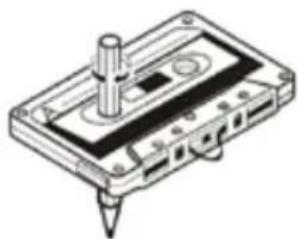
Loose tape may jam or get tangled in the cassette player. With a hexagonal pencil or a similar tool, gently turn the pencil to tighten the tape, as shown opposite.
If the spool feels tight when taking up slack tape as described above, this may be due to ridges on the spool of tape. Tight spools can lead to uneven play-back speed or tape tangling. In most cases the ridges can be removed by fast winding the cassette from one end to the other and back again.
Avoid the use of C120 tapes with this unit.
natural_image
Isometric line drawing of a cassette tape device with a central screw and base (no text or symbols)Maintenance
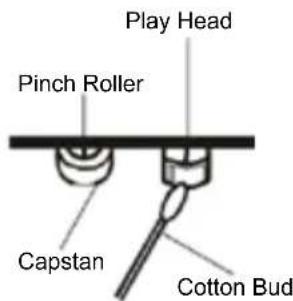
If the sound becomes muffled or in any case after every 15 hours of operation, clean the pinch roller, capstan and play head. Open the cassette door and use a cotton bud moistened with special tape head cleaning fluid.
CAUTION
Never touch any of the parts described above with a metal object. Do not insert a cassette until the cleaned parts are completely dry.
CD Playback
Loading a Disc
- Open the CD door by the OPEN area.
- Insert a disc with the label side facing upward.
- Close the CD door.
Note: Never touch the laser lens inside the CD compartment. If it ever gets dirty, clean it with a CD cleaner disc.
Removing a Disc
- Make sure the CD is not playing. If it is, press the CH-/STOP button.
- Open the CD door.
- Gently remove the disc.
- Close the CD door by hand.
- Replace the disc in its protective storage box.
Playing a CD
- Turn the unit on by pressing the POWER (ON/OFF)/SOURCE button.
- Press the POWER (ON/OFF)/SOURCE button repeatedly to select the CD mode ("CD" is shown
in the display).
- Follow the steps above to load a disc.
- The player begins reading disc immediately.
- When the disc is successfully read, the total number of the tracks shows on the LCD and play-back follows with the first track.
- Press the CH+/PLAY/PAUSE button once to halt music playback, the elapsed time flashes to indicate the player in pause mode; press this button again to resume normal playback. Press the CH-/STOP button to stop music playback, the LCD shows the total number of the tracks again.
Fast Forward / Fast Rewind & Skipping Tracks (CD/MP3/WMA/USB)
- To jump to the beginning of the currently playing track, press the TUNING-/SKIP/SEARCH DOWN button once. Press it a second time to skip to the previous track.
• To skip to the next track, press the TUNING+/SKIP/SEARCH UP button once. - To fast forward the currently playing track, press and hold the TUNING+/SKIP/SEARCH UP button. Once you reach the desired section of the track, release the button to resume normal playback.
- To fast rewind the currently playing track, press and hold the TUNING-/SKIP/SEARCH DOWN button. Once you reach the desired section of the track, release the button to resume normal playback.
- Press the 10+/ALBUM button once during playback to skip 10 tracks at a time. This is especially helpful on discs with a large number of tracks.
Skipping to the Previous/Next Album (MP3/WMA/USB)
- During playback, press and hold the 10+/ALBUM button until the album number flashes on the screen.
- Press the TUNING-/SKIP/SEARCH DOWN or TUNING+/SKIP/SEARCH UP button to select the album you want.
• Once the selected album number shows on the screen, press the 10+/ALBUM button to confirm. - This function is only available when the disc or USB contains several albums (folders).
Repeat, Random & Intro Modes (CD)
At any time during playback,
- press the MEMORY/PROGRAM/MODE button once to repeat the current track. "REPT" will be shown in the display.
- press the MEMORY/PROGRAM/MODE button twice to repeat all tracks. "ALL" will be shown in the display.
- press the MEMORY/PROGRAM/MODE button a third time to enter the random play function. All tracks on the disc will be played in a random order. "RANDOM" will be shown in the display.
- press the MEMORY/PROGRAM/MODE button a fourth time to enter the intro function. Each track will be played for 10 seconds and then jump to the next track. "INTRO" will be shown in the display.
- press the MEMORY/PROGRAM/MODE button a fifth time to deactivate the repeat function and return to normal playback.
Repeat, Random & Intro Modes (MP3/WMA/USB)
At any time during playback,
- press the MEMORY/PROGRAM/MODE button once to repeat the current track. "REPT" will be shown in the display.
- press the MEMORY/PROGRAM/MODE button twice to repeat the current album (if any). "DIR" will be shown in the display.
- press the MEMORY/PROGRAM/MODE button a third time to repeat all tracks. "ALL" will be shown in the display.
- press the MEMORY/PROGRAM/MODE button a fourth time to enter the random play function. All tracks on the disc will be played in a random order. "RANDOM" will be shown in the display.
- press the MEMORY/PROGRAM/MODE button a fifth time to enter the intro function. Each track will be played for 10 seconds and then jump to the next track. "INTRO" will be shown in the
display.
- press the MEMORY/PROGRAM/MODE button a sixth time to deactivate the repeat function and return to normal playback.
Anti-Shock Protection
A special circuitry inside the player guarantees that there will be no sound skipping when the player is subject to shock and shaking in music playback. The laser scans the CD/MP3 disc and saves data for up to 4/40 seconds ahead of where the playback is on the disc.
If there is too much vicious vibration or shaking exerted on the player, the player may malfunction and sound skipping is caused.
When this happens, place the player on a level table where no vibration will be brought. Normal sound will resume immediately.
Programmed Play (CD)
The tracks on the disc can be programmed for play in any order (up to 20 tracks can be programmed).
- While in CD stop mode, press the MEMORY/PROGRAM/MODE button. "PROG" and "001 P-01" are shown in the LCD, the track number "001" is flashing.
- Select the first track to be programmed using the TUNING+/SKIP/SEARCH UP button or the TUNING-/SKIP/SEARCH DOWN button, and then press the MEMORY/PROGRAM/MODE button again to store and advance to the next programming step.
- Repeat the above steps to program more tracks. A maximum of 20 tracks for CD can be programmed in memory in a preferred order.
- Press the CH+/PLAY/PAUSE button to begin programmed play in the preferred order after you are done with programming. The player stops automatically after all programmed tracks are played.
- You may press the CH-/STOP button to terminate programmed playback. In program stop mode, press the CH+/PLAY/PAUSE button to begin the programmed playback with the programming order identical with the previous one done. Press the CH-/STOP button again to clear the programming.
- During programmed playback, press the MEMORY/PROGRAM/MODE button once to repeat the current track; press the button twice to repeat all the programmed tracks; press the button three times to exit repeat mode.
Programmed Play (MP3/WMA/USB)
On MP3/WMA discs or USB playback up to 99 tracks can be programmed.
For the MP3/WMA/USB programming, it is necessary to select an album first and then a track in this album.
- At stop mode, press the MEMORY/PROGRAM/MODE button. "PROG" and "01 001 P-01" are shown in the LCD, the album number "01" is flashing.
- Press the TUNING+/SKIP/SEARCH UP button or the TUNING-/SKIP/SEARCH DOWN button to select an album and then press the MEMORY/PROGRAM/MODE button to confirm.
- The further operating steps are the same as the CD programming described above.
Note: ID information: For playing some MP3 disc with ID information, the LCD display can show the title of the disc/names of the artists and ALBUM.
USB Playback
- Press the POWER (ON/OFF)/SOURCE button to turn the unit on.
- Insert a USB stick to the USB port.
- Press the POWER (ON/OFF)/SOURCE button repeatedly to switch to USB mode ("USB" is shown in the display).
- When the inserted USB is detected and read, the first track will be played automatically.
- Press the CH+/PLAY/PAUSE button to pause or resume the playback.
- Press the CH-/STOP button to stop the playback.
Playback modes
Skipping, fast forwarding and fast rewinding tracks, repeat modes and intro & random functions in USB mode are the same as for MP3-CD playback. Please see the previous chapter for the instructions.
Notes:
- A USB device must always be connected directly to the USB port of this product. The use of a USB extension cord is not supported by this product. The USB port of this product cannot communicate with a computer directly.
- The reading time for a USB drive varies depending on the speed of the memory device and the number of songs and folders. In some cases the reading time may be as long as 60 seconds.
- Always switch off the unit before removing a USB flash drive to prevent damage to your USB device. The manufacturer is not responsible for the loss or damage of data.
- Due to numerous methods of compression it could be that some files or USB flash drives cannot be played.
Stereo Headphone Connector
A Stereo Phone Jack (3.5mm) has been provided on the top of the cabinet, so that you can listen to the set without disturbing others. To use this jack, plug in low impedance headphones/earphones (not included) and adjust the VOLUME CONTROL to a comfortable listening level.
Note: When external headphones/earphones are connected, the sound from the unit of main speakers will be muted.
Caution: Listening at high power for a long moment could damage users' ears.
Technical Specifications
GENERAL
Power requirement AC 100-240V\~50/60Hz
DC = 9V
(6x UM-2/C batteries 1.5V, not included)
Power consumption (max.) 9W
Weight ca. 2 kg
Dimensions ca. 360 x 215 x 185 mm (WxDxH)
Operation temperature +5°C \~ +35°C
RECEIVER SECTION
Receiving band FM
Tuning range/sensitivity FM 87.5 - 108 MHz
CD PLAYER SECTION
Playback system Compact Disc Digital Audio System
DAC 1 bit D/A converter
With 8 times over sampling digital filter
CASSETTE PLAYER
Playing system 2 channel stereo
Frequency response 125 -6300 Hz
Wow and flutter 0.35% WRMS (JIS)
AUDIO SECTION
Speaker impedance 8 ohms
Headphones impedance 32 ohms
Technical specifications and design may change without notice.
AVERTISSEMENT: AFIN DE RÉDUIRE LE RISQUE D'INCENDIE OU DE CHOC ÉLECTRIQUE, NE PAS EXPOSER CETTE ANTENNE À LA PLUIE OU À L'HUMIDITÉ.
ATENTION: AFIN DE REDUIRE LES RISQUES D'ELECTROCUTION, NE PAS RETIRER LE COFFRAGE (AVANT OUARRIERE). NE CONTIENT AUCUNE PIECE REMPLACABLE. CONFIER TOUTE REPARATION A DU PERSONNEL QUALIFIE.

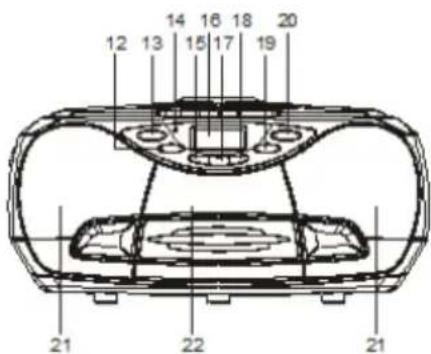
- CONTROLE DU VOLUME
- PHONES JACK
- POIGNEE
- CD PORTE
- CD PORTE OUVERTE
- PORT USB
- BOUTON CASSETTE PAUSE
- BOUTON CASSETTE STOP/EJECT
- BOUTON CASSETTE FAST FORWARD
- BOUTON CASSETTE REWIND
- BOUTON CASSETTE PLAY
- BOUTON TUNING-/SKIP/SEARCH DOWN
-
BOUTON TUNING+/SKIP/SEARCH UP
-
INDICATEUR STANDBY
- BOUTON MEMORY/PROGRAM/MODE
- ECRAN LCD
- BOUTON POWER (ON/OFF)/SOURCE
- BOUTON 10+/ALBUM
- BOUTON CH-/STOP
- BOUTON CH+/PLAY/PAUSE
- HAUT-PARLEUR
- PORTE CASSETTE
- ANTENNE FM TELESCOPIQUE
- COMPARTIMENT DES PILES
- PRISE AC
Alimentation
natural_image
Illustration of two cassette tapes with a curved arrow indicating transformation (no text or symbols)FR
Remarque:
natural_image
Isometric line drawing of a cassette tape device with a central knob and screw base (no text or symbols)Entretien
Protection anti-choc
Radio Station Presets
natural_image
Illustration of two cassette tapes with a curved arrow indicating transformation (no text or symbols)natural_image
Illustration of a cassette tape with a cylindrical pin and screw base (no text or symbols)Onderhoud
- RR 510(N)
- Hinweis:
- Pflege
- CAUTION
- Batteries
- Disposal of Used Electrical & Electronic Equipment
- Further Notes on the Device
- Setting a safe volume level
- Condensation
- Saving energy
- Unpacking
- Location of Controls
- Power Supply
- Battery Operation
- Notes:
- AC Mains Operation
- Radio
- Note:
- Radio Station Presets
- Cassette Playback
- PLAY button
- REWIND button
- FAST FORWARD button
- STOP/EJECT button
- PAUSE button
- Automatic Stop
- To Play a Cassette Tape
- Care of Cassette Tapes to Help Avoid Tangles
- Maintenance
- CD Playback
- Loading a Disc
- Removing a Disc
- Playing a CD
- Fast Forward / Fast Rewind & Skipping Tracks (CD/MP3/WMA/USB)
- Skipping to the Previous/Next Album (MP3/WMA/USB)
- Repeat, Random & Intro Modes (CD)
- Repeat, Random & Intro Modes (MP3/WMA/USB)
- Anti-Shock Protection
- Programmed Play (CD)
- Programmed Play (MP3/WMA/USB)
- USB Playback
- Playback modes
- Stereo Headphone Connector
- Technical Specifications
- GENERAL
- RECEIVER SECTION
- CD PLAYER SECTION
- CASSETTE PLAYER
- AUDIO SECTION
- Alimentation
- Remarque:
- Entretien
- Protection anti-choc
- Onderhoud
Brand : Karcher Audio
Model : RR 510
Category : Cd player/recorder