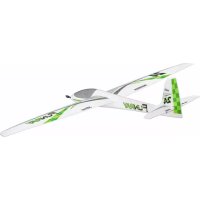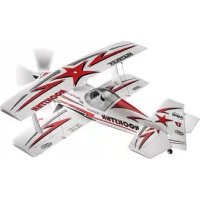
BK Rockstar - Remote control toy MULTIPLEX - Free user manual and instructions
Find the device manual for free BK Rockstar MULTIPLEX in PDF.


| Product type | Radio-controlled model airplane (not a toy) |
| Brand | Multiplex |
| Model | BK Rockstar |
| Wingspan | 1050 mm |
| Overall length | 1060 mm |
| Flying weight | 1800 g |
| Wing area | 48 dm² |
| Wing loading | 38 g/dm² |
| Number of channels | 5 |
| RC functions | Rudder, elevator, ailerons, motor |
| Typical flight time | Approximately 7 minutes (with 4S 2600 mAh battery) |
| Propulsion power supply | Li-Po 4S 2600 mAh battery (recommended Multiplex Li-BATT FX 4/1 2600) |
| Motor | Himax 4220-620 (or equivalent) |
| Main material | ELAPOR® foam |
| Recommended age | 14 years and older (adult supervision for minors) |
| Recommended servos | HiTec HS-82MG (4 pieces) |
| Recommended receiver | Multiplex RX-5 light M-LINK 2.4 GHz |
| Propeller | 14x7 inches |
| Maintenance | Clean with a dry cloth; use cyanoacrylate glue (Zacki-ELAPOR®) for repairs |
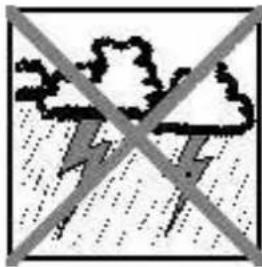
| Safety | Do not use in rainy weather, under the influence of substances, or near people/animals; wear safety goggles when gluing |
| Spare parts | Available from Multiplex; references listed in the manual |
Frequently Asked Questions - BK Rockstar MULTIPLEX
User questions about BK Rockstar MULTIPLEX
0 question about this device. Answer the ones you know or ask your own.
Ask a new question about this device
Download the instructions for your Remote control toy in PDF format for free! Find your manual BK Rockstar - MULTIPLEX and take your electronic device back in hand. On this page are published all the documents necessary for the use of your device. BK Rockstar by MULTIPLEX.
USER MANUAL BK Rockstar MULTIPLEX
Inbusschlüssel 3 (KIT)
Hohenruder: hoch 40 mm, runter 40 mm 70% EXPO
Querruder: hoch 17 mm runter 17 mm 50% EXPO
Hohenruder: hoch / runter: 55mm 70% EXPO
Querruder: hoch 22 mm / runter 22 mm 50% EXPO
This model is NOT A TOY in the usual sense of the term.
By operating the model the owner affirms that he is aware of the content of the operating instructions, especially those sections which concern safety, maintenance, operating restrictions and faults, and is capable of fulfilling these requirements.
This model must not be operated by any child under fourteen years of age. If a person below this age operates the model under the supervision of a competent adult who is acting as the child's guardian within the legal sense of the term, this individual is responsible for the implementation of the information in the OPERATING INSTRUCTIONS.
THE MODEL AND ASSOCIATED ACCESSORIES MUST BE KEPT OUT OF THE REACH OF CHILDREN UNDER THREE YEARS OF AGE! MODELS CONTAIN SMALL DETACHABLE PARTS WHICH MAY BE SWALLOWED BY CHILDREN UNDER THREE YEARS. CHOKING HAZARD!
All the warnings in the OPERATING INSTRUCTIONS must be observed whenever the model is operated. Multiplex Modellsport GmbH & Co. KG accepts no liability for loss or damage or any kind which occurs as a result of incorrect operation or misuse of this product, including the accessories required for its operation. This includes direct, indirect, deliberate and accidental loss and damage, and all forms of consequent damage.
Every safety note in these instructions must always be observed, as all the information contributes to the safe operation of your model. Use your model thoughtfully and cautiously, and it will give you and your spectators many hours of pleasure without constituting a hazard. Failure to operate your model in a responsible manner may result in significant property damage and severe personal injury. You alone bear the responsibility for the implementation of the operating instructions and the safety notes.
Approved usage
The model is approved exclusively for use within the modelling hobby. It is prohibited to use the model for any other purpose than that stated. The operator of the model, and not the manufacturer, is responsible for damage or injury of any kind resulting from non-approved use.
The model may only be operated in conjunction with those accessories which we expressly recommend. The recommended components have undergone thorough testing, are an accurate match to the model, and ensure that it functions safely. If you use other components, or modify the model, you operate it at your own risk, and any claim under guarantee is invalidated.
To minimise the risk when operating the model, please observe the following points:
- The model is guided using a radio control system. No radio control system is immune to radio interference, and such interference may result in loss of control of the model for a period of time. To avoid collisions, you must therefore ensure at all times that there is a wide margin of safety in all directions when operating your model. At the slightest sign of radio interference you must cease operating your model!
- Never operate your model until you have successfully completed a thorough check of the working systems, and carried out a range-check as stipulated in the instructions supplied with your transmitter.
- The model may only be flown in conditions of good visibility. You can avoid being temporarily blinded by not flying towards the sun, or in other diffi cult light conditions.
- A model must never be operated by a person who is under the influence of alcohol, drugs or medication which have an adverse effect on visual acuity and reaction time.
- Only fly your model in conditions of wind and weather in which you are able to maintain full control of the model. Even when the wind is light, bear in mind that turbulence can form at and around objects which may have an effect on the model.
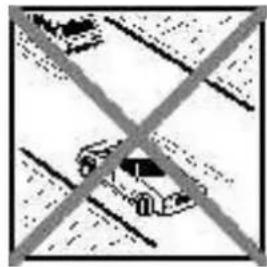
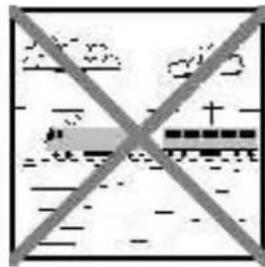
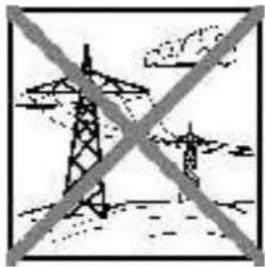
- Never fly in any location where you may endanger yourself of others, e.g. close to residential areas, overhead cables, open roads and railway lines.
- Never fly towards people or animals. You may think that flying low over other people's heads is proof of your piloting skill, but all it does is place others at unnecessary risk. It is in all our interests that you let other pilots know that this is what you think. Always fly in such a way that you do not endanger yourself or others. Bear in mind that even the best RC system in the world is subject to outside interference. No matter how many years of accident-free flying you have under your belt, you have no idea what will happen in the next minute.
Residual risks
Even if the model is operated in the correct manner, and you observe all safety aspects, there is always a certain residual risk.
For this reason it is mandatory to take out third-party liability insurance. If you join a club or flying association, insurance is usually available or included in the annual fee. Make sure that your insurance cover is adequate (i.e. that it covers powered model aircraft). Always keep your models and your radio control equipment in perfect order.
The following hazards may occur owing to the model's construction and type:
- Injury caused by the propeller: you must keep well clear of the area around the propeller from the moment that the battery is connected. Please bear in mind that objects in front of the propeller may be sucked into it, and objects behind the propeller may be blown away by it. The model may start moving when the propeller starts to turn. You must therefore position the model in such a way that it cannot move towards other persons if the motor should unexpectedly start running. When you are carrying out adjustment work involving the running motor, you must ensure that the model is always held securely by an assistant.
- Crash caused by pilot error: this can happen even to the best of pilots, so it is essential to fly exclusively in a safe environment: an approved model flying site and suitable insurance are basic essentials.
- Crash caused by technical failure or unnoticed damage in transit or in the workshop. A thorough check of the model before every flight is essential. However, you should also take into account at all times that material failures can and do occur. Never fly in a location where your model may damage or injure others.
- Keep within the stated operating limits. Excessively violent flying will weaken the airframe, and may result in sudden material failure, or may cause the model to crash during a subsequent flight due to "creeping" consequent damage.
- Fire hazard caused by electronic failure or malfunction. Store batteries safely, and always observe safety notes which apply to the airborne electronic components, the battery and the battery charger. Protect all electronic equipment from damp. Ensure that the speed controller and battery are adequately cooled.
The instructions which accompany our products must not be reproduced and / or published, in full or in part, in print or any electronic medium, without the express written approval of Multiplex Modellsport GmbH & Co. KG.
MULTIPLEX model kits are subject to constant quality checks throughout the production process, and we sincerely hope that you are completely satisfied with the contents of your kit. However, we would ask you to check all the parts before you start construction, as we cannot exchange components which you have already worked on. If you find any part is not acceptable for any reason, we will readily correct or exchange it. Just send the component to our Model Department. Please be sure to include the purchase receipt and a brief description of the fault.
We are constantly working on improving our models, and for this reason we must reserve the right to change the kit contents in terms of shape or dimensions of parts, technology, materials and fittings, without prior notification. Please understand that we cannot entertain claims against us if the kit contents do not agree in every respect with the instructions and the illustrations.
Caution!
Radio-controlled models, and especially model aircraft, are by no means playthings. Building and operating them safely requires a certain level of technical competence and manual skill, together with discipline and a responsible attitude at the flying field. Errors and carelessness in building and flying the model can result in serious personal injury and damage to property. Since we, as manufacturers, have no control over the construction, maintenance and operation of our products, we are obliged to take this opportunity to point out these hazards and to emphasise your personal responsibility.
Warning:
Like every aeroplane, this model has static limits. Steep dives and senseless manoeuvres inappropriate to the type may result in the loss of the aircraft. Please note: we will not replace the model in such cases. It is your responsibility to approach the airframe's limits gradually. It is designed for the power system recommended in these instructions, but is only capable of withstanding the flight loads if built exactly as described and if it is in an undamaged state.
Recommended equipment:
Zacki ELAPOR 20g VE1 RR+KIT Item number: 852727
Li-BATT FX 4/1 2600 (M6) RR+KIT Item number: 157362
Receiver RX-5 light M-LINK 2,4 GHz RR+KIT Item number: 55808
Drive set ROCKSTAR KIT Item number: 332667
Servo HS-82 MG (4x) KIT Item number: 112088
Extension lead 15 cm (UNI) (2x)
KIT Item number: 85019
Important note
This model is not made of Styrofoam™, and it is not possible to glue the material using white glue, polyurethane or epoxy; these adhesives only produce superficial joints, and simply break away under stress. Please be sure to use medium-viscosity cyano-acrylate glue exclusively, preferably Zacki ELAPOR® # 59 2727, which is optimised specifically for ELAPOR® particle foam. If you se Zacki ELAPOR® there is usually no need for cyano 'kicker' or activator. However, if you wish to use a different adhesive which requires the use of activator, please note that these materials are injurious to health, and should always be applied in the open air. Take care when handling all cyano-acrylate adhesives, as they harden in seconds, so don't get them on your fingers or other parts of the body. We strongly recommend the use of goggles to protect your eyes. Keep the adhesive out of the reach of children! For certain joints it is also possible to use hot-melt adhesive; the instructions indicate where this is the case.
Working with Zacki ELAPOR®
Zacki ELAPOR® has been developed specifically for glued joints in our models which consist of moulded ELAPOR® foam parts.
Please observe the following points in order to obtain perfect joints:
- Avoid the use of activator. 'Kicker' significantly weakens the joint. We advise leaving joined parts for 24 hours to obtain maximum strength, particularly when the glued area is large.
- Activator should only be used for temporary, small-area joints ('tacking'). Spray a little activator on one surface, and allow it to air-dry for about thirty seconds.
To obtain maximum joint strength you should lightly sand the surface with 320-grit abrasive paper before applying glue.
Bent parts - actually don't exist. If you find that a component has taken up a curve, perhaps after being transported, it is easy to straighten again. In this respect ELAPOR® behaves in a similar way to metal: bend the component back slightly beyond the correct position, and the material will then spring back to its proper shape when released, and maintain it. There are limits, however - don't overdo it!
Bent parts - really do exist. If you wish to paint your model, apply MPX Primer # 60 2700 to the surfaces, wiping it on very lightly as if you were cleaning the model. Paint must always be applied thinly and evenly, otherwise the component will warp. Then you really will have bent parts, and they will also be heavy and perhaps even unusable. We have found that matt-fi nish paints produce the best visual effect.
Technical information ROCKSTAR:
Wingspan: 1050 mm
Overall length: 1060 mm
All-up weight: 1800 g
Total surface area: 48dm^2
Wing loading: 38g / dm^2
Channels: 5
RC Functions: rudder, elevator, aileron, motor
Flight time: ca. 7 min (4S ~2600 mAh)
Note: please remove the pictures from the center of the instructions!
Congratulations on your new ROCKSTAR!
You will need the following tools to build the model:
2xZacki-Elapor # 85 2727 (KIT) (1xRR)
1xUHU Por (KIT)
Hot glue gun (KIT)
Medium-sized cross-point screwdriver (KIT)
Medium-sized slot-head screwdriver (KIT)
Balsa knife (KIT)
Pointed-nose pliers (KIT)
1.5 mm A/F allen key (KIT)
3 mm A/F allen key (KIT)
10 mm A/F open-ended spanner (KIT)
2.5 mm drill (KIT)
Before starting construction:
Please check that all the parts are present, referring to the Parts List on page 18+19 (Figs. 01 & 02).
1. Assembling the fuselage (KIT)
Clip together the two parts 33 and 34 which form the spreader plate for the wing retaining bolt, and glue the joint with Zacki. ! Caution ! Watch out for excess glue squirting out when the parts are joined. Glue the Canopy Lock clip 31, the cabane socket 28 and the wing bolt spreader plate in the right-hand fuselage shell 5. Glue the two rudder hinge pin supports 44 in the slots in the right-hand fin shell. At the same time glue the M5 nut support 39 and the tailwheel bracket 40 in place.
Figs. 03 + 04
Slip a length of spring steel wire 73 through the snake outer sleeve 74, and lay it in the right-hand fuselage shell as shown; the snake outer should project about 30~mm from the tail end of the fuselage. Glue it in place permanently. Figs. 05 - 07
Now glue the pre-assembled M-Frame 27 in the right-hand fuselage shell 5.
Fig. 08
Working in a similar manner, glue the following parts in the left-hand fuselage shell 4: the Canopy Lock clip 31 and the cabane socket 28. A second spring steel rod 73 should now be slipped into a snake outer sleeve 74, and fitted in the left-hand fuselage shell; this should also project at the tail end by about 30mm .
Figs. 09 - 11
Now offer up the two fuselage shells to each other dry (WITHOUT glue), and check that they fit together snugly at all points. When you are confidant that everything matches up correctly, apply glue to the joint surfaces, fit the two shell together, and check that they are accurately aligned.
Figs. 12 + 13
With this step complete, it is time to paint the dummy pilot in the colour scheme of your choice.
Please note that dark areas under the canopy may heat up strongly if subjected to direct sunshine. If this should happen, the ELAPOR foam may swell and bubble!
Apply the instrument panel sticker (decal sheet) to the moulded-in binnacle inside the cockpit. When you are sat
is fi ed with the appearance of your cockpit, glue the canopy 26 to the fuselage using UHU Por.
Fig. 14
Locate the four magnets 58 which retain the cowl 6, and glue them in the appropriate recesses at the front of the fuselage.
Fig. 15
Hold the rudder servo in your hand and centre it from the transmitter. Drill out the outermost hole in the servo output arm using a 2.5mm 0 bit. Fit the output arm on the servo shaft as shown in Fig. 16, and secure it with the output screw. Mount the swivel pushrod connector 54 in the outer hole in the output arm, securing it with the M2 self-locking nut 56. Fit an M3 grubscrew 55 in the open end of the pushrod connector barrel.
Place the servo in the opening in the left-hand side of the M-Frame, and secure it with the retaining screws supplied with the servo.
Fig. 16
Repeat the procedure with the elevator servo, with this exception: fit the output arm on the servo facing the opposite direction. Install the elevator servo in the right-hand opening in the M-Frame.
Fig. 17
Glue the four remaining magnets 58 in the appropriate recesses in the cowl 6.
! CAUTION !: Ensure that the pairs of magnets attract, rather than repel!
Fig. 18
Glue the two Canopy Lock lugs 32 in the slots in the fuselage hatch 7.
Fig. 19
2. Assembling the undercarriage (KIT+RR)
Glue the left-hand wheel spat holder 45 in the inboard left-hand wheel spat shell 18, then glue the outboard wheel spat shell 19 to the inboard shell. Repeat the procedure with the right-hand wheel spat (parts 20, 46 and 21).
Figs. 20 + 21
Place one lightweight wheel 67 in the left-hand wheel spat, then slip the wheel axle (M4 x 40 mm machine screw) 64 through the spat and wheel. Fit an M4 nut 66 loosely on the end of the screw. Fit a washer 65 on the screw, then slip it through the hole in the left-hand leg of the undercarriage unit 62 before securing it with a further washer 65 and an M4 self-locking nut 63.
Caution: the straight edge of the undercarriage unit is "forward!" Fig. 47 clearly shows the correct orientation of the undercarriage. Repeat the procedure with the right-hand wheel spat, and attach it to the right-hand leg of the undercarriage unit in the same way.
Fig. 22
The next step is to glue the undercarriage fairing 22 to the metal undercarriage unit with a drop of Zacki, but first check the correct position of the fairing by holding the undercarriage on the fuselage. The completed undercarriage unit can now be fixed to the fuselage using four M4 x 12 mm socket-head screws. Figs. 23 + 24
Fit the tailwheel 70 on the axle of the tailwheel unit, and secure it with the collet 71.
Fig. 25
3. Tail panels (KIT+RR)
Glue four hinge pin supports 44 in the bottom half of the tailplane 13. Glue the sleeve 38 for the tailplane retainer screw between the inboard hinge pin supports as shown, then glue the bottom tailplane shell 13 to the top tailplane shell 12.
Fig. 26
Glue the recessed hinge pin units 43 in the elevator 14. Glue the 3mm carbon fibre tube 72 in the long slot. Close the elevator by gluing the cover 15 in place, followed by the elevator horn 49.
Fig. 27
The hinges can now be clipped together to attach the elevator to the tailplane. Slide the tailplane assembly into the slot in the fuselage, and secure it by ftting the plastic M5 x 60 retaining screw 48 from the underside.
Figs. 28 + 29
Attach a swivel pushrod connector 53 to the elevator horn and slip the spring steel pushrod through the hole in the barrel. Set the elevator to neutral (centre), then tighten the M3 grubscrew 55 in the barrel to clamp the pushrod in place
Fig. 30
Glue two hinge pin units 43 and the rudder horn 42 in the rudder 16, then close the rudder by gluing the cover 17 in place. The completed rudder can now also be attached to the fin: first engage the spigot which forms the bottom fin hinge, then clip the two upper hinges together.
Figs. 31-33
Mount a swivel pushrod connector 53 on the rudder horn as described for the elevator, and clamp the spring steel pushrod in the barrel using an M3 grubscrew 55.
Fig. 34
4. Installing the motor (KIT+RR)
Attach the motor to the aluminium mount 59 using the four screws supplied, not forgetting to apply a drop of medium-strength thread-lock fluid to each screw! Now install the motor in the fuselage using the stand-off pillars 61 and four M4 x 65 mm machine screws 60 and washers 65.
Fig. 35
Fit the propeller driver 86 on the motor shaft together with the taper collet 87, the spinner backplate 85, the propeller 84, a 6mm I.D. washer 83 and the M6 nut 82. Tighten the retaining nut lightly, then rotate the propeller until it rests against the spinner backplate's integral bosses. Hold the propeller in this position while you tighten the retaining nut fully.
Fit the spinner cap 81 over this assembly, and fix it to the spinner backplate using two 3 × 16 mm screws 81.
Fig. 36
5. Completing the wings (KIT+RR)
The first step is to assemble the cabane for the top wing: glue the cabane strutts 23 and 24 and the wing bolt sleeve 35 to the cabane core 25. Glue the left and right cabane retainers 29 and 30 in the underside of the cover, followed by the 3 × 1 × 100 mm CFRP strip 78.
Fig. 37
Glue the strut clips 36 to both ends of the two wing strutts 10 and 11, and glue a 3 × 1 × 190 mm CFRP strip 77 on the inboard face of each strut. Take care that no glue runs into the strut clips.
Figs. 38 + 39
Glue the tubular spar 79 in the channel in the underside of the top wing 8, and a socket 37 for the strut clips on each side. You will fi nd recesses in the ailerons for the aileron link rod supports 50; glue these in place on both sides.
Fig. 40
Centre the aileron servos from your transmitter before screwing the output arms to the output shafts. The servos should be glued in the openings in the bottom wing 9, applying just a little hot-melt glue to the servo mounting lugs. Deploy the servo leads in the cable ducts, and apply adhesive tape over the open slots to seal them. Glue a horn 49 and an aileron link rod support 50 in each aileron. Locate the hole in the central wing fairing for the wing bolt, and glue the sleeve 35 in it.
Fig. 41
Connect the pre-formed end of the aileron pushrods 75 to the aileron servos, and connect them to the aileron horns in the usual manner, using the swivel pushrod connectors 53 and M3 grubscrews 55.
Fig. 42
Carefully glue the cabane assembly to the underside of the top wing as shown, ensuring that it fits the correct way round!
Fig. 43
6. Installing the receiving system (KIT+RR)
Connect all the servo leads to the receiver, and program the model memory to give the recommended control surface travels. Unless you have changed the channel assignment -at the transmitter, the standard sequence for MULTIPLEX radio systems is as follows:
- L.H. aileron
- Elevator
- Rudder
- Throttle
- R.H. aileron
Fix the receiver to the bottom of the M-Frame using hook-and-loop tape. A few drops of Zacki will ensure that the tape adheres firmly to the wood. The receiver can also be secured with a cable-tie.
7. Final airframe assembly (KIT+RR)
The first step is to attach the bottom wing to the fuselage: turn the fuselage onto its back, then guide the leading edge of the wing into the corner between the undercarriage and the undercarriage fairing. Connect the aileron lead to the receiver, then fold the wing's trailing edge down onto the wing saddle, and engage the locating lug in the fuselage. The wing can now be fi nally positioned, and fi xed to the fuselage using a single M5 x 35 mm plastic screw 47. Turn the aircraft right side up so that it stands on its undercarriage, and clip the wing strutts to the bottom wing on each side. The top wing and cabane can now be fi tted on the fuselage, and the top end of the wing strutts clipped in place. The fi nal step is to secure the top wing with a second M5 x 35 mm plastic screw 47.
Fig. 44
Two metal rods 76 are used to link the top and bottom ailerons: first attach swivel pushrod connectors to all four aileron link rod supports. Note that the red parts 51 belong on the left-hand side, and the green parts 52 on the right-hand side. Centre the ailerons from the transmitter before attaching one aileron link rod at the top using an M3 grubscrew 55. Clamp the link rod at the bottom with a further M3 grubscrew, taking care to keep both ailerons centred. Repeat the procedure on the other side.
Figs. 45 + 46
When dismantling the model, simply unclip the swivel pushrod connector barrels from their supports; this method maintains the correct alignment of the ailerons relative to each other. The colour of the connectors makes it easy to see the side to which they belong:
RED = left
GREEN = right
8. Balancing (KIT+RR)
First glue the two ballast weights 91 in the motor compartment with Zacki; check that the cowl can still be closed. Slide the flight battery into the battery tray, and adjust its position until the model balances at the recommended Centre of Gravity (100 mm back from the top wing leading edge, measured adjacent to the fuselage). Fix the battery in place using the strips of hook-and-loop tape 88 and 89 and the hook-and-loop strap 90.
To ensure a strong joint, we recommend applying a few drops of Zacki to the hook-and-loop tape where it makes contact with the bottom of the fuselage.
9. Recommended control surface travels
for the classic aerobatic schedule:
Rudder: 40 mm right / left, 60% EXPO
Elevator: 40 mm up, 40 mm down, 70%
EXPO
Ailerons: 17 mm up, 17 mm down, 40%
EXPO
Mixer (linear): 3,5mm aileron to rudder, opposite travel
i.e.: ailerons deflect left by
3,5mm at full right-rudder
For 3D aerobatics:
Rudder: 65 mm right / left, 60% EXPO
Elevator: 55mm up / 55 mm down, 70%
EXPO
Ailerons: 22mm up / 22 mm down, 50%
EXPO
n 4mm elevator to rudder
i.e.: elevator deflects up by
4mm at full right /left -rudder
No. Kit RR Description Material Dimensions
1 1 1 KIT building instructions Paper 80g / m^2 DIN-A4
2 1 1 Model complaints form Paper 80g / m^2 DIN-A4
3 1 1 Decal sheet Printed self-adhesive fi lm 700× 1000mm
4 1 1 L.H. fuselage shell Moulded Elapor foam Ready made
5 1 1 R.H. fuselage shell Moulded Elapor foam Ready made
6 1 1 Cowl Moulded Elapor foam Ready made
7 1 1 Fuselage hatch Moulded Elapor foam Ready made
8 1 1 Top wing Moulded Elapor foam Ready made
9 1 1 Bottom wing Moulded Elapor foam Ready made
10 1 L.H. wing strut Moulded Elapor foam Ready made
11 1 1 R.H. wing strut Moulded Elapor foam Ready made
12 1 1 Tailplane, top Moulded Elapor foam Ready made
13 1 1 Tailplane, bottom Moulded Elapor foam Ready made
14 1 1 Elevator Moulded Elapor foam Ready made
15 1 1 Elevator cover Moulded Elapor foam Ready made
16 1 1 Rudder Moulded Elapor foam Ready made
17 1 1 Rudder cover Moulded Elapor foam Ready made
18 1 L.H. inboard wheel spat shell Moulded Elapor foam Ready made
19 1 L.H. outboard wheel spat shell Moulded Elapor foam Ready made
20 1 R.H. inboard wheel spat shell Moulded Elapor foam Ready made
21 1 R.H. outboard wheel spat shell Moulded Elapor foam Ready made
22 1 1 Central undercarriage fairing Moulded Elapor foam Ready made
23 1 L.H. cabane strut Moulded Elapor foam Ready made
24 1 R.H. cabane strut Moulded Elapor foam Ready made
Cabane core Moulded Elapor foam Ready made
26 1 1 Canopy Vac.-moulded plastic Ready made
27 1 1 Tornado motor dome, complete Lime plywood, 3mm Ready made
Cabane socket Lime plywood, 3 mm Ready made
29 1 L.H. cabane retainer Inj.-moulded plastic Ready made
30 1 R.H. cabane retainer Inj.-moulded plastic Ready made
31 2 2 Canopy Lock clip Inj.-moulded plastic Ready made
32 2 2 Canopy Lock lug Inj.-moulded plastic Ready made
33 2 2 Wing bolt spreader plate A Inj.-moulded plastic Ready made,M5
34 2 2 Wing bolt spreader plate B Inj.-moulded plastic Ready made,M5
35 2 2 Wing bolt sleeve Inj.-moulded plastic Ready made
36 4 4 Wing strut clip Inj.-moulded plastic Ready made
37 4 4 Wing strut clip socket Inj.-moulded plastic Ready made
38 1 1 Tailplane retainer screw sleeve Inj.-moulded plastic Ready made
39 1 1 M5 nut support Inj.-moulded plastic Ready made
40 1 1 Tailwheel bracket Inj.-moulded plastic Ready made
41 1 1 Tailwheel bracket clamp Inj.-moulded plastic Ready made
42 1 1 Rudder horn Inj.-moulded plastic Ready made
43 6 6 Recessed hinge pin unit Inj.-moulded plastic Ready made
44 6 6 Recessed hinge pin support Inj.-moulded plastic Ready made
45 1 L.H. wheel spat holder Inj.-moulded plastic Ready made
46 1 1 R.H. wheel spat holder Inj.-moulded plastic Ready made
47 2 2 Plasticcheesehead screw Plastic M5x35mm
Plastic cheesehead screw Nylon M5 x 60mm
No. Kit RR Description Material Dimensions
49 3 3 "Twin" control surface horn Inj.-moulded plastic Ready made
50 4 4 Aileron link rod barrel support Inj.-moulded plastic Ready made
51 2 2 Swivel barrel RED Metal 6 × 8mm
52 2 2 Swivel barrel GREEN Metal 6 Ø x 8mm
53 4 4 Swivel barrel CLEAR Metal 6 × 8mm
54 2 2 Swivel barrel CLEAR Metal 6 × 8mm
55 11 11 Socket-head grubscrew Metal M3 x 3mm
56 2 2 Self-locking nut Metal M2
57 1 1 Nut Metal M5
58 8 8 Magnet Neodymium 5 × 2 × 10 ~mm
59 1 1 Aluminium motor mount Aluminium Ready made
60 4 4 Socket-head screw, motor bulkhead mounting, Metal M4 x 65mm
61 4 4 Motor bulkhead stand-off pillar Aluminium Ready made
62 1 1 Main undercarriage unit Aluminium F38 Ready made
63 2 2 Self-locking nut Metal M4
64 2 2 Machine screw for wheel axle Metal M4 x 40mm
65 8 8 Washer Metal 4mm I.D.
66 2 2 Wheel axle retaining nut Metal M4
67 2 2 Lightweight wheel Plastic 73mmØ
68 4 4 Socket-head screw Metal M4 x 12mm
69 1 1 Tailwheel unit Spring steel 1.5 × 210mm
70 1 1 Lightweight tailwheel Foam rubber 26mmØ
71 1 1 Tailwheel collet Metal 2mm I.D.
72 1 1 CFRP tube, 3 Ø Metal 3 Ø x 370mm
73 2 2 Spring steel wire Metal 1.2 × 740mm
74 2 2 Snake outer sleeve Plastic 3 Ø x 590mm
75 2 2 Pre-formed aileron pushrod Metal (1.4310) 1.3 x 70mm
76 2 2 Aileron link rod Metal (1.4310) 1.50 x 210mm
77 2 2 CFRP strip, wing strut CFRP 3 × 1 × 190 ~mm
78 1 1 CFRP strip, central strut CFRP 3 × 1 × 100 ~mm
79 1 1 Tubular spar GRP tube 8 Ø x 800mm
80 2 2 Spinner retaining screw Metal 3× 16mm
81 1 1 Spinner cap Inj.-moulded plastic 62mm 0
82 1 1 Nut Metal M6
83 1 1 Washer Metal 6mm I.D.
84 1 1 Propeller Inj.-moulded plastic 14× 7^
85 1 1 Spinner backplate Inj.-moulded plastic 62mm 0
86 1 1 Propeller driver Metal Ready made
87 1 1 Taper collet Metal Ready made
88 3 3 Hook-and-loop tape, hook Plastic 25× 60mm
89 3 3 Hook-and-loop tape, loop Plastic 25× 60mm
90 1 1 Hook-and-loop strap Plastic 25 × 200 ~mm
91 2 2 Ballast weight Metal 25 × 19 × 5 ~mm
92 0 4 Motor mount screws Metal 3 x 8mm
93 0 1 Motor Himax 4220-620
94 0 4 Servos HiTec HS-82MG
95 0 1 ESC MULTIcont BL-60 SD
92 0 4 Motor mount screws Metal 3 x 8mm
93 0 1 Motor Himax 4220-620
94 0 4 Servos HiTec HS-82MG
95 0 1 ESC MULTIcont BL-60 SD
RR fuselage with decals
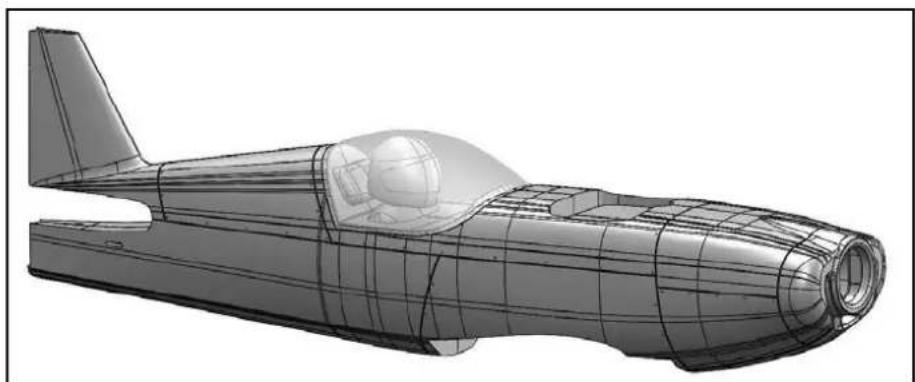
224422 # 22 4402
Cowl / fuselage hatch
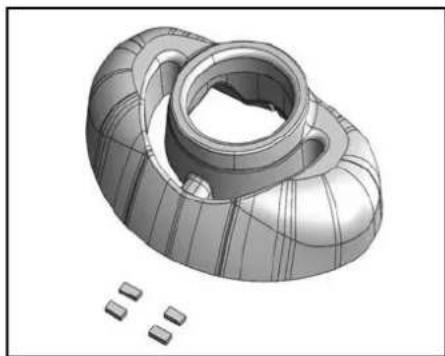
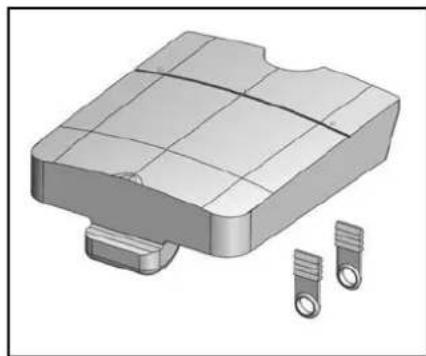
22 4404 # 22 4426