FD 51 ICE - Oven Ariston Thermo - Free user manual and instructions
Find the device manual for free FD 51 ICE Ariston Thermo in PDF.



| Product Type | Multifunction built-in electric oven |
| Brand | Ariston Thermo |
| Model | FD 51 ICE |
| Usable oven dimensions | Width 40 cm, Depth 39 cm, Height 34 cm |
| Usable volume | 53 liters |
| Supply voltage | 230 V / 50-60 Hz |
| Maximum power | 2100 W |
| Consumption to reach 200°C | 0.45 kWh |
| Consumption to maintain 200°C | 0.70 kWh |
| Total consumption (example) | 1.15 kWh |
| Cooking functions | Static, Fan-assisted, Grill, Double Grill, Double Grill with fan |
| Controls | Function selector knobs, thermostat, timer, electromechanical start/end cooking programmer (on some models) |
| Timer | Yes, with audible alarm and automatic oven shut-off (models with programmer) |
| Interior light | Yes, 25 W lamp, E14 socket, resistant to 300°C |
| Cooling ventilation | Yes, integrated (additional kit available for models without) |
| Door | Third glass available as option (kit code 053413) |
| Cooking levels | 5 levels |
| Interior material | Enameled, self-cleaning panels on some models |
| Cleaning | Warm water and non-abrasive detergent; avoid placing aluminum foil at the bottom |
| Installation | Built-in under counter or column; requires niche with ventilation |
| Electrical connection | 230 V single-phase with earth; omnipolar switch recommended |
| Safety | Mandatory grounding; child safety (3rd glass kit) |
| Certifications | Compliant with EC directives: Low Voltage, EMC, CE Marking |
| Spare parts and repairability | Third glass kit (053413) and ventilation kit (0053414) available; use of original parts recommended |
Frequently Asked Questions - FD 51 ICE Ariston Thermo
User questions about FD 51 ICE Ariston Thermo
0 question about this device. Answer the ones you know or ask your own.
Ask a new question about this device
Download the instructions for your Oven in PDF format for free! Find your manual FD 51 ICE - Ariston Thermo and take your electronic device back in hand. On this page are published all the documents necessary for the use of your device. FD 51 ICE by Ariston Thermo.
USER MANUAL FD 51 ICE Ariston Thermo
Blu (N) Marrone (L) Giallo-Verde ÷
Congratulations on choosing an Ariston appliance, which you will find is dependable and easy to use. We recommend that you read this manual for best performance and to extend the life of your appliance. Thank you.
Close-up View
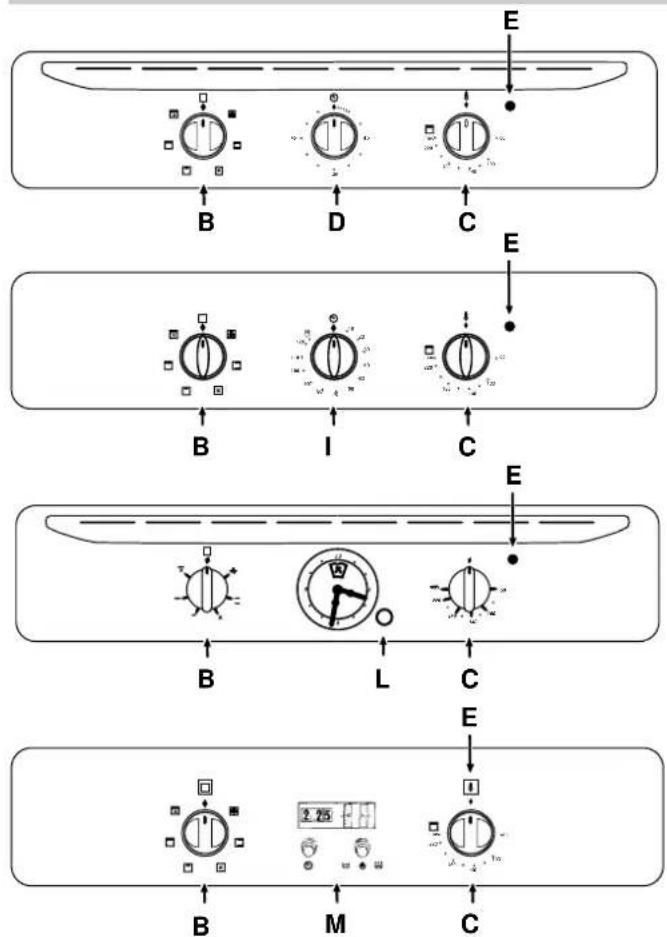
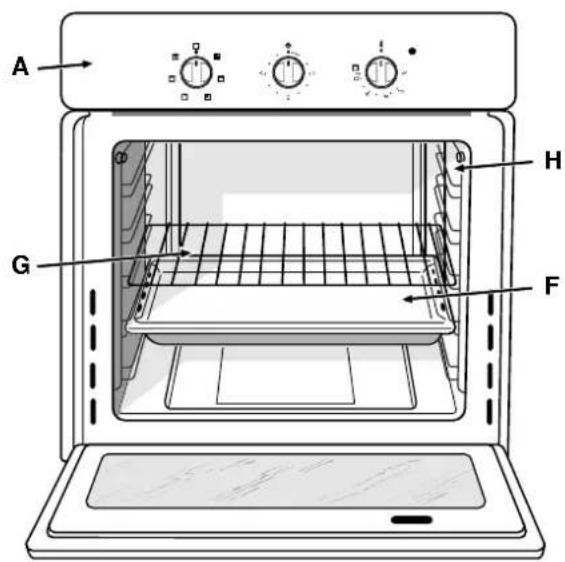
A. Control Panel
B. Knob for selecting the cooking features.
C. Knob for adjusting the cooking temperature.
D. Timer Knob (only on certain models)
E. Oven Light (only on certain models) - When the light is on, it indicates that the oven is heating. It will turn off when the temperature setting has been reached.
F.Dripping-pan
G.Oven Racks
H. Guides for sliding the racks or dripping-pan in and out.
1. Cooking Control Timer Knob (only on certain models)
L. Country Style Timer Knob (only on certain models)
M. Electromechanical Start/End Cooking Programmer (only on certain models)
How To Use Your Appliance
The Multifunction oven combines in a single appliance the advantages of traditional convection ovens with those of modern forced air ventilation ovens.
It is an extremely versatile appliance that allows you to easily and safely choose between 5 different cooking modes. The various features are selected by means of the selector knob (B) and the thermostat knob (C) on the control panel.
Attention: The first time you use the oven we recommend that you set the thermostat on the highest setting and leave the oven on for about a half of an hour with nothing in it. Then, open the oven door and let the room air. The odour that is often detected during this initial use is due to the evaporation of substances used to protect the oven during storage and until it is installed.
Attention: Only use the bottom shelf of the oven when using the rotisserie to cook (where present). For all other types of cooking, never use the bottom shelf and never place anything
on the bottom of the oven when it is in operation because this could damage the enamel. Always place your cookware (dishes, aluminium foil, etc. etc.) on the grate provided with the appliance inserted especially along the oven guides.
Convection Mode
Set the termostat knob (C) between 60^ and Max.
The outer heating elements at both the top and the bottom of the oven will come on. The heat is distributed uniformly from the top to the bottom. The convection mode is recommended for preparing meat-based dishes featuring beef or veal which require slow cooking with the addition of liquids. It still remains the best cooking mode for dry pastries and fruit in general. When cooking in convection mode, only use one dripping-pan or cooking rack at a time, otherwise the heat distribution with be uneven. Select from among the various rack heights based on the whether the dish needs more or less heat from the top or bottom.
Ventilation Mode
Set the thermostat knob (C) between 60^ and Max.
Both the heating elements and the fan will come on. Since the heat remains constant and uniform throughout the oven, the air cooks and browns food uniformly over its entire surface. With this mode, you can also cook various dishes at the same time, as long as their respective cooking temperatures are the same. A maximum of 2 rack levels can be used at the same time, following the instructions in the section entitled, "Cooking On More Than One Rack".
This cooking mode is ideal for au gratin dishes or those which require an extended cooking time.
Moreover, the excellent heat distribution makes it possible to use lower temperatures when cooking roasts. This results in less loss of juices, meat which is more tender and a decrease in the loss of weight for the roast.
The ventilated mode is especially suited for cooking fish, which can be prepared with the addition of a limited amount of condiments, thus maintaining their flavor and appearance. The ventilated mode can also be used to thaw white or red meat, fish and bread by setting the temperature to 80^ - 100^ . To thaw more delicate foods, set the termostat to 60^ or use only the cold air circulation feature by setting the thermostat to 0^ .
Grill
Set the thermostat to "C": Max.
The central heating element of the grill will come on. The incandescent heating element cooks food by means of thermal radiation directed downward. The extremely high and direct temperature of the grill makes it possible to brown the surface of meats and roasts while locking in the juices to keep them tender.
Double Grill
Set the thermostat to "C": Max.
Both of the grill elements are activated. This oversized grill has a completely new design, increasing cooking efficiency by 50% . The double grill also eliminates pockets of unheated air in the corners of the oven.
Ventilated Double Grill
Set the thermostat to "C": between 60^ and 200^ .
Both of the heating elements of the grill are activated, as well as the fan. This combination of features increases the effectiveness of the unidirectional thermal radiation of the heating elements through forced air circulation of the air throughout the oven. This helps prevents foods from burning
on the surface, allowing the heat to penetrate into the food.
Cooking Control Timer Knob (I)
Some models are equipped with a timer program to control when the oven shuts off during cooking. To use this feature, you must wind the "I" knob one full turn in the counterclockwise direction; then, turn the knob in the clockwise direction to set the time by matching up the indicator on the control panel with the number of minutes on the knob. At the end of the programmed length of time, the timer will sound and automatically turn off the oven.
Attention: to use the oven in manual mode without the cooking control timer, match the indicator on the control panel with the symbol on the timer knob.
When the oven is not in use, the cooking control timer can be used like a normal timer.
Timer (D)
To use the timer, it must be wound using the "D" knob. Turn the knob almost one full turn in the clockwise direction
Then, turn the knob back and set the time by positioning the number (minutes) on the knob dial beneath the mark on the control panel.
Oven Light
The light comes on when the "B" knob is turned to the setting. The light illuminates the oven and remains on when any of the heating elements is turned on.
Forced Air Ventilation
In order to reduce the external temperature of the oven, some models have been equipped with a cooling fan which comes on when the "B" knob is turned to a cooking setting. The fan remains on during the cooking process and a flow of air can be heard exiting between the oven door and the control panel. After you have finished cooking, it a good idea to keep the fan on for a few minutes by setting the thermostat knob to "●" in order to allow the oven to cool down rapidly. A supplemental kit (code 053414) is available from the nearest Merloni Elettrodomestic Service Centre for those models that do not come with this feature.
3rd Oven Glass
In order to further decrease the temperature of the oven door and reduce energy consumption, a supplemental kit has been made available. This kit should be installed if the oven is used in the presence of small children. To install the protective glass for the oven door (code 053413), contact your nearest Merloni Eletrodomestici Service Centre.
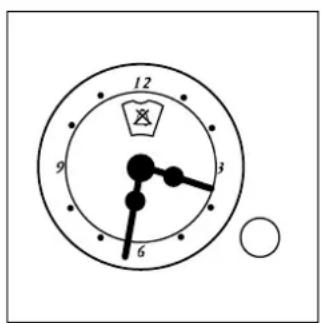
Country Style Clock and Timer
How to Set the Current Time
The oven must be connected to the power supply Pull and turn the knob in the counter-clockwise direction to set the time.
N.B.: The clock is electric. Therefore, in the event of a power outage, the clock will stop for the entire time the oven remains without power. When the power comes back on, the clock must be reset to the current time
Timer Feature
The timer operates by counting down a given period of time. This feature does not, however, turn the oven on or off. It merely emits an acoustical alarm when the time has run out.
How to Set the Timer
Turn the knob in the counter-clockwise direction until the indicator is set on the length of time desired (using the inside numbers). The time is clearly visible through the transparent window on the indicator itself.
The timer will begin to count down immediately.
To turn off the buzzer, or to use only the clock, set the indicator on the symbol.
Electromechanical Start/End Cooking Programmer
The Cooking
Programmer
The figure illustrates the controls for the programmer. Knobs 1, 2 and 3 allow you to make all the necessary settings.
Knob 1
When turned in the clockwise direction, it allows you to correct the time setting on the digi
tal clock (upon installation, after a power failure or when it runs fast or slow etc.).
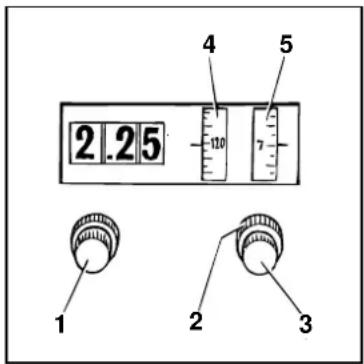
Knob 2
When turned in the clockwise direction, it:
-
sets the duration of the cooking time (max of 210 minutes);
-
stops the acoustical signal (stting);
-
sets the oven on manual mode (setting).
The symbols for the above appear in quadrant 4.
Knob 3
When pressed and turned in either the clockwise or counterclockwise direction, it sets the start of the cooking time displayed in quadrant 5. When the clock is adjusted, you must check that the time on the clock is synchronized with the time shown in quadrant 5.
Manual Operating Mode for the Oven
The oven can be used normally, i.e. without being programmed. In this case, knob 2 must be turned in the clockwise direction until the symbol appears in quadrant 4.
Semiautomatic Operating Mode
The start time is normal and end cooking time is programmed:
prepare the food to be cooked; rotate knob 2 in the clockwise direction and set the number of minutes for the end cooking time in quadrant 4; turn the oven knob to the desired temperature. Make sure that the time on the clock is synchronized with the time shown in quadrant 5.
Automatic Operating Mode
Arrange the food to be cooked; turn knob 2 in the clockwise direction, setting the length of the cooking time in quadrant 4; press and rotate knob 3 in the clockwise direction to set the cooking start time in quadrant 5; turn the oven knob to the desired temperature setting. At the end of the cooking time, the "0" in quadrant 4 will be aligned
with the marker; this indicates that the oven is no longer operating. An acoustical signal will sound to indicate that the cooking time is over.
To stop the signal, turn knob 2 in the clockwise direction so that the symbol is aligned with the marker in quadrant 4.
Example of programmer setting for the automatic operating mode for the oven.
End cooking time: 7:00 p.m.
Length of cooking time: 2 hours.
Arrange the food that is to be cooked; turn knob 2 in the clockwise direction, setting the length of the cooking time (2 hours) in quadrant 4.; press and rotate knob 3 in the clockwise direction, setting the end cooking time, 5:00, in quadrant 5; turn the oven control knob to the temperature setting desired.
After these settings have been made, the programmer will automatically stop and start the oven at 5:00 and 7:00 respectively.
Timer
The programmer can also serve as a timer only if the oven is not programmed for automatic operating mode and is not on.
To use the timer feature, turn knob 2 in the clockwise direction to set the time in quadrant 4. The maximum time setting is 210 minutes. To stop the acoustical signal, turn knob 2 in the clockwise direction until the symbol is aligned with the marker in quadrant 4.
Programmed Cooking
Programmed cooking is no different than normal cooking. The programmer does not control the cooking time setting when you are not present or doing other work. Therefore, it is best to use the completely automatic mode for foods which do not require special attention. When programming a time greater than 12 hours, it must always refer to the first 12 hours of the day (e.g. 20:00 must be understood to mean 8:00 and so forth). Therefore, it is possible to program cooking 12 hours in advance.
Important
To use the oven manually (without the programmer), the following is necessary:
-
Upon adjusting the clock, make sure that the time shown is synchronized with the time shown in quadrant 5.
-
Turn knob 2 in the clockwise direction so that the symbol is aligned with the marker in quadrant 4.
Before cleaning your oven, or performing maintenance, disconnect it from the power supply.
To extend the life of your oven, it must be cleaned frequently, keeping in mind that:
- The self-cleaning panels (if present) and the enameled parts should be washed with warm water - abrasive powders and corrosive substances should be avoided;
- The inside of the oven should be cleaned immediately after use with warm water and soap; the soap should be rinsed away and the interior dried thoroughly;
- Stainless steel can be stained if it remains in contact with agressive detergents (containing phosphorus) or water with a high lime content. We recommend that you rinse these parts thoroughly and dry them well after cleaning. It is also a good idea to dry any water spills;
- Never line the bottom of the oven with aluminium foil because the buildup of heat will not only impede the cooking process, but could also damage the enamel.
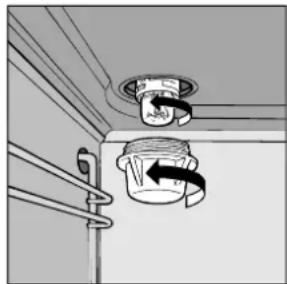
Replacing the Lamp in the Oven
- Cutoff the supply of power to the oven by turning off the omni-polar switch connecting it to the mains, or by removing the plug if it is accessible;
- Unscrew the glass cover attached to the lamp holder;
-
Unscrew the lamp and replace it with another high-temperature lamp (300^) with the following characteristics:
-
Voltage: 230/240 V
-Wattage:25W -
Socket: E14
-
Remount the glass cover and reconnect the appliance to the power supply.
Practical Cooking Advice
Preheating
If the oven must be preheated (generally this is the case when cooking leavened foods) the × "ventilation" mode can be used to reach the desired temperaure as quickly as possible in order to save on energy.
Once the food has been placed in the oven, the most appropriate cooking mode can then be selected.
Cooking on More Than One Rack
If you have to cook on more than one rack at the same time, use only the × "ventilation" mode, as it is the only one which is appropriate for this type of cooking.
- The oven has 5 rack heights. When cooking with the ventilation mode, use a combination of two of the three central rack heights. The topmost and bottommost rack heights are subject to more direct contact with the hot air being circulated in the oven, and using these levels could result in more delicate food being burned;
In general, use the second and fourth rack heights for foods which require more heat. Fore example, when cooking roasts together with other foods, put the roast at the second rack height and use the fourth for more delicate food; - When cooking dishes which require different temperatures and/or cooking times, set the temperature to that between the temperatures required for the two dishes and place the more delicate food at the fourth rack height. Then remove the dish with a shorter cooking time first;
- Use the dripping-pan at the bottom rack height and the broiler at the top;
- When cooking pastries on two racks at the same time, use the third and the fourth rack heights, not the second because it receives to much heat.
Using the Grill
The Multifunction oven offers you three different grilling modes.
Use the "grill" setting for small portions. Although electrical consumption is a mere 1200 W, it allows you to grill small portions like toasted sandwiches, hotdogs, etc., to perfection.
Position the food under the center of the grill because only the central part of the top heating element is turned on.
Food placed in the corners will not cook properly.
The "Double Grill" setting allows you to grill along the entire surface area of the grill. Use this mode when you have food distributed uniformly throughout the oven and you would like to brown the items uniformly.
The "Ventilated Double Grill" is extremely useful for grilling foods rapidly, as the distribution of heat makes it possible not only to brown the surface, but also to cook the bottom part.
This mode can also be used for browning foods at the end of the cooking process.
Important: always use the grill with the oven door closed. This will allow you both to attain excellent results and to save energy (10% circa).
When using any of the three grilling modes, it is recommended that the thermostat knob be turned to the highest setting, as it is the most efficient way to use the grill (which utilizes infrared rays).
If necessary, however, the thermostat can be set to lower temperatures by simply turning the knob to the desired setting.
When utilizing the grill, place the rack at the lower levels (see cooking table). To catch grease or fat and prevent smoke, place a dripping-pan at the bottom rack level.
Baking Pastries
When baking pastries, always place them in the oven after it has been preheated. Make sure you wait until the oven has been preheated thoroughly (the red "E" light will turn off). Do not open the door while the pastry is cooking in order to prevent it from dropping.
Batters must not be too runny, as this will result in prolonged cooking times. In general:
Pastry is too dry
Increase the temperature by 10^ and reduce the cooking time.
Pastry dropped
Use less liquid or lower the the temperature by 10^
Pastry is too dark on top
Place it on a lower rack, lower the temperature, and increase the cooking time.
Cooked well on the inside but sticky on the outside
Use less liquid, lower the temperature, and increase the cooking time.
The pastry sticks to the pan
Grease the pan well and sprinkle it with a dusting of flour.
I used more than one level and they are not all at the same cooking point
Use a lower temperature setting. It is not necessary to remove the food from all the racks at the same time.
Cooking Pizza
For best results when cooking pizza use the "ventilation mode"
- Preheat the oven for at least 10 minutes;
- Use a light aluminum pizza pan, placing it on the broiler supplied with the oven. If the dripping-pan is used, this will extend the cooking time, making it difficult to get a crispy crust;
- Do not open the oven door frequently while the pizza is cooking;
- If the pizza has a lot of toppings (three of four), it is recommended that the mozzarella cheese be placed on top halfway through the cooking process;
- When cooking more than one pizza at the same time, use rack heights 2 and 4 at a temperature of 220^ . Preheat the oven for at least 10 minutes. In general, the pizza at rack height 4 cooks slightly slower. Therefore, remove the pizza at rack level 2 first and leave the other in the oven for a few minutes more.
Cooking Fish and Meat
Meat must weigh at least 1Kg in order to prevent it from drying out. When cooking white meat, fowl and fish, use low temperature settings (150^ - 175^) . For red meat that should be well done on the outside while tender and juicy in the inside, it is a good idea to start with a high temperature setting (200^ - 220^) for a short time, then turn the oven down afterwards. In general, the larger the roast, the lower the temperature setting. Place the meat on the centre of the rack and place the dripping pan beneath it to catch the fat.
Make sure that the rack is inserted so that it is in the centre of the oven. If you would like to increase the amount of heat from below, use the low rack heights. For savory roasts (especially duck and wild game), dress the meat with lard or bacon on the top.
| Selection knob | Food to be cooked Wt. | (Kg) | Cooking position from bottom | Heating time (min.) | Thermostat knob | Cooking time (min.) |
| 1 Static Roast p | fork | 0,5 | 2 | 15 | 200 | 35 |
| Roast veal | 0,5 | 2 | 15 | 200 | 30 | |
| Duck | 0,5 | 1-2 | 15 | 200 | 30-35 | |
| Meringues | - | 2 | 10 | 100 | 60-75 | |
| Biscuits | - | 2 | 10 | 140 | 15-20 | |
| 2 Fan oven cooking | Pizza | 1 | 2 | 15 | 220 | 20-35 |
| Lasagne | 1 | 3 | 10 | 180 | 30-35 | |
| Baked noodles | 1 | 3 | 10 | 180 | 20-30 | |
| Lamb | 1 | 2 | 10 | 180 | 40-45 | |
| Chicken | 1 | 2 | 10 | 180 | 60-75 | |
| Mackerel | 1 | 2 | 10 | 180 | 50-55 | |
| Red porgy | 1,5 | 2 | 10 | 180 | 55-60 | |
| Chocolate cake | 1 | 3 | 10 | 160 | 50-60 | |
| 3 Grill Sole and | cuttle fish | 1 | 4 | 5 | Max | 8 |
| Squid and shrimp on spits | 1 | 4 | 5 | Max | 4 | |
| Cod steaks | 1 | 4 | 5 | Max | 10 | |
| Grilled vegetables | 1 | 3-4 | 5 | Max | 8-10 | |
| 4 Double Grill | veal steaks | 1 | 4 | 5 | Max | 15-20 |
| Cutlets | 1,5 | 4 | 5 | Max | 25 | |
| Hamburgers | 1 | 3 | 5 | Max | 7 | |
| Caballas | 1 | 4 | 5 | Max | 20-25 | |
| 5 Gratin Oven | Grilled chicken | 1,5 | 2 | 5 | 200 | 55-60 |
| Cuttle fish | 1,5 | 2 | 5 | 200 | 40-45 |
Note: cooking times are approximate and may vary according to personal taste.
Safety Is A Good Habit To Get Into
To maintain the EFFICIENCY and SAFETY of this appliance, we recommend:
- call only the Service Centers authorized by the manufacturer
-
always use original Spare Parts
-
This appliance is designed for non-professional, household use and its functions must not be changed.
- These instructions are only valid for the countries whose symbols appear on the manual and the serial number plate.
- The electrical system of this appliance may be used safely only when it is correctly connected to an efficient earthing system in compliance with the safety standards currently in effect.
The following items are potentially dangerous, and, therefore, appropriate measures must be taken to prevent children and the disabled from coming into contact with them:
- Controls and the appliance in general;
- Packaging (bags, polystyrene, nails, etc.);
- The appliance immediately after use of the oven or grill due to the heat generated;
- The appliance when no longer in use (potentially dangerous parts must be made safe).
Avoid the following:
- Touching the appliance with wet parts of the body;
- Using the appliance when barefoot;
- Pulling on the appliance or the supply cord to unplug it from the electrical outlet;
- Obstructing the ventilation or heat dissipation slots;
- Allowing power supply cords for small appliances to come into contact with the hot parts of the appliance;
- Exposing the appliance to atmospheric agents (rain, sun);
- Using the oven for storage purposes;
- Using flammable liquids near the appliance;
- Using adaptors, multiple sockets and/or extension cords;
- Attempting to install or repair the appliance without the assistance of qualified personnel.
Qualified personnel must be contacted in the following cases:
- Installation (following the manufacturer's instructions);
- When in doubt about operating the appliance;
- Replacing the electrical outlet when it is not compatible with the plug for the appliance.
Service Centres authorized by the manufacturer must be contacted in the following cases:
- If in doubt about the soundness of the appliance after removing it from the packaging;
- If the power supply cord has been damaged or needs to be replaced;
- If the appliance breaks down or functions poorly; ask for original spare parts.
It is a good idea to do the following:
- Only use the appliance to cook food, nothing else;
- Check the soundness of the appliance after it has been unpacked;
-
disconnect the appliance from the electrical mains if it is not functioning properly and before cleaning or performing maintenance;
-
When the appliance is not used for an extended period of time, cut off the supply of power and close the gas cock (if present);
- Use cooking gloves to place cookware in the oven or when removing it;
- Always grasp the oven door in the centre because the ends may be hot due to the escape of hot air;
- Make sure that the control knobs are on the “·”/“o” setting when the appliance is not in use;
- Cut the power supply chord after disconnecting it from the mains when you decide not to use the appliance any longer.
- The manufacturer will not be held liable for any damages that might arise out of incorrect installation or improper, incorrect or unreasonable use of the appliance.
Installation
Important: The power supply to the appliance must be cut off before any adjustments or maintenance work is done on it.
Installation of Built-in Ovens
In order to insure that the built-in appliance functions properly, the cabinet containing it must be appropriate. The figure below gives the dimensions of the cutout for installation under the counter or in a cabinet wall unit.
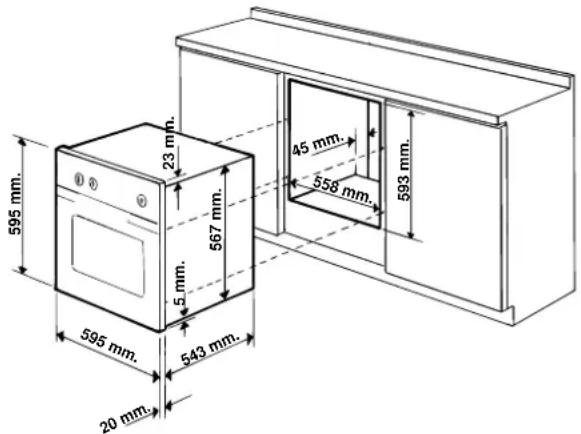
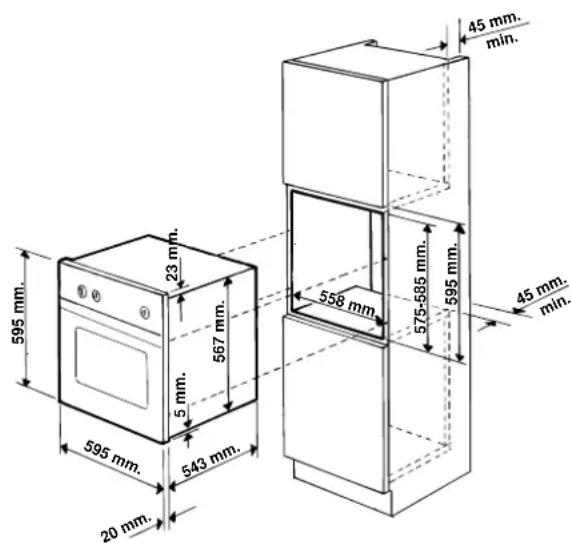
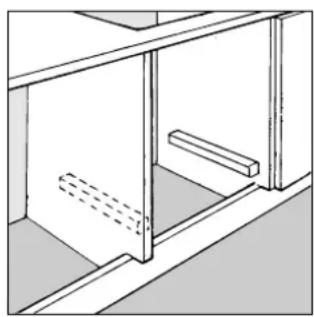
In order to ensure adequate ventilation, the back panel of
the cabinet must be removed. Installing the oven so that it rests on two strips of wood is preferable.
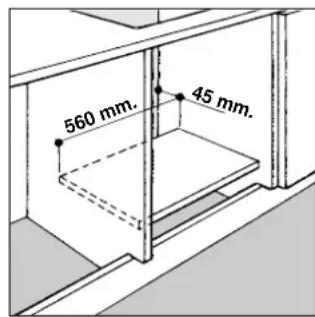
In the case where the oven rests on a continuous, flat surface, there must be an aperture of at least 45 × 560 mm.
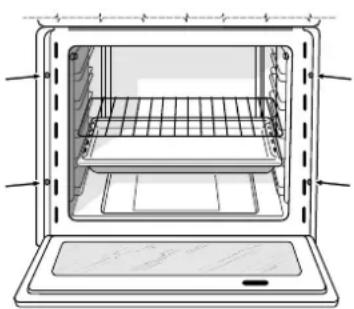
To fasten the oven to the cabinet, open the door of the oven and fasten it by inserting the 4 wood screws into the 4 holes locate on the perimeter of the frame.
The panels of the adjacent cabinets must be made of heat resistant material. In particular, cabinets with a veneer exterior must be assembled with glues able to withstand temperatures of up to 100^ .
In compliance with current safety standards, contact with the electrical parts of the oven must not be possible once it has been installed.
All parts which ensure safe operation of the appliance must not be able to be removed without the use of a tool.
Electrical Connection
Those ovens equipped with a three-pole power supply cord are designed to operate with alternating current with the voltage and frequency indicated on the data plate (located on the appliance) and in the instruction manual. The wire for grounding the appliance is yellow-green in color.
Mounting a Power Supply Cable
Opening the terminal board:
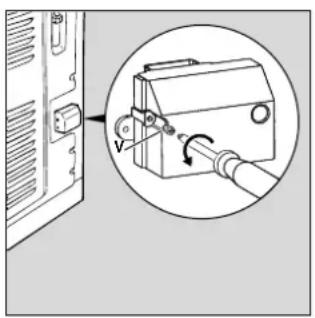
- Remove the "V" screw;
- Pull to open the cover of the terminal board.
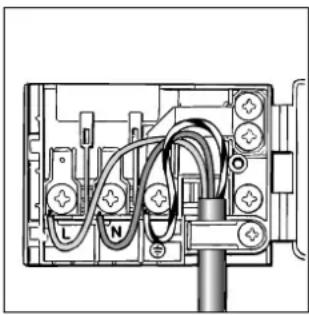
To install the cable, proceed as follows: -
Remove the wire clamp screw and the three contact screws L-N
-
Fasten the wires beneath the heads of the screws using the following color scheme: Blue (N) Brown (L) Yellow-Green
- Fasten the supply cable in place with the clamp, close the cover to the terminal box and fasten it with the "V" screw.
Attaching the Power Supply Cable to the Mains
The appliance must be connected directly to the mains by means of an omni-polar switch with a minimum contact break of 3mm sized for the load and in compliance with the standards currently in effect (the earthing wire must not be interrupted by the switch).
The power supply cord must be positioned so that it does not reach a temperature 50^ above ambient temperature at any one point.
Before making the connection, check that:
- the fuse and the electrical system in the home can handle the load of the appliance (see the data plate);
- the electrical mains in the home are equipped with an efficient grounding system in compliance with the safety standards currently in effect;
- The electrical outlet or omnipolar switch is within easy reach when the oven is installed.
NB: Do not use adaptors, shunts or reducing devices as they may cause overheating and lead to fires.
Technical Specifications
Inner Dimensions of the Oven: Width - 40 cm
Depth - 39 cm
Height- 34 cm
Inner Volume of the Oven: 53 Liters
Energy Consumption:
To reach 200^ : 0.45 kWh
To maintain the temp. at 200^ for 1 hour: 0.7kWh
Total: 1.15 kWh
Voltage and Frequency of Power Supply: 230V / 50 - 60Hz / 2100W

This appliance conforms with the following European Economic Community directives:
- 73/23/EEC of 19/02/73 (Low Voltage) and subsequent modifications;
- 89/336/EEC of 03/05/89 (Electromagnetic Compatibility) and subsequent modifications;
- 93/68/EEC of 22/07/93 and subsequent modifications.
consumo total: kWh 1,15
Azul (N) Castanho (L) Amarelo-Verde

- Blu (N) Marrone (L) Giallo-Verde ÷
- Close-up View
- How To Use Your Appliance
- Convection Mode
- Ventilation Mode
- Grill
- Double Grill
- Ventilated Double Grill
- Cooking Control Timer Knob (I)
- Timer (D)
- Oven Light
- Forced Air Ventilation
- 3rd Oven Glass
- Country Style Clock and Timer
- How to Set the Current Time
- Timer Feature
- How to Set the Timer
- Electromechanical Start/End Cooking Programmer
- The Cooking
- Programmer
- Knob 1
- Knob 2
- Knob 3
- Manual Operating Mode for the Oven
- Semiautomatic Operating Mode
- Automatic Operating Mode
- After these settings have been made, the programmer will automatically stop and start the oven at 5:00 and 7:00 respectively.
- Timer
- Programmed Cooking
- Important
- Before cleaning your oven, or performing maintenance, disconnect it from the power supply.
- Replacing the Lamp in the Oven
- Practical Cooking Advice
- Preheating
- Cooking on More Than One Rack
- Using the Grill
- Baking Pastries
- Pastry is too dry
- Pastry dropped
- Pastry is too dark on top
- Cooked well on the inside but sticky on the outside
- The pastry sticks to the pan
- I used more than one level and they are not all at the same cooking point
- Cooking Pizza
- Cooking Fish and Meat
- Safety Is A Good Habit To Get Into
- The following items are potentially dangerous, and, therefore, appropriate measures must be taken to prevent children and the disabled from coming into contact with them:
- Avoid the following:
- Qualified personnel must be contacted in the following cases:
- Service Centres authorized by the manufacturer must be contacted in the following cases:
- It is a good idea to do the following:
- Installation
- Installation of Built-in Ovens
- Electrical Connection
- Mounting a Power Supply Cable
- Attaching the Power Supply Cable to the Mains
- Technical Specifications
Brand : Ariston Thermo
Model : FD 51 ICE
Category : Oven