Traveller 1526 - Laptop TARGA - Free user manual and instructions
Find the device manual for free Traveller 1526 TARGA in PDF.



| Product Type | Laptop |
| Brand | Targa |
| Model | Traveller 1526 |
| Processor | AMD Turion 64-bit dual-core, L2 cache 512 KB/1 MB, bus 800 MHz |
| Chipset | ATI RXS690 + ATI SB600 |
| RAM Memory | DDRII 533/667/800, up to 4 GB (2 SO-DIMM slots) |
| Hard Drive | 250 GB (2.5", 5400 rpm) |
| Optical Drive | DVD Super Multi (DVD±R/RW, CD-R/RW, DVD-RAM) |
| Screen | 15.4" WXGA anti-glare (1280 x 800) |
| Graphics Card | ATI Mobility Radeon HD2600, 256 MB GDDR3 |
| Audio | HD sound card, 2 speakers + subwoofer |
| Wireless Connectivity | WiFi 802.11 b/g, Bluetooth |
| Wired Connectivity | Gigabit Ethernet (10/100/1000), 56K Modem |
| Ports | 4x USB 2.0, HDMI, VGA, IEEE 1394, S-Video, DVB-T, RJ-45, RJ-11, card reader (SD/MMC/MS/XD/SM) |
| Battery | Li-ion 9-cell, 10.8 V, 7200 mAh, battery life 2-3 hours |
| Power Supply | 90W AC adapter, 19V |
| Dimensions | 358 (L) x 259 (D) x 27-33 (H) mm |
| Weight | 2.9 kg |
| Main Features | Windows Vista, Windows Media Center with DVB-T TV, shortcut keys (WiFi, Bluetooth, IE, Media Center, Email, Photo), webcam, built-in microphone, system restore |
| Security | Kensington lock, BIOS password, lithium battery warning, FCC Class B compliance |
| Maintenance and Cleaning | Clean the screen with a dry microfiber cloth; avoid moisture and extreme temperatures. Use a TFT screen cleaning kit. |
| Spare Parts and Repairability | Battery and AC adapter available from the manufacturer. Hard drive and memory accessible from the bottom. For other components, contact Targa support. |
Frequently Asked Questions - Traveller 1526 TARGA
User questions about Traveller 1526 TARGA
0 question about this device. Answer the ones you know or ask your own.
Ask a new question about this device
Download the instructions for your Laptop in PDF format for free! Find your manual Traveller 1526 - TARGA and take your electronic device back in hand. On this page are published all the documents necessary for the use of your device. Traveller 1526 by TARGA.
USER MANUAL Traveller 1526 TARGA
natural_image
Simple line drawing of a laptop computer with a clock icon (no text or symbols)For better environmental protection, waste batteries should be collected separately for recycling or special disposal.
Déclaration WEEE
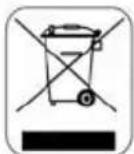
(English) Under the European Union ("EU") Directive on Waste Electrical and Electronic Equipment, Directive 2002/96/EC, which takes effect on August 13, 2005, products of "electrical and electronic equipment" cannot be discarded as municipal waste anymore and manufacturers of covered electronic equipment will be obligated to take back such products at the end of their useful life.
West Point Business Park, Link Road
Ballincollig Co.Cork, Ireland
Conditions FCC....III
natural_image
Simple line drawing of a laptop computer with a clock icon (no text or symbols)natural_image
Simple line drawing of a laptop computer with a clock icon (no text or symbols)Spécifications
text_image
Laptop diagram with numbered annotations pointing to key componentstext_image
Diagram of a rear panel with labeled components, showing numbered parts 1 and 2.1. Lecteur de carte
text_image
Diagram of a rear panel with numbered annotations pointing to internal components1. Connecteur RJ-45
text_image
Technical diagram of a rear panel with labeled components 1 and 2text_image
Diagram of a computer chassis showing internal components with numbered labels pointing to specific areas.text_image
Diagram showing a device connected to a cable with labeled parts ② and ③, likely illustrating a cable or wiring connection.text_image
Diagram of an internal computer case with numbered components and blue arrows indicating assembly or status.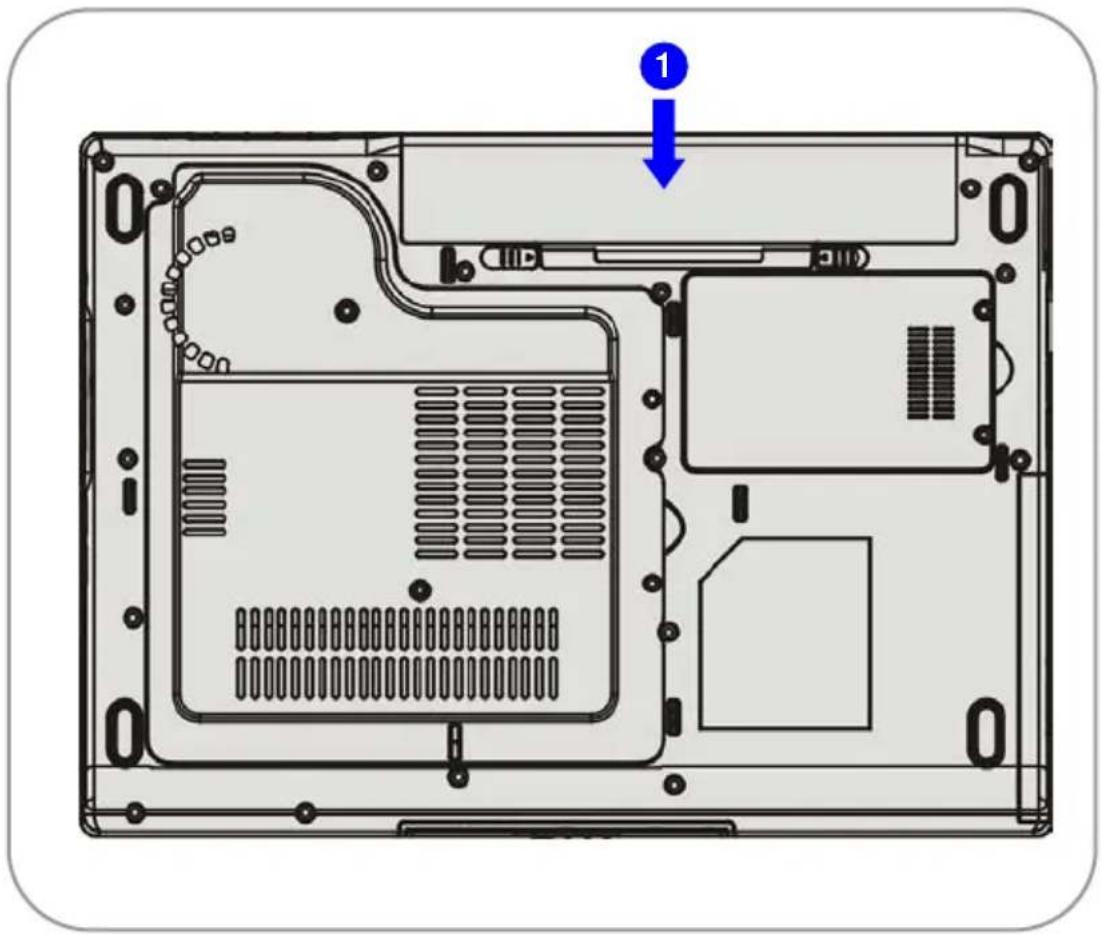
text_image
Diagram of a computer chassis showing internal components with labeled parts and a blue arrow pointing to component 1.text_image
Technical diagram of a mechanical component with numbered annotations pointing to features.text_image
Mouse Properties Buttons Pointers Pointer Options Wheel Hardware Button configuration Switch primary and secondary buttons Select this check box to make the button on the right the one you use for primary functions such as selecting and dragging. Double-click speed Double-click the folder to test your setting. If the folder does not open or close, try using a slower setting. Speed: Slow Fast ClickLock Turn on ClickLock Settings... Enables you to highlight or drag without holding down the mouse button. To set, briefly press the mouse button. To release, click the mouse button again. OK Cancel ApplyMouse Properties Window
natural_image
Simple line drawing of a laptop computer with a clock icon (no text or symbols)text_image
Safely Remove Hardware Select the device you want to unplug or eject, and then click Stop. When Windows notifies you that it is safe to do so unplug the device from your computer. Hardware devices USB Mass Storage Device 802.11g CardBus Wireless NetworkAdopter USB Mass Storage Device at Location 0 Properties Stop Display device components Stop a Hardware device Confirm devices to be stopped. Choose OK to continue. Windows will attempt to stop the following devices. After the devices are stopped they may be removed safely. USB Mass Storage Device Genect volume - (E:) Walking Disk USB Device OK CancelPréface
natural_image
Simple line drawing of a laptop computer with a clock icon (no text or symbols)| Main Advanced Security Boot Exit | |
| Market Name Model Name System Time [18:08:53] System Date [Wed 05/16/2007] ► Serial ATA [Not Detected] ► Primary IDE Master [ATAPICDKUM] ► System Infomation | Use [ENTER] to select a field. Use [+], [-] to configure system Date. ↔ Select Screen ↓↑ Select Item +- Change Field Tab Select Field F1 General Help F10 Save and Exit FSC Exit |
| V02.59 (C) Copyright 1985-2005, American Megatrends, Inc. | |
Menu Main (menu principal)
| BIOS SETUP UTILITY | |||
| Main Advanced Security Boot Exit | |||
| Market Name Model Name | Use [ENTER] to select a field. | ||
| System Time | [8:08:53] | Use [+], [-] to configure system Date. | |
| System Date | [Wed 05/16/2007] | ||
| Serial ATA | [Not Detected] | ||
| Primary IDE Master | [ATAFICDKOM] | ||
| System Infomation | ←→ Select Screen ↓↑ Select Item +- Change Field Tab Select Field F1 General Help F10 Save and Exit ESC Exit | ||
V02.59 (C) Copyright 1985-2005, American Megatrends, Inc.
text_image
BIOS SETUP UTILITY Main Advanced Security Boot Exit ▶ Chipset Configuration PowerNow [Enabled] C1F Support [Disable] Legacy USB Support [Auto] PCI Legacy Timer [64] ↔ Select Screen ↓↑ Select Item +- Change Field Tab Select Field F1 General Help F10 Save and Exit ESC Exit V02.59 (C) Copyright 1985-2005, American Megatrends, Inc.text_image
BIOS SETUP UTILITY Main Advanced Boot Security Exit Boot Settings Quiet Boot [Enabled] 1st Boot Device [HDD:PM TOSHIBA NK6] 2nd Boot Device [Network:PXE UNDI (B)] 3rd Boot Device [CD/DVD:SM-HL-DT-ST] Disabled: Displays normal POST messages. Enabled: Displays OEM Logo instead of POST messages. ←→ Select Screen ↑↓ Select Item +- Change Option F1 General Help F10 Save and Exit ESC Exit v02.58 (C) Copyright 1985-2004, American Megatrends, Inc.| BIOS SETUP UTILITY | |
| Main Advanced Security Boot Exit | |
| Supervisor Password: Not Installed User Password: Not Installed Change Supervisor Password | Enable/disable the generation of ACPI_PPC,_PSS,and_FCT objects. ↔ Select Screen ↓↑ Select Item +- Change Field Tab Select Field F1 General Help F10 Save and Exit ESC Exit |
V02.59 (C) Copyright 1985-2005, American Megatrends, Inc.
text_image
BIOS SETUP UTILITY Main Advanced Security Boot Exit Exit & Save Changes Exit & Discard Changes Discard Changes Load Setup Defaults Exit System setup after saving the changes. F10 key can be used for this operation. ↔ Select Screen +↑ Select Item +- Change Field Tab Select Field F1 General Help F10 Save and Exit ESC Exit V02.59 (C) Copyright 1985-2005, American Megatrends, Inc.natural_image
Simple line drawing of a laptop computer with a clock icon (no text or symbols)natural_image
Simple line drawing of a laptop computer with a clock icon (no text or symbols)Activation obligatoire
natural_image
Simple line drawing of a laptop computer with a clock icon (no text or symbols)natural_image
Simple line drawing of a laptop computer with a clock icon (no text or symbols)natural_image
Simple line drawing of a laptop computer with a clock icon (no text or symbols)For better environmental protection, waste batteries should be collected separately for recycling or special disposal.
WEEE verklaring
(English) Under the European Union ("EU") Directive on Waste Electrical and Electronic Equipment, Directive 2002/96/EC, which takes effect on August 13, 2005, products of "electrical and electronic equipment" cannot be discarded as municipal waste anymore and manufacturers of covered electronic equipment will be obligated to take back such products at the end of their useful life.
West Point Business Park, Link Road
Ballincollig Co.Cork, Ierland
FCC-conditions....III
natural_image
Simple line drawing of a laptop computer with a clock icon (no text or symbols)natural_image
Simple line drawing of a laptop computer with a clock icon (no text or symbols)Specificatie
| Fysieke eigenschap | |
| Afmeting 358 (b) x 259 (d) x | 27~33 (h) mm |
| Gewicht 2,9 kg | |
| CPU | |
| Processortype Contactvoetje S1 (638-pins, μPGA) | |
| Steunprocessor | Turion 64-bits Taylor processor, dual-core 35W (versie F/G) |
| L1 cache 64 KB | |
| L2 cache 512k/1M | |
| FSB snelheid 800 MHz | |
| Core chips | |
| Noordbrug ATI RXS690 | |
| Zuidbrug ATI SB600 | |
| Geheugen | |
| Technologie DDRII 533/ 667/ 800 | |
| Geheugen | DDRII SO-DIMM X 2 slot256/ 512/ 1024/ 2048 MB |
| Maximum 4 GB (2 GB DDRII SO-DIMM x 2) | |
| Elektriciteit | |
| AC adapter 90W, 19 Volt KSAFK1900474T1M2 | |
| Accutype | 9 cellen (Li-ion) BTY-M65 10,8 Vdc 7200 mAh |
| RTC accu Ja | |
| Opslag | |
| HDD vormfactor | 2,5" 9,5mm Hoog250 GB (5400rpm) |
| Optisch apparaat | DVD comboDVD dualSuper Multi(hier vermelde apparaten kunnen zonder aankondiging variëren) |
| I/O poort | |
| Monitor VGA x 1 | |
| HDMI x 1 | |
| USB x 4 (USB versie 2.0) | |
| Koptelefoon Uit x 1 (gedeeld met SPDIF) | |
| Mic-in x 1 | |
| Line-in x 1 | |
| RJ11 x 1 | |
| RJ45 x 1 | |
| IEEE1394 x 1 | |
| TV-uit | x 1 (S-video) |
| TV | x 1 |
| Kaartlezer | x 1 (SD/ MMC/ MS/ XD/ SM) |
| Communicatiepoort | |
| 56K Fax/MODEM | Steun |
| LAN 10/100/1000 Ethernet | |
| Wake on LAN Ja | |
| LAN opstarten Ja | |
| Bluetooth MS-6837D | |
| Draadloos Lan 802.11 b/g | |
| Express-kaart | |
| Slot Express-kaart Slot 34/54 x 1 | |
| Display | |
| LCD-type 15.4" WXGA non-glare | |
| Helderheid Helderheid geregeld door K/B sneltoetsen | |
| Video | |
| Grafische afbeeldingen(UMA) | ATI HD2600 |
| VRAM 256MB GDDR3 | |
| LCD 1280 x 800 WXGA | |
| Dualview-functie | LCD of CRT worden automatisch gedetecteerd indien verbonden. |
| CRT | 640 x 480, max. 32-bits kleur800 x 600, max. 32-bits kleur1024 x 768, max. 32-bits kleur1152 x 768, max. 32-bits kleur1400 x 1050, max. 32-bits kleur1600 x 1200, max. 32-bits kleur1800 x 1440, max. 32-bits kleur |
| Audio | |
| Geluidschip Codec HD audio-ondersteuning | |
| Interne luidspreker 2 luidsprekers met behuizing | |
| Geluidsvolume | Aanpassen met volumeknop, K/B sneltoets & SW |
| Software & BIOS | |
| USB FlashBoot Ja, USB floppy start uitsluitend DOS op | |
| BIOS Fastboot-ondersteuning --- Ja | |
| Andere | |
| Kensington-slot Ja | |
| Voldoet aan WHQL --- PC2001 | |
Productoverzicht
text_image
Laptop diagram with numbered annotations pointing to key components1. Vergrendeling afdekkap (binnenaanzicht)
text_image
Diagram of a rear panel with labeled components, showing numbered parts 1 and 2.1. Kaartlezer
De ingebouwde kaartlezer ondersteunt MMC (Multi-media Card), SD (Secure Digital), MS (Memory Stick), MS Pro (Memory Stick Pro), XD (eXtreme Digital) en SM (SmartMedia) kaarten.
2. Audiopoorten
text_image
Diagram of a rear panel with numbered annotations pointing to internal components1. RJ-45 connector
text_image
Technical diagram of a device rear panel with labeled components 1 and 2text_image
Laptop internal components diagram with numbered annotations pointing to specific areastext_image
Diagram showing a device being connected to a cable via three labeled components, with a magnified view of the device's open lid.text_image
Diagram of an internal computer case with numbered components and blue arrows indicating assembly or status.natural_image
Diagram of a computer chassis showing internal components and a blue arrow pointing to component 1 (no text or symbols present)info
Waarschuwing
text_image
Technical diagram of a device with numbered annotations pointing to internal components1. Cursorzone
natural_image
3D illustration of a CD inside a device with an open disc and a blue pointer, against a blue background (no text or symbols)Eject-knop
natural_image
Simple line drawing of a laptop computer with a clock icon (no text or symbols)text_image
Safely Remove Hardware Select the device you want to unplug or eject, and then click Stop. When Windows notifies you that it is safe to do so unplug the device from your computer. Hardware devices USB Mass Storage Device 802.11g CordBus Wireless NetworkAdapter USB Mass Storage Device at Location 0 Properties Stop Display device components Close Stop a Hardware device Confirm devices to be stopped. Choose OK to continue. Windows will attempt to stop the following devices. After the devices are stopped they may be removed safely. USB Mass Storage Device Generic volume - (E:) Walking Disk USB Device OK CancelVoorwoord
natural_image
Simple line drawing of a laptop computer with a clock icon (no text or symbols)Over BIOS-set-up
text_image
BIOS SETUP UTILITY Main Advanced Security Boot Exit Market Name Model Name System Time [18:08:53] System Date [Wed 05/16/2007] ► Serial ATA [Not Detected] ► Primary IDE Master [ATAPICDKUM] ► System Infomation Use [ENTER] to select a Cell. Use [-], [-] to configure system Date. ++ Select Screen ↓↑ Select Item +- Change Field Tak Select Field F1 General Help F10 Save and Exit ESC Exit V02.59(C) Copyright 1985-2005, American Megatrends, Inc.Main menu
| BIOS SETUP UTILITY | |||
| Main Advanced Security Boot Exit | |||
| Market Name Model Name | Use [ENTER] to select a field. | ||
| System Time System Date | [8:08:53] [Wed 05/16/2007] | Use [+], [-] to configure system Date. | |
| Serial ATA Primary IDE Master | [Not Detected] [ATAFICDKOM] | ||
| System Infomation | ←→ Select Screen ↓↑ Select Item +- Change Field Tab Select Field F1 General Help F10 Save and Exit ESC Exit | ||
| V02.59 (C) Copyright 1985-2005, American Megatrends, Inc. | |||
- System Time
♦ Serial ATA / Primary IDE Master
text_image
BIOS SETUP UTILITY Main Advanced Security Boot Exit ▶ Chipset Configuration PowerNow [Enabled] C1F Support [Disable] Legacy USB Support [Auto] PCI Legacy Timer [64] ↔ Select Screen ↓↑ Select Item +- Change Field Tab Select Field F1 General Help F10 Save and Exit ESC Exit V02.59 (C) Copyright 1985-2005, American Megatrends, Inc.PowerNow
♦ Legacy USB Support
| BIOS SETUP UTILITY | |
| Main Advanced Security Boot Exit | |
| Supervisor Password: Not Installed User Password: Not Installed Change Supervisor Password | Enable/disable the generation of ACPI_PPC,_PSS,and_PCT objects. ↔ Select Screen ↓↑ Select Item +- Change Field Tab Select Field F1 General Help F10 Save and Exit ESC Exit |
V02.59 (C) Copyright 1985-2005, American Megatrends, Inc.
text_image
BIOS SETUP UTILITY Main Advanced Security Boot Exit ► Boot Setting Configuration ► Boot Device Priority ↔ Select Screen ↓↑ Select Item +- Change Field Tab Select Field F1 General Help F10 Save and Exit ESC Exit V02.59 (C) Copyright 1985-2005, American Megatrends, Inc.- Boot Setting configuration
- Boot device Priority
text_image
BIOS SETUP UTILITY Main Advanced Security Boot Exit Exit & Save Changes Exit & Discard Changes Discard Changes Load Setup Defaults Exit System setup after saving the changes. F10 key can be used for this operation. ↔ Select Screen +↑ Select Item +- Change Field Tab Select Field F1 General Help F10 Save and Exit ESC Exit V02.59 (C) Copyright 1985-2005, American Megatrends, Inc.- Exit & Save changes
natural_image
Simple line drawing of a laptop computer with a clock on the right side (no text or symbols)natural_image
Simple line drawing of a laptop computer with a clock icon (no text or symbols)VERPLICHE ACTIVERING
natural_image
Simple line drawing of a laptop computer with a clock icon (no text or symbols)natural_image
Simple line drawing of a laptop computer with a clock on the right side (no text or symbols)SystemRecovery powered by HDTRONIC
text_image
SystemRecovery powered by HOSCONIC Systemholder Image controllerBelangrijk:
natural_image
Simple line drawing of a laptop computer with a clock icon (no text or symbols)(English) CAUTION: Danger of explosion if battery is incorrectly replaced. Replace only with the same or equivalent type recommended by the equipment manufacturer. Discard used batteries according to manufacturer's instructions.
For better environmental protection, waste batteries should be collected separately for recycling or special disposal.
Declaração WEEE
(English) Under the European Union ("EU") Directive on Waste Electrical and Electronic Equipment, Directive 2002/96/EC, which takes effect on August 13, 2005, products of "electrical and electronic equipment" cannot be discarded as municipal waste anymore and manufacturers of covered electronic equipment will be obligated to take back such products at the end of their useful life.
West Point Business Park, Link Road
Ballincollig Co.Cork, Irlanda
Instalar o Express card ....3-7
Remover o Express card....3-7
FAQ-Frequently asked questions-Dúvidas mais frequentes .....5-6
Conectar o TV card 7-2
Ajustes gerais....7-3
natural_image
Simple line drawing of a laptop computer with a clock icon (no text or symbols)natural_image
Simple line drawing of a laptop computer with a clock icon (no text or symbols)Especificação
text_image
Laptop diagram with numbered annotations pointing to key components1. Trinco da tampa (perspectiva interna)
text_image
Diagram of a rear panel with labeled components, showing numbered parts 1 and 2.text_image
Diagram of a rear panel with numbered annotations pointing to internal components1. Conector RJ-45
text_image
Technical diagram of a device rear panel with labeled components 1 and 2text_image
Laptop internal panel diagram with labeled ports and ventilation slotstext_image
Diagram showing a device with labeled components: open panel, internal cable, and connected cables with numbered parts.text_image
Diagram of an internal computer case with numbered components and blue arrows indicating assembly or status.natural_image
Diagram of a computer chassis showing internal components and ventilation slots (no text or labels)info
Aviso
text_image
Technical diagram showing three labeled components (1, 2, 3) with blue arrows pointing to a central rectangular feature.text_image
Mouse Properties Buttons Pointers Pointer Options Wheel Hardware Button configuration Switch primary and secondary buttons Select this check box to make the button on the right the one you use for primary functions such as selecting and dragging Double-click speed Double-click the folder to test your setting. If the folder does not open or close, try using a slower setting. Speed: Slow Fast ClickLock Turn on ClickLock Settings... Enables you to highlight or drag without holding down the mouse button To set, briefly press the mouse button. To release, click the mouse button again. OK Cancel Applynatural_image
Simple line drawing of a laptop computer with a clock icon (no text or symbols)Instalar o Express Card
Remover o Express Card
text_image
Safely Remove Hardware Select the device you want to unplug or eject, and then click Stop. When Windows notifies you that it is safe to do so unplug the device from your computer. Hardware devices USB Mass Storage Device 802.11g CardBus Wireless NetworkAdopter USB Mass Storage Device at Location 0 Properties Stop Display device components Close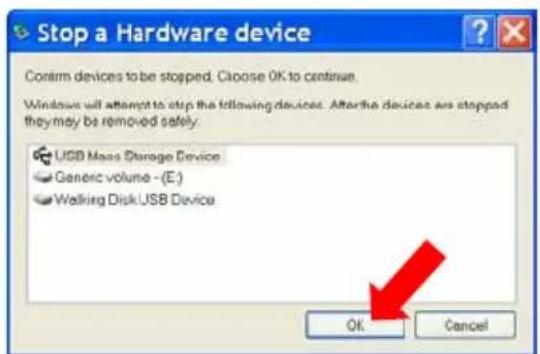
text_image
Stop a Hardware device Confirm devices to be stopped. Choose OK to continue. Windows will attempt to stop the following devices. Afterthe devices are stopped they may be removed safely. USB Mass Storage Device Generic volume - (E:) Walking Disk USB Device OK CancelPrefácio
natural_image
Simple line drawing of a laptop computer with a clock icon (no text or symbols)text_image
BIOS SETUP UTILITY Main Advanced Security Boot Exit Market Name Model Name System Time [16:08:53] System Date [Wed 05/16/2007] ► Serial ATA [Not Detected] ► Primary IDE Master [ATAI/CDKOM] ► System Information Use [ENTER] to select + G-14. Use [+], [-] to configure system Date. ++ Select Screen ↓↑ Select Item +- Change Field Tab Select Field F1 General Help F10 Save and Exit ESC Exit V02.59(C) Copyright 1*85-2005, American Megatrends, Inc.Menu Main
| BIOS SETUP UTILITY | |||
| Main Advanced Security Boot Exit | |||
| Market Name Model Name | Use [ENTER] to select a field. | ||
| System Time System Date | [8:08:53] [Wed 05/16/2007] | Use [+], [-] to configure system Date. | |
| Serial ATA Primary IDE Master | [Not Detected] [ATAPICDKOM] | ||
| System Infomation | ←→ Select Screen ↓↑ Select Item +- Change Field Tab Select Field F1 General Help F10 Save and Exit ESC Exit | ||
| V02.59 (C) Copyright 1985-2005, American Megatrends, Inc. | |||
- Hora do sistema
♦ Serial ATA / Primary IDE Master
| BIOS SETUP UTILITY | |||
| Main | Advanced | Security | Boot Exit |
| Chipset Configuration | |||
| PowerNow | [Enabled] | ||
| C1F Support | [Disable] | ||
| Legacy USB Support | [Auto] | ||
| PCI Legacy Timer | [64] | ||
| Select Screen | |||
| Select Item | |||
| +- | Change Field | ||
| Tab | Select Field | ||
| F1 | General Help | ||
| F10 | Save and Exit | ||
| ESC | Exit | ||
PowerNow
| BIOS SETUP UTILITY | |
| Main Advanced Security Boot Exit | |
| Supervisor Password: Not Installed User Password: Not Installed Change Supervisor Password | Enable/disable the generation of ACPI _PPC, _PSS, and _FCT objects. ↔ Select Screen ↓↑ Select Item +- Change Field Tab Select Field F1 General Help F10 Save and Exit ESC Exit |
V02.59 (C) Copyright 1985-2005, American Megatrends, Inc.
text_image
BIOS SETUP UTILITY Main Advanced Security Boot Exit ► Boot Setting Configuration ► Boot Device Priority ↔ Select Screen ↓↑ Select Item +- Change Field Tab Select Field F1 General Help F10 Save and Exit ESC Exit V02.59 (C) Copyright 1985-2005, American Megatrends, Inc.text_image
BIOS SETUP UTILITY Main Advanced Security Boot Exit Exit & Save Changes Exit & Discard Changes Discard Changes Load Setup Defaults Exit System setup after saving the changes. F10 key can be used for this operation. ++ Select Screen +↑ Select Item +- Change Field Tab Select Field F1 General Help F10 Save and Exit ESC Exit V02.59(C)Copyright 1985-2005, American Megatrends, Inc.natural_image
Simple line drawing of a laptop computer with a clock icon (no text or symbols)natural_image
Simple line drawing of a laptop computer with a clock on the right side (no text or symbols)natural_image
Simple line drawing of a laptop computer with a clock on the right side (no text or symbols)Conectar e ligar a placa de TV
natural_image
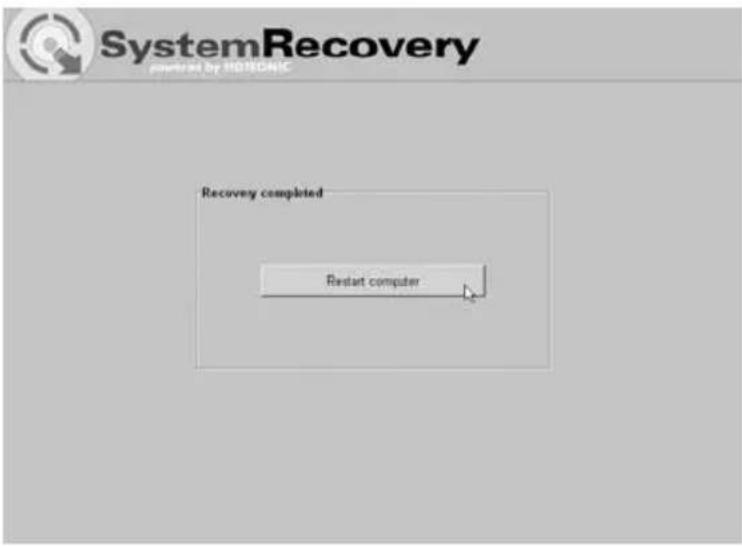
Simple line drawing of a laptop computer with a clock on the right side (no text or symbols)SystemRecovery powered by HTRONIC
SystemRecovery powered by HDTRONIC
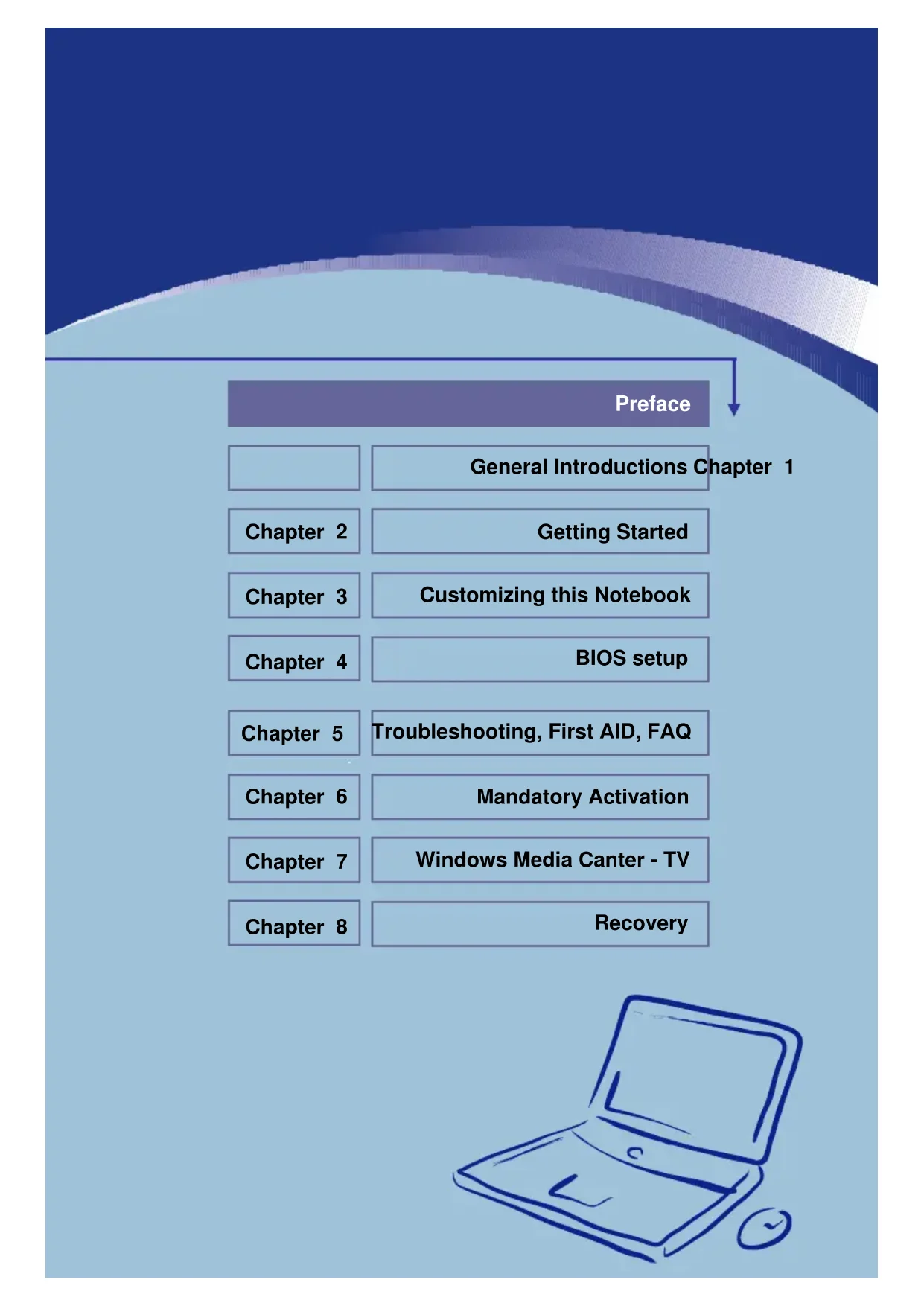
General Introductions Chapter 1
Chapter 2
Getting Started
Chapter 3
Customizing this Notebook
Chapter 4
BIOS setup
Chapter 5
Troubleshooting, First AID, FAQ
Chapter 6
Mandatory Activation
Chapter 7
Windows Media Canter - TV
Chapter 8
Recovery
natural_image
Simple line drawing of a laptop computer with a clock icon (no text or symbols)Regulations Information
FCC-B Radio Frequency Interference Statement
This equipment has been tested and found to comply with the limits for a Class B digital device, pursuant to part 15 of the FCC rules. These limits are designed to provide reasonable protection against harmful interference in a residential installation. This equipment generates, uses and can radiate radio frequency energy and, if not installed and used in accordance with the instructions, may cause harmful interference to radio communications. However, there is no guarantee that interference will not occur in a particular installation. If this equipment does cause harmful interference to radio or television reception, which can be determined by turning the equipment off and on, the user is encouraged to try to correct the interference by one or more of the following measures:
◆ Reorient or relocate the receiving antenna.
- Increase the separation between the equipment and receiver.
- Connect the equipment into an outlet on a circuit different from that to which the receiver is connected.
- Consult the dealer or an experienced radio TV technician for help.
NOTE
-
The changes or modifications not expressly approved by the party responsible for compliance could void the user's authority to operate the equipment.
-
Shield interface cables and AC power cord, if any must be used in order to comply with the emission limits.
FCC Conditions
This device complies with part 15 of the FCC Rules. Operation is subject to the following two conditions:
- This device may not cause harmful interference.
- This device must accept any interference received, including interference that may cause undesired operation.
Additional Safety Instructions for Devices with Wireless LAN
Your notebook features a Wireless LAN appliance. Therefore you must read and follow these safety instructions when working with your notebook:
- Turn the notebook off when traveling in an airplane or in a car.
- When you are in a hospital, a surgery area or near an electronic medical device, turn off the wireless adapter of your notebook! The RF signals may interfere with the functionality of the medical equipment.
- Place the notebook at least 20 cm (8 inch) away from pacemakers, as the RF signals may interfere with the functionality of the pacemaker.
- The transmitted RF signals can cause interference to hearing aids.
- Do not place the notebook with the wireless adapter turned on near flammable gas or in an explosion-sensitive area, as
the transmitted RF signals can cause explosions or fire.
- The range of the RF signals depend on the environmental conditions.
- When transmitting wireless data it is possible that unauthorized parties may receive data.
TARGA GmbH is not liable for any interference caused to RF or TV signals caused by unauthorized modification to this device. Furthermore, TARGA does not assume any liability for replacing any cables or devices that have not been specifically approved by TARGA GmbH. The user is solely responsible and liable for troubleshooting any interference caused by unauthorized modification of this device and for replacing any appliances.
CE Marking for Devices with Wireless LAN
This device complies with the Directive 1999/5/EC of the European Parliament and Council dated March 9, 1999 for radio and telecommunications equipment and has been proven to meet mutual immunity and conformity.
Safety
This notebook may be used in Belgium, Denmark, Germany, Finland, France, Greece, Great Britain, Ireland, Italy, Luxemburg, Netherlands, Austria, Portugal, Sweden, Switzerland, Spain, Iceland, Liechtenstein and Norway.
For information about possible operating restrictions, please contact the corresponding authority of the respective country.
If your country is not listed here, please contact the corresponding Regulation Authority in order to find out whether you may use this product in your country.
Restrictions
France
Restricted Frequency Band Only channels 10 to 11 (2,457
MHz and 2,462 MHz) may be used in France. Outdoor use of the device is not allowed.
Info: www.art-telecom.fr
Italy
A ministerial license is also required for indoor use. Contact your reseller for the required procedure. Outdoor use of the device is not allowed.
Info: www.agcom.it
Netherlands
A license is required for outdoor use. Contact your reseller for the required procedure.
Info: www.opta.nl
RF Frequencies for Wireless LAN Devices
For up-to-date information, please contact the corresponding authority of your country
(e.g. www.regtp.de).
Safety
Frequencies
According to the IEEE Standard 802.11b+g Wireless LAN adapters are designed for use on the ISM frequency band (Industrial, Scientific, Medical) between 2.4 and 2.4835 GHz. As each of the 11 available channels requires a DSSS (Direct Sequence Spread Spectrum) bandwidth of 22 MHz, a maximum of three independent channels are available (for instance, channels 3, 8, and 11). In the following table you'll find the channels that may be used in each country:
Channel MHz Europe, R&TTEFrance, R&TTE
| 1 | 2412 | X | |
| 2 | 2417 | X | |
| 3 | 2422 | X | |
| 4 | 2427 | X | |
| 5 | 2432 | X | |
| 6 | 2437 | X | |
| 7 | 2442 | X | |
| 8 | 2447 | X | |
| 9 | 2452 | X | |
| 10 | 2457 | X | X |
| 11 | 2462 | X | X |
Regulations – Exclusion of Liability
Exclusion of Liability for Wireless LAN Devices
Installing and operating wireless LAN devices must be in accordance with the instructions contained in the user documentation. This user documentation is contained in the
product package. Any modifications to the device that have not explicitly been approved by the manufacturer may void the operating authorization of the device. The manufacturer will not be liable for any interference in the reception of radio and TV signals resulting from unauthorized modifications on the device or from replacing or installing cables and accessories that have not been explicitly recommended by the manufacturer. It is the full responsibility of the user to troubleshoot any existing interference resulting from unauthorized modifications, or from replacing or installing components. Neither the manufacturer nor its authorized resellers or distributors are liable for any damage or violation of existing laws resulting from violating these Regulations.
This device is subject to the EMV-directive 2004/108/EC, and also the low voltage directive 2006/95/EC and fulfilled its requirements.
Safety Guideline for Using Lithium Battery
| (Danish) ADVARSEL! Lithiumbatteri --- Eksplosionsfare ved fejlagtighändtering. Udskiftning må kun ske med batteri af same fabrikat og type.Levé det brugte batteri tilbage til leverandøren. |
| (Deutsch) VORSICHT: Explosionsgefahr bei unsachgemäßem Austausch derBatterie. Ersatz nur durch denselben oder einen vom Hersteller empfohlenengleich-wertigen Typ. Entsorgung gebrauchter Batterien nach Angaben desHerstellers. |
| (English) CAUTION: Danger of explosion if battery is incorrectly replaced.Replace only with the same or equivalent type recommended by the equipmentmanufacturer. Discard used batteries according to manufacturer's instructions. |
| (Finnish) VAROITUS: Paristo voi räjähtää jos se on virheellisesti asennettu.Vaihda paristo ainoastaan valmistajan suosittelemaan tyyppiin. Hävitä käytettyparisto valmistajan ohjeiden mukaisesti. |
| (French) ATTENTION: Il y a danger d'ex;losion s'il y a remplacement incorrectde la batterie. Remplacer uniquement avec une batterie du meme type ou d'untype équivalent recommandé par le constructeur. Mettre au rebut les batteriesusages conformément aux instructions du fabricant. |
| (Norwegian) ADVARSEL: Eksplosjonsfare ved feilaktig skifte av batteri. Benyttsame batteritype eller en tilsvarende type anbefalt av apparatfabrikanten.Brukte batterier kasseres l henhold til fabrikantens instruksjoner. |
| (Swedish) WARNING: Explosionsfara vid felaktigt batteribyte. Använd sammabatterityp eller en ekvivalent typ som rekommenderas av apparattillverkaren.Kassera använt batteri enligt fabrikantens instruction. |
Caution on Using Modem
- Never install telephone wiring during a lightning storm.
- Never install telephone jacks in wet locations unless the jack is specifically designed for wet locations.
- Never touch uninsulated telephone wires or terminals unless the telephone line has been disconnected at the network interface.
- Use caution when installing or modifying telephone lines.
- Avoid using the telephone function (other than a cordless type) during an electrical storm. There may be a remote risk of electric shock from lightning.
- Do not use the telephone function to report a gas leak in the vicinity of the leak.
Optical Device Drive Notice
CAUTION: This appliance contains a laser system and is classified as a "CLASS 1 LASER PRODUCT." To use this model properly, read the instruction manual carefully and keep this manual for your future reference. In case of any trouble with this model, please contact your nearest "AUTHORIZED service station." To prevent direct exposure to the laser beam, do not try to open the enclosure.
Macrovision Notice
This product incorporates copyright protection technology that is protected by U.S. patents and other intellectual property rights. Use of this copyright protection technology must be authorized by Macrovision, and is intended for home and other limited viewing uses only unless otherwise authorized by Macrovision. Reverse engineering or disassembly is prohibited.
Safety Instructions
- Read the safety instructions carefully and thoroughly.
- Save this User Guide for possible use later.
- Keep this equipment away from humidity and high temperature.
- Lay this equipment on a stable surface before setting it up.
- The openings on the enclosure are used for air convection and to prevent the equipment from overheating. Do not cover the openings.
- Make sure that the power voltage is within its safety range and has been adjusted properly to the value of 100\~240V before connecting the equipment to the power inlet.
- Place the power cord in a way that people are unlikely to step on it. Do not place anything on the power cord.
- Always unplug the power cord before inserting any add-on card or module.
- All cautions and warnings on the equipment should be noted.
-
If any of the following situations arises, get the equipment checked by a service personnel:
-
The power cord or plug is damaged.
- Liquid has penetrated into the equipment.
- The equipment has been exposed to moisture.
- The equipment has not worked well or you can not get it work according to User's Manual.
- The equipment was dropped and damaged.
-
The equipment has obvious signs of breakage.
-
Never pour any liquid into the opening that could damage the equipment or cause an electrical shock.
-
Do not leave the equipment in an unconditioned environment with a storage temperature of 60^ C ( 140^ F) or above, which may damage the equipment.
-
To prevent explosion caused by improper battery replacement, use the same or equivalent type of battery recommended by the manufacturer only.
-
When install the coaxial cable to the TV Tuner, it is necessary to ensure that the metal shield is reliable connected to protective earthing system of the building.

廢電池請回收
For better environmental protection, waste batteries should be collected separately for recycling or special disposal.
WEEE Statement
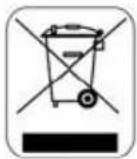
(English) Under the European Union ("EU") Directive on Waste Electrical and Electronic Equipment, Directive 2002/96/EC, which takes effect on August 13, 2005, products of "electrical and electronic equipment" cannot be discarded as municipal waste anymore and manufacturers of covered electronic equipment will be obligated to take back such products at the end of their useful life.
All trademarks are the properties of their respective owners.
- Microsoft is a registered trademark of Microsoft Corporation.
Windows® 98/ME, 2000/XP, Vista are registered trademarks of Microsoft Corporation.
♦ AMI ^® is a registered trademark of American Megatrends Inc. - PCMCIA and CardBus are registered trademarks of the Personal Computer Memory Card International Association.
The adress of the mouse supplier (Model: Logitech M-UAG120) is:
Logitech Europe S:A.
West Point Business Park, Link Road
Ballincollig Co.Cork, Ireland
Release History
| Version Revision Note Date | |
| 1.0 First Release 12, 2007 |
Table of Content
Preface
Regulations Information......II
FCC-B Radio Frequency Interference Statement ....II
FCC Conditions....III
Additional Safety Instructions for Devices with Wireless LAN....III
Safety Guideline for Using Lithium Battery...... VIII
Caution on Using Modem....IX
Optical Device Drive Notice.... IX
Macrovision Notice ....X
Safety Instructions....X
WEEE Statement.... XII
Trademarks ...... XV
Release History...... XV
Introductions
How to Use This Manual....1-2
Unpacking 1-4
Getting Started
Specification 2-2
Product View 2-6
Top-open View 2-6
Front View....2-10
Right-side View.... 2-11
Left-side View 2-13
Rear View 2-14
Bottom View....2-15
Power Management 2-16
AC Adapter 2-16
Battery Pack 2-17
Using the Battery Pack....2-20
Basic Operations ......2-23
Safety and Comfort Tips....2-23
Have a Good Work Habit 2-24
Knowing the Keyboard....2-25
Knowing the Touchpad....2-27
About Hard Disk Drive....2-30
Using the Optical Storage 2-31
Customizing this Notebook
Connecting the External Devices....3-2
Connecting the Peripheral Devices 3-3
Connecting the Communication Devices....3-6
Express Card Installation ....3-7
Installing the Express card ....3-7
Removing the Express card....3-7
Safely Remove Hardware ....3-8
BIOS Setup
About BIOS Setup....4-2
When to Use BIOS Setup....4-2
How to Run BIOS Setup 4-2
Control Keys 4-3
BIOS Setup Menu....4-4
Main menu....4-5
Advanced menu....4-7
Security menu....4-9
Boot menu 4-11
Exit menu....4-12
Troubleshooting, First Aid and FAQ
Troubleshooting, First Aid and FAQ....5-2
Troubleshooting 5-3
FAQ-Frequently asked questions 5-6
Mandatory Activation
Mandatory Activation....6-2
Windows Media Center – Initial Setup
Connect the TV card ....7-2
General Settings....7-3
Setting up TV reception 7-5
Setting Up Loudspeakers 7-8
Watching TV on your notebook....7-10
System Recovery
Restoring the System by Using the System Recovery Software....8-2
Preface
Chapter 1 General Introductions
Chapter 2
Getting Started
Chapter 3
Customizing this Notebook
Chapter 4
BIOS setup
Chapter 5
Troubleshooting, First AID, FAQ
Chapter 6
Mandatory Activation
Chapter 7
Windows Media Canter - TV
Chapter 8
Recovery
natural_image
Simple line drawing of a laptop computer with a clock icon (no text or symbols)Congratulations on becoming a new user of this notebook, the finely designed notebook. This brand-new exquisite notebook will give you a delightful and professional experience in using notebook. We are proud to tell our users that this notebook is thoroughly tested and certified by our reputation for unsurpassed dependability and customer satisfaction.
How to Use This Manual
This User's Manual provides instructions and illustrations on how to operate this notebook. It is recommended to read this manual carefully before using this notebook.
Chapter 1, General Introductions, includes the descriptions of all the accessories of this notebook. It is recommended to check out that if you have all the accessories included when you open the packing box. If any item is damaged or missing, please contact the vendor where you purchased this notebook.
Chapter 2, Getting Started, provides the specification of this notebook, and introduces the function buttons, quick launch buttons, connectors, LEDs and externals of this notebook. Also, this chapter instructs the correct procedure of installing or uninstalling the battery pack, and the brief ideas on how to use this notebook.
Chapter 3, Customizing this Notebook, gives instructions not only in connecting the mouse, keyboard, printer, external monitor, IEEE 1394 devices, and communication devices, but also in installing and removing the PC card.
Chapter 4, BIOS setup, provides information on BIOS Setup program and allows you to configure the system for optimum use.
Chapter 5, Troubleshooting, First AID and FAQ, provides information about complications with your Notebook and answers you the most common technical questions.
Chapter 6, Mandatory Activation, helps you to activate your Windows Vista.
Chapter 7, Windows Media Center - TV, helps you to install your TV-Card and to work with Windows Media Center.
Chapter 8, Recovery, explains you how to recover your system - to bring it to the condition of the beginning.
Unpacking
First, unpack the shipping carton and check all items carefully. If any item contained is damaged or missing, please contact your local dealer immediately.
Also, keep the box and packing materials in case you need to ship the unit in the future.
The package should contain the following items:
- Notebook
- User's Manual or Quick Start Guide
- All-in-one application disk, containing the drivers, utilities and recovery function.
◆ High-capacity Li-ion battery pack - AC adapter and power cord
- Phone cable/Phone jack
- Notebook carry bag
- HDMI – DVI Adapter
- Logitech mini USB-mouse
- Antenne and adapter
◆ Remote control inclusive adapter
These accessories listed above may change without notice.
Preface
General Introductions Chapter 1
Chapter 2
Getting Started
Chapter 3
Customizing this Notebook
Chapter 4
BIOS setup
Chapter 5
Troubleshooting, First AID, FAQ
Chapter 6
Mandatory Activation
Chapter 7
Windows Media Canter - TV
Chapter 8
Recovery
natural_image
Simple line drawing of a laptop computer with a clock icon (no text or symbols)Specification
| Physical Characteristic | |
| Dimension 358 (W) x 259 (D) x 27~33 (H) mm | |
| Weight 2.9 kg | |
| CPU | |
| Processor Type Socket S1 (638-pin, μPGA) | |
| Support Processor | Turion 64 bit Taylor Processor, dual core 35W (version F/G) |
| L1 Cache 64KB | |
| L2 Cache 512k/1M | |
| FSB Speed 800MHz | |
| Core Chips | |
| North Bridge ATI RXS690 | |
| South Bridge ATI SB600 | |
| Memory | |
| Technology DDRII 533/ 667/ 800 | |
| Memory | DDRII SO-DIMM X 2 slot256/ 512/ 1024/ 2048 MB |
| Maximum 4GB (2GB DDRII SO-DIMM x 2) | |
| Power | |
| AC Adapter 90W, 19 Volt KSAFK1900474T1M2 | |
| Battery Type 9 cells (Li-Ion) | BTY-M65 10.8 Vdc 7200mAh |
| RTC Battery Yes | |
Storage
| HDD form factor | 2.5" 9.5mm High250 GB (5400 rpm) |
| Optical Device | DVD ComboDVD dualSuper Multi(Devices listed here may vary without notice) |
I/O Port
| Monitor VGA x 1 | |
| HDMI x 1 | |
| USB x 4 (USB version 2.0) | |
| Headphone Out x 1 (shared with SPDIF) | |
| Mic-in x 1 | |
| Line-in x 1 | |
| RJ11 x 1 | |
| RJ45 x 1 | |
| IEEE1394 x 1 | |
| TV-Out x 1 (S-Video) | |
| TV x 1 | |
| Card Reader x 1 (SD/ MMC/ MS/ XD/ SM) | |
Communication Port
| 56K Fax/MODEM Support | |
| LAN | 10/100/1000 Ethernet |
| Wake on LAN | Yes |
| LAN Boot Yes | |
| Bluetooth MS-6837D | |
| Wireless Lan 802.11 b/g | |
| Express Card | |
| Slot Express Card Slot 34/54 x 1 | |
| Display | |
| LCD Type 15.4" WXGA non-glare | |
| Brightness Brightness controlled by K/B hot-keys | |
| Video | |
| Graphics(UMA) ATI HD2600 | |
| VRAM 256MB GDDR3 | |
| LCD 1280 x 800 WXGA | |
| Dual View Function | LCD or CRT will be auto detected when connected. |
| CRT | 640 x 480, max. 32bit color800 x 600, max. 32bit color1024 x 768, max. 32bit color1152 x 768, max. 32bit color1400 x 1050, max. 32bit color1600 x 1200, max. 32bit color1800 x 1440, max. 32bit color |
| Audio | |
| Sound Codec chip | HD audio support |
| Internal Speaker | 2 Speakers with housing |
| Sound Volume Adjust by volume button, K/B hot-key & SW |
| Software & BIOS |
| USB Flash Boot Yes, USB floppy boot up DOS only |
| BIOS Fast Boot Support --- Yes |
| Others |
| Kensington Lock Yes |
| Compliance WHQL --- PC2001 |
Product Overview
This section provides the description of basic aspects of your notebook. It will help you to know more about the appearance of this notebook before using it.
Top-open View
Press the Cover Latch to open the top cover (LCD Panel). The figure of top-open view and description showing below will lead you to browse the main operating area of your notebook.
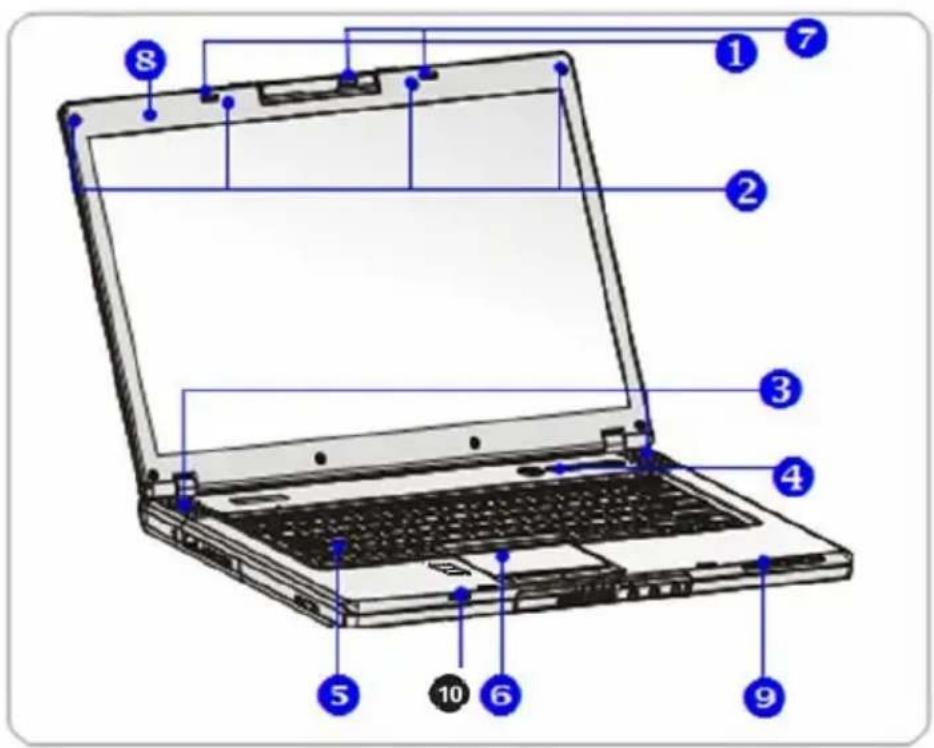
text_image
Laptop diagram with numbered annotations pointing to key components1. Cover Latch (Internal View)
It is a bounce-back device to lock the cover with the deck when closing your Notebook PC.
2. Rubber Pads
Protect your Notebook PC from random closing.
3. Stereo Speakers
Make high quality sound blaster with stereo system and Hi-Fi function supported.
4. Quick Launch Buttons and Power Button
 | Power Button: Turn the notebook power ON and OFF. |
| Quick Launch Buttons:Simply click the quick launch buttons to speed up the starting of the programs in common use. It helps you to do works more efficiently.Note: These Quick Launch Buttons will only work when the supplied preload disk is installed. | |
 WI-FI WI-FI | Press the WI-FI Quick Launch Button to enable/disable the WI-FI application. |
 Bluetooth Bluetooth | Press the Bluetooth Quick Launch Button to enable/disable the Bluetooth application. |
 IE Explorer IE Explorer | Press the Internet Quick Launch Button to activate the IE Explorer browser. |
 Media Center Media Center | Press the Media Center Quick Launch Button to activate the Windows Media Center application. |
 E-mail E-mail | Press the E-mail Quick Launch Button to launch the E-mail application. |
 Snap Shot Snap Shot | Press the Snap Shot Launch Button to take a picture from camera. |
5. Keyboard
The built-in keyboard provides all the functions of a full-sized (US-defined) keyboard.
6. Touchpad
Pointing device of the computer.
7. Webcam Power Button
Press this power button to enable / disable the Webcam function.
8. Internal Microphone
There is built-in microphone and its function is the same with microphone.
9. Status LED
 | Hard Disk In-use: Blinking Blue when the notebook is accessing the hard disk drive. |
 | Num Lock: Glowing Blue when the Num Lock function is activated. |
 | Caps Lock: Glowing Blue when the Caps Lock function is activated. |
 | Scroll Lock: Glowing Blue when the Scroll Lock function is activated. |
 | Power On / OFF / StandbyBlinking Blue when the system is in suspend mode.Glowing Blue when the system is activated.LED goes out when the system is turned off. |
 | Battery StatusGlowing Green when the battery is being charged.Glowing Orange when the battery is in low battery status.Blinking Orange if the battery fails and it is recommended to replace with a new battery. |
 | Wireless LAN and BluetoothGlowing Green when wireless LAN function is enabled.Glowing Blue when Bluetooth function is enabled.Glowing light blue at the same time when Wireless LAN and Bluetooth function are both enabled. |
10. Finger Print
Secure device of computer
Front View
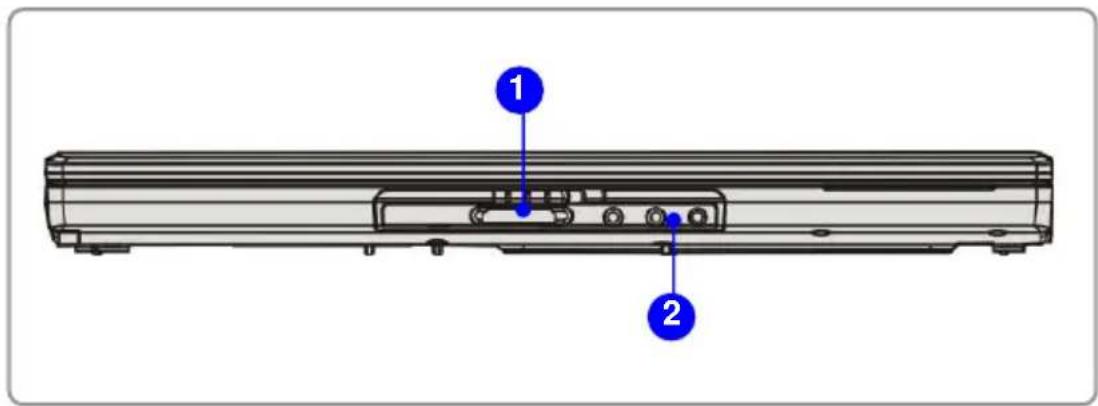
text_image
Diagram of a rear panel with labeled components, showing numbered parts 1 and 2.1. Card Reader
The built-in card reader supports MMC (Multi-media Card), SD (Secure Digital), MS (Memory Stick)、XD (eXtreme Digital), and SM (SmartMedia) cards。
2. Audio Port Connectors
Make high quality sound blaster with stereo system and Hi-Fi function supported.
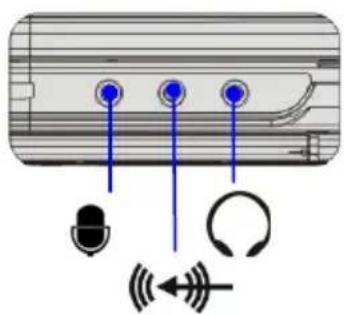 | [40WY] | Microphone: Used for an external microphone. (5.1 Center) |
 | Line In: Used for an external audio device. (5.1 Rear) | |
| [2YTB] | Line Out: A connector for speakers or headphones. (5.1 Front) |
Right-side View
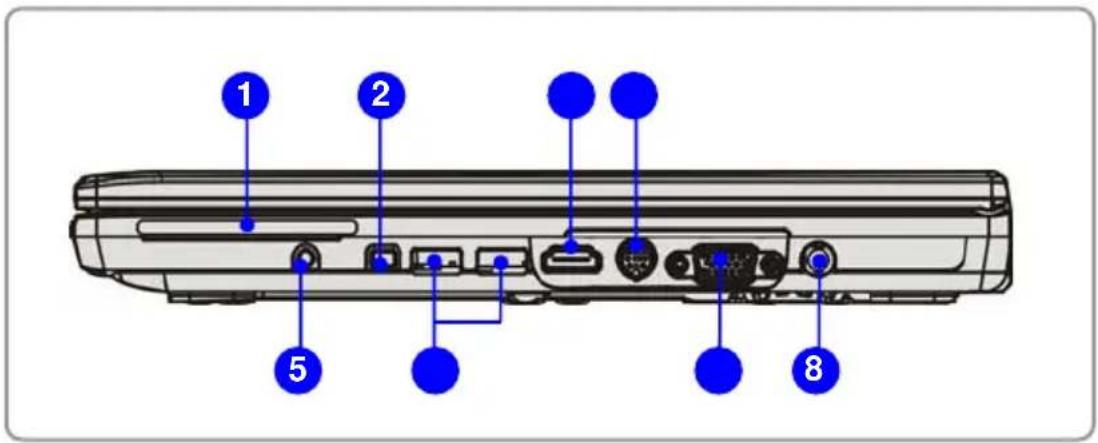
text_image
1 2 5 81. Express Card Slot
The computer provides an Express Card slot. The new Express Card interface is smaller and faster than PC Card interface. The Express Card technology takes advantage of the scalable, high-bandwidth serial PCI Express and USB 2.0 interfaces.
2. IEEE 1394
The IEEE 1394 port is a high-speed bus that allows you to connect high-end digital devices such as the DV (digital video camera).
3. HDMI Connector
HDMI (High Definition Multimedia Interface Support) is a new interface standard for PCs, displays and consumer electronics devices that supports standard, enhanced and high-definition video, plus multi-channel digital audio on a single cable. It enables your PC to transmit all HDTV standards that combine HDCP-protected video at resolutions up to 1080p and 8-channel digital audio with 5 Gbps of bandwidth provided.
4. S-Video Connector
By using a Super VHS (S-Video) cable, this connector allows you to connect a television (NTSC/PAL system) to use as a computer display.
5. TV-Tuner Connector (DVB-T)
This notebook provides you with a high quality TV viewing experience via the TV-Tuner Connector.
6. USB Port
The USB 2.0 port allows you to connect USB-interface peripheral devices, such as the mouse, keyboard, modem, portable hard disk module, printer and more.
7. VGA Port
The 15-pin-D-sub VGA port allows you to connect an external monitor or other standard VGA-compatible device (such as a projector) for a great view of the computer display.
8. Power Connector
To connect the AC adapter and supply power for the notebook.
Left-side View
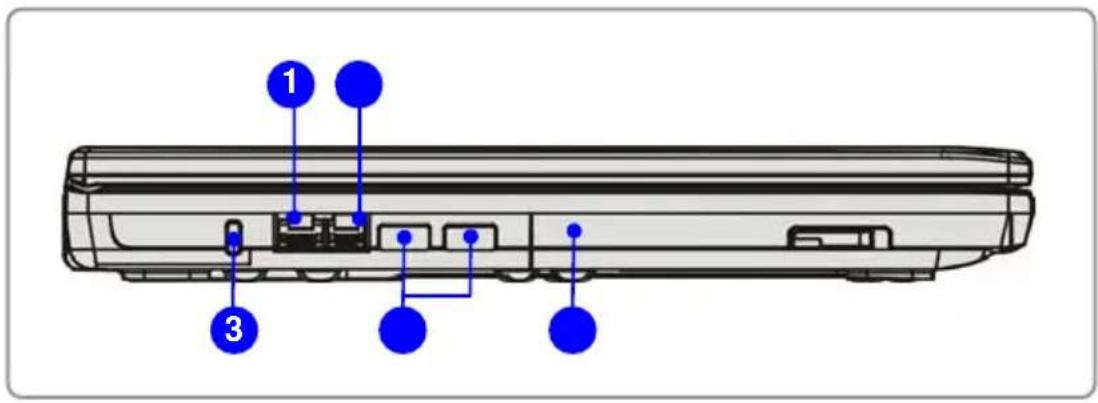
text_image
Diagram of a rear panel with numbered annotations pointing to internal components1. RJ-45 Connector
The 10/100/1000 Ethernet connector is used to connect a LAN cable for network connection.
2. RJ-11 Connector
The computer provides a built-in modem that allows you to connect an FJ-11 telephone line through this connector. With the 56K V.90 modem, you can make a dial-up connection.
3. Kensington Lock
This port is used to lock the computer to location for security.
4. USB Port
The USB 2.0 port allows you to connect USB-interface peripheral devices.
5. Optical Device Drive
A slim DVD Multi (DVD Dual and DVD RAM) drive is available in the computer, depending on the model you purchased. The optical device allows you to use the CD/DVD disc for installing software, accessing data and playing music/movie on the computer
Rear View
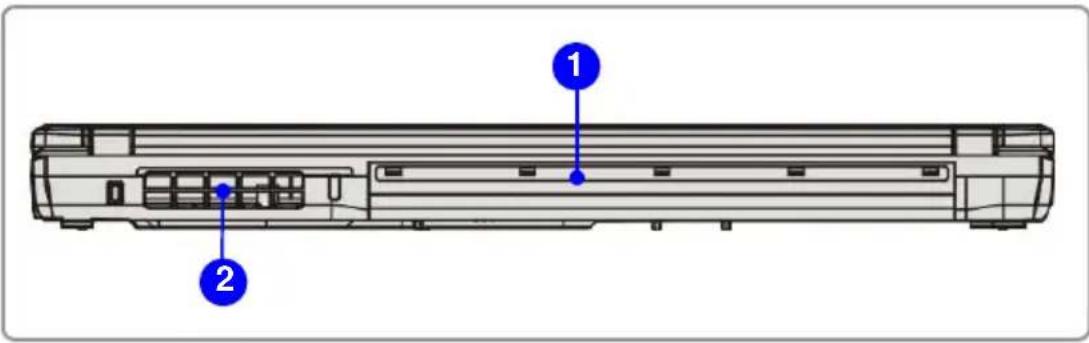
text_image
Technical diagram of a vehicle rear panel with labeled components 1 and 21. Battery Pack (Rear View)
This notebook will be powered by the battery pack when the AC adapter is disconnected.
2. Ventilator
The ventilator is designed to cool the system. DO NOT block the ventilator for air circulation.
Bottom View
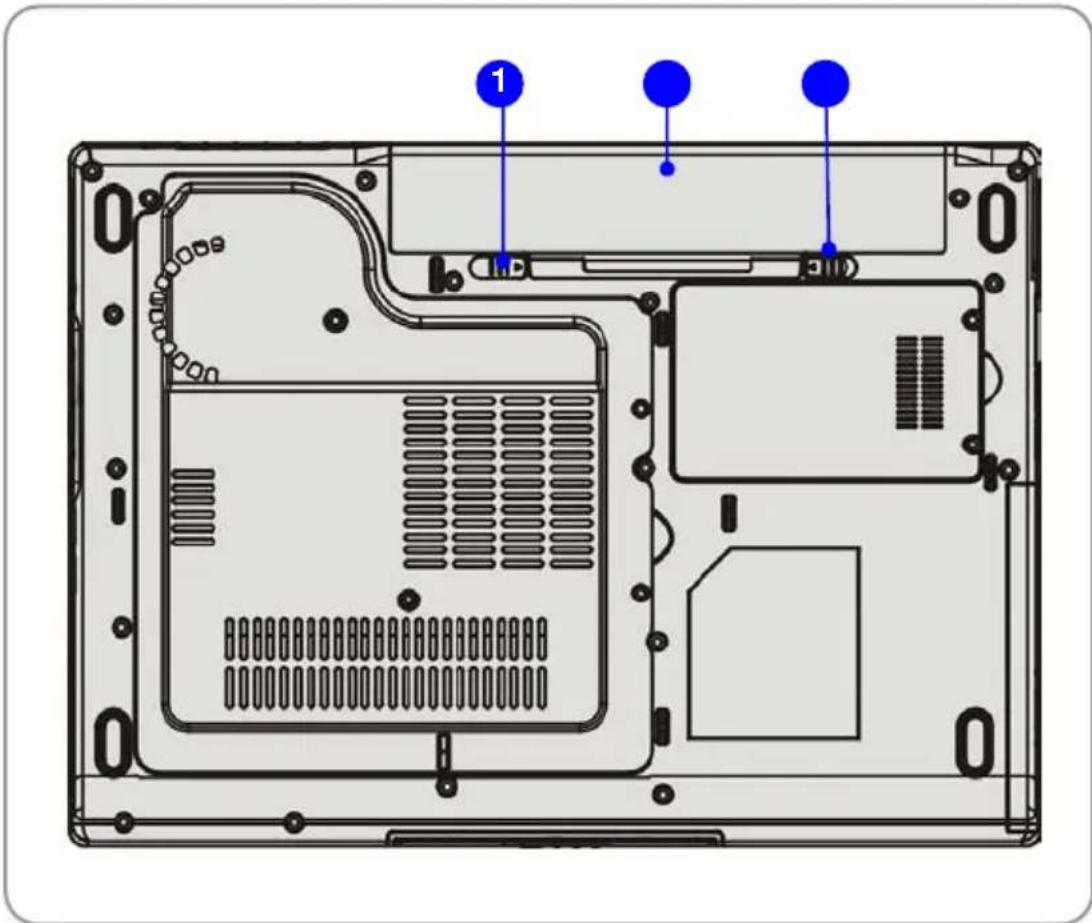
text_image
Laptop internal components diagram with numbered annotations pointing to specific areas1. Battery Lock/Unlock Button
Battery cannot be moved when the button is positioned on lock status. Once the button is pushed to unlock position, the battery is removable.
2. Battery Release Button
It is a bounce-back device as a preparation for releasing the battery pack. Press it with one hand and pull the battery pack carefully with the other.
3. Battery Pack
This notebook will be powered by the battery pack when the AC adapter is disconnected.
Power Management
AC Adapter
Please be noted that it is strongly recommended to connect the AC adapter and use the AC power while using this notebook for the first time. When the AC adapter is connected, the battery is being charged immediately.
NOTE that the AC adapter included in the package is approved for your notebook; using other adapter model may damage the notebook or other devices on the notebook.
Connecting the AC Power
- Unpack the package to find the AC adapter and power cord.
- Attach the power cord to the connector of the AC adapter.
- Plug the DC end of the adapter to the notebook, and the male end of the power cord to the electrical outlet.
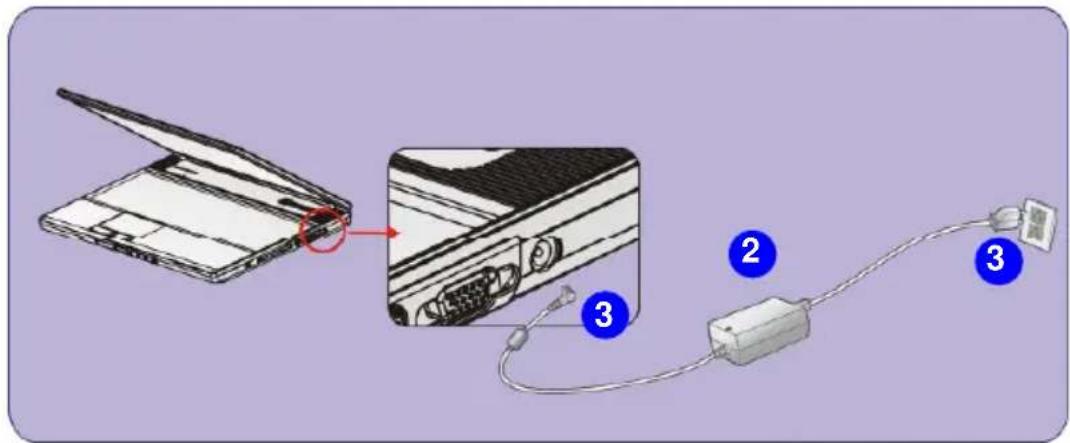
text_image
Diagram showing a device being connected to a cable via three labeled components, with a magnified view highlighting the connector.Disconnecting the AC Power
When you disconnect the AC adapter, you should:
-
Unplug the power cord from the electrical outlet first.
-
Unplug the connector from the notebook.
-
Disconnect the power cord and the connector of AC adapter.
-
When unplugging the power cord, always hold the connector part of the cord. Never pull the cord directly!
Battery Pack
This notebook is equipped with a high-capacity Li-ion Battery pack. The rechargeable Li-ion battery pack is an internal power source of the notebook.
Releasing the Battery Pack
It is recommended to have an extra battery in reserve to avoid this notebook from lacking of power supply. Please contact your local dealer for standard battery pack.
To remove the battery pack - see picture on site 2-18:
- Make sure the Notebook is turned off.
- Check the Lock/Unlock button is in unlocked status.
- Locate the Battery Release Button on the bottom side.
- Push the Release Button to the direction of arrow showing below the button.
- Slide the left side of the battery pack first out of the compartment and then pull the right side of the battery pack.
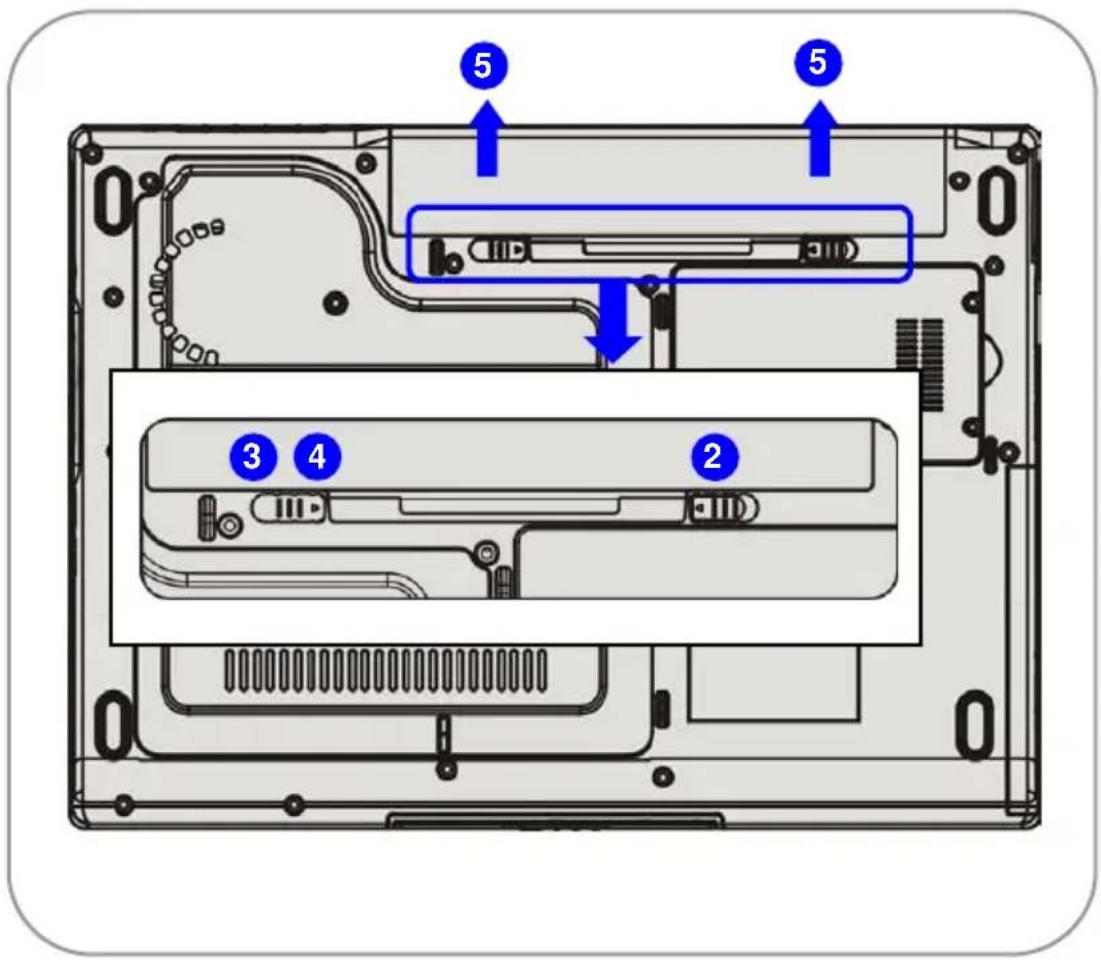
text_image
Diagram of an internal computer case with numbered components and blue arrows indicating assembly or status.Replacing the Battery Pack (see picture on site 2-19)
- Insert the right side of battery pack into the compartment.
- Slightly slide and press the battery pack into the right place.
- After the right side of the battery pack fitting the right track, then slightly press the left side of battery pack into the battery chamber.
- Make sure the Lock/Unlock Button is in lock position.
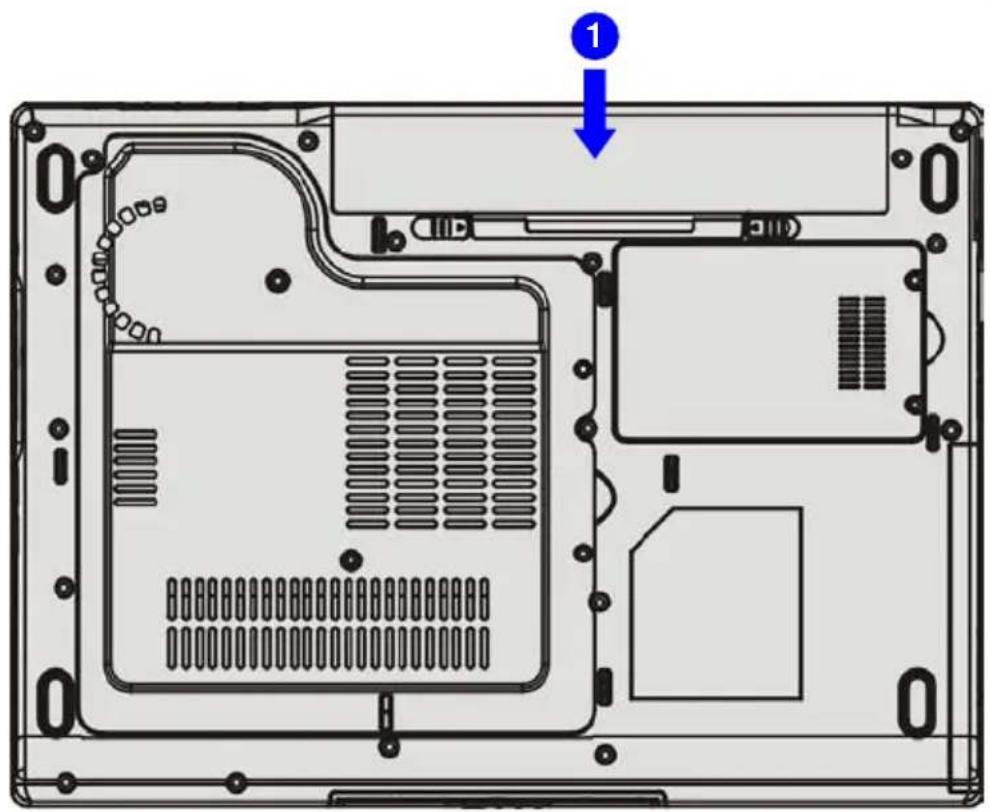
natural_image
Diagram of a computer chassis showing internal components and ventilation slots (no text or labels)info
Warning
- Do not try to disassemble THE BATTERY PACK.
- Please follow your local laws and regulations to recycle the used battery pack.
Using the Battery Pack
Battery Safety Tips
Replacing or handling the battery incorrectly may present a risk of fire or explosion, which could cause serious injury.
- Only replace the main battery pack with the same or equivalent type of battery.
- Do not disassemble, short-circuit or incinerate batteries or store them to temperatures above +60°C (+140°F).
- Do not temper with batteries. Keep them away from children.
- Do not use rusty or damaged batteries.
- Dispose of batteries according to local regulations. Check with your local solid waste officials for details about recycling options or for proper disposal in your area.
Conserving Battery Power
Efficient battery power is critical to maintain a normal operation. If the battery power is not managed well, the saved data and customized settings may be lost.
Follow these tips to help optimizing battery life and avoid a sudden power loss.
- Suspend system operation if the system will be idle for a while or shorten the Suspend Timer's time period.
- Turn off the system if you won't be using it for a period of time.
- Disable unneeded settings or remove idle peripherals to conserve power.
- Connect an AC adapter to the system whenever possible.
Charging the Battery Pack Properly
Your notebook computer features a powerful, rechargeable Li-Ion battery pack. Normally, a fully charged battery delivers approx. 2 to 3 hours of battery operation for your notebook. It is very important that you enable the Power Management features under Windows Vista for careful management of power consumption. The endurance will vary depending on the different notebook configurations as well as work habits. A very bright display, lots of hard disk access using the DVD drive as well as an extensive use of the WLAN adapter will increase power consumption and therefore reduce battery endurance.
-
To charge the battery, connect the power adapter to the notebook and to a wall outlet. During the charging process, the battery indicator (LED) located next to the status indicators (LEDs) will light up. If the notebook is turned off, an empty battery will take approx. 3 hours to become fully charged. The charging time will be longer if the notebook is turned on and being used. It is normal that the battery becomes warm during the charging process.
-
The battery will develop its full capacity after completing 20 charging and discharging cycles without performing any quick charging.
-
In order to maintain its full capacity, it is recommended that you fully discharge the battery from time to time. To do so, disconnect the power adapter and keep your notebook turned on until it automatically toggles to the Standby mode. Then reconnect the power adapter in order to recharge the battery.
-
As a rule the battery capacity will reduce to approx. 85% after performing 500 charging cycles.
-
Never leave the battery unused for a long period of time. All batteries are subject to self-discharge. Storing the battery for a long time may cause a low discharge status that could damage the battery. Make sure that you charge the battery from time to time (approx. every 4 weeks).
- While charging, never exposure the battery to high temperatures (higher than 45^ C or 113^ F ).
Basic Operations
If you are a beginner to the Notebook, please read the following tips to make yourself safe and comfortable during the operations.
Safety and Comfort Tips
The Notebook is a portable platform that allows you to work anywhere.
However, choosing a good workspace is important if you have to work with your Notebook for long periods of time.
- Your work area should have enough illumination.
- Choose the proper desk and chair and adjust their height to fit your posture when operating.
- When sitting on the chair adjust the chair's back (if available) to support your back comfortably.
- Place your feet flat and naturally on the floor, so that your knees and elbows have the proper position (about 90-degree) when operating.
- Put your hands on the desk naturally to support your wrists.
- Adjust the angle/position of the LCD panel, so that you can have the optimal view.
- Avoid using your Notebook in the space where may cause your discomfort (such as on the bed).
- The Notebook is an electrical device, please treat it with great care to avoid personal injury.
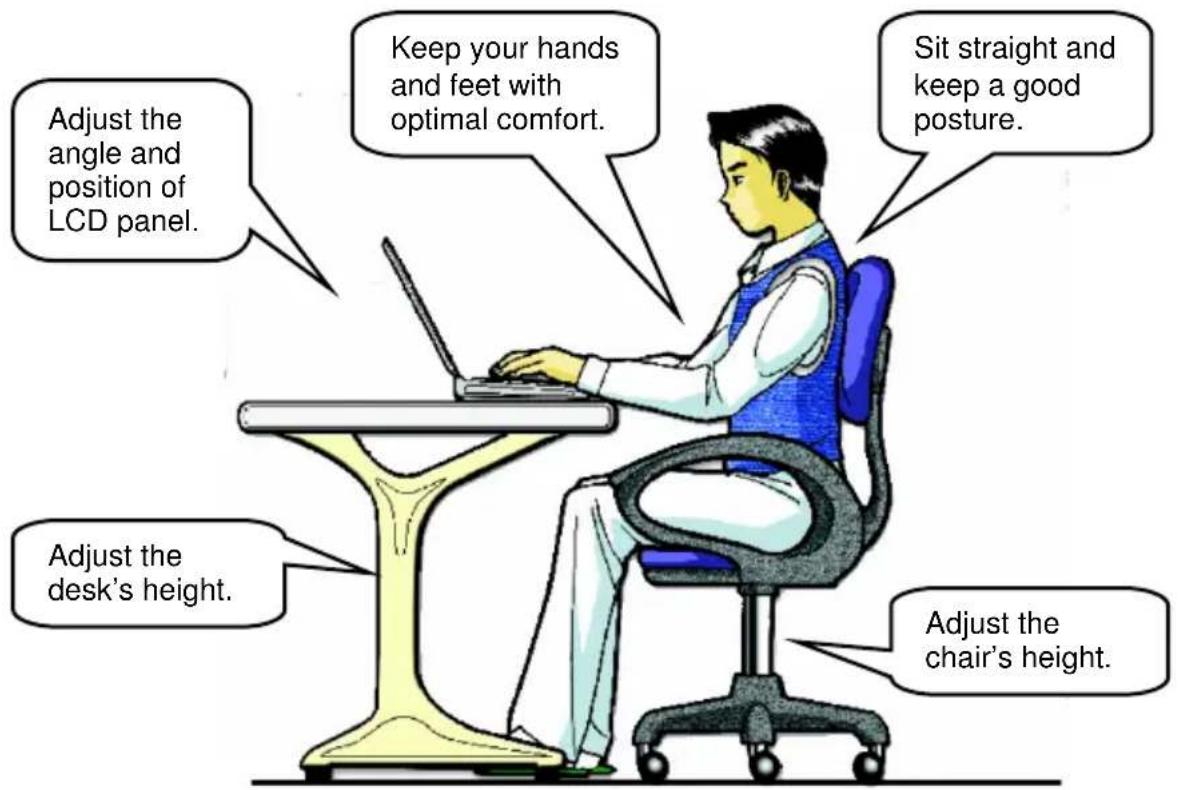
text_image
Adjust the angle and position of LCD panel. Keep your hands and feet with optimal comfort. Sit straight and keep a good posture. Adjust the desk's height. Adjust the chair's height.Have a Good Work Habit
Have a good work habit is important if you have to work with your Notebook for long periods of time; otherwise, it may cause discomfort or injury to you. Please keep the following tips in mind when operating.
- Change your posture frequently.
- Stretch and exercise your body regularly.
- Remember to take breaks after working for a period of time.
Knowing the Keyboard
The Notebook's keyboard provides all the functions of a full-sized keyboard and an additional [Fn] key for specific functions on the Notebook. The keyboard can be divided into four categories: Typewriter keys, Cursor keys, Numeric keys and Function keys.
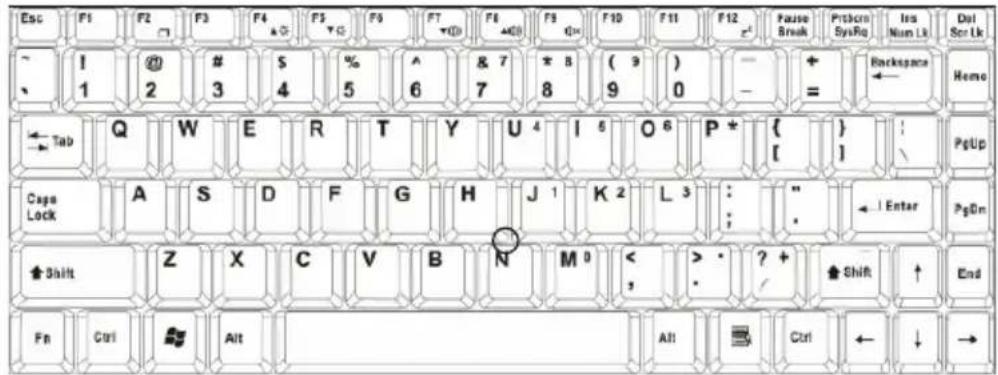
text_image
Esc F1 F2 F3 F4 F5 F6 F7 F8 F9 F10 F11 F12 Fase Break Ptricon SysRn Ins Num Lk Del Scr Lk ~ 1 @ # 5 % ^ & 7 * 8 ( 9 ) - + Backspace Hemo 、 1 2 3 4 5 6 7 8 9 0 - = ← Tab Q W E R T Y U 4 I 5 O 6 P { } ↓ Q W E R T Y U 4 I 5 O 6 P [ ] Cage Lock A S D F G H J 1 K 2 L 3 : " ← Enter PgOn Shift Z X C V B N M 0 < > ? + Shift ↑ End Fn Ctrl Alt Alt Ctrl ← ↓ →Function Keys
■ Windows Keys
You can find the Windows Logo key ( ) and one Application Logo key ( ) on the keyboard, which are used to perform Windows-specific functions, such as opening the Start menu and launching the shortcut menu. For more information of the two keys, please refer to your Windows manual or online help.
■ [Fn] Key
![TARGA Traveller 1526 - ■ [Fn] Key - 1](/content/2026/02/379739/images/f689810ecde23a801d4650dc0627284838288fa44734e586c54a1f993e9b1025.jpg) | Switch the display output mode between the LCD, external monitor and Both. |
![TARGA Traveller 1526 - ■ [Fn] Key - 2](/content/2026/02/379739/images/ce35b4cb31189d70236c0aeb49cfd18887e259a1a7f2a47e75cc068a370740aa.jpg) | Enable or disable the touchpad function. |
![TARGA Traveller 1526 - ■ [Fn] Key - 3](/content/2026/02/379739/images/adc60df6d2ee44f8660fe4b8497acc0edecba3d5b03fb5556cb289532498cfb8.jpg) | Increase the LCD brightness. |
![TARGA Traveller 1526 - ■ [Fn] Key - 4](/content/2026/02/379739/images/29456ccea7151b60e36781afb730e7a8c2162c193367c2c1fc1bcbc6c6b1450c.jpg) | Decrease the LCD brightness. |
![TARGA Traveller 1526 - ■ [Fn] Key - 5](/content/2026/02/379739/images/99a1bcf69fa2a26261be89d334bac4daf093c7a359d1b7a594776efcc65bc8f8.jpg) | Decrease the built-in speaker's volume. |
![TARGA Traveller 1526 - ■ [Fn] Key - 6](/content/2026/02/379739/images/e39a2c61191360997444914b6dcc435610dfff54258de2bc3890c1f7d5c918b6.jpg) | Increase the built-in speaker's volume. |
![TARGA Traveller 1526 - ■ [Fn] Key - 7](/content/2026/02/379739/images/70c7f45448ff820b25800113f5164e16ee4c0fcfc61251c0aeb577ff8adc5568.jpg) | Disable the computer's audio function. |
![TARGA Traveller 1526 - ■ [Fn] Key - 8](/content/2026/02/379739/images/ea89a9729d621108369e13f742f91ef3dccc2bd228c4e6be6d5e10264a1945c6.jpg) | Force the computer into suspend mode (depending on the system configuration). |
Knowing the Touchpad
The touchpad integrated in your Notebook is a pointing device that is compatible with standard mouse, allowing you to control the Notebook by pointing the location of the cursor on the screen and making selection with its two buttons.
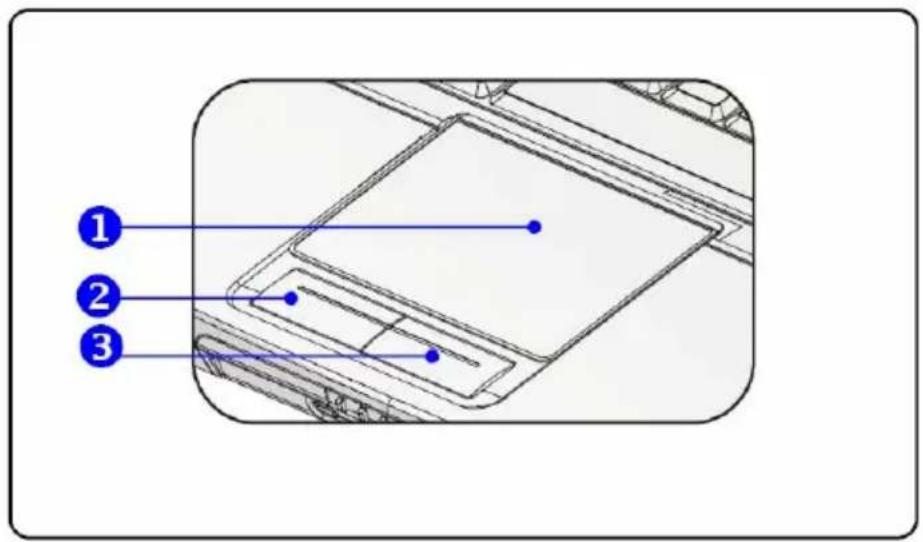
text_image
Technical diagram of a device with numbered annotations pointing to specific components1. Cursor Movement Area
This pressure-sensitive area of the touchpad, allows you to place your finger on it and control the cursor on the screen by moving your finger.
2. Left Button
Acts as the mouse's left button.
3. Right Button
Acts as the mouse's right button.
Using the Touchpad
Read the following description to learn how to use the touchpad:
■ Positioning and Moving
Place your finger on the touchpad (usually using the forefinger), and the rectangular pad will act as a miniature duplicate of your display. When you move your fingertip across the pad, the cursor on the screen will move simultaneously in the same direction. When your finger reaches the edge of the pad, lift your finger and replace it on a proper location of the touchpad.
■ Point and Click
When you have moved and placed the cursor over an icon, a menu item or a command that you want to execute, simply tap slightly on the touchpad or press the left button to select. This procedure, called as point and click is the basics of operating your Notebook. Unlike the traditional pointing device such as the mouse, the whole touchpad can act as a left button, so that your each tap on the touchpad is equivalent to pressing the left button. Tapping twice more rapidly on the touchpad is to execute a double-click.
■ Drag and Drop
You can move files or objects in your Notebook by using drag-and-drop. To do so, place the cursor on the desired item and slightly tap twice on the touchpad, and then keep your fingertip in contact with the touchpad on the second tap. Now, you can drag the selected item to the desired location by moving your finger on the touchpad, and then lift your finger from the
touchpad to drop the item into place. Alternately, you can press and hold the left button when you select an item, and then move your finger to the desired location; finally, release the left button to finish the drag-and-drop operation.
Using the Touchpad
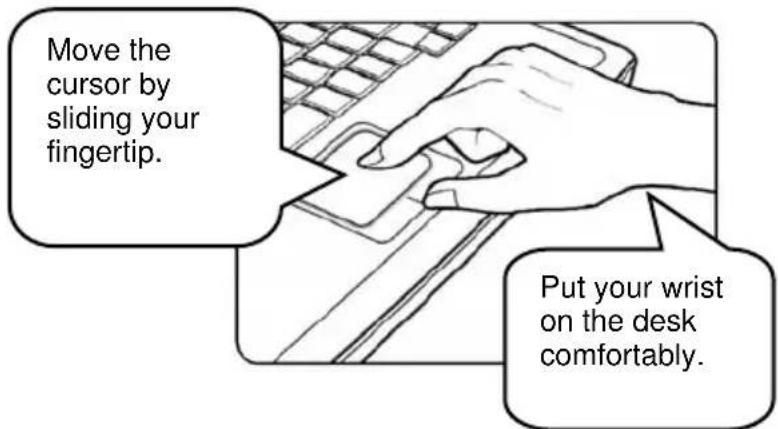
text_image
Move the cursor by sliding your fingertip. Put your wrist on the desk comfortably.■ Configuring the Touchpad
You can customize the pointing device to meet your personal needs. For example, if you are a left-hand user, you may want to swap the functions of the two buttons. In addition, you can change the size, shape, moving speed and other advanced features of the cursor on the screen.
To configure the touchpad, you can use the standard Microsoft or IBM PS/2 driver in your Windows operating system. The Mouse Properties in Control Panel allows you to change the configuration.
About Hard Disk Drive
Your Notebook is equipped with a 2.5-inch hard disk drive. The hard disk drive is a storage device with much higher speed and larger capacity than other storage devices, such as the floppy disk drive and optical storage devices. Therefore, it is usually used to install the operating system and software applications.
info
- To avoid unexpected data loss in your system, please backup your critical files regularly.
- Do not turn off the Notebook when the Hard Disk In-use LED is on.
- Do not remove or install the hard disk drive when the Notebook is turned on. The replacement of hard disk drive should be done by an authorized retailer or service representative.
Using the Optical Device
Your Notebook is equipped with an optical storage device. The actual device installed in your Notebook depends on the model you purchased.
■ DVD Combo Drive: This device allows you to read DVD and CD, and record CD format.
■ DVD Dual Drive: In addition to read DVD and CD, this device allows you to record CD format and both the -R/RW and +R/RW DVD formats.
■ DVD Multi: Works as a multi-functional DVD Dual Drive and a DVD RAM Drive.
■ Lightscribe: Allows users to have brief texts curved on the obverse side of the disks with the laser read/write head of the Optical Device Drive.
■ HD DVD: HD DVD (or High-Definition DVD) is a high-density optical disc format designed for the storage of data and high-definition video.
info
- The optical storage devices are classified as a Class 1 Laser products. Use of controls or adjustments or performance of procedures other than those specified here in may result in hazardous radiation exposure.
- Do not touch the lens inside the drive.
Inserting the Disk
The following instruction describes the general procedure when operating the optical storage device.
- Confirm that the Notebook is turned on.
-
Press the Eject Button on the drive's panel and the disk tray will slide out partially. Then, gently pull the tray out until fully extended.
-
Place your disk in the tray with its label facing up. Slightly press the center of the disk to secure it into place.
-
Push the tray back into the drive.
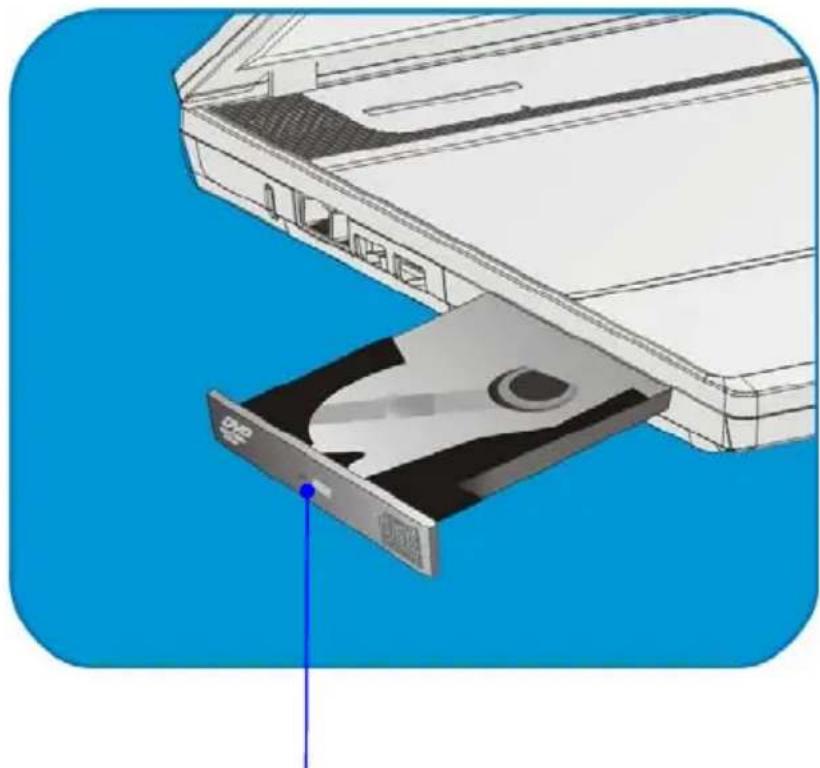
natural_image
3D illustration of a CD/DVD drive assembly with a blue indicator line (no text or symbols)Eject Button
Removing the Disk
- Press the Eject Button on the drive's panel and the disk tray will slide out partially. Then, gently pull the tray out until fully extended.
- Hold the disk by its edge with your fingers and lift it up from the tray.
- Push the tray back into the drive.
info
- Confirm that the disk is placed correctly and securely in the tray before closing the tray.
- Do not leave the disk tray open.
Preface
General Introductions Chapter 1
Chapter 2
Getting Started
Chapter 3
Customizing this Notebook
Chapter 4
BIOS setup
Chapter 5
Troubleshooting, First AID, FAQ
Chapter 6
Mandatory Activation
Chapter 7
Windows Media Canter - TV
Chapter 8
Recovery
natural_image
Simple line drawing of a laptop computer with a clock on the right side (no text or symbols)Connecting the External Devices
The I/O (input/output) ports on the Notebook allow you to connect peripheral devices.
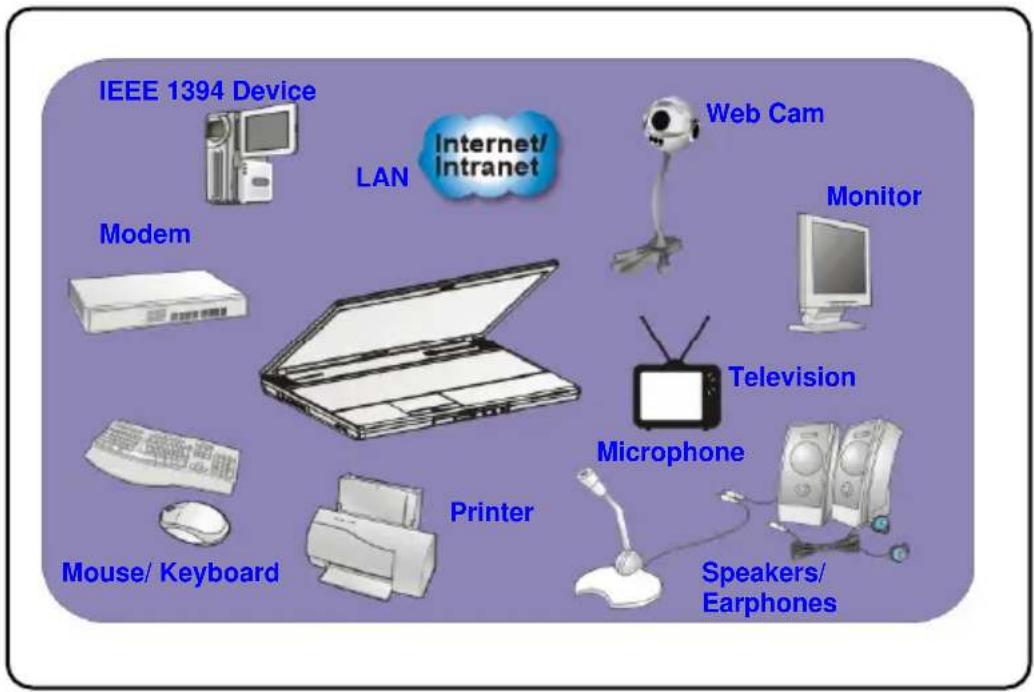
text_image
IEEE 1394 Device LAN Internet/ Intranet Web Cam Monitor Modem Television Microphone Printer Mouse/ Keyboard Speakers/ EarphonesConnecting the Peripheral Devices
Connecting the Mouse
You can connect a mouse to your Notebook through the PS/2 port or USB port. If there is no PS/2 port available on your Notebook, but you only have a mouse with PS/2 connector, please purchase a PS/2-USB connector first. To connect the mouse:
- Turn on the Notebook and install the mouse driver.
- Connect your mouse to the Notebook.
- The Notebook may auto detect your mouse driver and enable the mouse function. If there is no detection of your mouse you can manually enable the mouse by going to Start Menu → Control Panel → Add Hardware to add the new device.
Connecting the Keyboard
You can connect a keyboard to your Notebook through the PS/2 port or USB port. If there is no PS/2 port available on your Notebook, but you only have a keyboard with PS/2 connector, please purchase a PS/2-USB connector first. To connect the keyboard:
- Turn on the Notebook and install the keyboard driver.
- Connect your keyboard to the Notebook.
- The Notebook may auto detect your keyboard driver and enable the keyboard function. If there is no detection of your keyboard you can manually enable the keyboard by going to Start Menu→Control Panel→Add Hardware to add the new device.
Connecting the Printer
If your printer has a USB interface, you can then use the USB port on the Notebook to connect the printer. The following instruction describes the general procedure to connect a printer:
- Turn off the Notebook.
- Connect one end of the printer cable to the Notebook's USB port and the other end to the printer.
- Connect the power cord and turn on the printer.
- Turn on the Notebook and the system will detect a new device. Install the required driver.
For further instructions, please refer to your printer's manual.
Connecting the External Monitor or TV
You can connect an external monitor to your Notebook through the VGA port for a larger view with higher resolution. To connect the monitor:
- Make sure that the Notebook is turned off.
- Plug the monitor's D-type connector into the Notebook's VGA port.
- Connect the monitor's power cord and turn on the monitor.
- Turn on the Notebook and the monitor should respond by default. If not, you can switch the display mode by pressing [Fn]+[F2]. Alternately, you can change the display mode by configuring the settings in Display Properties of Windows operating system.
Connecting the IEEE 1394 devices
The IEEE 1394 port of your Notebook is a next-generation serial bus that features a high-speed transfer rate and the connection of up to 63 devices, allowing you to connect many high-end peripheral devices and consumer electronic appliances, such as the DV (digital video camera). The IEEE 1394 standard interface supports “plug-and-play” technology, so that you can connect and remove the IEEE 1394 devices without turning off the Notebook. To connect the IEEE 1394 device, simply connect the cable of the device to the IEEE 1394 port of your Notebook.
Connecting the Communication Devices
Using the LAN
The RJ-45 connector of the Notebook allows you to connect the LAN (local area network) devices, such as a hub, switch and gateway, to build a network connection. This built-in 10/100/1000 Base-T LAN module supports data transfer rate up to 1000Mbps.
For more instructions or detailed steps on connecting to the LAN, please ask your MIS staff or network manager for help.
Using the Modem
The built-in 56Kbps fax/data modem allows you to use a telephone line to communicate with others or to dial-up to connect the Internet.
For more instructions or detailed steps on dialing-up through the modem, please consult your MIS staff or Internet service provider (ISP) for help.
info
-
To reduce the risk of fire, use only No. 26 AWG or larger telecommunication lone cord.
-
You are strongly recommended to install the modem driver included in the software CD of your Notebook to take full advantage of the modem feature.
Express Card Installation
This computer provides an Express Card slot. The new Express Card interface is smaller and faster than PC Card interface. The Express Card technology takes advantage of the scalable, high-bandwidth serial PCI Express and USB 2.0 interfaces.
The following instruction provides you with a basic installation for the Express Card, including how to install and remove it. For more information, please refer to the manual of your Express Card.
Installing the Express Card
- Locate the Express Card slot on your notebook. If there is the dummy card in the slot, remove it first.
- Insert the Express Card into the slot (usually with its label facing up) and push it until it is firmly seated.
Removing the Express Card
- Press the edge of the Express card to make the card stretch out a bit.
- Pull the Express card out of the slot.
- Reattach the dummy card back to the slot.
Safely Remove Hardware
If you connect any peripheral device to your system, the Safely Remove Hardware icon ( ) will appear on the taskbar. Double-click the icon to bring up the Safely Remove Hardware dialog box. You can see all connected peripheral devices here. If you want to remove any of the devices, move the cursor to the device and click Stop.
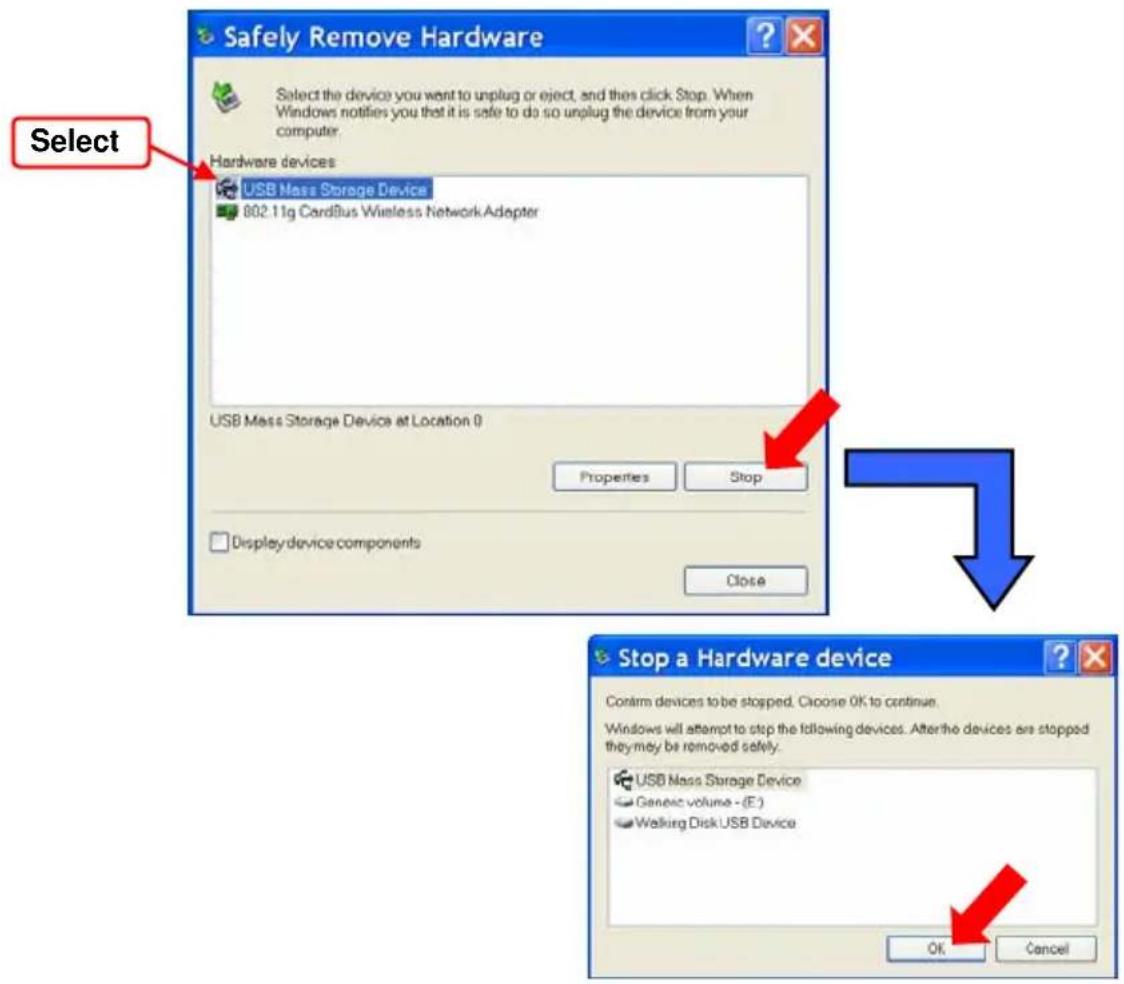
text_image
Safely Remove Hardware Select the device you want to unplug or eject, and then click Stop. When Windows notifies you that it is safe to do so unplug the device from your computer. Hardware devices USB Mass Storage Device 802.11g CardBus Wireless NetworkAdapter USB Mass Storage Device at Location 0 Properties Stop Display device components Close Stop a Hardware device Confirm devices to be stopped. Choose OK to continue. Windows will attempt to stop the following devices. After the devices are stopped they may be removed safely. USB Mass Storage Device Generic volume - (E:) Walking Disk USB Device OK CancelPreface
General Introductions Chapter 1
Chapter 2
Getting Started
Chapter 3
Customizing this Notebook
Chapter 4
BIOS setup
Chapter 5
Troubleshooting, First AID, FAQ
Chapter 6
Mandatory Activation
Chapter 7
Windows Media Canter - TV
Chapter 8
Recovery
natural_image
Simple line drawing of a laptop computer with a circular button on the right (no text or symbols)About BIOS Setup
When to Use BIOS Setup?
You may need to run the BIOS Setup when:
- An error message appears on the screen during the system booting up and requests you to run SETUP.
- You want to change the default settings for customized features.
- You want to reload the default BIOS settings.
How to Run BIOS Setup?
To run the BIOS Setup Utility, turn on the Notebook and press the [Del] key during the POST procedure.
If the message disappears before you respond and you still wish to enter Setup, restart the system by turning it OFF and ON, or simultaneously pressing [Ctrl]+[Alt]+[Delete] keys to restart.
info
The screen snaps and setting options in this chapter are for your references only. The actual setting screens and options on your Notebook may be different because of BIOS update.
Control Keys
You can use only the keyboard to control the cursor in the BIOS Setup Utility.
 | Press left arrow to select one menu title. |
 | Press right arrow to select one menu title. |
 | Press up arrow to select one item above the menu title. |
 | Press down arrow to select one item under the menu title. |
 | Increase the setting value or make changes. |
 | Decrease the setting value or make changes. |
 | 1) Open the selected item to change setting options.2) Bring up a sub-menu when available. |
 | In some items, press this key to change setting field. |
 | Bring up help screen providing the information of control keys. |
 | 1) Exit the BIOS Setup Utility.2) Return to the previous screen in a sub-menu. |
BIOS Setup Menu
Once you enter the BIOS Setup Utility, the Main menu will appear on the screen.
The Main menu displays the system information, including the basic
configuration. The pictures shown in this chapter are for reference only, and
| Main Advanced Security Boot Exit | |
| Market Name Model Name | Use [ENTER] to select a Cell. |
| System Time System Date | [18:08:53] [Wed 05/16/2007] |
| ▶ Serial ATA ▶ Primary IDE Master | [Not Detected] [ATATICDKUM] |
| ▶ System Infomation | |
| ++ Select Screen ↓↑ Select Item +- Change Field Tek Select Field F1 General Help F10 Save and Exit ESC Exit | |
Main menu
Show System Overview information about firmware version, CPU features,
Memory size and setting of System Time and Date.
Advanced menu
Configure IDE and USB settings.
Security menu
Install or clear Supervisor's and User's Password settings.
Boot menu
Set up Boot Type and Boot Sequence.
Exit menu
Choose decided status before leaving the BIOS menu.
Main menu
| BIOS SETUP UTILITY | |||
| Main Advanced Security Boot Exit | |||
| Market Name Model Name | Use [ENTER] to select a field. | ||
| System Time | [8:08:53] | Use [+], [-] to configure system Date. | |
| System Date | [Wed 05/16/2007] | ||
| Serial ATA | [Not Detected] | ||
| Primary IDE Master | [ATAFICDKOM] | ||
| System Infomation | ←→ Select Screen ↓↑ Select Item +- Change Field Tab Select Field F1 General Help F10 Save and Exit ESC Exit | ||
V02.59 (C) Copyright 1985-2005, American Megatrends, Inc.
- System Time
This item allows you to set the system time. The system clock will go on no matter you shut down the PC or get into sleep mode. The set format is [hour:minute:second].
- System Date
This item allows you to set the system date. The date format is [day:month:date:year].
Day Day of the week, from Sun to Sat, which is determined by BIOS (read-only).
Month The month from 01 (January) to 12 (December).
Date The date from 01 to 31.
Year The year can be adjusted by users.
♦ Serial ATA / Primary IDE Master
These items display the types of the primary IDE devices installed in the Notebook. Press [Enter] to bring up a sub-window showing the detailed information of the device, including the device name, vendor, LBA mode, PIO mode and more.
- System Information
This item provides the information about the firmware, processor, and system memory.
Advanced menu
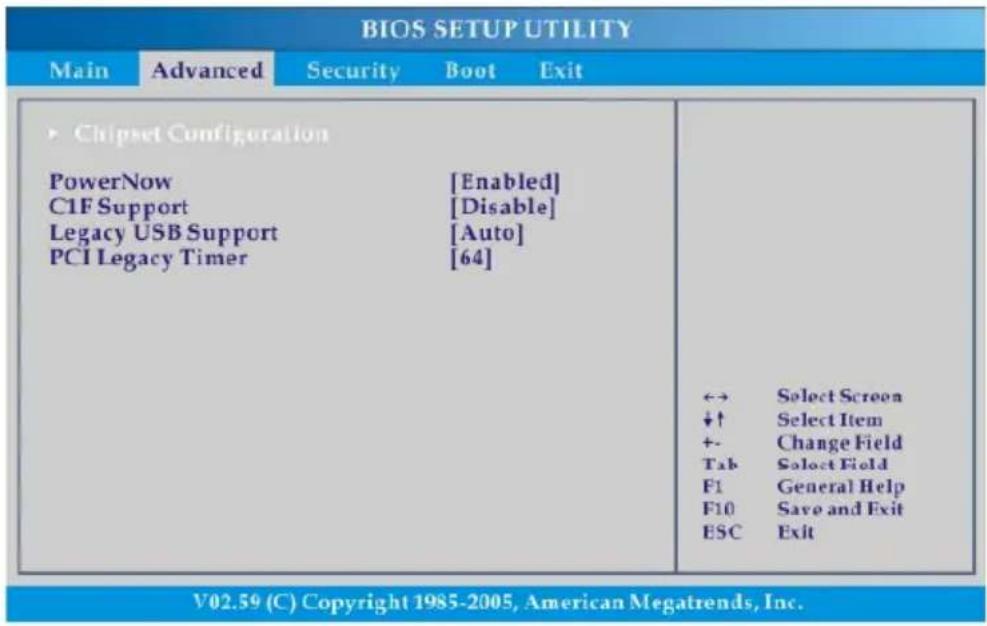
text_image
BIOS SETUP UTILITY Main Advanced Security Boot Exit ▶ Chipset Configuration PowerNow [Enabled] C1F Support [Disable] Legacy USB Support [Auto] PCI Legacy Timer [64] ↔ Select Screen ↓↑ Select Item +- Change Field Tab Select Field F1 General Help F10 Save and Exit ESC Exit V02.59 (C) Copyright 1985-2005, American Megatrends, Inc.PowerNow
This item allows you to enable or disable PowerNow function. When set to Enabled, the system always operates in a conserve power mode. If you want optimize the processor, set this item to Disabled, so that the processor's speed will vary depending on the use of your operating system and applications. Default setting is set to Enabled.
♦ Legacy USB Support
Selecting Enabled allows you to use USB devices, such as mouse, keyboard, or portable disk, in DOS system; or allows you to boot your system by USB device. Setting options: Enabled, and Disabled.
- PCI Latency Timer
This item controls how long each PCI device can hold the bus before another takes over. When set to higher values, every PCI device can conduct transactions for a longer time and thus improve the effective PCI bandwidth. For better PCI performance, you should set the item to higher values. Setting options: 32, 64, 96, 128, 160, 192, 224, and 248.
Security menu
| BIOS SETUP UTILITY | |
| Main Advanced Security Boot Exit | |
| Supervisor Password: Not Installed User Password: Not Installed Change Supervisor Password | Enable/disable the generation of ACPI_PPC,_PSS,and_PCT objects. ↔ Select Screen ↓↑ Select Item +- Change Field Tab Select Field F1 General Help F10 Save and Exit ESC Exit |
V02.59 (C) Copyright 1985-2005, American Megatrends, Inc.
- Change Supervisor/User Password
When you select the function, a message box will appear on the screen as below:
Enter New Password
Type the password you want, up to six characters in length and press [Enter]. The password typed now will replace any previously set password from CMOS memory. You may also press [ESC] to abort the selection and not enter a password.
When the Supervisor Password is set, the new item User Access Level and Password Check will be added in the menu. You can make further settings of access right in the User Access Level item. Setting options: No Access, View Only, Limited and Full Access. The Password Check item is used to specify the type of BIOS password protection that is implemented. Settings are described below:
Setup The password prompt appears only when end users try to run Setup.
Always A password prompt appears every time when the Notebook is powered on or when end users try to run Setup.
To clear a set password, just press [Enter] when you are prompted to enter the password. A message box will show up confirming the password will be disabled. Once the password is disabled, the system will boot and you can enter Setup without entering any password.
info
About Supervisor Password and User Password
Supervisor Password allows the user to enter and change the settings of the setup menu; User Password only allows the user to enter the setup menu, but do not have the right to make changes.
Boot menu
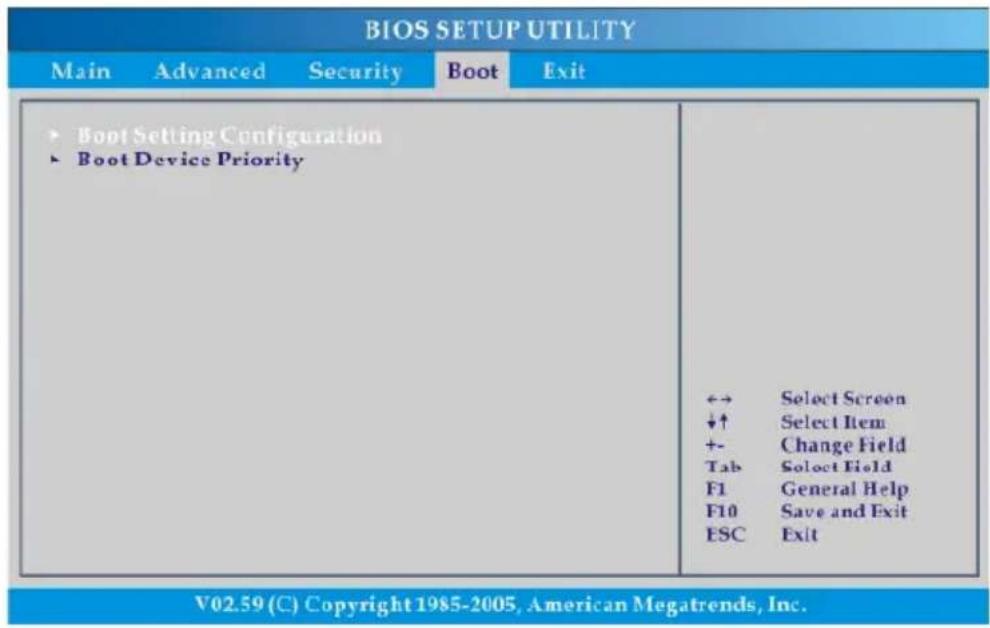
text_image
BIOS SETUP UTILITY Main Advanced Security Boot Exit ► Boot Setting Configuration ► Boot Device Priority ↔ Select Screen ↓↑ Select Item +- Change Field Tab Select Field F1 General Help F10 Save and Exit ESC Exit V02.59 (C) Copyright 1985-2005, American Megatrends, Inc.- Boot Settings Configuration
Configure settings during system boot.
- Boot Device Priority
Press [Enter] to bring up a sub-window showing the sequence of boot devices where BIOS attempts to load the disk operating system.
Exit menu
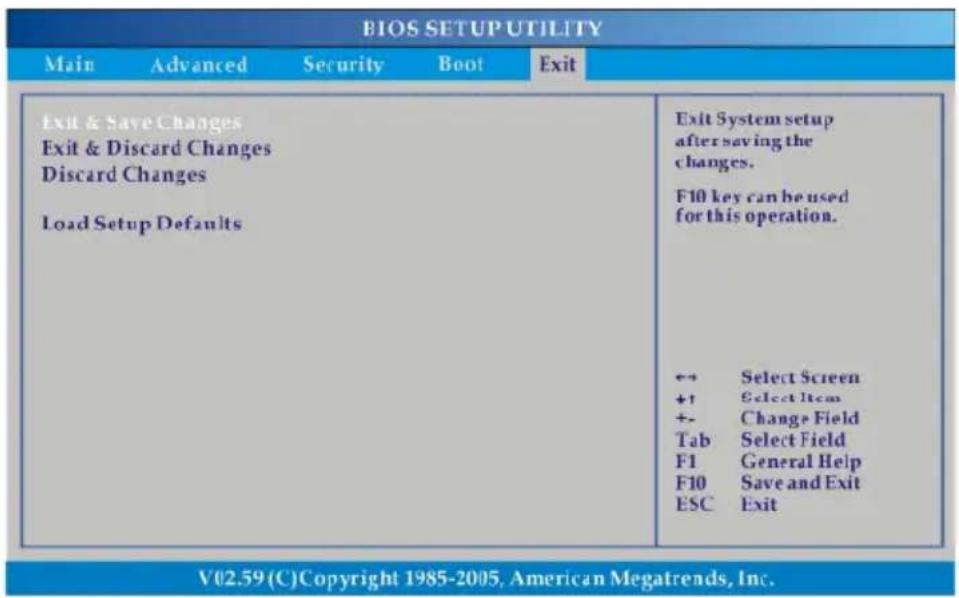
text_image
BIOS SETUP UTILITY Main Advanced Security Boot Exit Exit & Save Changes Exit & Discard Changes Discard Changes Load Setup Defaults Exit System setup after saving the changes. F10 key can be used for this operation. ↔ Select Screen +↑ Select Item +- Change Field Tab Select Field F1 General Help F10 Save and Exit ESC Exit V02.59 (C) Copyright 1985-2005, American Megatrends, Inc.- Exit & Save Changes
Save the changes you have made and exit the utility.
- Exit & Discard Changes
Exit the utility without saving the changes you have made.
♦ Discard Changes
Abandon your changes and reload the previous configuration before running the utility.
- Load Setup Defaults
Select this item to load the default settings for optimal system performance.
Preface
General Introductions Chapter 1
Chapter 2
Getting Started
Chapter 3
Customizing this Notebook
Chapter 4
BIOS setup
Chapter 5
Troubleshooting, First AID, FAQ
Chapter 6
Mandatory Activation
Chapter 7
Windows Media Canter - TV
Chapter 8
Recovery
natural_image
Simple line drawing of a laptop computer with a clock icon (no text or symbols)Troubleshooting, First Aid and FAQ
This notebook computer is a carefully tested, high-quality computer system offering the latest technology. However, problems and malfunction can never be totally avoided. In order to help you restore a fully-functional system we have collected together some detailed information about identifying and resolving the most common problems. If you have any problem, proceed as follows:
- Read the "Troubleshooting" section.
- Try to find the solution to your problem in the Chapter "FAQ".
NOTE
You'll find the latest FAQ on your desktop under Manufacturer Information and also on the Internet.
Go to http://www.service.targa.co.uk/ to search for the latest FAQ and drivers.
- Read the corresponding chapter in this manual.
- Make use of the Windows System Recovery.
- If the notebook does not boot or there are errors during the booting up process, use the Recovery Software found on the EasyInstall CD. This software will help you restore the Windows boot and system files, and also reset your notebook to the factory default configuration if necessary.
- Call our hotline.
- If none of the above has helped you solve the problem, you can use our Pickup Service.
Troubleshooting
If your notebook hangs while running or booting this can be due to a recently installed software. This can be solved as follows:
- Power your notebook on. First of all you'll see the usual BIOS messages. As soon as they have finished, press the [F8] key. This will display the Windows Vista boot menu. Select the Safe Mode command. Windows will now boot in a special "emergency mode".
- Click Start/All Programs/Accessories/System Tools/System Restore to restore it to an earlier time when it worked. If this does not succeed, please also try all the other restore options.
- Uninstall the recently installed software via the Add or Remove Programs option from the Control Panel (this also works in Safe Mode).
- Start your notebook with the Windows Vista Home Premium Edition CD inserted into the drive and hold any letter key (e.g. . [H]) until the Windows Setup is launched. Wait until all files have been loaded. In the Windows Welcome screen, press [Enter], confirm the End User License Agreement by pressing [F8] and press [R] to repair an installation. (You only need to reinstall the drivers from the supplied EasyInstall CD once Windows has been repaired.)
- Contact the manufacturer of the third-party software.
Notebook
If you do not hear any sound, there are several possible reasons for hardware or software malfunction. In order to locate them better, proceed as follows:
- Make sure that the sound card driver has been installed and that you have selected the sound card as default audio device. To do so, open the Control Panel and double-click on Sounds and Audio Devices, click the Audio tab and check that Realtek Audio is selected as the default recording and playback device.
- For the standard playback device, click the Volume button and make sure that there is no check mark on any Mute option. Drag all the volume rulers to a medium volume level.
- Re-install the sound driver form the EasyInstall CD.
- Contact our Hotline.
If you cannot connect to the Internet via a modem, there are several possible reasons. Follow these steps to locate the problem:
- Uninstall the modem by opening the Device Manager found in Control Panel/System/Hardware. Click the plus sign next to Modems and right-click on the modem to choose the Uninstall command. The modem will be removed from the list. Now you can reinstall it automatically from the Device Manager by clicking on the Action/Scan for hardware changes.
- You can also perform a diagnostics from the Device Manager. Double-click on the modem, open the Diagnostics tab and click the Query Modem button. The list that pops up should contain a first entry Succeeded for a modem that
Notebook
is working properly.
- Try a different modem cable.
- Make sure that the modem cable has been properly inserted into the modem port.
- Try a different telephone wall socket (easy when using a notebook).
- Try connecting to a different ISP to get Internet access.
- Establish a test connection to a normal telephone number (e.g. your mobile phone) by clicking
Start/AllPrograms/Accessories/Communications/HyperTerminal.
FAQ – Frequently Asked Questions
Where Can I Find Spare Parts and Accessories?
Targa offers a wide range of spare parts and accessories for your PC.
+49 2921 / 99-3030 only English
Information About Drivers, FAQs and Manual
In order to have all components of your Targa computer optimally tuned, you should regularly install the latest drivers. You can download them free from the Targa Service site on the Internet. There you'll also find additional FAQs plus this manual as a PDF document for opening in Adobe Reader. Adobe Reader offers a comfortable search function that you can access via Edit/Search, so that you can easily find the desired information and help texts. You'll find the Targa Service portal on the Internet at: http://www.service.targa.co.uk
Java applets do not execute.
Solution: Download the current version of Java Virtual Machine from java.sun.com.
Notebook
Why does My Computer Show a Smaller Hard Disk Size than the Advertised Size, e.g. 232GB Instead of the Advertised 250GB?
Solution: The reason is the different units used for calculating this value. All manufacturer documents use units referring to base 10 digits. Therefore, 250 GB correspond to 250 billion bytes (this is a 250 followed by 9 zeros). However, the computer calculates using units based on 1024. 1 GB is equal to 1024 * 1024 * 1024 bytes = 1 073 741 824 bytes. Thus, for the computer 1 GB is a little more than 1 billion bytes. The conversion of the (decimal) 250 GB is: (250 billion) divided by (1073741824) = approx. 232 GB in units of 1024 for the computer.
How can I determine the exact capacity of the hard disk?
Solution: Open the Control Panel, followed by the Administrative Tools folder. All system programs of this folder are displayed. Open Computer Management. Computer Management is a general program that includes an area with the name Storage. Click on the + symbol in front of this area and select the suboption Disk Management. On the right of the window, all the existing data media are displayed. Disk 0 represents the system hard disk. The list also displays the total size and the partitions on each medium, along with the size of each partition. Please note: currently there is more than one partition because of the Recovery and Driver partitions. These partitions total the following size of the hard disk.
Notebook
How Can I Enable/Disable the Autorun of CD-ROMs in Windows?
Solution: Click Start/Run and enter "regedit". Search for the key HKEY_LOCAL_MACHINE\System\CurrentControlSet \Services\Cdrom and then the entry Autorun. Double-click on the entry to edit the value: 1 = enabled 0 = disabled. After changing this value you must restart your computer.
The e-mail hotkey always launches Windows Mail, but I want to use a different mail program. Is this possible?
Solution: Yes. In Control Panel, select the Internet options and then select the Programs tab. Under E-Mail, select the program you want to launch by pressing the hotkey.
The Internet browser hotkey always launches Microsoft Internet Explorer, but I want to use a different browser. Is this possible?
Solution: Yes. Click on Start/All Programs/Program Access and Defaults. Select User-defined. Next, click the down arrow. Here you can select a different browser to become your default browser. As an alternative, during the installation of the browser there should be an option to select whether to use it as your default browser.
Notebook
How do I clean my notebook TFT display?
Solution: To clean a TFT display you can use normal brand glass detergent. However, be careful that you don't apply too much detergent and that the liquid enters the display. Use a dry cotton cloth to dry the unit and avoid scratching the surface. It's best to use cleaning sets made especially for notebooks and TFT displays.
Pixel errors on LCDs (notebook computers + monitors)
Active Matrix LCDs (TFT) with a resolution of 1280 x 800 pixels (XGA) rendered by three sub-pixels each (red, green, blue), a total of almost 3,1 million control transistors are used. Due to this high amount of transistors and the corresponding complex manufacturing process, in some cases faulty or the wrong driving of pixels and/or sub-pixels can occur. In the past there have been different attempts to define the number of permitted pixel errors. Normally, these were very complicated and completely different from manufacturer to manufacturer. Therefore, for manufacturing and guarantee repairs, Targa follows the strict and transparent definition of the ISO 13406-2, Class II standard that will be summarized in the following. Among others, ISO Standard 13406-2 defines universal specifications regarding pixel errors. The pixel errors are categorized into four error classes and three error types. And each pixel is composed of three sub-pixels with one primary color (red, green, blue) each.
Notebook
Types of pixel errors
Type 1: pixel always lights (bright, white dot)
Type 2: pixel never lights (dark, black dot)
Type 3: abnormal or defective sub-pixel of the colors red, green or blue (lighting continuously, not lighting or blinking)
Classes of pixel errors
| Pixel-Class | Typ 1 | Typ 2 | Typ 3 |
| I | 0 | 0 | 0 |
| II | 2 | 2 | 5 |
| III | 5 | 15 | 50 |
| IV | 50 | 150 | 500 |
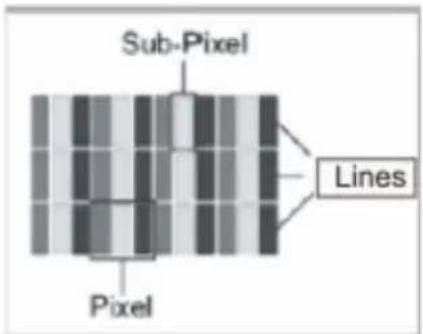
text_image
Sub-Pixel Lines PixelThe number of errors for the above mentioned types in each error class refers to one million pixels and must be converted according to the physical display resolution. For example, for Active Matrix LCDs (TFT) with a resolution of 1280 x 800 pixels (WXGA) rendered by three sub-pixels each (red, green, blue), a total of almost 3,1 million control transistors are used. for example, consider a 15,4-inch WXGA display with 1280 horizontal and 800 vertical dots (pixels). This is 1,024,000 pixels in total. Referring this figure to 1 million pixels, a factor of approx.
Notebook
1.02 is obtained. Therefore, error class II permits two errors of type 1 or type 2 and five errors of type 3.
Error class 1 only applies for special applications (e.g. medical) and implies higher costs. Error class II has become a standard for quality-orientated manufacturers with very good displays.
BIOS updates for your notebook
Only use official BIOS versions from our service site on the Internet. Never install any third-party or modified BIOS versions as this can void the warranty. Start downloading the proper BIOS Update from our service site
http://www.service.targa.co.uk. You can find the proper update by entering the serial number or searching by model. Only use the BIOS that has been approved for your device. Open the Downloads tab and download the ZIP file containing the latest BIOS version. Extract the ZIP file and follow the instructions of the supplied readme.txt file.
Preface
General Introductions Chapter 1
Chapter 2
Getting Started
Chapter 3
Customizing this Notebook
Chapter 4
BIOS setup
Chapter 5
Troubleshooting, First AID, FAQ
Chapter 6
Mandatory Activation
Chapter 7
Windows Media Canter - TV
Chapter 8
Recovery
natural_image
Simple line drawing of a laptop computer with a clock icon (no text or symbols)MANDATORY ACTIVATION
Activation associates the use of the software with a specific device. During activation, the software will send information about the software and the device to Microsoft. This information includes the version, language and product key of the software, the Internet protocol address of the device, and information derived from the hardware configuration of the device. For more information, see http://go.microsoft.com/fwlink/?linkid=69497. By using the software, you consent to the transmission of this information. Before you activate, you have the right to use the version of the software installed during the installation process. Your right to use the software after the time specified in the installation process is limited unless it is activated. This is to prevent its unlicensed use. You will not be able to continue using the software after that time if you do not activate it. If the device is connected to the Internet, the software may automatically connect to Microsoft for activation. You can also activate the software manually by Internet or telephone. If you do so, Internet and telephone service charges may apply. Some changes to your computer components or the software may require you to reactivate the software.
The software will remind you to activate it until you do.
Preface
General Introductions Chapter 1
Chapter 2
Getting Started
Chapter 3
Customizing this Notebook
Chapter 4
BIOS setup
Chapter 5
Troubleshooting, First AID, FAQ
Chapter 6
Mandatory Activation
Chapter 7
Windows Media Canter - TV
Chapter 8
Recovery
natural_image
Simple line drawing of a laptop computer with a clock icon (no text or symbols)Notebook
Connect the TV card
Your Targa Notebook is supplied with a TV card, which enables you to receive digital TV stations by means of DVB-T. It is very easy to use, as the relevant software is to a large degree based on a conventional television. Most functions can therefore be used intuitively. You only have to complete a few steps to make this feature available to you.
Before you can enjoy watching television at your network you must of course provide an antenna or cable TV connection and set up the channels. This is no great problem as the software does most of the work for you. You will soon get the hang of it with the following step-by-step instructions.
The connections required to receiving television channels, the so-called coaxial sockets, are already provided on the notebook. Here you can connect an analog room antenna, an analog cable TV connection or an antenna for digital terrestrial television (DVB-T). If you want to connect a satellite receiver, that is not a problem either. You only have to lay a coaxial cable from the receiver to the notebook. Please note that this will only work if the TV image is also output at your receiver via the coaxial socket. This is not the case with more recent digital receivers.
Once you have connected the cable you can start adjusting the necessary TV settings. The next section on the initial configuration describes how to do this.
The Windows Media Centre - Initial Configuration
The Windows Media Centre is the central component for managing all multimedia content on your notebook. With this media centre, fully integrated in Windows Vista™, you can view videos and DVDs, listen to music from audio, CDs or hard disk files, view the TV guide, record TV programmes, and much more. The Media Centre replaces many individual programs and unites all media under a single user interface. The first time you open the Media Centre you must set it up, once only, to enable you to use it to its full extents. With this, e.g. your internet connection is checked and the available TV reception is set up. The whole procedure takes only a few minutes and is carried out with the help of a wizard.
General Settings
Open the Media Centre with the Windows Media Centre icon in the Start menu. The first time you start the program the setup wizard automatically appears. If you have already opened the Media Centre beforehand or the configuration was previously cancelled you can also start the initial configuration manually. To do this, in the start screen of the Media Centre, select Tasks / Settings, switch to the General group and select the Windows Media Centre Setup option. You can now use the Execute Setup Again button to restart the initial configuration.
You are now welcomed by the Setup wizard. You can now carry out an express setup (Required Setup) or a user-defined setup (Optional
Notebook
Setup). The Required Setup is completed with the click of a mouse and is especially suitable if you want to watch video, DVDs and audio CDs immediately. TV and radio reception is not configured with this option. For a complete setup, select the Option Setup option. This procedure is described in the following. Press the OK button to open the first window. This only contains a few items of standard information; press Next to continue. The Media Centre then briefly displays the steps carried out during the configuration. You can also skip this window with the Next button.
You are now informed about the data protection guidelines (Privacy Policy). If you wish to read these, open them by clicking the Display the Data Protection Provisions Online button. Click Next to move to the next step. The Media Centre would like to regularly send information to Microsoft, so that the program can be improved in line with users' requirements. If you consent to this anonymous report, select the Yes, I would like to participate option. If you do not want reports to be sent to Microsoft, select the No, I do not want to participate option. Click Next to start the actual configuration.
The Media Centre can do more than simply play CDs and DVDs. It also enables you to call up additional information about each album or film. This could be, e.g. CD cover, background information to a film or the current TV guide. To do this, the Media Centre needs an internet connection. It does this by simply using your existing connection, e.g. by
Notebook
modem, DSL or router. You can use the Yes or No options to enable or disable this additional information.
General configuration of the Media Centre is not finished. The wizard briefly notifies you of this in a message box. Click the Next button to now set up the reception and display components.
Setting up TV reception
After the basic settings have been configured in the Windows Media Centre you can set up TV reception. The software searches for and saves all television stations available in your region
You can now set up TV reception. In the dialog box displayed, select the Configure Tuner, TV Signal and TV Guide Listings option and click the Next button. First you must choose the region for which you want to receive the TV guide listings. The default region selected is Germany. Confirm this with the Yes... option or select another region with No... .
The Media Centre now automatically establishes an internet connection and downloads the current setup options for your country. This can take a few minutes, depending on the speed of your internet connection. The Media Centre can regularly load the current TV guide listings from the internet. This makes it easier for you to obtain an overview, provides additional information and enables, e.g. more convenient programming of the integrated video recorder. Enable this function with Yes or switch
Notebook
it off with No. If you have enabled this function, you must then agree to the legal terms with the I agree option.
You must now enter your post code so that the Windows Media Centre can precisely determine your TV guide listings. Enter this in the relevant field and click the Next button to open the next dialog box. The Media Centre will now access the internet again and update the guide listings information. This only takes a minute and the software automatically forwards you to the next step.
The Windows Media Centre now lists the types of reception for your region. The selection list is entirely dependent on your location. Select your DVB-T signal. The Media Centre now searches for further information in the internet, the message then appears that the TV guide listings has been completely downloaded. Click Next to move to the next step.
One of the most important steps now follows. The Media Centre starts automatic station search. It searches, lists and saves all the TV channels you can receive. This may take a while, depending on the number of receivable channels. Press the Start Search button to initiate this process. The search can take a while. This is highly dependent on the reception used. After all, DVB-T can transmit around a dozen stations, a satellite more than one hundred. As soon as the Media Centre has finished its search it lists the stations it has found. TV
Notebook
reception is now completely set up. Click the Next button to finish this step and to return to the main screen of the initial configuration.
Optimising the screen display
After all stations have been found and saved, the software automatically switches you back to the configuration screen. Next, you should optimally configure your screen.
Select the item: Optimise how Window Media Centre looks on your display and click the Next button. You can use the Watch Video button to view a test view and check the current setting. Click Next to switch to configuration. The Windows Media Centre now automatically switches to full screen mode so that you can better assess the image.
The wizard now asks whether your preferred display is connected. Confirm with Yes and move to the next step. Select your monitor type. The default should be your notebook display. Use the Built-In Display option for this.
In the following step you must select the screen format. You can choose between 16:9 (widescreen) and 4:3 (standard) displays. Your notebook's display has 16:9 format. You must therefore select this option. The Media Centre usually retains the currently selected resolution. If you wish, you can select a different resolution for TV and film output. Click Yes to retain the current resolution and No to assign
Notebook
your own resolution for the Media Centre. Finally, you can now adjust the display controls. You can adjust the brightness, contrast or perform an RGB colour matching. The screen configuration is then finished and the software switches you back to the main configuration screen.
Setting up the loudspeakers
Finally, you can also set up your computer's loudspeakers. This is particularly important if you use more than two stereo loudspeakers, i.e. a surround system.
To do this, select the Set Up Your Speakers item in the main menu of the wizard. Click Next to move to the next step. The first dialog box contains some explanatory information only. In the second dialog box you must select how the loudspeakers are connected to your computer. For analog PC loudspeakers, select the Mini Jack Plugs option; for optical digital output select Toslink and for internal loudspeakers select the Integrated option. You must then enter the number of loudspeakers. You can choose between 2 speakers, 5.1 Surround speakers and 7.1 Surround speakers. If you have previously selected the integrated loudspeakers, you can of course only enter two loudspeakers. The other options are only possible if you have connected a surround system or a digital amplifier.
In the next step you must try out your loudspeakers with the Test button. If everything works ok, you can continue with the I heard sound from
Notebook
all of my speakers option. If the loudspeakers were silent or you did not hear a test signal from all of them, you must check the connections and repeat the test with I did not hear sound from all of my speakers. Click Next to move to the last dialog box. Here you can close loudspeaker setup with I am finished.
Setting up the media library
You can enable the internal library so that the Media Centre can manage all your video, music and picture files. To do this, select Set up your Music, Pictures, and Videos Libraries.
In the first step you must select what you want to do. Select the Add folder to watch option. Click Next to move to the next step.
You can now choose whether you want to add this folder to your computer or set to media folders on another computer, e.g. in a home network. For local media files, select the Add folders to this computer option.
Now select the folders on your computer. You can, e.g. select the media files in your own private user directory or also select the public media folders for all users of this computer. Of you wish, use the Local Drive (C:) option to select your own individual folder. Your selection is displayed again in the next window and the procedure is closed with the Finish button. Media Centre now searches for files on your computer.
Notebook
This can take a while. You are then automatically returned to the main screen of the wizard.
You have now completed all the steps for initial configuration of the Windows Media Centre. The program is now completely set up and can be used immediately. Use the I am finished button to confirm this again and then close the wizard with Next and Finish. You are automatically returned to the main screen of the Media Centre.
Watching TV on your notebook
Before you can use the TV program on your notebook you must use the Setup wizard to set up TV reception. The step-by-step instructions for this are given at the beginning of this chapter. Alternatively, you can also select Settings / TV from the Tasks group in the main menu of the Media Centre Here you will find Set Up TV Signal ad TV Guide Listings. Use these to set up the reception signal (cable TV, DVB-T, etc.) and start the stations search. The actions are the same as with the wizard, but only these individual steps are carried out. The Windows Media Centre also includes a complete television receiver with which you can receive and view the current TV guide listings. This is very easy to use, as the Media Centre has been adapted to appear like a conventional television. Most functions can therefore be used intuitively, so that you will soon get the hang of using them.
First, open Media Centre from the Windows Start menu. The program's
Notebook
Start screen automatically opens. Select the TV +Film group.
You are now switched to the group for TV reception. Various functions are available for you to choose. Use the Live TV button to switch directly to the current TV guide listings. The program automatically displays the channel last selected. Use Record to record and play TV programmes and movies. The TV Guide opens an electronic TV guide and you can use Search to search the channels for interesting TV programmes.
To watch the current TV show, select Live TV. Media Centre now activates TV reception and displays the channel you last watched. Use the control panel in the bottom right-hand side to control the television program. You can use the plus and minus (+ / -) keys of the channel switch to change channels. If you have found an interesting programme, you do not have to do anything. The control panel automatically disappears after a few seconds leaving you a clear view of the programme. You can also use the buttons in the top right-hand title bar to switch between full screen and television mode.
Media Centre has a so-called Time Shift function. It invisibly stores the current TV channel for a certain period in the background. This enables you to watch the program from any time you wish using the Forward and Rewind buttons in the control panel. E.g. you can rewind to watch an interesting report again or if you missed the start of a film.
Notebook
If you want to find out about the current TV program, use the green Media Centre icon in the top left-hand corner to return to the main menu of the TV area. Now select TV Guide. This opens an electronic TV guide, which displays all channels in a clear list. Use the arrow keys in the bottom right-hand corner to move in the list. Use the up and down arrows to move through the channel list. Use the right and left arrow keys at the top to move through the times. If you want to watch one of the programs displayed, simply double-click the name. This automatically switches you to the Live TV function and you can see the selected programme.
Preface
General Introductions Chapter 1
Chapter 2
Getting Started
Chapter 3
Customizing this Notebook
Chapter 4
BIOS setup
Chapter 5
Troubleshooting, First AID, FAQ
Chapter 6
Mandatory Activation
Chapter 7
Windows Media Canter - TV
Chapter 8
Recovery
natural_image
Simple line drawing of a laptop computer with a clock on the right side (no text or symbols)Restoring the System by Using the System Recovery Software
The EasyInstall CD/DVD supplied with your Targa PC contains a completely new Recovery software that lets you restore your PC gradually into a normal operating status. It offers four options:
- Restore Boot Files Only
- Restore System Files
- Restore All Files (Leaves User Files Unchanged)
- Complete Restore (All Files will be Deleted)
If your PC does not boot or only boots giving trouble, insert the EasyInstall DVD-ROM into your CD/DVD drive and restart your computer.
- A message warning of a possible loss of data will appear. Click the button Run program.
SystemRecovery
Information for Recovery-Process
With this program you can set back the software installation of your system step-by-step into the delivery state. It is precondition that the Factory-Prepared-Recovery data is remaining on your hard disk.
Please consider that the data of the system partition (Drive C:) can be deleted by the restore-process.
If you don't want this, please exit this program now. Save your user data on a suitable media e.g. CD-ROM. After this start the process once more to put your system back into the delivery state.
There are four different methods of system-restore. These methods are explained in the following menu. You can phase the individual methods top down. After each step you
Run Program
Exit Program
- In the next step you can choose between the four options mentioned above.
SystemRecovery powered by HDTRONIC
Chose Restore Mode
Restore Boot Files only
The files needed by Windows for the start will be written newly.
- Restore Systemfiles
The system files of Windows will be written newly
Restore all files (Leaves User files unchanged)
The software installation will be reseted to the delivery state.
- Complete Restore (All files will be deleted)
The software installation will be reseted to the delivery state.
- If you have trouble starting Windows, first try the option Restore Boot Files Only.
- If you have problems with Windows system files that cannot be solved after executing the Windows System Restore, try the second option Restore System Files.
- If the computer still does not start after applying these procedures, try the third option Restore All Files (Leaves User Files Unchanged). Any user files will be kept as long as they have been saved into the pre-defined user folders.
- Only if this option also fails should you select the last item Complete Restore (All Files will be Deleted). Please note that this procedure will completely erase any data from your PC. Use this option to restore the factory-default software configuration.
Important!
Please remember that launching this process will restore the factory default configuration of your computer. This will erase any data from your hard disk (under Windows labeled drive C:). If you don't want this, exit the Recovery software and backup your personal data first (e.g. on a CD-ROM or on the second partition (Install) of your hard disk).
- Launch the recovery process by clicking the Start button.
SystemRecovery
Summary
Systemrestore could be started now
( Complete Restore ( All files will be deleted ) )
Back
Next
Stall
Aborl
Notebook
- Click the OK button to confirm the warning message in the next window.
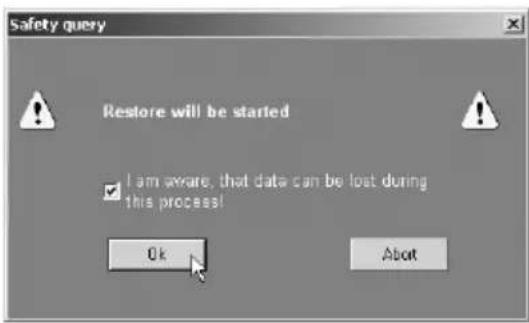
text_image
Safety query Restore will be started I am aware, that data can be lost during this process! Ok Abot- The system recovery process starts. This process may take a while. You can monitor the completion status of the recovery in the progress bar.
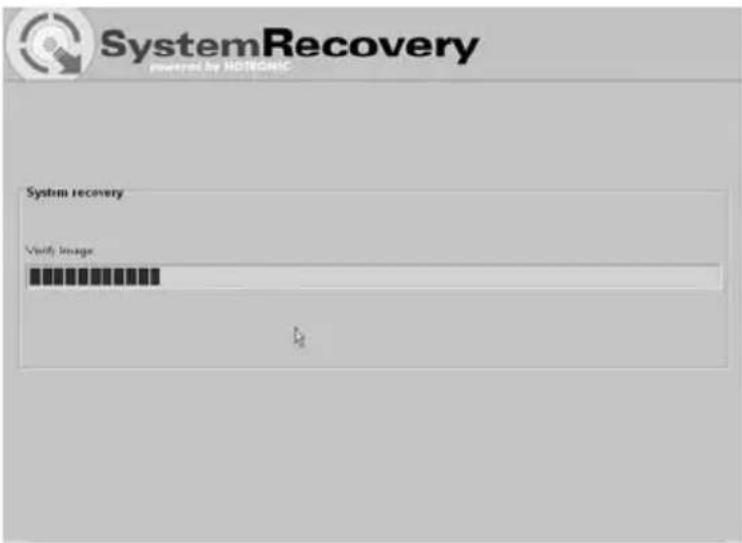
text_image
SystemRecovery Powered by HONOCNIC System recovery Verify ImageImportant!
You must never turn off your computer while the recovery process is running. You must not interrupt the recovery process!
Notebook
- After the recovery has finished click
Restart Computer to restart your computer.