Latitude X1 - Laptop DELL - Free user manual and instructions
Find the device manual for free Latitude X1 DELL in PDF.



| Product type | Professional laptop |
| Brand | Dell |
| Model | Latitude X1 (PP05S) |
| Processor | Intel Pentium M or Celeron M |
| RAM | Up to 2 GB DDR2 |
| Hard drive | ATA hard drive, variable capacity |
| Screen | 12.1 inches (XGA format) |
| Power supply | 65 W AC adapter, lithium-ion battery |
| Battery life | Varies by usage, approximately 3-5 hours |
| Weight | Approximately 1.2 kg (2.6 lb) |
| Dimensions (W × D × H) | Approximately 295 × 200 × 25 mm |
| Operating system | Microsoft Windows XP Professional |
| Connectivity | USB 2.0, modem, Ethernet, Wi-Fi (optional) |
| Optical drive | CD/DVD-ROM (optional) |
| Key features | Dell QuickSet, integrated diagnostics, power management |
| Maintenance and cleaning | Use a soft, dry cloth. Avoid solvents. |
| Security | Kensington lock, BIOS password |
| Spare parts and repairability | Battery, hard drive, memory user-replaceable |
| General information | Dell warranty, technical support available at support.dell.com |
Frequently Asked Questions - Latitude X1 DELL
User questions about Latitude X1 DELL
0 question about this device. Answer the ones you know or ask your own.
Ask a new question about this device
Download the instructions for your Laptop in PDF format for free! Find your manual Latitude X1 - DELL and take your electronic device back in hand. On this page are published all the documents necessary for the use of your device. Latitude X1 by DELL.
USER MANUAL Latitude X1 DELL
Notes, Notices, and Cautions

NOTE: A NOTE indicates important information that helps you make better use of your computer.

NOTICE: A NOTICE indicates either potential damage to hardware or loss of data and tells you how to avoid the problem.

CAUTION: A CAUTION indicates a potential for property damage, personal injury, or death.
Abbreviations and Acronyms
For a complete list of abbreviations and acronyms, see the Glossary in your User's Guide.

NOTE: Some features may not be available for your computer or in certain countries.
Information in this document is subject to change without notice.
© 2005 Dell Inc. All rights reserved.
Reproduction in any manner whatsoever without the written permission of Dell Inc. is strictly forbidden.
Trademarks used in this text: Dell, the DELL logo, and Latitude are trademarks of Dell Inc.; Microsoft and Windows are registered trademarks of Microsoft Corporation; Intel, Pentium, and Celeron are registered trademarks of Intel Corporation.
Other trademarks and trade names may be used in this document to refer to either the entities claiming the marks and names or their products. Dell Inc. disclaims any proprietary interest in trademarks and trade names other than its own.
Model PP05S
January 2005 P/N T6011 Rev. A00
Contents
Finding Information 5
Setting Up Your Computer 8
About Your Computer 10
Front View 10
Left View 11
Right View 11
Back View 11
Bottom View 12
Using a Battery 12
Battery Performance 12
Checking the Battery Charge 13
Charging the Battery 15
Removing a Battery 16
Installing a Battery 16
Storing a Battery 17
Solving Problems 17
Notebook System Software (NSS) 17
Lockups and Software Problems 17
Using the Dell Diagnostics 19
When to Use the Dell Diagnostics 19
Starting the Dell Diagnostics From Your Hard Drive ..... 20
Starting the Dell Diagnostics From the Optional Drivers and
Utilities CD 20
Dell Diagnostics Main Menu. 21
Finding Information

NOTE: Some features may not be available for your computer or in certain countries.

NOTE: Additional information may ship with your computer.
What Are You Looking For? Find It Here
• A diagnostic program for my computer
- Drivers for my computer
• My computer documentation
• My device documentation
• Notebook System Software (NSS)
Drivers and Utilities CD (also known as ResourceCD)
Documentation and drivers are already installed on your computer. You can use the CD to reinstall drivers, run the Dell Diagnostics, or access your documentation.
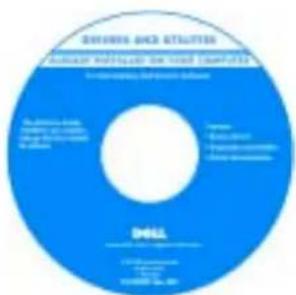
Readme files may be included on your CD to provide last-minute updates about technical changes to your computer or advanced technical-reference material for technicians or experienced users.
NOTE: Drivers and documentation updates can be found at support.dell.com.
NOTE: The Drivers and Utilities CD is optional and may not ship with your computer.
• How to set up my computer
- Basic troubleshooting information
• How to run the Dell Diagnostics
• How to remove and install parts
Quick Reference Guide

NOTE: The Quick Reference Guide is optional and may not ship with your computer.
NOTE: This document is available as a PDF at support.dell.com.
What Are You Looking For? Find It Here
| Warranty informationTerms and Conditions (U.S. only)Safety instructionsRegulatory informationErgonomics informationEnd User License Agreement | DellTM Product Information Guide |
| How to remove and replace partsSpecificationsHow to configure system settingsHow to troubleshoot and solve problems | User's GuideMicrosoft® Windows® XP Help and Support Center1 Click the Start button and click Help and Support.2 Click User's and system guides and click User's guides.The User's Guide is also available on the optional Drivers and Utilities CD. |
| Service Tag and Express Service CodeMicrosoft Windows License Label | Service Tag and Microsoft Windows LicenseThese labels are located on the bottom of your computer.Use the Service Tag to identify your computer when you use support.dell.com or contact technical support.Enter the Express Service Code to direct your call when contacting technical support. |
What Are You Looking For? Find It Here
- Solutions — Troubleshooting hints and tips, articles from technicians, online courses, frequently asked questions
- Community — Online discussion with other Dell customers
- Upgrades — Upgrade information for components, such as memory, the hard drive, and the operating system
- Customer Care — Contact information, service call and order status, warranty, and repair information
- Service and support — Service call status and support history, service contract, online discussions with technical support
- Reference — Computer documentation, details on my computer configuration, product specifications, and white papers
- Downloads — Certified drivers, patches, and software updates
- Notebook System Software (NSS)—If you reinstall the operating system for your computer, you should also reinstall the NSS utility. NSS provides critical updates for your operating system and support for Dell™
3.5-inch USB floppy drives, Intel ^® Pentium ^® M processors, optical drives, and USB devices. NSS is necessary for correct operation of your Dell computer. The software automatically detects your computer and operating system and installs the updates appropriate for your configuration.
To download Notebook System Software:
1 Go to support.dell.com and click Downloads.
2 Enter your Service Tag or product model.
3 In the Download Category drop-down menu, click All.
4 Select the operating system and operating system language for your computer, and click Submit.
5 Under Select a Device, scroll to System and Configuration Utilities, and click Dell Notebook System Software.
Dell Support Website — support.dell.com
NOTE: Select your region to view the appropriate support site.
NOTE: Corporate, government, and education customers can also use the customized Dell Premier Support website at premier.support.dell.com. The website may not be available in all regions.
What Are You Looking For? Find It Here
| How to use Windows XPDocumentation for my computerDocumentation for devices (such as a modem) | Windows Help and Support Center1 Click the Start button and click Help and Support.2 Type a word or phrase that describes your problem and click the arrow icon.3 Click the topic that describes your problem.4 Follow the instructions on the screen. | |
| How to reinstall my operating system | Operating System CDThe operating system is already installed on your computer. To reinstall your operating system, use the Operating System CD. See your User's Guide for instructions. | |
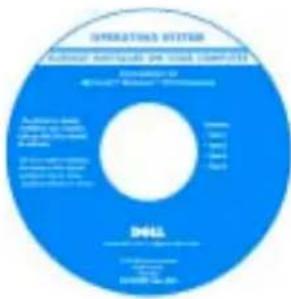 | After you reinstall your operating system, use the Drivers and Utilities CD to reinstall drivers for the devices that came with your computer.Your operating system product key label is located on your computer. | |
| NOTE: The color of your CD varies based on the operating system you ordered.NOTE: The Operating System CD is optional and may not ship with your computer. | ||
Setting Up Your Computer

CAUTION: Before you begin any of the procedures in this section, follow the safety instructions in the Product Information Guide.
1 Unpack the accessories box.
2 Set aside the contents of the accessories box, which you will need to complete the setup of your computer.
The accessories box also contains user documentation and any software or additional hardware (such as PC Cards, drives, or batteries) that you have ordered.
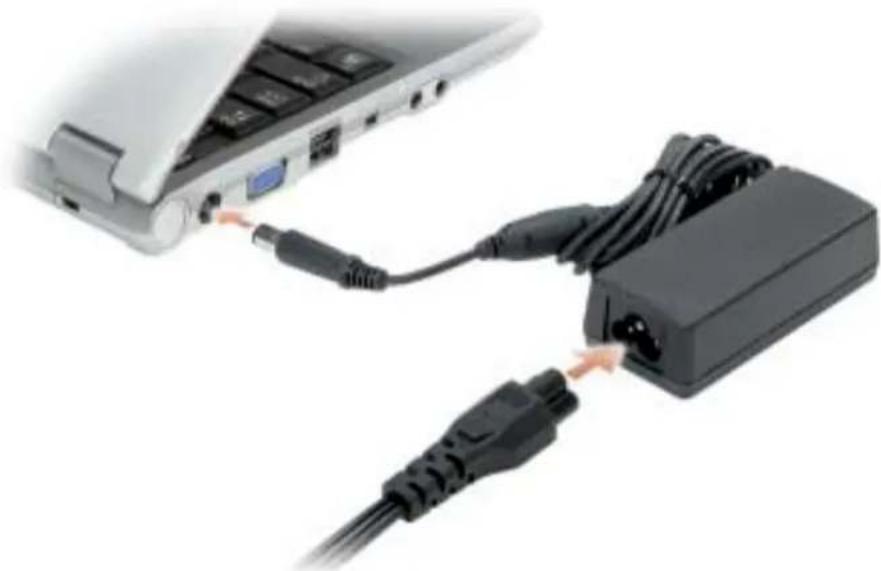
3 Connect the AC adapter to the AC adapter connector on the computer and to the electrical outlet.
natural_image
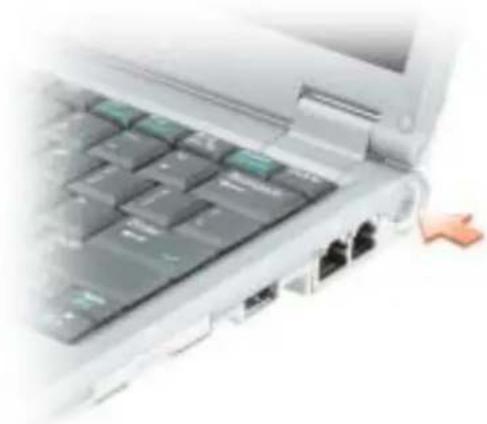
Close-up of a laptop connected to a black electrical adapter cable (no text or symbols visible)4 Open the computer display and press the power button to turn on the computer.
natural_image
Close-up of a laptop keyboard with port and socket, showing a hand pointing to the left side (no text or symbols visible)About Your Computer
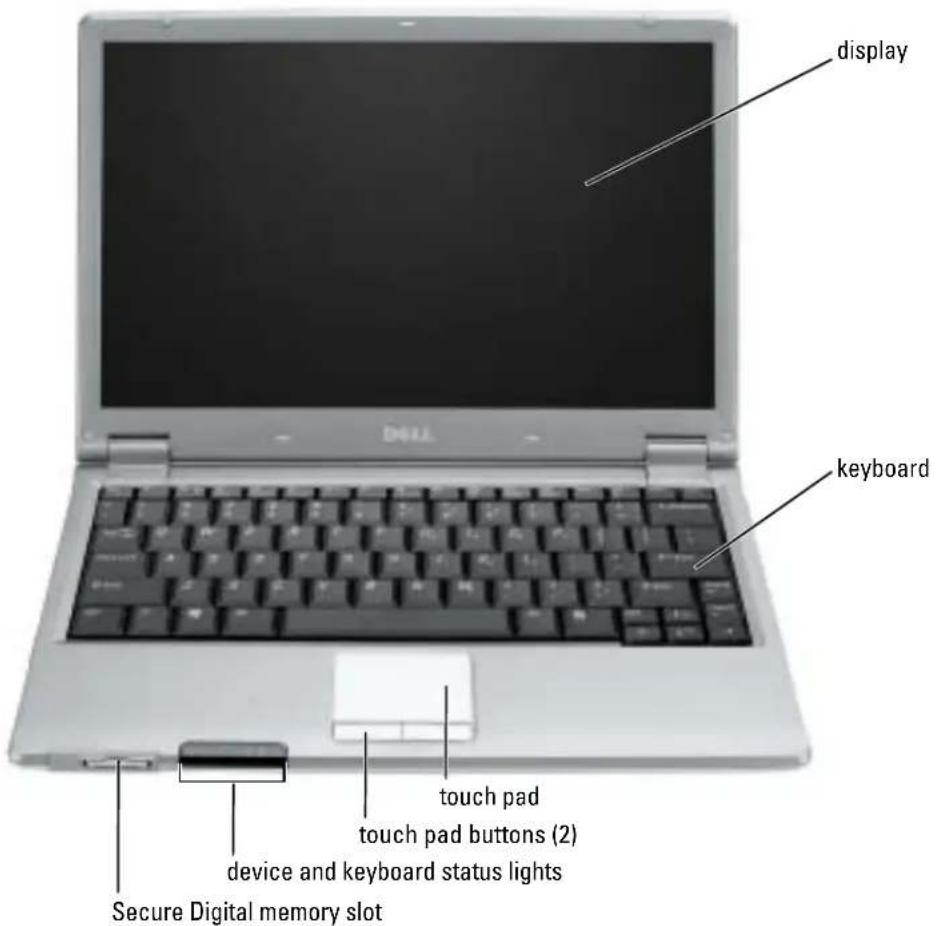
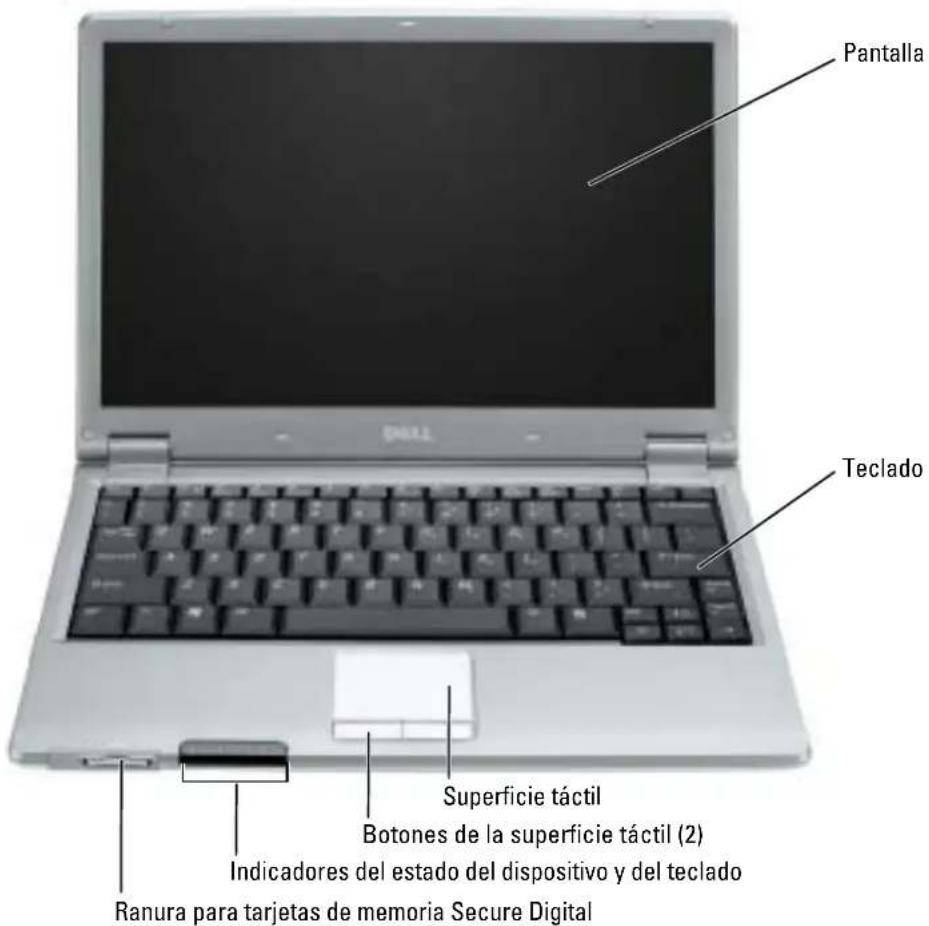
Front View
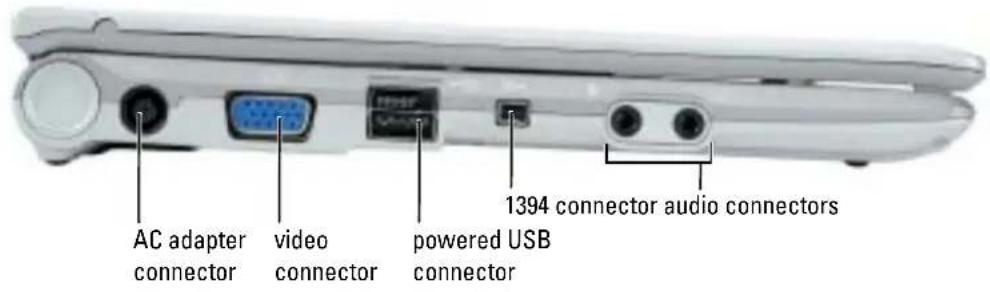
Left View
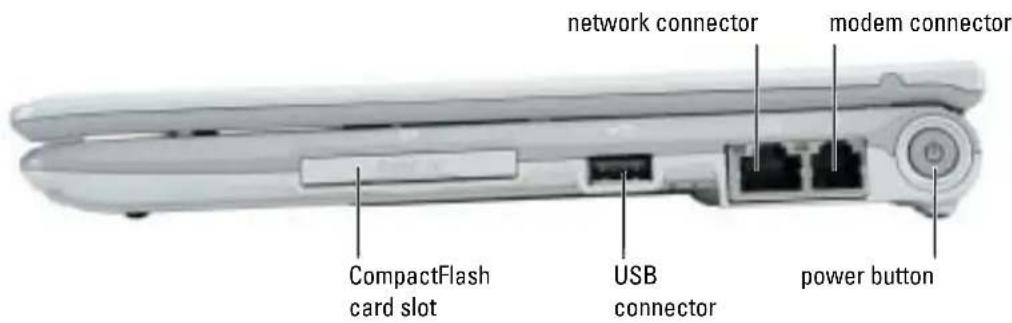
Right View
Back View

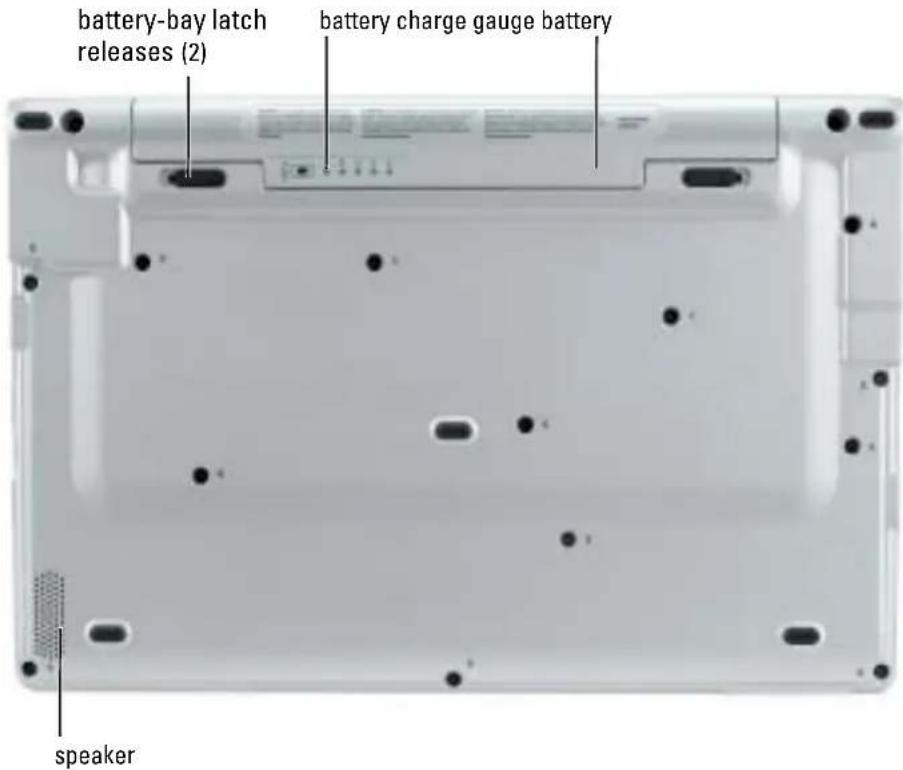
Bottom View
Using a Battery
Battery Performance

CAUTION: Before you begin any of the procedures in this section, follow the safety instructions located in the Product Information Guide.

NOTE: For information about the Dell warranty for your computer, see the Product Information Guide or separate paper warranty document that shipped with your computer.
For optimal computer performance and to help preserve BIOS settings, operate your Dell ^™ portable computer with the main battery installed at all times. Use a battery to run the computer when it is not connected to an electrical outlet. One battery is supplied as standard equipment in the battery bay.
Battery operating time varies depending on operating conditions. Operating time is significantly reduced when you perform operations including, but not limited to, the following:
- Using wireless communications devices or USB devices
- Using high-brightness display settings, 3D screen savers, or other power-intensive programs such as 3D games
- Running the computer in maximum performance mode

NOTE: It is recommended that you connect your computer to an electrical outlet when writing to a CD or DVD.
You can check the battery charge before you insert the battery into the computer. You can also set power management options to alert you when the battery charge is low.

CAUTION: Using an incompatible battery may increase the risk of fire or explosion. Replace the battery only with a compatible battery purchased from Dell. The lithium-ion battery is designed to work with your Dell computer. Do not use a battery from other computers with your computer.

CAUTION: Do not dispose of batteries with household waste. When your battery no longer holds a charge, call your local waste disposal or environmental agency for advice on disposing of a lithium-ion battery. See "Battery Disposal" in the Product Information Guide.

CAUTION: Misuse of the battery may increase the risk of fire or chemical burn. Do not puncture, incinerate, disassemble, or expose the battery to temperatures above 65^ C ( 149^ F). Keep the battery away from children. Handle damaged or leaking batteries with extreme care. Damaged batteries may leak and cause personal injury or equipment damage.
Checking the Battery Charge
The Dell QuickSet Battery Meter, the Microsoft® Windows® Power Meter window and icon, the battery charge gauge and health gauge, and the low-battery warning provide information on the battery charge.
Dell QuickSet Battery Meter
If Dell QuickSet is installed, press
The Battery Meter window displays status, charge level, and charge completion time for the battery in your computer.
The following icons appear in the Battery Meter window:

The computer or docking device is running on battery power.

The computer is connected to AC power and the battery is charging.

The computer is connected to AC power and the battery is fully charged.
For more information about QuickSet, right-click the Icon in the taskbar, and click Help.
Microsoft® Windows® Power Meter
The Windows Power Meter indicates the remaining battery charge. To check the Power Meter, double-click the icon on the taskbar. For more information about the Power Meter tab, see "Power Management" in your User's Guide.
If the computer is connected to an electrical outlet, a silicon appears.
Charge Gauge
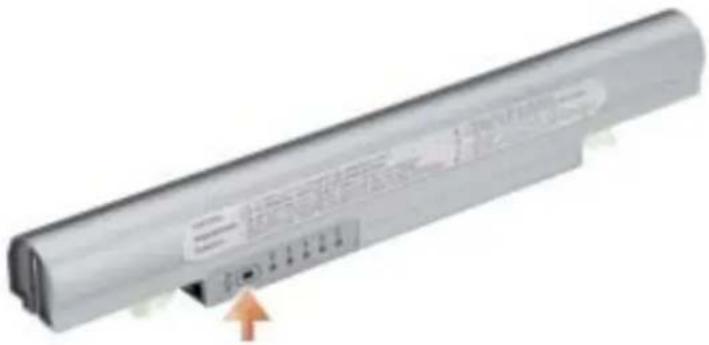
Before you insert a battery, press the status button on the battery charge gauge to illuminate the charge-level lights. Each light represents approximately 20 percent of the total battery charge. For example, if the battery has 80 percent of its charge remaining, four of the lights are on. If no lights appear, the battery has no charge.
natural_image
Close-up of a silver cylindrical battery with a small orange arrow pointing to its side (no visible text or symbols)Health Gauge
The battery operating time is largely determined by the number of times it is charged. After hundreds of charge and discharge cycles, batteries lose some charge capacity, or battery health. To check the battery health, press and hold the status button on the battery charge gauge for at least 3 seconds. If no lights appear, the battery is in good condition, and more than 80 percent of its original charge capacity remains. Each light represents incremental degradation. If five lights appear, less than 60 percent of the charge capacity remains, and you should consider replacing the battery. See "Specifications" in your User's Guide for more information about the battery operating time.
Low-Battery Warning

NOTICE: To avoid losing or corrupting data, save your work immediately after a low-battery warning.
Then connect the computer to an electrical outlet. If the battery runs completely out of power, hibernate mode begins automatically.
A pop-up window warns you when the battery charge is approximately 90 percent depleted. For more information about low-battery alarms, see "Power Management" in your User's Guide.
Charging the Battery

NOTE: The AC adapter charges a completely discharged battery in approximately 1 hour with the computer turned off. Charge time is longer with the computer turned on. You can leave the battery in the computer as long as you like. The battery's internal circuitry prevents the battery from overcharging.
When you connect the computer to an electrical outlet or install a battery while the computer is connected to an electrical outlet, the computer checks the battery charge and temperature. If necessary, the AC adapter then charges the battery and maintains the battery charge.
If the battery is hot from being used in your computer or being in a hot environment, the battery may not charge when you connect the computer to an electrical outlet.
The battery is too hot to start charging if the ⏻ light flashes alternately green and orange.
Disconnect the computer from the electrical outlet and allow the computer and the battery to cool to room temperature. Then connect the computer to an electrical outlet to continue charging the battery.
I'or more information about resolving problems with a battery, see "Power Problems" in your User's Guide.
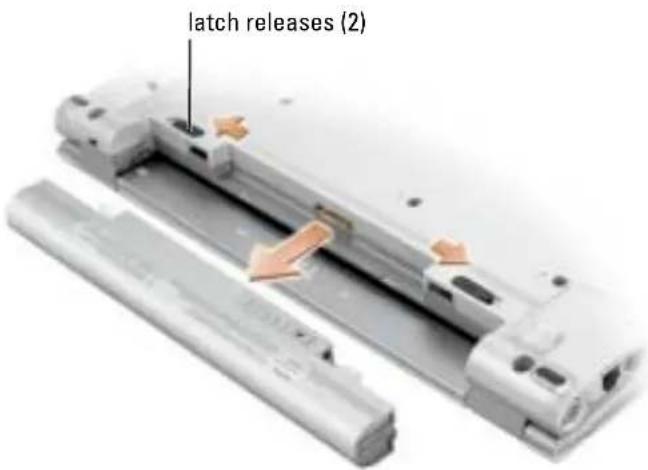
Removing a Battery

CAUTION: Before performing these procedures, disconnect the modem from the telephone wall jack.
1 Ensure that the computer is turned off or connected to an electrical outlet.
2 Slide and hold the battery-bay latch releases on the bottom of the computer, and then remove the battery from the bay.
Installing a Battery
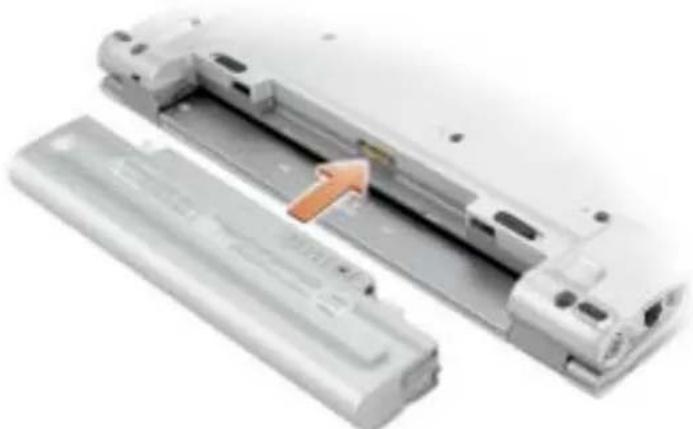
Slide the battery into the bay until the latch releases click.
natural_image
Disassembled electronic device casing with a highlighted orange arrow indicating a component (no text or symbols visible)Storing a Battery
Remove the battery when you store your computer for an extended period of time. A battery discharges during prolonged storage. After a long storage period, recharge the battery fully before you use it.
Solving Problems
Notebook System Software (NSS)
If you reinstall the operating system for your Dell™ computer, it is also recommended to reinstall the NSS utility. The utility is available on the optionalDrivers and Utilities CD and on the Dell Support website at support.dell.com.
To download the utility, go to Downloads at support.dell.com and select your computer model from the drop-down menu. Under Select Your Download Category select System and Configuration Utilities, select your operating system and language, and then follow the instructions.
NSS provides critical updates for your operating system and support for Dell ^™ 3.5-inch USB floppy drives, Intel ^® Pentium ^® M processors, Intel Celeron ^® M processors, optical drives, and USB devices. NSS is necessary for the correct operation of your Dell computer. The software automatically detects your computer and operating system and installs the updates appropriate for your configuration.

NOTE: NSS is critical for the correct operation of USB devices.
Lockups and Software Problems

CAUTION: Before you begin any of the procedures in this section, follow the safety instructions in the Product Information Guide.
The computer does not start up
ENSURE THAT THE AC ADAPTER IS FIRMLY CONNECTED TO THE COMPUTER AND TO THE ELECTRICAL OUTLET.
The computer stops responding

NOTICE: You might lose data if you are unable to perform an operating system shutdown.
TURN THE COMPUTER OFF — If you are unable to get a response by pressing a key on your keyboard or moving your mouse, press and hold the power button for at least 8 to 10 seconds until the computer turns off. Then restart your computer.
A program stops responding
END THE PROGRAM —
1 Press
2 Click Applications.
3 Click the program that is no longer responding.
4 Click End Task
A program crashes repeatedly

NOTE: Software usually includes installation instructions in its documentation or on a floppy disk or CD.
CHECK THE SOFTWARE DOCUMENTATION — If necessary, uninstall and then reinstall the program.
A program is designed for an earlier Microsoft® Windows® operating system
IF YOU ARE USING WINDOWS XP, RUN THE PROGRAM COMPATIBILITY WIZARD —
The Program Compatibility Wizard configures a program so it runs in an environment similar to non-Windows XP operating system environments.
1 Click the Start button, point to All Programs→Accessories, and then click Program Compatibility Wizard.
2 In the welcome screen, click Next.
3 Follow the instructions on the screen.
A solid blue screen appears
TURN THE COMPUTER OFF — If you are unable to get a response by pressing a key on your keyboard or moving your mouse, press and hold the power button for at least 8 to 10 seconds until the computer turns off. Then restart your computer.
Other software problems
CHECK THE SOFTWARE DOCUMENTATION OR CONTACT THE SOFTWARE MANUFACTURER FOR TROUBLESHOOTING INFORMATION —
- Ensure that the program is compatible with the operating system installed on your computer.
- Ensure that your computer meets the minimum hardware requirements needed to run the software. See the software documentation for information.
- Ensure that the program is installed and configured properly.
- Verify that the device drivers do not conflict with the program.
- If necessary, uninstall and then reinstall the program.
BACK UP YOUR FILES IMMEDIATELY.
USE A VIRUS-SCANNING PROGRAM TO CHECK THE HARD DRIVE, FLOPPY DISKS, OR CDs.
SAVE AND CLOSE ANY OPEN FILES OR PROGRAMS AND SHUT DOWN YOUR COMPUTER THROUGH THE Start MENU.
SCAN THE COMPUTER FOR SPYWARE — If you are experiencing slow computer performance, you frequently receive pop-up advertisements, or you are having problems connecting to the Internet, your computer might be infected with spyware. Use an anti-virus program that includes anti-spyware protection (your program may require an upgrade) to scan the computer and remove spyware. For more information, go to support.dell.com and search for the keyword spyware.
RUN THE DELL DIAGNOSTICS — If all tests run successfully, the error condition is related to a software problem.
Using the Dell Diagnostics
When to Use the Dell Diagnostics
If you experience a problem with your computer, perform the checks in "Solving Problems" and run the Dell Diagnostics before you contact Dell for technical assistance.
It is recommended that you print these procedures before you begin.

NOTICE: The Dell Diagnostics works only on Dell™ computers.
Start the Dell Diagnostics from either your hard drive or from the optional Drivers and Utilities CD (also known as the ResourceCD).
Starting the Dell Diagnostics From Your Hard Drive
The Dell Diagnostics is located on a hidden diagnostic utility partition on your hard drive.
NOTE: If your computer cannot display a screen image, contact Dell.
1 Shut down the computer.
2 Turn on the computer. When the DELL ^™ logo appears, press
3 When the boot device list appears, highlight Diagnostics and press
- During the assessment, answer any questions that appear.
- If a failure is detected, the computer stops and beeps. To stop the assessment and restart the computer, press
; to continue to the next test, press ; to retest the component that failed, press . - If failures are detected during the Pre-boot System Assessment, write down the error code(s) and contact Dell before continuing on to the Dell Diagnostics.
If the Pre-boot System Assessment completes successfully, you receive the messageBooting Dell Diagnostic Utility Partition. Press any key to continue.
NOTE: If you see a message stating that no diagnostics utility partition has been found, run the Dell Diagnostics from your Drivers and Utilities CD.
4 Press any key to start the Dell Diagnostics from the diagnostics utility partition on your hard drive.
Starting the Dell Diagnostics From the Optional Drivers and Utilities CD
1 Connect a CD drive to the system.
2 Insert the Drivers and Utilities CD.
3 Shut down and restart the computer.
When the DELL logo appears, press
If you wait too long and the Windows logo appears, continue to wait until you see the Windows desktop. Then shut down your computer and try again.
NOTE: The next steps change the boot sequence for one time only. On the next start-up, the computer boots according to the devices specified in system setup.
4 When the boot device list appears, highlight CD/DVD/CD-RW Drive and press
5 Select the CD/DVD/CD-RW Drive option from the CD boot menu.
6 Select the Boot from CD-ROM option from the menu that appears.
7 Type 1 to start the ResourceCD menu.
8 Type 2 to start the Dell Diagnostics.
9 Select Run the 32 Bit Dell Diagnostics from the numbered list. If multiple versions are listed, select the version appropriate for your computer.
10 When the Dell Diagnostics Main Menu appears, select the test you want to run.
Dell Diagnostics Main Menu
1 After the Dell Diagnostics loads and the Main Menu screen appears, click the button for the option you want.
| Option Function | |
| Express Test Performs a quick test of devices. This test typically takes 10 to 20 minutes and requires no interaction on your part. Run Express Test first to increase the possibility of tracing the problem quickly. | |
| Extended Test | Performs a thorough check of devices. This test typically takes 1 hour or more and requires you to answer questions periodically. |
| Custom Test Tests a specific device. You can customize the tests you want to run. | |
| Symptom Tree Lists the most common symptoms encountered and allows you to select a test based on the symptom of the problem you are having. | |
2 If a problem is encountered during a test, a message appears with an error code and a description of the problem. Write down the error code and problem description and follow the instructions on the screen.
If you cannot resolve the error condition, contact Dell.
NOTE: The Service Tag for your computer is located at the top of each test screen. If you contact Dell, technical support will ask for your Service Tag.
3 If you run a test from the Custom Test or Symptom Treeoption, click the applicable tab described in the following table for more information.
| Tab Function |
| Results Displays the results of the test and any error conditions encountered. |
Errors Displays error conditions encountered, error codes, and the problem description.
| Tab Function |
| Help Describes the test and may indicate requirements for running the test. |
| Configuration Displays your hardware configuration for the selected device.The Dell Diagnostics obtains configuration information for all devices from system setup, memory, and various internal tests, and it displays the information in the device list in the left pane of the screen. The device list may not display the names of all the components installed on your computer or all devices attached to your computer. |
| Parameters Allows you to customize the test by changing the test settings. |
4 When the tests are completed, if you are running the Dell Diagnostics from the Drivers and Utilities CD, remove the CD.
5 When the tests are complete, close the test screen to return to the Main Menu screen. To exit the Dell Diagnostics and restart the computer, close the Main Menu screen.
Dell™ Latitude™ X1
Dell Support-website — support.dell.com
natural_image
Close-up of a laptop connected to a black electronic device with cables (no visible text or symbols)natural_image
Close-up of a laptop keyboard with port connections and a hand pointing to the left side (no visible text or symbols)Over de computer
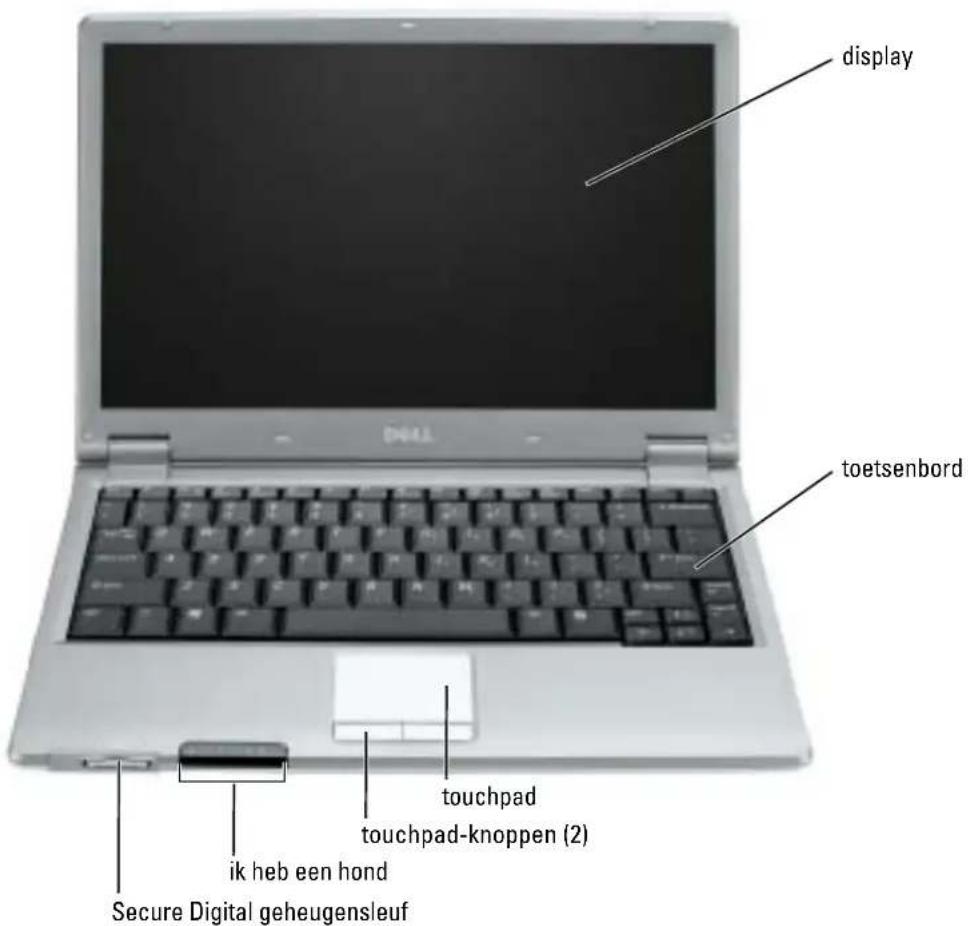
Vooraanzicht
natural_image
Exterior view of a silver battery with a small orange arrow pointing to its side (no visible text or symbols)Gezondheidscontrole
natural_image
Disassembled electronic device casing with a highlighted orange arrow indicating a component (no text or symbols visible)natural_image
Close-up of a laptop connected to a black electronic device via cable (no text or symbols visible)natural_image
Close-up of a laptop keyboard with port labels and a hand pointing to the right side (no visible text or symbols)natural_image
Exterior view of a silver cylindrical battery with a small orange arrow pointing to its side (no visible text or symbols)Jauge d'état
natural_image
Two views of a battery pack with an orange arrow indicating a specific component (no text or symbols visible)Dell Support-Website – support.dell.com
natural_image
Close-up of a laptop connected to a black electronic device via cable (no text or symbols visible)natural_image
Close-up of a laptop keyboard with port connections and a hand pointing to the left side (no visible text or symbols)natural_image
Exterior view of a silver-colored battery with a small orange arrow pointing to its side panel (no visible text or symbols)natural_image
Two views of a battery pack with an orange arrow indicating a specific component (no text or symbols visible)Lagern des Akkus
Gennaio 2005 N/P T6011 Rev. A00
Sommario
Drivers and Utilities 108
CD Drivers and Utilities (noto anche come ResourceCD)
natural_image
Close-up of a laptop connected to a black electronic device via cable (no text or symbols visible)natural_image
Close-up of a laptop keyboard with port and socket, showing no visible text or symbolsnatural_image
Exterior view of a silver cylindrical battery with a small orange arrow pointing to its side (no visible text or symbols)natural_image
Two views of a battery pack assembly, one showing internal components and the other showing exterior casing (no text or symbols visible)Enero 2005 N/P T6011 Rev. A00
Contenido
natural_image
Close-up of a laptop connected to a black electronic device via cable (no text or symbols visible)natural_image
Close-up of a laptop keyboard with port and socket, showing a hand pointing to the left side (no text or symbols visible)Acerca de su equipo
Vista anterior
natural_image
Exterior view of a silver cylindrical battery with a small orange arrow pointing to its side (no visible text or symbols)Medidor de estado
natural_image
Two views of a battery pack assembly with an orange arrow indicating a specific component (no text or symbols visible)- Notes, Notices, and Cautions
- Abbreviations and Acronyms
- Contents
- Finding Information 5
- Setting Up Your Computer 8
- About Your Computer 10
- Using a Battery 12
- Solving Problems 17
- Using the Dell Diagnostics 19
- Finding Information
- What Are You Looking For? Find It Here
- Setting Up Your Computer
- About Your Computer
- Bottom View
- Using a Battery
- Battery Performance
- Checking the Battery Charge
- Dell QuickSet Battery Meter
- Microsoft® Windows® Power Meter
- Charge Gauge
- Health Gauge
- Low-Battery Warning
- Charging the Battery
- Removing a Battery
- CAUTION: Before performing these procedures, disconnect the modem from the telephone wall jack.
- Installing a Battery
- Storing a Battery
- Solving Problems
- Notebook System Software (NSS)
- Lockups and Software Problems
- The computer does not start up
- The computer stops responding
- A program stops responding
- END THE PROGRAM —
- A program crashes repeatedly
- A program is designed for an earlier Microsoft® Windows® operating system
- IF YOU ARE USING WINDOWS XP, RUN THE PROGRAM COMPATIBILITY WIZARD —
- A solid blue screen appears
- Other software problems
- CHECK THE SOFTWARE DOCUMENTATION OR CONTACT THE SOFTWARE MANUFACTURER FOR TROUBLESHOOTING INFORMATION —
- BACK UP YOUR FILES IMMEDIATELY.
- Using the Dell Diagnostics
- When to Use the Dell Diagnostics
- Starting the Dell Diagnostics From Your Hard Drive
- Starting the Dell Diagnostics From the Optional Drivers and Utilities CD
- Dell Diagnostics Main Menu
- Dell™ Latitude™ X1
- Over de computer
- Vooraanzicht
- Gezondheidscontrole
- Jauge d'état
- Lagern des Akkus
- Sommario
- Contenido
- Acerca de su equipo
- Vista anterior
- Medidor de estado
Brand : DELL
Model : Latitude X1
Category : Laptop