
44.05 - Car radio Macrom - Free user manual and instructions
Find the device manual for free 44.05 Macrom in PDF.



| Product type | 4-channel car audio amplifier |
| Brand | Macrom |
| Model | 44.05 |
| Maximum power | 65 W x 4 (4 Ω) |
| RMS power (4 Ω) | 40 W x 4 (4 channels) / 40 W x 2 + 110 W x 1 (3 channels) / 100 W x 2 (2 channels) |
| Frequency response | 10 - 45,000 Hz (+0/-1 dB) |
| Signal-to-noise ratio | 105 dB (IHF-A) |
| Speaker impedance | 2-4 Ω (4 channels) / 2 Ω (stereo) / 4 Ω (bridged) |
| Built-in filters | Low-Pass and High-Pass adjustable from 50 to 160 Hz, slope 12 dB/octave |
| Input sensitivity | 500 mV (fixed) or variable from 100 mV to 2 V |
| Power supply | 14 V DC (11-16 V allowed), negative ground |
| Protections | Soft start, overheating, output short circuit |
| Status indicator | Check Control LED: white (off), green (operating), red (protection) |
| Dimensions (W x H x D) | 280 x 55 x 250 mm |
| Net weight | 3.2 kg |
| Fuses | 2 x 20 A (or 2 x 25 A) |
| By-Pass output (preamp) | Yes, in 2CH input mode |
| Circuit board material | Gold-plated Vetronite |
| Connectors | Gold-plated RCA input, gold-plated screw speaker outputs |
Frequently Asked Questions - 44.05 Macrom
User questions about 44.05 Macrom
0 question about this device. Answer the ones you know or ask your own.
Ask a new question about this device
Download the instructions for your Car radio in PDF format for free! Find your manual 44.05 - Macrom and take your electronic device back in hand. On this page are published all the documents necessary for the use of your device. 44.05 by Macrom.
USER MANUAL 44.05 Macrom
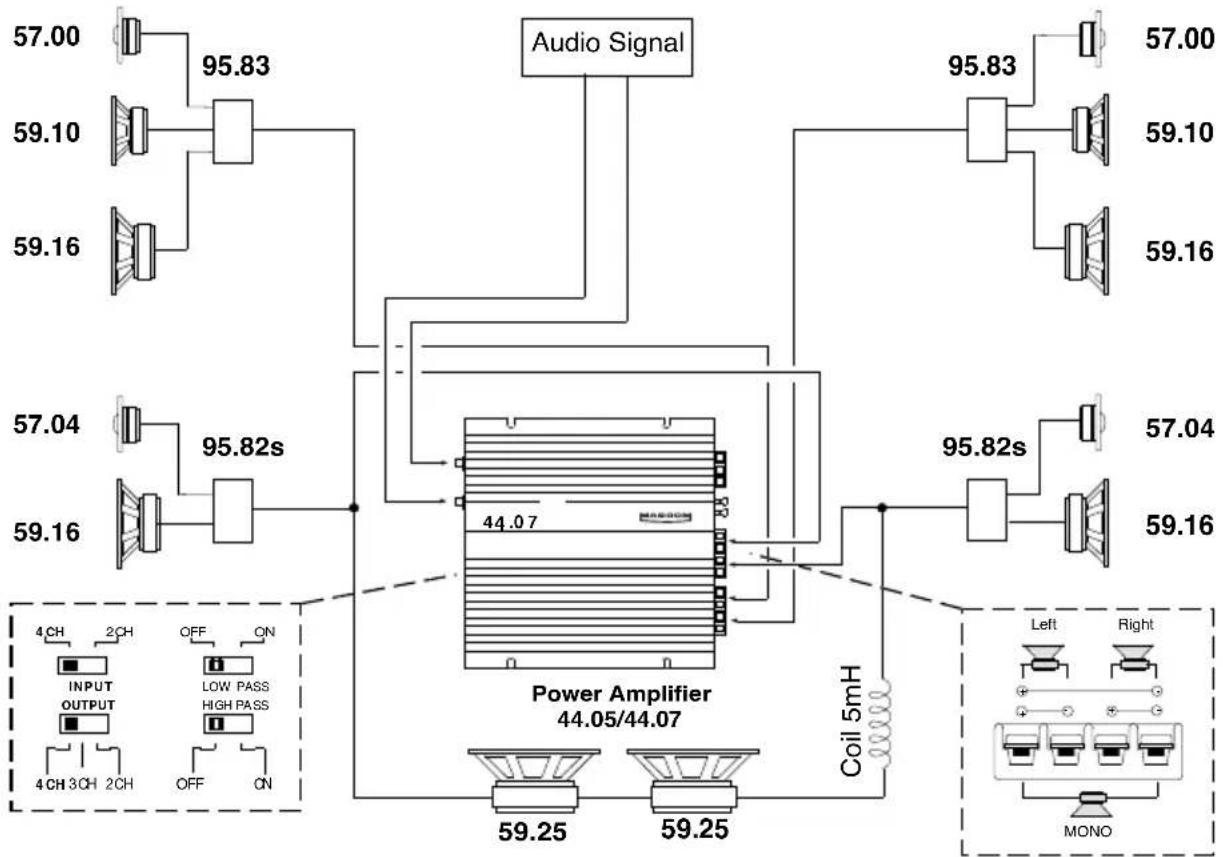
Five channel passive configuration
flowchart
graph TD
    A["57.00"] --> B["95.83"]
    C["59.10"] --> D["95.83"]
    E["59.16"] --> F["95.83"]
    G["57.04"] --> H["95.82s"]
    I["59.16"] --> J["95.82s"]
    K["44.07"] --> L["Power Amplifier 44.05/44.07"]
    M["59.25"] --> N["59.25"]
    O["95.83"] --> P["Coil 5mH"]
    Q["95.82s"] --> R["Coil 5mH"]
    S["57.00"] --> T["Audio Signal"]
    U["59.10"] --> V["Audio Signal"]
    W["59.16"] --> X["Audio Signal"]
    Y["57.04"] --> Z["Audio Signal"]
    AA["59.16"] --> AB["Audio Signal"]
    AC["4CH 2CH OFF ON INPUT OUTPUT LOW PASS HIGH PASS 4CH 3CH 2CH OFF ON"] --> AD["Power Amplifier 44.07"]
    AE["Left Right MONO"] --> AF["Power Amplifier 44.07"]
    AG["Left Right MONO"] --> AH["Power Amplifier 44.07"]
Six channel passive configuration

flowchart
graph TD
    A["57.00"] --> B["95.83"]
    C["59.10"] --> D["95.83"]
    E["59.16"] --> F["95.83"]
    G["57.04"] --> H["95.82s"]
    I["59.16"] --> J["95.82s"]
    K["Audio Signal"] --> L["Band-Pass Filter"]
    L --> M["Power Amplifier 44.05/44.07"]
    M --> N["Coil 5mH"]
    N --> O["Left"]
    N --> P["Right"]
    Q["4CH 2CH OFF ON INPUT OUTPUT LOW PASS HIGH PASS 4CH 3CH 2CH OFF ON"] --> M
    R["59.25"] --> M
    S["59.25"] --> M
    T["59.16"] --> M
    U["57.00"] --> V["95.83"]
    W["59.10"] --> X["95.83"]
    Y["59.16"] --> Z["95.82s"]
    AA["57.04"] --> AB["95.82s"]
    AC["59.16"] --> AD["95.82s"]
INTRODUCTION
For us at MACROM the achievement of the topmost sound quality is one of our greatest concerns. By the fact that you chose to buy one of the “programmable” amplifiers MACROM we realize that this is also your concern.
This unit offers 70/100 Watt max. 4-channel at 4 Ohm or 2x150 Watt max. when mono-bridged, with pure and stable sound qualities.
We advise you to read the following instructions very carefully in order to get the maximum out of the outstanding performances and the advanced features and functions of the 44.05/44.07. Please report any problem to the nearest MACROM dealer.
PRECAUTIONS
- The unit may be damaged by wrong lead connection, therefore read carefully the instructions of this manual for the correct connection of the leads.
- The last lead to be connected is the one to the positive (+) terminal of the battery; connect this lead only after having completed and checked all other connections.
- Due to the power of the 44.05/44.07 it is imperative that all connections are clean and secure in order to avoid damage to the unit.
- Be sure to install the amplifier in a position with good air circulation and good heat dissipation.
- In case of fuse replacement make sure to replace it with a fuse of the same amperage. The use of fuses with the wrong amperage may seriously damage the components of the unit. If fuses blow more than once, carefully check all electrical connections. Also have your car's voltage regulator checked. Do not attempt to repair the unit yourself. If repairs are ever needed, take the unit to your MACROM dealer or to your nearest MACROM service station.
- In order to obtain the best possible performance from this unit, make sure that the temperature inside your car is within the range of -10^ and +60^ before you switch the unit on. Good air circulation is essential to prevent heat build-up inside the unit.
FEATURES
The power of the 44.05/44.07 can be subdivided as follows:
a) 40/65 W RMS for each of the four output channels
b) 40/65 W RMS on two stereo channels and 110/150 W RMS mono
c) 100/150 W RMS on two stereo channels
• NO AMPERAGE LIMITATIONS
The amperage limitation circuits incorporated in traditional amplifiers may cause untimely clipping and a low transient response. The absence of such circuits ensures a low T.I.M. effect, an excellent transient response and a perfect sound quality.
• INPUT MODE SELECTOR
This selector allows the user to choose between 2 or 4 input signals to the amplifier.
• OUTPUT MODE SELECTOR
This selector allows the user to specify the number and the configuration of the outputs.
• BY-PASS OUTPUT
In the "2 CH INPUT" configuration a preamplified BY-PASS output with unitary gain can be used.
• ADJUSTMENT OF INDEPENDENT CROSSOVER FREQUENCIES
This control allows for independent and continuous adjustment of the Low Pass and High Pass crossover frequencies from 50 to 160 Hz adding great versatility to your unit.
• REMOTE ON/OFF
On switching the head unit on or off, the amplifier is automatically switched on or off.
• RCA INPUT SENSITIVITY
The sensitivity adjustment of this new amplifier is positioned at 500 mV for optimum coupling with other MACROM sources. However, the continuous adjustment from 100 mV to 2 V is possible for easy coupling of other sources available on the market.
- CHECK CONTROL INDICATOR
This LED Shows the current state of the amplifier.
WHITE The unit is off.
GREEN The unit works perfectly well.
RED The unit is in the protection mode, verify connections.
• TRIPLE PROTECTION
Your unit is provided with three different protection devices, as befits all high-end products:
SOFT START: the amp powers gradually in order to avoid damage to the speakers in case the head unit is switched on with the volume control set to maximum.
OVERHEATING: in case of wrong installation the unit enters the protection mode before being damaged. As soon as the temperature returns to normal values, the unit resumes normal operation.
OUTPUT SHORT CIRCUIT: in case of a short circuit at the speaker outlets the unit enters the protection mode in order to avoid serious damage to the end-stage transistors. Normal operation is resumed on eliminating the short circuit.
• FINAL STAGE WITH DISCREET COMPONENTS (TRANSISTORS)
FEATURES
• MOS-FET POWER SUPPLY STAGE
The high power of the 44.05/44.07 is obtained by the use of a highly sophisticated C-MOS-FET supply units giving constant performance, high efficiency in favour of lower current-consumption. The results are excellent performance, a linear and ample frequency response with high dynamics.
CAPACITIVE/INDUCTIVE POWER SUPPLY FILTER
This filter reduces radio frequency interferences (RFI) and cuts off system noises (i.e. the whine of the alternator).
• GILDED VETRONITE PRINTED CIRCUIT
• GOLD-PLATED RCA-CONNECTORS
• GOLD-PLATED SCREW-TYPE SPEAKER OUTPUT CONNECTIONS
INSTALLATION
INSTALLATION (Fig. 3, page 4)
Due to the high power of the amplifier a great amount of heat is generated when the unit is in use. Therefore, it is necessary to install the unit in a place with good air circulation or otherwise the amplifier will enter the protection mode. The most suitable place for installation is the boot; obviously, the unit should not be covered with carpet floor or similar.
- Place the unit at the point of installation and mark the position of the four securing screws provided.
- Drill the screw holes.
- Place the amplifier in the correct position and secure it by means of the four tapping screws provided.
NOTE: Connect the ground lead to a screw already provided on the chassis of the car (marked with an * in the figure).
CONNECTIONS
CONNECTIONS (Fig. 1, page 3)
①RCA-input connector, channel B/F (right)
② RCA-input connector, channel A/E (left)
③Input level adjustment of channels A-B
④RCA- input connector, channel D, or BY-PASS output connector (right)
⑤ RCA- input connector, channel C, or BY-PASS output connector (left)
⑥Input level adjustment of channels C-D
⑦ Output mode selector
⑧ Input mode selector
⑨High Pass on/off selector
⑩ Low Pass on/off selector
⑪ Frequency adjustment of Low Pass (the indication is referred to -3 dB)
⑫ Frequency adjustment of High Pass (the indication is referred to -3 dB)
CONNECTIONS
CONNECTIONS (Fig. 2, page 3)
⑬ Positive output terminal, speaker A, or positive output speaker E
⑭ Negative output terminal, speaker A
⑮ Positive output terminal, speaker B
⑯ Negative output terminal, speaker B, or negative output speaker E
⑰ Positive output terminal, speaker C, or positive output speaker F
⑱ Negative output terminal, speaker C
⑲ Positive output terminal, speaker D
20 Negative output terminal, speaker D, or negative output speaker F
212x20/2x25 A fuses
②2 Power supply terminal +12 V to the battery (BATT)
23 Terminal for connection of the negative ground lead (GND)
24 Terminal for remote switch-on (REMOTE)
25 Check control status indicator
CONNECTIONS:
- Battery lead: Connect the terminal BATT ②2 to the battery cable of the car by means of a (yellow) cable of adequate section.
Do not connect this lead to circuits existing within the electric system of the car. In order to avoid damage to the car it is imperative that this lead be fitted with a fuse (not provided) as near as possible to the battery. This connection is the to be carried out last. - Remote switch-on lead: Connect the remote switch-on lead (REMOTE) or the control lead of the power antenna coming from the head unit (blue) to the REMOTE ^24 terminal of the amplifier. NOTE: In case this lead is not connected, the amplifier will not be switched on when the head unit is switched on. If your head unit is not fitted with an outlet for a power antenna, a quick-break lever switch (SPST) shall be installed between the power source (+12 V) and the remote switch-on lead and connected to the REMOTE ^24 terminal so as to provide for manual switch-on of the amplifier.
- Ground lead: Secure the ground lead (black) to a clean spot on the car chassis and to the GND terminal 23. Make sure that there is electric continuity between this spot and the negative terminal of the battery. The ground cable should be as short as possible; in case more than one amps are used, connect all the ground connectors to one spot.
- Fuse: In case of fuse replacement make sure to replace it with a fuse of the same amperage. The use of fuses with the wrong amperage may seriously damage the components of the unit.
- Speaker outlet terminals: Make sure to keep the right polarity and phase on connecting the speakers. This includes the control of the right polarity, positive (+) and negative (-). NOTE: The negatives of the speakers should NEVER be connected witch each other and no common ground lead must be used. Non adequately isolated wires should never come into contact with each other, with metallic parts of the car or with the ground lead.
- RCA input connectors: Connect the Pre output leads of your head unit to the RCA input connectors by means of RCA extension cables (90.05-90.10-90.25-90.50 by MACROM). Make sure to observe the right channel designation: left L (white) and right R (red).
SETTINGS AND SELECTORS
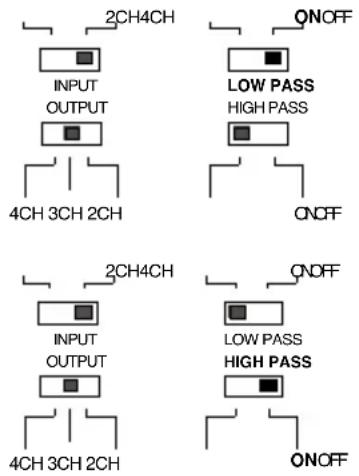
ON/OFF MODE & HIGH-PASS SELECTOR SWITCH
a) "ON/OFF Low-Pass" MODE: Select the "ON" position when you want to use the Low-Pass filter section; thus, only the low frequencies are output at the C-D or F outputs.
b) "ON/OFF High-Pass"MODE: Select the "ON" position when you want to use the High-Pass filter section; thus, only the medium-high frequencies are output at the A-B or E outputs.
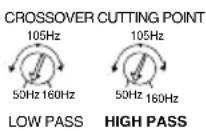
ADJUSTMENT OF LOW&HIGH PASS FREQUENCIES
a) "HIGH PASS": Allows for continuous adjustment of the High Pass frequency between 50 and 160 Hz, that is, for the determination of the point where the medium-high frequencies start.
b) "LOW PASS": Allows for continuous adjustment of the Low Pass frequency between 50 and 160 Hz, that is for the determination of the point where the low frequencies end.
INPUT GAIN ADJUSTMENT CONTROL
In the mid position (click) an input sensitivity of 500 mV is selected corresponding to the preamplified outputs of MACROM products.
In case the amplifier is to be connected to a head unit that is not of MACROM make but is fitted with preamplified RCA outputs, proceed as follows:
a) adjust the volume control of your head unit to 3/4 of maximum output level.
b) turn the input gain control by means of a screwdriver and adjust the input gain from 2 V to 0.1 V in order to have the maximum sound level with no distortion.
NOTE: Both adjustments are always activated, independently from the number of inputs, except in case "c" described at page 13.
flowchart
graph TD
    A["2CH4CH INPUT OUTPUT"] --> B["2CH4CH ONOFF"]
    C["4CH 3CH 2CH"] --> D["2CH4CH INPUT OUTPUT"]
    E["LOW PASS HIGH PASS"] --> F["2CH4CH ONOFF"]
    G["4CH 3CH 2CH"] --> H["2CH4CH ONOFF"]
    I["2CH4CH INPUT OUTPUT"] --> J["2CH4CH ONOFF"]
    K["4CH 3CH 2CH"] --> L["2CH4CH ONOFF"]
    M["LOW PASS HIGH PASS"] --> N["2CH4CH ONOFF"]


GAIN
CONTRO

GAIN
CONTRO

GAIN
CONTROL

GAIN
CONTROL
SETTINGS AND SELECTORS
OUTPUT MODE SELECTOR WITH 4 INPUT CHANNELS
a) "4CH INPUT" "4CH OUTPUT" MODE: As your head unit is equipped with four pre-amplified outputs select the position "4CH" and connect the outputs to the amplifier inputs marked with the letters A (left), B (right), C (left) and D (right). Thus, the amplifier can be used as a 4-channel stereo system, front section A and B and rear section C and D, by using the speaker outputs A, B, C and D. You can then activate (ON) independently the different sections of the built-in electronic crossover to obtain the High-Pass outputs A and B and/or the Low-Pass outputs C and D.

b) "4CH INPUT" "3CH OUTPUT" MODE: This configuration uses a single 44.05/44.07 amplifier as a multi-amplifying system. There are 3 output channels, 2 stereo channels A and B, and a third channel F with a single bridged mono signal which can then be balanced by means of the fader control of your head unit.
In case you want to use the built-in electronic crossover, it is possible to connect medium-high speaker systems to the A and B outputs by placing the High-Pass selector in the ON position, whereas a woofer system or a powerful subwoofer can be connected to the section F by placing the Low-Pass in the ON position.

SETTINGS AND SELECTORS
OUTPUT MODE SELECTOR WITH 2 INPUT CHANNELS AND A BY-PASS OUTPUT
a) "2CH INPUT" "4CH OUTPUT" MODE: As your head unit is equipped with only two pre-amplified outputs select the position "2CH" and connect the outputs to the amplifier inputs marked with the letters A / E (left) and B / F (right). Then select the position "4CH" in order to have 4 output channels, A, B, C and D, respectively, to drive 4 speakers. You can then activate (ON) the different sections of the built-in electronic crossover to obtain the High-Pass outputs A and B and/or the Low-Pass outputs C and D.
NOTE: In case a preamplified output is needed to control another amplifier, the RCA-connectors C and D marked BY-PASS and carrying a unitary gain output signal can be used.
The By-Pass output is active only with the "2CH INPUT" configuration.
IMPORTANT NOTE: Both input sensitivity adjustments are activated and operate independently on the respective outputs.

b) "2CH INPUT" "3CH OUTPUT" MODE: This configuration uses a single 44.05/44.07 amplifier as a multi-amplifying system. There are 3 output channels, 2 stereo channels A and B, and a third channel F with a single bridged mono signal.
In case you want to use the built-in electronic crossover, the outputs A and B can be connected to medium-high speaker systems by placing the High-Pass selector in the ON position, whereas by placing the Low-Pass selector in the position ON a woofer system or a powerful subwoofer can be connected to the mono output F.
IMPORTANT NOTE: Both input sensitivity adjustments are activated and operate independently on the respective outputs.

c) "2CH INPUT" "2CH OUTPUT MODE: This configuration uses the amplifier as a traditional and powerful 2-channel stereo system with the output channels E and F.
On activating the built-in electronic crossover, Low-Pass ON with this configuration, only the low frequencies are output for driving two powerful subwoofers.
IMPORTANT NOTE: With this configuration only one of the two input sensitivity controls (the right one) is activated for the adjustment of the signal at the E (left) outputs.

TECHNICAL DATA
44.05 Maximum Power 65Wx4
Nominal RMS 4 Ohm, 20Hz to 20 kHz at 0.1% THD
"4 CH Output" mode 40Wx4
"3 CH Output" mode 40Wx2 110Wx1
"2 CH Output" mode 100Wx2
44.07 Maximum Power 85Wx4
Nominal RMS 4 Ohm, 20Hz to 20 kHz at 0.1% THD
"4 CH Output" mode 60Wx4
"3 CH Output" mode 60Wx2 150Wx1
"2 CH Output" mode 150Wx2
Output By-Pass (Preamplifier) 1-1
Frequency response +0, -1dB 10-45.000 Hz
S/N IHF-A-weighted 105 dB
Crossover frequencies
LOW-PASS 50-160 Hz
HIGH-PASS 50-160 Hz
Crossover slope 12dB/oct.
Input sensitivity/Impedance
(for nominal power output)
Control in central position (click) 500mV/10 kOhm
Variable control 100-2,000 mV/10 kOhm
Speaker impedance 2CH 4 Ohm
3CH 2 Ohm 4 Ohm (mono bridged)
4CH 2-4 Ohm
Power supply ( Negative ground ) 14.0V DC (11-16V permissible)
Net Weight
44.05 3.2 kg
44.07 4.5 kg
Chassis size
44.05 280(W) × 55(H) × 250(D)
44.07 280(W) x 55(H) x 300(D)
Due to continuing improvement, the features and the design are subject to change without notice.
EINFÜHRUNG
Nominale RMS 4 Ohms, 20Hz to 20 kHz at 0.1% THD
Modo "4CH USCITA" 40Wx4
Modo "3CH USCITA" 40Wx2 110Wx1
Modo "2CH USCITA" 100Wx2
Nominale RMS 4 Ohms, 20Hz to 20 kHz at 0.1% THD
Modo "4CH USCITA" 60Wx4
Modo "3CH USCITA" 60Wx2 150Wx1
Modo "2CH USCITA" 150Wx2
Uscita By-Pass (Preamplificata) 1-1


- INTRODUCTION
- PRECAUTIONS
- FEATURES
- • NO AMPERAGE LIMITATIONS
- • INPUT MODE SELECTOR
- • OUTPUT MODE SELECTOR
- • BY-PASS OUTPUT
- • ADJUSTMENT OF INDEPENDENT CROSSOVER FREQUENCIES
- • REMOTE ON/OFF
- • RCA INPUT SENSITIVITY
- - CHECK CONTROL INDICATOR
- • TRIPLE PROTECTION
- • FINAL STAGE WITH DISCREET COMPONENTS (TRANSISTORS)
- • MOS-FET POWER SUPPLY STAGE
- CAPACITIVE/INDUCTIVE POWER SUPPLY FILTER
- • GILDED VETRONITE PRINTED CIRCUIT
- • GOLD-PLATED RCA-CONNECTORS
- • GOLD-PLATED SCREW-TYPE SPEAKER OUTPUT CONNECTIONS
- INSTALLATION
- INSTALLATION (Fig. 3, page 4)
- CONNECTIONS
- CONNECTIONS (Fig. 1, page 3)
- CONNECTIONS (Fig. 2, page 3)
- CONNECTIONS:
- SETTINGS AND SELECTORS
- ON/OFF MODE & HIGH-PASS SELECTOR SWITCH
- ADJUSTMENT OF LOW&HIGH PASS FREQUENCIES
- INPUT GAIN ADJUSTMENT CONTROL
- OUTPUT MODE SELECTOR WITH 4 INPUT CHANNELS
- OUTPUT MODE SELECTOR WITH 2 INPUT CHANNELS AND A BY-PASS OUTPUT
- TECHNICAL DATA
- EINFÜHRUNG
Brand : Macrom
Model : 44.05
Category : Car radio