
Officejet 5744 - Printer HP - Free user manual and instructions
Find the device manual for free Officejet 5744 HP in PDF.



| Product Type | Multifunction printer (print, scan, copy, fax) |
| Brand | HP |
| Model | Officejet 5744 |
| Dimensions (approx.) | 447 x 472 x 269 mm |
| Weight (approx.) | 8.5 kg |
| Power supply | 100-240 V AC, 50/60 Hz |
| Main functions | Print, scan, copy, wireless fax, Wi-Fi Direct, Apple AirPrint |
| Connectivity | USB 2.0, Wi-Fi (802.11 b/g/n), Ethernet 10/100 |
| Display | Color touchscreen control panel |
| Automatic document feeder | Yes, for documents (ADF) |
| Scanner glass | Yes |
| Ink cartridges | HP, user-replaceable |
| Print heads | User-replaceable (depending on model) |
| Maintenance | Unplug before cleaning; use a soft cloth |
| Safety | Follow precautions: stable surface, avoid water, do not obstruct ventilation slots |
| Available spare parts | Ink cartridges, print heads, power cord |
| Repairability | No user-serviceable parts; refer to qualified technician |
| Manufacturer warranty | 1 year for printer, 90 days for software media |
| OS compatibility | Windows, macOS, iOS, Android |
| General information | Manual available in multiple languages; online help at HP Support |
Frequently Asked Questions - Officejet 5744 HP
User questions about Officejet 5744 HP
0 question about this device. Answer the ones you know or ask your own.
Ask a new question about this device
Download the instructions for your Printer in PDF format for free! Find your manual Officejet 5744 - HP and take your electronic device back in hand. On this page are published all the documents necessary for the use of your device. Officejet 5744 by HP.
USER MANUAL Officejet 5744 HP
- Follow the illustrations on the setup flyer to set up your printer.
- Install software.
Windows®
Go to 123.hp.com/0J5740, and then follow the on-screen instructions. If your computer is not connected to the Internet, insert the software CD in your computer. If the CD does not start, browse to Computer, double-click the CD/DVD drive icon with the HP logo, double-click setup.exe, and then follow the on-screen instructions.
OS X/iOS
To install the latest HP software on a Mac, go to 123.hp.com/0J5740. HP software for Mac is not included on the software CD that came with the printer.
This product is Apple AirPrint enabled. The printer and iOS device or Mac must be on the same local network.
Note: Always make sure that the paper tray is loaded with the desired paper. After closing the tray, ensure that this paper is selected on the printer control panel.
Learn more
Electronic Help: Install the electronic Help by selecting it from the recommended software during software installation. Learn about product features, printing, troubleshooting, and support. Find notices, environmental, and regulatory information, including the European Union Regulatory Notice and compliance statements, in the Technical Information section.
- Windows® 8.1: Click the down arrow in lower left corner of the Start screen, select the printer name, click Help, and then select Search HP Help.
- Windows® 8: On the Start screen, right-click an empty area on the screen, click All Apps on the app bar, click the icon with the printer's name, and then click Help.
- Windows® 7, Windows Vista®, and Windows® XP: Click Start > All Programs > HP > HP Officejet 5740 series > Help.
- OS X: Click Help > Help Center. In the Help Viewer window, click Help for all your apps, and then click HP Officejet 5740 series.
Readme: Contains HP support information, operating system requirements, and recent printer updates.
- Windows: Insert the software CD in your computer, and then browse to the ReadMe.chm file. Double-click ReadMe.chm to open, and then select the ReadMe in your language.
- Mac: Open the Documents folder located at the top-level of the software installer. Double-click ReadMe, and then select the ReadMe in your language.
On the Web: Additional help and information: www.hp.com/go/support. Printer registration: www.registerer.hp.com. Declaration of Conformity: www.hp.eu/certificates. Ink usage: www.hp.com/go/inkusage.
Scan to find out more!
Standard data rates may apply. Might not be available in all languages. www.hp.com/eu/m/0J5740


DEEN FR
IT
PTES NL
The information contained herein
is subject to change without notice.

B9576-90056
Printed in [English]
© 2014 Hewlett-Packard Development Company, L.P.
Control panel
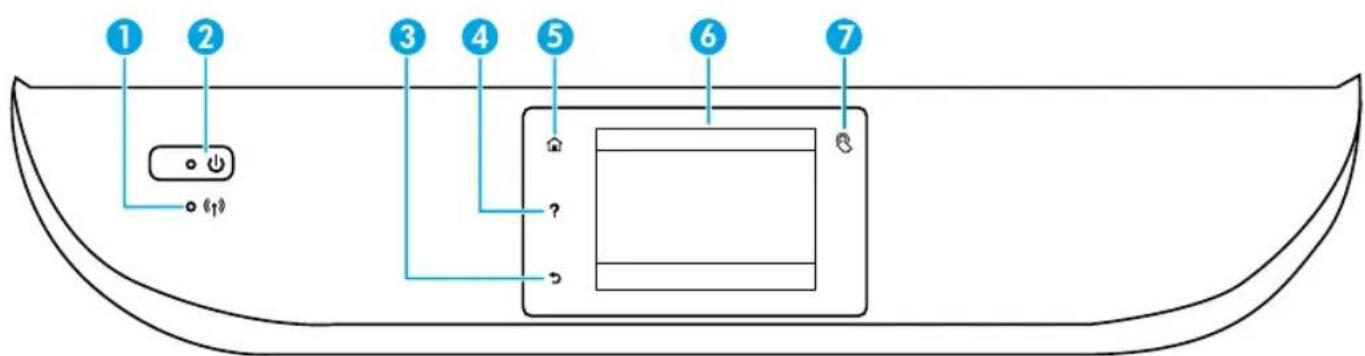
1 Wireless light: Indicates the status of the printer wireless connection.
- Solid blue light indicates that wireless connection has been established and you can print.
- Slow blinking light indicates that wireless is on, but the printer is not connected to a network. Make sure your printer is within the range of wireless signal.
- Fast blinking light indicates wireless error. Refer to the message on the printer display.
- If wireless is turned off, the wireless light is off and the display screen shows Wireless Off.
| 2 | On button: Turns the printer on or off. |
| 3 | Back button: Returns to the previous screen. |
| 4 | Help button: Shows help content if it is available for the current operation. |
| 5 | Home button: Returns to the Home screen, the screen that is displayed when you first turn on the printer. |
| 6 | Control panel display: Touch the screen to select menu options, or scroll through the menu items. |
| 7 | Near Field Communication (NFC) button: Indicates the area where you can print documents and images from a mobile device (such as a smartphone or tablet) by touching the device on the printer. |
Safety information
Always follow basic safety precautions when using this printer to reduce the risk of injury from fire or electric shock.
- Read and understand all instructions in the documentation that comes with the printer.
- Observe all warnings and instructions marked on the printer.
- Unplug this printer from wall outlets before cleaning.
- Do not install or use this printer near water, or when you are wet.
- Install the printer securely on a stable surface.
- Install the printer in a protected location where no one can step on or trip over the power cord, and the power cord cannot be damaged.
- If the printer does not operate normally, see the help file (which is available on your computer after you install the software).
- There are no user-serviceable parts inside. Refer servicing to qualified service personnel.
- Use only with the power cord and power adapter (if provided) supplied by HP.
Basic troubleshooting
If you are unable to print:
- Make sure the cable connections are secure.
- Make sure the printer is powered on. The On button will be lit white.
- Check the wireless status light to make sure your printer is connected to a network.
- Visit the HP Diagnostic Tools website at www.hp.com/go/tools to download free diagnostic utilities (tools) that you can use to fix common printer problems.
Make sure that the printer is set as your default printing device:
- Windows 8.1 and Windows 8: Point to or tap the upper-right corner of the screen to open the Charms bar, click the Settings icon, click or tap Control Panel, and then click or tap View devices and printers.
- Windows 7: From the Windows Start menu, click Devices and Printers.
- Windows Vista: On the Windows taskbar, click Start, click Control Panel, and then click Printer.
- Windows XP: On the Windows taskbar, click Start, click Control Panel, and then click Printers and Faxes.
Make sure that your printer has a check mark in the circle next to it. If your printer is not selected as the default printer, right-click the printer icon and choose Set as Default Printer from the menu.
If you are using a USB cable and you are still unable to print, or the software installation fails:
- Remove the CD from the CD/DVD drive, and then disconnect the USB cable from the computer.
- Restart the computer.
- Insert the printer software CD in the CD/DVD drive, and then follow the on-screen instructions to install the printer software. Do not connect the USB cable until you are told to do so.
- After the installation finishes, restart the computer.
If you are using wireless and you are still unable to print:
Go to the Networking section on the next page for more information.
MacWindows
Check your print queue:
- In System Preferences, click Printers & Scanners (Print & Fax in OS X v10.7 Lion and OS X v10.8 Mountain Lion).
- Click Open Print Queue.
- Click a print job to select it.
- Use the following buttons to manage the print job:
- Cancel icon: Cancel the selected print job.
- Resume: Continue a paused print job.
- If you made any changes, try to print again.
Restart and reset:
- Restart the computer.
- Reset the printer.
a. Turn off the printer and unplug the power cord. b. Wait a minute, then plug the power cord back in and turn on the printer.
Reset the printing system:
- In System Preferences, click Printers & Scanners (Print & Fax in OS X v10.7 Lion and OS X v10.8 Mountain Lion).
- Press and hold the Control key as you click the list at the left, and then choose Reset printing system.
- Add the printer you want to use.
Uninstall the software:
- If the printer is connected to your computer through USB, disconnect the printer from your computer.
- Open the Applications/Hewlett-Packard folder.
- Double-click HP Uninstaller, and then follow the on-screen instructions.
Anonymous usage information storage: The HP cartridges store a limited set of anonymous information about the usage of the printer. For more information and instructions for disabling this storage, see the electronic Help.
Acknowledgements: Windows XP, Windows Vista, Windows 7, Windows 8, and Windows 8.1 are U.S. registered trademarks of Microsoft Corporation.
Mac, OS X, and AirPrint are trademarks of Apple Inc., registered in the U.S. and other countries.
Wireless networking
Need networking help?
www.hp.com/go/wirelessprinting
The HP Wireless Printing Center at www.hp.com/go/wirelessprinting can help you prepare your wireless network, set up or reconfigure your printer, and troubleshoot networking problems.
If connecting your printer to the network was unsuccessful
- Confirm that wireless is enabled on your printer.
- From the printer control panel, touch (Wireless).
- If it shows Wireless Off, touch (Settings), and then touch Wireless Settings.
- In the Wireless Settings screen, select On for the Wireless option.
- Confirm that your printer is connected to your network.
- From your printer control panel, touch (Wireless).
- Touch (Settings).
- Touch Print Reports, and then touch Wireless Test Report. The Wireless Test Report is automatically printed.
- Check the top of the report to see if something failed during the test.
See the Diagnostics Results section for all tests that were performed, to determine whether or not your printer passed. - From the Current Configuration section, find out the Network Name (SSID) to which your printer is currently connected. Make sure that the printer is connected to the same network as your computer.
Note: If your computer is connected to a Virtual Private Network (VPN), temporarily disconnect from the VPN before proceeding with the installation. After installation you will need to disconnect from the VPN to access your printer over your home network.
- Make sure security software is not blocking communication over your network.
Security software, such as firewalls, can block communication between your computer and printer when installing over a network. If your printer cannot be found, temporarily disable your firewall and check if the problem goes away. For more help and tips on security software, go to: www.hp.com/go/wpc-firewall.
- Restart components of the wireless network.
Turn off the router and the printer, and then turn them back on in this order: router first and then printer. Sometimes, turning off devices and then turning them back on helps resolve network communication issues. If you still cannot connect, turn off the router, the printer, and the computer, and then turn them back on in this order: router first, then printer, and then computer.
Note: If the wireless connection cannot be made, the printer can also be connected to the network using an Ethernet cable.
If you still have problems, visit the HP Wireless Printing Center (www.hp.com/go/wirelessprinting). This website contains the most complete, up-to-date information about wireless printing, as well as information to help you prepare your wireless network; solve problems when connecting the printer to the wireless network; and resolve security software issues.
Note: If you are using a computer running Windows, you can use the Print and Scan Doctor tool, which can help solve many problems you might have with the printer. To download this tool, visit www.hp.com/go/tools.
If you want to share your printer with multiple computers on your network
First install your printer on your home network. After you have successfully connected your printer to your home network, you can share your printer with other computers on the same network. For each additional computer you only need to install the HP printer software.
Wireless networking (continued)
If you want to change from a USB connection to a wireless connection
First make sure that you have already successfully installed your printer software.
Windows
- Do one of the following according to your operating system:
- Windows 8.1: Click the down arrow in lower left corner of the Start screen, select the printer name, and then click Utilities.
- Windows 8: On the Start screen, right-click an empty area on the screen, click All Apps on the app bar.
- Windows 7, Windows Vista, and Windows XP: From the computer's Start menu, select All Programs or Programs, and then select HP.
- Select HP Officejet 5740 series.
- Select Printer Setup & Software.
- Select Convert a USB connected printer to wireless. Follow the on-screen instructions.
Mac
Use HP Utility in Applications/Hewlett-Packard to change the software connection to wireless for this printer.
If you want to use the printer wirelessly without a router
Use Wi-Fi Direct to print wirelessly without a router, from your computer, smartphone, or other wireless enabled device. To use Wi-Fi Direct from a computer, the printer software must be installed on the computer.
- Make sure that Wi-Fi Direct on your printer is turned on:
a. From the Home screen on the printer display, touch (Wi-Fi Direct). b. If Status is Off, touch (Wi-Fi Direct Settings) and turn Wi-Fi Direct on.
- Connect your wireless enabled device to your printer:
a. Turn on the Wi-Fi connection on your mobile device. For more information, see the documentation provided with the mobile device. b. From the mobile device, connect to a new network. Use the process you normally use to connect to a new wireless network or hotspot. Choose the Wi-Fi Direct name from the list of wireless networks shown such as DIRECT-**-HP Officejet-5740 (where ** are the unique characters to identify your printer). c. Enter the Wi-Fi Direct password when prompted.
- Print as you normally do from your computer or mobile device.
Note: Wi-Fi Direct connection does not provide Internet access.
Visit the HP Wireless Printing Center at www.hp.com/go/wirelessprinting for more information about Wi-Fi Direct.
This product is designed for use in open environments (e.g., in homes and not connected to the public internet) in which anyone may access and use the printer. As a result, the Wi-Fi Direct setting is in "Automatic" mode by default, without an administrator password; this allows anyone in wireless range to connect and access all functions and settings of the printer. If higher security levels are desired, HP recommends changing the Wi-Fi Direct Connection Method from "Automatic" to "Manual" and establishing an administrator password.
If you want to print with AirPrint
This printer is Apple AirPrint™-enabled. You can print wirelessly from your iOS device or Mac.
- Your printer and iOS device or Mac must be on the same wireless network.
- With Apple AirPrint™, you cannot scan documents from the printer to your iOS device.
Setup fax
- If your country or region is listed below, visit www.hp.com/uk/faxconfig for setup information. Otherwise, follow the instructions in this guide.
Austria
Finland
- Ireland
Netherlands
Sweden
Belgium
France
Italy
- Portugal
Switzerland
Denmark
Germany
Norway
Spain
United Kingdom
- Connect the phone line.
Note: HP printers are designed specifically for use with traditional analog phone services. If you are in a digital phone environment (such as DSL/ADSL, PBX, ISDN, or VoIP), you might need to use digital-to-analog filters or converters when setting up the printer for faxing. Contact your phone company to determine which setup options are best for you.
If the phone line is only used for fax
a. Connect one end of the phone cord to the phone wall jack. b. Connect the other end to the port labeled 1-LINE on the back of the printer.
If you have subscribed to a DSL/ADSL service, connect a DSL/ADSL filter between the 1-LINE port and the phone wall jack.
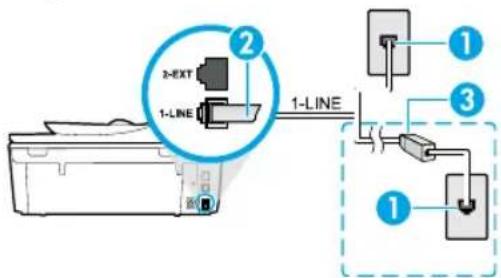
1 Phone wall jack 2 Fax port (1-LINE) Note: Do not insert into the port labeled 2-EXT. 3 DSL/ADSL filter (provided by the telephone company or service provider)
If additional devices are connected to the phone line
If you have other devices to connect, connect them as shown in the diagram below:
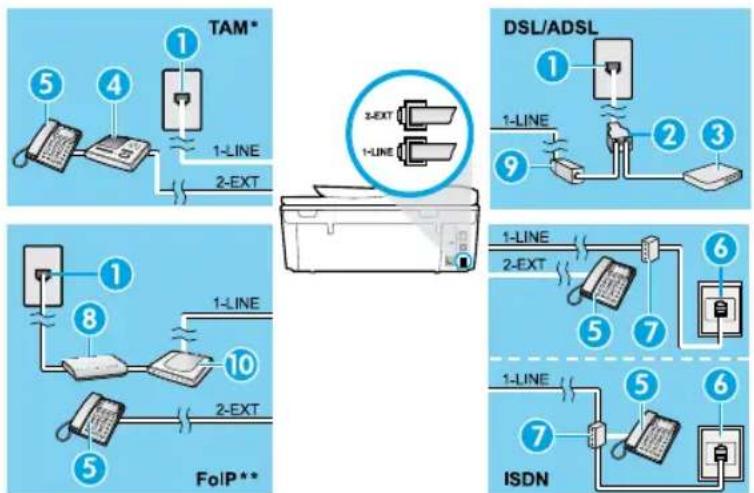
- TAM: Telephone answering machine ** VoIP: Fax over Internet Protocol
1 Phone wall jack 2 Parallel splitter 3 DSL/ADSL modem 4 Telephone answering machine 5 Telephone 6 ISDN wall jack 7 Terminal adapter or ISDN router 8 Broadband modem 9 DSL/ADSL filter 10 Analog telephone adaptor
- Test fax setup.
The fax test checks hardware, verifies phone cord type and connection status, and checks for a dial tone and an active phone line. To run the test:
a. From the Home screen on the printer display, press the Up and Down buttons to select Fax, and then press OK. b. Select Settings, select Advanced Settings, select Fax Setup Wizard, and then follow on-screen instructions.
Use fax
Send a standard fax
- Load your original print-side down on the right front corner of the scanner glass or print-side up in the Document Feeder.
- From the printer control panel display, touch Fax.
- Touch Send Now.
- Enter the fax number by using the keypad.
To add a pause in the fax number, press * repeatedly, until a dash (-) appears on the display.
- Touch Black or Color.
If the printer detects an original loaded in the document feeder, it sends the document to the number you entered.
If the recipient reports problems with the quality of the fax you sent, try changing the resolution or contrast of your fax.
Send a fax using an extension phone
- Dial the number by using the keypad on the extension phone. Do not use the keypad on the printer control panel when sending a fax using this method.
- If the recipient answers the phone, you can engage in a conversation before sending the fax. If a fax machine answers the call, you will hear fax tones from the receiving fax machine.
- Load your original print-side down on the right front corner of the scanner glass or print-side up in the document feeder.
- From the printer control panel display, touch Fax.
- Touch Send Fax.
- Touch Black or Color.
If you were on the phone with the recipient, ask the recipient to start receiving the fax when they hear fax tones on the fax machine. When the printer begins faxing, you can hang up the phone or remain on the line. You might not hear fax tones during fax transmission.
For more information about other ways you can send faxes, such as scheduling a fax to be sent later or sending faxes from a computer, see the electronic Help.
Receive a fax automatically
By default, the printer automatically answers incoming calls and receives faxes.
To receive faxes manually, turn off Auto Answer from the printer control panel.
The printer will answer calls after the number of rings specified in the Rings to Answer setting.
If an answering machine is connected to the printer, the Rings to Answer setting for the printer must be set to a higher number than the answering machine.
- Make sure the printer is turned on and paper is loaded.
- From the printer display, touch Fax.
- Touch Setup, and then touch Preferences.
- Select On for the Auto Answer option.
Note: If you have subscribed to a voice mail service on the same phone line that you will use for faxing, you cannot receive faxes automatically. You must be available to respond in person to incoming fax calls. (If you want to receive faxes automatically, contact your phone company to subscribe to a distinctive ring service or to obtain a separate phone line for faxing.)
The printer can store received faxes in its internal memory. To reprint these faxes, see "Reprint received faxes from memory" on the next page.
Use fax (continued)
Receive a fax manually
If you are on the phone with another person, you can receive faxes manually without hanging up the phone.
- Make sure the printer is turned on and paper is loaded.
- Remove any originals from the document feeder.
Set Rings to Answer to a higher number to allow you time to answer the incoming call before the printer does.
Or turn off Auto Answer so that the printer does not automatically answer incoming calls.
- Ask the sender to start sending the fax.
- When you hear fax tones, from the Home screen on the printer control panel, touch Fax, touch Send and Receive, and then touch Receive Now.
When the printer begins to receive the fax, you can hang up the phone or remain on the line. You might not hear fax tones during fax transmission.
Reprint received faxes from memory
If Backup Fax Reception is turned on, incoming faxes will be stored in memory even when the printer has an error condition.
Note: All faxes stored in memory might be deleted from memory when the printer is turned off.
- Make sure paper is loaded in the printer.
- From the Home screen on the printer display, touch Fax.
- Touch Reprint.
The faxes are displayed in the reverse order from when they were received, with the most recently received fax printed first.
- To stop printing, select Cancel.
Print a report or log
Fax reports provide useful system information about the printer.
- From the Home screen on the printer display, touch Setup and then touch Fax Setup.
- Touch Reports and then touch Fax Confirmation.
- Touch to select one of the options.
Solve fax problems
If you still have problems using fax after successfully completing the fax test, follow the steps below:
Cannot send but can receive faxes
- Perform a copy or scan to ensure that the printer is working properly.
- Check the physical fax connections.
- Check if other fax devices can send to the same phone number. The receiving fax device might have blocked your phone number, or it might be having technical problems.
- If the problem persists, print the fax test report and fax log (and if available, the Caller ID report and Junk Fax report), and then contact HP for further help.
Cannot receive but can send faxes
- Check the fax settings on the printer.
- Check the physical fax connections.
- Check if other devices connected to the same phone line can receive faxes. The phone line might be faulty or the sending fax device might be having problems sending faxes. You might also want to check if you have blocked the sender's phone number.
- Check the problem with the sender. If the problem persists, print the fax test report and fax log (and if available, the Caller ID report and Junk Fax report), and then contact HP for further help.
Cannot send and receive faxes
- Perform a copy or scan to ensure that the printer is working properly.
- Check the physical fax connections.
- Check the fax settings on the printer.
- Check if other devices connected to this phone line can send or receive faxes. There might be a problem with the phone line.
- Reset the printer by turning off the printer and, if possible, the main switch of the power supply. Wait for a few seconds before turning on the power again. Try to send or receive a fax on the printer.
- If the problem persists, print the fax test report and fax log (and if available, the Caller ID report and Junk Fax report), and then contact HP for further help.
- Note: If you have subscribed to a voice mail service on the same phone line used for faxing, you will have to receive faxes manually.
Check the printer fax settings
- The Auto Answer feature is turned on for the printer to receive fax automatically.
- If you have subscribed to a voice mail service from the phone company or service provider, ensure that the Rings to Answer on the printer is set to be more than that of the telephone answering machine. The printer will monitor the line and decide if an incoming call is a normal phone call or fax call. If it is a fax call, the printer will start a fax connection automatically. Otherwise, you might have to receive the fax manually by selecting Fax on the printer display.
- If multiple phone numbers are assigned to the same physical phone line and the line is shared by multiple devices, ensure that the printer is set to the correct distinctive ring setting for receiving faxes.
Check the physical fax connections
- Connect the phone cable from the 1-LINE port on the back of the printer to the phone wall jack and connect a phone cable from the 2-EXT port on the back of the printer to an extension phone. From the extension phone, call the phone number that failed to receive the faxes.
- If you were trying to fax to an external number, be sure to include any required access code or numbers prior to entering the number. You might also need to add a pause in the number to prevent the printer from dialing too fast; to add a pause, press * repeatedly until a dash (-) appears on the display.
- If you cannot make any outgoing calls because no dial tone is detected or the line is noisy, try using another phone cable in place of the one connected to the 1-LINE phone port, or move the printer to another location which has a separate phone line (if possible) and see if there are similar problems.
- If you are in a digital phone environment (such as VoIP, fax over VoIP), reduce the fax speed and turn off the Error Code Modulation (ECM) from the printer control panel. If needed, contact your phone company to find out if there are problems with the phone line or to learn more about the capabilities of the phone network.
HP printer limited warranty statement
| HP product Duration of limited warranty | |
| Software Media 90 days | |
| Printer 1 year | |
| Print or Ink cartridges Until the HP ink is depleted or the "end of warranty" date printed on the cartridge has been reached, whichever that have been refilled, remanufactured, refurbished, misused, or tampered with. | occurs first. This warranty does not cover HP ink products |
| Printheads (only applies to products with customer 1 year replaceable printheads) | |
| Accessories 1 year unless otherwise stated |
A. Extent of limited warranty
- Hewlett-Packard (HP) warrants to the end-user customer that the HP products specified above will be free from defects in materials and workmanship for the duration specified above, which duration begins on the date of purchase by the customer.
- For software products, HP's limited warranty applies only to a failure to execute programming instructions. HP does not warrant that the operation of any product will be interrupted or error free.
- HP's limited warranty covers only those defects that arise as a result of normal use of the product, and does not cover any other problems, including those that arise as a result of:
a. Improper maintenance or modification; b. Software, media, parts, or supplies not provided or supported by HP; c. Operation outside the product's specifications; d. Unauthorized modification or misuse.
- For HP printer products, the use of a non-HP cartridge or a refilled cartridge does not affect either the warranty to the customer or any HP support contract with the customer. However, if printer failure or damage is attributable to the use of a non-HP or refilled cartridge or an expired ink cartridge, HP will charge its standard time and materials charges to service the printer for the particular failure or damage.
- If HP receives, during the applicable warranty period, notice of a defect in any product which is covered by HP's warranty, HP shall either repair or replace the product, at HP's option.
- If HP is unable to repair or replace, as applicable, a defective product which is covered by HP's warranty, HP shall within a reasonable time after being notified of the defect, refund the purchase price for the product.
- HP shall have no obligation to repair, replace, or refund until the customer returns the defective product to HP.
- Any replacement product may be either new or like-new, provided that it has functionality at least equal to that of the product being replaced.
- HP products may contain remanufactured parts, components, or materials equivalent to new in performance.
- HP's Limited Warranty Statement is valid in any country where the covered HP product is distributed by HP. Contracts for additional warranty services, such as on-site service, may be available from any authorized HP service facility in countries where the product is distributed by HP or by an authorized importer.
B. Limitations of warranty TO THE EXTENT ALLOWED BY LOCAL LAW, NEITHER HP NOR ITS THIRD PARTY SUPPLIERS MAKES ANY OTHER WARRANTY OR CONDITION OF ANY KIND, WHETHER EXPRESS OR IMPLIED, INCLUDING WARRANTIES OR CONDITIONS OF MERCHANTABILITY, SATISFACTORY QUALITY, AND FITNESS FOR A PARTICULAR PURPOSE.
C. Limitations of liability
- To the extent allowed by local law, the remedies provided in this Warranty Statement are the customer's sole and exclusive remedies.
- TO THE EXTENT ALLOWED BY LOCAL LAW, EXCEPT FOR THE OBLIGATIONS SPECIFICALLY SET FORTH IN THIS WARRANTY STATEMENT, IN NO EVENT SHALL HP OR ITS THIRD PARTY SUPPLIERS BE LIABLE FOR DIRECT, INDIRECT, SPECIAL, INCIDENTAL, OR CONSEQUENTIAL DAMAGES, WHETHER BASED ON CONTRACT, TORT, OR ANY OTHER LEGAL THEORY AND WHETHER ADVISED OF THE POSSIBILITY OF SUCH DAMAGES.
D. Local law
- This Warranty Statement gives the customer specific legal rights. The customer may also have other rights which vary from state to state in the United States, from province to province in Canada, and from country to country elsewhere in the world.
- To the extent that this Warranty Statement is inconsistent with local law, this Warranty Statement shall be deemed modified to be consistent with such local law. Under such local law, certain disclaimers and limitations of this Warranty Statement may not apply to the customer. For example, some states in the United States, as well as some governments outside the United States (including provinces in Canada), may:
a. Preclude the disclaimers and limitations in this Warranty Statement from limiting the statutory rights of a consumer (e.g., the United Kingdom); b. Otherwise restrict the ability of a manufacturer to enforce such disclaimers or limitations; or c. Grant the customer additional warranty rights, specify the duration of implied warranties which the manufacturer cannot disclaim, or allow limitations on the duration of implied warranties.
- THE TERMS IN THIS WARRANTY STATEMENT, EXCEPT TO THE EXTENT LAWFULLY PERMITTED, DO NOT EXCLUDE, RESTRICT, OR MODIFY, AND ARE IN ADDITION TO, THE MANDATORY STATUTORY RIGHTS APPLICABLE TO THE SALE OF THE HP PRODUCTS TO SUCH CUSTOMERS.
HP Limited Warranty
The name and address of the HP entity responsible for the performance of the HP Limited Warranty in your country is as follows:
United Kingdom: Hewlett-Packard Ltd, Cain Road Bracknell GB-Berks RG12 1HN
Eire: Hewlett-Packard Ireland Limited, 63-74 Sir John Rogerson's Quay, Dublin 2
Malta: Hewlett-Packard International Trade B.V. Malta Branch, 48, Amery Street, Sliema SLM 1701, MALTA
You may have additional statutory rights against the seller based on your purchase agreement. Those rights are not in any way affected by this HP Limited Warranty.
www.hp.com/go/wirelessprinting
www.hp.com/go/wirelessprinting
- WINDOWS®
- OS X/IOS
- LEARN MORE
- SCAN TO FIND OUT MORE
- CONTROL PANEL
- SAFETY INFORMATION
- BASIC TROUBLESHOOTING
- IF YOU ARE UNABLE TO PRINT
- MAKE SURE THAT THE PRINTER IS SET AS YOUR DEFAULT PRINTING DEVICE
- IF YOU ARE USING A USB CABLE AND YOU ARE STILL UNABLE TO PRINT, OR THE SOFTWARE INSTALLATION FAILS
- IF YOU ARE USING WIRELESS AND YOU ARE STILL UNABLE TO PRINT
- MACWINDOWS
- CHECK YOUR PRINT QUEUE
- RESTART AND RESET
- RESET THE PRINTING SYSTEM
- UNINSTALL THE SOFTWARE
- WIRELESS NETWORKING
- NEED NETWORKING HELP
- IF CONNECTING YOUR PRINTER TO THE NETWORK WAS UNSUCCESSFUL
- IF YOU WANT TO SHARE YOUR PRINTER WITH MULTIPLE COMPUTERS ON YOUR NETWORK
- WIRELESS NETWORKING (CONTINUED)
- IF YOU WANT TO CHANGE FROM A USB CONNECTION TO A WIRELESS CONNECTION
- WINDOWS
- MAC
- IF YOU WANT TO USE THE PRINTER WIRELESSLY WITHOUT A ROUTER
- IF YOU WANT TO PRINT WITH AIRPRINT
- SETUP FAX
- IF THE PHONE LINE IS ONLY USED FOR FAX
- IF ADDITIONAL DEVICES ARE CONNECTED TO THE PHONE LINE
- USE FAX
- SEND A STANDARD FAX
- SEND A FAX USING AN EXTENSION PHONE
- RECEIVE A FAX AUTOMATICALLY
- USE FAX (CONTINUED)
- RECEIVE A FAX MANUALLY
- REPRINT RECEIVED FAXES FROM MEMORY
- PRINT A REPORT OR LOG
- SOLVE FAX PROBLEMS
- CANNOT SEND BUT CAN RECEIVE FAXES
- CANNOT RECEIVE BUT CAN SEND FAXES
- CANNOT SEND AND RECEIVE FAXES
- CHECK THE PRINTER FAX SETTINGS
- CHECK THE PHYSICAL FAX CONNECTIONS
- HP PRINTER LIMITED WARRANTY STATEMENT
- EXTENT OF LIMITED WARRANTY
- LOCAL LAW
- HP LIMITED WARRANTY
Brand : HP
Model : Officejet 5744
Category : Printer