WS 105 TX - Washing machine INDESIT - Free user manual and instructions
Find the device manual for free WS 105 TX INDESIT in PDF.


| Product type | Washing machine |
| Brand | Indesit |
| Model | WS 105 TX |
| Dimensions (W x H x D) | 59.5 x 85 x 40 cm |
| Wash capacity | 1 to 5 kg |
| Power supply | 220/230 V – 50 Hz |
| Maximum absorbed power | 1850 W |
| Water pressure | 0.05 – 1 MPa (0.5 – 10 bar) |
| Drum capacity | 40 litres |
| Maximum spin speed | 1000 rpm |
| Wash programmes | Cotton, synthetics, delicates, quick wash, rinse, spin, delay start (1-12h) |
| Settings | Temperature, spin speed, easy iron, eco, lightly soiled, stain |
| Load type | Front (door) |
| Detergent drawer | 3 compartments + removable bleach compartment |
| Child safety | Yes (door locked during cycle) |
| Indicators | On/off, door locked |
| Water connection | Cold water, 3/4 gas thread |
| Drain connection | Height 60-100 cm |
| Adjustable feet | Yes (front) |
| Weight (approx.) | About 55 kg |
| Energy class | Not specified in the manual |
| Maintenance | External cleaning: damp cloth; detergent drawer: washable under running water; pump inspection possible |
| Repairability | Spare parts available from customer service; special power cable |
| Standards | Compliant with European low voltage and electromagnetic compatibility directives |
Frequently Asked Questions - WS 105 TX INDESIT
User questions about WS 105 TX INDESIT
0 question about this device. Answer the ones you know or ask your own.
Ask a new question about this device
Download the instructions for your Washing machine in PDF format for free! Find your manual WS 105 TX - INDESIT and take your electronic device back in hand. On this page are published all the documents necessary for the use of your device. WS 105 TX by INDESIT.
USER MANUAL WS 105 TX INDESIT
Instructions for installation and use
Waschvollautomat
Instructions for installation and use
3. 4To Ha 3TuKekkax (c. 5)
BbIIOJXHbHayuHTbcqHTaTb3THKeTKn,IPnKpeIIMMbIEKOJeKeJeHBeJIbHO,TO6bIpABNTbHO BbOHPaTb PcKHMbCTHPKN,CyIKN H FIAKCHN.
4. Tnnuhble oun6kn n kak nx n36exaTb (c. 6)
PaHbIe BbI 6paIIaJIcB3a COBETAMN K CBOHM 6abuyIkaM. Ho B Hx BpeMeHa cIe He 6blIO CHITETNIcckHX TKAHe N CTHPKa CHTAIAcB IPOCTbIM DEIOM. CeroIHHIyHIH KOHCyIbTAHT—CTnpaJIbHAA MaIHHa. BlaIarOJaPcE BbI CMoKTe cTHpAIB DaKe IIepCTAHIE H3JeIN, Hpe3yIbTAT 6yDet IyHHe, qem IIpyrO CTnPKe.
5. PacnpeJeHnteIb MOUxN cpeCTB (c.7)
CobetbH peKOMeHN HIO HIOJIb3OBAHHIO OTJeIeHnn pacipeJInTeJIa MOHOHX cpeCTB.
6.Панель ураленя (c.3)
KoHCTpyKINI NaHCIN ynpABTCHNCA TPhaJIbHaMaIIHHa IIPOCTA: BcRO HECKOJIbKO KHOIIOK, CIOMOIIbIO KOtOpBX BblBb6HpaeTe peKM CTHPKN (OT HHTeHCNBHO,doJeJHKaTHOR).PiPiPABHbOM Bb6opepeKMBA BICOKOC KaCCTBO CTnPKH DIOJIROCBHOCTB MaIHINHr IpaHTPOBaHbI.
9.Bo3MOxHbIe HeNCnPaBHOCTN n CnOc6blnx yCTpaHeHHa (c.8n9)
MHOTNCIPO6KMBBICMOKCTECPCHNTbCAMH,CCHHBHIMATCJIbHO H3yHTC IIHPBEDEHIIbE B 30TM pa3JIeIe peKOMeHuaHN. B CIOJKHbIX CNTyaIHHX HEMJIIEHHO BbIBaIte TEXHKOBC cepBnCHORO CEHTpa Indesit.
10. Texnueckne xapaKtepncn (c.9)
KpaTKe TexHnueckne daHHbIe, KOtOpBHe Heo6XoHMO 3HaTb BJIaJeBHy CTpaTbHOH MaHHbIe: MoJIJI, HIOpe6JIeHHe 3JIeKToP0HepHI, paCXOJI BOJI, RaapHTbI, CKOpocBb PaaIIeHNb 6apababa H Pa3bIX pexHMax, COOTBetCTBHe HTaJIbHCKHM II CBpONcCKHM HopMaM H cTaHApTAM H IIp.
11. Bawa 6e3onacHocTb n 6e3onacHocTb Bawnx dTeen (c. 12)
KaK ObecIeHTb 630IaHcOCTb IOMA H CEMbH -3TO cAmOE TJIABHOE, YTO BBI JOIKHBI 3HaTb KAK BTAJcJIcH NIOJIb3OBaTeJIc ThPaJIbHOJ MaIIHHbI.
Kak noJIb3OBAtbcra MaunHOJ
IIOJyHeHHXopoHxpe3yJIbTaTOBOeHbBaXHo pa3o6paTb6cJIbe IIO TKAHN IIBCTy
Bb CJIaTe 60JIbIooe JeIO, cJIn IepcI CTnPKoI paccoptnpye 6eJIbe IO MaTePhaIy H IIbEtY, IpOHTaTe 3THKeTKH Ha OTJeJIbHbIX BeIIax H CMeIIaTe KpyIHbIe BeIIH C MeJIkHMn.
IoproTOBka6JIb.
Pa36epHTe 6eJIbe IIO MaTePnAiy N IO yCToHNUBOCTN OKpacKn. BeIOe H IIBeTHoe 6eJIbe CTnpaIte OTJeIIbHO. He 3abYbTe BByHyTb BCE H3 KapMaHOB,OCO6EHNO MeIKNe IpeIMTeB, (MOHeTb, 3HaKN, HROJKN I np.), KOTOpBJe MOrYT IOBpeINTb MaHHy. IpOBepTe, XopoINIO JIN DepeKaTcra IyROBnIbI H 3acteHHTe MOJHN.
CBepeTecb C3TNKETkAM
Ha oicKHe H 6cJIbc HmCHOT C3THKCTKN,IOKA3bBAHO- IINe KaK yXaXHBaTb 3a 3TNM H3DCJINMH.
B Ta6JHHe (cm. c. 5) npHBeJIb HcHMBOJbI, IIPOCTABJIcMbIC Ha 3THKeTkax, IN pacKpIto Hx coepKaAHnC Co6JIIOChnC npaBHcTHPKn HaJOJIro coXpaHHT BaHH BCIIH.
CmeuBaTe KpynHbIe MeKne Beu np 3aRpy3Ke MaunHbI.
MaHHa 6OpyIOBaHa 3JKeK TPOHHbIM yCTpOINCTBOM, KOHTPOINHPyIOIH M 3aIpy3Ky 6apabaHa. Ipeep BbIOJIHeHN Cm IIKKJa OTKHMA 0TO yCTPOINCTBO CTapaeTc 6OJIee HIN MCHC pABIOMEpIO paIpeJeINTb HArpy3Ky IO 6apabany, 4TO, B CBOIO Oc
peB,3aBnCHT KAKOTTHNATHpaembIX BCIICh,TAK HOTHX HaayabHOI 3arpy3Kn. EcnHaarpy3Ka pacuPceJeHa6OJIe Hm MeHee paBHOMcPHo,TO MaHHa MoKCT BbIOJIHrTb OTKHM Ha BbICOKHX O6Opotax 6e3 IyMa HTPACKn.
Пуск Maшины
IocJe yctaHOBKn HOBOI MaHHbI BKIOHTe IIKKJI cTHpKn IIO nporpaMMe "1" c Tempepatyo90°C.
PpaBbHbI Nyck MaHHbOchB BaKcN C TOCh 3pCHINIOBbIeHHa KaeCTBa CTHPKN yBeIuYHeHHa cPoKa 3KcIIyataHn O6opyoBaHHa.1ocJe 3arpy3Kn MaHHbHn3aIpaBKn MOIOHx CpeICTB npa3HNbIX IO6abOK 06a3aTeJbHO y6eHTECB B TOM, YTO:
ⅡIaHHTbI IpEIMTOB OJExJIb H3 JIHKaTHbIX TKAHCn (HHKHee 6JIbc, YJKN) IOMecHTte HX B XOJIIEBbie MEIOOCHN
1.IBepHaMaHHHbHaJeKHO 3aKpbTa.
2.MaHHa BKIOueHa B 3JIeKTPnueCKyO cTeB.
3. OTKpI KpaH IOJaH BOJIbI.
4. PykoTka A haxoHTcB noIOKeHH (Stop/Reset).
Bb6op nporpaMMbl
Bb6epHr HxHyIO pOrpAMMy
HO TaOINue, KOTOPa IPNBEHeHa
Ha c. 4. NObepHrTe pyKoRTKy
IPOrpaMAtopa A TAK, TTO6bl BbOpAHAA IpOrpAMMA COBIIaJc OTMcTKOH HA pyKoRTKC; IPH
HOMOUI pyKoRTKN TepMOCTata B yCTaHOBHt CEOXODHYO
TEMNEPApy; YoeINTecb, TTO
pyKoRTKa BbOopa CkOpocTH
OTKHMa C HaxOHTCBA
TPc6yCMOM IOLOXCKHH, CCINH
HEOOXIDMO, HAKMITE KHOIIKN
E,F,G,H,3ATcEM HAXMNTc
KHOIIKY BKIOUChH/ BbIKIOUeHHI (IO3NIIJI).
HaHOMHHaCm, TTO "IPOpAMM HbH NCK"ecBbXOTHTe H M BOCIOJIb3OBaTBcA, OJIKCH 6bITb yCTaHOBJEHNo HaJaJa UKCA CTnPKN.
IooKoHuaHHN cTHpKn...
KHTe, KOrHaIoracHET HnHnKaTOp M 3TO DOJXHO IIPOH3OHTI IN6JIH3NTeJIbHO Upe3 3MHHyTBIOCJIe OKOHuaHH cTHpKn. BkHIOHTe
CTnpaIbHyO MaHHy HaKaTHEm KHOHN I (NoIOXKeHHe O).
OTKpoIe DBepu MaHHHb. BbHyB 6eJIbe, OCTaBBte DBepu MaHHHb II pHOTkpBTIO, qTO6bl DaTb HcIIapHTbcra OCTaBHeCBAIe.
IpcckpoTe KpaH IOaHn BOJI.
B clyuae oTKIOUOeHHN 3JIeK TPOINHTaHHH HIN caMOIPOH3- BOJbHO BbIKIOUeHHN MaHHb 3aHaHHn HpOgPamMa coXpaHReTc B HAmrTH.
Kak n36abntbcra OT pTeH: obuine pekomehdauu
Pacta maphkoBbIX pyuek HnH fioomactep: HanecheTe MeTHIOBbI cInpT Ha KycOeK BaIb I npotpHTe PAnIO, 3aTeM cTHpaIte np9 90^
JeroTb H CMA3Ka: CHTC TOIcTb I cIa 3aP3HcHH, pa3MaHTc OCTaTOK MapraHOM HIN CJIHBOHbIM MacOM, OCTaBBTC Ha BpEM; 3aTeM CIIHMHTe CKHINdApom H cpa3y Ke npocTHpaTe BeIIb.
BCK: CHTHE BOK, HOIOKHTE 1KaHb MExy DByM HCTAMN pIxJOH ByMaH H npOrJaIbe TOpAHM yTIOOM; cpa3y Je oopabotare BATHbIM TAMIOHOM, CMOCHHbIM CKHHApOM HIN MCTHOBBIM CnIPTOM.
KebateIbnape3nka: ydaHHe c HMOUBo KHOKCTbN JIA CHTHA JaKa, 3aTeM IpOTpHe THeToT KaHbIO.
Iieehb: XIOIKOBbc H NbHbIc TKAHH 3aMOHTe B pACTBOpC I aCTH KINKO TMOIOIero CpcCTBa Ha 5 aactc B0bH b IOabBte cTOIOBYIOJOKy yKcyca. TorVac npocTHpAire. 3aepnHn HbIX 6eHX TKAHX CMOHTe B 10%-Hom pactBOpe HepeKncn BOOpOJa H IpocTHpaIe.
Iy6na nomaja: XIOIOK HIN Iepctb obaoatae KHNKHM MOOHMM cpeicbOM H IpotpHte; IeIK OUYHaaite IYTHOBBOBHTJEEM.
JaHn Hrtn:IOJOKHTcTKaHB MCKDy DByMgIhCTAMN pbXIOB OymarH, CMOHTc KINKOCtBIO IIN CHRTH JaKa.
Ia oT TaBbI: HIOJIb3yIe TaMIOII, CMOeHHbIg 3THIOBBIM cHPTOM.
Панель упраВленья
YIpaBJIaMaIIHHoI —rJIaBHOe cJeIaTb IpaBJIbHbI Bb6Op. N 3TO OueHb IpocTo!

IpekeKIOUaTeNb nporpaMM nycKa nporpamMbI
HcnoB3yHTe 3Ty pyKoRTKy JIbIbOpa IpoIpaMMblCTnPK.
IIOBopauHbaIe pyKoTky TIObKO HacOBoi CTpeJIke.
Toro,TOObBbopaTb IpPammyIOBepHTe pyKoRTKy IpPamMTopaTak,TOOBCHMBOI/HOMEp TpebyemnI pOgPammbi COBIIcOTMeTKHOyKOITke.
HaKMHTe KHOIIKY BKJIOHeHH/ BbKIOHeHHI(103HnI), HnIKaTOp MHAFHTMnTn.
Yepe3 5 cekyH yctaHOBKn 6dyT pHHBBHIOI BepKHe,IKICHTPK HauHcTc, KOTda HINHKATOp L IepctAHETMHrAtb (OCTaHcTeTOpeB). EChn BixOnHIE PEPBaHbIporpAMMy BIPONCEeBBIOJIHCHEHINHMCMHbIyCTaHOBKn, BIOEpHTe OINH H3 CHMBOTOB (Stop/Reset) HIOIOKHTre 5 cekyH; OTMeHa IporpAMMbI6yJet IOIIIBPCKJCHMOPAHHCMHNHKATOpA I,IOCJEOTOr BO BIMOKeTe BIKIOHNI MauHHN.
BbIMOKeTeHcNOH3OBaTHpyKoNky ⅡIy yCTaHOBKn ONEpaunn C OTIOKEHHbIMCTAPTOM.
BbIepHeOHy3HETbIpeXIO3HnI
TaIMcpa,HaKMIckHOIKyIKIOCHHH
BbIKIOUeHHI (IO3HNI) H
IOIOKIIINc5cckyIYcIAHOKB2yID
IOITBePKeHa,KoIaHHINkATOp L
3aTOpHTc,TeIePb Bbl MOKeTe
ycAHOBBHeooXIOHMIOIpOPAMMy.
MepuaneunDukamopAL(2ceKOpum
uuepe34cek)zachem makke
nOKa3b6aem,ymo ycmahoeHa
npoepMaUMOxOeHNbMcmpnOM.
BmoepMaMOOHoompbm6Oepuy
unepe3ApumMaunhy.
KorTa IporpamMnHbI Nyck II IporpamMaYcTaNOBChbI, BpaIChIIa IIpeKIOHATEBlyKeHeHEMeIOTHKaKOr 3HaCHIIa, 3a HCKIOUeHHCM yCTAHOBKn B IOJIOKeHne (Stop/ Reset).

Pacpedenumnb mooux cpedcme b ononhunembo h cmaekou dnoombenuaema naxooumc30ecb

PykoTka Bb6opa nporpamm PykoTka npedha3haueha DnBb6opa Temiepatypb CTHpKN corIacHO TabHne nporpamm.Kpome TTO,CHOMOUBO 0TOH pyKO8TKBbMOKeTe yCTAHOBHTb TEMIEpatpy HNKe peKOMeHIOBAHHON HIN BbIOHNTH XoIOHyTOchPKy ()

KhoNka NckNoeHnOxHMA 30I KHOIIKO BbIKJIOaCTcR yEKMOTXHMA (CHMBOI HIN YcTaHABJIHBAeTcR cKOpOCTb OTXHMA HKe, TEm IpeYcMOTpeHO IporpAMoM. MaKcHMaJIbHaR cKOpOCTb BpaIIChHHBapabaaI pHn OTXHMC: Xionok 1000 06./Mun
Cunmemuka800o6./mun IIepcb 600 o6./mun IIeK Hem
PacpeJeHHeMaccb6JIbIa IIO 6apa6aHy BcERda BbINOJHaeTcHa MeJIeHHbIX ObopoTax.

PacnpedeJIteJIb MOIOxN cpeCTB
PacnpeJIHTeJIb MOIOIINX cpEICB HMEcT TPHOTCLCHNIA
1-MOHOIIe cpeJCTBOIJIINPEIBApHTeJIbHOI CTnPKH
2-MOIOIICCcpeCTBOIITCHPKH
3-IO6aBKN(CMHHTTEH,apOMATH3aTopbHIIp.)
IOIOJIHTTEJIbHOEOTIEJHNE4, IIPcIHnA3HaCHHNOEITBOIeINBATeT BMOXHO BCTaBNTB BOITJeJEHNE1.

Jerkoe rnaKeHne
PIMHEHNEOTOHyHKINHO3BOIET BAMHO6CKaTbO6p30BAHINCKTAIOK Ha 6e Ibe H TEM cMbIM O6eneHTB 6o1ee JERKOEITJAKHEHNE.
BbIMoKeTe HCTOIB3OBaTb yHKINIO BmecTe CIIPOrPAMMnI3-4(XJIOIK), 5-6(CHITcHkA)H8-9(JIeTHKaIHHbc TKAHI).
HaKMHTc KHOHKy Ha IIPOIpaMMax 5-6-8-9 H MaIIHHa OCTaHOBHTC Ha CHMBOJI 3ABCPIHITb CTnPKy Bbl MOKETeIOBTOPbIM HAKAIIHEM KHOHKn E.
BHHMaHHe: BHe MoKeTe BOCHIOIBOBAITbCSrTOI dyHKnHcE,ecHn HAKaTAKHOIIKaH(BbBCiCHeHHTH).

KhONka 3KCTpa-3KOHOMN
YMeHbIIaETIOTpeJIeHHe BOIbI npn
HOIOCKaHH. PekOMeHdyETc
HCIOIB3OBaTB 3Ty yHyKuHIO npn
HCIOIHOn 3aRpy3Ke MaHHbI,
PiOpOpHOnHaJIbHO yMeHbIIa
KOHcCTBO MOIOIETO CpCICTBa.

YckopeHHa CTnnpka
Hn Haaatnn 30n KhoKn npIOJIKHTeJBHOCTbIKJAcTnPKCOKpaIaaeTc npNoH3NtEJbHoHa 30% .KHOIIKaHCnIOJIb3yctcB CneHnAIBbIX nporpAMmax (CM.c. 4),a TaKxB IIporpAMmax CTnPKH3JeHHN IIIepTH NIIeJKA.

YdaneHne nTeH (cM. c. 7)
TOn KIOIKO 3aIacr cpcKHM yCHIIeHHOHTnPKH.ΦΦeKTHBHOCTb HcIOJIb30BAHINJOOABOKKMMOIOICMY cpeCTByyBEINHBAETc,IPN3TOM ydaJIaIOTc cambc CTOnKHeHH.

KHONKa BKNIOUeHnra/ BBKNIIOUeHnra
HaKaTHe Ha KHOIIky BkIIOyAeT MaHHy. EcIn KHOIIKa HCHaKata,TOMaIHINHbBkIIOHcyHa.
BbIKIOeHHeMaHHHbI He OTMeHHET 3aHaHHyIO IpoIpaMMy.

HnDnKaTOp BKnOueHn/ BbIKNoUeHn
HINIKATOP LMHnAeT,KOJMAaHHHa BKKIOUeHa N OKnJaET BBOJa IPOrPAMMb. EcHn HINIKATOP L CBEHTICHEMHRA,TO 0TO O3NaAcT,HTO 3aAHHeIIPHHHO.

HdkaTop 6noknpOBKn DBepcbl
HINHKATOP HOKA3bBAcT,TO DBepHa MAHHHb6IOKHPoBaHa. IIOHBa c CIIHOIOTKpbHbDBEPyMOKETPnBcCTH KIOITOMKMaHHHb.IOJKNTCb, KOJAAHHKATOp NIOACHe.06bHHO HINHKATOP Rachet Upe3 MHHyTB IOCE OKOHAAHH CTNKn.
UTo cTnpaem cerOJHra?
HepeHINHnIeONIOaKHBateJAMNOTJeHHe3BbIIpeHETKN.
IeCTByIIOIPOpPAMMc,MAHHa cama IIOJaET IO6aBKN MOIOIIHX CpeICTB B BODY.
KIOOe MOIOoee cpeCTBO 3aJIINBaCTCBOTIDIEHNE2aHEIOcpeCTBHeHHIOpeI IYCKOMMaIIHHbl.
IOMHHTe,TO KHKHe MOIOIIHe cpeCTBa IIpHIOIHbI IIN CTnPK INI pTeMnepaType IO 60°C IN IIN IPOIpaMM,HE IIpeDyCMATPNBAIOHX IIpeIBaHPTEJBHyO CTnPKy. CyIeCTBYIOIIOPOIKN HKJIKHe MOIOIIHe cpeCTBa B CteIIHaJIb HbIX KOHTeHepax, KOToPbIE 3aKaIbIBaIOTc IprMoB6apabAH. DeIeCTByITe COJIaCHO HHCTpyKIHN HA yIaNKOBE 3THX cpeCTB.
He HIOJIb3yIteCb CpeCTBaMH, IINpIHAB3HauchHHbIMN TOJIBKO DpyHHOI CTHPK, IIOCKOJIbKY OOBIIbHOe IIeHOO6pa3OBaHNHe MOKeT BbIEcTH H3 CIPO8 CTHpAJIbHyOMaIIHHY.
BCKOPOM BpemEn OKnJaetcnoHBJIeHHe MOIOIINX cpeIcTB,IPeIHa3HaueHHbIX IN IINpyHoi,INIMAMIIHHHOI cIINPKN.
B3aKIOHoeHne eIe OIN Cekper: INPH CTnHPKE B XOJOIOHO BOJE yMeHBIIaHTe KOJINHeCTBO MOIOIIEr cpeCTBa, TAK KA K BO XOJOIOHO BOJe OHO pACTBOPaETc JyHlC, YCM B TcIIIOH.
TTO,TOO6bl NOMbIT paCnpeDenIeJIb MOOHIX cPcDETB,NOTHNIte ERO HA Ce5R,KAK yka3aHO HA pCuHyke.3aTeM OCTabTe ero nOD CTpyE BOBb HHECKONKMOHHTY.
OmdenHeue 1
MOUue CpeCTBO Dn
PpeBapnteIbHOCTnPK
(nopouok)
OmdeneHue 2:
MOUue CpeCTBO DJIa CTnPKI
(nopowoKmnnKndKoe)
OmdeneHue 3:
Oobk (cmrTeHn
apomatn3aTOpbI np.)
OmdeneHue 4:
OToBnBaTeNb NdeNkathbI
OT6eINBaTeJIb
OTo6eJInBaHne I KhoIIka
«YДаJIeHne ПЯТeн»
JIoTOK 4 nIg OTo6JIINBaTeI BCTaBJIeTcB OToJIeJIeHne I paCIIpeJIeJIteJI MOIOUHX cpeICTB.He 3aIIIOJIHHTe JIoTOK 4 BBIIIE OTMeTKn max (CM. pHCyHOK).
Ipi OTeBHaHHpeKHM
IpeBapHTeBHOcTnPKHe
tpe6yeTc.ObbHbO t6eHN
BaTeJb IprMeHrOT pN cTnP
Ke IIPOuHBIX 6eJIbX TkaHei;
JeHKaTHbIO6eHNBaTeJb
MOxHO HcIOJIb3OBaTB JIA
IBeTHbIX, CHTeTHueckHX IN
IIepCTaHbIX TkaHei. OTeEHN
BAHHe He IprMeHReTc B Ipo-
rpaMMax cTnPK NIEIKOBbIX
TKaHei H CIIeINaJIbHbIX IPO-
rpaMMax (cm. c. 4).
IIpHOT6eJIHBAHHIOJIb3yI- TcB KHOIIKOYdAICIHHNITCTCH. EcJHOT6eJIHBAHHe BbIOJIHIEcKaKOTJeIbHbI IIKJI,3aIOJIHNTEOTJEJIHHe 4OT6eINBaTeIeM,HaKMHTe KHOIIKy H (ydaIChHC IIrTcH),BKJIOHTc MaIIHHy,3aTeM bI6epHTe OINH H3 CHMBOJOB ,COOT-BETCTBYIOIH THIY TKAHH
EcJH OT6eJIHBAHHc BKJIOUcHO B O6bIHHI INKJI CTHPKN, 3aHOJHHTe OTJeEHN M0IOIIHM CpeICTBOM IIO6abKaMn, HAKMNTe KHOINKY H (yJaJIeHNHEITCH), yCTaHOBHtC HeoXoIMMyIO IIpOgpaMMy H BKJIOHTc MaIHINHy.
Kak cHn3ntb paCXOdbI
3KoHmua 3Knayamaaue
6bmo6bx npubopoe He Hanocum
yuepoa okpykaoue cpeed.
MAKCHMAJIbHAR 3ATPY3KA
CTapaItec MaKCHMaJIbHO 3aRpyKaIb MaIIHHy, 3THM BbI cKOHOMHTe IeKtpOHePTHIO, BOy, MOIOIHc CpIcTBA H Bpem. HanpHmep, pNn POIHoB 3aRpy3Ke paXoJ OIEKtpOHePTHN 6yIeT Ha 50% MeHbIe, Yem npn 3aRpy3Ke HAIIOJIOHNHy.
HYKHA JIN IPIPEDBAPHTEJBHAR CTHPKA?
IporpaMMb IpcBapHTcJIbHO CTnPK HJxHbTOJIbKO JINr cJIbHO 3aRp3HeHHOTo 6cJIb! OTKaOITpeBapHTeJIbHO CTnPK C6epKet MOIOHne CpeCTBA, BOy H 3aTpaTb 3JIeKTpo-3HeptHa 5-15%, He RObOp yKe o BaIeM JInuHOM BpeMeHN.
TAK JIN HEOBXOJIMA TOPRA BOA?
Ipei CTHPKO3AMOHTE 6eJIbe, O6pa6oTaIe IHTHa cHIIHbHbIMn CpeCTBaMn, H BAm He NOTpc6yctc cHHIKOM TOpHAR BOa. CTHPKa npn 60°C cnOCo6Ha cKOHOHMTb Do 50% 3JKeK-tpo3HeprHH.
IIEPED BBIOPOPM IPOPTPAMMBI CYIKK...
IocJIe OTKHMa 6JIbHa BA BbCOKHX OOBOPax cyIIHkA 6JIbI IOJTe 6IcIpec.
HeHcIIpaBHOCTn Ix yCTpaHHeHne
Pa36ePntecb c npo6JeMoJ camn...
Bo3MOKHO BAM IIpHJeTcH CTOKIKHyTBcC KaKoi-JIN6o HEnCHPbABHOCTbIO, HO He TOPOHHTecB BbIbBAbMaCTepa. Bo MHOHNX CUYaXx BbI CaMH MoKeTe peIHNTb BO3HHKIIHe IPOB6JIeMBI
MaunHa He BkHouaetc.
BcraBJIeHa JIN BnIka B po3eK? Bm MOJIN BbIKIOHTb MaHHy Ha BpeMa HCTKN.
HeotKIOUeHOJN3JIeKTPnueTBo?H3-3aIpeperpy3KNMOr cpa6oTaB aBTOMaT3JIeKTPocETn. He NcKIOUeHo,TO B BAIIEM paOHe IIPOH30IIa KaKaJ-To aBa-pn.
3aKpbTa Hn Bepua MaHHb? CTnpaJIbHaa MaHHHa HC MoKcT 6bITb BKIOueHa,ecnN DBePua OTKpbIra.0To cIcJHaHO n3 coo6paKeHn 6e3OJaHOCHTn.
Hakata JIN KhoNkBAKIOHueHHBbIKIOUeHHa?EcJIN KHOIIKa HaxkaT, HO MaIHHa BCC JEC HC BKIOHuACTc,TO,3HaHT,6bl 3aJAHIpOrpAMMHBIIyck (IO TaI-Mepy).
IipabHbHo Jn yctaHOBJeHa pyKa IporpamMHO ro nycKa? IpOBepbTe (HaTex MaHHax, Ie TaKaay pyKa ecTb).
OTKpbT Jn Kpan IoJaHn BOJb? MaIIHa, He 3aIOJIHeHHa BDOJ, He MoKeT BKJIIOUHTbcJ. 3TO cJeJaHO H3 COOpaXeHN 6e3OnacHOCTH.

MaunHa He 3aInBaet Body.
PpabHbno Hn noCoeHHCHIJaHr?
He nepekpbIa JH IOJa a BOIb I Ome? Bo3MOxHO, B BaIIeM IOMe HJIN II6JIH- 3OCTN BeIeTcpeMOHT N BOIOChA6KeHHe BpemeHHO OTKJIIOUeHO.
IOctaTOUHOJINdABJeHHeB BOOnpOBoe?BO3MOxHO, HEnCnPaBeH aTOKJIaB.
He 3acopen Jn HJbtp? HJIbTp Ha 3aJIHBHOM IIIaHIre MOKeT 6bITb 3aBHT H3BeCTKObIMuCAtTHaMn HJH MycOpOM, OCTABIIHMcra NocJe peMOHTa BOIOIPOBOJa.
He nepekaT JH mHaHn HODaHn BObI? PpocncnTe, KaK npoJoxeH mHaHr, HcT JH H3rH6OB H nepcnoMOB.
Bpaaeta nepeekno- yateIb nporpaM.
IIOIOKINTE, NOKA HACOC OTKaayct BOy, BbIKIOHITe MaHHHy,BbIEcpHTe OINH H3 CHMBOJIOB OCTaHOB/IIyck
3aTeM BKJIOHTe MaHHy.EcHn BpaIeHHe IpeKJIIOHaTeJI He IpeKpAuaTcA,6oPaTHTeCb B cepBnCHbI neHTp 3a NOMOIIbIO.
Maunha 3aINBaET n CInBaET BODy ODHOBpeMeHHO.
He cHIIHKOM HIN HN3Ko paHIO.10KeH cJINBHOIJIaHr? KOHeI IIIaHra IOnJKeH HAXOJNTcH Ha BbICote 60-100 cm.
HeokaaJcH KOHeu IIIaHaB B OBe?
HmeeTcJH OTBdHa Tpy6Ka B cHHbH ChTeMe?
Ecln HONbITKN ycTpaHHTb HeHCnpaBHOCtB He yBeHuJaHCB ycHexOM, BbIKHOHTe MaHHy, NepeKpoTe BOJy N O6paHTCcB B CcpBNCbH IIeHTp 3a HMOUIO.
HaBcpxHx 3taKax 3aHnn MoKeT cKa3aTbCn TaK Ha3bIbAcMbn “CHoHHbI OΦΦeK”, IJraeroycrpaHeHH yCTaHaBJIbBAOT CnEuaJIbHbAHTHCnOH.

PpO6JIembl npn cJnBe BObI NOTXnME.
IpeHIOJIaTAEJINBb6paHnHaIIporpMaABTOMaTHeCKnCINB?BHEKOTOpBXIIporpMa CINB BbIOJI-HaETcBpyHyIO.
BKnHoeHN peKHM ocTaHOBKn C BDOIb B MaHHHe?Ta yHKnH IpeHIOHaerpyHoH cINB BOIb H3MaHHbI.
He 3acopen JIN CJBHBHOHacoc?IINIOBepKN 3aKpoHTe KpaH, BbIKJIOUHTeMaunHy H3 cTn, DaJIee-CM. HHCPTpyKIIHN Ha c.11.PnHEO6XODIMOCTH BB3OBHTeCIIHaJIHCTa cepBHCHOIeHTpa.
He IIOJIb3yIITcB yJIyIaMNI JINII, He yIIOJIHOMOChIIbIX Ipn3BOJNTeJIem. IIpn peMOHTe Tpe6yIte HcIOJIb3OBAHHaOpIHHaJIbHbIX 3aIacHBIX qAcTei.
He Iepekat JIN CINBIOH HJAHr? IpocJeNTc, KAK IIPOJOKeH HJAHr, HeT JIN H3RHOB H IpeJIOMOB.
HerJH3acopoB B KaHa.1n 3aun? B KaKOM COCTHHN yJINHHTeJIb CJINHBHOI IIIaHra? HecTaHApTHbIy JINHHTeJIb MOKeT 3aIepKHNBaTb BOy.
CnIbHaBn6paun npn OTXnme.
CHTbI JIN TpaHcHOpTHpoBouHbIe orpaHHnTeJH?CM. HnCTpyKuHH nO yctaHOBKe MaunHHbHa cJeDyIOUWeI CTpaHHue.
Xopoio JIN BBipOBHeHa MaHHa? PeryIepno IpoBepnTe rOpH3OHTaJIbHOcTb ycTaIOBKn MaHHHb. OtperyIHPyTe NIOJKeHHe HOKCK MaHHHb.
IocTaToeH JIN 3a3Op MeKJy MaHHHO, CTeHO H OKpyKaIOUHMn IIpeMetam? EcIN OTO He BCTpaHBacMa MOcJIb, TO cH HEo6XoJHMo 06ccIeHTb HCKOTOpoc IPOcTpaHcTBO (HeCKOJIbKO caHTHMcTPOB) IIN IepMeIIeHH BO BpEMr OTKHMa.
IpoTeuKn.
IIIOTHO JIN 3aTAYHO MeTaJIInueckoe KOJIbIO Ha KOHHe 3a.IINBHO IIIJAHra? 3aKpoIte KpaH, BbIKIOuHn- Te MaunHy H3 CeTH, IIIOITaHHTe KOJIbIO pyKaMn 6e3 OcO6bI3 ycHIn.
HerJH3acopaBpacnppeJeHTeJe MOIOHNX cpECTB?H3BJIeKHTepacIpeJeHTeJIb H IpOMoITe erO B IpoTOOH BOJE.
Haekho JIN 3aKpeHHe CInBHOIⅢaHr? 3aKpoTe KpaH, BbIKIOHTe MaHHHy H3 ceTH, NOITAHHTe COeHNHeHHe.
N36bIToHoe neHOo6pa3OBaHne.
IIOxOHTHMOOoee cpeCTBOJIA DaHHoMaH Hb?PiOBcpc,ecTB ynaKOBKeHaINncb:"ImaHHHO CTHPKN"HnH "IpyHOn HAaHHHO CTHPKn".
IpaBnIbNo JIN BbIIO3HpyeMoIOoee cpeCTBO?PeIO3HPOBka MOIOoTe HeTOJIbKO yxuAaCTKaueCTBO CTHPKN, H N MoKETpNBecTH K IOJOMKeMaHHbl.
EciHIOcIeIOBepKMaIIHHaIIPO
IOJbKaETpaOtaTBHeIOJIbKHbIM O6
pa3OM,CBrXHTecCB CcePBHCIIbIM
IEHTpOM,06CJIyKbHAIOIHMM
IPOJYkuHIOMapKnAriston,HHe 3a-
6yIbTe COOOHTB CteIyHOIIyIO
HIDopMaHIO:
-XapakTep HeHcTipabHocTH;
-MOJCJB CTnpaJIbHOI
MAIIINHbI (Mod...);
ZABOJICKOH HOMeP (S/N)..
TnAHHbEyKa3aHbTBaJIYKeHa 3aHei cTeHke BaIe i CtnpaIbHO MIIHHbI.
TexHnueckne xapaKTepeHCTNKn
KoHeI IJIaHra Hn HpN KaKHX yCIOBHX He JOtKeH HAXOINTB CBAOIE.
IOnyckaetca HapaunBaHHe CJINBHOrOUIHaHaTApYTHMUIHaHOM CTAKHMKeJINAMETPOMHUNHOIO 150cm.
Ecln CINBHOI IIAH BCTPOEH BKA HAIHN3AIIHO, HA BcpxHIX 3TAkAX MOKeT CO3JIaTbC4 "CHFOHHI 3Φ- feKT" -MaIIINHa OIHOBpeMeHHO CINBaET H3AIIBaET BOY. DII INPEOTBpaIIeHHI NOIO6HOro 3ΦfeKta HA CINBHOMI WIAHReYCTAHABINBaET CAAHTHCDOH (PPOJaTeCB XO3JNCTBEHHbIX MaFA3HHax).
3NeKtpnueckne COeINHeH
PipeBkIOHHeHMMAHHbI BcETb yoeHtReCb, HTO:
1)Po3eTKa H IPOBOJka COOTBETCTBYOT MAKCHMAIbHOH HaPyr3KE, yKa3aHHoB B Ta6JIHcKHe HA 3a,IHei CTChKc MaIIHHbI, a TAKKe OTBCHaOT Tpe6OBaHHM DeIcTBYIOIHX CTAHdPTOB.
2)HaipbkeHHe HHTaHHH HaxOHTcB IpeJeIax, yKa3aHHbIX B Ta6JIuKe HA 3aIIHe CTeHKe MaIIHHbI.
3)Po3eTKHnIKAIOJDKHb6bITbOIOHO TIIIA.BIPOTHBHO mCIyae 3aMeHHTe PO3eTKY HIN BILIKY,HOHN B KOEM CIyAe He IIOJB3yITeCb NEpeXoIHKAMH.
4)Bce ⅢeKtpueckne IOMaIIHHe Uph60bpI HMeIOT HaJeKHOe 3aBcMJIeHHe.
Bunmaune!
HpMa CnHMaer Cce6BcKyIO OTBeTCTBeHHOCTb, B cIyae HecooiooHnN 3INX IIpaBnI.
UeIIOOaHOBbIe NaKebTbI,
HeOHJIaCTbI,ΓB03bIbI INpyHc
KOMTIOHEHTbI yTaNKOBKH He
IOXIOITIIEETCKHXHp
TIOCKO1bky JABJIOHOTc
HOTEHINHAUBHBIM HCTOHHKOM
OTACHOCTH.
YxOДи o6cJIyJxKuBaHHe - 3TO IpoCTo
He npebbwaTe peKOMeHDoBaHHbIe Do3bl MOUx CpeDCTB.
B coctab BcexCpeCTB, npenHa3HaueHHbIX IINCTHpAIBHbIX MaHH, BXOHT aHTnHaKHH. EcJIN BOa B BaIeMecTHOCN OTINuAeTcOc06o JckCTKOCTbIO, TO KpOMCHCIOJB3OBAHN CMYHTeJIBOBII IIpi KaKaIOI CTHPKC, H3peJa IIPOIHBOJNTe OOHCTKY, IIyCTNB MaIHHy HA BblIOJIHeHHe IIporpaMMI CTHPKN 6c3 6cJIbH N MOIOICrO CpeCTBa C OINHM JINHB ydaJIHTCEJM HAKNII.
He HcIOJIb3yIte cJINIKOM MHO MOIOUHX CpeCTB N IO6aBOK, TAK KAK 3TO IIPHBOTHT K O6pa3OBAHHIO H36bI-TOHON IIeHb, HAKNIH H, B KOHIe KOHIIOB, MOKeT IOBpeITb MaIIHHY.

He 3a6yobme npoeepumb ece KopmaHbI: Manehkue npedmembl Mozym noepedumb eaewmy dpoyc Cmupalha MauuHa.
Ipn Heo6xOdImocTn npOBepaTe Haoc n pe3HOBbI shnaHr
CTnpaJIbna MaIIHnHa OChIeHa HAcOCm CamOoHuaIOeOc THa, KOtOpB He Tpe6yTe Cteua.HNoHcTKn. OJnako MeKHe IpeMeTb (MOHTb, IIYTOBnBn H np.) MOrT cIyauHIOHAcTB B HAcoc. IIN Hx N3BteHn Haoc o6OpyIOBaH "yIOBHTeHem", H.II PhNlBtpOM,IOCTUY K KOTOpOMy 3aKpBr HnKHe IpeDHe Hane.IbIo.
C NOMOIIbIO OTBCPTK OTKPOITc PAHcJIb (pHc.1), NOBcPHITc KpbHnIKy npoTHB YACOBI CTpeIKH (pHc.2) H3BIEKHTe PHJbTp. OCMOTPHTe PHJbTp.
Pe3HHOBblI1aHr
IpoBepaHrte IHaHr He peKe OJHO rBa B roI. Pn HIOb6x Ipn3HaKax Teu HIN NOBpcKcHHe HEmCJIeHHo 3AmcHHe IIIaHr. HEnCpABHbII TaHr, HaXOJIHcHcH IOI DaBIEHHem, MOKeT BHe3AIHO IIIOHyTB BO BpeMaPbOtBu MaIHHbI.
BHHMaHHe: Ipeep TeKAK OTKpbTb H BbHyTb 0HbIbTp, a TAKKe IIpeep BbIIIOHeHEm JIOb6x OIIepaHn IO TexHNueCKOMy 06cHJBAHNO, y6cHNTcCt, TO MAHINHa 3aKOHnHa IIKN CTHPKN, IN BbIKIOHTe MaIHNNy H3 cETN. BO BpCM N3BJIeEHn HfNtpa MoKCT BbHITbcnHEMHOTo BO1-3TO HOPMaJIbHOE HJIeHne. YcTAHOBHTe 0HbIbTp Ha MeCTO H IIOTHO 3aKpOHTe KpMkKy. PpOcHJHTe, TIO6bl KpOKN BHHKeH qACTH BOIIIIN B COOTBcETByIOHNE OTBepTH.
He npocTo BaJxHo, a cBepXBaJxHo
BaSHA co6cTBeHHa 6e3ONaCHOCb H 6e3ONaCHOCb BaIINX DeTeH
CThpaaBnaMaHHaCKoHcTpynpObaHa H3rTOOBHeHa B COOTBcTcBHH C cAmbIMC pOrHM MeKdyHapOHBIMn HopMaMH n CTaHApTaMn, YTO6b Bn BaHa CeMbYyBCBOaJIe6aAHHeHHBM.
BHHMaTeJIbHo IIpoHTaIe TOT pa3JeI. OH coJePKeHIT H-ΦOpMaHIO, kacaIOuYIOc BaIIe JINHOJ 6e3OioacHOCTN IINyCTaHOBKe, OKCIIyATAUHN TeXHHueCKOM 06cJyKHBaHH CTHPaJIbHOJ MaIHbI.
1.MaHnHa npEHa3NaeHaJyCTaHOBKn B HOMeHHeHH. Hn npn KaKHX 06cToTaeJIbCTBAX He HCNOIb3ayTeMaHHHy Ha yIInue, XOTa 6bH NIOHABCCOM (OCO6cHOn OIIACHO BO BpEm IOXJNr IrpO3bl).
2.MaHnHa npEHa3NaYeHaJI B3Poc.IbIX NO.Ib30BaTeJei H TOJIbKO IJIg6bIbTOBOcTHpKn pN cTpORm COJIHOJeHH HHCTpyKuHIN ppAByH, H3IOXKeHHbIX B Ha-CTOaIeM JOKyMeHTE.
3.MaHnHa 06JaAeT 60JIb HMM BEcOM. IpeBnraIte MaHHHy OeyH ocToPOXHO H ToJIbKO C HMOUbIO DByxTpex HeIOBek.
4.Ipe3arpy3k0n HOBH nopHH6JIbI npOBepHre, He octaIOcB JIN B MaIIHHe YTO-JH6O OT IpeIbIyuee CTHPKN.
5.He kacaiTecb pa6oTaioiuee MaHHbI,ecINBaHHpyKN HIN HOH MOKpbIC HIN CbIPbIE;He NOJIb3yHTecbMaHHHOH 6OCHKOM.
6.He noIb3yItecb yIHHHTeHMn HIN TPOHnKAMn -3TO ONaCHO,OCo6eHHO B CpeJe cIOBbIiChHO BIAJXHOCTBO. Y6eINTecb BOTcyTCTBHN IpeCn6OB,NJIOMOB H NHBIX IOBpeKeHn Ha KaBeJe 3JIeKTPoIHNTAHN.
7.HeIOIb3yItecB MoIOuHMn CpeCTBaMn IIA pyHoo CTHPKN, TAK KAIOHBouHCHHOe NHeOO6pa3OBAHHe, XaPaKTEpHoe IIA 3THX CpeCTB, MOKeT PnHBecTH K HIOJOMK MaHHbl.
8.He TaHHTe npoBo, TTo6bBbHyTb BnIKy H3 PO3ETKHO TO OCHb OHACHO.
9.6yIbTe oCtOpOKHbI:BoJa, cINBaemn H3 pa6oTaIOuee MaHHbI, MoKeT 6bITb OeHb Tropae. IBepua MaHHb I npOuece pa6oTb TaKke pa3OrpeBaetc.CJeIHTe, YTO6bI JeTH He IOXoHNJ K pa6oTaIOuee MaHHHe H He npHKacaJINCb K IBepue.He IIrTaIReTcB CCHIOHOTKpbITb IBepuy,TaK KaK 3TO INPBCEET K IOJOMKE MEXAHN3Ma 3aMKa.
10.EcHH Bb3aMeTHH HTO-Heo6bHHO BpaOte MaHHbI, HepeKpoTe Kpan NoaHN BOH BbHbTe BHJky H3po3eKn. He nbTaeCb caMOCTOATEB HO BCKpbITb HOTpeMOHTpOBaTB MaHHHy.
ToIbko KBA.TnHnupoBHHn cheHnIHCT HIOIbKO IOINHHHe 3aAnhbcIeTaN Indesit!
Kak 3aMeHnTb nHTaIOuI KaeJIb
CInpaIbHaMaIIHHeOchHHe cHnAaIbHIM HHTaIOHM Ka6eJcM, KOTOpBb MoKHO HpNo6peCT H TO.BKO AABTOPH30BaHHOM LcHtpeTexHueckoro 06cIyKnBAHH.
3aMeHa Ka6eTg 0NEKTPoHnTa HnBa BbIOIHReTc CJIeDyIOHHM 06pa3OM:
1.BbIKIOHTeMaHHHyH3JIEKTPocetTH.
2.OTBepHHTe IBa BHHTaI,CHMM-TE KpbHIIky (Pnc.3).
- OToCoeHHHTe IPOBOJaOTIOaBHTeJpaHNOHOMEx F (pHc.4).O6paTHTC BHHMaHHe Ha IBcT paCnIOJOKeHHe IPOBOJb: CHHN npOBnN, KopuHneBb npo
BOI L. IocJIeIHMMOTcoeINHHTe
IIPOBOL 3aEBMJIeHHN H.
IIpuMeueHue: CHMBOJIbL N H HAHCCHbHa KOpTIcc6IOKAIOJABJIeHHpaJHOHOMEX.
4.Ha3aHHei CTeHKe CJIeKa BbHnBnTc Ka5CbHnBBoN H BnKcHHem BBepx BBTaHTe IHTaIOHnKa6Cb (pnc.5).
Hobii Ka6eIb 3JektpounTaany yTaanabNtBaeTcB O6-pathom npnKc.
IIIOJXHTBCPXRHOKpBHIkyHaMaIHHy(phc.6)HIODBHBTEceBHepeTak,YTOb3AMKNBOUINBOTBCPCTHA2kpeNTCkpBHKBYHTaMH
Pnc.3
PHe.4 PHe.5 PHe.6
Uwaazaj, by Nie pomylic temperature....
Instalace a transport
Here are the 11 topics explained in this manual. Read, learn and have fun: you will discover many secret ways to get a better wash, more easily and making your washing machine last longer.
1. Installation and removal (p. 46)
Installation, after delivery or transport, is the most important operation for the correct functioning of your washing machine. Always check:
- That the electric system conforms to regulations;
- That the inlet and draining pipes are connected correctly. Never use pipes that have already been used.
- That the washing machine is levelled properly; something worth checking to aid the performance of your washing machine:
- That the drum's fixing screws have been removed from the back of the washing machine;
2. What goes in your washing machine and how to start it (p. 38)
A correct distribution of your laundry is vital to the successful outcome of the wash and the life of the washing machine. Learn all the tips and secrets to dividing your linen: colour, type of fabric.
3. Guide to understanding labels (p. 41)
The symbols on the labels of your garments are easy to understand and equally important for the success of your wash. The guide includes simple instructions to help you choose the right temperature, wash cycles and ironing methods.
4. Useful tips to avoid mistakes (p. 42)
Years back, our grandmothers were the ones who gave us good advice - and in those days synthetic fibres did not exist: washing was easy. Today, your washing machine offers you helpful advice allowing you to wash wool even better than an expert laundress would by hand.
5. The detergent dispenser (p. 43)
How to use the detergent dispenser and the bleach compartment.
6. Understanding the control panel (p. 39)
Washing machine's control panel is very simple. It has only a few essential buttons to help you choose any type of wash cycle, ranging from the most energetic, capable of cleaning a mechanic's overalls, to the most delicate for wool. Familiarising yourself with it will help you get the best out of your wash while helping your washing machine last longer. It's easy.
7. Guide to the wash programmes (p. 40)
Herein is an easy table to help you choose the right programme, temperature, detergents and possible additives. Choose the right programme and you will get better results with your wash while saving time, water and energy, day after day.
8. Care and maintenance (p. 47)
With just a bit of care, it will repay you with loyalty and devotion. With the necessary upkeep, it will wash for years and years to come.
9. Problems and solutions (p. 44 and 45)
Before calling a technician, read these pages: immediate solutions may be found for a number of problems. If the problem persists, call your local Indesit customer services who will be pleased to help. Any failure will be repaired, as soon as possible.
10. Technical characteristics (p. 45)
Herein are the technical features of your washing machine: model type number, electric and water specifications, size, capacity speed of the spin cycle and compliance with Italian and European regulations.
11. Safety for you and your family (p. 48)
Here you will find the necessary safety guidelines, and it is important for you to read this section carefully.
What goes in your washer?
Before washing, you can do a great deal to ensure better results. Divide your garments according to fabric and colour. Read the labels, follow their guidelines.
Dividing your garments according to fabric and colour, is very important for good results
Before washing.
Divide your washing according to the type of fabric and colour fastness.
Empty all pockets (coins, paper, money and small objects) and ensure all loose buttons are repaired or removed prior to loading.
The labels say it all.
Always look at the labels: they tell you everything about your garment and how to wash it in the best possible way.
The table on page 41 shows all meanings behind these symbols. Their recommendations are important to achieve better wash results.
Big and small happily together.
This washing machine has a special electronic control device for even distribution: before the spin cycle starts, this device allows the garments to positions themselves, to minimise noise and vibrations during the spin cycle.
Starting the washer
After installing your new washing machine, start a wash cycle by setting programme "1" at 90 degrees.
Starting your washing machine in the right way is important for the quality of your wash, to help prevent future problems and enhance life expectancy of your appliance. Once you have loaded your washing machine and added the detergent together with any fabric conditioner, always check that:
For more delicate garments: protect underwear, tights and stockings and delicate items by placing them in a canvas pouch
- The door is closed correctly.
- The plug is secured in the socket.
- The water supply is turned on.
- Selector knob A is positioned on one of the symbols (Stop/ Reset).
Choose the desired programme
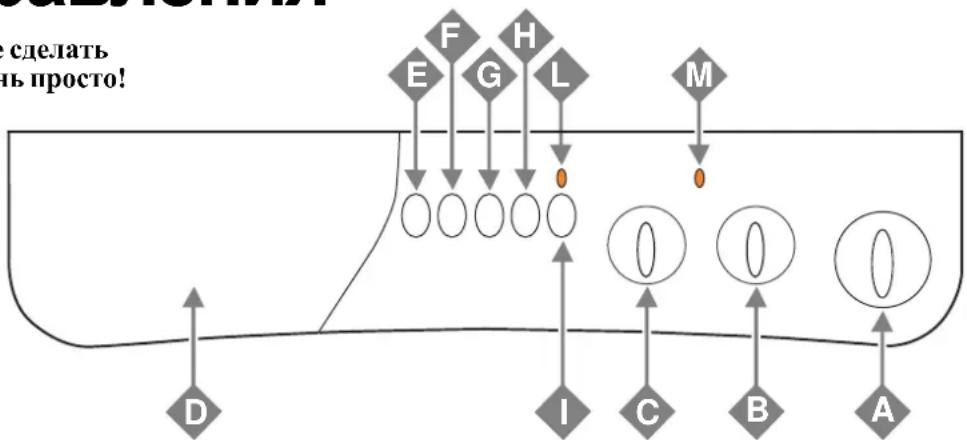
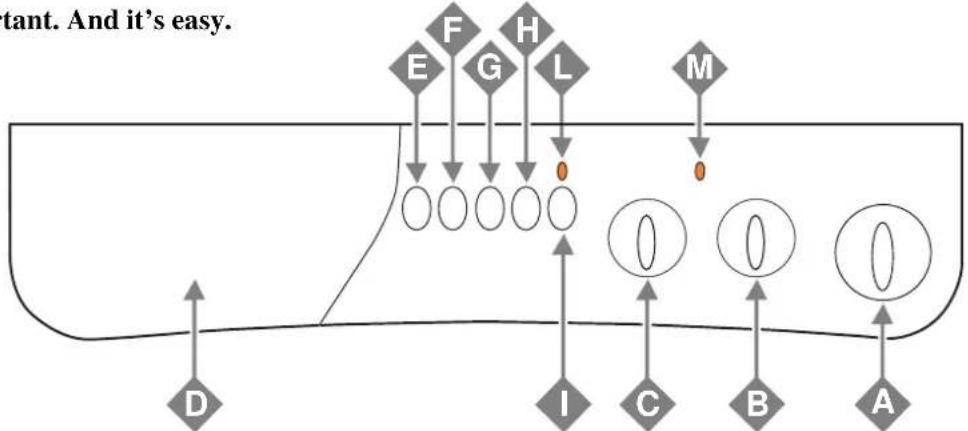
The programme is selected according to the type of garments that need to be washed. To choose a programme, refer to the table on page 40. Turn knob A until the selected programme is aligned with the mark on the knob, turn knob B to the desired temperature settings, check that knob C is in the desired position, if necessary use buttons E, F, G and H, and lastly, press on/off button I (I position).
Remember that, if you want to use it, the "programmed start" should be set before the wash cycle.
At the end of the wash cycle... The M lamp to extinguish: it will take about three minutes.
Then turn the washing machine off by pressing on-off button I (O position). You can now open the washing machine door safely. After having removed the
freshly cleaned washing, leave the door open to allow air circulation inside the drum.
Always disconnect electricity at the socket and turn off the water supply.
Remember that, in the event of a power failure, or should the washing machine switch itself off, the programme chosen will remain in its memory.
How to eliminate the most common stains
Ink and biro Dab with a wad of cotton soaked in methyl alcohol or alcohol at 90^
Tar Dab with fresh butter, rub in turpentine then wash immediately.
Wax Scrape away, then run a hot iron between two sheets of absorbent paper. Then rub in cotton with turpentine or methyl alcohol.
Chewing gum Rub in nail polish remover and wipe with a clean rag.
Mold Cotton and white lincn should be placed in a solution of 5 parts water, one bleach and a spoon of vinegar, then washed immediately. For other white fabrics, use hydrogen peroxide at 10 volumes and wash immediately.
Lipstick Dab with ether on wool or cotton. Use tricloroetilene for silk.
Nail polish Place a sheet of absorbent paper on the side of the stain, wet it with nail polish remover, shifting the garment as the sheet gradually changes colour.
Grass Dab with a wad of cotton soaked in methyl alcohol.
Understanding the control panel
Here I’m in command
Making the right choice is important. And it's easy.

Programme selector knob and programmed start
Use this knob to select the wash programme.
Turn this knob clockwise only. To select a programme, you should turn the knob so that the symbol/number of the desired programme is in line with the pointer on the knob.
Now press on/off button I (position I), pilot lamp L will start flashing. After 5", the setting will be accepted, pilot lamp L will stop flashing (staying lit) and the wash cycle will begin.
Should you wish to interrupt the programme in progress or set a new one, select one of the symbols (Stop/Reset) and wait 5" : when the cancellation has been accepted, pilot lamp L flashes, and you can then turn the appliance off.
You can use this knob to delay the appliance's operation. Select one of the four delay time positions, press the on/off button I (position I) and wait 5". The setting has now been accepted (pilot lamp L stays lit) and you can select the programme you desire. Pilot lamp L has a particular flashing motion (2" on and 4" off) to indicate that a delayed start has been set.
During this phase, you can open the appliance door and change the washing load, should you wish to do so.
After the wash cycle has been set and accepted by the washing machine, turning the knob will have no effect (except for when it is on position Stop/Reset).

The detergent dispenser with the additional bleach compartment is here.

Temperature control knob
It is used to set the wash temperature in the recommended programme table on pag. 40. It also allows you to reduce the temperature recommended for the selected programme, and even to set a cold wash cycle ()。

Spin exclusion knob
It is used to exclude the spin cycle (by choosing symbol ) or to reduce the spin speed of the selected programme. The maximum speed for the four types of fabric are:
Fabric Speed
Cotton 1000 rpm
Synthetics 800 rpm
Wool 600 rpm
Silk no
Note: distribution phase will be carried out at low speed.

Detergent dispenser
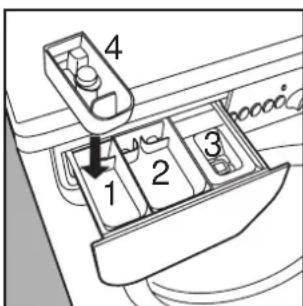
It is divided into three compartments:
1.Detergent for pre-wash;
2.Detergent for the main cycle wash;
- Fabric conditioner.
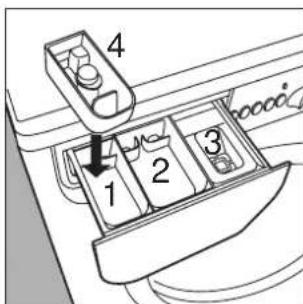
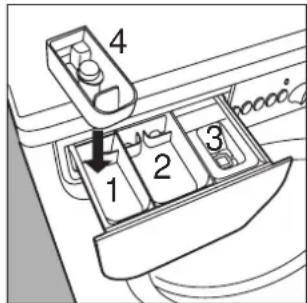
The washing machine is equipped with an extra compartment 4 (provided as an accessory) for the bleach, to be inserted in compartment 1.

Easy iron
This function allows your washing to come out of the machine without creases, making it much easier to iron. You can use it with programmes 3-4 (Cotton), 5-6 (Synthetics) and 8-9 (Delicates).
Press this button in programmes 5-6-8-9 and th wash cycle will come to a stop on symbol . You can complete it by pressing button E again. Important: this function should not be used when button H(stain removal) has been pressed.

Extra Economy
Reduces water consumption during the rinse cycles. We recommend that you use this function only with small laundry loads, dosing the detergent proportionally.

Rapid wash
This button reduces the length of the wash programme by about 30% . It cannot be used with special programmes (see page 40) or those for wool and silk.

Stain removal (see page 43)
Thanks to this command, the washing machine will carry out a more intensive wash that optimises the effectiveness of the liquid additives, thus allowing
more resistant stains to be removed. When you press the stain removal button, you cannot activate the pre-wash.

On-off
When button I is pressed, the washing machine is switched on, when it is not the machine is switched off.
Turning the appliance off does not cancel the selected programme.

The on-off lamp
Lamp L flashes when the appliance is switched on and awaiting a programme to be set. A steady light means the appliance has accepted the selected programme.

The door block lamp
The safety lamp indicates that the washing machine door is locked to prevent it from being opened accidentally. To avoid any damages to lock mechanism, you must wait for the lamp to extinguish, before attempting to open the door which takes around three minutes.
What are you washing today?
A programme for all seasons
| Type of fabric and degree of soil Programme knob | Temperature knob | Detergent for wash | Fabric softener | Stain rem. button/ Bleach | Length of the cycle (minutes) | Description of wash cycle |
| COTTON | ||||||
| Exceptionally soiled whites (sheets, tablecloths, etc.) | 1 90°C | 155 | Prewash cycle, wash cycle at 90°C, rinse cycles, intermediate and final spin cycles | |||
| Exceptionally soiled whites (sheets, tablecloths, etc.) | 2 90°C | Del./Trad. | 135 | Wash cycle at 90°C, rinse cycles, intermediate and final spin cycles | ||
| Heavily soiled whites and fast colours | 3 60°C | Del./Trad. | 130 | Wash cycle at 60°C, rinse cycles, intermediate and final spin cycles | ||
| Slightly soiled whites and delicate colours (shirts, jumpers, etc.) | 4 40°C | Del./Trad. | 90 | Wash cycle at 40°C, rinse cycles, intermediate and final spin cycles | ||
| Rinse cycles/Bleach | Del./Trad. | Rinse cycles, intermediate and final spin cycles | ||||
| Spin cycle Draining and final spin cycle | ||||||
| Stop/Reset | Interrupts/Cancels the selected programme | |||||
| SYNTHETICS | ||||||
| Heavily soiled fast colour synthetics (baby linen, etc.) | 5 60°C | Delicate | 95 | Wash cycle at 60°C, rinse cycles, anti-crease or delicate spin cycle | ||
| Delicate colour synthetics (all types of slightly soiled garments) | 6 40°C | Delicate | 70 | Wash cycle at 40°C, rinse cycles, anti-crease or delicate spin cycle | ||
| Delicate colour synthetics (all types of slightly soiled garments) | 7 30°C | 30 | Wash cycle at 30°C, rinse cycles and delicate spin cycle | |||
| Rinse cycles/Bleach | Delicate | Rinse cycles, anti-crease or delicate spin cycle | ||||
| Fabric softener | Rinse cycles with automatic introduction of softener, anti-crease or delicate spin cycle | |||||
| Spin cycle Draining and delicate spin cycle | ||||||
| Stop/Reset | Interrupts/Cancels the selected programme | |||||
| DELICATES | ||||||
| Hand wash | 8 40°C | 60 | Wash cycle at 40°C, rinse cycles and delicate spin cycle | |||
| Particularly delicate garments and fabrics (curtains, silk, viscose, etc.) | 9 30°C | 50 | Wash cycle at 30°C, rinse cycles, anti-crease or draining | |||
| Rinse cycles | Rinse cycles, anti-crease or draining | |||||
| Spin cycle Draining and delicate spin cycle | ||||||
| Draining Draining | ||||||
| Stop/Reset | Interrupts/Cancels the selected programme | |||||
| PROGRAMMED START | ||||||
| 12 - 9 - 3 - 1 hour delay Start is delayed by 12 - 9 - 3 - 1 hours | ||||||
| Stop/Reset | Interrupts/Cancels the selected programme | |||||
Important: to cancel the wash programme you have just set, select one of the symbols (Stop/Reset) and wait for at least 5 seconds.
The data found in the table is purely indicative, and can vary according to the quantity and type of washing, the water system temperature and the room temperature.
Special programme
Daily wash Your washer has a programme available for the washing of lightly soiled garments in a short amount of time. By setting programme 7 at a temperature of 30^ , you can wash different types of fabrics together (except for wool and silk), with a maximum load of 3kg . This programmes allows you to save on both time and energy as it only lasts around 30 minutes. We recommend the use of liquid detergent.
Understanding labels
Learn the meaning of these symbols and you will get better results, your garments will last longer resulting in an improved wash.
All over Europe, garment labels contain messages expressed in small yet important symbols. Understanding them is very important if you want to get better results and treat your garments the way they deserve to be treated.
These symbols are divided in five different categories and shapes: washing bleaching, ironing drying cleaning and drying
Useful tips
Turn shirts inside out to get better results and make them last longer.
Always empty pockets of their contents.
Look at the label: it will always give you useful advice.
When loading your washing, try to have a mixture of large to small items.

Make sure you select the right temperature!
Consult and learn the symbols in this table: they will help you obtain a better wash, treat your clothes properly, and get a better performance out of your washing machine.
| Wash Bleaching | Ironing Dry cleaning | Drying | O | |
| Strong action | Delicate action | High Temp. Low Temperat. | ||
| 95 Wash at 95°C | 95 Bleaching only in cold water | Hot iron at max 200°C | Dry clean with any solvent Machine | dryable |
| 60 Wash at 60°C Do not bleach | 60 A B C | Medium hot ironing at max 150°C | Dry clean only with perchloride, benzine av., pure alcohol, R111 and R113 | Do not machine dry |
| 40 Wash at 40°C | not dry clean | Iron at max 110°C | Dry clean with av. benzine, pure alcohol and R113 Spread | to dry |
| 30 Wash at 30°C Not ironable Do | Hang to dry without spin drying | |||
| Hand wash | Dry on clothes hanger | |||
| Not washable in water |
Useful tips
Never use your washing machine to wash... torn, fraying or non-hemmed linen. If it is absolutely neccessary, place it in a bag for protection. Do not wash coloured linen with whites.
Watch the weight!
For best results, do not exceed the weight limits stated below (figures show weight of dry garments):
-Resistant fabrics: 5 kg maximum
-Synthetic fabrics: 2.5 kg maximum
- Delicate fabrics: 2 kg maximum
- Pure new wool: 1 kg maximum
How much does it weigh? 1 sheet 400-500 gr.
1 pillow case 150-200 gr.
1 tablecloth 400-500 gr.
1 bathrobe 900-1,200 gr.
1 towel 150-250 gr.
Coloured T-shirts, printed ones and shirts last longer if turned inside out before washing. Printed T-shirts and sweatshirts should always be ironed inside out.
Dungaree alert.
Very popular "salopette" type overalls have straps with hooks that can damage the drum of your washing machine or other garments during the wash. To minimise the risk, place hooks in the pocket and fasten with safety pins.
Holidays: unplug the appliance.
It is recommended that you should unplug the machine from the socket and turn off the water supply. Leave the door ajar to allow air circulation to the draw and the door gasket area. This will prevent unpleasant odours.
WOOLCYCLE
For best results, we recommend you use a specific detergent, taking care not to wash more than 1kg of laundry.
How to wash almost anything
Curtains.
Curtains tend to crease a great deal. A useful tip to reduce creasing: fold the curtains and place them in a pillow case or mesh bag. Do not load anything else inside the appliance, this will ensure that the overall weight does not exceed the half load. Remember to use the specific programme 9 which automatically excludes the spin cycle.
■ Quilted coats and anorak.
You can wash quilted coats and wind-cheaters, too, if they are padded with goose or duck down. Do not load more than 2-3 kg and never load 5 kg. Repeat rinse once or twice using the gentle spin.
Trainers.
Once you have removed mud and dirt from trainers, you can even wash them with jeans or any other tough garments. Do not wash trainers with whites.
It's important for a good wash
Useful tips about the detergent dispenser
The first secret is the easiest: the detergent dispenser is opened by rotating it outwards.
You must follow the dosage recommendations provided by the manufacturers when adding detergent or fabric conditioner. Doses will vary according to the wash load, the water hardness and how soiled the washing is. Experience will help you select the right dosage almost automatically: it will become your secret.
Before adding detergent for prewashing in compartment 1, make sure that the extra compartment for bleach 4 has not been inserted.
Ensure no overfilling when adding fabric conditioner in compartment 3.
The washing machine automatically adds the softener to the wash in each programme.
Liquid detergent is poured into compartment 2 just a few seconds before starting the wash cycle.
Remember that liquid detergent is only designed for wash cycles of up to 60 degrees on non pre-wash items.
Special containers are sold with liquid or powder detergents for placing inside the washing machine drum, these are positioned according to the instructions found in the detergent box
Never use hand wash detergent, because it may form too much foam, which could damage the washing machine. Detergents that are specifically formulated for both hand and machine wash are an exception.
One last secret: when washing with cold water, always reduce the amount of detergent you use: it dissolves less easily in cold water than in hot water, so part of it would be wasted.
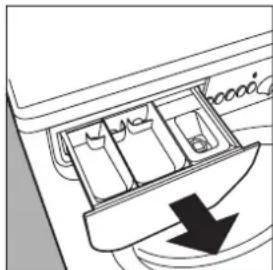
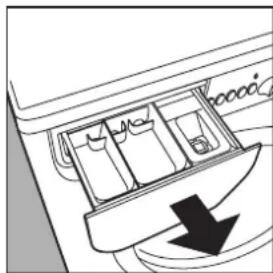
The detergent dispenser can be removed and cleaned: pull it outwards, as indicated in the figure. Then leave it under running water for a few minutes.
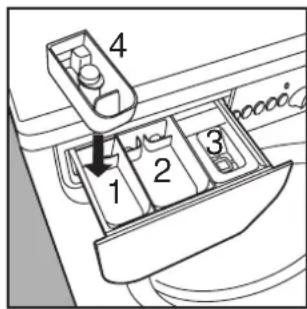
In compartment 1:
Detergent for pre-washing (powder)
In compartment 2:
Detergent for washing
(powder or liquid)
In compartment 3:
Additives (softeners, perfumes, etc.)
In compartment 4:
Bleach and delicate bleach.
Bleach cycle and stain remover button
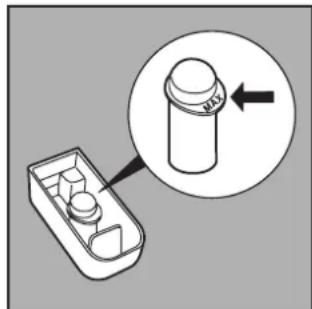
If bleaching is necessary, the extra case 4 (provided) must be inserted into compartment 1 of the detergent dispenser.
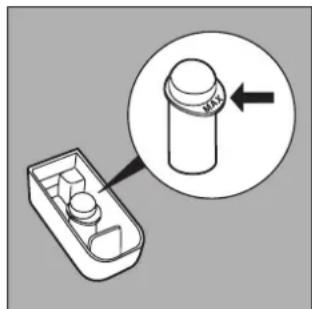
When pouring in the bleach, be careful not to exceed the "max" level indicated on the central pivot (see illustration).
The use of the additional bleach container excludes the possibility of using the pre-wash cycle. Traditional bleach can only be used on sturdy white fabrics, whereas delicate bleach can be used for coloured fabrics, synthetics and for wool.
You cannot bleach with the "Silk" programme and with the "special programmes" (see page 40).
Use the stain removal button every time you want to bleach. Should you want to do it separately you must pour the bleach into the additional container 4, press button H (stain removal), start the washing machine, then select one of the symbols according to the type of fabric. When you bleach during a normal wash cycle, pour the detergent and any additives in the special compartments, press button H (stain removal), set the programme you desire and turn the washing machine on.
Cutting costs efficiently
A guide to environmentally friendly and economic use of your appliance.
MAXIMISE THE LOAD SIZE
Achieve the best use of energy, water, detergent and time by using the recommended maximum load size.
SAVE up to 50% energy by washing a full load instead of 2 half loads.
DO YOU NEED TO PRE-WASH?
For heavily soiled laundry only!
SAVE detergent, time, water and between 5 to 15% energy consumption by NOT selecting Prewash for slight to normally soiled laundry.
IS A HOT WASH REQUIRED?
Pretreat stains with stain remover or soak dried in stains in water before washing to reduce the necessity of a hot wash programme.
SAVE up to 50% energy by using a 60^ wash programme.
BEFORE USING A DRYING PROGRAMME ...
SAVE energy and time by selecting the highest suitable spin speed to reduce the water content in laundry before using a drying programme.
Troubleshooting
Before calling, read the following
In most cases, when your washing machine fails to work, the problems arising can be easily solved without having to call for a technician. Before calling for assistance, always check these points.
The washing machine fails to start.
Is the plug correctly inserted into the socket? It could have been moved whilst cleaning.
Is there electricity in the house?
A circuit breaker may have switched off as a result of too many electrical appliances working at the same time. Or maybe due to a general failure in your entire area.
■Is the washing machine door closed properly?
For safety reasons, the washing machine cannot work
if the door is open or not shut properly.
■Is the On/Off button pressed?
If it is, then a programmed start has been set.
Is the programmed start knob, in the correct position for those models concerned?
Is the water supply turned on? For safety reasons, if the washing machine does not load water, it cannot start a wash cycle.

RIGHT
WRONG
Turn off the water supply after use. This will eliminate the possibility of leakage.
Always leave the appliance door ajar to avoid bad odours.
Clean the appliance's exteriors gently. To clean the exteriors and the rubber parts of the appliance, always use a soft cloth dipped in warm and soapy water.
Leave the washing machine plugged in while cleaning. Even during maintenance, the appliance should always be unplugged.
Use solvents and aggressive abrasives. Never use solvents or abrasives to clean the external and rubber parts of the washing machine.
Neglect the detergent dispenser. It is removable and can easily be cleaned by leaving it under running water.
Go on holiday without thinking about her. Before leaving, always make sure that the washing machine is unplugged and that the water supply is turned off.
But where did all the water go?
Simple: with the new Indesit technology, you need less than half of it, to get good results on twice as much! This is why you cannot see the water through the door: because there is little, very little of it, to respect the environment yet without renouncing maximum cleanliness. And, on top of that, you are also saving electricity.
select one of the symbols stop/reset, then switch it back on. If the knob continues to turn, call for assistance because it is showing an anomaly.
The washing machine fails to fill with water.
Is the hose correctly connected to the tap?
Is there a water shortage? There could be work in progress in your building or street.
Is there sufficient water pressure? The autoclave may be malfunctioning.
Is the tap filter clean? If the water is very calcareous, or if work has recently been carried out on the water piping, the tap filter could be clogged with particles and debris.
Is the rubber hose kinked? The tract of the rubber hose bringing water to washing machine must be as straight as possible. Make sure it is not squashed or kinked.
The programme selector knob keeps turning?
Wait a few minutes for the drain pump to empty the tub, switch the washer off,
The washing machine continuously fills and drains water.
Is the drain hose positioned too low? It must be installed at a height ranging from 60 to 100cm
Is the end of the hose immersed in water?
Does the wall drainage system have a breather pipe? If the problem persists even after these checks, turn the water supply off the machine and call for assistance.
If you live on an upper floor of your building, there may be a problem with your drain trap. To solve this problem, a special valve must be installed.
The washing machine does not drain or spin.
Is the drain hose kinked? The tract of the drain hose must be as straight as possible. Make sure the drain hose is not squashed or kinked.
Is the washing machine's drain duct clogged? Is there an extension of the drain hose? If so, is it positioned incorrectly, blocking the water flow?
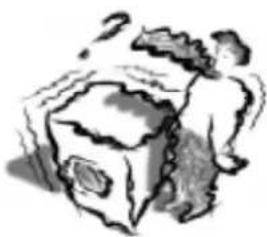
Excessive vibration during the spin cycle.
Have all transit screws been removed durind installation? See the following page on installation procedures.
Has the washing machine been levelled correctly? The levelling of the appliance should be checked periodically. Adjust the feet and check them with a level.
Is there space between the machine and adjacent units? If it is not a built-in model, the washing machine will oscillate a bit during the spin cycle. A few cm of space should therefore be left around it.
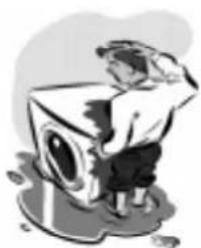
The washing machine leaks.
Is the metal ring of the inlet hose properly attached? Turn off the water supply, unplug the appliance and try tightening its attachment without forcing it.
Is the detergent dispenser obstructed? Remove and wash it under tap water.
Is the drain hose well attached? Turn off the water supply, unplug the appliance and try tightening its attachment.
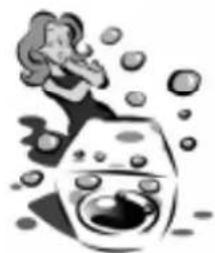
Too much foam.
Is the detergent appropriate for machine washing? Check whether the definition on its label reads "for machine wash" or "hand and machine wash", or any other similar wording.
Is the correct amount being used? An excessive amount of detergent, besides producing too much foam, does not guarantee a more effective wash, and causes scaling in the internal parts of the appliance.
If, despite all checks, the washing machine fails to function and the problem persists, call your nearest authorised Customer Service Centre, providing the following information:
- the nature of malfunction
- the model type no. (Mod. ...)
- the serial number (S/N ...) This information can be found on the data plate situated at the back of the washing machine.
Technical characteristics
| Model | WS 105 TX |
| Dimensions | width 59,5 cm height 85 cm depth 40 cm |
| Capacity | from 1 to 5 kg |
| Electrical connections | voltage 220/230 Volt 50 Hz maximum absorbed power 1850 W |
| Water connections | maximum pressure 1 MPa (10 bar) minimum pressure 0,05 MPa (0,5 bar) drum capacity 40 litre |
| Spinning speed | up to 1000 rpm |
| Control programs in compliance with IEC regulation 456 | programme 3; temperature 60°C; carried out with 4,5 kg load. |
| CE | This appliance conforms with the following E.E.C. directives: - 73/23/EEC of 19/02/73 (Low Voltage) and subsequent modifications - 89/336/EEC of 03/05/89 (Electromagnetic Compatibility) and subsequent modifications |
Installation and removal
When the new washer arrives
Whether new or just transported to a new house, installation is extremely important for the correct functioning of your washing machine.
After removing the appliance from its packaging, check that it is intact. If in doubt, contact a qualified technician immediately. The inside of the machine is supported, for transportation, by four screws on the back panel.
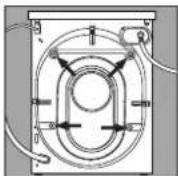
Before using the washing machine, remove the screws, remove the spacers together with the rubber tubes attached to them (keeping all the parts) and use the plastic plugs provided to fill in the holes.
Important: Use the cap (provided) to close the 3 holes which housed the stoppin, situated in the right-hand part of the lower back of the washing machine.
Levelling
The washing machine must be levelled appropriately in order to guarantee its correct functioning. To level the appliance, the front feet must be adjusted; the angle of inclination, measured according to the worktop, must not exceed 2^ . When placed on carpet, make sure the ventilation is not reduced.
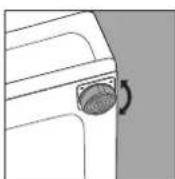
The front feet are adjustable.
Retain the transit screws, spacers and washers. Should you move house then these should be replaced to support the inside of the machine to prevent damage when transporting the machine.
Connection to the water mains
Water pressure must range within the values indicated on the data plate on the rear of your washing machine. If the water pipes are new or left unused, then before connecting the machine run the water until clear to remove debris. Connect the inlet hose to a cold water tap having a 3/4 BSP thread. Ensure that the rubber sealing washers are fitted at each end of the inlet hose, with the fitter washer at the tap end.
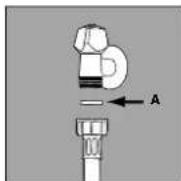
The rubber gasket.
Connect the inlet hose to the threaded connector on the machine rear.
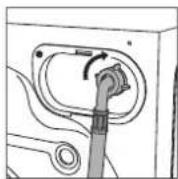
Water pipe inlet at the top right.
Connecting the drain hose
There are two hooks (right or left) on the rear of your washing machine to which the drain hose is to be fixed. Insert the other end in a stand pipe or place it on the edge of a sink or tub avoiding excessive kinks and bending. It should be placed at a height ranging from 60 to 100cm . If it is necessary to fix the end of the hose at a height below 60cm from the ground, it must be fixed in the appropriate hook placed on the upper part of the back panel.

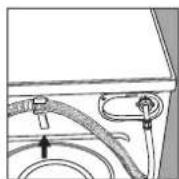
The hook to be used in case the drain hose ends at a height below 60 cm.
If the drains hose empties into a tub or sink then fit the plastic guide and secure it to the tap.
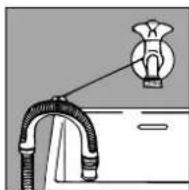
The guide for draining into tubs and sinks.
The end of the drain hose must be positioned so that it cannot become submerged.
Extensions are unadvisable. In case of absolute need, the extension must have the same diameter as the original hose and must not exceed 150cm . In case of wall draining pipes, their efficiency must be checked by a qualified technician. If the dwelling is on one of the upper floors of a building, there may be drain trap problems causing the washing machine to load and unload water continuously.
In order to avoid such an inconvenience, special anti-drain trap valves are available in shops.
Electric connection
Before connecting the appliance to the electric socket, be sure that:
1) the electric socket is able to sustain the appliance's maximum power load indicated on the data plate and in compliance with the law;
2) the supply voltage is included within the values indicated on the data plate;
3) the socket is compatible with the appliance's plug. If not, do not use adapters, but replace either the socket or the plug;
4) electric household appliances must be equipped with an "earthing" system.
Warning!
The company denies all liability if and when these norms are not respected.
Plastic bags, expanded styrofoam, nails and other packaging parts are not children's toys, and are potentially dangerous.
Easy Care and Maintenance
Treat your machine well and it will provide many years of trouble free service
Your washing machine is a reliable companion in life and on the job. It is just as important for you to keep it in shape.
Your washing machine is designed to provide reliable service over many years. A few simple steps will help to prolong its life and avoid problems. It is advisable, to turn off water taps when the machine is not to be used, this protects the hoses, etc.
If the water in your area is too hard, use a deliming product (water is hard if it often leaves whitish stains around taps or drains, especially of bath tubs.
For more accurate information as to the type of water in your system, call the local water works or a local plumber).
Pockets must always be emptied removing even pins, badges and any other hard object.
The washing machine exterior should be cleaned with a rag dipped in lukewarm water and soap.
It is important to wash the detergent dispenser regularly.
To prevent dried washing powder from
accumulating, place the dispenser under running water for a few minutes.
Never exaggerate with doses.
Normal detergents already contain deliming agents. Only if the water is particularly hard, that is, rich in lime content, do we recommend the use of a specific product at every wash.
A periodical wash cycle with a dose of a deliming product, without detergents or washing, may prove useful.
Never use too much detergent or additives because this could cause an excess amount of foam, scaling and possible damage to the component parts of your washing machine.

Do not forget to empty all pockets: small objects can cause damage to your washer.
When in need, check the pump and the rubber hose.
The washer comes equipped with a self-cleaning pump that does not require any cleaning or maintenance. Small objects may accidentally fall into the pump: coins, hair clips, loose buttons and other small items. To avoid possible damage, they are withheld in an accessible pre-chamber, situated at the lower end of the pump.
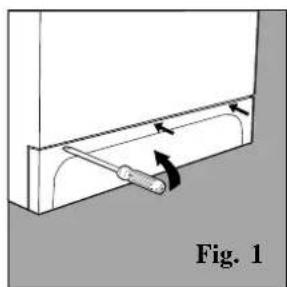
Attention: Before attempting to examine this pre-chamber, first ensure that the machine has finished its programme and is empty. Unplug the machine, as with any maintenance.
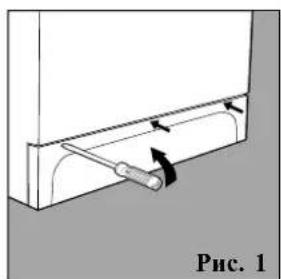
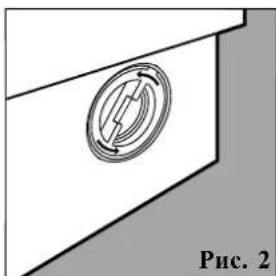
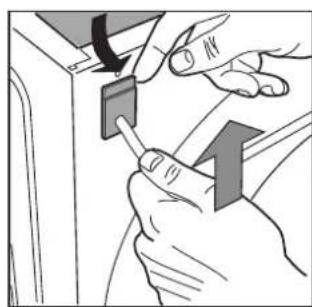
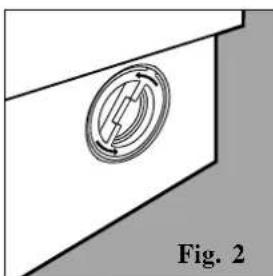
To gain access gently ease down the top of the plinth panel situated at the base of the machine, with a screwdriver etc, to release it. Then ease the top edge forward to allow it to be lifted clear (Fig. 1). Place a shallow dish or tray below the cover of the pre-chamber to catch the small amount of water present. Release the cover by turning anticlockwise (Fig. 2). Ensure that the cover is securely replaced. Re-fit the plinth cover by inserting the hooks on its lower edge into the slots and ease the top edge back into position.
The water inlet hose
Check the rubber hose at least once a year. If you see any cracks, replace it immediately. When you use your washing machine, water pressure is very strong and a cracked tube could easily split open.
Important for the safe use of your washing machine
Your safety and that of Your washer has been built in compl
your family
Your washer has been built in compliance with the strictest international safety regulations. To protect you and all your family.
Read these instructions and all the information in this manual carefully: they are an important source, not only of numerous useful tips, but also of vital information on safety, use and maintenance.
- the machine should not be installed in an outdoor environment, not even when a roof shelters the area, because it may be very dangerous to leave it exposed to rain and thunderstorms.
- It must only be used by adults and exclusively for washing clothes following the instructions provided in this manual.
-
Should it have to be moved, proceed with the help of two or three people and handle it with the utmost care. Never try to do this alone, because the appliance is very heavy.
4.Before loading the washing machine, make sure the drum is empty. -
Never touch the washing machine when barefoot or with wet or damp hands or feet.
-
Never use extensions or multiple plugs, which are particularly dangerous in humid environments. The power supply cable must never be bent or dangerously compressed.
-
Never open the detergent dispenser while the appliance is functioning; do not use hand wash detergent because the abundance of foam could damage its internal parts.
-
Never pull on the supply cable or the washing machine to disconnect it from the wall socket: it is extremely dangerous.
- While the appliance is functioning, do not touch the drain water as it could reach very high temperatures. The appliance door, during wash cycles, tends to become hot; ensure that children do no touch it. Never force the washing machine door because this could damage the safety lock which prevents accidental opening when the machine is working. Allow a few minutes at the end of the program for the lock to release.
- In case of malfunctioning, first close the water tap and unplug the appliance from the wall socket; do not under any circumstances touch internal parts in order to attempt repairs.
How to change the power supply cable
The washing machine power supply cable is special and can be purchased exclusively from authorised Technical Service Centres.
To replace the cable: 1. Make sure that the machine is switched off and unplugged.
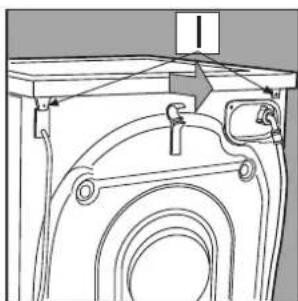
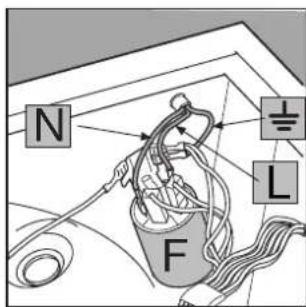
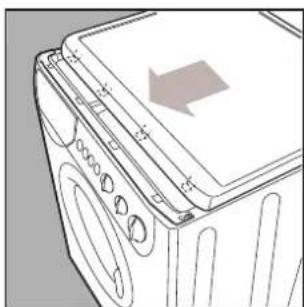
- Remove the covering lid by unscrewing the two screws I, and then pull it towards you [fig. 3]. 3. Disconnect the wires from the radio interference suppressor F [fig. 4] noting as to their position (Blue=N wire; Brown=L wire) leaving the earth wire until last N.B.: letters L, N and the
symbol 1一 are indicated on the radio interference suppressor. 4. Remove the upper part of the cable slightly from the back panel of the appliance, pull the power supply cable upwards and take it out [fig.5].
To put the covering lid back on, rest it on the washing machine [fig. 6] and let it slide forwards until the hooks situated on the front slide into the special slots formed into the control panel and tighten the screws back on.
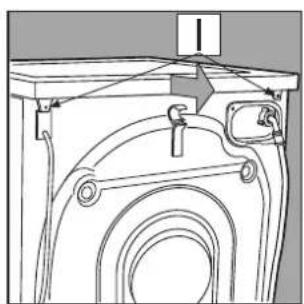
Fig. 3 Fig. 4
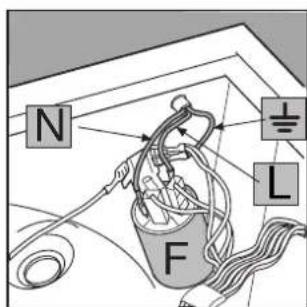
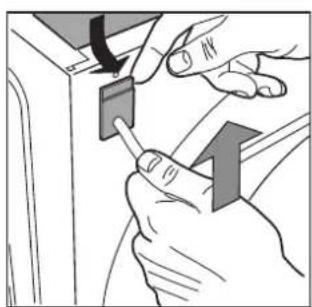
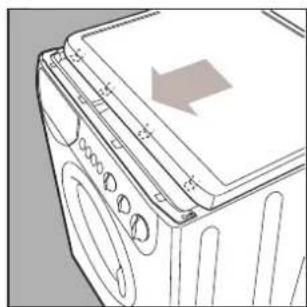
Fig. 5 Fig. 6
Kurzanleitung
Dispositif antibalourds.
Additives (assouplissants, perfumes, etc.)
Bac 4:
Leader for young Europe