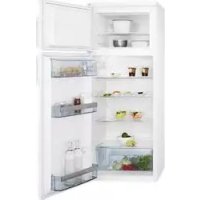
S52300DSW1 - Fridge AEG - Free user manual and instructions
Find the device manual for free S52300DSW1 AEG in PDF.



| Product type | Combined fridge-freezer |
| Brand | AEG |
| Model | S52300DSW1 |
| Dimensions (H x W x D) | 1404 x 545 x 604 mm |
| Power supply | 230 V, 50 Hz |
| Operating autonomy | 19 h |
| Climate class | SN (10°C to 32°C), N (16°C to 32°C), ST (16°C to 38°C), T (16°C to 43°C) |
| Refrigerant | Isobutane (R600a), flammable gas |
| Refrigerator defrost | Automatic |
| Freezer defrost | Manual (defrost when frost reaches 3-5 mm) |
| Interior lighting | Replaceable bulb (max power indicated on diffuser) |
| Shelves | Height-adjustable glass shelves |
| Door bins | Height-adjustable |
| Vegetable drawer | Yes |
| Butter compartment | Yes |
| Thermostat | Manual, continuous adjustment |
| Original spare parts | Available at www.aeg.com/shop |
| After-sales service | Contact with model, PNC, serial number (on rating plate) |
| Cleaning | Warm water and mild detergent, avoid abrasive products |
| Installation | Wait 4 hours before plugging in, do not install near heat sources |
Frequently Asked Questions - S52300DSW1 AEG
User questions about S52300DSW1 AEG
0 question about this device. Answer the ones you know or ask your own.
Ask a new question about this device
Download the instructions for your Fridge in PDF format for free! Find your manual S52300DSW1 - AEG and take your electronic device back in hand. On this page are published all the documents necessary for the use of your device. S52300DSW1 by AEG.
USER MANUAL S52300DSW1 AEG
S52300DSW1 DA Brugsanvising 2
7. PROBLEEMOPLossing

WAARSCHUWING!
Thank you for choosing this AEG product. We have created it to give you impeccable performance for many years, with innovative technologies that help make life simpler – features you might not find on ordinary appliances. Please spend a few minutes reading to get the very best from it.
Visit our website for:

Get usage advice, brochures, trouble shooter, service information: www.aeg.com

Register your product for better service: www.aeg.com/productregistration

Buy Accessories, Consumables and Original spare parts for your appliance: www.aeg.com/shop
CUSTOMER CARE AND SERVICE
We recommend the use of original spare parts.
When contacting Service, ensure that you have the following data available. The information can be found on the rating plate. Model, PNC, Serial Number.
Warning / Caution-Safety information
General information and tips

Environmental information
Subject to change without notice.
1. SAFETY INSTRUCTIONS
Before the installation and use of the appliance, carefully read the supplied instructions. The manufacturer is not responsible if an incorrect installation and use causes injuries and damages. Always keep the instructions with the appliance for future reference.
1.1 Children and vulnerable people safety

WARNING!
Risk of suffocation, injury or permanent disability.
- This appliance can be used by children aged from 8 years and above and persons with reduced physical, sensory or mental capabilities or lack of experience and knowledge if they have been given supervision or instruction for the operation of the appliance by a person who is responsible for their safety.
- Do not let children play with the appliance.
- Keep all packaging away from children.
- Cleaning and user maintenance shall not be made by children without supervision.
1.2 Installation

WARNING!
Only a qualified person must install this appliance.
- Remove all the packaging.
- Do not install or use a damaged appliance.
- Obey the installation instruction supplied with the appliance.
Always be careful when you move the appliance because it is heavy. Always wear safety gloves. - Make sure the air can circulate around the appliance.
-
Wait at least 4 hours before connecting the appliance to the power supply. This is to allow the oil to flow back in the compressor.
-
Do not install the appliance close to radiators or cookers, oven or hobs.
- Only for appliances with water connection: connect only to drinking water supply.
- The rear of the appliance must stand against the wall.
- Do not install the appliance where there is direct sunlight.
Electrical connection

WARNING!
Risk of fire and electrical shock.
- The appliance must be earthed.
- All electrical connections should be made by a qualified electrician.
- Make sure that the electrical information on the rating plate agrees with the power supply. If not, contact an electrician.
- Always use a correctly installed shockproof socket.
- Do not use multi-plug adapters and extension cables.
- Make sure not to cause damage to the electrical components (e.g. mains plug, mains cable, compressor). Contact the Service or an electrician to change the electrical components.
- Connect the mains plug to the mains socket only at the end of the installation. Make sure that there is access to the mains plug after the installation.
- The mains cable must stay below the level of the mains plug.
- Do not pull the mains cable to disconnect the appliance. Always pull the mains plug.
1.3 Use
- This appliance is intended to be used in household and similar applications such as:
Staff kitchen areas in shops, offices and other working environments
-Farm houses -
By clients in hotels, motels and other residential type environments
-
Bed and breakfast type environments.

WARNING!
Risk of injury, burns, electrical shock or fire.
- Use this appliance in a household environment.
- Do not change the specification of this appliance.
- Do not put electrical appliances (e.g. ice cream makers) in the appliance unless they are stated applicable by the manufacturer.
- Be careful not to cause damage to the refrigerant circuit. It contains isobutane (R600a), a natural gas with a high level of environmental compatibility. This gas is flammable.
- If damage occurs to the refrigerant circuit, make sure that there are no flames and sources of ignition in the room. Ventilate the room.
- Do not let hot items to touch the plastic parts of the appliance.
- Do not put fizzy drinks in the freezer compartment. This will create pressure on the drink container.
- Do not store flammable gas and liquid in the appliance.
- Do not put flammable products or items that are wet with flammable products in, near or on the appliance.
- Do not touch the compressor or the condenser. They are hot.
- Do not remove or touch items from the freezer compartment if your hands are wet or damp.
- When you remove an ice lolly from the appliance, do not eat it immediately. Wait a few minutes.
- Do not freeze again food that has been thawed.
- Obey the storage instructions on the packaging of frozen food.
1.4 Care and Cleaning

WARNING!
Risk of injury and damage to the appliance.
- Before maintenance, deactivate the appliance and disconnect the mains plug from the mains socket.
- Do not use water spray and steam to clean the appliance.
- Clean the appliance with a moist soft cloth. Only use neutral detergents. Do not use abrasive products, abrasive cleaning pads, solvents or metal objects.
- Regularly examine the drain of the refrigerator and if necessary, clean it. If the drain is blocked, defrosted water collects in the bottom of the appliance.
- This appliance contains hydrocarbons in the cooling unit. Only a qualified person must do the maintenance and the recharging of the unit.
1.5 Internal light
- The type of light bulb or halogen lamp used for this appliance, is only for household appliances. Do not use it for house lighting.
1.6 Disposal

WARNING!
Risk of injury or suffocation.
- Disconnect the appliance from the mains supply.
- Cut off the mains cable and discard it.
- Remove the door catch to prevent children and pets to be closed in the appliance.
- The refrigerant circuit and the insulation materials of this appliance are ozone-friendly.
- The insulation foam contains flammable gas. Contact your municipal authority for information on how to discard the appliance correctly.
- Do not cause damage to the part of the cooling unit that is near the heat exchanger.
2.PRODUCT DESCRIPTION
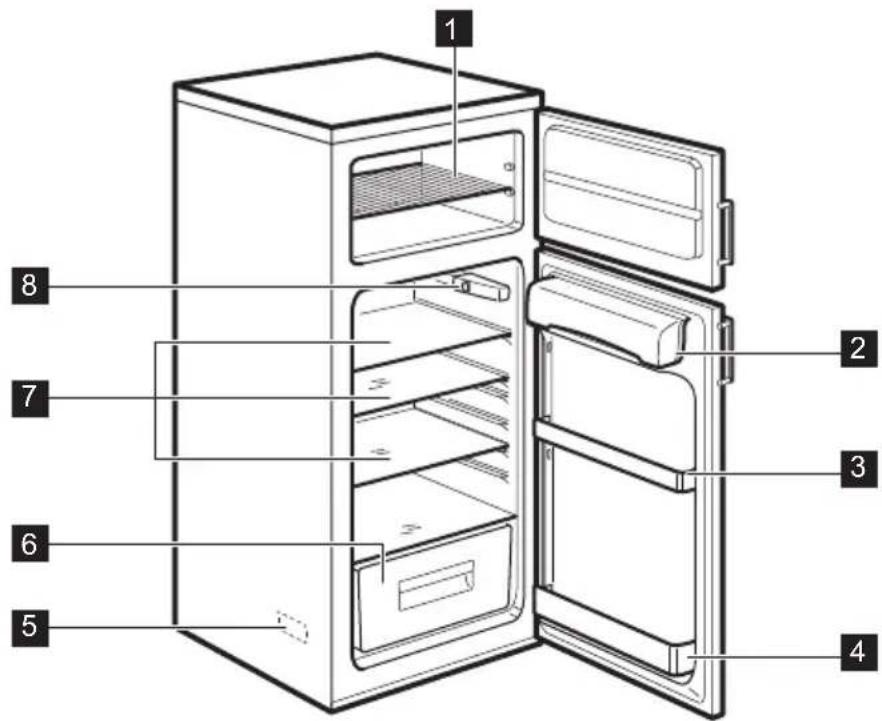
1 Wire shelf
Compartment for butter
3 Door shelf
4 Bottle shelf
5 Rating plate
6 Vegetable drawer
Glass shelves
8 Temperature knob and internal light
3. BEFORE FIRST USE
3.1
- Clean the inner parts of the appliance and all the accessories with warm water and neutral detergent.
- Make sure that the appliance and the accessories are fully dry.
- Connect the mains plug to the mains socket.
- Activate the appliance and set the temperature.

Do not use abrasive products, abrasive cleaning pads or solvents to clean the appliance and the accessories.
3.2 Activating the appliance and setting the temperature
Turn the temperature knob clockwise to activate the appliance and, at the same time, to set the temperature. The numbers that are on the knob refer to different temperatures of cold.
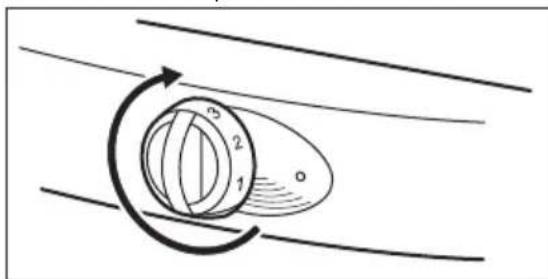
Turn the temperature knob to lower settings to obtain minimum cold temperature.
Turn the temperature knob to higher settings to obtain maximum cold temperature.

We recommend that you set a medium cold temperature.
The conditions that follow can have an effect on the temperature setting.
- The room temperature and the location where the appliance is installed.
- How frequently the opening of the appliance door occurs.
- The quantity of food that is in the appliance.
4. DAILY USE
4.1 Freezing the fresh food
The freezer is applicable to freeze fresh food and for the storage of frozen food and of deep-frozen food.

If the temperature knob is set at a medium position, it is not necessary to change the setting. If you want to freeze the food more quickly, set the temperature knob at a higher position. In this condition, the temperature of the fridge can decrease to 0 ^ C and more. If this occurs, set the temperature knob to a lower position.
4.2 Storage of frozen food
Do not put immediately frozen food in the freezer if the appliance is new or was deactivated for a period of time.
Set the temperature knob at the highest position and let the appliance operate for minimum 2 hours.

A power failure can cause the defrosting of the freezer.
If the power was off, for a period of time longer than the "Rising Time" value, you must use or cook immediately the defrosted food. Refer to "TECHNICAL INFORMATION" for the value.
You can freeze the cooked food when it becomes cool.
4.3 Thawing
Before you cook frozen food or deep-frozen food, thaw the food in the fridge or at room temperature. It is possible to cook small quantities of frozen food directly from the freezer, but this increases the cooking time.
4.4 Glass shelves
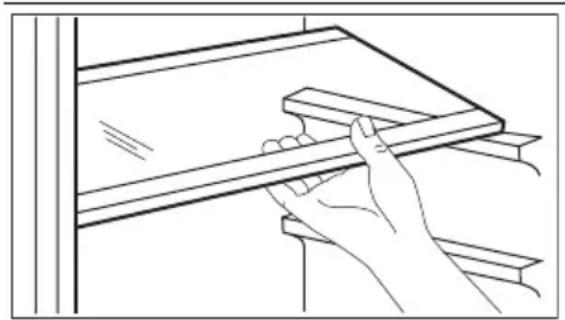
You can put the glass shelves at different heights.
4.5 Positioning the door shelves
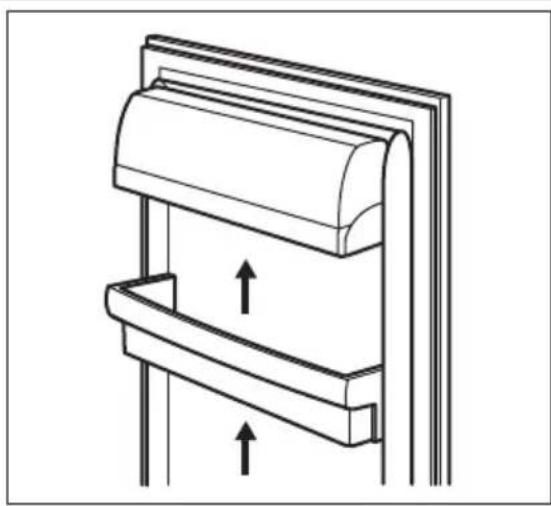
You can put the door shelf at different heights.
- Pull the shelf in the direction of the arrows until it disengages.
- Put the shelf in the new position.
5. HINTS AND TIPS
5.1 Energy saving
- Do not to open the door of the fridge or of the freezer frequently.
- Do not keep the door of the fridge or of the freezer open for more than the necessary time.
-
If the appliance operates continuously and there is frost on the internal rear part, the cause can be:
-
The temperature knob is set at the lowest position.
The room temperature, where the appliance is installed, is too warm. -
The appliance is full.
Set the temperature knob at a higher position. The automatic defrosting starts and the energy consumption decreases.
5.2 Refrigeration
- Do not put hot food in the fridge. Wait until it becomes cool.
- Do not put in the fridge liquids that evaporate.
-
Put all the food, that has a strong flavour or odour, in containers.
Make sure that there is air circulation around the food. -
Put all types of meat in polythene bags. Put them on the glass shelf above the vegetable drawer. Do not keep the meat in the fridge for more than 2 days.
- Put a cover on cooked food and cold dishes and put them on one of the shelves.
- Wash fruit and vegetables and put them in the vegetable drawer.
- Put butter and cheese in special airtight containers, aluminium foil or polythene bags.
Make sure that milk bottles have a cap and put them in the bottle shelf on the appliance door. - Do not keep in the fridge bananas, potatoes, onions and garlic that are without packaging.
5.3 Freezing
- The rating plate gives the indication of the maximum quantity of food that the freezer can freeze in 24 hours.
The freezing of the food is completed in 24 hours. Do not put other food in the freezer during this time. -
Put the food in small quantities in the freezer. This helps to freeze quickly the food and to thaw only the necessary quantity.
-
Wrap the food in aluminium foil or put it in polythene bags. Make sure that the packaging is airtight.
- Do not put fresh food together with frozen food. This to prevent the temperature of the frozen food to increase.
- The storage time for fat food is shorter than for non-fat food or for low-fat food. The salt decreases the storage time of the food.
- We recommend that you write, on each packaging, the date of when the food was frozen.
6. CARE AND CLEANING

CAUTION!
Before maintenance, disconnect the mains plug from the mains socket.
6.1 Cleaning
- Clean the appliance and the accessories regularly.
- Clean all the parts of the appliance and all the accessories only with warm water and neutral detergent. Make sure that the appliance and the accessories are fully dry.
- Clean the gasket of the door regularly. To replace a damaged gasket, contact the Service.
- Clean the grill of the condenser and the compressor, that are behind the
5.4 Storage of the frozen food
- When you buy frozen food, make sure that you put it in the freezer in a very short time.
- When you thaw frozen food, you must cook it in a very short time. It is not possible to freeze again food that was frozen before.
- Make sure that the use-by date is not expired. You can find the information on the packaging of the food.
appliance, with a brush. This helps to decreases the energy consumption and keeps the appliance in good conditions.

- Be careful not to pull, move or to cause damage to the pipes or the cables.
- Be careful not to cause damage to the cooling unit.
- Do not clean the appliance with abrasive products, abrasive cleaning pads, solvents, detergents with perfume or wax polish.
After maintenance, connect the mains plug to the mains socket.
6.2 Automatic defrosting of the fridge
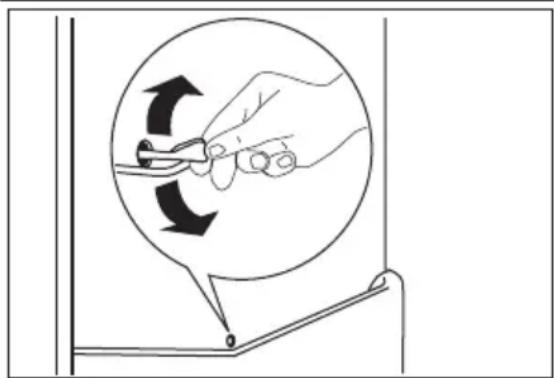
The removal of frost occurs automatically when the motor compressor stops during operation.
The water drains out through the drain hole and collects in the water container where it evaporates.
The water container is behind the appliance, above the motor compressor.
The drain hole is in the fridge on the rear part.
To prevent water to collect in other parts of the fridge, make sure that the drain hole is always clean. Use the cleaning tool that is in the drain hole.
6.3 Defrosting of the freezer

There can be frost on the freezer shelves and around the top compartment.
Defrost the freezer when the layer of frost has a thickness of 3 or 5mm

CAUTION!
Do not use sharp metal tools to remove the frost.
Do not use mechanical devices to defrost the freezer.
- Deactivate the appliance.
- Remove all the food from the freezer. Wrap the food in newspaper and keep it at a cold temperature.
- Keep the appliance door open until defrosting is completed.
- Clean and fully dry the freezer.
-
Connect the mains plug to the mains socket.
-
Activate the appliance.
- Set the temperature knob at the highest position and let the appliance operate for 2 or 3 hours with this setting.
- Put back the food in the freezer.
6.4 When the appliance is not used for long periods
- Deactivate the appliance and disconnect the mains plug from the mains socket.
- Remove all the food.
- Defrost the appliance.
- Fully clean and dry the appliance and all the accessories.
- Keep the doors open to prevent unpleasant smells.
6.5 Replacing the lamp
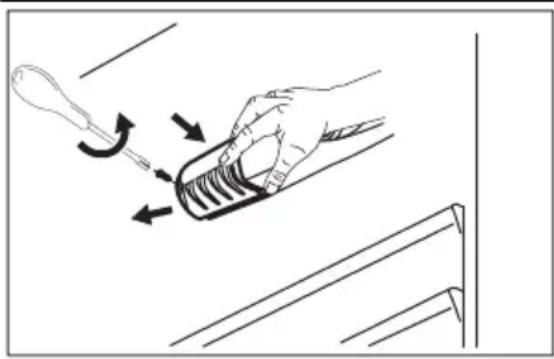
- Disconnect the mains plug from the mains socket.
- Remove the screw from the lamp cover.
- Remove the lamp cover
- Replace the old lamp with a new one. Use only lamps for household appliances. The lamp cover shows the maximum power of the lamp.
- Install again the lamp cover.
- Connect the mains plug to the mains socket.

The type of light bulb or halogen lamp used for this appliance, is only for household appliances. Do not use it for house lightning.
7. TROUBLESHOOTING

WARNING!
Disconnect the mains plug from the mains socket before you do the check.
For problems that are not in the table, contact the Service.
| Problem Possible solution | |
| The appliance makes noise during operation. | Some sounds are normal when the appliance is operating. Refer to the leaflet supplied with the appliance. |
| The appliance does not operate. | Make sure that the appliance is activated. |
| Make sure that the mains plug is connected to the mains socket. | |
| Do a check and see if there is voltage. Connect a different appliance to the same mains socket. To repair a mains socket, contact a qualified electrician. | |
| The lamp does not come on. | Close and open the door to make sure that the lamp is not in standby. |
| The lamp is defective. Replace the lamp. | |
| The compressor operates continuously. | Set the temperature knob at a lower position. |
| Make sure that the appliance door is closed. | |
| Make sure not to open and close the appliance door too frequently. | |
| Make sure not to put hot food in the appliance. Wait until it becomes cool. | |
| Make sure that the room temperature is not too warm. | |
| Water collects on the rear plate of the fridge. | It is normal that this occurs when the automatic de-frosting operates. |
| Water collects in the fridge. | Make sure that the drain hole is not clogged. |
| Make sure that food or packaging do not prevent the water to collect in the water container. | |
| There is water on the floor. | The melting water outlet does not flow in the evaporative tray above the compressor. Attach the melting water outlet to the evaporative tray. |
| The temperature in the appliance is too cold | Set the temperature knob to a lower position. |
| The temperature in the appliance is not sufficiently cold. | Set the temperature knob to a higher position. |
| Make sure that the appliance door is closed. | |
| Make sure not to put hot food in the appliance. Wait for the food to become cool. | |
| Make sure that the appliance is not too full. | |
| Problem Possible solution | |
| The temperature in the fridge is not sufficiently cold. Make sure that there is cold air circulation. | |
| There is too much frost. Make sure that the food is closed in special containers or packaging. | |
| Make sure that the appliance door is closed. | |
| Set the temperature knob to a lower position. | |
8. TECHNICAL INFORMATION
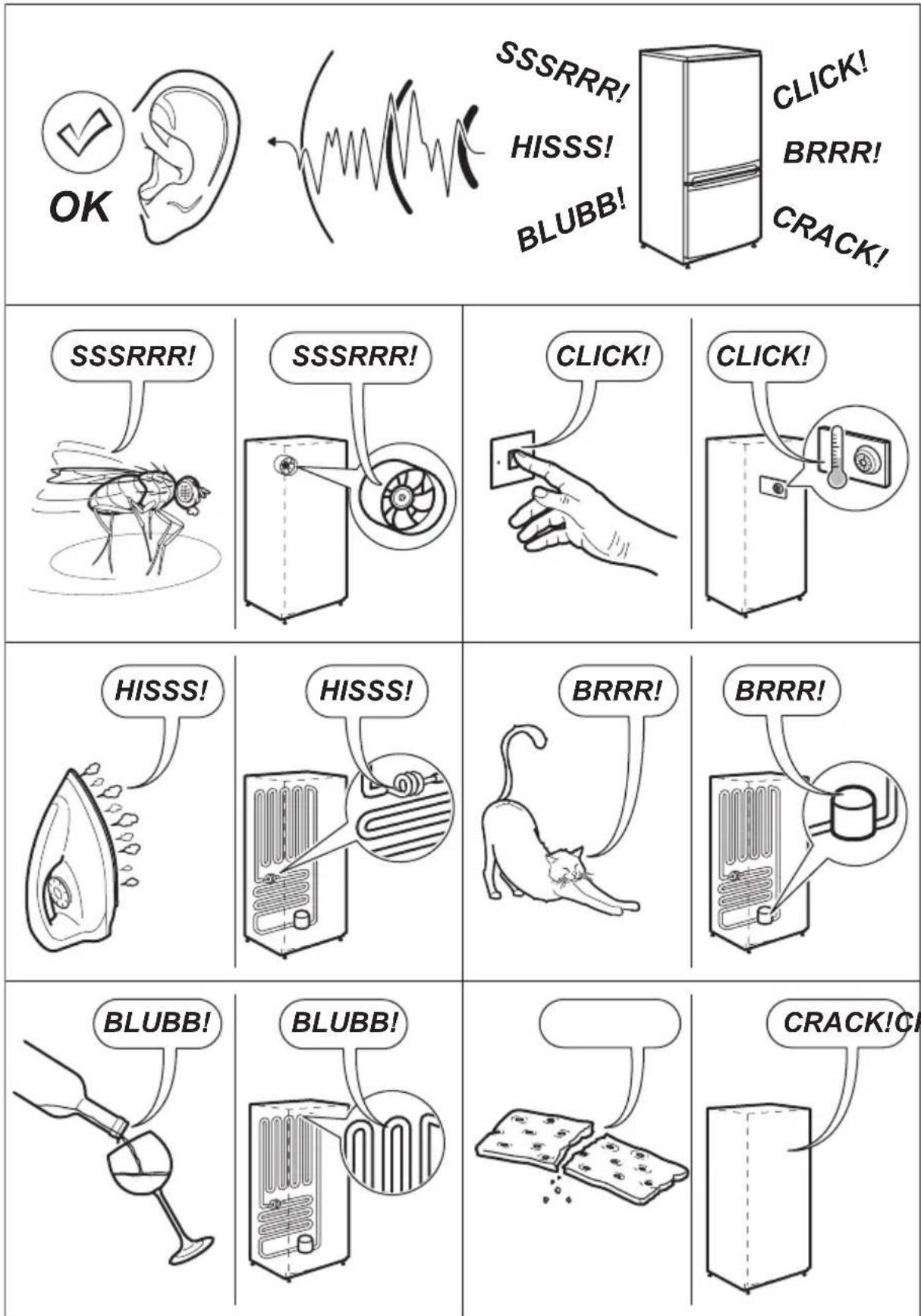
8.1 Normal sounds
There are some sounds during normal running (compressor, refrigerant circulation).
8.2 Positioning
This appliance can be installed in a dry, well ventilated indoor (garage or cellar) also, but for optimum performance install this appliance at a location where
the ambient temperature corresponds to the climate class indicated on the rating plate of the appliance:
| Climate temperature mate class |
| SN +10°C to + 32°C |
| N +16°C to + 32°C |
| ST +16°C to + 38°C |
| T +16°C to + 43°C |
8.3 Technical data
| Dimensions Height 1404 mm |
| Width 545 mm |
| Depth 604 mm |
| Rising Time 19 h |
| Voltage 230 V |
| Frequency 50 Hz |
For more information, refer to the rating plate and to the energy label.
9. ENVIRONMENT CONCERNS
Recycle the materials with the symbol .Put the packaging in applicable containers to recycle it. Help protect the environment and human health and to recycle waste of electrical and electronic
appliances. Do not dispose appliances marked with the symbol with the household waste. Return the product to your local recycling facility or contact your municipal office.
SOMMAIRE
- INSTRUCTIONS DE SECURITE 39
2.DESCRIPTION DE L'APPAREIL 41 - AVANT LA PREMIÈRE UTILISATION 41
- UTILISATION QUOTIDIENNE 42
- CONSEILS 43
- ENTRETIEN ET NETTOYAGE 44
- EN CAS D'ANOMALIE DE FONCTIONNEMENT 46
8.CARACTERISTIQUES TECHNIQUES 48 - EN MATIÈRE DE PROTECTION DE L'ENVIRONNEMENT 50
POUR DES RÉSULTATS PARFAITS
KataxwpnoTe To Tpoiov aoc, wote va exe KaLutepo eepic: www.aeg.com/productregistration

ayopaoet Eapntmuata, avaawoiqa kai yvnoia avtaalakikyaia tn ouokeu nac: www.aeg.com/shop