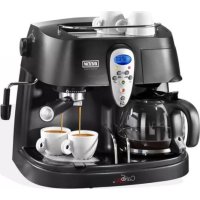
Café Joy V2 - Coffee machine BEEM - Free user manual and instructions
Find the device manual for free Café Joy V2 BEEM in PDF.



| Product type | Coffee and espresso machine |
| Model | Café Joy V2 |
| Brand | BEEM |
| Dimensions (W x H x D) | 440 x 308 x 324 mm |
| Net weight | Approx. 5.5 kg |
| Operating voltage | 230 V~ |
| Mains frequency | 50 Hz |
| Power | 2050 W |
| Protection class | I |
| Protection type | IPX0 |
| Main functions | Coffee and espresso preparation, steam nozzle for milk frothing and reheating, keep warm, delayed programming, automatic drip-stop |
| Water tank | With level indicator and cup graduations, max capacity (“Max” mark) |
| Included filters | Permanent filter (gold), 1-cup filter, 2-cup filter |
| Included accessories | Glass carafe with lid, filter holder, measuring/tamping spoon, cleaning brush, frothing tip |
| Maintenance and cleaning | Clean after each use, descale regularly (every 3 months for coffee maker, every 80-150 cycles for espresso) |
| Safety | Automatic shut-off after 2 h, overheat protection, detailed safety instructions in the manual |
| Spare parts and repairability | Spare parts available (lid, frothing tip, filter, drip tray, etc.); repairs by authorized service |
| Warranty | Statutory warranty + extended manufacturer warranty possible (see conditions at www.beem.de) |
Frequently Asked Questions - Café Joy V2 BEEM
User questions about Café Joy V2 BEEM
0 question about this device. Answer the ones you know or ask your own.
Ask a new question about this device
Download the instructions for your Coffee machine in PDF format for free! Find your manual Café Joy V2 - BEEM and take your electronic device back in hand. On this page are published all the documents necessary for the use of your device. Café Joy V2 by BEEM.
USER MANUAL Café Joy V2 BEEM
Coffee and espresso machine
Open the fold-out page at the beginning and end of the user manual in order to view the illustrations during reading.
General instructions 25
Safety instructions 26
Startup 29
Appliance description 30
Before using for the 1rst time .30
Operation and use 31
Recipes for coffee specialities 39
Cleaning and care 40
Storage 43
Spare parts and other accessories . . 43
Troubleshooting 44
Technical data 45
Dear Customer,
Before using the appliance, please read the instructions contained in this user manual on startup, safety, intended use as well as cleaning and care.
Open the fold-out page at the beginning and end of the user manual in order to view the illustrations during reading.
Keep this user manual in a safe place and pass it on to any future owners together with the appliance.
Copyright
This document is copyrighted. Any duplication or reprinting, in whole or in part, and the reproduction of the illustrations, even in modified form, is only permitted with the written approval of the manufacturer.
Notes on environmental protection
The packaging materials used can be recycled. When no longer required, dispose of the packaging materials according to local environmental regulations.
This product may not be disposed of in the domestic refuse within the European Union. Dispose of the appliance via communal collection points.
Warranty/Guarantee
In addition to the statutory warranty obligation, BEEM also grants an extended manufacturer's guarantee for some products.
Provided this is granted, the corresponding details for each product can be found either on the product-specific packaging, advertising material or on the BEEM website.
Please visit our website to obtain more information on comprehensive guarantee conditions, available accessories and spare parts as well as user manuals in various languages.
Symbols used

DANGER
This indicates an imminent hazardous situation, which could lead to severe physical injury or death.
Follow these instructions to avoid danger.

WARNING
This indicates a possible hazardous situation, which could lead to severe physical injury or death.
Follow these instructions to avoid danger.
ATTENTION
This indicates a potentially hazardous situation, which could lead to minor injuries or material damage.
Follow these instructions to avoid danger.
NOTE
A note contains additional information to simplify the use of the appliance.
Intended use
This appliance is intended for predominantly non-commercial use in closed rooms for the preparation of coffee or espresso as well as for frothing milk and heating beverages. Any use other than previously stated is considered as improper use.

WARNING
If not used for its intended purpose and/or used in any other way, the appliance may be or become a source of danger.
Use the appliance only for its intended purpose.
Observe the procedures described in this user manual.
No claims of any kind will be accepted for damage resulting from use of the appliance for other than its intended purpose.
The risk must be borne solely by the user.
Limitation of liability
We assume no reliability for damage or follow-up damage in the case of:
failure to observe the instructions in the user manual,
use for other than the intended purpose,
improper or unsuitable handling,
incorrectly performed repairs,
unauthorised modifications,
use of non-approved parts or spare parts,
use of unsuitable supplementary or accessory parts.
Declaration of Conformity
BEEM hereby declares that this appliance complies with the fundamental requirements and other relevant provisions of 2006/95/EC, 2009/125/EC and 2004/108/EC directives.
Safety instructions
Inspect the appliance for visible signs of damage before use. Do not use a damaged device.
This appliance is not intended for use by persons (including children) with restricted physical, sensory or mental capabilities or with insufficient experience and/or knowledge unless they are supervised by a person responsible for their safety or have received instructions on the use of the appliance from such a person.
Children must be supervised to ensure that they do not play with the appliance.
Store the appliance and accessory parts out of the reach of children.
Do not leave the appliance unattended during operation.
Only allow repairs to the appliance to be carried out by an authorised specialist or by the works customer service; this particularly applies to replacing a damaged connecting cable. Unqualified repairs can lead to considerable danger for the user. They will also invalidate the warranty/guarantee.
Repairs to the appliance during the guarantee period may only be carried out by service centres authorised by the manufacturer, otherwise the warranty/guarantee will become invalid in the event of damage or subsequent damage.
Defective parts may only be replaced with original spare parts. Only original spare parts guarantee that the safety requirements are met.
Only use spare parts from the manufacturer or spare parts that are specifically recommended by the manufacturer. The warranty/guarantee will otherwise be invalidated.
Do not use this appliance together with an external timer or a separate remote control system.
DANGER
Danger from electric current!
Do not use the appliance if the mains cable or mains plug is damaged.
Do not open the housing of the appliance. Danger from electric current if live connections are touched and/or the electrical and mechanical configuration is changed.
Never immerse the appliance or the mains plug in water or other liquids.
Pull the plug out of the mains socket, if you are not using the appliance,
-
if a malfunction occurs during operation,
-
before you clean the appliance.
Risk of suffocation!
Never play with packaging material. Risk of suffocation.

WARNING
Danger of burns!
Do not touch the hot surfaces of the appliance during operation.
Only grip the plastic parts of the strainer holder or steam nozzle during use.
Do not point the steam nozzle to- towards parts of your body or towards other persons.
Before cleaning, allow the appliance to cool down.
Do not open the filter compartment during operation.
Keep all parts of your body away from escaping steam.
Do not move the appliance during operation.
Do not cover the drain pipe in the drip tray in order to allow the steam to dissipate when the pressure is relieved.
ATTENTION
Do not pour in any other liquids apart from water or put foodstuffs into water tank.
Never operate the appliance without water, otherwise it will be damaged.
Do not pull the connecting cable to remove the plug from the mains socket.
Do not use sharp objects or abra- sive cleaning agents to clean the surfaces of the appliance.
Descale the appliance regularly.
Requirements for the place of use
For safe and trouble-free operation of the appliance, the place of operation must satisfy the following requirements:
Place the appliance on a firm, dry, flat, waterproof and heat-resistant surface.
- Do not install the appliance in a hot, wet or very humid environment.
The mains socket must be easily accessible and allow fast disconnection in the event of an emergency.
- The surface finishes on furniture may contain substances that can be detrimental to the feet of the appliance. If necessary, place a mat under the feet of the appliance.
Electrical connection
For safe and trouble-free operation of the appliance, the following instructions on the electrical connection must be be observed:
Before connecting the appliance, compare the connection data (voltage and frequency) on the rating plate with those of your mains power supply. The data must correspond in order to avoid damage to the appliance. If in doubt, ask your electrical appliance retailer.
The mains socket must be protected by at least a 10 A automatic circuit breaker.
Ensure that the mains cable is undamaged and is not laid over sharp edges.
The mains cable must not be pulled tightly, bent or come into contact with hot surfaces.
Route the mains cable to prevent risk of tripping.
The electrical safety of the appliance is only assured when it is connected to a properly installed protective earth (PE) conductor system. Connection to a mains socket without PE conductor is forbidden. If in doubt, the electrical system must be checked by a qualified electrician. The manufacturer assumes no liability for injury or damage caused by a missing or interrupted protective earth conductor.
Startup
Unpacking
Remove the appliance, all accessory parts and the user manual from the box.
Remove all packaging materials and protective foils from the product and the accessories before using it for the first time.
NOTE
Do not remove the rating plate or any warning signs on the appliance. If possible, keep the original packaging during the guarantee period in order to be able to pack the appliance properly in the event of a guarantee claim. Transport damage will invalidate the warranty/guarantee.
Check the delivery contents
Check for visible signs of damage or missing items.
Report incomplete or damaged contents to your supplier immediately.
Appliance description
(See illustration on the left fold-out page)
Appliance:
Water tank with filling level indicator 1 and cup scale (inside)
Coffee filter ventilation/steam outlet2
Water tank cover3
Hotplate area4
Espresso machine function switch5
Brewing unit6
Steam nozzle7
Froth attachment8
Cleaning brush9
Measuring spoon/tamper10
Handle with retaining bracket11
Strainer holder12
Strainer inserts13
13a Strainer insert for 1 cup
13b Strainer insert for 2 cups
14 Drip tray with cover
15 Operating panel
Base station16
17 Coffee machine hotplate
18 Permanent filter
19 Drip stop
20 Filter holder
21 Glass jug
22 Glass jug lid
23 User manual (not illustrated)
Espresso machine function switch
Position


Function
Espresso dispenser
Espresso machine switched off.
Water/steam dispenser
Operating panel
24 Display
25 Red indicator light "Coffee machine"
26 Yellow indicator light "Timer"
27 --00 Button
(for setting the minute display)
28 Button
(for Setting the timer preset)
29 Green indicator light "Espresso Maker"
30 Yellow indicator light "Heater"
31 But
(Espresso machine ON/OFF switch)
32 Button
(coffee machine ON/OFF switch
33 00:--Button
(for setting the hour display)
Before using for the first time
Clean the appliance and the accessories as described in the section Cleaning and care (page 40).
Insert the plug into a mains socket.
NOTE
In the case of a new appliance, production residues (fats) can cause light odour. Ensure sufficient ventilation.
Prepare the appliance for use as follows:
Coffee machine
Fill the water tank (1) with fresh water up to the "Max" mark.
Switch on the coffee machine as described in the section Brewing coffee (page 33). Allow the water to run through and pour it out.
Repeat the procedure with water only and then with a little coffee.
Switch off the coffee machine as described in the section Switching off the coffee machine (page 33).
Espresso machine
Fill the water tank (1) with fresh water up to the "Max" mark.
Put a suitably-sized cup or bowl onto the drip tray (14).
Run the brewing process without coffee as described in the section Making espresso (page 36).
Activate the steam nozzle for approx. 45 seconds as described in the section Frothing milk (page 37). Only use water for this.
Clean the appliance as described in the section Cleaning and care (page 40).
Operation and use
Switching on the display lighting
Press any key to switch on the display lighting. The display lighting extinguishes 30 seconds after pressing the button if no coffee is brewed.
NOTE
The appliance responds to further input only after the display lighting has switched on.
Setting the time
Insert the plug into the mains socket. 12:00 appears in the display.
Press the button (28) once.
CLOCK is displayed on the lower right corner of the display.
Set the hour by pressing the 00:-- button (33).
Set the minutes by pressing the -:00 button (27). To fast forward, press and hold down the 00:-- button (33) or -:00 button (27).
The CLOCK display extinguishes automatically a few seconds after pressing the button or pressing the button (28) twice. The time is now set.
NOTE
The time can be set only, if Clock is displayed.
The time will be stored until either a new time is entered or the plug is removed from the socket for more than a minute.
Fill with water
Remove the lid (3) of the water tank (1).
Only fill the amount of water required for the desired number of cups.
NOTE
Pay attention to the filling level indicator on the water tank. Do not overfill!
Put the lid back onto the water tank.
Coffee machine
General instructions
To measure the desired quantity of water, there are cup marks on the water tank (1).
Always use fresh, cold, non-carbonated mineral water or tap water. Never put other foodstuffs into the water tank (1).
Thanks to the permanent filter (18), filter paper is us not necessary. Remove and clean the permanent filter after each use.
Clean and descale the coffee machine regularly as described in the section Cleaning and care (page 40). A dirty and/or scaled coffee machine impairs the aroma.
If possible, use freshly ground coffee powder to assure optimum flavour.
Automatic drip-stop function
NOTE
If the appliance is in use, the glass jug (21) must be standing under the filter holder (20). The lid (22) of the glass jug pushes the drip-stop (19) upwards and the coffee can flow from the filter and through the lid into the glass jug.
The drip-stop prevents water from leaking out of the filter when the glass jug (21) is removed from the coffee machine. The glass jug (21) may only be taken out if the coffee machine for a few seconds during operation, otherwise the filter will overfill.
Inserting the permanent filter
Pull the filter holder (20) out of the ap- appliance.
Insert the permanent filter (18) into the filter holder (20) from above.
NOTE
When inserting the permanent filter (18) make sure that it snaps into the flat part in the filter holder (20). Pay attention to the marks (image A1).
Brewing coffee
Fill the water tank with water as described in the section Filling with water (page 32).
Insert the permanent filter (18) into the filter holder (20) as described in the section Inserting the permanent filter (page 33).
Put the desired quantity of coffee powder into the filter.
Recommendation: one teaspoon (approx. 4-6 g) per cup.
Push the filter holder back into the appliance until it stops.
Place the glass jug (21) with lid (22) onto the hotplate (17).
NOTE
Make sure that the glass jug (21) is standing in the middle under the filter holder (20).
Press the button (32) to start brewing coffee. The red indicator light "Coffee machine" (25) lights up. The brewing process begins.
Roughly 1 minute after brewing has completed, you can remove the glass jug (21) and pour coffee.
After completing the brewing process, the coffee is kept warm on the hot plate for about two hours.
Cancelling the brewing process
Press the button (32) to cancel the brewing process. The red indicator light "Coffee machine" (25) extinguishes.
Press the button again to restart brew- ing.
Switching off the coffee machine
Press the button (32) to switch off the coffee machine. The red indicator light "Coffee machine" (25) extinguishes.
NOTE
The appliance switches itself off automatically after 2 hours.
Brewing coffee using the timer
NOTE
To brew coffee using the timer, the clock must be set as described in the section Setting the clock (page 31).
Press the button (28) twice. TIMER is displayed on the lower left edge of the display.
⇔ Use the 00:-- button (33) and --:00 button (27) to set the desired start time.
To fast forward, press and hold down the 00:-- button (33) or --:00 button (27).
The TIMER display extinguishes automatically a few seconds after pressing the button or when button (28) is pressed twice. The start time is now set.
Fill water into the water tank and the coffee powder into the permanent filter.
Press the (1)(32) twice. The yellow indicator light "Timer" (26) lights up and the timer is activated.
When the preset time is reached, the appliance is switched on automatically.
NOTE
To deactivate the automatic timer preset before the set time has elapsed, press the button (32).
Espresso machine
General instructions
After heating up the appliance, allow hot water to run through the strainer insert and holder.
Preheat your cups on the hot plate.
Rinse out cold cups with hot water to preheat them before use.
To preheat, leave the empty, cleaned strainer holder with strainer insert in the warmed-up appliance.
If possible, use freshly ground coffee powder to develop optimum taste.
Try out different degrees of grinding fineness for the coffee powder. The grinding fineness has an influence on the aroma and the cream of the es- presso.
Only press down the coffee powder lightly. If the coffee powder is pressed down too firmly, it may become bitter and the percolation time increases.
Fill the water tank with fresh water.
Empty and clean the strainer insert after each use.
Clean and descale the appliance at regular intervals. A dirty and/or scaled appliance impairs the aroma.
Installing the strainer insert
NOTE
Select the flat strainer insert (13a) to make a cup of espresso (image B1). Select the deep strainer insert (13b) to make two cups of espresso at the same time or for a double espresso.
Turn the nib on the side of the strainer insert (13) towards the handle (11) and insert the strainer (12) into the holder (image B 2).
After inserting, turn the strainer (13) a quarter-turn to the left or right. The nib prevents the strainer insert from falling out.
Removing the strainer insert
After using, empty the strainer insert (13) as described in the section Emp-tying/cleaning the strainer insert (page 40).
Turn the strainer insert (13) so that the nib on the wall of the strainer insert is pointing towards the handle and lift the strainer insert (13) out of the holder (12).
Installing the strainer holder
NOTE
The following symbols refer to the mark (6) on the brewing unit
Hold the strainer holder (12) using the handle (11) under the symbol on the brewing unit (6) and push the strained holder into the brewing unit from below (image D1).
NOTE
Take care not to tilt the strainer holder.
Turn the handle (11) of the strainer holder (7) to the right until the handle is under the symbol image D2).
Removing the strainer holder
Turn the handle (11) of the strainer holder (12) to the left until the handle is under the symbol on the brewing unit.
Take the strainer holder out of the strainer holder from below.
Preheating the appliance
Fill the water tank with water as described in the section Filling with water (page 32).
Put the strainer insert into the holder as described in the section Installing the strainer insert (S. 35).
Insert the trainer holder (12) without coffee powder into the appliance as described in the section Installing the strainer holder (page 35).
Place a cup onto the drip tray (14) under the strainer holder (12).
Press / (31). The green indicator light "Espresso machine" (29) and the yellow indicator light "Heater" (30) light up and the appliance begins to heat up.
After approx. 3 minutes, the yellow indicator light "Heater" (30) extinguishes
Turn the function selection switch (5) to the position and allow the hot water to run into the cup.
Turn the function selection switch (5) to the middle position when the cup is full.
Making espresso
Preheat the appliance as described in the section Preheating the appliance (page 36).
Check the water level in the water tank (1) and add water, if necessary.
Remove the strainer holder as described in the section Removing the strainer holder (page 35).
Fill the strainer insert (13) with coffee powder to the top and wipe off any excess coffee powder with the handle of the measuring spoon (image C1, C2).
NOTE
Do not overfill the strainer insert. An overfilled strainer insert cannot be inserted into the appliance.
Press down the coffee powder lightly using the tamper (10) (image C3).
NOTE
Remove any surplus coffee powder from the edge of the strainer holder in order not to stain the seal of the brewing unit (6).
insert the strainer holder (12) into the appliance as described in the section Installing the strainer holder (page 35).
Place a cup onto the drip tray (14) under the strainer holder (12).
NOTE
If you wish to make two cups of espresso at the same time, place
the cups next to each other on the cup rest so that one cup is filled from
each of the openings on the underside of the strainer holder.
Turn the function selection switch (5) to the position and allow the freshly brewed coffee to run into the cup.
Turn the function selection switch (5) to the position after the desired amount coffee has run into the cup.
Wait until the espresso stops dripping. The pressure in the appliance will be relieved and a little steam and water is dispensed into the drip tray (14).
Press / (31) to switch off the appliance.
Clean the appliance as described in the section Cleaning and care (page 40).
Frothing milk
NOTE
Use cold containers and cold milk. The best results are achieved with full-fat milk or milk with a fat content of at least 2% .
The special froth attachment enables production of a firm froth with low-fat milk.
Check the water level in the water tank (1) and add water, if necessary. The water is required for the generation of steam.
Press / (31). The green indicator light "Espresso machine" (29) and the yellow indicator light "Heater" (30) light up and the appliance begins to heat up.
After approx. 3 minutes, the yellow indicator light "Heater" (30) extinguishes Fill the froth container up to approximately one-third with cold milk.
Position the steam nozzle (7) of the appliance so that the steam nozzle with the froth attachment can protrude into the froth container.
immerse the steam nozzle into the milk in the froth container and turn the function selection switch (5) to the position to start the frothing process (image E1).
NOTE
First of all, hold the steam nozzle just under the surface of the milk until the milk in the froth container is lukewarm.
Subsequently immerse the nozzle down to the bottom of the froth container to swirl the milk.
When the frothed milk has the desired consistence, turn the function selection switch (5) to the middle position and pull out the froth container downwards.
Tap the froth container once or twice on a firm surface to condense the frothed milk produced.
Pour or skim the frothed milk into the drinking receptacle.
Press the / (31) to switch off the appliance.
Clean the steam nozzle and the metal tube immediately after use to prevent deposits and clogging of the steam nozzle. Instructions on cleaning can be found in the section Cleaning the steam nozzle (page 41).
NOTE
When steam generation is switched off, the appliance discharges excess water into the drip tray.
Heating beverages with steam
The hot steam generated by the appliance can be used to heat milk, beverages and water for tea.
Check the water level in the water tank (1) and add water, if necessary. The water is required for the generation of steam.
Press / (31). The green indicator light "Espresso machine" (29) and the yellow indicator light "Heater" (30) light up and the appliance begins to heat up.
After approx. 3 minutes, the yellow indicator light "Heater" (30) extinguishes.
Position the steam nozzle (7) of the appliance so that the steam nozzle protrudes into the container with the beverage to be heated.
Completely immerse the steam nozzle into the container and turn the function selector switch (5) to the position to allow steam to discharge from the nozzle. The hot steam heats up the liquid in the receptacle.
NOTE
Move the receptacle in circles during the steam discharge to achieve quicker heating.
When the beverage has the desired temperature, turn the function selection switch (5) to the middle position and pull the container out downwards.
Press / (31) to switch off the appliance.
Clean the steam nozzle and the metal tube immediately after use to prevent deposits and clogging of the steam nozzle. Instructions on cleaning can be found in the section Cleaning the steam nozzle (page 41).
NOTE
When steam generation is switched off, the appliance discharges excess water into the drip tray.
Recipes for coffee specialities
Cappuccino
Cappuccino is normally made from one third espresso, one third hot milk and one third frothed milk.
It is served in a ceramic cup and often decorated with a little cocoa powder sprinkled onto the froth.
NOTE
The cup should be well preheated as preparation takes place in several steps.
Preparation:
Take the cappuccino cup and make the espresso first.
Place the cup onto the hot plate so that the espresso stays hot.
Pour twice as much milk - compared with the amount of espresso - into the froth container and froth up half the milk. The other half of the milk remains liquid.
Hold back the frothed milk back in the froth container with a plastic spatula or a knife and pour the hot milk onto the espresso.
Scoop the frothed milk out of the froth container and spread a froth topping over the cappuccino.
Sprinkle a little cocoa powder onto the frothed milk.
Latte Macchiato
The classic latte macchiato consists of three layers: a bottom layer of hot milk (2/3), a top layer of frothed milk (1/3) and an espresso that is poured through the frothed milk. As fatty milk has a higher density than espresso, the coffee floats on the milk.
The latte macchiato is served in a tall glass with a long spoon.
NOTE
The espresso cup and the glass should be well preheated as preparation takes place in several steps.
Preparation:
Pour the milk into the froth container and froth up roughly one third of the milk. The rest of the milk is only heated and remains liquid.
Pour the hot milk and the frothed milk into the glass.
Place the glass onto the hot plate so that the milk stays hot.
Take the espresso cup and prepare the espresso.
Pour the hot espresso down the side of the glass through the milk froth. The espresso floats on the lower milk layer.
Cleaning and care
Before beginning work, pay attention to the safety instructions in the Safety section (page 27)!
Clean the appliance after each use.
Pull the plug out of the mains socket and allow the appliance to cool down.
Wipe all parts of the appliance with a damp cloth.
Coffee machine
NOTE
Clean the glass jug (21) and the permanent filter (18) after each use.
Pull the filter holder (20) our of the appliance.
Remove the permanent filter (18) from the filter holder (20).
Clean the permanent filter (18) with warm water by hand and not in the dishwasher.
During use, condensation deposits on the cover above the filter holder (20). Remove this with a clean, dry cloth.
Clean the glass jug (21) with lid (22) and the filter holder (20) with washing-up liquid and subsequently rinse with fresh water.
Push the drip-stop (19) several times during rinsing.
Wipe the hotplate (17) carefully with a damp cloth. Do not use abrasive cleaning agents.
Insert the permanent filter (18) back into the filter holder as described in the section Inserting the permanent filter (page 33).
Push the filter holder back into the ap- appliance until it stops.
Espresso machine
Emptying/cleaning the strainer insert
⇔ take the strainer holder (12) with the strainer insert (13) out of the appliance as described in the section Removing the strainer holder (page 35).
⇔ fold up the retaining bracket on the handle of the strainer holder (image F1).
Hold up the retaining bracket, hold the strainer insert firmly and knock the coffee grounds out of the strainer insert (13) over a waste bin (image F2).
NOTE
Use a spoon if the coffee grounds do not fall out.
Take the strainer insert (13) out of the strainer holder (12) as described in the section Removing the strainer insert (page 35).
Rinse the strainer insert and holder under running water.
NOTE
The strainer insert can also be cleaned in the dishwasher.
Rinse the polished aluminium strainer holder by hand since it is can lose its gloss or discolour.
Do not put the strainer holder (12) back into the machine it is not to be used for a longer period of time. This increases the service life of the seal.
Cleaning the steam nozzle
In order to avoid clogging, the steam nozzle must be cleaned after each use:
Pull the froth attachment out down- wards and clean it by hand or in the dishwasher.
Fill a suitable container up to a half with water and immerse the steam nozzle into it completely.
Switch on the steam nozzle for ap- prox. 20 seconds.
You can also clean the froth attach-ment with warm water and washing-up liquid.
NOTE
If the steam nozzle becomes clogged, you can unclog it using a wooden toothpick.
Emptying the drip tray
Remove the drip tray (14) and its cover.
Clean the drip tray (14) with warm water and washing-up liquid.
After drying, put the drip tray (14) back into the appliance.
Cleaning the brewing unit
If required, clean the brewing unit (6) with a damp cloth.
Stubborn stains on the underneath can be removed by running several normal brewing operations without coffee powder. Coffee powder residues are washed away by the hot water.
Descaling
To increase the service life of the appliance and not impair the taste, it must be descaled regularly. The coffee machine and the espresso machine must be descaled separately.
Coffee machine
We recommend descending the coffee machine every three months:
Fill the water tank with water up to the "Max." mark and add citric acid or vinegar essence (approx. 5% acid).
NOTE
If you use a commercially available.
descaling agent, observe the manufac turer's instructions for use.
Place the glass jug (21) with lid (22) onto the hotplate (17).
Switch on the coffee machine.
Wait until approximately one cup full has run through and then switch off the appliance.
Allow the descending solution to soak for approximately 15 minutes and switch on the appliance again.
Repeat the previously-mentioned steps and leave the appliance switched on until the descending solution has run through.
Repeat the procedure three times with fresh water.
Rinse the glass jug (21), lid, filter holder (20) and permanent filter (18) thoroughly under running water.
Push the drip-stop (19) several times while rinsing.
Espresso machine
The intervals between descending depend on the water hardness (in the case of hard water every 80 brews; and soft water every 150 brews).
Fill the water tank with water up to the "Max." mark and add citric acid or vinegar essence (approx. 5% acid).
NOTE
If you use a commercially available.
descaling agent, observe the manufac turer's instructions for use.
Place a fairly large receptacle under the holder holder.
Press (31).
Turn the function selection switch (5) to the position and allow the descending solution to run through the appliance.
NOTE
If the appliance is severely scaled, it may be necessary to repeat the descending process.
Rinse out the water tank thoroughly and flush out the appliance by allowing two tank fillings of clean water to run through the appliance.
Wash all removable parts with warm water and detergent before preparing espresso again.
Care of stainless steel parts
We recommend using INOX-METAL-POLISH from Beem for regular maintenance and the removal of difficult stains from stainless steel surfaces. The polish restores appliances to their original shine. INOX-METAL-POLISH is available in tubes and is suitable for pots as well as for other objects made of stainless steel, chromium, brass, copper, aluminium, silver and also hard plastics. INOX-METAL-POLISH is used in factories for polishing stainless steel. You can obtain INOX-METAL-POLISH from your retailer or by phoning us or visiting our website at www.beem.de.
Storage
If you do not intend to use the appliance for a longer period of time, clean it as described in the section Cleaning and care (page 40).
Empty the water tank.
Store the appliance and all accessory parts at a dry, clean and frost-free location, which is protected against direct sunlight.
Spare parts and other accessories
| Item* Article No. | Designation |
| 3 900 376 001 Water tank cover | |
| 8 900 376 006 Froth attachment | |
| 9 900 376 011 Cleaning brush | |
| 10 900 376 016 Measuring spoon/tamper | |
| 11, 12 900 521 031 Strainer holder with handle | |
| 13a 900 521 036 Strainer insert for 1 cup | |
| 13b 900 521 041 Strainer insert for 2 cups | |
| 14 900 376 031 Drip tray with cover | |
| 18 900 376 071 Permanent gold filter | |
| 20 900 376 041 Filter holder | |
| 21, 22 900 376 046 Glass jug with lid | |
- numbering according to the description of the appliance
Troubleshooting
The following table will help you locate and eliminate minor faults:
| Fault Possible cause Remedy | ||
| No symbol in the display. | Not plugged in. Insert the mains plug. | |
| No mains power. | Check the fuse/mains socket. | |
| Display is defective. | Contact customer service. | |
| The automatic circuit breaker in the electrical distribution board trips. | Too many appliances connect- ed to the same power circuit. | Reduce the number of appliances on the power circuit. |
| No fault detected. | Contact customer service. | |
| It is not possible to prop- erly push the filter holder into the brewing position. | The permanent filter is not properly seated in the filter holder. | Insert the permanent filter properly, see the section Inserting the permanent filter (page 33). |
| The coffee runs very slowly into the glass jug. | Drip-stop is blocked. Clean the drip-stop. | |
| Appliance is scaled. Descale the appliance. | ||
| No water runs out of the appliance despite pumping noise. | No water in the tank. Fill with water. | |
| The coffee runs onto the hot plate. | Glass jug is not properly placed. | Place the glass jug in the middle under the filter holder. |
| Water runs out of the appliance. | Too much water in the water tank. | Do not overfill the water tank. |
| Drip tray is full. Empty the drip tray. | ||
| No fault detected. | Contact customer service. | |
| Water runs out of the strainer holder. | The edge of the strainer holder is soiled by coffee residues. | Clean holder and strainer insert. |
| Milk does not froth | Appliance not warmed up. | Wait until the yellow indicator light "Heater" (30) extinguishes. |
| Receptacle too big or form not suitable. | Use a tall, narrow recep-tacle. | |
| Use skimmed milk. Low-fat or full-fat milk. | ||
NOTE
If you cannot resolve the problem with the steps described above, please contact customer service.
Technical data
| Model | Café Joy V2 Coffee and espresso machine |
| Type number W14.001 | |
| Dimensions (W x H x D) 440 x 308 x 324 mm | |
| Main set approx. net weight 5.5 kg | |
| Operating voltage 230V~ | |
| Mains frequency 50 Hz | |
| Power 2050 W | |
| Protection class I | |
| Type of protection IPX0 | |
Sommaire
Indications generales 47
modifications non-authorises
| Problema Causa posible Solutacion | ||
| No hay indication en la噎a | La clavija de red no está en- chufada. | Enchufe la clavija de red. |
| No hay tensión de red. | Compruebe el automáti- co/la toma de corriente. | |
| Pantalla defectuosa. | Informe al service de atencion al cliente. | |
| Se dispara el interruptor automatico del cuadro electrico. | Hay demasiados aparatos conectados al mesmo circuito electrico. | Reduzca el número de aparatos conectados al circuito electrico. |
| No se enquiryra ningún fallo. | Informe al service de atencion al cliente. | |
| El soporte de filtro no seSEOSEOSEOSEOSEOSEOSEOSEOSEOSEOSEOSEOSEOSEOSEOSEOSEOSEOSEOSEOSEOSEOSEOSEOSEOSEOSEOSEOSEOSEOSEOSEOSEOSEOSEOSEOSEOSEOSEOSEOSEOSEOSEOSEOSEOSEOSEOSEOSEOSEOSEOSEOSEOSEOSEOSEOSEOSEOSEOSEOSEOSEOSEOSEOSEOSEOSEOSEOSEOSEOSEOSEOSEOSEOSEOSEOSEOSEOSEOSEOSEOSEOSEOSEOSEOSEOSEOSEOSEOSEOSEOSEOSEOSEOSEOSEOSEOSEOSEOSEOEOSEOSEOSEOSEOSEOSEOSEOSEOSEOSEOSEOSEOSEOSEOSEOSEOSEOSEOSEOSEOSEOSEOSEOSEOSEOSEOSEOSEOSEOSEOSEOSEOSEOSEOSEOSEOSEOSEOSEOSEOSEOSEOSEOSEOSEOSEOSEOSEOSEOSEOSEOSEOSEOSEOSEOSEOSEOSEOSEOSEOSEOSEOSEOSEOSEOSEOSEOSEOSEOSEOSEOSEOSEOSEOSEOSEOSEOSEOSEOSEOSEOSEOSEOSEOSEOSEOSEOSEOSEOSEOSEOSEOSEOSEOSEOSEOSEOSEOSEO SEOSEOSEOSEOSEOSEOSEOSEOSEOSEOSEOSEOSEOSEOSEOSEOSEOSEOSEOSEOSEOSEOSEOSEOSEOSEOSEOSEOSEOSEOSEOSEOSEOSEOSEOSEOSEOSEOSEOSEOSEOSEOSEOSEOSEOSEOSEOSEOSEOSEOSEOSEOSEOSEOSEOSEOSEOSEOSEOSEOSEOSEOSEOSEOSEOSEOSEOSEOSEOSEOSEOSEOSEOSEOSEOSEOSEOSEOSEOSEOSEOSEOSEOSEOSEOSEOSEOSEOSEOSEOSEOSEOSEOSEOSEOSEOSEOSEOSEOSEOseoSEOSEOSEOSEOSEOSEOSEOSEOSEOSEOSEOSEOSEOSEOSEOSEOSEOSEOSEOSEOSEOSEOSEOSEOSEOSEOSEOSEOSEOSEOSEOSEOSEOSEOSEOSEOSEOSEOSEOSEOSEOSEOSEOSEOSEOSEOSEOSEOSEOSEOSEOSEOSEOSEOSEOSEOSEOSEOSEOSEOSEOSEOSEOSEOSEOSEOSEOSEOSEOSEOSEOSEOSEOSEOSEOSEOSEOSEOSEOSEOSEOSEOSEOSEOSEOSEOSEOSEOSEOSEOSEOSEOSEOSEOSEOSEOSEOSEOSEOSEQEOSEOSEOSEOSEOSEOSEOSEOSEOSEOSEOSEOSEOSEOSEOSEOSEOSEOSEOSEOSEOSEOSEOSEOSEOSEOSEOSEOSEOSEOSEOSEOSEOSEOSEOSEOSEOSEOSEOSEOSEOSEOSEOSEOSEOSEOSEOSEOSEOSEOSEOSEOSEOSEOSEOSEOSEOSEOSEOSEOSEOSEOSEOSEOSEOSEOSEOSEOSEOSEOSEOSEOSEOSEOSEOSEOSEOSEOSEOSEOSEOSEOSEOSEOSEOSEOSEOSEOSEOSEOSEOSEOSEOSEOSEOSEOSEOSEOSEOSEQEQEOSEOSEOSEOSEOSEOSEOSEOSEOSEOSEOSEOSEOSEOSEOSEOSEOSEOSEOSEOSEOSEOSEOSEOSEOSEOSEOSEOSEOSEOSEOSEOSEOSEOSEOSEOSEOSEOSEOSEOSEOSEOSEOSEOSEOSEOSEOSEOSEOSEOSEOSEOSEOSEOSEOSEOSEOSEOSEOSEOSEOSEOSEOSEOSEOSEOSEOSEOSEOSEOSEOSEOSEOSEOSEOSEOSEOSEOSEOSEOSEOSEOSEOSEOSEOSEOSEOSEOSEOSEOSEOSEOSEOSEOSEOSEOSEOSEOSEO SEOEOSEOSEOSEOSEOSEOSEOSEOSEOSEOSEOSEOSEOSEOSEOSEOSEOSEOSEOSEOSEOSEOSEOSEOSEOSEOSEOSEOSEOSEOSEOSEOSEOSEOSEOSEOSEOSEOSEOSEOSEOSEOSEOSEOSEOSEOSEOSEOSEOSEOSEOSEOSEOSEOSEOSEOSEOSEOSEOSEOSEOSEOSEOSEOSEOSEOSEOSEOSEOSEOSEOSEOSEOSEOSEOSEOSEOSEOSEOSEOSEOSEOSEOSEOSEOSEOSEOSEOSEOSEOSEOSEOSEOSEOSEOSEOSEOSEOSEOEO SEOEOSEOSEOSEOSEOSEOSEOSEOSEOSEOSEOSEOSEOSEOSEOSEOSEOSEOSEOSEOSEOSEOSEOSEOSEOSEOSEOSEOSEOSEOSEOSEOSEOSEOSEOSEOSEOSEOSEOSEOSEOSEOSEOSEOSEOSEOSEOSEOSEOSEOSEOSEOSEOSEOSEOSEOSEOSEOSEOSEOSEOSEOSEOSEOSEOSEOSEOSEOSEOSEOSEOSEOSEOSEOSEOSEOSEOSEOSEOSEOSEOSEOSEOSEOSEOSEOSEOSEOSEOSEOSEOSEOSEOSEOSEOSEOSEOSEO SEOEO SEOEO SEOEO SEOEO SEOEO SEOEO SEOEO SEOEO SEOEO SEOEO SEOEO SEOEO SEOEO SEOEO SEOEO SEOEO SEOEO SEOEO SEOEO SEOEO SEOEO SEOEO SEOEO SEOEO SEOEO SEOEO SEOEO SEOEO SEOEO SEOEO SEOEO SEOEO SEOEO SEOEO SEOEO SEOEO SEOEO SEOEO SEOEO SEOEO SEOEO SEOEO SEOEO SEOEO SEOEO SEOEO SEOEO SEOEO SEOEO SEOEO SEOEQEO SEOEO SEOEO SEOEO SEOEO SEOEO SEOEO SEOEO SEOEO SEOEO SEOEO SEOEO SEOEO SEOEO SEOEO SEOEO SEOEO SEOEO SEOEO SEOEO SEOEO SEOEO SEOEO SEOEO SEOEO SEOEO SEOEO SEOEO SEOEO SEOEO SEOEO SEOEO SEOEO SEOEO SEOEO SEOEO SEOEO SEOEO SEOEO SEOEO SEOEO SEOEO SEOEO SEOEO SEOEO SEOEO SEOEO SEOEO SEOEO SEOEO SCOEO SEOEO SCOEO SEOEO SCOEO SCOEO SCOEO SCOEO SCOEO SCOEO SCOEO SCOEO SCOEO SCOEO SCOEO SCOEO SCOEO SCOEO SCOEO SCOEO SCOEO SCOEO SCOEO SCOEO SCOEO SCOEO SCOEO SCOEO SCOEO SCOEO SCOEO SCOEO SCOEO SCOEO SCOEO SCOEO SCOEO SCOEO SCOEO SCOEO SCOEO SCOEO SCOEO SCOEO SCOEO SCOEO SCOEO SCOEO SCOEO SCOEO SCOEO SCOEO SCOEO SCOEOIGO SCOEOIGO SCOEOIGO SCOEOIGO SCOEOIGO SCOEOIGO SCOEOIGO SCOEOIGO SCOEOIGO SCOEOIGO SCOEOIGO SCOEOIGO SCOEOIGO SCOEOIGO SCOEOIGO SCOEOIGO SCOEOIGO SCOEOIGO SCOEOIGO SCOEOIGO SCOEOIGO SCOEOIGO SCOEOIGO SCOEOIGO SCOEOIGO SCOEOIGO SCOEOIGO SCOEOIGO SCOEOIGO SCOEOIGO SCOEOIGO SCOEOIGO SCOEOIGO SCOEOIGOIGO SCOEOIGO SCOEOIGO SCOEOIGO SCOEOIGO SCOEOIGO SCOEOIGO SCOEOIGO SCOEOIGO SCOEOIGO SCOEOIGO SCOEOIGO SCOEOIGO SCOEOIGO SCOEOIGO SCOEOIGO SCOEOIGO SCOEOIGO SCOEOIGO SCOEOIGO SCOEOIGO SCOEOIGO SCOEOIGO SCOEOIGO SCOEOIGO SCOEOIGO SCOEOIGO SCOEOIGO SCOEOIGO SCOEOIGO SCOEOIGO SCOEOIGO SCOEOIGO SCOEOigo SCOEOIGO SCOEOIGO SCOEOIGO SCOEOIGO SCOEOIGO SCOEOIGO SCOEOIGO SCOEOIGO SCOEOIGO SCOEOIGO SCOEOIGO SCOEOIGO SCOEOIGO SCOEOIGO SCOEOIGO SCOEOIGO SCOEOIGO SCOEOIGO SCOEOIGO SCOEOIGO SCOEOIGO SCOEOIGO SCOEOIGO SCOEOIGO SCOEOIGO SCOEOIGO SCOEOIGO SCOEOIGO SCOEOIGO SCOEOIGO SCOEOIGO SCOEOIGO SCOEOIGOSCOEOIGO SCOEOIGO SCOEOIGO SCOEOIGO SCOEOIGO SCOEOIGO SCOEOIGO SCOEOIGO SCOEOIGO SCOEOIGO SCOEOIGO SCOEOIGO SCOEOIGO SCOEOIGO SCOEOIGO SCOEOIGO SCOEOIGO SCOEOIGO SCOEOIGO SCOEOIGO SCOEOIGO SCOEOIGO SCOEOIGO SCOEOIGO SCOEOIGO SCOEOIGO SCOEOIGO SCOEOIGO SCOEOIGO SCOEOIGO SCOEOIGO SCOEOIGO SCOEOIGO SCOEQIGO SCOEQIGO SCOEQIGO SCOEQIGO SCOEQIGO SCOEQIGO SCOEQIGO SCOEQIGO SCOEQIGO SCOEQIGO SCOEQIGO SCOEQIGO SCOEQIGO SCOEQIGO SCOEQIGO SCOEQIGO SCOEQIGO SCOEQIGO SCOEQIGO SCOEQIGO SCOEQIGO SCOEQIGO SCOEQIGO SCOEQIGO SCOEQIGO SCOEQIGO SCOEQIGO SCOEQIGO SCOEQIGO SCOEQIGO SCOEQIGO SCOEQIGO SCOEQIGO SCOEQigo SCOEQIGO SCOEQIGO SCOEQIGO SCOEQIGO SCOEQIGO SCOEQIGO SCOEQIGO SCOEQIGO SCOEQIGO SCOEQIGO SCOEQIGO SCOEQIGO SCOEQIGO SCOEQIGO SCOEQIGO SCOEQIGO SCOEQIGO SCOEQIGO SCOEQIGO SCOEQIGO SCOEQIGO SCOEQIGO SCOEQIGO SCOEQIGO SCOEQIGO SCOEQIGO SCOEQIGO SCOEQIGO SCOEQIGO SCOEQIGO SCOEQIGO SCOEQIGO SCOEQIGOIGO SCOEQIGO SCOEQIGO SCOEQIGO SCOEQIGO SCOEQIGO SCOEQIGO SCOEQIGO SCOEQIGO SCOEQIGO SCOEQIGO SCOEQIGO SCOEQIGO SCOEQIGO SCOEQIGO SCOEQIGO SCOEQIGO SCOEQIGO SCOEQIGO SCOEQIGO SCOEQIGO SCOEQIGO SCOEQIGO SCOEQIGO SCOEQIGO SCOEQIGO SCOEQIGO SCOEQIGO SCOEQIGO SCOEQIGO SCOEQIGO SCOEQIGO SCOEQIGO SCOEQIDA SCOEQIDA SCOEQIDA SCOEQIDA SCOEQIDA SCOEQIDA SCOEQIDA SCOEQIDA SCOEQIDA SCOEQIDA SCOEQIDA SCOEQIDA SCOEQIDA SCOEQIDA SCOEQIDA SCOEQIDA SCOEQIDA SCOEQIDA SCOEQIDA SCOEQIDA SCOEQIDA SCOEQIDA SCOEQIDA SCOEQIDA SCOEQIDA SCOEQIDA SCOEQIDA SCOEQIDA SCOEQIDA SCOEQIDA SCOEQIDA SCOEQIDA SCOEQIDA SCOEQIDASCO EQIDA SCOEQIDA SCOEQIDA SCOEQIDA SCOEQIDA SCOEQIDA SCOEQIDA SCOEQIDA SCOEQIDA SCOEQIDA SCOEQIDA SCOEQIDA SCOEQIDA SCOEQIDA SCOEQIDA SCOEQIDA SCOEQIDA SCOEQIDA SCOEQIDA SCOEQIDA SCOEQIDA SCOEQIDA SCOEQIDA SCOEQIDA SCOEQIDA SCOEQIDA SCOEQIDA SCOEQIDA SCOEQIDA SCOEQIDA SCOEQIDA SCOEQIDA SCOEQIDA SCOEQIRA SCOEQIDA SCOEQIDA SCOEQIDA SCOEQIDA SCOEQIDA SCOEQIDA SCOEQIDA SCOEQIDA SCOEQIDA SCOEQIDA SCOEQIDA SCOEQIDA SCOEQIDA SCOEQIDA SCOEQIDA SCOEQIDA SCOEQIDA SCOEQIDA SCOEQIDA SCOEQIDA SCOEQIDA SCOEQIDA SCOEQIDA SCOEQIDA SCOEQIDA SCOEQIDA SCOEQIDA SCOEQIDA SCOEQIDA SCOEQIDA SCOEQIDA SCOEQIDA SCOEQIDAIGO SCOEQIDA SCOEQIDA SCOEQIDA SCOEQIDA SCOEQIDA SCOEQIDA SCOEQIDA SCOEQIDA SCOEQIDA SCOEQIDA SCOEQIDA SCOEQIDA SCOEQIDA SCOEQIDA SCOEQIDA SCOEQIDA SCOEQIDA SCOEQIDA SCOEQIDA SCOEQIDA SCOEQIDA SCOEQIDA SCOEQIDA SCOEQIDA SCOEQIDA SCOEQIDA SCOEQIDA SCOEQIDA SCOEQIDA SCOEQIDA SCOEQIDA SCOEQIDA SCOEQIRA LOEYOLO LEOYLO LEOYLO LEOYLO LEOYLO LEOYLO LEOYLO LEOYLO LEOYLO LEOYLO LEOYLO LEOYLO LEOYLO LEOYLO LEOYLO LEOYLO LEOYLO LEOYLO LEOYLO LEOYLO LEOYLO LEOYLO LEOYLO LEOYLO LEOYLO LEOYLO LEOVLO LEOVLO LEOVLO LEOVLO LEOVLO LEOVLO LEOVLO LEOVLO LEOVLO LEOVLO LEOVLO LEOVLO LEOVLO LEOVLO LEOVLO LEOVLO LEOVLO LEOVLO LEOVLO LEOVLO LEOVLO LEOVLO LEOVLO LEOVLO LEOVLO LEOvLO LEOVLO LEOVLO LEOVLO LEOVLO LEOVLO LEOVLO LEOVLO LEOVLO LEOVLO LEOVLO LEOVLO LEOVLO LEOVLO LEOVLO LEOVLO LEOVLO LEOVLO LEOVLO LEOVLO LEOVLO LEOVLO LEOVLO LEOVLO LEOVLO LEO VLO LEOVLO LEOVLO LEOVLO LEOVLO LEOVLO LEOVLO LEOVLO LEOVLO LEOVLO LEOVLO LEOVLO LEOVLO LEOVLO LEOVLO LEOVLO LEOVLO LEOVLO LEOVLO LEOVLO LEOVLO LEOVLO LEOVLO LEOVLO LEOVLO LEOYLO LEOVLO LEOVLO LEOVLO LEOVLO LEOVLO LEOVLO LEOVLO LEOVLO LEOVLO LEOVLO LEOVLO LEOVLO LEOVLO LEOVLO LEOVLO LEOVLO LEOVLO LEOVLO LEOVLO LEOVLO LEOVLO LEOVLO LEOVLO LEOvLO LEOvLO LEOvLO LEOvLO LEOvLO LEOvLO LEOvLO LEOvLO LEOvLO LEOvLO LEOvLO LEOvLO LEOvLO LEOvLO LEOvLO LEOvLO LEOvLO LEOvLO LEOvLO LEOvLO LEOvLO LEOvLO LEOvLO LEOvLO LEOvLO LEOVLO LEOvLO LEOvLO LEOvLO LEOvLO LEOvLO LEOvLO LEOvLO LEOvLO LEOvLO LEOvLO LEOvLO LEOvLO LEOvLO LEOvLO LEOvLO LEOvLO LEOvLO LEOvLO LEOvLO LEOvLO LEOvLO LEOvLO LEOvLO LEOylo LEOylo LEOylo LEOylo LEOylo LEOylo LEOylo LEOylo LEOylo LEOylo LEOylo LEOylo LEOylo LEOylo LEOylo LEOylo LEOylo LEOylo LEOylo LEOylo LEOylo LEOylo LEOylo LEOylo LEOylo LEOylos LEOylos LEOylos LEOylos LEOylos LEOylos LEOylos LEOylos LEOylos LEOylos LEOylos LEOylos LEOylos LEOylos LEOylos LEOylos LEOylos LEOylos LEOylos LEOylos LEOylos LEOylos LEOylos LEOylos LEOylos LEOyLOS LEOylos LEOylos LEOylos LEOylos LEOylos LEOylos LEOylos LEOylos LEOylos LEOylos LEOylos LEOylos LEOylos LEOylos LEOylos LEOylos LEOylos LEOylos LEOylos LEOylos LEOylos LEOylos LEOylos LEOylos LEOyLos LEOylos LEOylos LEOylos LEOylos LEOylos LEOylos LEOylos LEOylos LEOylos LEOylos LEOylos LEOylos LEOylos LEOylos LEOylos LEOylos LEOylos LEOylos LEOylos LEOylos LEOylos LEOylos LEOylos LEOylos LEOyos LEOylos LEOyos LEOyos LEOyos LEOyos LEOyos LEOyos LEOyos LEOyos LEOyos LEOyos LEOyos LEOyos LEOyos LEOyos LEOyos LEOyos LEOyos LEOyos LEOyos LEOyos LEOyos LEOyos LEOyos LEOyos LEOyos LEOyous LEOyos LEOyos LEOyos LEOyos LEOyos LEOyos LEOyos LEOyos LEOyos LEOyos LEOyos LEOyos LEOyos LEOyos LEOyos LEOyos LEOyos LEOyos LEOyos LEOyos LEOyos LEOyos LEOyos LEOyos LEOyOS LEOyos LEOyos LEOyos LEOyos LEOyos LEOyos LEOyos LEOyos LEOyos LEOyos LEOyos LEOyos LEOyos LEOyos LEOyos LEOyos LEOyos LEOyos LEOyos LEOyos LEOyos LEOyos LEOyos LEOyos LEOyas LEOyas LEOyas LEOyas LEOyas LEOyas LEOyas LEOyas LEOyas LEOyas LEOyas LEOyas LEOyas LEOyas LEOyas LEOyas LEOyas LEOyas LEOyas LEOyas LEOyas LEOyas LEOyas LEOyas LEOyas LEOy as LEOy as LEOy as LEOy as LEOy as LEOy as LEOy as LEOy as LEOy as LEOy as LEOy as LEOy as LEOy as LEOy as LEOy as LEOy as LEOy as LEOy as LEOy as LEOy as LEOy as LEOy as LEOy as LEOy as LEOy as LEOyas LEOyas LEOyas LEOyas LEOyas LEOyas LEOyas LEOyas LEOyas LEOyas LEOyas LEOyas LEOyas LEOyas LEOyas LEOyas LEOyas LEOyas LEOyas LEOyas LEOyas LEOyas LEOyas LEOyas LEOyAS LEOyas LEOyas LEOyas LEOyas LEOyas LEOyas LEOyas LEOyas LEOyas LEOyas LEOyas LEOyas LEOyas LEOyas LEOyas LEOyas LEOyas LEOyas LEOyas LEOyas LEOyas LEOyas LEOyas LEOyas LEOyaz LEOyaz LEOyaz LEOyaz LEOyaz LEOyaz LEOyaz LEOyaz LEOyaz LEOyaz LEOyaz LEOyaz LEOyaz LEOyaz LEOyaz LEOyaz LEOyaz LEOyaz LEOyaz LEOyaz LEOyaz LEOyaz LEOyaz LEOyaz LEOyaz LEOyas LEOyas LEOyas LEOyas LEOyas LEOyas LEOyas LEOyas LEOyas LEOyas LEOyas LEOyas LEOyas LEOyas LEOyas LEOyas LEOyas LEOyas LEOyas LEOyas LEOyas LEOyas LEOyas LEOyas LEOyay LEOyay LEOyay LEOyay LEOyay LEOyay LEOyay LEOyay LEOyay LEOyay LEOyay LEOyay LEOyay LEOyay LEOyay LEOyay LEOyay LEOyay LEOyay LEOyay LEOyay LEOyay LEOyay LEOyay LEOyay LEOyag LEOyag LEOyag LEOyag LEOyag LEOyag LEOyag LEOyag LEOyag LEOyag LEOyag LEOyag LEOyag LEOyag LEOyag LEOyag LEOyag LEOyag LEOyag LEOyag LEOyag LEOyag LEOyag LEOyag LEOyag LEOyage LEOyage LEOyage LEOyage LEOyage LEOyage LEOyage LEOyage LEOyage LEOyage LEOyage LEOyage LEOyage LEOyage LEOyage LEOyage LEOyage LEOyage LEOyage LEOyage LEOyage LEOyage LEOyage LEOyage LEOyage LEOy age LEOyage LEOyage LEOyage LEOyage LEOyage LEOyage LEOyage LEOyage LEOyage LEOyage LEOyage LEOyage LEOyage LEOyage LEOyage LEOyage LEOyage LEOyage LEOyage LEOyage LEOyage LEOyage LEOyage LEOyage LEOyages LEOyage LEOyage LEOyage LEOyage LEOyage LEOyage LEOyage LEOyage LEOyage LEOyage LEOyage LEOyage LEOyage LEOyage LEOyage LEOyage LEOyage LEOyage LEOyage LEOyage LEOyage LEOyage LEOyage LEOyage LEOyase LEOyage LEOyage LEOyage LEOyage LEOyage LEOyage LEOyage LEOyage LEOyage LEOyage LEOyage LEOyage LEOyage LEOyage LEOyage LEOyage LEOyage LEOyage LEOyage LEOyage LEOyage LEOyage LEOyage LEOyage LEOyAGE LEOyage LEOyage LEOyage LEOyage LEOyage LEOyage LEOyage LEOyage LEOyage LEOyage LEOyage LEOyage LEOyage LEOyage LEOyage LEOyage LEOyage LEOyage LEOyage LEOyage LEOyage LEOyage LEOyage LEOyage LEOyAge LEOyage LEOyage LEOyage LEOyage LEOyage LEOyage LEOyage LEOyage LEOyage LEOyage LEOyage LEOyage LEOyage LEOyage LEOyage LEOyage LEOyage LEOyage LEOyage LEOyage LEOyage LEOyage LEOyage LEOyage LEOy Age LEOyage LEOyage LEOyage LEOyage LEOyage LEOyage LEOyage LEOyage LEOyage LEOyage LEOyage LEOyage LEOyage LEOyage LEOyage LEOyage LEOyage LEOyage LEOyage LEOyage LEOyage LEOyage LEOyage LEOyage LEOyaging LEOyage LEOyage LEOyage LEOyage LEOyage LEOyage LEOyage LEOyage LEOyage LEOyage LEOyage LEOyage LEOyage LEOyage LEOyage LEOyage LEOyage LEOyage LEOyage LEOyage LEOyage LEOyage LEOyage LEOyage LEOyoge LEOyage LEOyage LEOyage LEOyage LEOyage LEOyage LEOyage LEOyage LEOyage LEOyage LEOyage LEOyage LEOyage LEOyage LEOyage LEOyage LEOyage LEOyage LEOyage LEOyage LEOyage LEOyage LEOyage LEOyage LEOyge LEOyage LEOyage LEOyage LEOyage LEOyage LEOyage LEOyage LEOyage LEOyage LEOyage LEOyage LEOyage LEOyage LEOyage LEOyage LEOyage LEOyage LEOyage LEOyage LEOyage LEOyage LEOyage LEOyage LEOyage LEOyager LEOyage LEOyage LEOyage LEOyage LEOyage LEOyage LEOyage LEOyage LEOyage LEOyage LEOyage LEOyage LEOyage LEOyage LEOyage LEOyage LEOyage LEOyage LEOyage LEOyage LEOyage LEOyage LEOyage LEOyage LEOyrace LEOyage LEOyage LEOyage LEOyage LEOyage LEOyage LEOyage LEOyage LEOyage LEOyage LEOyage LEOyage LEOyage LEOyage LEOyage LEOyage LEOyage LEOyage LEOyage LEOyage LEOyage LEOyage LEOyage LEOyage LEOylage LEOyage LEOyage LEOyage LEOyage LEOyage LEOyage LEOyage LEOyage LEOyage LEOyage LEOyage LEOyage LEOyage LEOyage LEOyage LEOyage LEOyage LEOyage LEOyage LEOyage LEOyage LEOyage LEOyage LEOyage LEOyige LEOyage LEOyage LEOyage LEOyage LEOyage LEOyage LEOyage LEOyage LEOyage LEOyage LEOyage LEOyage LEOyage LEOyage LEOyage LEOyage LEOyage LEOyage LEOyage LEOyage LEOyage LEOyage LEOyage LEOyage LEOyag LEOyage LEOyage LEOyage LEOyage LEOyage LEOyage LEOyage LEOyage LEOyage LEOyage LEOyage LEOyage LEOyage LEOyage LEOyage LEOyage LEOyage LEOyage LEOyage LEOyage LEOyage LEOyage LEOyage LEOy age LDOyage LDOyage LDOyage LDOyage LDOyage LDOyage LDOyage LDOyage LDOyage LDOyage LDOyage LDOyage LDOyage LDOyage LDOyage LDOyage LDOyage LDOyage LDOyage LDOyage LDOyage LDOyage LDOyage LDOyage LDOyage LDOy age LDOyage LDOyage LDOyage LDOyage LDOyage LDOyage LDOyage LDOyage LDOyage LDOyage LDOyage LDOyage LDOyage LDOyage LDOyage LDOyage LDOyage LDOyage LDOyage LDOyage LDOyage LDOyage LDOyage LDOyage LODOyage LODOyage LODOyage LODOyage LODOyage LODOyage LODOyage LODOyage LODOyage LODOyage LODOyage LODOyage LODOyage LODOyage LODOyage LODOyage LODOyage LODOyage LODOyage LODOyage LODOyage LODOyage LODOyage LODOyage LODOyage LOOd yage LODOyage LODOyage LODOyage LODOyage LODOyage LODOyage LODOyage LODOyage LODOyage LODOyage LODOyage LODOyage LODOyage LODOyage LODOyage LODOyage LODOyage LODOyage LODOyage LODOyage LODOyage LODOyage LODOyage LODOyage LODOYage LODOyage LODOyage LODOyage LODOyage LODOyage LODOyage LODOyage LODOyage LODOyage LODOyage LODOyage LODOyage LODOyage LODOyage LODOyage LODOyage LODOyage LODOyage LODOyage LODOyage LODOyage LODOyage LODOyage LODOyage LODO yageLODOyageLODOyageLODOyageLODOyageLODOyageLODOyageLODOyageLODOyageLODOyageLODOyageLODOyageLODOyageLODOyageLODOyageLODOyageLODOyageLODOyageLODOyageLODOyageLODOyageLODOyageLODOyageLODOyageLODOyageLODOyageLODO yageLODOyageLODOyageLODOyageLODOyageLODOyageLODOyageLODOyageLODOyageLODOyageLODOyageLODOyageLODOyageLODOyageLODOyageLODOyageLODOyageLODOyageLODOyageLODOyageLODOyageLODOyageLODOyageLODOyageLODOyage LODOyageLODOyageLODOyageLODOyageLODOyageLODOyageLODOyageLODOyageLODOyageLODOyageLODOyageLODOyageLODOyageLODOyageLODOyageLODOyageLODOyageLODOyageLODOyageLODOyageLODOyageLODOyageLODOyageLODOyageLODOyage LODOYageLODOYageLODOYageLODOYageLODOYageLODOYageLODOYageLODOYageLODOYageLODOYageLODOYageLODOYageLODOYageLODOYageLODOYageLODOYageLODOYageLODOYageLODOYageLODOYageLODOYageLODOYageLODOYageLODOYageLODOYageLODOYage LODOYageLODOYageLODOYageLODOYageLODOYageLODOYageLODOYageLODOYageLODOYageLODOYageLODOYageLODOYageLODOYageLODOYageLODOYageLODOYageLODOYageLODOYageLODOYageLODOYageLODOYageLODOYageLODOYageLODOYageLODO YageLODOYageLODOYageLODOYageLODOYageLODOYageLODOYageLODOYageLODOYageLODOYageLODOYageLODOYageLODOYageLODOYageLODOYageLODOYageLODOYageLODOYageLODOYageLODOYageLODOYageLODOYageLODOYageLODOYageLODOYageLODO YageLoSLoSLoSLoSLoSLoSLoSLoSLoSLoSLoSLoSLoSLoSLoSLoSLoSLoSLoSLoSLoSLoSLoSLoSLoSLoSLoSLoSLoSLoSLoSLoSLoSLoSLoSLoSLoSLoSLoSLoSLoSLoSLoSLoSLoSLoSLoSLoSLoSLoSLo SLoSLoSLoSLoSLoSLoSLoSLoSLoSLoSLoSLoSLoSLoSLoSLoSLoSLoSLoSLoSLoSLoSLoSLoSLoSLoSLoSLoSLoSLoSLoSLoSLoSLoSLoSLoSLoSLoSLoSLoSLoSLoSLoSLoSLoSLoSLoSLoSLoSLoTLoSLoSLoSLoSLoSLoSLoSLoSLoSLoSLoSLoSLoSLoSLoSLoSLoSLoSLoSLoSLoSLoSLoSLoSLoSLoSLoSLoSLoSLoSLoSLoSLoSLoSLoSLoSLoSLoSLoSLoSLoSLoSLoSLoSLoSLoSLoSLoSLoSLoSSLoSLoSLoSLoSLoSLoSLoSLoSLoSLoSLoSLoSLoSLoSLoSLoSLoSLoSLoSLoSLoSLoSLoSLoSLoSLoSLoSLoSLoSLoSLoSLoSLoSLoSLoSLoSLoSLoSLoSLoSLoSLoSLoSLoSLoSLoSLoSLoSLoSLo | ||
| Sale agua del portafiltro. | El borde del portafiltro está su-cio con restos de café molido. | Limpie el portafiltro y el filtró. |
| No se produce el espuma-do de la leche. | El aparato no se ha calentado suficientemente. | Espere hasta que se apague el piloto de control "calentar" (30). |
| El recipientte es demasiado grande o la forma no es la apropriada. | Utilice un recipiente estrecho alto. | |
| Está usingo leche desnatada. | Utilice leche semidesna-tada o leche entera. | |
INDICACION
Elements of Lifestyle
BEEM GmbH
Subject to printing error.
For service in other countries contact your local dealer.
- COPYRIGHT
- NOTES ON ENVIRONMENTAL PROTECTION
- WARRANTY/GUARANTEE
- SYMBOLS USED
- DANGER
- WARNING
- ATTENTION
- NOTE
- INTENDED USE
- LIMITATION OF LIABILITY
- DECLARATION OF CONFORMITY
- SAFETY INSTRUCTIONS
- DANGER OF BURNS
- REQUIREMENTS FOR THE PLACE OF USE
- ELECTRICAL CONNECTION
- STARTUP
- UNPACKING
- CHECK THE DELIVERY CONTENTS
- APPLIANCE DESCRIPTION
- APPLIANCE
- ESPRESSO MACHINE FUNCTION SWITCH
- POSITION
- FUNCTION
- OPERATING PANEL
- BEFORE USING FOR THE FIRST TIME
- COFFEE MACHINE
- ESPRESSO MACHINE
- OPERATION AND USE
- SWITCHING ON THE DISPLAY LIGHTING
- SETTING THE TIME
- FILL WITH WATER
- GENERAL INSTRUCTIONS
- AUTOMATIC DRIP-STOP FUNCTION
- INSERTING THE PERMANENT FILTER
- BREWING COFFEE
- CANCELLING THE BREWING PROCESS
- SWITCHING OFF THE COFFEE MACHINE
- BREWING COFFEE USING THE TIMER
- INSTALLING THE STRAINER INSERT
- REMOVING THE STRAINER INSERT
- INSTALLING THE STRAINER HOLDER
- REMOVING THE STRAINER HOLDER
- PREHEATING THE APPLIANCE
- MAKING ESPRESSO
- FROTHING MILK
- HEATING BEVERAGES WITH STEAM
- RECIPES FOR COFFEE SPECIALITIES
- CAPPUCCINO
- PREPARATION
- LATTE MACCHIATO
- CLEANING AND CARE
- EMPTYING/CLEANING THE STRAINER INSERT
- CLEANING THE STEAM NOZZLE
- EMPTYING THE DRIP TRAY
- CLEANING THE BREWING UNIT
- DESCALING
- CARE OF STAINLESS STEEL PARTS
- STORAGE
- TROUBLESHOOTING
- TECHNICAL DATA
- SOMMAIRE
- INDICACION
Brand : BEEM
Model : Café Joy V2
Category : Coffee machine