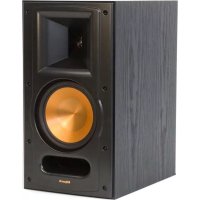
RB61 II - Speaker KLIPSCH - Free user manual and instructions
Find the device manual for free RB61 II KLIPSCH in PDF.



| Product Type | Bookshelf Speaker |
| Brand | Klipsch |
| Model | RB61 II |
| Technology | Klipsch Tractrix® Horn |
| Recommended Use | Stereo, surround, home theater |
| Placement | On shelf or stand at ear height |
| Wall Mounting | Possible via keyhole slots (screws not included) |
| Connection | Screw terminals for bare wire, pins, spade connectors; bi-wiring possible |
| Bi-amping | Not recommended |
| Internal Wiring | Bandwidth Balanced™ Monster® |
| Maintenance | Regular dusting; grille cleanable with vacuum brush |
| Cleaning | Dry cloth only, no abrasive or solvent products |
| Safety | Do not expose to rain or moisture; unplug during storms |
| Warranty (USA and Canada) | 5 years (electronics 2 years) |
| Protective Grille | Removable with magnetic attachment |
| Bass Management | Adjustable to Large or Small in the receiver |
| Included Accessories | Magnetic grille, user manual |
Frequently Asked Questions - RB61 II KLIPSCH
User questions about RB61 II KLIPSCH
0 question about this device. Answer the ones you know or ask your own.
Ask a new question about this device
Download the instructions for your Speaker in PDF format for free! Find your manual RB61 II - KLIPSCH and take your electronic device back in hand. On this page are published all the documents necessary for the use of your device. RB61 II by KLIPSCH.
USER MANUAL RB61 II KLIPSCH
natural_image
Black-and-white photo of multiple compact audio speakers with visible sound waves and no text or symbolsIMPORTANT SAFETY INSTRUCTIONS
- READ these instructions.
- KEEP these instructions.
- HEED all warnings.
- FOLLOW all instructions.
- DO NOT use this apparatus near water.
-
CLEAN ONLY with dry cloth.
-
DO NOT block any ventilation openings. Install in accordance with the manufacturer's instructions.
-
DO NOT install near any heat sources such as radiators, heat registers, stoves, or other apparatus (including amplifiers) that produce heat.
-
DO NOT defeat the safety purpose of the polarized or grounding type plug. A polarized plug has two blades with one wider than the other. A grounding type plug has two blades and a third grounding prong. The wider blade or the third prong are provided for your safety. If the provided plug does not fit into your outlet, consult an electrician for replacement of the obsolete outlet.
-
PROTECT the power cord from being walked on or pinched, particularly at plugs, convenience receptacles, and the point where they exit from the apparatus.
-
ONLY USE attachments/accessories specified by the manufacturer.
-
USE only with a cart, stand, tripod, bracket, or table specified by the manufacturer, or sold with the apparatus. When a cart is used, use caution when moving the cart/apparatus combination to avoid injury from tip-over.
-
UNPLUG this apparatus during lightning storms or when unused for long periods of time.
-
REFER all servicing to qualified service personnel. Servicing is required when the apparatus has been damaged in any way, such as power-supply cord or plug is damaged, liquid has been spilled or objects have fallen into the apparatus, the apparatus has been exposed to rain or moisture, does not operate normally, or has been dropped.

This symbol indicates that there are important operating and maintenance instructions in the literature accompanying this unit.

This symbol indicates that dangerous voltage constituting a risk of electric shock is present within this unit.
WARNING: To reduce the risk of fire or electrical shock, do not expose this apparatus to rain or moisture.


WARNING: Voltages in this equipment are hazardous to life. No user-serviceable parts inside. Refer all servicing to qualified service personnel.
CAUTION: Changes or modifications not expressly approved by the manufacturer could void the user's authority to operate.
ABOUT YOUR KLIPSCH PURCHASE
Thank you for your purchase of Klipsch bookshelf loudspeakers. After reading this manual and connecting your system, you will hear the result of over 55 years of stringent engineering and class-leading research and development. Like all Klipsch products, your bookshelf loudspeakers feature Klipsch Tractrix® Horn-loaded Technology—the guiding design for the first Klipschorn® developed in 1946 and for every product that has followed. Horn-loading allows your speakers to deliver high sensitivity, low distortion, flat frequency response and wide dispersion, which translates to unequaled power, detail and dynamics, the hallmarks of "The Klipsch Sound." Please be sure to fill out the warranty card at the back of this manual or online at www.klipsch.com so we are better able to serve you. Again, thank you for choosing Klipsch and we hope that your speakers bring life to your music and movies for many years.
UNPACKING
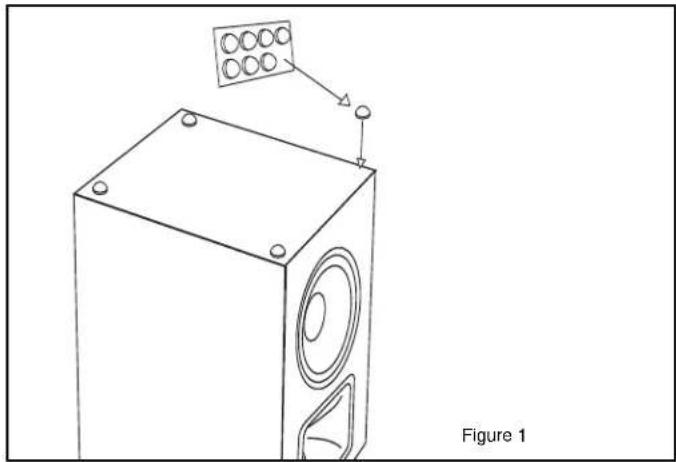
The easiest way to remove the speaker from its carton is to turn the open end of the box down so that it is resting on a table or the floor, with the flaps spread out and away. Then pull the box straight up and off. Remove any packing material from the speaker and grille, place it back in the carton, and store in case you ever need to ship the loudspeaker. Attach the dome-shaped self-stick pads on the bottom of the cabinet for shelf protection. (See Figure 1.) Align the magnetic posts on the inside of the grille with the screws on the front of the speaker, and it will snap into place.
natural_image
Line drawing of a speaker tower with a panel and indicator lights, labeled as Figure 1 (no text or symbols on the diagram itself)PLACEMENT
Although your Reference Series speakers will perform well in a wide variety of locations, you will get the most out of them by following some simple guidelines:
- Place the front left and right speakers on shelves or stands with their tweeters at approximately ear height for a seated listener. Used as surround-channel speakers, they usually perform best when placed slightly higher than that.
- If you are installing your speakers in a cabinet, place them so their fronts are at least flush with the cabinet's front.
- If possible, arrange both speakers so that they are equal distances from the floor and the wall behind them. It can also help to have the left and right speakers at different distances from their nearest side walls. This sort of staggering helps smooth the bass range.
- Any speaker's bass output and response is strongly influenced by its distance from room boundaries, such as walls and the floor. Moving a speaker closer to a room boundary will increase its bass output, while moving it away will reduce the bass. Following the suggestions above will typically yield good results with Klipsch Reference Series bookshelf speakers, but you may find that you can "fine-tune" the sound by moving them slightly from side to side or front to back until music recordings with strong bass content sound just right to you. Don't be afraid to experiment.
flowchart
graph TD
    A["L"] --> B["6'-15'"]
    B --> C["R"]
    C --> D["2'-3'"]
    D --> E["Figure 2"]
    F["Angle inward"] --> A
    G["6'-15'"] --> H["Figure 2"]
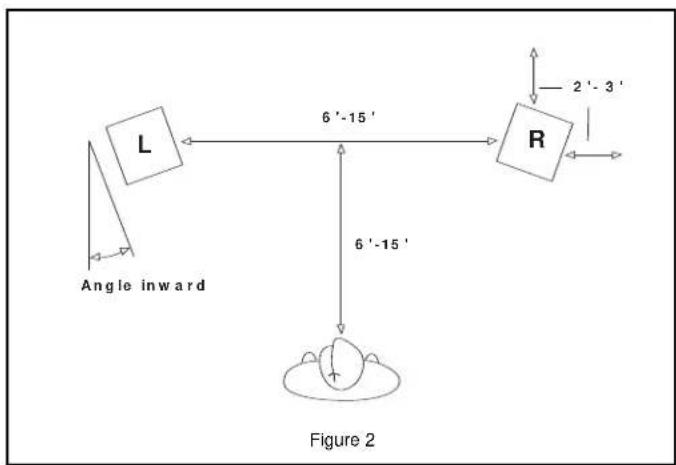
Two-Channel Stereo System - Figure 2 shows a typical speaker arrangement for a two-channel stereo system. A good starting point is to create an equilateral triangle with the speakers and your listening position. Depending on the size of the room and the furniture arrangement, you may find it convenient to make the distance from the listening position to the line between the speakers somewhat larger or smaller, but try to keep it centered, so that you are at approximately the same distance from each speaker. That will yield the best stereo image. Angling widely spread speakers in slightly toward the listening position can help maintain a good stereo image.
Stereo Setup for Wide Coverage - If you are primarily interested in being able to hear the sound well from any position in the room rather than from a particular seating area, you may prefer to move the speakers far apart along adjoining walls, creating a big "L." This will not provide a very good stereo image, but it will give spacious, well-balanced sound with good coverage.
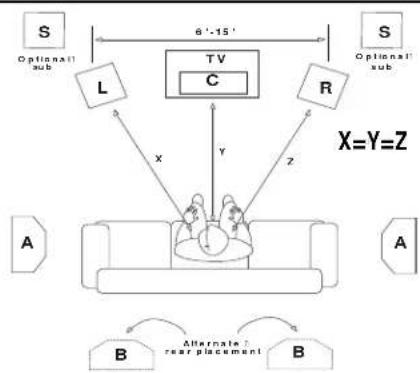
Home Theater System - Figure 3 shows a typical home theater speaker setup, with a pair of bookshelf speakers at the front left and right, a horizontal center-channel speaker between them, and a pair of surround speakers on the side walls. The basic strategy for placing the front left and right speakers is similar to the one described above for a two-channel stereo system, but anchored by the video screen. Ideally, the front left and right speakers should be approximately in line with the screen and equidistant from it. Unless your video screen is very large, you may prefer less spread between the left and right speakers than in a dedicated stereo music system. This may better associate the size of the sonic image with the video image.
flowchart
graph TD
    S["Special Sub"] --> L["L"]
    S --> C["C"]
    S --> R["R"]
    L --> x["x"]
    C --> y["y"]
    R --> z["z"]
    x --> A["A"]
    y --> B["B"]
    z --> B["B"]
    style S fill:#f9f,stroke:#333
    style L fill:#ccf,stroke:#333
    style C fill:#cfc,stroke:#333
    style R fill:#fcc,stroke:#333
    style A fill:#ffc,stroke:#333
    style B fill:#fcc,stroke:#333
    style x fill:#fff,stroke:#333
    style y fill:#fff,stroke:#333
    style z fill:#fff,stroke:#333
    note right of S "8'-15'"
    note right of B "Alternate 1 rear placement"
    note right of A "X=Y=Z"
Figure 3
Reference Series bookshelf speakers can also be used as surround-channel speakers. The best location usually is high up, on the walls to the sides and slightly behind the seating area. Many other placements can work surprisingly well, however — behind the listening area, for example, or even on the floor facing up toward the ceiling in a pinch. Aiming the speakers toward your listening area will emphasize specific rear channel sounds, while directing them away from the listening position will produce a greater sense of spaciousness. Experiment and find what sounds best to you.
WALL AND CEILING MOUNTING
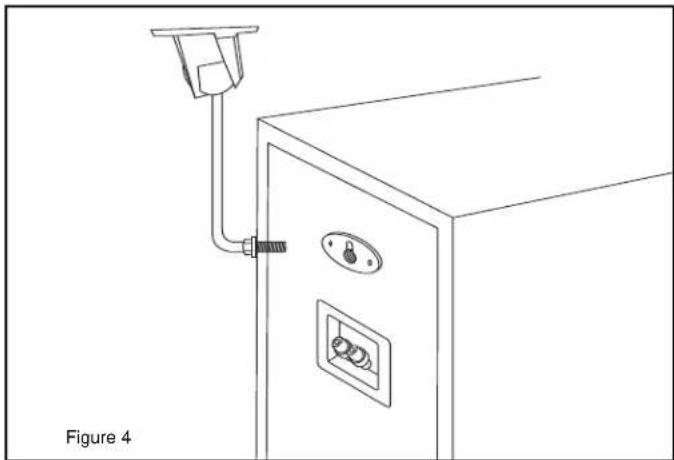
Some models have threaded inserts for use with wall or ceiling brackets, as well as back-panel keyholes for flush wall-mounting. If you will be using brackets, see their instructions for mounting details. To use the keyhole, all you need is a screw head of the appropriate size protruding slightly from the wall. If possible, the screw should be driven into a wall stud; if not, be sure to use anchors appropriate for the speaker's weight in the drywall or plaster. (See figure 4.)
CONNECTIONS
Note: Proper connection of your speakers to your amplifier or receiver is vital to obtaining good sound quality. Please follow these directions carefully. Sloppy connections can cause amplifier malfunction or damage.
Klipsch Reference Series speakers are wired internally with Bandwidth Balanced™ Monster® Cable. Bandwidth Balanced technology employs multiple gauges of high-purity copper wire,
natural_image
Line drawing of a cabinet with electrical outlets and a wall-mounted switch, labeled Figure 4 (no text or symbols on the diagram itself)carefully selected and wound to ensure optimum signal transfer at all frequencies.
You will obtain best performance from your speakers if you connect them to your amplifier or receiver with Monster Cable or similar quality wire available from your dealer. We recommend that you use 16-gauge or heavier stranded copper wire. Use a lower gauge (heavier) wire for longer runs to reduce the amount of amplifier power lost due to the wire's resistance. On the back of each speaker are two sets of binding posts, one feeding the tweeter and the other the woofer. For conventional wiring, these sets are connected together with gold-plated metal straps or wire jumpers, which can be removed for bi-wiring or biamping. We will explain ordinary single-wiring first and then the alternatives. All the information regarding single-wiring also applies to bi-wiring.
BUT FIRST: TYPES OF CONNECTORS
Bare wire. Pull the two conductors apart for about an inch and strip approximately 1/4-inch of insulation from the end of each. (A wire stripper will simplify this, but you can use an ordinary pocket knife to cut around and through the insulation down to the wire.) Twist the strands of wire on each individual conductor tightly together. Loosen the nuts on a pair of binding posts until the holes through the metal posts are exposed, then insert the bare wire through the holes. Screw the nuts down finger-tight on the wire. Make sure that no strands of wire are touching from one binding post to the other or to any strands from the other conductor. Failure to observe this precaution at either end of the connection can result in amplifier malfunction or damage.
Pins. Many pre-made speaker cables are terminated with metal pins. Loosen the nuts on a pair of binding posts until the holes through the metal posts are exposed, then insert the pins through the holes. Screw the nuts down finger-tight on the pins — do not overtighten. Make sure that there is no metal-to-metal contact between the two pins or binding posts. Failure to observe this precaution at either end of the connection can result in amplifier malfunction or damage.
Spade lugs. Some speaker cables are terminated with U-shaped connectors called spade lugs. Loosen the nuts on a pair of binding posts and slip the spade lugs around the metal posts. Screw the nuts down finger-tight on the lugs and inspect to ensure they have remained firmly in place. Make sure that there is no metal-to-metal contact between the two lugs or binding posts. Failure to observe this precaution at either end of the connection can result in amplifier malfunction or damage.
OTHER TYPES OF SPECIALTY CONNECTORS ARE AVAILABLE TO FACILITATE HOOKING UP YOUR SPEAKERS. PLEASE CONSULT YOUR AUTHORIZED KLIPSCH DEALER FOR SUGGESTIONS AND FURTHER DETAILS.
SPEAKERS TO AMPLIFIER: KEEPING IT STRAIGHT
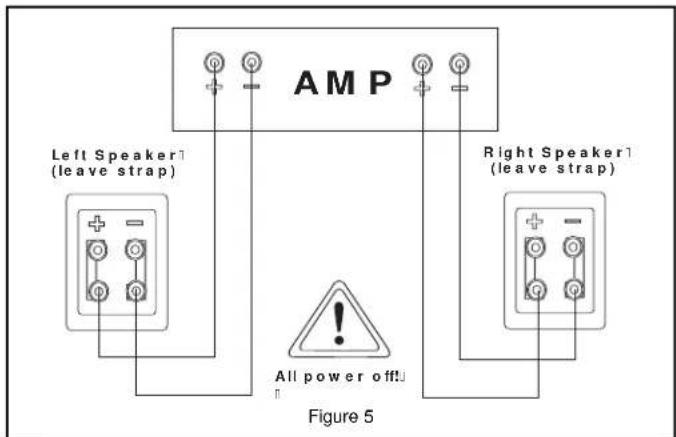
One of the most important things about hooking up your speakers is keeping them in the same polarity, or phase. If they are connected out of phase, bass and sound imaging will be degraded.
The easiest way to ensure that your speakers are wired in phase is to always connect the positive and negative output terminals on your amplifier or receiver to the matching input terminals on your speakers: positive ("+", color-coded red) to positive and negative ("-", color-coded black) to negative. (See Figure 5.)
text_image
AMP Left Speaker (leave strap) Right Speaker (leave strap) All power off! Figure 5Most pre-terminated speaker cables have color-coded connectors that make it easy to match output and inputs correctly. If yours do not, or if you are making your own out of paired, two-conductor wire, look for identifying marks on the insulation of the two conductors. Normally there will be printing, a stripe or a molded ridge along one of the conductors.
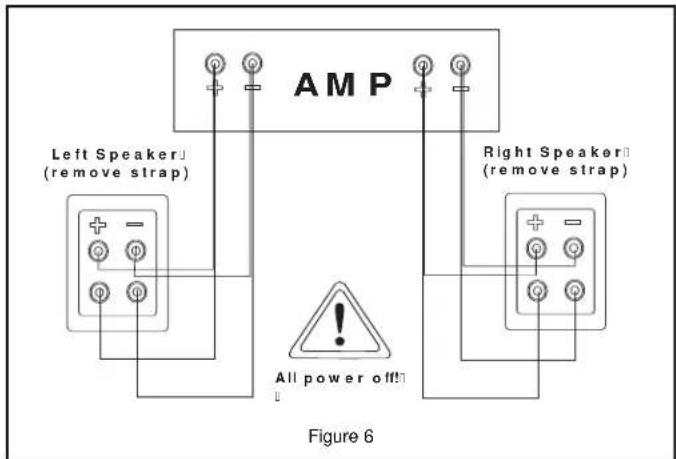
Bi-wiring - In bi-wiring, separate cables are connected from the amplifier or receiver output terminals to the speaker input terminals for the tweeter and woofer. (See Figure 6.) This results in lower electrical resistance between the amplifier and speaker than single-wiring with the same gauge cable. In some cases bi-wiring may be preferable to single-wiring with lower-gauge cable, which will be thicker and probably less flexible.
text_image
AMP Left Speaker (remove strap) Right Speaker (remove strap) All power off!! Figure 6To bi-wire your Reference Series speakers, loosen the nuts on the binding posts and remove the metal straps or wire jumpers linking the woofer and tweeter terminals. Observing proper polarity, connect one cable to the tweeter binding posts (upper) and another to the woofer binding posts (lower). Run both cables back to your amplifier or receiver and attach them to the same channel. (Do not, for example, attach one to an A speaker output and the other to a B speaker output on an amplifier or receiver with A/B speaker switching.) Amplifiers may be severely damaged if straps are not removed.
Biomping - In biamplification, the tweeter and woofer are driven by separate amplifiers fed from the same preamplifier output. We do not recommend biamplifying any of our speakers, since in general it will produce no benefit that could not be obtained simply by using a single larger amplifier and may cause severe sound degradation if not done properly. If you do biamplify, use the same model amplifier for the tweeter and woofer sections (to prevent frequency-response errors caused by different amplifier gains) and be sure to remove the straps linking the two sets of input terminals on the speaker. Amplifiers may be severely damaged if straps are not removed.
BASS MANAGEMENT SETTINGS
Surround-sound receivers and processors use what is known as bass management to ensure that low frequencies in the various channels are sent to speakers that can handle them well and
away from small speakers that cannot. Any of the Klipsch Reference Series bookshelf models can be set to Large in your receiver or processor's speaker setup menu if necessary. But if your system includes a good powered subwoofer, you probably will get better overall performance by using the Small setting and letting the sub handle the low bass, especially in the case of speakers having a single woofer less than 6.5 inches in diameter.
CARE AND CLEANING
The only thing you should ever need to do to your speakers is dust them occasionally. Never apply any abrasive or solvent-based cleaner or any harsh detergent. You can clean the grilles with the brush attachment of a vacuum cleaner.
WARRANTY — U.S. AND CANADA ONLY
The Warranty below is valid only for sales to consumers in the United States or Canada. KLIPSCH, L.L.C. ("KLIPSCH") warrants this product to be free from defects in materials and workmanship (subject to the terms set forth below) for a period of five (5) years from the date of purchase. During the Warranty period, KLIPSCH will repair or replace (at KLIPSCH's option) this product or any defective parts (excluding electronics and amplifiers). For products that have electronics or amplifiers, the Warranty on those parts is for a period of two (2) years from the date of purchase.
To obtain Warranty service, please contact the KLIPSCH authorized dealer from which you purchased this product. If your dealer is not equipped to perform the repair of your KLIPSCH product, it can be returned, freight paid, to KLIPSCH for repair. Please call KLIPSCH at 1-800-KLIPSCH for instructions. You will need to ship this product in either its original packaging or packaging affording an equal degree of protection.
Proof of purchase in the form of a bill of sale or receipted invoice, which is evidence that this product is within the Warranty period, must be presented or included to obtain Warranty service.
This Warranty is invalid if (a) the factory-applied serial number has been altered or removed from this product or (b) this product was not purchased from a KLIPSCH authorized dealer. You may call 1-800-KLIPSCH to confirm that you have an unaltered serial number and/or you purchased from a KLIPSCH authorized dealer.
This Warranty is only valid for the original purchaser and will automatically terminate prior to expiration if this product is sold or otherwise transferred to another party.
This Warranty does not cover cosmetic damage or damage due to misuse, abuse, negligence, acts of God, accident, commercial use or modification of, or to any part of, the product. This Warranty does not cover damage due to improper operation, maintenance or installation, or attempted repair by anyone other than KLIPSCH or a KLIPSCH dealer which is authorized to do KLIPSCH warranty work. Any unauthorized repairs will void this Warranty. This Warranty does not cover product sold AS IS or WITH ALL FAULTS.
REPAIRS OR REPLACEMENTS AS PROVIDED UNDER THIS WARRANTY ARE THE EXCLUSIVE REMEDY OF THE CONSUMER. KLIPSCH SHALL NOT BE LIABLE FOR ANY INCIDENTAL OR CONSEQUENTIAL DAMAGES FOR BREACH OF ANY EXPRESS OR IMPLIED WARRANTY ON THIS PRODUCT. EXCEPT TO THE EXTENT PROHIBITED BY LAW, THIS WARRANTY IS EXCLUSIVE AND IN LIEU OF ALL OTHER EXPRESS AND IMPLIED WARRANTIES WHATSOEVER, INCLUDING BUT NOT LIMITED TO, THE WARRANTY OF MERCHANTABILITY AND FITNESS FOR A PRACTICAL PURPOSE.
Some states do not allow the exclusion or limitation of incidental or consequential damages or implied warranties so the above exclusions may not apply to you. This Warranty gives you specific legal rights, and you may have other rights, which vary from state to state.
WARRANTY OUTSIDE THE UNITED STATES AND CANADA
The Warranty on this product if it is sold to a consumer outside of the United States or Canada shall comply with applicable law and shall be the sole responsibility of the distributor that supplied this product. To obtain any applicable warranty service, please contact the dealer from which you purchased this product, or the distributor that supplied this product.
IMPORTANTES CONSIGNES DE SÉCURITÉ
À PROPOS DE VOTRE ACHAT DE PRODUIT KLIPSCH
natural_image
Line drawing of a speaker tower with sound waves and a labeled component (Figure 1), no text or symbols present.PLACEMENT
natural_image
Line drawing of a cabinet with electrical outlets and a wall-mounted fixture (no text or symbols)Figure 4
text_image
AMP Left Speaker (leave strap) Right Speaker (leave strap) All power off!! Figure 5text_image
AMP Left Speaker (remove strap) Right Speaker (remove strap) All power off!! Figure 6ÜBER IHR KLIPSCH-PRODUKT
natural_image
Line drawing of a speaker tower with a panel and indicator lights, labeled Figure 1 (no text or symbols on the diagram itself)PLATZIERUNG
natural_image
Line drawing of a cabinet with a wall-mounted fixture and a lock, no text or symbols presenttext_image
AMP Left Speaker (leave strap) Right Speaker (leave strap) All power off!! Figure 5text_image
AMP Left Speaker (remove strap) Right Speaker (remove strap) All power off! Figure 6natural_image
Line drawing of a speaker tower with a panel and indicator lights, labeled as Figure 1 (no text or symbols on the diagram itself)COLLOCAZIONE
natural_image
Line drawing of a cabinet with electrical outlets and a piping outlet (no text or symbols)Figure 4
text_image
AMP Left Speaker (leave strap) Right Speaker (leave strap) All power off!! Figure 5text_image
AMP Left Speaker (remove strap) Right Speaker (remove strap) All power off!! Figure 6text_image
2' - 3' 6' - 15' L R 6' - 15' Angle inwardFigure 2
natural_image
Line drawing of a door with attached electrical outlets and a wall-mounted switch, labeled Figure 4 (no text or symbols on the diagram itself)text_image
AMP Left Speaker (leave strap) Right Speaker (leave strap) All power off! Figure 5text_image
AMP Left Speaker (remove strap) Right Speaker (remove strap) All power off! Figure 6natural_image
Line drawing of a speaker tower with a panel and indicator lights, labeled as Figure 1 (no text or symbols on the diagram itself)UBICACIÓN
natural_image
Line drawing of a cabinet with an attached outlet and a piping fixture (no text or symbols)Figure 4
text_image
AMP Left Speaker (leave strap) Right Speaker (leave strap) All power off!! Figure 5text_image
AMP Left Speaker (remove strap) Right Speaker (remove strap) All power off!! Figure 6natural_image
Line drawing of a speaker tower with a panel and indicator lights, labeled as Figure 1 (no text or symbols on the diagram itself)擺放
natural_image
Line drawing of a door with a wall-mounted fixture and a lock, labeled Figure 4 (no text or symbols on the diagram itself)text_image
AMP Left Speaker (leave strap) Right Speaker (leave strap) All power off!! Figure 5text_image
AMP Left Speakeru (remove strap) Right Speakeru (remove strap) All power off!! Figure 6Register your new Klipsch product now at www.klipsch.com!
Cut along dotted line and mail.
For multiple speaker purchases, please fill out only one warranty card.
Name:
Street Address:
City/State/Zip:
Home Phone:
Work Phone:
E-mail Address:
Would you like to receive the latest product updates and news via e-mail? q Yes q No
Product Purchase
Model and serial number must be included to honor your warranty card. For multiple speaker purchases, please fill out only one warranty card.
Model Serial Number
Model Serial Number
Model Serial Number
Model Serial Number
Model Serial Number
What store did you purchase your Klipsch products from?
Store Name: State:
How did you hear about Klipsch? q Audio/Home Theater Magazine q Other Magazine q TV q
Radio q Newspaper q Trade Show q Friend q Retail Dealer q Direct Mail
Have you purchased Klipsch products before? q Yes q No
If yes, what products?
Product Name(s):
When do you hope to purchase additional loudspeakers? q 6 mos. - 1 yr. q 1-2 yrs.
How likely are you to consider Klipsch products for your upcoming purchases?
q try likely q Somewhat likely q Doubtful
If doubtful, why? q Don't carry product I'm looking for q fo expensive
q Klipsch dealer too far away q Other
Please tell us about you!
q Married q Single q Student q Male q Female
Age: q 15-17 q 18-24 q 25-35 q 36-45 q 46-55 q 55-64 q 65+
Annual Household Income: q Under \25,000 q \25-35,000 q \35-50,000 q \50-75,000 q
\75-100,000 q \100,000+

text_image
Klipsch®3502 Woodview Trace, Suite 200 Indianapolis, Indiana 46268 USA 1·800·KLIPSCH · www.klipsch.com
Make sure you return your warranty card so that we may keep you up-to-date on new Klipsch products and promotions. If you have any questions, contact your local authorized Klipsch dealer.
For your records:
Model:
Date Purchased:
Kiipsch Audio Technologies 3502 Woodview Trace, Suite 200 Indianapolis, IN 46268 USA
Stamp Here
Postage
FIRST CLASS
Place