ManualGo.com
Espresso Pure - Machine à café GAGGIA - Free user manual and instructions
Find the device manual for free Espresso Pure GAGGIA in PDF.
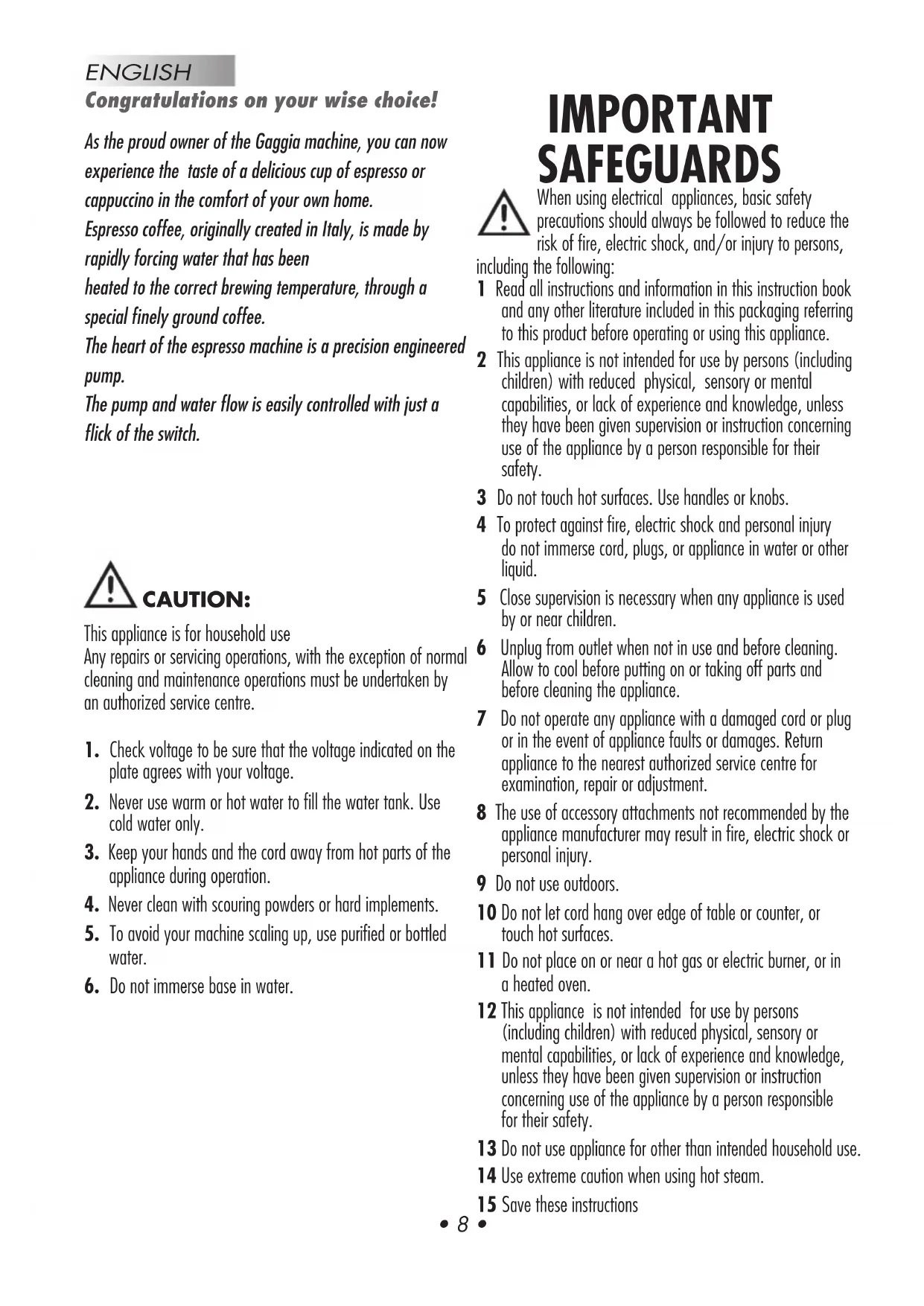


Download the instructions for your Machine à café in PDF format for free! Find your manual Espresso Pure - GAGGIA and take your electronic device back in hand. On this page are published all the documents necessary for the use of your device. Espresso Pure by GAGGIA.
USER MANUAL Espresso Pure GAGGIA
Congratulations on your wise choice!
As the proud owner of the Gaggia machine, you can now
experience the taste of a delicious cup of espresso or
cappuccino in the comfort of your own home.
Espresso coffee, originally created in Italy, is made by
rapidly forcing water that has been
heated to the correct brewing temperature, through a
special finely ground coffee.
The heart of the espresso machine is a precision engineered
The pump and water flow is easily controlled with just a
This appliance is for household use
Any repairs or servicing operations, with the exception of normal
cleaning and maintenance operations must be undertaken by
an authorized service centre.
1. Check voltage to be sure that the voltage indicated on the
plate agrees with your voltage.
2. Never use warm or hot water to fill the water tank. Use
3. Keep your hands and the cord away from hot parts of the
appliance during operation.
4. Never clean with scouring powders or hard implements.
5. To avoid your machine scaling up, use purified or bottled
6. Do not immerse base in water.
IMPORTANT SAFEGUARDS When using electrical appliances, basic safety
precautions should always be followed to reduce the
risk of fire, electric shock, and/or injury to persons,
including the following:
1 Read all instructions and information in this instruction book
and any other literature included in this packaging referring
to this product before operating or using this appliance.
2 This appliance is not intended for use by persons (including
children) with reduced physical, sensory or mental
capabilities, or lack of experience and knowledge, unless
they have been given supervision or instruction concerning
use of the appliance by a person responsible for their
3 Do not touch hot surfaces. Use handles or knobs.
4 To protect against fire, electric shock and personal injury
do not immerse cord, plugs, or appliance in water or other
5 Close supervision is necessary when any appliance is used
by or near children.
6 Unplug from outlet when not in use and before cleaning.
Allow to cool before putting on or taking off parts and
before cleaning the appliance.
7 Do not operate any appliance with a damaged cord or plug
or in the event of appliance faults or damages. Return
appliance to the nearest authorized service centre for
examination, repair or adjustment.
8 The use of accessory attachments not recommended by the
appliance manufacturer may result in fire, electric shock or
9 Do not use outdoors.
10 Do not let cord hang over edge of table or counter, or
11 Do not place on or near a hot gas or electric burner, or in
12 This appliance is not intended for use by persons
(including children) with reduced physical, sensory or
mental capabilities, or lack of experience and knowledge,
unless they have been given supervision or instruction
concerning use of the appliance by a person responsible
13 Do not use appliance for other than intended household use.
15 Save these instructionsENGLISH
Description of parts:
2 Hot water/brew switch (pump)
4 Steam switch (temperature)
5 Correct temperature light
6 Removable water tank
7 Steam/hot water knob
8 Turbo frother steam nozzle (removeable)
12 Basin (removable)
13 “Perfect cream” Filter (OPTION)
19 Power cable and plug
24 Cappuccino maker kit (OPTION)
25 Overflowing protection hole
Instructions for the power supply cord
A A short power-supply cord is provided to reduce risks of
getting tangled up or tripping over a longer cord.
B Longer extension cords are available and may be used if
care is exercised in their use.
C If a long extension cord is used:
1 the marked electrical rating of the extension cord
should be at least as great as the electrical rating of
2 if the appliance is of the grounded type, the extension
cord should be a grounding type
3 the cable does not hang from the table to avoid the
risk of getting caught up in it.
1. Remove the water tank cover (22) and fill the tank with
cold water checking the level through the tank window
N.B.: The upper section of the tank (6) is provided with an
overflowing safety hole (25) in case of tank overfilling.
The water tank can also be removed (FIG.02), after
removing the tank cover (22).
Re-install tank with water and cover (22).
2. Insert plug (19) into a suitable wall outlet (see point 1
3. Press the main switch (1), the start light (3) will light
The temperature light (5) will light up fixed when the
required temperature is reached;
This procedure fills the water boiler with fresh water.
This should be done whenever the machine is switched on.
This machine, featuring a pump to brew coffee, is equipped
with a self-priming system.
Place an empty cup under the brewing head (14), do not
insert the filter holder and press the hot water/coffee switch
You will hear the sound of the operating pump, and after
a few seconds, water will start flowing out of the brewing
Warning! Before removing the water tank,
make sure that the machine is off as not to
damage the self-primer.ENGLISH
Caution: Never operate pump without water
in machine as damage to the pump may occur.
Damage of pump run without water is not covered
When the cup is full,press again the hot water/coffee switch
(2) to stop dispensing.
The Gaggia machine is now ready to be used.
N.B.: The pump self-primer could be temporarily out of order
because of an “air bubble”.
In this case water does not flow from brewing head (14), and
the following procedure should be followed:
a) Place a small frothing pitcher or mug under the steam
b) Turn the knob (7) counterclockwise to open the steam/hot
water dispensing tap and press the hot water/coffee switch
(2) to start dispensing.
c) Alter a few seconds, a steady stream of water will emerge
from the steam nozzle. Allow about one cup of water to
fill the pitcher. Press the hot water/coffee switch (2) and
close the steam/hot water tap (7) to stop dispensing.
The Gaggia machine is now ready to be used.
d) NOTE: The temperature ready-light (5) will automatically
flash as the machine boiler heats.
After switching on the machine for the first coffee, wait 6
minutes until the machine has fully heated up, while for
all subsequent coffees the machine will be ready to use.
1. The taste of your coffee depends on the characteristics
of the beans from which it is made, the type of bean,
where it was grown and processed. The coffee beans
that are roasted for a longer period of time and at higher
temperatures will be much darker in colour.Darker beans
will produce a richer cup of coffee than the lightly-roasted
2. A variety of dark roasts are available from which you
can choose to brew your espresso. Each of these roasts
is a blend of coffee beans that are roasted at a specific
temperature producing a specific type of flavour.There are
decaffeinated beans that have up to 98% of the caffeine
content removed. The next time you purchase coffee for
your espresso maker, experiment with one of the many
kinds of coffee being sold. You may just find that it tastes
better than the blend you have been using.
3. A fine “espresso grind” for pump-driven machines must be
used. Be sure to ask for this when buying coffee or when
having beans ground. Do not use a blade-type grinder
because it makes too much coffee dust and produces an
4. The mark of real espresso is its dark color, rich taste and
the light brown, natural froth called “crema” in Italian.
5. Cappuccino is simply a combination of espresso and hot,
frothy milk.Cappuccino is usually topped with cinnamon,
nutmeg or cocoa powder.
6. Espresso Coffee should be served immediately after it is
7. Espresso is served in 2 to 2 ½ oz. demitasse cups. A 4 or
6 oz. cup or glass is used for cappuccino
8. Ideally, coffee beans should be ground immediately before
using. Remember, it must be an “espresso grind” for
pump-driven espresso machines.
9. It’s best to store ground coffee or beans in an airtight
container in the freezer of your refrigerator. Ground coffee
tends to absorb food odours.ENGLISH
How to make a good Espresso coffee:
1 Follow the procedure described under “Preparation”.
2 Select the correct filter basket (10, 11) and insert it in
the filter holder (9).
Use the small filter for 1 cup and the large filter for 2 cups
Then insert the filter holder (9) into the brewing head (11)
3 Wait until the machine has reached the correct temperature
with filter holder inserted (heating time of about 6
Pre-heat the filter holder (9) by pressing the coffee/hot
water switch (2); water will start coming out of the
filter holder (this operation is required for the first coffee
After dispensing 50cc of water press again the coffee /hot
water switch (2) to stop water dispensing.
4. Remove the filter holder (9) and fill it with ground coffee
using the measuring spoon included in the supply. Place one
level measure of coffee in basket for each cup of espresso.
Do not overfill. Gently tamp down coffee with the tamper
(18) provided. Do not compress too firmly.
5 Clean any excess coffee from the rim of filter holder (9).
Insert filter holder into brew head by holding handle
approximately 45 degrees to the left as you face machine.
When properly aligned,move handle firmly to the right to
The handle should point to the front of the machine or
slightly to the right.
6 Place one or two espresso cups on the drip plate to line
up with the spouts of the filter holder. Press the hot
water/coffee switch (2).
7 When the cups are 3/4 full, press again the coffee
switch(2). The more water you allow to flow, the weaker
the coffee. When properly made, the espresso will have a
light brown foam “crema” floating on the top.
If not, refer to “In the event of faulty function”.
8 Remove cups and serve.
9 To make more espresso, carefully and slowly remove the
filter holder by moving handle to the left. Be careful as
hot water will be on top of the coffee grinds in the holder.
Some water will continue to drip from brewing head as
Preparing cappuccino:
When preparing to make a cappuccino, have all of the
ingredients at hand as well as a frothing pitcher (or mug)
halffilled with skimmed or low-fat milk and cups that are larger
(6 oz.) than those used for espresso.
“Perfect cream” filter (13)
Even when the coffee is not properly ground, the “perfect
cream filter” will help produce the foamy ‘cream’
typical of fine espresso.
You can use the “perfect cream filter” with a single
or double dose of ground coffee by using the special
To ensure perfect performance, clean your “perfect
cream filter” every day prior to use.
Should your “perfect cream filter” become clogged,
immerse it for a few seconds in boiling water.
filter holder is removed. That is normal and due to the pump
pressure in the system. Knock out used coffee grinds from
filter. For more espresso repeat steps 4 to 8 above
How to use the coffee pods
To use pods, use exclusively the appropriate filter (16).
After heating (“see “How to make a good Espresso
coffee” section, step 3), remove the filter holder (9) and
insert the pod; make sure that the pod paper does not come
out of the filter holder.
Insert the filter holder in the machine with a 45° movement
Then turn rightwards to hold it in position. The filter holder
handle shall be perpendicular to the machine or slightly moved
Then follow the “How to make a good Espresso
coffee” procedure – steps 6 to 8.ENGLISH
1. Follow the procedure described under “Preparation”.
2. Press the main switch (1).
3. Allow about 6 minutes for the machine to reach its proper
operating temperature.
4. Place a pitcher under the steam nozzle (8).
5 Slowly turn the steam knob (7) counterclockwise and press
the hot water/coffee switch (2) to dispense hot water.
N.B.: Dispensing should not exceed 60 seconds.
After getting the desired quantity of hot water, press the
coffee/hot water switch (2) and turn the steam knob (7)
to stop dispensing. Then remove the pot.
1 Make espresso (in a large cups) as described above
2 With the machine ready to deliver coffee, convey the pipe
over the drip tray (12), open the “Hot water/steam” tap
knob (7) for a few seconds so to let the remaining water
come out of the steam pipe; after a few seconds only
steam will come out.
3 Close the steam/hot water tap knob(7).
4 Press steam switch (4).
5 After 50 to 60 seconds or, when temperature ready-light
(5) goes on, place the frothing pitcher halffilled with low-fat
milk under Turbo Frother steam nozzle so that tip is just
under the surface of the milk. See Fig.03.
6 Slowly turn steam valve knob (7) counter clockwise to
IMPORTANT. The more you turn the knob, the greater
the steam pressure for frothing.
N.B.: Dispensing should not exceed 60 seconds.
Turbo frother steam nozzle version:
Steam can be used to froth the milk for cappuccinos and also
Caution! Scalding hazard! Splashing may occur
at the start – scalding hazard! The hot water
nozzle and pipe can reach high temperatures:
avoid touching it directly with your hands.
7 Move pitcher in circular motion keeping the tip of steam
nozzle just under surface of milk as it begins to froth. Do
not let milk come to a boil since it will not froth.
8 When you have made enough froth,turn steam knob
clockwise to shut off steam and remove pitcher. Put steam
9 Spoon the froth onto the espresso in each cup and gently
pour the hot milk along the side of the cup. Top each cup
of cappuccino with a dash of cinnamon, cocoa and nutmeg.
10 NOTE: If you want to make more espresso immediately
after steaming milk, the machi-ne boiler must be refilled
with water and temperature brought down to a brewing
Otherwise, espresso may taste “burned”.
To do this: place an empty cup on drip plate. Do not insert
filter holder. Press the coffee/hot water switch (2) to fill
the cup with water. Press again switch (2). You many now
proceed to make more espresso.
The higher the fat content in the milk the denser the froth will
be. The Turbo-Frother (8) or the cappuccino maker pos.24
will give you all the froth required but don’t let milk come
It may require two or three attempts to “become an expert” but
you will be successful at frothing milk if you give it a chance.
Swivel the Turbo- Frother steam nozzle (or milk frother) slightly
outward so that you can get the frothing pitcher under the
nozzle without knocking the base of the machine.ENGLISH
1 IMPORTANT: the steam nozzle should be cleaned after
each use in order to avoid build up of milk deposits that
are very difficult to clean. Cleaning is made easy as can
be seen in the DESCRIPTION OF PARTS. The outer
part of nozzle can be removed by pulling downward.
The outside of the steam pipe can be cleaned with a damp
The steam jet is cleaned by running a shot of steam through
The hole in the steam nozzle must be kept open. A needle
2 Clean filter holder and filter in warm water after use.
Pay attention as the Turbo-Frother
steam nozzle could be hot!
Air intake to be kept clean and
3 Wipe body of machine with a damp cloth as required.
4 Remove basin and grid (12, 23) and rinse with water. Do
not use abrasive substances.
5 Clean the seal (15) inside of the brewing head (14) and
6 The shower disc (17) should be unscrewed and cleaned
periodically depending on frequency of use.
7 If the machine is not used for a long period of time,
discharge the water from the boiler by turning the steam
knob counterclockwise (7), and press the hot water/coffee
switch. Let a quantity of water equal to two cappuccino
cups come out of the frother. Close the steam knob (7)
and press the hot water/coffee and the steam switch.
In hard water areas, minerals found in the water will accumulate
and affect operation of the unit.
1 Approximately every two months (this can vary depending
on use and water condition), clean the machine with
Gaggia descaler (in which case follow the instructions on
2 Remove shower disc (17) and clean.
3 Pour solution into tank and turn on pump for 15
4 Allow solution to flow through brewing head and steam
nozzle for several seconds.
5 Wait 20 minutes, then repeat. process until solution has
6 Rinse machine thoroughly by running plain cold water
through machine. Replace shower disc (17).
NOTE: Product failure due to scale accumulation is not
covered by warranty. No other servicing should be attempted
Use “Gaggia cleaner” for best results.
Turn off the machine. Never operate pump unless there is
8 NOTE: It is very normal for an espresso machine to emit
steam and drip occasionally as the water pressure changes
Be certain to empty drip tray (12) as required.ENGLISH
In the event of faulty function
Problem: Check to ensure against the following:
Coffee does not flow. Water is in tank.
Filter basket clogged because coffee is too fine or compressed too firmly.
Shower disc requires cleaning.
Coffee flows too quickly. Coffee is ground too coarsely.
Coffee is not pressed down with tamper.
Pump makes loud noise. No water in tank.
Coffee is ground too coarsely.
Water leaking excessively from filter
Filter holder not properly inserted in brew head.
Gasket in brewing head dirty or worn.
Coffee grinds not cleaned off the rim of filter holder.
Espresso has little creamy froth. Coffee is ground too coarsely.
Coffee is not pressed down with tamper.
Coffee is too old or dried out.
Espresso is too cold.
Machine is not warmed up (6 min).
Coffee is ground too coarsely.
Not enough milk froth. Steam nozzle and/or air intake hole clogged.
Milk is too hot.dEuTScH
24 Kit Préparation Cappuccino (OPTION)
1 Interruptor principal
1 Interruptor principal
Instructions for end-of-life disposal treatment
This product complies with EU Directive 2002/96/EC.
The symbol on the product or on its packa-
ging indicates that this product may not be treated
as household waste. Instead it shall be handed over
to the applicable collection point for the recycling of
electrical and electronic equipment.
By ensuring this product is disposed of correctly, you
will help prevent potential negative consequences
for the environment and human health, which could
otherwise be caused by inappropriate waste handling
of this product. For more detailed information about
recycling of this product, please contact your local city
ofce, your household waste disposal service or the
shop where you purchased the product.
Dieses Produkt entspricht der EU-Richtlinie 2002/96/EG Das Symbol auf dem Produkt oder seiner
(waste electrical and electronic equipment - WEEE).