Babynova 600 - Washing machine Soba - Free user manual and instructions
Find the device manual for free Babynova 600 Soba in PDF.


User questions about Babynova 600 Soba
0 question about this device. Answer the ones you know or ask your own.
Ask a new question about this device
Download the instructions for your Washing machine in PDF format for free! Find your manual Babynova 600 - Soba and take your electronic device back in hand. On this page are published all the documents necessary for the use of your device. Babynova 600 by Soba.
USER MANUAL Babynova 600 Soba
Operating instructions
Washing machine
Babynova 600
Inhaltsverzeichnis
Instructions d-installation
| INSTALLATION | Safety instructions | 30 |
| Electrical connection | 30 | |
| Manual | 31 | |
| Connection and installation | 31 - 32 | |
| Prior to the first wash | 32 | |
| INSTRUCTIONS | Programme selection | 33 - 34 |
| Fabric selection | 34 | |
| Adding the correct amount of detergent | 35 | |
| Programme examples | 36 | |
| CLEANING AND MAINTENANCE | Care instructions | 37 |
| Removing lime stone | 37 | |
| Cleaning the water inlet sieve | 37 | |
| SUMMARY | Problem checks | 38 - 39 |
| Emergency draining | 38 | |
| Cleaning the drain pump | 38 | |
| Stain removal | 40 | |
| HLCC labels | 41 | |
| Tips | 42 | |
| Guarantee | 43 |
Safety instructions

Attention
- Please ensure you read the instructions carefully before using your machine.
- This washing machine is designed solely for the cleaning of laundry and garments equipped with, and in accordance with the necessary HLCC labels, and during use must be protected from interference by unauthorised persons (ie children).
- This washing machine should not be left unattended during use.

Attention
- This product must not be modified in anyway.
- Always switch of the cold water supply after using your machine.

Attention
Every care was taken to respect the environment in the manufacture and packaging of this product. Would you please ensure that the packaging and, when the time comes, the «old» machine are disposed of according to the rules for protection of the environment. Detach the mains lead and remove it together with the plug. Destroy the lock on the door. In this way you can prevent children from shutting themselves in and the risk of suffocation!
Electrical connection
Plug socket 230V / 50Hz
Rated effect 1,35 kW
- Fuse: min. 6 A
- Kindly note the rating label on the back of the machine.
Manual
Connection and installation
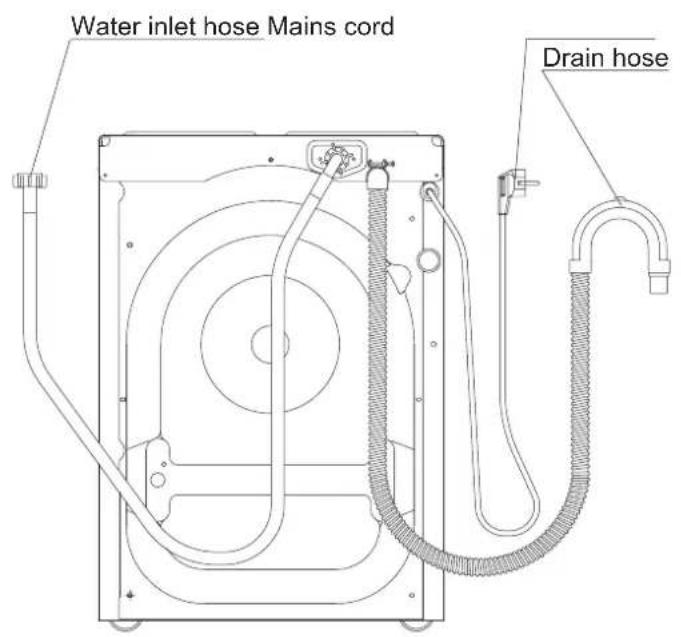
Water inlet connection
It is intended for cold-water connection only
- Screw the intake hose on to the tap.
- The washing machine is intended for a water pressure of 1 to 10 bar. If the pressure exceeds 10 bar, a pressure reducing valve must be installed in the water-line. If the pressure is less than 1 bar, the flowrate regulator behind the strainer (in the water inlet connection of the machine) must be removed.
- Check if all hose connections are leaktight.
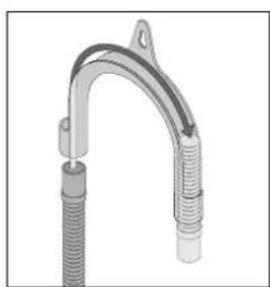
Drain connection
- Do not kink the drain hose.
- Hang the drain hose over the edge of thge sink or wash basin. The bend in the hose must not be raised more than 1m above the surface on which your machine stands (so that drainage can function properly).
- Secure the drain hose with the hose holder supplied. Pull the hose holder to the centre of the hose bend onto the drain hose and secure against slipping. If required, use a weight or any other suitable means to ensure that the drain hose cannot slip.
- Tight connection to a non-ventilated drain requires special steps and should be carried out by a plumber only.
Connection and installation
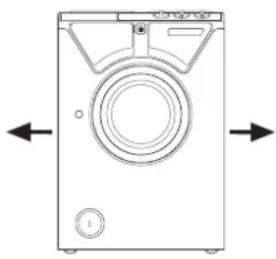
Installation
- The appliance must stand level on a plain surface, and it must not be placed on vibrating floors.
- The machine stands on castors and will therefore swing sideways during the spin cycle. Use a floor rail (available as accessory) or place the appliance on a rubber mat.
- A minimum free space of 3cm between the appli-ance and other pieces of furniture must therefore be kept on both sides.
Attention
It is important to allow the machine to move freely on its castors, as otherwise we cannot assume liability for any consequential damage.
Attention
- Always ensure the drain hose is free of obstructions of any kind, since this will have an adverse effect on the smooth running of your machine.
- Only install your machine in a room protected from frost.
- The company excepts no responsibility for improper use, or maintenance work carried out by unauthorised service personnel resulting in water damage.
Prior to the first wash
Attention:
The washing machine must be properly installed and connected.
The washing machine was tested before leaving the factory. To make sure that any traces of water used in the test are removed, wash for the first time without introducing any dirty linen.
- do not put any dirty linen into the machine
open the water cock - place 1/2 measuring cup of detergent in the chamber foreseen for the main detergent
- start the "easy-care / fine wash" programme at 60^ and let it run its course
The washing machine is now clean and ready for operation.
SOBA Babynova 600
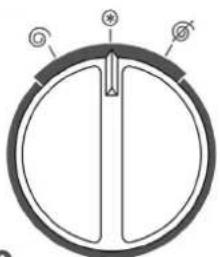
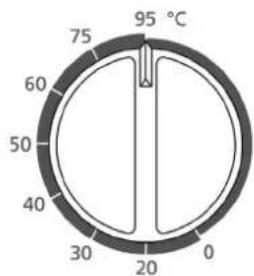
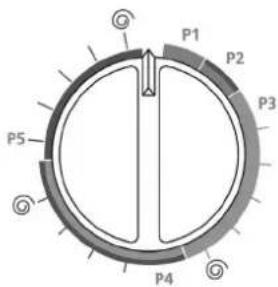
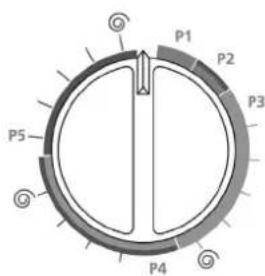
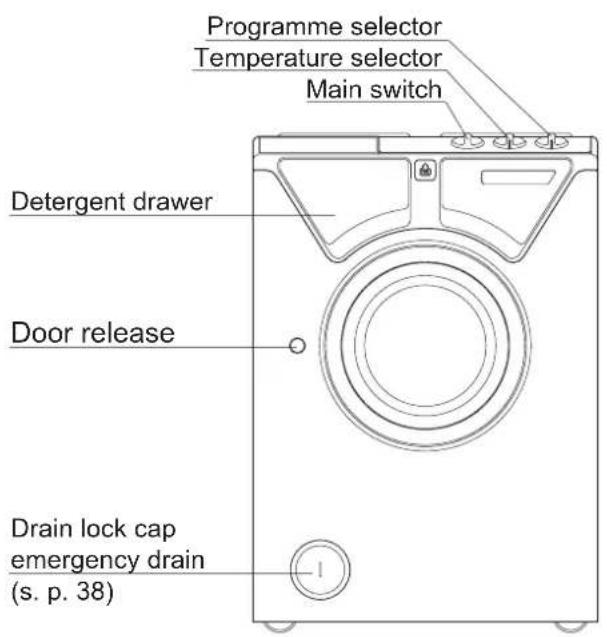
Programme selector
- With this selector switch you may choose between:
1 Whites and Coloureds with prewash from 40^ - 95^
2 Whites and Coloureds without prewash from 40^ - 95^
3 Easy-care fabrics - higher water level from cold - 60^
4 Delicate fabrics / Curtains from cold - 40^
5 Wool from cold - 40^
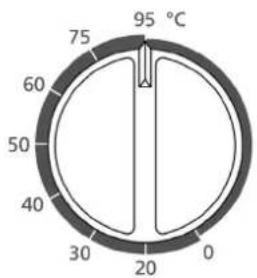
Temperature selector
- The temperature selector switch allows you to select any temperature required, from cold to 95^ .
- Please pay attention to the care marks on the laundry to be washed. Our indications regarding temperature selection serve as guidelines only and are not binding.
- Please assure that the correct temperature for the selected program has been chosen.
- An automatical temperature limit for the programs wool (5) at 40^ and delicate wash (4) at 60^ gives additional security, independent of the selected temperature.
- For lightly soiled laundry, the intensive effect of high temperatures is not likely to be required in most cases.
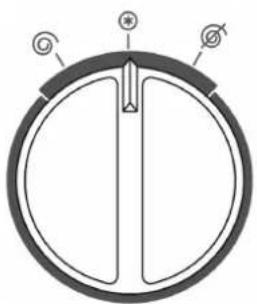
Main switch
- The main switch allows you to choose between the following settings: "⑥" (ON with Spin Dry) - spinning at 600 rpm (final spin speed)
^ (ON without Spin Dry)
Attention:
After each wash or drying cycle the main switch should be set to "0".
Programme selection
1 • Whites and Coloureds with prewash • INTENSIVE • 40 - 95°C
- turn programme selector in position 1
- set temperature acc. to HLCC care labelling guide
- turn main switch on position “⑤” (ON with Spin Dry) or “⑥” (ON without Spin Dry)
Note: Normal soiled clothes, should never be washed in a pre-wash programme since the standard wash programme will achieve the same results and save water, detergent and energy.
2 • Whites and Coloureds without prewash • NORMAL • 40 - 95°C
- turn programme selector in position 2
- set temperature acc. to HLCC care labelling guide
- turn main switch on position “ON with Spin Dry” or “ON without Spin Dry)
3 • Easy-care fabrics • cold to 60^
- turn programme selector in position 3
- set temperature acc. to HLCC care labelling guide
- turn main switch on position “G” (ON with Spin Dry) or “G” (ON without Spin Dry)
4 • Delicate fabrics / Curtains - higher water level • cold to 40^
- turn programme selector in position 4
- set temperature acc. to HLCC care labelling guide (automatic temperature limit at 60^ )
- turn main switch on position “⑤” (ON with Spin Dry) - spin speed of this program is 500 rpm or on position “∅” ( ON without Spin Dry)
5 • Wool • cold to 40^
- turn programme selector in positione 5
- set temperature acc. to HLCC care labelling guide (automatic temperature limit at 40^ )
- turn main switch on position "C(ON with Spin Dry) - spin speed of this program is 500 rpm or on position "O( ON without Spin Dry)
Fabric selection
Sorting the various types of fabric
- According to garment labels
- Extend of soiling
- Colours
Always fill your machine according to manufacturers instructions, in order to wash economically.
Avoid overloading your machine, since this dramatically reduces for cleaning effect.
Using the correct amount of detergent, is determined by the following factors:
size and type of your washing machine
- your water supply (hard or soft water)
degree of soiling of your laundry
- amount of fabric in your drum
- type and brand of detergent used
Before adding detergent please check if
- Your washing machine is loaded to its max capacity -> this saves energy and water
- Your laundry is badly soiled ie greasy, ground in dirt etc
- The amount of detergent to be used tallys with the type of water (ie hard / soft) according to detergent manufacturers instructions
- The detergent is suitable for the selected programme, temperature, and type of fabric to be washed.
Protection of the environment
Your washing machine protects the environment, by saving up to 30% of detergent because:
- Your machine is fitted with an ECO - Valve
(This prevents any unused detergent from being discharged) - The amount of powder needed as indicated by detergent manufacturers on their packaging is designed for 5kg machines
--> Your machine however has a max capacity of 3 kg.
-->Use less for smaller quantities.
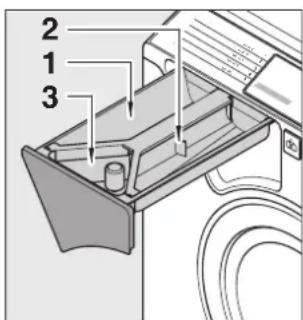
Compartment I
pre-wash, bleach or spotting agents
Compartment II
main-wash
Compartment III
conditioner, softening agents
Advise
The manufacturer recommends for an additional water softening devise to be fitted to your machine, if you live in an area with "normal" water, since this significantly reduces the amount of detergent needed (see soft water).
| programme | temperature | press button | capacity max. kg | compting rate | |||
| time min | energy kWh | water litres | |||||
| heavily soiled withes with pre-wash | 1 95°C | ◎ / Ø | 3 125 | 1.30 55 | |||
| heavily soiled coloureds with pre-wash | 1 60°C | ◎ / Ø | 3 110 | 0.80 55 | |||
| normally soiled withes 2 95°C | ◎ / Ø | 3 115 | 1.20 50 | ||||
| normally soiled coloureds 2 60°C | ◎ / Ø | 3 100 | 0.81 50 | ||||
| normally soiled easy-care fabrics | 3 40°C | ◎ / Ø | 1.5 60 | 0.25 45 | |||
| delicate fabrics/curtains 4 40°C | ◎ / Ø | 1.5 45 | 0.25 40 | ||||
| woollens 5 30°C | ◎ / Ø | 1 30 0 | 0.25 60 | ||||
Cleaning and maintenance

Warning: Before starting cleaning, maintenance and removal of faults, pull the mains plug out of the socket and close the water-tap!
Advise:
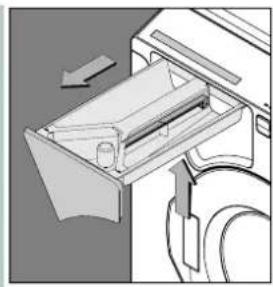
Remove the detergent drawer for cleaning at regular intervals
Pull out the drawer.
- Lift the drawer slightly, and remove completely.
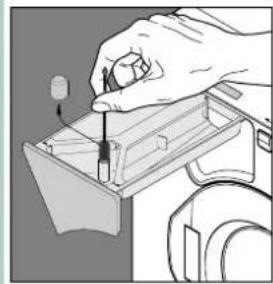
- Clean detergent drawer with warm water.
- Remove siphon cover and clean with warm water.
- Clean the filler channel for softener if necessary with a bottle brush and remount siphon cover.
- When drawer removed check if there is any remaining detergent in the shaft of the drawer and clean if necessary.
- Clean housing, control panel and loading door with a soft cloth.
Removing lime stone
If you have used the correct amount of detergent, de-scaling should not be necessary. However, should it be required use corrosion proof de-scaler for washing machines only.
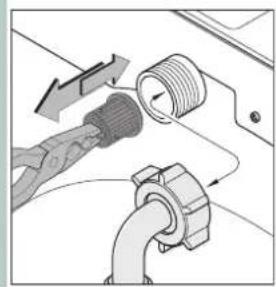
Cleaning the intake fi Iter
- Turn off the water and unscrew the intake hose from the machine.
- push the split safety ring sideways out of the union nut and lift the union nut off.
- take the coarse filter out and clean it
- replace the filter, mount the union nut and safety ring.
- Screw the intake hose back on to the tap and check that the connection is watertight

Warning: Before starting cleaning, maintenance and removal of faults, pull the mains plug out of the socket and close the water-tap!
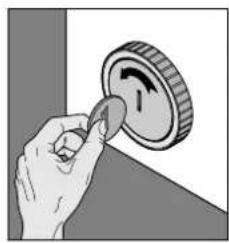
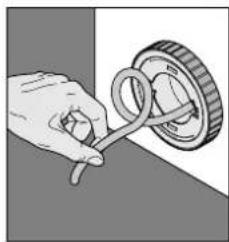
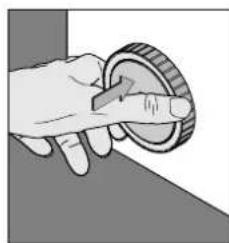
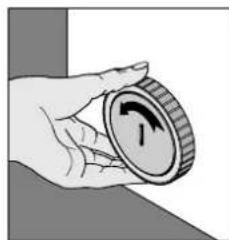
Emergency draining
If the programme is interrupted by a malfunction or in some other way the water remaining in the machine can be removed through a hose.
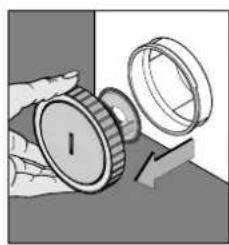
- Use a coin to remove the cover disc from this drain lock cap.
- Once the hose has been folded out to its full length the water in the machine can be drained out into an appropriate container.
Important: If the failure occurs during the heating phase it is essential that you allow the water to cool before draining to avoid the danger of scalding.
- Replace the hose into the rear of the cap.
Warning
Cleaning of drain pump only necessary in case of faults.
Cleaning the drain pump
The drain pump must only be opened, when the machine is empty.
- Press in the outer ring of the locking plug (see Pic 1)
- and turn anticlockwise 1/4 turn (see Pic 2). Press once again and turn another 1/4 turn, to release the plug.
- in order to close, turn drain filter twice to the right (turn - push - turn).
Faults possible causes Solving the problem
| drum stationary | ·no electricity supply ·no programme selected ·main switch on position “0” ·loading door open | ·plug in another socket check fuse ·select programm (see P. 33 - 34) ·turn main switch to “◎” or “∅” ·close loading door |
| no spin | ·main switch on position “∅” ·the washing is unevenly distributed | ·turn main switch to “◎” ·if the laundry is unevenly distributed, the machine will automatically return to the wash cycle for a short period, until the spin cycle can commence. If this is not possible the programme will end without spinning. → loosen the washing by hand, and turn the programme selector to “◎”. |
| machine moves, does not stand properly | ·does not stand correct on the floor | ·adjust machine properly - see instruction page 31 - 34 |
| little or no detergent enters the machine | ·detergent drawer blocked ·incorrect programme selection | ·clean drawer (see P. 37) ·see programme selection (P. 33 - 34) |
| conditioner in the machine at programme start | ·to much conditioner in compartment III | ·fill to max. - line only |
| conditioner compartment fl ooded | ·intake valve blocked | ·clean detergent drawer and valve (see P. 37) |
| traces of water on floor | ·excess lather dripping from machine ·detergent drawer open ·inlet hose leaking ·drain trap fitted incorrectly | ·correct detergent dosage ·close drawer ·check connection of inlet hose on machine and cold fi II tap. ·see P. 38 |
| washing not cleaned | ·to much or to little detergent ·incorrect programme selection ·incorrect temperature selection ·certain staines remain | ·correct detergent dosage (see P. 35) ·see P. 33 - 34 ·see P. 33 - 34 ·see P. 40 |
| washing is damaged | ·sharp object in drum ·sharp object in clothing ·faulty fabrics | ·check inside drum ·check pockets ·claim from fabric manufacturer |
| powder residues in washing | ·interrupted water supply ·detergent in conditioning drawer | ·check water supply ·clean detergent drawer (see P. 37) |
| The water is not pumped off | ·the run off system is blocked or the hose has a kink ·the lye pump is clogged | ·check hose and runoff ·clean lye pump (see page 38) |
If your washing machine fails to operate correctly after having carried out the procedures listed above, please contact your customer service.
Important: Before removing a stain with a solvent or similar product test it on an "invisible" point - at the back of the hem - to be sure neither the fabric nor colour are impaired.
Ballpoint and felt pen: Rub out with alcohol, soak up dissolved dyestuff, wash out remaining marks with gall soap.
Beer: Rinse with lukewarm water, then machine-wash.
Blood: Soak in cold water, rub stains out with gall soap, then machine-wash.
Bright specks: Brush out with vinegar water.
Burn marks: Drip vinegar water on stains, allow to act for several hours, then rinse well with clear water.
Butter: Wash in lukewarm soapsuds, on delicate fabrics remove stain with ammonia solution or gall soap.
Coffee/cocoa: Soak in cold water, then wash out with warm (in case of insensitive fabrics with hot) soapy water.
Dampstains and mould: In case of light-coloured cotton or linen fabrics, spread with a paste consisting of calcium carbonate, soap and water, allow to act, wash out well or rub out with gall soap, rinse and then machine-wash.
Egg white: Rinse in cold water, then machine-wash.
Egg yolk: Soak in lukewarm soapsuds, then wash out.
Fat: Wash out with warm soapsuds or gall soap.
Fruit juice: Sprinkle with salt and wash out with warm water or rub out with gall soap, then machine-wash.
Fruit stains: see "Fruit juice"
Grass: Rub out with gall soap, then machine-wash.
Grease: Rub out with cooking oil or margarine, wash out in soapsuds, remove possibly remaining marks with balsam turpentine or gall soap.
Icecream: Remove with lukewarm water or gall soap.
Ink: Sprinkle thickly with salt, shake out after acting, treat with vinegar or gall soap, rinse well and machine-wash.
Iodine: Moisten, then rub out with the cut surface of a raw potato, rinse with cold water, repeat until the stain disappears, then machine-wash.
Lipstick: Wash out with gall soap.
Milk: Rinse with cold water, then machine-wash.
Nail polish: Dissolve with acetone (Be careful: not to be used for acetate or triacetate!), then machine-wash.
Red wine: Sprinkle with salt, allow to act, shake out, then wash or treat with gall soap.
Rust: Drip lemon juice on light-coloured fabrics until stain disappears, rinse well or put fabric in water containing some glycerine, then wash out with soapy water.
Shoe polish: Dissolve with balsam turpentine, then wash out with soapsuds.
Soot marks: Never wash off! At first, blow off the loose soot, then sprinkle with salt, allow to act, and wash out with soapy water or gall soap.
Spinach: Rub off with the cut surface of a raw potato, then machine-wash.
Sweat: Soak in vinegar water, rinse well and machine-wash.
Tar: Rub out with cooking oil or margarine, wash out in soapsuds, remove possibly remaining greasy marks with ammonia solution or gall soap.
Tea: Wash out with soapsuds or gall soap.
Urine: Wash out with soapsuds or rub out with thinned ammonia solution or gall soap.
Wax: Crease fabric several times in order to loosen the wax and scratch off carefully, then iron out with care using blotting paper or tissue paper until the wax has been soaked up completely. Rub out possible remaining marks with ethyl alcohol, then wash out in soapsuds.
Wine: see "Beer"
Yellowed fabrics: Wash with detergent and a handful of salt (does not work well on synthetics).
Colours run / Fading:
Follow the manufacturer's instructions.
HLCC care labelling guide
Washing
Cotton, linnen, modal, viscose, white or colour fast.
Coured cottons, cotton / modal, polyester / cottons and polyester / modal not colourfast
Silks, modal, viscose and synthetic fabrics s.a. polyacryl, polyester and polyamid

Reine Schurwolle
Machine
washable
woollens

cates wash programme

dicates wash programme with reduced agitation.

d wash only up to 37^

wash, dry cleaning only
Bleaching
Bleaching with chlorine possible

bleaching, do not use stain removers containing bleach. Professional cleaning only
Drying
Can be dryed at max. temperature setting

at low temperature setting only

hot machine dry
Dry cleaning

wash, dry cleaning only

- The machine should not be used to store worn clothing. Damp, worn clothing is liable to mould and staining.
- Flushing problems (e.g. residues in the detergent chamber) may be possible with highly concentrated powder products. In this case the measuring cups (if available) in the detergent packages should be used.
- With some detergents (liquid or powder) foam may develop even in the final spin cycle. This does not impair the rinsing result.
- White detergent residues may be visible, after completion of a wash cycle particularly on dark textiles. This is due to insufficient rinsing. Generally this is the insoluble water softeners in modern phosphate-free detergents.
Remedy: Shake or brush it off, try another detergent or use a liquid detergent.
- Before putting the laundry in the machine check whether there are any metal parts on or in the laundry that could work loose e.g. metal buttons, bra wiring etc. Such parts could work into the machine and cause a rattling noise.
Repairs of this kind cannot be undertaken free of charge, even during the guarantee period.